
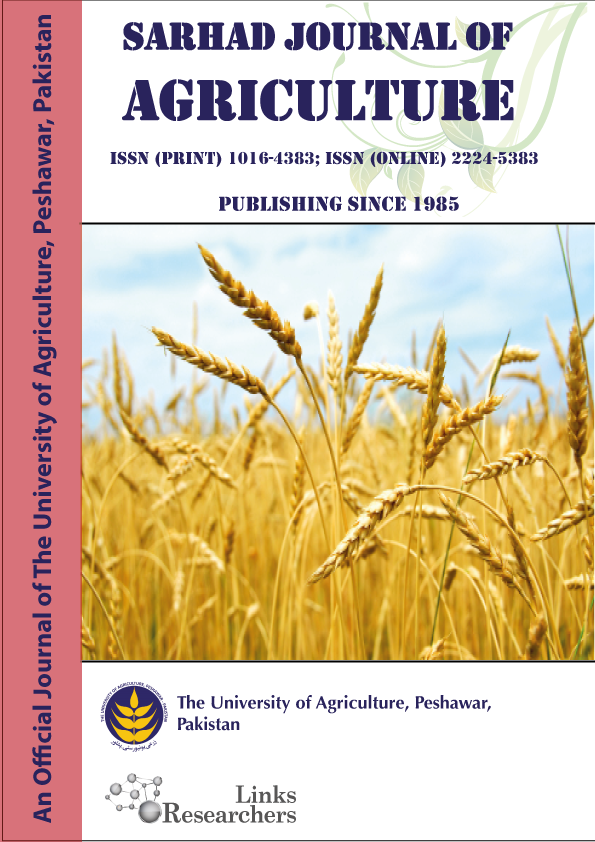
A New Phase in the Journal's Development
The publication of Volume 43, Issue 1 (February 2027), marks an important stage in the development of the Sarhad Journal of Agriculture (SJA). Established in 1985, the journal has maintained a continuous commitment to disseminating scientific knowledge in agriculture and allied disciplines. Over more than four decades, it has developed into an HEC-recognized, Scopus-indexed, peer-reviewed, open-access journal, providing researchers with an established platform for sharing their scientific findings.
As Chief Editor, I consider it both an honour and a responsibility to lead this journal into its next phase. Our priority is to build on its institutional foundation while improving the quality of published research, strengthening international participation, and ensuring that the journal meets increasingly demanding standards of scholarly publishing. These objectives require collective commitment from authors, reviewers, editors, the university administration, and the wider scientific community.
Institutional Leadership and the Journal's Future Direction
The journal operates under the patronage of Dr. Imran Khan, Vice-Chancellor of The University of Agriculture Peshawar. His institutional vision places considerable emphasis on improving the university's academic standing, strengthening research activities, and expanding its international visibility. The development of the Sarhad Journal of Agriculture is an important part of this broader academic agenda.
Institutional support is essential for a university journal to develop a strong editorial system, maintain publication standards, and compete for international recognition. The Vice-Chancellor's support provides an important foundation for these efforts. Our shared objective is to strengthen SJA's academic reputation, improve its international reach, and work progressively towards eligibility for a recognized Journal Impact Factor.
Achieving these goals will depend primarily on the scientific merit of published articles, transparent peer review, responsible editorial decisions, publication regularity, and compliance with international publishing standards.
Scope and Research Priorities
The Sarhad Journal of Agriculture publishes original research articles, review papers, and special issues covering a broad range of agricultural and related sciences. Its scope includes crop production and improvement, agronomy, soil science, plant nutrition, plant protection, animal sciences, fisheries and aquaculture, agricultural biotechnology, natural resource management, environmental sciences, climate-smart agriculture, food security, agricultural economics, agribusiness, agricultural extension, rural development, and the application of artificial intelligence in agriculture.
The journal welcomes contributions addressing both fundamental scientific questions and practical challenges. Particular importance is attached to research that contributes to sustainable agricultural production, efficient resource utilization, environmental protection, climate resilience, and improved livelihoods. We also encourage interdisciplinary studies that connect agricultural research with emerging technological, economic, and environmental developments.
Transition to Bimonthly Publication
One of the most significant developments beginning with Volume 43 (2027) is the transition of SJA from quarterly to bimonthly publication. Since its establishment in 1985, the journal has followed a four-issue annual publication schedule. Starting with this volume, it will publish six issues annually, with one issue every two months.
This decision reflects the growing volume of research submissions and the journal's intention to provide more regular opportunities for publishing scientifically sound research. The increased publication frequency will also require greater attention to editorial planning, reviewer availability, manuscript processing, and timely production.
However, increasing the number of issues must not come at the expense of scientific quality. Our editorial policy will continue to emphasize rigorous peer review, originality, methodological soundness, ethical research practices, and the relevance of published findings. The long-term ambition is to develop the journal further and, when supported by sufficient research quality and editorial capacity, consider a monthly publication schedule.
Highlights of the Current Issue
Volume 43, Issue 1 brings together 20 original research articles contributed by researchers working in Pakistan and other countries. The diversity of authorship and research subjects demonstrates the journal's broad disciplinary coverage and its continuing engagement with the international research community.
The contributions address several important areas of agricultural and applied sciences. These include food security and farming-system diversification in Indonesia; molecular responses of wheat to salinity; genetic variation and resistance to insect pests; nutrient management and disease incidence in ridge gourd; and physiological responses of tissue-cultured date palm under salt stress.
Other studies examine sustainable business models, biological approaches to plant disease management, pathogenic fungi associated with safflower, communication strategies for agricultural technology adoption, and the use of microbial fermentation to improve the properties of plant-derived products.
The issue also includes research on agricultural social protection and climate resilience in Pakistan, yield-related characteristics of brown mustard, phytochemical profiling of black mulberry, and the influence of superabsorbent polymers on wheat growth. Further contributions investigate heavy-metal-tolerant bacteria, the biochemical and sensory properties of processed meat products, vertebral abnormalities in commercially important carp species, agricultural innovation incubators for rural youth in Iraq, ethnobotanical knowledge in Upper Dir, and the application of nettle leaf extract in broiler production.
Collectively, these studies address diverse scientific questions and practical concerns. Their geographical and disciplinary range reflects the importance of maintaining an inclusive publication platform where researchers can communicate findings relevant to agriculture, food systems, biological resources, and environmental sustainability.
Research Articles
| Sr.# | Title and Author’s details | DOI |
| 1 | Overcoming Food Insecurity through Diversification: A SWOT Analysis of Farming Households in Central Indonesia Yuliana Bakari, Ria Indriani and St. Aisyah |
https://doi.org/10.17582/journal.sja/2027.43.1.01.13 |
| 2 | Quantitative Expression Analysis of the TaSOS2 Gene under Salt Stress in Bread Wheat (Triticum aestivum. L.) Plants Abdurauf A. Dolimov, Ozod S. Turaev, Doston Sh. Erjigitov, Dilshod E. Usmonov, Behkzod O. Mamajonov, Khamida R. Adizova, Umiddijan Sh. Bakhadirov, Durdona Sh. Shokirova, Saidmurod K. Baboev, Zafar M. Ziyaev and Fakhriddin N. Kushanov |
https://doi.org/10.17582/journal.sja/2027/43.1.14.21 |
| 3 | Evaluation of Different Wheat Genotypes for Resistance Against Green Bug (Schizaphis graminum Rodani) (Homoptera: Aphididae) Mohammad Zubair, Khwaja Junaid, Asad ur Rahman, Mehran Ullah, Shabir Ahmed, Ijaz Ullah, Rahim Shah and Gul Raiz |
https://doi.org/10.17582/journal.sja/2027/43.1.22.32 |
| 4 | The Effect of Elemental Sulfur on Nitrogen and Potassium Efficiency and Incidence of Downy Mildew in Ridge Gourd Tayyeba Samreen |
https://doi.org/10.17582/journal.sja/2027/43.1.33.42 |
| 5 | Effect of Disper Osmotic GS on Some Antioxidant Enzymes and Leaf Content of some Microelements of Date Palm Phoenix dactylifera L.c.v. Barhi Produced by Tissue Culture Under Salt Stress Conditions Sawsan Fathi Tayah Al-Husseinawi and Ahmed Dinar Khalaf Al-Asadi |
https://doi.org/10.17582/journal.sja/2027/43.1.43.52 |
| 6 | Achieving Competitive Advantage: How Sustainable Business Models Enhance Performance through Knowledge Management Nur Fajrina and Felina C. Young |
https://doi.org/10.17582/journal.sja/2027/43.1.53.64 |
| 7 | The Inhibitory Effect of Biofungicide Trichoderma atroviride and Riboflavin on Alternaria Alternata Causing Leaf Spot Disease Indate Palm Shatha Fadel Abdel Sayed, Israa Malallah Handel, Muntaha Jawad kadhim and Alaa Naser Ahmed |
https://doi.org/10.17582/journal.sja/2027/43.1.65.77 |
| 8 | Isolation, Pathogenicity and Control Evaluation of Safflower Associated Pathogenic Fungi from Al-Qadisiyah Governorate, Iraq Sulaf Hamid Taimooze |
https://doi.org/10.17582/journal.sja/2027/43.1.78.85 |
| 9 | Ranking Communication Channels for Technology Adoption: A Cramer’s V–Based Multi-Channel Analysis in Arid-Zone Dairy Farming Imam Bux, Zaheeruddin Mirani, Jasmin Binti Arif Shah, Ubedullah Kaka, Nur Bahiah Mohamed Haris, Arathy Biju Sindhu and Abubakar Bala Shelleng |
https://doi.org/10.17582/journal.sja/2027/43.1.86.100 |
| 10 | Microbial Co-Fermentation and Solvent Extraction Enhance the Phenolic Profile, Antioxidant Activity and Antibacterial Potential of Alpinia officinarum Eka Fitasari, Osfar Sjofjan, Eko Widodo, Lilik Eka Radiati, Roy Hendroko Setyobudi and Mohammad Zahoor |
https://doi.org/10.17582/journal.sja/2027/43.1.101.110 |
| 11 | Enhancing Income, Productivity and Climate Resilience: The Role of Agricultural Social Protection Schemes in Pakistan Ammar Arshad, Ahmad Nawaz, Neelam Shahi Mulk and Asad Ghalib |
https://doi.org/10.17582/journal.sja/2027/43.1.111.119 |
| 12 | Characterization of Brown Mustard Accessions for Yield Contributing Traits Ayesha Saddiqa, Saba Tabasum and Sehar Nawaz |
https://doi.org/10.17582/journal.sja/2027/43.1.120.128 |
| 13 | Gas Chromatography-Mass Spectrometry (GC-MS) Profiling of Bioactive Constituents of Black Mulberry (Morus nigra) Fruit Extract Shehla Tasneem, Faiza Zubair, Naila Riaz and Asif Bilal |
https://doi.org/10.17582/journal.sja/2027/43.1.129.140 |
| 14 | Influence of Some Selected Superabsorbent Polymers on Vegetative Growth and Yield of Soft Wheat (Triticum aestivum L.) Genotypes in Thi-Qar Governorate, Iraq Khudhair Joudah Yasir Al-Saidan |
https://doi.org/10.17582/journal.sja/2027/43.1.141.149 |
| 15 | Isolation and 16S Ribotyping of Heavy Metal Tolerant Bacterial Strain from Leather Industry Effluent Annum Gul, Ramna Gulzar, Wasim Abbas, Ali Hasnain, Ammara Ahsan, Muhammad Shoib, Maryam Iqbal, Awais Riaz, Samra Rafiq, Muhammad Khizar Sultan, Adeel Ahmad, Aqsa Ahmad and Muhammad Umer Farooq Awan |
https://doi.org/10.17582/journal.sja/2027/43.1.150.157 |
| 16 | Comparative Assessment of the Biochemical and Sensory Properties of Branded Canned Beef and Chicken Luncheon Meats Available in Retail Markets of Baghdad, Iraq Raed Mohammed Khalaf Al-Zaidi, Mohammed Jawad Mohaisen, Jaafar Nozad Aakef, Mayson Thafir Hadi and Eman J. Al-Attar |
https://doi.org/10.17582/journal.sja/2027/43.1.158.165 |
| 17 | Vertebral Deformities in Two Major Carp Species, Catla catla and Labeo rohita from Rice Canal Larkana, Sindh, Pakistan Bushra Shaikh, Naeem Tariq Narejo, Ayaz Hussain Qadri, Muhammad Hanif Chandio, Faheem Saddar, Farzana Hashim, Athar Mustafa Laghari, Munawar Lal, Shafiq ur Rehman, Shahnaz Rashid and Ghulam Abbas |
https://doi.org/10.17582/journal.sja/2027/43.1.166.171 |
| 18 | Developing a Framework for the Implementation and Evaluation of Agricultural Innovation Incubators among Rural Youth in Iraq Mohammed Talib Alabboodi and Ahmed Hamdan Lafta |
https://doi.org/10.17582/journal.sja/2027/43.1.172.179 |
| 19 | Ethno botanical Attributes and Plant Utilization at Tehsil Kalkot Upper Dir Khyber Pakhtunkhwa, Pakistan Khan Sher, Mushtaq Ahmad and Laila Shaukat |
https://doi.org/10.17582/journal.sja/2027/43.1.180.192 |
| 20 | Aqueous Leaf Extract of Nettle (Urtica dioica L.) Preparation, Phytochemical Significance and Its Application in Broiler Chicken Production Rakhaa.Sh. Alnassrallah, Teeb A. Altabtabaai, Hanan Fadhil Aswad and Ahmed F. Kadhim |
https://doi.org/10.17582/journal.sja/2027/43.1.193.203 |
Acknowledgements
The continued development of SJA depends on the contributions of many individuals and institutions. I sincerely thank all authors who have selected our journal for the dissemination of their research. I am equally grateful to the reviewers whose critical assessments and constructive recommendations help maintain the scientific standard of published work.
I acknowledge Dr. Imran Khan, Vice-Chancellor and Patron of the journal, for his institutional support and commitment to strengthening research and scholarly publishing at the university.
My appreciation also goes to the Editorial Board for its academic contribution and editorial responsibilities, and to ResearchersLinks Ltd for its technical and publishing support.
The cooperation of all these contributors is particularly important as the journal moves towards a more frequent publication schedule and further strengthens its international presence.
Invitation to the Research Community
The Sarhad Journal of Agriculture welcomes original research articles and review papers from researchers, academicians, and professionals in agricultural and allied sciences worldwide. We particularly encourage submissions that offer new scientific insights, employ sound research methodologies, and address emerging challenges in agricultural production, food security, natural resource management, and environmental sustainability.
Our commitment is to provide a fair, transparent, and academically rigorous peer-review process, together with consistent and timely publication. Researchers at all career stages are encouraged to contribute, and international collaboration remains an important priority in expanding the journal's scholarly reach.
Looking Ahead
The beginning of Volume 43 represents an opportunity to strengthen the journal's contribution to agricultural science. Our progress will be measured not simply by the number of articles published, but by their scientific quality, relevance, originality, and contribution to knowledge.
As Chief Editor, I look forward to working with the Patron, Editorial Board, reviewers, authors, and the university administration to advance these objectives. With collective effort, institutional commitment, and adherence to sound publishing practices, SJA can further strengthen its position as a respected platform for agricultural research in Pakistan and internationally.
I warmly welcome our readers to Volume 43 and thank the research community for its continued confidence in the Sarhad Journal of Agriculture.
Prof. Dr. Amanullah Chief Editor, Sarhad Journal of Agriculture The University of Agriculture Peshawar, Pakistan
Correspondence by email:
Chief Editor, Sarhad Journal of Agriculture,
The University of Agriculture Peshawar, 25130, Pakistan
Email: sja@aup.edu.pk
For complete details of all articles in this issue, please visit: https://researcherslinks.com/journal-details/Comparative-Study-of-Biochemical-Accuracy/14/current-issue
