
Culicoides biting midges are widely distributed across Thailand and have gained attention due to their potential role in transmitting pathogens of medical and veterinary importance, including arboviruses and Leishmania (Mundinia). Despite their significance, a comprehensive synthesis of Culicoides species diversity, distribution patterns, and pathogen associations in Thailand remains lacking. To address this gap, a systematic review and meta-analysis were conducted following PRISMA guidelines using studies published between January 2015 and December 2025. A total of 22 eligible studies were included in the qualitative synthesis, and quantitative synthesis was conducted for studies reporting pathogen detection. The review identified 61 Culicoides species representing seven subgenera and four species groups, demonstrating considerable taxonomic diversity across Thailand. No statistically significant associations were detected between reported species richness and sampling duration or trap type. Meta-analysis estimated a pooled pathogen detection prevalence of 9% in Culicoides populations, with substantial heterogeneity across studies (I² = 94.8%). Subgroup analyses revealed significant variation according to pathogen type (p < 0.0001). Leishmania (Mundinia) spp., Crithidia spp., Crithidia brevicula, Trypanosoma spp., Onchocercidae sp., mermithids, Leucocytozoon spp., Leucocytozoon caulleryi, Plasmodium juxtanucleare, P. gallinaceum, and bluetongue virus were detected in multiple Culicoides species. Culicoides oxystoma was the most frequently reported species and exhibited a broad host-feeding spectrum, highlighting its potential epidemiological importance. These findings provide the first comprehensive synthesis of Culicoides diversity, ecology, and pathogen associations in Thailand. Expanded surveillance, standardized trapping, molecular tools for cryptic species identification, and experimental studies are needed to strengthen understanding of Culicoides-associated pathogen transmission and support surveillance.
Review · Volume 14, Issue 12, Pages 2897–2919, 18 November 2026 · Open Access
Species Diversity, Ecology, and Pathogen Associations of Culicoides Biting Midges in Thailand: A Systematic Review and Meta-Analysis (2015−2025)
, , , , ,
Affiliations & Notes ⌄
- *Correspondence | Babi Kyi Soe; Email: babikyisoe.vet@gmail.com
- *Correspondence | Poom Adisakwattana; Email: poom.adi@mahidol.ac.th
Article Info ⌄
- Journal:
- Advances in Animal and Veterinary Sciences
- Submitted Date:
- 10 September 2026
- Accepted Date:
- 9 November 2026
- Published Date:
- 18 November 2026
From the article
- This systematic review summarizes current evidence on Culicoides species diversity, ecology, and pathogen associations in Thailand.
- Further experimental studies are needed to clarify the role of Culicoides species in pathogen transmission in Thailand.
- The frequent detection of multiple pathogens and opportunistic host-feeding behavior suggests that prioritizing C. oxystoma for further ecological and experimental investigations.
- These findings support the need for continued surveillance and integrated vector-pathogen-host studies to strengthen disease risk assessment and control in Thailand.
Selected from the article's own text.
Abstract
Introduction
Culicoides (Diptera: Ceratopogonidae) are small hematophagous flies and are widely distributed worldwide. More than 6,000 distinct species of the family Ceratopogonidae have been reported worldwide and show broad host feeding preferences, including humans . They play an important role in the transmission of several arboviruses of veterinary concern, including bluetongue virus, Schmallenberg virus, African horse sickness virus, and Oropouche virus which have caused a major economic impact ; ; ; . More than 1,300 species have been described globally, with ongoing discoveries complicating surveillance in tropical regions . Their broad host range, responsiveness to environmental conditions, and involvement in the transmission of emerging diseases. Besides viruses, they also harbor protozoa including Haemoproteus, Leucocytozoon, and Plasmodium, which cause avian haemoparasitic infections (Boveba et al., 2013; ; ; . Attention has increased on their potential role in transmitting filarial nematodes such as Mansonella perstans, M. ozzardi, and M. streptocerca, the causative agents of human mansonellosis ; , following molecular detection of Onchocercidae sp. and mermithids DNA in Culicoides crepuscularis, C. mahasarakhamense, C. milnei, and C. huffi ; ; .
Leishmaniasis, while traditionally considered transmitted by sand flies, has gained attention in Thailand. Unlike Leishmania infantum, which sand flies transmit, Leishmania (Mundinia) parasites are suspected to be transmitted by Culicoides rather than phlebotomine sand flies ; ; . Therefore, the earlier assumption of sand flies being the exclusive vectors of Leishmania has been challenged, underscoring the need to reassess vector surveillance and competence of biting midges. Becvar et al., 2021 stated that previous detection of Leishmania (Mundinia) DNA in phlebotomine sand flies might reflect short-term survival within the peritrophic membrane, yielding positive PCR. Supporting this, recent experimental studies have shown that Leishmania (Mundinia) does not complete development in sand flies whereas full development to metacyclic forms occurs in C. sonorensis and C. peregrinus, indicating Culicoides as primary vectors and capable of transmitting these parasites ; ; . Detection of L. martiniquensis and L. orientalis in several Thai Culicoides species, notably C. peregrinus and C. oxystoma supporting their possible epidemiological role ; ; ; ; ; . Importantly, Thailand is facing an emerging public health concern from autochthonous leishmaniasis caused by L. (Mundinia) martiniquensis and L. (Mundinia) orientalis. Increasing case reports, including HIV co-infections and recurrent episodes, have been documented in northern and southern regions ; , highlighting the need for accurate documentation of their distribution and abundance is needed.
Pathogen detection in field-caught midges anchors vector incrimination while blood-meal analysis clarifies vector-host interactions and pathways that facilitate pathogen circulation between animal reservoirs and humans. Together, these approaches strengthen One Health surveillance across veterinary and public-health sectors ; ; . The 2020 African horse sickness outbreak exemplified this, with abundant C. imicola and C. oxystoma recorded on affected farms in Prachuap Khiri Khan Province and Nakhon Ratchasima Province , ; ; . Similar risks are reported for bluetongue (BTV) and epizootic hemorrhagic disease viruses, whose distribution reflects climate-sensitive shifts in vector range ; . Molecular detection of BTV in field-caught midges and the initiation of coordinated national surveillance have strengthened Thailand’s capacity for orbivirus monitoring .
Culicoides species feed on a wide range of hosts, including both mammals and birds, and their feeding patterns vary with host availability, local habitat features, and environmental conditions ; . In Thailand, bovine-avian mixed blood meals in Culicoides spp. of the subgenus Trithecoides , and mixed human-bovine and bovine-avian blood meals in several Culicoides species illustrate opportunistic feeding across available hosts. Human DNA has also been detected in at least five identified Culicoides species in different regions of Thailand further highlighting their tendency to feed near human dwellings and exploit a variety of vertebrate hosts when accessible ; ; ; ; . This plasticity in host choice may strengthen the capacity of Culicoides to function as bridge vectors, creating opportunities for pathogens to move between domestic animals, wildlife, and humans . By feeding across multiple host groups within the same environment, these biting midges can link otherwise separate ecological communities, increasing the likelihood of cross-species transmission and supporting pathogen circulation at the human-animal interface .
Thailand supports particularly high species diversity and unresolved cryptic lineages of Culicoides biting midges . With accelerating globalization, environmental shifts, and the growing emergence of vector-borne infections, sustained monitoring of Culicoides biting midges in Thailand has become increasingly important. Therefore, this systematic review and meta-analysis aims to (i) synthesize available evidence on the species diversity, geographical distribution, abundance patterns, and ecological characteristics of Culicoides biting midges in Thailand; (ii) summarize pathogen detections and host bloodmeal associations reported in these vectors; and (iii) identify species of potential epidemiological importance that warrant further investigation of their vector competence. This study provides the first nationwide synthesis of Culicoides diversity, ecology, host associations, and pathogen detections in Thailand. By integrating evidence from diverse ecological settings, it offers a comprehensive overview of species distribution, abundance patterns, and potential epidemiological significance, identifies geographical surveillance gaps, and establishes a foundation for future veterinary and public health research within Thailand and the Greater Mekong Subregion.
Materials and methods
Search strategy and selection criteria
The literature search was conducted using PubMed, Scopus, and Web of Science databases to identify studies related to Culicoides biting midges in Thailand. The search strategy combined the following terms in the title, abstract, or keywords: (“prevalence” OR “epidemiology” OR “incidence” OR “presence” OR “abundant” OR “occurrence”) AND (“Thailand”) AND (“Culicoides” OR “biting midges”). The process followed the Preferred Reporting Items for Systematic Reviews and Meta-Analyses (PRISMA) (Supplementary File 1) as described by Page et al. (2021). Three databases were selected based on subject relevance, document accessibility, compatibility with Boolean operators and parentheses, and support for bulk data export. In addition, the reference lists of all included studies were examined to capture further relevant publications. Literature retrieval was completed in December 2025, and the review protocol was pre-registered on the OSF platform (https://doi.org/10.17605/OSF.IO/3YKJC).
After duplicate removal, screening was conducted in three stages: title screening, abstract screening, and full-text assessment to determine eligibility according to predefined inclusion criteria: (a) investigated Culicoides biting midges; (b) were conducted in Thailand; (c) reported original data on species diversity, abundance, ecology, host associations, or pathogen detection; (d) were published as original research articles in international peer-reviewed journals; (e) were written in English; and (f) were available in full text. Two independent reviewers performed the selection process. All extracted data were cross-verified, and any inconsistencies were resolved through consultation with a senior researcher.
Quality assessment
All eligible studies were independently assessed for methodological quality by two reviewers using the Joanna Briggs Institute (JBI) Critical Appraisal Checklist for Analytical Cross-Sectional Studies , as most included investigations employed cross-sectional designs. To improve applicability to entomological field studies, two additional items were evaluated descriptively: (i) adequacy of Culicoides specimen handling, including preservation and identification procedures, and (ii) use of clearly described trapping methods . These supplementary items were considered separately from the JBI checklist and were used to provide context regarding methodological rigor rather than to influence quality ratings. Any disagreements between reviewers were resolved through discussion, and study authors were contacted when clarification was required.
Each JBI item was assessed as “Yes,” “No,” or “Unclear,” and study-level assessment results were recorded in an Excel spreadsheet (Supplementary File 2). Rather than relying solely on the number of negative or unclear responses, methodological quality was evaluated descriptively, considering the relevance and potential implications of individual checklist items for each study’s design and outcomes. Studies with all applicable items assessed as “Yes” were described as having no methodological concerns identified based on the assessed criteria, rather than having no risk of bias. Studies with “No” or “Unclear” responses were evaluated according to the nature and potential impact of the identified methodological limitations. These assessments were used to support the interpretation of findings and identify methodological limitations across studies.
Data extraction and qualitative synthesis
Data were extracted independently from all eligible studies and verified for accuracy. A second reviewer cross-checked the extracted information to ensure consistency and completeness, and any discrepancies were resolved through discussion until consensus was reached. Data extraction focused on three components: (a) bibliometric information, (b) methodological characteristics, and (c) study findings, including species diversity, geographical distribution, host blood-meal associations, pathogen detection, and other ecological characteristics (Supplementary File 3). All information was compiled using a Microsoft Excel spreadsheet (Version 2017).
A qualitative synthesis was conducted to summarize Culicoides diversity, geographical distribution, abundance patterns, pathogen detections, and host blood-meal associations. Host–vector–pathogen interactions were visualized using an integrated association network. To assess whether sampling effort influenced observed species richness, sampling duration and trap type reported in each study were evaluated. The relationship between sampling duration and the number of recorded Culicoides species was examined using Spearman’s rank correlation and visualized with scatter plots. Differences in species richness among trap types were assessed using the Kruskal–Wallis test and visualized using jittered scatter plots. All statistical analyses and visualizations were performed in R (https://www.r-project.org/). Statistical significance was defined as p < 0.05.
Meta-analysis
Study-level quantitative synthesis was conducted for studies reporting pathogen detection in Culicoides populations for which the number of examined Culicoides was available, with subgroup analyses performed according to pathogen group and Culicoides species. Data were compiled in a Microsoft Excel spreadsheet and analyzed in R (https://www.R-project.org/) using the meta package with the metaprop function. Specifically, a random-effects inverse-variance approach with logit-transformed proportions (PLOGIT) was applied. Between-study variance (τ²) was estimated using the maximum likelihood (ML) method, and 95% confidence intervals were calculated using the normal approximation on the logit scale and subsequently back-transformed to proportions. Zero-event studies were retained using a continuity correction of 0.5, following the default settings of the inverse-variance approach. Statistical heterogeneity was assessed using Cochran’s Q test, τ², and I² statistics, with I² values of <25%, 25–75%, and >75% indicating low, moderate, and high heterogeneity, respectively . Forest plots were generated to visualize pooled pathogen detection estimates and subgroup analyses.
Assessment of publication bias
Publication bias was assessed through visual inspection of funnel plot symmetry and statistically evaluated using Egger’s regression test and statistical significance was set at p < 0.05.
Results
Selection of articles and quality assessment
A total of 77 records were identified through database searches and reference screening. After duplicate removal and incorporation of additional records identified through supplementary searches, 22 studies met the eligibility criteria and were included in the systematic review. The included studies demonstrated good methodological quality, with appropriate sampling, Culicoides identification, and outcome measurement procedures. Eighteen studies (81.8%) had no methodological concerns identified across the assessed criteria, while four studies (18.2%) had at least one methodological limitation or insufficiently reported item. Consequently, all 22 studies were retained for both qualitative synthesis, while 7 studies reporting the number of examined Culciodies were included in the quantitative meta-analysis (Supplementary File 4). The study selection process and reasons for exclusion at each stage are summarized in the PRISMA flow diagram (Figure 1).
Bibliometric data and spatiotemporal distribution
Among the 22 included studies, most were published in high-impact journals, with 77.3% (17/22) appearing in Q1, followed by 4.5% (1/22) in Q2, 9.1% (2/22) in Q3, and 9.1% (2/22) in non-JCR-indexed journals. For species identification, only 31.8% (7/22) studies relied solely on taxonomic keys, whereas the remaining 68.2% (15/22) studies used combined morphological and molecular approaches (mitochondrial cytochrome C oxidase subunit I (COI) gene-specific PCR or COI-barcoding).
Seasonal investigations were limited; however, the available evidence indicated higher Culicoides abundance during the rainy season ; ; . Sampling duration ranged from 3 days to 7 years, and collection methods varied across studies. CDC light traps were the most frequently used collection method (40.9%), followed by sweep nets (18.2%), combinations of multiple trap types (18.2%), and ultraviolet light traps (18.2%). One study (4.5%) employed a custom-designed trap constructed from white fine-mesh material. Most investigations focused on Culicoides species composition, abundance, and seasonal occurrence across diverse ecological settings, including mixed-livestock farms (86.6%), peri-urban areas (53.7%), horse stables and animal shelters (41.8%), plantation areas (17.9%), wetlands and coastal habitats (22.4%), and cave environments (16.4%).
Recorded Culicoides species and ecological characteristics
A total of 61 Culicoides species were documented, representing seven subgenera (Trithecoides, Avaritia, Haemophoructus, Hoffmania, Meijerehelea, Beltranmyia, and Remmia) and four species groups (Clavipalpis, Ornatus, Shermani, and Shortti), indicating considerable taxonomic diversity within the Thai Culicoides fauna. Species records were obtained from a wide range of ecological settings and geographical regions, reflecting the broad distribution of Culicoides species throughout the country. A summary of species occurrences according to sampling origin is presented in Table 1.
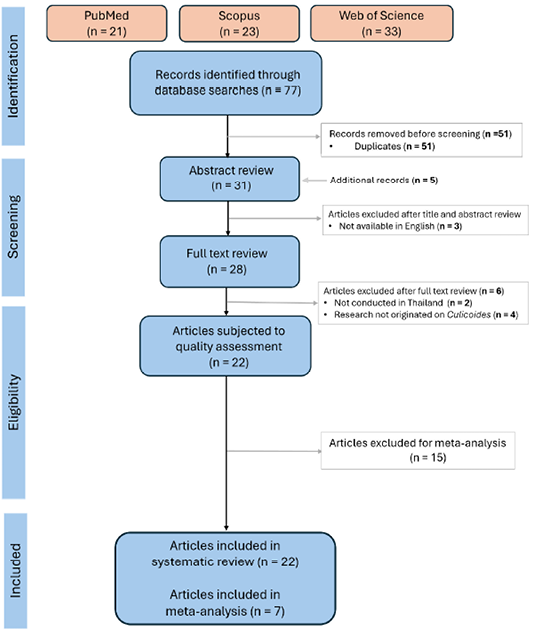
PRISMA flow chart of included studies.
Among the 22 included studies, 21 (95.5%) investigated Culicoides fauna and abundance patterns and were included in the descriptive synthesis. Species-specific abundance data were unavailable from Thepparat et al. (2015). Direct comparisons of abundance estimates should be interpreted cautiously because of differences in study design and sampling conditions. Although the available data do not permit identification of the most abundant Culicoides species nationally, several species were consistently reported as dominant across studies. C. oxystoma was identified as the dominant species in 8 of 21 studies (38.1%), followed by C. peregrinus in 5 studies (23.8%), and C. imicola and C. mahasarakhamense in 2 studies each (9.5%). The remaining studies reported other Culicoides species as dominant taxa. These recurrent findings across multiple investigations suggest that these species constitute important components of the Culicoides fauna reported from Thailand.
Of the 22 included studies, 10 were conducted in Southern Thailand, followed by Western and Northern Thailand, with seven studies each (Supplementary File 5). The included studies collectively documented Culicoides populations across 28 provinces distributed throughout Thailand, demonstrating broad geographical coverage of biting midge research. Sampling efforts were unevenly distributed. The provinces in northeastern region represented the most intensively surveyed area, followed by the provinces from northern and southern regions, whereas eastern, central,
Table 1: The list of identified Culicoides species in Thailand and their sampling origins.
| Genus (subg) | Species | Sampling origin | References | |
| Identified species | ||||
| 1 | Culicoides (Haemophoructus) | C. arenicola | Mixed livestock farms, mangroves and beaches and nearby houses | Thepparat et al., 2015; Tepboonrueng et al., 2025 |
| 2 | Culicoides (Avaritia) | C. hui | Mixed livestock farms, mangroves and beaches | Thepparat et al., 2015 |
| 3 | Culicoides (Haemophoructus) | C. kinari | Mixed livestock farms, mangroves and beaches | Thepparat et al., 2015 |
| 4 | Culicoides (Avaritia) | C. kusaiensis | Mixed livestock farms, mangroves and beaches | Thepparat et al., 2015 |
| 5 | Culicoides (Avaritia) | C. parabubalus | Mixed livestock farms, mangroves and beaches | Thepparat et al., 2015 |
| 6 | Culicoides (Avaritia) | C. quatei | Mixed livestock farms, mangroves and beaches | Thepparat et al., 2015 |
| 7 | Culicoides (Avaritia) | C. spiculae | Mixed livestock farms, mangroves and beaches | Thepparat et al., 2015 |
| 8 | Culicoides (Avaritia) | C. pseudocordiger | Mixed livestock farms, mangroves and beaches | Thepparat et al., 2015 |
| 9 | Culicoides (Avaritia) | C. actoni | Mixed livestock farms, nearby houses, durian plantations, horse stables, districts, rice fields, animal shelters, margin of ponds and streams | Fujisawa et al., 2021; Jomkumsing et al., 2021; Pramual et al., 2021; Pramual et al., 2021; Choocherd et al., 2022; Sunantaraporn et al., 2022; Gomontean et al., 2023; Pramual et al., 2023; Phasuk et al., 2023; Kamyingkird et al., 2023; Promrangsee et al., 2024; Tepboonrueng et al., 2025; Promrangsee et al., 2025; Gomontean et al., 2025 |
| Table continues on next page................ | ||||
| Genus (subg) | Species | Sampling origin | References | |
| 10 | Culicoides (Beltranmyia) | C. asiana | Mixed livestock farms, nearby houses, districts, horse stables | Fujisawa et al., 2021; Jomkumsing et al., 2021; Pramual et al., 2021; Choocherd et al., 2022; Phasuk et al., 2023; Kamyingkird et al., 2023; Tepboonrueng et al., 2025; Soe et al., 2025a |
| 11 | Culicoides (Clavipalpis group) | C. brevipalpis | Mixed livestock farms, nearby houses, districts, horse stables | Fujisawa et al., 2021; Choocherd et al., 2022; Sunantaraporn et al., 2022; Phasuk et al., 2023; Gomontean et al., 2023; Tepboonrueng et al., 2025 |
| 12 | Culicoides (Meijerehelea) | C. flavipunctatus | Mixed livestock farms, districts, horse stables | Fujisawa et al., 2021; Choocherd et al., 2022; Phasuk et al., 2023; Kamyingkird et al., 2023 |
| 13 | Culicoides (Avaritia) | C. fulvus | Mixed livestock farms, nearby houses, districts, horse stables | Fujisawa et al., 2021; Jomkumsing et al., 2021; Pramual et al., 2021; Sunantaraporn et al., 2022; Songumpai et al., 2022; Choocherd et al., 2022; Phasuk et al., 2023; Gomontean et al., 2023; Promrangsee et al., 2024; Tepboonrueng et al., 2025; Soe et al., 2025a |
| 14 | Culicoides (Avaritia) | C. imicola | Mixed livestock farms, district, horse stables | Fujisawa et al., 2021; Jomkumsing et al., 2021; Pramual et al., 2021; Sunantaraporn et al., 2022; Choocherd et al., 2022; Kaewmee et al., 2023; Kamyingkird et al., 2023; Phasuk et al., 2023; Gomontean et al., 2023; Promrangsee et al., 2024 |
| 15 | Culicoides (Trithecoides) | C. insignipennis | Mixed livestock farms, nearby houses, durian plantations, caves, districts | Fujisawa et al., 2021; Sunantaraporn et al., 2022; Ampol et al., 2024; Promrangsee et al., 2024; Tepboonrueng et al., 2025; Promrangsee et al., 2025; Soe et al., 2025a |
| 16 | Culicoides (Beltranmyia) | C. jacobsoni | Mixed livestock farms, nearby houses, districts, durian plantation, caves | Fujisawa et al., 2021; Jomkumsing et al., 2021; Songumpai et al., 2022; Sunantaraporn et al., 2022; Ampol et al., 2024; Promrangsee et al., 2024; Tepboonrueng et al., 2025; Promrangsee et al., 2025 |
| 17 | Culicoides (Avaritia) | C. orientalis | Mixed livestock farms, nearby houses, districts, durian plantations, caves, horse stables | Fujisawa et al., 2021; Sunantaraporn et al., 2022; Songumpai et al., 2022; Choocherd et al., 2022; Phasuk et al., 2023; Ampol et al., 2024; Promrangsee et al., 2024; Promrangsee et al., 2025; Soe et al., 2025a; Tepboonrueng et al., 2025 |
| 18 | Culicoides (Hoffmania) | C. innoxius | Mixed livestock farms, nearby houses, districts, durian plantations, caves, horse stables | Fujisawa et al., 2021; Jomkumsing et al., 2021; Pramual et al., 2021; Sunantaraporn et al., 2021; Sunantaraporn et al., 2022; Choocherd et al., 2022; Songumpai et al., 2022; Gomontean et al., 2023; Kamyingkird et al., 2023; Phasuk et al., 2023; Ampol et al., 2024; Promrangsee et al., 2024; Tepboonrueng et al., 2025; Promrangsee et al., 2025; Soe et al., 2025a |
| 19 | Culicoides (Hoffmania) | C. peregrinus | Mixed livestock farms, nearby houses, districts, durian plantations, horse stables, rice fields, animal shelters, margin of ponds and streams | Fujisawa et al., 2021; Jomkumsing et al., 2021; Pramual et al., 2021; Songumpai et al., 2022; Sunantaraporn et al., 2022; Choocherd et al., 2022; Kaewmee et al., 2023; Pramual et al., 2023; Kamyingkird et al., 2023; Gomontean et al., 2023; Phasuk et al., 2023; Promrangsee et al., 2024; Gomontean et al., 2025; Tepboonrueng et al., 2025; Promrangsee et al., 2025; Soe et al., 2025a |
| 20 | Culicoides (Haemophoructus) | C. arakawae | Mixed livestock farms, nearby houses, districts, horse stables | Fujisawa et al., 2021; Jomkumsing et al., 2021; Sunantaraporn et al., 2022; Choocherd et al., 2022; Phasuk et al., 2023; Promrangsee et al., 2024; Tepboonrueng et al., 2025; Soe et al., 2025a |
| 21 | Culicoides (Remmia) | C. oxystoma | Mixed livestock farms, nearby houses, districts, caves, horse stables, rice fields, animal shelters, margin of ponds and streams | Fujisawa et al., 2021; Jomkumsing et al., 2021; Pramual et al., 2021; Sunantaraporn et al., 2021; Songumpai et al., 2022; Sunantaraporn et al., 2022; Choocherd et al., 2022; Kaewmee et al., 2023; Gomontean et al., 2023; Phasuk et al., 2023; Pramual et al., 2023; Kamyingkird et al., 2023; Pramual et al., 2024; Promrangsee et al., 2024; Ampol et al., 2024; Gomontean et al., 2025; Tepboonrueng et al., 2025; Soe et al., 2025a |
| Table continues on next page................ | ||||
| Genus (subg) | Species | Sampling origin | References | |
| 22 | Culicoides (Trithecoides) | C. anophelis | Mixed livestock farms | Fujisawa et al., 2021; Jomkumsing et al., 2021; Pramual et al., 2021; Gomontean et al., 2023 |
| 23 | Culicoides (Trithecoides) | C. palpifer | Mixed livestock farms, nearby houses | Fujisawa et al., 2021; Sunantaraporn et al., 2021; Kaewmee et al., 2023; Gomontean et al., 2023; Tepboonrueng et al., 2025; Soe et al., 2025a |
| 24 | Culicoides (Clavipalpis group) | C. clavipalpis | Mixed livestock farms, nearby houses, district, horse stables | Fujisawa et al., 2021; Choocherd et al., 2022; Phasuk et al., 2023; Gomontean et al., 2023; Tepboonrueng et al., 2025 |
| 25 | Culicoides (Hoffmania) | C. huffi | Mixed livestock farms, nearby houses, districts, durian plantations, horse stables, rice fields, animal shelters, margin of ponds and streams | Fujisawa et al., 2021; Jomkumsing et al., 2021; Pramual et al., 2021; Sunantaraporn et al., 2021; Sunantaraporn et al., 2022; Songumpai et al., 2022; Choocherd et al., 2022; Kaewmee et al., 2023; Phasuk et al., 2023; Kamyingkird et al., 2023; Promrangsee et al., 2024; Tepboonrueng et al., 2025; Promrangsee et al., 2025; Soe et al., 2025a; Gomontean et al., 2025 |
| 26 | Culicoides (Shermani group) | C. nigripes | Mixed livestock farms, nearby houses | Fujisawa et al., 2021; Tepboonrueng et al., 2025 |
| 27 | Culicoides (Shortti group) | C. shortti | Mixed livestock farms, nearby houses, district, horse stables, rice fields, animal shelters, margin of ponds and streams | Fujisawa et al., 2021; Jomkumsing et al., 2021; Pramual et al., 2021; Sunantaraporn et al., 2022; Choocherd et al., 2022; Kaewmee et al., 2023; Phasuk et al., 2023; Gomontean et al., 2023; Promrangsee et al., 2024; Gomontean et al., 2025; Tepboonrueng et al., 2025; Soe et al., 2025a |
| 28 | Culicoides (Clavipalpis group) | C. circumbasalis | Mixed livestock farms and nearby houses | Tepboonrueng et al., 2025 |
| 29 | Culicoides (Trithecoides) | C. guttifer | Mixed livestock farms and nearby houses, districts, durian plantations, caves, horse stables | Jomkumsing et al., 2021; Pramual et al., 2021; Sunantaraporn et al., 2021; Songumpai et al., 2022; Sunantaraporn et al., 2022; Choocherd et al., 2022; Phasuk et al., 2023; Gomontean et al., 2023; Ampol et al., 2024; Promrangsee et al., 2024; Promrangsee et al., 2025; Soe et al., 2025a; Tepboonrueng et al., 2025 |
| 30 | Culicoides (Haemophoructus) | C. gewertzi | Mixed livestock farms and nearby houses | Tepboonrueng et al., 2025 |
| 31 | Culicoides (Clavipalpis group) | C. liui | Mixed livestock farms and nearby houses, caves, districts | Ampol et al., 2024; Promrangsee et al., 2024; Tepboonrueng et al., 2025 |
| 32 | Culicoides (Haemophoructus) | C. mahasarakhamense | Mixed livestock farms and nearby houses, districts, caves, rice fields, animal shelter, margin of ponds and streams | Pramual et al., 2021; Sunantaraporn et al., 2021; Songumpai et al., 2022; Kaewmee et al., 2023; Gomontean et al., 2023; Pramual et al., 2023; Ampol et al., 2024; Promrangsee et al., 2024; Gomontean et al., 2025; Tepboonrueng et al., 2025; Soe et al., 2025a |
| 33 | Culicoides (Haemophoructus) | C. sumatrae | Mixed livestock farms and nearby houses, caves, districts, horse stables | Sunantaraporn et al., 2021; Choocherd et al., 2022; Phasuk et al., 2023; Promrangsee et al., 2024; Ampol et al., 2024; Tepboonrueng et al., 2025; |
| 34 | Culicoides (Haemophoructus) | C. tamada | Mixed livestock farms, mangroves, beaches and nearby houses | Thepparat et al., 2015; Tepboonrueng et al., 2025 |
| 35 | Culicoides (Meijerehelea) | C. flaviscutatus | Mixed livestock farms, districts | Songumpai et al., 2022; Gomontean et al., 2023 |
| 36 | Culicoides (Hoffmania) | C. fordae | Mixed livestock farms, districts | Songumpai et al., 2022; Soe et al., 2025a |
| 37 | Culicoides (Haemophoructus) | C. elbeli | districts | Songumpai et al., 2022 |
| 38 | Culicoides (Haemophoructus) | C. malayae | Mixed livestock farms, caves | Ampol et al., 2024 |
| Table continues on next page................ | ||||
| Genus (subg) | Species | Sampling origin | References | |
| 39 | Culicoides (Hoffmania) | C. thurmanae | Mixed livestock farms, caves | Ampol et al., 2024 |
| 40 | Culicoides (Avaritia) | C. brevitarsis | Mixed livestock farms, districts, horse stables | Pramual et al., 2021; Sunantaraporn et al., 2022; Choocherd et al., 2022; Phasuk et al., 2023; Gomontean et al., 2023; Kamyingkird et al., 2023 |
| 41 | Culicoides (Avaritia) | C. tainanus | Districts | Choocherd et al., 2022 |
| 42 | Culicoides (Trithecoides) | C. similis | Districts, horse stables | Choocherd et al., 2022; Phasuk et al., 2023 |
| 44 | Culicoides (Haemophoructus) | C. gemminus | Mixed livestock farms, districts, horse stables | Pramual et al., 2021; Choocherd et al., 2022; Phasuk et al., 2023; Gomontean et al., 2023; Kamyingkird et al., 2023 |
| 44 | Culicoides (Haemophoructus) | C. histrio | Districts, horse stables | Choocherd et al., 2022; Kamyingkird et al., 2023 |
| 45 | Culicoides (Avaritia) | C. halonostictus | Mixed livestock farms, districts, horse stables | Fujisawa et al., 2021; Choocherd et al., 2022; Phasuk et al., 2023 |
| 46 | Culicoides (Avaritia) | C. griffithi | Districts, horse stables | Choocherd et al., 2022; Phasuk et al., 2023 |
| 47 | Culicoides (Avaritia) | C. homotomus | Mixed livestock farms, districts, horse stables | Fujisawa et al., 2021; Pramual et al., 2021; Jomkumsing et al., 2021; Choocherd et al., 2022; Phasuk et al., 2023; Gomontean et al., 2023 |
| 48 | Culicoides (Avaritia) | C. niphanae | Districts | Choocherd et al., 2022 |
| 49 | Culicoides (Avaritia) | C. flavescens | Mixed livestock farms | Gomontean et al., 2023 |
| 50 | Culicoides (Meijerehelea) | C. hegneri | Mixed livestock farms | Gomontean et al., 2023 |
| 51 | Culicoides (Trithecoides) | C. suzukii | Mixed livestock farms | Gomontean et al., 2023 |
| 52 | Culicoides (Trithecoides) | C. boophagus | Mixed livestock farms | Gomontean et al., 2023 |
| 53 | Culicoides (Trithecoides) | C. parahumeralis | Mixed livestock farms and nearby houses | Gomontean et al., 2023; Tepboonrueng et al., 2025 |
| 54 | Culicoides (Avaritia) | C. minimus | Horse stables | Kamyingkird et al., 2023 |
| 55 | Culicoides (Avaritia) | C. grahamii | Mixed livestock farms | Pramual et al., 2021 |
| 56 | Culicoides (Avaritia) | C. obscurus | Mixed livestock farms | Thepparat et al., 2024 |
| 57 | Culicoides (Avaritia) | C. wadai | Mixed livestock farms | Thepparat et al., 2024 |
| 58 | Culicoides (Ornatus group) | C. pampangensis | Mixed livestock farms | Thepparat et al., 2024 |
| 59 | Culicoides (Trithecoides) | C. albibasis | Mixed livestock farms | Gomontean et al., 2023; Thepparat et al., 2024 |
| 60 | Culicoides (Trithecoides) | C. rugulithecus | Mixed livestock farms | Thepparat et al., 2024 |
| 61 | Culicoides (Haemophoructus) | C. gemmelus | Residential areas | Sunantaraporn et al., 2022 |
| Unidentified species | ||||
| 62 | Culicoides (Avaritia) | C. subg. (Avaritia) sp. | Mixed livestock farms and nearby houses | Tepboonrueng et al., 2025 |
| 63 | Culicoides (Trithecoides) | C. subg. (Trithecoids) sp. | Mixed livestock farms and nearby houses, durian plantations, caves, districts | Fujisawa et al., 2021; Jomkumsing et al., 2021; Choocherd et al., 2022; Songumpai et al., 2022; Gomontean et al., 2023; Promrangsee et al., 2024; Ampol et al., 2024; Promrangsee et al., 2025; Soe et al., 2025a; Tepboonrueng et al., 2025 |
Taxonomic classifications were standardized based on updated authoritative taxonomic references.
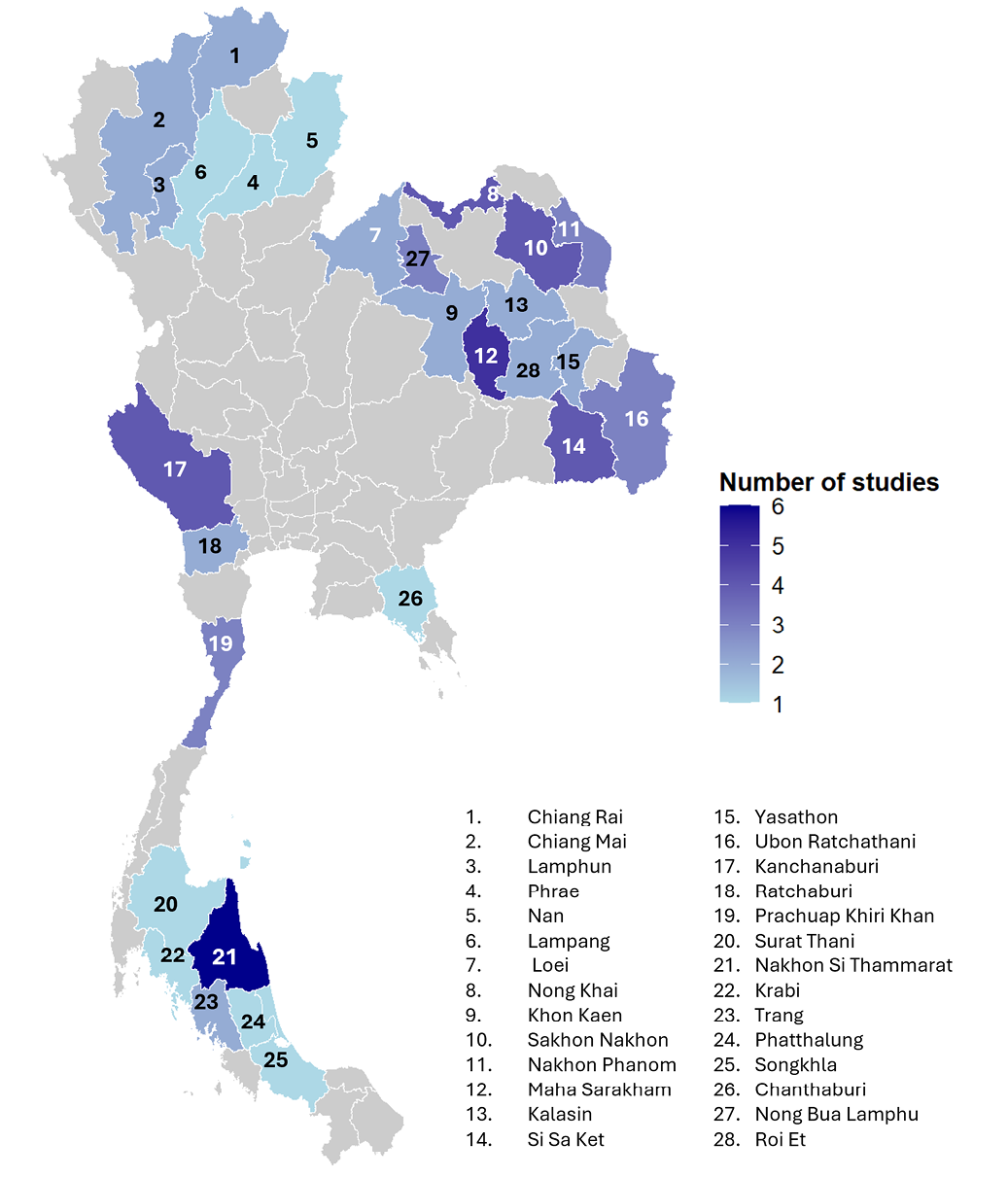
Geographical distribution and research coverage of Culicoides studies across Thailand. Province shading represents the number of included studies, with darker colors indicating greater research intensity rather than Culicoides abundance.
and western Thailand received comparatively less attention. Research activity was concentrated in several provinces, particularly Nakhon Si Thammarat in southern region and Maha Sarakham in northeastern region, where repeated surveys were conducted across multiple locations and years. This uneven sampling distribution highlights substantial geographical gaps in current knowledge and suggests that the known distribution of Culicoides species in Thailand may remain incomplete. The geographical coverage and sampling intensity of studies included in this review are illustrated in the heatmap shown in Figure 2.
To explore potential influences on reported species richness, the relationship between sampling duration, trap type, and the number of recorded Culicoides species was examined (Supplementary File 6). Of the included studies, 19 investigated Culicoides species identification, with sampling durations ranging from less than one month to 84 months and the number of identified species ranging from 4 to 40. A positive association was observed, indicating that studies with longer sampling periods tended to report a greater number of Culicoides species. However, the relationship was not statistically significant (Spearman’s ρ= 0.4, p= 0.0874). Species richness varied across trap types, with combined trapping approaches generally recording a greater number of Culicoides species than individual trapping methods among the 22 studies. Median species richness appeared highest for combined traps, followed by ultraviolet light traps and sweep nets, whereas CDC light traps and customized traps tended to record fewer species. However, the Kruskal–Wallis test showed no statistically significant difference in species richness among trap types (p = 0.0676), indicating the observed variation was insufficient to demonstrate a significant effect of trap type on the number of recorded Culicoides species. These findings imply that extended sampling and combined trapping approaches may improve species detection, although sampling duration and trapping alone do not fully explain the observed variation in Culicoides diversity across studies.
Pathogen detection in Culicoides biting midges
Among the 22 included studies, 12 (54.5%) performed pathogen detection in Culicoides populations. Molecular analyses identified a diverse range of pathogens, including Leishmania spp. (58.3%, 7/12 studies), other trypanosomatids such as Crithidia spp., Crithidia brevicula, and Trypanosoma spp. (41.7%, 5/12), Leucocytozoon spp. (25%, 3/12), Plasmodium juxtanucleare (25%, 3/12), P. gallinaceum (8.3%, 1/12), filarial nematodes (16.7%, 2/12), Leucocytozoon caulleryi (8.3%, 1/12), and bluetongue virus (8.3%, 1/12). Out of 12, two studies performed pathogen screening using pooled specimens, detecting bluetongue virus and haemosporadians in C. orientalis, C. oxystoma, C. fulvus, C. imicola, C. mahasarakhamense, C. guttifer, and C. huffi ; . Detailed information on examined species, abundance of each species in which pathogens were detected, pathogen detection rates, and molecular markers is provided in Table 2.
Table 2: Compiled data on Culicoides species abundance, numbers examined, pathogen detection rates, and associated molecular markers of 12 studies.
| No. | Culicoides species | Abundance n (%) | Pathogen | Examined n (%) | Pathogen detected n (%) | Targeted gene | References |
| 1. | Leishmania | ||||||
| L. martiniquensis | |||||||
| C. peregrinus | 966 (88.3) | L. martiniquensis | 100 (10.4) | 3 (3.0) | ITS 1; 3’UTR-HSP70-I | Kaewmee et al., 2023 | |
| 49 (19.4) | L. martiniquensis | 34 (69.4) | 5 (14.7) | ITS 1 | Songumpai et al., 2022 | ||
| 214 (24.5) | L. martiniquensis | nil | 9 | ITS 1 | Tepboonrueng et al., 2025 | ||
| C. oxystoma | 37 (14.6) | L. martiniquensis | 33 (89.2) | 3 (9.1) | ITS 1 | Songumpai et al., 2022 | |
| 160 (29.3) | L. martiniquensis | 160 (29.3) | 3 (1.9) | ssu rRNA; ITS 1 | Promrangsee et al., 2024 | ||
| 103 (11.8) | L. martiniquensis | nil | 2 | ITS 1 | Tepboonrueng et al., 2025 | ||
| C. orientalis | 12 (7.4) | L. martiniquensis | 12 (41.7) | 1 (8.3) | ITS 1 | Ampol et al., 2024 | |
| 55 (10.1) | L. martiniquensis | 55 (10.1) | 3 (5.5) | ssu rRNA; ITS 1 | Promrangsee et al., 2024 | ||
| C. jacobsoni | 6 (3.7) | L. martiniquensis | 6 (100) | 2 (33.3) | ITS 1 | Ampol et al., 2024 | |
| C. mahasarakhamense | 11 (4.3) | L. martiniquensis | 10 (90.9) | 1 (10) | ITS 1 | Songumpai et al., 2022 | |
| 106 (47.5) | L. martiniquensis | 106 (47.5) | 3 (2.8) | ITS 1 | Sunantaraporn et al., 2021 | ||
| 32 (13.6) | L. martiniquensis | 30 (93.7) | 15 (50) | ITS 1 | Ampol et al., 2024 | ||
| 14 (2.6) | L. martiniquensis | 14 (2.6) | 3 (21.4) | ssu rRNA; ITS 1 | Promrangsee et al., 2024 | ||
| C. (Trithecoides) spp. | 23 (14.2) | L. martiniquensis | 18 (78.3) | 8 (44.4) | ITS 1 | Ampol et al., 2024 | |
| 85 (15.5) | L. martiniquensis | 85 (15.5) | 2 (2.4) | ssu rRNA; ITS 1 | Promrangsee et al., 2024 | ||
| C. actoni | 5 (0.9) | L. martiniquensis | 5 (0.9) | 1 (20.0) | ssu rRNA; ITS 1 | Promrangsee et al., 2024 | |
| C. sumatrae | 20 (3.7) | L. martiniquensis | 20 (3.7) | 2 (10.0) | ssu rRNA; ITS 1 | Promrangsee et al., 2024 | |
| Table continues on next page........... | |||||||
| No. | Culicoides species | Abundance n (%) | Pathogen | Examined n (%) | Pathogen detected n (%) | Targeted gene | References |
| C. arakawae | 34 (6.2) | L. martiniquensis | 34 (6.2) | 2 (5.9) | ssu rRNA; ITS 1 | Promrangsee et al., 2024 | |
| C. huffi | 7 (2.8) | L. martiniquensis | 7 (100) | 1 (14.3) | ITS 1 | Songumpai et al., 2022 | |
| 143 (16.3) | L. martiniquensis | nil | 6 | ITS 1 | Tepboonrueng et al., 2025 | ||
| C. guttifer | 48 (29.6) | L. martiniquensis | 41 (85.4) | 11 (26.8) | ITS 1 | Ampol et al., 2024 | |
| 17 (3.1) | L. martiniquensis | 17 (3.1) | 3 (17.6) | ssu rRNA; ITS 1 | Promrangsee et al., 2024 | ||
| 90 (10.3) | L. martiniquensis | nil | 1 | ITS 1 | Tepboonrueng et al., 2025 | ||
| C. innoxius | 41 (7.5) | L. martiniquensis | 41 (7.5) | 4 (9.8) | ssu rRNA; ITS 1 | Promrangsee et al., 2024 | |
| 49 (5.6) | L. martiniquensis | nil | 1 | ITS 1 | Tepboonrueng et al., 2025 | ||
| C. shortti | 65 (11.9) | L. martiniquensis | 65 (11.9) | 4 (6.2) | ssu rRNA; ITS 1 | Promrangsee et al., 2024 | |
| C. fordae | 60 (23.7) | L. martiniquensis | 45 (75) | 1 (2.2) | ITS 1 | Songumpai et al., 2022 | |
| C. fulvus | 3 (1.2) | L. martiniquensis | 2 (66.7) | 1 (50.0) | ITS 1 | Songumpai et al., 2022 | |
| 7 (1.3) | L. martiniquensis | 7 (1.3) | 1 (14.3) | ssu rRNA; ITS 1 | Promrangsee et al., 2024 | ||
| C. nigripes | 1 (0.1) | L. martiniquensis | nil | 1 | ITS 1 | Tepboonrueng et al., 2025 | |
| L. orientalis | |||||||
| C. peregrinus | 49 (19.4) | L. orientalis | 34 (69.4) | 1 (2.9) | ITS 1 | Songumpai et al., 2022 | |
| 214 (24.5) | L. orientalis | nil | 18 | ITS 1 | Tepboonrueng et al., 2025 | ||
| C. oxystoma | 37 (14.6) | L. orientalis | 33 (89.2) | 1 (3.0) | ITS 1 | Songumpai et al., 2022 | |
| 160 (29.3) | L. orientalis | 160 (29.3) | 3 (1.9) | ssu rRNA; ITS 1 | Promrangsee et al., 2024 | ||
| 103 (11.8) | L. orientalis | nil | 1 | ITS 1 | Tepboonrueng et al., 2025 | ||
| C. innoxius | 49 (5.6) | L. orientalis | nil | 1 | ITS 1 | Tepboonrueng et al., 2025 | |
| C. trithecoides) spp. | 23 (14.2) | L. orientalis | 18 (78.3) | 4 (22.2) | ITS 1 | Ampol et al., 2024 | |
| C. orientalis | 12 (7.4) | L. orientalis | 12 (100) | 1 (8.3) | ITS 1 | Ampol et al., 2024 | |
| 31 (3.5) | L. orientalis | nil | 1 | ITS 1 | Tepboonrueng et al., 2025 | ||
| C. jacobsoni | 6 (3.7) | L. orientalis | 6 (100) | 1 (16.7) | ITS 1 | Ampol et al., 2024 | |
| C. mahasarakhamense | 32 (4.3) | L. orientalis | 30 (93.7) | 8 (26.7) | ITS 1 | Ampol et al., 2024 | |
| C. guttifer | 48 (29.6) | L. orientalis | 41 (85.4) | 6 (14.6) | ITS 1 | Ampol et al., 2024 | |
| 90 (10.3) | L. orientalis | nil | 2 | ITS 1 | Tepboonrueng et al., 2025 | ||
| C. huffi | 90 (16.3) | L. orientalis | nil | 1 | ITS 1 | Tepboonrueng et al., 2025 | |
| C. (Avartia) sp. | 5 (0.6) | L. orientalis | nil | 1 | ITS 1 | Tepboonrueng et al., 2025 | |
| 2. | Other trypanosomatids | ||||||
| C. peregrinus | 966 (88.3) | Crithidia spp. | 100 (10.4) | 26 (26.0) | ssu rRNA; gGAPDH | Kaewmee et al., 2023 | |
| 49 (19.4) | Crithidia spp. | 34 (69.4) | 6 (17.6) | ssu rRNA | Songumpai et al., 2022 | ||
| 173 (30.9) | Crithidia spp. | 165 (95.4) | 2 (1.2) | ssu rRNA | Sunantaraporn et al., 2022 | ||
| 214 (19.4) | Crithidia spp. | nil | 11 | ssu rRNA | Tepboonrueng et al., 2025 | ||
| C. oxystoma | 37 (14.6) | Crithidia spp. | 33 (89.2) | 2 (6.1) | ssu rRNA | Songumpai et al., 2022 | |
| C. orientalis | 18 (2.8) | Crithidia spp. | 7 (38.9) | 1 (14.3) | ssu rRNA | Songumpai et al., 2022 | |
| C. fordae | 60 (23.7) | Crithidia spp. | 45 (75) | 2 (4.4) | ssu rRNA | Songumpai et al., 2022 | |
| C. elbeli | 39 (15.4) | Crithidia spp. | 28 (71.8) | 1 (3.6) | ssu rRNA | Songumpai et al., 2022 | |
| C. (Trithecoides) spp. | 86 (9.8) | C. brevicula | nil | 1 | ssu rRNA | Tepboonrueng et al., 2025 | |
| C. huffi | 21 (9.4) | Trypanosoma sp. | 21 (9.4) | 1 (4.8) | ssu rRNA | Sunantaraporn et al., 2021 | |
| C. guttifer | 42 (7.5) | Trypanosoma sp. | 40 (95.2) | 1 (2.5) | ssu rRNA | Sunantaraporn et al., 2022 | |
| 3. | Nematodes | ||||||
| C. huffi | 155 (58.9) | mermithids | 147 (94.8) | 4 (2.7) | ssu rRNA | Promrangsee et al., 2025 | |
| Table continues on next page........... | |||||||
| No. | Culicoides species | Abundance n (%) | Pathogen | Examined n (%) | Pathogen detected n (%) | Targeted gene | References |
| C. mahasarakhamense | 23 (0.3) | Onchocercidae sp. | nil | 1 | 12S rRNA | Pramual et al., 2023 | |
| 4. | Haemosporidians | ||||||
| C. oxystoma | 503 (7.3) | Leucocytozoon spp. | nil | 2 | cyt b | Soe et al., 2025a | |
| 5 (0.9) | Leucocytozoon spp. | 5 (100) | 1 (20) | cyt b | Sunantaraporn et al., 2022 | ||
| C. mahasarakhamense | 866 (13.6) | Leucocytozoon spp. | nil | 6 | cyt b | Soe et al., 2025a | |
| 4273 (26.2) | Leucocytozoon spp. | nil | nil | cyt b | Pramual et al., 2021 | ||
| C. guttifer | 195 (2.7) | Leucocytozoon spp. | nil | 3 | cyt b | Soe et al., 2025a | |
| C. fulvus | 188 (2.1) | Leucocytozoon spp. | nil | 2 | cyt b | Soe et al., 2025a | |
| 33 (5.9) | Leucocytozoon spp. | 28 (84.8) | 1 (3.6) | cyt b | Sunantaraporn et al., 2022 | ||
| C. (Trithecoides) sp. | 139 (24.7) | Leucocytozoon spp. | 107 (77) | 1 (0.9) | cyt b | Sunantaraporn et al., 2022 | |
| C. arakawae | 1004 (14.9) | Leucocytozoon caulleryi | nil | 1 | cyt b | Soe et al., 2025a | |
| C. mahasarakhamense | 866 (13.6) | Plasmodium juxtanucleare | nil | 1 | cyt b | Soe et al., 2025a | |
| 4273 (26.2) | Plasmodium juxtanucleare | nil | nil | cyt b | Pramual et al., 2021 | ||
| C. huffi | 636 (3.9) | Plasmodium juxtanucleare | nil | nil | cyt b | Pramual et al., 2021 | |
| C. guttifer | 1174 (7.2) | Plasmodium juxtanucleare | nil | nil | cyt b | Pramual et al., 2021 | |
| 42 (8.6) | Plasmodium juxtanucleare | 40 (95.2) | 1 (2.5) | cyt b | Sunantaraporn et al., 2022 | ||
| C. mahasarakhamense | 4273 (26.2) | Plasmodium gallinaceum | nil | nil | cyt b | Pramual et al., 2021 | |
| 5. | Bluetongue virus | ||||||
| C. orientalis | 1646 (17.0) | Bluetongue virus | nil | nil | BTV Partial S10 | Fujisawa et al., 2021 | |
| C. imicola | 1293 (13.4) | Bluetongue virus | nil | nil | BTV Partial S10 | Fujisawa et al., 2021 | |
| C. oxystoma | 631 (6.5) | Bluetongue virus | nil | nil | BTV Partial S10 | Fujisawa et al., 2021 | |
| C. fulvus | 350 (3.6) | Bluetongue virus | nil | nil | BTV Partial S10 | Fujisawa et al., 2021 | |
Where the number of Culicoides individuals examined for pathogen detection was explicitly reported, detection rates were calculated as the number of positive individuals divided by the number examined × 100. Where species-specific denominators were unavailable, only the reported positive counts were presented, and detection rates were not calculated.
Among pathogens, Leishmania was the most frequently investigated pathogen, with L. martiniquensis and L. orientalis detected in multiple Culicoides species from northern and southern Thailand. Several species, including C. peregrinus, C. oxystoma, C. mahasarakhamense, C. guttifer, C. huffi, C. orientalis, C. innoxius, C. jacobsoni, and Culicoides (Trithecoides) spp., were reported positive for both Leishmania species. Culicoides species positive for haemosporadian parasites were detected in the northern, northeastern, and southern Thailand. Interestingly, viral detection was limited to a single study conducted in western Thailand. The geographical distribution of pathogen-positive Culicoides populations is presented in Figure 3.
Host bloodmeal analysis
Host bloodmeal analysis was performed in 10 studies (45.5%), revealing feeding on ten vertebrate hosts, including humans, cattle, water buffaloes, pigs, goats, chickens, horses, dogs, birds, and deer. Cattle and chicken were the most frequently identified blood-meal sources and were associated with a broad range of Culicoides species. Human blood meals were detected in several species, including C. brevitarsis, C. oxystoma, C. orientalis, C. sumatrae, and C. imicola, indicating potential opportunities for human–vector contact. Host identification was primarily based on amplification of mitochondrial cytochrome b (cyt b) and prepronociceptin (PNOC) genes. Detailed host association records are summarized in Supplementary File 7, and the integrated host–vector–pathogen interaction network is illustrated in Figure 4.
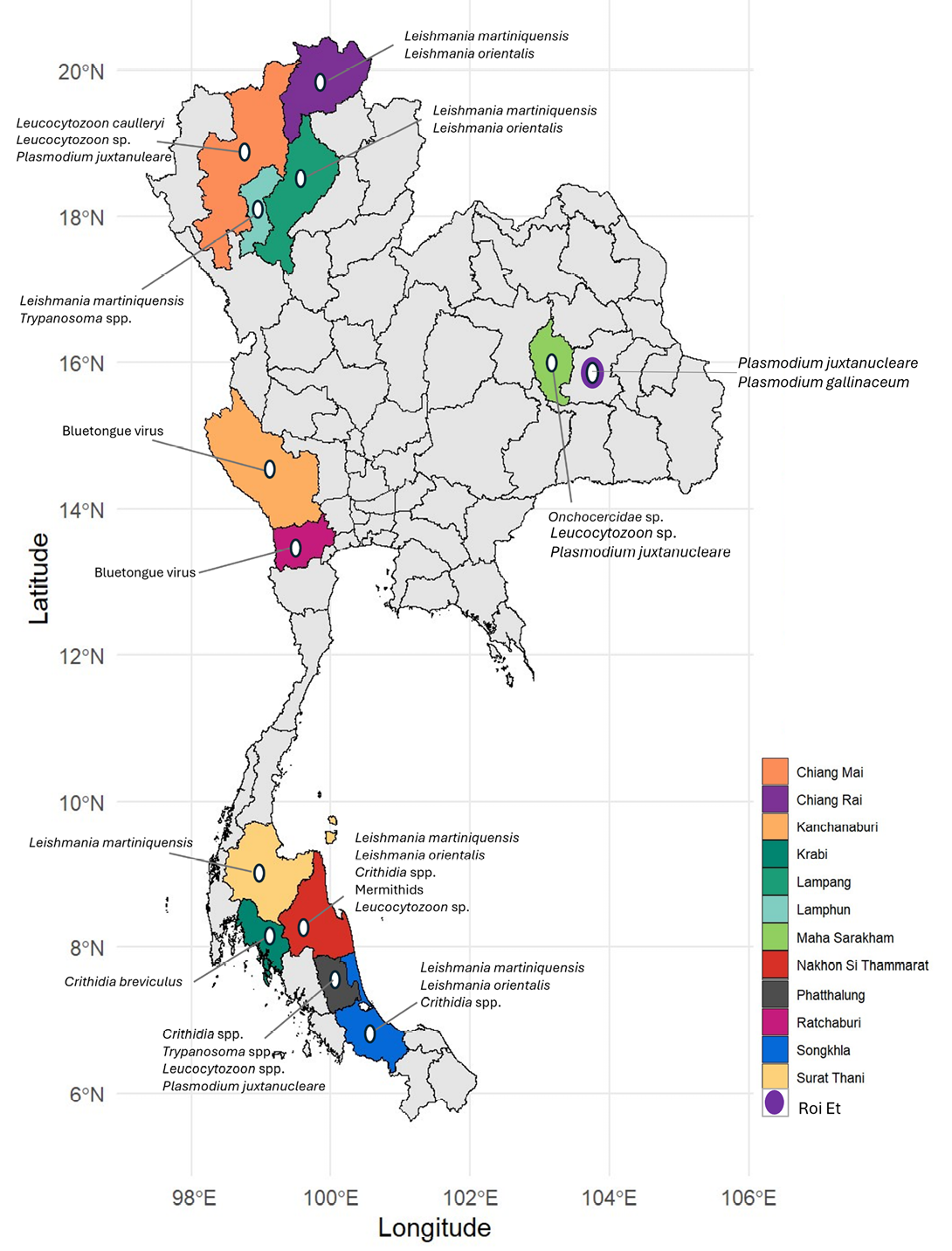
Geographical distribution of reported molecular detections of pathogen DNA or RNA in Culicoides biting midges across Thailand.
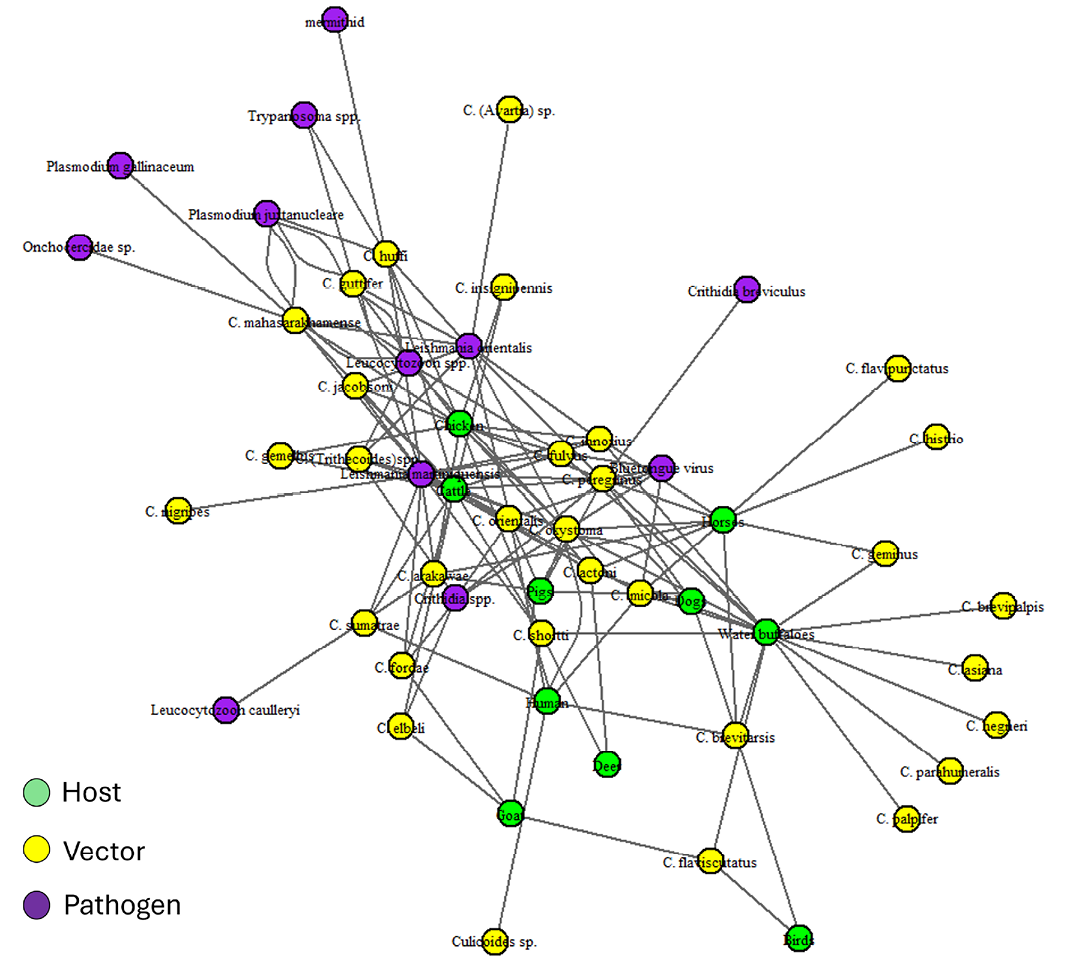
Tripartite network illustrating reported associations among vertebrate hosts, Culicoides biting midges, and molecularly detected pathogens in Thailand. Connections represent documented host blood-meal associations or pathogen detections rather than confirmed biological transmission.
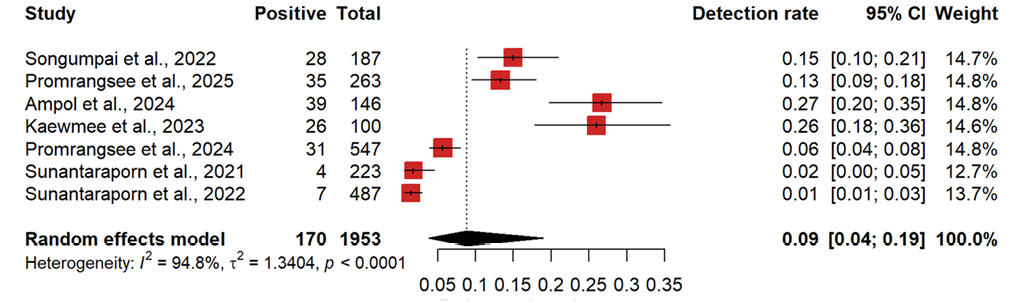
Forest plot showing the study-level overall pooled prevalence of pathogen detection in individually tested Culicoides specimens. Positive and total indicate the numbers of pathogen-positive and examined specimens, respectively. Squares represent study-specific estimates, horizontal lines indicate 95% confidence intervals, and the diamond represents the pooled estimate.
Meta-analyses
Although study-level pathogen detection for at least one pathogen was investigated in 12 studies, five studies did not report the number of Culicodies examined and were therefore excluded from the meta-analysis. Consequently, only 7 studies reporting pathogen detection in overall examined Culicoides populations were included in the meta-analysis. The pooled prevalence of study-level pathogen detection was 9% (95% CI: 4–19%), with substantial heterogeneity observed across studies (I² = 94.8%, τ² = 1.47, p < 0.0001) (Figure 5).
Sub-group meta-analysis
Pathogen group
The overall pooled pathogen detection rate was 5% (95% CI: 2–10%), with substantial heterogeneity across studies (I² = 93.6%, τ² = 1.8194, p < 0.0001). Significant differences were detected between pathogen groups (χ² = 32.28, df = 3, p = <0.0001), indicating that pooled detection rates varied according to pathogen type (Figure 6). Among the pathogen groups, Leishmania exhibited the highest pooled detection rate at 7% (95% CI: 3–15%), based on five studies comprising 94 positive detections from 1,203 analyzed specimens. Individual study estimates ranged from 1% to 27%, with substantial heterogeneity (I² = 94.1%, τ² = 0.9734, p < 0.0001). Other trypanosomatids showed a pooled detection rate of 3% (95% CI: 1–15%) from four studies involving 40 positive detections among 997 specimens, with substantial heterogeneity (I² = 94.8%, τ² = 2.7300, p < 0.0001). The detection rate for haemosporidians was 1% (95% CI: 0–2%), from single study reporting 4 positive detections from 487 analyzed specimens. For nematodes, only one study reported 35 positive detections among 263 specimens, yielding a detection rate of 13% (95% CI: 9–18%).
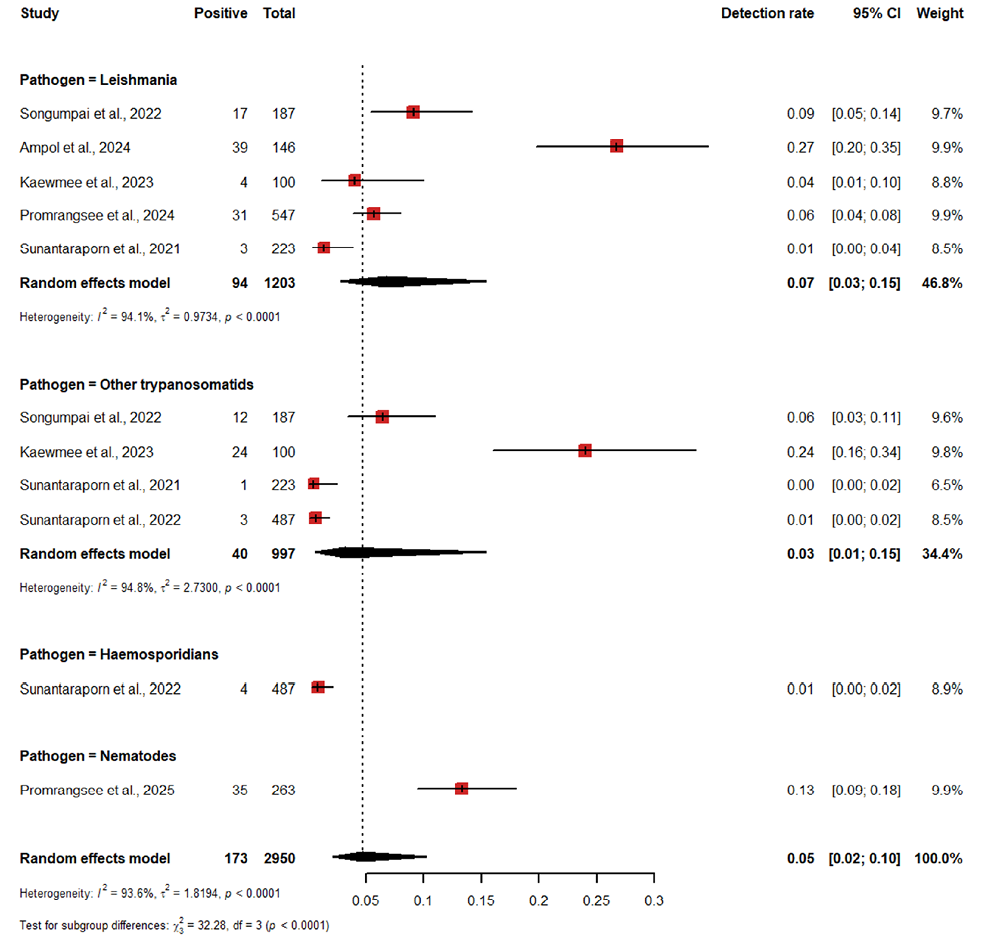
Sub-group analysis according to pathogen type.
Culicoides species
Subgroup meta-analysis according to Culicoides species showed variation in pathogen detection prevalence; however, differences between species were not statistically significant (Q= 28.24, df= 14, p= 0.0132). Species represented by a single study exhibited the highest prevalence estimates, including C. jacobsoni (33.0%, 95% CI: 4–78%), C. actoni (20.0%, 95% CI: 2–72%), and C. sumatrae (10.0%, 95% CI: 1–32%). Among species represented by multiple studies, C. huffi showed the highest pooled pathogen detection prevalence (22.0%, 95% CI: 17–29%), followed by C. guttifer (18.0%, 95% CI: 9–33%) C. peregrinus (13.0%, 95% CI: 2–48%), C. fulvus (12.0%, 95% CI: 3–35%), C. oxystoma (12.0%, 95% CI: 5–28%), C. mahasarakhamense (8.0%, 95% CI: 2–29%), and C. orientalis (4.0%, 95% CI: 1–12%). Substantial heterogeneity was detected in several species, particularly C. peregrinus (I² = 91.4%), C. mahasarakhamense (I² = 94.7%), and C. oxystoma (I² = 78.5%). In contrast, heterogeneity was low in C. guttifer (I² = 66.0%), C. orientalis (I² = 49.5%), C. fulvus (I² = 45.3%), and C. huffi (I² = 40.4%) (Supplementary File 8).
Altogether, pooled pathogen detection rates differ significantly between pathogen groups by sub-group analysis, with Leishmania showing the highest detection rate, followed by nematodes, other trypanosomatids, and haemosporidians.
Publication bias
Visual inspection of the funnel plot revealed some dispersion of studies across the funnel; however, no substantial asymmetry was observed (Supplementary File 9). Egger’s regression test was statistically significant (df= 6, p= <0.0001), suggesting evidence of publication bias. Interpretation should be made with caution because the analysis included only 7 studies, which may reduce the sensitivity of funnel plot–based methods to detect small-study effects.
Discussion
Culicoides biting midges are increasingly recognized for their broad host range, ecological adaptability, and role in the transmission of emerging pathogens. This study provides the first comprehensive synthesis of Culicoides research in Thailand over the past decade (2015–2025), integrating evidence on species diversity, vector ecology, and pathogen association. The findings reveal high taxonomic diversity, important host–vector–pathogen interactions, and notable geographical surveillance gaps, providing a foundation for future vector surveillance and disease risk assessment in Thailand.
Although three major bibliographic databases were searched and reference lists were examined, the use of selected search terms and restriction to English-language, peer-reviewed publications may have resulted in the omission of some relevant ecological, entomological, and locally published studies. Quality assessment demonstrated that the included studies were generally of high methodological quality. The consistent application of appropriate sampling strategies, species identification approaches, and outcome measurement methods strengthens confidence in the reliability of the synthesized findings. This improvement coincided with broader adoption of integrated diagnostic approaches and increasing national research attention toward Culicoides in Thailand. Furthermore, the predominance of publications in high quartile journals reflects growing scientific interest in Culicoides research and suggests that the available evidence has generally undergone rigorous peer review. Despite broad geographical coverage across 28 provinces, sampling efforts were concentrated in provinces of northeastern, northern, and southern Thailand, whereas provinces in central, eastern, and western regions received less attention, possibly reflecting the locations of research institutions, accessibility of study sites, and the presence of livestock husbandry practices. Future investigations in poorly surveyed areas are therefore required to provide a more representative understanding of Culicoides diversity and distribution throughout the country.
Overall, this review documented 61 Culicoides species belonging to 7 subgenera (Trithecoides, Avaritia, Haemophoructus, Hoffmania, Meijerehelea, Beltranmyia, and Remmia) and 4 species groups (Clavipalpis, Ornatus, Shermani, and Shortti), highlighting the considerable taxonomic diversity of Culicoides fauna in Thailand. High species richness may reflect broad ecological adaptability and varied host-feeding tendencies, which enhance opportunities for pathogen transmission and complicate vector control efforts . Thailand’s high Culicoides diversity may be supported by favorable climatic conditions, diverse habitats, and abundant vertebrate hosts. This richness exceeds current reports from Indonesia, Malaysia, and India, which have documented fewer species, possibly due to true ecological variation or differences in sampling methods ; ; . Similarly, a recent survey in China recorded eight subgenera despite lower overall species richness . To the best of our knowledge, Culicoides comprises 1,347 valid species, of which 875 are assigned to subgenera, 336 to species groups, and 136 remain unclassified . Therefore, accurate species identification becomes essential for reliable interpretation of ecological patterns, vector competence, and disease transmission dynamics. In the present review, uneven geographical distribution of surveys suggests that the current inventory remains incomplete, and additional species remain to be investigated through expanded surveillance in underrepresented provinces. Furthermore, reliance on morphological identification in some studies may have limited the differentiation of closely related or cryptic species, potentially affecting estimates of species diversity. Integrating morphological and molecular identification approaches in future studies could improve taxonomic accuracy and provide a more comprehensive understanding of Culicoides diversity in Thailand.
Regarding species identification, the widespread adoption of integrated morphological and molecular identification approaches represents an important advancement in the accurate characterization of Culicoides diversity, particularly for resolving cryptic species complexes and improving taxonomic resolution beyond morphology alone . However, taxonomic uncertainties remain. Previous studies have suggested that C. elbeli and C. menglaensis may represent the same species, while distinguishing C. oxystoma from C. kingi continues to be challenging because of their morphological similarity ; . To date, matrix-assisted laser desorption/ionization time-of-flight mass spectrometry (MALDI-TOF MS) has been evaluated as a promising diagnostic approach, with species-level identification successfully achieved through protein profiling ; . Seasonal investigations were comparatively limited, yet the available evidence consistently demonstrated higher Culicoides abundance during the rainy season. Comparable seasonal trends have been documented in Indonesia, India, China, and Brazil, where Culicoides populations commonly increased during rainy periods when humidity and temperature favor breeding conditions ; ; ; . However, the limited number of studies with seasonal abundance highlights the need for continuous year-round surveillance to better characterize seasonal fluctuations.
Although species abundance varied considerably across studies, several species were repeatedly identified as dominant, particularly C. oxystoma, C. peregrinus, C. mahasarakhamense, and C. imicola. These species are widely recognized as important livestock-associated biting midges and have been implicated in the transmission of several veterinary pathogens ; ; ; ; Sarker et al., 2025). The repeated detection of these species across diverse ecological settings suggests broad ecological adaptability and potential epidemiological importance. Their predominance also supports prioritizing these species in future studies investigating host preference, seasonal dynamics, pathogen carriage, and vector competence. This need has become increasingly relevant following the emergence of African horse sickness (AHS) in Thailand in 2020, which caused mortality in horses and highlighted the critical role of Culicoides surveillance in preparedness against arboviral transmission , . Given that C. imicola is a proven vector of African horse sickness virus, while the vector competence of other abundant Thai Culicoides species remains largely unknown, targeted investigations are warranted to assess their potential involvement in AHS transmission under local ecological conditions.
A positive trend between sampling duration and the number of Culicoides species recorded was observed, highlighting that extended sampling periods may increase the likelihood of detecting a broader range of species. These findings indicate that while extended sampling is beneficial for improving species detection, it should be integrated with standardized methodologies and diverse ecological coverage to more accurately characterize Culicoides diversity . In this review, combined trapping approaches tended to detect a greater number of Culicoides species than individual trap types, however, the difference was not statistically significant. This finding suggests that variation in species richness among studies may be influenced by factors beyond trap selection alone, including geographical location, habitat characteristics, sampling duration, and local species composition. Regarding trap types, CDC light traps are straightforward to operate and can yield large numbers of Culicoides with relatively low cost and effort. However, their limitations should be recognized, and the suitability of this trapping method should be carefully evaluated against the study objectives . Briefly, studies requiring pathogen detection or the use of live midges typically demand larger sample sizes, in which case more powerful or specialized trapping systems become necessary. Therefore, above mentioned exploratory findings should be interpreted cautiously, as Culicoides species richness may be influenced by variations in sampling effort, habitat diversity, seasonality, and geographical coverage. Non-significant associations should not be interpreted as evidence that sampling duration or trapping method has no influence on species richness. Although the Onderstepoort (OBTs) ultraviolet (UV) light trap is widely used internationally because of its strong attraction efficiency and long-standing adoption in Culicoides research, the situation in Thailand differs ; . This trap was not reported in the included Thai studies and none of the included studies clearly discussed the scientific criteria for trap selection in relation to pathogen detection and host blood meal analysis. Most of the studies have relied on CDC light traps largely because they are more readily available, easier to deploy across diverse field sites, and commonly used in broader entomological surveys . This reliance may influence collected species compositions, trap performance across habitats, and comparability with studies from regions where OBTs remain the standard for Culicoides sampling. Future studies should adopt standardized trapping strategies aligned with specific research objectives, such as vector competence experimental studies, pathogen detection or blood-meal analysis, while expanding sampling efforts in underrepresented geographic regions.
More than half of the included studies investigated pathogen detection in Culicoides populations, reflecting growing interest in the role of biting midges as potential vectors of both veterinary and zoonotic pathogens in Thailand. Leishmania spp. represented the most frequently detected pathogen group, with multiple Culicoides species testing positive for L. martiniquensis and L. orientalis. These findings align with increasing attention toward autochthonous leishmaniasis in Thailand and the ongoing search for alternative vectors beyond traditional phlebotomine sand flies ; . However, pathogen detection alone does not confirm vector competence, as positive molecular findings may reflect ingestion of infected blood meals rather than successful pathogen development and transmission. Experimental transmission studies remain necessary to clarify the epidemiological role of Culicoides species implicated in Leishmania circulation . Moreover, detection percentages should be interpreted cautiously, particularly when based on small sample sizes, as illustrated by the 100% detection of L. martiniquensis in C. nigripes, which was based on a single positive specimen. The detection of other trypanosomatids, filarial nematodes, hemosporidians, and bluetongue virus further illustrates the diverse pathogen associations observed within Thailand Culicoides populations. Detection of bluetongue virus in C. oxystoma, C. fulvus, C. orientalis, and C. imicola is particularly noteworthy because these species are frequently reported as dominant Culicoides species in Thailand. Moreover, the results should be interpreted cautiously, as differences in the pathogens investigated across Culicoides species limit direct comparisons of detection rates and their biological significance. Similarly, the host–vector–pathogen network represents reported associations rather than confirmed transmission pathways, as host-feeding and pathogen-detection records were compiled from different studies. Continued surveillance integrating pathogen screening with ecological and abundance data will be important for assessing the risk of pathogen emergence and spread.
For host blood-meal analysis, only one study employed the prepronociceptin (PNOC) marker, which targets recently acquired blood meals. This approach may provide a more reliable representation of active host-feeding behavior, thereby improving interpretation of host preference and potential pathogen transmission dynamics . Host blood-meal analysis revealed feeding on diverse vertebrate hosts, including livestock, companion animals, wildlife, birds, and humans. The predominance of cattle and chicken blood meals may likely reflect host availability in agricultural settings, while detection of human-derived blood meals confirms opportunistic feeding behavior and human–vector contact ; . However, these findings do not establish host preference or bridge-vector activity due to limited blood-meal data, variations in sampling techniques and molecular identification methods, and insufficient information on host availability, exposure, and vector competence. Together with the host–vector–pathogen network, these findings highlight diverse host associations and underscore the importance of a One Health approach for understanding the potential epidemiological significance of Culicoides in Thailand.
The meta-analysis demonstrated an overall study-level pathogen detection prevalence of 9% in Culicoides populations. Although relatively low, this finding may still have epidemiological significance when abundant and widely distributed species are involved. This estimate was intended to provide a descriptive overview of pathogen detection across the included studies rather than represent the prevalence of any particular pathogen. However, given the biological diversity of the detected pathogens, including differences in their transmission mechanisms, host associations, and diagnostic approaches, the combined estimate should be interpreted cautiously. Furthermore, the substantial between-study heterogeneity (I²= 94.8%) indicates considerable variability in pathogen detection across studies, limiting the epidemiological interpretation of the overall estimate. Although relatively low, pathogen detection may warrant further epidemiological investigation, particularly when abundant and widely distributed Culicoides species are involved.
With regards to region, unequal surveillance intensity across regions may have influenced the observed patterns and limited the ability to detect true regional differences. Pathogen detection prevalence varied significantly according to pathogen group, with Leishmania exhibiting the highest pooled detection prevalence. This pattern likely reflects increasing research attention and growing interest in Culicoides as potential alternative vectors. Herein, multiple observations originating from the same study may not be statistically independent. In particular, pathogen-group observations can overlap when the same insects were tested for multiple pathogens. Therefore, the overall estimates of subgroup analyses should not be treated as directly comparable with the primary study-level pooled prevalence. Out of the 22 included studies, seven focused on the role of Culicoides biting midges in Leishmania transmission by conducting investigations in reported Leishmania-endemic areas, particularly in locations near the houses of infected patients ; ; ; ; Kaewmee et al., 2024; ; . Therefore, Thailand stands at a critical point to compile existing evidence and further advance research to elucidate the role of biting midges in local Leishmania (Mundinia) transmission.
Although livestock animals serve as the primary hosts for biting midges, opportunistic feeding on other vertebrates cannot be ruled out ; ; . Supporting this, most of the included studies sampled Culicoides mostly from livestock farming areas, which could enhance the apparent association with domestic hosts and bias host-preference interpretations, which may shape transmission dynamics of pathogens . Optimized trapping strategies, improved species identification using advanced tools, and expanded coverage of sampling origins will support this objective. In accordance with these findings, C. homotomus (subgenus Monoculicoides) has been collected in under-represented areas, including Kanchanaburi and Ratchaburi .
Culicoides oxystoma exhibited a relatively stable abundance pattern across multiple independent studies in this review. This species was consistently reported from diverse ecological settings, including mixed livestock farms, horse stables, animal shelters, residential areas, caves, rice fields, and aquatic habitats. In addition, it demonstrated a broad host-feeding range, with blood meals identified from seven of the ten recorded vertebrate host categories, highlighting its ecological adaptability and potential epidemiological importance. Molecular screening has detected multiple pathogens in C. oxystoma, including L. martiniquensis, L. orientalis, Crithidia spp., Leucocytozoon spp., and bluetongue virus; however, these detections reflect pathogen presence rather than confirm transmission. Culicoides oxystoma positive for Leishmania DNA were found in recognized Leishmania index areas, particularly Songkhla, Lampang, Nakhon Si Thammarat, and Lamphun provinces ; ; ; . Culicoides oxystoma with >60% abundance records originated from Maha Sarakham and Prachuap Khiri Khan provinces and relatively high abundance was recorded in Lampang; nonetheless, zoonotic vector-borne infections have been infrequently reported from these areas, potentially reflecting limited surveillance or reporting gaps (Kamyingkard et al., 2023; ; . The frequent reporting and apparent abundance of C. oxystoma may also reflect differences in sampling intensity, trapping methods, and geographical coverage among studies. Recurrent pathogen detection in C. oxystoma across multiple studies, together with its broad geographical distribution, high abundance, and diverse host-feeding behavior, highlights its potential epidemiological importance in Thailand. Nevertheless, confirmation of its role as a competent vector requires experimental evidence demonstrating pathogen development and transmission. Outside Thailand, C. oxystoma has been implicated as a vector of several bovine arboviruses, including Akabane virus in Japan and epizootic hemorrhagic disease virus (EHDV) in Israel . This species has also been reported as a potential vector of bluetongue virus (BTV) in India . Collectively, its broad geographical occurrence, diverse host associations, and repeated pathogen detections support prioritizing C. oxystoma for further ecological and experimental vector competence investigations in Thailand.
Taken together, these findings demonstrate that Thailand supports a diverse Culicoides fauna with broad host associations and diverse pathogen detections. However, the limited number of vector competence studies continues to constrain understanding of the ecological and epidemiological importance of many species. Future vector competence investigations should prioritize C. oxystoma because of its repeated pathogen associations, broad host-feeding behavior, widespread distribution, and frequent abundance across multiple ecological settings. Addressing these limitations will improve assessment of Culicoides-associated disease risks and strengthen surveillance efforts in both animal and human populations. Expansion of this work to other countries within the Greater Mekong Subregion would facilitate coordinated regional surveillance and support evidence-based vector management and disease control strategies.
Strengths and limitations
This systematic review has several strengths. To our knowledge, it represents the first comprehensive systematic review of Culicoides research conducted in Thailand over the past decade, integrating evidence on species diversity, geographical distribution, sampling methodologies, abundance, host bloodmeal associations, and pathogen detection. The review was undertaken using a systematic and transparent approach, enabling the synthesis of evidence generated across a ten-year period and diverse ecological settings. By collating records from different regions of the country, this study establishes an updated baseline for understanding the current knowledge of Culicoides fauna in Thailand and identifies important gaps in geographical coverage, vector surveillance, host bloodmeal patterns, and pathogen associations.
Several limitations should be considered when interpreting the findings. Firstly, the available evidence was unevenly distributed across provinces, with many areas of Thailand remaining unrepresented. Secondly, considerable differences were observed in sampling duration, trapping methodologies, ecological settings, and taxonomic identification approaches, limiting direct comparisons of species abundance and preventing quantitative synthesis of abundance estimates at the national level. Thirdly, some studies relied on morphological identification, while molecular confirmation was applied inconsistently, which may have affected species-level resolution for morphologically similar taxa. Fourthly, host preference and pathogen detection data were available for only a limited number of species and study locations, restricting broader ecological and epidemiological interpretations. Consequently, a small proportion of studies (2/12) relied on pooled Culicoides samples for pathogen screening. Although pooling is practical for large-scale surveillance, it limits accurate estimation of individual infection prevalence and may obscure species-specific vector–pathogen relationships. Moreover, the absence of records for particular species, hosts, or pathogens should not be interpreted as evidence of true absence but rather as a reflection of current surveillance efforts and research priorities. Finally, molecular detection of pathogens does not confirm vector competence, and therefore the epidemiological roles of many pathogen-positive Culicoides species remain uncertain. Future studies incorporating standardized surveillance protocols, broader geographical coverage, and experimental vector competence investigations will be essential to strengthen understanding of vector role of Culicoides in Thailand.
Conclusion
This systematic review summarizes current evidence on Culicoides species diversity, ecology, and pathogen associations in Thailand. Molecular studies have confirmed the presence of L. martiniquensis, L. orientalis, Crithidia spp., C. brevicula, Trypanosoma spp., avian haemosporidians, mermithids, Onchocercidae sp., and bluetongue virus in several Culicoides species. However, molecular detection alone does not confirm established infection or vector competence. Further experimental studies are needed to clarify the role of Culicoides species in pathogen transmission in Thailand. Human-derived blood meals were detected in C. oxystoma, C. imicola, C. orientalis, C. sumatrae, and C. brevitarsis, with C. oxystoma showing the widest host range and highest pathogen diversity. The frequent detection of multiple pathogens and opportunistic host-feeding behavior suggests that prioritizing C. oxystoma for further ecological and experimental investigations. These findings support the need for continued surveillance and integrated vector-pathogen-host studies to strengthen disease risk assessment and control in Thailand.
Acknowledgements
The authors would like to thank the Graduate Scholarship Program for ASEAN and NON-ASEAN countries, Chulalongkorn University, and Research Center for Thermotolerant Microbial Resources, Yamaguchi University for funding the research stay in Thailand (2018-2021) and Japan (2024), which supported this collaborative study.
Novelty Statement
This systematic review integrates Culicoides diversity, distribution, ecology, and pathogen associations in Thailand (2015–2025), combining meta-analysis, geographical mapping, and host–vector–pathogen networks to highlight epidemiological patterns and surveillance gaps.
Author’s Contribution
BKS: Writing review and editing, writing original draft, Validation, methodology, investigation, resources, formal analysis, software, data curation, conceptualization. AH-L: Writing review and editing, methodology, investigation, resources, data curation. KSH: Writing review and editing, resources, data curation. AA: Investigation, resources, data curation. HS: Writing review and editing, investigation, data curation, conceptualization. PA: Writing review and editing, supervision, validation, methodology, investigation, resources, formal analysis, data curation, conceptualization.
Financial support
This research did not receive any specific grant from funding agencies in the public, commercial, or not-for-profit sectors.
Data availability
All data analyzed in this study are presented in the manuscript and its supplementary materials, provided this is accurate.
Generative AI and AI assisted technology statement
QuillBot (https://quillbot.com/) was used exclusively for English language editing to enhance readability and clarity. It was not used for data analysis and interpretation of results. The authors are fully responsible for all content presented in this manuscript.
Conflict of interest
The authors declare no financial or personal relationships with individuals or organizations that could inappropriately influence or bias the content of this paper.
Supplementary Material
There is supplementary material associated with this
article. Access the material online at:
References
- Ahmadi S, Hataminejad M, Esboei BR, Hosseini SA, Fakhar M (2024). An update on Leishmania martiniquensis infections: Transmission, clinical characteristics, and treatment. Parasite Epidemiol. Contr., 27: p.e00386. [CrossRef]
- Ampol R, Somwang P, Khositharattanakool P, Promrangsee C, Pataradool T, Tepboonreung P, Siriyasatien P, Preativatanyou K (2024). Nanopore-based surveillance of Leishmania parasites in Culicoides Latrielle (Diptera: Ceratopogonidae) caught from the affected community and Tham Phra Cave in Chiang Rai province, the endemic area of Leishmaniasis in Northern Thailand. Insects, 15(5): 327. [CrossRef]
- Azonvide CL, Adjobimey T, Sina H, Nyariki JN, Baba-Moussa L (2022). High prevalence of Mansonella perstans infection maintained in South Benin by Culicoides milnei, Culicoides imicola, and Culicoides inornatipennis. J. Parasitol. Vector Biol., 14(1): 31-40.
- Banerjee N, Mazumdar SM, Bellis G, Mazumdar A (2025). New species, country records, DNA barcoding and host blood meal analysis of some Indian species of Culicoides Latreille subgenus Trithecoides Wirth and Hubert (Diptera: Ceratopogonidae). Acta Trop., pp. 107798. [CrossRef]
- Becker M, Park JS, Gentry G, Husseneder C, Foil L (2021). Comparison of trapping methods for use in surveys for potential Culicoides vectors of orbiviruses. Parasit. Vectors, 14(1): p.564. [CrossRef]
- Becvar T, Vojtkova B, Siriyasatien P, Votypka J, Modry D, Jahn P, Bates P, Carpenter S, Volf P, Sadlova J (2021). Experimental transmission of Leishmania (Mundinia) parasites by biting midges (Diptera: Ceratopogonidae). PLoS Pathog., 17(6): p.e1009654. [CrossRef]
- Bobeva A, Zehtindjiev P, Bensch S, Radrova J (2013). A survey of biting midges of the genus Culicoides Latreille, 1809 (Diptera: Ceratopogonidae) in NE Bulgaria, with respect to transmission of avian haemosporidians. Acta Parasitol., 58(4): 585-591. [CrossRef]
- Borkent A, Dominiak P (2020). Catalog of the biting midges of the world (Diptera: Ceratopogonidae). Zootaxa, 4787: 1–377. [CrossRef]
- Bukauskaitė D, Iezhova TA, Ilgūnas M, Valkiūnas G (2019). High susceptibility of the laboratory-reared biting midges Culicoides nubeculosus to Haemoproteus infections, with review on Culicoides species that transmit avian haemoproteids. Parasitology, 146(3): 333-341.
- Bunpapong N, Charoenkul K, Nasamran C, Chamsai E, Udom K, Boonyapisitsopa S, Tantilertcharoen R, Kesdangsakonwut S, Techakriengkrai N, Suradhat S, Thanawongnuwech R (2021). African horse sickness virus serotype 1 on horse farm, Thailand, 2020. Emerg. Infect. Dis., 27(8): 2208. [CrossRef]
- Carpenter S, Veronesi E, Mullens B, Venter G (2015). Vector competence of Culicoides for arboviruses: three major periods of research, their influence on current studies and future directions. Rev. Sci. Tech., 34(1): 97-112. [CrossRef]
- Carvalho LPC, Silva FS (2014). Seasonal abundance of livestock-associated Culicoides species in northeastern Brazil. Med. Vet. Entomol., 28(2): 228-231.
- Chanmol W, Jariyapan N, Somboon P, Bates MD, Bates PA (2019). Development of Leishmania orientalis in the sand fly Lutzomyia longipalpis (Diptera: Psychodidae) and the biting midge Culicoides soronensis (Diptera: Ceratopogonidae). Acta Trop., 199: 105157. [CrossRef]
- Choocherd S, Pattanatanang K, Chimnoi W, Kamyingkird K, Tongyoo P, Phasuk J (2022). Preliminary study on comparative efficacy of four light sources for trapping Culicoides spp. (Diptera: Ceratopogonidae) in Prachuap Khiri Khan Province, Thailand. J. Econ. Entomol., 115(5): 1719-1723.
- Dadawala AI, Biswas SK, Rehman W, Chand K, De A, Mathapati BS, Kumar P, Chauhan HC, Chandel BS, Mondal B (2012). Isolation of bluetongue virus serotype 1 from Culicoides vector captured in livestock farms and sequence analysis of the viral genome segment-2. Transbound. Emerg. Dis., 59(4): 361-368. [CrossRef]
- Duan YL, Li ZH, Bellis GA, Li L, Liu BG, Wang JP, Liu JM, Liao DF, Zhu JB (2024). Culicoides and midge-associated arboviruses on cattle farms in Yunnan Province, China. Parasite, 31: p.72.
- Ebai R, Kien CA, Fombad FF, Esofi F, Ouam E, Ntuh AN, Amambo GN, Gandjui VNT, Chunda VC, Nietcho F, Nchang LC (2024). Culicoides species of the rain forest belt of the littoral region of Cameroon: Their incrimination in the transmission of Mansonella perstans. Pathogens, 13(2): 146. [CrossRef]
- Egger M, Smith GD, Schneider M, Minder C (1997). Bias in meta-analysis detected by a simple, graphical test. Br. Med. J., 315: 629-634. [CrossRef]
- Fujisawa Y, Homat T, Thepparat A, Changbunjong T, Sutummaporn K, Kornmatitsuk S, Kornmatitsuk B (2021). DNA barcode identification and molecular detection of bluetongue virus in Culicoides biting midges (Diptera: Ceratopogonidae) from western Thailand. Acta Trop., 224: 106147. [CrossRef]
- Gomontean B, Vaisusuk K, Chatan W, Wongpakam K, Sankul P, Lachanthuek L, Mintara R, Thanee I, Pramual P (2023). Diversity, abundance and host blood meal analysis of Culicoides Latreille (Diptera: Ceratopogonidae) from cattle pens in different land use types from Thailand. Insects, 14(7): 574. [CrossRef]
- Gomontean B, Wannasingha W, Mintara R, Pramual P (2025). Immature habitats of Culicoides Latreille (Diptera: Ceratopogonidae) from Northeastern Thailand. Int. J. Trop. Insect Sci., pp. 1-11. [CrossRef]
- Gopurenko D, Bellis G, Pengsakul T, Siriyasatien P, Thepparat A (2022). DNA barcoding of Culicoides Latreille (Diptera: Ceratopogonidae) from Thailand reveals taxonomic inconsistencies and novel diversity among reported sequences. J. Med. Entomol., 59(6): 1960-1970.
- Higgins JP, Thompson SG (2004). Controlling the risk of spurious findings from meta-regression. Statist. Med., 23(11): 1663-1682. [CrossRef]
- Hudson AR, McGregor BL, Shults P, England M, Silbernagel C, Mayo C, Carpenter M, Sherman TJ, Cohnstaedt LW (2023). Culicoides-borne Orbivirus epidemiology in a changing climate. J. Med. Entomol., 60(6): 1221-1229.
- Jiménez-Cabello L, Utrilla-Trigo S, Lorenzo G, Ortego J, Calvo-Pinilla E (2023). Epizootic hemorrhagic disease virus: current knowledge and emerging perspectives. Microorganisms, 11(5): p.1339. [CrossRef]
- Jomkumsing P, Surapinit A, Saengpara T, Pramual P (2021). Genetic variation, DNA barcoding and blood meal identification of Culicoides Latreille biting midges (Diptera: Ceratopogonidae) in Thailand. Acta Tropica, 217: 105866. [CrossRef]
- Kaewmee S, Mano C, Phanitchakun T, Ampol R, Yasanga T, Pattanawong U, Junkum A, Siriyasatien P, Bates PA, Jariyapan N (2023). Natural infection with Leishmania (Mundinia) martiniquensis supports Culicoides peregrinus (Diptera: Ceratopogonidae) as a potential vector of leishmaniasis and characterization of a Crithidia sp. isolated from the midges. Front. Microbiol., 14: 1235254. [CrossRef]
- Kamyingkird K, Choocherd S, Chimnoi W, Klinkaew N, Kengradomkij C, Phoosangwalthong P, Thammasonthijarern N, Pattanatanang K, Inpankaew T, Phasuk J, Nimsuphan B (2023). Molecular identification of Culicoides species and host preference blood meal in the African horse sickness outbreak-affected area in Hua Hin district, Prachuap Khiri Khan province, Thailand. Insects, 14(4): 369. [CrossRef]
- Kapustová A, Kulich Fialová M, Svobodová M, Brzoňová J (2025). Combining blood meal analysis and parasite detection yields a more comprehensive understanding of insect host feeding patterns. Parasit. Vectors, 18(1): p.288. [CrossRef]
- Kaufmann C, Steinmann IC, Hegglin D, Schaffner F, Mathis A (2012). Spatio-temporal occurrence of Culicoides biting midges in the climatic regions of Switzerland, along with large scale species identification by MALDI-TOF mass spectrometry. Parasit. Vectors, 5(1): p.246. [CrossRef]
- King S, Rajko-Nenow P, Ashby M, Frost L, Carpenter S, Batten C (2020). Outbreak of African horse sickness in Thailand. Transbound. Emerg. Dis., 67(5): 1764-1767.
- la Puente MJ, Navarro J, Ferraguti M, Soriguer R, Figuerola J (2017). First molecular identification of the vertebrate hosts of Culicoides imicola in Europe and a review of its blood-feeding patterns worldwide: implications for the transmission of bluetongue disease and African horse sickness. Med. Vet. Entomol., 31(4): 333-339.
- Lassen SB, Nielsen SA, Kristensen M (2012). Identity and diversity of blood meal hosts of biting midges (Diptera: Ceratopogonidae: Culicoides Latreille) in Denmark. Parasit. Vectors, 5(1): 143. [CrossRef]
- Moola SZCEKRE, Munn Z, Tufanaru C, Aromataris E, Sears K, Sfetcu R, Currie M, Qureshi R, Mattis P, Lisy KMPF, Mu PF (2020). Systematic reviews of etiology and risk. JBI Manual Evid. Synth., 1: 217-269.
- Morag N, Saroya Y, Braverman Y, Klement E, Gottlieb Y (2012). Molecular identification, phylogenetic status, and geographic distribution of Culicoides oxystoma (Diptera: Ceratopogonidae) in Israel. PLoS One, 7(3): p.e33610. [CrossRef]
- Mullen GR, Murphree CS (2019). Biting midges (ceratopogonidae). In: Medical and veterinary entomology, 2019; Academic Press. pp. 213-236. [CrossRef]
- Ngape D, Steele CH, McDermott EG (2021). A comparison of BG Sentinel and CDC trap attractants for mosquito surveillance in urban and suburban areas of Montgomery and Prince George’s Counties, Maryland, USA. J. Vector Ecol., 46(2): 186-199.
- Page MJ, McKenzie JE, Bossuyt PM, Boutron I, Hoffmann TC, Mulrow CD, Shamseer L, Tetzlaff JM, Akl EA, Brennan SE, Chou R (2021). The PRISMA 2020 statement: An updated guideline for reporting systematic reviews. Br. Med. J., pp. 372. [CrossRef]
- Phasuk J, Choocherd S, Panthawong A, Phoosangwalthong P, Chimnoi W, Kamyingkird K (2023). Pattanatanang, K. Seasonal abundance of Culicoides imicola and Culicoides oxystoma in Prachuap Khiri Khan province, Thailand. Agric. Natl. Resour., 57(3): 533-540. [CrossRef]
- Pramual P, Jomkumsing P, Jumpato W, Bunauea S (2021). Molecular detection of avian haemosporidian parasites in biting midges (Diptera: Ceratopogonidae) from Thailand. Acta Trop., 224: e106118. [CrossRef]
- Pramual P, Jumpato W, Gomontean B, Mintara R, Wannasingha W, Wongpakam K (2024). Population genetics of the biting midge Culicoides oxystoma Kieffer (Diptera: Ceratopogonidae) from Thailand and its genetic relationships with global populations. Trop. Biomed., 41(1): 125-133. [CrossRef]
- Pramual P, Khamluea S, Butlun P, Promdungdee A (2023). Molecular detection of filarial nematode from Culicoides biting midges (Diptera: Ceratopogonidae) in northeastern Thailand. [CrossRef]
- Prastowo J, Wulandari KY, Nugraheni YR, Priyowidodo D, Sahara A (2018). Occurrence of Culicoides Latreille (Diptera: Ceratopogonidae) Collected from a Layer Farm in Yogyakarta. Int. J. Poult. Sci., 17(5): 249-254.
- Promrangsee C, Sanprasert V, Thepparat A, Sunantaraporn S, Ampol R, Boonserm R, Siriyasatien P, Preativatanyou K (2025). First record of mermithid parasitism in adult biting midges, Culicoides huffi (Diptera: Ceratopogonidae), collected from Southern Thailand, with ultrastructural and molecular characterization. Parasit. Vectors, 18(1): p.303. [CrossRef]
- Promrangsee C, Sriswasdi S, Sunantaraporn S, Savigamin C, Pataradool T, Sricharoensuk C, Boonserm R, Ampol R, Pruenglampoo P, Mungthin M, Schmidt-Chanasit J (2024). Seasonal dynamics, Leishmania diversity, and nanopore-based metabarcoding of blood meal origins in Culicoides spp. in the newly emerging focus of leishmaniasis in Northern Thailand. Parasit. Vectors, 17(1): p.400. [CrossRef]
- Purse BV, Carpenter S, Venter GJ, Bellis G, Mullens BA (2015). Bionomics of temperate and tropical Culicoides midges: Knowledge gaps and consequences for transmission of Culicoides-borne viruses. Ann. Rev. Entomol., 60(1): 373-392.
- Quaglia AI, Blosser EM, McGregor BL, Runkel IVAE, Sloyer KE, Erram D, Wisely SM, Burkett-Cadena ND (2020). Tracking community timing: Pattern and determinants of seasonality in Culicoides (Diptera: Ceratopogonidae) in Northern Florida. Viruses, 12(9): p.931. [CrossRef]
- Rot A, Meiswinkel R, Fleker M, Blum SE, Behar A (2020). Towards modernizing the taxonomy of Mediterranean Culicoides using classical morphology, mtDNA barcoding, and MALDI-TOF MS protein profiling. Acta Trop., 211: 105628. [CrossRef]
- Ruang-Areerate T, Ruang-Areerate P, Manomat J, Naaglor T, Piyaraj P, Mungthin M, Leelayoova S, Siripattanapipong S (2023). Genetic variation and geographic distribution of Leishmania orientalis and Leishmania martiniquensis among Leishmania/HIV co-infection in Thailand. Sci. Rep., 13(1): p.23094. [CrossRef]
- Sadeddine R, Sambou M, Davoust B, Righi S, Daghri K, Benakhla A, Parola P, Mediannikov O (2024). Molecular detection of Potential Novel Mansonella species (Filarioidea: Onchocercidae) in equine and Culicoides enderleini from Africa. J. Hellenic Vet. Med. Soc., 75(3): 7751-7756. [CrossRef]
- Sarkar A, Banerjee P, Kar S, Pal A, Mazumdar A (2025). Investigating the influence of blood meal sources on the composition of culturable haemolytic gut bacteria of a wild-caught BTV vector Culicoides oxystoma Kieffer (Diptera: Ceratopogonidae). Med. Vet. Entomol., 39(3): 538-547.
- Sathiyamoorthy N, Ponnudurai G, Senthilvel K, Rani N, Ramya K (2021). Prevalence of Culicoides species in livestock farms in relation to season, Namakkal, Tamil Nadu. J. Pharma. Innov., 10: 166-170.
- Scroggs SL, Gutierrez J, Reister-Hendricks LM, Gunter KB, Tilston NL, McGregor BL (2025). Enhanced infection and transmission of the 2022–2024 Oropouche virus strain in the North American biting midge Culicoides sonorensis. Sci. Rep., 15(1): p.27368. [CrossRef]
- Sick F, Beer M, Kampen H, Wernike K (2019). Culicoides biting midges-underestimated vectors for arboviruses of public health and veterinary importance. Viruses, 11(4): 376. [CrossRef]
- Slama D, Baraket R, Remadi L, Chaker E, Babba H (2021). Morphological and molecular differentiation between Culicoides oxystoma and Culicoides kingi (Diptera: Ceratopogonidae) in Tunisia. Parasit. Vectors, 14(1): p.607. [CrossRef]
- Slama D, Haouas N, Mezhoud H, Babba H, Chaker E (2015). Blood meal analysis of Culicoides (Diptera: Ceratopogonidae) in central Tunisia. PLoS One, 10(3): p.e0120528.
- Soe BK, Kaewmee S, Mano C, Pattanawong U, Tipparawong N, Siriyasatien P, Gatherer D, Urbaniak MD, Bates PA, Jariyapan N (2025a). Molecular detection of parasites and host preference in wild-caught Culicoides biting midges (Diptera: Ceratopogonidae) in Chiang Mai and Nakhon Si Thammarat Provinces, Thailand. Parasite, 32: 2.
- Soe BK, Arnuphapprasert A, Adisakwattana P, Gil MO, Huertas-López A (2025b). Phlebotomine sand fly distribution, abundance and pathogen associations in Thailand: A scoping review. Parasitology, pp. 1-50.
- Songumpai N, Promrangsee C, Noopetch P, Siriyasatien P, Preativatanyou K (2022). First evidence of co-circulation of emerging Leishmania martiniquensis, Leishmania orientalis, and Crithidia sp. in Culicoides biting midges (Diptera: Ceratopogonidae), the putative vectors for autochthonous transmission in southern Thailand. Trop. Med. Infect. Dis., 7(11): p.379.
- Srivarasat S, Brownell N, Siriyasatien P, Noppakun N, Asawanonda P, Rattanakorn K, Preativatanyou K, Kumtornrut C (2022). Case report: autochthonous disseminated cutaneous, mucocutaneous, and visceral leishmaniasis caused by Leishmania martiniquensis in a patient with HIV/AIDS from Northern Thailand and literature review. Am. J. Trop. Med. Hyg., 107(6): p.1196.
- Sunantaraporn S, Hortiwakul T, Kraivichian K, Siriyasatien P, Brownell N (2022). Molecular identification of host blood meals and detection of blood parasites in Culicoides Latreille (Diptera: Ceratopogonidae) collected from Phatthalung province, Southern Thailand. Insects, 13(10): p.912.
- Sunantaraporn S, Thepparat A, Phumee A, Sor-Suwan S, Boonserm R, Bellis G, Siriyasatien P (2021). Culicoides Latreille (Diptera: Ceratopogonidae) as potential vectors for Leishmania martiniquensis and Trypanosoma sp. in northern Thailand. PLoS Negl. Trop. Dis., 15(12): p.e0010014.
- Tepboonrueng P, Pataradool T, Boonserm R, Rimmer LW, Preativatanyou K, Sunantaraporn S, Siriyasatien P (2025). DNA barcoding of Culicoides biting midges (Diptera: Ceratopogonidae) and detection of Leishmania and other trypanosomatids in southern Thailand. Parasit. Vectors, 18(1): p.194.
- Thepparat A, Bellis G, Ketavan C, Ruangsittichai J, Sumruayphol S, Apiwathnasorn C (2015). Ten species of Culicoides Latreille (Diptera: Ceratopogonidae) newly recorded from Thailand. Zootaxa, 4033(1): 48-56.
- Thepparat A, Kamata N, Siriyasatien P, Prempree W, Dasuntad K, Chittsamart B, Sanguansub S (2024). Seasonal abundance and diversity of Culicoides biting midges in livestock sheds in Kanchanaburi Province, Thailand. Insects, 15(9): 701.
- Venter GJ, Sebitsang SS, Swart VR, Boikanyo SNB, De Beer CJ (2022). Comparison of the efficiency of the Onderstepoort‐and Centres for Disease Control ultraviolet light traps for the collection of livestock associated Culicoides species in South Africa. Med. Vet. Entomol., 36(1): 113-126.
- Wang YN, Duan YL, Li ZH, Deng JM, Sun XN, Shen XY, Yang AX, Li SL (2025). Diversity and Seasonal Abundance of Culicoides (Diptera: Ceratopogonidae) in Tengchong County of Yunnan, China. Insects, 16(8): p.780.
- Wilson AL, Courtenay O, Kelly-Hope LA, Scott TW, Takken W, Torr SJ, Lindsay SW (2020). The importance of vector control for the control and elimination of vector-borne diseases. PLoS Negl. Trop. Dis., 14(1): p.e0007831.
- Ya’cob Z, Mintara R, Belabut DM, Halim MRA, Pramual P (2025). DNA barcoding and host blood meal identification of Culicoides Latreille (Diptera, Ceratopogonidae) from Malaysia. Acta Trop., 263: 107564.
- Yanase T, Kato T, Kubo T, Yoshida K, Ohashi S, Yamakawa M, Miura Y, Tsuda T (2005). Isolation of bovine arboviruses from Culicoides biting midges (Diptera: Ceratopogonidae) in southern Japan: 1985–2002. J. Med. Entomol., 42(1): 63-67.

Services
Article usage statistics
Loading…
Related articles
- Spatial and Seasonal Distribution of Culicoides Species in Morocco in Relation to the Transmission of Bluetongue VirusesHosts and Viruses · 2015
- Prevalence of Midges: Potent Vectors for Bluetongue Virus Infection in West Bengal, IndiaAdvances in Animal and Veterinary Sciences · 2013
- Prevalence of Bovine Tuberculosis in Cattle and Cattle-Derived Products in Indonesia: A Systematic Review and Meta-AnalysisAdvances in Animal and Veterinary Sciences · 2026
- Pathogenic Potential and Global Epidemiology of Bluetongue Virus that Cause Infection in RuminantsAdvances in Animal and Veterinary Sciences · 2020
- Molecular Detection and Risk Factors of African Horse Sickness Virus (AHSV) in Different Governorates of SudanJournal of Animal Health and Production · 2020
- Molecular Detection of Leucocytozoon spp. in Broiler Chickens in Baghdad CityAdvances in Animal and Veterinary Sciences · 2024