
This study evaluated the effectiveness of 4% zinc phosphide (Zn3P2) coated maize grain bait, mixed with animal fat, as a toxicant bait for wild boar control under field conditions. During the poison baiting a total of 497 kg of bait was placed at 18 baiting points, out of which 393 kg was consumed, resulting in an overall bait consumption rate of 79% of the total bait placed. The bait consumption on the first night was highest that is 93.26%, but it decreased steadily over the next two nights as population of wild boar decreased because of mortalities. More than 450 dead bodies were found from the field area. The results of this study demonstrated the effectiveness of zinc phosphide as a toxicant for controlling wild boar populations. The significant decline in bait consumption over the three-day poisoning period, following a successful pre-baiting phase, suggests that a substantial portion of the local population was affected by the toxic bait. Zinc phosphide offers the advantage of rapid action for immediate population control. Further studies are suggested to evaluate long-term impacts, environmental safety, and effectiveness under varying field conditions.
Research Article · Volume 44, Issue 2, Pages 109–114, 19 November 2026 · Open Access
A Novel Bait Formulation of Zinc Phosphide for the Control of Wild Boar, Sus scrofa cristatus: A Field Evaluation Study
, ,
Affiliations & Notes ⌄
- 1Vertebrate Pest Management Programme, Institute of Plant and Environmental Protection, National Agricultural Research Centre, Islamabad, Pakistan
- 2Ex-Senior Director, Plant Protection, Pakistan Agriculture Research Council, Islamabad, Pakistan
- *Correspondence | Uswah Sehar; Email: uswahseharsi96@gmail.com
Article Info ⌄
- Journal:
- South Asian Journal of Zoology
- Submitted Date:
- 10 September 2026
- Revision Date:
- 20 October 2026
- Accepted Date:
- 30 October 2026
- Published Date:
- 19 November 2026
Abstract
INTRODUCTION
Wild boar (Sus scrofa cristatus) is widely distributed in all the agro-forestry systems of Pakistan, and is a major vertebrate pest of maize, potatoes, sugarcane, groundnut, wheat crops, forest plantations and plant nurseries etc ; ; ; ; . Due to its digging and wallowing habits, irrigation systems are badly damaged in irrigated forest plantations, where in, heavy expenditure is incurred in rebuilding them. They are the most important vertebrate modifiers of ecosystems, causing losses of native plants, birds and invertebrates habitats, resulting into enhanced conditions for aliens plants and diseases, increasing erosion and altering nutrients cycles, by way of its digging and uprooting habits. They are known to cause foot-and-mouth disease (FMD) to livestock in Australia . In addition to this, the wild boar is subject to many infectious diseases such as swine fever, trichinosis and stomatitis, resulting into exchange of infections with domestic pig stock, domestic livestock and wild animals.
Various methods and techniques have been developed, evaluated or being used in many countries for the control of wild boar ; ; . Among these the chemical control, few decades ago was carried out with the use of toxic insecticides such as aldrin, endrin, dimecron, temic, carbofuran, aldicarb and furadon . These toxic compounds and their use were banned because of secondary and tertiary poisoning of non-target animal species and persistent residues in the soil. However, very toxic compounds such as sodium fluoroacetate (1080) is still being used in New Zealand and Australia against wild boar.
Shafi and Khokhar (1986) reported a significant reduction from 80% to 100% in wild boar population by using sodium fluoroacetate (1080) wheat grain bait in sugarcane fields. However, despite of the effectiveness, the strong taste and odor of insecticidal compounds often discourage wild boars from consuming the bait in sufficient quantities for large-scale control. Additionally, these baits are highly attractive to livestock and non-target wildlife, raising serious concerns about safety. While 1080 is commonly used in countries like Australia and New Zealand, it poses serious risks to livestock, wildlife, and humans, making its application highly dangerous without proper oversight. For this reason, only trained and certified vertebrate pest control professionals are recommended to handle its use. Other challenges such as bait-shyness, aversion, and tolerance in wild boars further limit its success. Moreover, no reliable antidote exists in the event of accidental poisoning.
Alternate to this situation, anticoagulants such as warfarin and coumatetralyl have been evaluated with 80-90% reduction in populations ; . Despite this level of success, these compounds have not been adopted by the farmers of developing countries because of high cost of such compounds and labour intensive in application. In search of cost-effective and because of high knockdown effects, zinc phosphide an acute toxin, having different formulations (2%), has been evaluated against wild boar in rangelands and agri-fields of Islamabad. With these formulations various degree levels of mortality of wildboars were recorded. In such operations low level of cost-benefit ratio was obtained . As yet, 4% formulation of zinc phosphide has not been tested or evaluated against wild boar. The main objective of this study was to evaluate non-poisonous bait acceptance during the pre-baiting phase and to determine the effectiveness of 4% zinc phosphide-coated maize grain bait mixed with animal fat in reducing wild boar activity.
MATERIALS AND METHODS
Study area
This study was carried out in the range-land of Nilore area of Islamabad Capital territory, Pakistan, located around 25 kilometers southeast of the capital city. The topography is characterized by hard rock and steep hills, with elevations varying from 300-600 meters. The climate is semiarid, with less than 25 centimeters of rainfall per year. Major vegetation of this area includes dry subtropical scrub forest vegetation, dominated by plants like Acacia modesta and Ziziphus mauritiana. Besides the dominance of A. modesta and Z. mauritiana, other common trees include Casia fistula, Platanus orientalis, Melia azedarach, Acacia nilotica, and Dalbergia sissoo.
Site selection
The study was carried out at different locations of Nilore field area. The field area was thoroughly surveyed and 18 active baiting points were selected. Active baiting points were selected on the basis of wild boar activity signs like fresh foot prints, excreta, digging of soil surface, hide outs, active pathways and damage to vegetation. Most of the baiting points were near water channel and garbage area. The furrows of 0.9 x 0.3 x 0.3m (length x width x depth) were excavated across the pathways of wild pigs for the placement of bait.
Bait preparation
Fresh bait was prepared by using bait mixing machine. This bait was prepared by mixing animal fat with broken maize grain and zinc phosphide in the ratio of (1:18:1) by weight. Broken maize grains have large surface area which also helps to absorb the poison more effectively. The grain bait was prepared in the batches of 10 kg. All the ingredients were weighed by using electronic balance machine. First required quantity of broken maize was placed in the bucket of bait mixing machine, then half quantity of semi-solid animal fat (cow) was added in the rotated grains. In this way, all the grains became sticky in nature, then zinc phosphide compound was added and lastly the remaining quantity of animal fat was incorporated for coating purpose. These materials were mixed thoroughly until each grain of maize turns gray to black in color. There was no release of typical smell of phosphine gas when placed under room temperature for 9-10 days due to coating of animal fat.
The 10 kg of animal fat coated 4% zinc phosphide maize grain bait comprises of broken maize grains, 9 kg; animal fat (cow), 0.5 kg; zinc phosphide (80%), 0.5 kg.
Application methodology
Pre-baiting is a key step in wildlife pest management strategies, particularly when targeting species like wild boar. It helps attract the animals to a specific location, gradually familiarizing them with a new type of bait material. This process not only confirms the presence of the target species but also helps assess potential risks to non-target animals . Once these conditions are evaluated and considered safe, toxic bait can be introduced. Additionally, monitoring during the pre-baiting phase ensures that the poison bait is applied in controlled and precise quantities. Pre-baiting affords an objective decision-making tool for applicators and researchers applying Zn3P2 bait in the field conditions and objective technique for assessing pre-bait acceptance that would improve the efficacy of acute rodenticide such as Zn3P2 . Pre-baiting was carried out for 03 consecutive days and initially 5 kg of plain bait was placed at each baiting point (18 points).
Poison baiting was carried out in two phases, each phase of 3 days separated by 10 days. Measured quantity of bait was placed in furrows late in the evening, so that livestock and other non-target animals can be protected. Also, local community was informed before start of the operation. Bait consumption was recorded next day early in the morning. After recording the data, bait was covered, during day time, with sacks and thorny bushes to avoid consumption by non-target animals. The quantity of bait placed was changed according to the consumption data of previous night at each baiting point. During the 1st phase of operation bait consumption data were taken for 3 nights (Fig. 2) which was not recorded during the 2nd phase.
Statistical analysis
A repeated measures analysis of variance (ANOVA) was performed using IBM SPSS Statistics to assess bait consumption by wild boars over a three-day period. The within-subjects factor was Day, with three levels (Day 1, Day 2, and Day 3), and the dependent variable was the quantity of bait consumed. The analysis also included multivariate tests and tests of within-subjects contrasts to explore the overall and trend-specific effects of time on bait intake. The significance level was set at p < 0.05 for all tests.
RESULTS
The results of pre-baiting showed that a total of 303 kg of non-poisonous bait was placed at all baiting points, out of which 219 kg of bait was consumed which showed 72.28% consumption rate. The rate of bait consumption of pre-baiting at 1st night was 46.67% while it increased on the 3rd night to 90.09%. Figure 1 shows that the bait consumption increased over three nights, indicating that the wild boars gradually became more attracted to the bait.
Repeated measures ANOVA revealed a statistically significant increase in bait consumption over the three-day pre-baiting period (F = 43.29, p < .001, Partial η² = 0.718). Trend analysis indicated a strong linear pattern (F = 59.82, p < .001), suggesting that wild boars progressively located and consumed more bait across days. This increasing trend prior to toxic baiting supported the establishment of effective bait stations and confirming active wild boar presence in the area.
Poison baiting was carried out on the 4th night i.e., after 03 days of pre-baiting. During the poison baiting (1st phase) a total of 337 kg of bait was placed at all baiting points, out of which 233 kg was consumed, resulting in an overall bait consumption rate of 69.14%. The bait consumption on the first night was highest that is 93.26% as shown in Figure 2, but it decreased steadily over the next two nights as population of wild boars decreased. The consumption rate was lowest at 3rd night i.e., 10.59% which showed the typical pattern of acute poisoning. A total of 200 dead bodies of wild boar were recovered from the operational field area.
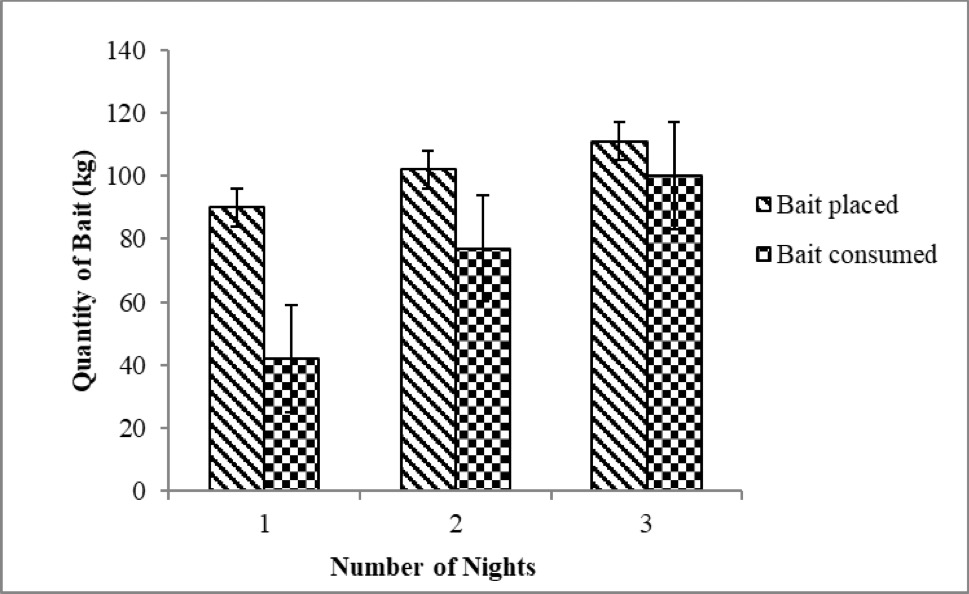
Pre-baiting trend of animal fat coated grain bait applied and consumed by wild boar at Nilor field area.
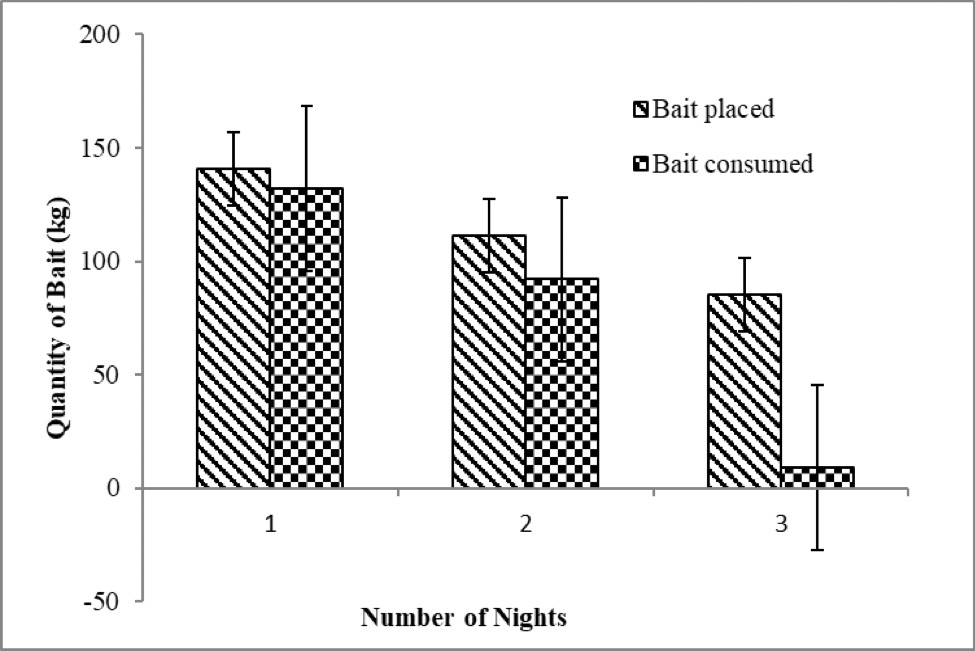
Poison-baiting trend of animal fat coated zinc phosphide (4%) grain bait consumed by wild boar at Nilor field area.
The delivery of poison bait was stopped for 10 days (after 1st phase of poisoning). During the second phase, starting on the 11th day, 160 kg of poison bait was consumed at 18 points for three nights. During this second phase a total of 250 dead bodies were found from the field area. 75% mortalities were recorded after 1st day of the poison baiting, 15% on the second day and rest were found after 3rd day of baiting. During the 2nd phase of poison baiting, 497 kg of bait was delivered out of which 393 kg was consumed by wild boars present in the operational area, causing about 450 mortalities of boar.
Repeated measures ANOVA revealed a statistically significant decline in bait consumption over three days (F = 50.03, p < .001, η² = 0.746), with both linear and quadratic trends significant, suggesting rapid population suppression following toxic bait placement.
DISCUSSION
During the three nights of pre-baiting, the observations were recorded about the bait consumption, showing that maximum bait consumption was recorded on the 3rd night which showed wild boar population gradually became more attracted to the bait. These results align with earlier findings of Khokhar and Rizvi (1998) emphasizing the consumption of dough balls on the second and third nights of pretreatment baiting was almost constant at most of the sites. Pre-baiting is important in improving the effectiveness of population control strategies. Lavelle et al. (2018) evaluated the movement behavior to improve toxic baiting strategies for wild pigs and found out that giving wild pig at least 15 days to get used to the bait stations worked best, and almost 90% of them ate the non-toxic bait.
The present study demonstrated a clear and statistically significant decline in bait consumption by wild boars following the application of toxic bait. During the three-day poison baiting phase, repeated measures ANOVA revealed a strong reduction in consumption, with means decreasing from 7.33 kg on Day 1 to only 0.50 kg by Day 3. This decline was supported by a highly significant main effect of time (p < 0.001) and a large effect size (Partial η² = 0.746), indicating a substantial reduction in wild boar activity at bait stations. Trend analysis revealed both a significant linear and quadratic effect, suggesting that the drop in consumption was most dramatic after the second day.
The results of this study demonstrated the effectiveness of zinc phosphide as a toxicant for controlling wild boar (Sus scrofa) populations. The significant decline in bait consumption over the three-day poisoning period, following a successful pre-baiting phase, suggests that a substantial portion of the local population was affected by the toxic bait. Zinc phosphide is known for its rapid mode of action and acute toxicity, causing mortality typically within a few hours of ingestion due to the release of phosphine gas in the stomach, which interferes with cellular respiration (EPA, 1998). The sharp decline in bait consumption observed in this study, from 132 kg on Day 1 to 9 kg on Day 3 from all bait stations, reflects the toxicant’s high lethality.
During three nights of poison baiting the maximum bait applied at one bait point was 30 kg while the minimum quantity was 13 kg, average being 18.72 kg per bait point. Similarly, the maximum bait consumed at one bait point was 25 kg while the minimum quantity was 02 kg, average being 12.94 kg. The consumption data of poison bait for 1st two nights was 93.62% and 82.88%, respectively. It showed maximum consumption of animal fat coated 4% zinc phosphide maize grain bait. Similar high consumption was reported by Khan et al. (2017) for coumatetralyl-coated maize grain bait, confirming maize as a preferred bait base for wild boars.
Zinc phosphide offers the advantage of rapid action for immediate population control as it was observed in previous experiment where paraffinized 2% zinc phosphide capsular Technology was used to kill 98.11% wild boar population successfully . In the Punjab, 80.4% to 100.0% reduction in pig activity was noted through application of this capsular technique. The animal fat coated zinc phosphide grain bait delays the release of phosphine gas from the poison as phosphine gas is only released when it reacts with moisture (water or stomach acid). Animal fat is hydrophobic in nature; the fat forms a protective layer around the poison, which limits the exposure to moisture in the environment. Also, palatability of poison bait was increased due to coating of animal fat because; wild boar being omnivores in nature preferred the animal fat. It is usually the oil (fat in this case) baits which are most productive of nose-ticking vapours to wild boar. Khokhar and Rizvi (1998) also observed that the paraffinization of the poison capsules most probably delays the release of the poison.
Zinc phosphide, an acute rodenticide, is widely used in 11 rice producing countries of Southeast Asia, mostly at concentrations of 1-5% ; ; . Zn3P2 is one of the safest rodenticide available and should continue to be used as a field rodenticide. The results of field studies have shown few risks to non-target species when its baits are properly applied ; . The strong emetic action of Zn3P2 reduces secondary risks and most carnivores refuse to eat the gastrointestinal tracts of poisoned animals. During this current study no such incident was observed with zinc phosphide 4% bait because of strong ematic action of the compound . Zinc phosphide is one of the safest rodenticide available in the world market and should continue to be used as a field rodenticide. The results of field studies have shown few risks to non-target animal species when baits are properly applied such as using protected bait stations. Several studies indicate that zinc phosphide possess little secondary risk to non-target wildlife .
CONCLUSION
The present study demonstrated that wild boar readily accepted maize-based bait during the pre-baiting phase, with a significant increase in consumption over time. Following the application of animal fat-coated 4% zinc phosphide maize grain bait, the consumption declined sharply within two days, indicating high bait efficacy and likely population suppression. Animal fat is an effective attractant to increase bait palatability and initial uptake by wild boar. The significant temporal trends and large effect sizes confirm the effectiveness of combining pre-baiting with acute toxic baiting for wild boar control. The findings of this field study support Zn3P2 as a promising toxicant against wild boar. Further studies are suggested to evaluate long-term impacts, environmental safety, and effectiveness under varying field conditions such as large scale area based operations.
DECLARATIONS
Acknowledgment
We acknowledge the support and help in the field operation of staff of Pakistan Institute of Engineering and Applied Sciences for their valuable cooperation and assistance in identifying suitable baiting points in the Nilore area during the conduct of this study.
Fundings
This work was funded by Agricultural Linkages Program (ALP) of Pakistan Agricultural Research Council, Islamabad, under the project CS-195 Development of bait delivery systems and screening the palatability of baits formulated for the management of wild boar, (Sus scrofa).
Authors’ Contribution
IA: Conceptualization, investigation, methodology, visualization, writing review and editing. US: Investigation, methodology, formal analysis, data curation, writing original draft. AAK: Conceptualization, data curation, formal analysis; writing review and editing.
Ethical statement
The authors comply with all the laws and regulations that apply to science and profession during the period of studies.
Generative AI and AI assisted technology statement
No artificial intelligence (AI) tools were used in the preparation, writing, analysis, or interpretation of this manuscript. All content is the original work of the authors.
Statement of conflict of interest
The authors have declared no conflict of interest.
References
- Brooks, J.E., Ahmad, E., Hussain, I. and Khan, M.H., 1989. The agricultural importance of the wild boar (Sus scrofa L.) in Pakistan. Trop. Pest Manage., 35: 278-281.
- Caudell, J.N. and Shwiff, S.A., 2007. Modeling costs of using Ovo Control G for managing nuisance Canada goose (Branta canadensis) populations. In: Proceedings of the 12th wildlife damage management conference (eds. D.L. Nolte, W.M. Arjo and D.H. Stalman). University of Nebraska, Lincoln, NE, pp. 42-49.
- Ch Karim, F. and Zakaria, S.M., 1962. Studies on the control of the wild boars in the old Punjab region. Agric. Pak., 13: 85-89.
- Choquenot, D., Kay, B. and Lukins, B., 1990. An evaluation of warfarin for the control of feral pigs. J. Wildl. Manage., 54: 353-359.
- Dunne, H.W., 1970. The role of wild animals in the epidemiology of foot-and-mouth disease. J. Am. Vet. Med. Assoc., 157: 1821-1827.
- EPA (U.S. Environmental Protection Agency), 1998. Reregistration Eligibility Decision (RED) for Zinc Phosphide. Office of Pesticide Programs.
- Fall, M.W., 1980. Management strategies for rodent damage problems in agriculture. In: Proc. Symp. on small mammals: Problems and control. (ed. F.E. Sanches). Biotrop Publication No. 12: 248, 177-182.
- Fitzpatrick, R.J., McGirr, J.I. and Papworth, D.S., 1955. The toxicity of rodenticides. II. Red squill and zinc phosphide. Vet. Rec., 67: 124, 142, 144, 245, 250.
- Hegdal, P.L., Gatz, T.A. and Fite, E.C., 1981. Secondary effects of rodenticides on mammalian predators. In: Proc. The Worldwide Fur Bearer Conf. Frostburg, MD, pp. 1781-1793.
- Hone, J. and Atkinson, B., 1983. Evaluation of fencing to control feral pig movement. Aust. Wildl. Res., 10: 499-506. [CrossRef]
- Hood, G.A., 1972. Zinc phosphide– a new look at an old rodenticide for field rodents. In: Proc. 5th Vertebr. Pest Conf. Fresno, California, pp. 85-92.
- Inayatullah, C., 1973. Wildboar in West Pakistan. Wildlife Management Branch Bull. No. 1. Pakistan Forest Research Institute, Peshawar, 17.
- Johnson, G.D. and Fagerstone, K.A., 1994. Primary and secondary hazards of zinc phosphide to non-target wildlife: A review of the literature. DWRC Research Report No. 11-55-005, 26.
- Khan, A.A., Munir, S. and Ahmed, I., 2017. Field evaluation of coumatetralyl for the control of wild boar, Sus scrofa cristatus. Pakistan J. Zool., 49: 1143-1146.
- Khokhar, A.R. and Rizvi, S.W.A., 1998. Productivity enhancement of rice crop yield through prevention of losses due to wild boars in Pakistan. Turk. J. Zool., 22: 167-174.
- Lavelle, M.J., Snow, N.P., Halseth, J.M., VanNatta, E.H., Sanders, H.N. and VerCauteren, K.C., 2018. Evaluation of movement behaviors to inform toxic baiting strategies for invasive wild pigs (Sus scrofa). Pest. Manage. Sci., 74: 2504-2510.
- Matschke, G.H. and Lavoie, G.K., 1976. Zinc phosphide– a literature review. Denver Wildlife Research Centre, CO: US Fish and Wildlife Service, 45.
- O’Brien, P.H., 1988. The use of 1080 poison for feral pig control in Australia. Aust. Wildl. Res., 15: 283-290.
- Pavlov, P.M., 1980. Control methods for the Asiatic wildboar (Sus scrofa cristatus) in Pakistan. Assig. Report. FAO, Rome, 12.
- Roberts, T.J., 1997. Mammals of Pakistan. Revised edition. Ernest Benn Ltd., London, 526.
- Shafi, M.M. and Khokhar, A.R., 1986. Distribution and status of wild boar (Sus scrofa) in Pakistan. J. Bombay Nat. Hist. Soc., 83: 63-67.
- Singleton, G.R. and Petch, D.A., 1994. A review of the biology and management of rodent pests in Southeast Asia. ACIAR Tech. Report No. 30: 65.
- Sterner, R.T., 1999. Pre-baiting for increased acceptance of zinc phosphide baits by voles: an assessment technique. Pestic. Sci., 55: 553-557. [CrossRef]
- Taber, R.D., 1965. The emergent boars. Pac. Discov., 18: 10.
- Tariq, S.A., Pervez, A., Ahmed, S.M. and Zaffar, H., 2019. Development of vertebrate pest management models for sugarcane crop. Pakistan Sugr. J., 34: 15-22. [CrossRef]

Services
Article usage statistics
Loading…
Related articles
- Field Evaluation of Coumatetralyl for the Control of Wild Boar, Sus scrofa cristatusPakistan Journal of Zoology · 2017
- Evaluation of a Novel Technique to Detect the Presence and Attraction of Wild Boar (Sus scrofa) towards Baiting PointsSouth Asian Journal of Zoology · 2025
- Evaluation of Bait Formulations of Coumatetralyl (Racumin) for Rodent Control in Wheat Crop in Pothwar ZoneSouth Asian Journal of Zoology · 2025
- Population Frequencies and Proportional Efficacies of Acute and Anticoagulant Rodenticides Formulated Baits and Fumigant Against Rodent Pests of Wheat CropSouth Asian Journal of Zoology · 2025
- Development and Evaluation of a Maize Cob Based Bait Formulation against Subterranean Termites (Odontotermes spp.)Sarhad Journal of Agriculture · 2022
- Field Evaluation of Selective Systemic Formulations against Sucking Insect Pest Complex and their Natural Enemies on a Transgenic Bt CottonPakistan Journal of Zoology · 2017