
Regional food-security studies commonly emphasize aggregate public spending or socioeconomic determinants, leaving limited evidence on whether the functional composition of local agricultural expenditure matters, particularly in coastal and rural regions exposed to logistical and climate-related risks. The objective of this study is to determine the effect of the composition of fiscal policy expenditure in the agricultural sector on government performance in improving the Food Security Index in regencies/cities in the Tomini Bay Region, Indonesia. This study employs a quantitative approach using secondary data from 17 regencies/cities over the 2020–2024 period, yielding 85 panel data observations. FSI data were obtained from the National Food Agency, while fiscal data were obtained from the Directorate General of Fiscal Balance (DJPK) of the Ministry of Finance. The independent variables include economic function expenditure for agriculture and food security, social welfare function expenditure for farmers, and environmental function expenditure for sustainable agriculture. The analytical technique used is multiple regression with panel data. The results indicate that the composition of fiscal expenditure in the agricultural sector is able to explain government performance in improving the FSI by 97.6665%. Expenditure on the economic function of agriculture and food security and expenditure on the environmental function of sustainable agriculture are positively and significantly associated with the Food Security Index. By contrast, social-welfare expenditure for farmers has a positive but statistically insignificant association. The study contributes to the fiscal-policy and regional food-security literature by demonstrating that the functional allocation of agricultural expenditure, rather than expenditure volume alone, is relevant to regional food-security outcomes. Agricultural spending appears more effective when directed toward productivity enhancement, distribution infrastructure, technology adoption, market access, climate adaptation, and ecosystem protection. The findings suggest that local governments should integrate cross-functional expenditure planning, link farmer assistance to productive empowerment, and strengthen climate-resilient local food systems.
Research Article · Volume 43, Issue 2, 2027, Pages 288–299, published online 27 November 2026 · Open Access
Analysis of Government Performance in Enhancing the Food Security Index Based on the Composition of Fiscal Policy Expenditure in the Agricultural Sector of Regencies/Cities in the Tomini Bay Region, Indonesia
, , ,
Affiliations & Notes ⌄
- 1Department of Agribusiness, Gorontalo State University, Gorontalo
- 2Department of Development Economics, Gorontalo State University, Gorontalo:
- 3Department of Animal Science, Gorontalo State University, Gorontalo:
- 4Department of Public Administration, Muhammadiyah University of Gorontalo, Gorontalo, Indonesia
- *Correspondence | Siti Rahmatia Machieu; Email: rahmatiamachieu@ung.ac.id
Article Info ⌄
- Journal:
- Sarhad Journal of Agriculture
- Submitted Date:
- 5 November 2025
- Accepted Date:
- 29 July 2026
- Published Date:
- 27 November 2026
Abstract
Introduction
Regional food security is a measure of the government’s capacity to manage economic development that addresses the basic needs of society. At the regency/municipal level, the Food Security Index (FSI) is not merely an aggregate figure, but a reflection of the availability, affordability, utilization, supply stability, purchasing power, infrastructure, and sustainability of the food system. The six-dimensional food security framework positions agency and sustainability as important elements in assessing policy quality; therefore, the evaluation of government performance needs to examine how public budgets strengthen the food system . Food security performance across regions is influenced by economic capacity, governance, and policy strategies .
The Tomini Bay Region is strategic for Indonesia’s food security because it brings together agriculture, fisheries, livestock, smallholder plantations, and the coastal economy. However, regencies/cities in this region face infrastructure disparities, limited connectivity, variations in public services, and differences in fiscal capacity. Therefore, government performance cannot be assessed solely on the basis of the magnitude of agricultural expenditure, but must also consider its composition, allocation direction, targeting accuracy, and impact on the FSI. Soko et al. (2023) emphasize that public agricultural expenditure is more effective in improving food security when supported by sound institutions; thus, agricultural budgets must promote improvements in food production, distribution, access, and consumption.
The composition of fiscal expenditure in the agricultural sector is important because each type of expenditure has different effects. Capital expenditure strengthens irrigation, farm production roads, post-harvest facilities, and storage; goods and services expenditure supports extension services, pest control, food data collection, and distribution; while social assistance or grants support farmers and vulnerable households when their targets and programs are appropriate. Sogah et al. (2024) state that government expenditure in the agricultural sector is associated with increased production. The fiscal function of agriculture also serves as an instrument for income stabilization, competitiveness enhancement, and protection against food market risks .
Post-pandemic fiscal policy has been directed toward budget consolidation, efficiency, and improving the quality of development expenditure. Indrawati et al. (2024) emphasize that the effectiveness of public expenditure needs to be strengthened through sharper prioritization, subsidy reform, poverty targeting, and alignment of regional policies with national directions. Large agricultural expenditure does not necessarily increase the FSI if it is concentrated on administration or short-term programs. Conversely, limited budgets can still perform well when directed toward food value chains, farmer productivity, local food diversification, and the protection of vulnerable groups. Fitrawaty et al. (2026) show that Indonesia’s food security is sensitive to macroeconomic shocks. Strengthening government performance requires indicator-based monitoring. Garton et al. (2022) emphasize the importance of monitoring and evaluation to ensure that food system transformation proceeds in an accountable manner. Béné et al. (2022) caution that food system transformation requires measurement that captures sustainability, equity, and the quality of development outcomes.
Chandio et al. (2023) show that farm management and agricultural investment play an important role in increasing wheat production. Jiang and Huang (2026) demonstrate that fiscal support for sustainable agriculture can affect soil health and farmer welfare. Boly and Sanou (2022) state that policies in the agricultural sector can influence food security through the dynamics of production and the use of agricultural resources. Béné et al. (2021) find that the access dimension was the most affected aspect during the pandemic in many low- and middle-income countries. Improving food security in Tomini Bay requires the integration of agricultural productivity, investment, and ecological sustainability. Farm management and investment can increase wheat production , while fiscal support for sustainable agriculture affects soil health and farmer welfare . Cross-sectoral policies also determine production, resources, and food access ; .
Data on the food security index in the three provinces of the Tomini Bay Region, representing the average of the regencies/cities included in the Tomini Bay Region, are presented as follows:
Based on Figure 1, it can be seen that the average FSI of regencies/cities in the Tomini Bay Region is relatively high, with Gorontalo consistently remaining above 80 and reaching 81.99 in 2024. North Sulawesi fluctuated from 81.35 in 2020 to 77.21 in 2024, and this province should receive attention because its FSI over the last three years has tended to be lower than in 2020–2021. Meanwhile, Central Sulawesi was relatively lower, although it increased to 73.47 in 2024 after consistently declining during 2020–2023. An interesting point concerns Gorontalo: the high FSI of Gorontalo needs to be interpreted cautiously because PoU remains high, increasing from 10.33% in 2020 to 15.99% in 2024, even placing it among the ten highest nationally. This indicates that fiscal performance in the food sector has not fully ensured the adequacy of public consumption.
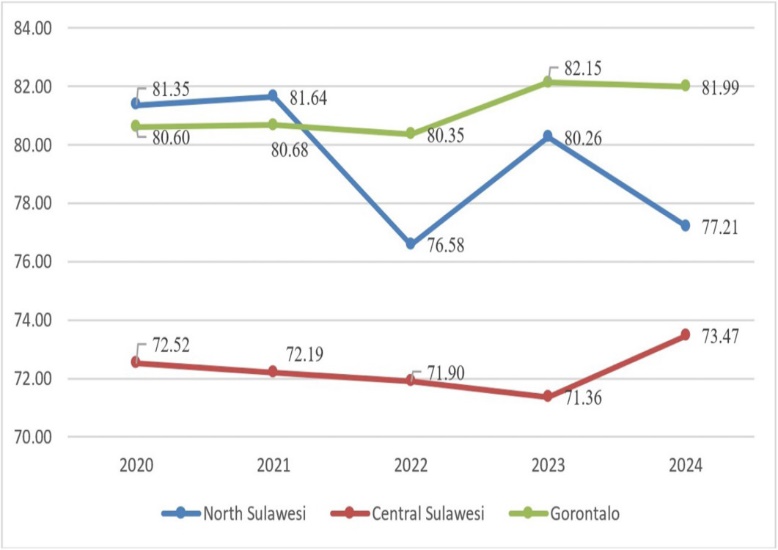
Average provincial food security index based on regency/city data in the tomini bay region
Recent studies indicate that food security is shaped by food system resilience, policy effectiveness, and public expenditure performance. Tendall et al. (2015) and Schipanski et al. (2016) conceptualize resilient food systems, while Cottrell et al. (2019) reveal vulnerabilities from production shocks. Béné et al. (2021) emphasize food access during crises, and Boly and Sanou (2022) demonstrate varied policy impacts on Indonesia’s food security. Springmann et al. (2018) highlight sustainable food system limits, whereas Béné et al. (2022), Garton et al. (2022), and Fanzo et al. (2021) stress measurement, monitoring, and accountability improvements. Kandanda Maroy et al. (2026) show budget realization is more decisive than allocation alone. However, limited studies integrate these dimensions; therefore, this study develops a framework linking resilience, policy implementation, and expenditure effectiveness to strengthen Indonesia’s sustainable food security governance.
The objective of this study is to analyze the effect of the composition of fiscal policy expenditure in the agricultural sector, consisting of economic function expenditure for agriculture and food security, social welfare function expenditure for farmers, and environmental function expenditure for sustainable agriculture, on government performance in improving the Food Security Index in regencies/cities in the Tomini Bay Region, Indonesia.
Materials and Methods
The approach used in this study is quantitative, namely a research approach that emphasizes objective measurement and the analysis of numerical data to understand a particular phenomenon ; . This study was conducted in 17 regencies/cities in the Tomini Bay Region. Data collection in this study employed the documentation method because it used secondary data. This study used secondary data accessed through the National Food Agency at https://satudata.badanpangan.go.id and the Directorate General of Fiscal Balance (DJPK) of the Ministry of Finance at https://djpk.kemenkeu.go.id/?p=5412 for fiscal data. The data used cover the period 2020–2024; thus, the number of panel data observations was 85 research data points. Data analysis in this study used multiple regression with panel data, which is a statistical analytical method used to measure the effect of more than one independent variable on one dependent variable (Y) using panel data, namely a combination of time-series and cross-sectional data ; ; . The equation for panel data regression is as follows:
FSIit = αit + β1EFEAFSit + β2SWFEFit + β3EFESAit + ε
Description:
FSI = Food Security Index; EFEAFS = economic function expenditure for agriculture and food security; SWFEF = social welfare function expenditure for farmers; EFESA = environmental function expenditure for sustainable agriculture; α = constant; β = regression coefficient; ε = epsilon.
Results and Discussion
The number of data points in this study was 85, consisting of 5 years of time-series data and 17 regions (regencies/cities) in the Tomini Bay Region. Based on the results of the Chow test and the Hausman test, this study employed the Fixed Effect Model (FEM) approach.
Classical assumption testing
The results of the classical assumption testing using the assistance of the E-Views 9 program are as follows:
Table 1: Classical assumption testing of panel data multiple regression
| No | Classical assumption | Type of test | Variabel | ||
| EFEAFS | SWFEF | EFESA | |||
| 1 | Normality | Jarque bera | 3.327958 (0.189384) | ||
| 2 | Autocorrelation | Durbin watson | 1.708632 | ||
| 3 | Multicollinearity | VIF | 2.675 | 1.587 | 1.303 |
| 4 | Heteroscedasticity | Glejser (Prob. value) | 0.2417 | 0.7983 | 0.2211 |
Source: E-Views Version 9 Data Processing, 2026
Based on Table 1, the results of the classical assumption analysis of panel data multiple regression can be interpreted as follows:
Normality
The data normality test (Jarque Bera) found that the Jarque Bera (JB) value was 3.327, with a test probability value of 0.189. This probability or significance value is greater than 0.05; therefore, Ho is accepted, and the data in this study satisfy the normality test (the data are normally distributed).
Autocorrelation testing
The Durbin Watson value was 1.708. The calculated Durbin Watson value lies between -2 and +2 (-2 < 1.708 < +2). Thus, it can be concluded that the data satisfy the autocorrelation test.
Multicollinearity testing
The Variance Inflation Factor (VIF) value for the variable of economic function expenditure for agriculture and food security was 2.675. The VIF value for social welfare function expenditure for farmers was 1.587, and that for environmental function expenditure for sustainable agriculture was 1.303. These VIF values are lower than the standard threshold of 10; therefore, it is concluded that the regression model does not have a multicollinearity problem.
Heteroscedasticity testing
The probability value of economic function expenditure for agriculture and food security was 0.2417. The probability value of social welfare function expenditure for farmers was 0.7983, and the probability value of environmental function expenditure for sustainable agriculture was 0.2211. Based on these results, the probability values of the Glejser test are greater than the alpha value of 0.05; therefore, the regression model in this study is not affected by symptoms of heteroscedasticity.
Multiple regression equation
The results of the analysis using the E-Views 9 program are presented in Table 2 as follows:
Table 2: Results of panel data multiple regression analysis
| Dependent Variable: FSI | ||||
| Method: Panel Least Squares | ||||
| Date: 05/22/26 Time: 09:16 | ||||
| Sample: 2020 2024 | ||||
| Periods included: 5 | ||||
| Cross-sections included: 17 | ||||
| Total panel (balanced) observations: 85 | ||||
| Variable | Coefficient | Std. error | t-Statistic | Prob. |
| C | 4.400766 | 0.040687 | 108.1613 | 0.0000 |
| EFEAFS | 0.007780 | 0.001633 | 4.763443 | 0.0000 |
| SWFEF | 0.002245 | 0.001384 | 1.621661 | 0.1097 |
| EFESA | 0.003675 | 0.001342 | 2.738450 | 0.0303 |
| Effects specification | ||||
| Cross-section fixed (dummy variables) | ||||
| R-squared | 0.981943 | Mean dependent var | 10.32375 | |
| Adjusted R-squared | 0.976665 | S.D. dependent var | 8.106939 | |
| S.E. of regression | 0.040980 | Sum squared resid | 0.109159 | |
| F-statistic | 186.0351 | Durbin-Watson stat | 1.708632 | |
| Prob(F-statistic) | 0.000000 | |||
Source: E-Views Version 9 Data Processing, 2026
Based on the figures in the Unstandardized Coefficients column, the multiple regression equation is as follows:
Ŷ = 4.4007 + 0.0077X1 + 0.0022X2 + 0.0036X3 + e
Subsequently, the testing proceeded with the coefficient of determination and hypothesis testing as follows:
Coefficient of determination
Based on Table 2, the coefficient of determination or Adjusted R Square value is 0.976665. This value indicates that 97.6665% of the variability in government performance in improving the Food Security Index of regencies/cities in the Tomini Bay Region can be explained by economic function expenditure for agriculture and food security, social welfare function expenditure for farmers, and environmental function expenditure for sustainable agriculture. Meanwhile, the remaining 2.3335% is explained by other variables not examined in this study, such as agricultural productivity, market access and logistics infrastructure, food price stability, household income levels, climate change, the level of diversification of food sources, and access to basic services related to nutrition and health.
Simultaneous test results
Based on Table 2, the calculated F-value was 186.0351, with a significance value of 0.000000. This significance value is smaller than the alpha value of 0.05; therefore, the hypothesis is accepted. This means that economic function expenditure for agriculture and food security, social welfare function expenditure for farmers, and environmental function expenditure for sustainable agriculture simultaneously have a significant effect on government performance in improving the Food Security Index of regencies/cities in the Tomini Bay Region.
Partial testing
The effect of economic function expenditure for agriculture and food security on government performance in improving the food security index
Based on the analysis in Table 2, the calculated t-value was 4.763443, with a significance value of 0.0000, which is smaller than the alpha value of 0.05; therefore, economic function expenditure for agriculture and food security has a positive and significant effect on government performance in improving the Food Security Index of regencies/cities in the Tomini Bay Region. The positive and significant coefficient indicates that an increase in government expenditure allocation for economic functions related to the agricultural sector and food security is able to improve government performance in strengthening regional food security. This condition shows that government investment in agricultural development, such as the provision of production facilities and infrastructure, irrigation development, support for agricultural technology, improved market access, and strengthening of food distribution chains, has a tangible impact on regional capacity to ensure the availability, affordability, and sustainability of food supplies for the community.
For regencies/cities in the Tomini Bay Region, where most local economies still rely on the agricultural sector, economic expenditure functions not only as an instrument for developing the production sector, but also as an effort to enhance regional capacity in addressing the risk of food insecurity. The greater the budgetary support directed toward strengthening productivity and efficiency in the agricultural sector, the greater the opportunity for local governments to increase local food availability, reduce dependence on supplies from outside the region, and maintain food stability for the community. Thus, economic function expenditure is one of the strategic instruments that directly supports the achievement of regional food security. Economic function expenditure directed toward agriculture and food security is able to strengthen the capacity of local governments to deliver food-related services more concretely. In the Tomini Bay Region, field needs do not stop at increasing production, but also concern the quality of governance, the accuracy of program targeting, and the government’s ability to identify farmers’ needs in each area. When budgets are delivered in the form of institutional support, mentoring, and coordination across regional government agencies, agricultural programs can more readily address fundamental issues such as production inputs, farmer group development, and the strengthening of local supply. This is in line with Asare-Nuamah et al. (2023), who emphasize the importance of governance in strengthening food security, and Subramaniam et al. (2022), who show that institutional quality plays a role in improving food access and availability.
Government expenditure in the agricultural sector needs to be understood as a lever for local economic capacity. The Tomini Bay Region has agrarian and coastal characteristics; therefore, the effectiveness of expenditure depends heavily on its ability to improve the relationship among production, technology, and farmer welfare. In practice, farmers often face limited technology, production costs, access to financing, and weak bargaining power in the market. Therefore, economic expenditure that promotes technology adoption, financing expansion, and the enhancement of farm business capacity can affect regional food resilience. Abdul-Majid et al. (2024) show that agricultural technology adoption is associated with improved farmer welfare, while Okunlola and Ayetigbo (2024) affirm that agricultural financing is an important factor for sustaining growth in the agricultural sector. Regencies/cities in Tomini Bay do not always face the same problems; some areas are closer to production centers, while others face logistical constraints, limited infrastructure, and the pressure of climate change on cropping patterns. Strong economic expenditure can help regions build more adaptive responses through improvements in production infrastructure, distribution support, and the strengthening of agricultural services. Oyelami et al. (2023) emphasize that climate change and institutional quality are related to food security, while Azimi and Rahman (2024) show that the environment, institutions, and food vulnerability are interrelated in determining the quality of community welfare.
The effect of social welfare function expenditure for farmers on government performance in improving the food security index
Based on the analysis in Table 2, the calculated t-value was 1.621661, with a significance value of 0.1097, which is greater than the alpha value of 0.05; therefore, social welfare function expenditure for farmers has a positive but insignificant effect on government performance in improving the Food Security Index of regencies/cities in the Tomini Bay Region. The positive but insignificant coefficient indicates that social welfare programs intended for farmers are, in principle, aligned with efforts to improve food security. Nevertheless, their contribution has not been strongly evident in promoting an increase in the regional Food Security Index. This condition may indicate that social welfare expenditure functions more as an instrument of protection and as a buffer for farmer household welfare than as an instrument that directly increases food production capacity.
Social assistance, subsidies, and various forms of social protection for farmers can indeed help maintain purchasing power and reduce the economic vulnerability of farmer households. However, these benefits tend to be felt more in terms of individual or household welfare in the short term than in aggregate improvements in food production and availability at the regional level. In addition, it is still possible that the amount of assistance provided has not been sufficient to encourage changes in production behavior or farm investment that would affect improvements in food security. Improving food security is not sufficient through a social assistance approach alone, but requires integration with productive programs that can enhance farm business capacity, land productivity, and the sustainability of farmers’ income. In other words, social protection remains important, but its effectiveness will be greater if it is synergized with agricultural economic development programs.
Social welfare expenditure for farmers has a supportive direction, but it has not yet become the main driver of improvements in the regional FSI. In the Tomini Bay Region, assistance received by farmers is often more quickly absorbed for household consumption needs, education costs, health care, or daily needs when food prices and production costs increase. This situation makes the benefits of the program evident in the socio-economic stability of farmer families, but it does not immediately alter regional food production capacity. Ghosh et al. (2024) show that cash transfers to farmers are more effective when linked to broader rural development strategies. Mwakipesile et al. (2026) also affirm that cash assistance can improve household food access, but its impact depends on program design and the vulnerability conditions of the region. Social welfare expenditure for farmers needs to be viewed as a risk-buffering instrument, particularly when farmers face crop failure, price fluctuations, limited planting capital, and pressure from living costs. However, its driving force for the FSI may weaken if assistance is not connected to productive programs such as access to seeds, fertilizers, extension services, mechanization, farm financing, and the strengthening of farmer institutions. Msuha and Kissoly (2024) show that participants in productive safety net programs may remain vulnerable to poverty and food insecurity if support is not sufficient to change the economic capacity of households. Czyżewski et al. (2025) also affirm that social protection expenditure for farmers has a redistributive function, but it needs to be balanced with an agricultural development orientation.
Improving food security does not depend solely on the existence of social assistance, but also on the ability of local governments to link farmer protection with improvements in the local food ecosystem. Smallholder farmers, farm laborers, women farmers, and vulnerable households need protection so that they do not fall deeper into hardship when facing economic pressure, but they also require access to productive assets, markets, technology, and agricultural services. Annaful and Annan (2025) emphasize the importance of strengthening equitable livelihoods for actors in the food system, while Jomo (2026) shows that social inclusion in food system transformation is important for improving food security in a sustainable manner. Thus, social welfare expenditure will be more effective if it serves as an entry point toward the economic empowerment of farmers.
The effect of environmental function expenditure for sustainable agriculture on government performance in improving the food security index
Based on the analysis in Table 2, the calculated t-value was 2.738450, with a significance value of 0.0303, which is smaller than the alpha value of 0.05; therefore, environmental function expenditure for sustainable agriculture has a positive and significant effect on government performance in improving the Food Security Index of regencies/cities in the Tomini Bay Region. The positive and significant coefficient indicates that government expenditure directed toward environmental aspects and sustainable agriculture contributes to strengthening regional food security. This finding means that the success of food security is determined not only by short-term increases in food production, but also by the government’s ability to maintain the quality of natural resources that constitute the primary foundation of agricultural activities.
Environmental function expenditure realized through land conservation, water resource management, rehabilitation of critical areas, environmental pollution control, and climate change mitigation efforts can enhance the carrying capacity of agricultural ecosystems. These conditions enable food production activities to proceed more stably and sustainably. In the context of the Tomini Bay Region, which is highly dependent on natural resources, well-maintained environmental quality will be an important factor in sustaining agricultural productivity and reducing the risk of crop failure due to environmental degradation and climate change. Food security policy cannot be separated from environmental policy. Efforts to increase food production that are not balanced with sound environmental management have the potential to reduce agricultural productivity in the future. Therefore, budget allocation for environmental functions constitutes a form of long-term investment that not only preserves the sustainability of natural resources, but also strengthens regional capacity to ensure food security for present and future generations.
Government allocation to the environmental agenda is an important component of regional performance in strengthening food security. In Tomini Bay, agricultural productivity is strongly influenced by seasons, land conditions, water availability, and increasingly unpredictable weather changes. When local governments pay attention to ecological risk control, farmers have better opportunities to maintain cropping patterns and reduce production vulnerability. Rezaei et al. (2023) affirm that climate change can suppress crop yields through heat, drought, and disruptions to water availability. Mudzielwana (2025) also emphasizes the importance of climate-smart food systems that combine adaptation, mitigation, and governance so that agriculture remains productive under environmental pressure.
Regional food security cannot be built merely through rapid production-oriented interventions; it requires agricultural practices that maintain soil fertility, biodiversity, and resource efficiency. In the agricultural areas of Tomini Bay, problems such as declining land quality, erosion, dependence on chemical inputs, and weak post-harvest land recovery can reduce regional capacity to maintain local food supplies. Therefore, budgetary support for sustainable agriculture is important for improving the ecological foundation of farm enterprises. Kerr et al. (2021) show that agroecology can strengthen food security through diversification, agroforestry, and soil management. Kabato et al. (2025) affirm that climate-smart agriculture promotes productivity while reducing environmental pressure. Government performance in increasing the FSI will be more robust if environmental protection is positioned as part of the food development strategy, rather than merely as a conservation matter. The Tomini Bay Region has a combination of coastal areas, agricultural plains, and rural areas that are mutually dependent; therefore, disruptions to water, soil, and land cover can affect the food supply chain. Strengthening environmental policies can help maintain the sustainability of small-scale agriculture, improve the carrying capacity of the region, and reduce pressure on farmer households. Ricciardi et al. (2021) show that small-scale agriculture can support yields and biodiversity, while Rockström et al. (2023) emphasize the importance of maintaining safe boundaries for Earth systems, including climate, water, and nutrient cycles. Thus, if the agricultural sector is optimized by taking sustainability aspects into account, it will have a long-term impact on food security.
The composition of fiscal expenditure in the agricultural sector has strong explanatory power for local government performance in improving food security in the Tomini Bay Region. Economic expenditure, farmer social protection, and environmental expenditure cannot be viewed as separate budget items, but rather as an integrated regional food policy. Field conditions show that farmers need not only production support, but also social protection, institutional access, and a stable farm business environment. Fanzo et al. (2021) emphasize the importance of a food system monitoring framework to strengthen policy accountability, while Aassouli et al. (2023) show that food governance alignment determines the sustainability of food security policies. Strengthening the FSI in Tomini Bay cannot rely on a single type of expenditure, because regional food issues are cross-sectoral. Economic expenditure appears to drive productivity and distribution, social expenditure plays a role in maintaining the resilience of farmer households, while environmental expenditure strengthens the sustainability of the food production base. However, field-level factors such as market quality, logistics, household income, local food diversity, and nutrition services still need to be considered to ensure that food security achievements become increasingly robust. del Valle et al. (2024) emphasize the importance of integrating public programs in food governance, while Munyoro (2025) shows that strengthening the capacity of smallholder farmers can improve local food access during disruptions.
Conclusions and Recommendations
This study indicates that regional food security is shaped not only by the volume of agricultural expenditure but also by how fiscal resources are distributed across economic, social, and environmental functions. The positive and significant associations of economic and environmental expenditure with the Food Security Index suggest that local fiscal policy is more effective when it addresses both the productive and ecological foundations of the food system. Economic expenditure appears to strengthen food security by improving production capacity, irrigation, infrastructure, technology adoption, distribution, and market access. Environmental expenditure complements these functions by protecting land quality, water availability, and ecosystem resilience, which are especially important in the agrarian and coastal areas of the Tomini Bay Region. The insignificant association of farmer social-welfare expenditure should not be interpreted as evidence that such spending is unnecessary. Instead, it indicates that its contribution may be indirect, delayed, or dependent on programme design. Social assistance can protect household consumption and reduce vulnerability, but it may not immediately improve regional indicators of food availability, distribution, or system stability unless it is connected to productive empowerment. Theoretically, this study extends the literature on public expenditure and food-system resilience by showing that different expenditure functions operate through distinct transmission mechanisms. Economic spending strengthens productive and market capacity, environmental spending protects the natural resource base, and social spending buffers household-level risks. Therefore, similar levels of total agricultural expenditure may generate different food-security outcomes depending on their functional composition, coordination, and implementation quality. This interpretation shifts attention from aggregate spending levels toward the quality, purpose, and complementarity of regional fiscal interventions.
Based on these findings, local governments should prioritize the effectiveness of economic expenditure for irrigation, storage, agricultural extension, appropriate technology, local distribution networks, and market connectivity. Performance should be monitored through measurable indicators, such as irrigation functionality, post-harvest loss reduction, technology adoption, and farmer market access. Environmental expenditure should be integrated into food-security planning through land conservation, watershed protection, efficient water management, and climate-adaptive agriculture. Social-welfare programmes should be redesigned by linking assistance to training, productive assets, farm financing, insurance, and farmer organizations. These recommendations should be implemented through integrated budgeting, programme-level expenditure tracking, and periodic outcome evaluation. Because the analysis is observational, the findings indicate robust associations rather than definitive causal effects. Future studies should examine budget realization, lagged effects, food prices, productivity, household income, logistics, nutrition access, climate shocks, and spatial dependence.
Acknowledgments
The authors would like to express their gratitude to the Institute for Research and Community Service (LPPM) of Gorontalo State University and the Ministry of Higher Education, Science, and Technology of the Republic of Indonesia.
Novelty Statement
The novelty of this study lies in the integration of government performance, regional food security, and the composition of fiscal policy expenditure in the agricultural sector into a single analytical framework that is more specifically focused on regencies/cities in the Tomini Bay Region. Theoretically, this study expands the understanding that regional food security is influenced not only by the size of the budget, but also by the direction of expenditure composition, which includes economic functions, farmer social welfare, and the environment for sustainable agriculture. Methodologically, this study offers a more measurable approach through the use of regency/municipal panel data, thereby enabling the capture of interregional variation and temporal dynamics in assessing food-related fiscal performance. The novelty of the research findings is reflected in the finding that economic expenditure and environmental expenditure play a strong role in driving improvements in the FSI, whereas farmer social welfare expenditure has not yet become a strong direct driver. This finding provides a practical contribution, namely that agricultural fiscal policy in Tomini Bay needs to be directed not only toward farmer protection, but also toward productivity, distribution, and the sustainability of the food ecosystem.
Author’s Contribution
Siti Rahmatia Machieu: Conceptualized the study, designed the methodology, resources research management, supervised the research process, writing original draft preparation, and writing review and editing
Fitri Hadi Yulia Akib: Conceptualization, methodology, formal analysis, writing original draft preparation, writing review and editing
Muhammad Mukhtar: Conducted data collection, statistical analysis, and interpretation of results.
Umar Sako Baderan: Formal analysis, and project administration.
All authors reviewed and approved the final version of the manuscript.
All authors contributed significantly to this research.
Generative AI and AI-assisted technology statement
The authors declare that no generative AI and AI assisted technology was used in the creation of this manuscript.
Conflicts of interest
The authors have declared no conflict of interest.
References
- Aassouli, D., A. Akande and R. Jureidini. 2023. Comparative analysis of sustainable food governance and the alignment of food security policies to sustainable development: A case study of OIC countries. Sustain., 15(22): 15789. https://doi.org/10.3390/su152215789 [CrossRef]
- Abdul-Majid, M., S.A. Zahari, N. Othman and S. Nadzri. 2024. Influence of technology adoption on farmers’ well-being: Systematic literature review and bibliometric analysis. Heliyon., 10(2): e24316. https://doi.org/10.1016/j.heliyon.2024.e24316 [CrossRef]
- Annaful, V.T., and R.A. Annan. 2025. Advancing equitable livelihoods of people involved in Ghana’s food systems: A scoping review of evidence. Front. Sustain. Food Sys., 9:1723213. https://doi.org/10.3389/fsufs.2025.1723213 [CrossRef]
- Asare-Nuamah, P., A. Amoah and S.A. Asongu. 2023. Achieving food security in Ghana: Does governance matter? Polit. Policy. https://doi.org/10.1111/polp.12540 [CrossRef]
- Azimi, M.N. and M.M. Rahman. 2024. Food insecurity, environment, institutional quality, and health outcomes: Evidence from South Asia. Glob. Health. 20:22. https://doi.org/10.1186/s12992-024-01022-2 [CrossRef]
- Béné, C., D. Bakker, M.J. Chavarro, B. Even, J. Melo and A. Sonneveld. 2021. Global assessment of the impacts of COVID-19 on food security. Glob. Food Secur., 31:100575. https://doi.org/10.1016/j.gfs.2021.100575 [CrossRef]
- Béné, C., J. Fanzo, H.A. Achicanoy and M. Lundy. 2022. Can economic development be a driver of food system sustainability? Empirical evidence from a global sustainability index and a multi-country analysis. PLOS Sustain. Transfor., 1(5): e0000013. https://doi.org/10.1371/journal.pstr.0000013 [CrossRef]
- Boly, M. and A. Sanou. 2022. Biofuels and food security: Evidence from Indonesia and Mexico. Ener. Policy., 163: 112834. https://doi.org/10.1016/j.enpol.2022.112834 [CrossRef]
- Chandio, A.A., M. Alnafissa, W. Akram and M. Usman. 2023. Examining the impact of farm management practices on wheat production: Does agricultural investment matter? Heliyon., 9(12): e22838. https://doi.org/10.1016/j.heliyon.2023.e22838 [CrossRef]
- Choudhury, A. and S. Sahu. 2023. Reconciling the mixed evidence in the fiscal decentralization-government size nexus using panel quantile regression. Econ. Modell., 125: 106347. https://doi.org/10.1016/j.econmod.2023.106347 [CrossRef]
- Clapp, J., W.G. Moseley, B. Burlingame and P. Termine. 2022. The case for a six-dimensional food security framework. Food Policy., 106: 102164. https://doi.org/10.1016/j.foodpol.2021.102164 [CrossRef]
- Cottrell, R.S., K.L. Nash, B.S. Halpern, et al. 2019. Food production shocks across land and ocean reveal similar vulnerabilities. Nature Food., 1: 14-21. https://doi.org/10.1038/s43016-019-0006-0 [CrossRef]
- Czyżewski, A., R. Kata and A. Matuszczak. 2025. Variability of the level of budget expenditures on social insurance of farmers in the agricultural policy of Poland after accession to the European Union. Sustain., 17(3): 947. https://doi.org/10.3390/su17030947 [CrossRef]
- del Valle, M., K. Shields and S. Boza. 2024. Integration and coherence in food governance—A comprehensive analysis of food security public programs in Chile. Front. Sustain. Food Syst., 8: 1431969. https://doi.org/10.3389/fsufs.2024.1431969 [CrossRef]
- Fanzo, J., L. Haddad, K.R. Schneider, C. Béné, N.M. Covic, A. Guarin, A.W. Herforth, M. Herrero, U.R. Sumaila, N.J. Aburto, M. Amuyunzu-Nyamongo, S. Barquera, J. Battersby, T. Beal, P. Bizzotto Molina, E. Brusset, E. Cafiero, C. Campeau, P. Caron, et al. 2021. Rigorous monitoring is necessary to guide food system transformation in the countdown to the 2030 global goals. Food Policy., 104: 102163. https://doi.org/10.1016/j.foodpol.2021.102163 [CrossRef]
- Fanzo, J., L. Haddad, K.R. Schneider, et al. 2021. Rigorous monitoring of food systems transformation: A key to achieving sustainable development goals. Food Policy., 104: 102146. https://doi.org/10.1016/j.foodpol.2021.102034 [CrossRef]
- Fitrawaty, M. Rinaldi, S.T. Wahyudi and I. Muda. 2026. Exchange rate shocks and food security in Indonesia (1990–2024): Evidence from a vector error correction. Cogent Econ. Finan., 14(1): 2644569. https://doi.org/10.1080/23322039.2026.2644569 [CrossRef]
- Garton, K., V. Kraak, J. Fanzo, G. Sacks, S. Vandevijvere, L. Haddad, et al. 2022. A collective call to strengthen monitoring and evaluation efforts to support healthy and sustainable food systems: The Accountability Pact. Publ. Health Nutrit., 25(9): 2353-2357. https://doi.org/10.1017/S1368980022001173 [CrossRef]
- Ghosh, B., R.R. Burman, R.N. Padaria, S. Paul, G.S. Mahra, P. Kumar, A. Bhowmik, S. Mallick, et al. 2024. Performance of cash transfer program on farmers’ livelihood: Evidence from PM-KISAN scheme of India. Front. Sustain. Food Syst., 8:1478795. https://doi.org/10.3389/fsufs.2024.1478795 [CrossRef]
- Guo, X. and M. Islam. 2025. Advancing food security and proposing future strategies: A comparative performance analysis of Global Food Security Index and Annual Population Changes of top-ranked countries. PLOS ONE., 20(5): e0324231. https://doi.org/10.1371/journal.pone.0324231 [CrossRef]
- Indrawati, S.M., E. Satriawan and Abdurohman. 2024. Indonesia’s fiscal policy in the aftermath of the pandemic. Bulletin of Indonesian Economic Studies. Advance online publication. https://doi.org/10.1080/00074918.2024.2335967 [CrossRef]
- Jiang, L. and L. Huang. 2026. Fiscal support for sustainable agriculture: Assessing the impacts of input subsidies on soil health and farmer livelihoods in China. Front. Sustain. Food Syst., 10: 1774647. https://doi.org/10.3389/fsufs.2026.1774647 [CrossRef]
- Jomo, S. 2026. Gender equality and social inclusion in food systems transformation pathways: Evidence from Eastern Africa. Front. Sustain. Food Syst., 10: 1816769. https://doi.org/10.3389/fsufs.2026.1816769 [CrossRef]
- Kabato, W., G.T. Getnet, T. Sinore, A. Nemeth and Z. Molnár. 2025. Towards climate-smart agriculture: Strategies for sustainable agricultural production, food security, and greenhouse gas reduction. Agron., 15(3): 565. https://doi.org/10.3390/agronomy15030565 [CrossRef]
- Kandanda Maroy, L.P., D. Bahati Shamamba, J.K. Buraye, B. Bashangwa Mpozi and A.O. Egesa. 2026. Public agricultural financing, budget execution, and food and nutritional security outcomes in the DRC: Evidence from time-series analysis. Front. Sustain. Food Syst., 10: 1800720. https://doi.org/10.3389/fsufs.2026.1800720 [CrossRef]
- Kata, R., A. Czyżewski and A. Matuszczak. 2024. Functions of fiscal policy concerning agriculture in Poland after accession to the European Union (2004–2022). Polish Polit, Sci, Yearbook., 53(2). https://doi.org/10.15804/ppsy202421 [CrossRef]
- Kerr, R.B., S. Madsen, M. Stüber, J. Liebert, S. Enloe, N. Borghino, P. Parros, D.M. Mutyambai, M. Prudhon and A. Wezel. 2021. Can agroecology improve food security and nutrition? A review. Glob. Food Secur., 29: 100540. https://doi.org/10.1016/j.gfs.2021.100540 [CrossRef]
- Msuha, B. and L.D. Kissoly. 2024. Analysis of vulnerability to poverty and food insecurity among productive social safety net program participants in Tanzania. Cogent Soc. Sci., 10(1): 2329807. https://doi.org/10.1080/23311886.2024.2329807 [CrossRef]
- Mudzielwana, R.V.A. 2025. Climate-smart food systems: Integrating adaptation and mitigation strategies for sustainable agriculture in South Africa. Front. Sustain. Food Syst., 9: 1580516. https://doi.org/10.3389/fsufs.2025.1580516 [CrossRef]
- Munyoro, J.K. 2025. Strengthening small-scale farmers capability to enhance local food access amid disruptions. Front. Sustain. Food Sys., 9: 1508056. https://doi.org/10.3389/fsufs.2024.1508056 [CrossRef]
- Mwakipesile, G., L. Mwinuka and W. George. 2026. Integrated cash transfer programmes and household food security: An endogenous switching regression analysis from drought-prone regions of Tanzania. Cogent Food Agric., 12(1): 2673254. https://doi.org/10.1080/23311932.2026.2673254 [CrossRef]
- Okunlola, O.C. and O.A. Ayetigbo. 2024. Impact of agricultural financing on agricultural growth sustainability in Nigeria. J. Develop. Areas. https://doi.org/10.1353/jda.2024.a929946 [CrossRef]
- Oyelami, L.O., S.E. Edewor, J.O. Folorunso and U.D. Abasilim. 2023. Climate change, institutional quality and food security: Sub-Saharan African experiences. Scient. Afric., 21: e01837. https://doi.org/10.1016/j.sciaf.2023.e01837 [CrossRef]
- Purba, B., R.E. Rosihana, Haryasena, Nurjannah, H.T. Mokui, R.J. Sugiharjo, M.R. Gobel, K. Arsyad, S. Abdullah, I.Z. Rela, S.F. Tauran, P.B. Purba, F.T.R. Silalahi, R. Febrinova, M.Z. Hippy, A. Hindardjo, D.S. Purba, S.R. Machieu, N.M. Purnami, S.H. Tampubolon and St. R. Aisyah. 2024. Metode penelitian dalam bisnis dan ekonomi. Yayasan Kita Menulis. ISBN: 978-623-113-640-4.
- Putria, A.C., T.S. Prakoso and M. Ohyver. 2023. Modeling the effect of poverty rate, GDRP, and minimum wage, on mean years of schooling in Gorontalo province with panel data regression. Proced. Comp. Sci., 216: 510-516. https://doi.org/10.1016/j.procs.2022.12.163 [CrossRef]
- Ratnasari, V., S.H. Audha and A.T.R. Dani. 2023. Statistical modeling to analyze factors affecting the middle-income trap in Indonesia using panel data regression. Method X. 11: 102379. https://doi.org/10.1016/j.mex.2023.102379 [CrossRef]
- Rezaei, E.E., H. Webber, S. Asseng, K. Boote, J.L. Durand, F. Ewert, P. Martre and D.S. MacCarthy. 2023. Climate change impacts on crop yields. Natu. Rev. Earth Environ., 4(12): 831-846. https://doi.org/10.1038/s43017-023-00491-0 [CrossRef]
- Ricciardi, V., Z. Mehrabi, H. Wittman, D. James and N. Ramankutty. 2021. Higher yields and more biodiversity on smaller farms. Natu. Sustain., 4(7): 651-657. https://doi.org/10.1038/s41893-021-00699-2 [CrossRef]
- Rockström, J., J. Gupta, D. Qin, S.J. Lade, J.F. Abrams, L.S. Andersen, D.I. Armstrong McKay, X. Bai, G. Bala, S.E. Bunn, D. Ciobanu, F. DeClerck, K. Ebi, L. Gifford, C. Gordon, S. Hasan, N. Kanie, T.M. Lenton, S. Loriani, et al. 2023. Safe and just Earth system boundaries. Nature., 619(7968): 102-111. https://doi.org/10.1038/s41586-023-06083-8 [CrossRef]
- Schipanski, M.E., G.K. MacDonald, S. Rosenzweig, et al. 2016. Realizing resilient food systems. Bio. Sci., 66(8): 600-610. https://doi.org/10.1093/biosci/biw052 [CrossRef]
- Siregar, R.S., Ika, K. Situmorang, H. Lestari, W.R. Kunusa, I. Rahmawati, A.S. Daming, St. R. Aisyah, I.Z. Rela, S. Abdullah, J. Simarmata, S.F. Tauran, J.S. Lakat, R. Nurlim, E.K. Wiyati, S.R. Machieu and I. Kato. 2025. Penelitian kualitatif dan kuantitatif. Yayasan Kita Menulis. ISBN: 978-623-113-717-3.
- Sogah, E., J.K.M. Mawutor, I. Ofoeda and F.C. Gborse. 2024. The relationship between government expenditure on agriculture and agriculture production. Journal of Economic and Administrative Sciences. Advan. online Public., https://doi.org/10.1108/JEAS-06-2023-0163 [CrossRef]
- Soko, N.N., S. Kaitibie and N.N. Ratna. 2023. Does institutional quality affect the impact of public agricultural spending on food security in Sub-Saharan Africa and Asia? Glob. Food Secur., 36:100668. https://doi.org/10.1016/j.gfs.2022.100668 [CrossRef]
- Springmann, M., M. Clark, D. Mason-D’Croz, et al. 2018. Options for keeping the food system within environmental limits. Nature., 562: 519-525. https://doi.org/10.1038/s41586-018-0594-0 [CrossRef]
- Subramaniam, Y., T.A. Masron and T. Subramaniam. 2022. Institutional quality and food security. Singapore Econ. Rev. https://doi.org/10.1142/S0217590820500046. [CrossRef]
- Tendall, D.M., J. Joerin, B. Kopainsky, P. Edwards, A. Shreck, Q.B. Le, P. Krütli, M. Grant and J. Six. 2015. Food system resilience: Defining the concept. Glob. Food Secur., 6: 17-23. https://doi.org/10.1016/j.gfs.2015.08.001 [CrossRef]

Services
Article usage statistics
Loading…
Related articles
- The Mediating Role of Extreme Poverty in the Relationship Between the Blue Economy and Food Security in Coastal Areas of Tomini Bay, IndonesiaPakistan Journal of Agricultural Research · 2026
- Comparative Analysis of Agricultural Institutional Policies on Smallholder Farmers’ Food Security: Evidence from Indonesia, China and IndiaSarhad Journal of Agriculture · 2023
- Analysis of Food and Nutrition Security in Pakistan: A Contribution to Zero Hunger PoliciesSarhad Journal of Agriculture · 2021
- Situation Analysis of Food Security and Access to Advisory Services for Small Scale Rural Households Under AKIS Model in the Punjab PakistanPakistan Journal of Agricultural Research · 2025
- A Multivariate Cluster Analysis of Soybean Meal from Sindh, Pakistan Reveals Distinct Nutri-Physiochemical Profiles Governing its Valorization in Poultry DietsVeterinary Sciences: Research and Reviews · 2026
- Integrated Community-Based Agribusiness Models for Transforming Smallholder Cattle Farming: A Multi-Dimensional Sustainability PerspectiveAdvances in Animal and Veterinary Sciences · 2026