
Nitrogen (N) is an essential macronutrient influencing soybean production and soil health under sustainable agricultural systems. The present study evaluated the effect of different nitrogen fertilizer rates on soybean growth, grain yield, and post-harvest soil nitrogen concentration. The field experiment was conducted during the Rabi season of 2023–2024 at the Soil and Environment Research Institute, Tandojam, Pakistan, using a randomized complete block design (RCBD) with four treatments and four replications. All treatments received 50 kg P₂O₅ ha⁻¹ through diammonium phosphate (DAP; 18-46-0), while urea supplied the treatment-specific additional N. The treatments were T1: 0 kg N ha⁻¹ from urea + 50 kg P₂O₅ ha⁻¹, T2: 75 kg N ha⁻¹ from urea + 50 kg P₂O₅ ha⁻¹, T3: 37.5 kg N ha⁻¹ from urea + 50 kg P₂O₅ ha⁻¹, and T4: 18.75 kg N ha⁻¹ from urea + 50 kg P₂O₅ ha⁻¹. Agronomic parameters, including plant height, number of leaves plant⁻¹, number of pods plant⁻¹, and grain yield, together with selected soil physicochemical properties, were determined after harvest. The highest residual soil nitrogen concentration (0.029%) and organic matter content (0.53%) were recorded in T2. However, T4 recorded the maximum plant height (15.6 cm), number of leaves plant⁻¹ (17), number of pods plant⁻¹ (24.9), and grain yield (1100 kg ha⁻¹). The higher grain yield observed under T4 suggests that the lower urea-N rate was sufficient under the conditions of this experiment; however, nitrogen use efficiency and the contribution of biological nitrogen fixation were not directly quantified. Therefore, the findings support further evaluation of reduced urea-N rates under locally relevant conditions rather than providing a direct estimate of nitrogen use efficiency or biological nitrogen fixation.
Research Article · Volume 42, Issue 2, Pages 135–140, 28 November 2026 · Open Access
Effect of N-Fertilizer Application on Growth, Yield and Soil Nitrogen Content in Soybean (Glycine max L.) Under Sustainable Agriculture
, , , , , ,
Affiliations & Notes ⌄
- 1Soil and Environment Research Institute, Tandojam, Pakistan
- *Correspondence | Nazia Rais; Email: naziarais81@gmail.com
Article Info ⌄
- Journal:
- Advances in Agriculture and Animal Sciences
- Submitted Date:
- 28 July 2026
- Accepted Date:
- 14 November 2026
- Published Date:
- 28 November 2026

From the article
- The higher yield in T4 may indicate that the lower urea-N rate was adequate under the specific soil, climatic, and management conditions of the trial.
- Different urea-N rates, applied with a uniform phosphorus rate, affected post-harvest soil N, soybean growth, and grain yield under the agro-climatic conditions of Tandojam.
- T2 produced the highest residual soil N (0.029%), whereas T4 produced the tallest plants, the highest number of leaves and pods, and the highest grain yield (1100 kg ha⁻¹).
- Under the specific conditions of this field experiment, T4 (18.75 kg N ha⁻¹ from urea + 50 kg P₂O₅ ha⁻¹) was associated with the highest measured soybean growth and grain yield.
Selected from the article's own text.
Abstract
Introduction
Nitrogen (N) is one of the most essential macronutrients required for plant growth and development, playing a fundamental role in chlorophyll synthesis, photosynthesis, protein formation, enzyme activity, and crop productivity. Excessive dependence on synthetic nitrogen fertilizers can increase production costs, nitrogen losses, greenhouse gas emissions, nitrate leaching, and environmental pollution . Consequently, improving nitrogen management through environmentally responsible approaches has become an important goal of sustainable agriculture ; . Soybean (Glycine max L. Merr.) is an important legume because of its high protein and oil contents. In addition to its nutritional value, soybean can contribute to nitrogen cycling through biological nitrogen fixation (BNF) in association with compatible rhizobia. This process can reduce dependence on fertilizer N under suitable environmental and biological conditions ; . The amount of N derived from biological fixation varies with genotype, rhizobial effectiveness, soil conditions, and climate. Nitrogen contained in roots and residues may also contribute to subsequent nutrient cycling after decomposition ; . However, the magnitude of BNF cannot be inferred directly from residual soil N or crop yield unless it is specifically measured. Soybean may benefit from a small amount of mineral N during early growth before effective nodulation, whereas excessive mineral N can alter nodulation and BNF . Therefore, determining an appropriate fertilizer-N rate is important for crop performance and efficient use of applied nutrients. In Pakistan, particularly in Sindh Province, agricultural soils may have low organic matter and limited available nitrogen because of intensive cultivation, inadequate residue recycling, and imbalanced fertilizer use. Information on soybean response to reduced fertilizer-N rates under local agro-climatic conditions remains limited. Keeping these considerations in view, the present study was conducted at the Soil and Environment Research Institute, Tandojam, during the Rabi season 2023–2024. The objective was to evaluate the effect of different urea-N rates, applied with a uniform phosphorus rate, on soybean growth, yield, and post-harvest soil nitrogen concentration. Nodulation and BNF were not quantified and therefore were not used as directly measured response variables in the present study.
Materials and Methods
The experiment was conducted during the Rabi season 2023–2024 at the Soil and Environment Research Institute (SERI), Tandojam, Sindh, Pakistan. The experimental soil was silty clay loam. Before sowing, composite soil samples were collected randomly from 0–15 cm depth across the experimental field to determine initial physicochemical properties (Table 1). Samples were air-dried, gently ground, and passed through a 2-mm sieve before analysis. Soil pH and electrical conductivity (EC) were measured in a 1:2 soil-to-water suspension following Richards (1954). Soil texture was determined by the hydrometer method . Organic matter was measured by the Walkley–Black wet-oxidation method , and total nitrogen by Kjeldahl digestion . Available phosphorus was determined by sodium-bicarbonate extraction using the Olsen method . Available potassium was determined by flame photometry following the institute laboratory’s routine soil-testing procedure. Initial soil analysis indicated pH 8.40, EC 2.70 dS m⁻¹, organic matter 0.50%, total N 0.028%, available P 2.50 mg kg⁻¹, and available K 260 mg kg⁻¹. Soil samples were collected again after harvest using the same sampling depth and laboratory procedures. The soybean variety was PARC-11, developed by the Pakistan Agricultural Research Council (PARC), Islamabad, and was sown on 15 November 2023 at a seed rate of 25–30 kg acre⁻¹. Before sowing, seed was inoculated with Bradyrhizobium japonicum using a sugar solution (26 g sugar) as an adhesive, and 120 g inoculum acre⁻¹ was applied. The crop was planted at 45 cm row-to-row and 5 cm plant-to-plant spacing, giving an approximate plant population of 120,000 plants ha⁻¹. The experiment comprised four treatments. All treatments received the same phosphorus rate of 50 kg P₂O₅ ha⁻¹ through DAP (18-46-0), applied before sowing during land preparation. Urea was the source of the treatment-specific additional N. The treatments were: T1, 0 kg N ha⁻¹ from urea + 50 kg P₂O₅ ha⁻¹; T2, 75 kg N ha⁻¹ from urea + 50 kg P₂O₅ ha⁻¹; T3, 37.5 kg N ha⁻¹ from urea + 50 kg P₂O₅ ha⁻¹; and T4, 18.75 kg N ha⁻¹ from urea + 50 kg P₂O₅ ha⁻¹. No additional urea was applied at the flowering stage. Because DAP (18-46-0) also supplies nitrogen, 50 kg P₂O₅ ha⁻¹ corresponds to approximately 108.7 kg DAP ha⁻¹ and contributes approximately 19.6 kg N ha⁻¹ to each treatment. Thus, the approximate total fertilizer-N inputs from urea plus DAP were 19.6, 94.6, 57.1, and 38.3 kg N ha⁻¹ for T1, T2, T3, and T4, respectively. These values distinguish the urea-N treatment rates from total fertilizer-N input. The experiment was arranged in a randomized complete block design (RCBD) with four treatments and four replications. Each plot measured 25 m² (5 m × 5 m). Irrigation was applied three to five times according to crop water requirements, and weed control, plant protection, and other intercultural practices were maintained uniformly. Agronomic observations included plant height, number of leaves plant⁻¹, number of pods plant⁻¹, and grain yield. Soil pH, EC, organic matter, total N, available P, and available K were determined before sowing and after harvest.
Table 1: Physicochemical properties of the experimental soil before sowing of soybean crop.
| Soil property | Unit | Value |
| Soil texture | — | Silty clay loam |
| pH (1:2 soil-water suspension) | — | 8.40 |
| Electrical conductivity (EC) | dS m⁻¹ | 2.70 |
| Organic matter | % | 0.50 |
| Total nitrogen | % | 0.028 |
| Available phosphorus | mg kg⁻¹ | 2.50 |
| Available potassium | mg kg⁻¹ | 260 |
Statistical analysis
The experimental data were subjected to analysis of variance (ANOVA) using Statistics version 8.1. Treatment means were compared using the least significant difference (LSD) test at the 5% probability level (P ≤ 0.05). The reported error bars represent the standard error of the mean. Because the present dataset did not include a direct calculation of nitrogen use efficiency (NUE), BNF, or N balance components, these variables were not statistically analyzed as measured response variables.
Results and Discussion
Effect of different nitrogen fertilizer rates on soil physicochemical properties
The effect of different urea-N rates on soil physicochemical properties after soybean harvest is presented in Table 2. Soil EC varied from 0.74 to 0.82 dS m⁻¹, with the lowest value in T2 and the highest in T1. Soil pH remained within a relatively narrow range (8.76–8.84). Organic matter was highest in T2 (0.53%), followed by T3 (0.51%) and T4 (0.50%), while T1 had the lowest value (0.49%). According to the ANOVA, organic matter differed significantly among treatments, whereas EC and pH did not. The limited change in pH and EC over one growing season is consistent with the relatively short duration of the experiment; therefore, stronger changes should not be inferred from the present study. The small differences in organic matter may be associated with differences in crop biomass and residue inputs, but residue carbon inputs were not directly quantified in this experiment. Similar links between crop management, nutrient inputs, biomass production, and soil organic matter dynamics have been discussed in recent soil and crop studies ; . Thus, the present data support a modest treatment-associated difference in post-harvest organic matter rather than a direct demonstration of improved long-term soil health.
Table 2: Effect of different nitrogen fertilizer rates on soil physicochemical properties after harvest.
| Treatment | EC (dS m⁻¹) | pH | Organic matter (%) | Soil texture |
| T1 | 0.82±0.02 | 8.84±1.07 | 0.49±0.05 | Silty clay loam |
| T2 | 0.74±0.03 | 8.76±1.06 | 0.53±0.06 | Silty clay loam |
| T3 | 0.77±0.01 | 8.79±1.05 | 0.51±0.04 | Silty clay loam |
| T4 | 0.79±0.02 | 8.81±1.08 | 0.50±0.01 | Silty clay loam |
Effect of different nitrogen fertilizer rates on soil nutrient content
The post-harvest soil nutrient results are presented in Table 3. Residual soil N was highest in T2 (0.029%), followed by T3 (0.026%) and T4 (0.024%), while T1 had the lowest value (0.022%). Available P (2.40–2.60 mg kg⁻¹) and K (256–262 mg kg⁻¹) varied within relatively narrow ranges among treatments. The higher residual N under T2 may reflect the larger mineral-N input, but residual concentration alone does not quantify crop N uptake or nitrogen-use efficiency. Similar studies emphasize that fertilizer-N supply, crop uptake, and biological fixation jointly influence N balances in grain legumes ; ; . Because nodulation, biological N fixation, and N uptake were not measured here, the relative contribution of these processes cannot be established from this dataset.
Table 3: Effect of different nitrogen fertilizer rates on soil nutrient content after harvest.
| Treatment | Nitrogen (%) |
Phosphorus (mg kg⁻¹) |
Potassium (mg kg⁻¹) |
| T1 | 0.022±0.002 | 2.40±0.5 | 256±2.45 |
| T2 | 0.029±0.003 | 2.60±0.9 | 262±3.33 |
| T3 | 0.026±0.001 | 2.50±0.6 | 260±4.65 |
| T4 | 0.024±0.002 | 2.50±0.8 | 258±5.78 |
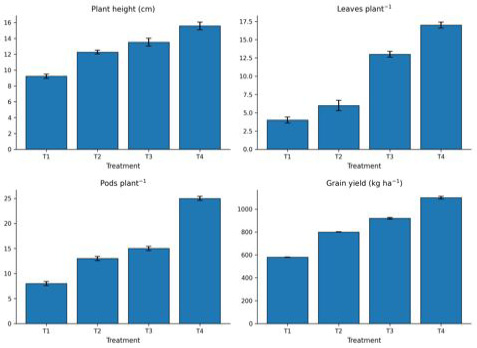
Effect of the four fertilizer treatments on (A) plant height, (B) number of leaves per plant, (C) number of pods per plant, and (D) grain yield. Bars show treatment means and error bars represent the standard error of the mean calculated from four field replicates. Significance letters are not shown because the original ANOVA/LSD output was not available for independent verification.
Effect of different nitrogen fertilizer rates on soybean growth
As shown in Figure 1, plant height increased across the fertilized treatments relative to T1. The tallest plants (15.6 cm) were recorded in T4, followed by T3 (13.4 cm) and T2 (11.8 cm), whereas T1 recorded 8.3 cm. These differences indicate that the tested urea-N rates affected vegetative growth under the experimental conditions. The response is consistent with the recognized role of N in supporting vegetative development and crop productivity ; . However, the superior response of T4 should not be interpreted as direct evidence of higher NUE or BNF because neither variable was measured. The maximum number of leaves plant⁻¹ was recorded in T4 (17), followed by T3 (13), T2 (6), and T1 (4). Leaf development can be influenced by N availability and overall plant growth; however, photosynthetic rate and leaf area were not measured in the present experiment. Therefore, the results demonstrate differences in leaf number but do not directly establish differences in photosynthetic efficiency. The maximum number of pods plant⁻¹ was recorded in T4 (24.9), followed by T3 (20.8), T2 (16.7), and T1 (8.7). The greater pod number in T4 was accompanied by its higher grain yield, suggesting a favorable yield-component response under the tested treatment. Comparable studies emphasize that soybean growth and yield responses to N supply are influenced by the interaction between fertilizer N, biological N fixation, and crop demand ; . The physiological mechanism responsible for the present response requires further investigation.
Effect of different nitrogen fertilizer rates on grain yield
Grain yield differed significantly among treatments. The maximum grain yield (1100 kg ha⁻¹) was recorded in T4, followed by T3 and T2, whereas the control treatment produced 580 kg ha⁻¹ (Figure 1). Although T2 had the highest residual soil N, it did not produce the highest grain yield. Thus, a greater amount of residual N was not necessarily associated with greater grain production in this experiment. The higher yield in T4 may indicate that the lower urea-N rate was adequate under the specific soil, climatic, and management conditions of the trial. Similar research has shown that soybean N responses are shaped by both fertilizer-N supply and biological N fixation, with management and environmental conditions influencing the balance between these sources ; . However, the present study cannot determine whether the T4 response resulted from improved NUE, greater BNF, altered N uptake, or another physiological mechanism because these parameters were not directly measured. The inoculation with Bradyrhizobium japonicum provides biological context for interpreting the soybean response, but it does not quantify the amount of atmospheric N fixed. In addition, improved NUE should not be inferred solely from higher yield at a lower fertilizer-N rate; direct NUE calculations based on N uptake and/or defined agronomic efficiency measures are required ; ; . Therefore, the present findings should be interpreted as evidence of a favorable soybean growth and yield response to the tested reduced urea-N treatment, rather than as a direct measurement of NUE or BNF.
This study has several limitations. It was conducted at one site during a single growing season, so the findings should not be generalized to other soils, seasons, or production systems without further testing. Nodulation, biological nitrogen fixation, plant N uptake, and nitrogen-use efficiency were not measured directly, consequently, these processes cannot be confirmed as mechanisms underlying the observed responses.
Conclusion
Different urea-N rates, applied with a uniform phosphorus rate, affected post-harvest soil N, soybean growth, and grain yield under the agro-climatic conditions of Tandojam. T2 produced the highest residual soil N (0.029%), whereas T4 produced the tallest plants, the highest number of leaves and pods, and the highest grain yield (1100 kg ha⁻¹). Because all treatments received the same 50 kg P₂O₅ ha⁻¹ through DAP (18-46-0), the treatment comparison was conducted under a common phosphorus supply. DAP also contributed approximately 19.6 kg N ha⁻¹ to each treatment, and no additional urea was applied at flowering. The higher yield under T4 suggests that the lower urea-N rate was adequate under the conditions of this one-season experiment. However, NUE, nodulation, and BNF were not directly measured; therefore, the observed response cannot be used to quantify NUE or the contribution of BNF. Under the specific conditions of this field experiment, T4 (18.75 kg N ha⁻¹ from urea + 50 kg P₂O₅ ha⁻¹) was associated with the highest measured soybean growth and grain yield. Multi-season and multi-location studies including direct measurements of N uptake, NUE, nodulation, and BNF are recommended before making broader fertilizer recommendations.
Acknowledgement
The authors gratefully acknowledge the Soil and Environment Research Institute, Tandojam, Pakistan, for providing the research facilities and institutional support necessary to conduct this study. The authors sincerely thank **Mr. Sohail Ahmed Qureshi, Director, Soil and Environment Research Institute, Tandojam, Pakistan, for providing financial support** for this research. The authors also acknowledge the valuable assistance of the institute’s technical staff during the experimental work.
Novelty Statement
The novelty of this study lies in its systematic evaluation of different nitrogen fertilizer rates and their effects on soybean growth, yield performance, and post-harvest soil nitrogen status under the agro-climatic conditions of Tandojam, Sindh, Pakistan. By assessing soybean responses to varying urea-N application rates under a uniform phosphorus supply, this study provides location-specific evidence on nitrogen management and crop productivity. Furthermore, the assessment of post-harvest soil nitrogen status offers additional insight into the effects of nitrogen fertilization on soil nutrient dynamics. The findings contribute to the development of locally adapted and resource-efficient nitrogen management strategies, supporting sustainable soybean production and improved nutrient use in the region.
Author’s Contribution
Nazia Rais: Conceptualization, methodology, investigation, data curation, formal analysis, visualization, writing – original draft, and writing – review and editing.
Sohail Ahmed Qureshi: Funding acquisition, supervision, project administration, and critical review of the manuscript.
Inzamam-ul-Haque Khanzada: Research guidance, validation, and writing – review and editing.
Naseer Ahmed Deho: Investigation, data collection, and laboratory analysis.
Nasir Khan Katyar: Investigation, data collection, and laboratory analysis.
Fozia Naz Memon: Data curation, laboratory analysis, and writing – review and editing.
Muhammad Yaseer: Experimental assistance, data collection, and laboratory support.
All authors read and approved the final version of the manuscript.
Generative AI and AI assisted technology statement
The authors declare that no generative AI and AI assisted technology was used in the creation of this manuscript.
Conflict of interest
The authors have declared no conflict of interest.
References
- Bremner, J.M., 1996. Nitrogen–Total. In: D.L. Sparks (Ed.), Methods of Soil Analysis, Part 3: Chemical Methods. Soil Science Society of America, Madison, Wisconsin, USA. pp. 1085–1121. https://doi.org/10.2136/sssabookser5.3.c37 [CrossRef]
- Elli, E.F., Ciampitti, I. A., Castellano, M. J., Purcell, L. C., Naeve, S., Grassini, P., La Menza, N. C., Moro Rosso, L., de Borja Reis, A. F., Kovács, P., and Archontoulis, S.V. 2022. Climate change and management impacts on soybean N fixation, soil N mineralization, N₂O emissions, and seed yield. Front. Plant Sci., 13: 849896. https://doi.org/10.3389/fpls.2022.849896 [CrossRef]
- Elrys, A.S., Elnahal, A. S., Abdo, A. I., Desoky, E. S., Selem, E., and Rady, M. M. 2022. Traditional, modern and molecular strategies for improving the efficiency of nitrogen use in crops for sustainable agriculture: A fresh look at an old issue. J. Soil Sci. Plant Nutr., 22: 3130–3156. https://doi.org/10.1007/s42729-022-00873-1 [CrossRef]
- Govindasamy, P., Muthusamy, S. K., Bagavathiannan, M., Mowrer, J., Jagannadham, P. T. K., Maity, A., Halli, H. M., Sujanayananad, G. K., Vadivel, R., Das, T. K., Raj, R., Pooniya, V., Babu, S., Rathore, S. S., 2023. Nitrogen use efficiency—a key to enhance crop productivity under a changing climate. Front. Plant Sci., 14: 1121073. https://doi.org/10.3389/fpls.2023.1121073 [CrossRef]
- Goyal, R.K., Mattoo, A.K. and Schmidt, M.A., 2021. Rhizobial–host interactions and symbiotic nitrogen fixation in legume crops toward agriculture sustainability. Front. Microbiol., 12: 669404. https://doi.org/10.3389/fmicb.2021.669404 [CrossRef]
- Herridge, D.F., Giller, K.E., Jensen, E.S. and Peoples, M.B., 2022. Quantifying country-to-global scale nitrogen fixation for grain legumes II. Coefficients, templates and estimates for soybean, groundnut and pulses. Plant Soil, 469(1–2): 15–29. https://doi.org/10.1007/s11104-021-05166-7 [CrossRef]
- Hifizah, A., Astati, Qurniawan, A., Paly, M.B., Syawal, S. and Suriani. 2026. The effectiveness of cattle manure-based fertilizers mixed with different level of urea on the growth of Pennisetum purpureum. Adv. Agric. Anim. Sci., 42(1): 16-24. https://doi.org/10.17582/journal.aaas/2026/42.1.16.24 [Full text] [CrossRef]
- Janati, W., Benmrid, B., Elhaissoufi, W., Zeroual, Y., Nasielski, J., and Bargaz, A. 2021. Will phosphate bio-solubilization stimulate biological nitrogen fixation in grain legumes? Front. Agron., 3: 637196. https://doi.org/10.3389/fagro.2021.637196 [CrossRef]
- Liu, Q., Wu, K., Song, W., Zhong, N., Wu, Y., and Fu, X.. 2022. Improving crop nitrogen use efficiency toward sustainable green revolution. Ann. Rev. Plant Biol., 73: 523–551. https://doi.org/10.1146/annurev-arplant-070121-015752 [CrossRef]
- Lyu, X., Lyu, X., Sun, C., Lin, T., Wang, X., Li, S., Zhao, S., Gong, Z., Wei, Z., Yan, C., and Ma, C. 2022. Systemic regulation of soybean nodulation and nitrogen fixation by nitrogen via isoflavones. Front. Plant Sci., 13, Article 968496. https://doi.org/10.3389/fpls.2022.968496 [CrossRef]
- Moodie, C.D., Smith, H.W. and McCreery, R.A., 1959. Laboratory manual for soil fertility. Washington State University, Pullman, USA.
- Olsen, S.R., Cole, C.V., Watanabe, F.S. and Dean, L.A., 1954. Estimation of available phosphorus in soils by extraction with sodium bicarbonate. USDA Circular No. 939.
- Palmero, F., Fernandez, J. A., Garcia, F. O., Haro, R. J., Prasad, P. V. V., Salvagiotti, F., and Ciampitti, I.A. 2022. A quantitative review into the contributions of biological nitrogen fixation to agricultural systems by grain legumes. Eur. J. Agron., 136: 126514. https://doi.org/10.1016/j.eja.2022.126514 [CrossRef]
- Pandit, M., Panthi, S. and Chiluwal, A., 2026. Biological nitrogen fixation in soybean: Mechanisms, benefits, sustainability, and future prospects. Agronomy, 16(10): 946. https://doi.org/10.3390/agronomy16100946 [CrossRef]
- Richards, L.A., 1954. Diagnosis and improvement of saline and alkali soils. USDA Agriculture Handbook No. 60. https://doi.org/10.1097/00010694-195408000-00012 [CrossRef]
- Walkley, A. and Black, I.A., 1934. An examination of the Degtjareff method for determining soil organic matter and a proposed modification of the chromic acid titration method. Soil Sci., 37(1): 29–38. https://doi.org/10.1097/00010694-193401000-00003 [CrossRef]

Services
Article usage statistics
Loading…
Related articles
- Sustainable Fertilization with Palm Residues, Organic Sulfur and Garlic Extract and its Effect on the Growth, Yield, and Chemical Characteristics of Bunching OnionPakistan Journal of Agricultural Research · 2026
- Studies on the optimum period of growth, effect of soil working and fertilizer application on the yield of Dioscorea deltoidae Rhizomes at Sharan (Kaghan Valley)Pakistan Journal of Forestry · 1978
- Sunflower Helianthus annuus L Growth, Yield and Oil Quality Response to Combined Application of Nitrogen and BoronPakistan Journal of Agricultural Research · 2018
- Nitrogen and Sulphur Fertilization Effects on Maize Growth and Nutrient Uptake in Contrasting SoilsSarhad Journal of Agriculture · 2026
- The Effect of Azolla (Azolla pinnata) Extract on the Growth and Yield of Sweet Corn under Reduced Nitrogen Fertilization PracticeSarhad Journal of Agriculture · 2024
- Effects of Nitrogen Fertilization Rates on Growth, Quality and Economic Return of Fodder Maize (Zea mays L.)Sarhad Journal of Agriculture · 2015