
Introduction
Many conventional medicines are available in the market to treat different metabolic disorders. But these medicines have many side effects on the human body, as failure of the heart, edema, abrupt weight gain at any age, abdominal distension, kidney damage, liver damage, reproductive health damage, and many others ; . To avoid these severe side effects, it became an urgent need to find an alternative to these conventional methods, which provide the same effect. We are eager to find a safer alternative and such a medication that is naturally available and has fewer side effects on other body systems ; . The assessment and identification of natural antioxidants derived from plants and foods has received a lot of attention. It is an effort to minimize the negative effects of synthetic chemicals used to treat a variety of illnesses .
A safe alternative to medication is phytotherapy or herbalism . Herbal medicine has been used by human civilizations from ancient times to the present day for the prevention and treatment of various diseases. At present, around half of the licensed medications on the market contain constituents of natural products . The popularity of herbal therapy has grown significantly since it is inexpensive, readily available, and free of toxicity or negative side effects . According to an estimate, 4 billion people in developing countries rely on herbal medicines to cure many metabolic diseases. This is a cheap, less harmful, and more accessible source of medication for the majority of the population ; .
The mulberry tree is one of the wonder plants that help in medication. It belongs to family Moraceae, is widely present in Asian countries. Mulberry trees are naturally found in subtropical regions of Asia, such as Japan, India, Korea, and China. Because they have many therapeutic qualities, the genus Morus includes the widely recognized species . The most popular mulberry is Black Mulberry or Morus nigra, which is dark purple and nearly black in colour. It is typically large in size, loaded with juice, and has a well-balanced ratio of sugar-acid . Black Mulberry fruit is one of the important parts of this tree. The fruit of the mulberry, when fully ripened, has a delicious taste and aroma . M. nigra fruits are one of the key ingredients in Tutiaswad and Unani medication. It is consumed as both raw (fresh) and dried fruit forms. At the chemical level, mulberry fruits are rich in water, fiber, minerals (phosphorous, calcium, potassium, sodium, and magnesium), vitamins, lipids, protein, essential and non- essential amino acids, and carbohydrates (anthocyanin, rutin, kaempferol, myricetin, resveratrol, phenol, alkaloids, flavonoids) ; . Mulberry fruit is used as a natural remedy in Chinese medicine to help with urine discharge, strengthen joints, treat fever, lower blood pressure, and prevent liver damage .
A typical technique of determining the functional and chemical composition of the plant extracts is gas chromatography-mass spectrometry, or GC-MS . It is an amalgamation of two techniques, mass spectrometry and gas chromatography, which give an overview of data on all metabolites, their area, percentage, and retention time as graphs and figures . This technique is common in drug discovery, forensic investigations, environmental surveillance, and therapeutics to trace and examine individual compounds of a specific extract due to its dependable outcomes . The present study involved the utilization of a GC-MS-based method to analyze the phytoconstituents of M. nigra fruit extract.
The positive therapeutic effects of the discovered metabolites were subsequently studied and reported in literature. Although several GC-MS-based phytochemical analyses of Morus nigra have been reported in the past, this study is unique in a number of aspects: (i) the phytochemical composition of medicinal plants varies according to geographical location, environmental factors, and soil conditions; the plant material analyzed in this work was collected from Sargodha, Pakistan (ii) the current study uses GC-MS analysis to identify the chemical constituents (iii) it compiles and discusses the reported biological and pharmacological activities of each detected compound based on the available literature, providing a comprehensive bioactive profile of Morus nigra that may aid in explaining the potential medicinal relevance of the detected phytochemicals and (iv) bridge the gap between allopathic or other medications and traditional phytotherapy.
Materials and Methods
Authentication of M. nigra fruit
M. nigra fruit was confirmed by Dr. Amin Shah, Associate Professor of Botany, in charge Herbarium (SARGU) Department of Botany, University of Sargodha, Pakistan. It was confirmed that Morus nigra, with Voucher No., ST-712 was placed in the Herbarium of the Botany department (SARGU), University of Sargodha, Sargodha.
Fresh black mulberry fruit extract
The black mulberry fruits (Morus nigra) were collected from the University of Sargodha, Punjab, Pakistan (32.0833° N, 72.6667° E; altitude ~190 m), which has a semi-arid climate and moderate fertility, with alluvial soil, moderate organic matter, and irrigation-dependent agriculture (canal water); pH 7-8; mild winters, hot summers (up to 45°C), average annual rainfall of about 500 mm, and about 8 hours of sunshine per day.
In March 2025, fresh black mulberry (Morus nigra) fruits were harvested from mature plants at the University of Sargodha. To guarantee consistency in maturity, fully ripened fruits were carefully chosen. The reported phytochemical profile represents the composition of fruits collected under these particular conditions because this study is based on a single harvest. 1 kg of fruit was washed with fresh running water and air-dried. For extract preparation, the fruit was homogenized at room temperature and centrifuged 2 times for 10 minutes each, at 4000 rpm. The extract of mulberry was filtered using Whatman filter paper I. The extract was prepared for GC-MS analysis using a rotary evaporator based at the School of Pharmacy, University of Sargodha. The Heidolph rotary evaporator was of German origin (Model: Base Hei-VAP value (EU), P/N: 560-00000-00-0, S/N: 200004555) to prepare the mulberry fruit extract. The parameters of temperature, rate of rotational speed, vacuum pressure, etc., of the evaporation process were specially modified for M. nigra extract. Drying of the filtrate was performed at low pressure at 45oC until it got thick. The thick extract was air-dried in the petri dishes under the laminar air flow hood with filtered warm dry air circulation to convert it into dark purple residues. It yielded 160g of extract ; . Approximately 10 mg of the dried crude extract was dissolved in HPLC-grade methanol, thoroughly vortexed, and filtered through a 0.22 µm membrane filter before GC–MS analysis. The GC-MS analysis was then performed using the clear filtrate. The extraction yield was determined using the following formula:
Yield (%) =Weight of dried extract/ Weight of fruit sample×100
160 g of dried extract (16 percent yield) were produced from 1 kg of black mulberry fruit. Variability was not evaluated because no replicate extractions were carried out.
GC-MS Analysis of M. nigra extract
The chemical characterization analysis of the M. nigra fruit extract was done with the help of the GC-MS. The analysis was performed through an appropriate system of Agilent Technologies (USA), which comprised an MS 5975C and GC 7890A. This system can be used to separate, identify, and quantify the metabolites or constituents of the extract. The GM parameters were carefully adjusted in order to ensure proper separation of the analytes. 1µl injection was injected into the system using split injection mode (5:1). It offered precise control of the volume of sample that could be added into the column. The carrier gas was He (helium), and the flow rate of the carrier gas was kept constant at 1 mL/min to ensure constant chromatographic results. The inlet temperature was set to 275 °C to ensure that the extract sample vaporized rapidly.
The chromatographic separation occurred in a DB-5MS capillary column, with 30 meters length, 0.25 µm film thickness, and 0.25 mm internal diameter. It offered excellent peak resolution and form. The program of the oven temperature was adjusted to ensure efficient separation. The oven temperature was initially set and held at 50 °C for 2 min, then gradually increased at a rate of 7 °C/min up to 290 °C, where it was finally maintained for 1 min.
This resulted in a total run time of 37 minutes and 28.26 seconds. The auxiliary temperature was maintained at 250oC. To provide full-scan mass spectra for thorough phytochemical profiling, the GC-MS system was run in SCAN mode (35- 500 m/z). Since the study aimed to qualitatively identify phytochemical constituents rather than perform targeted quantitative analysis, the GC–MS system was operated in SCAN mode, and Selected Ion Monitoring (SIM) analysis was not used.
By comparing the mass spectra with the National Institute of Standards and Technology (NIST 2020) mass spectral library (version 20), compounds were identified. Only compounds with a match score (spectral similarity index) of ≥80% were considered to be reliable. Furthermore, fragmentation patterns were manually analyzed to verify that the identified compounds were plausible. Each compound’s abundance was estimated using relative peak areas. A single GC-MS injection of the extract was used to report peak area percentages. Since the goal of this study was qualitative and semi-quantitative GC-MS profiling, no internal standards were employed.
In studies where targeted quantification is carried out, analytical validation parameters like repeatability and detection limits are addressed. Phytochemical profiling by GC–MS is mainly used to identify volatile and semi-volatile compounds and is generally considered a descriptive, semi-quantitative technique. A similar approach was used by Abbas et al. (2025), who identified compounds in plant extracts using GC–MS and then linked these constituents to their possible biological activities without performing detailed method validation.
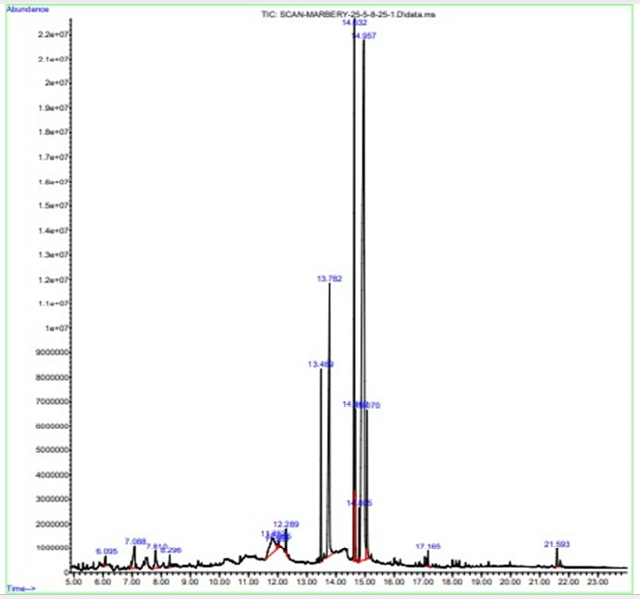
Gas Chromatography Mass Spectrometry (GC-MS) chromatogram of aqueous extract of Morus nigra fruit, showing the separation of bioactive components at different retention times.
Results and Discussion
Gas Chromatography- Mass Spectrometry (GC-MS) of aqueous extract of Morus nigra
The GC-MS analysis of extract of Morus nigra revealed that 17 phytochemicals compounds were present, represented by distinct chromatographic peaks at different retention times and peak areas (%) as shown in Figure 1. Table 1 exhibited the peak no, retention time (min), peak area, peak area (%), metabolites detected, class of metabolites, molecular formula of metabolites, molecular weight of metabolites (g/mol), reported biological activity of metabolites, and their molecular structures. The chromatogram (Figure 1) shows the separation profile of all identified constituents.
Among these 17 metabolites, the most abundant metabolite was found at peak no 14. There were 3 components detected on this peak. Those were 10E,12Z-Octadecadienoic acid, (9E,11E)- Octadecadienoic acid, and 9,12-Octadecadienoicacid (Z, Z). Their retention times were 14.957 min; with 1151160241 peak area, and 48.94 peak area %. Respectively. The 10E,12Z-Octadecadienoic acid belongs to the class of polyunsaturated fatty acids and conjugated linoleic acid. Its molecular formula is C₁₈H₃₂O₂ with a 280.452 (g/mol) molecular weight. This compound has been reported for its biological roles as anti- diabetic, antibacterial, antioxidant, and anti-inflammatory potential as given in Table 1. The (9E,11E)-Octadecadienoic acid belongs to the class of unsaturated fatty acids and conjugated linoleic acids. Its molecular formula is C₁₈H₃₂O2 with 280.4 (g/mol) molecular weight. This compound has been reported for its biological activities. It has anticancer, anti- Alzheimer’s, anti- diabetic, antibacterial, antifungal, and anti-inflammatory potential as given in Table 1. The third component is 9,12- Octadecadienoic acid (Z, Z) which belongs to the class polyunsaturated omega-6 fatty acid. Its molecular formula is C₁₈H₃₂O₂ with 280.45 (g/mol) molecular weight. This compound has been reported for its biological activities. 9,12- Octadecadienoic acid (Z, Z) has anti- diabetic, antibacterial, antifungal, and anti-inflammatory potential (Table 1).
The 2nd most abundant component among all metabolites was found at peak no 11 of the chromatograms. All three analytes—10,13-octadecadienoic acid methyl ester, 9,12-octadecadienoic acid methyl ester, and (E, E)-9,12-octadecadienoic acid methyl ester—were detected at a retention time of 14.632 min, with a combined peak area of 356,618,149 and a peak area percentage of 15.16%. Formula of 10,13-octadecadienoic acid methyl ester is C₁₉H₃₄O₂ with 294.5 (g/mol) molecular weight. This compound has been reported for its biological activities as antidiabetic, antitumor, anti-inflammatory, antifungal, and antibacterial potential, as mentioned in Table 1. The 9,12- Octadecadienoic acid, methyl ester belongs to class Fatty acid methyl esters. C₁₉H₃₄O₂ is its molecular formula, with 294.47 (g/mol) molecular weight. This compound has been reported for its biological activities. It has anti- diabetic, antitumor, antifungal, antibacterial, anti-inflammatory role and antioxidant potential shown in Table 1. The third component is 9,12- Octadecadienoic acid, methyl ester, (E, E) which belongs to class fatty acid methyl
Table 1: Major phytochemical metabolites identified in the fruit extract of Morus nigra by GC-MS.
| Peak no | Retention time (min) | Peak area | Peak area (%) | Metabolites detected | Class | Molecular formula | Molecular weight (g/mol) | Reported Biological Activity |
| 1 | 6.095 | 11011937 | 0.47 | 2,5-Dimethylfuran 3, 4(2H,5H)-dione | Furan derivatives | C₆H₈O₃ | 128.13 | Antidiabetic , antibacterial |
| 2 | 7.088 | 38126578 | 1.62 | Pimelic acid, 2-naphthyl nonyl ester | Dicarboxylic acid derivatives | C₂₆H₃₆O₄ | 412.5616 | Antidiabetic antifungal |
| 3 | 7.810 | 29126343 | 1.24 | 5-Hydroxymethylfurfural | Furans and aldehydes | C₆H₆O₃ | 126.11 | Antidiabetic antifungal |
| 4 | 8.296 | 7548976 | 0.32 | Cyclotetrasiloxane, octamethyl | Cyclic volatile methyl siloxanes | C₈H₂₄O₄Si₄ | 296.62 | Antidiabeticantibacterial and antifungal |
| 5 | 11.852 | 82148742 | 3.49 | Benzonitrile, 3,5-dimethoxy | Aromatic compounds | C₉H₉NO₂ | 163.176 | antidiabetic |
| 6 | 11.981 | 5880151 | 0.25 | Butanoic acid, 2- methyl- ethyl ester | Fatty acids esters | C₇H₁₄O₂ | 130.18 | Antidiabetic antifungal |
| 7 | 12.035 | 4141856 | 0.18 | Methyl tetradecanoate | Fatty acids methyl esters | C₁₅H₃₀O₂ | 242.40 | Antidiabetic Antibacterial |
| 8 | 12.289 | 16718499 | 0.71 | Tetradecanoic acid | Long-chain saturated fatty acids | C₁₄H₂₈O₂ | 228.37 | Antidiabetic antibacterial |
| 9 | 13.489 | 90623382 | 3.85 | Hexadecanoic acid, methyl ester | Carboxylic acids | C17H34O2 | 270.45 | anti-diabetic antiulcer, anti-diuretic |
| 10 | 13.782 | 346214954 | 14.72 | n-Hexadecanoic acid | Long- chain saturated fatty acids | C₁₆H₃₂O₂ | 256.43 | Antidiabetic Anti-inflammatory |
| Tridecanoic acid | Long- chain fatty acids | C₁₃H₂₆O₂ | 214.35 | Antidiabetic | ||||
| 11 | 14.632 | 356618149 | 15.16 | 10,13-Octadecadienoic acid, methyl ester | Fatty acid methyl esters | C₁₉H₃₄O₂ | 294.5 | Antidiabetic,antifungal, antibacterial,antitumor |
| 9,12- Octadecadienoic acid, methyl ester | Fatty acid methyl esters | C₁₉H₃₄O₂ | 294.47 | Anti-bacterial |
||||
| 9, 12-Octadecadienoic acid, methyl ester, (E,E) | Fatty Acid Methyl Esters | C₁₉H₃₄O₂ | 294.4721 | Antidiabetic | ||||
| 12 | 14.660 | 70881866 | 3.01 | 9- Octadecenoic acid (Z)-, methyl ester | Fatty Acid Methyl Esters | C₁₉H₃₆O₂ | 296.49 | Antidiabetic antibacterial |
| 13 | 14.805 | 24635788 | 1.05 | Methyl stearate | Fatty acid methyl esters | C₁₉H₃₈O₂ | 298.5 | Anti-microbial, antiparasitic |
| 14 | 14.957 | 1151160241 | 48.94 | 10E,12Z-Octadecadienoic acid | Polyunsaturated fatty acid and conjugated linoleic acid | C₁₈H₃₂O₂ | 280.452 | Antidiabetic |
| (9E,11E)-Octadecadienoic acid | Unsaturated fatty acids and conjugated linoleic acids | C₁₈H₃₂O₂ | 280.4 | Antibacterial and antifungal | ||||
| 9, 12- Octadecadienoic acid (Z,Z) | Polyunsaturated omega-6 fatty acid | C₁₈H₃₂O₂ | 280.45 | Antidiabetic | ||||
| 15 | 15.070 | 93014036 | 3.95 | Octadecanoic acid | Long-chain fatty acids | C₁₈H₃₆O₂ | 284.48 | Antidiabetic Antibacterial |
| 16 | 17.165 | 7987511 | 0.34 | Bis (2- ethylhexyl) phthalate | Phthalate esters | C₂₄H₃₈O₄ | 390.56 | Antidiabetic antibacterial |
| 17 | 21.593 | 16181744 | 0.69 | gamma-Sitosterol | Sterols | C₂₉H₅₀O | 414.71 | Anti-inflammatory |
esters. Its molecular formula is C₁₉H₃₄O₂ with 294.4721 (g/mol) molecular weight. This compound has been reported for its biological activities. Literature showed that its anti- diabetic, antitumor, antifungal, antibacterial, anti-inflammatory and antioxidant potential (Table 1).
The 3rd most abundant metabolite of the extract found at peak no 10 of chromatogram. There were 2 components detected on this peak. Those were n-Hexadecanoic acid and Tridecanoic acid. Their retention time was 13.782 min; with 346214954 peak area, and 14.72 peak area %. n-Hexadecanoic acid belongs to class long-chain saturated fatty acids. C₁₆H₃₂O₂ is its molecular formula, with 256.43 (g/mol) molecular weight. This compound has been reported for its biological roles as antidiabetic, anti-cancer, anti-inflammatory and anti-bacterial potential as mentioned in Table 1. The second component istridecanoic acid which belongs to class long- chain fatty acids. Its molecular formula is C₁₃H₂₆O₂ with 214.35 (g/mol) molecular weight. This compound has been reported for its biological activities. Literature showed that it has hypoglycemic, antifungal, anti-inflammatory, and antibacterial potential (Table 1).
These 3 major constituents together accounting for more than half of the total extract composition. In addition to these dominant peaks several other compounds, belong to different classes, were detected in smaller proportions, collectively contributing to the pharmacological profile of the M. nigra extract (Table 1; Figure 2).
The predominance of polyunsaturated fatty acids, conjugated linoleic acids, and fatty acid methyl esters indicated that the M. nigra extract was rich in metabolites with reported potential pharmacological relevance especially in terms of antidiabetic, antioxidant, antimicrobial, antibacterial, antifungal, anti-cancer, and metabolic regulation. Many of these compounds are found in literature for their role in glucose metabolism and diabetes management and other metabolic disorders.
A number of conventional medicines are used by people to cure many diseases, but due to severe side effects of these medicines, such as infertility, damage to vital organs, and many other issues, scientists are eager to find a natural replacement. The study of Tavlo et al. (2022) found that conventional medicine is a potential reproductive toxicant for all creatures including humans and wildlife. To identify safer and more effective alternatives to these medicines, researchers have increasingly focused on herbal medicine.
Herbalism or herbal medication is one of the oldest ways of medication (Tutiaswad, a Yunani medication, 460 BC). The assessment and identification of natural
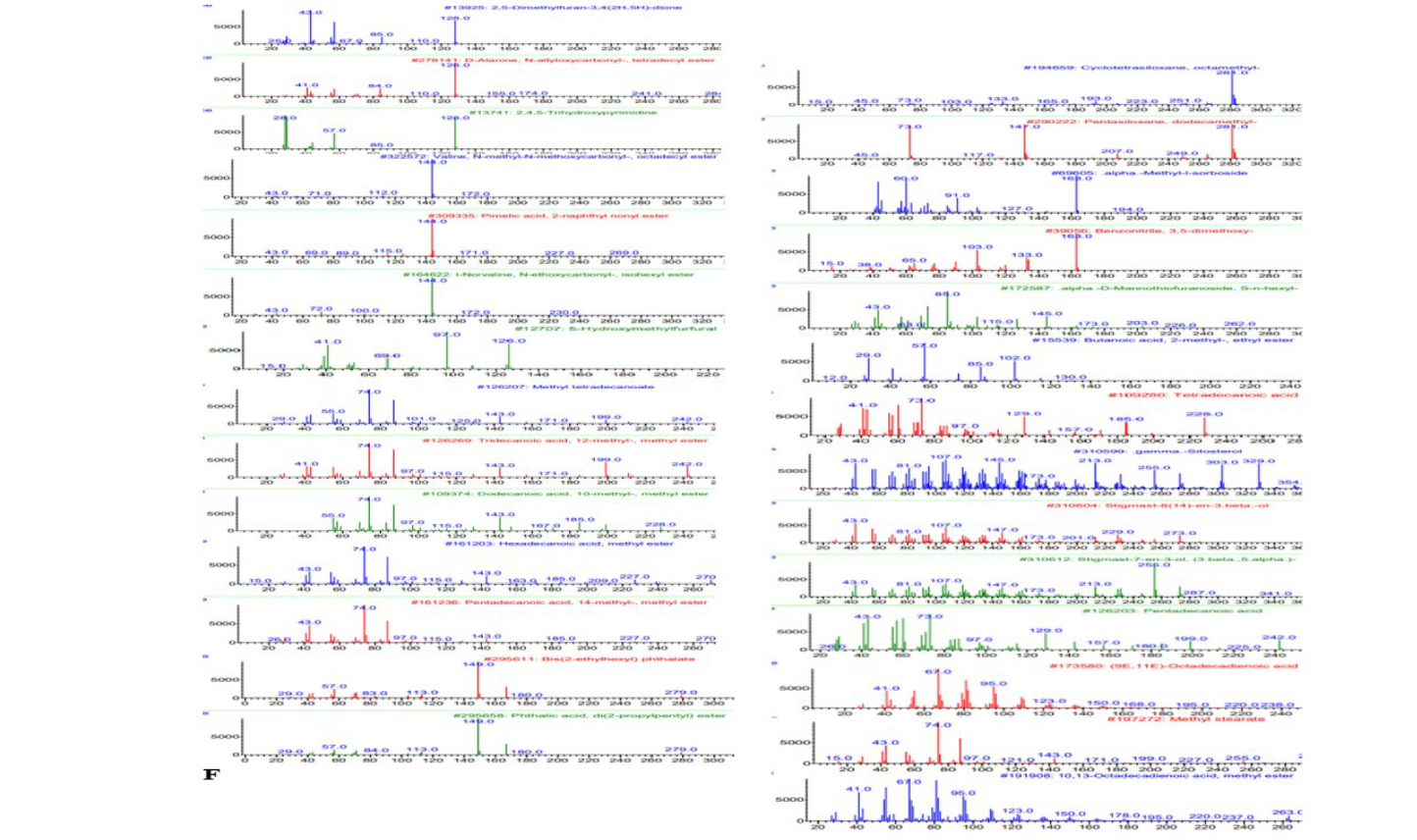
Mass spectra of identified compounds from aqueous extract of Morus nigra fruit by GC-MS
antioxidants derived from plants and foods has received a lot of attention. As pointed out by Jan et al. (2022) and Bilal et al. (2024), among many types of metabolites that occur in plants, the following may be listed: alkaloids, glycosides, tannins, volatile oils, and terpen.
A bulk of research has been conducted over the past 20 years on the Mulberry plant’s leaves and fruit, in order to isolate and identify the active components. Alsaleh et al. (2024) reported that findings from preclinical studies conducted over the past decade suggest that black mulberry has emerged as a potential therapeutic agent. Black mulberry fruit is one of the important parts of black mulberry tree (Liu et al., 2023).
The study of Jan et al. (2021) explored that mulberry fruit is a great source of fiber, minerals, vitamins, lipids, protein, essential and non- essential amino acids, and carbohydrates. It is also reported by the study of Katisart et al. (2024) that black mulberry fruit is abundant in bioactive elements, such as polysaccharides, anthocyanin (purple substance of fruit), rutin, kaempferol, myricetin, resveratrol, phenol, alkaloids, flavonoids and other active ingredients. Compared to raspberries and strawberries, fresh mulberry fruit has a higher protein content. The studies of Shao et al. (2024) support the results that mulberry has hypoglycemic, hypolipidemic, anti-inflammatory, antiviral, antibacterial, cardioprotective, antihyperlipidemic, prebiotic, antitumor, immunomodulatory, anti-obesity, anti-diabetic, gut microbiota balance, and antioxidant effects.
In the current study, the GC-MS profiling of black mulberry fruit has unveiled many bioactive compounds of this fruit. The phytochemicals present in the fruits of Morus nigra, as elucidated by GC-MS analysis, are also stated in the findings of Burğut et al. (2023) and Vukmirović et al. (2023). Their results confirm that the plant is a source of numerous bioactive substances belonging to different chemical groups.
After profiling by GC-MS, total 17 compounds were found in extract. These all metabolites were from different classes with their own therapeutic properties. They were separated and analyzed on the basis of their area, area percentages, retention time, and their therapeutic potential. Three most abundant components were found based on area percentages. These dominant phytochemicals have amazing potential to cure many diseases as reported by the study of Wang et al. (2021). These metabolites belonged to fatty acid methyl esters, long-chain saturated fatty acids, polyunsaturated fatty acid, conjugated linoleic acid, and polyunsaturated omega- 6 fatty acid.
These metabolites comprised more than half portion of the extract of mulberry. It is reported by Akhilraj et al. (2023) that polyunsaturated fatty acids and conjugated linoleic acids have anti-diabetic, antibacterial, antioxidant, and anti-inflammatory potential. Antidiabetic, antitumor, anti- inflammatory, antifungal, and antibacterial activities of fatty acid methyl esters were also reported by Okereke et al. (2023). According to Tolba et al. (2025), Purushothaman et al. (2025), and de Oliveira et al. (2025), long-chain fatty acids have antidiabetic, anticancer, anti-inflammatory, and antibacterial potential.
Only qualitative and semi-quantitative GC-MS profiling of volatile and semi-volatile compounds found in black mulberries is included in this study; non-volatile compounds were not found. Since the study was intended for qualitative and semi-quantitative GC-MS profiling rather than quantitative comparison, statistical analysis was not applicable. As peak area normalization was used to estimate relative abundance, so statistical validation and absolute quantification were not carried out. Without verification using reliable reference standards, compound identification was based on fragmentation pattern analysis and library matching. There was no statistical analysis done because the study did not use biological replicates or replicate injections. The study is limited to semi-quantitative analysis due to the lack of internal standards; replication and internal or external standards would be necessary for absolute quantification. The reported extraction yield is based on a single harvest and extraction. This phytochemical profile reflects the chemical composition from a single harvesting period; the concentration and diversity of secondary metabolites in plants are known to be influenced by seasonal variations, phenological stages, and environmental factors such as temperature, soil properties, and rainfall. Therefore, variations in the phytochemical composition may occur due to harvesting at different times of the year, and this is considered as a limitation of current study. Future research involving several harvest periods and under different environmental conditions would allow a better understanding of the temporal variability and generalizability of the phytochemical profile.
For statistical evaluation and quantitative validation, future research will include replicate analyses and internal standards. For thorough quantitative and non-volatile phytochemical characterization, future research utilizing replicate analyses, internal standards, and complementary LC–MS-based techniques are necessary. Future research using duplicate extractions would enable evaluation of variability and improve reproducibility.
After exploring a huge number of bioactive components of this miracle fruit by GC-MS, it is confidently proven that it has many beneficial bioactive compounds having many reported therapeutic properties, so it could be considered as a replacement to other conventional medicines after exploring its therapeutic potentials, no side effects, availability, and affordability.
Conclusions and Recommendations
Results of GC-MS analysis of Morus nigra methanolic extract have shown that there are many bioactive compounds present in it, mainly fatty acids, such as CLA and PUFA omega-6. In addition to this, the paper gives us a comprehensive analysis about the phytochemical composition of the extract. From the results of the study, we can infer that the fruits of Morus nigra can be used as sources of bioactive compounds for further research into pharmacology and nutrition. Nevertheless, this information was obtained from a descriptive semi-quantitative analysis of one single batch of fruits only.
Acknowledgments
The authors are thankful to the National Science and Technology (NST) fellowship, Ministry of Science and Technology, Government of Bangladesh, for the financial support and Dr. Amin Shah, Associate Professor of Botany, in charge Herbarium (SARGU) Department of Botany, University of Sargodha, Pakistan for confirming the originality of the experimental plant officially with the voucher No., ST-712.
Novelty Statement
The present study provides a comprehensive GC–MS-based phytochemical profiling of black mulberry, which enables the identification of a diverse range of volatile and semi-volatile compounds, and creates a reliable chemical fingerprint of black mulberry and identifies compounds with previously reported biological significance in the literature, rather than direct therapeutic efficacy. This analytical insight also provides a scientific basis for future hypothesis-driven pharmacological and functional investigations, and expands our knowledge of phytochemicals.
Author’s Contribution
Shehla Tasneem: Data curation, Formal analysis, Resources, Visualization, Writing- original draft.
Faiza Zubair: Supervision, Conceptualization, Investigation, Methodology, Resources, Writing- original draft and review.
Naila Riaz: Formal analysis, Methodology, Writing- original draft, review & editing.
Asif Bilal: Formal analysis, Investigation, Methodology, Software, Writing- review & editing.
Generative AI or AI assisted technology statement
The authors declare that no generative AI and AI assisted technology was used in the creation of this manuscript.
Conflict of interest
The authors declare no competing interests.
