
Grey francolin (Francolinus pondicerianus) and Black francolin (Francolinus francolinus) are the key game birds of Rakh Sardaran Game Reserve in District Haripur. The present study was conducted to find out the comparative population density, habitat preference and diet composition of both species in Rakh Sardaran Game Reserve. The study area was divided into four sub-study sites. The line transect method was used to study the habitat preference at the selected sites and the relationship between habitat and francolin numbers was also counted for all the study sites. The results showed that the overall population density of Grey and Black francolin was 2.4 birds/km2 and 1.5 birds/km2 respectively. The habitats of rocky area support the highest population density i.e. (0.6 birds/km2) of Black francolin followed by plain areas (0.5birds/km2), stream beds (0.1 bird/km2), and agricultural land (0.3 birds/km2). Highest density of Grey francolin was observed in rocky area i.e. 0.9 birds/km2 followed by plain areas, 0.7 birds/km2, agricultural land, 0.5 birds/km2 and stream beds, 0.3 birds/km2. Crop and gizzard were collected during the hunting season for diet analysis of francolin species. The result showed that both species consumed 12 plants, 11 seeds, and 4 insect species in study site. Food preference revealed similarity in types of food consumed with slight variation in preferred diet at different study sites. Floral and faunal variety of food contents demonstrated the omnivorous and food generalist characters of francolin species. Habitat preference showed both sympatric species shared all the types of habitat with small variation in the breeding season. The major threats to Francolin species in study area included illegal hunting, poaching, overgrazing, use of pesticides, and fertilizers. There is dire need to evaluate agricultural practices and the effectiveness of environmental conservation measures. The baseline study will be helpful to devise better conservation strategies of game birds of Rakh Sardaran Game Reserve, District Haripur to enhance the conservation efforts.
Research Article · Volume 76, Issue 2, Pages 54–60, 23 November 2026 · Open Access
Habitat and food preferences of Grey francolin (Francolinus pondicerianus) and Black Francolin (Francolinus francolinus) in Rakh Sardaran game reserve, District Haripur, Khyber Pakhtunkhawa, Pakistan
, , , ,
Affiliations & Notes ⌄
- 1Department of Forestry & Wildlife Management, University of Haripur, Khyber Pakhtunkhwa, Pakistan
- 2Wildlife Department, Khyber Pakhtunkhwa, Pakistan
- 3UNESCO Pakistan Country Office
- 4Pakistan Forest Institute, Peshawar
- *Correspondence | Aftab Ahmad; Email: barkat.ullah@pfi.edu.pk
- *Correspondence | Shehnila Kanwal Barkat Ullah Khan; Email: ullah@pfi.edu.pk
Article Info ⌄
- Journal:
- Pakistan Journal of Forestry
- Submitted Date:
- 4 December 2025
- Accepted Date:
- 13 March 2026
- Published Date:
- 23 November 2026
Abstract
Introduction
Francolin species belongs to order Galliformes, characterized by a diverse and large group of birds contaning 70 genera and 250 species . Pakistan is the homeland foe the five partridge species including; Grey francolin (Francolinus pondicerianus), Black francolin (Francolinus francolinus), Chukar partridge (Alectoris chukar), See-See partridge (Ammoperdix griseogularis) and Snow partridge (Lerwa lerwa) .
The francolin is ecologically diverse group of birds, represented by one or more species in almost all biomes of the world, except the boreal forests, extreme desert parts of the Saharan Africa and the polar region. In Pakistan two francolin species exists in various ecological zones . These species of francolins mostly exist in irrigated plantation, grassy vegetation, rocky tracks, cultivated fields and agricultural belt of Punjab Province, Nara area and Southern Sindh, Neelum Valley, Mirpur in Azad and Jammu Kashmir, Juniper forests of Baluchistan, Kohat, Dera Ismail Khan and all around the Hazara region in Khyber Pakhtunkhwa Province .
Grey francolin originated as a grassland bird in the open largely treeless plain, cultivated land and deserted scrub are the most suited habitats for Grey francolin while cropland along the wetland proved to the worst habitat for this species . Black francolin lives on the land surface in the wide cover of large grasses vegetation; though often climb up on the branches of trees for calling . They live in low vegetative cover, but come to agricultural fields and grassland for feeding, chiefly in the dusk and dawn .
The F. pondicerianus mainly feed at sunrise and sunset time, however, it might feed continuously all over the day to some extent, especially in winter . F. francolinus is an opportunistic feeder and mostly feed on berries, seeds, tubers, roots, grasses, insects, and vegetable matter. The grains or weed seeds, succulent vegetation and grits etc. are the preferred feeding items of F. pondicerianus . They also feed different animal species including reptiles, earthworms, amphibians and spiders ; . The current study was conducted in Rakh Sardaran Game reserve, District Haripur to find habitat preference, population abundance and feeding pattern of these francolin.
Materials and Methods
District Haripur lies on latitude 33°-44’ to 34°-22’ and longitude 72°-35’ to 73°-15’. The district Haripur is surrounded by Abbottabad District from North East, Manshera District from North, Mardan from North West. Margallah hills from South East, Buner from North West and Swabi district from west site (District . Geologically, the rocks are mainly limestone, often mixed with red shale and sandstone, and weathered limestone is found commonly (District . The important rivers and streams of the study area are Indus, Dauor, Haro and Sirin (District . The maximum temperature 41ºC and minimum humidity from 19% was recorded in the month of June while the minimum temperature 3ºC and maximum humidity from 70% is recorded in January (District .
Study area
The present study was conducted in Rakh Sardaran Game Reserve. It is located at 25 km distance from Haripur city. The total area of Rakh Sardaran Game Reserve (Figures 1 and 2). is 4,200 ha. It was established in public sector in 30 July 1986 under the N.W.F.P wildlife ACT 1975. Geographically it is surrounded by Panian, Sari-kot road in North. Jabri-Kas Nallah in the South, Gangar hills in East and National highway, N 35 situated on West . Rakh sardaran Game Reserve falls in sub-tropical scrub forest and the dominant flora includes Phulai (Acacia modesta), Kao (Olea ferruginea), Kikar (Acacia nilotica), Beer (Ziziphus mauritiana), Sanatha (Dodonaea viscosa), Bhaikar (Adhatoda vasica).
Study design
Data collection
To determine the population density of Grey francolin and Black francolin in Rakh Sardaran Game Reserve, census was conducted from November 2015 to May 2016. A preliminary survey was conducted in the study area for data collection. The whole study area was divided into four sub-study sites on the basis of habitat type including rocky area, plain area, stream beds and agricultural lands. The line transect method was used covering all types of habitats in the study area . The starting and ending point of transects were marked by using Global Positioning System (GPS).
Efforts were made to conduct survey in dusk and dawn, respectively, while irregular day time surveys were also conducted to observe the feeding and behavioral activities of studied species. All francolin birds were observed while walking along transect, including the flying birds, were recorded. The observations were made by using binocular (A211 10×50) and photographic documentation was done by using digital camera (coolpix 3000). During the line transect survey the habitat type, physical feature (elevation, erosion, water channel, caves etc.) and weather conditions were also studied. During the walk along the transect signs (feathers, fecal material, food items etc.) of species and along with physical appearance were also observed. The data was analyzed by using this equation .
D = Σ n / L×2W, where
L = Total length of Line transect.
n = Number of objects detected.
W = Width of transects
D = Density
Diet analysis
The crop of francolin (collected during the hunting season from November 2015 to February 2016) were used for diet analysis. The crop samples were collected from local hunters and wildlife staff from the various sites of Rakh Sardaran Game Reserve. The data sheets was used to record the basic information including gender of hunted species, study site, habitat type, hunting date and weather at the time of. Each crops food contents were packed and tagged separately in polythene bags and were taken into laboratory, where it was dissected and upper skin of crop was removed. All the food contents were segregated by using forceps. The food contents from each crop were dried in the sunlight, after they were fully dried; food contents were placed in petri dish and segregated into different categories to identify the diet components. Grains, plants, insects, and unidentified materials were placed separately. Insects were identified with naked eyes and hand lens was used for the identification of minute food particle obtained from the crops. The vegetarian part of food component including seed and grains of different crops and grasses and plants were identified through the indigenous knowledge of local communities, farmers and botanist.
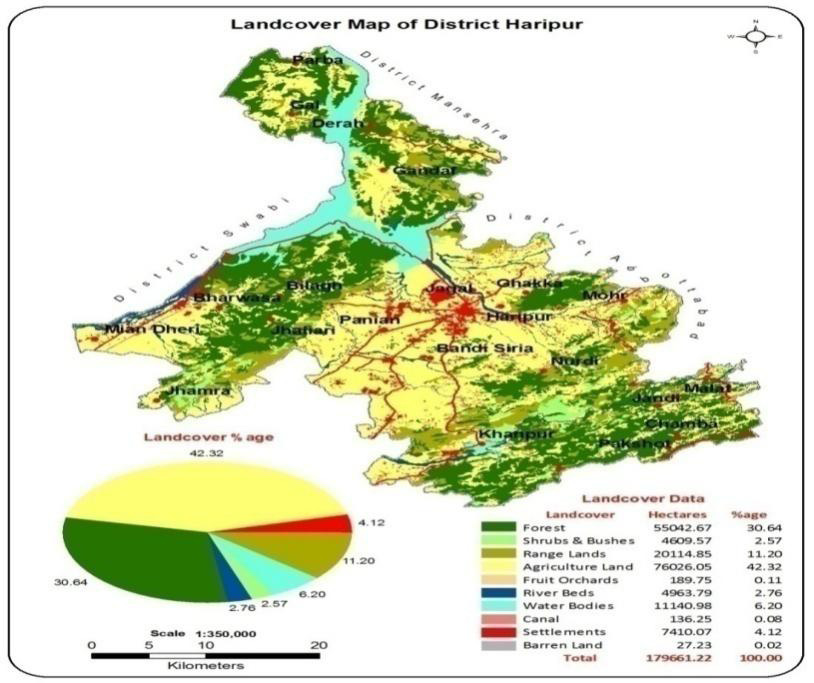
Shows the land cover map of district Haripur, KP.
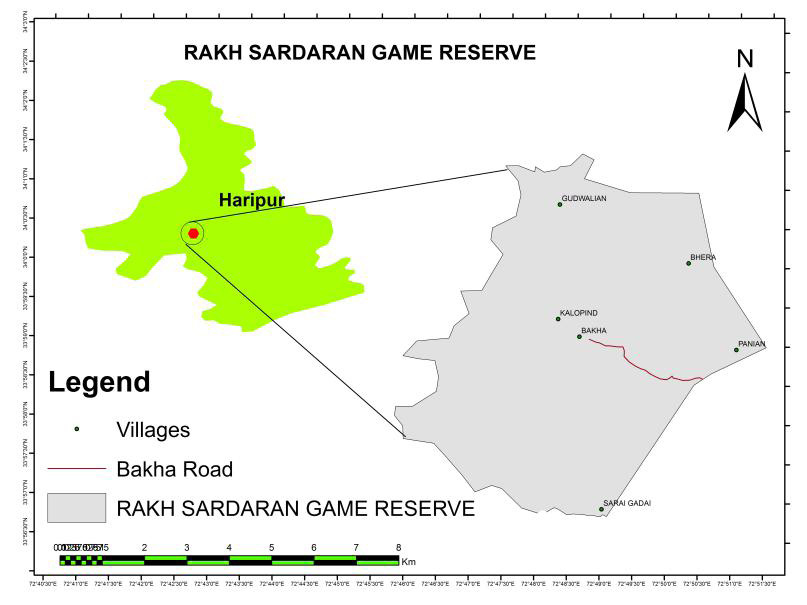
Shows the map of rakh sardaran game reserve.
Habitat preference
Line transect method was used to study the habitat type and preference of grey and black francolin in Rakh Sardaran Game Reserve. The total area was divided into 4 sub habitats such as rocky area, plain area, stream beds and agricultural land . Two transects were plotted in each sub-habitat randomly, covering habitat of species. Total eight transects were plotted and walked to cover the study area comprehensively. The length of each transect in every sub-habitat was 1 km long with 50m wide on both sides of transact . The data sheets were used for collecting the information about floral composition, dominant vegetation type and cover at each sub-habitat in study site .
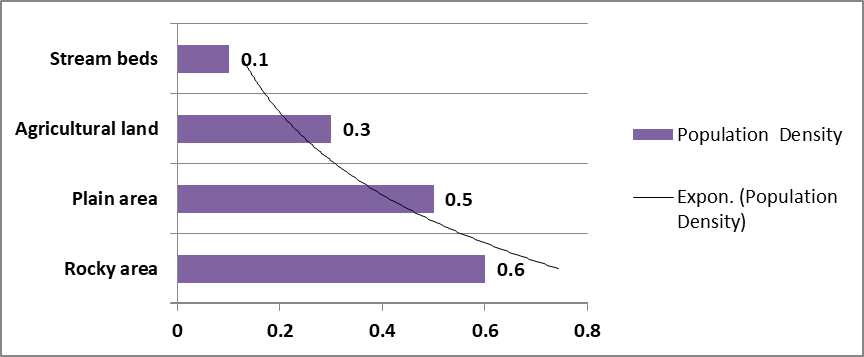
Population density of Black francolin at different study sites in RSGR.
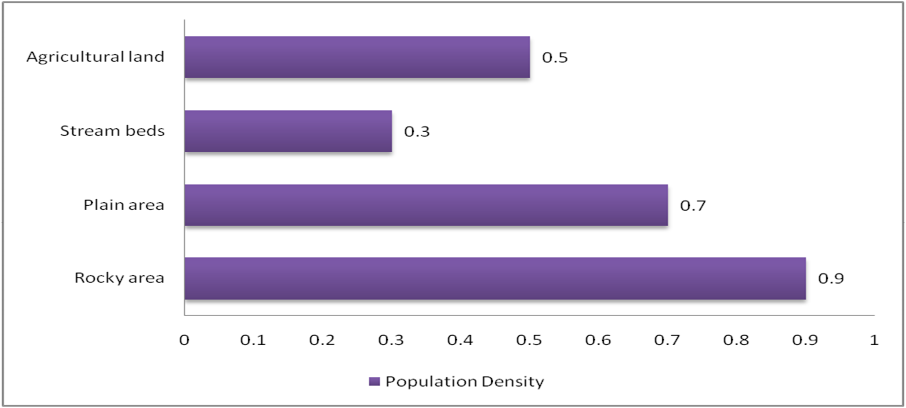
Population density of Grey francolin at different study sites in RSGR
Results and Discussion
Description of each study site
All the four study sites were surveyed to enlist the dominant vegetation type of the study area and association of francolin species.
Rocky area sub-habitat
The key characteristics of this habitat were Rocky Mountains of Gangar hills, woodlands and ravines. Acacia modesta, Dalbergia sissoo, Acacia nilotica tree species with undergrowth shrubs of Adhatoda vasica, Dodonaea viscosa, Ziziphus jujuba and herbs of Cynodon dactylon, Cenchrus ciliaris and Desmostachya bipinnata dominated the vegetation cover of rocky area.
Plain area sub-habitat
The plain area habitat was characterized by scrub patches and barren lands with Acacia modesta, Dalbergia sisso, and Broussonetia papyrifera tree species, Dodonaea viscosa, Adhatoda vasica, and Ziziphus nummularia shrubs and Cynodon dactylon, Cannabis sativa, Cenchrus ciliaris, Panicum antidotale herbs.
Stream beds sub-habitat
This study site was constituted of water channels, streams and main Jabri-kas Nallah. The dominant vegetation composition includes trees Dalbergia sisso, Broussonetia papyrifera, Acacia modesta and Ficus palmata, Shrubs Dodonaea viscosa, Adhatoda vasica and Cannabis sativa, and Herbs Cynodon dactylon, Eleusine indica, Trifolium alexandrinum.
Agricultural land sub-habitat
This habitat is rain-fed cultivated and uncultivated fields. Sinapis alba, Triticum aestivum, Zea mays, Sorghum bicolor etc were grown in agricultural fields. Acacia modesta, Delbergia sisso, Melia azedarach and Morus alba were dominant species of tree Centaurea iberica, Adhatoda vasica, Dodonaea viscosa dominant species of shrubs Cynodon dactylon, Cenchrus ciliaris, Cannabis sativa dominant species of herbs were key vegetative part of agricultural land habitat.
Population density of black and grey francolin
The maximum number of grey francolin was recorded in rocky area sub-habitat which was 0.9birds/km2
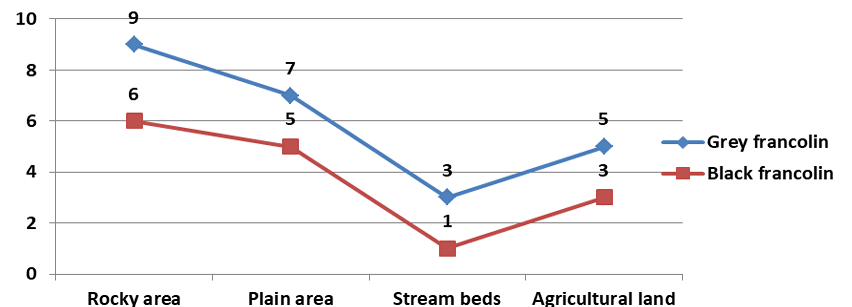
Habitat type and species occurrence at different study sites in RSGR
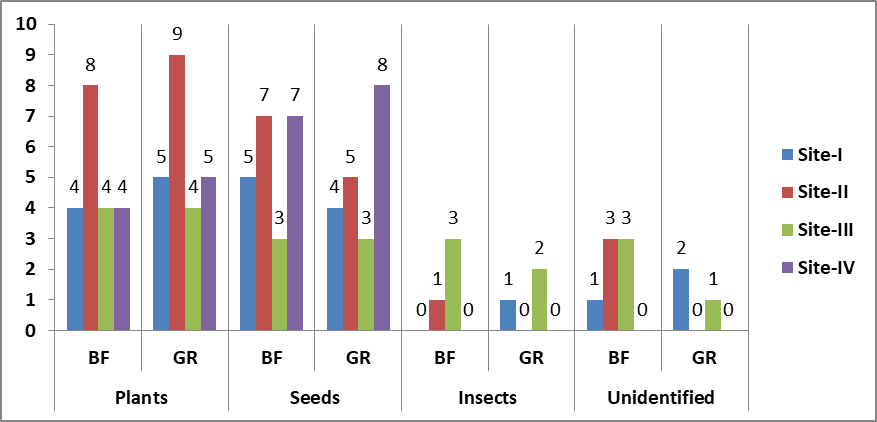
Diet profiles of francolin species at four study sites in RSGR
followed by plains, agricultural and with minimum numbers was recorded along the stream beds (Figure 4). Similarly, the presence of black francolin was higher in rocky area sub-habitat 0.6birds/km2 followed by plains, agriculture and stream beds habitat type in the study area (Figure 3). Although both species preferred the same type of habitat in RSGR but Grey francolin population was higher at the study sites of RSGR.
Table 1: Crop sample collection from RSRG.
| Study sites | Crop sample | |||
| Black Francolin | Grey francolin | |||
| Male | Female | Male | Female | |
| Site-I | 2 | 1 | 3 | 2 |
| Site-II | 1 | 1 | 2 | 0 |
| Site-III | 0 | 0 | 2 | 0 |
| Site-IV | 3 | 1 | 4 | 3 |
| Total | 6 | 3 | 11 | 5 |
I=rocky area, II= plains, III= stream beds, IV= agricultural land
Habitat preference and partitioning
A total of 39 grey and black francolin (24 grey and 15 black) were recorded in study site (Figure 5).
Diet analysis
A total of 16 crop samples of grey francolin and 9 crop samples of black francolin, were collected for the diet analysis from the study area (Table 1).
The consumption of different food items showed omnivorous behavior of both species. The seeds of 12 different plant species were consumed by francolin species and with only the vegetative part of 13 plants species were recorded. The insects constituted a small portion of francolins diet (Table 2 and Table 3). The result showed that major difference was observed in diet composition of both species at all the four study sites of RSGR (Figure 6).
Conclusions and Recommendations
Present study, was conducted to find out the habitat suitability, population estimation, habitat overlapping, and to determine the food preferences and feeding ecology of both francolin species in Rakh Sardaran Game Reserve District Haripur. The overall population density of grey francolin was 2.4birds/km2 and Black francolin was 1.5birds/km2. The result showed that the highest ratio of population density of both species was found in rocky area sub-habitat.
Table 2: Diet compositions (Plants) of francolins species in RSGR
| S. N0. | Plants | Black francolin | Grey francolin | ||
| Vegetative part | Seed | Vegetative part | Seed | ||
| 1 | Pennisetum glaucum | - | - | ||
| 2 | Triticum aestivum | - | - | ||
| 3 | Sorghum bicolor | Leaves | Leaves | ||
| 4 | Pennisetum typhoides | - | - | - | |
| 5 | Zea mays | - | - | ||
| 6 | Ricinus communis | - | Leaves | - | |
| 7 | Cyperus rotundus | - | - | ||
| 8 | Cynodon dactylon | Leaves | - | - | - |
| 9 | Tribulus terrestris | Leaves | - | Leaves | - |
| 10 | Ziziphus mauritiana | - | - | Leaves | - |
| 11 | Eleusine indica | - | - | ||
| 12 | Acacia modesta | Leaves | - | Leaves | - |
| 13 | Cyperus rotundus | - | - | - | |
| 14 | Panicum antidotale | Leaves | - | - | |
| 15 | Dactyloctenium spp. | Leaves | - | Leaves | |
| 16 | Cymbopogon flexuosus | Leaves | - | - | - |
| 17 | Trifolium alexandrinum | - | - | Leaves | - |
| 18 | Cenchrus ciliaris | - | - | Leaves | - |
| 19 | Pennisetum glaucum | Leaves | - | - | - |
| Total | 19 | 08 | 09 | 08 | 08 |
Table 3: Diet compositions (Animals and their body parts) of francolins species in RSGR.
| S. No. | Insects | Black francolin | Grey francolin |
| Body part | Body part | ||
| 1 | Hymenoptera | Thorax& head | - |
| 2 | Diptera | Abdomen | Thorax |
| 3 | Blattodea | - | Abdomen |
| 4 | Orthoptera | Thorax | Thorax |
| Total | 04 | 03 | 03 |
Present study also investigated the habitat suitability and partitioning of both francolin species in study area. The result showed that both species preferred rocky area sub-habitat and avoided plain area, stream beds, and agricultural land sub habitats because vegetation of rocky area provided shelter, food, escaping sites and breeding ground. No major habitat partitioning between Grey francolin and Black francolin was observed in study area and their preferred habitat overlap.
Crop analysis was used to find the feeding ecology of Grey and Black francolin in study area. The result showed that both species consumed 12 plants, 11 seeds, and 4 insect species in Rakh Sardaran Game Reserve. The maximum food content consumed by both species was seeds and plant leaves which indicates that both species are omnivorous and grainivorous behavior. The major threats which are found in study area are illegal hunting, poaching of francolins species, overgrazing, fuel wood cutting, human interference in natural habitat of francolin species, encroachment, agricultural practices, and use of pesticides, fertilizers and natural hazards. The outcome of this research will be helpful to devise the better conservation strategies for these two species of francolins in Rakh Sardaran Game Reserve, District Haripur Pakistan.
Funding Sources
This work was supported and granted by Department of Forestry Environment and Wildlife, Government of Khyber Pakhtunkhwa, Pakistan.
Acknowledgments
The authors are thankful to the Wildlife Department, Khyber Pakhtunkhwa, and the field staff of Rakh Sardaran Game Reserve for their support during the field surveys and the collection of crop samples. The authors also thank the local hunters and communities for their cooperation, and the Department of Forestry & Wildlife Management, University of Haripur, for providing laboratory facilities.
Novelty Statement
This study provides a comparative baseline on the population density, habitat preference and crop-content diet composition of sympatric Grey and Black francolins in Rakh Sardaran Game Reserve, Haripur, showing that both species prefer rocky-area habitat with no major habitat partitioning and share a broadly overlapping omnivorous diet. These findings provide an evidence base for habitat-specific conservation and hunting management of game birds in the reserve.
Author’s Contribution
Aftab Ahmad conducted the fieldwork, collected the data, performed the crop content analysis and wrote the first draft of the manuscript. Muhammad Kabir supervised the study and designed the research methodology. Muhammad Faique Khan and Iftikhar-Uz-Zaman assisted in the field surveys and provided logistic support in Rakh Sardaran Game Reserve. Shehnila Kanwal analysed the data and prepared the maps and figures. Barkat Ullah Khan conceptualized the study, reviewed and edited the manuscript and handled the correspondence. All authors read and approved the final manuscript.
Generative AI and AI-assisted technology statement
The authors declare that no generative AI and AI assisted technology was used in the creation of this manuscript.
Conflict of interest
The authors have declared no conflict of interest.
References
- Burnham, M.P., Anderson, D.R., Laake, J.L., 1980. Estimation of density from line transect sampling of biological populations. Wildl. Monogr., No. 72. P 202. [CrossRef]
- District profile Haripur. 2014. pp 25-31.
- Fuller, R.A., Carroll, J.P. and McGowan, P.J. eds., 2000. Partridges, quails, francolins, snowcocks, guineafowl, and turkeys: status survey and conservation action plan 2000-2004 (Vol. 54). IUCN.
- Hussain, I., Nisa, A. and Khalil, S., 2009. Population biology of the Grey Francolin (Francolinus pondicerianus) in an agro-ecosystem of the Pothwar Plateau, Pakistan. Chinese Bird., 3: pp.91-102. https://doi.org/10.5122/cbirds.2012.0009 [CrossRef]
- Kakakhel, F.B., 2012. Habitat preference of Chukar Partridge in Sewagali Game Reserve of Swat District Khyber Pakhtunkhwa province of Pakistan. The Pakistan Journal of Forestry. p 62.
- Khalil, S. and Anwar, M., 2016. Habitat preference of grey francolin (Francolinus pondicerianus) in Salt Range, Punjab. J. Anim. Plant Sci., 26(3): 842-849.
- Khan, M.F., Awam, M.S., Nayyer, A.Q., Mehmood, K. snf Khattak, M.N.K., 2015. A Comparative study on the population and habitats of the Grey Francolin (Francolinus pondicerianus) and Black francolin (Francolinus francolinus) in Mang Game reserve, Haripur, Pakistan. J. Anim. Plant Sci., 25 (1): 101-107.
- Khan, W.A. and Mian, A., 2011. Food of Black Francolin (Francolinus francolinus henrici) in Lal Suhanra National Park, Pakistan. Pak. J. Zool., 43(5).
- Khan, W.A. and Mian, A., 2013. Comparative population biology of black (Francolinus francolinus) and grey (F. pondicerianus) Francolins under Lal Suhanra National Park (Pakistan) conditions. Pak. J. Zool., 45: pp.949-958.
- Mirza, Z.B., Wasiq, H., 2007. A field guide to birds of Pakistan. Bookland, Lahore. Pakistan. pp 73-81.
- Payne, R., 2000. Birds of the World Biology Recent Families Birds of the World. pp 532.
- Shah, S.A., 2004. Habitat preference of black francolin Francolinus francolinus and Grey Francolin F. pondicerianus during the breeding season in Rakh Sardaran Game Reserve, Pakistan. International Galliformes Symposium.
- Waseem, A.K. and Mian, A., 2012. Food of Grey Francolin (Francolinus pondicerianus) with remarks on competition with Black francolin (Francolinus francolinus) in Lal Suhanra National Park Pakistan. Pak. J. Zool., 4: 1099-1109.

Services
Article usage statistics
Loading…
Related articles
- Habitat selection of grey francolin in Sweagali game reserve of Swat district Kyhber Pakhtunkhwa province of PakistanPakistan Journal of Forestry · 2024
- Habitat preferences of Chukar partridge in Sewagali game reserve of Swat district Kyhber Pakhtunkhwa Province of PakistanPakistan Journal of Forestry · 2024
- Ecology of black francolin in Swegali game reserve of Swat district Kyhber Pakhtunkhwa province of PakistanPakistan Journal of Forestry · 2024
- Impact of Feeding Habits on Population Ecology and Breeding Biology of Grey Francolin (Francolinus pondicerianus) in District Bhakkar, Punjab, PakistanPakistan Journal of Zoology · 2021
- Histomorphological Study of Syrinx of Black Francolin (Francolinus francolinus) in IraqAdvances in Animal and Veterinary Sciences · 2017
- Damages Done by Black Bear (Ursus thibetanus) in Moji Game Reserve and its Surroundings, Leepa Valley, Azad Jammu and Kashmir (Pakistan)Pakistan Journal of Zoology · 2020