
Eimeria is a genus of parasites belonging to the family Eimeriidae which consisting of numerous species responsible for coccidiosis of various animals such as sheep, cattle, goats, swine, horses, cats and dogs. The protozoa are classified as enteric coccidia and monoxenous which is require a single host to complete their lifecycle. The primarily infects to the digestive tracts of carnivores, omnivores and herbivores which its leading to diarrheal condition known as coccidiosis. This study focused on assessing prevalence of Eimeria infections of dogs to obtain molecular identification of Eimeria species, to make phylogenetic tree analysis and to determine the risk factors related to infection. In Iraq’s Al-Diwaniya province, 200 fecal samples were collected from dogs of various ages and sexes to conduct flotation tests and PCR analysis and phylogenetic tree examination. The overall prevalence of Eimeriosis of dogs in the present study was 13% based on PCR tech nique and 26% with flotation method. The native genotype in our study identified with four genotypes reported in the gene bank with the accession numbers MG825662. 1, MG825666. 1, LC380054. 1 and HM070377. 1. There were many risk factors related to high prevalence of Eimeriosis in dogs including: female dogs, 3 months until1 year age, stray dogs, ground house floor, time of house floor cleaning longer than a month, winter seasons and southern parts of the province. The higher prevalence of Eimeriosis infection is in stray dogs especially female dogs with 3 months to1 year of age.
Research Article · Volume 43, Issue 2, Pages 261–270, 24 November 2026 · Open Access
Molecular Identification and Phylogenetic tree Analysis of Eimeria spp from Dogs in Al-Diwaniya Province, Iraq
, , ,
Affiliations & Notes ⌄
- 1College of Veterinary medicine, University of Al-Qadissiya. Al-Qadesiya, Iraq
- 2College of Agriculture and Forestry, University of Mosul, Mosul, Iraq
- 3College of Veterinary medicine, University of Al-Qadisiyah
- *Correspondence | Mozhir K.K. Almahdawi; Email: mozhir2007@uomosul.edu.iq
Article Info ⌄
- Journal:
- Sarhad Journal of Agriculture
- Submitted Date:
- 24 June 2025
- Accepted Date:
- 3 March 2026
- Published Date:
- 24 November 2026
From the article
- According to the results of PCR – technique the prevalence of Eimeriosis in the present work was significantly higher in female dogs(bitchs) 18.
- The prevalence of Eimeriosis in the present study was significantly higher in 3 month-1year old dogs.
- The prevalence of Eimeriosos in the current study was significantly higher in in stray dogs 18.
- The current study revealed that Eimeriosis is evident in dogs in Al-Diwaniya province, Iraq and there are four genotypes in the world identifies with the native genotype under the accession numbers MG825662.
Selected from the article's own text.
Abstract
Introduction
Eimeriosis have been reported in a very wide range of birds and vertebrate animals including sheep, cattle, buffaloes, deer’s, and many wild animals , ; . The Eimeria species are commonly host specific. The Eimeria species are common gastrointestinal parasites which invades intestinal mucosa for many animal species including ruminants , wild animals and dogs ; . In dogs the disease may be more serious when the animals are reared in overcrowded kennels especially in winter seasons when the floor of kennels are contaminated with the infective oocysts ; . This parasite has exogenous and endogenous phases phases of life cycle, the exogenous phase occurs outside the animal bodies in the favorable hot and moist environments and the endogenous phase in which the parasite gets a very large number of divisions in the intestinal cells ; . The main root of infection is through the ingestion of contaminated water and food with the infective sporulated oocytes ; ; . The morbidity rate of this disease may approach 10-40% especially in the overcrowded kennels but the mortality rate may be very low . There are many Eimeria species in the world including E. canis, E. cynomysis, E. parva, E. perforance, E. magna and E. stiedai ; . The clinical cases of infection are characterized by abdominal pain, diarrhea, tenesmus, weakness, anorexia and dehydration which may leads to the death of the infected animals ; . The subclinical cases of infection are characterized by alterations in intestinal physiology, anorexia resulting in weight gain and poor growth of the young animals . The diagnosis of Eimeria species are performed by morphological identification through using taxonomic informations but it is difficult to differentiate between some species (Guardhouse and Eshar, 2014). Also there may be morphological changes of some species due to the use of some antiparasitic therapies prior of sampling time ; . The molecular techniques are used for identification of different Eimeria species which is a reliable, more sensitive and time efficient technique for identification of Eimeria infections in animals ; . The PCR reports of Eimeria species in dogs are very limited worldwide . So far as there is no molecular studies have been performed in Al-Diwaniya province, Iraq to detect the Eimeria species affecting dogs. The objectives of the present study were to investigate prevalence of Eimeria of dogs to obtain conduct molecular identification of Eimeria species and to perform phylogenetic tree analysis.
Materials and Methods
Fecal samples
In this current study, 200 fecal samples were collected from varying ages and sexes of dogs. The samples were obtained either directly from rectum using plastic gloves or from the ground immediately after defecation and described method by Guarnera et al. (2000). Each sample was placed in a labeled plastic container, stored in a cool box and transported to the research laboratory at the College of Veterinary Medicine for analysis.
Carpological examination
Fecal samples were analyzed microscopically by using the flotation concentration technique.
Flotation method
This method was performed for detecting Eimeria oocysts , 4-5gm of faeces were placed in beaker and mixed with tap water, then sieved and the fluid transferred to clean test tubes (15ml) then Centrifuged at 1000 rpm for 3 minutes, the supernatant was discarded. Sheather’s solution was introduced to the sediment and thoroughly mixed before undergoing centrifugation again at the same speed for 5 minutes. Following this drop of solution was carefully extracted from the surface by using pipette, placed onto a slide, covered with a coverslip and examined under 10X and 40X magnifications (Dryden et al., 2005; .
Molecular study
A molecular study was carried out to detect Eimeria of dogs and to establish phylogenetic relationships. The research involved following steps:
DNA Extraction
The DNA were extracted from fecal samples by using AccuPrep® stool DNA Extraction Kit, Pioneer. Korea and performed according to company instructions.
DNA estimation
DNA extracted from fecal samples was analyzed by using Nano Drop spectrophotometer (Thermo, USA) to determines purity and concentration of DNA by measuring absorbance at 260/280 nm.
Polymerase chain reaction (PCR)
Polymerase chain reaction, commonly known as PCR which is a widely-used molecular biology technique designed to amplify and create multiple copies of specific DNA sequences. By utilizing series of temperature cycles and specialized enzymes like DNA polymerase. This technique has found extensive applications in various fields, including medical diagnostics, forensic science, genetic research, and biotechnology PCR techniques were utilized to identify Eimeria spp. in DNA extracted from fecal samples. The procedures were implemented following the guidelines provided by the manufacturer (Table 1).
Table 1: PCR Thermo cycler conditions were done by using conventional PCR thermo cycler system.
| PCR step | Temp. | Time | repeat |
| Initial Denaturation | 95 °C | 5min | 1 |
| Denaturation | 95 °C | 30sec. | 30 cycle |
| Annealing | 52 °C | 30sec. | |
| Extension | 72 °C | 60sec. | |
| Final extension | 72 °C | 5min. | 1 |
| Hold | 4 °C | - | - |
Primers
The primers utilized in this study for the detection of Eimeria species were supplied by Pioneer Company., Korea as following (Table 2).
Table 2: PCR primers internal transcribed spacer 1, partial sequence gene in Eimeria spp.
| Primers | Sequence | Amplicon | |
| Eimeria ITS1 | F | CTTCAGCTTTCGACGGTAGG | 494bp |
| R | CTGCAGTATTCAAGGCGACA | ||
Results
The fecal sample analysis using the flotation method yielded the following results. Out of a total, 200 fecal samples examined, 52 samples (26%) were infected with oocysts of Eimeria parasite, while 148 samples (74%) were free from oocytes of parasite (Table 3) and (Figure 1).
Table 3: Overall percentage of eimeria sp. in dogs by flotation method and PCR technique.
| No. of dogs examined | Infected with Eimeria sp. microscopically | Non infected with Eimeria sp. microscopically | ||
| 200 | positive | % | Negative | % |
| 52 | 26 | 148 | 74 | |
| Infected with eimeria sp. by PCR | Non infected with eimeria sp. by PCR | |||
| positive | % | Negative | % | |
| 26 | 13 | 174 | 87 | |
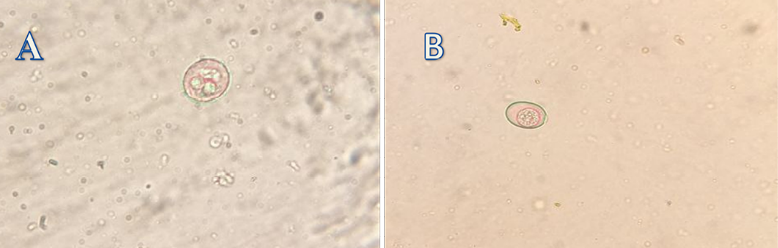
Speculated oocyte of Eimeria , B : unsporulated oocyte of Eimeria.
PCR technique
Eimeria spp. were detected in 26 (13%) of fecal samples from dogs by using PCR – technique, through using specific primers designed according to the gene of ITSI which was used for detection of Eimeria spp. protozoa at (494 bp) on agars gel electrophoresis, while 174 (87%) were free from the parasite, as shown in Figure 2.
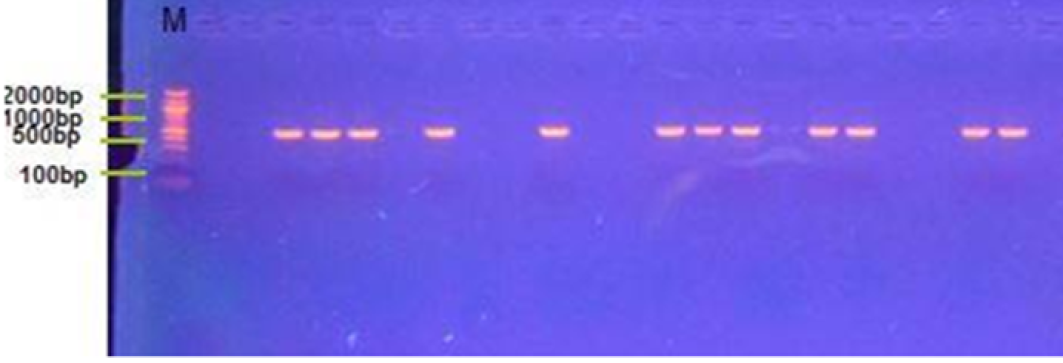
Agarose gel electrophoresis shows the PCR product analysis of DNA extracted from fecal samples of the dogs, where Lane (M) ladder (100-2000 bp), other lane shown positive Eimeria spp. at (494bp) PCR product size
DNA sequence and phylogeny tree
The local Eimeria isolates were uploaded to the NCBI Gene Bank database, where their accession numbers were retrieved as outlined in (Table 4). A phylogenetic tree was generated EGA version 6. 0 showing al Eimeria
Eimeria isolates to be closely related to the Eimeria sequences listed in the NCBI Blast database. The identities varied as illustrated in Table (4) and Figure 3 and Figure 4.
The results of sequencing of the nucleotides of the native genotype revealed presence of 4 genotypes in the world identifies with the native genotype in our study with higher percentage of identity 100% with the genotypes which were obtained from gene bank under the accession numbers MG825662. 1 and MG825666. 1 from Polland. Also the results of sequencing of the nucleotides of the native genotype of Eimeria species revealed identity percentage of 99.
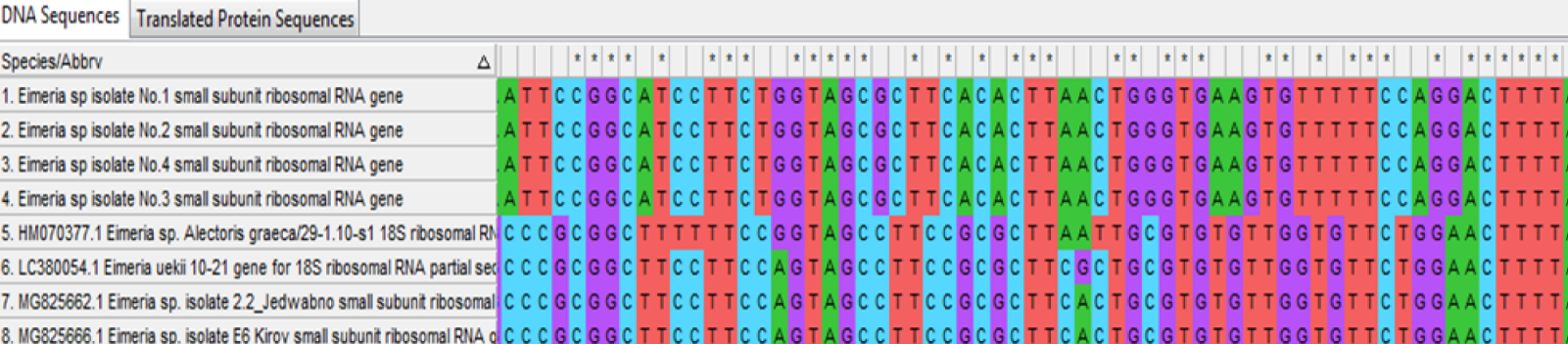
Multiple sequence alignment analysis of small subunit ribosomal RNA gene in local Eimeria isolates and NCBI-Genbank Eimeria spp. isolates.
Table 4: The NCBI-BLAST Homology Sequence identity (%) between local Eimeria species of dog isolates and NCBI-BLAST submitted Eimeria species isolates
| Eimeria isolate | Genbank Accession number | NCBI-BLAST Homology Sequence identity (%) | |||
| Identical Eimeria | Number of Genbank Accession | Country | Identity (%) | ||
| No. 1 | MK894303 | Eimeria | MG825666. 1 | Poland | 100% |
| No. 2 | MK894304 | Eimeria | MG825662. 1 | Poland | 100% |
| No. 3 | MK894305 | Eimeria | LC380054. 1 | Japan | 99. 80% |
| No. 4 | MK894306 | Eimeria | HM070377. 1 | USA | 97. 17% |
Table 5: The relative risk of several factors related to the prevalence of Eimeria infection based on PCR- technique.
| Factors | No. of tested dogs | PCR – technique | |||
| No. of positive (%) | Relative risk (RR) | 95% Confidence interval (CI) | P-value | ||
| Gender | |||||
| Male | 96 | 7(7. 29) a | 1 | ||
| Female | 104 | 19(18. 26) b | 2. 842 | 1. 137-7. 104 | 0. 021 |
| Age | |||||
| < 3 months | 60 | 2(3. 33) a | 1 | ||
| 1-5 years | 67 | 6(8. 95) a | 2. 852 | 0. 553-14. 708 | 0. 192 |
| 3 months-1 year | 73 | 18(24. 65) b | 9. 490 | 2. 103-42. 823 | 0. 0006 |
| Type of dogs | |||||
| Pet dogs | 56 | 3(5. 35) a | 1 | ||
| Police dogs | 62 | 8(12. 90) a | 2. 617 | 0. 658-10. 403 | 0. 159 |
| Stray dogs | 82 | 15(18. 29) b | 3. 955 | 1. 087-14. 381 | 0. 026 |
| House floor | |||||
| Concrete | 106 | 8(7. 54) a | 1 | ||
| Ground | 94 | 18(19. 14) b | 2. 901 | 1. 197-7. 030 | 0. 014 |
| House floor cleaning | |||||
| Once amonth | 102 | 7(6. 86) a | 1 | ||
| Longer than a month | 98 | 19(19. 38) b | 3. 264 | 1. 305-8. 162 | 0. 008 |
80% with the genotype reported in the gene bank under the accession number LC380054. 1 from Japan. Moreover the results of sequencing of the nucleotides of the native gene of Eimeria species revealed identity percentage of 97. 17% with the genotype reported in the gene bank under the accession number HM070377. 1 from United States of America. According to the results of PCR – technique the prevalence of Eimeriosis in the present work was significantly higher in female dogs(bitchs) 18. 26% [Relative risk (RR): 2. 842 times , Confidence interval(CI): 1. 137-7. 104 ] than the male dogs 7. 29%. The prevalence of Eimeriosis in the present study was significantly higher in 3 month-1year old dogs
Table 6: The relative risk of seasonal factors related to the prevalence of Eimeria infection based on PCR technique.
| Seasonal factors | No. of tested dogs | PCR – technique | |||
| No. of positive (%) | Relative Risk (RR) | 95% Confidence Interval | P- value | ||
| Summer | 54 | 2(3. 70) a | 1 | ||
| Autumn | 48 | 4(8. 33) a | 2. 363 | 0. 413-13. 523 | 0. 321 |
| Spring | 46 | 6(13. 04) a | 3. 900 | 0. 747-20. 359 | 0. 084 |
| Winter | 52 | 14(26. 92) b | 9. 578 | 2. 054-44. 661 | 0. 0008 |
Table 7: The relative risk of geographical factors related to the prevalence of Eimeria infection based on PCR technique.
| Geographical factors | No of tested dogs | PCR – technique | |||
| No of positive (%) | Relative risk (RR) | 95% Confidence Interval (CI) | P- value | ||
| Central parts | 36 | 1(2. 77) a | 1 | ||
| Eastern parts | 35 | 2(5. 71) a | 2. 121 | 0. 183-24. 511 | 0. 538 |
| Northern parts | 38 | 4(10. 52) a | 4. 117 | 0. 437-38. 740 | 0. 184 |
| Western parts | 42 | 5(11. 90) a | 4. 729 | 0. 526-42. 526 | 0. 131 |
| Southern parts | 49 | 14(28. 57) b | 14. 000 | 1. 745-112. 308 | 0. 002 |
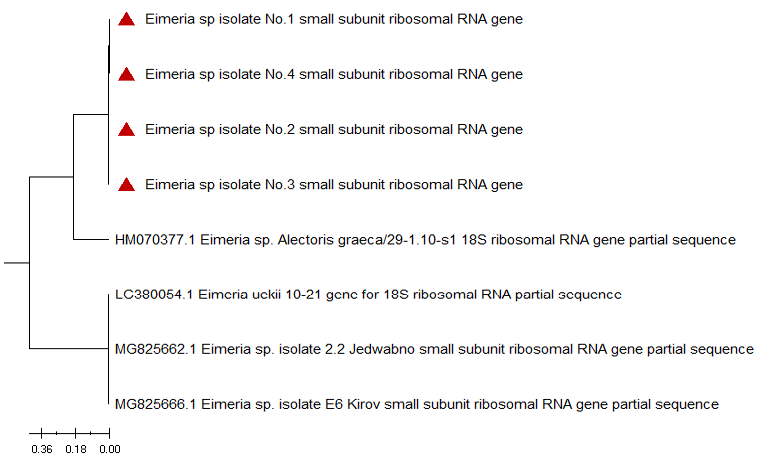
Phylogenetic tree analysis based on small subunit ribosomal RNA gene partial sequence in local Eimeria dogs isolates that used for genetic Eimeria species identification.
24. 65% (RR: 9. 490 times, CI: 2. 103-42. 823) than the 1-5 years and < 3 months old dogs 8. 95% and 3. 33% respectively. The prevalence of Eimeriosos in the current study was significantly higher in in stray dogs 18. 29% (RR: 3. 955 times , CI: 1, 087-14. 381) than police and pet dogs 12. 90% and 5. 35% respectively. In the current work the prevalence of Eimeriosis was greater in ground house floor dogs 19. 14% (RR: 2. 901 times, CI: 1. 197-7. 030 ) than the concrete house floor dogs 7. 54%. The prevalence of Eimeriosis was significantly higher in longer than a month period of house floor cleaning 19. 38% (RR: 3. 264 times, CI: 1. 305-8. 162) than once a month of house floor cleaning 6. 86% (Table 5). The present study revealed a higher significantly prevalence of Eimeriosis through winter season which was 26. 92% (RR: 9. 578 times, CI: 2. 054-44. 661) than the summer, autumn and spring seasons which were 3. 70%, 8. 33%, 13. 04% respectively (Table 6). The prevalence of Eimeriosis in the current study was significantly higher in the southern parts of Al-Diwaniya province 28. 57% (RR: 14. 000 times, CI: 1. 745-112. 308) than the central, eastern, northern and western parts of the province which were 2. 77%, 5. 71%, 10. 52%, 11. 90% respectively (Table 7).
Discussion
Eimeria parasites are intracytoplasmic parasites which invade and destroy the intestinal epithelial cells of the infected dogs leading to digestive dysfunction, chronic or acute damage to the intestinal mucosa of the infected animals ; . The clinical symptoms of the infected animals, morphology of oocysts and the typical post mortem lesions are very important for identification of Eimeria species in dogs , but the PCR – technique is the gold standard approach for detection of Eimeria species in the infected animals ; . This study based on the findings of the PCR technique the prevalence of Eimeriosis in dogs was determined to be 13%. This is notably higher compared to the results reported by Kohansal et al. (2017) who indicated a prevalence rate of 0. 7% of dogs in Iran by using the sedimentation concentration method and modified Ziehl-Neelsen staining. The present study indicates a higher prevalence of Eimeriosis in dogs compared to the findings of Maheswari et al. (2023) who documented a prevalence rate of 1. 33% among Kintamani Bali dogs in the Kintamani district. Indonesia through using the floating method. The prevalence of Eimeriosis in the current study was higher than the results of Mohamed and Al-barwary, (2016) who reported that the prevalence of Eimeriosis in dogs was 3. 7% in Duhok province, Kurdistan region, Iraq by using flotation technique and sedimentation technique. In the current study the prevalence of Eimeriosis in dogs was lower than the results of Beiromvand et al. (2013) who mentioned that the prevalence of Eimeriosis in dogs was 19% in the Chenaran County, Razavi Khorasan Province, Iran through using sieving/flotation and modified Ziel-Neelsen staining technique. This variations in the prevalence may be due to various factors, including environmental variations, the climate, age of the animals, husbandry procedures and management systems . In the present work the prevalence of Eimeriosis was higher in the female dogs (batches) more than the male dogs and this finding is consistent with the results of Rehman et al. (2011); Mohamaden et al. (2018) who mentioned that the prevalence of Eimeriosis was higher in the female animals than the males because the female animals are exposed to many physiological stresses which is related to pregnancy, parturition and lactation which makes them more susceptible to the infections with Eimeria species more than the males. The prevalence of Eimeriosis in the current study was higher in 3 month-1 year old dogs than the adult dogs with 1-5 years old and the young puppies with < 3 months age, and this result is compatible with the results of who reported that the prevalence of Eimeriosis is higher in the growing animals more than adult animals , and this may be attributed to the higher protective immunity in the adult animals than the growing animals and the young animals < 3 months have a higher maternal immunity due to the high levels of the antibodies in the colostrum. In the present study the prevalence of Eimeriosis in the stray dogs was higher than the pet and police dogs which may be attributed to the fact that the stray dogs consumes the rabbit , rodent, cat, chichen, wild animal and other domestic animal farces in their area and this coprophagic behavior in the stray dogs were observed publicly and plays important role in the transmission of Eimeria from other animal species to the dogs ; Al-Mousawi et. al., 2024) while the pet and Police dogs have specific feeding programs in their owner house and kennels and don’t have coprophagic behaviors like the stray dogs. In the current work the prevalence of Eimeriosis was higher in ground house floors than the concrete house floors and this result is compatible with the results of Kohansal et al. (2017), Keomoungkhoun et al. (2023) who mentioned that the animals reared on the ground house floor had a greater infections with Eimeria species than the animals reared on the concrete house floor because the cleaning of the concrete floor is easier than the ground floor. In the present work the prevalence of Eimeriosis was higher when the house floor cleaning was longer than a month than once amonth cleaning of the house floor, and this observation is compatible with the findings of and Keomoungkhoun et al. (2023) who reported that the prevalence of Eimeriosis was higher in the longer than a month of the house floor cleaning period than the once a month cleaning period due to the more contamination of the floors with the oocytes of Eimeria species. The prevalence of Eimeriosis in dogs in the present study was higher in the winter season than the summer, autumn and spring seasons and this result is consistent with results of El-Seify et al. (2012) and Fadly, (2012) who reported that the prevalence of Eimeriosis was higher in the winter seasons than other seasons which may be due to presence of high levels of rains during the winter seasons that increases the distribution and contamination of the ground with the infective oocysts. These oocysts and the Eimeria parasites can remain viable and infectious for many years in vitro leading to many adverse environmental effects due to a thick oocyte wall. In the current study the prevalence of Eimeriosis was higher in the southern parts of Al-Diwaniya Province than the central, eastern, northern and western parts of the province, and this result is compatible with results of Ren et al. (2021) who reported that the prevalence of Eimeriosis in Sichuan region which is located in the southwest parts of China was higher than Shaanxi which is located in the central parts of China which me be attributed to differences in soil conditions, rainfall environments, vegetation, humidity, temperature and other factors due to differences in the climate may affect on the distribution of the oocytes and Eimeria parasites. On the contrary reported that the prevalence of Eimeriosis was higher in summer seasons than winter, autumn and spring seasons. The results of sequencing of the nucleotides of the native genotype revealed presence of 4 genotypes in the world identifies with nucleotides the native genotype in our study with higher percentage of identity 100% with the genotypes which were obtained from gene bank under the accession numbers MG825662. 1 and MG825666. 1 from Poland. Also the results of sequencing of the nucleotides of the native genotype of Eimeria species revealed identity percentage of 99. 80% with the genotype reported in the gene bank under the accession number LC380054. 1 from Japan. Moreover the results of sequencing of the nucleotides of the native genotype of Eimeria species revealed identity percentage of 97. 17% with the genotype reported in the gene bank under the accession number HM070377. 1 from United States of America. The clustering observed within the same nodule suggests a close relationship among involved entities, likely influenced by the geographic proximity of the countries in question. This proximity may follow a shared migratory path for paratenic hosts such as rodents and birds across different nations along a common geographic line. The findings of this study incorporate data from multiple investigations that have documented genetic variation and phylogenetic relationships based on nuclear gene sequences. The sequences have been utilized to assess genetic diversity in Eimeria and other protozoa parasites worldwide. The results revealed low genetic variation in the nuclear ribosomal ITS-1 region of Eimeria isolates from Iraq compared to those found in other countries. It was concluded that DNA sequencing combined with phylogenetic analysis serves as a valuable tool for understanding the evolutionary relationships among organisms.
Conclusions and Recommendations
The current study revealed that Eimeriosis is evident in dogs in Al-Diwaniya province, Iraq and there are four genotypes in the world identifies with the native genotype under the accession numbers MG825662. 1, MG825666. 1, LC380054. 1and MH070377. 1.
There were several risk factors related to high prevalence of Eimeriosis including: Female dogs, 3 months-1 year ages, stray dogs, ground house floor, longer than a month house floor cleaning, winter season and southern parts of the province.
Acknowledgments
The authors would like to thank University of Mosul, College of Agriculture and Forestry for their cooperation. As well as College of Veterinary Medicine, University of Al-Qadissiya for their financial support of the surveillance efforts.
Novelty Statement
The originality of this study lies in the fact that it provides first comprehensive molecular and genetic analysis of Eimeria strains in dogs of Diwaniyah Governorate in Iraq which linking them to global genetic patterns and identifying precise environmental factors (such as cleaning habits and type of flooring) that contribute to spread of infection.
Author’s Contribution
Noor I. Jarad and Mozhir K. K. Almahdawi: The authors mentioned in this manuscript contributed to preparation of the study plan, fieldwork, laboratory analysis, data collection, statistical analysis, and interpretation of results. Supervised for follow-up of the experimental research work and wrote draft of the manuscript.
Alyaa S. K. Al-Shammari , Abdul Sattar S. S. Al-Bayati: The authors contributed to the following tasks: laboratory analysis of samples, manuscript review, and correction of spelling and grammatical errors. They prepared the raw materials required for this study, wrote the research draft, and reviewing of the manuscript references.
Generative AI and AI-assisted technology statement
The authors declare that no generative AI and AI assisted technology was used in the creation of this manuscript.
Conflict of interest
The authors have declared no conflict of interest.
References
- Abbas, N.M., S. Rahman, M. Abubakar, M.I. Arshad and K. Ashfaq. 2023. Circulation of predominantly prevalent serotypes of foot and mouth disease virus in bovine animals in Bahawalpur, Pakistan. Sarhad J. Agric., 39(2): 308-315.DOI. https: //dx. doi. org/10. 17582/journal. sja/2023/39. 2. 308. 315 [Full text] [CrossRef]
- Al-Jubory Q.J.A. and H.M.A. Al-Rubaie. 2016. Molecular identification and characterization and phylogenetic study of six Eimeria species in cattle in Al-Najaf Province. Euphrates J. Agric. Sci., 8(3): 83-96. https://doi.org/10.36320/ajb/v8.i3.9288 [CrossRef]
- Al-Mousawi, Zahraa H.K., Mozhir K.K. Almahdawi and Abdulsatar S.S. Al-Bayati. 2024. Impact of varying sorbitol concentration mat logical and biochemical blood parameters in Wistar rats (Rattus norvegicus). Advance. life Sci.; 11: 767-772. https: //www. als-journal. com/1149-24/ https://doi.org/10.62940/als.v11i4.2220 [CrossRef]
- Bangoura, B., K.D. Bardsley. 2020. Ruminant Coccidiosis. Veterinary Clinics of North America: Food Anim. Pract., 36(1): 187-203. DOI https://dx.doi.org/1016/j. cvfa. 2019;12. 006. [CrossRef]
- Beiromvand, M., L. Akhaghi, S.H.F. Massom, A.R. Meamar, A. Motevalian, H. Oramazdi, E. Razmjou. 2013. Prevalence of zoonotic intestinal parasites in domestic and stray dogs in a rural area of Iran. Preventive Veterinary Med., 109(1-2): 162-167. https://dx.doi.org/ 10. 1016/j.prevetmed. 2012.09.009.
- Bibi, A., N. Ara, F. Aman and H. Shahzad. 2025. Effect of nitrogen and rhizobium inoculation on growth and yield of fenugreek (Trigonella foenum-graecum) fresh leaves. Sarhad J. Agric., 41(3): 962-970. https://doi.org/10.17582/journal.sja/2025/41.3.962.970 [Full text] [CrossRef]
- Bowman, D.D. Protozoans. S.S.L.D.D. Bowman C. Lynn, M.L. Eberhard. 2007. Georgis Parasitology for Veterianarians. Philadelphia (PA); W. B. Saunders Co. pp: 91-98.
- Charles, S.D., H.M. Chopade, D.K.C.R. Ciszewski, R.G. Arther, T.L. Settje, Reinemeyer. 2007. Safety of 5% Ponazuril (Toltrazuril Sulfone) Oral Suspension and Efficacy against Naturally Acquired Cystoisospora ohioensis-like infection in beagle puppies. Parasitol. Res., 101: S137–S144. https://doi.org/10.1007/s00436-007-0621-9 [CrossRef]
- Carvalho F.S., A.A. Wenceslau, M. Teixeira, J.A.M. Carneiro, A.D.B. Melo, G.R. Albuquerque. 2011. Diagnosis of Eimeria species using traditional and molecular methods in field studies. Vet. Parasitol. 176(2/3): 95-100 https://doi.org/10.1016/j.vetpar.2010.11.015 [CrossRef]
- Dryden, M., W.P.A. Payne, R. Ridley, V. Smith. 2025. Comparison of common fecal flotation techniques for the recovery of parasite eggs and oocysts. Veterinary Therapeu., 6(1): 15-28.
- Ekawasti, F.R.W. Nurcahyo, L.W. Firdausy., A.H. Wardhana, D.H. Sawitri, J. Prastowo, D. Priyowidodo. 2021. Prevalence and risk factors associated with Eimeria species infection in cattle of different regions of Indonesia. Vet. World., 14(9): 2339- 2345. https: //DOI. org/10. 14202/vetworld. 2021. 2339-2345.
- Ekawasti F., R.W. Nurcahyo, M.F. Nashrulloh, D. Priyowidodo, J. Prastowo. 2022. Development of a multiplex polymerase chain reaction technique for detection and discrimination of Eimeria spp. in cattle in Indonesia. Veterinary World., 15(4): 975-980 https://doi.org/10.14202/vetworld.2022.975-980 [CrossRef]
- El-Seify, M.A., A.M. Desoukey, R.E. Khalafalla, S. Khalafalla, S. Sorour. 2012. Pre valence of Eimeria and Cryptosporidium species in cattle in Kafr El-Sheikh Province. Vet Med J. 2012., 10(2): 1-22. https://doi.org/10.21608/kvmj.2012.110197 [CrossRef]
- Fadly, R.S.A. 2012. Some parasitic causes of diarrhea in calves in Behera Governorate. Assiut Vet. Med. J., 58(143): 328-334. https: //kvmj. journals. ekb. eg/article_110197_ 849ffc441c2 14b268eeadee919f23707 . pdf
- Frenkel, J.K., B.B. Parker. 1996. An apparent role of dogs in the transmission of Toxoplasma gondi. The probable importance of Xenosmophilia. Ann N. Y. Acad Sci., 791: 402-407. https://doi.org/10.1111/j.1749-6632.1996.tb53546.x [CrossRef]
- Farooq, M.U., K. Ishaq. M.I. Khan, M.F. Iqbal , T. Ahmad, J. Akbar, A. Fraz, S. Naeem and A. Latif. 2023. Restricted feeding and apprpach and realimentation: An approach to improve growth performance of Beetal kids under high-input feeding system. Sar. J. Agric., 39(4): 781-786. https://doi.org/10.17582/journal.sja/2023/39.4.781.786 [Full text] [CrossRef]
- Fehlberg, H.F., P.A. Brito, M. Alvarez, B.P. Berto, G.R. Albuquerque. 2018. Eimeria spp. (Apicomplexa: Eimeriidae) of marsupials (Mammalia: Didelphimorphia) in southern Bahia. Revista Brasileira de Parasitologia Veterinária., 27(4): 604–608 https://doi.org/10.1590/s1984-296120180062 [CrossRef]
- Gardhouse S., D. Eshar. 2014. Diagnosis and successful treatment of Eimeria infection in a group of zoo-kept black-tailed Prairie dogs (Cynomys ludovicianus), J. Zoo Wildlife Med., 46(2): 367-369. https://doi.org/10.1638/2014-0130R.1 [CrossRef]
- Guarnera E.A., Santillan, G.R. Botinelli, A. Franco. 2000. Canine Echinococcosis: an alternative for surveillance epidemiology. Veterin. Parasitol., 88: 131-134. https://doi.org/10.1016/S0304-4017(99)00188-0 [CrossRef]
- Hastutiek, P., N.D.R. Lastuti, L.T. Suwanti, A. Sunarso, E. Suprihati, D.A. Kurniawati, M. Matsubayashi. 2022. Coproparasitological examinations and molecular determination of Eimeria species in Madura cattle reared on Madura Island, Indonesia. Parasitol. Int., 86: 102478. https://doi.org/10.1016/j.parint.2021.102478 [CrossRef]
- Hllytchaikra, F.F., A.B.J. V.A. Martín, P.B. Bruno, R.A. George. 2018. Eimerias spp. (Apicomplexa Eimeriidae) of marsupials (Mammalia: Didelphimorphia) in southern Bahia, Brazil. Rev Bras Parasitol Vet., 27(4): 604-608 https://doi.org/10.1590/s1984-296120180062 [CrossRef]
- Jarad, N.I. 2020. Molecular detection of cryptosporidium parvum in chicken in Al-Diwaniya Province. Iraqi J. Veterin. Sci., 34(2): 441-445. https://doi.org/10.33899/ijvs.2019.126159.1249 [CrossRef]
- Kanwal, S., M. Naeem, Z.U. Nisa, R. Farhat and Z.U. Rehman. 2022. Effect of vitamins and hormones during different stages of Lactationin Lohi Sheep and Beetal Goats. Sarhad J. Agric., 38(4): 1462-1467. https://doi.org/10.17582/journal.sja/2022/38.4.1462.1467 [Full text] [CrossRef]
- Jarad, N.I., and A.M. Al-Khafaji. 2021. Detection of Eimeria Species in Domestic Cattle with both Microscopic and Molecular Methodes in AL-Diawniyah Province. Veterin. Practition., 22: 82-84.
- Kirnisson, K., G.R. Palsdottir, M. Eydal. 2018. Parasites of dogs and cats imported to Iceland during 1989-2017 with remarks on parasites occurring in the native populations. IceI Agric. Sci., 31: 49-63. https://doi.org/10.16886/IAS.2018.04 [CrossRef]
- Keomoungkhoun, B., P.G.Y. Arjentinia, S. Sangmaneedet, W. Taweenan. 2023. First report on the molecular prevalence and associated risk factors of Eimeria spp. in dairy cattle in Khon Kaen, Thailand. Veterin. World.,15: 1489-1495. https://doi.org/10.14202/vetworld.2023.1489-1495 [CrossRef]
- Kohansal, M.H., A. Fazaeli, A. Nourian, A. Haniloo and K. KamaliK. 2017. Dogs gastrointestinal parasites and their association with public health in Iran, J. Vet. Res. 2017., 61: 189-195. https://doi.org/10.1515/jvetres-2017-0024 [CrossRef]
- Li, J., L. Xing, J. Wang, Z. Tao, M. Liu. 2010. Inhibitory effect of S-nitroso-glutathione on Eimeria tenella oocysts was mainly limited to the early stages of sporogony. Veterin. Parasitol., 173(1-2): 64-69. https://doi.org/10.1016/j.vetpar.2010.06.022 [CrossRef]
- Lopez-Osorio, S., D. Villar, K. Failing, A. Taubert, C. Hermosilla, J. Chaparro-Gutierrez. 2020. Epidemiological survey and risk factor analysis on Eimeria infections in calves and young cattle up to 1 year old in Colombia. Parasitol. Res., 2020; 119(1): 255–266. https://doi.org/10.1007/s00436-019-06481-w [CrossRef]
- Maheswari L.G.W., I.M. Dwinata, I.B.M. Oka. 2023. Prevalence of coccidian infection in Kintaman Bali dog. Buletin Veterin. Udayana.,15(2): 312-319. https://doi.org/10.24843/bulvet.2023.v15.i02.p18 [CrossRef]
- Malek, S.S., H.M. Kuraa. 2018. Detection and identification of Eimeria species in naturally infected calves at Assiut Governorate. Zagazig Veterin. J., 46(1): 60- 69. https://doi.org/10.21608/zvjz.2018.7624 [CrossRef]
- Mehdi, H.A., B.T. Mohammed and A.M. Bashi. 2018. Effect of Silver and Zinc oxide Nanocompound Mixture on Growth and Some Physiological Properties of Sclerotinia sclerotiorum. Ind. J. Ecol., 45(2): 358-366.
- Mohamed, T.A. and L.T.O. Al-Barwary. 2016. Prevalence of intestinal parasites in the intestine of dogs (sheep-keeper, owned, pet and stray) in Duhok Province, Kurdistan region. J. Vet. Sci. Technol., 7(6): 1-4. https://doi.org/10.4172/2157-7579.1000379 [CrossRef]
- Mohamaden, W.I., N.H. Sallam, E.M. Abouelhassan. 2018. Prevalence of Eimeria species among sheep and goats in Suez Governorate, Egypt, Int. J. Vet. Sci. Med., 6(1): 65–72. https://doi.org/10.1016/j.ijvsm.2018.02.004 [CrossRef]
- Rehman U., R.Z. Sajid, M. Abbas, M. Arshad, Z. Iqbal, A. Iqbal. 2011. Epidemiology of Eimeria and associated risk factors in cattle of district Toba Tek Singh, Pakistan. Parasitol Res., 108(5): 1171– 1177. https://doi.org/10.1007/s00436-010-2159-5 [CrossRef]
- Ren Z., D. Yu, W. Zhao, Y. Luo, J. Cheng, Y. Wang, Z. Yank, X. Yao, W. Yang, X. Wu, Y. Li. 2021. Investigation and molecular identification of Eimeria sp. sampled from captive forest musk deer. Peer J., 9: e11751 https://doi.org/10.7717/peerj.11751 [CrossRef]
- Ryan, M.M., K.H. Decker, L. Duszynski. 2001. Prevalence of Eimeria Apicomyplexae E. Apicomplexa: Eimeriidae) in reintroduced Gunnison’s Prairie dogs (Cynomys gunnisoni). The American Midl Naturalist., 145(2): 409-413 https://doi.org/10.1674/0003-0031(2001)145[0409:POEAEI]2.0.CO;2 [CrossRef]
- Salad, A.A., S. Ahmed, E.U. Khan, M.S. Zafar, I. Mohsin, M. Ahmad, Z.A. Ahmed and M. Uzar. 2025. Effects of dietary bypass fat supplementation and varying NDF levels on growth performance, feed efficiency, blood metabolites and nutrients digestibility in Beetal goat bucks. Sar. J. Agric., 41(1): 275-282. https://doi.org/10.17582/journal.sja/2025/41.1.275.282 [Full text] [CrossRef]
- Saratsis A., I. Regos, N. Tzanidakis, N. Voutzourakis, A. Stefanakis, D. Treuter, A. Joachim, S. Sotiraki., 2012. In vivo and in vitro efficacy of sainfoin (Onobrychis viciifolia) against Eimeria spp in lambs. Veterin. Parasitol., 188(1–2): 1–9 https://doi.org/10.1016/j.vetpar.2012.03.014. [CrossRef]
- Skirnisson, K. and C.A. Cuyler. 2016. New Eimeria species (Protozoa: Eimeriidae) from caribou in Ameralik, West Greenland. Parasitol. Res., 115(4): 1611–1615. https://doi.org/10.1007/s00436-015-4897-x [CrossRef]
- Skirnisson, K. and A. Duszynski. 2020. Prevalence of Eimerid Oocysts in feces of a quarantined dog in Iceland is explained by coprophagic behavior prior to its importation. Case report. BMC Veterin. Res., 16(2): 195-199. https://doi.org/10.1186/s12917-020-02401-8 [CrossRef]
- Sudan V., A. Jaiswal, D. Shanker. 2012. Prevalence of rare Eimeria canis from the nondescript dogs of Mathura, Uttar Pradesh, India. Scient. J. Vet. Adv., 1: 90-93.
- Zajac, A.M. and G.A. Conboy. 2012. Veterinary Clinical Parasitology (8th ed. ). practical, diagnostic guide for identifying internal and external parasites in domestic animals, featuring clear illustrations and fecal examination techniques. Pages 40-88. American Veterinary Medical Association.

Services
Article usage statistics
Loading…
Related articles
- Molecular Identification and Phylogenetic Analysis of Theileria equi and Babesia caballi Infections in Equids from Erbil Province, North of IraqAdvances in Animal and Veterinary Sciences · 2019
- Molecular Identification of Cystoisospora Protozoan Infecting DogsJournal of Animal Health and Production · 2025
- Molecular Identification and Prevalence of Blood Parasites and Rickettsia in Stray Dogs in DKI Jakarta ProvinceAdvances in Animal and Veterinary Sciences · 2024
- Comparative Analysis of Phylogenetic Trees of Otodectes cynotis Isolated from Cats in Babil ProvinceJournal of Animal Health and Production · 2025
- Molecular detection and phylogenetic analysis of sheeppox virus in Al - Hassa of Eastern Province of Saudi ArabiaAdvances in Animal and Veterinary Sciences · 2014
- Prevalence, Molecular Characterization and Phylogenetic Analysis of Fasciola spp. Based on ITS2 Gene Sequence from Slaughtered Animals in Abattoirs and its public Health in Qualyobia Province, EgyptAdvances in Animal and Veterinary Sciences · 2022