
During the field visit for the analysis of fish diversity of Rice canal, district Larkana, Sindh, two deformed carp specimens Catla catla and Labeo rohita)were encountered from the catch of fisherman. Vertebral column deformities were analyzed through X-rays and radiographs of both the species. The radiograph of the Catla catla showed lordotic curvature from the 20th up to 35th vertebra. While the radiograph of Labeo rohita shows whole body vertebral column scoliosis starting from 11th abdominal vertebrae to 35th. The present investigation of deformities in two different species suggests that deformities are widespread in the study area due to number of reasons like water quality, scarcity, food deficiency, predation and indiscriminate fishing pressure in the canals.
Research Article · Volume 43, Issue 1, Pages 166–171, 2 November 2026 · Open Access
Vertebral Deformities in Two Major Carp Species, Catla catla and Labeo rohita from Rice Canal Larkana, Sindh, Pakistan
· · · · · · · · · ·
Affiliations & Notes ⌄
- 1Department of Zoology, University of Sindh, Jamshoro, Sindh, Pakistan
- 2Department of Biological Sciences, Preston University, Karachi, Pakistan
- 3Department of Fisheries (Inland) Government of Sindh, Pakistan
- 4Directorate of College Education, Government of Baluchistan, Pakistan
- 5Marine Fisheries Department, West Wharf, Karachi, Pakistan
- 6Center of Excellence in Marine Biology, University of Karachi, Karachi, Pakistan
- *Correspondence | Bushra Shaikh; Email: zoologistshaikh@gmail.com
Article Info ⌄
- Journal:
- Sarhad Journal of Agriculture
- Submitted Date:
- 20 April 2026
- Accepted Date:
- 25 May 2026
- Published Date:
- 2 November 2026

Abstract
Introduction
Major carps, Catla catla (Thaila) and Labeo rohita (Rohu) are one of the important food fish of Pakistan and are rich in approximately for each and every one variety of freshwater circumstances . Skeletal deformities are prevalent issues in aquaculture, affecting fish health, survival and economic returns . Several skeletal distortions like vertebral fusion, bending in jaw, lordosis process like curvature in ventral vertebral parts and abnormalities in operculum parts. Likewise, sporadic complex of the spinal deformities having of a consecutive doubling of scoliosis, the kyphosis and lordosis (SKL) as well departs from the head up to the tail fins as reported by several researchers (Narejo et al., 2007 in Cirrhinus mrigala, and Parveen et al., 2021 in Channa striata). The present study was carried out to record and describe the occurrence of lordosis (ventral curvature of spine) in C. catla and scoliosis (lateral curvature of spine) in L. rohita. Knowledge of these malformations is important to improve aquaculture methods. Skeletal curvature (deformities) are mainly caused to injuries during the early days of inadequate water quality, food scarcity and indiscriminate fishing pressure in the area . Furthermore, this study compares aberrant fish with normal fish and implies abnormality is not related to the growth of dissimilar bodily metrics and quality of fish.
Materials and Methods
Larkana city is located in upper Sindh at a distance of about 85 km southwest of Sukkur. It includes an area of 7423sq km. and lies at 33°00′ N, 65°16′ E longitude. With the completion of the Sukkur Barrage in 1931 towards the west of Larkana was Dadu Canal and in the east Rice Canal. It is the non-perennial, while the others are perennial canals and run through the district for 76 km, Dadu canals for 80 km, Warah for 84 km and the Khirthar canal for 60 km . During the period of research activity on August 20, 2024 in Rice Canal Larkana. The specimens of deformed C. catla and L. rohita were encountered from the catch of fisherfolks with malformations in the vertebral column. The fish were caught by fishermen through gill net. These specimens were stored in ice box and transported to laboratory for separate analysis. Fish specimens were measured in cm and in body weight in g as well.
The X-ray radiographs were examined in laboratory facility and the location of deformities was recorded. The similar body length and weight of normal fish of both the species (C. catla and L. rohita) was also procured from the catch of fishermen of the Rice canal. Total length (cm) of both the normal and abnormal fish were recorded by using a measuring tape and weight in g through electronic balance. The specimen of C. catla measured 44.0 cm in length and weighed 1500g, while L. rohita measured 35.0 cm in length and weighed 778g. Data was statistically analyzed by using student t-test for comparison of means (P<0.05).
Results and Discussion
The examined fish specimen were identified (Figure 1) as malformed due to abnormal body shapes deviating from the normal phenotype. Specifically two types of vertebral column deformities were observed (Figure 1; P<0.05) shows the deformity at caudal region in C. catla while (Figure 2; P<0.05) in L. rohita shows the skeletal deformity from 11th to 35th vertebrae. Comparison of several morphometric features of both aberrant and normal fish showed no difference in measurements. It demonstrated that abnormality is not associated with the growth of body parameters and the quality of abnormal fish in comparison with normal ones (Table 1 and Table 2; P<0.05).
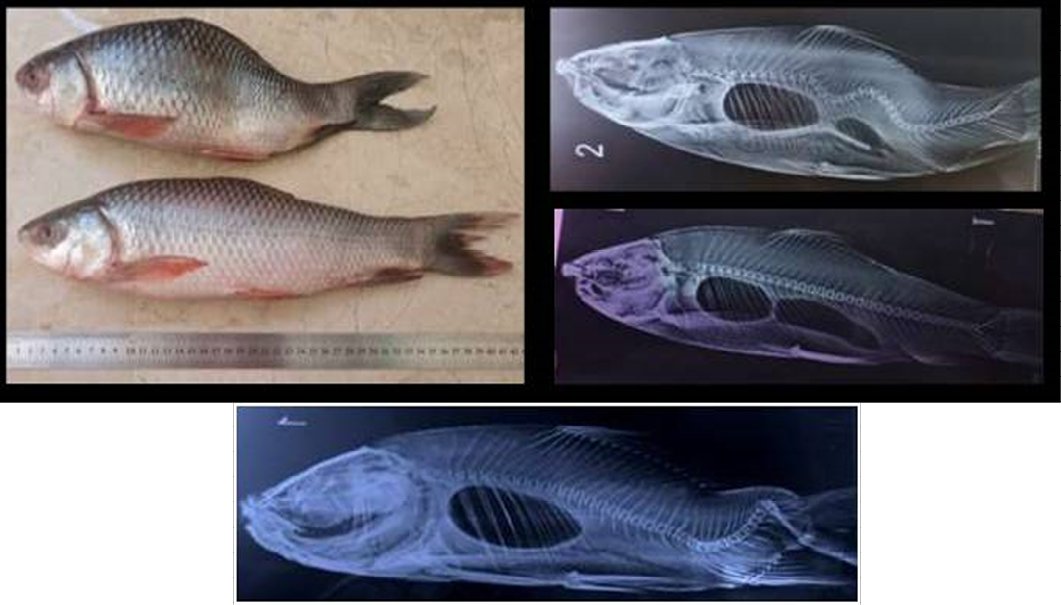
Horizontal view of radiograph of C. catla from Rice canal district Larkana, Sindh, Pakistan.
Table 1: Comparison of morphometric parameters between normal and abnormal individuals of C. catla collected from Rice Canal, Larkana, Sindh, Pakistan. Different superscripts are significantly (P<0.05) different. (n= 186).
| Body parameters | Normal catla catla | Abnormal catla catla |
| Total body weight (g) | 1516±11.41a | 1500±8.93a |
| Total body length (cm) | 44±6.13a | 44±5.37a |
| Fork length (cm) | 40±3.21 a | 39.8±3.62 a |
| Standard length (cm) | 36.5±7.30 a | 35.1±5.82 a |
| Head length (cm) | 10±8.34 a | 11±1.22 a |
| Eye diameter (cm) | 0.9±0.05 a | 1±0.73 a |
| Body girth (cm) | 31±2.52 a | 34.3±2.56 a |
| Pectoral fin length(cm) | 9±0.81 a | 9.1±1.28 a |
| No. of pectoral fin rays | 17.0±0.93 a | 17±1.63 a |
| Pelvic fin length (cm) | 7.9±0.73 a | 8±1.11 a |
| No. of pelvic fin rays | 10±0.88 a | 9.6±1.34 a |
| Dorsal fin length (cm) | 10.7±0.68 a | 11±1.48 a |
| No. of dorsal fin rays | 19±1.00 a | 18±1.58 a |
| Anal fin length (cm) | 7.5±0.65 a | 8±1.49 a |
| No. of anal fin rays | 8±0.93 a | 8±0.99 a |
| Tail fin length (cm) | 6.7±0.59 a | 7±1.33 a |
| No. of tail fin rays | 11±1.10 a | 11±2.03 a |
| Lateral line(cm) | 22.5±1.74 a | 23±1.88 a |
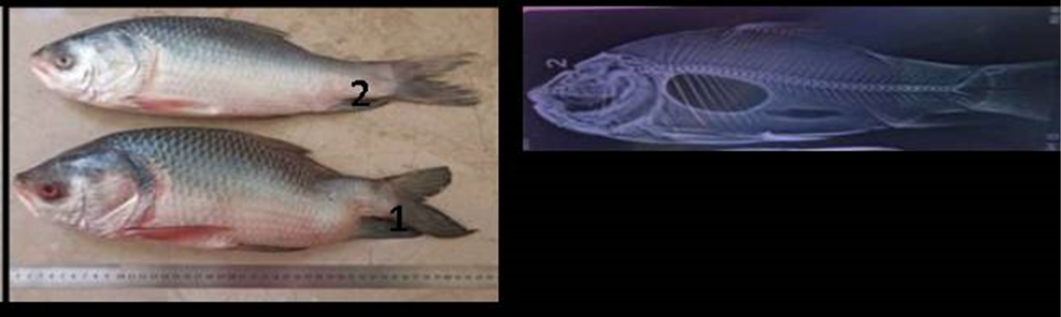
Horizontal view of radiograph of L. rohita from Rice canal, District Larkana, Sindh, Pakistan
Table 2: Comparative analysis of body parameters in normal vs. abnormal L. rohita collected from rice canal, district larkana, sindh, pakistan. dissimilar superscripts are significantly different (P<0.05). (n= 186).
| Body parameters | Normal labeo rohita | Abnormal labeo rohita |
| Total body weight (g) | 844±3.61 a | 845±2.87 a |
| Total body length (cm) | 42±2.74 a | 41±3.11 a |
| Fork length (cm) | 36.1±0.95 a | 35.4±2.78 a |
| Standard length (cm) | 34±0.96 a | 33±3.52 a |
| Head length (cm) | 7.5±1.01 a | 8±1.22 a |
| Eye diameter (cm) | 0.7±0.04 a | 1±0.08 a |
| Body girth (cm) | 24±2.34 a | 25±2.44 a |
| Pectoral fin length(cm) | 2±0.68 a | 3±0.83 a |
| No. of pectoral fin rays | 17±2.65 a | 16±1.43 a |
| Pelvic fin length (cm) | 5±0.69 a | 5.5±1.22 a |
| No. of pelvic fin rays | 9±1.12 a | 9±1.42 a |
| Dorsal fin length (cm) | 7.5±1.31 a | 6.5±1.22 a |
| No. of dorsal fin rays | 13±2.01 a | 14±1.67 a |
| Anal fin length (cm) | 2.5±0.99 a | 3±1.83 a |
| No. of anal fin rays | 7±1.33 a | 7.6±1.59 a |
| Tail fin length (cm) | 5±0.88 a | 8.5±1.54 a |
| No. of tail fin rays | 11±1.43 a | 10±2.65 a |
| Lateral line(cm) | 29±2.67 a | 28±3.55 a |
During the present research abnormal curvature was found in two carp species C. catla and L. rohita from the Rice Canal, District Larkana, Sindh was mainly due to the malnutrition, poor water quality and indiscriminate fishing pressure. Some researchers have proposed that the inward curvature (Lordosis and Scoliosis)and abnormal lateral curvature may be caused by genetic factors, environmental stressors, water quality or inadequate levels of vitamins and minerals ; ; . However, pollutants such as heavy metals and hazardous exposure to aquatic systems have a crucial influence. All these contaminants disrupt fish physiology and due to such characteristics major changes in fish physiology happened and these changes directly lead to anomalies in the body skeleton of fish ; . The continuous addition of contaminants in the canal water disrupt habitat structure and clearcut harms the environmental developments and hence skeletal abnormalities are extremely relevant markers in fish populations ; .Such malformations can limit swimming efficiency, increase susceptibility to disease, and reduce market value. A number of researchers have proposed that there are several nutritional influences and biotic and abiotic factors of the environment that are involved in the development of skeletal deformities ; ; ; ; . The proposals of the aforesaid professors are in support of the idea of contemporary research. The various body parameters of both the aberrant fishes were compared with the normal ones resulting as no dissimilarity among the measurements of reported fishes. So, it was decided that single homogenous population of both fishes (C. catla and L. rohita) available in Rice canal, District Larkana. ; ; ; variety of authors like suggested this claim. Our findings are supported by prior work results, as these abnormalities in fish skeletan structures and spinal curvature are also consistent with other research findings ; ; . However, it is important to note that no significant changes or abnormalities in the morphometric parameters and growth patterns like length and weight measurements were detected. The damaged fish populations were recorded in the same homogenous groups and on the other hand normal fishes were shown in genetically diverse groups. These 129 discoveries are consistent with other researchers ; ; ; . Although certain changes in morphometric structures have been reported, these differences may have been caused by malnutrition or environmental diseases ; .
Conclusions and Recommendations
The results of this study suggest that the malformations of the fish bones could be attributable to environmental stress, nutrient shortage and anthropogenic activities. Therefore, the study accentuates the importance of accessing and managing skeletal anomalies in fresh water fish to improve their health and economic viability.
Acknowledgments
The authors are greatly acknowledged the Authorities of University of Sindh, Jamshoro and Department of Zoology for providing all research facilities for carrying out this research. This research is the part of Ph.D thesis of Ms. Bushra Shaikh.
Novelty Statement
This investigation presents the first combined evaluation of vertebral abnormalities and morphometric associations in local fish species from the Indus River systems in Sindh, Pakistan, emphasizing their conservation and ecological significance.
Author’s Contribution
Bushra Shaikh: Performed the experiment and prepared the initial draft of the manuscript as Ph.D. scholar.
Naeem Tariq Narejo and Ayaz Hussain Qadri: Designed and conceived the idea of this experiment.
Muhammad Hanif Chandio: Proofread the literature and edit the manuscript.
Faheem Saddar and Athar Mustafa Laghari: Collected fish samples for the research.
Farzana Hashim: Helped in data reviw.
Ghulam Abbas: Helped in literature review, manuscript editing, data review and revised final draft of the manuscript.
Munawar Lal, Shafiq ur Rehman and Shahnaz: Rashid, helped in writing, format and bibliography.
Generative AI and AI-assisted technology statement
The authors declare that no generative AI and AI assisted technology was used in the creation of this manuscript.
Conflict of interest
There is no conflict among authors on the current research.
References
- Afonso, J.M., D. Montero, L. Robaina, H. Fernández, M.S. Izquierdo and R. Ginés. 1998. Selection programs for stress tolerance in fish. Cah. Options Mediterranean. 34: 235–245.
- Baeverfjord, G., T. Asgard and K.D. Shearer. 1998. Development and detection of phosphorus deficiency in Atlantic salmon, Salmosalar L., parr and post-smolts, Aquacult. Nutrit., 4: 1–11. https://doi.org/10.1046/j.1365-2095.1998.00095.x. [CrossRef]
- Bengtsson, B.E. 1974. Vertebral damage to minnow Phoxinus phoximus exposed to zinc, Oikos, 25:134-9. https://doi.org/10.2307/3543634. [CrossRef]
- Bengtsson, B.E., A. Bengtsson and M. Himberg. 1985. Fish deformities and pollution in some Swedish waters, Ambio., 14(1): 32-35.
- Bensimon-Brito, A., E. Cardeira and M.L. Cancela. 2016. Zebrafish as a model for understanding vertebral malformations. Develop. Biol., 420(2): 203–212.
- Boglione, C., A. Costa and M. Scardi. 2021. Skeletal deformities in aquaculture: current knowledge and future directions. Aquac. Int., 29: 123–146.
- Boglione, C., G. Gisbert, S. Gavaia, D. Witten, M. Moren and P. Fontagné. 2019. Skeletal anomalies in reared European fish larvae and juveniles: causes, prevention and remediation. Rev. Aquacult., 11(3): 1111–1139. https://doi.org/10.1111/raq.12269 [CrossRef]
- Boglione, C., M. Pulcini and S. Cataudella. 2015. Skeletal anomalies as indicators of stress in aquaculture. Fish Physiol. Biochem., 41: 1–17.
- Bucke, D. and C. Andrews. 1985. Vertebral abnormalities in chub, Leuciscus (Squalius) cephalus L, Bullet. Europ. Associat. Fish Pathol., 5(1): 3-5.
- Chandio, M.H., H. Kalhoro, S. Kalhoro, J.A. Baloch, R. Iqbal, R. and N.T. Narejo. 2020. Impact of diverse feed stuffs on weight gain of Channa punctatus raised in cisterns. Sindh Univ. Re. J. (Science Series), 52(2). https://sujo.usindh.edu.pk/index.php/SURJ/article/view/1984
- Dars, B.A., N.T., Narejo, M.H. Chandio, H. Narejo, M.P. Narejo, F. Saddar, G. Dastagir, G. Abbas and S. Rashid. 2023. Inter-relationship of various body measurements with regard to length in Clarias gariepinus, reared in cemented ponds. Sar. J. Agric., 39(3): 604-608. [CrossRef]
- Fjelldal, P.G., R. Nordgarden and T. Hansen. 2020. Effects of temperature and nutrition on vertebral development in fish. Aquacult. Res., 51(4): 1565–1575.
- Fjelldal, P.G., T. Hansen and A. Berg. 2016. A radiological study on vertebral deformities in cultured Atlantic salmon (Salmo salar L.). Aquac., 452: 1–8. https://doi.org/10.1016/j.aquaculture.2015.10.020 [CrossRef]
- Fraser, T.W. K., P.G. Fjelldal and T. Hansen. 2019. Skeletal deformities in aquaculture species: effects of environmental conditions. Rev. Fish. Sci. Aquac., 27(2): 125–145.
- Gavaia, P.J., S. Dinis and M.T. Cancela. 2018. Osteological development and abnormalities in fish larvae: a review. Aquacult., 491: 30–44. https://doi.org/10.1016/j.aquaculture.2018.02.034 [CrossRef]
- Georgakopoulou, E., P. Katharios, P. Divanach, and G. Koumoundouros. 2010. Effect of temperature on the development of skeletal deformities in gilthead seabream (Sparus aurata Linnaeus, 1758). Aquaculture, 308(1–2), 13–19. [CrossRef]
- Haga, Y., T. Suzuki, H. Kagechika and T. Takeuchi. 2003. A retinoic acid receptor-selective agonist causes jaw deformity in the Japanese flounder, Paralichthys olivaceus. Aquaculture, 221(1–4): 381–392. [CrossRef]
- Imed M., T. Deli, K. Kessabi, S. Barhoumi, A. Kerkeni and K. Saïd. 2008. Association of spinal deformities with heavy metal bioaccumulation in natural populations of grass goby, Zosterisessor ophiocephalus Pallas, 1811 from the Gulf of Gabès (Tunisia), Environ. Monitor. Assess., 156(1-4): 551-560. https://doi.org/10.1007/s10661-008-0504-2 [CrossRef]
- Jafri, S.I.H., N.T. Narejo and S.M. Hussain. 1998. Anomalous dorsal fin of a catfish, Rita rita. Pak. J. Zool., 30(2): 159-161.
- Jalbani, S., N.T. Narejo, P. Khan, M.Y. Laghari, P. K. Lashari and F. Memon. 2016. Morphometric and meristic analysis of endangered Catfish, Rita rita from Indus River near Jamshoro, Sindh, Pakistan. Sindh Univ. Res. Jour. (Sci. Ser.) 48(2): 349-352.
- Khan, P., N.T. Narejo, S. Jalbani, F. Memon and G. Dastagir. 2015. Study of mansural characters and meristic counts of Heteropneustes fossilis from Manchar Lake, District Jamshoro, Sindh, Pakistan. Int. J. Innovat. Appl. Res., 3(12): 1- 3.
- Khoso, A.G., S.A. Memon, Lashari, A.A. and R.B. Mahar. 2021. GIS-based spatial variability of COD and heavy metals owing to Larkana City sewage drained into the Rice Canal, Sindh, Pakistan. Environ. Sci. Pollut. Res., 28(45): 63957–63975. https://doi.org/10.1007/s11356-021-15128 [CrossRef]
- López-Olmeda, J.F. and F.J. Sánchez-Vázquez. 2019. Thermal biology and circadian rhythms in fish: implications for skeletal development. Fish Physiol. Biochem., 45: 1341–1354.
- Mariasingarayan, Y., J. Danaraj and P.G. Fjelldal. 2023. Occurrence of skeletal deformities in wild and cultured fish populations: a comparative study. Aquac. Fisher., 8(6): 521–530.
- Mariasingarayan, Y., J. Danaraj, B. Veeraiyan, P.G Fjelldal, K. Karuppiah, R. Narayanasamy. 2024. Vertebral column deformity in six species of wild fish at the Coromandel coast, Bay of Bengal India, Aquac. Fisher., 9 (4): 635-641. [CrossRef]
- Martini, A., M.M. Bonaldo and P. Parma. 2022. Impact of rearing density on skeletal deformities in marine fish larvae. Aquac., 547: 737451.
- Narejo, N.T. 2010. Morphometric characters and their relationship in Gudusia chapra (Hamilton) from Keenjhar lake (Distt: Thatta), Sindh. Pak. J. Zool., 42(1): 101-104.
- Narejo, N.T., A.M. Mastoi, M.Y. Laghari and P.K. Lashari. 2007. Incidence of crocked vertebral column in adult Cirrhinus mrigala (Hamilton) from Keenjhar Lake (Distt: Thatta) Sindh, Pakistan. Pak. J. Zool., 39(3): 199-201.
- Parveen, S., N.T. Narejo, A.H. Qadri, H. Kalhoro and M.H. Afshan. 2021. Curvature deformity of vertebral column in adult Channa striata (Snakehead) from River Indus near Jamshoro Sindh, Pakistan. Sindh. Univ. Res. Jour. (Sci. Ser.), 53 (1): 9-12.
- Pulcini, D., C. Boglione, E. Palamara and S. Cataudella. 2010. Use of meristic counts and skeletal anomalies to assess developmental plasticity of farmed rainbow trout (Oncorhynchus mykiss, Walbaum 1792): a preliminary study, J. Appli. Ichthyol., 26(2): 298-302. https://doi.org/10.1111/j.1439-0426.2010.01425.x [CrossRef]
- Santos, M.E., R.M. Leal and A.F. Castro. 2020. Environmental and nutritional factors affecting skeletal deformities in farmed fish. Aquac. Repor., 17: 100354. https://doi.org/10.1016/j.aqrep.2020.100354 [CrossRef]
- Tong, X.H., Q.H. Liu, S.H. Xu, D.Y. Ma, Z.Z. Xiao, Y.S. Xiao and J. Li. 2012. Skeletal development and abnormalities of the vertebral column and of the fins in hatchery-reared turbot Scophthalmus maximus. J. Fish Biol. Mar., 80(3): 486-502. https://doi.org/10.1111/j.1095-8649.2011.03173.x [CrossRef]
- Wargelius, A. and E. Edvardsen. 2021. Genetic and environmental interactions in fish skeletal development. Aquacult. Repor., 20: 100701.
- Witten, P.E., G. Huysseune and A. Hall. 2017. A practical approach for the classification of skeletal anomalies in fish. J. Appli. Ichthyol., 33(2): 145–153. https://doi.org/10.1111/jai.13212 [CrossRef]
- Ytteborg, E., P. Torgersen and S. Baeverfjord. 2020. Early developmental stress and skeletal deformities in farmed fish. Front. Marine Sci., 7: 571248. https://doi.org/10.3389/fmars.2020.571248 [CrossRef]

Services
Article usage statistics
Loading…
Related articles
- Adverse Impacts of a Mixture of Metals on Two Freshwater Fish Species, Catla catla and Labeo rohitaSarhad Journal of Agriculture · 2024
- Sub-Lethal Effects of Endosulfan+Chlorpyrifos Mixture on Biochemical Parameters and Blood Genotoxicity Markers of Two Cyprinidae Fish Species Catla catla and Labeo rohitaPakistan Journal of Zoology · 2025
- Nutritional Status Assessment of Wild and Cultured Stock of Major Carps in Central Punjab, PakistanPakistan Journal of Zoology · 2025
- Density Dependent Growth Performance of Catla catla and Labeo rohita under Cage Culture at Syphon Headworks, Punjab, PakistanPakistan Journal of Zoology · 2026
- Chromium contamination in water, sediment and its bioaccumulation in Indian major carps in River Chenab, PakistanPunjab University Journal of Zoology · 2018
- Gill Disease Caused by <i>Thelohanellus</i> <i>bifurcata</i> Basu and Haldar, 1999 a Pathogenic Myxozoan Parasite in Cultured Indian Carp, Labeo rohita (Hamilton, 1822) in Punjab, IndiaJournal of Animal Health and Production · 2014