
Abstract | The present study investigated the effects of an aqueous nettle leaf extract on growth performance, feed efficiency, carcass characteristics, and overall productive performance in broiler chickens. A total of 240 one-day-old Ross 308 broiler chicks were randomly allocated to four experimental groups using a completely randomized design. The experimental arrangement consisted of a control group and three groups receiving the nettle-derived preparation through drinking water at concentrations of 10, 15, and 20 mL/L, respectively. The findings indicated that dietary supplementation with the aqueous extract significantly enhanced (P ≤ 0.05) productive performance, particularly in the T4 group (20 mL/L), which achieved the greatest final body weight, body weight gain, and European Production Efficiency Factor (EPEF). This group also exhibited a lower feed conversion ratio compared with the untreated control birds. Feed consumption showed moderate differences among the experimental groups, whereas marked improvements were detected in body weight gain and feed use in broilers supplied with the nettle-derived preparation. Carcass evaluation revealed significant improvements in dressing percentage with edible organs and in the relative weights of economically important carcass cuts. Birds supplemented with nettle extract exhibited higher percentages of breast, thigh, and wing cuts compared with the control group, indicating improved carcass quality and muscle development. Additionally, mortality rate was significantly reduced in treated groups, especially in T4, reflecting improved flock health and survivability. The observed improvements could be linked to the abundance of biologically active constituent’s in nettle leaves, including flavonoids, phenolic compounds, vitamins, and essential minerals, which enhance digestive enzyme activity, improve intestinal morphology, increase nutrient absorption, and strengthen immune responses. Overall, the findings indicate that the prepared aqueous leaf extract represents a natural and effective growth-promoting additive for broiler production, providing a promising alternative to conventional antibiotic growth promoters. Among the tested treatments, the highest supplementation level (20 mL/L) produced the greatest improvements in productive performance, carcass traits, and the overall health status of broiler chickens under the conditions of the present study.
Introduction
Poultry production represents one of the fastest-growing sectors in animal agriculture worldwide due to its efficiency in converting feed into high-quality animal protein and its relatively low production cost compared to other livestock systems. The continuous expansion of intensive broiler production systems has increased the demand for strategies aimed at improving growth performance, feed efficiency, and carcass quality while maintaining bird health and production sustainability (Abdelli et al., 2021; Al-Salhi et al., 2025a).
For many years, antibiotic growth promoters were routinely incorporated into poultry diets to enhance productivity and reduce the occurrence of disease. Nevertheless, increasing concerns regarding antimicrobial resistance and the presence of drug residues in poultry products have led to regulatory restrictions and complete bans in several countries. As a result, research has increasingly focused on natural alternatives, especially phytogenic feed additives, which are considered safe and sustainable options for improving poultry performance ; . These plant-derived additives have gained substantial interest because they can improve growth performance and production efficiency while avoiding the limitations associated with the use of antibiotic growth promoters. Their beneficial effects are mainly attributed to bioactive compounds, including phenolics, flavonoids, alkaloids, and essential oils, which enhance digestive function, stimulate enzyme secretion, modulate intestinal microflora, and improve antioxidant status. As a result, these additives can enhance nutrient utilization, growth performance, and carcass yield in broiler chickens. Several recent studies have demonstrated the potential of nettle (Urtica spp.) as an effective phytogenic feed additive for improving growth performance and carcass characteristics in poultry. Teixeira et al. (2023) reported that dietary supplementation with Urtica urens enhanced body weight gain and carcass-related traits in broiler chickens, emphasizing its value as a natural functional additive in poultry nutrition. Likewise, Puvača et al. (2023) showed that supplementation with nettle essential oil improved production efficiency and carcass quality, indicating its effectiveness in enhancing broiler performance.
In addition, Milosevic et al. (2021) reported that dietary inclusion of nettle improved growth performance and feed efficiency in broiler chickens, likely through enhanced nutrient absorption and metabolic activity. More recently, Wlaźlak et al. (2026) observed that dietary inclusion of dried nettle improved intestinal morphology and positively affected growth performance, thereby contributing to better carcass traits and production efficiency in poultry.
Overall, these findings indicate that nettle and its derivatives can serve as effective natural alternatives to synthetic growth promoters by improving growth performance, feed efficiency, and carcass characteristics in broiler chickens.
Despite these encouraging findings, most previous studies have evaluated nettle as a feed additive in powder or extract form mixed directly into diets. Information regarding the use of an aqueous leaf extract supplied through drinking water and its influence on growth performance and carcass characteristics under local production conditions remains limited. In addition, variations in extraction procedures and methods of administration may affect the biological efficacy of its bioactive constituents. Therefore, this study was designed to prepare an aqueous leaf extract and investigate its effects on growth performance, feed efficiency, and carcass characteristics in broiler chickens, with the aim of assessing its suitability as a natural and sustainable growth-promoting additive for modern poultry production systems.
Preparation of aqueous nettle leaf extract
Fresh leaves of the nettle plant were collected from a pesticide-free site during the vegetative growth stage and authenticated by a qualified plant taxonomist. The leaves were thoroughly washed with distilled water to remove dust and surface impurities, then shade-dried at ambient temperature (25–28°C) under adequate ventilation for 7–10 days until a constant weight was achieved, thereby helping to preserve thermolabile phytochemicals.
Following drying, the leaves were ground into a fine powder using an electric grinder and stored in airtight, light-resistant containers under dry conditions until extraction. The aqueous extract was prepared using a standardized hot-water extraction procedure with slight modifications to previously described methods for phytogenic feed additives ; . This approach was selected because of its efficiency in extracting water-soluble bioactive constituents, including phenolic compounds, flavonoids, and glycosides, which are recognized for their biological activity in poultry nutrition .
Briefly, 100 g of the leaf powder was mixed with 1 L of distilled water (1:10, w/v) in a heat-resistant glass container. The mixture was maintained at 80°C for 45 min with continuous magnetic stirring to enhance the release of bioactive constituents. After cooling to room temperature, the extract was filtered sequentially through sterile muslin cloth followed by filter paper to remove plant residues and obtain a clear filtrate. The filtrate was then concentrated under reduced pressure using a rotary evaporator at 45–50°C to increase the concentration and stability of the phytochemical constituents. The concentrated extract was transferred into sterile amber glass bottles and stored at 4°C until use to minimize oxidation and degradation of heat-sensitive compounds. A fresh batch of extract was prepared weekly throughout the experimental period to maintain its biological activity, and it was diluted with drinking water immediately before administration to achieve the required experimental concentrations. A schematic flow diagram illustrating the preparation of the aqueous leaf extract used in the present study is presented in Figure 1.
Broiler management and experimental conditions
A total of 240 one-day-old Ross 308 broiler chicks were randomly allocated to four experimental groups using a completely randomized design (CRD), with three replicates assigned to each treatment. The control group (T1) received unsupplemented drinking water, whereas the remaining groups were provided with the prepared aqueous leaf extract via drinking water at concentrations of 10 (T2), 15 (T3), and 20 mL/L (T4), respectively.
The birds were raised under standard intensive production conditions using a deep-litter housing system and were provided with unrestricted access to feed and water throughout the experimental period. Environmental conditions, including temperature, ventilation, and lighting schedule, were managed according to the Ross 308 Broiler Management Handbook to promote optimal growth and welfare. Appropriate environmental control measures were maintained throughout the
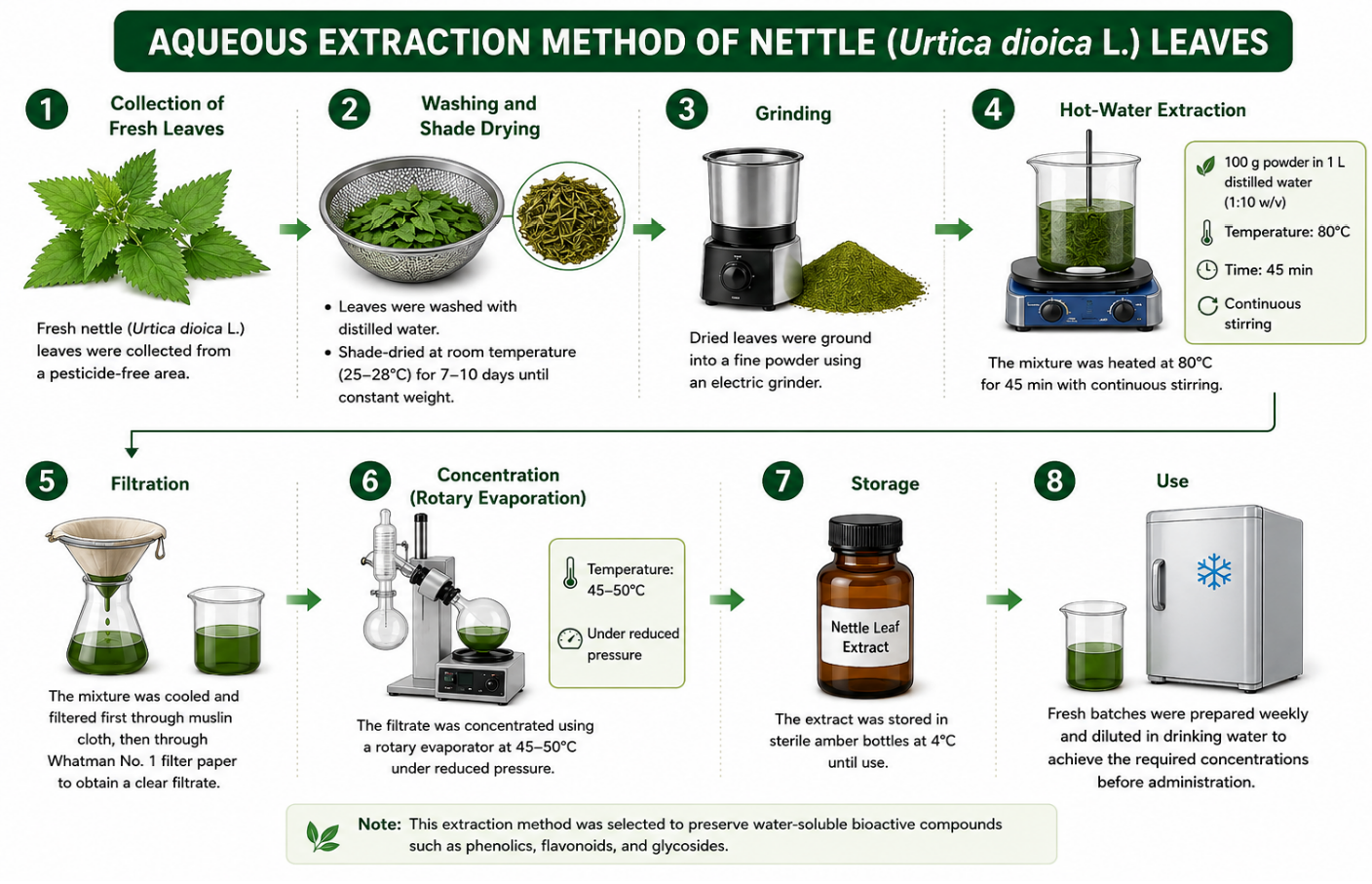
Schematic illustration of the preparation procedure for the aqueous leaf extract used in the experimental treatments
trial, as effective environmental management is recognized as a key factor in sustaining poultry health and production efficiency .
The basal diets were formulated to satisfy the nutrient requirements of broiler chickens and were offered in mash form during the entire study. The starter diet (1–10 days) contained 21.9% crude protein and 2940 kcal/kg metabolizable energy, while the grower (11–21 days) and finisher (22–42 days) diets contained 19.7% and 18.3% crude protein with metabolizable energy levels of 2995 and 3035 kcal/kg, respectively. Growth performance variables, including body weight, body weight gain, feed intake, feed conversion ratio, and the European Production Efficiency Factor (EPEF), were monitored throughout the experiment. Carcass characteristics were assessed at 35 days of age using standard slaughter and carcass evaluation procedures.
Productive performance and carcass characteristics of broiler chickens
Growth performance was monitored throughout the experimental period to evaluate the effects of the prepared aqueous leaf extract on broiler productivity. The evaluated parameters included body weight (BW), body weight gain (BWG), feed intake (FI), feed conversion ratio (FCR), mortality rate, and the European Production Efficiency Factor (EPEF), following standard procedures widely adopted for broiler performance assessment ; . Individual body weights were recorded at the beginning of the trial and subsequently at weekly intervals using a calibrated digital electronic balance. Body weight gain was calculated as the difference between the final and initial body weights using the following equation:
BWG (g/bird) = Final body weight − Initial body weight
Feed intake (FI) was recorded weekly for each replicate by subtracting the amount of feed remaining from the total quantity offered, using the following equation:
FI (g/bird) = Feed offered − Feed remaining
Feed conversion ratio (FCR) was determined as:
FCR = Feed intake (g) / Body weight gain (g)
Mortality was monitored daily throughout the experimental period and expressed as a percentage of the initial flock size according to the following formula:
Mortality (%) = (Number of dead birds / Total number of birds) × 100
The European Production Efficiency Factor (EPEF) was used as an overall indicator of production efficiency and was calculated using the following equation:
EPEF = [(Live body weight (kg) × Livability (%)) / (Age (days) × FCR)] × 100
At 42 days of age, a representative sample of birds from each treatment was randomly selected and slaughtered after an appropriate feed withdrawal period to evaluate carcass characteristics. Following slaughter and complete bleeding, carcasses were defeathered and eviscerated. Dressing percentage was calculated both with and without edible organs according to the following equation:
Dressing percentage (%) = (Carcass weight / Live body weight) × 100
The relative weights of the major and secondary carcass cuts, including breast, thigh, wings, neck, back, and drumstick, were determined and expressed as percentages of carcass weight using the following equation:
Relative cut weight (%) = (Weight of cut / Carcass weight) × 100
These measurements were used to assess the effects of the prepared aqueous nettle leaf extract on carcass yield and distribution of economically important carcass components in broiler chickens.
Statistical analysis
The data generated in this experiment were analyzed according to a completely randomized design (CRD). Treatment effects on the measured variables were evaluated using one-way analysis of variance (ANOVA). When significant treatment effects were detected, comparisons among treatment means were performed using Duncan’s multiple range test, with statistical significance declared at P < 0.05. Percentage data were transformed, when necessary, to satisfy the assumptions of normality and homogeneity of variance before statistical analysis. All analyses were conducted using standard statistical software, and the results are expressed as mean ± standard error (SE). The statistical methodology followed the procedures described by Snedecor and Cochran (1989) for the design and analysis of biological experiments.
Results and Discussion
Effect of the prepared aqueous extract of nettle (Urtica dioica L.) leaves on body weight of broiler chickens
Table 1 demonstrates that supplementation with the prepared aqueous extract of nettle (Urtica dioica L.) leaves significantly (P ≤ 0.05) affected the body weight of broiler chickens during the experimental period. No significant differences among treatments were detected at one week of age. However, from the second week onward, significant differences became evident and remained until the end of the trial. Birds receiving treatment T4 achieved significantly greater body weights than those in the control group (T1) at most measurement periods and recorded the highest final body weight at 42 days of age. Treatment T3 ranked second, followed by T2, whereas the control treatment produced the lowest body weight values. These findings suggest that supplementation with the prepared aqueous nettle leaf extract enhanced growth performance by increasing body weight in broiler chickens. The observed improvement may be related to the abundance of bioactive constituents in nettle leaves, including phenolic compounds, flavonoids, vitamins, and essential minerals, which can support digestive activity, improve nutrient absorption, and enhance nutrient utilization, thereby promoting body growth and weight gain.
Effect of the prepared aqueous extract of nettle (Urtica dioica L.) leaves on body weight gain of broiler
As shown in Table 2, supplementation with the prepared aqueous extract of nettle (Urtica dioica L.) leaves significantly (P ≤ 0.05) influenced the body weight gain of broiler during the experimental period. No significant differences were detected among treatments during the first week. However, significant differences emerged from the second week and persisted until the end of the trial. Birds in treatment T4 achieved significantly greater body weight gain than those in the control treatment (T1), recording the highest cumulative body weight, followed by T3 and T2, while the control group exhibited the lowest values. These findings indicate that supplementation with the prepared aqueous nettle leaf extract enhanced
Table 1: Effect of aqueous nettle (Urtica dioica L.) leaf extract on weekly body weight (g) of broiler chickens (Mean ± SE)
| Treatment | Wk 1 | Wk 2 | Wk 3 | Wk 4 | Wk 5 | Wk 6 |
| T1 | 163.88 ± 0.29 | 455.76± 3.11b | 801.21 ± 0.29 b | 1229.00 ± 5.54 c | 1731.10 ± 6.18 d | 2340.21 ± 4.94 d |
| T2 | 165.22 ± 0.86 | 468.54± 5.45a | 809.42 ± 2.42b | 1244.87 ± 3.49 c | 1758.00 ± 2.67 c | 2383.10 ± 3.44 c |
| T3 | 166.11 ± 0.11 | 468.87 ± 1.11 a | 820.00± 12.61ab | 1273.75 ± 13.47b | 1800.00 ± 13.47 b | 2444.21 ± 15.28 b |
| T4 | 165.77 ± 0.72 | 470.65 ± 1.45 a | 841.10 ± 5.55 a | 1316.86 ± 5.44 a | 1861.32 ± 5.74 a | 2529.10 ± 5.60 a |
| Significance | NS | * | * | * | * | * |
*Within the same column, means bearing different superscript letters differ significantly (P ≤ 0.05).
NS = No significant difference.
Table 2: Effect of the prepared aqueous leaf extract on weekly body weight gain (g) of broiler (Mean ± SE)
| Treatment | 0–1 Wk | 1–2 Wk | 2–3 Wk | 3–4 Wk | 4–5 Wk | 5–6 Week | Total BWG (0–42 d) |
| T1 | 120.88 ±0.29b | 291.89 ±2.89b | 345.45±1.09b | 427.78 ±5.52b | 502.11± 0.67d | 609.11 ±1.23d | 2297.22 ± 8.75 d |
| T2 | 122.22 ± 0.86a | 303.33 ±4.72a | 340.89 ±0.58b | 435.44±1.28ab | 513.11 ±1.63c | 625.11 ±0.86c | 2340.11 ± 5.96 c |
| T3 | 123.11 ± 0.11a | 302.77 ±1.05a | 351.12±11.75ab | 453.77 ± 4.23a | 526.23 ±0.96b | 644.22 ±2.18b | 2401.22 ±15.28b |
| T4 | 122.77 ± 0.72a | 304.89 ±0.88a | 370.45 ± 4.47 a | 475.77 ± 0.22a | 544.45 ±0.80a | 667.78 ±0.22a | 2486.11 ± 5.60 a |
| Significance | * | * | * | * | * | * | * |
*Within the same column, means bearing different superscript letters differ significantly (P ≤ 0.05).
the growth performance of broiler chickens. This positive response may be associated with the bioactive constituents of nettle leaves, including phenolic compounds, flavonoids, vitamins, and essential minerals, which can stimulate digestive enzyme activity, improve nutrient digestibility, and increase nutrient absorption, thereby supporting greater body weight gain and overall growth performance.
Effect of the prepared aqueous extract of nettle (Urtica dioica L.) leaves on feed intake of broiler chickens
It is evident from Table 3 that the supplementation of the prepared aqueous extract of nettle (Urtica dioica L.) leaves had a significant effect (P ≤ 0.05) on feed intake of broiler chickens during most of the experimental period. No significant differences were observed among treatments during the early experimental weeks, whereas significant differences appeared during the middle and late growth phases and continued until the end of the experiment. Treatment T4 recorded a significantly higher feed intake compared with the control group (T1) in most periods and achieved the highest total feed intake at 42 days of age, followed by T3 and T2, while the control group recorded the lowest value. These results indicate that supplementation with the prepared aqueous extract of nettle leaves influenced feed consumption patterns in broiler chickens. This may be attributed to the stimulatory effect of bioactive compounds present in nettle leaves on appetite, digestive secretions, and gut health, which may enhance feed utilization and voluntary feed intake.
Effect of aqueous nettle leaf extract (Urtica dioica L.) leaves on feed conversion ratio of broiler chickens
Table 4 shows that supplementation with the prepared aqueous extract of nettle (Urtica dioica L.) leaves significantly (P ≤ 0.05) affected the feed conversion ratio (FCR) of broiler chickens throughout the experimental period. No significant differences were found among treatments during the first week; however, significant improvements became apparent from the second week and continued until the end of the experiment. Birds in treatment T4 exhibited a significantly lower FCR than those in the control group (T1), reflecting superior feed efficiency, followed by T3 and T2, while the control group showed the least favorable feed conversion values. These findings indicate that supplementation with the prepared aqueous nettle leaf extract enhanced feed utilization efficiency in broiler chickens. The observed improvement may be related to the bioactive compounds present in nettle leaves, which can stimulate digestive enzyme activity, support intestinal health, and improve nutrient absorption and utilization, thereby enhancing feed conversion efficiency.
Table 3: Effect of aqueous nettle (Urtica dioica L.) leaf extract on weekly feed intake (g) of broiler (Mean ± SE)
| Treatment | Wk 1 | Wk 2 | Wk 3 | Wk 4 | Wk 5 | Wk 6 | Total feed intake (1–42 d) |
| T1 | 175.69 ±1.33 | 459.27 ±6.35b | 547.06 ±2.34b | 732.95±10.80b | 915.51 ±1.99a | 1185.73 ±2.53a | 4016.21 ± 16.71 ab |
| T2 | 178.44 ±1.14 | 472.17 ±7.08b | 541.20 ±0.74b | 725.73 ±2.75b | 901.38 ±6.28b | 1131.44 ±2.04c | 3950.37 ± 3.93 c |
| T3 | 177.69 ±0.35 | 467.28±0.64ab | 559.37±17.87ab | 742.71±9.02ab | 898.08 ±0.70b | 1131.65 ±1.16c | 3976.78 ± 20.39 bc |
| T4 | 178.02 ±1.19 | 467.49 ±1.22a | 580.35 ± 6.72a | 762.83 ±1.79a | 905.59±3.12ab | 1144.12±2.43b | 4038.40 ± 9.64 a |
| Significance | NS | NS | * | * | * | * | * |
*Within the same column, means bearing different superscript letters differ significantly (P ≤ 0.05).
NS = No significant difference.
Table 4: Effect of aqueous nettle (Urtica dioica L.) on (FCR; g feed/g body weight gain) of broiler (Mean ± SE)
| Treatment | Wk 1 | Wk 2 | Wk 3 | Wk 4 | Wk 5 | Wk 6 | Overall FCR (1–42 d) |
| T1 | 1.45 ± 0.008a | 1.57 ± 0.006a | 1.58±0.003a | 1.71±0.006a | 1.82±0.003a | 1.95±0.003a | 1.75 ± 0.0035 a |
| T2 | 1.46 ± 0.005a | 1.56 ± 0.003a | 1.59±0.003b | 1.67±0.006b | 1.76±0.006b | 1.81±0.005b | 1.69 ± 0.0020 b |
| T3 | 1.44 ± 0.003a | 1.54±0.003bc | 1.59±0.003b | 1.64±0.006b | 1.71±0.003c | 1.76±0.006c | 1.66 ± 0.0046 c |
| T4 | 1.45 ± 0.005a | 1.53 ± 0.003c | 1.57±0.003c | 1.60±0.003c | 1.66±0.003d | 1.71±0.003d | 1.62 ± 0.0009 d |
| Significance | NS | * | * | * | * | * | * |
*Within the same column, means bearing different superscript letters differ significantly (P ≤ 0.05).
NS = No significant difference.
Effect of the prepared aqueous extract of nettle (Urtica dioica L.) leaves on mortality rate and (EPEF) in broiler chickens
Table 5 demonstrates that supplementation with the prepared aqueous extract of nettle (Urtica dioica L.) leaves significantly (P ≤ 0.05) affected both the mortality rate and the European Production Efficiency Factor (EPEF) in broiler chickens. The mortality rate declined progressively as the supplementation level increased, with birds in treatment T4 showing the lowest mortality compared with the control group (T1), while T2 and T3 recorded intermediate values. In contrast, EPEF increased significantly following dietary supplementation, with T4 producing the highest efficiency index, followed by T3 and T2, whereas the control group exhibited the lowest EPEF value. These findings suggest that supplementation with the prepared aqueous nettle leaf extract improved flock survival and overall production efficiency. This positive effect may be associated with the bioactive constituents of nettle leaves, which can enhance immune function, support intestinal health, and alleviate physiological stress, thereby contributing to improved productivity and flock performance.
Table 5: Effect of aqueous nettle (Urtica dioica L.) leaf extract on mortality rate (%) and (EPEF) of broiler (Mean ± SE)
| Treatment | Mortality (%) | EPEF |
| T1 | 10.00 ± 0.39 a | 286.58 ± 9.19 c |
| T2 | 5.00 ± 0.27 ab | 318.96 ± 10.23 b |
| T3 | 3.33 ± 0.18 ab | 338.90 ± 8.48 ab |
| T4 | 1.66 ± 0.13 b | 365.54 ± 5.92 a |
| Significance | * | * |
*Within the same column, means bearing different superscript letters differ significantly (P ≤ 0.05).
The results of the present study demonstrated that supplementation with the prepared aqueous extract of nettle (Urtica dioica L.) leaves significantly improved all productive performance traits of broiler chickens, including body weight, body weight gain, feed intake, feed conversion ratio, mortality rate, and European Production Efficiency Factor (EPEF). The most pronounced improvement was observed in treatment T4 (20 mL/L), which consistently outperformed the control and other treated groups. This overall improvement in productive performance can be explained by the synergistic action of the bioactive compounds present in nettle leaves, such as flavonoids, phenolic compounds, vitamins, and essential minerals. These compounds play a crucial role in enhancing digestive enzyme activity, improving nutrient digestibility, and increasing nutrient absorption efficiency, which ultimately leads to enhanced growth performance and higher body weight gain. In addition, improved intestinal health and increased absorptive surface area through enhanced villus morphology contribute to better nutrient utilization and overall productivity.
Regarding feed conversion ratio (FCR), the observed reduction in treated groups, particularly T4, indicates improved feed efficiency and more effective conversion of feed into body mass. This reflects better nutrient utilization and reduced metabolic waste. Moreover, the reduction in mortality rate and the improvement in European Production Efficiency Factor (EPEF) suggest enhanced health status and immune response in treated birds. These effects may be attributed to the antioxidant and anti-inflammatory properties of nettle leaves, which help reduce oxidative stress and improve resistance to environmental and pathological challenges. The marked improvement in productive performance may be attributed not only to the bioactive compounds found in nettle leaves, but also to their positive effects on gut health, physiological status, and immune system efficiency. Beneficial gut microbiota play a crucial role in maintaining efficient digestion and nutrient utilization, while improved physiological and biochemical status contribute to enhanced metabolic performance and overall bird health. In this context, Al-Salhi et al. (2022) and Al-Salhi and Al-Shatti (2023) highlighted the importance of beneficial bacterial communities and bioderived preparations in improving digestive function and physiological performance in poultry. Biochemical indicators and immune-enhancing strategies are closely linked to improved metabolic efficiency, health status, and productive performance in broiler chickens; therefore, the outstanding growth performance, feeding efficiency, low mortality rate, and high positive flow rate observed in this study can be explained by the combined effects of improved intestinal function, improved physiological homeostasis, and enhanced immune response ; .
These findings are consistent with those of Abdelli et al. (2021), who reported that phytogenic feed additives enhance nutrient digestibility, regulate gut microbiota, and improve the overall productive performance of poultry. Likewise, Cross et al. (2007) showed that herbal feed additives and their essential oils promote growth performance and suppress harmful microorganisms in the gastrointestinal tract, supporting the improved feed conversion efficiency observed in the present study. Similarly, Milosevic et al. (2021) found that dietary inclusion of nettle improves growth performance and feed efficiency by enhancing nutrient absorption and metabolic processes. Teixeira et al. (2023) also reported that nettle supplementation increased body weight, growth rate, and carcass characteristics, in agreement with the greater body weight and weight gain recorded in the current study.
In addition, Puvača et al. (2023) demonstrated that nettle derivatives improve productive performance and meat quality through their antioxidant activity, whereas Wlaźlak et al. (2026) found that nettle enhances intestinal morphology and nutrient absorption, thereby contributing to improved growth performance. Overall, the improvements observed in productive performance, particularly in treatment T4, may be attributed to the combined action of the bioactive compounds present in the prepared aqueous nettle leaf extract. These compounds likely promote intestinal health, strengthen immune function, and improve nutrient utilization, ultimately leading to superior productive performance in broiler chickens.
Table 6: Effect of aqueous nettle leaf extract on dressing percentage of broiler (Mean ± SE)
| Treatments | Dressing percentage without edible organs (%) | Dressing percentage with edible organs (%) |
| T1 | 74.83 ± 0.58 | 78.89 ± 0.61 b |
| T2 | 75.28 ± 0.76 | 79.98 ± 0.57 ab |
| T3 | 77.48 ± 0.24 | 81.71 ± 0.37 a |
| T4 | 76.81 ± 1.17 | 80.80 ± 1.22 ab |
| Significance | N.S. | * |
*Within the same column, means bearing different superscript letters differ significantly (P ≤ 0.05).
NS = No significant difference.
Effect of the prepared aqueous nettle leaf extract on dressing percentage of broiler
Table 6 presents the effect of the prepared aqueous nettle leaf extract on dressing percentage with and without edible organs in broiler chickens at 42 days of age. The results showed no significant differences among treatments in dressing percentage without edible organs. However, significant differences (P ≤ 0.05) were observed in dressing percentage with edible organs. Birds in T3 recorded the highest dressing percentage with edible organs (81.71%), whereas the lowest value was observed in the control group (T1), which recorded 78.89%.
The improvement in dressing percentage may be attributed to the biologically active compounds present in nettle leaves, including flavonoids, phenolic compounds, vitamins, and essential minerals, which may enhance nutrient utilization and protein deposition in body tissues. These effects could contribute to increased carcass yield and improved productive performance. The present findings are in agreement with those reported by Safamehr (2012), Nobakht et al. (2011), and Bekele et al. (2015), who observed improvements in carcass characteristics of broiler chickens supplemented with nettle preparations.
Table 7: Effect of the prepared aqueous nettle leaf extract on relative weights of primary and secondary carcass cuts of broiler (Mean ± SE)
| Treatments | Breast (%) | Thigh (%) | Wings (%) | Neck (%) | Back (%) | Drumstick (%) |
| T1 | 32.23 ±0.47c | 15.90 ±0.31d | 13.58 ±0.10c | 20.62 ±0.32a | 6.71 ± 0.12 a | 10.93 ± 0.12 a |
| T2 | 33.47 ±0.18b | 16.66 ± 0.43c | 14.36 ±0.54b | 20.09 ±0.35b | 5.56 ± 0.38b | 9.84 ± 0.56 b |
| T3 | 33.68± 0.55ab | 16.91 ±0.57b | 14.52 ±0.66ab | 19.79 ±0.61c | 5.39 ± 0.35bc | 9.62 ± 0.31 c |
| T4 | 33.94 ±0.21a | 17.16 ±0.24a | 14.88 ± 0.17 a | 19.48 ±0.30d | 5.20 ± 0.56 c | 9.31 ± 0.10 d |
| Significance | * | * | * | * | * | * |
*Within the same column, means bearing different superscript letters differ significantly (P ≤ 0.05).
Effect of the prepared aqueous nettle leaf extract on relative weights of carcass cuts of broiler
Table 7 presents the effect of the prepared aqueous nettle leaf extract on the relative weights of primary and secondary carcass cuts of broiler chickens at 42 days of age. The results revealed significant differences (P ≤ 0.05) among treatments in all carcass cut traits. Birds receiving the prepared aqueous nettle leaf extract exhibited higher percentages of breast, thigh, and wing cuts compared with the control group. The highest values for breast (33.94%), thigh (17.16%), and wings (14.88%) were recorded in T4, whereas the lowest values were observed in T1. Conversely, the percentages of neck, back, and drumstick cuts decreased significantly with increasing levels of the prepared aqueous nettle leaf extract, with T4 recording the lowest values compared with the control group.
The increase in the relative weights of the economically important carcass cuts, particularly the breast and thigh muscles, may be associated with the bioactive compounds present in nettle leaves, including flavonoids, phenolic compounds, vitamins, and essential minerals. These constituents may improve nutrient digestibility, stimulate protein synthesis, and promote muscle development, leading to a higher proportion of valuable muscle tissues in the carcass. The present results agree with those of Bekele et al. (2015) and Safamehr (2012), who reported improvements in carcass traits and muscle yield in broiler chickens receiving nettle-based supplements. Moreover, the enhanced growth performance observed in the supplemented groups may have contributed to a more favorable distribution of carcass components and greater development of the main commercial cuts. The role of improved biological efficiency in enhancing productive outcomes has also been emphasized by Al-Salhi et al. (2025b), who reported successful application of microbial fermentation technologies in poultry-associated systems, highlighting the importance of biological optimization processes in supporting efficient nutrient utilization and overall production performance. Moreover, maintaining a sustainable poultry production system requires effective management of environmental pollutants, as environmental contamination may negatively influence animal health and production efficiency. Alabresm et al. (2026) emphasized the potential of eco-friendly biotechnological approaches for pollutant reduction and environmental management.
Conclusions and Recommendations
Supplementation of broiler drinking water with the prepared aqueous extract of nettle (Urtica dioica L.) leaves improved growth performance, feed efficiency, carcass characteristics, and overall production efficiency. Among the tested levels, supplementation at 20 mL/L produced the best overall performance. These results indicate that the prepared aqueous leaf extract may represent an effective natural growth-promoting additive and could serve as a sustainable alternative to conventional antibiotic growth promoters in contemporary broiler production systems.
Acknowledgments
The authors are gratful to Al-Ayen Iraqi University, Al-Qasim Green University, and the University of Thi Qar for their academic support and cooperation in completing this study. The authors also acknowledge the support of Al-Hamza Agricultural High School, Babylon Education Directorate, for providing the appropriate experimental environment and facilities that contributed to the successful completion of the research.
Novelty Statement
The novelty of this study lies in the preparation and application of an aqueous nettle (Urtica dioica L.) leaf extract administered through drinking water as a natural phytogenic additive in broiler chickens. Unlike previous studies that mainly evaluated nettle powder or feed-based preparations, this study investigates its use in aqueous form at different concentrations and demonstrates its effects on growth performance, feed efficiency, carcass characteristics, mortality, and overall production efficiency. The findings identify 20 mL/L as the most effective supplementation level under the conditions of the present study.
Author’s Contribution
Rakhaa Sh. Alnassrallah: Manuscript drafting and correspondence with the journal.
Teeb A. Altabtabaai and Hanan Fadhil Aswad: Data collection, organization, and formatting.
Ahmed F. Kadhim: Methodology development and statistical analysis.
All authors reviewed and approved the final version of the manuscript.
Generative AI and AI-assisted technology statement
The authors declare that no generative AI and AI assisted technology was used in the creation of this manuscript.
Conflict of interest
The authors have declared no conflict of interest.
