
This study was conducted in Abbottabad region, (Pakistan), to evaluate the microbiological quality of common bakery products and identify major contaminating pathogens. A total of 204 bakery samples (biscuits, cakes, and bread) were randomly collected from vendors between January and June 2024. Total viable count (TVC), Escherichia coli, coliforms, yeast, mold, Staphylococcus aureus, and Salmonella were enumerated using standard plate count techniques on selective media. Isolates were characterized by morphological, Gram staining, and biochemical profiling (Catalase, Oxidase, Indole, MR-VP, and Urease tests), and confirmed by 16S rRNA gene sequencing and phylogenetic analysis. Results were compared with Pakistan Standards and Quality Control Authority (PSQCA) and US FDA permissible limits. Median TVC values for biscuits (15,000 CFU/g), cakes (29,000 CFU/g), and bread (29,000 CFU/g) were higher than the permissible limit (<1,000 CFU/g). Elevated levels of E. coli (300–400 CFU/g) and coliforms (800–1,000 CFU/g) were detected, alongside high yeast and mold counts (up to 4,000 CFU/g in bread). Predominant isolates included E. coli, Klebsiella pneumoniae, and Enterobacter cloacae, confirmed as Enterobacter spp. with 99.25% sequence similarity. Bakery products sold in Abbottabad were found to be contaminated with fecal and environmental microorganisms, indicating poor hygienic and processing conditions. Strengthening Good Hygiene Practices (GHP), regular microbiological monitoring, and strict enforcement of food safety regulations are essential to protect consumer health and ensure the nutritional safety of bakery food.
Research Article · Online First, 20 November 2026 · Open Access
Assessment of Food Safety in Abbottabad Bakeries: Isolation and Characterization of Pathogenic Microflora
, , , , ,
Affiliations & Notes ⌄
- 1Department of Microbiology, Faculty of Health and Biomedical Sciences, Abbottabad University of Science and Technology, Abbottabad
- 2Department of Microbiology, University of Veterinary and Animal Sciences, Lahore
- 3MOE, Key Laboratory of Cell Activities and Stress Adaptations, School of Life Science, Lanzhou University, Lanzhou, Gansu Province 730000, China
- 4Department of Health and Biological Sciences, Abasyn University, Peshawar
- *Correspondence | Afzal Khan; Email: afzalmicrobio@gmail.com
Article Info ⌄
- Journal:
- Pakistan Journal of Zoology
- Submitted Date:
- 20 February 2026
- Revision Date:
- 5 June 2026
- Accepted Date:
- 23 June 2026
- Published Date:
- 20 November 2026
Ayub Jadoon and Syeda Afifa have contributed equally to this work.

Abstract
Introduction
Bakery products, including biscuits, bread, and cakes, are important dietary staples consumed worldwide due to their nutritional value, affordability, and convenience (Siddiqui et al., 2020). However, their high nutrient content also render them an ideal growth environment for wide range of microorganisms, such as yeasts, molds, spoilage bacteria, and pathogens . Microbial contamination can occur at various points of the production chain including through raw materials, poor processing, packaging, handling in aseptic and improper storage conditions ; .
Consequently, contamination leads high economic losses through spoilage and mitigate shelf-life, as well as serious health hazards for consumers, potentially resulting in food borne diseases and outbreak . Microbiological quality of food is a sensitive indicator of food safety and hygienic standards in which food is manufactured . The key microbial parameters include total viable count (TVC) which reflects the total microbial burden and the presence of hygiene indicators like coliforms and Escherichia coli (E. coli). These indicators are definitive confirmation of human fecal contamination and inadequate sanitation practices ; . Moreover, the identification of pathogens such as Salmonella spp., Staphylococcus aureus and Klebsiella spp. poses a direct and immediate health risk to consumers ; .
In Pakistan the bakery industry is rapidly expanding; however, maximum number of businesses are informal and fail to follow good hygiene standards . Studies reports from different regions of the country have underlined significant levels of microbial contamination in various food products. For instance, high prevalence of coliform and aerobic plate counts have been reported in street food and dairy items, emphasizing to systemic failures in food handling and hygiene . Furthermore, studies from metropolitan cities such as Lahore , Islamabad , and Karachi , have documented high level microbial loads that exceed the permissible limits set by the Pakistan Standard and Quality Control Authority (PSQCA) and other international bodies like the US Food and Drug Administration (FDA). The PSQCA establishes safety standards with regard to bakery products such as biscuits and bread, while with other products like cakes, manufacturers often reference FDA regulations .
Therefore, the current study aims (1) to evaluate the microbiological quality of different bakery products (biscuits, cakes and bread) commercially available in Abbottabad, Pakistan, by comparing TVC, coliforms, E. coli, yeast and mold counts against PSQCA and US FDA standards; (2) to isolate and characterize the most dominant contaminating microorganisms by both biochemical profiling and 16S rRNA gene sequencing of proper identification, and (3); and to ascertain the prevalence.
Materials and Methods
Study area and sample collection
A total sample size of 204 food samples (i.e., biscuits and cakes as well as bread) were collected in an aseptic condition and from various bakery stores of the district Abbottabad, Khyber Pakhtunkhwa Pakistan. The sampling localities comprise an area in Mansehra, Murree Road, Mandian, Jadoon Plaza, Jinnah Abad, Habibullah colony, Main Bazar, Mall Road, Karim Pura, Baber Road, Jhanji, Chitapul, Jail Road, and Malikpura. Each of the composite samples were about 300 g and was packed in sterile packets to ensure sample integrity. After that, the samples were transferred to EBM Hatar Industrial State Microbiology Lab and analyzed within 2-3 h after collection.
Microbiological Enumeration
Samples (10g) homogenized in 90 mL of buffered peptone water (BPW) to form 1:10 initial dilution. The BPW consists of Enzymatic Digest of Casein (Peptone (10g/L), Sodium Chloride (5 g/L), Disodium Hydrogen Phosphate (3.5g/L), and Potassium Dihydrogen Phosphate (1.5g/L), were microbiologically enumerated as per ISO guidelines .
All the analyses were conducted in standard pour plate or spread plate methods using sterilized and prepared media in accordance with manufacturer guidelines . Total Plate Count (TPC) was calculated by plating suitable concentrations on plate count agar (PCA) and incubated at 35 2°C for 48 h, with plates containing 25-250 colonies selected for counting. In dilution/plating to enumerate E. coli and coliform, sample on Brilliance E. coli/ coliform selective agar (Peptone: 8.0 g, sodium chloride: 5.0 g, disodium hydrogen phosphate: 2.2 g, potassium dihydrogen phosphate: 1.8 g, sodium lauryl sulphate: 0.1 g (selective agent), chromogenic mix: 0.35 g (includes rose-gal and X-Glu), tryptophan: 1.0 g, agar: 10.6 g) and incubated at 37°C to 24-48 h; where purple colonies demonstrated E. coli and pink colonies indicated coliforms. The yeast and mold counts were determined by plating on Dichloran Glycerol (DG-18) Agar with incubation at 22-25°C for 3-7 days. The detection of S. aureus was carried out using spread plating on Baird-Parker Agar accompanied with egg yolk tellurite emulsion followed by incubation at 35-37°C for 24-48 h, with typical colonies black shiny and surrounded by clear areas viewed as presumptive positive. Detection of Salmonella was performed using a three-step procedure; pre-enrichment in buffered peptone water at 36°C for 24 h; selective enrichment in rappaport-vassiliadis soya peptone broth (soya peptone: 4.5g (nitrogen source), NaCl: 7.2g-8.0g, MgCl2: 13.4g-13.58g, KH2PO4: 0.6g-1.26g K2HPO4: 0.18g-0.4g, malachite green: 0.036g, Final pH: 5.2±0.2) at 41.5°C for 24 h; and selective plating on Brilliance Salmonella Agar and incubated at 37 °C for 24-48 h with purple colonies indicating presumptive Salmonella.
Biochemical identification and colony morphology
The presences of presumptive isolates were purified and confirmed with morphology of the colonies, using Gram staining, and a pattern of biochemical tests like catalase, oxidase, triple sugar iron (TSI), motility indole urease (MIU), methyl red (MR), and voges-proskauer (VP) tests which were conducted following previous authors .
Molecular identification
The boiling lysis method was used to extract genomic DNA using the pure bacterial cultures.In the boiling lysis methods 2–3 mL of microorganism was taken and centrifuged 1.5 mL to create a pellet. then STET buffer (containing lysozyme) was added and re-suspended the pellet. The tubes were placed in a boiling water bath or heat block at 95-100 C for 30–60 sec. The tubes were spined at high speed (10–15 min) to create a pellet containing debris. The pellet containing denatured chromosomal DNA and proteins was removed using a sterile toothpick. The plasmid DNA from the supernatant was precipitated using isopropanol or ethanol. Polymerase chain reaction (PCR) was used to amplify the 16S rRNA gene using universal primers 27F (5`-AGAGTTTGATCMTGGCTCAG-3`) and 1492R (5`-ACCTTGTTACGACTT-3`). PCR reaction mixture had an overall volume of 25 μl it includes 2.5 μL of 10X PCR buffer, 1.5 μL MgCl2, 0.5 μL of 10 mM dNTPs, 0.5 μL each of forward and reverse primers (10 μM), 0.125 μL Taq DNA polymerase, 1−2 μL template DNA, and nuclease-free water. The amplification conditions were as follows; initial denaturation at 95 °C for 10 min, 40 cycles of denaturation at a temperature of (95°C, 1 min), annealing at a temperature of (56 °C, 1 min) and extension at a temperature of 72 °C for 1 min, and final extension (72 °C 10 min) .
Electrophoresis of amplicons on a 1 % agarose gel stained with ethidium bromide was used to visualize amplicons. The purified products of the right size (~1500 bp) were subjected to phylogenetic analysis. The derived 16S rRNA gene sequences in comparison with known sequences in the NCBI database was done through the algorithm of BLAST. Taxonomic identification was confirmed by building phylogenetic trees by the use of maximum likelihood algorithmic method in MEGA software.
All of the analyses were done in duplicate or triplicate by applying strict aseptic techniques. Sterility of the media was checked by incubating some representative samples at 37 oC. Proper reference strains such as E. coli ATCC 25922, Pseudomonas aeruginosa ATCC 27853, Salmonella Typhimurium ATCC 14028, and Staphylococcus aureus ATCC 6538 were employed as positive and negative controls to each assay. The glassware and equipment were sterilized correctly and calibrated.
Statistical analysis
Statistical analysis was done in IBM SPSS statistics for Windows version 20.0. First, descriptive statistics, mean ± standard deviation of the continuous variables, were used to summarize the data. Independent samples t-tests were applied in order to establish whether there are any significant differences in the means of two independent sets. The analysis of the comparisons between more than two groups involved a one-way analysis of variance (ANOVA), and a post-hoc test (such as Tukey HSD) was used to perform a pairwise comparison when the outcome of ANOVA was significant. A threshold p-value of < 0.05 was considered a level of statistical significance in this study.
Results
Microbial load
The microbiological analysis of 204 bakery products from 13 different sites of Abbottabad, KPK, Pakistan was carried out. Current study revealed extensive non-compliance with PSQCA and FDA safety standards.
The median TVC for biscuits was 15,000 CFU/g (IQR: 8,000-25,000), which far surpassing the PSQCA permissible limit of <1,000 CFU/g. Similarly, bread had median TVC of 29,000 CFU/g (IQR: 20,000-56,000), although the mean TVC for cake was within the FDA limit (<10,000 CFU/g), the median count was 29,000 CFU/g (IQR: 15,000-50,000), indicating a significant number of individual samples had very high levels of contamination. The difference in TVC across product types was statistically significant (p < 0.001).
The presence of fecal contamination was alarmingly high across all products. E. coli counts (< 3 CFU/g), showed median level 400 CFU/g (IQR: 200-500) in biscuits, 300 CFU/g (IQR: 200-400) in cake, and 300 CFU/g (IQR: 200-400) in bread; these difference across products was not statistically significant (p=0.143). Similarly, coliform counts (<10 CFU/g), were significantly ((p=0.05) high (1,000 CFU/g; IQR: 600-2,000) in biscuits, 800 CFU/g (IQR: 400-1,750) in cake, and 800 CFU/g (IQR: 600-1,000) in bread (Table I). Furthermore, the higher level of pathogens associated with spoilage and contamination were detected. Klebsiella spp., a pathogen not explicitly regulated by the standards, was frequently isolated at median concentrations of 300 CFU/g (IQR: 100 -2,350) in biscuits, 500 CFU/g (IQR: 200-1,750) in cake, and 700 CFU/g (IQR: 400-1,775) in bread. The variation in counts across the three product types was significant (p<0.001). Yeast and mold count also surpassed the safety standard of <100 CFU/g. Median levels were 600 CFU/g (IQR: 300-1,375) in biscuits, 2,200 CFU/g (IQR: 1,200 - 4,225) in cake, and 4,000 CFU/g (IQR: 2,700 - 6,000) in bread, (Fig. 1) with a statistically significant difference (p<0.001).
Characteristics of isolates
Current study further characterized 18, highly contaminated food items based on morphology. The isolated colonies revealed a wide range of characteristics on different culture media. The food items include biscuits and cake from Mall Road Karimpura formed translucent, purple (coliform, circular), shiny/smooth blue (Klebsiella spp., spindle), mucoid/smooth colonies (Table II). On another hand, isolates from Jinnahabad Colony formed pink (E. coli, circular), white (Yeast/mold, irregular), opaque, shiny, circular, translucent, purple (coliform, circular), shiny/smooth colonies. Similarly, one highly contaminated isolate from Malikpura formed white (Yeast/mold, irregular), opaque colonies with a dry texture, and undulate margins.
Table I. Microbial load (CFU/g) and statistical comparison of bakery products (biscuits, cakes, bread) against PSQCA safety standards.
|
Samples (Median IQR) |
Total viable count |
E. coli |
Coliforms |
Klebsiella spp. |
Yeast and mold |
|
PSQCA Saftey Standard |
<1000 |
<3 |
<10 |
<100 |
|
|
Biscuit (n= 108) |
15,000 (8,000 - 25,000) |
400 (200 - 500) |
1,000 (600 - 2,000) |
300 (100 - 2,350) |
600 (300 - 1,375) |
|
Cake (n= 60) |
29,000 (15,000 - 50,000) |
300 (200 - 400) |
800 (400 - 1,750) |
500 (200 - 1,750) |
2,200 (1,200 - 4,225) |
|
Bread (n= 36) |
29,000 (20,000 - 56,000) |
300 (200 - 400) |
800 (600 - 1,000) |
700 (400 - 1,775) |
4,000 (2,700 - 6,000) |
|
p-value |
<0.001 |
0.143 |
0.017 |
<0.001 |
<0.001 |
IQR, interquartile range.
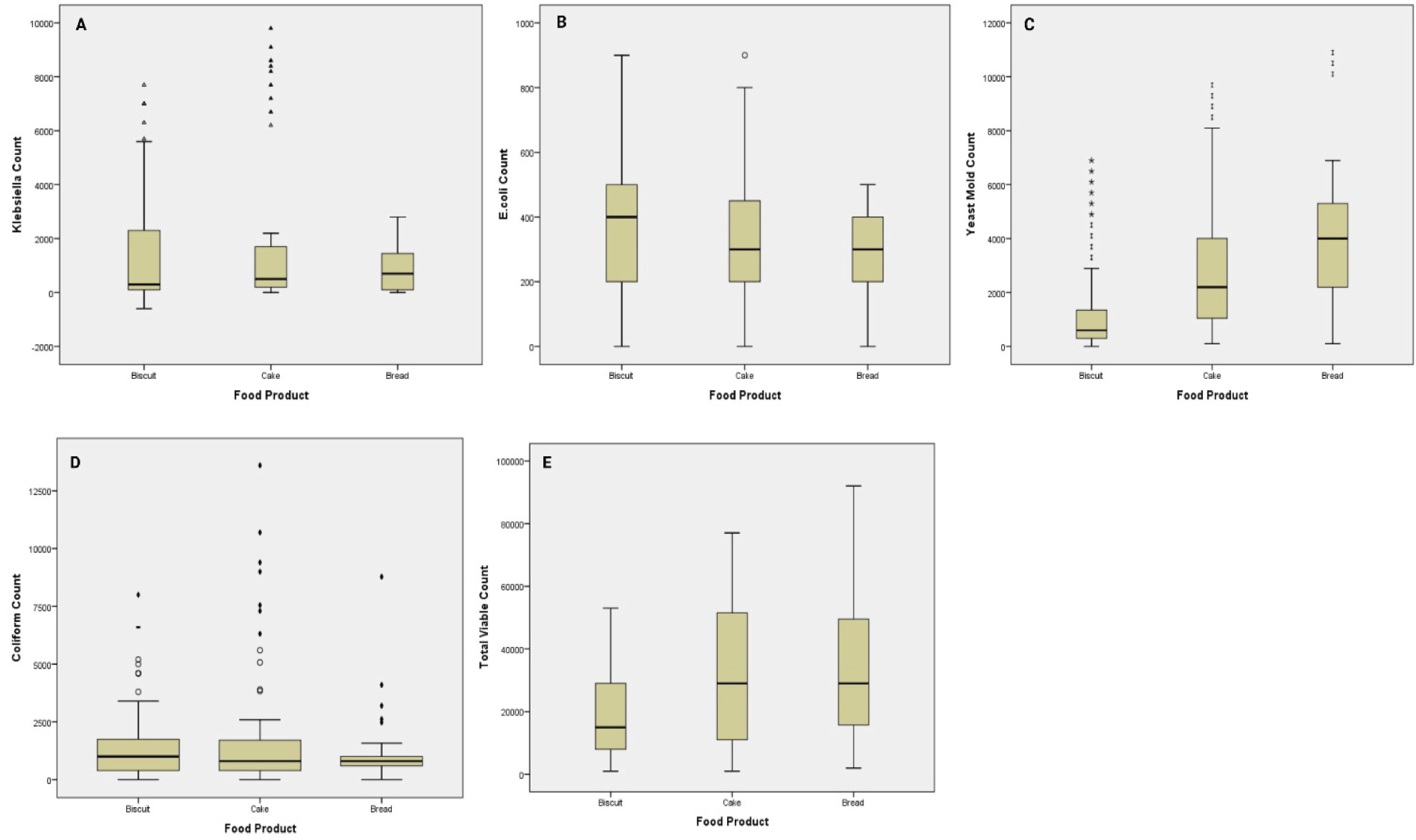
Comparative analysis of bakery products and their microbial load (CFU/g). (A) Klebshiella spp., count (B) E. coli count (C) Yeast/mold count (D) Coliform count (E) total viable count.
Table II. Biochemical characterization of food isolates from different regions of Abbottabad.
|
Sample code(s)/ location code |
Color |
Optical |
Texture |
Margin |
Shape |
Species |
|
MRKB1-3 |
Purple |
Translucent |
Shiny+ smooth |
Entire |
Circular |
Coliform |
|
MRKC1-5 |
Blue |
Translucent |
Mucoid+ smooth |
Entire |
Spindle |
Klebsiella spp. |
|
JBCB1-3 |
Pink |
Opaque |
Shiny |
Entire |
Circular |
E. coli |
|
JBCB4 |
Pink |
Translucent |
Shiny |
Entire |
Circular |
E. coli |
|
JBCB5 |
Purple |
Translucent |
Shiny+ smooth |
Entire |
Circular |
Coliform |
|
JBCB6 |
Blue |
Translucent |
Mucoid+ smooth |
Entire |
Spindle |
Klebsiella spp. |
|
JBCB7 |
Pink |
Opaque |
Shiny+smooth |
Entire |
Circular |
E. coli |
|
JBCBr1 |
White |
Opaque |
Dry |
Undulate |
Irregular |
Yeast/mold |
|
MKPB1 |
White |
Opaque |
Dry |
Undulate |
Irregular |
Yeast/mold |
MRKB, Mall Road Karimpura (Biscuit); MRKC, Mall Road Karimpura (Cake); JBCB, Jinnahabad Colony (Biscuit); JBCB, Jinnahabad Colony (Bread); MKPB, Malikpura (Biscuit).
Table III. Biochemical assessment of different food products.
|
Probable identification |
Samples |
Gram stain |
Catalase |
Oxidase |
Indole |
MR |
VP |
Urease |
Conclusive biochemical identification |
|
E. coli |
MRKB1, MRKC3 |
- |
+ |
- |
+ |
+ |
- |
- |
Escherichia coli |
|
MRKB4 |
- |
+ |
- |
+ |
+ |
- |
+ |
Unidentified enterobacteriaceae |
|
|
Klebsiella spp. |
MRKB2, MRKC2 |
- |
+ |
- |
- |
- |
+ |
+ |
Klebsiella pneumoniae |
|
MRKC1, MRKSB1 |
- |
+ |
- |
- |
+ |
- |
+ |
Unidentified Enterobacteriaceae |
|
|
Enterobacter spp. |
MRKB3, MRKSB2 |
- |
+ |
- |
+ |
+ |
+ |
+ |
Enterobacter cloacae complex |
The biochemical profiling led to the definitive identification of several key pathogens. Strains MRKB1 and MRKC3 were conclusively identified as Escherichia coli, based on their Gram-negative reaction and a positive result for catalase, indole, and MR tests, coupled with negative results for oxidase, VP, and urease. In a similar manner, strains MRKB2 and MRKC2 were identified as Klebsiella pneumoniae, characterized by their Gram-negative nature, a positive catalase test, and positive results for VP and urease, while testing negative for oxidase, indole, and MR. Furthermore, strains MRKB3 and MRKSB2 were identified as part of the Enterobacter cloacae complex, displaying a Gram-negative reaction, a positive catalase test, and positive results for indole, MR, VP, and urease, with a negative oxidase result. However, not all isolates could be pinpointed to a specific species; strain MRKB4, which shared some characteristics with E. coli (Gram-negative, catalase and indole positive, MR positive, oxidase and VP negative) but was urease positivean atypical trait for E. coli was categorized as an unidentified member. Similarly, strains MRKC1 and MRKSB1, which exhibited a biochemical profile that did not perfectly align with standard patterns, were also classified as unidentified Enterobacteriaceae as shown in Table III.
Molecular identification of isolates and phylogenetic analysis
Genomic DNA from four representative isolates was successfully amplified using universal 16S rRNA primers, yielding a single band of approximately 1500 bp, as visualized on an agarose gel. BLASTn analysis of the sequenced 16S rRNA fragments showed 99.25% similarity with several species within the Enterobacter genus, including Enterobacter mori (Accession: MK641315.1), Enterobacter cloacae (MK559559.1), and Enterobacter roggenkampii (CP045064.2) (Table III). A phylogenetic tree constructed using the neighbor-joining method confirmed the close evolutionary relationship between the isolates and the Enterobacter clade (Fig. 2). Based on these results, the predominant contaminating bacteria were identified as Enterobacter spp.
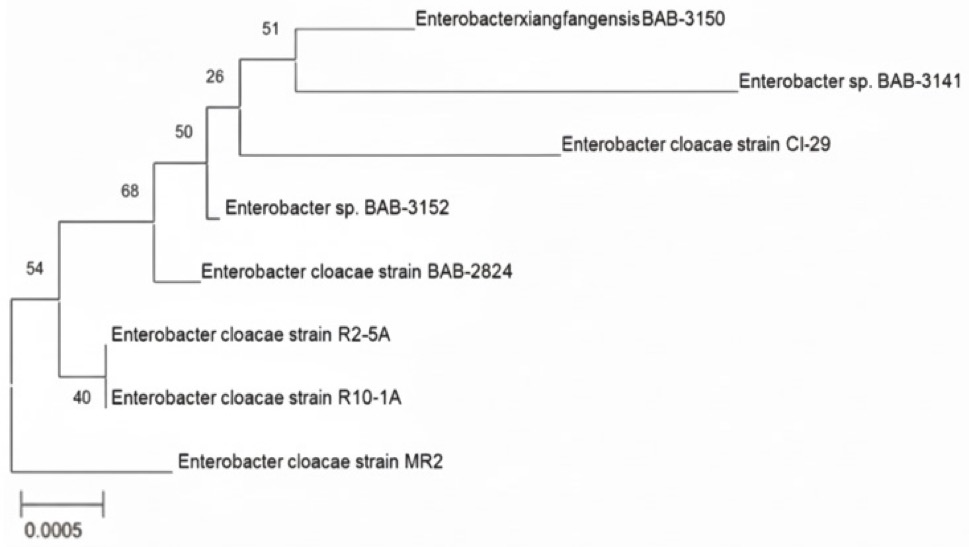
Phylogenetic tree of the isolated strain based on 16S rRNA gene sequences. The tree shows the relationship of the isolate (shown as SK1) with closely related species from the NCBI database. Bootstrap values (based on 1000 replications) are shown at the branch points
Discussion
This study demonstrates the evaluation of microbiological quality of bakery products that are marketed in Abbottabad, Pakistan. The results indicate highest prevalence of microbial contamination, indicating that the local and international food safety standards are violated on a large scale and offers to present a certain threat to consumer’s health. The most notable result is the high rates of violation of the safety standards of TVC. Median TVC of the products biscuits (15,000 CFU/g), cakes (29,000 CFU/g), and bread (29,000 CFU/g) have safely far surpassed the PSQCA-approved limit of less than 1,000 CFU/g. Although the average TVC of cakes was noted to be under the US FDA stipulation of cakes (Less than 10,000 CFU/g), high median value suggests that the average was skewed with few non-contaminated samples since majority were found to be highly contaminated. The results are consistent with other regions which reported high levels of microbial loads in bakery items. A study in Nigeria found microbial count in bread ranging from 7.4x10⁵-14. 4x10⁵ CFU/g , whereas a study in Ethiopia confirmed the potential of bread sold in Jimma Town to be a health hazard with a low microbial quality turbocharged by high mean counts of aerobic mesophilic bacteria (5.2±0.5 Log CFU/g) and a high prevalence (68%) of Staphylococcus aureus . In a similar manner, a recent study carried in Lahore, Pakistan, reported unacceptable TVCs in several types of baked goods, which was what we found and indicated that this was a system problem in Pakistan informal bakery industry Gill et al. (2020). The highest levels of contamination were in bread with a total plate count of 4.7x10⁵ CFU/g. In contrast with patties with lower count (1.6 x10⁵ CFU /g) compared to cake (5.7 × 10 4 CFU/ g).
More importantly than the high TVC, was the identification of certain hygiene indicators and pathogens. E. coli and other coliforms showing a median concentration hundreds of times higher than allowable limits (e.g., 400 CFU/g vs. <3 CFU/g in biscuits), is unambiguously due to fecal contamination, or unsanitary handling, and using contaminated water and raw materials. It is a serious health issue in the population. Our findings are consistent a study conducted in Baghdad Iraq which reported highest loads of Staphylococcus spp. and coliforms in local market products were significantly higher than found in supermarkets, and it reflects a larger problem of inefficient storage or handling in smaller retail outlets . The elevated yeast and mold count in all products and bread in particular (median 4,000 CFU/g) demonstrate that there was a problem with their spoilage and the likely eventual formation of mycotoxins and this was not the focus here yet this is another important risk area. Probably this is because of improper storage areas and the lack of preservatives. Similar findings were reported in previous studies where improper storage, lack of preservatives, and rough handling contributed in food items contamination (Faparusi and Adewole, 2026; .
Biochemical characterization performed was successful to determine the main pathogens, such as Escherichia coli, Klebsiella pneumoniae, and Enterobacter cloacae complex. The characterization of these representatives of the family of Enterobacteriaceae is complementary to the large numbers of coliform and indicates a probable common point of contamination, including water, soil, or illogical actions of food workers. The presence of E. coli, a definitive indicator of fecal contamination, is particularly concerning. Our finding is constant with other studies; for example, a survey conducted in India has revealed that 74% of ready to eat food is contaminated, including E. coli (41%) is a primary isolate, S. aureus (31%), Pseudomonas spp. (5%), and Yeast (3%), that indicated poor hygiene of vendors is associated with contaminated bacteria (Teegala et al., 2023).
Molecular analysis using 16S rRNA gene sequencing was used to achieve a more specific identification. The phylogenetic profile proved that the most dominant contaminants were indeed the members of the Enterobacter genera, with the 99.25% similarity to such species as E. mori, E. cloacae, and E. roggenkampii. This extends further than biochemical profiling to give final, species-level identification. Enterobacter spp. are well known environmental contaminants but they also contain opportunistic pathogens that may cause infections in immunocompromised individuals. The fact that they are in the food shows lack of sanitation and contamination after food processing. Molecular methods such as 16S rRNA sequencing are described as the gold standard in the identification of food contaminants and have been successfully applied in other research studies to track down the origin of the spoilage and pathogenic bacteria in foodstuffs . Despite being extremely effective, 16S rRNA sequencing is not always able to differentiate the closely related species, especially in some genera, such as Pseudomonas and Bacillus. Such alternative methodologies as MALDI-TOF MS have been reported to have a superior discriminating capability . Even though 16S rRNA sequencing is powerful, it is usually combined with other molecular methods, including PCR and phylogenetic analysis to enhance resolution and accuracy of bacterial identification ; ; .
Conclusion
The results show that bakery products in Abbottabad are manufactured in low hygienic conditions, which have highly contaminated the products with pathogens such as coliforms, E. coli, Enterobacter and Klebsiella spp. This is a significant threat to the health of the population since these products are daily food items. Such immediate actions include the introduction of compulsory hygiene training of the workers, a strong enforcement of food safety control, the regular checking of microbiology, and sensitization of the population. To maintain the safety of these foods, hygienic practices should be followed during the production process in order to avoid cross-contamination to ensure the health of the consumers is safeguarded.
Declarations
Acknowledgement
The author appreciates the generous support of the Department of Microbiology, Faculty of Health and Biomedical Sciences, Abbottabad University of Science and Technology, Abbottabad.
Funding
This research was supported by the research facilities of the Department of Microbiology, Faculty of Health and Biomedical Sciences, Abbottabad University of Science and Technology, Abbottabad, Pakistan. No external funding was received for this study.
Generative AI and AI assisted technology statement
The authors declare that no generative AI and AI assisted technology was used in the creation of this manuscript.
Statement of conflict of interest
The authors have declared no conflict of interest.
References
- Ali, S., Rezende, V.T., Ullah, S., de Paiva, E.L. Tonin, F.G., Corassin, C.H. and de Oliveira, C.A.F., 2023. Food processing and challenges in the food production and quality: The foodomics approach. Fd. Biosci., 56: 103217. https://doi.org/10.1016/j.fbio.2023.103217 [CrossRef]
- Al-Nasiry, B., 2020. Detection of bacterial contamination in filled and dried biscuit products of young children. Ann. Trop. Med. Hlth., 23: 231-602. https://doi.org/10.36295/ASRO.2020.231602 [CrossRef]
- Arshad, F. and Zahoor, T., 2019. Assessing the microbiological safety status of most commonly consumed food items sold at local and branded restaurants of Faisalabad, Pakistan. J. Fd. Saf., 39: e12587. https://doi.org/10.1111/jfs.12587 [CrossRef]
- Azad, Z.A.A., Ahmad, M.F. and Siddiqui, W.A., 2019. Food spoilage and food contamination, in health and safety aspects of food processing technologies. Springer. pp. 9-28. https://doi.org/10.1007/978-3-030-24903-8_2 [CrossRef]
- Bloomfield, S.J., Zomer, A.L., O’Grady, J., Kay, G.L., Wain, J., Janecko, N., Palau, R. and Mather, A.E., 2023. Determination and quantification of microbial communities and antimicrobial resistance on food through host DNA-depleted metagenomics. Fd. Microbiol., 110: 104162. https://doi.org/10.1016/j.fm.2022.104162 [CrossRef]
- Boukharouba, A., 2022. Isolation and identification of foodborne pathogens of special interest in food safety. Universitat Politècnica de València. [CrossRef]
- Chukwu, E., Nwaokorie, F., Coker, A., Avila-Campos, M. and Ogunsola, F., 2019. 16S rRNA gene sequencing: A practical approach to confirming the identity of food borne bacteria. Ife J. Sci., 21: 13-25. https://doi.org/10.4314/ijs.v21i3.2 [CrossRef]
- Das, K., Sarkar, A. and Hossain, A., 2020. Isolation of pathogenic microorganisms and determination of their antibiotic resistance patterns collected from different bakery products of Dhaka city. Fd. Res., 4: 1312-1316. https://doi.org/10.26656/fr.2017.4(4).400 [CrossRef]
- Demissie, S., Natea, G. and Raga, D., 2018. Microbial quality and safety of bread sold in cafeteria, tea and bread shop of Jimma town, Oromia regional state, southwest Ethiopia. Int. J. Adv. Res., 6: 771-779. https://doi.org/10.21474/IJAR01/6282 [CrossRef]
- Dimri, A.G., Chaudhary, S., Singh, D., Chauhan, A. and Aggarwal, M., 2020. Morphological and biochemical characterization of food borne gram-positive and gram-negative bacteria. Sci. Arch., 1: 16-23.
- Faparusi, F. and Adewole, A., 2019. Characterization of moulds associated with spoilage of bread soldin Ilaro, Yewa-South, Nigeria. Int. J. Biol. Chem. Sci., 13: 426-433. https://doi.org/10.4314/ijbcs.v13i1.33 [CrossRef]
- Gill, A., John, A., Iqbal, N. and Faridi, T.A., 2020. Assessment of biochemical profile among patients of microbiological quality assessment of bakery products available in Lahore, Pakistan: Microbiological quality assessment of bakery products available in Lahore, Pakistan. J. Nutr. Fd. Sci., pp. 24-29. https://doi.org/10.54393/df.v1i01.1 [CrossRef]
- Gitau, G.K., Kimeli, P., Ikiror, D., Mwangi, W., Machuchu, D., Gakuru, M.I. and Owuor, G., 2022. Factors associated with total coliform and total viable bacterial count in camel milk from Isiolo County, Kenya. Vet. World, 15: 1954. https://doi.org/10.14202/vetworld.2022.1954-1960 [CrossRef]
- India, F., 2024. Manual on microbiological examination of food and water.
- Kabiraz, M.P., Majumdar, P.R., Mahmud, M,M,C., Bhowmik, S. and Ali, A., 2023. Conventional and advanced detection techniques of foodborne pathogens: A comprehensive review. Heliyon, 9: e15482. https://doi.org/10.1016/j.heliyon.2023.e15482 [CrossRef]
- Khan, M.R., 2018. 38 value addition. Developing sustainable agriculture in Pakistan: pp. 857. https://doi.org/10.1201/9781351208239-38 [CrossRef]
- Madison, J.D., 2018. Microbial community characterization and restructuring for the amelioration of amphibian chytridiomycosis. University of South Dakota.
- Mahunu, G., Osei-Kwarteng, M., Chidozie Ogwu, M. and Afoakwah, N.A., 2024. Safe food handling techniques to prevent microbial contamination. In: Food safety and quality in the global south. Springer. pp. 427-461. https://doi.org/10.1007/978-981-97-2428-4_14 [CrossRef]
- Mehboob, A. and Abbas, T., 2019. Evaluation of microbial quality of street food in Karachi City, Pakistan: An epidemiological study. Microbiol. Res., 10: 7463. https://doi.org/10.4081/mr.2019.7463 [CrossRef]
- Mira, M., Maestre-Carballa, L., Lluesma-Gomez, M. and Martinez-Garcia, M., 2019. High-throughput 16S rRNA sequencing to assess potentially active bacteria and foodborne pathogens: A case example in ready-to-eat food. Foods, 8: p. 480. https://doi.org/10.3390/foods8100480 [CrossRef]
- Muhammad, S.M. and Galadima, S.I., 2022. Determination of microbiological quality of bread and sanitation conditions of local bakeries in Aliero Town, Kebbi State. Appl. Sci. Technol. Res. J., 1: 1-9. https://doi.org/10.31316/astro.v1i2.4274 [CrossRef]
- Ntuli, V., Sibanda, T., Elegbeleye, J.A., Mugadza, D.T., Eyassu Seifu, E. and Buys, E.M., 2023. Dairy production: Microbial safety of raw milk and processed milk products. In: Present knowledge in food safety. Academic Press. pp. 439-454. https://doi.org/10.1016/B978-0-12-819470-6.00076-7 [CrossRef]
- Pérez-Lavalle, L., Carrasco, E. and Valero, A., 2020. Microbiological criteria: Principles for their establishment and application in food quality and safety. Ital. J. Food Saf., 9: 8543. https://doi.org/10.4081/ijfs.2020.8543 [CrossRef]
- Qamar, T., Ahmad, R.S., Arshad, M.S. and Afzaal, M., 2024. Assessing the effectiveness of local and international food safety standards in small and medium-sized enterprises (SMEs) of Pakistan. J. Fd. Qual., 2024: 6110406. https://doi.org/10.1155/2024/6110406 [CrossRef]
- Rahman, R., Scharff, R.L. and Wu, F., 2023. Foodborne disease outbreaks in flour and flour-based food products from microbial pathogens in the United States, and their health economic burden. Risk Anal., 43: 2519-2526. https://doi.org/10.1111/risa.14132 [CrossRef]
- Siddiq, H.M.U., Siddiq, U., Ahmad, A., Anjum, A., Chaudhary, M. and Hussain, I., 2020. Fungal load, coliform and aflatoxins in wheat flour of Lahore Metropolitan City. Abasyn J. Life Sci., 3: 93-99.
- Siddiqui, S.A., Mahmud, M.M.C., Abdi, G., Wanich, U., Farooqi, M.Q.U., Settapramote, N., Khan, S. and Wani, S.A., 2022. New alternatives from sustainable sources to wheat in bakery foods: Science, technology, and challenges. J. Fd. Biochem., 46: e14185. https://doi.org/10.1111/jfbc.14185 [CrossRef]
- Teegala, V., Pavan, K.B.C. and Kumar, A.V., 2021. Microbiological quality of street vended Panipuri in Jagtial district of Telangana, India. J. Fd. Saf. Hyg., 6: 127-133. https://doi.org/10.18502/jfsh.v6i3.6944 [CrossRef]
- Wages, J.A., 2020. Microbiota characterization of poultry processing systems and associated microbiological sampling materials collected at commercial processing facilities. University of Arkansas.
- Zhu, K., Jin, H., He, Z. Zhu, Q. and Wang, B., 2006. A continuous method for the large-scale extraction of plasmid DNA by modified boiling lysis. Nat. Protoc., 1: 3088–3093. https://doi.org/10.1038/nprot.2006.452 [CrossRef]
- Zwirzitz, B., Wetzels, S.U., Dixon, E.D., Stessl, B., Zaiser, A., Rabanser, I., Thalguter, S., Pinior, B., Roch, F., Strachan, C., Zanghellini, J., Dzieciol, M., Wagner, M. and Selberherr, E., 2020. The sources and transmission routes of microbial populations throughout a meat processing facility. NPJ Biofilms Microb., 6: 26. https://doi.org/10.1038/s41522-020-0136-z [CrossRef]

Services
Article usage statistics
Loading…
Related articles
- Isolation and Characterization of Bacteria Contaminating Eggshell from Imported and Locally Produced ChickenJournal of Animal Health and Production · 2025
- Assessment of Food Hygiene Knowledge, Attitudes and Practices of Fish Handlers in Kaduna State, NigeriaAdvances in Animal and Veterinary Sciences · 2018
- Genetic and Pathogenic Characterization of a Newcastle Disease Virus Isolated from Pigeons in EgyptHosts and Viruses · 2018
- Assessment of antibiogram and resistogram of pathogenic bacteria isolated from irrigated wheat field waterPunjab University Journal of Zoology · 2018
- Isolation, Screening and Characterization of the Viral Pathogens from Apis mellifera ColoniesJournal of Innovative Sciences · 2023
- Molecular Identification and Characterization of Lactic Acid producing Bacterial Strains Isolated from Raw and Traditionally Processed Foods of Punjab, PakistanPakistan Journal of Zoology · 2019