
Commercially, strawberries are grown under diverse climatic conditions, from tropical and subtropical to slightly temperate regions. In Khyber Pakhtunkhwa (KP), fields in the districts of Mardan and Charsadda are major contributors for commercial strawberry production whereas Swat provides the runner to all the commercial producers in KP as well as in Punjab. Strawberry is also cultivated to some extent in Abbottabad, Mansehra, Haripur, and Peshawar. Strawberries latent ring spot virus (SLRSV) causes symptoms such as mosaic, chlorosis, mottling, deformed leaves, and crinkling, whereas leaf cupping, savoying, necrotic rings, or necrotic spots, and misshapen fruits with small size were also noticed in some plants, posing a threat to strawberry production in the areas. Therefore, two-year surveys (2020-21 and 2021-22) were conducted in these areas to determine the incidence and distribution of SLRSV and to characterize the virus. DAS-ELISA confirmed the presence of SLRSV with incidence higher in the plains compared to hilly areas. The mean incidence of SLRSV in district Swat was 11.7% during the first year; intriguingly, it increased by 3% in the second year (14.7%). Similarly, in district Mardan, the average incidence was 23.3% in the first-year survey, 3.4% lower than the following year’s (26.7%). In the district of Charsadda, the average incidence of SLRSV was 23.5%, increasing to 26.8% the following year. Molecular characterization disclosed the sequence identity range of SLRSV (72.49%-91.75%), however, most of the isolates showed identity ranges between 83% and 86%. The nematode vector Xiphinema diversicaudatum has also been extracted and identified from soils of the commercial strawberry fields in Mardan and Charsadda. Sequence analysis confirmed that SLRSV isolates are closely related to the Egyptian SLRSV isolate (MT648777).
Research Article · Volume 43, Issue 2, Pages 209–218, 24 November 2026 · Open Access
Assessment of Strawberry Latent Ring Spot Virus in Commercial Strawberry Growing Fields of Khyber Pakhtunkhwa-Pakistan
,
Affiliations & Notes ⌄
- 1Department of Plant Pathology, The University of Agriculture, Peshawar.
- *Correspondence | Asad Ali; Email: asadjp2005@yahoo.com
Article Info ⌄
- Journal:
- Sarhad Journal of Agriculture
- Submitted Date:
- 5 September 2026
- Accepted Date:
- 29 July 2026
- Published Date:
- 24 November 2026
From the article
- Data extracted from the surveys (2020-21 and 2021-22) revealed that the average incidence of SLRSV was 11.7% and 14.7%, respectively, in district Swat (Table 2).
- In Sherpalam (20%), the incidence of SLRSV increased by 5% compared to the previous observation.
- However, the incidence of SLRSV at Bagh Dera (11.7%, 2021-22) remained higher than that reported for Khwazakhela (8.3%, 2020-21).
- In two-year surveys, the lowest disease incidence was observed in the Saro Shah field, with SLRSV infection rates of 18.3% and 30.0%.
Selected from the article's own text.
Abstract
Introduction
Strawberry (Fragaria x ananassa Duchesne), a significant horticultural cash crop in the Rosaceae family with high economic returns . The climate of Northern Pakistan is very favorable for strawberry cultivation, as the crop receives low chilling temperatures, which enhance productivity. Commercially, the crop is grown in the districts of Abbottabad, Charsadda, Haripur, Mardan, Mansehra, and Peshawar of Khyber Pakhtunkhwa (KP) province . The crop is cultivated on 227 ha in Pakistan, producing almost 96 tons of strawberries annually (GOP, 2017). District Swat, primarily focusing on raising nursery (saplings), provides almost 60 to 70 million saplings/year to other parts of the country. Comparatively, sapling production is a more profitable business than fruit production . These exotic cultivars/varieties failed to achieve the targeted production as achieved in other strawberry-producing countries . There are certain constraints in production technology, cultivar selection, and adaptation that directly or indirectly affect production. Therefore, locally adapted cultivars are preferred and ranked as the top priority of the growers. However, there are some important strawberry viruses that pose a threat to strawberry production, which include strawberry vein bending virus (SVBV), strawberry mild yellow edge virus (SMYEV), strawberry latent ring spot virus (SLRSV), strawberry mottle virus (SMoV), tobacco streak virus (TSV), and strawberry crinkle virus (SCV) . Strawberry latent ringspot virus (SLRSV) is a member of family Secoviridae, genus Nepovirus, which is one of the most important genera of nematode-transmitted viruses. Martin et al. (2004) reported SLRSV in cherry from Canada and the US for the first time, and Xiphenema diversicaudatum is a major vector transmitting the virus locally under natural field conditions (EPPO/CABI, 1996).
SLRSV poses a threat to a wide range of hosts, including berries, olives, peaches, roses, and other plant species. In Italy, the virus present in an asymptomatic olive plant was detected and confirmed by one-step RT-PCR . Using ELISA and RT-PCR protocols, the virus was confirmed from India infecting rose plants (Kulshresthaet al., 2004). SLRSV-specific forward and reverse primer pair amplified a band fragment of 497 bp from RNA2 of the SLRSV-encoding region of the coat protein isolated from Canada and the US strawberries ; , apricot, and peaches . Therefore, SLRSV was identified as the most important strawberry virus and ranked as a high-risk strawberry virus in the area ; . The virus could be detected, isolated, and characterized on assay hosts’ plants and through DAS-ELISA. SLRSV is prevalent in many countries, causing severe losses in strawberry crops, particularly in Europe . Moreover, one-step RT-PCR was successfully used to detect SLSRV, in addition to DAS-ELISA , and it was shown that direct detection can be performed reliably with one-step RT-PCR , which is a reliable, rapid diagnostic technique that enables early diagnosis of SLRSV in strawberries. This assay was easy, quick, and specific, with significant sensitivity.
Little work has been done on incidence, distribution, and especially on characterization of SLRSV infecting strawberries in KP, Pakistan. Proper identification is necessary for the effective integrated approach to control the virus. To overcome the problems associated with the quality, quantity, and perishability of fruit, Pakistan can export it to other countries, including the United States, Europe, and the Middle East. This article focuses on the scientific lexicon of unexplored SLRSV found in commercial strawberry fields in the KP province.
Materials and Methods
Survey for the assessment of strawberry latent ring spot virus
Symptom-based observations led us to conduct extensive surveys of commercial strawberry-growing areas (runners and fruit-producing areas) in Khyber Pakhtunkhwa (KP), including the districts of Mardan, Charsadda, and Swat (Figure 1), during February to May 2020-2021 and 2021-2022. Surveys aimed to determine the incidence and distribution of strawberry latent ring spot virus (SLRSV) infecting strawberry crops. The two-stage clustered sampling technique was used for sample collection, with five fields selected in each district. In each field, 30 random strawberry leaf samples were collected irrespective of the visible symptoms. These samples were stored at -20°C until further processing.
Serological detection of viruses infecting strawberries
All strawberry leaf samples collected during the survey were tested using the double-antibody sandwich ELISA (DAS-ELISA) method to confirm the presence of SLRSV with commercial kits from BIOREBA, Switzerland. The ELISA was performed according to the manufacturer’s protocol.
Disease incidence (%) was calculated as the number of positive samples divided by the total number of samples, using the following formula.

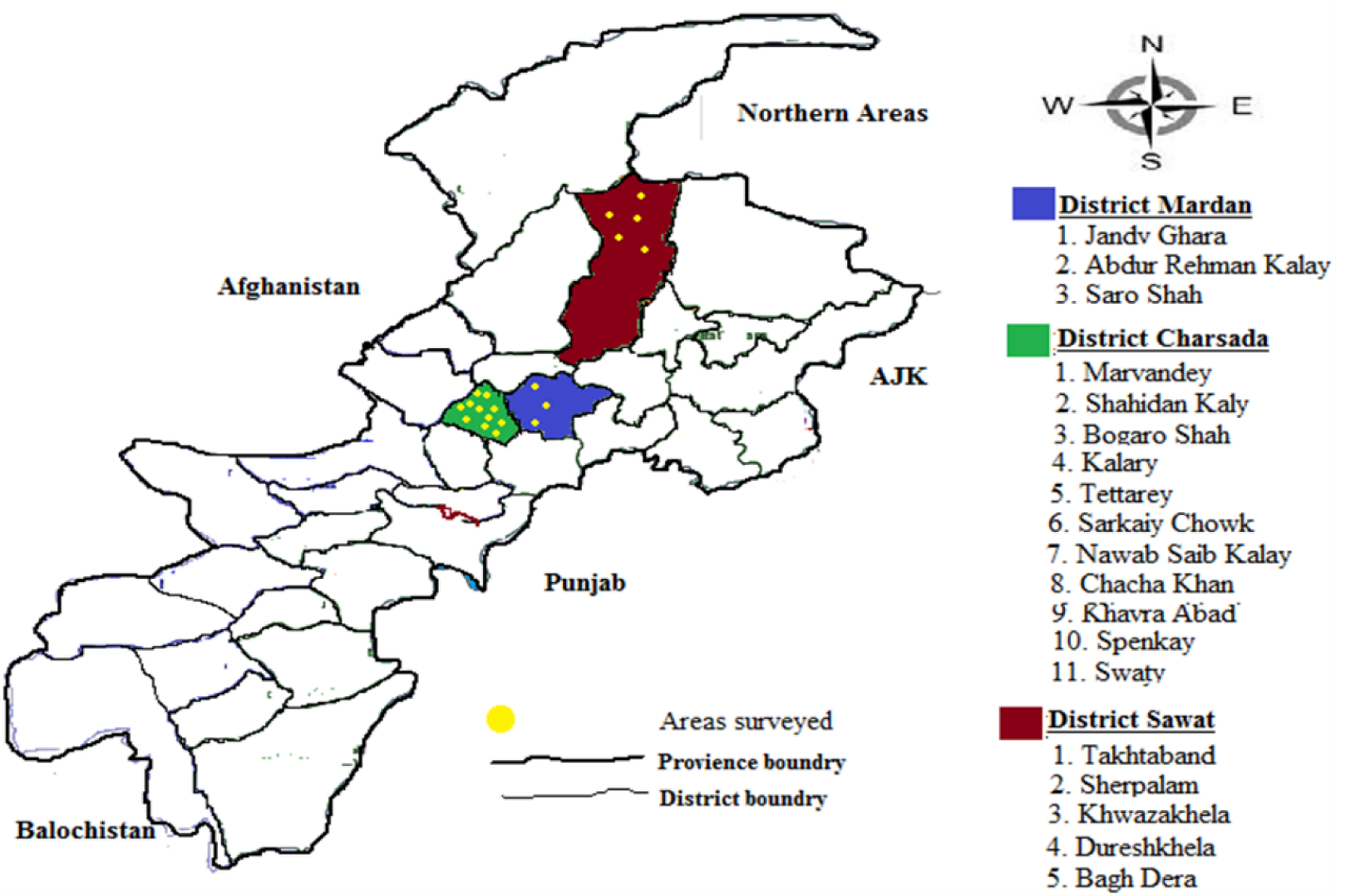
Strawberries are grown commercially in Swat, Mardan and Charsadda districts of Khyber Pakhtunkhwa, Pakistan as highlighted in the in the administrative boundaries. Major strawberry growing areas surveyed to determine the incidence of SLRSV infecting strawberry. The locations in each district were tagged with yellow dots mentioning the strawberry fields where the samples were collected randomly.
Nematode extraction and identification
Nematodes are known to transmit strawberry viruses, especially SLRSV (EPPO/CABI, 1996; . J3 and J4 were isolated from a 20 g soil sample using the decanting and sieving method and the tray method . Nematodes were identified using morphological characteristics observed under a compound microscope at 40X magnification, compared with the identification key described by Loof and Luc (1990).
Table 1: Primer set, their sequences and size of amplicons used in the current study to amplify the coat protein encoding region of the respective viruses infecting strawberry crop.
| SLR SV | CP-F CP-R |
497 bp | CCTCTCCAACC TGCTAGACT |
RNA extraction
Total RNA was extracted from samples, confirmed as SLRSV-positive, by ELISA using the EZ spin column total RNA extraction kit (Bio basic Inc., Canada, as per the manufacturer’s instructions).
DNA synthesis
Revert Aid First Strand cDNA synthesis kit (Thermo Scientific) was used to synthesize cDNA according to the manufacturer’s protocol.
Polymerase chain reaction (PCR) to amplify coat protein encoding regions
The viral genome in the coat protein regions of the respective virus was amplified using virus-specific primer sets (Table 1). For each 50µl PCR reaction, 1 µl cDNA template, 5 µl 10X PCR buffer, 5µl 2mM dNTPs, 1µl Taq DNA polymerase and forward and 1µl of reverse primers (25pmol) were aliquoted in the reaction mixture. The PCR regime comprised of an initial denaturation step for 2 min at 94°C. It was then followed by 34 cycles of denaturation at 94°C for 1 minute, annealing at 55°C (30sec), and an extension step at 72°C (1 min). The final extension step was performed at 72°C for 3 min, after which the tubes were held at -20°C until further processing.
Purification of PCR product
The PCR products were resolved on a 2% agarose gel. The bands after ethidium bromide staining were
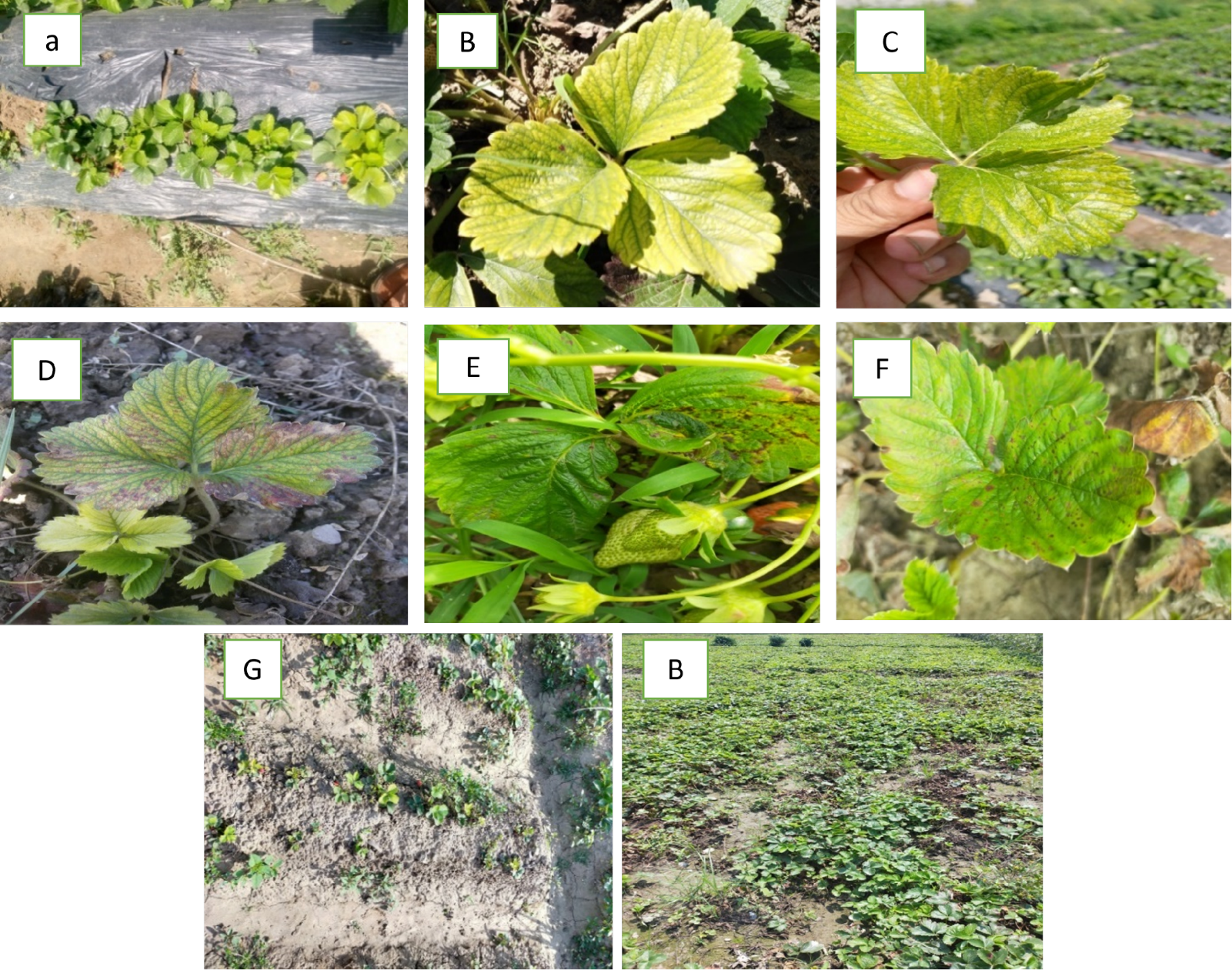
SLRSV infection led to different types of symptoms on strawberries, observed during the surveys, which are (a) Severe stunting and chlorosis (b) Chlorosis of strawberry leaves (c) strawberry leaves with chlorosis and deformation (d) Strawberry leaves showing mosaic, chlorosis and necrosis of leaves(e) Severe leaf deformation and crinkling with mottling and insect injury(f) Strawberry leaves showing mottling and crinkling of leaves with necrotic spots.(g, h) Strawberry field showing patches of poorly grown plants.
observed under UV light using a trans-illuminator. The required bands were cut from the gel under UV light in a trans-illuminator. The gel was purified using the SV-GEL extraction kit according to the manufacturer’s recommendations.
Sequence analysis of SLRSV
After eluting the DNA of interest from the gel, the samples were sent, along with the virus-specific primers (Table 1), for direct sequencing on an ABI sequencing machine. Each segment was sequenced in both directions. The phylogenetic relationship of Pakistani isolates was established by comparing the obtained sequences with other virus isolates reported in GenBank. The sequences were analyzed using GENETYX ver. 7.0 (GENETYX Co., Tokyo, Japan). Multiple alignments were generated using the neighbor-joining method in the Clustal W program, and phylograms were constructed in Mega X with 1000 bootstrap replicates.
Results
SLRSV in strawberry fields in Khyber Pakhtunkhwa
Surveys revealed that strawberry fields, particularly those in plain areas where strawberries are grown primarily for fruit production, were infected with SLRSV. Symptoms including stunting (Figure 2a), chlorosis (Figure 2b), cupping (Figure 2c), mosaic, mottling (Figure 2d), leaf deformation (Figure 2e), and crinkling (Figure 2f) were observed in fields of the strawberry crop of Khyber Pakhtunkhwa (KP), Pakistan. In some strawberry fields, signs of nematode infection were also observed as poorly grown patches (Figure 2g,h).
SLRSV incidence
Data extracted from the surveys (2020-21 and 2021-22) revealed that the average incidence of SLRSV was 11.7% and 14.7%, respectively, in district Swat (Table 2). During 2020-21 in the district of Swat, the highest incidence of 15% was recorded in Sherpalam (Shakardara), whereas it was 8.3% in Khwazakhela, the lowest among the surveyed locations. The following year, an increase was observed in the incidence percentage across most fields. In Sherpalam (20%), the incidence of SLRSV increased by 5% compared to the previous observation. Intriguingly, the lowest incidence (11.7%) was recorded at Bagh Dera (Matta) rather than at Khwazakhela this year. However, the incidence of SLRSV at Bagh Dera (11.7%, 2021-22) remained higher than that reported for Khwazakhela (8.3%, 2020-21).
In district Mardan, the mean SLRSV incidence was 20.5% (2020-21), increasing to 23.3% the following year (Table 3). During the first-year survey in the fields of Abdur Rahman Kalay, the incidence was 23.3%, increasing to 26.7% in the second year, while in Saro Shah, the incidence was 18.3% in the first year and increased to 23.3% in the second year. In two-year surveys, the lowest disease incidence was observed in the Saro Shah field, with SLRSV infection rates of 18.3% and 30.0%.
Similarly, in district Charsadda, 23.5% of plants were infected by the virus during 2020-21. However, the number increased to 26.8% in 2021-22 (Table 4). In strawberry fields of Marvandai (Rajar), Khavra Abad (Tangi), and Teetara (Sarkay), the incidence of SLRSV was once again as high as 26.7%, whereas Kalary (Sarkay) was ranked at the top (36.7%) following the year’s survey (2021-22). However, in 2 020-21, the lowest incidence (20%) was noted in Shaheedan Kalay (Rajar) and Spenky (Tangi), whereas in 2021-22, the incidence percentage (20%) remained unchanged at Sarkay.
Comparatively, the lowest mean percent incidence was observed in the strawberry fields of the district of Swat, where the land was used for runner production, while the district of Mardan ranked second most affected by the virus. However, the district of Charsadda holds the top position among the surveyed districts, and the maximum incidence was recorded in more districts than Swat and Mardan.
Table 2: Incidence of SLRSV infecting strawberries in hilly areas of district Swat (Nursery producing areas) in Khyber Pakhtunkhwa, Pakistanduring the year 2020-21
| Area surveyed | SLRSV | |||||
| 2020-21 | 2021-2 | |||||
| Samples tested | Samples positive | % Incidence | Samples tested | Samples positive | % Incidence | |
| Takhtaband / Ogday | 60 | 6 | 10.0 | 60 | 8 | 13.3 |
| Sherpalam (Shakardara) | 60 | 9 | 15.0 | 60 | 12 | 20.0 |
| Khwazakhela | 60 | 5 | 8.3 | 60 | 8 | 13.3 |
| Dureshkhela (Matta) | 60 | 8 | 13.3 | 60 | 9 | 15.0 |
| Bagh dera (Matta) | 60 | 7 | 11.7 | 60 | 7 | 11.7 |
| Average percent incidence | 11.7 | 14.7 | ||||
Table 3: Incidence of SLRSVinfecting strawberry crops in district mardan of khyber pakhtunkhwa, pakistan during the year 2020-21 and 2021-22.
| Area surveyed | SLRSV | |||||
| 2020-21 | 2021-22 | |||||
| Samples tested | Samples positive | % Incidence | Samples tested | Samples positive | % Incidence | |
| JandyGhara | 60 | 12 | 20.0 | 60 | 12 | 20.0 |
| Abdur Rehman Kalay | 60 | 14 | 23.3 | 60 | 16 | 26.7 |
| Saro Shah | 60 | 11 | 18.3 | 60 | 14 | 23.3 |
| Average percent incidence | 20.5 | 23.3 | ||||
Table 4: Incidence of SLRSVinfecting strawberry crops in district Charsadda of Khyber Pakhtunkhwa, Pakistan during the year 2020-21 and 2021-22.
| Area surveyed | SLRSV | |||||
| 2020-21 | 2021-22 | |||||
| Samples tested | Samples positive | % Incidence | Samples tested | Samples positive | % Incidence | |
| Marvandey (Rajer) | 60 | 16 | 26.7 | 60 | 18 | 30.0 |
| Shaheedankalay | 60 | 12 | 20.0 | 60 | 20 | 33.3 |
| Bogaro shah (Sarkay) | 60 | 13 | 21.7 | 60 | 15 | 25.0 |
| Kalary (Sarkay) | 60 | 15 | 25.0 | 60 | 22 | 36.7 |
| Teetara (Sarkay) | 60 | 16 | 26.7 | 60 | 14 | 23.3 |
| Sarkay chowk | 60 | 14 | 23.3 | 60 | 12 | 20.0 |
| Nawab saibkalay (Utmanzai) | 60 | 13 | 21.7 | 60 | 17 | 28.3 |
| Chacha khan bangle | 60 | 15 | 25.0 | 60 | 14 | 23.3 |
| Khavra abad (Tangi) | 60 | 16 | 26.7 | 60 | 17 | 28.3 |
| Spenkay (Tangi) | 60 | 12 | 20.0 | 60 | 13 | 21.7 |
| Swaty | 60 | 13 | 21.7 | 60 | 15 | 25.0 |
| Average percent Incidence | 23.5 | 26.8 | ||||
Table 5: Percent identities at nucleotide sequence level of Pakistani isolate of SLRSV infecting strawberry crop with other SLRSV isolates reported across the world in GenBank.
| Accession # | Isolate/strain | Host | Country | % Nuc. Identity |
| MF796988 | Lilium 14-010-2 | Lilium | Netherlands | 85.74 |
| MF796974 | Lilium 12-001 | Lilium | Netherlands | 84.91 |
| MF797006 | Robinia 14-027 | Robinia | Netherlands | 85.71 |
| MF796998 | Fragaria 14-023 | Chenopodium | Netherlands | 72.49 |
| MF797000 | Phaseolus 14-024 | P. vulgaris | Netherlands | 84.91 |
| MN082041 | Golden peach NZ | Prunus persica | New Zealand | 84.94 |
| KF695118 | Iso 3-6 | Vaccinium | New Zealand | 85.71 |
| HM591198 | Blackberry NZ | Rubus sp. | New Zealand | 86.12 |
| MZ291960 | 19SP058 | Fragaria | Canada | 74.46 |
| AY461735 | NCRG-MEN 454 | N.A. | USA | 90.34 |
| HQ456537 | Mint 515 | Mint | USA | 85.45 |
| AY438666 | Mint | USA | 90.74 | |
| MW854292 | DSMZ PV 1314 | S. moricatum | Germany | 83.50 |
| MT648777 | SLRSV-Eg | Fragaria | Egypt | 91.75 |
| X77466 | Hampshire H | N.A. | UK | 85.11 |
| MZ405641 | DSMZ PV-0247 | N.A. | Scotland | 83.70 |
| KF695119 | 6-6 | V. darrowii | New Zealand | 86.62 |
| DQ324376 | Gorz 2 | N.A. | Poland | 86.12 |
* Sequence of these isolates has been used in the phylogenetic analysis as well.
Vector identification
Dagger nematode, Xiphinema diversicaudatum was found in strawberry fields in all the surveyed areas. Its morphological traits, such as long cylindrical bodies (4-6 mm long) that assumed a distinctive J-shaped structure when heat relaxed, served as the basis for identification.
Molecular detection and characterization of SLRSV
Molecular detection by PCR confirmed the presence of the virus in ELISA-positive samples, as evidenced by the formation of a single, crisp band of approximately 500 bp in SLRSV-positive samples. Comparison of the Pakistani SLRSV isolate with globally reported isolates in GenBank showed nucleotide identity range of 72.49% to 91.75% (Table 5). Sequence analysis showed that the Pakistani SLRSV isolate was extremely like SLRSV isolate reported from Egypt (MT648777) that infected strawberries. Both isolates showed strong sequence similarity to an isolate reported from the USA, indicating they shared a common ancestor. Data analysis showed that the SLRSV genome appears to be evolutionarily stable, and many of these strains or isolates reported worldwide have already undergone the necessary alterations in accordance with their specific agro-ecological circumstances. Most of the isolates show an identity of 83-86%.
Phylogenetic analysis of the SLRSV Pakistani isolate,
compared with globally reported isolates using the nucleotide sequence of the coat protein-encoding region, resulted in two clusters; however, the majority of the reported isolates fell into cluster A (Figure 3). Pakistani isolates delineated into cluster A, close
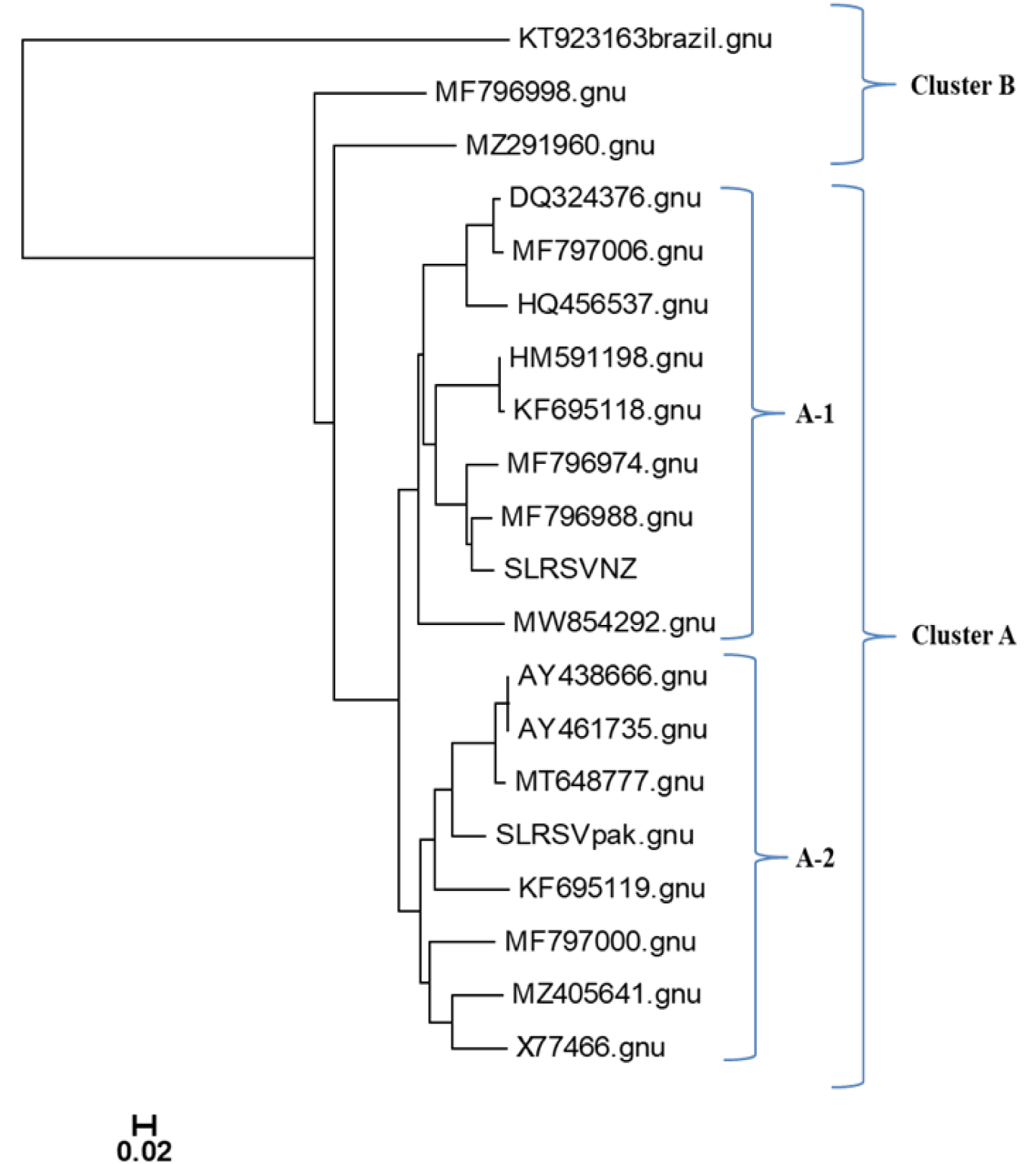
Representation of phylogenetic relationship of SLRSV isolates in the GenBank with Pakistani isolate (SLRSVpak) based on nucleotide sequence of coat protein encoding region using neighbor joining method with a boot strap value of 1000. A total of two clusters, namely, Cluster A and Cluster B were constructed, whereas Cluster A further divided into two subclades (A-1 and A-2). SLRSVpak grouped in A-2 showing close relationship with isolates with MT648777, AY461735 and AY438666.
to the isolates reported from Egypt and the USA. No grouping based on geographic distribution or host plant infected could be seen in the phylogram. Cluster A was divided again into two subclades, with the majority of the isolates grouping together in subclade-1, which was further divided into two groups. Subclade-2 comprised of only two isolates: one from Canada infecting strawberry and the other from the Netherlands infecting Chenopodium spp. Similarly, Cluster B is also delineated into two subclades. Pakistani isolates, along with isolates reported from the USA, Egypt, and Canada, were in one subclade, while the isolates from the UK, Scotland, and the Netherlands were grouped together in a second subclade. Intriguingly, a great diversity was observed among isolates reported from the Netherlands, infecting different host crops, and they were delineated across all clusters and subclades, although the majority of the isolates were in Cluster A and subclade-1. A similar topology was also observed in a phylogram constructed from amino acid sequences in the coat protein-encoding region (data not shown).
Discussion
The assessment of Strawberry latent ringspot virus (SLRSV) in commercially cultivated strawberries in Khyber Pakhtunkhwa (KP), Pakistan, provided insights into the virus’s prevalence, symptomatology, and molecular characteristics. During 2020-21 and 2021-22, extensive surveys highlighted the prevalence of SLRSV in the districts of Swat, Mardan, and Charsadda. The symptoms, including stunting, chlorosis, cupping, mosaic, mottling, leaf deformation, and crinkling, produced by the virus, are consistent with previous reports of SLRSV infections in strawberries . In addition, the appearance of nematode-induced reduced-growth patches in some areas further complicated the disease scenario, suggesting a potential interaction between nematodes and SLRSV that led to crop loss .
A significant variation was noticed in the incidence of SLRSV across the surveyed regions. In the district of Swat, the mean incidence was 11.7% during 2020-21, which increased to 14.7% in 2021-22 (Table 2). In Swat, strawberry fields located in the Sherpalam (Shakardara) area were most affected by the virus, where maximum incidence of 15% and 20% was recorded in 2020-21 and 2021-22, respectively, whereas minimum incidence during 2020-21 was observed in Khwazakhela (8.3%) and 11.7% in Bagh Dera (2021-22). In Sherpalam, 5% difference in increase was noticed during two-year surveys, which indicates a potential spread of the virus, possibly due to poor disease management or the free movement of infected propagative material . In district Mardan, the average SLRSV incidence increased from 20.5% to 23.3%, with the highest incidence observed in Abdur Rahman Kalay (26.7%) in 2021-22. Among the districts, the incidence rose from 23.5% to 26.8% in Charsadda, with Kalary (Sarkay) securing the top rank at 36.7% in 2021-22. These results highlighted the escalating threat posed by SLRSV to commercial strawberry production in KP, particularly in regions where the virus is already prevalent. Compared with hilly areas used for nursery production, the disease incidence was higher in plain areas. The vector pressure, weather, and closeness to virus sources all affect the temporal and spatial dispersion of viruses . Numerous and diverse causes, including variations in the populations of alternative host plants, the presence and effectiveness of vectors, and viral interactions in infected hosts, could all affect shifts in virus incidence . The prevalence of SLRSV with increased incidence in Charsadda might be due to differences in farming practices, environment, or the evolution of SLRSV to produce more virulent strains, whereas in Swat, where strawberry runners are primarily produced, suggests that poor management strategies used may influence the spread of SLRSV . The climate on the plains is favorable for both the multiplicity of insect vectors and the spread and multiplication of the virus, and this high vector population leads to an increased prevalence of viral diseases. Chandler cultivar is planted in most Pakistani locations. The poor level of tolerance in. Chandler may be the reason for this widespread viral infection of strawberries in Pakistan. Handa and Sharma (2018) reported that among the various cultivars grown in India, the Chandler cultivar had the highest incidence of viral disease. The weed population was also extremely high across nearly all strawberry-growing regions (Figure 2). At various locations, weeds were nearly overgrowing the strawberry plants (fully covering the strawberry plants). These weeds may serve as alternate host for the virus and the insects that carry it, creating a microclimate favorable for insect fecundity. This may also explain why plains have a higher incidence of viruses in strawberry crops than hilly regions.
The presence of “Xiphinema diversicaudatum,” commonly known as dagger nematode, extracted and identified from soil in all surveyed areas, is significant, as it is the only known vector of SLRSV , contributing to the spread of the virus and highlighting the need for IPM strategies for the control of both SLRSV and its vector. Molecular detection of SLRSV by PCR confirmed its presence of the virus in DAS-ELISA-positive samples. The identity of SLRSV, and the molecular confirmation concured with PCR-based detection of SLRSV has also been reported in other crops ; .
Phylogeny of SLRSVpak (Figure 3) suggesting a close ancestral lineage with isolates reported from Egypt (MT648777) and the USA (AY461735, AY438666). The isolate shares a high nucleotide sequence identity of 91.75% with the Egyptian isolate, which is a possible indicator of SLRSV introduction into the region or of an evolutionary background. Clustering of SLRSVpak with Egyptian and USA isolates in cluster A supports the common ancestor lineage/origin hypothesis, which could be driven by the facilitation of free exchange of plant materials that violate quarantine rules and regulations. El-Morsy et al. (2017) also reported an 80-99 % identity range for SLRSV between an Egyptian isolate and isolates reported worldwide. Mazyad et al. (2014) have also reported a DNA sequence identity in the range of 80–85 percent range. However, no such evolution based on the host plant infected was observed. It appears that after evolving, isolates reported from various geographic sites are now stable. Although, Tang et al. (2013) documented the geographically based evolution of SLRSV reported from various locations worldwide and the grouping of isolates by host in New Zealand. A wide host range of SLRSV isolates, particularly those from the Netherlands, shows diversity, suggesting adaptability to different agroecological conditions . Phylogenetic trees based on geographic or host-range data do not provide a clear understanding, suggesting significant evolutionary changes that may be influenced by host adaptability and/or environmental pressures .
Conclusions and Recommendations
This article provides significant insight into the SLRSV situation in Khyber Pakhtunkhwa, which poses a serious threat to commercial strawberry-producing areas. The increasing spread of SLRSV, coupled with its nematode vector, suggests the need for extensive virus management protocols, i.e., the use of virus-free planting material, control of nematode vectors, and support for breeding to develop resistant strawberry varieties. Additionally, the molecular and phylogenetic characterization of SLRSV isolates underscores the virus’s evolution and worldwide distribution, which could be better to inform future research and management efforts.
Acknowledgments
The authors acknowledge the finding pf HEC NRPU
project # 10217.
Novelty Statement
This research work is conducted for the first time on SLRSV situation in Khyber Pakhtunkhwa, Pakistan. The study suggests the need of virus-free planting material, control of nematode vectors and support for breeding to help contain its rapid spread in strawberry varieties.
Author’s Contribution
Both the authors contributed in the research work as well as in the manuscript write-up.
Generative AI and AI-assisted technology statement
The authors declare that no generative AI and AI assisted technology was used in the creation of this manuscript.
Conflict of interest
The authors have declared no conflict of interest.
References
- El-Morsy, S.L., M.A. El-Sheikh, R.A.A. El-Razik, S.A. Youssef and A.A. Shalaby. 2016. Molecular identification of strawberry latent ringspot virus (SLRSV) in Egypt. J. Bas. Env. Sci., 4:24-33. https://doi.org/10.21608/jbes.2017.369638 [CrossRef]
- EL-Morsy, S.I., M.A. E L-Sheikh, R.A.A. El-Razik, S.A. Youssef and A.A. Shalaby. 2017. Molecular Identification of Strawberry Latent Ring Spot Virus (SLRSV) In Egypt. J. Bas. Env. Sci., 4: 24-33. https://doi.org/10.21608/jbes.2017.369638 [CrossRef]
- EPPO/CABI. 1996. Arabis mosaic nepovirus. In: Quarantine pests for Europe, 2nd edition (Smith, I.M., McNamara, D.G, Scott, P.R. and M. Holderness eds), CAB International, Wallingford, UK.
- Faggioli, F., L. Ferretti, G. Pasquini and M. Barba. 2002. Detection of Strawberry Latent Ring spot virus in leaves of Olive Trees in Italy using a one-Step RT-PCR. J. Phytopath., 150: 636-639. https://doi.org/10.1046/j.1439-0434.2002.00810.x [CrossRef]
- GOP. 2017. Government of Pakistan. Fruit, vegetables and condiments statistics of Pakistan (2017).
- Grafton-Cardwell, E.E., T.M. Perring, R.F. Smith, J. Valencia and C.A. Farrar. 1996. Occurrence of mosaic viruses in melons in the Central Valley of California. Plant Dis., 80(10): 1092-1097. https://doi.org/10.1094/PD-80-1092 [CrossRef]
- Green, A. 1971. Soft Fruits. In: Hulme, A.C (ed). The biochemistry of fruits and their products. Academic Press. New York, 2: 375-410.
- Handa, A. and A. Sharma. 2018. Incidence of major virus diseases of strawberry in north western Himalayan region of India. J. Pharmacogn Phytochem, 7(5): 245-248.
- Kumari, S. 2009. Detection of cherry leaf roll virus and strawberry latent ring spot virus by one- step RT-PCR. Plant Proc. Sci., 45(4) 140-143 https://doi.org/10.17221/3/2009-PPS. [CrossRef]
- Kulshrestha, S., V. Hallan, G. Raikhy, R. Ram and A.A. Zaidi. 2004. Strawberry latent ring spot virus infecting roses in India. Ameri. Phytopathol. Soc., 88:86.3-86.3. https://doi.org/10.1094/PDIS.2004.88.1.86C [CrossRef]
- Loof, P.A.A. and M. Luc. 1990. A revised polytomous key for the identification of species of the genus Xiphinemia Cobb, 1913 (Nematoda: Longidorridae) with exclusion of the X. americanum group. Syst. Parasitol., 16 (1): 35-66. https://doi.org/10.1007/BF00009600 [CrossRef]
- Mabood, M.A. 1994. The future prospects of strawberry production in Pakistan. Advis. Leaflet., 17: 2, 51-52.
- Martin, R.R., I.E. Tzanetakis, J.E. Barnes and J.F. Elmhirst. 2004. First report of Strawberry latent ringspot virus in strawberry in United States and Canada. Plant Dis., 88: 575 https://doi.org/10.1094/PDIS.2004.88.5.575A. [CrossRef]
- Martin, R. R. and I. E. Tzanetakis. 2006. Characterization and Recent Advances in Detection of Strawberry Viruses. Plant Dis., 90: 384-396. https://doi.org/10.1094/PD-90-0384 [CrossRef]
- Martin, R.R. and I.E. Tzanetakis. 2013. High risk strawberry viruses by region in the United States and Canada: implications for certification, nurseries, and fruit production. Plant Dis., 97: 1358-1362. https://doi.org/10.1094/PDIS-09-12-0842-RE [CrossRef]
- Mazyad, A. A., A.A. Kheder, A. El-Attar and A.F. Amal. 2014. Characterization of Strawberry latent ringspot virus(SLRSV) on strawberry in Egypt. Egypt. J. virol., 11: 219-235.
- Sharma, A., A. Handa, S. Kapoor, S. Watpade, B. Gupta and P. Verma. 2018. Viruses of strawberry and production of virus free planting material—a critical review. Int. J. Env. Sci. Technol., 7(2): 521-545.
- Shaukat, H., A. Mujahid and M. B.Rashad. 2018. Department of Horticulture, College of Agriculture, University of Sargodha.
- Southey, J.F. 1986. Laboratory methods for work with plant and soil nematodes. H.M.S.O. Books, Norwich, NR3 1PD, Norfolk, UK: pp-202.
- Tang, J., L.I. Ward and G.R.G. Clover. 2013. The diversity of Strawberry latent ring spot virus in New Zealand. Plant Dis., 97: 662-667. https://doi.org/10.1094/PDIS-07-12-0703-RE [CrossRef]
- Tariq, M., M.K. Hussain, Z.K. Malik and N. Jehan. 2018. An estimation of technical efficiency of strawberry production in district Charsadda Khyber Pakhtunkhwa. Sarhad J. Agric., 34(1): 93-101. https://doi.org/10.17582/journal.sja/2018/34.1.93.101 [Full text] [CrossRef]
- Taylor, C.E. and D.J.F. Brown. 1997. Nematode vectors of plant viruses. Wallingford, UK: CAB International.
- Tzanetakis, I.E., W.M. Wintermantel, A.A. Cortez, J.E. Barnes, S.M. Barrett, M.P. Bolda, and R.R. Martin. 2006. Epidemiology of Strawberry pallidosis associated virus and occurrence of pallidosis disease in North America. Plant Dis. Rep., 90:1343–1346. https://doi.org/10.1094/PD-90-1343 [CrossRef]
- Ullman, D.E., J.J. Cho and T.L. German. 1991. Occurrence and distribution of cucurbit viruses in the Hawaiian Islands. Plant Dis. Rep., 75: 367–370. https://doi.org/10.1094/PD-75-0367 [CrossRef]
- Whitehead, A.G. and J.R. Hemming. 1965. A Comparison of Some Quantitative Methods Extracting Small Vermiform Nematodes from the Soil. Ann. Appl. Biol., 55: 25-38. https://doi.org/10.1111/j.1744-7348.1965.tb07864.x [CrossRef]

Services
Article usage statistics
Loading…
Related articles
- Exploring Incidence of Potato Viruses in Major Growing Areas of Potato in Khyber Pakhtunkhwa, PakistanPakistan Journal of Weed Science Research · 2024
- Developed One-step Reverse Transcription Loop-Mediated Isothermal Amplification (Rt-Lamp) Assay for Detection of Strawberry Latent Ring Spot VirusJournal of Virological Sciences · 2021
- The Role of Vertical Transmission of Dengue Virus among Field-Captured Aedes aegypti and Aedes albopictus Mosquitoes in Peshawar, Khyber Pakhtunkhwa, PakistanPakistan Journal of Zoology · 2017
- Assessment of Weed Management Competency of Field Assistants in Khyber Pakhtunkhwa, PakistanSarhad Journal of Agriculture · 2020
- Climate Change Competencies Assessment of Field Assistants in Khyber Pakhtunkhwa, PakistanSarhad Journal of Agriculture · 2018
- Prevalence and Associated Risk Factors of H9N2 Avian Influenza Virus in Poultry from Live Bird Markets in Four Districts of Khyber Pakhtunkhwa, PakistanAdvances in Animal and Veterinary Sciences · 2026