
The local sustainability of regional Himalayan agriculture critically depends on climate change by virtue of the survival dependence of smallholder farmers on regionalized environmental expertise. The paper examines farmers’ perceptions and adaptation responses under the influence of environmental conditions, Indigenous Knowledge (IK), and psychological bias in Shopian, Ganderbal, Bandipora, Rajouri, Samba, and Kathua districts. The primary data was collected by conducting 60 in-depth interviews and corresponding surveys by means of a mixed-method approach. Surveys used reflective thematic analysis and descriptive statistics for analysis. The results of the analysis suggest that farmers’ perceptions of climate depend on geographical and climatic conditions and that IK provides a pragmatic kit and culture repository of adaptation responses. Psychological biases of availability, recency, and optimism bias, respectively, shape how such knowledge is perceived and used, and on occasions limit time adaptation. The study establishes the potential for a hybrid adaptation model of indigenous wisdom and scientific intervention. A reduction of cognitive biases, policymakers and strategists of development will incorporate climate-resilient practices more relevantly and accessibly and ensure productive agriculture and culture preservation in the region.
Research Article · Volume 43, Issue 2, Pages 219–230, 24 November 2026 · Open Access
Between Memory and Modernity: Indigenous Climate Adaptation Practices in the Himalayan Agriculture of Jammu and Kashmir
Affiliations & Notes ⌄
- 1Amity Institute of Liberal Arts, Amity University Mumbai, Maharashtra, India
- *Correspondence | Arshad Bhat; Email: bhatarshad09@gmail.com
Article Info ⌄
- Journal:
- Sarhad Journal of Agriculture
- Submitted Date:
- 8 September 2026
- Accepted Date:
- 17 November 2026
- Published Date:
- 24 November 2026
From the article
- The paper describes an iterative process between traditional ecological knowledge and climate adaptation issues that smallholder farmers in Jammu and Kashmir face today in six districts: Shopian, Ganderbal, Bandipora, Rajouri, Samba, and Kathua.
- The findings indicate that localized environmental conditions such as altitude, precipitation variability, and soil conditions greatly affect smallholder farmers’ perceptions of climate change.
- Indigenous knowledge (IK), which has developed over generations of adaptation to emerging environmental conditions, is critical to understanding seasonal patterns and selecting crop varieties that are resilient, as well as managing water.
- Policymakers, research teams, and local governance need to firmly base their context-specific, farmer-led approaches on indigenous knowledge with modern, locally appropriate climate-resilient technologies.
Selected from the article's own text.
Abstract
Introduction
Farmers’ perceptions of climate change arise from their daily interaction with the environment and reliance on weather for agriculture ; . What farmers perceive of climate change is significant because it guides how they are willing to adopt climate-friendly practices . A farmer can respond to climate change’s negative impacts if they notice anything unusual in the environment. However, the connection between perception and response to climate change is not straightforward. Farmers’ adoption of adaptive or protective measures, showing how farmers respond to climate change, is not determined by whether they perceive accurate climate change. Studies by Yarong and Minpeng (2021) and Balasubramanian et al. (2023) determined that just 46 percent of farmers adopted adaptation measures, but about 80 percent perceived climate change. Similarly, a case by Rani and Prasher (2021) established that 75 percent of farmers noticed changes in the yields of their crops due to climate change. However, not all farmers adopted adaptive measures. Hence, farmers perceive climate change as crucial for climate adaptation and the sustainability of the rural environment.
Past studies on farmers’ perceptions aimed at finding how farm attributes and various economic and demographic factors shaped their perceptions & . Some of the studies compared farmers’ perceptions of different climate factors, such as rainfall, temperature, and humidity, against historical official weather observations ; ; ; . Some of the decision-making on climate change works established that the nature of the information used impacts a farmer’s conceptualization of climate change and, therefore, how they do or do not act ; .
Some of these surveys asked farmers about their perceptions of climate change and weather patterns ; ; ; , as well as whether they thought these changes were caused by humans or by nature . Some studies investigated how farmers evaluated the impact of climate change on their general livelihood, income, produce, and planting and harvesting ; . There hasn’t been much focus on how farmers view climatic extremes like droughts or floods and how unpredictable they think they are ; ; . Psychological biases arise because of climate change uncertainty and affect farmers’ decision-making ; . Psychological theory application helps us realize farmers’ perceptions of climate change. The theories provide insights into how psychological aspects influence farmers’ decisions. Overall, they provide insights into how farmers engage with climate change, its impacts, and how they influence them to adopt environmental practices . The theories describe how biases influence farmers’ perceptions so that they either exaggerate or downplay risks. A literature review discovered different psychological biases that affect farmers, such as availability heuristic, hindsight bias, framing effect, confirmation bias, recency bias, optimism bias, illusion of control bias, decision regret effect, and anchoring effect ; ; ; . The biases influence farmers’ decision-making and their yields extensively .
Keeping the backdrop in view, the paper attempts to examine farmers’ perceptions using psychological and behavioral frameworks. There is a gap in qualitative literature that specifically focuses on why farmers subjected to the same climate threats perceive climate change differently. The present study contributes to climate perception literature by creating insights into smallholder farmers’ perceptions of current trends and future developments. Although various literature previously examined the role of Indigenous Knowledge (IK) on climate adaptation, few have considered how IK shapes farmers’ perceptions regarding climate ; ; . The paper investigates how farmers’ perceptions and adaptation practices have been shaped by IK. The paper relies on primary data collected from small farmers of Jammu and Kashmir, a region in northern India. The farmers there face both flood and drought, early and late snowfall, untimely snow and rainfall, a combination of extremes not yet addressed by relevant literature. Literature has not yet investigated the intricacies of small farmers’ perceptions in such risky circumstances ; ; .
The key research questions for this work are: (RQ 1) What local environmental conditions affect smallholder farmers’ views of climate change? (RQ 2) Does Indigenous Knowledge (IK) affect the climate viewpoint of smallholder farmers? (RQ 3) What psychological biases affect the adoption of Indigenous Knowledge (IK) for sustainable climate practices? The present study uses a mixed-method approach to analyze these questions. Our findings present specific biases that affect how farmers perceive climate change. We explain these biases based on psychological and behavioral theories for a better understanding of the findings.
Climate change has begun to impede the agricultural livelihoods of rural households in the UT of Jammu and Kashmir, which contains the Himalayas. Perceived increases in warmth and snowmelt, less consistent precipitation, and extreme weather events that are evident across the region could all be indicators of climate change ; ; . Farmers in the Kashmir Valley have reported a statistically significant annual increase in temperature of nearly 0.04 °C and a decrease in precipitation of about 4.5 mm. These factors put more strain on cropping windows, water sources, and crop productivity . Regional survey results indicate that local knowledge is prevalent; 57% of respondents reported a decrease in precipitation, 75% reported a decrease in snow, almost 60% reported a decrease in stream flow, and 75% reported more instances of extreme weather; all of which exaggerated the agricultural output of the local farming context .
In this regard, Indigenous agricultural systems that embody centuries of ecological knowledge are established pathways for resilient adaptation. Communities in the Kashmir Himalayas demonstrate traditional agroforestry systems that intentionally co-locate field crops, trees, and livestock in homegardens, boundary plantations, and agri-silvicultural systems. These landscapes can enhance biodiversity and food security, while increasing carbon sequestration, resilience, and capacity to climate-related stressors . Furthermore, community-driven initiatives that build resilience have also emerged from the National Innovations on Climate Resilient Agriculture (NICRA) program in the semi-arid Shivalik hills of Jammu and Kashmir, where access to climate-smart technology and locally relevant training, credits, and structural conditions enabled farmers to consider strengthening resilience while simultaneously increasing productivity and incomes . This study explores the ways in which long-established indigenous practices are being manifested in new climate adaptation actions and examines how local perceptions around climate adaptation may converge with agroecological tradition and official norms. This research will seek to show how memory (i.e., traditional knowledge) and modernity (i.e., contemporary scientific knowledge) render this vision of resistance possible in the very fragile ecosystem of Jammu and Kashmir. The present study addresses research questions.
(RQ 1) What localized climatic and environmental stressors influence smallholder farmers’ perceptions of climate change in the Himalayan districts of Jammu and Kashmir?
(RQ 2) In what ways does Indigenous Knowledge (IK) inform and shape smallholder farmers’ perceptions and understanding of climate variability?
(RQ 3) How do cognitive and psychological biases affect the interpretation and application of Indigenous Knowledge (IK) in the formulation of climate adaptation strategies?
The current study rested on the primary data obtained from six districts: Shopian, Ganderbal, Bandipora, Rajouri, Samba, and Kathua, three districts from the Kashmir region and three from the Jammu region, giving equal representation to each region, using mixed methods to address these issues (Figure 1).
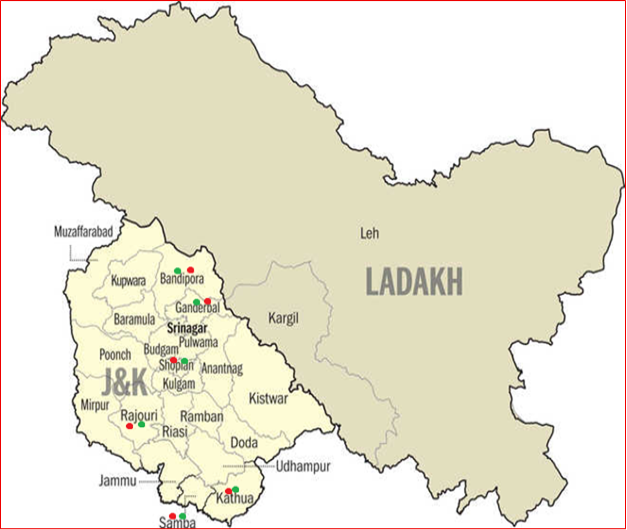
Map showing the sampled district with two dots (red and green)
The analysis highlights the relationships between actual environmental conditions, norms of knowledge, and human abilities for cognition. The results have been described in terms of established psychological and behavioral theories to develop a better and contextual understanding of climate perception and adaptive practices or customary adaptations of smallholder farmers in the Himalaya.
Methodology
The study used a mixed-method research design, combining qualitative and quantitative methods to gain a comprehensive focus on indigenous climate adaptation practices from the Himalayan agriculture of Jammu and Kashmir. The researchers purposively selected six districts: three from the Kashmir division, Shopian, Ganderbal, and Bandipora, and the three districts from the Jammu division: Rajouri, Samba, and Kathua, based on spatial heterogeneity for variability in climate exposure, levels of stressors associated with climate, and levels of adaptation responses shaped by indigenous knowledge systems. The selection of the three districts from the Kashmir division is considered high-to mid-altitude temperate areas relying on horticulture, especially the production of apples. While the three districts from the Jammu division are considered subtropical, semi-arid lowland districts rely on a mixed cropping-livestock-based economy. The variation in spatial heterogeneity of districts will also provide variation in exposure to climate, levels of adaptive strategies, adaptation, and mitigation responses using indigenous knowledge systems.
The primary data for this report were derived from household surveys, key informant interviews (KIIs), and focus group discussions (FGDs) conducted between 2023 and 2024. The researcher employed a multi-stage sampling methodology. In the first stage, based on the criteria of predominance of agriculture and existing effects of climate variability, the researchers chose two blocks in each district. In the second stage, researchers randomly sampled three to four villages from these blocks guided by the most up-to-date census data available. Next, researchers employed a stratified random sampling methodology to select 75 farmer households (in total) from the sampled villages with some representation of landholding size, gender of household head, and dominant farming systems (horticulture, field crops, and integrated). In total, the achieved sample sizes across districts were approximately 450 households.
The Household Survey tool was designed with sections on socio-demographic characteristics, the farm profile, changes in climate perceived over the past 20 years, impact on cropping systems, indigenous adaptation, and the extent to which indigenous practices were integrated into modern science practice. The perception-based questions had open-ended responses, Likert scale, and scales on awareness, perceived reliability of, and maintenance of traditional practices. Key informants were agricultural extension agents, local elders, progressive farmers, and representatives from FPOs, who provided their opinion on shifting indigenous practices, community-based adaptation efforts, and limitations to concepts of knowledge transmission. The FGDs had 8-10 participants in each group and were implemented to verify the differences in responses from surveys, particularly with respect to local (rather than culturally embedded) practices and collective adaptation initiatives.
As part of contextualizing the results collected from participants, we also sought out secondary data sources, including district meteorological data (i.e., rainfall and temperature), existing agricultural statistical data, and agricultural and interdisciplinary academics (among others). Both rainfall and temperature trends were also analyzed, not only to triangulate farmers’ perceptions (supporting or refuting them) but to build a strong climatological context for studying climate change in the district. Coding themes were developed inductively (from the field) and deductively (from the literature) in indigenous knowledge and climate change adaptation. The methods, like descriptive statistics, cross-tabulations, and chi-square tests, are used to determine potential associations between socio-economic factors and the adoption of adaptation measures by farmers. This approach takes different tools (empirical household datasets and community accounts of experience in contextualising climate change through temporal trends) to capture the living link between “memory” (traditional ecological knowledge) and “modernity” (scientific intervention) through attestation to socio-ecological units in space and particularly temporally to each of the six study districts of participants.
Sampling
This study utilized a multi-pronged sampling strategy, using primary data collected from the above-referenced purposively selected districts. Six (6) purposively selected districts were specified as Shopian, Ganderbal, and Bandipora from the Kashmir division and Rajouri, Samba, and Kathua from the Jammu division based on their agro-climatic variability and risk for vulnerabilities of high-turn vulnerability due to climate-change impacts and climate variability such as erratic rainfall regimes, extended dry periods, advection frost events, and water shortages attributed to glacier melt. From each purposively selected district, we selected four (4) blocks based on levels of climate-related risk and vulnerability, such as floods, droughts, and extreme temperature vulnerability.
Block Development Offices and District Agricultural Offices issued a list of every farmer in each block. Five farmers were selected at random from these lists in each block, taking care to ensure representation across altitude, cropping system, and socioeconomics. The intended respondents for this study were smallholder farmers, as defined by FAO as farmers who cultivated less than 10 hectares of land. Smallholder farmers comprise marginal, small, and medium-sized farmers and together form a vast share of the agrarian population in the study area. In total, the researchers conducted a total of 450 interviews across the six districts (75 interviews within each district). In selecting respondents, we tried to ensure that there was diversity in terms of age, gender, and experience. The interviews were carried out using a semi-structured interview schedule because it facilitated (i) flexibility to respond to local language, and (ii) details of local adaptation strategies. The study did not stop interviewing respondents until we reached the point of thematic saturation, whereby all later responses provided no further themes. Thus, the variation in samples was sufficient, and the breadth of the contextual findings was confirmed.
All interviews were conducted with informed consent secured, participants were informed about the aims of the study, the nature of the questions (i.e., the things we would be asking), and they could stop at any time with no consequence. Other ethical considerations include respectfully and appropriately protecting the participants’ privacy, voluntary participation, not making participants answer questions when they feel under duress, etc. Interviews were recorded with participants’ permission so that the researcher could accurately transcribe and conduct thematic analysis of the interview recordings.
Interview design and procedure
Using open-ended questions, data were collected from the farmers in the six districts of this study, Shopian, Ganderbal, Bandipora, Rajouri, Samba, and Kathua, utilizing a semi-structured interview schedule. The field survey was conducted from the start of 2024 to the end of 2024, reflecting possible key periods that would allow the farmers to respond in the context of their work. Each interview ranged from 30 to 50 minutes, and the interviews continued until there was obvious theme saturation and the participants demonstrated comprehension. The semi-structured format accommodated flexibility with probing questions and deep storytelling while simultaneously forming a friendly and collaborative environment between the interviewer and participant.
The interview guide comprised a total of seven areas: (i) Awareness and understanding of climate change farmer definitions, key indicators, and local observations. (ii) Perceived impacts of climate change on cultivation changes in crop yield, crop quality, and cultivation practice. (iii) Impacts of extreme climate events: frost, drought, unseasonal rain, and heat waves. (iv) Timeframe of perceived changes: the date that an observable change in climate conditions was first identified and its changes over time. (v) expectations of future changes, anticipated impacts to weather patterns, farming seasons, and farm productivity. (vi) Perceived contributing factors: natural, anthropogenic, and policy climate change driving factors. (vii) how Indigenous Knowledge (IK) played a role in informing their perceptions and associated adaptation decisions, traditional practices, seed use, water management, and use alongside modern practices.
The data collection tools were intended to produce qualitative data that was rich in detail and illustrated the connections between indigenous knowledge systems and agro-ecological practices. Before field research, the interview schedule had been pilot-tested among five farmers from a non-sample village in Ganderbal to confirm that the questions were articulated, culturally appropriate, and could reach the participants’ reflexivity. The pilot statement by participants was used as a basis for changes in wording and question ordering. All interviews were conducted in the language the respondents preferred (Kashmiri, Dogri, Gojri, or Urdu).
Coding procedure and analysis
The semi-structured interviews with farmers were audio-recorded, and informed consent was obtained from participants. The interviews were conducted in the participants’ local languages. This was done to honour cultural and linguistic context, and all interviews were subsequently transcribed verbatim and translated into English for the purposes of analysis. The researcher used Ullah et al. (2022) reflexive thematic analysis, following an inductive approach to make sense of the data, via the six stages of familiarising yourself with the data, coding, developing themes, reviewing the themes, defining and naming themes. The researchers went through several iterations of reviewing and revising codes and themes to clearly conceptualize the codes and themes that still had meaningful connections to the raw data that was analyzed. Triangulation was made possible by cross-referencing emerging themes with field notes, secondary data, and observations from community interactions. The final thematic map of the study illustrates how “modernity”, scientific interventions, and “memory”, indigenous knowledge has influenced climate adaptation tactics in the Himalayan agriculture of Jammu and Kashmir.
Results and Discussion
The results show that indigenous adaptation measures to climate change coexist with agricultural development programs that are themselves dependent on altitude, agro-climatic conditions, and socio-economic contexts. Farmers in Shopian, Ganderbal, and Bandipora, the temperate districts, mostly depend on horticulture, especially apple, walnut, and almond cultivation. In these districts, 78-85% of the respondents observed changes in flowering and harvesting dates, with apples blooming now occurring up to two weeks earlier than they did 20 years ago. The indigenous practices still used entail mulching with dried grass, mixed cropping with legumes, and tying stone bundles on sloping lands for soil moisture retention. According to reports from 60-72% of households, these practices have been passed from generation to generation and considered highly reliable to sustain yields in times of erratic precipitation. However, only 35-40% of the respondents reported some integration of these practices with modern approaches, such as low-density apple plantations and low-cost drip irrigation, to name a few, for a cautious but slow blending of memory and modernity.
Water is scarce during the rabi season, causing periods of drought. Being subtropical and semi-arid, the Rajouri, Samba, and Kathua districts really suffer from this water shortage and drought. Here, farmers have adopted somewhat water-centric strategies; 68-75% practice rainwater harvesting through traditional kunds (earthen storage pits) and earthen check dams, supplemented by borewell irrigation where economic conditions permit. Smallholders still cultivate traditional drought-tolerant crops that include bajra (Pennisetum glaucum), black gram, and mustard, while bigger farmers have now moved on to making money by growing maize and vegetables as a sideline with irrigation. And surprisingly, 55% of the respondents in these districts claimed to have been coached by agriculture extension agencies in scheme-based programs such as National Innovations on Climate Resilient Agriculture (NICRA) to favour hybrid varieties and integrated nutrient management. However, some elder FGDs expressed a concern that the loss of seed-saving traditions might threaten resilience in the long term, depending heavily on purchased hybrids.
To summarize the key theme that emerged across the six study districts, while indigenous strategies do still provide the foundation of resilience, their transmission to the younger generation is weakening. Some 42% of farmers under 35 reported actively
Table 1: Indigenous and modern climate adaptation practices in the six study districts
| District | Dominant farming system | Key indigenous practices | Adoption (%) | Key modern practices | Adoption (%) | Observed climate impacts |
| Shopian | Apple & walnut orchards | Grass mulching, mixed cropping, stone bunding | 72 | High-density apple, drip irrigation | 38 | Early flowering, irregular rainfall |
| Ganderbal | Mixed horticulture & cereals | Crop rotation with legumes, traditional seed storage | 65 | Improved seed varieties, polyhouse veg. | 41 | Reduced snowfall, erratic frost events |
| Bandipora | Horticulture & paddy | Raised bunding, organic manure use, traditional water channels (kulhs) | 70 | Borewell irrigation, chemical fertilizers | 36 | Glacier-fed irrigation decline |
| Rajouri | Mixed crops & livestock | Rainwater kunds, drought-tolerant millets, seed saving | 68 | Hybrid maize, micro-irrigation | 52 | Extended dry spells, heat stress |
| Samba | Field crops & vegetables | Check dams, mulching, intercropping | 73 | Hybrid vegetables, tube wells | 55 | Erratic monsoons, high evapotranspiration |
| Kathua | Cereals, oilseeds & livestock | Earthen ponds, mustard rotation, cow dung manure | 75 | High-yield wheat, pump irrigation | 50 | Prolonged droughts, flash floods |
trying to learn from elders, compared to 78% of older farmers. Such a generation gap, combined with short-term profits offered by modern methods, may render a slight ecological favor for ancient indigenous methods (Table 1). However, there is evidence of the evolution of hybrid methods, especially in mid-altitude locations of Ganderbal and Rajouri, where farmer practices include a mix of mulching and organic manure-based traditional agriculture and seed improved varieties, and micro-irrigation systems.
The comparative analysis identifies that ecological fit is critical to the continued sustainability of adaptation practices. In temperate systems, examples of indigenous soil management that conserve moisture are effective, while in dryland systems, converting the sequence of traditional rainwater harvesting practices to a model using modern irrigation systems minimizes potential loss from variation in seasonal rainfall. The research indicates that resilience in Himalayan agriculture is less of a choice than a negotiated hybrid process according to geographic and economic pressures, and layers of intergenerational learning. As in the case of Jammu and Kashmir, it will be essential to implement policies that further develop this hybridization as a resilience strategy, such as incentivizing the preservation of traditional seed systems, improving climate-resilient infrastructure, and supporting farmer-to-farmer knowledge exchange to preserve agricultural livelihoods across the diverse agro-ecologies of the region.
RQ1: Localized climatic and environmental stressors influencing perceptions of climate change
Farmers across the six districts have noted the obvious changes in weather patterns over the past twenty years. Farmers from the low altitude districts of Shopian, Ganderbal and Bandipora have reported late snow, inconsistent rain fall and off season frosts which can affect apple blooms and reduce overall fruit yield; Rajouri and Samba farmers have noted that extreme heat waves occur more frequently with prolonged periods of no precipitation drought, that has affected wheat and maize yields; and farmers in Kathua wanted attention that flash floods in the monsoon season cause so much devastation to paddy fields and loss of top soil so there is little or no recovery for some individuals. In every case, the comments made show these locally specific changes to climate were experienced through day-to-day farming activities; the farmers noted that their perspectives of climate uncertainty captured observable changes (as opposed to metrological climate reports) through expecting to change planting and harvesting dates (in some cases not yielding any products at all) and experienced changes to insect pest infestation rates-each of which have implications for crop yield.
RQ2: Indigenous knowledge shaping perceptions and understanding
Indigenous Knowledge (IK) emerged as one of the primary lens’s farmers used to interpret climate variability, like the following examples. In Shopian, orchardists were aware of relying on their IK and noted that the “chillai kayan” (forty-day severe winter) referenced when to expect flowering and frost risk. In Bandipora, fishing communities stated snowmelt timing relied on some environmental indicators, such as water clarity and trout migration timings, but climate change may be impacting these cycles. In Rajouri and Samba, elders stated they relied on phenological indicators, such as mustard sprouting earlier or nesting activities of birds that reflected changes in the weather. While IK also served as a repository that provided adaptive practices, staggered sowing to hedge against uncertain protests of when rain would come, mixed cropping to transfer risk, and traditional irrigation systems (kuhls and naalas) to soften drought impacts. Although younger farmers described a gradual shift toward modern-type weather advisories, with some reliance still on IK, they complemented their decisions.
RQ3: Cognitive and psychological biases in integrating IK into adaptation
The incorporation of IK into decisions about adaptation was not done equally. Three types of bias were frequently seen in the analysis: (i) Availability bias. Farmers tended to recall and act upon recent extreme weather events (like the floods of 2014 or the drought of 2022) much more strongly than they did on gradual trends that occurred over a longer period. This resulted in short-term adaptations instead of structural changes. (ii) Confirmation bias, some farmers invoked IK, but the way they selected and interpreted that IK was guided by personal values and past experiences, sometimes ignoring other evidence that might direct them differently. For example, even with lots of uncharacteristic and erratic winters, a portion of orchardists continued to plant apple varieties that required high chilling hours. (iii) Status quo bias - There was a reluctance to replace long-standing practices even when evidence suggested that these practices were no longer as effective as they were. In Samba and Kathua, farmers continued to grow traditional varieties of paddy rice, despite reduced water resources. The interaction between the above biases meant that while IK was a respected body of knowledge, its complete adaptive capacity was sometimes not utilized because of habit and selective interpretation (Table 2).
The findings reveal an intersection of place-based environmental conditions and ongoing factors of Indigenous Knowledge (IK) systems regarding Himalayan agriculture. For all six districts, farmers’ conceptualization of change related to climate comes from their lived experience of perception: snow timing, sowing seasons, pest invasion, and water availability. In general, this is consistent with previous studies in other areas of the Himalaya exploring perceptions of climate change ; . Overall, the researchers agree with these studies that conceptualizing climate awareness phenomenologically, instead of data-based, is based on their real lived experiences. IK ultimately still provides a culturally grounded and locationally situated cognitive lens to interpret cues in the environment. However, in a more hybridized decision-making process, it is mediated by processes of contemporary scientific knowledge and advisory systems. The empirically supported conventional heuristics were found in externalities inside this gestalt of remembering and modernizing sociality (Ahmed and Zufikar., 2019). Snow and blooming cues have historically had the biggest impact on seasonal timing decisions for adaptation in higher altitude apple-growing districts like Shopian and Bandipora, whereas meteorological alerts are changing the decision-making process and engagement with IK in lowland agrarian districts like Samba and Kathua.
The integration of IK is not straightforward, nor is it without critique. For example, the recognition of
Table 2: Summary of key findings across districts
| District | Main climatic stressors | IK indicators used | Key bias observed | Adaptation strategies |
| Shopian | Delayed snowfall, erratic frost | Chillai kalan timing, apple bloom signs | Status quo bias | Mixed orchard varieties, delayed pruning |
| Ganderbal | Unseasonal rainfall, pest outbreaks | Bird migration, river flow levels | Availability bias | Staggered sowing, pest-resistant crops |
| Bandipora | Altered snowmelt, water scarcity | Trout migration, water clarity | Confirmation bias | Water storage pits, crop diversification |
| Rajouri | Heat waves, dry spells | Mustard sprouting, animal behavior | Status quo bias | Drought-tolerant maize, traditional kuhls |
| Samba | Drought, erratic monsoon | Wind direction, insect abundance | Availability bias | Alternate wetting-drying in paddy |
| Kathua | Flash floods, soil erosion | Rain cloud formations, bamboo flowering | Confirmation bias | Raised-bed cultivation, bund strengthening |
Table 3: Localized climatic stressors and indigenous knowledge indicators across districts
| District | Elevation zone | Main climatic stressors | IK indicators used | Adaptation strategies |
| Shopian | High-altitude temperate | Delayed snowfall, erratic frost | Chillai kalan timing, apple bloom signs | Mixed orchard varieties, delayed pruning |
| Ganderbal | Mid-altitude temperate | Unseasonal rainfall, pest outbreaks | Bird migration timing, river flow levels | Staggered sowing, pest-resistant crops |
| Bandipora | High-altitude with lakeside microclimate | Altered snowmelt, water scarcity | Trout migration patterns, water clarity | Water storage pits, crop diversification |
| Rajouri | Mid-altitude sub-tropical | Heat waves, dry spells | Mustard sprouting, livestock behavior | Drought-tolerant maize, traditional kuhls |
| Samba | Low-altitude sub-tropical plains | Drought, erratic monsoon | Wind direction shifts, insect abundance | Alternate wetting-drying in paddy |
| Kathua | Low-altitude floodplain | Flash floods, soil erosion | Rain cloud formations, bamboo flowering | Raised-bed cultivation, bund strengthening |
Table 4: Cognitive and psychological biases influencing climate adaptation
| Bias type | Manifestation in study area | Effect on adaptation | District examples |
| Availability bias | Overweighting recent extreme events (e.g., floods, droughts) in decision-making | Reactive short-term responses rather than structural changes | Samba, ganderbal |
| Confirmation bias | Selective interpretation of IK to support prior beliefs, ignoring contradictory evidence | Continued use of maladaptive practices (e.g., high chill apple varieties despite warming winters) | Shopian, kathua |
| Status quo bias | Preference for maintaining long-standing cropping patterns | Slower uptake of new, climate-resilient practices | Rajouri, samba |
availability bias, confirmation bias, and status quo bias regarding farmers’ adaptation decisions demonstrates the role of psychological heuristics in the appraisal of climate risks . Availability bias resulted in farmers attaching more weight to recent extreme events that prompted reactive, event-related measures rather than systemic modes of adaptation. Confirmation bias also limited farmers’ adaptive flexibility by providing price discounts for established IK cues and sometimes acted against a backdrop where ecological baselines have changed. The status quo bias remains strong and acts as a constraint in tradition-based crop selection, showing the persistence and sometimes rigidity of cultural agricultural norms (Table 3).
These suggested biases are more than cognitive limitations; they are embedded in socio-cultural systems that potentially privilege stability and unwritten traditions. This is paradoxical, while IK is described as adaptive and place-specific, its forms of application may reinforce path dependency while entering those spaces of uncertainty brought about by accelerating climate variability. Innovative adaptation in Himalayan agriculture may therefore require cognitive bridging between IK and scientific forecasts that attempt to break respect for cultural authority while accommodating ecological change (Table 4).
Conclusions and Recommendations
The paper describes an iterative process between traditional ecological knowledge and climate adaptation issues that smallholder farmers in Jammu and Kashmir face today in six districts: Shopian, Ganderbal, Bandipora, Rajouri, Samba, and Kathua. The findings indicate that localized environmental conditions such as altitude, precipitation variability, and soil conditions greatly affect smallholder farmers’ perceptions of climate change. Indigenous knowledge (IK), which has developed over generations of adaptation to emerging environmental conditions, is critical to understanding seasonal patterns and selecting crop varieties that are resilient, as well as managing water. As presented in this research, the key lies in the relationship between IK and IK filters, namely, availability bias, recency bias, and optimism, which can act as a complement to decision-making and for adaptive capacity or constraining the decision-making both. In the balance of memory and modernity, the potential for hybrid adaptation is possible, where traditional practices can be enriched through scientific discoveries. Policymakers, research teams, and local governance need to firmly base their context-specific, farmer-led approaches on indigenous knowledge with modern, locally appropriate climate-resilient technologies. An equilibrium based on indigenous knowledge can lead to a higher adaptive capacity locally, while also preserving for granted beliefs towards agricultural livelihoods in uncertain environmental contexts.
Acknowledgements
The author expresses his sincere gratitude to all the respondents who generously contributed their time, insights and experiences for this study. Their cooperation and willingness to share valuable information made this research possible. I also extend my heartfelt thanks to the Hon’ble Vice Chancellor Amity University Mumbai for his continuous support, encouragement and academic guidance. His commitment to fostering a research-oriented environment greatly facilitated the successful completion of this work.
Novelty Statement
This paper is novel in uncovering how indigenous climate-adaptation prac-tices in Himalayan agriculture are actively evolving rather than disappear-ing, blending traditional memory with modern needs. It offers original in-sights by documenting practices rarely captured in formal research on Jammu and Kashmir. The study provides a new framework for understanding how local knowledge can inform contemporary climate-resilient agriculture.
Generative AI or AI assisted technology statement
The authors declare that no generative AI or AI assisted technology was used in the creation of this manuscript.
Conflict of interest
The authors have no conflict of interest.
References
- Ahmed, R. and M. Zulfiqar. 2019. Climate change–farmers’ perception, adaptation, and impact on agriculture in the Lakki Marwat District of Khyber Pakhtunkhwa. Sar. J. Agric., 35(3): 880–889. [Full text] [CrossRef]
- Angmo, D., R. Puri, M. Mehta and G. Devi. 2022. Ethnobotanical survey of wild edible plants of Leh District, Ladakh. Defen. Life Sci. J., 7(4): 257–266. https://doi.org/10.14429/dlsj.7.18012 [CrossRef]
- Ashraf, A. and I. Ahmad. 2021. Prospects of cryosphere-fed Kuhl irrigation system nurturing high mountain agriculture under a changing climate in the Upper Indus Basin. Sci. Tot Environ., 788: 147752. https://doi.org/10.1016/j.scitotenv.2021.147752 [CrossRef]
- Ashraf, A. and G. Akbar. 2020. Addressing climate change risks influencing the cryosphere-fed Kuhl irrigation system in the Upper Indus Basin of Pakistan. Int. J. Environ., 9(2): 184–203. https://doi.org/10.3126/ije.v9i2.32700 [CrossRef]
- Ashraf, A. and A. Batool. 2019. Evaluation of glacial resource potential for sustaining the Kuhl irrigation system under a changing climate in the Himalayan region. J. Mount. Sci., 16: 1150–1159. https://doi.org/10.1007/s11629-018-5077-0 [CrossRef]
- Balasubramanian, S., M. Hoelzle and R. Waser. 2023. Fountain scheduling strategies for improving water-use efficiency of artificial ice reservoirs (ice stupas). Cold Reg. Sci. Technol. Advan. online publication. https://doi.org/10.1016/j.coldregions.2022.103369 [CrossRef]
- Dhami, S., A. al-Nowaihi and C.R. Sunstein. 2019. Heuristics and public policy: Decision-making under bounded rationality. Stud. Microeconom., 7(1): 7–58. https://doi.org/10.1177/2321022219832148 [CrossRef]
- Foguesatto, C.R., F.D. Artuzo, E. Talamini and J.A.D. Machado. 2020. Understanding the divergences between farmers’ perception and meteorological records regarding climate change: A review. Environ. Develop. Sustain., 22(1): 1–16. https://doi.org/10.1007/s10668-018-0193-0 [CrossRef]
- Hazarika, A., A.J. Nath, D. Reang, R. Pandey, G.W. Sileshi and A.K. Das. 2024. Climate change vulnerability and adaptation among farmers practicing shifting agriculture in the Indian Himalayas. Environ. Sustain. Indicat., 23: 100430. https://doi.org/10.1016/j.indic.2024.100430 [CrossRef]
- Hossain, B. 2025. A systematic review of adaptation practices to promote health resilience in response to climate change. Environ. Develop., 101166. https://doi.org/10.1016/j.envdev.2025.101166 [CrossRef]
- Hussain, W. and M.A. Khan. 2024. Climate change-induced glacial lake outburst floods in Hunza Valley of Pakistan: An assessment of indigenous farming community perceptions and adaptation. Environ. Develop. Sustain., 26(5): 11515–11539. https://doi.org/10.1007/s10668-023-03396-6 [CrossRef]
- ICIMOD. 2025. The Hindu Kush Himalaya Assessment: Mountains, Climate Change, Sustainability and People. Kathmandu: ICIMOD.
- IPCC. 2022. Cross-Chapter Paper 5: Mountains. In Climate Change 2022: Impacts, Adaptation and Vulnerability (WGII AR6). https://www.ipcc.ch/report/ar6/wg2/
- Islam, M. 2024. Climate change adaptation through a social innovation lens: A framework-based study of Ladakh, India’s community-based approach for sustainable agriculture practice. Water., 15(7): 1424. https://doi.org/10.3390/w15071424 [CrossRef]
- Kalita, B., C.J. Kumar, N. Hazarika, K.K. Baruah and L. Borah. 2024. Exploring climate change adaptation practices and agricultural livelihoods among rice farmers of the Brahmaputra Valley in Northeast India. Environ. Manag., 73(6): 1180–1200. https://doi.org/10.1007/s00267-024-01954-w [CrossRef]
- Kumar, P., S. Angchuk and D. Namgyal. 2022. ‘CHURPOON’: An indigenous and sustainable water management system in cold arid Ladakh. J. Agric. Exten. Manag., 23(2): 129. https://doi.org/10.1000/jaem.2022.0230202 [CrossRef]
- Ladon, P. 2024. Preserving agropastoral practices in Ladakh: An ecological necessity. Centre Excellen. Himalayan Stud. (Online article)
- Leroy, D. 2024. Farmers’ perceptions of multiple stressors: Access to and exclusion from an irrigation district in Jalisco, Mexico. J. Rural Stud., 108: 103264. https://doi.org/10.1016/j.jrurstud.2024.103264 [CrossRef]
- Mahdi, S.S., R. Jan, I.A. Jehangir, A. Hussain, M.A. Bhat, B. Dhekalé, L. Ahmed, N.R. Sofi, S.A. Bangroo, A.M.I. Qureshi, O.A. Wani and F.A. Bahar. 2021. Farmers’ perception of climate change and adaptation strategies under temperate environmental conditions of Kashmir, India. J. Agrometeorol., 23(4): 442–451. https://doi.org/10.54386/jam.v23i4.161 [CrossRef]
- Mehta, P.S., R.K. Chaturvedi and A.B. Shrestha. 2019. Climate change impacts and adaptation strategies for agriculture in the Indian Himalayan Region. Environ. Develop., 31: 1–16. https://doi.org/10.1016/j.envdev.2019.02.002 [CrossRef]
- Nasiri, A.R., R. Kerachian, M. Mashhadi, S.A. Shahangian and T. Zobeidi. 2024. Extending the theory of planned behavior to predict the behavior of farmers in choosing low-water-intensive medicinal plants. J. Environ. Manag., 369: 122333. https://doi.org/10.1016/j.jenvman.2024.122333 [CrossRef]
- Negi, G.C.S. and S.P. Singh. 2021. Traditional ecological knowledge for climate change adaptation in the Indian Himalaya. Current Sci., 120(3): 515–523. https://doi.org/10.18520/cs/v120/i3/515-523 [CrossRef]
- Nkuba, M.R., R. Chanda, G. Mmopelwa, E. Kato, M. Najjingo Mangheni, D. Lesolle and G. Mujuni. 2023. Effect of indigenous and scientific forecasts on pastoralists’ climate change perceptions in the Rwenzori region, Western Uganda. Clim. Develop., 15(6): 522–534. https://doi.org/10.1080/17565529.2022.2119831 [CrossRef]
- Nüsser, M., S. Yadav, S. Yadav and A. Haselwanter. 2019. Socio-hydrology of “artificial glaciers” in Ladakh, India: Assessing adaptive strategies in a changing cryosphere. Region. Environ. Chan., 19(3): 701–714. https://doi.org/10.1007/s10113-018-1372-0 [CrossRef]
- Parrey, H.A., S.A. Shah, M.S. Bhat, I.A. Thoker and F.A. Hajam. 2025. Understanding climate vulnerability and adaptation among farmers: A micro-level study from the Northwestern Himalayas. Int. J. Environ. Clim. Chan., 15(5): 173–194. https://doi.org/10.9734/ijecc/2025/v15i54844 [CrossRef]
- Patel, S., R.K. Mall, A. Chaturvedi, R. Singh and R. Chand. 2023. Passive adaptation to climate change among Indian farmers. Ecol. Indicat., 154: 110637. https://doi.org/10.1016/j.ecolind.2023.110637 [CrossRef]
- Rai, S.C. 2007. Traditional ecological knowledge and community-based natural resource management in Northeast India. J. Mount. Sci., 4(3): 248–258. https://doi.org/10.1007/s11629-007-0248-4 [CrossRef]
- Rani, S. and R.S. Prasher. 2021. Farmers’ perceptions towards climate change and its adaptation strategies in Himachal Pradesh. Ind. J. Econom. Develop., 17(1): 77–85. https://doi.org/10.35716/IJED/20168 [CrossRef]
- Salman, A., M.I. Husnain, I. Jan, M. Ashfaq, M. Rashid and U. Shakoor. 2018. Farmers’ adaptation to climate change in Pakistan: Perceptions, options and constraints. Sar. J. Agric., 34(4): 963–972. [Full text] [CrossRef]
- Sam, A.S., S.S. Padmaja, H. Achele, R. Kumar and K. Müller. 2020. Climate change, drought, and rural communities: Understanding people’s perceptions and adaptations in rural eastern India. Int. J. Disast. Risk Reduct., 44: 101436. https://doi.org/10.1016/j.ijdrr.2019.101436 [CrossRef]
- Sambrook, K., E. Konstantinidis, S. Russell and Y. Okan. 2021. The role of personal experience and prior beliefs in shaping climate change perceptions: A narrative review. Front. Psychol., 12: 669911. https://doi.org/10.3389/fpsyg.2021.669911 [CrossRef]
- Sharma, S., S.P. Singh, A. Bhat, A.P. Singh, J.S. Manhas and M.K. Sharma. 2024. Factors influencing the adoption of climate-resilient technologies in semi-arid regions: Insights from NICRA in Samba District, Jammu and Kashmir in the Shivalik Hills, India. J. Experimen. Agric. Int., 46(12): 693–699. https://doi.org/10.9734/jeai/2024/v46i123178 [CrossRef]
- Siram, B., M. Shah and R. Panda. 2022. Vaccine hesitancy in COVID-19: A behavioural economics approach – A systematic literature review. Stud. Microeconom.,1–11. https://doi.org/10.1177/23210222221129445 [CrossRef]
- Tandup, C. 2022. Traditional method of farming and land resource management in Zanskar Trans-Himalayan region: A case study of Zanskar sub-division, Ladakh, India. In Tradition. Ecolog. Knowled. Res. Manag. Asia., 175–190. https://doi.org/10.1007/978-3-031-16840-6_11 [CrossRef]
- Tsewang, T., S. Acharya, A. Mishra, K. Kumar, V.C. Verma, V.K. Tiwari and Avantika. 2023. Traditional methods for vegetable and grain storage in the Leh district of trans-Himalayan Ladakh. Ind. J. Tradition. Knowled., 22(3). https://doi.org/10.56042/ijtk.v22i03.4832 [CrossRef]
- Ullah, A., N. Khan, A. Rahman and R. Ullah. 2022. Folks benefit from the indigenous angiosperm flora of Sheikh Buddin National Park, Dera Ismail Khan, Pakistan. Sar. J. Agric., 38(3): 902–911. https://doi.org/10.17582/journal.sja/2022/38.3.902.911 [Full text] [CrossRef]
- Verma, K., P. Sharma, D.R. Bhardwaj and P. Thakur. 2024. Indigenous knowledge in traditional agroforestry systems of Kashmir Valley: Current challenges and future opportunities. In Tradition. Agroforest. Pract. Ind. Himalayas.
- Waldman, K.B., N. Vergopolan, S.Z. Attari, J. Sheffield, L.D. Estes, K.K. Caylor and T.P. Evans. 2019. Cognitive biases about climate variability in smallholder farming systems in Zambia. Weath. Clim. Soc., 11(2): 369–383. https://doi.org/10.1175/WCAS-D-18-0050.1 [CrossRef]
- Weber, E.U. 2010. What shapes perceptions of climate change? Wiley Interdisciplinary Reviews: Clim. Chan., 1(3): 332–342. https://doi.org/10.1002/wcc.41 [CrossRef]
- Yarong, L. and C. Minpeng. 2021. Farmers’ perception of combined climatic and market risks and their adaptive behaviors: A case in Shandong Province of China. (Journal details missing—please provide if needed)
- Yazdanpanah, M., T. Zobeidi, L.A. Warner, K. Löhr, A. Lamm and S. Sieber. 2023. Shaping farmers’ beliefs, risk perception, and adaptation response through construct-level theory in the southwest of Iran. Scient. Report., 13(1): 5811. https://doi.org/10.1038/s41598-023-32564-x [CrossRef]

Services
Article usage statistics
Loading…
Related articles
- Indigenous Agricultural Practices of the Paddari Tribe in Jammu and Kashmir: Insights for Sustainable Mountain FarmingPakistan Journal of Agricultural Research · 2025
- Climate Change and Agriculture: An Overview of Farmers Perception and Adaptations in Balambat Tehsil, District Dir Lower, PakistanSarhad Journal of Agriculture · 2018
- FARMERS BELIEFS ABOUT INDIGENOUS FARMING PRACTICES AND SUSTAINABLE AGRICULTURAL DEVELOPMENTPakistan Journal of Agricultural Research · 2018
- EFFECTIVENESS OF AGRICULTURAL EXTENSION SERVICES IN DISSEMINATION OF INFORMATION TO THE FARMING COMMUNITY OF DISTRICT BHIMBER, AZAD JAMMU AND KASHMIRPakistan Journal of Agricultural Research · 2018
- Effectiveness of Agricultural Extension Services in Reducing Poverty of Apple Growers of District Bagh, Azad Jammu and KashmirSarhad Journal of Agriculture · 2021
- Navigating Climate Uncertainty: Determinants of Agricultural Adaptation Strategies in District PeshawarSarhad Journal of Agriculture · 2026