
The cracking behavior and hydraulic properties of puddled Vertisols during drainage and drying remain insufficiently understood. This is important for its appropriate management for rainfed crop production. We studied the cracking index of Vertisols on draining through puddling manipulation and organic matter application. We collected 0–30 cm Vertisol soil samples used for rainfed rice production in Bangkala, Indonesia. We constructed 18 plastic-layered 50 cm long x 50 cm wide x 40 cm deep wooden boxes to create mini rainfed rice media in a plastic house. The media were filled with a soil sample, then evenly puddled, creating mini-30-cm depth paddy soil. To mimic field conditions, in the puddled soil we planted three rice seedlings per hill, four hills per wooden box, and allowed them to grow for 53 days. The experiment was arranged according to a split-plot design with three replications, two puddling depths (10 and 15 cm) as the main plot, and three organic matter levels (0 and equivalent to 10 Mg ha−1 rice husk ash (RHA) or rice straw compost) as sub-plots. We measured crack number (using a wire shrinkage ring), width and depth (with a vernier caliper), length density, and soil water content when the crack started to develop. Organic matter application and puddling depth affected the cracking characteristics and saturated hydraulic conductivity of Vertisols during drying after rice cultivation. At a 15 cm puddling depth, compost application significantly reduced crack width by approximately 3.05 mm (57%) compared with the control. The 15 cm puddling depth also reduced crack depth compared with the 10 cm depth by 3.68 mm (40%) with compost and 0.99 mm (8%) with RHA. RHA application at 10 cm puddling depth was most effective in reducing crack number and length density. Puddling at 15 cm depth significantly reduced both initial and final saturated hydraulic conductivity by 85% compared with the 10 cm depth, indicating lower water loss through percolation at a 15 cm puddling depth. In conclusion, organic matter application and puddling depth manipulation may improve soil physical indicators relevant to subsequent post-rice crop establishment.
Special Issue: Regenerative Agriculture for Sustainable Food Production and Environmental Restoration · Volume 42, Issue 1, Pages 24–32, 27 November 2026 · Open Access
Cracking Indices and Physical Properties of Vertisols on Drying as Affected by Puddling Depth and Rice-based Compost Applications
, , , ,
Affiliations & Notes ⌄
- 1Department of Soil Science, Faculty of Agriculture, Hasanuddin University, Makassar, Indonesia
- *Correspondence | Mona Ayu Santi; Email: monaayu.s@kkumail.com
- *Correspondence | Sikstus Gusli; Email: sikstusgusli@gmail.com
Article Info ⌄
- Journal:
- Sarhad Journal of Agriculture
- Submitted Date:
- 21 May 2026
- Accepted Date:
- 9 October 2026
- Published Date:
- 27 November 2026
From the article
- The number of cracks was significantly influenced by both puddling depth and organic matter application (Figure 1).
- The widest cracks were observed in the control group at 15 cm puddling depth (5.33 mm), whereas the narrowest cracks occurred in the compost application at 15 cm depth (2.28 mm).
- Puddling depth primarily affected crack depth; compared with 10 cm puddling, 15 cm significantly decreased crack depth by 3.68 mm (40%) with compost and 0.99 mm (8%) with RHA.
- Moreover, RHA at 10 cm puddling depth reduced crack number and crack length density.
Selected from the article's own text.
Abstract
Introduction
Vertisols are a vital resource for rain-fed paddy cultivation in South Sulawesi, supporting a key rice-palawija (dryland crop) cropping system such as corn, cassava, soya bean, and peanut (BPS, 2025). However, the propensity of Vertisols to form deep and wide cracks upon drying after the rice season is a major problem for post-rice land utilization . Vertisols are clay-rich soils characterized by significant shrink–swell behavior, forming wide and deep cracks during wet and dry seasons. These cracks alter soil pore connectivity, subsequently influencing capillary water movement through the soil pores (Cakir and Cangir, 2021; . In Jeneponto, variations in rainfall and temperature create alternating wetting and drying conditions, with prolonged drying during the dry season causing clay shrinkage and the development of wide cracks in Vertisols (Soil . During tillage, the breakdown of soil aggregates can disperse fine clay particles, increasing the proportion of dispersed particles and promoting the formation of a denser soil layer with smaller pores. As the soil dries, clay particles shrink and may reaggregate; this altered structure influences pore-size distribution . As these cracks disrupt soil structure and pose a direct physical obstacle to the root systems, stunting their early growth and limiting their access to water and nutrients stored in the subsoil (Lopez et al., 2016).
Several studies reported that compost improves soil cohesion, which strengthens soil aggregates, allowing the soil to resist shrinkage forces more effectively ; . In addition, rice husk ash (RHA) could promote aggregate stability and increase soil porosity, allowing for better water infiltration and drainage . Rice husk ash displays the capability to hold water, which helps to reduce soil moisture loss and the severity of cracks ; .
Common established practices from previous studies focus on physical properties management by incorporating organic matter like crop residues or manure, and using conservation tillage methods ; ; , 2018). However, its specific impact on cracking patterns is poorly quantified. Furthermore, while the benefits of organic material addition to the soil are well-known, a critical gap exists in understanding how different types of locally available organic materials such as RHA and compost interact with specific puddling depths to control the morphology of cracks, including crack initiation, width, and depth, and hydraulic conductivity in a post-rice Vertisol. We hypothesized that: 1. Deeper puddling would reduce crack dimensions, specifically crack depth and width, but increase the number of cracks; 2. Different types of organic matter applied would result in differences in crack depth, width, and number. Therefore, we aimed to identify the effects of puddling depth and type of organic application on the cracking indices, selected physical properties, and hydraulic conductivity of Vertisols.
Materials and Methods
Soil sample collection and experimental design
Bulk vertisols were collected at a depth of 0-30 cm from a single sampling site in Bangkala Barat Subdistrict, Jeneponto Regency, South Sulawesi, Indonesia. Following collection, the soil was air-dried prior to filling the wooden boxes. This study was conducted at the Experimental Farm of the Faculty of Agriculture, Hasanuddin University, South Sulawesi, Indonesia (5°07’39”S,119°28’59”E). The glasshouse temperature during the experiment ranged from 26 to 28 °C. The soil was classified as Vertisols according to Soil Taxonomy (Soil . As characterized in previous studies on the study site, the soil was classified as having a clay texture (70% clay, 29.53% silt, and 0.48% sand), predominantly montmorillonite (43%) and illite (57%) minerals (Tekmira Laboratory, 2015; adapted by . The soil contained 071% C-organic, and had a bulk density of 1.11 g cm-3 adapted by Masria et al. (2018).
The experiment was arranged according to a split-plot design with three replications, two puddling depths (10 and 15 cm) as the main plot, and organic matter treatments (RHA and rice straw compost, each at 10 Mg ha−), along with a control, as sub-plots. Each main plot was divided into three sub-plots, resulting in six treatment combinations with three replications, for a total of 18 experimental units. The eighteen wooden boxes of 50 cm long × 50 cm wide × 40 cm deep were constructed to simulate a saturated paddy environment. A central drainage outlet was created by installing a 10 mm diameter PVC pipe through a hole in the base of each box. The interior was then fully lined with a waterproof plastic barrier to prevent leakage. Each box was filled with 30 kg of air-dried Vertisols, which were evenly distributed to achieve a consistent depth.
Soil puddling and organic matter application
The puddling procedure was initiated by saturating the soil overnight. Puddling was then performed using a custom pitchfork with 10 cm and 15 cm tines. Puddling was conducted sequentially on five discrete 6-kg soil layers, giving a total of 30 kg per wooden box. The organic matter treatments were expressed on an air-dry basis. The C-organic content of the compost was 26%, while that of RHA was 13%. A calculated dose of 0.05 kg of either rice husk ash (RHA) or compost was thoroughly mixed into each 6 kg layer before puddling. Thus, the total amendment applied to each box was 0.25 kg for 5 layers, equivalent to an application rate of 10 Mg ha−1. Puddling intensity was standardized at 25 passes of the pitchfork, with one pass consisting of both sides of the soil layer.
Rice cultivation
An improved rice variety (Oryza sativa L.), Inpari 37, was cultivated and allowed to grow for a period of 53 days until it reached the maximum vegetative stage. Rice seeds were pre-germinated for 20 days, then seedlings were transplanted into the wooden boxes at a spacing of 25 cm × 25 cm, resulting in four hills per box with three seedlings for each hill. An initial fertilizer application was conducted at 7 days after transplanting (DAT) using urea, SP-36, and KCl at rates of approximately 75 kg ha−1, 100 kg ha−1, and 50 kg ha−1, respectively, equivalent to 34.5 kg N ha−¹, 36 kg P₂O₅ ha-¹, and 30 kg K₂O ha-¹, respectively. The rice plants were maintained only through their vegetative growth phase.
Cracking indices and hydraulic conductivity measurements
Saturated hydraulic conductivity was measured using the constant-head method, as described by , based on the following formula.
Ks = VL/ [At(L+h)]
where V was defined as the total water volume transmitted (mm³) through the sample of cross-sectional area A (mm²) during time t (hours), driven by a hydraulic head that was maintained at h (mm) across the sample length L. Saturated hydraulic conductivity, Ks (expressed in millimeters per hour, mm/h) was determined directly using the entire wooden box, lined with plastic, connected to an outlet, specifically designed for the experiment. The head during measurement was maintained constant at 5 cm. The water conducted during the measurement was collected through the outlet. Initial Ks was measured one day after puddling (before rice planting), while final Ks was measured after rice cultivation, before plant removal. Drainage was initiated when the rice was 53 days old by releasing the water through the drainage hole (outlet) installed in the wooden boxes. After drainage, the soil was allowed to dry naturally under the experimental conditions.
Determining crack indices involves the number of cracks, crack width, crack depth, and crack length density. The measurement was performed using the test lines method developed by . A circular wire loop was used to form a test line composed of a series of contiguous circles. The diameter of the wire loop was scaled to the whole surface area of the wooden box. Cracks were counted starting from the first semicircular line (bold line) and then continued along the opposing semicircular line of the next loop, forming one complete wave cycle, until the final semicircular line was reached. The crack length density was calculated using the following formula by .
LA = (π × NL)/2
NL = N/L
L = (M × π ×d)/2
The total number of crack intersections (N) was counted along a test line composed of M consecutive waves, and (d) is the wire loop diameter (160 mm). The width and depth of the individual cracks were measured using a millimeter-scale ruler.
Soil bulk density was determined using the clod method under dry soil conditions. The volume of each soil clod was measured by the water volume displacement method. The soil was initially wrapped in plastic, then placed in a glass cylinder. The soil clod volume was obtained from the difference between the final and initial water volume. Furthermore, the clods were oven-dried at 105°C for 48 hours to obtain the oven-dry weight. Bulk density was calculated using the following equation:

Statistical analysis
The significant differences between treatments were assessed by one-way analysis of variance (ANOVA). A post-hoc Tukey’s honest significant difference (HSD) test was applied to identify specific differences between group means, with a significance level of p ≤ 0.05 using the Statistix 10 software program.
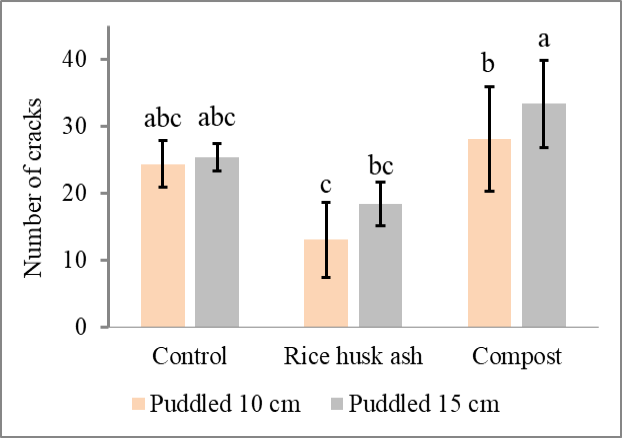
Number of cracks observed in Vertisols as affected by puddling depth (10 and 15 cm) and organic matter application (control, rice husk ash, and compost). Bars represent the mean ± standard deviation (n = 3). Different letters above the bars indicate significant differences between puddling depth and organic matter application according to Tukey’s HSD test at p< 0.05, the same letter suggests no significant difference between treatments.
Results and Discussion
Cracking indexes
Deeper puddling generally reduced crack width and length but had variable effects on the number and density of cracks depending on the organic matter type (Figure 1). Compost application tended to increase the number and density of cracks but decreased their width and length, indicating a transition from fewer, large cracks to more numerous fine cracks. Conversely, RHA demonstrated the opposite effect, decreasing the number and density of cracks. This could be due to the addition of silica, which improves structural hardness. Silica-forming cementitious compounds like calcium silicate and calcium aluminate reduce plasticity and increase strength for soil stabilization ; . Puddling physically disrupts soil aggregates and redistributes fine particles, which can accelerate the weathering of several primary minerals in Vertisols, such as feldspar, pyroxene, and amphibole, potentially affecting particle dispersion, soil plasticity, and permeability ; ; . Puddling may promote the dispersion of fine soil particles, while the weathering of primary minerals may contribute to changes in the soil mineral composition and physical properties ; ; .
The number of cracks was significantly influenced by both puddling depth and organic matter application (Figure 1). Compost addition showed the highest number of cracks under both puddling depths, with means exceeding 30 cracks at 15 cm puddling depth. In contrast, soil treated RHA exhibited the lowest number of cracks, particularly under 15 cm puddling depth, which resulted in less than 20 cracks. However, control plots did not differ significantly from either treatment. These results indicate that compost application increased the number of visible cracks, likely due to enhanced aggregate formation and differential shrink-swell behavior induced by improved organic and clay interactions . Conversely, RHA may have reduced the extent of cracking by increasing silica content, which stabilizes soil aggregates and reduces shrinkage .
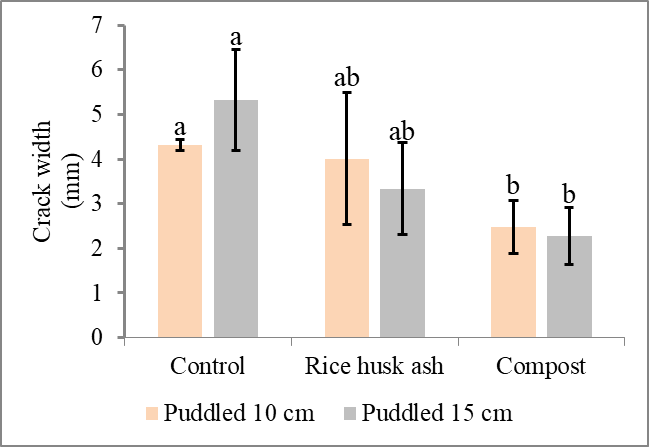
Crack width (mm) of Vertisols under different puddling depths (10 cm and 15 cm) and organic matter applications (control, rice husk ash, and compost). Bars represent the mean ± standard deviation (n = 3). Different letters above bars indicate statistically significant differences among organic matter application (p< 0.05), while the same letter suggests no significant difference between treatments.
The width of soil cracks (Figure 2) was strongly influenced by the type of organic amendment applied. Compost produced the narrowest cracks, followed by RHA, while the control treatment consistently showed the widest crack formation. This pattern suggests that organic materials, particularly those with larger particle sizes and greater structural bulk like compost, help stabilize the soil matrix and reduce lateral crack expansion Although puddling depth did not show a strong or consistent effect on crack width, the presence and type of organic amendment remained the dominant factor controlling how wide the cracks developed. The widest cracks were observed in the control group at 15 cm puddling depth (5.33 mm), whereas the narrowest cracks occurred in the compost application at 15 cm depth (2.28 mm).
The reduction in crack width with deeper puddling may be attributed to the formation of a compacted layer that limits vertical shrinkage Furthermore, the addition of organic materials, especially compost, enhances soil moisture retention and elasticity, mitigating the development of wide cracks during drying ; . Similar findings have been reported by Cheng et al. (2020), who observed that water content determined the microstructure, which directly influenced soil crack on drying stage. Excessively wide, deep, and continuous soil cracks can hinder plant growth by disrupting seed germination and seedling emergence (Kalita et., 2020). In addition, continuous cracks can increase water loss from the soil and lead to surface crust formation, which can make it more difficult for seedlings to emerge (Kalita et., 2020).
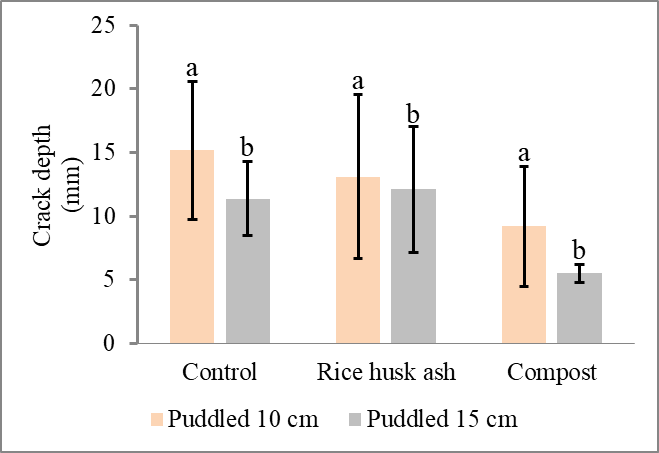
Crack depth (mm) of Vertisols influenced by puddling depth (10 cm and 15 cm) and organic amendments (control, rice husk ash, and compost). Bars represent the mean ± standard deviation (n = 3). Different letters above the bars indicate significant differences among puddling depths (p< 0.05) according to Tukey’s HSD test, while the same letter suggests no significant difference between treatments.
The control plots exhibited the deepest cracks (15,17 mm at 10 cm puddling) as depicted in Figure 3, while compost applications displayed the shallowest cracks (5,52 mm at 15 mm puddling). Increasing puddling depth consistently reduced crack depth across treatments, likely due to improved subsoil compaction and reduced desiccation stress. The lower crack depth in compost addition may result from increased aggregate stability and organic carbon content, which reduce the susceptibility of soil to deep shrinkage fissures.
Crack length density (Figure 4) was mainly influenced by the type of organic amendment added to the soil. Although the response was not fully consistent, finer materials such as RHA generally tended to reduce crack length density, whereas the coarser compost sometimes increased it. This indicates that the particle size and physical characteristics of each organic material play an important role in determining how cracks form and propagate across the soil surface. The highest values were recorded under compost addition, particularly at 15 cm puddling depth, whereas RHA application showed the lowest density values. This pattern suggests that while compost reduced individual crack size and length, it promoted the formation of more numerous but finer cracks, leading to a higher overall crack density. This could enhance infiltration and surface drainage during wetting cycles, which may be beneficial for water holding capacity.
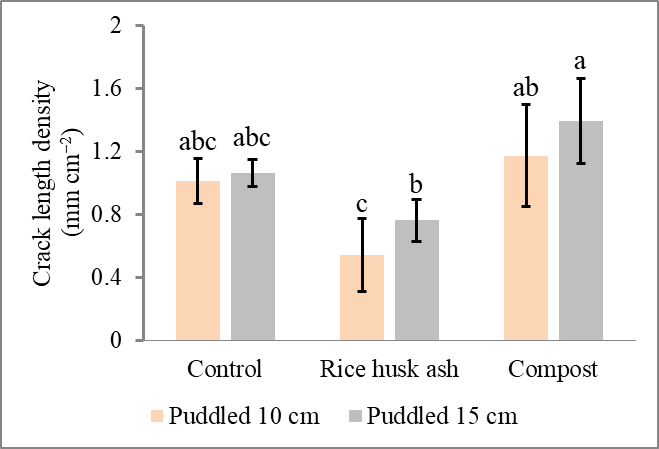
Crack length density in Vertisols as affected by puddling depth (10 and 15 cm) and organic matter treatments (control, rice husk ash, and compost). Bars represent mean ± standard deviation (n = 3). Distinct letters above bars indicate significant differences (p< 0.05) according to Tukey’s HSD test, while the same letter suggests no significant difference between treatments.
Bulk density (Figure 5) showed slight variations among treatments and puddling depths, although none of these differences were statistically significant. At 15 cm puddling, the control exhibited a small increase in bulk density (1,52 g cm⁻³), whereas RHA showed a slight decrease (1,36 g cm⁻³), and compost remained essentially unchanged (1,41 g cm⁻³). Crack initiation in Figure 6 occurred between 7 and 9 days after drainage across all treatments, with no clear trend between the 10 cm and 15 cm puddling depths. Soil moisture at crack initiation was also similar, ranging from 0,40 to 0,50 g g⁻¹. The moisture value remained clustered around 0,42–0,43 g g⁻¹.
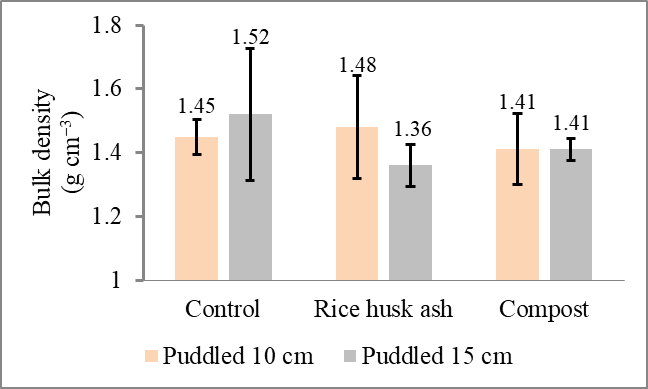
Soil bulk density of Vertisols after treatment at different puddling depths (10 and 15 cm) and organic matter treatments (control, rice husk ash, and compost). Bars represent the mean ± standard deviation (n = 3). No significant differences (p< 0.05) according to Tukey’s HSD test.
Puddling intensity affects water transmission properties
The results demonstrated that both puddling depth and the type of organic matter application significantly influenced the cracking indices, along with the hydraulic conductivity of Vertisol. Deeper puddling consistently suppressed crack depth formation, while the effects of organic matter varied notably between compost and rice husk ash (RHA), particularly the addition of compost significantly decreased crack width, and RHA was most effective in reducing the number of cracks.
Deeper puddling (15 cm) consistently resulted in greatly lower K values compared to shallow puddling (Figure 7). For instance, in the control group, K initial at 10 cm puddling was 13.11 mm h−1, then decreased to 0.75 mm h−1 at 15 cm puddling. This trend was held for K final, where the 15 cm puddling treatment resulted in an extremely low value compared to 10 cm puddling depth. This pronounced reduction can be attributed to the more complete destruction of soil macropores and the formation of a more compacted plasmic layer during deep puddling, which creates a less permeable soil matrix ; ; .
In general, RHA led to lower Ks values compared to the control, particularly under shallow puddling. This suggests that the fine, particulate nature of RHA effectively filled soil pores, thereby reducing hydraulic conductivity ; ; . In contrast, the compost treatment showed a different effect, especially under shallow puddling, where it resulted in higher Ks initial and Ks final values than RHA yet still less than the control. This indicates that compost may help maintain a more porous soil structure, potentially by enhancing aggregate stability,
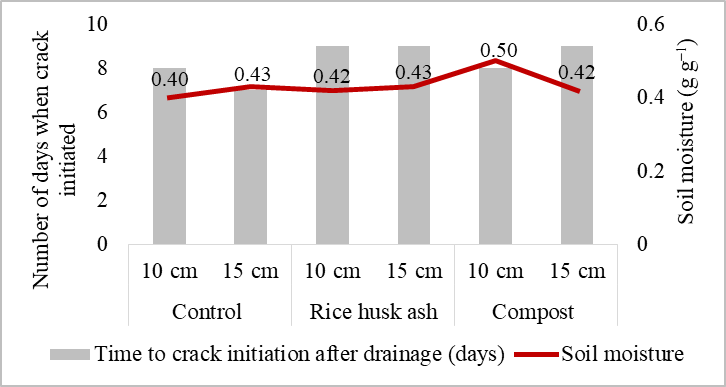
Soil moisture content at crack initiation and time (in days) needed to develop crack following drainage of Vertisols after treatment in different puddling depth (10 and 15 cm) and organic matter treatments (control, rice husk ash, and compost).
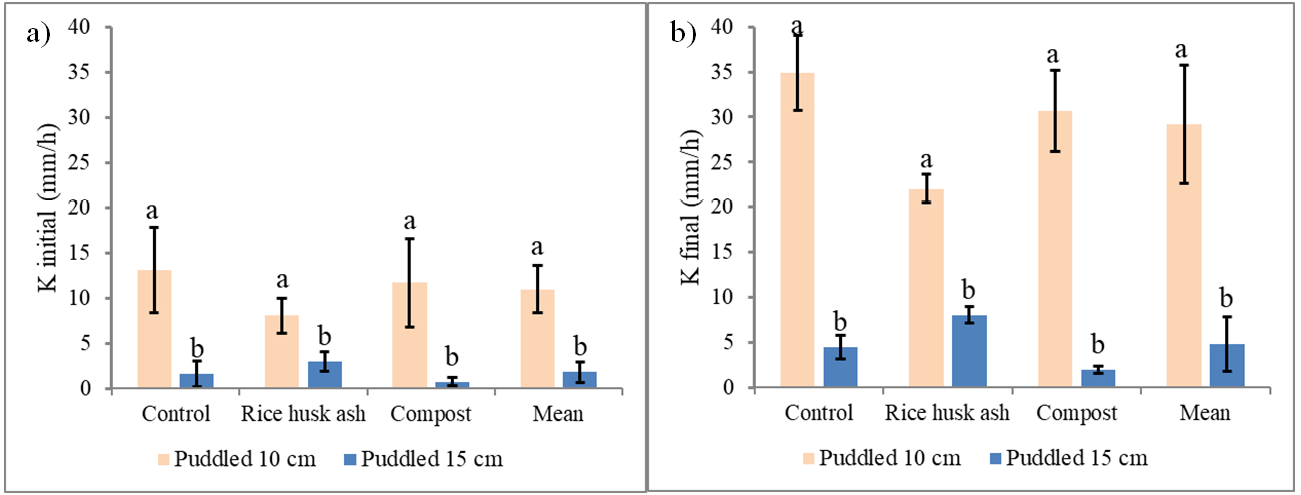
Effect of puddling depth and organic matter on the initial (a) and final (b) hydraulic conductivity
(K). Different letters above the bars indicate significant differences (p < 0.05, Tukey’s HSD), while the same letter suggests no significant difference between treatments.
which can preserve some conductive pathways even after puddling ; . Therefore, deep puddling is a highly effective management practice for reducing water loss through percolation in Vertisols. Moreover, organic matter can further modulate this effect, with RHA providing an additional reduction in K value.
Conclusions and Recommendations
The characteristics of cracks formed and saturated hydraulic conductivity (Ks) in Vertisols during drying following rice cultivation were influenced by organic matter application and the puddling depths applied. Organic matter application primarily affected crack width; compost at 15 cm puddling depth reduced crack width by 3.05 mm (57%) compared with the control. Puddling depth primarily affected crack depth; compared with 10 cm puddling, 15 cm significantly decreased crack depth by 3.68 mm (40%) with compost and 0.99 mm (8%) with RHA. Moreover, RHA at 10 cm puddling depth reduced crack number and crack length density. Puddling at 15 cm significantly reduced initial and final Ks conductivity by 85% compared with 10 cm. Therefore, deeper puddling reduced crack depth and saturated hydraulic conductivity, potentially reducing water loss through percolation, while organic matter application reduced crack width, which potentially lessens the effects of root growth on soil cracking. In particular, organic matter influenced crack width, whereas puddling depth affected crack depth. This differential response is noteworthy, as the underlying mechanisms remain unclear. Further studies need to address this research question.
Acknowledgements
The authors would like to express sincere gratitude to the owner of the rice field, Ms. Ramlah for allowing soil sampling at the site.
Novelty Statement
Cracking behavior of Vertisols on drying following puddling is a serious constraint for dryland crop production following rice. Here, we reveal that puddling manipulation along with organic matter application enhances Vertisols’ physical characteristics, more favorable for dryland crops after rice.
Author’s Contribution
Mona Ayu Santi: Conceptualization; data curation; formal analysis; funding acquisition; methodology; project administration; software; resources; validation; writing-original draft; writing-review and editing.
Sartika Laban: Conceptualization; data curation; funding acquisition; methodology; validation; supervision; writing-review and editing.
Andi Febrianti Ramadhani Sri Astuti: Formal analysis; data curation; funding acquisition; writing-review and editing.
Khaerunnisa Nasir: Formal analysis; data curation; funding acquisition; writing-review and editing.
Sikstus Gusli: Conceptualization; data curation; formal analysis; funding acquisition; methodology; project administration; resources; supervision; validation; writing-original draft; writing-review and editing.
Generative AI and AI-assisted technology statement
The authors declare that no generative AI and AI assisted technology was used in the creation of this manuscript.
Conflict of interest
The authors declare no conflicts of interest.
References
- Abdulrahman, S.M., G.Y. Al Kindi, & E.A.A. Ihsan. 2024. Sustainable Stabilization of Clay Soil with Rice Husk Ash. J. Engineer. Technol. Sci., 56(04): 450–462. https://doi.org/10.5614/j.eng.technol.sci.2024.56.4.2 [CrossRef]
- Alnaser, Y. and K. Alkhaled. 2020. The Behavior and Pattern of Soil Cracks and Its Managements in Vertisols. Mesopotam. J. Agric., 48(2): 68–76. https://doi.org/10. 33899/magrj.2020.126766.1030 [CrossRef]
- Atef, A. and Z. Hossain. 2025. Assessing the Impact of Rice Husk Ash on Soil Strength in Subgrade Layers: A Novel Approach to Sustainable Ground Engineering. Sustain., 17(12): 5457. https://doi.org/10.3390/su17125457 [CrossRef]
- Bahmaniar, M.A. 2008. The influence of continuous rice cultivation and different waterlogging periods on the morphology, clay mineralogy, Eh, pH and K in paddy soils. Euras. Soil Sci., 41(1): 87–92. https://doi.org/10.1134/S1064229308010109 [CrossRef]
- BPS. 2025. Statistik Daerah Kabupaten Jeneponto 2025. Badan Pusat Statistik Kab.Jeneponto.
- Cahyono, P. 2020. Effects Of Compost on Soil Properties and Yield of Pineapple (Ananas comusus L. MERR.) on Red Acid Soil, Lampung, Indonesia. Int. J. GEOM., 19(76). https://doi.org/10.21660/2020.76.87174 [CrossRef]
- Çakir, R. and C. Cangir. 2021. Water retention and irrigation characteristics of Vertisols in northwestern Turkey. Geode. Region., 25: e00402. https://doi.org/10.1016/j.geodrs. 2021.e00402 [CrossRef]
- Cheng, Q., C.S. Tang, H. Zeng, C. Zhu, N. An, and B. Shi. 2020. Effects of microstructure on desiccation cracking of a compacted soil. Engineer. Geol., 265: 105418. https://doi.org/10.1016/j.enggeo.2019.105418 [CrossRef]
- Debele, T. & H. Deressa. 2016. Integrated Management of Vertisols for Crop Production in Ethiopia: A Review. J. Bio. Agric. Healthcare., 6(24): 26-36.
- Eickhorst, T. and R. Tippkötter. 2009. Management-induced structural dynamics in paddy soils of south east China simulated in microcosms. Soil and Tillage Research, Soil Manag. Sustain., 102(2): 168–178. https://doi.org/10.1016/j.still.2008.07.007 [CrossRef]
- Goitom, B., R.P. Tripathi, W. Ogbazghi, and T. Weldeslassie. 2016. Effect of Puddling and Compaction on Water Requirements of Rice at Hamelmalo, Eritrea. Computat. Water. Ener. Environ. Engineer., 5(2): 27–37. https://doi.org/10.4236/ cweee. 2016.52003
- Intharasombat, N., A.J. Puppala, & R. Williammee. 2007. Compost Amended Soil Treatment for Mitigating Highway Shoulder Desiccation Cracks. J. Infrastruct. Sys., 13(4): 287–298. https://doi.org/10.1061/(ASCE)1076-0342 (2007) 13:4(287) [CrossRef]
- Jha, P., K.M. Hati, N.K. Lenka, B.L. Lakaria, M.V. Coumar, B.P. Meena, J.K. Thakur, A.K. Biswas, & A.K. Patra. 2025. Soil Health in Indian Vertisols. https://acsess.onlinelibrary. wiley.com/doi/10.1002/9780891187400.ch8
- Juita, N., Iskandar, and Sudarsono. 2017. Characteristic and Genesis of Black and Red Soil Vertisol in Jeneponto Regency. J. Trop. Soil., 21(2): 123–128. https://doi.org/10.5400/jts.2016.v21i2.123-128 [CrossRef]
- Kalita, J., P. Ahmed, & N. Baruah. 2020. Puddling and its effect on soil physical properties and growth of rice and post rice crops: A Rev., 9: 503–510.
- Kirchhof, G., S. Priyono, W.H. Utomo, T. Adisarwanto, E.V. Dacanay, and H.B. So. 2000. The effect of soil puddling on the soil physical properties and the growth of rice and post-rice crops. Soil Till. Res., 56(1): 37–50. https://doi.org/10.1016/ S0167-1987(00) 00121-5
- Klute, A. and C. Dirksen. 1986. Hydraulic Conductivity and Diffusivity: Laboratory Methods. In A. Klute (Ed.), SSSA Book Series (pp. 687–734). Soil Sci. Soc. Americ. Amer. Soc. Agron. https://doi.org/10.2136/sssabookser5.1.2ed.c28 [CrossRef]
- Kranz, C.N., R.A. McLaughlin, A. Amoozegar, and J.L. Heitman. 2023. Influence of compost amendment rate and level of compaction on the hydraulic functioning of soils. JAWRA J. Americ. Water Resour. Associat., 59(5): 1115–1127. https://doi.org /10.1111/1752-1688.13119 [CrossRef]
- Kome, G.K., R.K. Enang, F.O. Tabi, & B.P.K. Yerima. 2019. Influence of Clay Minerals on Some Soil Fertility Attributes: A Review. Open J. Soil Sci., 09(09): 155–188. https://doi.org/10.4236/ojss.2019.99010 [CrossRef]
- Kukal, S.S. and G.C. Aggarwal. 2003. Puddling depth and intensity effects in rice–wheat system on a sandy loam soil: II. Water use and crop performance. Soil Till. Rese., 74(1): 37–45. https://doi.org/10.1016/S0167-1987(03)00124-7 [CrossRef]
- Li, C., Q. Cheng, C. Tang, Y. Gu, L. Cui and H. Guo. 2024. Effects of layer thickness on desiccation cracking behaviour of a vegetated soil. Biogeotechnics, 2: 100068. https://doi.org/10.1016/j.bgtech.2023.100068 [CrossRef]
- Lopez-Bellido, R.J., V. Muñoz-Romero, F.J. Lopez-Bellido, C. Guzman, & L. Lopez-Bellido. 2016. Crack formation in a mediterranean rainfed Vertisol: Effects of tillage and crop rotation. Geoderma, 281, 127–132. https://doi.org/10.1016/j.geoderma.2016. 07.001 [CrossRef]
- Lu, S.G., F.F. Sun, and Y.T. Zong. 2014. Effect of rice husk biochar and coal fly ash on some physical properties of expansive clayey soil (Vertisol). Catena., 114: 37–44. https://doi.org/10. 1016/j.catena.2013.10.014
- Masria, M., C. Lopulisa, H. Zubair, & B. Rasyid. 2018. Karakteristik Pori dan Hubungannya dengan Permeabilitas pada Tanah Vertisol Asal Jeneponto Sulawesi Selatan. J. Ecosol., 7(1): 38–45. https://doi.org/10.20956/ecosolum.v7i1.5209 [CrossRef]
- Obalum, S.E., D. Uteau-Puschmann, and S. Peth. 2019. Reduced tillage and compost effects on soil aggregate stability of a silt-loam Luvisol using different aggregate stability tests. Soil Tillage Res., 189: 217–228. https://doi.org/10.1016/j.still.2019.02.002 [CrossRef]
- Qu, J., B. Li, T. Wei, C. Li, and B. Liu. 2014. Effects of rice-husk ash on soil consistency and compactibility. CATENA., 122: 54–60. https://doi.org/10.1016/j.catena.2014.05.016 [CrossRef]
- Ringrose-Voase, A.J. 1990. One-dimensional image analysis of soil structure. I. Principles. J. Soil Sci., 41(3): 499–512. https://doi.org/10.1111/j.1365-2389.1990. tb00082.x [CrossRef]
- Sagala, S.D., D.A. Purba, & A. Marques. 2025. Sustainable Soil Improvement: Soft Clay Stabilization Using Rice Husk Ash and Waste Spent Catalyst RCC. Int. J. Geom., 29(131): 48-55. https://doi.org/10.21660/2025.131.4842 [CrossRef]
- Sayara, T., R. Basheer-Salimia, F. Hawamde, & A. Sánchez. 2020. Recycling of Organic Wastes through Composting: Process Performance and Compost Application in Agriculture. Agron., 10(11): 1838. https://doi.org/10.3390/agronomy10111838 [CrossRef]
- Shiralipour, A., D.B. McConnell, & W.H. Smith. 1992. Physical and chemical properties of soils as affected by municipal solid waste compost application. Biom. Bioener., 3(3): 261–266. https://doi.org/10.1016/0961-9534(92)90030-T [CrossRef]
- Singh, V.K., S. Sharma, & P. Kaur. 2026. Mineralogical composition of soils under rice-based cropping systems in Shiwalik Foothills of Northwest India. Discov. Soil., 3(1): 36. https://doi.org/10.1007/s44378-026-00192-2 [CrossRef]
- Soil Survey Staff, 2014. Keys to Soil Taxonomy. 12th Edition, USDA-Natural Resources Conservation Service, Washington DC.
- Somasundaram, J., R.S. Chaudhary, B.L. Lakaria, R. Saha, N.K. Sinha, R.K. Singh, P. Jha, R.K. Singh, & A. Subba Rao. 2014. Pothole Formation and Occurrence in Black Vertisols of Central and Western India. Agric. Res., 3(1): 87–91. https://doi.org/10.1007/ s40003-014-0098-6
- Somasundaram, J., R.K. Singh, S.N. Prasad, A. Kumar, S.S. Ali, N.K. Sinha, R.S. Chaudhary, M. Mohanty, B.L. Lakaria, M. Sankar, & R. Lal, 2018. Effect of Soil Amendments and Land Use Systems on Surface Cracks, Soil Properties and Crop Yield in a Vertisol. Agric. Res., 7(4): 443–455. https://doi.org/10.1007/s40003-018-0334-6 [CrossRef]
- Taha, M.M.M., C.P. Feng, & S.H.S. Ahmed. 2021. Modification of Mechanical Properties of Expansive Soil from North China by Using Rice Husk Ash. Materials (Basel, Switzerland), 14(11): 2789. https://doi.org/10.3390/ma14112789 [CrossRef]
- Tripathi, U.K. 2024. Scientist and Technical Officer (Administration) to Vice Chancellor JNKVV, Jabalpur, Madhya Pradesh, India.
- Wang, D., J.Y. Lin, J.M. Sayre, R. Schmidt, S.J. Fonte, J.L.M. Rodrigues, & K.M. Scow. 2022. Compost amendment maintains soil structure and carbon storage by increasing available carbon and microbial biomass in agricultural soil – A six-year field study. Geoder., 427: 116117. https://doi.org/10.1016/j.geoderma.2022.116117 [CrossRef]

Services
Article usage statistics
Loading…
Related articles
- Simple Bulk Storage Methods to Maintain the Physical Properties, Botanical Component, Nutrient Content, and Nutritional Values of Rice Straw Supplemented with Calcite-Based Minerals, Molasses, and UreaAdvances in Animal and Veterinary Sciences · 2023
- Mathematical Modeling and Optimization of Physical Properties of Paddy as Influenced by DryingPakistan Journal of Agricultural Research · 2021
- Puddled Soil Settling Period and Seedling Age Affect Growth, Productivity and Economic Benefits of Mechanically Transplanted RicePakistan Journal of Agricultural Research · 2024
- GIS-Based Assessment of Soil Physical Properties under Cultivated and Uncultivated Lands in Semi-Arid Conditions of IraqSarhad Journal of Agriculture · 2027
- Technical Efficiency Analysis of Rice Production in Pakistan under Dry and Puddle Conditions: A Case Study of Selected Districts of Punjab province, PakistanSarhad Journal of Agriculture · 2017
- Biochar and Fly Ash Role in Improving Mechanical and Physical Properties of VertisolSarhad Journal of Agriculture · 2017