
Pasundan cattle, native to West Java, are well adapted to fibrous diets. However, the optimal rice straw-to-concentrate ratio for maintaining haematological health remains undetermined. This study investigated the impact of varying rice straw-to-concentrate ratios on the haematological profiles of Pasundan cattle. Eighteen healthy heifers (aged 1.5–2 years; 160.58 ± 12.4 kg body weight) were assigned to three groups for a 95-day feeding trial: Group A (70% straw: 30% concentrate), Group B (60%: 40%), and Group C (50%: 50%). Blood samples were collected before and after the trial and analysed for red blood cell (RBC), white blood cell (WBC), and platelet indices using an automated analyser. The findings demonstrated significant (p < 0.05) increases in RBC count across all groups: Group A exhibited an increase from 7.02 ± 0.85 to 8.15 ± 0.92 × 10⁶/µL, Group B from 6.98 ± 0.78 to 8.08 ± 0.88 × 10⁶/µL, and Group C from 7.05 ± 0.91 to 8.22 ± 0.95 × 10⁶/µL. Similarly, haemoglobin levels increased significantly (p < 0.05), with Group A increasing from 9.85 ± 1.12 to 11.45 ± 1.28 g/dL, Group B from 9.78 ± 1.08 to 11.38 ± 1.22 g/dL, and Group C from 9.92 ± 1.15 to 11.52 ± 1.31 g/dL. Hematocrit values also showed significant enhancement (p < 0.05), with Group A increasing from 29.5 ± 3.2 to 34.2 ± 3.8%, Group B from 29.2 ± 3.0 to 34.0 ± 3.6%, and Group C from 29.8 ± 3.4 to 34.5 ± 3.9%. WBC counts increased significantly only in Group A, from 8.36 ± 1.24 to 11.02 ± 1.58 × 10³/µL (p < 0.05), accompanied by changes in lymphocyte and monocyte populations, whereas Groups B and C showed no significant changes. Platelet counts decreased significantly in Group A, from 290 ± 45 to 111 ± 38 × 10³/µL (p < 0.05), while Group C demonstrated an increase in mean platelet volume, from 6.8 ± 0.9 to 8.2 ± 1.1 fL (p < 0.05). Pasundan cattle exhibited haematological stability across all treatment conditions, demonstrating their resilience to fibrous feeding systems. The 60:40 straw-to-concentrate ratio (40% concentrate) appeared to provide a balanced physiological response, supporting immune and platelet stability while maintaining erythropoietic benefits in broiler chickens. These findings underscore the potential of rice straw as a sustainable feed resource and highlight the adaptive capacity of Pasundan cattle for livestock development in Indonesia.
Research Article · Volume 15, Issue 1, Pages 157–166, 16 November 2026 · Open Access
Dietary Balance of Rice Straw and Concentrate Modulates Hematological Profiles in Pasundan Cattle
, , , , , ,
Affiliations & Notes ⌄
- 1Department of Animal Production, Faculty of Animal Husbandry, Universitas Padjajaran, Sumedang, West Java, 45363, Indonesia
- 2Department of Animal Nutrition and Feed Technology, Faculty of Animal Husbandry, Universitas Padjadjaran, Sumedang, West Java, 45363, Indonesia
- 3Working Group of Genetic Medicine, Faculty of Medicine, Universitas Padjadjaran, Sumedang, West Java, 45363, Indonesia
- 4UPTD Center for Artificial Insemination of Beef Cattle Breeding and Development, Ciamis, West Java, Indonesia
- *Correspondence | Nena Hilmia; Email: nena.hilmia@unpad.ac.id
Article Info ⌄
- Journal:
- Journal of Animal Health and Production
- Submitted Date:
- 4 March 2026
- Accepted Date:
- 22 August 2026
- Published Date:
- 16 November 2026

Abstract
Introduction
Sustainable livestock production in tropical regions requires the efficient use of local feed resources. The dependence on low-quality forages, such as rice straw, limits animal productivity and health. In Indonesia, rice straw is the main agricultural by-product used in ruminant diets, particularly during the dry season when fresh forage is scarce . Rice straw has low nutritive value owing to its high lignocellulosic content, low crude protein content, and poor digestibility, which reduces voluntary intake and nutrient utilisation . Concentrate supplementation provides fermentable energy and protein to enhance rumen microbial activity and improve utilisation of fibrous feeds (Chen et al., 2021). However, the optimal balance between straw and concentrate inclusion in the diets of indigenous cattle breeds remains unclear.
Pasundan cattle, an indigenous Indonesian breed, were developed through the crossbreeding of Bos sondaicus with Javanese, Madura, and Sumba Ongole cattle . They are predominantly located in West Java, including Ciamis, Cianjur, Sumedang, Sukabumi, Kuningan, Pangandaran, Tasikmalaya, Indramayu, and Purwakarta. This breed is notable for its adaptability to tropical climates, tolerance of fibrous diets, low stress levels, consistent reproductive cycles, and resistance to several tropical diseases . Pasundan cattle are important not only for food security but also for cultural and socio-economic contributions to smallholder farming systems . Nevertheless, population assessments indicate a continuous decline over recent years, raising concerns about genetic erosion and long-term sustainability (Arifin et al., 2019). To address this, conservation efforts have incorporated artificial reproductive technologies (ART), such as semen cryopreservation, artificial insemination, and oestrous synchronisation protocols designed to improve reproductive efficiency , 2025). Yet, nutritional strategies remain equally critical to support both productivity and conservation goals.
Nutritional management of Pasundan cattle involves integrating fibrous crop residues, particularly rice straw, with concentrate supplementation. These feeding systems maintain rumen function, meet protein and energy requirements, and sustain animal health . The balance between roughage and concentrate is vital, as high-concentrate diets (>70%) may cause subclinical ruminal acidosis with acid accumulation and haematological disturbances . Diets that rely too heavily on fibrous feed can lead to nutrient deficiencies, impairing erythropoiesis and immune competence .
Despite the extensive literature on exotic beef cattle nutrition, empirical data on optimal rice straw-to-concentrate ratios for Indonesian breeds, especially Pasundan cattle, are lacking. Research on local cattle mainly focuses on growth, digestibility, and reproduction ; , with limited attention to haematological responses as nutritional and physiological indicators. Haematological parameters, such as red blood cell (RBC) count, haemoglobin, haematocrit, white blood cell (WBC) differentials, and platelet indices, are biomarkers of nutritional status, immune function, and health . Studies on exotic breeds have shown that high-concentrate diets (>70%) can cause subclinical ruminal acidosis and haematological issues ; ; however, it is unclear whether indigenous breeds show similar sensitivities or greater resilience. Pasundan cattle, which evolved under tropical conditions with fibrous diets, may have distinct haematological patterns compared to temperate breeds.
Given the importance of optimising the utilisation of agricultural by-products and maintaining cattle health, evaluating the effects of different rice straw-to-concentrate feeding ratios on the haematological status of Pasundan cattle is essential. With limited empirical data on the optimal inclusion levels for indigenous breeds, this study investigated their haematological responses to varying rice straw-to-concentrate ratios, aiming to develop cost-effective feeding strategies that support Pasundan cattle conservation.
Materials and Methods
Animals and ethical
All animal procedures in this study were approved by the Universitas Padjadjaran Health Research Ethics Committee (Approval No. 1398/UN6.KEP/EC/2023). The study was conducted on 18 Pasundan heifers aged 1-2.5 years, with an average body weight of 160.58 kg. These cattle were subjected to a 95-day intensive rearing protocol at the Ciparanje Beef Cattle Teaching Farm. Each animal was housed in a separate pen, measuring 1.5 x 1.8 x 1.5 meters. The pens were distinctly labelled to streamline data collection and equipped with both a feed and a water trough.
Experimental design and diets
This study categorised the animals into three treatment groups, each receiving distinct feed treatments characterised by specific straw-to-concentrate ratios over 95 days. The sample size of six animals per treatment group (n= 6, total N= 18) was determined based on prior haematological studies in cattle that demonstrated sufficient statistical power with comparable sample sizes ; . A completely randomised design (CRD) was utilised for this experiment, with the animal subjects randomly assigned to one of three experimental treatments.
Group 1 was fed a mixture of 70% straw and 30% concentrate, group 2 received 60% straw and 40% concentrate, and group 3 was given an equal ratio of 50% straw to 50% concentrate. Dietary adaptation to the experimental feed was conducted progressively over 14 days; during this acclimation period, anthelmintic treatments and vaccinations were concurrently performed. Animals were handled gently and consistently throughout the study to minimise stress. Daily health monitoring was conducted by trained personnel, and any signs of illness or distress were recorded. All animals remained healthy throughout the study period. The concentrates included in the diet were bran, coconut cake, palm kernel cake, cassava pulp, cassava chips, coffee skins, molasses, and cocoa skins. The feeding regimen involved the administration of rice straw and concentrate, structured according to a treatment plan that accounted for the feed’s dry matter content. The total daily feed allocation was formulated to provide 3% of the animal’s body weight on a dry matter basis, in accordance with maintenance and growth requirements. Rations were adjusted based on individual body weights and dry matter content to ensure consistency in nutrient intake across groups. Rice straw was provided three times daily at 08:00, 10:00, and 16:00 WIB, while concentrates were administered twice daily at 09:00 and 15:00 WIB. Water was provided ad libitum through the water troughs in each pen. Nutrient composition of the experimental diets during the treatment period is presented in Table 1.
Table 1: Pasundan cattle diet composition during the experiment.
| Feeding | Groups of treatment | ||
| A | B | C | |
| Rice straw | 70 | 60 | 50 |
| Concentrate | 30 | 40 | 50 |
| Nutrient | % | ||
| Dry Matter | 53.79 | 58.89 | 63.99 |
| Ash | 13.30 | 13.30 | 13.31 |
| Crude protein | 7.75 | 8.70 | 9.66 |
| Crude fiber | 30.72 | 28.72 | 26.73 |
| Crude fat | 6.27 | 7.17 | 8.07 |
| Nitrogen-free extract (NFE) | 41.93 | 42.07 | 42.22 |
| Total Digestible Nutrient (TDN) | 58.34 | 59.92 | 61.50 |
Blood sampling and haematology
Blood samples were collected at two time points: Day 0 (baseline, before dietary treatment) and Day 95 (end of feeding trial). This two-timepoint design was chosen based on established protocols for nutritional haematology studies in beef cattle, where 90-95 days is sufficient to observe stable physiological adaptation to dietary changes . The sampling interval also accounts for the erythrocyte lifespan in cattle (approximately 160 days) and minimises animal stress from repeated venipuncture (Shretha et al, 2016). While intermediate sampling would provide additional temporal resolution, resource constraints and animal welfare considerations limited sampling frequency.
Blood samples (3–5 mL) were obtained via jugular venipuncture. The samples were collected in EDTA-coated Vacutainer tubes and analysed immediately. Haematological parameters were assessed using an automated haematology analyser (Sysmex XP-300; Kobe, Japan). The following parameters were measured:
RBC profile: RBC count, haemoglobin (Hb), haematocrit (HCT), mean corpuscular volume (MCV), mean corpuscular haemoglobin (MCH), mean corpuscular haemoglobin concentration (MCHC), and red cell distribution width (RDWc).
WBC profile: WBC count, lymphocytes, monocytes, and granulocytes (both absolute and relative).
Platelet profile: platelet count, mean platelet volume (MPV), platelet crit (PCT), platelet distribution width (PDW), and PDW coefficient of variation (PDWc).
Statistical analysis
Data are presented as mean ± standard deviation (SD). Intra-group changes from baseline (day 0) to the conclusion of the trial (day 95) were assessed using paired t-tests. To evaluate inter-group differences in the extent of change, a one-way analysis of variance (ANOVA) was conducted, followed by Tukey’s honestly significant difference (HSD) post hoc tests. The normality of the data and homogeneity of variances were confirmed using the Shapiro-Wilk and Levene’s tests, respectively. Statistical significance was set at p < 0.05. All statistical analyses were performed using SPSS version 26.0 (IBM Corp., Chicago, IL, USA).
Results
Across the 95-day feeding period, all haematological parameters remained within physiological ranges in all treatment groups (straw: concentrate ratios: A= 70:30; B= 60:40; C= 50:50; n= 6 per group). Unless otherwise stated, reported differences refer to within-group (before–after) changes.
At the whole-blood level, a statistically significant increase in RBC counts was observed across all groups (p < 0.05): Group A exhibited an increase from 7.39±0.98 ×10⁶/µL to 8.98±0.71 ×10⁶/µL; Group B from 8.52±0.96 ×10⁶/µL to 9.86±0.93 ×10⁶/µL; and Group C from 8.19±0.88 ×10⁶/µL to 9.31±0.55 ×10⁶/µL, indicating a consistent elevation in circulating erythrocytes across the dietary gradients. White blood cell counts increased significantly only in Group A (p < 0.05), rising from 9.45±1.99 ×10³/µL to 11.67±1.39 ×10³/µL, while remaining stable in Groups B (9.84±1.66 ×10³/µL to 10.82±2.95 ×10³/µL, p > 0.05) and C (9.19±3.82 ×10³/µL to 10.98±3.02 ×10³/µL, p > 0.05). Platelet counts declined significantly in Group A (p < 0.05), decreasing from 387.17±151.29 ×10³/µL to 268.33±99.89 ×10³/µL, but exhibited no detectable changes in Groups B (337.00±88.63 ×10³/µL to 276.00±82.77 ×10³/µL, p > 0.05) and C (279.17±95.47 ×10³/µL to 314.33±87.77 ×10³/µL, p > 0.05). Collectively, these patterns suggest a broadly preserved haematological homeostasis, with diet-specific shifts most pronounced in the group with the highest straw inclusion percentage (Figure 1).
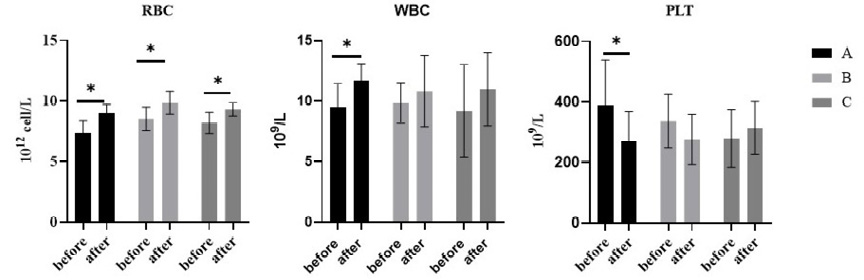
Whole blood hematological profile of Pasundan cattle before and after a 95-day feeding period with varying rice straw-to-concentrate ratios. Red blood cell (RBC), white blood cell (WBC), and platelet (PLT) counts were measured across three treatment groups: Group A (70% straw: 30% concentrate, (black bars), Group B (60% straw: 40% concentrate, light gray bars), and Group C (50% straw: 50% concentrate, dark gray bars). Data are expressed as mean ± standard deviation (SD). Asterisks (*) denote statistically significant differences between pre- and post-feeding within the same group (p < 0.05).
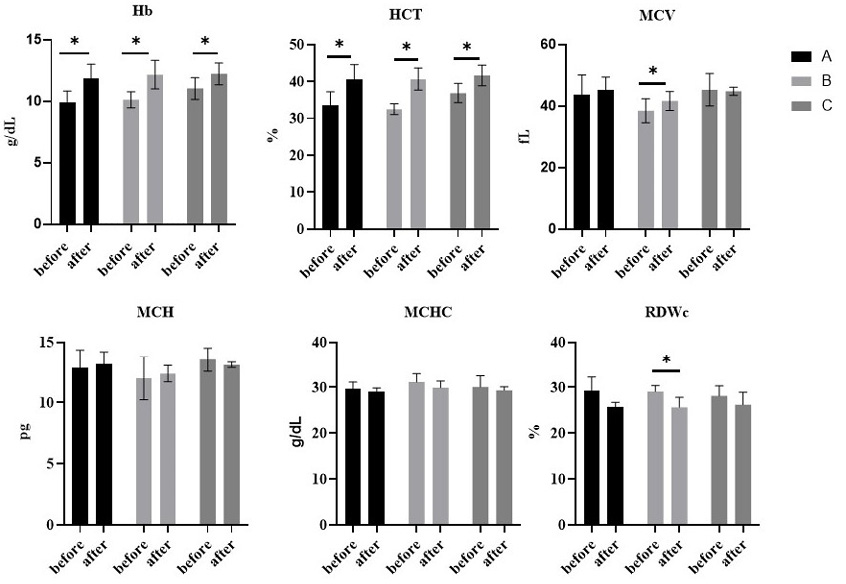
Red blood cell (RBC) parameters of Pasundan cattle before and after 95 days of feeding with varying rice straw-to-concentrate ratios. Hemoglobin (Hb), hematocrit (HCT), mean corpuscular volume (MCV), mean corpuscular hemoglobin (MCH), mean corpuscular hemoglobin concentration (MCHC), and red cell distribution width (RDWc) were assessed in three treatment groups: Group A (70% straw: 30% concentrate, black bars), Group B (60% straw : 40% concentrate, light gray bars), and Group C (50% straw: 50% concentrate, dark gray bars). Values are presented as mean ± SD. Asterisks (*) denote significant differences between before and after feeding within the same group (p < 0.05).
In alignment with the whole-blood profile, both Hb and HCT levels increased significantly across all groups (p<0.05), indicative of enhanced oxygen-carrying capacity. Specifically, haemoglobin levels increased in Group A from 9.87±0.96 g/dL to 11.83±1.19 g/dL, in Group B from 10.12±0.66 g/dL to 12.17±1.16 g/dL, and in Group C from 11.04±0.88 g/dL to 12.23±0.89 g/dL. Similarly, haematocrit levels increased in Group A from 33.45±3.76% to 40.64±3.98%, in Group B from 32.48±1.45% to 40.69±2.98%, and in Group C from 36.87±2.59% to 41.65±2.78%. The MCV significantly increased in Group A (43.67±6.50 fL to 45.33±4.13 fL, p< 0.05), whereas the RDWc significantly decreased in Group B (29.08±1.30% to 25.63±2.18%, p < 0.05), suggesting subtle variations in red cell morphology and size heterogeneity across the dietary spectrum. The MCH and MCHC remained stable and within the reference limits across all groups (Figure 2).
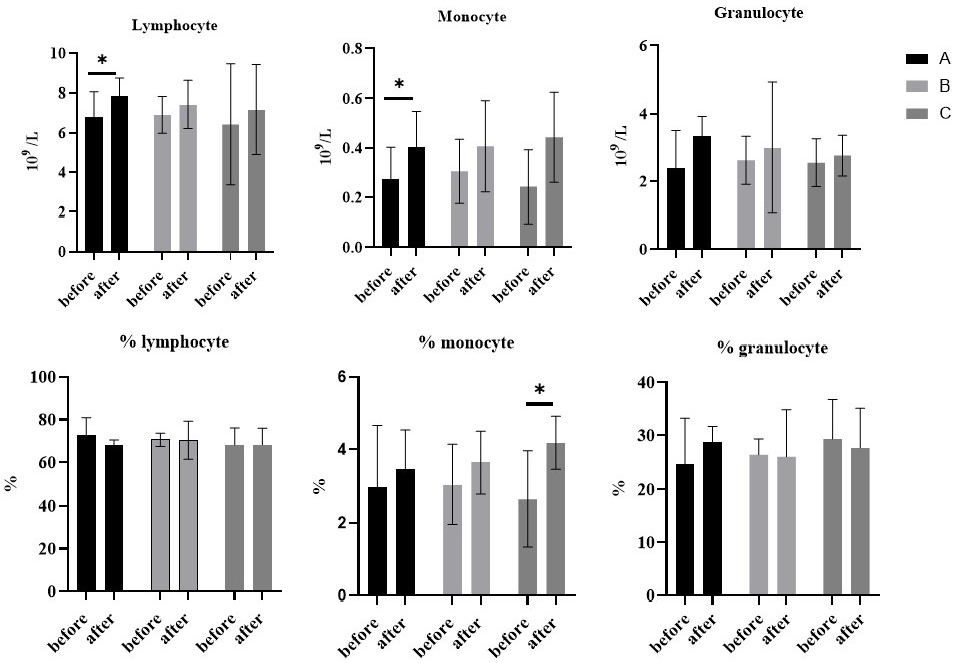
In addition to the total WBC counts, differential analyses revealed significant increases in lymphocytes and monocytes in Group A (p < 0.05). Specifically, lymphocyte levels increased from 6.81±1.28 ×10³/µL to 7.89±0.85 ×10³/µL, and monocyte levels rose from 0.27±0.13 ×10³/µL to 0.40±0.14 ×10³/µL in Group A. Conversely, granulocyte proportions remained stable across all groups (Group A: 2.38±1.13 ×10³/µL to 3.35±0.57 ×10³/µL, p < 0.05). Group B demonstrated a relative increase in monocyte count (0.30±0.13 ×10³/µL to 0.41±0.18 ×10³/µL, p < 0.05) without corresponding changes in other leukocyte classes, whereas Group C exhibited no significant alterations in leukocyte distribution (Figure 3).
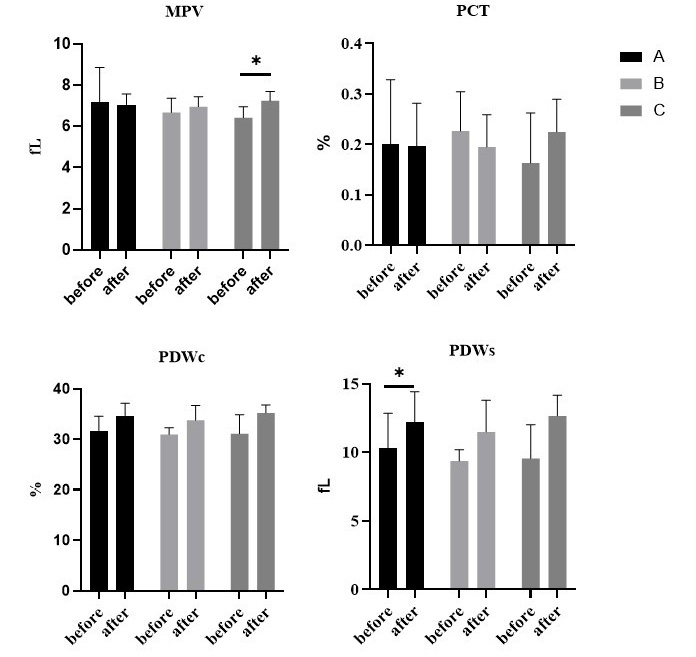
In alignment with the observed changes in total platelet count, variations in platelet indices were observed under different dietary conditions. Specifically, Group A demonstrated an increase in platelet distribution width (PDWc: 31.70±2.87% to 34.68±2.48%, p < 0.05), while Group C exhibited an increase in both mean platelet volume (MPV: 6.42±0.53 fL to 7.23±0.45 fL, p < 0.05) and PDWc (31.10±3.80% to 35.23±1.60%, p < 0.05). No significant differences in PCT levels were detected among the groups (Figure 4).
White blood cell (WBC) differentials of Pasundan cattle before and after 95 days of feeding with varying rice straw-to-concentrate ratios. Absolute counts and percentages of lymphocytes, monocytes, and granulocytes were measured in three treatment groups: Group A (70% straw : 30% concentrate, black bars), Group B (60% straw : 40% concentrate, light gray bars), and Group C (50% straw : 50% concentrate, dark gray bars). Values are presented as mean ± SD. Asterisks (*) indicate significant differences between before and after feeding within the same group (p < 0.05).
Platelet parameters of Pasundan cattle before and after 95 days of feeding with varying rice straw-to-concentrate ratios. Mean platelet volume (MPV), plateletcrit (PCT), platelet distribution width coefficient of variation (PDWc), and platelet distribution width standard deviation (PDWs) were measured in three treatment groups: Group A (70% straw : 30% concentrate, black bars), Group B (60% straw : 40% concentrate, light gray bars), and Group C (50% straw : 50% concentrate, dark gray bars). Values are presented as mean ± SD. Asterisks (*) indicate significant differences between before and after feeding within the same group (p < 0.05).
Discussion
Haematological parameters are valuable biomarkers for assessing physiological status, dietary adequacy, and early indicators of systemic disorders , including subclinical acidosis , inflammation , or nutrient deficiencies . The research revealed that Pasundan cattle are physiologically resilient to diets with varying ratios of rice straw to concentrate. The increases in RBC, haemoglobin, and haematocrit across all groups reflect enhanced erythropoiesis and oxygen-carrying capacity. The results are consistent with previous studies showing that concentrate supplementation improves nutrient supply for red blood cell production ; . The observed increases likely stem from improved rumen fermentation and microbial protein synthesis, providing amino acids and micronutrient cofactors essential for erythropoiesis ; . The baseline haematological profiles of all subjects were uniformly comparable. Since the animals were maintained under identical environmental and managerial conditions with the sole variable being the rice straw-to-concentrate ratio, any observed alterations in RBC, haemoglobin, and haematocrit levels are postulated to be a direct result of the dietary treatments
The observed selective increase in MCV within the high-straw group, alongside the reduction in RDWc in the 60:40 group, indicates adaptations in erythrocyte morphology and distribution. These changes are likely influenced by the balance between fermentable energy and fibre. Such morphological remodelling suggests that red blood cells adjust their size variability to meet metabolic demands under varying ruminal fermentation profiles. Previous research has demonstrated that dietary fibre levels can impact erythropoiesis by modulating nutrient absorption and the availability of essential cofactors necessary for red blood cell maturation ; . Notably, the absence of significant changes in MCH and MCHC across the treatments indicates that haemoglobin content and concentration were maintained, thereby preserving oxygen-carrying efficiency despite variations in erythrocyte morphology. This stability is consistent with the findings that indigenous cattle breeds often maintain haematological homeostasis under variable nutritional inputs, reflecting their physiological resilience to dietary stressors ; .
Furthermore, the lymphocytosis observed in the 70:30 group substantiates the hypothesis that fermentation-derived short-chain fatty acids (SCFAs) can enhance the activity of gut-associated lymphoid tissue, thereby stimulating local immune responsiveness without inducing pathological inflammation . Such an effect highlights the role of ruminal fermentation products as immunomodulatory signals that may strengthen mucosal defence mechanisms. Simultaneously, the slight increase in monocyte counts observed in cattle fed high-straw diets could be interpreted as an adaptive enhancement of immune surveillance. This alteration likely represents a physiological adjustment to monitor changes in rumen microbial populations and their by-products, rather than a harmful pro-inflammatory response .
The absence of neutrophilia or an increase in other leukocyte subsets further substantiates this interpretation, indicating that the immune system was operating in a state of balanced vigilance rather than being activated by stress. Equally important is the stability of total white blood cell counts in the groups with higher concentrate levels, which underscores the capacity of Pasundan cattle to maintain an immunological balance across different fibre levels. This observation stands in contrast to findings in non-indigenous taurine breeds such as Holstein-Friesian and Angus, where diets high in fibre or imbalanced often lead to leucocytosis, increased neutrophil-to-lymphocyte ratios, or systemic inflammatory responses ; . Overall, the balanced leukocyte dynamics observed in Pasundan cattle imply that their immune responses to dietary changes are subtle, adaptive, and nonpathological.
Furthermore, the observed selective increase in WBC counts in Group A (70:30 straw-to-concentrate ratio) stimulates local immune responsiveness without inducing pathological inflammation. This increase is linked to higher fibre content (30.72% crude fibre), which boosts fermentation of structural carbohydrates in the rumen and raises SCFA levels, particularly acetate, propionate, and butyrate. These SCFAs have immunomodulatory effects, stimulating the gut-associated lymphoid tissue (GALT) and promoting lymphocyte proliferation ; . Butyrate and propionate serve as energy sources for colonocytes and immune cells, affecting immune cell differentiation via histone deacetylase (HDAC) inhibition and G-protein-coupled receptor (GPR) signalling .
The differential WBC analysis (Figure 3) showed that the increase in Group A was mainly due to lymphocytes and monocytes, not neutrophils. This pattern indicates an adaptive, non-pathological immune response rather than acute inflammation or stress. Lymphocytosis reflects enhanced adaptive immunity, whereas monocytosis implies increased immune surveillance of the rumen microbial environment . All WBC values remained within the normal physiological range for cattle (4.0-12.0 × 10³/µL; , and the absence of neutrophilia or elevated neutrophil-to-lymphocyte ratios confirmed that the changes reflected physiological adaptation rather than stress . This SCFA-mediated immunomodulation likely strengthens mucosal defence mechanisms without causing systemic inflammation, aligning with the physiological resilience of indigenous Indonesian cattle to high-fibre diets .
The observed reduction in platelet counts in the 70:30 group, alongside increases in MPV and PDW, suggests a compensatory release of larger, more metabolically active platelets under conditions of restricted substrate availability. This adaptive response aligns with previous bovine studies demonstrating that platelet indices can vary with dietary energy status and breed-specific physiology ; . Mechanistically, these adjustments are believed to be mediated by thrombopoietin signalling, which regulates platelet production and maturation in response to changes in nutrient intake ; . Notably, all platelet indices in this study remained within the established reference ranges, indicating that the overall haemostatic function was maintained despite diet-induced modulation of platelet dynamics.
An important consideration is distinguishing diet-induced haematological changes from normal physiological variations, such as growth or environmental adaptation. Consistent increases in RBC, haemoglobin, and haematocrit levels across all treatment groups indicated the benefits of nutritional management during the 95-day trial. However, the lack of a zero-concentrate control group (rice straw only) limits the isolation of diet-specific effects from time-dependent changes. Diet-driven erythropoiesis is plausible given differences in nutrient composition between groups (Table 1), particularly in crude protein (7.75% vs 8.70% vs 9.66%) and total digestible nutrients (58.34% vs 59.92% vs 61.50%). Enhanced rumen fermentation from concentrate supplementation provides amino acids and micronutrient cofactors (iron, copper, cobalt, and B vitamins) essential for red blood cell production ; ; . Diet-specific modulation in WBC and platelet parameters provides evidence of treatment effects beyond general time-related changes.
Our findings corroborate and expand upon the existing research on indigenous Indonesian cattle breeds. Anggraeny et al. (2025) reported similar haematological profiles in Bali, Madura, and Ongole crossbred cattle under tropical feeding conditions, with RBC counts of 6.8-8.5 × 10⁶/µL, haemoglobin at 9.5-12.0 g/dL, and WBC counts of 7.5-11.0 × 10³/µL. These findings align with those observed in Pasundan cattle, demonstrating comparable haematological ranges and adaptive capacities. Anggraeny et al. (2025) also noted haematological stability across nutritional conditions, reinforcing our findings of resilience in Pasundan cattle. Kabir et al. (2022) found that fermented rice straw-based rations improved blood parameters in Bangladesh cattle, with haemoglobin rising from 9.2 to 11.8 g/dL and haematocrit from 28.5% to 35.2% after 90 days, findings similar to ours. Their study showed that probiotic fermentation improved nutrient digestibility and erythropoiesis, consistent with our view that rumen fermentation enhances haematology. Soetanto and Fatchiyah (2023) highlighted the adaptation of local breeds to low-quality fibrous feeds. Our data show that Pasundan cattle maintain healthy blood profiles across a range of rice straw-to-concentrate ratios. Research on other tropical cattle offers additional context. Ndlovu et al. (2007) found that indigenous African breeds maintained adequate haematology on high-fibre diets, with RBC counts of 6.5-8.0 × 10⁶/µL and haemoglobin of 9.0-11.5 g/dL, findings comparable to ours. Quang et al. (2015) noted Brahman crossbred cattle in Vietnam improved growth and digestibility with concentrate supplementation on a rice straw diet, supporting our observation that concentrate supplementation enhances nutritional status in tropical cattle. These comparisons show that Pasundan cattle exhibit haematological responses consistent with those of other indigenous tropical breeds, marked by resilience, efficient utilisation of fibrous feed, and haematological homeostasis across diets.
Collectively, the haematological responses of Pasundan cattle, characterised by enhanced erythropoiesis, diet-specific yet stable immune modulation, and balanced platelet dynamics, underscore their remarkable physiological resilience to rice straw-based feeding systems. The observed alterations in lymphocyte and monocyte subsets indicate adaptive immune flexibility, whereas platelet turnover patterns confirm efficient hematopoietic regulation rather than pathological conditions. Practically, a 60:40 straw-to-concentrate ratio (40% concentrate; Group B) provided an optimal balance. This treatment enhanced erythropoiesis, similar to other groups, while maintaining stable WBC and platelet indices, indicating balanced haematological homeostasis. In contrast, Group A had higher WBC and lower platelet counts, whereas Group C showed increased mean platelet volume. Although the changes were within physiological ranges, Group B’s stability may benefit consistent immune and haemostatic functions ; . Additionally, the 60:40 ratio maximises the use of low-cost rice straw with an adequate concentrate, offering an economically viable feeding strategy for smallholder farmers . On a broader scale, these findings support the role of Pasundan cattle as a robust genetic resource capable of thriving under resource-limited tropical conditions, thereby contributing to conservation, sustainable livestock production, and food security in Indonesia.
This study has several limitations that should be acknowledged. First, blood samples were collected exclusively on days 0 and 95, which constrained our capacity to elucidate haematological changes over time. Intermediate sampling on days 30 and 60 would provide valuable insights into the timing and stabilisation of these changes. Future research should incorporate more frequent sampling to understand the temporal progression of dietary adaptation better. Second, the absence of a zero-concentrate control group limits the ability to fully isolate diet-specific effects from time-related physiological maturation and growth effects. Third, the relatively small sample size (n= 6 per group), while consistent with previous studies in indigenous cattle and sufficient to detect major differences, may limit statistical power to detect subtle between-group differences. Fourth, the study was conducted at a single location during a single season, which may limit the generalizability of the findings to other environmental conditions, seasons, or management systems. Future research should include more frequent sampling to understand the temporal progression of dietary adaptation better. Second, without a zero-concentrate control group (rice straw only), it is difficult to separate diet-specific effects from time-related changes, such as growth or adaptation.
Conclusion
Pasundan cattle exhibit haematological stability and immune resilience on rice straw-based diets with varying concentrate levels. All dietary treatments (70:30, 60:40, and 50:50 straw-to-concentrate) maintained the haematological parameters within the normal range. Significant increases in red blood cell count, haemoglobin, and haematocrit were observed, indicating enhanced erythropoiesis and increased oxygen-carrying capacity. Group B (60:40) showed the most balanced response, maintaining immune homeostasis without affecting white blood cell or platelet counts, while achieving erythropoietic benefits similar to those of the other groups. This strategy offers smallholders a cost-effective way to use local by-products, thereby supporting Pasundan cattle conservation and productivity. However, limitations such as two-time-point sampling, the lack of a zero-concentration control, small sample sizes, and a single-location/seasonal design should be considered in future studies. Future studies with multiple time points, seasons, larger samples, and control groups are recommended to understand further the diet-specific mechanisms of haematological adaptation in Pasundan cattle.
Acknowledgement
This study was supported by the Universitas Padjadjaran Internal Research Grant, namely “Riset Kompetisi Dosen UNPAD” (RKDU) contract number 1965/UN6.3.1/PT.00/2024, during fiscal year 2024.
Novelty Statement
This study provides novel insight into the haematological adaptability of Pasundan cattle under practical rice straw–concentrate feeding systems, a topic that remains largely undocumented for this indigenous breed. Unlike previous research that primarily emphasises growth performance or digestibility responses in local cattle, the present study specifically elucidates how graded levels of concentrate inclusion (30–50%) modulate erythrocytic, leukocytic, and platelet dynamics while maintaining physiological homeostasis.
Author’s Contribution
RW, NH, DNH designed the study and experiment, AL performed the data tabulation, RW, RS, NM, APZNLS, performed data curation, statistical analysis, interpretation, and drafted the original manuscript. All the authors read and approved the final manuscript.
Generative AI and AI assisted technology statement
The authors declare that no generative AI and AI assisted technology was used in the creation of this manuscript.
Conflict of interest
The authors have declared no conflict of interest.
References
- Abo-Donia FM, Ahmed El-Shora M, Abd-Elaziz Riad W, Basuony Elgamal N, Abdel-Menaem El-Hamady W (2022). Improve the nutritional value and utilization of rice straw via an ensiling process with different sources of energy and nitrogen enrichment. J. Appl. Anim. Res., 50(1): 333–341. https://doi.org/10.1080/09712119.2022.2076685 [CrossRef]
- Adenkola AY, Ayo JO (2010). Physiological and behavioural responses of livestock to road transportation stress: A review. Afr. J. Biotechnol., 9(31): 4845–4856.
- Anggraeny YN, Prihandini PW, Aprilliza MN, Widiawati Y, Pamungkas D, Mariyono M, Krishna NH, Antari R, Setiasih S, Tiesnamurti B, Rofiq MN (2025). Comparison of ruminal ecology and blood profiles in Bali, Madura, and Ongole crossbred cattle of Indonesia. Vet. World., 18(2): 379–387. https://doi.org/10.14202/vetworld.2025.379-387 [CrossRef]
- Antanaitis R, Juozaitienė V, Malašauskienė D, Televičius M (2019). Can rumination time and some blood biochemical parameters be used as biomarkers for the diagnosis of subclinical acidosis and subclinical ketosis? Vet. Anim. Sci., 8: 100077. https://doi.org/10.1016/j.vas.2019.100077 [CrossRef]
- Broderick GA (2018). Review: Optimizing ruminant conversion of feed protein to human food protein. Animal, 12(8): 1722–1734. https://doi.org/10.1017/S1751731117002592 [CrossRef]
- Cronin P, Joyce SA, O’Toole PW, O’Connor EM (2021). Dietary fibre modulates the gut microbiota. Nutrients, 13(5): 1655. https://doi.org/10.3390/nu13051655 [CrossRef]
- Cui L, Wang H, Ding Y, Li J, Li J (2019). Changes in the blood routine, biochemical indexes and the pro-inflammatory cytokine expressions of peripheral leukocytes in postpartum dairy cows with metritis. BMC Vet. Res., 15(1): 1–10. https://doi.org/10.1186/s12917-019-1912-y [CrossRef]
- Grozovsky R, Giannini S, Falet H, Hoffmeister KM (2015). Novel mechanisms of platelet clearance and thrombopoietin regulation. Curr. Opin. Hematol., 22(5): 445–451. https://doi.org/10.1097/MOH.0000000000000170 [CrossRef]
- Haryono, Tiesnamurti B, Anggraeni A (2014). National action plan for conservation and sustainable utilization of animal genetic resources in Indonesia. In: Subandriyo et al. (eds). Proc. 16th AAAP Anim. Sci. Congr. Vol I. Indonesian Society of Animal Science, Yogyakarta, pp. 3–16.
- Hilmia N, Noor RR, Sumantri C, Gurnadi RE, Priyanto R (2013). Productivity and genetic diversity of local cattle in Ciamis-West Java. J. Indones. Trop. Anim. Agric., 38(1): 10–19. https://doi.org/10.14710/jitaa.38.1.10-19 [CrossRef]
- Kabir ME, Alam MJ, Hossain MM, Ferdaushi Z (2022). Effect of feeding probiotic fermented rice straw-based total mixed ration on production, blood parameters and faecal microbiota of fattening cattle. J. Anim. Health Prod., 10(2): 109–117. https://doi.org/10.17582/journal.jahp/2022/10.2.190.197 [CrossRef]
- Kaneko J J, Harvey J W and Bruss M L (2008) Clinical Biochemistry of Domestic Animals. Academic press Elsevier Inc, 6th ed. pp. 351-888.
- Kardaya D, Suharti S, Astuti DA, Priyanto R (2023). Performances of post-weaned Pasundan calves fed extra diets in an extensive grazing system. Indones. J. Anim. Vet. Sci., 28(3): 379–388. https://doi.org/10.14334/jitv.v28i3.3131 [CrossRef]
- Khafipour E, Krause DO, Plaizier JC (2009). A grain-based subacute ruminal acidosis challenge causes translocation of lipopolysaccharide and triggers inflammation. J. Dairy Sci., 92(3): 1060–1070. https://doi.org/10.3168/jds.2008-1389 [CrossRef]
- Koh A, De Vadder F, Kovatcheva-Datchary P, Bäckhed F (2016). From dietary fiber to host physiology: Short-chain fatty acids as key bacterial metabolites. Cell, 165(6): 1332–1345. https://doi.org/10.1016/j.cell.2016.05.041 [CrossRef]
- Lebois M, Dowling MR, Gangatirkar P, Hodgkin PD, Kile BT, Alexander WS, Josefsson EC (2016). Regulation of platelet lifespan in the presence and absence of thrombopoietin signaling. J. Thromb. Haemost., 14(9): 1882–1887. https://doi.org/10.1111/jth.13397 [CrossRef]
- Li F, Li C, Chen Y, Liu J, Zhang C, Irving B, Fitzsimmons C, Plastow G, Guan LL (2019). Host genetics influence the rumen microbiota and heritable rumen microbial features associate with feed efficiency in cattle. Microbiome, 7(1): 1–17. https://doi.org/10.1186/s40168-019-0699-1 [CrossRef]
- Mao J, Wang L (2025). Rumen acidosis in ruminants: A review of the effects of high-concentrate diets and the potential modulatory role of rumen foam. Front. Vet. Sci., 12: 1–7. https://doi.org/10.3389/fvets.2025.1595615 [CrossRef]
- Mazzullo G, Rifici C, Cammarata F, Caccamo G, Rizzo M, Piccione G (2014). Effect of different environmental conditions on some haematological parameters in cow. Ann. Anim. Sci., 14(4): 947–954. https://doi.org/10.2478/aoas-2014-0049 [CrossRef]
- Motta GA, Neto PSM, Nociti RP, Santana ÁE (2023). Hematological normality, serum biochemistry, and acute phase proteins in healthy beef calves in the Brazilian Savannah. Animals., 13(15): 2398. https://doi.org/10.3390/ani13152398 [CrossRef]
- Ndlovu T, Chimonyo M, Okoh AI, Muchenje V, Dzama K, Raats JG (2007). Assessing the nutritional status of beef cattle: Current practices and future prospects. Afr. J. Biotechnol., 6(24): 2727–2734. https://doi.org/10.5897/AJB2007.000-2436 [CrossRef]
- Pedlar CR, Newell J, Lewis NA (2019). Blood biomarker profiling and monitoring for high-performance physiology and nutrition: Current perspectives, limitations and recommendations. Sports Med., 49(S2): 185–198. https://doi.org/10.1007/s40279-019-01158-x [CrossRef]
- Prissy A (2024). The impact of diet and nutrition on periodontal health. Int. Digit. Organ. Sci. Res., 10(2): 19–24.
- Quang DV, Xuan BH, Hop DV (2015). Effect of concentrate supplementation on nutrient digestibility and growth of Brahman crossbred cattle fed a basal diet of grass and rice straw. J. Anim. Sci. Technol., 57(1): 28. https://doi.org/10.1186/s40781-015-0068-y [CrossRef]
- Revskij D, Haubold S, Viergutz T, Kröger-Koch C, Tuchscherer A, Kienberger H, Rychlik M, Tröscher A, Hammon HM, Schuberth HJ, Mielenz M (2019). Dietary fatty acids affect red blood cell membrane composition and red blood cell ATP release in dairy cows. Int. J. Mol. Sci., 20(11): 2760. https://doi.org/10.3390/ijms20112769 [CrossRef]
- Saleh N, Allam T, Omran A, Abdelfattah A (2022). Evaluation of changes in hemato-biochemical, inflammatory, and oxidative stress indices as reliable diagnostic biomarkers for subclinical mastitis in cows. Alex. J. Vet. Sci., 72(2): 23–34. https://doi.org/10.5455/ajvs.140786 [CrossRef]
- Sarnklong C, Coneja JW, Pellikaan W, Hendriks WH (2010). Utilization of rice straw and different treatments to improve its feed value for ruminants: A review. Asian-Australas. J. Anim. Sci., 23(5): 680–692. https://doi.org/10.5713/ajas.2010.80619 [CrossRef]
- Shrestha RP, Horowitz J, Hollot CV, Germain MJ, Widness JA, Mock DM, Veng-Pedersen P, Chait Y (2016). Models for the red blood cell lifespan. J. Pharmacokinet. Pharmacodyn., 43: 259–274. https://doi.org/10.1007/s10928-016-9470-4 [CrossRef]
- Soetanto H, Fatchiyah F (2023). Omics technology for genetic selection towards feed efficiency traits of indigenous cattle in Indonesia: A review. J. Nutr. Ternak Trop., 6(2): 113–132. https://doi.org/10.21776/ub.jnt.2023.006.02.6 [CrossRef]
- Sutarno, Setyawan AD (2015). Review: Genetic diversity of local and exotic cattle and their crossbreeding impact on the quality of Indonesian cattle. Biodiversitas, 16(2): 327–354. https://doi.org/10.13057/biodiv/d160230 [CrossRef]
- Tamer F, Tullemans BME, Kuijpers MJE, Claushuis TAM, Heemskerk JWM (2022). Nutrition phytochemicals affecting platelet signaling and responsiveness: Implications for thrombosis and hemostasis. Thromb. Haemost., 122(6): 879–894. https://doi.org/10.1055/a-1683-5599 [CrossRef]
- Widyastuti R, Hilmia N, Ramdani D, Hidayat R, Hernaman I, Daud AR, Alhuur KR, Bayani MS, Setiawan R, Prastowo S, Santoso S (2025). Physiological, cytological, and reproductive hormone characterization of estrus in Pasundan heifers synchronized with double injection of prostaglandin F2α. Vet. World., 18(5): 1357–1364. https://doi.org/10.14202/vetworld.2025.1357-1364 [CrossRef]
- Widyastuti R, Pristihadi D, Prastowo S, Maheshwari H, Sumantri C, Boediono A (2021). Assisted reproductive technology in tropical animals: Case in Pasundan cattle genetic conservation and utilization. IOP Conf. Ser.: Earth Environ. Sci., 1–7. https://doi.org/10.1088/1755-1315/902/1/012036 [CrossRef]

Services
Article usage statistics
Loading…
Related articles
- Effects of Selenium-Enriched High-Protein Concentrate Supplementation on Blood Metabolites and Pregnancy Rate in Beef Cows Fed a Rice Straw-Based DietAdvances in Animal and Veterinary Sciences · 2025
- Effect of Feeding Probiotic Fermented Rice Straw-Based Total Mixed Ration on Production, Blood Parameters and Faecal Microbiota of Fattening CattleJournal of Animal Health and Production · 2022
- Increased Gliricidia sepium in Ration Containing Rice Straw on Rumen Fermentation and Microbial Protein Synthesis of Indigenous Bali CattleAdvances in Animal and Veterinary Sciences · 2018
- Hematological and Biochemical Profile of Bali Cattle Affected by Foot and Mouth Disease at Different Infection StagesAdvances in Animal and Veterinary Sciences · 2024
- Effects of Urea Levels and Lime Supplementation during Rice Straw Ammoniation on Rumen In Vitro Fermentation, Methane Production, and Volatile Fatty Acid ProfilesJournal of Animal Health and Production · 2026
- Evaluating Green Concentrate on Physiological and Metabolic Blood Profile of Friesian Holstein Cows in Negative Energy BalanceAdvances in Animal and Veterinary Sciences · 2025