
A 60-days feeding trial was carried out to evaluate the effect of vitamin C (VC) on growth performance, serum biochemistry, antioxidant activity and survival rate of grass carp (Ctenopharyngodon idella). For this purpose, 5 experimental diets were formulated by supplementing graded ascorbyl-2-monophosphate levels at 0, 75, 150, 300 and 600 mg/kg with analyzed ascorbic acid values of 7.26, 32.85, 59.1, 109.04 and 213.06 mg/kg. Twenty-five fish with average initial weight (4.00±2 g) were stocked in each aquarium (100 liters capacity) after acclimatization and fed with experimental diets @3% body weight ratio for 60 days. After completion of experiment, results showed that VC supplementation enhanced (P < 0.05) growth performance up to 59.1 mg/kg. A better feed conversion ratio was noted at 59.1 mg/kg of VC and was constant afterward. However, VC levels did not affect (P > 0.05) feed intake and survival rate of grass carp. The whole-body crude protein significantly increased by increasing the level of VC from 7.26 to 59.1 mg/kg, while further addition in the level of VC gave a constant result. VC supplementation significantly improved the crude fat compared to fish fed basal diet. VC supplementation had a significant impact on hematological parameters of grass carp. The fish fed with higher levels of VC had higher muscle superoxide dismutase, catalase, glutathione peroxidase activities and serum lysozyme. Values for serum lysozyme and alkaline phosphatase significantly increased reaching a constant value after 59.1 mg/kg of VC level for ALP and 32.85 mg/kg of VC for serum lysozyme. Moreover, VC supplementation significantly decreased the activity of alanine aminotransferase, aspartate aminotransferase, thiobarbituric acid reactive substances and glucose. Dietary VC concentration in the liver enhanced in dose-dependent manner till 59.1 mg/kg of VC. Furthermore, survival rate of fish fed dietary VC was significantly increased in the challenge trial with Aeromonas hydrophila. The best VC level of grass carp, on the basis of weight gain% and liver VC content were estimated as 63.06 and 80.12 mg/kg, respectively. In conclusion, the supplementation of VC improved the growth, body composition, serum biochemistry, antioxidant enzyme activities and survival rate of juvenile grass carp.
Research Article · Online First, 11 November 2026 · Open Access
Effect of Ascorbyl-2-Monophosphate (Thermostable Vitamin C) on Growth Performance, Antioxidative Behavior and Immune Response of Grass Carp (Ctenopharyngodon idella)
· · · · · · ·
Affiliations & Notes ⌄
- 1University of Veterinary and Animal Sciences, Department of Fisheries and Aquaculture, Lahore, Pakistan
- 2Department of Zoology, University of Gujrat, Gujrat, Pakistan
- 3Institute of Zoology, University of the Punjab, Lahore, Pakistan
- 4Department of Fisheries and Aquaculture, University of Okara, Okara, Pakistan
- *Correspondence | Mahroze Fatima; Email: mahroze.fatima@uvas.edu.pk
Article Info ⌄
- Journal:
- Pakistan Journal of Zoology
- Submitted Date:
- 3 June 2023
- Accepted Date:
- 21 April 2026
- Published Date:
- 11 November 2026

Abstract
INTRODUCTION
Vitamin C (VC) being an essential micronutrient, is required for proper development and growth of fish ; NRC, 2011; . It enhances fish survival rate by improving healing of wounds and decreasing the chances of pathogen infection. It enhances the response of fish to stressors, respiratory and immune factors ; ; . It is the necessary element for many body functions including mineralization, nutrient absorption, norepinephrine and carnitine production ; ; . Furthermore, it is required for collagen biosynthesis ; . Its role as an antioxidant protects the body’s metabolism from free radicals and other health deteriorating components ; . Its utilization in different physiological processes necessary for health makes the presence of VC vital for fish survival. However, some fish species cannot synthesize VC due to the lack of enzyme involved in VC production (L-gulonolactone oxidase) ; ; . VC deficiency has harmful impacts on the fish body including scoliosis, lordosis, fin erosion, spinal deformity, erratic swimming behavior, internal hemorrhaging, anorexia, anemia, suppressed immunity, impaired collagen development and erratic swimming behavior , 2006; ; . Therefore, VC supplementation is vital for normal fish growth and development .
Supplementation of VC has been studied extensively and its supplementation varies with the change in fish species, culturing environment, feeding nature, developmental stages, size, VC form and feed formulation ; ; . Best level of VC supplementation has been determined by Zhou et al. (2012) in cobia (13.6 mg/kg), Wang et al. (2017) in yellow drum (142.2 mg/kg), Lin and Shiau (2004) in juvenile grouper (8.3 mg/kg), Nasar et al. (2021) in grass carp (67.1667 mg/kg), Huang et al. (2016) in tilapia (45 mg/kg), Zehra and Khan (2012) in mori (35.65 mg/kg), Huang et al. (2017) in Chinese sucker (84.6 mg/kg), Zou et al. (2020) in Chu’s croaker (102.28 mg/kg), Ming et al. (2012) in Wuchang bream (700 mg/kg), Shiau and Hsu (1999) in tilapia (63.37 mg/kg), Xu et al. (2016) in grass carp (92.8-129.8 mg/kg), Ai et al. (2006) in large yellow croaker (28.2 mg/kg), Chen et al. (2015) in largemouth bass (109.5 mg/kg) and Gouillou-Coustans et al. (1998) in carp (270 mg/kg).
Ctenopharyngodon idella, commonly known as grass carp, has an annual production of over 5 million tonnes (FAO, 2012). By weight, its production rate is much higher than other fish species . It is native to China and southeastern Russia and was introduced in Pakistan in 1994. It can be cultured in both mono and polyculture practices. Its culturing can be enhanced by improving the quality of feed. As the supplementation of optimal VC level has proven to be a beneficial inclusion in the fish diet so its addition is usually made to boost growth performance and immunity. Previously, effects of VC on grass carp have been determined using L-ascorbic acid which is an unstable form of VC and degrades quickly ; . However, no study has been conducted on the effects of VC in grass carp using ascorbyl-2-monophosphate which is a stable form of VC. So, this experiment was conducted to assess the efficacy of VC supplementation levels on growth performance, serum biochemistry, antioxidant activity and survival rate in grass carp.
MATERIALS AND METHODS
Experimental diet
This experiment was carried to evaluate dietary effects of VC dietary in grass carp. For this purpose, five experimental diets were formulated by increasing the supplementation levels of VC (Ascorbyl-2-monophosphate) at 0, 75, 150, 300 and 600 mg/kg levels. The ascorbic acid level in diets was analyzed as 7.26, 32.85, 59.1, 109.04 and 213.06 mg/kg through high performance liquid chromatography and the diets were named C7.3, C33.9, C59.1, C109.0 and C213.1, respectively. Table 1 provides the basal diet composition determined following the protocol of AOAC (2016). Diet components were
Table I. Experimental diet and proximate composition.
|
Ingredients (g/kg) |
C7.3 |
C32.9 |
C59.1 |
C109.0 |
C213.1 |
|
Fish meal |
250.0 |
250.0 |
250.0 |
250.0 |
250.0 |
|
Soybean meal |
250.0 |
250.0 |
250.0 |
250.0 |
250.0 |
|
Wheat flour |
195.0 |
194.92 |
194.85 |
194.70 |
194.40 |
|
Rice polish |
200.0 |
200.0 |
200.0 |
200.0 |
200.0 |
|
Fish oil |
60.0 |
60.0 |
60.0 |
60.0 |
60.0 |
|
Vitamin premix (vitamin C free)+ |
20.0 |
20.0 |
20.0 |
20.0 |
20.0 |
|
Mineral mixture§ |
20.0 |
20.0 |
20.0 |
20.0 |
20.0 |
|
Monocalcium phosphate |
5.0 |
5.0 |
5.0 |
5.0 |
5.0 |
|
L-Ascorbyl- 2-monophosphate (mg/kg) |
0 |
75.0 |
150.0 |
300.0 |
600.0 |
|
Proximate composition (g/kg) |
|||||
|
Moisture |
97.9 |
99.9 |
100.4 |
98.6 |
98.9 |
|
Crude protein |
298.7 |
299.1 |
298.6 |
301.2 |
299.7 |
|
Crude fat |
111.5 |
113.4 |
113.8 |
113.2 |
111.5 |
|
Vitamin C content (mg/kg) |
7.26 |
32.85 |
59.1 |
109.04 |
213.06 |
+ Each gram of vitamin premix (vitamin C free) contains: Vitamin A 15 M.I.U; Vitamin B1 5000 mg; Vitamin B2 6000 mg; Vitamin B6 4000 mg; Vitamin B12 9000 mg; Vitamin D3 3 M.I.U; Vitamin E 6000 IU; Vitamin K3 4000 mg; Folic acid 750 mg; Nicotinic acid 25000 mg; Calcium pantothenate 10000 mg. § Each gram of mineral mixture contains: KH2PO4 479 mg/g; MgSO4.7H2O 153 mg/g; NaCl 51 mg/g; COCl.6H2O 0.0816 mg/g; AlCl3.6H2O 0.255 mg/g; CuSO4.5H2O 210.67 mg/g; FeSO4.H2O 100.6 mg/g; MnSO4.5H2O 116.67 mg/g; ZnSO4.7H2O 121.33 mg/g; CaCO3 316 mg/g
purchased from market and were finely ground in a grinder (Kenwood, AT283). They were screened (0.05 mm) and analyzed according to AOAC (2016) for proximate composition before diet formulation. Vitamin premix (VC free), fish oil and mineral mixture were added in horizontal double ribbon mixer for uniform mixing. Water was added, and the dough was passed through a modified meat mincer fitted with cutter for pellet formation. The resulting pellets were shade-dried till 10% moisture content. They were stored in labeled self-sealing bags and kept at -20℃.
Experimental fish and feeding trial
Grass carp (C. idella) juveniles were procured from Fish Farms, Ravi Campus C block, Pattoki, Pakistan. To reduce the risk of pathogen infection, the fish were given salt bath (5 g/L KMnO4). Before trial, the juveniles (4.00±2 g) were acclimatized in 2000 L cemented tanks with 0.4 L/min water exchange rate and were fed with basal diet. After this duration, 25 juveniles were distributed randomly in experimental aquaria (100 L) and initial weight was recorded. The juveniles were hand-fed twice a day @3% body weight for a duration of 60 days. Survival rate of each aquarium was checked daily. All treatments were assessed in triplicates. The uneaten diet was siphoned off the aquaria bottom after 3 h for determining the feed intake (FI) and feed conversion ratio (FCR). Water quality parameters like dissolved oxygen, temperature and pH were monitored daily and were in optimum culture ranges throughout the experimental trial.
After feeding trial, 10 fish were kept for challenge trial with Aeromonas hydrophila, while remaining 15 juveniles from each aquarium were starved for 24 h and harvested. The juveniles were euthanized by clove oil overdose (3000 mg/L) for 60 sec . For chemical analysis, 3 juveniles were used for proximate whole-body analysis and 4 for hematology and serum analysis. Muscle samples of 3 fish were separated for antioxidant enzymes analyses. Body indices (viscera and liver) of 3 fish were analyzed to efficacy of VC supplementation. Liver of 2 fish were collected to determine VC concentrations.
Data collection
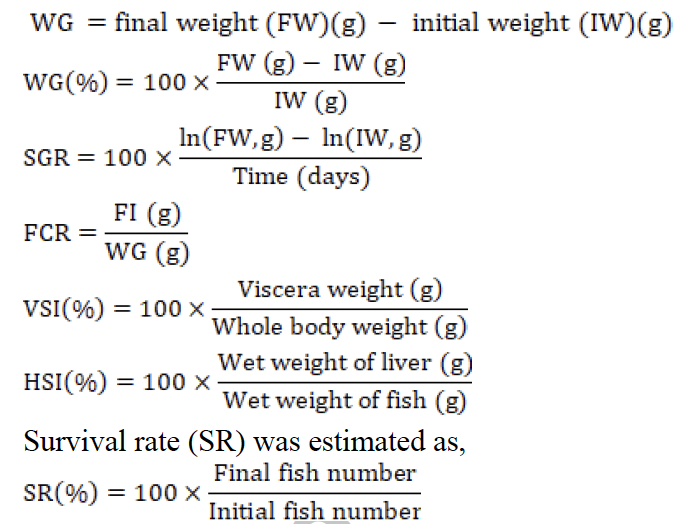
The data regarding growth performance was assessed by calculating weight gain (WG), % weight gain (%WG) and specific growth rate (SGR). FI and FCR were calculated to determine feed utilization. Moreover, the viscera and liver weight were used for viscerosomatic index (VSI) and hepatosomatic index (HSI) analysis .
Proximate composition analysis
Samples were analyzed following AOAC (2016). Dry matter (DM) was examined by oven drying (105 °C for 24 h). Crude protein (CP) of the samples was calculated by estimation of nitrogen after acid digestion (N×6.025) using Kjeldhal’s apparatus. Crude fat (CF) was measured by using the soxhlet apparatus (Sr. no. 70861). Furthermore, the crude ash (CA) was assessed by flaming the sample in an electric furnace at 660 °C.
Hematology and antioxidants enzymes activity
At the trial termination, blood was collected from caudal vein of non-anesthetized fish with the help of EDTA rinsed sterile syringe. Hematological parameters HGB (hemoglobin), HCT (hematocrit), WBC (white blood cell), RBC (red blood cell) and MCHC (count mean corpuscular hemoglobin) were determined by an automated hematology analyzer (MEK-655) .
The activities of antioxidant enzymes were determined from fish muscle samples. Superoxide dismutase (SOD) was estimated through calculating its capacity to prevent photo reduction of Nitroblue tetrazole . Catalase (CAT) was measured at 240 nm, where it reduces the level of H2O2 in tissues (Chance and Maehly, 1995). Glutathione peroxidase (GPx) was measured by calculating its ability to decline H2O2 concentration at the wavelength of 470 nm by Civello method . Lastly, thiobarbituric acid reactive substances (TBARS) were estimated at 530 nm through Gatta et al. (2000) method.
Serum biochemistry
Collected blood samples were used for analyzing alkaline phosphatase (ALP), alanine transaminase (ALT), aspartate transaminase (AST), glucose and serum lysozyme. Samples were assessed through kits (CHEMELEX, S.A, Pol. Ind. Can Castells, Spain). Serum lysozyme activity was assessed by using the procedure of Shugar (1952) and following formula:

0.001 is the absorbance change at A450 nm; 0.1 is the enzyme solution.
Moreover, VC content in liver tissues was determined by following Rutkowski and Grzegorczyk (1998).
Challenge trial
The juveniles (10 per aquarium) were challenged with A. hydrophila (5×10⁵ cfu/ml) via intra-peritoneal injection . The juveniles were fed with their respective diets during challenge trial and the water quality parameters were checked as in the feeding trial. The challenge trial was carried out for 10 days, during which the mortality was determined.
Statistical analysis
Data was assessed through one-way analysis of variance (ANOVA) under CRD (completely randomized design) by using Costat Computer Software (version 6.303). The means having significant differences were compared by Tukey’s Honestly Significant Difference test. At p < 0.05 the means were taken as significant. Broken-line regression analysis was used to estimate the best dietary level of VC.
RESULTS
Growth performance, feed utilization and body indices
Impacts of VC levels on grass carp growth performance, feed utilization and organ indices are presented in Table II. VC levels significantly affected the growth parameters (FW, WG, WG% and SGR%). Compared to basal diet, an increase (P < 0.05) in growth performance was noted at higher VC levels till 59.1 mg/kg, becoming constant afterward. Based on WG%, best level of VC was estimated as 63.06 mg/kg in grass carp (Fig. 1A).
VC supplementation had a significant effect on FCR. Increase in the VC supplementation level yielded a better FCR at 59.1, 109.04 and 213.06 mg/kg (these levels were non-significant compared to each other). VC supplementation did not affect (P > 0.05) FI.
Among body indices, only VSI was significantly affected by the VC supplementation, while HSI remained non-significant even at higher VC levels. An increase in VC levels resulted in higher VSI values till 32.85 mg/kg and remained constant afterward. However, the survival rate remained independent of the VC supplementation levels.
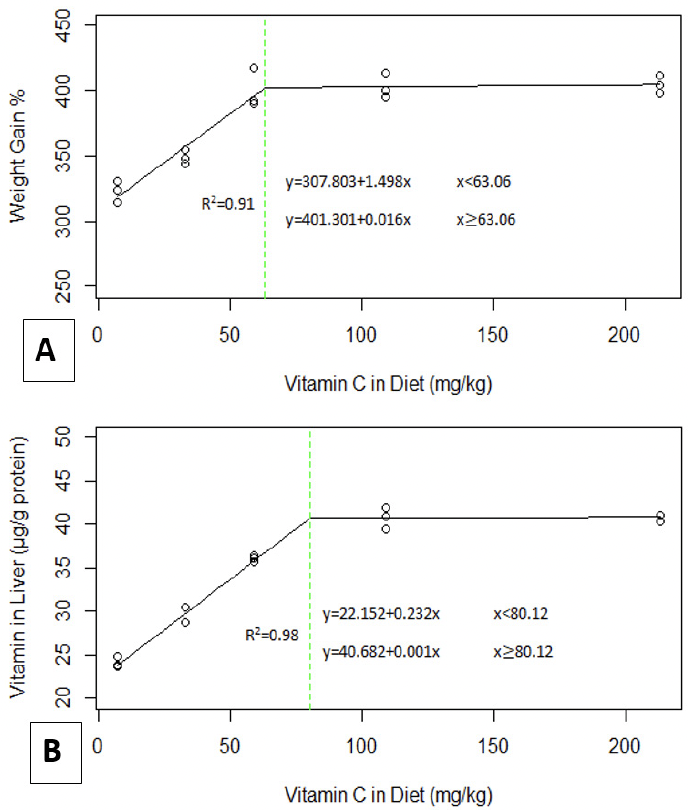
Optimum VC level for grass carp on the basis of % WG (A), and lever content (B) calculated through broken line regression.
Table II. Growth performance and body indices of C. idella fed with different levels of vitamin C.
|
Diets |
FW (g) |
AWG |
WG (%) |
SGR (%) |
F1 |
FCR |
SR (%) |
HSI (%) |
VSI (%) |
|
C7.3 |
17.73±0.33c |
13.53±0.33c |
322.81±8.7c |
2.40±0.03c |
20.38±0.2 |
1.50±0.04a |
100±0 |
2.35±0.03 |
4.07±0.05b |
|
C-32.9 |
18.83±0.18b |
14.64±0.19b |
348.85±5.5b |
2.50±0.01b |
20.30±0.0 |
1.38±0.02b |
100±0 |
2.37±0.01 |
4.89±0.02a |
|
C59.1 |
21±0.64a |
16.80±0.64a |
400.38±14a |
2.68±0.04a |
20.4±0.04 |
1.21±0.04c |
100±0 |
2.35±0.05 |
4.92±0.02a |
|
C109.0 |
21.16±0.36a |
16.95±0.37a |
403.01±9.5a |
2.69±0.03a |
20.35±0.0 |
1.20±0.02c |
100±0 |
2.36±0.00 |
4.89±0.03a |
|
C213.1 |
21.16±0.3a |
16.96±0.3a |
404±7.08a |
2.69±0.02a |
20.48±0.2 |
1.20±0.03c |
100±0 |
3.22±0.81 |
4.92±0.02a |
Superscript. Different superscript in one row indicates significant difference and same superscript show non-significance. IW, initial weight; FW, final weight; AWG, absolute weight gain; SGR, specific growth rate; FI, feed intake; FCR, feed conversion ratio; SR, survival rate; HIS, hepatosomatic index; VSI, viscerosomatic index.
Whole-body composition
The supplementation of VC had a non-significant effect on whole-body moisture. The whole-body CP significantly increased as VC level increased from 7.26 to 59.1 mg/kg and any further increase gave a result similar (P > 0.05) to fish fed VC level of 59.1 mg/kg. Dietary VC significantly enhanced CF content when compared to basal diet. Moreover, the highest whole-body CA was observed in fish fed 109.04 mg/kg of VC (Table III).
Table III. Whole body proximate (g/kg) of C. idella fed with different levels of vitamin C.
|
Diets |
Moisture |
CP |
CF |
Ash |
|
C7.3 |
708.4±0.35 |
169.0±0.34c |
56.5±0.10b |
41.2±0.02d |
|
C-32.9 |
709.3±0.05 |
174.2±0.04b |
60.2±0.00a |
41.9±0.01bc |
|
C59.1 |
711.1±0.40 |
177.1±0.31a |
60.3±0.05a |
41.6±0.00c |
|
C109.0 |
710.9±0.04 |
177.0±0.01a |
60.9±0.04a |
42.3±0.00a |
|
C213.1 |
710.3±0.14 |
176.5±0.01a |
61.0±0.05a |
42.0±0.00ab |
Superscript. Different superscript in one row indicates significant difference and same superscript show non-significance. CP, crude protein; CF, crude fat.
Hematological parameters
Effects of VC levels on the hematology parameters of C. idella are given in Table IV. VC supplementation decreased (P < 0.05) the HGB content in fish fed 59.1, 109.04 and 213.06 mg/kg of VC compared to 7.26 and 32.85 mg/kg of VC. The highest RBCs were observed in fish-fed 59.1 mg/kg of VC, however, VC supplementation had an overall non-significant effect on RBC levels. Increase in VC levels significantly affected WBC and HCT levels. In comparison to the above-mentioned hematology parameters, VC supplementation had a non-significant effect on MCHC values at all levels.
Table IV. Hematology of C. idella fed with VC levels.
|
Diets |
HGB (g/dl) |
RBC (106/dl) |
WBC (103/dl) |
HCT (%) |
MCHC (g/dl) |
|
C7.3 |
9.6± 0.17a |
1.67± 0.13b |
439.66± 1.52c |
25.6± 1.34d |
26.03± 1.15 |
|
C-32.9 |
10.10± 0.45a |
1.80± 0.03ab |
450± 2bc |
36.26± 1.22b |
24.56± 1.15 |
|
C59.1 |
7.86± 0.30b |
1.97± 0.06a |
458± 2.64b |
32.96± 0.11c |
26.13± 1.16 |
|
C109.0 |
8.13± 0.37b |
1.67± 0.03b |
522.33± 8.50a |
37.26± 0.90ab |
25.9± 1.2 |
|
C213.1 |
7.8± 0.34b |
1.84± 0.06ab |
532.66± 6.65a |
39.64± 0.66a |
26.2± 1.99 |
Superscript. Different superscript in one row indicates significant difference and same superscript show non-significance. HGB, hemoglobin; RBC, red blood cells; WBC, white blood cells; HCT, hematocrit; MCHC, mean corpuscular hemoglobin concentration.
Antioxidants enzyme activities
Significantly higher muscle SOD, CAT, and GPx activities were observed in fish fed higher VC diets (Table V). Lowest (P < 0.05) SOD and GPx activities were noted in fish fed basal diet and these values significantly increased as the VC level increased to 32.85 mg/kg, however, higher VC levels did not further increase the values. Increase in the dietary VC enhanced CAT activity till 109.04 mg/kg of VC, however, further increase resulted in a constant value. Dietary VC significantly reduced the TBARS values when compared to fish fed basal diet.
Table V. Antioxidants enzyme activities of C. idella fed with different levels of vitamin C.
|
Diets |
SOD (u/mg protein) |
CAT (u/mg protein) |
GPX (mu/mg protein) |
TBARS (mg/g) |
|
C7.3 |
6.28±0.02c |
76.88±0.0d |
101.47±0.7b |
3.49±0.02a |
|
C-32.9 |
6.48±0.03a |
79.87±0.00c |
113.44±1.16a |
3.21±0.01b |
|
C59.1 |
6.50±0.00a |
79.97±0.00b |
113.53±0.68a |
3.19±0.00b |
|
C109.0 |
6.49±0.01 a |
80.23±0.03 a |
115.00±0.30a |
3.22±0.03b |
|
C213.1 |
6.37±0.00 b |
80.21±0.02 a |
114.69±1.09a |
3.16±0.04b |
Superscript. Different superscript in one row indicates significant difference and same superscript show non-significance. SOD, superoxide dismutase; CAT, catalase; GPX, glutathione peroxidase; TBARS, thio barbituric acid reactive substance.
Serum biochemistry
The means of serum lysozyme and ALP significantly increased, reaching a constant value after 59.1 mg/kg of VC level for ALP and 109.04 mg/kg of VC for serum lysozyme. However, VC supplementation significantly decreased the values for ALT, AST and glucose (Table VI).
Table VI. Serum biochemistry f C. idella fed with VC levels.
|
Diets |
ALP (U/ml) |
ALT (IU/ml) |
AST (U/ml) |
Glucose (mg/dl) |
Serum lysozyme (U/ml) |
|
C7.3 |
14.93± 0.17c |
71.34± 0.83a |
126.62± 0.79a |
6.58± 0.27a |
213.25± 10.33c |
|
C-32.9 |
17.85± 0.48b |
29.83± 1.02b |
81.59± 1.52c |
5.03± 0.29b |
276.12± 8.90b |
|
C59.1 |
22.15± 0.50a |
29.61± 0.55b |
104.06± 3.09b |
3.47± 0.32c |
279.47± 8.97b |
|
C109.0 |
23.16± 0.36a |
30.72± 0.94b |
82.28± 2.26c |
3.60± 0.08c |
320.09± 7.23a |
|
C213.1 |
23.46± 1.00a |
30.29± 0.78b |
103± 0.4.54b |
3.58± 0.11c |
327.65± 5.33a |
Superscript. Different superscript in one row indicates significant difference and same superscript show non-significance. ALP, alkaline phosphatase; ALT, alanine transaminase; AST, aspartate aminotransferase.
Vitamin C concentration in liver
Dietary VC concentration in the liver enhanced in a dose-dependent manner till 109.04 mg/kg of VC (Table VII). The mean values for fish fed VC levels of 109.04 and 213.06 mg/kg showed a non-significant result. According to the regression analysis, the optimal VC content in the liver was 80.12 mg/kg (Fig. 1B).
Table VII. Vitamin C concentration in liver of C. idella.
|
Diets |
Vitamin C concentration in liver (µg/g protein) |
|
C7.3 |
24.07±0.61d |
|
C-32.9 |
29.31±0.99c |
|
C59.1 |
36.11±0.35b |
|
C109.0 |
40.79±1.25a |
|
C213.1 |
40.88±0.43a |
Survival rate after challenge trial
After A. hydrophila infection, VC supplementation significantly increased the survival rate of C. idella (Table VIII) compared to juveniles fed basal diet. The survival rate improved till 109.04 mg/kg and was constant afterward.
Table VIII. Vitamin C concentration survival rate after challenged with A. hydrophila in C. idella.
|
Diets |
Survival rate (%) |
|
C7.3 |
37.77±3.84c |
|
C-32.9 |
55.55±3.84b |
|
C59.1 |
66.66±6.66b |
|
C109.0 |
91.11±3.84a |
|
C213.1 |
88.88±3.84a |
Superscript. Different superscript in one row indicates significant difference and same superscript show non-significance. SR, survival rate.
DISCUSSION
In this experiment, dietary VC increased growth performance of juvenile grass carp when compared to basal diet. Past experimental studies conducted by Nasar et al. (2021), Chen et al. (2015), Ai et al. (2006), Liang et al. (2017), Zhou et al. (2012), Zou et al. (2020), Khan et al. (2017) and Shiau and Hsu (1999) concluded a significant impact of dietary VC on growth performance. According to the regression analysis, best level of VC based on WG% was estimated 63.06 mg/kg (R2= 0.91) which is comparable to statistical value determined by Nasar et al. (2021) as 67.1667 mg/kg in grass carp. However, higher values of VC supplementation were reported in Chinese sucker (84.6 mg/kg) , in Chu’s croaker (102.28 mg/kg) and largemouth bass (109.5 mg/kg) . This variation might be because of fish size, metabolism, source of VC, feed formulation and nature of the feed ingredients used ; , 1994; .
In this study, the improvement in growth performance was because of enhanced feed utilization and whole-body nutrient composition. Improved FCR value was recorded at 59.1 mg/kg of VC, indicating that at this level of VC supplementation the fish showed higher ability in utilizing feed ingredients and any further increase in VC levels did not further enhance FCR. Similar to our result, Nasar et al. (2021) observed an increase in FCR value in juveniles fed 100 mg/kg of VC diet. Moreover, VC supplementation also improved feed utilization in largemouth bass and mori ; . As the VC level improves the feed utilization, so more nutrients are available for absorption and deposition, consequently improving the fish’s whole-body nutrient composition. Moreover, VC also acts as a cofactor for promoting protein synthesis ; ; , which further increases whole-body CP content, which can be observed in the present study. Furthermore, VC also improved the whole-body CF in this study. These findings were in line with the results of Zou et al. (2020), Huang et al. (2017), Chen et al. (2015), Nasar et al. (2021) and Tewary and Patra, (2008). This improvement might be because of antioxidant characteristic of VC which lowers unsaturated fatty acid peroxidation. Lower levels of CF were observed in juveniles fed VC unsupplemented diet (basal diet) which may be because of impaired carnitine and insulin-like growth factor secretion ; , both of which are related to the body lipid synthesis.
Organ indices HSI and VSI are often used to evaluate nutritive and physiological status of fish ; ; . In this study, VC levels significantly improved VSI when compared to fish-fed basal diet. Similarly, Chen et al. (2003) and Daniel et al. (2018) also reported similar results. Higher levels of body indices indicate that VC supplementation supports normal physiological processes of the fish body ; .
Blood parameters (HGB, RBC, WBC and HCT) are indicators of fish health and immune response. In response to VC supplementation, HGB, WBC and HCT significantly increased in this study. Previous studies by Andersen et al. (1994) and Hamre et al. (1997) also noted a significant improvement in the hematological parameters. Dietary VC plays important role in iron absorption consequently improving the blood chemistry in fish.
Antioxidant enzymes (CAT, GPx, SOD and TBARS) are crucial in the degeneration of ROS (reactive oxygen species), lowering oxidation stress and mechanism leading to protection during tissue injury ; . In the current experiment, fish fed dietary VC had higher values of CAT, GPx and SOD when compared to juveniles fed basal diet. Similar to our study, Xie and Niu (2006) and Hu et al. (2013) also reported a significant impact of dietary VC on antioxidant enzyme activities. In contrast, TBARS values were higher in juveniles fed with basal diet than in VC supplemented diets. Higher levels of TBARS are an indicator of biotoxicity and lipid peroxidation . VC supplementation protects fish body from lipid peroxidation by reducing levels of TBARS. Past studies have indicated that VC supplementation significantly lowers the content of TBARS in fish body ; ; . This decrease might be because of the nature of VC in increasing activities of antioxidant enzymes. Moreover, formation of vitamin E (lipid-soluble antioxidant) from alpha-tocopherol radicles in presence of VC further helps in the prevention of lipid oxidation and enhancing growth performance of fish .
The ALP, AST and ALT are important indicators of liver physiology. They are important in oxidative stress responses and health status of fish. In this research, dietary VC increased (P < 0.05) serum ALP activity. This was similar to past studies that observed a positive increase in activity of ALP in response to dietary VC , 2017; ; ; . According to our findings, the ALT, AST and glucose content significantly decreased when the level of VC was increased. The increase in these enzymes (ALT and AST) and the serum glucose indicate stress conditions in fish. In his study, the decrease in ALT, AST and glucose indicates that the role of VC in increasing the activities of antioxidants might be responsible for decreasing stress, consequently improving fish health.
The liver is considered a major organ for catabolism and storage of VC ; . In liver, its content indicates the status of VC in fish ; . In the present study, best VC concentration was estimated as 80.12 mg/kg in grass carp liver, which was much higher than the value estimated for WG%. Similar results regarding VC supplementation were also reported by Ai et al. (2006), Xiao et al. (2010) and Wu et al. (2015), indicating that optimal VC level needed to sustain physiological functions in fish is much higher than VC level required for growth.
A. hydrophila challenge method is often used in experimental designs to check the effectiveness of a dietary inclusion regarding disease resistance. VC supplementation significantly increased fish survival rate during challenge trial when compared to juveniles fed with basal diet. Past studies by Hu et al. (2020), Han et al. (2020), Liang et al. (2017) and Tewary and Patra (2008) have observed that VC supplementation significantly enhances survival rate in fish. Additionally, VC supplementation improves the resistance of fish against pathogenic species like Escherichia coli, Vibrio harveyi, Vibrio alginolyticus and Edwardsiella tarda ; ; ; ; .
CONCLUSION
In conclusion, VC significantly increased growth performance of juvenile grass carp by improving feed utilization, whole-body composition, hematological parameters, antioxidant enzyme activities and serum biochemistry. The best dietary VC level for grass carp based on WG% and liver VC content was estimated as 63.06 mg/kg and 80.12 mg/kg, respectively.
Declarations
Funding
This research did not receive any grant from funding agencies in the public, commercial, or not-for-profit sectors.
Ethical statement
This experiment was carried out in accordance with the standard guidelines for care and use of laboratory animals in research and procedures were approved by the Ethical Review Committee of University of Veterinary and Animal Sciences, Lahore Pakistan (No. Dr/161). During experiments, the fish were inspected several times a day and precautions were taken to minimize stress by keeping the fish in opaque tanks, minimizing handling and monitoring water chemistry. Humane endpoints were used and any fish that showed signs of disease or abnormal behavior (lethargy and disoriented swimming) was quickly euthanized. At all sampling times, fish were almost completely exsanguinated by blood sampling and euthanized using an overdose of clove oil before collection of organ samples.
Supporting information
The data that support the findings of this study are available from the corresponding author upon reasonable request.
Generative AI and AI assisted technology statement
The authors declare that no generative AI and AI assisted technology was used in the creation of this manuscript.
Statement of conflict of interest
The authors have declared no conflict of interest.
References
- Ai, Q., Mai, K., Tan, B., Xu, W., Zhang, W., Ma, H. and Liufu, Z., 2006. Effects of dietary vitamin C on survival, growth, and immunity of large yellow croaker, Pseudosciaena crocea. Aquaculture, 261: 327-336. https://doi.org/10.1016/j.aquaculture.2006.07.027 [CrossRef]
- Ai, Q., Mai, K., Zhang, C., Xu, W., Duan, Q., Tan, B. and Liufu, Z., 2004. Effects of dietary vitamin C on growth and immune response of Japanese seabass, Lateolabrax japonicus. Aquaculture, 242: 489-500. https://doi.org/10.1016/j.aquaculture.2004.08.016 [CrossRef]
- Andersen, H.J., Pellett, L. and Tappel, A.L., 1994. Hemichrome formation, lipid peroxidation, enzyme inactivation and protein degradation as indexes of oxidative damage in homogenates of chicken kidney and liver. Chem. Biol. Interact., 93: 155-169. https://doi.org/10.1016/0009-2797(94)90094-9 [CrossRef]
- AOAC (Association of Official Analytical Chemists), 2016. Official Methods of Analysis of AOAC international. 20th Ed. George W. Latimer, Jr.
- Asaikkutti, A., Bhavan, P.S., Vimala, K., Karthik, M. and Cheruparambath, P., 2016. Effect of different levels dietary vitamin C on growth performance, muscle composition, antioxidant and enzyme activity of freshwater prawn, Macrobrachium malcolmsonii. Aquacult. Rep., 3: 229-236. https://doi.org/10.1016/j.aqrep.2016.04.002 [CrossRef]
- Biswas, B.K., Biswas, A., Junichi, I., Kim, YS. and Takii, K., 2013. The optimal dietary level of ascorbic acid for juvenile Pacific bluefin tuna, Thunnus orientalis. Aquacult. Int., 21: 327-336. https://doi.org/10.1007/s10499-012-9555-z [CrossRef]
- Carvalho, P.L., Almeida, P.H., Xavier, W.D., Vicente, I.S., Guimarães, M.G., Rodrigues, E.J., Ito, P.I., Pezzato, L.E. and Barros, M.M., 2021. Vitamin C supplementation improves growth performance and caudal fin regeneration in zebrafish (Danio rerio). Aquacult. Nutr., 27: 115-123. https://doi.org/10.1111/anu.13407 [CrossRef]
- Chagas, E.C. and Val, A.L., 2003. Effect of vitamin C on weight and hematology of tambaqui. Pesqui. Agropecu. Bras., 38: 397-402. https://doi.org/10.1590/S0100-204X2003000300009 [CrossRef]
- Chance, B. and Maehly, A.C., 1955. Assay of catalase and peroxidase. Methods Enzymol., 2: 764-775. https://doi.org/10.1016/S0076-6879(55)02300-8 [CrossRef]
- Chen, H.Y. and Jenn, J.S., 1991. Combined effects of dietary phosphatidylcholine and cholesterol on the growth, survival and body lipid composition of marine shrimp, Penaeus penicillatus. Aquaculture, 96: 167-178. https://doi.org/10.1016/0044-8486(91)90147-Y [CrossRef]
- Chen, R., Lochmann, R., Goodwin, A., Praveen, K., Dabrowski, K. and Lee, K.J., 2003. Alternative complement activity and resistance to heat stress in golden shiners (Notemigonus crysoleucas) are increased by dietary vitamin C levels in excess of requirements for prevention of deficiency signs. J. Nutr., 133: 2281-2286. https://doi.org/10.1093/jn/133.7.2281 [CrossRef]
- Chen, Y.J., Yuan, R.M., Liu, Y.J., Yang, H.J., Liang, G.Y. and Tian, L.X., 2015. Dietary vitamin C requirement and its effects on tissue antioxidant capacity of juvenile largemouth bass, Micropterus salmoides. Aquaculture, 435: 431-436. https://doi.org/10.1016/j.aquaculture.2014.10.013 [CrossRef]
- Civello, P.M., Martinez, G.A., Chaves, A.R. and Anon, M.C., 1995. Peroxidase from strawberry fruit (Fragaria ananassa Duch): partial purification and determination of some properties. J. Agric. Fd. Chem., 43: 2596-601. https://doi.org/10.1021/jf00058a008 [CrossRef]
- Corti, A., Casini, A.F. and Pompella, A., 2010. Cellular pathways for transport and efflux of ascorbate and dehydroascorbate. Arch. Biochem. Biophys., 500: 107-115. https://doi.org/10.1016/j.abb.2010.05.014 [CrossRef]
- Dabrowski, K., 1991. Administration of gulonolactone does not evoke ascorbic acid synthesis in teleost fish. Fish Physiol. Biochem., 9: 215-221. https://doi.org/10.1007/BF02265142 [CrossRef]
- Dabrowski, K., 1994. Primitive actimoterigian fishes can synthesize ascorbic acid. Experientia, 50: 745-748. https://doi.org/10.1007/BF01919376 [CrossRef]
- Daniel, N., Muralidhar, A.P., Srivastava, P.P., Jain, K.K., Pani Prasad, K., Manish, J. and Sivaramakrishnan, T., 2018. Dietary ascorbic acid requirement for growth of striped catfish, Pangasianodon hypophthalmus (Sauvage, 1878) juveniles. Aquacult. Nutr., 24: 616-624. https://doi.org/10.1111/anu.12596 [CrossRef]
- Dawood, M.A., Koshio, S., El-Sabagh, M., Billah, M.M., Zaineldin, A.I., Zayed, M.M. and Omar, A.A., 2017. Changes in the growth, humoral and mucosal immune responses following β-glucan and vitamin C administration in red sea bream, Pagrus major. Aquaculture, 470: 214-222. https://doi.org/10.1016/j.aquaculture.2016.12.036 [CrossRef]
- Dawood, M.A. and Koshio, S., 2018. Vitamin C supplementation to optimize growth, health and stress resistance in aquatic animals. Rev. Aquacult., 10: 334-350. https://doi.org/10.1111/raq.12163 [CrossRef]
- FAO, 2012. The state of world fisheries and aquaculture. Opportunities and challenges. Food and Agriculture Organization of the United Nations.
- Fatima, M., Afzal, M. and Shah, S.Z., 2019. Effect of dietary oxidized oil and vitamin E on growth performance, lipid peroxidation and fatty acid profile of Labeo rohita fingerlings. Aquacult. Nutr., 25: 281-291. https://doi.org/10.1111/anu.12851 [CrossRef]
- Fontagne-Dicharry, S., Lataillade, E., Surget, A., Larroquet, L., Cluzeaud, M. and Kaushik, S., 2014. Antioxidant defense system is altered by dietary oxidized lipid in first-feeding rainbow trout (Oncorhynchus mykiss). Aquaculture, 424: 220-227. https://doi.org/10.1016/j.aquaculture.2014.01.009 [CrossRef]
- Fracalossi, D.M., Allen, M.E., Yuyama, L.K. and Oftedal, O.T., 2001. Ascorbic acid biosynthesis in Amazonian fishes. Aquaculture, 192: 321-332. https://doi.org/10.1016/S0044-8486(00)00455-5 [CrossRef]
- Garcia, F., Pilarski, F., Onaka, E.M., de Moraes, F.R. and Martins, M.L., 2007. Hematology of Piaractus mesopotamicus fed diets supplemented with vitamins C and E, challenged by Aeromonas hydrophila. Aquaculture, 271: 39-46. https://doi.org/10.1016/j.aquaculture.2007.06.021 [CrossRef]
- Gatta, P.P., Pirini, M., Testi, S., Vignola, G. and Monetti, P.G., 2000. The influence of different levels of dietary vitamin E on sea bass Dicentrarchus labrax flesh quality. Aquacult. Nutr., 6: 47-52. https://doi.org/10.1046/j.1365-2095.2000.00127.x [CrossRef]
- Giannapolitis, C.N. and Ries, S.K., 1997. Superoxide dismutase. I. Occurrence in higher plants. Pl. Physiol., 59: 309-314. https://doi.org/10.1104/pp.59.2.309 [CrossRef]
- Goede, R.W., 1990. Organismic indices and an autopsy-based assessment as indicator of health and condition of fish. Am. Fish. Soc. Symp., 8: 93-108.
- Gouillou-Coustans, M.F., Bergot, P. and Kaushik, S.J., 1998. Dietary ascorbic acid needs of common carp (Cyprinus carpio) larvae. Aquaculture, 161: 453-461. https://doi.org/10.1016/S0044-8486(97)00292-5 [CrossRef]
- Hamre, K., Waagbo, R., Berge, R.K. and Lie, O., 1997. Vitamins C and E interact in juvenile Atlantic salmon (Salmo salar L.). Free Radic. Biol. Med., 22: 137-149. https://doi.org/10.1016/S0891-5849(96)00281-X [CrossRef]
- Han, Q., Fan, H., Peng, J., Zhou, L. and Gan, L., 2020. Ascorbic acid enhanced the growth performance, oxidative status, and resistance to Aeromonas hydrophila challenge of juvenile grass carp (Ctenopharyngodon idella). Aquacult. Int., 28: 15-30. https://doi.org/10.1007/s10499-019-00440-z [CrossRef]
- Harsij, M., Kanani, H.G. and Adineh, H., 2020. Effects of antioxidant supplementation (nano selenium, vitamin C and E) on growth performance, blood biochemistry, immune status and body composition of rainbow trout (Oncorhynchus mykiss) under sub-lethal ammonia exposure. Aquaculture, 521: 734942. https://doi.org/10.1016/j.aquaculture.2020.734942 [CrossRef]
- Hu, J.R., Wang, A.L., Cao, J.M., Chen, S.C., Li, J.Y. and Li, B.S., 2009. A review: regulation of vitamin C in growth, reproduction and immune in aquatic animals. Fish. Res., 28: 40-46.
- Hu, Y., Huang, Y., Wen, H., Huan, Z., Zhong, L., Mao, X., Li, J. and Xiao, T., 2013. Effect of vitamin C on growth, immunity and anti-ammonia-nitrite stress ability in juvenile black carp (Mylopharyngodon piceus). J. Fish China, 37: 565-573. https://doi.org/10.3724/SP.J.1231.2013.38322 [CrossRef]
- Hu, Y., Zhang, J., He, L., Hu, Y., Zhong, L., Dai, Z. and Zhou, D., 2020. Effects of dietary vitamin C on growth, antioxidant activity, and immunity in ricefield eel (Monopterus albus). J. World Aquacult. Soc., 51: 159-170. https://doi.org/10.1111/jwas.12636 [CrossRef]
- Huang, F., Jiang, M., Wen, H., Wu, F., Liu, W., Tian, J. and Shao, H., 2016. Dietary vitamin C requirement of genetically improved farmed Tilapia, Oreochromis niloticus. Aquacult. Res., 47: 689-697. https://doi.org/10.1111/are.12527 [CrossRef]
- Huang, F., Wu, F., Zhang, S., Jiang, M., Liu, W., Tian, J., Yang, C. and Wen, H., 2017. Dietary vitamin C requirement of juvenile Chinese sucker (Myxocyprinus asiaticus). Aquacult. Res., 48: 37-46. https://doi.org/10.1111/are.12858 [CrossRef]
- Jimenez-Fernandez, E., Ponce, M., Rodriguez-Rua, A., Zuasti, E., Manchado, M. and Fernandez-Diaz, C., 2015. Effect of dietary vitamin C level during early larval stages in Senegalese sole (Solea senegalensis). Aquaculture, 443: 65-76. https://doi.org/10.1016/j.aquaculture.2015.03.013 [CrossRef]
- Khajepour, F., Hosseini, S.A. and Imanpour, M.R., 2012. Dietary crude protein, citric acid and microbial phytase and their interacts to influence growth performance, muscle proximate composition and hematocrite of common carp, Cyprinus carpio L, juveniles. World J. Zool., 7: 118-22.
- Khan, K.U., Zuberi, A., Nazir, S., Ullah, I., Jamil, Z. and Sarwar, H., 2017. Synergistic effects of dietary nano selenium and vitamin C on growth, feeding, and physiological parameters of mahseer fish (Tor putitora). Aquacult. Rep., 5: 70-75. https://doi.org/10.1016/j.aqrep.2017.01.002 [CrossRef]
- Leal, E., Zarza, C. and Tafalla, C., 2017. Effect of vitamin C on innate immune responses of rainbow trout (Oncorhynchus mykiss) leukocytes. Fish Shellfish Immunol., 67: 179-188. https://doi.org/10.1016/j.fsi.2017.06.021 [CrossRef]
- Lee, K.J. and Dabrowski, K., 2003. Interaction between vitamins C and E affects their tissue concentrations, growth, lipid oxidation, and deficiency symptoms in yellow perch (Perca flavescens). Br. J. Nutr., 89: 589-596. https://doi.org/10.1079/BJN2003819 [CrossRef]
- Lee, S.M., Jeon, I.G. and Lee, J.Y., 2002. Effects of digestible protein and lipid levels in practical diets on growth, protein utilization and body composition of juvenile rockfish (Sebastes schlegeli). Aquaculture, 211: 227-239. https://doi.org/10.1016/S0044-8486(01)00880-8 [CrossRef]
- Liang, X.P., Li, Y., Hou, Y.M., Qiu, H. and Zhou, Q.C., 2017. Effect of dietary vitamin C on the growth performance, antioxidant ability and innate immunity of juvenile yellow catfish (Pelteobagrus fulvidraco R ichardson). Aquacult. Res., 48: 149-160. https://doi.org/10.1111/are.12869 [CrossRef]
- Lin, M.F. and Shiau, S.Y., 2005. Dietary L-ascorbic acid affects growth, nonspecific immune responses and disease resistance in juvenile grouper, Epinephelus malabaricus. Aquaculture, 244: 215-221. https://doi.org/10.1016/j.aquaculture.2004.10.026 [CrossRef]
- Lin, M.F. and Shiau, S.Y., 2004. Requirements of vitamin C (L‐ascorbyl‐2‐monophosphate‐Mg and L‐ascorbyl‐2‐monophosphate‐Na) and its effects on immune responses of grouper, Epinephelus malabaricus. Aquacult. Nutr., 10: 327-333. https://doi.org/10.1111/j.1365-2095.2004.00307.x [CrossRef]
- Ming, J., Xie, J., Xu, P., Ge, X., Liu, W. and Ye, J., 2012. Effects of emodin and vitamin C on growth performance, biochemical parameters and two HSP70s mRNA expression of Wuchang bream (Megalobrama amblycephala Yih) under high temperature stress. Fish Shellfish Immunol., 32: 651-661. https://doi.org/10.1016/j.fsi.2012.01.008 [CrossRef]
- Misra, C.K., Das, B.K., Mukherjee, S.C. and Pradhan, J., 2007. Effects of dietary vitamin C on immunity, growth and survival of Indian major carp Labeo rohita, fingerlings. Aquacult. Nutr., 13: 35-44. https://doi.org/10.1111/j.1365-2095.2007.00451.x [CrossRef]
- Moreau, R., Dabrowski, K. and Sato, P.H., 1999. Renal L-gulono-1 4-lactone oxidase activity as affected by dietary ascorbic acid in lake sturgeon (Acipenser fulvescens). Aquaculture, 180: 359-372. https://doi.org/10.1016/S0044-8486(99)00211-2 [CrossRef]
- Naiel, M.A., Ismael, N.E., Abd El-hameed, S.A. and Amer, M.S., 2020. The antioxidative and immunity roles of chitosan nanoparticle and vitamin C-supplemented diets against imidacloprid toxicity on Oreochromis niloticus. Aquaculture, 523: 735219. https://doi.org/10.1016/j.aquaculture.2020.735219 [CrossRef]
- Nasar, M.F., Shah, S.Z., Aftab, K., Fatima, M., Bilal, M. and Hussain, M., 2021. Dietary vitamin C requirement of juvenile grass carp (Ctenopharyngodon idella) and its effects on growth attributes, organ indices, whole‐body composition and biochemical parameters. Aquacult. Nutr., 27: 1903-1911. https://doi.org/10.1111/anu.13327 [CrossRef]
- NRC, N., 2011. Nutrient requirements of fish and shrimp. Anim. Nutr. Ser. Natl. Res. Counc. Natl. Acad., 376. [CrossRef]
- Ogawa, M., Portier, R.J., Moody, M.W., Bell, J., Schexnayder, M.A. and Losso, J.N., 2004. Biochemical properties of bone and scale collagens isolated from the subtropical fish black drum (Pogonia cromis) and sheepshead seabream (Archosargus probatocephalus). Fd. Chem., 88: 495-501. https://doi.org/10.1016/j.foodchem.2004.02.006 [CrossRef]
- Pimpimol, T., Phoonsamran, K. and Chitmanat, C., 2012. Effect of dietary vitamin C supplementation on the blood parameters of Mekong giant Catfish (Pangasianodon gigas). Int. J. Agric. Biol. Eng., 14.
- Reddy, S.J., 2018. Immunostimulatory effect of supplementary diet vitamin C on growth, hematology, survival and immunity of fish Catla catla. J. Pharm., 8: 46-54.
- Rutkowski, M. and Grzegorczyk, K., 1998. Colorimetric determination of vitamin C concentration in blood plasma with phosphotungstic reagent a modification of Kyaw method. Diagn Lab., 34: 511-20.
- Shah, S.Z., Afzal, M., Khan, S.Y., Hussain, S.M. and Habib, R.Z., 2015. Prospects of using citric acid as fish feed supplement. Int. J. Agric. Biol., 17: 1-8.
- Shahkar, E., Yun, H., Kim, D.J., Kim, S.K., Lee, B.I. and Bai, S.C., 2015. Effects of dietary vitamin C levels on tissue ascorbic acid concentration, hematology, non-specific immune response and gonad histology in broodstock Japanese eel, Anguilla japonica. Aquaculture, 438: 115-121. https://doi.org/10.1016/j.aquaculture.2015.01.001 [CrossRef]
- Shiau, S.Y. and Hsu, T.S., 1999. Quantification of vitamin C requirement for juvenile hybrid tilapia, Oreochromis niloticus × Oreochromis aureus, with L-ascorbyl-2-monophosphate-Na and L-ascorbyl-2-monophosphate-Mg. Aquaculture, 175: 317-326. https://doi.org/10.1016/S0044-8486(99)00103-9 [CrossRef]
- Shugar, D., 1952. The measurement of lysozyme activity and the ultra-violet inactivation of lysozyme. Biochim. Biophys. Acta, 8: 302-309. [CrossRef]
- Tabrez, S. and Ahmad, M., 2009. Effect of wastewater intake on antioxidant and marker enzymes of tissue damage in rat tissues: Implications for the use of biochemical markers. Fd. Chem. Toxicol., 47: 2465-2478. https://doi.org/10.1016/j.fct.2009.07.004 [CrossRef]
- Tewary, A. and Patra, B.C., 2008. Use of vitamin C as an immunostimulant. Effect on growth, nutritional quality, and immune response of Labeo rohita (Ham.). Fish Physiol. Biochem., 34: 251-259. https://doi.org/10.1007/s10695-007-9184-z [CrossRef]
- Varghese, T., Gopan, A. and Rejish, K.V.J., 2022. Reinventing the micronutrients beyond nutrition: Functions in immune modulation and stress mitigation of fish. In: Biotechnological advances in aquaculture health management (eds. S.K. Gupta and S.S. Giri). Springer Nature Singapore, Singapore. https://doi.org/10.1007/978-981-16-5195-3_22 [CrossRef]
- Wan, J., Ge, X., Liu, B., Xie, J., Cui, S., Zhou, M., Xia, S. and Chen, R., 2014. Effect of dietary vitamin C on non-specific immunity and mRNA expression of three heat shock proteins (HSPs) in juvenile Megalobrama amblycephala under pH stress. Aquaculture, 434: 325-333. https://doi.org/10.1016/j.aquaculture.2014.08.043 [CrossRef]
- Wang, L., Chen, D., Lou, B., Zhan, W., Chen, R., Liu, F. and Mao, G., 2017. The effects of dietary vitamin C on growth performance, serum enzymes activities and resistance to Vibrio alginolyticus challenge of yellow drum Nibea albiflora. Aquacult. Res., 48: 4684-4695. https://doi.org/10.1111/are.13290 [CrossRef]
- Wu, P., Liu, Y., Jiang, WD., Jiang, J., Zhao, J., Zhang, Y.A., Zhou, X.Q. and Feng, L., 2017. A comparative study on antioxidant system in fish hepatopancreas and intestine affected by choline deficiency: Different change patterns of varied antioxidant enzyme genes and Nrf2 signaling factors. PLoS One, 12: 0169888. https://doi.org/10.1371/journal.pone.0169888 [CrossRef]
- Wu, F., Wen, H., Jiang, M., Liu, W., Tian, J., Yang, C.G. and Huang, F., 2015. Effect of dietary vitamin C on growth performance, flesh quality and antioxidant function in genetically improved farmed tilapia. J. Fish Sci. China, 22: 79-87.
- Xiao, L.D., Mai, K.S., Ai, Q.H., Xu, W., Wang, X.J., Zhang, W.B. and Liufu, Z.G., 2010. Dietary ascorbic acid requirement of cobia, Rachycentron canadum Linneaus. Aquac. Nutr., 16: 582-589. https://doi.org/10.1111/j.1365-2095.2009.00695.x [CrossRef]
- Xie, Z., Niu, C., Zhang, Z. and Bao, L., 2006. Dietary ascorbic acid may be necessary for enhancing the immune response in Siberian sturgeon (Acipenser baerii), a species capable of ascorbic acid biosynthesis. Comp. Biochem. Physiol. A Mol. Integr. Physiol., 145: 152-157. https://doi.org/10.1016/j.cbpa.2006.05.015 [CrossRef]
- Xie, Z. and Niu, C., 2006. Dietary ascorbic acid requirement of juvenile ayu (Plecoglossus altivelis). Aquacult. Nutr., 12: 151-156. https://doi.org/10.1111/j.1365-2095.2006.00395.x [CrossRef]
- Xu, H.J., Jiang, W.D., Feng, L., Liu, Y., Wu, P., Jiang, J., Kuang, S.Y., Tang, L., Tang, W.N., Zhang, Y.A. and Zhou, X.Q., 2016. Dietary vitamin C deficiency depresses the growth, head kidney and spleen immunity and structural integrity by regulating NF-κB, TOR, Nrf2, apoptosis and MLCK signaling in young grass carp (Ctenopharyngodon idella). Fish Shellfish Immunol., 52: 111-138. https://doi.org/10.1016/j.fsi.2016.02.033 [CrossRef]
- Yusuf, A., Huang, X., Chen, N., Li, S., Apraku, A., Wang, W. and David, M.A., 2021. Growth and metabolic responses of juvenile largemouth bass (Micropterus salmoides) to dietary vitamin C supplementation levels. Aquaculture, 534: 736243. https://doi.org/10.1016/j.aquaculture.2020.736243 [CrossRef]
- Zehra, S. and Khan, M.A., 2012. Dietary vitamin C requirement of fingerling, Cirrhinus mrigala (Hamilton), based on growth, feed conversion, protein retention, hematological indices, and liver vitamin C concentration. J. World Aquacult. Soc., 43: 648-658. https://doi.org/10.1111/j.1749-7345.2012.00597.x [CrossRef]
- Zhou, Q., Wang, L., Wang, H., Xie, F. and Wang, T., 2012. Effect of dietary vitamin C on the growth performance and innate immunity of juvenile cobia (Rachycentron canadum). Fish Shellfish Immunol., 32: 969-975. https://doi.org/10.1016/j.fsi.2012.01.024 [CrossRef]
- Zou, W., Lin, Z., Huang, Y., Limbu, S.M., Rong, H., Yu, C., Lin, F. and Wen, X., 2020. Effect of dietary vitamin C on growth performance, body composition and biochemical parameters of juvenile Chu’s croaker (Nibea coibor). Aquacult. Nutr., 26: 60-73. https://doi.org/10.1111/anu.12967 [CrossRef]

Services
Article usage statistics
Loading…
Related articles
- Effect of Vitamin E Supplementation on Growth Performance, Immune Function, Serum Biochemical Parameters, and Antioxidant Capacity of Swan Goose (Anser cygnoid)Pakistan Journal of Zoology · 2023
- Effect of fish oil on growth performance and immune response in experimentally infected broiler chicken with avian influenza virus H9N2Punjab University Journal of Zoology · 2018
- Effect of Herbal Extract on the Growth Performance, Serum Biochemical Composition, Ileal Histo-Morphology and Immune Response of Broiler ChickensPakistan Journal of Zoology · 2021
- Improved Growth Performance, Innate Immune Response, and Gut Microbes by Dietary Inclusion of Polyphenol Rich Agricultural Waste in Hybrid TilapiasPakistan Journal of Zoology · 2025
- Effect of Extra Arginine Supplementation on Growth Performance, Carcass Characteristics and Immune Response in BroilersJournal of Animal Health and Production · 2022
- Dietary Effect of Zinc on Growth Performance, Carcass Characteristics and Immune Response in Hubbard Broilers Raised under Hot ClimateJournal of Animal Health and Production · 2024