
Queen-cell cup characteristics can influence queen-rearing success, but evidence is limited on whether the biological origin of beeswax itself affects queen development in Apis cerana javana. This study compared wax from A. cerana javana, A. mellifera, and A. dorsata, together with their three 1:1 pairwise blends. Five cell-builder colonies were used as biological replicates, with two queen cups per treatment in each colony (60 cups in total). Larvae younger than two days were grafted, and larval acceptance, pupal length, emergence weight, and adult body, wing, and hind-leg morphometrics were evaluated. No statistically detectable treatment effect was observed for the measured traits (P > 0.05). A. cerana javana wax produced numerically higher acceptance, pupal length, and emergence weight, but the differences were small relative to experimental variation. Under the conditions tested, beeswax origin was therefore not a dominant determinant of queen development. Because the number of independent cell-builder colonies was limited, small treatment effects cannot be excluded. Larger multi-colony trials are needed before the different wax sources can be considered biologically equivalent.
Special Issue: Innovations in Sustainable Fisheries, Marine Resources, and Food Systems for Food Security and Human Well-being · Volume 42, Issue 2, Pages 73–81, 28 November 2026 · Open Access
Effect of Comb Material on Larval Acceptance, Pupal Length, and Queen Morphometrics
, ,
Affiliations & Notes ⌄
- 1Magister of Animal Husbandry, University of Islam Malang, City Postal Code 65144, Malang, Indonesia
- 2Animal Husbandry, University of Islam Malang, City Postal Code 65144, Malang-Indonesia
- *Correspondence | Dewi Masyithoh; Email: masyithoh.dewi@unisma.ac.id
Article Info ⌄
- Journal:
- Sarhad Journal of Agriculture
- Submitted Date:
- 2 April 2026
- Accepted Date:
- 9 October 2026
- Published Date:
- 28 November 2026
From the article
- The absence of a detectable treatment effect suggests that beeswax species origin was less influential than other features of the queen-rearing environment under these conditions.
- The results therefore support a cautious operational interpretation: locally available beeswax may be usable for A. cerana javana queen-cup production when cup dimensions, larval age, and colony management are standardized, but larger trials are needed before recommending complete interchangeability among wax sources.
- Within the conditions and replication used in this exploratory study, beeswax from A. cerana javana, A. mellifera, A. dorsata, and their 1:1 pairwise blends produced no statistically detectable differences in larval acceptance, pupal length, emergence weight, or the measured queen morphometric traits.
- A. cerana javana wax showed numerically higher values for several developmental traits, but these differences were not statistically supported.
Selected from the article's own text.
Abstract
Introduction
Reliable queen production is central to colony replacement, selective breeding, and the continuity of pollination services in managed honeybees. This is especially relevant for Apis cerana in Southeast Asia, where the species is locally adapted and shows behavioural defenses against Varroa destructor . Improving practical queen-rearing methods for A. cerana javana may therefore support both native-honeybee conservation and sustainable apiculture.
Queen-rearing success is influenced by several factors that act before and after grafting. Larval age affects acceptance and subsequent queen traits ; , while queen-cell dimensions can alter body size and morphometric development ; . Previous studies have also compared different queen-cup materials or substrates, including wax and plastic, and have shown that material and cup preparation can affect acceptance or emergence in some rearing systems ; ; .
However, those studies do not resolve a narrower question: whether the species origin of beeswax matters when queen cups are otherwise comparable in size and are used for the same A. cerana javana larvae. Wax from different Apis species may differ in chemical composition and physical properties, but it is unclear whether such differences are biologically large enough to influence nurse-bee acceptance or queen development. The present study therefore compared beeswax from A. cerana javana, A. mellifera, and A. dorsata, as well as their pairwise 1:1 blends, while keeping queen-cup dimensions and larval age constant. The objective was to determine whether beeswax origin affects larval acceptance, pupal development, emergence weight, and adult queen morphometrics. The study extends earlier work on queen-cup materials by isolating beeswax biological origin as the experimental factor rather than comparing broad material classes.
Material and Methods
Research location and period
The experiment was conducted at Kembang Joyo Honeybee Farm, Donowarih, Karangploso, Malang Regency, Indonesia, during July 2025. Morphometric measurements were completed in the farm laboratory.
Colonies and experimental materials
Six Apis cerana javana colonies were used. Each colony was maintained on five frames with available honey and pollen stores. One colony supplied grafting larvae, and five colonies served as cell-building colonies. Beeswax was obtained from A. cerana javana, A. mellifera, and A. dorsata. Worker larvae of A. cerana javana younger than two days were used for grafting. Queen cups were standardized to 1.00 cm in length, 0.71 cm in mouth diameter, and 0.62 cm in basal diameter.
Treatments and experimental layout
Six beeswax formulations were evaluated:
T1 = 100% A. cerana javana beeswax
T2 = 100% A. mellifera beeswax
T3 = 100% A. dorsata beeswax
T4 = 50% A. mellifera beeswax + 50% A. cerana javana beeswax
T5 = 50% A. cerana javana beeswax + 50% A. dorsata beeswax
T6 = 50% A. mellifera beeswax + 50% A. dorsata beeswax
The field layout was balanced across the five cell-building colonies. Each colony received two queen cups of each treatment, giving 12 cups per colony and 60 cups in total. Treatment positions on the cell-building frame followed the randomized allocation shown in Figure 1. The two cups within each colony-treatment combination formed one experimental replicate and were summarized at replicate level for analysis.
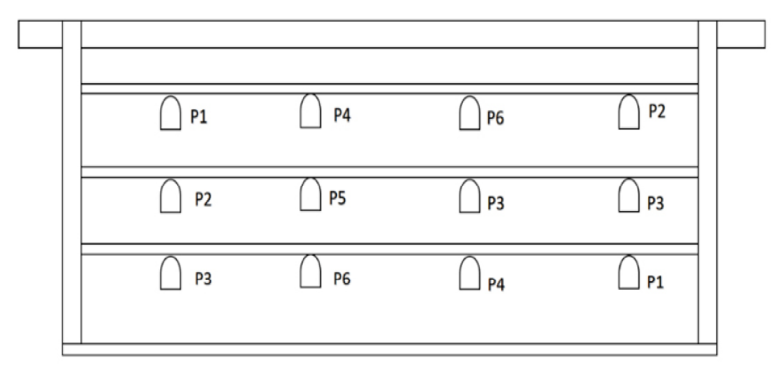
Arrangement of queen cups on a cell-building frame. P1-P6 correspond to treatments T1-T6.
Queen-cup preparation and grafting
Beeswax was used either as a single-species wax or as a 1:1 blend. Blends were prepared at 65 °C, after which the wax was moulded to the standardized queen-cup dimensions. Each cup was fixed mouth-downward to a wooden frame and labelled by treatment. Frames were placed in the cell-building colonies one day before grafting to allow worker bees to clean, polish, and warm the cups. The experimental workflow, including queen-cup preparation, larval grafting, acceptance assessment, pupal measurements, and queen emergence evaluation is illustrated in Figure 2.
Larvae younger than two days were transferred into the prepared cups using a grafting needle. Larval acceptance was assessed three days after grafting by recording larvae that remained alive and were receiving royal jelly. On day 5, after cell capping and pupation, pupal length was measured using a digital caliper.
Emergence and morphometric measurements
Queens were collected immediately after emergence on day 12. They were held at 34-35 °C and 70-80% relative humidity during transfer to the laboratory, immobilized with carbon dioxide, and weighed immediately to obtain emergence weight. Body parts were photographed on a stage micrometer graduated at 0.01 mm, and linear measurements were obtained from calibrated images using Adobe Photoshop 2021.
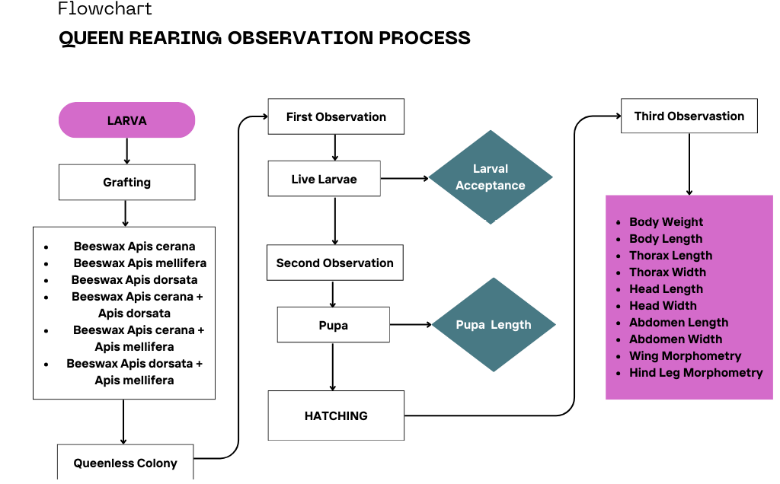
Queen-rearing workflow and observation points.
Response variables
The recorded variables were larval acceptance, pupal length, emergence weight, body length, head length and width, thorax length and width, abdomen length and height, forewing and hindwing dimensions, wing venation indices and distances, and hind-leg measurements.
Statistical analysis
The two queen cups within each colony-treatment combination constituted one experimental replicate and were summarized at replicate level, giving five replicate values per treatment (n = 5). Treatment effects were evaluated using one-way analysis of variance (ANOVA) at a significance level of 0.05. Because all treatment groups had the same number of replicates, the analysis used a balanced design. For transparency, the F statistic, numerator and denominator degrees of freedom, and exact P value are reported for each response variable. When the overall F test was significant, mean separation was planned using orthogonal contrasts; however, no trait reached P < 0.05, so no post-hoc separation was performed. Statistical analyses were performed in IBM SPSS Statistics 28 (IBM Corp., Armonk, NY, USA). Because only five replicate means were available per treatment, formal normality tests have limited diagnostic power; therefore, the ANOVA results were interpreted conservatively, and the balanced design and treatment-level variation were considered when evaluating robustness.
The experimental design was exploratory. A sensitivity calculation for six treatment groups, 30 replicate means, alpha = 0.05, and 80% power indicated that the design was reliably powered only for a large omnibus treatment effect (Cohen’s f approximately 0.73). Accordingly, failure to detect significance should not be interpreted as evidence of strict biological equivalence among wax sources. Colony identity was not fitted as a separate model term in the original analysis; this is acknowledged as a limitation because colony-level variation may affect queen rearing.
Ambient apiary temperature, relative humidity, and nectar flow were not quantified separately during the trial. All treatments were conducted concurrently at the same apiary and were managed under the same routine conditions, reducing systematic environmental differences among treatments while not eliminating colony-level and temporal variation.
Results and Discussion
Across the six beeswax formulations, treatment means were similar for larval acceptance, pupal length, emergence weight, body dimensions, wing traits, and hind-leg measurements. The omnibus ANOVA detected no significant treatment effect for any measured trait (all P > 0.05). Exact F statistics and P values are reported in Tables 1-4. Because the design had only five experimental replicates per treatment, these non-significant results are interpreted as absence of a statistically detectable effect under the testedconditions rather than proof that all wax sources are biologically equivalent.
Table 1: Developmental parameters (mean ± SD).
| Variable | T1 | T2 | T3 | T4 | T5 | T6 | F | P-value |
| Larval acceptance (score) | 1.16± 0.40 | 0.83± 0.40 | 0.67± 0.81 | 0.67± 0.81 | 1.00± 0.63 | 1.00± 0.63 | 0.488 | 0.782 |
| Pupal length (mm) | 16.96±0.80 | 16.75±0.73 | 16.78±0.85 | 16.80±0.33 | 16.81±0.73 | 16.84±0.96 | 0.047 | 0.999 |
| Emergence weight (mg) | 115.26±1.39 | 114.98±2.02 | 113.79±2.01 | 113.67±1.80 | 113.46±1.15 | 113.97±1.53 | 0.984 | 0.448 |
Note: Values are mean ± SD of five experimental replicates. ANOVA df = 5,24. No treatment effect was significant at P < 0.05.
Table 2: Body morphometrics of emerged queens (mean ± SD).
| Variable | T1 | T2 | T3 | T4 | T5 | T6 | F | P-value |
| Body length (mm) | 10.07±0.75 | 9.69±0.95 | 9.75±0.75 | 9.42±0.54 | 9.90±0.64 | 9.77±0.69 | 0.442 | 0.815 |
| Head length (mm) | 3.05±0.04 | 3.04±0.11 | 3.01±0.08 | 3.02±0.13 | 3.00±0.01 | 3.03±0.12 | 0.204 | 0.958 |
| Head width (mm) | 3.17±0.02 | 3.18±0.03 | 3.19±0.03 | 3.16±0.04 | 3.18±0.03 | 3.22±0.05 | 1.778 | 0.156 |
| Thorax length (mm) | 3.24±0.05 | 3.18±0.05 | 3.17±0.04 | 3.21±0.07 | 3.23±0.07 | 3.22±0.03 | 1.347 | 0.279 |
| Thorax width (mm) | 3.17±0.04 | 3.16±0.07 | 3.22±0.08 | 3.20±0.06 | 3.19±0.05 | 3.20±0.05 | 0.670 | 0.650 |
| Abdomen length (mm) | 5.40±0.25 | 5.31±0.13 | 5.35±0.23 | 5.37±0.24 | 5.36±0.30 | 5.38±0.22 | 0.086 | 0.994 |
| Abdomen height (mm) | 3.70±0.05 | 3.65±0.09 | 3.67±0.09 | 3.65±0.07 | 3.66±0.06 | 3.65±0.08 | 0.345 | 0.880 |
Note: Values are mean ± SD of five experimental replicates. ANOVA df = 5,24. No treatment effect was significant at P < 0.05.
Table 3: Wing morphometrics of emerged queens (mean ± SD).
| Variable | T1 | T2 | T3 | T4 | T5 | T6 | F | P-value |
| Forewing length (mm) | 8.43±0.24 | 8.40±0.14 | 8.38±0.10 | 8.35±0.10 | 8.42±0.09 | 8.40±0.18 | 0.180 | 0.967 |
| Forewing width (mm) | 2.86±0.04 | 2.83±0.06 | 2.82±0.05 | 2.84±0.03 | 2.86±0.04 | 2.84±0.04 | 0.653 | 0.662 |
| Hindwing length (mm) | 6.19±0.03 | 6.16±0.03 | 6.18±0.02 | 6.19±0.02 | 6.19±0.02 | 6.17±0.03 | 1.231 | 0.326 |
| Hindwing width (mm) | 1.83±0.03 | 1.83±0.03 | 1.82±0.03 | 1.84±0.02 | 1.85±0.02 | 1.82±0.02 | 1.051 | 0.411 |
| Cubital A (mm) | 0.44±0.02 | 0.43±0.02 | 0.44±0.22 | 0.43±0.01 | 0.42±0.01 | 0.43±0.02 | 0.034 | 0.999 |
| Cubital B (mm) | 0.15±0.02 | 0.13±0.01 | 0.14±0.02 | 0.13±0.01 | 0.14±0.02 | 0.14±0.08 | 0.218 | 0.951 |
| Cubital index | 2.99±0.48 | 3.46±0.28 | 2.99±0.31 | 3.19±0.40 | 3.25±0.60 | 2.99±0.23 | 1.131 | 0.371 |
| Distance C (mm) | 0.81±0.02 | 0.79±0.02 | 0.78±0.03 | 0.78±0.03 | 0.80±0.40 | 0.77±0.03 | 0.040 | 0.999 |
| Distance D (mm) | 1.72±0.02 | 1.70±0.03 | 1.70±0.02 | 1.72±0.03 | 1.73±0.10 | 1.70±0.02 | 0.408 | 0.839 |
| Dumbbell index | 0.98±0.03 | 0.98±0.02 | 0.97±0.03 | 0.98±0.04 | 1.00±0.02 | 0.97±0.06 | 0.462 | 0.801 |
| Inner wing length (mm) | 3.97±0.04 | 3.95±0.02 | 3.96±0.03 | 3.96±0.03 | 3.97±0.02 | 3.96±0.06 | 0.218 | 0.951 |
| Inner wing width (mm) | 2.00±0.02 | 1.94±0.03 | 1.99±0.03 | 1.99±0.03 | 2.00±0.03 | 1.99±0.22 | 0.292 | 0.913 |
| Radial field (mm) | 2.86±0.03 | 2.84±0.02 | 2.84±0.02 | 2.84±0.02 | 2.85±0.03 | 2.84±0.02 | 0.618 | 0.688 |
| Radial cell I (mm) | 0.33±0.03 | 0.30±0.02 | 0.30±0.02 | 0.31±0.02 | 0.32±0.03 | 0.31±0.01 | 1.323 | 0.288 |
| Radial cell II (mm) | 0.43±0.02 | 0.42±0.02 | 0.41±0.02 | 0.41±0.02 | 0.43±0.03 | 0.41±0.03 | 0.853 | 0.526 |
| Radial cell III (mm) | 0.61±0.92 | 0.58±0.04 | 0.63±0.02 | 0.61±0.02 | 0.61±0.03 | 0.59±0.02 | 0.011 | 1.000 |
| Radial cell IV (mm) | 1.64±0.02 | 1.61±0.02 | 1.60±0.05 | 1.62±0.02 | 1.63±0.01 | 1.62±0.03 | 1.277 | 0.306 |
Note: Values are mean ± SD of five experimental replicates. ANOVA df = 5,24. No treatment effect was significant at P < 0.05.
Table 4: Hind-leg morphometrics of emerged queens (mean ± SD).
| Variable | T1 | T2 | T3 | T4 | T5 | T6 | F | P-value |
| Femur (mm) | 2.47±0.05 | 2.47±0.04 | 2.44±0.10 | 2.45±0.09 | 2.48±0.03 | 2.42±0.08 | 0.519 | 0.760 |
| Tibia (mm) | 2.67±0.05 | 2.64±0.05 | 2.66±0.05 | 2.68±0.07 | 2.67±0.04 | 2.66±0.04 | 0.359 | 0.871 |
| Metatarsus (mm) | 1.70±0.01 | 1.71±0.02 | 1.71±0.01 | 1.70±0.01 | 1.71±0.02 | 1.71±0.01 | 0.667 | 0.652 |
| Tarsus (mm) | 1.29±0.55 | 1.49±0.03 | 1.48±0.01 | 1.49±0.01 | 1.49±0.03 | 1.48±0.02 | 0.632 | 0.677 |
Note: Values are mean ± SD of five experimental replicates. ANOVA df = 5,24. No treatment effect was significant at P < 0.05.
Larval acceptance and pupal development
The absence of a detectable treatment effect suggests that beeswax species origin was less influential than other features of the queen-rearing environment under these conditions. Previous work has shown that larval age, cup preparation, and material class can affect acceptance ; ; ; . In the present trial, larval age and cup dimensions were standardized, and all wax cups were placed in the colonies one day before grafting. This preconditioning allowed workers to clean and polish the cups and may have reduced practical differences among wax sources. This is a plausible biological explanation rather than evidence that the waxes are chemically identical.
Pupal length also varied little among treatments. Queen growth is strongly influenced by larval provisioning, developmental temperature, cell geometry, and colony condition ; ; . Because these factors were largely shared among treatments, any wax-origin effect may have been small relative to within-colony biological variation.
Emergence weight and body morphometrics
Queens reared in A. cerana javana wax were numerically heavier at emergence, but the difference from the other wax formulations was small. Emergence weight is biologically relevant because it can be associated with subsequent queen performance, yet it is also sensitive to larval nutrition and the timing of weighing after emergence ; . The same pattern of limited treatment separation was observed for body, head, thorax, and abdomen measurements. These results indicate that changing the species origin of the wax, while keeping cup dimensions constant, did not produce a clear shift in overall queen size in this experiment.
Wing and hind-leg morphometrics
Wing and hind-leg measurements were likewise similar among treatments. These traits integrate developmental processes over the entire larval and pupal period, so large and consistent differences would be expected if wax origin strongly altered queen development. Their stability across treatments therefore supports the interpretation that beeswax origin was not a dominant developmental cue under the tested conditions. This conclusion is consistent with the broader observation that queen morphology responds to multiple interacting rearing factors rather than to a single cup characteristic ; .
Interpretation, practical relevance, and limitations
The practical value of the present negative result is not that all wax sources have been proven equivalent. A non-significant test only indicates that the experiment did not detect a treatment effect of the size present in this dataset. With only five experimental replicates per treatment, the study had limited ability to detect small or moderate differences. The results therefore support a cautious operational interpretation: locally available beeswax may be usable for A. cerana javana queen-cup production when cup dimensions, larval age, and colony management are standardized, but larger trials are needed before recommending complete interchangeability among wax sources.
The study also has environmental and design limitations. Ambient apiary temperature, humidity, nectar flow, and colony-specific nurse-bee activity were not quantified in the original report. Although all treatments were evaluated concurrently at one site, these factors can contribute to queen-rearing variation. Future work should increase the number of cell-building colonies, record colony strength and microclimate quantitatively, define a primary outcome for sample-size calculation, and analyze colony as a random or blocking factor. Chemical characterization of the different wax sources would also help determine whether physical or chemical differences among the waxes are biologically meaningful.
Conclusions and Recommendations
Within the conditions and replication used in this exploratory study, beeswax from A. cerana javana, A. mellifera, A. dorsata, and their 1:1 pairwise blends produced no statistically detectable differences in larval acceptance, pupal length, emergence weight, or the measured queen morphometric traits. A. cerana javana wax showed numerically higher values for several developmental traits, but these differences were not statistically supported. The findings therefore do not demonstrate superiority of any wax source and should not be interpreted as proof of equivalence. For practical queen rearing, locally available beeswax appears to be a reasonable option when cup dimensions and colony management are standardized. This conclusion should be validated in larger multi-colony experiments with colony-aware statistical analysis and recorded environmental conditions.
Acknowledgements
No specific funding from public, commercial, or non-profit bodies supported this work. The authors thank the management and staff of Kembang Joyo Beekeeping Farm, Malang, for access to colonies and field facilities, and the Faculty of Animal Science, Universitas Islam Malang, for laboratory access and technical assistance throughout the study and the preparation of this manuscript.
Novelty Statement
The novelty of this study lies not in comparing queen-cup materials in general, which has been addressed previously, but in isolating the biological origin of beeswax as the experimental factor. The study compares wax from three Apis species and their three pairwise 1:1 blends in A. cerana javana while holding queen-cup dimensions and larval age constant, and it evaluates outcomes from graft acceptance through pupal development to a broad set of adult queen morphometrics. The results provide evidence that, under the tested conditions, wax species origin was not a dominant source of variation. This narrows an unresolved practical question in A. cerana javana queen rearing and identifies colony condition, cup geometry, larval age, and other management variables as higher-priority targets for subsequent optimization.
Authors’ Contribution
Muhammad Anwar Sadat: Designed the study, Collected the data, Contributed to data interpretation, Prepared the original draft.
Nurul Humaidah: Designed the study, Contributed to data interpretation, Ritically revised the manuscript.
Dewi Masyithoh: Designed the study, Collected the data, contributed to data interpretation, Prepared the original draft, Critically revised the manuscript.
All authors read and approved the final manuscript.
Generative AI and AI-assisted technology statement
The authors declare that no generative AI and AI assisted technology was used in the creation of this manuscript.
Conflicts of interest
The authors declare that there is no conflict of interest related to this article.
References
- Abou-Shaara, H., S. Mehrparvar, Q.D. Read, J. Chen, and E. Amiri. 2025. Impact of commercial plastic queen cell cups on rearing success and development of honey bee queens. J. Apicul. Res., 64(4): 1074–1084. https://doi.org/10.1080/00218839.2024.2418682 [CrossRef]
- Chole, H., S.H. Woodard, and G. Bloch. 2019. Body size variation in bees: Regulation, mechanisms, and relationship to social organization. Curr. Opin. Insect Sci., 35: 77–87. https://doi.org/10.1016/j.cois.2019.07.006 [CrossRef]
- Contreras, M.C.A., E.F. Contreras, M.J.O. Macias, G.J.M. Tapia, T. Petukhova, and N.E. Guzmán. 2017. Effect of different substrates on the acceptance of grafted larvae in commercial honey bee (Apis mellifera) queen rearing. J. Apicult. Sci., 61(2): 245–251. https://doi.org/10.1515/JAS-2017-0019 [CrossRef]
- De Souza, D.A., M.A.F. Bezzera-Laure, T.M. Francoy, and L.S. Gonçalves. 2013. Experimental evaluation of the reproductive quality of Africanized queen bees (Apis mellifera) on the basis of body weight at emergence. Genet. Molecul. Res., 12(4): 5382–5391. https://doi.org/10.4238/2013.November.7.13 [CrossRef]
- Es’kov, E.K. and M.D. Es’kova. 2014. Variability patterns of nest construction, physiological state, and morphometric traits in honey bee [In Russian]. Zhurn. Obshcheĭ Biologii., 75(2): 132–155.
- Gérard, M., M. Guiraud, B. Cariou, M. Henrion, and E. Baird. 2023. Elevated developmental temperatures impact the size and allometry of morphological traits of the bumblebee Bombus terrestris. J. Experimen. Biol., 226(8): jeb245728. https://doi.org/10.1242/jeb.245728 [CrossRef]
- Gregorc, A. and V. Lokar. 2010. Selection criteria in an apiary of Carniolan honey bee (Apis mellifera carnica) colonies for queen rearing. J. Cent. Europ. Agric., 11(4): 401–408. https://doi.org/10.5513/JCEA01/11.4.848 [CrossRef]
- Hailu, T.G., P. D’Alvise, and M. Hasselmann. 2021. Disentangling Ethiopian honey bee (Apis mellifera) populations based on standard morphometric and genetic analyses. Insect., 12(3): 1-21. https://doi.org/10.3390/insects12030193 [CrossRef]
- Han, B., Q. Wei, E. Amiri, H. Hu, L. Meng, M.K. Strand, D.R. Tarpy, S. Xu, J. Li, and O. Rueppell. 2022. The molecular basis of socially induced egg-size plasticity in honey bees. eLife., 11: e80499. https://doi.org/10.7554/eLife.80499 [CrossRef]
- Hassona, N. 2018. Cubital index determination of some honey bee races Apis mellifera subspecies at El-Manzla Region in El-Dakahlia Governorate, Egypt. J. Plant Protect. Pathol., 8(1): 39–44. https://doi.org/10.21608/jppp.2017.46930 [CrossRef]
- Hennessy, G., C. Harris, L. Pirot, A. Lefter, D. Goulson, and F.L.W. Ratnieks. 2021. Wind slows play: Increasing wind speed reduces flower visiting rate in honey bees. Anim. Behav., 178: 87–93. https://doi.org/10.1016/j.anbehav.2021.05.022 [CrossRef]
- Hristov, P., R. Shumkova, N. Palova, and B. Neov. 2020. Factors associated with honey bee colony losses: A mini-review. Veterin. Sci., 7(4): 166-179. https://doi.org/10.3390/vetsci7040166 [CrossRef]
- Ibrahim, M.M., Y.S. Chandel, and Anil. 2019. Morphometrics of Apis cerana from agroclimatic zones of Himachal Pradesh. Ind. J. Entomol., 81(3): 406–410. https://doi.org/10.5958/0974-8172.2019.00116.0 [CrossRef]
- Kamel, S.M., M.A.M. Osman, M.F. Mahmoud, K.M. Mohamed, and S.M. Abd Allah. 2013. Morphometric study of newly emerged unmated queens of honey bee Apis mellifera L. in Ismailia Governorate, Egypt. Arthropods. 2(2): 80-88.
- Kasiera, W., S. Kariuki, M. Musonye, K. Krausa, and N. Kiatoko. 2023. Influence of landscape on foraging range and homing ability of Afrotropical stingless bees. Insect. Sociaux., 70(1): 59–67. https://doi.org/10.1007/s00040-023-00899-3 [CrossRef]
- Kastratović, V. 2022. Some aspects of beeswax hydrolysis. Agric. Forest., 68(4): 79–88. https://doi.org/10.17707/AgricultForest.68.4.07 [CrossRef]
- Kovalskyi, I., L. Kovalska, A. Druzhbiak, I. Kovalchuk, A. Boyko, V. Zhmur, R. Havdan, M. Druzhbiak, D. Perig, I. Lunyk, L. Fiialovych, O. Petryshak, G. Paskevych, B. Bogdan, and I. Leshchyshyn. 2024. Ontogenesis of honey bees (Apis mellifera) under the influence of temperature stress. Regulat. Mechanis. Biosys., 15(2): 300–305. https://doi.org/10.15421/022443 [CrossRef]
- Lashari, M.A., A.M. Ahmed, D.M. Aljedani, F.N. Khoso, R. Mahmood, M.K. Rafique, H.A. Ghramh, W. Akram, S. Ahmad, S. Hussain, and K.A. Khan. 2025. Grafted larval age as a factor affecting honeybee (Apis mellifera) queen cell acceptance and morphometric characteristics. Pak. J. Zool., 57(3): 1073–1081. https://doi.org/10.17582/journal.pjz/20231105074710 [Full text] [CrossRef]
- Lozier, J.D., Z.M. Parsons, L. Rachoki, J.M. Jackson, M.L. Pimsler, K.J. Oyen, J. Strange, and M.E. Dillon. 2021. Divergence in body mass, wing loading, and population structure reveals species-specific and potentially adaptive trait variation across elevations in montane bumble bees. Insect Systemat. Divers., 5(5): 3: 1-15. https://doi.org/10.1093/isd/ixab012 [CrossRef]
- Ma, Y., H. Ren, J. Ning, and P. Zhang. 2017. Functional morphology and bending characteristics of the honeybee forewing. J. Bion. Engineer., 14(1): 111–118. https://doi.org/10.1016/S1672-6529(16)60382-7 [CrossRef]
- Masaquiza, D., M.O. Ferrán, S. Guamán, E. Naranjo, M. Vaca, L.M. Curbelo, and A. Arenal. 2023. Geometric Morphometric Analysis of Wing Shape to Identify Populations of Apis mellifera in Camagüey, Cuba. Insect., 14(3): 306-318. https://doi.org/10.3390/insects14030306 [CrossRef]
- Mattiello, S., R. Rizzi, M. Cattaneo, P.A. Martino, and M. Mortarino. 2022. Effect of queen cell size on morphometric characteristics of queen honeybees (Apis mellifera ligustica). Ital. J. Anim. Sci., 21(1): 532–538. https://doi.org/10.1080/1828051X.2022.2043790 [CrossRef]
- Metorima, F., C. Maia, F. Halak, A. Parpinelli, and V. Arnaut de Toledo. 2015. Morphometric measurements of Africanized honeybee queens kept in an incubator or in queen banking. Acta Scientiarum. Anim. Sci., 37(1): 91–96. https://doi.org/10.4025/actascianimsci.v37i1.24006 [CrossRef]
- Minarti, M., A.R. Yusryansyah, and D. Masyithoh. 2022. The effect of queen cell size difference in morphometrics of bees queen Apis cerana. J. Ilmu-ilmu Peternakan., 32(3): 324–332. https://doi.org/10.21776/ub.jiip.2022.032.03.15 [CrossRef]
- Mortensen, A.N., S. Bruckner, G.R. Williams, and J.D. Ellis. 2019. Comparative morphology of adult honey bees, Apis mellifera, reared in vitro or by their parental colony. J. Apicult. Res., 58(4): 580–586. https://doi.org/10.1080/00218839.2019.1616976 [CrossRef]
- Nabillatunnisa, H. Widiawati, and H.R.C. Soesilohadi. 2020. Intraspecies variation of honey bee, Apis cerana Fabr. (Hymenoptera: Apidae) on bee farms in Gunung Kidul and Kulon Progo. AIP Confer. Proceed., 2260: 020030. https://doi.org/10.1063/5.0016408 [CrossRef]
- Nannan, L., L. Huamiao, J. Yan, L. Xingan, L. Yang, W. Tianjiao, H. Jinming, N. Qingsheng, and X. Xing. 2022. Geometric morphology and population genomics provide insights into the adaptive evolution of Apis cerana in Changbai Mountain. BMC Genom., 23: 64. https://doi.org/10.1186/s12864-022-08298-x [CrossRef]
- Narah, J., M. Streinzer, J. Chakravorty, K. Megu, J. Spaethe, A. Brockmann, and T. Schmitt. 2024. Cuticular hydrocarbon profiles of Himalayan bumble bees (Hymenoptera: Bombus Latreille) are species-specific and show elevational variation. J. Chem. Ecol., 50(12): 969–977. https://doi.org/10.1007/s10886-024-01486-x [CrossRef]
- Nuraliyeva, U.A., N.N. Spatay, A.M. Davletova, M.R. Toishimanov, G.A. Moldakhmetova, Z.A. Kussainova, A.A. Khudaiberdiev, S.N. Khrapova, and D.A. Baimukanov. 2023. The impact of environment on the morphometric characteristics of honeybees Apis mellifera carnica in South-East Kazakhstan. OnLine J. Biol. Sci., 23(4): 520–527. https://doi.org/10.3844/ojbsci.2023.520.527 [CrossRef]
- Okuyan, S. and E. Akyol. 2018. The Effects of Age and Number of Grafted Larvae on Some Physical Characteristics of Queen Bees and Acceptance Rate of Queen Bee Cell. Turk. J. Agric. Food Sci. Technol., 6(11): 1556–1561. https://doi.org/10.24925/turjaf.v6i11.1556-1561.1955 [CrossRef]
- Osorio, C.S., H.N. Flores, O.T. Sánchez, and B.A. Valiente. 2022. Changes in bee functional traits at community and intraspecific levels along an elevational gradient in a Mexical-type scrubland. Oecologia., 200(1–2): 145–158. https://doi.org/10.1007/s00442-022-05248-y [CrossRef]
- Park, H.G., B.Y. Kim, J.M. Kim, Y.S. Choi, H.J. Yoon, K.S. Lee, and B.R. Jin. 2021. Upregulation of transferrin and major royal jelly proteins in the spermathecal fluid of mated honeybee (Apis mellifera) queens. Insect., 12(8): 690. https://doi.org/10.3390/insects12080690 [CrossRef]
- Rangel, J., T.F. Shepherd, A.N. Gonzalez, A. Hillhouse, K. Konganti, and N.H. Ing. 2021. Transcriptomic analysis of the honey bee (Apis mellifera) queen spermathecae reveals genes that may be involved in sperm storage after mating. PLoS ONE., 16(1): e0244648. https://doi.org/10.1371/journal.pone.0244648 [CrossRef]
- Rattanawannee, A., O. Duangpakdee, P. Rod-Im, and R. Hepburn. 2015. Discrimination of two Tetragonula (Apidae: Meliponini) species in Thailand using geometric morphometric analysis of wing venation. Kasetsart Journal: Natur. Sci., 49(5): 700–710.
- Rehman, N.U., S. Anjum, N.A. Qureshi, and M.H. Khan. 2023. The effect of larval age, and wet and dry grafting, on the rearing of queen bees using the Doolittle grafting method. Entomol. Res., 54(1): 1-7. https://doi.org/10.1111/1748-5967.12700 [CrossRef]
- Shawer, M.B., E.A. Taha, K.M. Mousa, K.A. Khan, S. Ibrahim, S. Hassan, and E.M. Elnabawy. 2021. Seasonal variations of colony activities linked to morphometric and glands characterizations of hybrid Carniolan honey bee (Apis mellifera carnica Pollmann) workers. J. King Saud University – Sci., 33 (6): 101543-101556. https://doi.org/10.1016/j.jksus.2021.101543 [CrossRef]
- Shilpa, M.P., P.P. Anand, Y.S. Vardhanan, and E.M. Manogem. 2023. High and lowland dependent wing phenotypic variation of the dark blue tiger butterfly, Tirumala septentrionis (Butler, 1874) (Lepidoptera: Nymphalidae) with FE-SEM wing scales nanomorphology. Zoologisch. Anzeig., 302: 131–145. https://doi.org/10.1016/j.jcz.2022.12.002 [CrossRef]
- Tan, K., H.R. Hepburn, S. He, S.E. Radloff, Y. Yu, and Y. Liu, 2006. Gigantism in honeybees: Apis cerana queens reared in mixed-species colonies. Naturwissenschaften., 93(7): 315–320. https://doi.org/10.1007/s00114-006-0113-2 [CrossRef]
- Thiripurasundari, S., S. Balasubramanian, and M. Varadharajan. 2017. Comparative study on average body weight and morphometric studies on honeybees Apis florea and Apis cerana indica (Fabricius, 1787). Int. J. Zool. Stud., 2(2): 27–30.
- Ustadi, U., N. Ikhsan, M. Junus, and Suyadi. 2022. Improving the larvae acceptance rate and morphometric characteristics of queen Apis cerana javana by grafting larvae at different ages. Biodiversit., 23(1): 166–170. https://doi.org/10.13057/biodiv/d230121 [CrossRef]
- Ustadi, U., S. Suyadi, N. Nur Ikhsan, L.E. Radiati, O. Sjofjan, A. Susilo, and D. Batoro. 2022. The difference queen cup materials on the acceptance grafted larvae and wing morphometrics in Apis cerana queen rearing. Proceedings of the 6th International Seminar of Animal Nutrition and Feed Science (ISANFS 2021) (Advances in Biological Sciences Research), 254–258. Atlantis Press. https://doi.org/10.2991/absr.k.220401.051 [CrossRef]
- Valladares, G.A., P.F. Torres, and R.E. Palma. 2024. Assessing ecogeographic rules in two sigmodontine rodents along an elevational gradient in Central Chile. Anim., 14(6): 830. https://doi.org/10.3390/ani14060830 [CrossRef]
- Węgrzynowicz, P. and A. Łoś. 2020. Dataset of wing venation measurements for Apis mellifera caucasica, A. mellifera carnica and A. mellifera mellifera (Hymenoptera: Apidae), their hybrids and backcrosses. Biodivers. Data J., 8: e53724. https://doi.org/10.3897/BDJ.8.e53724 [CrossRef]
- Xu, R., B. Ma, Y. Yang, X. Dong, J. Li, X. Xu, and Y. Fang. 2024. Proteome-metabolome profiling of wax gland complex reveals functional changes in honeybee, Apis mellifera L. iSci., 27(3): 109279. https://doi.org/10.1016/j.isci.2024.109279 [CrossRef]
- Xu, X., X. Du, S. Zhou, B. Zhou, K. Lai, Q. Wang, H. Li, C. Zhu, H. Xu, X. Zhang, M. Cao, and X. Zhu. 2023. Impacts of High Temperature During Early Capped Brood On Pupal Development and The Size of Appendages in Adult Workers Apis cerana. Front. Ecol. Evolut., 11: 1144216. https://doi.org/10.3389/fevo.2023.1144216 [CrossRef]
- Zhong, W.L., G.L. Ding, C.Y. Yuan, J.X. Huang, and M. Feng. 2024. Honey bee (Apis cerana) Queen Rearing Methods Influence Queen Morphological Characteristics and Reproductive-Related Gene Expression. Apidol., 55,49: 1-21. https://doi.org/10.1007/s13592-024-01083-7 [CrossRef]
- Zhou, S., X. Zhu, X. Xu, M. Zheng, and B. Zhou. 2016. Assessing geometric morphometrics analysis in microtaxonomy of the Apis cerana Fabricius (Hymenoptera: Apidae) within China. J. Kansas Entomol. . 89(4): 297–305. https://doi.org/10.2317/0022-8567-89.4.297 [CrossRef]
- Zhu, X., S. Zhou, X. Xu, J. Wang, Y. Yu, K. Yang, Q. Luo, Y. Xu, S. Wang, and B. Zhou. 2017. Morphological differentiation in Asian honey bee (Apis cerana) populations in the basin and highlands of southwestern China. J. Apicult. Res., 56(3): 203–209. https://doi.org/10.1080/00218839.2017.1306374 [CrossRef]

Services
Article usage statistics
Loading…
Related articles
- Grafted Larval Age as a Factor Affecting Honeybee (Apis mellifera) Queen Cell Acceptance and Morphometric CharacteristicsPakistan Journal of Zoology · 2025
- Effects of Rearing Interlude and Grafting Technique on Honeybee Apis mellifera L. Queen under Field ConditionsPakistan Journal of Zoology · 2019
- Evaluation of the Protective Effects of Adsorbent Materials and Ethanolic Herbal Extracts against Aflatoxins Hepatotoxicity in Albino Rats: Histological, Morphometric and Immunohistochemical StudyAdvances in Animal and Veterinary Sciences · 2019
- The effect of sugar feeding on behavior of acceptance of 1 and 2 day old larvae in upper and lower bars of the grafted frames of honeybee, Apis mellifera for queen rearingPakistan Journal of Forestry · 2000
- Study of External Morphometric Variants and Length-Weight Relationship of Labeo rohita (Hamilton-1822) Fed with Varying Protein LevelsSarhad Journal of Agriculture · 2018
- Effects of Antibiotic Treated Mulberry Leaves Feeding on Larval Growth, Cocoon Production, and Gut Bacteria of SilkwormPakistan Journal of Zoology · 2025