
This study focuses on the role of the agricultural social protection schemes of the Government of Pakistan such as the Livestock Insurance Scheme for Borrowers (LISB), Crop Loan Insurance Scheme (CLIS), the Kissan Package 2022 and the Prime Minister Youth Business & Agriculture Loan Scheme (PMYBALS) in enhancing farmers’ income, productivity, and climate-resilience. A mixed-methods design is employed and a qualitative document analysis (QDA) of State Bank of Pakistan (SBP) Circulars / Circular Letters (2001–2024) is integrated with quantitative analysis of primary survey data. The survey targeted 310 smallholder farmers in flood-affected districts across Punjab, Sindh and Khyber Pakhtunkhwa, of whom 290 provided complete responses. The analysis evaluates the effectiveness of the said schemes in mitigating climate vulnerability through social protection. Findings indicate that protective schemes offer moderate relief from climate shocks by covering loan defaults, though accessibility barriers and low confidence in coverage limit uptake. Preventive and promotive schemes yield significant income improvements and productivity gains, particularly via mechanization and inputs, with stronger effects among youth and women, however, these gains do not consistently translate to climate-smart technology adoption. The study concludes that these interventions stabilize livelihoods and build resilience, yet require complementary awareness, training and targeted scaling to optimize transformative impacts for inclusive climate adaptation in agrarian economies is needed.
Research Article · Volume 43, Issue 1, Pages 111–119, 26 October 2026 · Open Access
Enhancing Income, Productivity and Climate Resilience: The Role of Agricultural Social Protection Schemes in Pakistan
· · ·
Affiliations & Notes ⌄
- 1State Bank of Pakistan, Pakistan
- 2Lahore School of Economics, Pakistan
- 3Institute of Development Studies (IDS), The University of Agriculture Peshawar, Pakistan
- 4Liverpool Hope University, United Kingdom
- *Correspondence | Ammar Arshad; Email: ammararshadrashid@gmail.com
Article Info ⌄
- Journal:
- Sarhad Journal of Agriculture
- Submitted Date:
- 7 December 2025
- Accepted Date:
- 12 March 2026
- Published Date:
- 26 October 2026
Abstract
Introduction
C
limate change poses an existential threat to developing economies and Pakistan is no exception. In a country where agriculture employs 37.4% of the labor force and contributes 24% to the national GDP (Government of , the clouds of climate change induced disruptions are looming large. While there is no universally agreed definition for the term social protection, Devereux and Sabates-Wheeler’s (2004) assertion that social protection encompasses all such intervention which aim to augment the income of the poor and attenuate their livelihood risks is the most extensively used definition. Traditionally, social protection is considered to be a subject of fiscal policy and encompasses programs aimed at poverty reduction through support programs such as unconditional cash transfers ; ; . However, with a general consensus on the criticality of climate vulnerabilities, central banks are increasingly recognized for their ancillary role in advancing social protection via regulatory and risk-sharing measures . Rigolini (2021) underscores the urgency with which nations must prioritize their climate change adaptation efforts and calls for a multi-faceted action-plan. In line with these global calls to action, central banks are progressively integrating environmental and social considerations into their regulations and policy interventions, examples of which include stress testing for climate risks, mandatory climate disclosures and green banking guidelines ; ; ; . Despite the increasing calls for central banks to play their part in reducing climate-induced vulnerabilities via social protection, the policy measures available to them (such as inflation control, financial inclusion and risk-sharing) remain underexplored ; .
A key literature gap exists in examining central banks’ role in mitigating climate vulnerabilities via social protection from beneficiaries’ perspectives. While prior studies have focused on fiscal approaches or central banks’ climate adaptation policies, overlooking subsidized financing, financial inclusion and insurance facilitation, our research addresses this gap by analyzing State Bank of Pakistan’s (SBP) initiatives in agriculture sector in Pakistan. Over the past two decades, SBP has shifted its agricultural policies from productivity-driven initiatives in the early 2000s to climate-resilient social protection measures by 2025, responding strategically to these vulnerabilities. A Qualitative Document Analysis (QDA) of SBP Circulars and Circular Letters on Agricultural Credit (2001–2024) reveals a broad evolution of schemes.
Table 1: Subsidized agricultural financing schemes in pakistan
| Feature | PMYB&ALS | IF&RSLF | MSRSSFM | GMSS |
| Eligibility Criteria | Citizens aged 21-45; startups/existing SMEs owned by youth; agriculture farmers. | Small/marginalized landless farmers/tenants in flood-affected areas | All farmers, processors, and corporates engaged in agriculture crop production. | Existing/new subsistence landholding farmers and new small farmers. |
| Loan Size | Tiered: T1 up to Rs 0.5M; T2 > Rs 0.5M to Rs 1.5M; T3 > Rs 1.5M to Rs 7.5M. | Up to Rs 200,000 per borrower. | Up to Rs 30M. | Up to Rs 500,000 per borrower. |
| Loan type/purpose | Agriculture production/development loans. | Production/working capital for input supplies, rentals of farm implements, etc. | Purchase of new/used (up to 3 years old) farm machinery. | Short-term production/working capital for all crop and non-crop sectors. |
| End user markup | T1: 0%; T2: 5%; T3: 7%. | 0% p.a. | 7% p.a. | 0% p.a. |
| Bank rate/pricing & Subsidy | T1: KIBOR+9% (incl. wholesale lender margin); T2/T3: KIBOR+3%. Govt subsidizes difference via allocated budget, paid quarterly. Uses 6-month KIBOR offer. | Subsidy to PFIs: 6-month KIBOR+3% for commercial banks; KIBOR+9% for MFBs. Claims submitted half-yearly. | KIBOR (6-month offer) + 3% p.a. Govt pays difference ((KIBOR+3%) - 7%). Claims submitted half-yearly. | Subsidy to PFIs: 6-month KIBOR+3% for commercial banks; KIBOR+9% for MFBs. Claims submitted quarterly, audited. |
| Risk mitigation/sharing | Govt bears credit losses (principal only): T1 up to 50% (40% | 50% credit risk coverage on outstanding loans (principal) if classified 'SUBSTANDARD' per Prudential Regulations. | GoP bears 25% first loss on disbursed portfolio (principal only) per Prudential Regulations for Agriculture Financing. | - |
| Other notable | 25% loans to women; online application via PM Youth Portal. | Budget allocation by GoP (Finance Division); subsidy claims half-yearly. | Online portal for applications; direct payment to supplier/vendor. | Budget allocation by Finance Division; focuses on flood revival; subsidy claims quarterly. |
Source: State bank of pakistan, 2022
Table 2: Agricultural insurance schemes in Pakistan
| Feature | CLIS | LISB |
| Eligibility criteria | All borrowers with landholdings up to 25 acres. | All borrowers availing loan from banks for the purchase of livestock (up to 10 cattle). |
| Loan covered | All borrowers availing agri production loans from banks/MFBs to cultivate major field crops i.e. Wheat, Rice, Sugarcane, Maize and Cotton. | All livestock loans up to PKR 5 million |
| Insured perils | Natural calamities, crop diseases and infestation. | Death due to disease or natural causes; death due to climate induced disasters; accidental death. |
| Premium | Maximum 2% per crop per season. | Up to a maximum of 4% per annum. |
| Premium borne by | Government of pakistan | Government of pakistan |
| Payment of claims | Payable to the banks by the insurers for credit to the insured borrower’s loan account. | Payable to the banks by insurers for credit to the insured borrower’s loan account. |
Source: State bank of pakistan, 2014
This study focuses on the Livestock Insurance Scheme for Borrowers (LISB), Crop Loan Insurance Scheme (CLIS), the Kissan Package 2022 [comprising the GoP Markup Subsidy Scheme (GMSS), Interest Free Loans and Risk Sharing Scheme for Landless Farmers (IF&RSLF), and Markup Subsidy and Risk Sharing Scheme for Farm Mechanization (MSRSSFM)] and the Prime Minister Youth Business & Agriculture Loan Scheme (PMYBALS). These schemes are chosen due to their explicit focus on mitigating climate-induced risks and delivering comprehensive social protection, offering a robust lens to examine vulnerability reduction among Pakistan’s smallholder farmers. These schemes were introduced amid an average interest rate of 22%, emphasizing subsidized access and Table 1 below presents their salient features while Table 2 delineates the salient features of insurance schemes.
This study aims to investigate the effectiveness of agricultural social protection schemes in Pakistan, with a focus on smallholder farmers. We trace the evolution of SBP’s agricultural policies from productivity-driven to climate-resilient measures, assessing the schemes’ impacts on income improvement, productivity enhancement, climate-smart technology adoption and preparedness for climate risks through quantitative analysis of primary survey data. The study extends the theoretical framework of social protection by evaluating the schemes’ protective, preventive, promotive and transformative functions from beneficiaries’ perspectives, particularly among youth and women, to address gaps in central banks’ contributions to climate adaptation in agrarian economies.
Materials and Methods
This study employs a mixed-methods research design to investigate the role of SBP’s agricultural financing and insurance schemes in mitigating climate vulnerability through social protection, focusing on smallholder farmers in Pakistan. By integrating Qualitative Document Analysis (QDA) with quantitative analysis of primary survey data, the research extends the theoretical scope of social protection, as conceptualized by Devereux and Sabates-Wheeler (2004) and Holzmann and Jørgensen (2001), by positioning central bank-led financial schemes as state-backed mechanisms for climate adaptation. This dual-method approach enables a comprehensive examination of both the policy intent behind SBP’s interventions and their empirical outcomes, triangulating qualitative insights with statistical associations to assess vulnerability reduction among smallholders.
To trace the evolution of SBP’s agricultural policies and their alignment with climate vulnerability mitigation, a Qualitative Document Analysis (QDA) was conducted on publicly available SBP Circulars and Circular Letters on Agricultural Credit from 2001 to 2024 (SBP, 2025). The QDA framework used by Bowen (2009) was adapted for this study and it entailed a systematic process for selection of the Circulars and Circular Letters, their coding and thematic analysis. The thematic analysis was guided by Devereux and Sabates-Wheeler’s (2004) four-function social protection framework (protective, preventive, promotive, transformative).
The short-listing criteria for selection of Circulars and Circular Letters was their relevance to agricultural financing, insurance programs and smallholder-focused climate interventions. The Circulars and Circular Letters pertaining to the subject of microfinance were excluded. To capture emergent themes, such as climate risk mitigation and resilience-building, the coding scheme used for QDA categorized the interventions by year, ID, scheme name, policy focus, target population, social protection role and implementation mechanism (e.g., subsidies, risk-sharing). The findings were synthesized in a QDA matrix, classifying schemes as:
Protective (LISB, CLIS: relief from shocks).
Preventive (GMSS, IF&RSLF: income stabilization).
Promotive (MSRSSFM, PMYB&ALS: productivity enhancement).
Transformative (PMYB&ALS: resilience for women/youth).
Table 3: Summary statistics
| Summary statistics | ||||
| Variable | Mean | SD | Min | Max |
| Age (Years) | 37.99 | 10.82 | 21.00 | 60.00 |
| Children (No.) | 2.03 | 2.17 | 0.00 | 6.00 |
| Family members (No.) | 7.52 | 2.73 | 3.00 | 12.00 |
| Education (Years) | 10.05 | 4.08 | 3.00 | 16.00 |
| Total land (Acres) | 5.52 | 3.18 | 0.50 | 12.00 |
| Financing amount (PKR) | 2,149, 372 | 1,665, 880 | 85,000 | 5,165, 000 |
This study employed purposive sampling, specifically targeting farmers with landholdings of 0–12.5 acres who were beneficiaries of the afore-mentioned agricultural insurance and subsidized financing schemes. To ensure representation from climate-vulnerable areas, the selection focused on flood-affected regions as identified by National Disaster Management Authority (NDMA). The researchers partnered with commercial banks, where Agriculture Credit Officers administered the 49-item Urdu questionnaire directly to these farmers in 44 districts across the provinces of Punjab, Sindh and Khyber Pakhtunkhwa. A power calculation targeting a minimum effect size of 0.15, 80% power and 5% significance level yielded a base sample of 280; adjusting for a 10% non-response rate, 310 farmers were targeted. The final sample includes 290 complete responses (185 Punjab, 83 Sindh and 22 Khyber Pakhtunkhwa).
Results and Discussion
This section examines scheme distribution, fund utilization, self-reported improvements in income and productivity, perceptions of climate adaptation and regression outcomes. These findings are grounded in Devereux and Sabates-Wheeler’s (2004) social protection framework, highlighting strengths in protective and preventive functions while identifying gaps in transformative climate-smart adoption.
Descriptives
Table 3 below presents the summary statistics for the data collected via survey. The average age of respondents was approximately 38 years and, on average, farmers had 2 children. Mean household size was 7.5 members and mean years of formal education were 10.05, indicating that a majority had completed secondary schooling. The average farm size was 5.52 acres and the mean financing amount availed under subsidized schemes was PKR 2.15 million, ranging from PKR 85,000 to PKR 5.165 million.
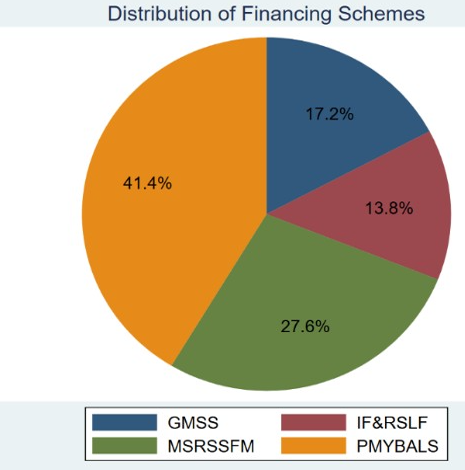
Distribution of financing schemes
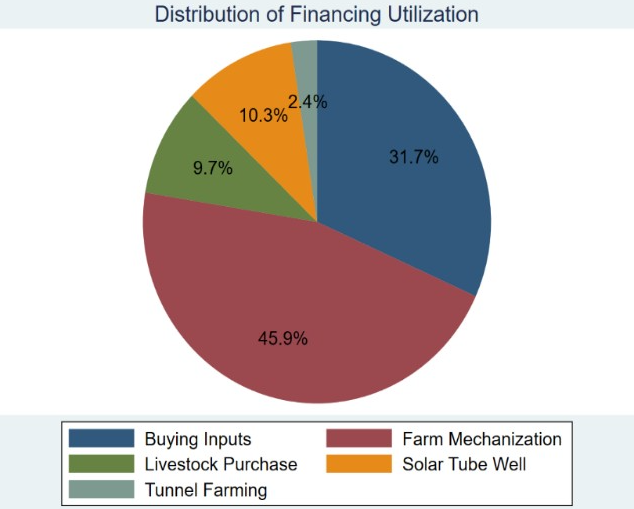
Distribution of financing utilization
Table 4: Regression results (Income & productivity improvement)
| (1) | (2) | |
| Variables | Income improvement | Productivity improvement |
| Age | -0.00401 | -0.00307 |
| Family members | 0.0126 | 0.0129 |
| Education | -0.00706 | -0.0218 |
| Total land | -0.00614 | 0.0225 |
| LN(Financing amount) | 0.0446 | -0.0598 |
| Financing schemes (PMYBALS as Reference category) | ||
| GMSS | 1.731*** | -0.769* |
| IF&RSLF | 1.408** | -0.519 |
| MSRSSFM | 0.384* | 0.0515 |
| Marital status (Married as reference category) | ||
| Unmarried | -0.0273 | -0.0326 |
| Financing satisfaction | 0.618*** | -0.0879 |
| Financing challenges | -0.114 | -0.00513 |
| Financing utilization (Solar tubewell as reference category) | ||
| Buying inputs | -0.114 | 0.641* |
| Farm mechanization | 0.0270 | 0.158 |
| Livestock purchase | 0.221 | 0.0284 |
| Tunnel Farming | -0.150 | 0.167 |
| Climate change impact | 0.0698 | -0.00348 |
| Constant | -0.254 | 3.314* |
| Observations | 290 | 290 |
| R-squared | 0.281 | 0.071 |
Across the subsidized credit schemes, self-reported outcomes reveal a clear divergence between economic gains and perceived climate and user-experience benefits. GMSS and IF&RSLF delivered the strongest income improvements, while productivity gains were highest under IF&RSLF and MSRSSFM, whereas PMYBALS consistently showed the weakest income and productivity effects. However, this pattern reverses for climate-related perceptions and satisfaction where PMYBALS beneficiaries expressed the strongest agreement that the scheme supports climate-resilient practices, enables climate-smart technology adoption, helps prepare for climate risks and provides overall satisfaction with subsidized financing. In contrast, GMSS and IF&RSLF beneficiaries, despite larger income gains, reported only moderate perceptions regarding climate adaptation and MSRSSFM beneficiaries highlighted the greatest challenges in accessing subsidized finance. For MSRSSFM and PMYBALS, willingness to recommend such schemes in the future was highest, while for IF&RSLF it was lowest. This suggests that ease of access and overall experiences are attached far more consideration than the income effects when it comes to recommendation decision. The respondents elicited moderate confidence in the ability of insurance schemes to protect from climate-related losses. The results suggest that simply targeting income improvement does not necessarily strengthen climate adaptation perceptions and insurance products remain constrained by access and credibility gaps.
Regression results
Table 4 reports the regression results for self-reported income improvement and productivity improvement. Several financing schemes showed statistically significant positive effects on income improvement when compared to the reference category (Prime Minister’s Youth Business Agri Loan Scheme – PMYBALS).
GMSS: +1.731 (p < 0.01)
IF&RSLF: +1.408 (p < 0.05)
MSRSSFM: +0.384 (p < 0.10)
Higher satisfaction with subsidized financing was strongly associated with greater income improvement (+0.618, p < 0.01). In contrast, none of the utilization categories (except marginally for buying inputs on productivity) showed strong effects and the coefficient on the log of financing amount was not significant for income. For productivity improvement, results were weaker overall (R² = 0.071). GMSS exhibited a negative association (−0.769, p < 0.10), possibly reflecting implementation. Purchasing agricultural inputs (versus solar tubewells) was positively linked to productivity (+0.641, p < 0.10).
Table 5 examines determinants of two key climate-adaptation outcomes (i) willingness/enablement to adopt climate-smart technologies and (ii) perceived preparedness for climate change risks. Results indicate that income improvement itself is negatively associated with enablement for climate-smart technology adoption (−0.178, p < 0.01), which may suggest that farmers who have already achieved income gains feel less urgent need for further technological shifts, or that the current schemes are not effectively bundled with climate-smart components. Higher education (+0.056, p < 0.10) and being unmarried (−0.306, p < 0.05) were also significant predictors. Satisfaction with subsidized financing strongly predicts better perceived preparedness against climate risks (+0.323 to +0.390, p < 0.01). Using financing for input purchases (versus solar tubewells) markedly improved preparedness (+1.070, p < 0.01), as did larger landholdings (+0.049, p < 0.10) and adoption of modern practices (+0.116, p < 0.10). Most subsidized financing schemes (GMSS, IF&RSLF, and MSRSSFM) were associated with significantly lower preparedness compared to PMYBALS, with coefficients ranging from −0.519 to −1.466 (p < 0.05 or better).
Analysis
The regression analysis demonstrates a robust positive effect of GMSS and IF&RSLF on income stabilization, aligning with the preventive function of social protection as outlined by Devereux and
Table 5: Regression results (Climate indicators)
| (1) | (2) | (3) | (4) | |
| Variables | Climate smart technology | Climate smart technology | Climate change preparedness | Climate change preparedness |
| Income improvement | -0.178*** | 0.0892 | ||
| Productivity improvement | -0.156 | 0.152* | ||
| Age | 0.00448 | 0.00469 | -0.00514 | -0.00501 |
| Education | 0.0566* | 0.0546* | -0.0221 | -0.0196 |
| Family members | 0.0302 | 0.0302 | -0.0286 | -0.0297 |
| Total land | -0.0142 | -0.00978 | 0.0488* | 0.0450 |
| LN (Financing amount) | -0.309 | -0.325* | -0.208 | -0.197 |
| Financing schemes (PMYBALS as Reference category) | ||||
| GMSS | 0.523 | 0.0961 | -1.440*** | -1.170*** |
| IF&RSLF | -0.239 | -0.570 | -1.466*** | -1.261*** |
| MSRSSFM | 0.205 | 0.152 | -0.537** | -0.519** |
| Marital status (Married as reference category) | ||||
| Unmarried | -0.306** | -0.305** | -0.321*** | -0.320*** |
| Financing satisfaction | 0.0519 | -0.0707 | 0.323*** | 0.390*** |
| Financing challenges | -0.0604 | -0.0404 | 0.0110 | 0.000968 |
| Financing utilization (Solar tubewell as reference category) | ||||
| Buying inputs | -0.368 | -0.247 | 1.070*** | 0.962*** |
| Farm mechanization | 0.336 | 0.353 | 0.276 | 0.257 |
| Livestock purchase | 0.0663 | 0.0308 | -0.0864 | -0.0703 |
| Tunnel Farming | -0.644* | -0.592 | 0.0904 | 0.0536 |
| Climate change impact | -0.0730 | -0.0854 | 0.180 | 0.185 |
| Modern practices | -0.0451 | -0.0538 | 0.104 | 0.116* |
| Constant | 7.734*** | 8.296*** | 4.788* | 4.260 |
| Observations | 290 | 290 | 290 | 290 |
| R-squared | 0.104 | 0.088 | 0.177 | 0.178 |
| Robust standard errors in parentheses *** p<0.01, ** p<0.05, * p<0.1 | ||||
Sabates-Wheeler (2004). This also resonates with the findings of Aleksandrova et al. (2024) and Carter and Sarah (2015) on income augmentation and attenuate livelihood risks for the poor in climate-vulnerable areas. However, the impact on productivity improvement is less pronounced, which suggests that productivity gains may be limited, possibly due to short-term loan structures prioritizing immediate relief over long-term investments. In contrast, MSRSSFM shows a modest positive effect on productivity indicating its promotive role in enhancing agricultural capabilities through mechanization, which is in-line with the findings of Holzmann and Jørgensen (2001).
Income improvement negatively affects climate-smart technology adoption, suggesting that higher incomes from subsidized loans may not directly translate into investments in climate-smart technologies. In continuation of the findings of Dikau and Volz (2018), we assert that this is reflective of farmers’ prioritization of short-term financial stability over investment in long-term adaptive practices largely due to limited awareness and high upfront costs. On the contrary, income and productivity improvements positively influence climate change preparedness. This indicates that financial stability and growth in agricultural outputs advance resilience against climate shocks ; .
The importance of accessibility and user-friendliness of these subsidized financing and insurance schemes is underscored by the positive effect of financing satisfaction on climate change preparedness. The transformative potential of such financial inclusion interventions can only be unlocked by better-targeting as results indicate that farmers who are satisfied with the financing terms are more likely to adopt climate resilient practices. Access to subsidized inputs enable farmers to diversify crops and adopt climate resilient varieties resulting in enhanced climate-change preparedness ; .
The results indicate that education has a positive influence on the adoption rate of climate-smart technology which means that the educated farmers are more likely to adopt innovative practices. However, the results’ lack of significance warrants caution that without better-targeting, education per se cannot guarantee better results. The negative effect of being unmarried on both technology adoption and preparedness may reflect lower financial stability or risk-taking capacity among unmarried farmers, who may lack familial support structures, potentially exacerbating vulnerabilities in line with broader poverty reduction frameworks ; .
This study’s focus on small-holder farmers acts as a potential limitation. The experiences of above-subsistence farmers are not captured, and the study relies on response from flood-affected districts only which limit the generalizability to other climate risks, such as droughts. Additionally, the adaptation and mitigation strategies (e.g., drought-resistant crops, solar-powered irrigation) and farmer-reported barriers to technology adoption have been insufficiently explored. Future researchers should endeavor to analyze farmer-reported data on technology adoption pattern, investigate adoption trends of climate-resilient practices and develop a scalable model for agrarian economies facing threatened by climate-change. Scalability of SBP’s frameworks across diverse climatic and economic contexts may also be explored to assess long-term impacts of promotive and transformative schemes on sustainable agricultural practices.
Conclusions and Recommendations
In Pakistan, agriculture underpins livelihoods for 37.4% of the workforce and in an era where the climate risks are ever-growing, the insights from this study advocate for targeting the subsidized agricultural financing schemes for smallholders and climate-vulnerable farmers, while simultaneously scaling accessible agricultural insurance. Furthermore, the study recommends optimizing loan terms to enhance repayment capacity without increasing borrower distress and integrating non-financial support through bundled models that blend financing facility with climate-smart agriculture training and agronomic advisory services to minimize vulnerabilities and maximize the long-term sustainability of subsidized schemes. The research elucidates how central bank interventions can address the intersection of climate risk and social protection. Findings reveal that the protective schemes provide relief from climate shocks by covering loan defaults, aligning with Holzmann and Jorgensen’s (2001) framework of risk mitigation.
The preventive, promotive and transformative focus of subsidized financing is evident in its significant income and productivity effects, particularly among youth and women. However, complementary policies, such as awareness drives and training sessions are a sine qua non to promote transformative outcomes. SBP’s agricultural financing and insurance schemes prioritize landless farmers, women and youth, a focus that is aligned with global calls for inclusive climate adaptation. Similar approaches may be taken by central banks across the globe to advance social protection goals by blending subsidized financing with risk-sharing mechanisms and insurance to mitigate climate vulnerabilities.
By addressing immediate liquidity constraints while simultaneously strengthening adaptive capacity, SBP’s agricultural support schemes demonstrate how monetary and regulatory instruments can perform a quasi-social protection function in climate-vulnerable settings. Climate resilience, however, is not an automatic by-product of subsidized financing rather the outcomes are largely dependent on the targeting precision and effectiveness of capacity-building support. The central banks in developing economies need to move beyond mere price stability and incentivize climate-sensitive lending through risk-sharing frameworks and regulatory innovations. If done in an effective manner, these policy measures enable countries to transition from reactive post-disaster liquidity provision toward proactive resilience-building.
Funding
No external funding was obtained for this research. The authors are solely responsible for the design, execution and outcomes of the study, and thank the partner commercial banks for their facilitation in survey data collection.
Novelty Statement
This study examines the role of social protection schemes in mitigating climate-induced vulnerabilities from the beneficiaries’ perspectives. It reveals how subsidized financing and insurance initiatives evolve from productivity-focused to climate-resilient strategies.
Authors’ Contribution
Ammar Arshad: Developed the mixed-methods research design, conducted the qualitative document analysis of SBP circulars, managed data collection through surveys with smallholder farmers and wrote the introduction, methodology, discussion and conclusion sections.
Ahmad Nawaz: Conceptualized the study, performed statistical analyses including regressions, created tables and figures for results visualization, and contributed to the results and discussion sections.
Neelam Shahi Mulk: Validated the research findings and methodology and reviewed the literature and manuscript.
Asad Ghalib: Supervised the overall project, ensured alignment with social protection frameworks, reviewed and edited the manuscript for clarity and coherence.
All authors have read and approved the final version of the manuscript and the manuscript has not been published or submitted to other journals previously.
Generative AI or AI assisted technology statement
The author’s declare that no Gen AI was used in the creation of this manuscript.
Conflict of interest
The authors declare that there is no conflict of interests regarding the publication of this article.
References
- Aldunate, E. and R. Martner. 2006. Fiscal policy and social protection. CEPAL. https://doi.org/10.18356/607aada9-es [CrossRef]
- Aleksandrova, M., L. Kuhl, and D. Malerba. 2024. Unlocking climate finance for social protection: an analysis of the Green Climate Fund. Clim. Polic., 24(7): 1-16 https://doi.org/10.1080/14693062.2024.2338817 [CrossRef]
- Boneva, L., G. Ferrucci, and F.P. Mongelli. 2022. Central banks and climate change. European Central Bank.
- Bowen, G.A. 2009. Document analysis as a qualitative research method. Qualitat. Res. J., 9 (2): 27–40. https://doi.org/10.3316/QRJ0902027 [CrossRef]
- Brunnermeier, M.K. and J.P. Landau. 2021. Finance, money, and climate change. Princeton University Press.
- Campiglio, E., Y. Dafermos, P. Monnin, J. Ryan-Collins, G. Schotten, and M. Tanaka. 2018. Climate change challenges for central banks and financial regulators. Natu. Clim. Chan., 8(6): 462–468. https://doi.org/10.1038/s41558-018-0175-0 [CrossRef]
- Carter, M.R. and J. Sarah. 2015. Social protection in the face of climate change: Targeting principles and financing mechanisms. World Bank Policy Res. Work. Paper No. 7476. https://doi.org/10.1596/1813-9450-7476 [CrossRef]
- Choong, C.K. and M. Firouz, 2020. Social Protection and Fiscal Policy in Malaysia. Khazanah Research Institute Discussion Paper 9/20.
- Devereux, S. and R. Sabates-Wheeler, 2004. Transformative social protection. IDS Working Paper 232.
- Dikau, S. and U. Volz. 2018. Central banking, climate change and green finance. Asian Development bank Institute Working Paper No. 867. https://doi.org/10.1007/978-981-10-8710-3_17-1 [CrossRef]
- Government of Pakistan. 2025. Pakistan Economic Survey 2024-25.
- Hayes, A.F. 2018. Introduction to mediation, moderation and conditional process analysis. Guilford Press.
- Holzmann, R. and S. Jørgensen. 2001. Social risk management: A new conceptual framework for social protection, and beyond. Int. Tax Public Finan., 8(4): 529-556. https://doi.org/10.1023/A:1011247814590 [CrossRef]
- Nasim, A. 2014. Fiscal space for social protection in Pakistan. Institute of Development and Economic Alternatives Policy Paper No. 01-14.
- Rigolini, R. 2021. Social protection and labor: A key enabler for climate change adaptation and mitigation. World Bank Group Discussion Paper No. 2108. https://doi.org/10.1596/36669 [CrossRef]
- State Bank of Pakistan, 2025. Agriculture Credit & Financial Inclusion Department Circulars. https://www.sbp.org.pk/acd/index.htm
- Zhang, Q., Y. Shi, X. Zhao, and J. Yang, 2025. Climate vulnerability, macroprudential policy and financial risk. Risk Manage., 27(4): 1-24. https://doi.org/10.1057/s41283-025-00179-3 [CrossRef]

Services
Article usage statistics
Loading…
Related articles
- Climate-Smart Agriculture to Enhance Agricultural Production: A Bibliometric Analysis and Systematic Literature ReviewSarhad Journal of Agriculture · 2026
- Role of Non-Timber Forest Products in Income Enhancement of Mountainous People of Swat and Mansehra Districts of Khyber Pakhtunkhwa, PakistanSarhad Journal of Agriculture · 2023
- CLIMATE VARIABILITY IMPACTS ON RICE CROP PRODUCTION IN PAKISTANPakistan Journal of Agricultural Research · 2018
- Strengthening Smallholder Centered Agricultural Knowledge and Information System (AKIS) in Punjab, PakistanSarhad Journal of Agriculture · 2026
- Impact of Tubewell Irrigation on Agricultural Production in District Dera Ismail Khan, Khyber Pakhtunkhwa-PakistanSarhad Journal of Agriculture · 2022
- Improving Water Productivity in Rice – A Response to Climate Change and Water Stress in PakistanSarhad Journal of Agriculture · 2020