
Crossbreeding indigenous cattle with high milk-production potential breeds is considered a rapid approach for dairy cattle improvement. In Bangladesh, many crossbreds carry varying levels of exotic blood, often with reduced adaptability to tropical conditions. This study aimed to develop a stable 50% Holstein-Friesian (HF) × 50% Pabna cattle (PC) crossbred herd and evaluate the productive and reproductive performance of first-generation (F1) crossbreds compared with purebred PC. Data were recorded from 2020 to 2024 in both register books and digital databases. Independent-samples t-tests were conducted using SPSS 22.0, and correlation coefficients were estimated using RStudio 4.5.0. Results revealed that average daily milk yield (AMY) was significantly (p<0.001) higher in crossbreds than in PC (7.15 vs. 2.89 kg/day). Crossbred cattle exhibited higher growth performance than PC, with greater birth weight (22.14 vs. 18.86 kg), 6-month weight (96.21 vs. 80.92 kg), 12-month weight (189.48 vs. 117.91 kg), 18-month weight (232.31 vs. 171.32 kg), and 24-month weight (276.93 vs. 245.47 kg). Although milk fat and protein percentages were lower, crossbreds produced higher 4% fat-corrected milk (FCM) and energy-corrected milk (ECM) yields. Milk yield (MY) showed significant negative correlations with lactose, protein, fat, and salt in PC and with fat and salt in HF crossbreds. Crossbreds had higher weight at puberty but lower age at first service and age at first calving than PC. Overall, the newly developed dairy crossbred showed superior growth and milk production, indicating its suitability for sustainable and profitable dairy farming under Bangladesh’s tropical conditions.
Research Article · Online First, 9 November 2026 · Open Access
Evaluation of Growth, Reproductive Traits, and Milk Quality of F1 Crossbred (50% Holstein-Friesian and 50% Pabna) Cattle in Bangladesh
· · · · ·
Affiliations & Notes ⌄
- 1Regional Station, Bangladesh Livestock Research Institute, Baghabari, Sahjadpur, Sirajgang-6770, Bangladesh
- 2Bangladesh Livestock Research Institute, Savar, Dhaka-1341, Bangladesh
- *Correspondence | Ummeya Shiha Alam; Email: shihaalam23@gmail.com
Article Info ⌄
- Journal:
- Pakistan Journal of Zoology
- Submitted Date:
- 9 July 2026
- Accepted Date:
- 1 August 2026
- Published Date:
- 9 November 2026

Abstract
INTRODUCTION
Bangladesh has made remarkable progress in livestock production; however, the national milk supply remains slightly below the recommended nutritional requirement. Total milk production in Bangladesh was 15.04 million metric tons, and the estimated per capita availability was 234.45 mL/day, which is lower than the recommended intake of 250 mL/day/head (DLS, 2024). Improved dairy productivity is a national priority because of population growth, increased purchasing power, and rising demand for animal-source foods. Well-planned and sustainable breeding strategies through genetic improvement can provide a practical pathway to increase milk production, reproductive efficiency, and overall herd performance under the agro-climatic conditions of Bangladesh.
Crossbreeding native cattle with exotic dairy breeds has long been advocated as a shortcut to improve dairy productivity in tropical and subtropical production systems. In Bangladesh, crossbred dairy cows have been reported to produce significantly higher milk yield than indigenous cows. The average daily milk yield of crossbred cows was 10.89 kg, compared with 7.65 kg in indigenous cattle, which was approximately 42.4% higher . Similarly, crossbreeding local non-descript cattle with high-genetic-merit exotic breeds has been considered an effective strategy to accelerate genetic progress in dairy animals .
However, even after decades of crossbreeding, documented information on genetic constitution, breed inheritance level, and performance stability remains limited for many crossbred populations at the farm level. An additional constraint to the scientific assessment and long-term efficacy of crossbreeding programmes is the lack of systematic animal identification, pedigree recording, and performance monitoring . Uncontrolled crossbreeding can produce genetically heterogeneous animals with varying proportions of local and exotic inheritance, which may reduce the predictability of productive and reproductive performance. Such mixed genetic backgrounds are often not supported by structured breeding objectives and may dilute the efficiency of selection programmes ; . In many tropical countries, crossbreeding programmes are limited by poor infrastructure, weak recording systems, limited technical capacity, and poor farmer participation. Bangladesh is no exception. The national crossbred cattle population consists of local cattle strains and several exotic breeds, including Holstein-Friesian (HF), Jersey, Sahiwal, and their crosses at different levels of inheritance . Therefore, breed improvement strategies should balance productivity with adaptability, fertility, disease resistance, and management feasibility.
Holstein-Friesian cattle are among the most widely used dairy breeds in crossbreeding programmes because of their large body size and high milk-production potential. However, their performance may be affected under tropical conditions because of heat stress, disease susceptibility, and higher nutritional and management requirements. Therefore, increasing the proportion of exotic blood above an adaptive threshold can increase production costs and reduce reproductive efficiency, especially in smallholder and semi-intensive dairy systems. Some studies have indicated that a balance of 50% local and 50% exotic genetic inheritance may provide a useful compromise between productivity and adaptability in tropical agro-ecological environments ; . In addition, crosses between indigenous zebu-type cattle and HF have shown positive additive genetic and heterotic effects for milk yield and calf birth weight .
Pabna cattle are an important indigenous cattle genetic resource of Bangladesh. They are well adapted to local environments and valued for disease resistance, heat tolerance, hardiness, and moderate milk-production potential. These traits suggest that Pabna cattle (PC) may serve as a promising maternal breed for sustainable crossbred dairy populations. However, the performance of pure PC and F1 HF × PC under local production conditions has not been sufficiently characterized. Therefore, it is important to evaluate growth, productive, and reproductive traits systematically to determine whether the F1 genotype enhances dairy performance without compromising adaptability and reproductive efficiency. Growth traits, such as live weight and average daily gain, are important indicators of general animal development and future productive potential. Live weight has also been widely estimated using linear body measurements, particularly in smallholder production systems where weighing facilities are limited . Moreover, reproductive traits such as services per conception, calving interval, and days open are important determinants of dairy farm profitability because of the close relationship between milk production and reproductive efficiency. Productive traits of dairy cattle enterprises, such as lactation length, lactation yield, and daily milk yield, are also important indicators of economic efficiency . When assessed together, these traits provide a more complete picture of genotype performance than milk yield alone.
The present study was designed to compare the productive and reproductive performance of F1 crossbred cattle containing 50% HF and 50% PC inheritance with that of pure PC. This comparison is important in view of the increasing demand for milk, the need for sustainable genetic improvement, and the limited performance-based evidence on structured HF × PC crosses in Bangladesh. The findings are expected to provide practical evidence for breed selection, crossbreeding policy, and sustainable dairy development programmes in Bangladesh.
MATERIALS AND METHODS
Location of the cattle breeding research farm
The study was carried out at the Bangladesh Livestock Research Institute (BLRI) cattle breeding farm, Regional Station (RS), Baghabari, Shahjadpur, Sirajganj District, which is located 168 kilometres from the country’s capital. The BLRI Regional Station is located at an altitude of 13.14 meters (43.11 feet) above sea level, at longitude 89.5873 and latitude 24.140. The mean temperature ranges from a minimum of 23.45°C to a maximum of 33.19°C, and annual rainfall is approximately 1,610 millimetres. Ethical consent before the start of the breeding programme at BLRI Regional Station was obtained from the respective technical committee members of BLRI.
Production of crossbred progeny
A nucleus herd of indigenous PC was established at the Regional Station, BLRI, Baghabari, before the crossbreeding programme was conducted. Half of the dams from the nucleus breeding herd were selected to produce crossbred progeny. Dams were crossed with imported 100% HF bull semen to produce 50% Pabna-50% HF F1 progeny. To achieve the desired breeding objective, a systematic mating plan and selection criteria were followed. A schematic diagram of the crossbreeding programme is shown in Figure 1.
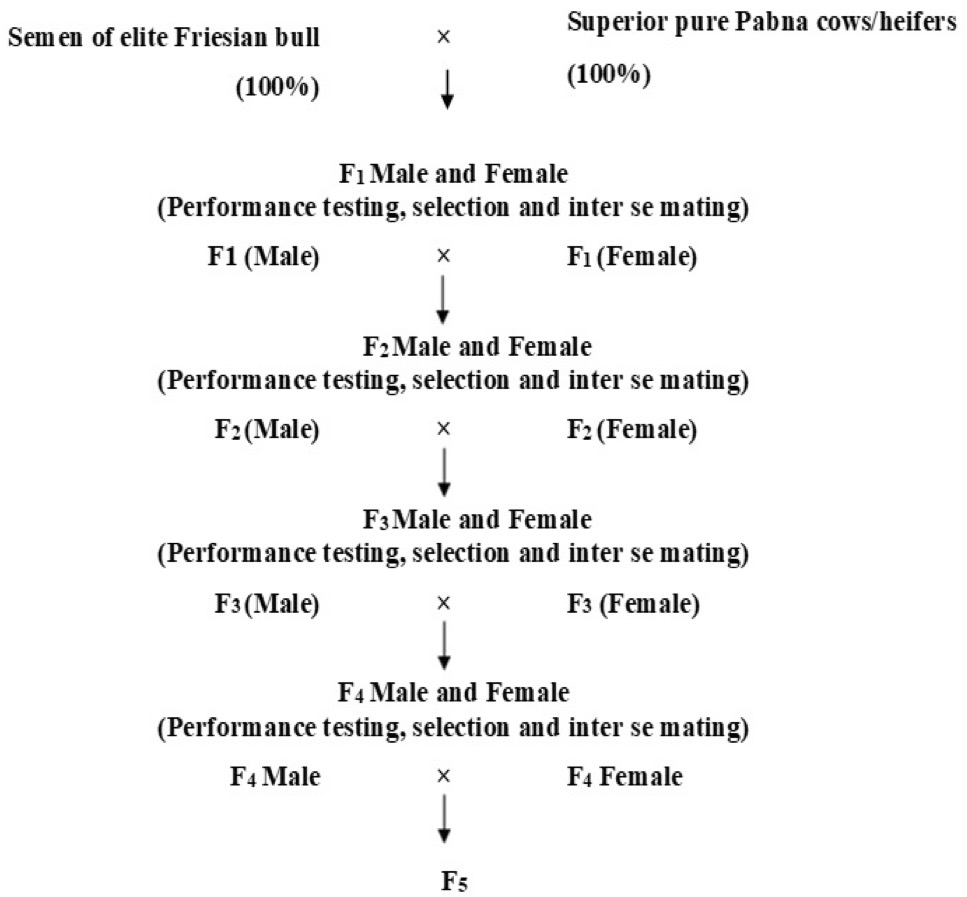
Schematic diagram of the crossbreeding programme.
Measurement of live weight and average daily gain
Record keeping is a crucial component of effective management and scientific evaluation on a research farm. In the present study, each animal was identified using a unique ear-tag number, and the birth weight of every calf was recorded immediately after birth. To monitor growth performance, live body weight was measured at regular 90-day intervals throughout the study period. All weight measurements were taken by the same trained personnel in the morning before feeding and watering to minimize variation caused by gut fill. Average daily gain (ADG) was calculated to assess cattle growth performance during the experimental period. Animals were weighed regularly throughout the study period to monitor growth trends. ADG was calculated using the following formula:
ADG (kg/day) = [Final live weight (kg) - Initial live weight (kg)] / Number of days between measurements.
Feeds and feeding
Feed was provided at 3.5% of the animal’s body weight on a dry matter basis. Under the total roughage feeding system, two-thirds of the roughage consisted of straw, while the remaining one-third was supplied as green fodder. Among the green roughages, one-third was leguminous fodder, and the remainder was non-leguminous fodder. During periods when green fodder was unavailable for approximately 2-3 months of the year, silage was used as an alternative. A concentrate mixture containing wheat bran, khesari bran, soybean meal, crushed maize, crushed wheat, DCP, vitamin-mineral premix, and salt was fed at 1.25% of the animal’s body weight. This concentrate was offered twice daily, in the morning and afternoon. In the absence of green grass or silage, urea-molasses-treated straw was used as the basal feed. Clean drinking water was made available to the animals at all times in a separate manger. The composition of the concentrate mixture is presented in Table I.
Table I. Composition of concentrate mixer.
| S. No. | Name of feed ingredients | Percentage (%) |
| 1 | Wheat bran | 30 |
| 2 | Kheshari bran | 25 |
| 3 | Wheat crashed | 11 |
| 4 | Maize crashed | 10 |
| 5 | Soybean meal | 20 |
| 6 | Di calcium Phosphate (DCP) | 02 |
| 7 | Salt | 01 |
| 8 | Vitamin Mineral Premix | 01 |
| Total | 100 | |
| ME value of the mixture (MJ/Kg DM) | 11.53 | |
ME, Metabolizable energy; DM, Dry matter.
Husbandry practices
The animals were fed twice daily by offering equal portions of the total feed at 08:00 and 16:00 h. Hand milking was carried out twice daily for all cows, once in the morning at 07:00 and once in the afternoon at 16:00. To ensure biosecurity, all milking utensils and the milkman’s hands were cleaned regularly with disinfectant. The manger, udder, teats, and flank of each animal were cleaned before milking. A small amount of mustard oil was applied to the teats to facilitate smooth and rapid milking and minimize teat injury. Special attention was given to the management and welfare of lactating animals throughout the lactation period. Vaccines against anthrax, haemorrhagic septicaemia (HS), lumpy skin disease (LSD), and foot-and-mouth disease (FMD) were administered throughout the year. Deworming was performed quarterly based on faecal analysis at the animal health laboratory, and anthelmintics were administered according to age and body weight.
Data collection
Data on productive and reproductive traits were collected from 62 purebred PC and 51 F1 crossbred cattle (50% HF × 50% Pabna). The records covered the period from 2020 to 2024.
Milk sample collection
Milk yield data were sourced from the official milk recording system. For compositional analysis, milk samples (100 mL per cow) were collected from all cows during a single milk-recording session. The collected samples were immediately refrigerated at 4°C and transported to the laboratory of Pran Dairy Limited, Pabna, Bangladesh, for chemical analysis. Major milk components were measured using an ultrasonic milk analyzer (MT-25, Wincom Company Ltd., Hunan, China), following the procedure described by Saha et al. (2024). To estimate 4% fat-corrected milk (FCM) yield, the following formula was used:
FCM (kg/d) = 0.4 × milk yield (kg/d) + 15 × fat yield (kg/d).
Energy-corrected milk (ECM) yield was calculated using the following formula:
ECM (kg/d) = (0.327 × milk yield) + [12.95 × fat (%) × milk yield / 100] + [7.65 × protein (%) × milk yield / 100] .
Statistical analysis
The collected data were entered and organized using Microsoft Excel (Microsoft Corporation, Redmond, WA, USA). Descriptive statistics, including percentages, means, and standard deviations (SD), were calculated for milk yield and related production parameters. Statistical analyses were performed using IBM SPSS Statistics version 22.0 (IBM Corp., Armonk, NY, USA). Data were expressed as mean ± standard error of the mean (SEM). An independent-samples t-test was applied to determine significant differences in body weight and average daily gain between cattle genotypes at different age groups. Analysis of variance (ANOVA) was performed where applicable to compare variations among different groups. Statistical significance was considered at P<0.05. In addition, Pearson’s correlation analysis was conducted using RStudio version 4.5.0 to evaluate relationships among milk composition traits.
RESULTS
Productive performance
Table II presents the productive performance of F1 crossbred (50% HF × 50% Pabna) and purebred PC. Body weights at birth, 6 months, 12 months, 18 months, and 24 months of age showed highly significant (P<0.001) differences between F1 crossbred and purebred PC. Total milk yield and average milk yield after 210 days of lactation were also significantly higher in the F1 crossbreds.
Figure 2 presents the ADG of purebred PC and F1 crossbred cattle (50% HF × 50% Pabna). Compared with purebred PC, the ADG of F1 crossbred cattle was significantly higher (P<0.001) between 6 and 12 months of age. Significant differences (P<0.05) were also observed in average daily weight gain between the two groups from birth to 6 months, 18 to 24 months, and birth to 24 months.
Fig. 2. Average daily gain (ADG) from birth to 24 years old of F1 crossbred (50% HF × 50% Pabna) and purebred Pabna cattle.
Table II. Productive performance of F1 crossbred (50%HF× 50% PC) and purebred Pabna cattle.
| Parameters | Crossbred Mean ±SE (n) |
Purebred Pabna Mean ±SE (n) |
Level of significance |
| Birth weight (kg) | 22.14±0.33 (57) | 18.86±0.23 (101) | *** |
| 6-month (kg) | 96.21±3.75 (36) | 80.92±1.77 (55) | *** |
| 12-month(kg) | 189.48±4.82(23) | 117.91±2.61(43) | *** |
| 18-month(kg) | 232.31±5.53 (16) | 171.32±7.04 (24) | *** |
| 24-month(kg) | 276.93±5.64 (11) | 245.47±9.97 (19) | ** |
| TMY (kg) at 240 days | 1725.04 ±156.26 (12) | 692.57± 39.75 (27) | *** |
| AMY (kg/day) at 240 days | 7.19 ± 0.65 (12) | 2.89 ±0.16 (27) | *** |
***p < 0.001, **p < 0.01, TMY, total milk yield; AMY, average daily milk yield; SE, standard error; n, number of animals.
Table III. Milk composition of F1 crossbred (50% HF × 50% Pabna) and purebred Pabna cows.
| Parameters | Crossbred Mean ± SE(n) |
Purebred Pabna Mean ± SE(n) |
Level of significance |
| Fat, % | 4.68 ± 0.21(12) | 5.89 ± 0.48(12) | * |
| SNF, % | 8.58 ± 0.73(12) | 9.73 ± 0.81(12) | ** |
| Lactose, % | 4.71 ± 0.12(12) | 5.34 ± 0.14(12) | ** |
| Protein, % | 3.14 ± 0.08(12) | 3.56 ± 0.09(12) | ** |
| Salt, % | 0.70 ± 0.01(12) | 0.80 ± 0.02(12) | ** |
| FCM yield (kg/d) | 8.9 ± 0.44 (12) | 3.22 ± 0.49 (12) | *** |
| ECM yield (kg/d) | 8.87 ± 0.39 (12) | 3.75 ± 0.53 (12) | *** |
***p < 0.001, **p < 0.01, *p < 0.05, SE, Standard Error; n, Number of animals: 4% fat-corrected milk yield (FCM)= 0.4 × milk yield (kg/d) + 15 × fat yield (kg/d), Energy-corrected milk yield (ECM) = (0.327 × milk yield) + (12.95% × fat × milk yield/100) + (7.65% × protein × milk yield/100), SNF, Solids Not Fat.
Table III shows the milk composition of purebred Pabna cows and F1 crossbred cows (50% HF×50% Pabna). Milk composition values were significantly greater in purebred Pabna cows than in F1 crossbred cows.
Reproductive performance
The reproductive performance of F1 crossbred and purebred Pabna cows is presented in Table IV. AP and SPC did not differ significantly (P>0.05) between F1 crossbred and PC cows. However, F1 crossbreds had significantly higher weight at puberty (P<0.01) than PC cows. AFS was significantly lower (P<0.05) in F1 crossbred cattle than in PC. In addition, AFC was significantly lower (P<0.05) in F1 crossbred cattle than in PC.
Table IV. Reproductive performance of F1 crossbred (50% HF × 50% Pabna) and purebred Pabna cows.
| Parameters | Crossbred Mean ±SE(n) |
Purebred Pabna Mean ±SE(n) |
Level of significance |
| AP (days) | 692.36±37.14(16) | 760.14±55.14 (112) | NS |
| WP (kg) | 256.97±7.23(16) | 179.57±7.47 (112) | *** |
| AFS (days) | 709.57±41.73(14) | 855.57±30.38(101) | * |
| AFC (days) | 1003.38±45.24 (14) | 1130.57±31.04 (101) | * |
| SPC (number) | 1.23± 0.53 (15) | 1.304±0.76 (101) | NS |
***p< 0.001, *p < 0.05, NS, Non-significant (p > 0.05); AP, Age at Puberty; WP, Weight at Puberty; AFS, Age at first service; AFC, Age at first calving; SPC, Service per conception; SE, Standard Error; n, Number of animals.
Correlation coefficient of milk composition
To assess the relationships among milk attributes, correlation coefficients for milk composition were calculated for both PC and crossbred cows. Figure 3 shows the Pearson correlation matrices of milk yield and different milk attributes in PC and HF crossbred cows, respectively. Strong negative correlations were found in PC milk between yield and lactose (-0.39, P<0.001), protein (-0.40, P<0.001), fat (-0.51, P<0.001), and salt (-0.45, P<0.001). In HF crossbred milk, significant negative correlations were found between milk yield and fat (-0.34, P<0.01) and between milk yield and salt (-0.30, P<0.01).
Fig. 3. Pearson correlation matrix of milk yield and milk attributes of Pabna cows (A) and F1 crossbred (50% HF × 50% Pabna) cows (B). Data represent 12 lactating Pabna cows of the same lactation. Milk was collected from all cows during a single milk-recording session, and composite milk samples were prepared.
DISCUSSION
Growth performance
The present study was carried out to compare the productive and reproductive performance of F1 crossbred cattle (50% HF × 50% Pabna) with that of the purebred PC especially with respect to growth, milk production and reproductive traits. The two genotypes were reared under an intensive production system, with similar housing, feeding and environmental conditions, thus minimizing the effect of management-related variation. Such comparative evaluation is particularly relevant for Bangladesh where indigenous cattle are generally characterized by low milk-producing capacity and crossbreeding with high-yielding exotic breeds, particularly HF, is widely practiced to improve dairy productivity.
The mean birth weight of F₁ crossbred calves (22.14 ± 0.33 kg) was significantly higher than that of purebred Pabna calves (18.86 ± 0.23 kg), indicating the favorable influence of HF inheritance on prenatal growth. This result is consistent with the results of Subrata (2022) who reported birth weights of 19.2 kg in purebred Pabna calves and 26.3 kg in 50% Pabna × HF crossbred calves. Similarly, Rokonuzzaman et al. (2009) observed that Local × Friesian calves had greater birth weight (22.5 ± 0.4 kg) compared to indigenous local calves (17.0 ± 0.4 kg). These consistent differences suggest that the introduction of exotic dairy germplasm can increase fetal growth and neonatal body weight, although the magnitude of improvement may be influenced by parental genotype, maternal size, parity, prenatal nutrition, and management conditions. The birth weight of crossbred calves in the present study was lower than the value of 29.77 ± 1.03 kg reported for 50% Friesian × 50% Local calves by Azad et al. (2023). Differences in the genetic characteristics of the indigenous dam population, selection history of the Friesian sires, maternal nutritional status, calf sex, gestation length and production environment could explain such variation between studies. Higher birth weights of F 1 crossbred calves compared with nondescript indigenous cattle were also reported by Mekonnen et al. (2020), which further supports the contribution of exotic inheritance and heterosis to improved early growth. However, very high calf birth weight may predispose to the risk of dystocia especially in small-framed indigenous dams. Therefore, the increase in birth weight by crossbreeding must be considered along with the calving ease, dam physique, and neonatal survival.
The present study also demonstrated the growth advantage associated with crossbreeding as the F₁ crossbreds exhibited superior body weight and body-weight gain. This is in agreement with the finding of Saha et al. (2024) who reported that crossbred cattle in Bangladesh had greater body length, heart girth; wither height and body-condition score than the local cattle. Similar advantages of crossbred cattle have also been reported under smallholder production systems in Kenya . The better growth performance may be due to additive effects of HF genes, heterosis, and improved feed-utilization capacity. However, the expression of this genetic potential is likely to depend on the availability of adequate nutrients and herd management practices since animals with a greater proportion of exotic inheritance generally have increased maintenance and production requirements.
Breed had a significant effect on average daily gain. The daily gain of F1 crossbred cattle was 0.46 kg/day which was significantly higher (p < 0.001) than pure PC (0.21 kg/day) between the ages of 6 and 12 months. So, during this time, the crossbred animals grew more than twice as fast as their purebred counterparts. This is consistent with previous studies which reported significantly higher average daily gain in crossbred cattle than indigenous cattle ; Siddique et al., 2015). The marked difference indicates that the F 1 genotype can attain breeding or productive body weight at an earlier age possibly minimizing the non-productive rearing period and increasing lifetime production efficiency.
Overall, the results suggest that the inclusion of 50% HF inheritance in PC significantly improves birth weight and postnatal growth under intensive management. The performance benefit of the F1 animals is likely to be due to a combination of the better growth potential of the exotic parent breed and heterotic effects due to mating genetically diverse populations. However, the long-term suitability of this genotype cannot be judged on the basis of growth performance alone. In formulating sustainable crossbreeding strategies for dairy production systems in Bangladesh, consideration should also be given to feed requirements, heat tolerance, disease resistance, fertility, calving difficulty, survivability, and economic returns.
Milk yield
The present study revealed that 50% HF × 50% Pabna crossbred cows had a significantly higher milk production than purebred Pabna cows. The average daily milk yield of crossbred cows was about 2.5-fold higher than that of purebred animals, indicating a strong positive effect of HF inheritance on lactation performance. This improvement is in line with earlier reports from Bangladesh and other tropical production systems where the introduction of Bos taurus genetics in indigenous cattle populations resulted in significant improvements in milk yield. Crossbred cows had 42.4% higher milk yield (10.89 vs. 7.65 kg/day) and 35.3% higher fat-corrected milk (10.35 vs. 7.54 kg/day) than Bangladeshi local cattle . Likewise, Galukande et al. (2013) found that the cows with 50% Bos taurus inheritance produced about 2.6 times more milk than indigenous cattle under highland climatic conditions.
The magnitude of milk production improvement observed in the present study is comparable with previous findings from different regions of Bangladesh. Previous studies showed daily milk yields of 6.03 ± 0.5 kg by 50% Local × 50% Friesian cattle in Comilla , 7.64 ± 1.74 kg by Holstein crossbreds in Mymensingh , 10.07 ± 0.54 L by 50% Holstein × 50% Desi cattle , 8.39 ± 2.01 L by Friesian–Local crossbreds , and 6.65 ± 0.19 L by Local–Friesian crossbreds in the greater Rajshahi region . However, relatively lower milk yields have also been recorded, such as 3.36 ± 0.03 L/day in Friesian–Local crossbred cattle at the Central Cattle Breeding and Dairy Farm, Savar , and 3.96 L/day in 50% Holstein × 50% Local crossbred cattle . Differences between studies may be associated with variation in genetic composition, lactation stage, feeding quality, climatic stress, farm management practices and selection intensity of breeding populations.
The higher milk yield of crossbred cows in the present study may be attributed to the greater genetic potential of HF inheritance for mammary development, milk synthesis capacity and nutrient partitioning toward lactogenesis. The combination of additive genetic effects and heterosis can improve productive traits in crossbred animals especially when proper feeding and management conditions permit the expression of their genetic potential. Both genotypes in this study were kept under the same intensive management conditions. Therefore, the observed differences are more likely to be due to genetic superiority than environmental variation.
Crossbred cows had significantly higher milk volume, but lower percentages of major milk components such as fat, protein and lactose, compared to purebred Pabna cows. This inverse relationship between milk quantity and milk solids concentration is commonly observed when high-yielding exotic dairy genetics are crossed into indigenous populations. Islam et al. (2008) also found higher fat and protein percentages in the milk of indigenous cattle compared with Holstein-crossed cattle. The lower concentration of milk solids in crossbred cows may be due to dilution effects associated with increased milk secretion. Genetic differences influencing milk component synthesis may also be a factor. Indigenous breeds tend to produce less milk but with higher concentrations of fat and protein, which is indicative of their adaptation to production systems with low inputs that are focused on survival and energy saving.
Although the percentage composition of milk constituents was lower, the crossbred cows gave distinctly higher fat-corrected milk (FCM) and energy-corrected milk (ECM) yields which were 2.76 and 2.36 times higher than those of purebred Pabna cows, respectively. The results suggest that crossbreeding considerably enhanced the total nutritional and economic value of milk production. Similar increase in FCM production of crossbred cattle over indigenous cattle was reported by Saha et al. (2024). Thus, the lactation efficiency of crossbred animals relative to dairy animals may be underestimated if only the percentage of milk components is considered; the total solids output and energy corrected production are more appropriate measures for the lactational efficiency.
The results in general confirmed that 50% HF × 50% Pabna crossbreeding significantly improves the milk production potential under intensive management condition in Bangladesh. However, the decrease in the concentration of milk components emphasizes the need to balance production improvement with the quality characteristics of milk. Future breeding strategies should therefore be aimed at optimizing the proportion of exotic inheritance to achieve a desirable combination of high milk yield, acceptable milk composition, adaptability, reproductive efficiency and economic sustainability under tropical production environments.
Reproductive performance
The reproductive performance in crossbred (50% HF × 50% Pabna) and purebred PC was different in different reproductive traits. There was no significant difference in age at puberty (AP) between the two genotypes, however, crossbred cows showed a numerically earlier age at puberty in comparison to purebred PC. This is contrary to the finding by Siddika et al. (2024) who reported that puberty was significantly earlier in crossbred cattle than indigenous cattle. The earlier age of first conception generally observed in crossbred animals is attributed to the effect of Bos taurus inheritance resulting in faster growth, earlier attainment of critical body weight and better development of the reproductive system. However the expression of this genetic advantage is highly dependent on nutritional status, growth rate, body condition and management practices. Thus, the lack of a significant difference in AP in the present study may be due to the similar intensive management conditions and nutritional availability provided to both genotypes.
WP was higher in crossbred cows (256.97 ± 7.23 kg) than in purebred Pabna cows, showing better growth potential and earlier acquisition of reproductive physiological maturity. The observed WP was also higher than the value reported by Azad et al. (2023) for 50% Holstein × 50% local cows (175.27 ± 8.15 kg). Similarly, the age at first service (AFS) of 22.90 ± 0.81 months reported in their study also supports the trend of improved reproductive development of crossbred cattle. The increased body weight at puberty in the present study may be a reflection of the combined effects of increased growth potential, heterosis effects and increased efficiency of nutrient utilization associated with HF inheritance.
Age at first calving (AFC) was lower in crossbred cows than in purebred Pabna cattle indicating improved reproductive efficiency of the crossbred genotype. This observation is consistent with the report of Paul et al. (2013) who observed significantly earlier first calving in crossbred cows (31.2 ± 1.3 months) than indigenous cows (37.6 ± 1.3 months; p<0.01). However, relatively similar AFC values between Friesian × Desi and Shahiwal × Desi cows were reported by Afrin et al. (2022), indicating that the magnitude of reproductive improvement by crossbreeding may vary by breed composition and production environment. Calving earlier is economically advantageous because it decreases the non-productive period and facilitates entry into the lactating herd earlier, thus increasing lifetime production.
No significant difference was observed in service per conception (SPC) between crossbred and purebred cows in the present study. This finding is in conformity with the report of Alam et al. (2008) who reported similar SPC values in indigenous, Desi × Friesian and Desi × Shahiwal cows. Hossain et al. (2005) found higher SPC values in crossbred cows than indigenous cows, implying greater variability in reproductive performance across different crossbreeding systems. Several interrelated factors contribute to differences in SPC, including accuracy of estrus detection, timing of artificial insemination, semen quality, inseminator skill, postpartum nutritional status, body condition score and overall herd management. Thus, before concluding on the genetic superiority, the reproductive performance of crossbred cattle should be evaluated under standardized management conditions.
The overall reproductive findings indicate that the 50% HF × 50% Pabna crossbred cows have improved reproductive potential, mainly due to higher pubertal weight and lower age at first calving, while having comparable conception efficiency to the indigenous cattle. These benefits suggest that small amounts of exotic inheritance can increase reproductive efficiency without much loss of adaptation in Bangladeshi production conditions.
Correlation of milk production with milk components
Correlation patterns between milk yield and milk compositional characteristics were different between purebred Pabna and crossbred cows, which might be due to differences in genetic background, lactation physiology and nutrient partitioning. The milk yield of purebred Pabna cows significantly and negatively correlated with fat, protein, lactose and salt contents indicating that higher volume of milk was associated with lower concentration of major milk constituents. On the contrary, significant negative association of fat and salt contents were observed with milk yield in crossbred cows. Similar negative associations between milk yield and compositional traits were previously reported by Kebede (2018) and Baset et al. (2016).
The negative relationship between milk yield and milk components may be a result of a dilution effect, where an increase in the secretion of milk volume results in a decrease in the concentration of specific solids. This phenomenon is well observed in high producing dairy genotypes where metabolic resources are preferentially allocated to milk synthesis at the expense of higher concentrations of milk constituents. The negative correlation between fat and protein in this study is consistent with the findings of Huhtanen and Rinne (2007), who also reported an inverse relationship between these major milk constituents. Breed-related differences also influence milk composition, with indigenous cattle producing milk with higher fat and protein contents, whereas crossbred animals have a higher milk volume, as reported by Atasever et al. (2020).
Relatively lower fat percentage milk but higher total milk yield was obtained from crossbred cows. Fat production was higher in crossbred than pure bred Pabna cows. This emphasizes the necessity to consider the total yield of the component, instead of the concentration, to evaluate the dairy productivity. Dietary factors, especially the quality of forage and supplementation of concentrate, also play a significant role in milk fat concentration and are of great economic importance in dairy production systems .
Milk protein was positively correlated with other compositional characteristics. In Pabna milk protein of cattle showed positive correlation with density (r=0.60; p<0.001), salt (r=0.85; p<0.001) and fat (r=0.54; p<0.001). Likewise, in crossbred cows protein was positively correlated with density (r=0.80; p<0.001), salt (r=0.67; p<0.001) and fat (r=0.38; p<0.05). These relationships show that higher levels of protein are generally associated with higher levels of milk solids and physical properties of milk. Genotypes had opposite relationships with milk conductivity. In purebred Pabna cows, conductivity was weakly associated with most milk components, but in crossbred cows it was strongly negatively correlated with protein, fat, salt and density. This indicates that conductivity might be more sensitive to ionic imbalance and physiological udder status in high producing crossbred cows. Indeed, Norberg et al. (2004) have also described similar relationships between milk conductivity and udder health indicators. In addition, Yanthi et al. (2018) reported that milk density increases with increasing concentrations of major solids such as lactose and protein.
Together, these results show a distinct production-quality trade-off between the two genotypes. Purebred Pabna cattle produce better compositional qualities of milk, whereas, HF × PC cows produce much higher volume of milk with acceptable milk quality. Thus, the selection strategies need to consider both total milk production and compositional characteristics for sustainable dairy improvement under Bangladesh conditions.
CONCLUSION
The present study revealed that the 50% HF × 50% Pabna crossbred cattle outperformed the purebred Pabna cattle in productive performance under intensive management conditions. The crossbreds had higher birth weight, weight gain and average daily gain, suggesting higher growth potential due to the advantage of exotic inheritance and heterotic effects. In addition, crossbred cows produced significantly higher milk yield, fat-corrected milk (FCM) and energy-corrected milk (ECM) confirming their superior lactation efficiency. The milk of purebred Pabna cows had relatively higher fat, protein and other solids but the higher milk yield of crossbred cows resulted in higher total nutrient yield. Reproductive performance was also improved, especially higher pubertal weight and lower age at first calving with similar service per conception. Thus, the 50% HF × 50% Pabna genotype is a promising dairy crossbred population for the improvement of milk productivity in Bangladesh. But, for successful development of dairy under changing climatic conditions, long-term breeding strategies must consider not only adaptability but also production efficiency, reproductive sustainability, heat tolerance, disease resistance and economic feasibility.
DECLARATIONS
Acknowledgements
The authors thank Pran Dairy Limited for providing laboratory support. The authors also thank Bangladesh Livestock Research Institute for providing funding.
Funding
This work was supported by the revenue research budget of Bangladesh Livestock Research Institute.
Data availability
Data will be made available upon reasonable request.
Ethical approval
The Institutional Animal Experimentation Ethics Committee of Bangladesh Livestock Research Institute approved the conduct of this breeding experiment. The ethical approval number is AEEC/BLRIJ001/2021.
Generative AI and AI-assisted technology
The authors declare that no generative AI or AI-assisted technologies were used to generate, analyse, or interpret the research data. Generative AI tools were used only to assist in improving the grammar and readability of the manuscript during the initial stage, and all scientific interpretations and conclusions are entirely the authors’ own.
Statement of conflict of interest
The authors have declared no conflict of interest.
References
- Afrin, M.S., Asad, L.Y. and Rahman, M.I., 2022. Performance of different crossbred cattle in Dhaka district. Sher-e-Bangla Agric Univ., Bangladesh.
- Alam, M.M., Sarder, M.J.U., Ferdousi, Z. and Rahman, M.M., 2008. Productive and reproductive performance of dairy cattle in char areas of Bangladesh. Bangladesh J. Anim. Sci., 25: 68-74. https://doi.org/10.3329/bvet.v25i2.4620 [CrossRef]
- Atasever, S., Vaiz, A., Garipoglu and Erdem, H., 2020. Effects of feeding management on milk yield and composition traits in crossbred Jersey cows. Pakistan J. Zool., 52: 1511–1516. https://doi.org/10.17582/journal.pjz/20190129110110 [CrossRef]
- Azad, A., Mou, M., Hridoy, M., Azam, S., Safa, M. and Bhuiyan, A., 2023. Production performance, breeding practices and challenges of Holstein–local crossbred cattle in selected areas of Bangladesh. Bangladesh J. Anim. Sci., 52: 69–77. https://doi.org/10.3329/bjas.v52i3.69207 [CrossRef]
- Banerjee, G.C., 2018. A textbook of animal husbandry. Oxford and IBH Publishing, Oxford.
- Baset, M., Huque, K., Sarker, N., Hossain, M., Islam, M., 2016. Effect of season, genotype and lactation on milk yield and composition of local and crossbred dairy cows reared under different feed base region. Bangl. J. Livest. Res., 19: 50–65. https://doi.org/10.3329/bjlr.v19i1-2.26427 [CrossRef]
- Bhuiyan, M.S.A., Lee, S.H., Hossain, S.M.J., Deb, G.K., Afroz, M.F. and Bhuiyan, A.K.F.H., 2021. Unravelling the genetic diversity and population structure of Bangladeshi indigenous cattle populations using 50K SNP markers. Animals (Basel), 11: 2381. https://doi.org/10.3390/ani11082381 [CrossRef]
- Department of Livestock Services, 2024. Livestock economy at a glance 2023–24. Department of Livestock Services, Ministry of Fisheries and Livestock, Government of the People’s Republic of Bangladesh, Dhaka.
- Galukande, E., Mulindwa, H., Wurzinger, M., Roschinsky, R., Mwai, A.O. and Sölkner, J., 2013. Cross-breeding cattle for milk production in the tropics: Achievements, challenges and opportunities. Anim. Genet. Resour., 52: 111–125. https://doi.org/10.1017/S2078633612000471 [CrossRef]
- Hasan, M.K., Rahman, M.A., Mahbub, A.S., Belal, S.A. and Ahmed, T., 2014. Performance of different crossbred cattle at Comilla district of Bangladesh. J. Sylhet Agril. Univ., 1: 161–167.
- Hoque, M., Shejuty, S., 2022. Evaluation of growth performance of Grade-2 Brahman crossbred progeny in a farmers’ participatory beef breeding program. J. Sci. Technol. Res., 3: 85–94. https://doi.org/10.3329/jscitr.v3i1.62810 [CrossRef]
- Hossain, M., Alam, M., Rashid, M., Asaduzzaman, M. and Rahman, M., 2005. Small-scale dairy farming practice in a selected area of Bangladesh. Pak. J. Nutr., 4: 215–221. https://doi.org/10.3923/pjn.2005.215.221 [CrossRef]
- Huhtanen, P. and Rinne, M., 2007. Effects of increasing the milk yield of dairy cows on milk composition. J. Anim. Feed Sci., 16: 42–58. https://doi.org/10.22358/jafs/74111/2007 [CrossRef]
- Islam, M.A., Sarder, M.J.U., Jahan, S.S. and Islam, M.H., 2016. Evaluate the productive and reproductive performance considering genotypes of dairy cows. Int. J. Nutr. Fd. Sci., 5: 10–15.
- Islam, M.R., Hassan, M.N., Siddiki, R., Khan, M.A.S. and Islam, M.A., 2008. Determination of the quality of milk from different genotypes of dairy cows. Bangladesh J. Anim. Sci., 37: 53–56. https://doi.org/10.3329/bjas.v37i1.9868 [CrossRef]
- Islam, M.S., Akhtar, A., Hossain, M.A., Rahman, M.F. and Hossain, S.S., 2017. Reproductive performance and repeatability estimation of some traits of crossbred cows in Savar dairy farm. J. environ. Sci. Nat. Resour., 10: 87–94. https://doi.org/10.3329/jesnr.v10i2.39017 [CrossRef]
- Kebede, F., Dessie, T., Beyts, C., Matika, O. and Watson, K., 2025. Integrating genetic, environmental, and phenotypic information in within and between breed evaluation of livestock for smallholder farmers in the tropics. CABI Rev., 1: 1–14. https://doi.org/10.1079/animalsciencecases.2024.0010 [CrossRef]
- Kebede, E., 2018. Effect of cattle breeds on milk composition in the same management conditions. Ethiop. J. agric. Sci., 28: 53–63.
- Khoda, M., Sarker, N., Bhuiyan, A. and Bhuiyan, M., 2015. Evaluation of productive and reproductive performances of crossbred and Deshi dairy genotypes in Bangladesh. Int. J. Nat. Soc. Sci., 2: 6–13.
- Knob, D., Thaler, N., Schweizer, H., Weigand, A., Kappes, R. and Scholz, A., 2021. Genetic and management factors affecting dairy cattle performance. Animals, 11: 309. https://doi.org/10.3390/ani11020309 [CrossRef]
- Lesosky, M., Dumas, S., Conradie, I., Handel, I.G., Jennings, A. and Thumbi, S., 2013. A live weight–heart girth relationship for accurate dosing of East African shorthorn zebu cattle. Trop. Anim. Hlth. Prod., 45: 311–316. https://doi.org/10.1007/s11250-012-0220-3 [CrossRef]
- Lukuyu, M.N., Gibson, J.P., Savage, D.B., Duncan, A.J., Mujibi, F.D.N. and Okeyo, A.M., 2016. Use of body linear measurements to estimate live weight of crossbred dairy cattle in smallholder farms in Kenya. SpringerPlus, 5: 1–14. https://doi.org/10.1186/s40064-016-1698-3 [CrossRef]
- Mamun, M., Khan, M., Sarker, M. and Islam, M.N., 2015. Productive and reproductive performance of Holstein Friesian crossbred and indigenous cows under smallholder farming systems. Bangladesh J. Anim. Sci., 44 166-170. https://doi.org/10.3329/bjas.v44i3.26367 [CrossRef]
- Mekonnen, T., Tadesse, Y. and Meseret, S., 2020. Genetic improvement strategy of indigenous cattle breeds: Effect of crossbreeding on production performance. J. appl. Life Sci. Int., 23: 23–40. https://doi.org/10.9734/jalsi/2020/v23i130140 [CrossRef]
- Norberg, E., Hogeveen, H., Korsgaard, I.R., Friggens, N.C., Sloth, K.H. and Løvendahl, P., 2004. Electrical conductivity of milk: Ability to predict mastitis status. J. Dairy Sci., 87: 1099–1107. https://doi.org/10.3168/jds.S0022-0302(04)73256-7 [CrossRef]
- Ojango, J.M.K., Wasike, C.B., Enahoro, D.K. and Okeyo, A.M., 2016. Dairy production systems and adoption of genetic and breeding technologies. Anim. Genet. Resour., 59: 81–95. https://doi.org/10.1017/S2078633616000096 [CrossRef]
- Paul, A.K., Maruf, A.A., Jha, P.K. and Alam, M.G.S., 2013. Reproductive performance of crossbred and indigenous dairy cows under rural conditions. J. Embryo Transf., 28: 319–324. https://doi.org/10.12750/JET.2013.28.4.319 [CrossRef]
- Rokonuzzaman, M., Hassan, M.R., Islam, S. and Sultana, S., 2009. Productive and reproductive performance of crossbred and indigenous dairy cows under smallholder farming systems. J. Bangladesh Agric. Univ., 7: 69–72. https://doi.org/10.3329/jbau.v7i1.4801 [CrossRef]
- Saha, S., Hasan, M., Uddin, M., Rahman, M., Khan, M. and Ahmed, S., 2024. Comparison between crossbred (Holstein × local) and Bangladeshi local cattle for body and milk quality traits. Dairy, 5: 153–160. https://doi.org/10.3390/dairy5010012 [CrossRef]
- Siddika, M.A., Asad, L.Y., Hossain, M.M., Ferdous, M. and Nath, S., 2024. Productive and reproductive performance of indigenous and crossbred cows bred artificially in rural area of Gaibandha district. IOSR J. Agric. Vet. Sci., 17: 19–27.
- Siddque, M.A.B., Sarker, N.R., Hamid, M.A., Amin, M.N. and Sultana, M., 2015. Growth performance, feed conversion ratio, and economics of production of native and crossbred (Local × Holstein Friesian) bulls for fattening under different improved feeding. J. Agric. Sci. Technol., 5: 770-781. https://doi.org/10.17265/2161-6256/2015.09.008 [CrossRef]
- Solaiman, M., Sorowar, G.M., Mahbubul, M., Hossain, F., Islam, M.A. and Chanda, T., 2022. Evaluation of milk yield performance of Friesian crossbred cows with different blood levels in Barishal district. Malays. Anim. Husb. J., 2: 1–4. https://doi.org/10.26480/mahj.01.2022.01.04 [CrossRef]
- Subrata, K.P., 2022. Performance of Pabna cattle under subsistence farming system in the northern districts of Bangladesh. MS Thesis, Chattogram Veterinary and Animal Sciences University, Chattogram.
- Tadesse, A.W., 2021. Review on reproductive and productive performance of dairy cows in Ethiopia. Int. J. Ecotoxicol. Ecobiol., 6: 14. https://doi.org/10.11648/j.ijee.20210601.13 [CrossRef]
- Usman, T., Guo, G., Suhail, S.M., Ahmed, S., Qiaoxiang, L. and Qureshi, M.S., 2012. Performance traits of Holstein Friesian cattle under subtropical conditions. Proc. Int. Workshop Dairy Sci. Park., 22: 92–95.
- VanRaden, P.M. and Sanders, A.H., 2003. Economic merit of crossbred and purebred US dairy cattle. J. Dairy Sci., 86. https://doi.org/10.3168/jds.S0022-0302(03)73687-X [CrossRef]
- Welderufael, B., Houaga, I., Gaynor, R.C., Gorjanc, G. and Hickey, J.M., 2025. Accurate determination of breed origin of alleles in a simulated smallholder crossbred dairy cattle population. Genet. Sel. Evol., 57: 35. https://doi.org/10.1186/s12711-025-00985-z [CrossRef]
- Yanthi, N.D., Said, S., Anggraeni, A. and Damayanti, R.M., 2018. Correlation of electric conductivity values with the dairy milk quality. J. Ilmu Ternak Vet., 23: 82–88. https://doi.org/10.14334/jitv.v23i2.1694 [CrossRef]

Services
Article usage statistics
Loading…
Related articles
- Comparative Assessment of Productive and Reproductive Traits in Holstein Friesian, Jersey, Sahiwal, and Indigenous Dairy Cows of Bogura District in BangladeshResearch Journal for Veterinary Practitioners · 2025
- Evaluation of Milk Yield, Quality, Feed Efficiency, and Economic Performance of Holstein Friesian Crossbred Cows at Long Hoa and Evergrowth Cooperatives in Mekong Delta of VietnamAdvances in Animal and Veterinary Sciences · 2025
- Evaluation of Ovsynch Estrus Synchronization in Holstein Friesian and Holstein Friesian-Jersey Crossbred Cows at District Thatta, Sindh, PakistanPakistan Journal of Zoology · 2024
- Productive and Reproductive Performance of Different Crossbred Dairy Cattle at Kishoreganj, BangladeshVeterinary Sciences: Research and Reviews · 2021
- Principle Component Analysis of Breeding Values Estimated by Six Animal Models for Evaluating Some Productive and Reproductive Traits of Holstein Dairy CattleAdvances in Animal and Veterinary Sciences · 2021
- Growth Performance Evaluation of Belgian Blue Cattle and Their Crossbred in Indonesian Livestock Breeding CentersAdvances in Animal and Veterinary Sciences · 2024