
The impact of the declining trend in the water level of the Caspian Sea on the reproductive conditions of certain species belonging to the genus Phalacrocorax (Microcarbo pygmaeus) and the family Ardeidae (Nycticorax nycticorax, Ardeola ralloides, Bubulcus ibis, Egretta garzetta) in Kyzylagach Bay during 2022–2025 was investigated. During the reproductive period in the bay, the number of individuals of migratory-nesting species exceeds that of sedentary populations by several orders of magnitude. Among the studied species, both sedentary and migratory-nesting populations were observed, whereas Bubulcus ibis was represented exclusively by migratory-nesting populations.The decline in the water level of the Caspian Sea has caused a shift in the reproductive habitats of these bird species from the tamarisk-reed biotopes of Kyzylagach Bay to nearby shelterbelt forest zones, particularly those dominated by Caspian locust (Gleditsia caspica Desf., 1809) and oak (Quercus macrantera Honen, 1838).
Research Article · Online First, 9 November 2026 · Open Access
Impact of Caspian Sea Water Level Decline on the Reproductive Condition of Specific Phalacrocoracidae and Ardeidae Species in the Kyzylagach Bay
· ·
Affiliations & Notes ⌄
- 1Ministry of Science and Education of the Republic of Azerbaijan, Baku State University, Azerbaijan
- 2Baku State University, Azerbaijan
- *Correspondence | Abulfaz Taghiyev; Email: abulfaztagiyev@yahoo.com
Article Info ⌄
- Journal:
- Pakistan Journal of Zoology
- Submitted Date:
- 23 April 2026
- Accepted Date:
- 17 July 2026
- Published Date:
- 9 November 2026

Abstract
Introduction
The coastal biotopes of Kyzylagach Bay in the Caspian Sea are characterized by extensive zonation, habitat diversity, and their location along major bird migration routes. These features make the area particularly significant for the reproduction of aquatic and semi-aquatic migratory-nesting and sedentary bird populations (Mustafayev and Sadigova, 2005; Mustafayev et al., 2011; Mustafayev and Humbatova, 2001; Taghiyev, 2013a, b). However, the decline in water level has led to the emergence of new ecological conditions, resulting in the drying out or degradation of reed beds and tamarisk vegetation. This, in turn, has complicated the reproductive conditions of bird populations. The study of changes in reproductive conditions under these new ecological circumstances is essential for addressing issues related to the conservation of the genetic pool and natural biodiversity ; ; Taghiyev and Karimova, 2021a, 2022). Although some bioecological data exist on Microcarbo pygmaeus, Nycticorax nycticorax, Ardeola ralloides, Bubulcus ibis, and Egretta garzetta along the southwestern coast of the Caspian Sea, the impact of water level decline on their reproductive conditions has not been sufficiently studied. In general, the adaptation of aquatic, semi-aquatic, and other ecological groups of birds to fluctuations in water levels remains poorly understood worldwide ; ; ; ; . In the local scientific literature, recent data on the distribution patterns, reproduction, trophic relationships, and biotopic associations of migratory-nesting aquatic and semi-aquatic bird populations in the Azerbaijani sector of the southwestern Caspian coast are presented in the works of ; ; ; , 2023; , and other authors.
Materials and Methods
The study examined the effects of the declining water level of the Caspian Sea during 2022-2025 on sedentary and migratory-nesting bird populations (Microcarbo pygmaeus, Nycticorax nycticorax, Ardeola ralloides, Bubulcus ibis, Egretta garzetta) inhabiting Kyzylagach Bay (39°10′16″N, 49°13′52″E – 38°50′55″N, 48°51′44″E) during wintering and reproductive periods. The number of individuals within wetland ecosystems was recorded, and the hydrological regime, vegetation structure, and level of anthropogenic impact in selected areas were analyzed. A linear transect method was employed to determine species composition and abundance. Observations were primarily conducted during morning and evening hours. All individuals detected visually or acoustically along the transect were recorded. Behavioral observations were carried out in nesting areas, including the number of nests and eggs, hatching success rates, and causes of reproductive failure. The vertical stratification of nests in trees, as well as tree density and height, were analyzed.
Field studies in the coastal (ecotone) zones of Kyzylagach Bay were conducted using pedestrian surveys, motorised and non-motorised boats, and vehicles along designated transects (39°10′16″N – 49°13′52″E; Fig. 1). Binoculars and a Carl Zeiss telescope were used for observations.
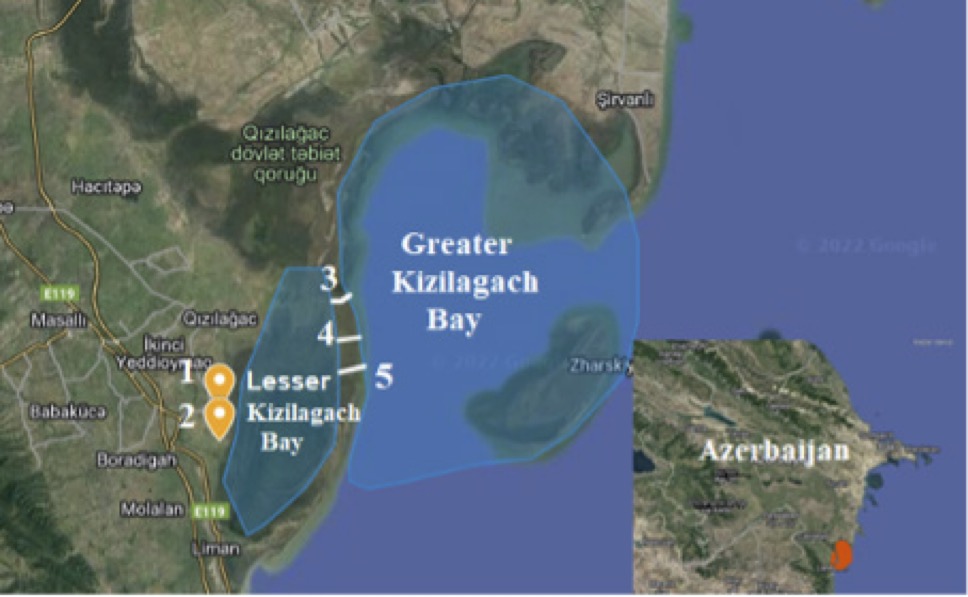
The geographic location of the study area: 1, Tazakand village; 2, Gumbashi village; 3-Fish passing channel; 4, Crash channel; 5, Water flowing channel
Results and Discussion
As a result of the ongoing decline in the water level of the Caspian Sea, spatial differences in water levels have emerged between the northern (39°03′32″N, 48°56′48″E –39°04′21″N, 48°53′27″E) and southern (38°52′32″N, 48°49′43″E) parts of Kyzylagach Bay. The Greater and Lesser Kyzylagach bays are interconnected via the Fish- passing channel (38°05′50″N, 48°55′31″E), Qəza (38°59′10″N, 48°55′25″E), and Spawning (39°04′10″N, 48°54′09″E) channels. The relatively higher water level in the northern part of the bay is maintained by inflow from the Vilash (39°03′31″N, 48°49′01″E) and Akkuşa rivers (39°16′16″N, 48°57′33″E), whereas in the southern part, water flows into the Caspian Sea through the Fish- passing channel , which is situated above sea level, resulting in a decrease in water level. Consequently, these hydrological differences have led to varying impacts on the reproductive conditions of bird populations inhabiting different parts of the bay. Migratory-nesting species such as Microcarbo pygmaeus, Nycticorax nycticorax, Ardeola ralloides, Bubulcus ibis, and Egretta garzetta nested until 2008–2010, as in previous decades, in tall perennial reed beds and tamarisk vegetation located at distances of 500–800 meters or more from the shoreline. However, beginning in 2008, the mass degradation of reed habitats, combined with the continued decline in water levels, led to a sharp deterioration in the reproductive conditions of these bird populations. During the period from 2010 to 2021, the principal nesting areas were concentrated in the southern part of the bay in the area known as Dannik, covering approximately 30 hectares and consisting of lake systems, and in the northern part in the area known as Pirman, with an area of approximately 3950 hectares, where birds nested in water-covered reeds and tamarisk vegetation. In the period from 2022 to 2025, the continued decline in water level, the emergence of new ecological conditions in the southern part of the bay, the high density of individuals within the studied populations, and increased intra- and interspecific competition, including with Ardea alba, Ardea purpurea, and Ardea cinerea, resulted in a shift in nesting habitats. As a consequence, these species relocated their nesting sites to artificial shelterbelt forests situated along the left side of the Baku–Astara railway, covering an area of 8.45 hectares, as well as to a smaller shelterbelt forest of 0.84 hectares near the villages of Vilash and Huseynhajili in the Masalli district (Table I).
The shelterbelt forest located between Gumbashi village of the Lankaran district and Tazakend village of the Masalli district, on the left side of the Baku-Astara railway, where bird colonies were formed, has a length of approximately 1300 meters and a width of 60-70 meters. This forest belt begins at a distance of 70–80 meters from the Gumbashi River. The dominant tree species in the shelterbelt is Caspian locust (Gleditsia caspica Desf., 1809), with oak (Quercus macrantera Honen, 1838) occurring less frequently, represented by approximately 30 trees. The height of both tree species ranges between 15 and 18 meters. The second vegetation layer is composed of cherry plum trees (Prunus cerasifera Ehrn., 1789), with heights ranging from 4 to 6 meters. The forest belt consists of eight rows of trees, with each row comprising two lines of trees spaced approximately 1 meter apart. In some areas, only a single line of trees is present, and in others, the row structure is disrupted. The longitudinal spacing between trees ranges from 2.4 to 3.10 meters, with an average of approximately 2.75 meters, while the transverse spacing between rows is approximately 6–7 meters. Within the shelterbelt, starting from a distance of approximately 100 meters from the Gumbashi River toward the bay, a large number of nests were recorded in the first four rows of trees.
Table I. Changes in the reproductive conditions of migratory-nesting bird populations.
|
Northern Kzylagac Bay- Pirman area |
Southern Kzylagac Bay- Dennik area |
Shelterbelt forest strip |
||
|
Southern part of dennik area |
Forest area along the Baku-Astara railway |
Forest area between the villages of Huseynhacili and Vilash |
||
|
2010- 2025 |
2008-2021 |
2022-2025 |
2022- 2025 |
2023- 2025 |
|
+ |
+ |
- |
+ |
+ |
|
+ |
+ |
- |
+ |
+ |
|
+ |
+ |
- |
+ |
+ |
|
+ |
+ |
- |
+ |
-* |
|
+ |
+ |
- |
+ |
+ |
From the direction of the railway, nests were absent in the first four rows up to a distance of 500 meters from the river, and only beyond this distance were relatively low numbers of nests, ranging from 4 to 7 per tree, observed. In the first four rows facing the bay, all rows contained nests, with a minimum of 4 nests per tree, an average of 12–16 nests, and a maximum of 32–40 nests, resulting in an overall average of approximately 18 nests per tree. Based on these values, excluding the initial 100-meter section without nests, and considering the spatial arrangement of trees, the estimated number of trees in the nesting zone is approximately 3,490.88. Multiplying this by the average number of nests per tree yields an estimated 62,835.84 nests. Given that each nest is occupied by two adult individuals, the total number of adult birds is estimated at approximately 125,671.68 individuals. Considering that all studied species are monogamous and that each nest contains between 2 and 5 eggs, with an average of approximately 3.5 eggs, the total reproductive output is estimated at approximately 439,850.88 eggs.
In the second vegetation layer, consisting of cherry plum trees located in the first two rows from the bay side, the spacing between trees is similar, ranging from 2.4 to 3.10 meters, with an average of approximately 2.75 meters. In some rows, 2–3 trees are present, while in others only a single tree occurs, resulting in an average of approximately two trees per row. The lowest nests in these trees are located at heights of approximately 2.0–2.5 meters above ground level. The cherry plum trees are bordered on the bay side by blackberry shrubs (Rubus saxatilis L., 1753), and between the shrubs and the first row of the shelterbelt, there is a channel approximately 3 meters wide, containing water at a depth of 0.30–0.60 meters, supplied by the Vilash River for agricultural purposes. The distance between the shelterbelt and the shoreline of Kyzylagach Bay is approximately 3326 meters. The number of nests per cherry plum tree ranges from a minimum of 4 to an average of 7–11 and a maximum of 15–18, resulting in an overall average of approximately 9.8 nests per tree. About the first 100 meters from the direction of the Gumbashi River, no nests were recorded in cherry plum trees. In the subsequent 1200-meter section, calculations based on tree spacing indicate approximately 1,745.44 trees in two rows. Multiplying this number by the average number of nests per tree yields approximately 17,105.31 nests. Taking into account two adult individuals per nest and an average of 3.5 eggs, the estimated number of individuals in this layer is approximately 12,218.08. Vertical stratification of nesting was clearly observed, with Microcarbo pygmaeus occupying the upper tree layer, Egretta garzetta and Nycticorax nycticorax occupying the middle layer, and Bubulcus ibis and Ardeola ralloides occupying the lower layer. As a result of changes in reproductive behavior observed during 2022–2025, a large colony was formed in this shelterbelt forest, with approximately 439,850.88 individuals in the upper layer and 12,218.08 individuals in the second layer, giving a total of approximately 452,068.08 individuals of the studied species.
Another area where changes in reproductive behavior were recorded is the shelterbelt forest located near the villages of Vilash and Huseynhajili in the Masalli district. In this area, colonies of Microcarbo pygmaeus were not recorded, whereas populations of Nycticorax nycticorax, Ardeola ralloides, Bubulcus ibis, and Egretta garzetta were present. Two shelterbelt forests are located in close proximity in this area, but bird colonies were observed only in the one situated approximately 150-160 meters from the Vilash-Goytepe highway, while no colonies were recorded in the second shelterbelt located 400–500 meters away. This shelterbelt consists exclusively of oak trees (Quercus macrantera Honen, 1838), with no presence of Gleditsia caspica or Prunus cerasifera.
The trees have heights ranging from 15 to 18 meters, and the shelterbelt has a length of approximately 140 meters and a width of approximately 60 meters. The spacing between trees, both longitudinally and transversely, is approximately 2.4–3.10 meters, with an average of approximately 2.75 meters. Based on these parameters, the total number of trees in this shelterbelt is estimated at approximately 1,110.29.
The minimum number of nests per tree was recorded as 1.0, the average ranged between approximately 4–6 (mean ~5.0), and the maximum ranged between 9–12 (mean ~10.5), resulting in an overall average of approximately 5.5 nests per tree. Considering that Nycticorax nycticorax, Ardeola ralloides, Bubulcus ibis, and Egretta garzetta are monogamous species, the number of parent individuals (male and female) can be estimated by multiplying the total average number of nests by the number of eggs (individuals) per nest. Accordingly, the calculation 1,110.29 × 5.5 × 3.5 yields an estimated total of approximately 21,373.08 individuals. It is assumed that the individuals forming colonies in this shelterbelt forest are primarily derived from populations originating from the northern part of Kyzylagach Bay.
Thus, over many years, the majority of individuals of migratory-nesting species such as Microcarbo pygmaeus, Nycticorax nycticorax, Ardeola ralloides, Bubulcus ibis, and Egretta garzetta, which traditionally reproduced in the reed-tamarisk wetland habitats of Kyzylagach Bay, have shifted to newly formed nesting sites as a consequence of the declining water level of the Caspian Sea and the resulting ecological changes. The alterations in reproductive conditions under these new ecological circumstances not only pose challenges for the conservation of these species but also lead to an increased risk of disease transmission and infection, contribute to the pollution of forest cover, water, and soil, promote the proliferation of pests and predators, and cause damage to vegetation due to the accumulation of bird excreta, including the drying of trees. Altogether, these factors result in the disruption of the overall ecological balance of the ecosystem.
Declarations
Acknowledgement
The authors express their gratitude to Baku State Univer-sity, the Minstry of Ecology and Natural Resources of the Respublic of Azerbaijan, and the administrations of the Absheron, Shirvan and Kyzylagach National Parks for their support during this study.
Funding
The research received no specific grant from any funding agency.
Ethical statement
Research permission was obtained from the Ministry of Ecology and Natural Resources of the Republic of Azerbaijan. This study was based on non-invasive field observations; no ethical approval was required.
Generative AI and AI assisted technology statement
The authors declare that no generative AI and AI assisted technology was used in the creation of this manuscript.
Statement of conflict of interest
The authors have declared no conflict of interest.
References
- Grishanov, D.G., 2005. Fauna, ecology, and protection of birds of wetland habitats in the Kaliningrad region. Biological Sciences dissertation. Kaliningrad, pp. 23.
- Linkov, A.B., 1989. Biology of reproduction, territorial connections, and protection of aquatic and semi-aquatic birds (based on the example of the Central Pre-Caucasus): Biological Sciences dissertation. Moscow, pp. 17.
- Mustafayev, G.T., 2003. Parameters of complex ecological analysis of terrestrial vertebrates. 1st Congress of the Azerbaijan Zoological Society. Elm, Baku. pp. 466–470.
- Mustafayev, G.T. and Humbatova, S.T., 2001. Materials on bird reproduction in the coastal part of Gobustan (first report). Proc. Baku State Univ. Nat. Sci. Ser., No. 2, pp. 54–60.
- Mustafayev, G.T., Sadigova, N.A., Mammadov A.T. and Qarabayli F.Z., 2011. Ecology of vertebrates (Textbook for Higher Education Institutions). Baku, pp. 344.
- Mustafayev, G.T. and Sadigova, N.A., 2005. Birds of Azerbaijan. Chashioglu, Baku. pp. 419.
- Nerekov, V.V., 2001. Development of the concept of ecotones and their role in biodiversity conservation. Adv. Modern Biolo. Moscow Nauka, 121: 323–337.
- Podkovyrov, V.A., 1997. Ecology of waterfowl in Lake Baikal under anthropogenic transformation of wetland biocenoses. V.A. Podkovyrov. Irkutsk: IGU Publishing, pp. 18.
- Rajabova, S.S., Taghiyev, A.N., Mukhtarov, G.S. and Karimova, N.A., 2020. Seasonal migration of sedentary bird populations along altitudinal gradients from the Lankaran lowland to the highlands of Talysh. In: Biological diversity of the Caucasus and Southern Russia, Proceedings of the XXII International Scientific Conference, Grozny, pp. 360–362.
- Taghiyev, A.N., 2013. Biotopes used by bird populations returning to breed on the southwestern coast of the Caspian Sea. Proc. Azerbaijan Zool. Soc., 5: 189–197.
- Taghiyev, A.N., 2013. Patterns of habitat use by birds returning to the southwestern coast of the Caspian Sea for breeding. Proc. Baku State Univ. Nat. Sci. Ser., pp. 140–146.
- Taghiyev, A.N., 2014. Taxonomic spectrum and conservation of birds breeding on the southwestern coast of the Caspian Sea. Pedagogical University News, Natural Sciences Section, pp. 54–58.
- Taghiyev, A.N. and Karimova, N.A., 2021a. Reproductive conditions and sociology of resident bird populations in the Lankaran plain. In: New directions in the development of agricultural systems and environmental protection, Baku, pp. 373–375.
- Taghiyev, A.N. and Karimova, N.A., 2021b. Synanthropization level and density of resident bird populations in the Lankaran plain. In: New directions in the development of agricultural systems and environmental protection, Baku, pp. 376–378.
- Taghiyev, A.N. and Karimova, N.A., 2021c. Taxonomic spectrum and population-level settlement characteristics of the ornithofauna during the breeding period in Kyzylagach National Park, Ankara. Collection of scientific studies and articles “Bilimsel Araştırmalar”, pp. 222–224.
- Taghiyev, A.N. and Karimova, N.A., 2022a. Current state of birds in the main biotopes during the reproduction period in Kyzylagach National Park. The XXXII International Scientific Symposium “Turks Victory: from Çanakkale to Karabakh”, Uzun Dijital Matbaa, Ankara, 26 November 2022, pp. 434–436.
- Taghiyev, A.N. and Karimova, N.A., 2022b. The settlement of birds in biotopes arriving for breeding in the Kyzylagach National Park. 11th International Conference: Achievements and Challenges in Biology, Baku State Printing House, Baku, 13–14 October 2022, pp. 290–291.
- Taghiyev, A.N., Karimova, N.A., 2022c. Trophic relationships of birds during the breeding period in the Small Kyzylagach Bay and adjacent terrestrial areas. ANAS “Biodiversity of Shusha and surrounding areas, soil and water resources: A look to the future”, “Elm” Publishing, Baku-Shusha, Azerbaijan, 22–24 September 2022, pp. 75–761.
- Taghiyev, A.N. and Karimova, N.A., 2023. Influence of water level reduction in the Caspian Sea on the breeding behavior of sedentary bird populations in Kyzylagach Bay. Egypt. J. Vet. Sci., 54: 831–840. https://doi.org/10.21608/ejvs.2023.204145.1478 [CrossRef]
- Taghiyev, A.N. and Karimova, N.A., 2024. The influence of the decrease in water level in the Caspian Sea on certain species within the Gulls (Laridae) family. J. Wildl. Biodiv., 8: 269–282.
- Taghiyev, A.N., Karimova, N.A. and Badalova, S.V., 2025. Changes in the breeding behavior of Microcarbo pygmaeus, Nycticorax nycticorax, Ardeola ralloides, Bubulcus ibis, Egretta garzetta species on the southwestern coast of the Caspian Sea. Egypt. J. Vet. Sci., 56: 705–711. https://doi.org/10.21608/ejvs.2024.267971.1829 [CrossRef]

Services
Article usage statistics
Loading…
Related articles
- Climate Change Impacts on Weed–Crop Interactions and Their Implications for Agricultural Productivity: A ReviewPakistan Journal of Weed Science Research · 2026
- Seasonal Stress Affects Reproductive and Lactation Traits in Dairy Cattle with Various Levels of Exotic Blood and Parities under Subtropical ConditionPakistan Journal of Zoology · 2019
- Multi-Factorial Analysis of Nutritional Imbalance and Its Impact on Reproductive Performance and Immunity in Captive Big CatsJournal of Animal Health and Production · 2025
- Impact of Climate Change on the Confined Aquifers Resources and Factors Responsible for Decline and Vulnerability of Groundwater in District KarakSarhad Journal of Agriculture · 2023
- Adverse Impacts of a Mixture of Metals on Two Freshwater Fish Species, Catla catla and Labeo rohitaSarhad Journal of Agriculture · 2024
- The Impact of Adding Spirulina Algae to Drinking Water on the Productivity, Egg Quality, Yolk Lipid Oxidation, and Blood Biochemistry of Laying HensAdvances in Animal and Veterinary Sciences · 2024