
Auricularia polytricha is a significant edible macrofungus considered as a part of an ideal food for humans. The current study was performed to evaluate the hypolipidemic influences of the dry fruiting bodies of A. polytricha (Ap), produced in the laboratory in Iraq on the mice growth. After successfully cultivating the macrofungus, different concentrations of macrofungal A. polytricha was prepared and added to feed of mice. A total of 120 mice females were divided into groups and fed with three treatments. The body weights and feed intake were daily recorded for 8 weeks. The total cholesterol, triglyceride, and the three types of lipoproteins including high-density lipoprotein (HDL), low-density lipoprotein (LDL), and very low-density lipoprotein (VLDL) levels were assessed in blood samples from mice which were obtained from their hearts. The results revealed that the macrofungal concentrations in the mice diet caused a significant decrease in cholesterol concentrations in their plasma to 95.0, 72.6, and 71.0 mg.100 ml-1 in Ap 0%, AP 50% and AP 100% treatments, respectively. The reduction in cholesterol associated with a decrease in triglycerides to 5.10, 4.20, and 4.10 mg.100 ml-1 in low-density lipoproteins, 18.27, 17.7, and 17.13 mg.100 ml-1 in very-low-density lipoprotein, 27.90, 24.73, and 24.37 mg.100 ml-1 in the three treatments respectively while the high-density lipoprotein was increased to 24.72 mg.100 ml-1 in AP100%, and 24.27 mg.100 ml-1 in AP50% compared with the control treatment. However, no significant effect of macrofungus on the body weight and feed intake of mice was found. These findings can provide extra insight to use mushroom’s supplements for diets to benefit human health and prevent fat related diseases.
Research Article · Volume 39, Issue Sp. 1, Pages 66–74, 14 November 2026 · Open Access
Hypolipidemic Effects of the Edible Mushroom Auricularia polytricha in a Mouse Model
, , , ,
Affiliations & Notes ⌄
- 1Ministry of Agriculture, Baghdad, Iraq
- 2Applied Biotechnology Department, Biotechnology College, Al-Qasim Green University, Babylon 51013, Iraq
- 3Medical Biotechnology Department, Biotechnology College, Al-Qasim Green University, Babylon 51013, Iraq
- 4Veterinary Medicine College, Baghdad University, Iraq
- *Correspondence | Fakhir Raheem Hameed Alshuwaili; Email: alshuwaili@biotech.uoqasim.edu.iq
Article Info ⌄
- Journal:
- Pakistan Journal of Agricultural Research
- Submitted Date:
- 10 April 2026
- Accepted Date:
- 25 October 2026
- Published Date:
- 14 November 2026
Abstract
Introduction
Edible Macrofungi, referred to as mushrooms, are considered as helpful food for reducing the risks of hyperlipidemia ; . Their sporocarps or fruiting bodies are composed of a high content of fibers, microelements, proteins, and low-fat content . The significant importance of the mushroom as anti-tumor , beneficial in confirming humoral and cellular immunity ; , regulating fat and cholesterol in the blood ; were proved. Furthermore, the edible mushroom was healthy when it was used by human being .
The genus Auricularia is known as wood ear and belongs to Auriculariales order and Auriculariaceae family. Their species are eatable and therapeutic and have been cultivated in diverse regions of the world. In Iraq, many edible macrofungi have been reported over the last decades. A. polytricha (Al Anbagi, 2014; ; ; 2022; 2024; ; . Different genetic polymorphisms may be expected between the collected macrofungi .
Species such as Auricularia polytricha and Auricularia auricular are the fourth most significant cultivated macrofungal species around the world specially in China and many other Asian countries ; ; ; . The isolates of A. polytricha have been described by owning unique gelatinous fruiting bodies easily to be seen with naked eyes. This edible fungus is frequently consumed in diverse parts of the world, especially in some parts of Asia, . It also has been described as a valuable source of enzymes and organic acids ; . Furthermore, A. polytricha has numerous pharmacological properties, positive effects on animal health through reducing the fat accumulation and hyperlipidemia as well as enrich the diversity of gut microbiota. The mechanisms of reducing lipids level by macrofungi could attribute to decrease serum TC, TG and LDL-C levels, enhance hepatic fat accumulation and shift the microbial composition and reduce the relative abundance of gut microbiota, which might be associated with hyperlipidemia . A variety of biological actions, including antioxidant, anticancer, immunomodulatory, hyperlipidemic, antidiabetic, anticoagulant, and hepatoprotective properties, are attributed to the bioactive substances found in Auricularia mushrooms, primarily polysaccharides .
In human body, Lipoproteins are important cellular and extracellular molecules with multifaceted structural and functional roles. Their metabolites are key components for cellular communication and metabolism . However, using lipoproteins as a nutrition supplement to improve human health is a significant goal for many studies.
With the continuous improvement of living standards, the aims of this work are to determine effects of A. polytricha on the total amount of cholesterol, triglyceride and lipoprotein profile [high-density lipoprotein (HDL), low-density lipoprotein (LDL), and very low-density lipoprotein (VLDL)] in mice when A. polytricha was supplemented to the diet as a nutrient source.
Materials and Methods
Auricularia polytricha cultivation and production of fruiting bodies
The strain of Auricularia polytricha, AP1, was obtained from Juncao Research institute located in Fujian Agricultural and Forestry University, Fujian, China. The A. polytricha mycelial growth was re-cultured under sterile conditions at the laboratories of the Department of Organic Farming, Plant Protection Directorate, Ministry of Agriculture, Baghdad, Iraq. Propagations were made using the prepared mycelia culture. The fungus was cultured and produced the fruiting bodies as described by Zhanxi (2007). Briefly, the culturing substrate was made by grinding corn cobs 39%, wheat straw 39%, wheat bran 20%, calcium carbonate 2% and water 60% The substrate was packed in polyethene bags 20×40 cm and pasteurized at 90ºC for 5 hours using an autoclave. A. polytricha spawn was prepared via sucking wheat seeds in distilled water for 6 hours and autoclaved these seeds twice and inoculated them by discs from the fungal culture. Then the bags with the substrate were inoculated with previously prepared A. polytricha spawn 2% and then incubated at 25-27°C until the bags were completely colonized by A. polytricha mycelia. Inoculated substrates were transferred into incubation cabinet and placed on tablets (200 cm × 30 cm) for 20 days to produce fungal fruit bodies. The conditions of the incubation cabinet were at 18°C and 90–95% relative humidity with a 12-hour interval photoperiod. Adequate ventilation was supplemented to prevent the increase of carbon dioxide, which will prevent the fruit body development. Later, fresh fruiting bodies of the strain were collected and used as a protein source in diet fed mice with protein percentage 9.13-10.22% .
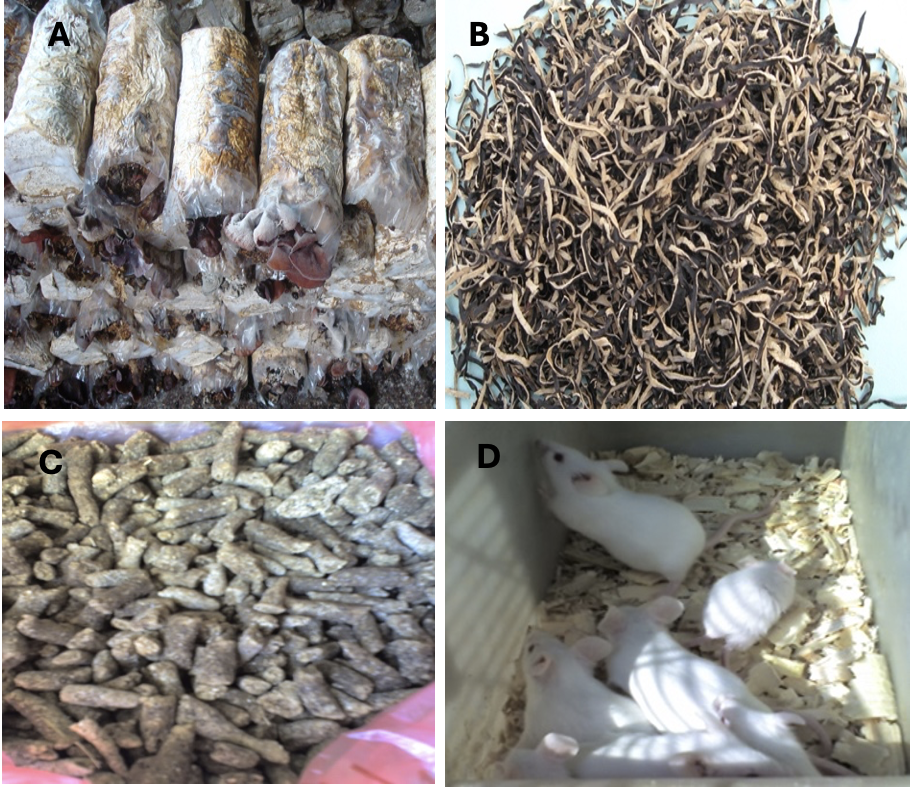
The mushroom cultivation and Animals Diet. A) The culturing substrate and fruiting bodies. B) Dry prepared macrofungus for diets. C) Prepared feed of mice. D) The experiment mice in a cage.
Animal diet and experimental design
The experiment was carried out in a laboratory of the college of Veterinary Medicine, University of Baghdad, Iraq. One hundred and twenty BALB/c female mice, which are more stable to gain and lose the weight and less variability than the male that stated by De Souza et al. (2022). These mice are specific-pathogen-free grade, body weight 20-25 g., and 12-week age, were divided randomly into three groups (40 mice /treatment) and four replicates/treatment, 10 mice each. The three treatments were as being introduced (Table 1). The first group represents the control treatment (0% AP). Mice were housed and adapted to their new living conditions of (25 ± 2) °C, a relative humidity of 60±5 (%) and a 12-hour cycle of light and dark. The mice were fed on a commercial feed for 2 weeks for adaptation. After that, collected fruiting bodies from their cultivation substrates were dried in the room conditions in dark and ground into small particles by grinder to produce fruiting body powder (Figure 1A and B). The prepared diets and their compositions were shown in Table 1. The diet powder (40 mesh) was mixed with water, converted into 2-mm diameter pellets using meat grinder, and oven dried at 60ºC (Figure 1C and D). The treatments were distributed in completely randomized design (CRD).
Table 1: Composition of experimental diets for 100 gm in the three treatments.
Composition | Group 3
| Group 2 50 % AP. | Group 1 Control (0% AP.) | |
|---|---|---|---|---|
Animal protein cone | 5 | 5 | 5 | |
Soybean meal | 0 | 20 | 40 | |
Fruiting body powder | 40 | 20 | 0 | |
Yellow corn | 15 | 15 | 15 | |
Barley | 15 | 15 | 15 | |
Sunflower meal | 15 | 15 | 15 | |
Vitamin mixture | 1 | 1 | 1 | |
Cholesterol | 0.5 | 0.5 | 0.5 | |
Binding material | 1 | 1 | 1 | |
Salt | 0.5 | 0.5 | 0.5 | |
Sucrose | 7 | 7 | 7 |
AP: Auricularia polytricha
Weight gain, food intake and liver weight
Body weights (g) and food intake (g/d) were recorded daily for eight weeks using a balance scale. Blood samples were collected by cardiac puncture and used for plasma lipid profile. Ten mice from each replicate (four replicates for each treatment) were fasted sacrificed. The mouse liver was immediately separated, washed and weighed to determine the liver index (%) based on the liver mass (g) to the body weight (g) .
Analysis of plasma and liver lipid profile
Analysis of samples were collected in heparinized tubes and performed in the same Animal Laboratory. Plasma was separated by centrifugation at 3000 rpm for 10 min at room temperature to obtain mice serum. Liver extraction was extracted following the method of Garvey et al. (1977). Liver tissues were perfused with cold saline, excised, and kept frozen at -70ºC. Plasma total cholesterol, triglycerides (TG), and high-density-lipoprotein (HDL) levels were estimated using enzymatic assay kits according to the manufacturer’s instructions (Sigma, St. Louis, MO). Low-density lipoprotein (LDL) levels were also assessed according to the Friedewald equation .
LDL = total cholesterol - (HDL + VLDL) where the concentration of very low-density lipoproteins (VLDL) is calculated by the serum concentration of TG. VLDL= TG/5.
Statistical analysis
Data was subjected to ANOVA analysis using the SPSS software. and Duncan's multiple range test, statistical comparisons of treatment means were achieved .
Results and Discussion
Successfully, fruiting bodies were grown and produced under the previously described conditions and applied to animal diets (Figure 1). During the 8-week feeding trial, the dietary supplementation with A. polytricha to oral fed female mice did not affect the body weights, food intake, and the liver weights. There were no significant differences in these parameters between the treatments of 50% and 100% A. polytricha powder and the control treatment, 0% A. polytricha (Figure 2). The results of this study showed supplementation with AP did not significantly affect animal growth and feed efficiency compared to the control treatment. These findings confirmed previous studies that the dietary supplementation with macofungi have not increased the body weight of animals . This proved the unique nutritional composition of the edible Auricularia species which have higher amounts of proteins, very low percentage of soluble sugars , a low level of fat content , and a lower percentage of carbohydrates ; . Consequently, for this reason, the diet with macrofungi could not increase mice’s weights and body fat. The study also showed that total cholesterol, LDL, and VLDL in plasma of mice were decreased with increasing macrofungal concentrations in the regime (Figure 3).
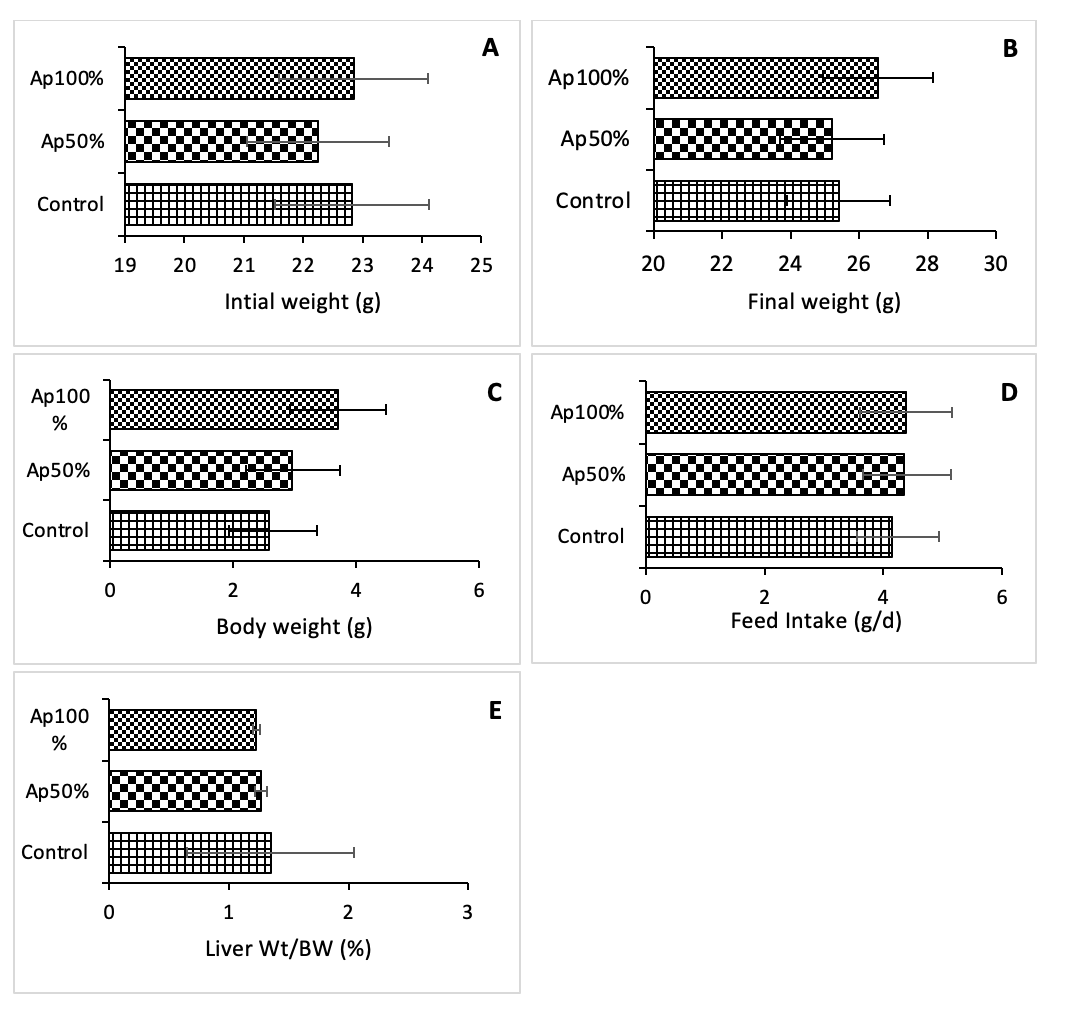
The body weight of mice before and after feed treatments (A, B). Effect of Auricularia polytricha on the body weight gain (C), feed intake (D) and liver weight (E) in mice after 8 weeks. No significant differences were noted between treatments at (p<0.05).
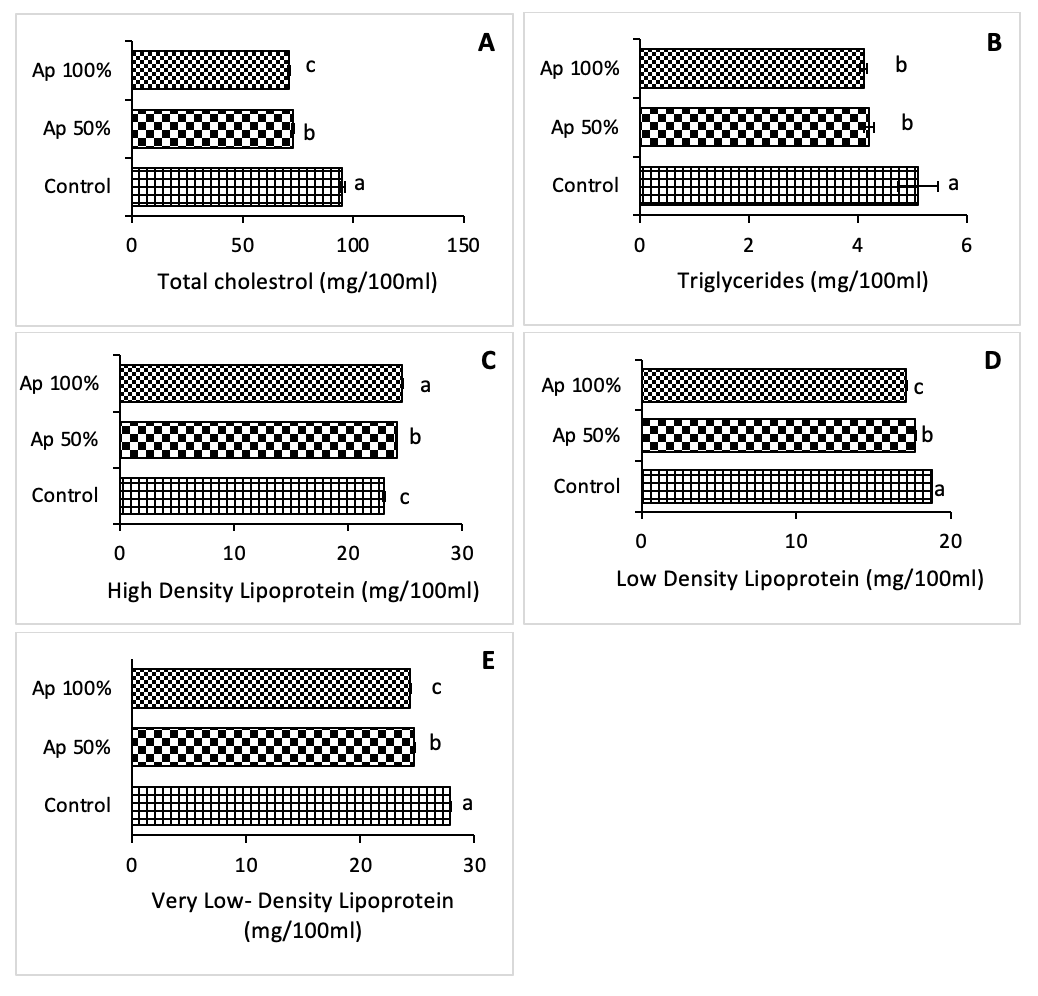
Effect of diet with macrofungus, Auricularia polytricha on the total cholesterol (A), triglycerides (B), high-density lipoprotein (HDL) (C), low-density lipoprotein (LDL) (D), and very low-density lipoprotein (VLDL) (E) in mice after 8 weeks. Each value is mean ± standard error (SE). a, b, c Bars followed by different letters show significant differences at (p <0.05).
The total cholesterol levels were 72.6 and 71.0 mg.100ml-1 in the treatments, 50 %AP, and 100%AP respectively compared with 95.0 mg.100ml-1 in the control. The decrease of cholesterol in the mice blood was associated with decreasing in triglycerides, LDL and VLDL. Triglycerides were decreased from 5 and 10 mg.100ml-1 in the control treatment to 4.20, and 4.10 mg.100 ml-1 for 50% AP, and 100%AP treatments respectively. LDL, which were 18.77 mg.100 ml-1 in the control treatment decreased to 17.70, and 17.13 mg.100ml-1 in 50%AP and 100%AP treatments respectively. VLDL also decreased from 27.90 mg.100ml-1 in the control treatment to 24.73, and 24.37 mg.100 ml-1 in AP50%, and AP100% treatments respectively. However, the diet with A. polytricha mushroom increased high-density-lipoproteins (HDL) from 23.13 mg.100 ml-1 in the control treatment to 24.27 and 24.73 mg.100ml-1 in AP50%, and AP100% treatment respectively. The mushroom diet in both treatments also decreased the Atherogenic index and Liver total cholesterol of mice after 8 weeks compared with that in the control treatment (Figure 3). In contrast, the mushroom diet increased the ratio of HDL-cholesterol to total cholesterol by 0.334 in the AP50% treatment and by 0.348 in the AP100% treatment. However, no significant difference was found between the effects of these two treatments (Figure 4).
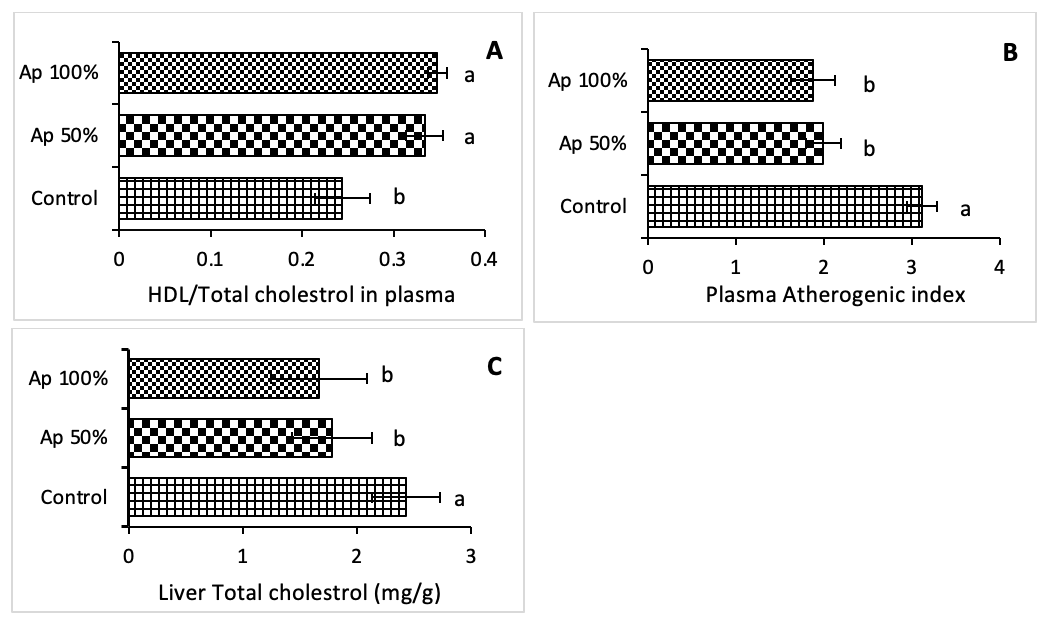
The association of the ratio of HDL-cholesterol to total cholesterol (A), Atherogenic index (B) and liver total cholesterol (C) in mice after 8 weeks with edible mushroom, Auricularia polytricha. Each value is mean ± S.E. a, b, c Bars followed by different letters show significant differences at (p<0.05).
The reduction in total cholesterol, LDL, and VLDL levels in current results was consistent with the previous findings. That is because of promoted fatty acid oxidation and inhibited gluconeogenesis via adiponectin pathway in the liver . Decrease the total cholesterol and LDL cholesterol in present findings also similar to results of Budinastiti and his colleagues (2018) who reported the negative effects of water from boiled A. polytricha on the total cholesterol and LDL cholesterol of Wistar rats even after being reused cooking oil. These results may be attributed to the high viscosity of intestinal mucosa of mice . The activity of lactobacillus enzymes that precipitate and separate cholesterol from bile salt leading to decrease concentrations is not excluded ; . In this study, increase the HDL cholesterol content supported the previous results as the water extracts of presented species showed anti-hypercholesterolemic effects in rats . The increase HDL may be due to the inhibition of VLDL as well as may be resulting from increasing of bile acids contents . There are several fungus’s nutrient complex constituents which influenced the changing of blood lipid profiles. These included polysaccharides, arkobat acid, niasin, dan flavonoid and fiber ; . For example, the β-glucan polysaccharide, which is one of the fungus fibers, can impede gastrointestinal lipase enzyme reaction such as pancreatic lipase enzyme which led to reduced absorbance and re-absorbance of fats including cholesterol and fat acid through fat metabolism . Based on antioxidant assays, the improvement in mice health by diet with A. polytricha can attributed to capacity of radical scavenging of this fungus. The ethyl acetate portion was the highest effective radical scavenger based on antioxidant investigations .
According to a previous study, noodles created from A. polytricha can also prevent hyperlipidemia and liver fat buildup that resulted from the HFD and regulate the gut microbiota. A. polytricha noodles may promote the diversity of gut microbiota through the decreasing the relative abundance of Deferribacteres as well as the ratio of Firmicutes to Bacteroidetes and increasing the relative richness of Verrucomicrobia, potentially causative to the prevention of hyperlipidemia . Furthermore, a previous work suggested that A. polytricha supplement could provide an exceptional protecting substance against NAFLD under regular nutritive recovery. It is treated by reducing the inflammatory response, oxidative stress, and lipid deposition . Additionally, polysaccharides from Auricularia auricular can modify the composition of fecal microbes and promote microbial community diversity. Auricularia auricular polysaccharides can boost immunoglobulin levels in mouse serum .
Conclusions
In conclusion, the results of this work indicated that the edible mushroom may be promising as complementary dietary strategy for decreasing cholesterol levels in plasma. Otherwise, the results revealed no significant effect of mushrooms on body weights and food intake of mice. The mushroom in the diet caused a significant decrease in triglycerides, cholesterol, very low-density-lipoprotein, low density lipoproteins while the high-density lipoprotein was increased compared to the control treatment.
Acknowledgements
This work was financed by the Iraqi Ministry of Agriculture and Veterinary Medicine College, Baghdad University, Iraq.
Authors’ Contributions
The roles of first, fourth, and fifth authors were designing and achieving the experimentation while the roles of third and fourth authors were data analysis, writing, reviewing, and editing.
Novelty Statement
Cultivation and using this edible mushroom in Iraq as a food supplement and good nature nutrient food are a unique step for future use of this fungus for improving health.
Conflict of Interest
The authors declare that there is no conflict of interest.
References
- Abd Razak, D.L., A. Jamalddin, A.Y. Abd Rashid, and M.A. Mana. 2020. Assessment of cosmeceutical potentials of selected mushroom fruitbody extracts through evaluation of antioxidant, anti-hyaluronidase and anti-tyrosinase activity. Multidiscip. Sci. J., 3: 329-342. [CrossRef]
- Al Anbagi, R. A. and T. O. Al-Khesraji. 2022. Morchella coica Pers., 1818 (Pezizales, Morchellaceae): A new record from Iraq. Bull. Iraq Nat. Hist. Mus., 17(1):89-101.
- Al Anbagi, R.A., F.E. Alshuwaili, and S.L. Stephenson. 2019. Fungi associated with forest floor litter in northwest Arkansas. Curr. Res. Environ. Appl. Mycol., 9(1): 25-35. [CrossRef]
- Al Anbagi, R.A., S.Q. Sulaiman and F.R. Alshuwaili. 2024. Intraspecies genetic and morphological analysis of the new collection of medical tinder Fomes fomentarius (L.) FR. 1849 (Agaricomycetes, Polyporales, Polyporaceae) from Iraq. Bull. Iraq Nat. Hist. Mus., 18(2): 357-366.
- Al Anbagi, R.A., S.Q. Suliaman, and T.O. Al-khesraji. 2022. Morphological and molecular identification of a new species of Coprinopsis iraqicus sp. nov. from Iraq. Indian J. Ecol., 49(4):1424-1432.
- Al-Anbagi, R.A. 2014. Histological study of the discomycetes fungus Cheilymina theleboloides. J. Babylon Univ. Pure Appl. Sci., 22: 769-778.
- Amin, K.A., A.M. Homeida, El R.H. Mazoudy, K.S. Hashim, and M. Garelnabi. 2019. Dietary lipids in health and disease. J. Lipids, 2019: 5729498. [CrossRef]
- Budinastiti, R., H.R. Sunoko, and N.S. Widiastiti. 2018. The effect of cloud ear fungus (Auricularia polytricha) on serum total cholesterol, LDL and HDL levels on Wistar rats induced by reused cooking oil. EDP Sci., 31:06006. [CrossRef]
- Cheung, P.C.K. 2013. Mini-review on edible mushrooms as source of dietary fiber: preparation and health benefits. Food Sci. Human Wellness, 2(3-4):162-166. https://doi.org/10.1016/j.fshw.2013.08. 001 [CrossRef]
- Chiu, W.C., H.H. Yang, S.C. Chiang, Y.X. Chou and H.T. Yang. 2014. Auricularia polytricha aqueous extract supplementation decreases hepatic lipid accumulation and improves antioxidative status in animal model of nonalcoholic fatty liver. BioMedicine, 4(2): 1-10. [CrossRef]
- Das, A.K., P.K. Nanda, P. Dandapat, S. Bandyopadhyay, P. Gullón, G.K. Sivaraman, D.J. McClements, B. Gullón, and J.M. Lorenzo. 2021. Edible mushrooms as functional ingredients for development of healthier and more sustainable muscle foods: A flexitarian approach. Molecules, 26:2463. [CrossRef]
- De Souza, G.O., F. Wasinski, and J. Donato Jr. 2022. Characterization of the metabolic differences between male and female C57BL/6 mice. Life Sci., 301: 120636. [CrossRef]
- Duncan, D.B. 1955. Multiple ranges and multiple F-test. Biometrics, 11:1-42.
- Fang, D., D. Wang, G. Ma, Y. Ji, H. Zheng, H. Chen, M. Zhao, Q. Hu and L. Zhao. 2021. Auricularia polytricha noodles prevent hyperlipemia and modulate gut microbiota in high-fat diet fed mice. Food Sci. Hum. Wellness, 10(4): 431-441. [CrossRef]
- Fontes, A., J. Ramalho‐Santos, H. Zischka, and A. M. Azul. 2022. Mushrooms on the plate: Trends towards NAFLD treatment, health improvement and sustainable diets. Eur. J. Clin. Investig., 52(3): e13667. [CrossRef]
- Garvey, I.S., N.E. Cremer, D.H. Sussdorf, and D.H. Campbell. 1977. Methods in immunology: A laboratory text for instruction and research. 3rd edition. W. R. Benjamin. Inc.
- Gomez, C., F. Jebbawi, M. Weingartner, J. Wang, S. Stücheli, B. Stieger, B. Gottstein, G. Beldi, B. Lundström-Stadelmann, and A. Odermatt. 2021. Impact on bile acid concentrations by Alveolar Echinococcosis and treatment with albendazole in mice. Metabolites, 11(7): 442. [CrossRef]
- Hadwan. H.A., A.K. Abdulrazzaq, F.R. Hameed, R.A. Chechan. 2021. The impact of edible mushroom species on lipid profiles and blood picture of male balb-c mice. J. of Hunan Univ. Nat. Sci., 48(9).
- Huang, C.H., W.K. Lin, S.H. Chang, G.J. Tsai. 2021. Ganoderma lucidum culture supplement Ameliorates Dyslipidemia and reduces visceral fat accumulation in type 2 diabetic rats. Mycology, 12(2):94-104.
- Li, L., C.H. Zhong, Y.B. Bian. 2014. The molecular diversity analysis of Auricularia auricula-judae in China by nuclear ribosomal DNA intergenic spacer. Electron J. Biotechnol., 17:27-33. [CrossRef]
- Liang, C.H., C.Y. Wu, P.L. Lu, Y.C. Kuo and Z.C. Liang. 2019. Biological efficiency and nutritional value of the culinary-medicinal mushroom Auricularia cultivated on a sawdust basal substrate supplement with different proportions of grass plants. Saudi J. of Bio. Sci., 26(2):263-269. [CrossRef]
- Lin, S.Y., J.W. Ayres, W. Winkler. 1988. Lactobacillus effects on cholesterol: In vitro and in vivo results. J. Dairy Sci., 72:2885-2899. [CrossRef]
- Liu, Q., R. Ma, S. Li, Fei Y., J. Lei, R. Li, Y. Pan, S. Liu, and L. Wang. 2022. Dietary supplementation of Auricularia auricula-judae polysaccharides alleviate nutritional obesity in mice via regulating inflammatory response and lipid metabolism. Foods, 11(7): 942. [CrossRef]
- Liu, S., S. Feng, C. Chiu, M. Chiang. 2021. Influence of dietary chitosan feeding duration on glucose and lipid metabolism in a diabetic rat model. Molecules, 26: 5033. [CrossRef]
- Liu, Y., S. Bastian, H.J. Wicher. 2020. Current understanding of the structure and function of fungal immunomodulatory proteins. Front. Nutr., 7: 132. [CrossRef]
- Lu, A., M. Shen, Z. Fang, Y. Xu M. Yu, S. Wang, Y. Zhang, and W. Wang. 2018. Antidiabetic Effects of the Auricularia auricular polysaccharides simulated hydrolysates in experimental type-2 diabetic rats. Nat. Prod. Commun., 13(2): 1934578X1801300220.
- Marie, S.M., S.Q. Suliaman and R.A. Al Anbagi. 2023. Molecular identification and phylogeny of Polyporus plorans, new record from Iraq. J. Adv. Educ. Sci., 3(1): 60-64.
- Mau, J.L., K.T. Wu, Y.H. Wu, and Y.P. Lin. 1998. Nonvolatile taste components of ear mushrooms. J. Agric. Food Chem., 46(11):4583-4586. [CrossRef]
- Miao, J., Regenstein, J.M., Qiu, J., Zhang, J., Zhang, X., Li, H., Zhang, H. and Wang, Z., 2020. Isolation, structural characterization and bioactivities of polysaccharides and its derivatives from Auricularia - A review. Int. J. Biol. Macromol., 150:102-113. https://doi.org/10.1016/j.ijbiomac.2020.02.054 [CrossRef]
- Muszynska, B., K. Kała, J. Rojowski, A. Grzywacz-Kisielewska, and W. Opoka. 2017. Composition and biological properties of Agaricus bisporus fruiting bodies: A review. Pol. J. Food Nutr. Sci., 67(3):173-181. [CrossRef]
- Neyrinck, A.M., L.B. Bindels, F.D. Backer, B.D. Pachikian P. D. Cani, and N. M. Delzenne. 2009. Dietary supplementation with chitosan derived from mushrooms changes adipocytokine profile in diet-induced obese mice, a phenomenon linked to its lipid-lowering action. Int. Immunopharm., 9: 767-773. [CrossRef]
- Pallant, J. 2010. SPSS survival manual: A step by step guide to data analysis using SPSS. McGraw-Hill Education. Routledge, UK.
- Rowan, N. and R. Sullivan. 2002. Medicinal mushrooms: Their therapeutic properties and current medical usage with special emphasis on cancer treatments. Cancer Research UK.
- Sulaiman S.Q., R.A. Al Anbagi, F.R.H. Alshuwaili, and A.S. Abdalrahman. 2024. New records of three basidiomycetous species from Iraq using phenotypic and phylogenetic analyses. Afr. J. Plant Sci., 11(4): 1047–1054. https://doi.org/10.14719/pst.4416 [CrossRef]
- Teoh, H.L., I.S. Ahmad, N.M.K. Johari, N. Aminudin and N. Abdullah. 2018. Antioxidant properties and yield of wood ear mushroom, Auricularia polytricha (Agaricomycetes), cultivated on rubberwood sawdust. Int. J. Med. Mushrooms, 20(4): 369-380. [CrossRef]
- Valverde, M.E., T. Hernández-Pérez, O. Paredes-López. 2015. Edible mushrooms: Improving human health and promoting quality life. Int. J. Microbiol., 2015:376387. https://doi.org/10.1155/2015/376387. [CrossRef]
- Vieira, P.L., G.N. Araújo, G.H. Telo, L.F.S. Smidt, M.F. Jost. 2016. Low-density lipoprotein values estimated by Friedewald equation are affected by diabetes control. Int. J. Cardiovasc. Sci., 29(5):348-354. [CrossRef]
- Volman, J.J. 2009. Immune modulation by dietary glucans from oat and mushrooms; Results from in vitro animal and human studies. Doctoral Thesis, Maastricht University. https://doi.org/10.26481/dis.20100226jv [CrossRef]
- Wasser, S.P. 2002. Medicinal mushrooms as a source of antitumor and immunomodulating polysaccharides. Appl. Microbiol. Biotechnol. J., 60: 258-274. [CrossRef]
- Xiao, J.J., J.S. Duan, Y.C. Wu, Y.H. Shi, Q.K. Fang, M. Liao, R.M. Hua and H.Q. Cao. 2018. Dissipation and migration of pyrethroids in Auricularia polytricha mont. from cultivation to postharvest processing and dietary risk. Molecules, 23(4):791. https://doi.org/10.3390/ molecules23040791. [CrossRef]
- Yin C., S. Tang, L.L. Aizhi, and C.J. Xie. 2021. Effects of bile acids on growth performance and lipid metabolism during chronic heat stress in broiler chickens. Animals, 11: 630. [CrossRef]
- Zborowski K., R. Grybos, and L.M. Pronicwicza. 2003. Determination of the Most Stable Structures selected hydroxypyranes and their cation and anion. J. Mol. Struct., 54: 27-46.
- Zhang H., Z.Y. Wang, L. Yang, X. Yang X. Wang, and Z. Zhang. 2011. In vitro antioxidant activities of sulfated derivatives of polysaccharides extracted from Auricularia auricular. Int. J. Mol. Sci., 12(5):3288–302. [CrossRef]
- Zhao, S., C. Rong, Y. Liu, F. Xu, S. Wang, C. Duan, J. Chen and X. Wu. 2015. Extraction of a soluble polysaccharide from Auricularia polytricha and evaluation of its anti-hypercholesterolemic effect in rats. Carbohyd. Polym., 122: 39-45. [CrossRef]

Services
Article usage statistics
Loading…
Related articles
- Effects of Different Sweetening Agents on the Physicochemical, Functional, and Sensory Quality of Value-Added Black Jelly Mushroom (Auricularia auricular-judae) DrinksSarhad Journal of Agriculture · 2024
- Comparative Effects of Radon Inhalation According to Mouse Strain and Cisplatin Dose in a Cisplatin-induced Renal Damage ModelPakistan Journal of Zoology · 2018
- Dynamic Effects of Ketogenic Diet on Autophagy and Cell Cycle in a Mouse Model of CT26+ Colon CancerPakistan Journal of Zoology · 2025
- Effect of Total Phenolic Acid on the Repeated Cerebral Ischemia-Reperfusion Model in MicePakistan Journal of Zoology · 2020
- Anti-Psoriasis Activity of Ethanolic Extract of Sorghum (Sorghum bicolor) in Imiquimod-Induced Mouse ModelAdvances in Animal and Veterinary Sciences · 2025
- Ameliorative Effect of Garden Cress (Lepidium sativum L.) Seeds Ethanolic Extract on High Fat Diet-prompted Non-alcoholic Fatty Liver Disease in the Rat Model: Impact on 3-Hydroxy-3-methylglutaryl-Coenzyme A Reductase and Vascular Endothelial Growth FactoAdvances in Animal and Veterinary Sciences · 2020