
Artemisia vulgaris L. is a perennial herb with a long history of traditional medicinal applications. Its pharmacological potential is due to its complex phytochemical composition, including bioactive components. Jaceosidin, a polymethoxylated flavonoid, is a significant bioactive component extracted from A. vulgaris. Herein, we focused on the extraction of jaceosidin from the aerial parts of A. vulgaris and the development of an accurate procedure for its structural evaluation. This study details the extraction, purification, and structural elucidation of jaceosidin through a combination of chromatographic techniques and comprehensive analysis using mass spectrometry and extensive one-dimensional and two-dimensional NMR spectroscopy. This study confirms the presence of a significant quantity of jaceosidin in A. vulgaris and establishes a validated analytical method for studying A. vulgaris quality control and bioactivity.
Research Article · Volume 76, Issue 2, Pages 61–66, 28 November 2026 · Open Access
Isolation and Structural Elucidation of Jaceosidin from Artemisia vulgaris using Advanced Spectroscopic Techniques
, , ,
Affiliations & Notes ⌄
- 1Biological Science Research Division, Pakistan Forest Institute Peshawar, Khyber Pakhtunkhwa, Pakistan
- *Correspondence | Salim Saifullah; Email: salim_saifullah28@yahoo.com
Article Info ⌄
- Journal:
- Pakistan Journal of Forestry
- Submitted Date:
- 13 February 2026
- Accepted Date:
- 12 November 2026
- Published Date:
- 28 November 2026
From the article
- The structural elucidation of complex natural products, such as jaceosidin, necessitates the application of advanced spectroscopic techniques (Figure 3).
- The sequence of fragments suggested that jaceosidin is classified as a flavonoid.
- Two-dimensional NMR spectroscopy techniques (Figure 6), including COSY, NOESY, HSQC, and HMBC, were employed to determine the positions of methoxy groups and to confirm the structure of Jaceosidin.
- The aim of this study was to isolate jaceosidin from the aerial parts of Artemisia vulgaris and to achieve a definitive structural elucidation using advanced spectroscopic techniques.
Selected from the article's own text.
Abstract
Introduction
The plant kingdom has been fundamental to the development and discovery of drugs for decades, offering an extensive range of structurally varied secondary metabolites with various biological functions . The genus Artemisia, belonging to the Asteraceae family, is highly prominent in medical applications, encompassing nearly 500 species worldwide . Artemisia vulgaris L., referred to as mugwort, is a perennial herb with a longstanding history of application in traditional medicinal practices in the Americas, Europe, and Asia. Historically, it has been utilized for its alleged emmenagogue attributes, antiseptic, antispasmodic, and anti-inflammatory, frequently made as poultices, decoctions, or infusions, to address various conditions such as irregular periods, epilepsy, fevers, and digestive diseases ; . The pharmacological potential of A. vulgaris is ascribed to its intricate phytochemical composition, encompassing several bioactive components, including coumarins, sesquiterpene lactones, essential oils (e.g., β-thujone, camphor, and 1,8-cineole), and flavonoids ; . Recently conducted studies have shown its hepatoprotective, antinociceptive, antioxidant, estrogenic, and cytotoxic properties ; . A. vulgaris is also utilized in the cosmetic and food sectors, and its application for biotechnological micropropagation has been evaluated .
Methoxylated flavones, a type of flavonoids, have attracted considerable scientific attention owing to their superior metabolic stability and powerful biological effects relative to their non-methylated counterparts . Jaceosidin (5,7,4’-trihydroxy-6,3’-dimethoxyflavone) is a notable polymethoxylated flavonoid extracted from various Artemisia species . Comprehensive in vitro and in vivo investigations have demonstrated that jaceosidin exhibits an impressive array of medicinal properties. It has been shown to possess significant anti-inflammatory properties by blocking the synthesis of crucial pro-inflammatory mediators such as prostaglandin E₂ (PGE₂) and nitric oxide (NO) via the regulation of MAPK and NF-κB signaling pathways . Moreover, its robust antioxidant capability, primarily via free radical scavenging, enhances its cytoprotective properties . Jaceosidin has demonstrated significant anticancer action by cell cycle arrest and inducing apoptosis in multiple cancer cell lines, along with anti-allergic and antibacterial properties ; ; . Despite its potential bioactivity, the extensive phytochemical analysis of A. vulgaris, particularly with the isolation and definitive identification of jaceosidin, continues to be an area requiring further study.
This study aimed to extract jaceosidin from the aerial portions of Artemisia vulgaris and to develop a precise methodology for its structural analysis. We present the effective extraction, purification, and detailed structural elucidation of jaceosidin utilizing a combination of chromatographic methods and an in-depth analysis of data from MS, and extensive 1D and 2D NMR spectroscopy. This study not only supports the existence of this important flavonoid in A. vulgaris but also establishes a validated analytical methodology for its detection in complex plant mixtures.
Materials and Methods
Plants material and reagents
The plant collection was done in the month of August and throughout this study, every chemical and reagent used was of the highest purity or analytical grade.
General experimental
To obtain a homogeneous powder, 2.75 kg of air-dried plant material is initially ground or crushed into small pieces. The powder is subsequently macerated in methanol at a ratio of 1 gram to 10 milliliters. The extraction procedure is illustrated in the subsequent flowchart (Figure 1).
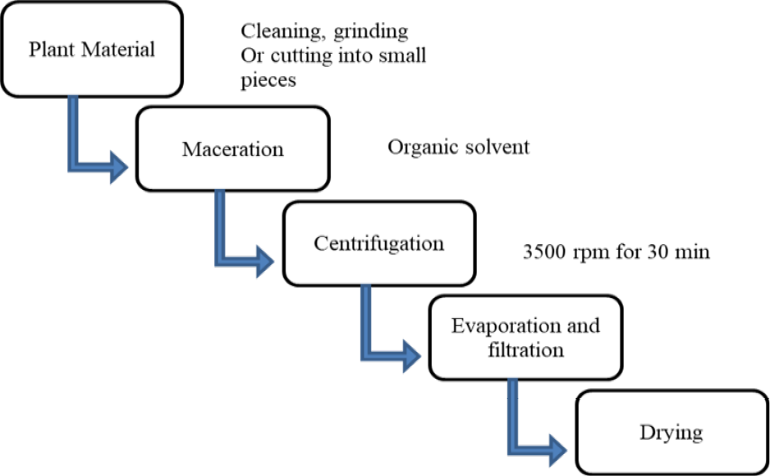
A depiction of the extraction procedure defined into distinct stages.
The crude extract was processed by passing it through a column packed with Merck alumina (ASTM) and silica gel (Si gel 60). The column measured 40.0 cm in length and 3.0 cm in diameter. Chromatography was conducted on semi-pure fractions utilizing an LH-20 Sephadex packed column measuring 32.0 cm in length and 2.0 cm in diameter (Figure 2). The application of thin-layer chromatography facilitated the quantification, identification, and purity assessment of the substances. The application of TLC plates coated with silica gel (E. Merck, F254) was employed to examine the absence of spots in compounds present in either extracts or their pure form. The TLC plates were examined under a UV lamp at a wavelength of 254 nm for fluorescence quenching stains and at 366 nm specially for fluorescent stains. Ceric(IV) sulfate was employed to visualize the chemical spots on TLC for the identification of flavonoids. A portion weighing 6.3 mg, with a percent yield of 0.0023%, was extracted from Fraction D and sub-fraction DA, which displayed a single spot on the TLC plate, indicating it is a pure compound. This pure sub-fraction underwent additional advanced spectroscopic methods to determine its structure.
A fraction (6.3 mg, percent yield 0.0023%) was isolated from Fraction D and sub-fraction DA containing a single spot on TLC plate which is the pure single compound. The pure subfraction has been subjected to further advanced spectroscopic techniques to elucidate the structure.
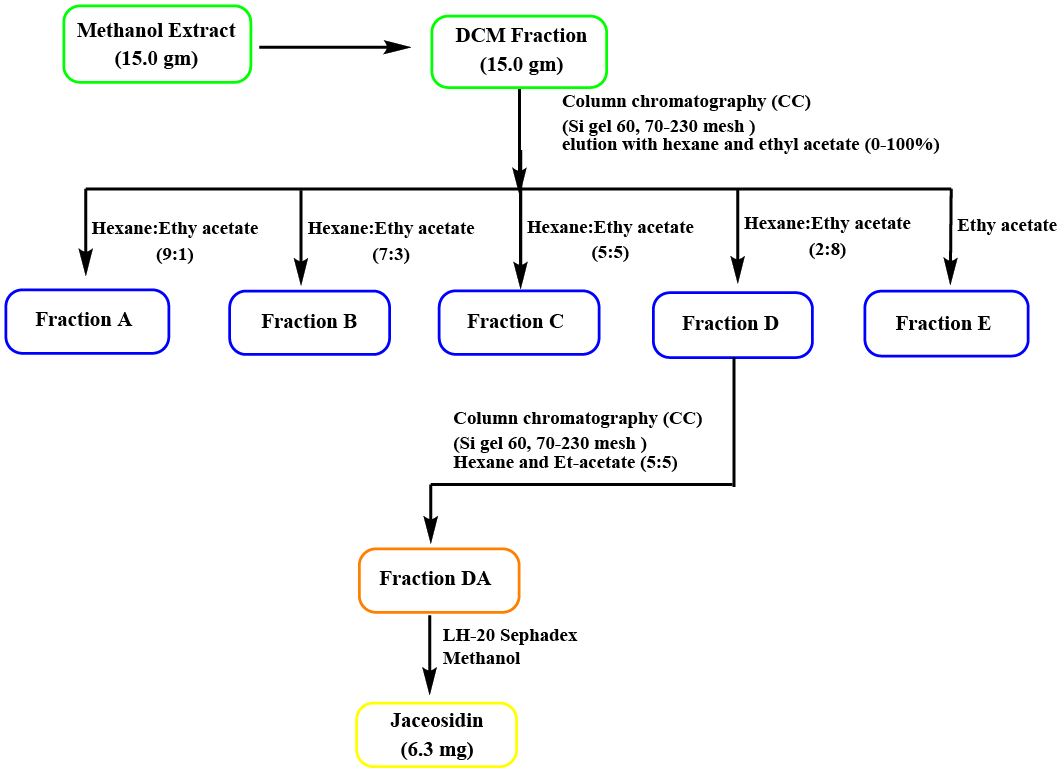
A depiction of the isolation procedure of jaceosidin from the methanol extract of A. vulgaris.
Spectroscopic techniques
A Varian MAT 311 mass spectrometer (MS) was employed to record EI-MS spectra. MS used the Jeol MS route (model-JMS 600H) alongside TSS 2000 and functioned in double focusing mode. The 1H-NMR spectra were acquired using Bruker Avance AV-300, AV-400, and AV-500 MHz instruments, while the 13C-NMR spectra were collected at 75, 100, 125, and 150 MHz. The DEPT 90° and 135° tests were employed to assess the multifaceted characteristics of the carbon signals. The effects of homo-nuclear 1H-1H coupling were identified using a 45° correlation spectroscopy (COSY) experiment. The one-bond 1H-13C connection was established by heteronuclear single quantum coherence (HSQC) analysis. We performed heteronuclear multiple bond correlation (HMBC) assays to ascertain the connectivity of 1H-13C bonds involving two and three electrons. The internal standard was employed to identify chemical changes in δ (ppm), and coupling constants (J) were calculated in Hz.
Results and Discussion
The structural elucidation of complex natural products, such as jaceosidin, necessitates the application of advanced spectroscopic techniques (Figure 3). Contemporary hyphenated methods, including liquid chromatography (LC) and mass spectrometry (MS), provide preliminary insights into molecular weight and fragmentation patterns. However, definitive structural confirmation requires comprehensive nuclear magnetic resonance (NMR) spectroscopic analyses. One-dimensional NMR techniques, such as ¹H and ¹³C NMR, furnish critical information regarding proton and carbon frameworks. In contrast, two-dimensional methods, including COSY, HSQC, and HMBC, are indispensable for establishing through-bond connectivity and accurately assigning all atoms within the molecule ; .
Jaceosidin was isolated as a yellow amorphous solid via column chromatography of the dichloromethane (DCM) fraction, employing a hexane:ethyl acetate (1:1) solvent system, followed by purification through a Sephadex column using methanol as the solvent. The presence of jaceosidin was confirmed as a yellow pustule on a silica gel TLC plate after treatment with ceric sulfate spray, indicating its flavonoid characteristics.
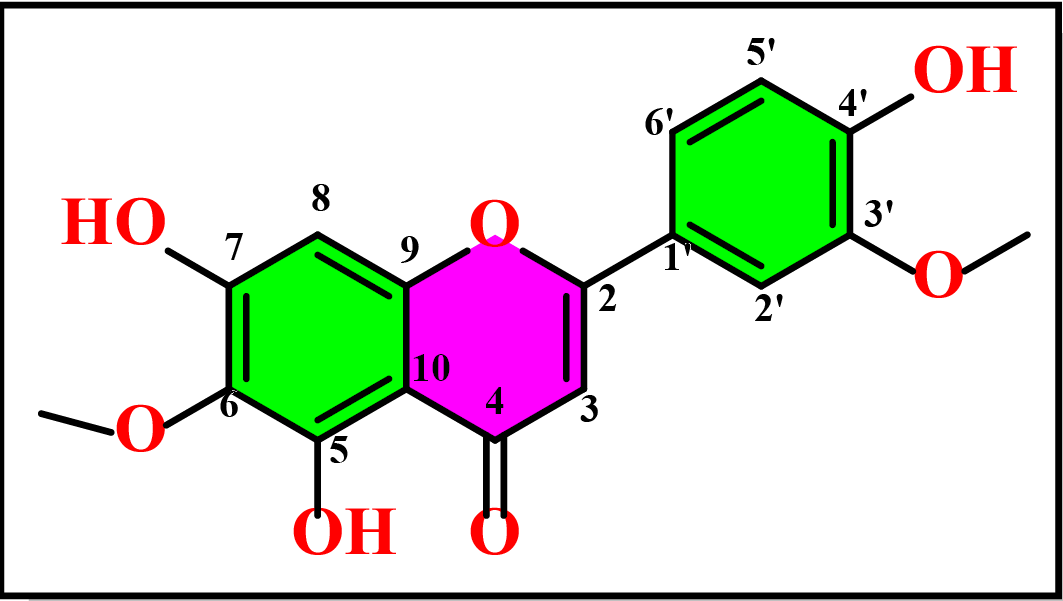
Chemical structure of Jaceosidin.
Mass spectrometry and molecular formula
The EI-MS spectrum of jaceosidin revealed the [M+] at m/z 330, which was also identified as the base peak. The significant fragment ions at m/z 330, 315, 301, 287, and 167 emerged from the breakdown of jaceosidin (Figure 4). The loss of a methyl radical is crucial for diagnosing methoxy-substituted flavonoids, observed across ionization modes. The removal occurs via an unbiased mechanism, with a competing heterolytic mechanism facilitated by intramolecular proton transfer during CID, particularly in jaceosidin where the 6-methoxy is adjacent to hydroxyl groups. Key cleavage mechanisms involve heterolytic inductive cleavage, leading to even-electron fragments and aiding in A- versus B-ring substitution identification. Jaceosidin include the possibility of a lactone as the classic RDA diagnostic ion and the presence of informative anions in negative mode RDA, which help create diagnostic patterns for methoxy-containing regioisomers. The sequence of fragments suggested that jaceosidin is classified as a flavonoid.
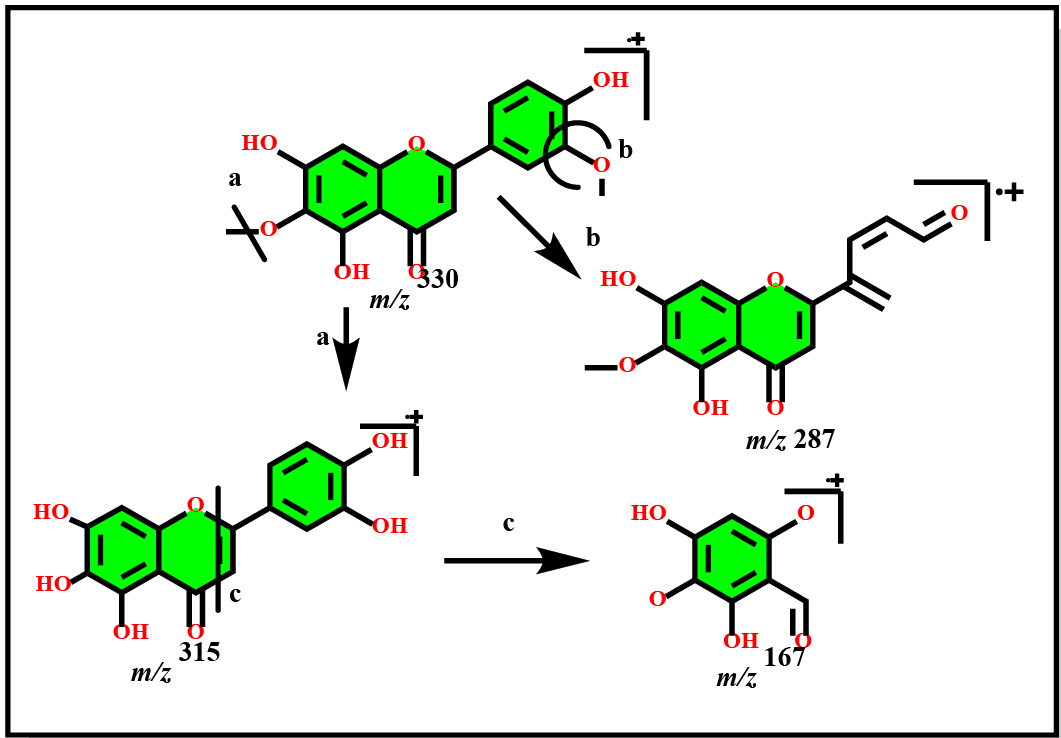
Key EI-MS fragmentation pattern of Jaceosidin.
NMR spectroscopy
The 1H-NMR spectrum Figure 5 displayed resonances for two signals at d 3.87 s and 3.96 s, which were attributed to the protons of methoxy groups linked to C-6 and C-3’. Signals at d 6.62 s and 6.55 s were assigned to H-3 and H-8, respectively. Three downfield signals at δ 7.48 d (J2’, 6’ = 2.0 Hz), 6.93 d (J5’, 6’ = 8.0 Hz), and 7.38 dd (J6’, 5’ = 7.8 Hz, J6’, 2’ = 2.0 Hz) were associated with H-2’, H-5’, and H-6’ in that order.
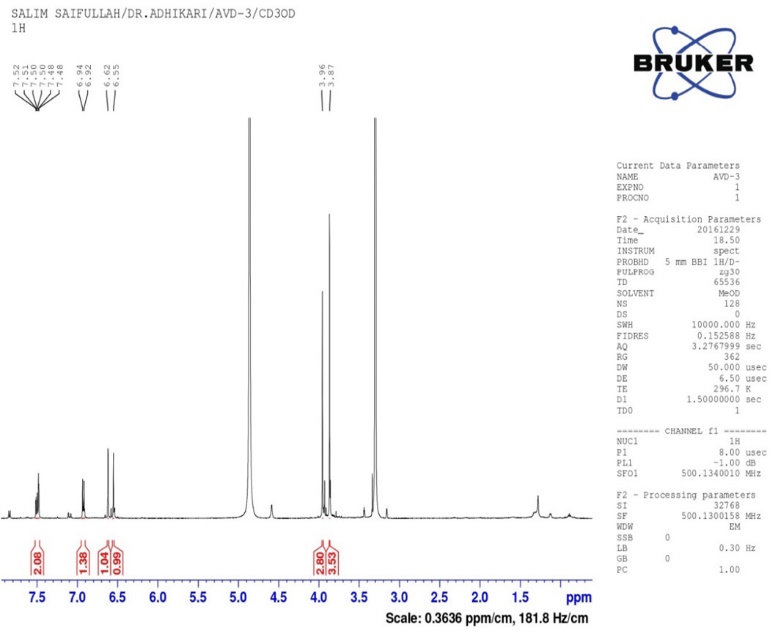
The 1H-NMR spectrum of Jaceosidin.
The broad band 13C-NMR and DEPT spectra identified resonances for seventeen carbons, comprising two methyl, five methine, and ten quaternary carbons.
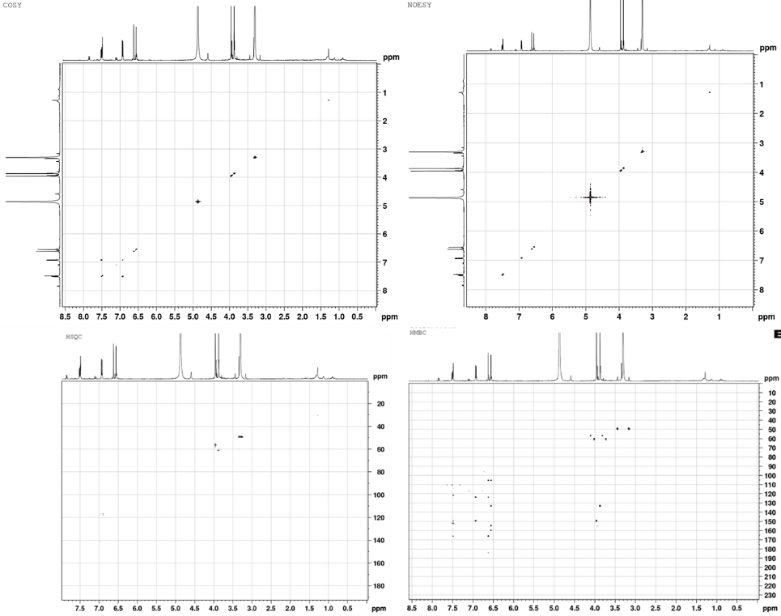
Two-dimensional NMR spectroscopy of Jaceosidin.
Two-dimensional NMR spectroscopy techniques (Figure 6), including COSY, NOESY, HSQC, and HMBC, were employed to determine the positions of methoxy groups and to confirm the structure of Jaceosidin. The HMBC interactions between protons and carbons at δ 3.87 and δ 133 (C-6), as well as δ 3.96 and δ 149.5 (C-3’), clearly indicated the locations of the methoxy groups within the compound (Figure 7).
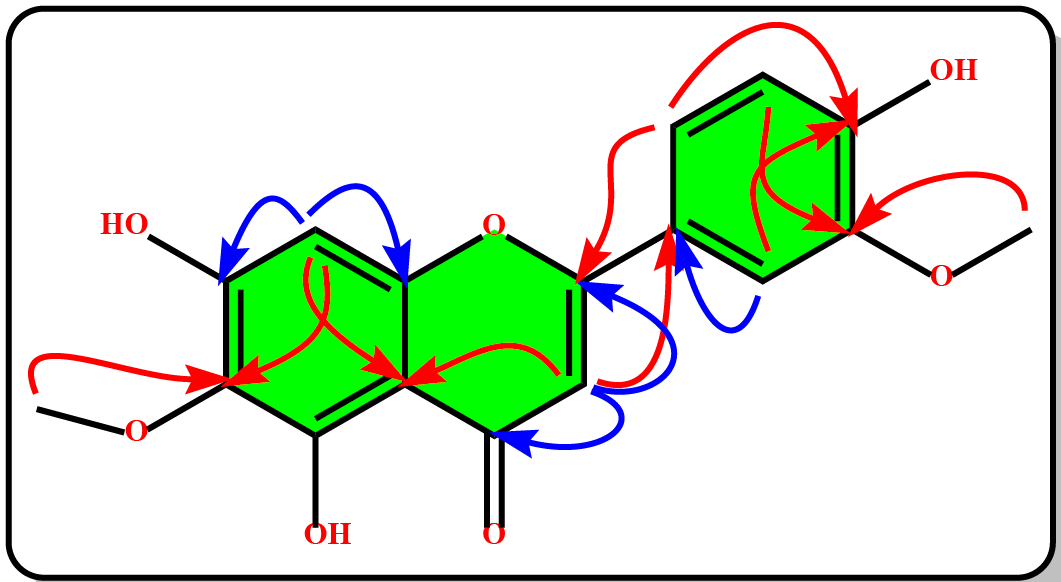
Key HMBC interaction of Jaceosidin.
Conclusion
The aim of this study was to isolate jaceosidin from the aerial parts of Artemisia vulgaris and to achieve a definitive structural elucidation using advanced spectroscopic techniques. Our methodology combines targeted enrichment and purification, guided by chromatographic profiling, with EI-MS to determine the molecular formula and key fragments. Additionally, comprehensive 1D/2D NMR was employed to assign all proton and carbon resonances and long-range connectivities. Where applicable, spectral constants were cross-validated against peer-reviewed literature values for jaceosidin isolated from Artemisia species. This experimental focus seeks to provide a definitive reference for jaceosidin derived from A. vulgaris, thereby facilitating subsequent studies on chemotaxonomy, quality control of mugwort preparations, and bioactivity assessment.
Acknowledgement
The authors acknowledge the support provided by the Pakistan Forest Institute (PFI) Peshawar in conducting this study.
Novelty Statement
Jaceosidin, a flavonoid from Artemisia plants, has been isolated and characterized through spectroscopic methods, indicating potential for various biological applications.
Author’s Contribution
Salim Saifullah: Conceptualization, Methodology, Data curation, Data interpretation, Data visualization, and writing first draft and writing revised drafts. Muhammad Ilyas: Data curation, Data interpretation, Data visualization, and writing first draft. Muhammad Farooq: Data curation, Data interpretation, Data visualization, and writing first draft. Sanam Zarif Satti: Data curation, Data interpretation, Data visualization, and writing first draft.
Generative AI and AI assisted technology statement
The authors declare that no generative AI and AI assisted technology was used in the creation of this manuscript.
Conflict of interest
The authors have declared no conflict of interest.
References
- Bora, K.S. and Sharma, A., 2011. The genus Artemisia: A comprehensive review. Pharma. Biol., 49(1): 101-109. https://doi.org/10.3109/13880209.2010.497815 [CrossRef]
- Dincer, B., Gundogmus, A.C. and Cinar, I., 2023. Jaceosidin protects L929 fibroblast cells by down-regulation of proinflammatory cytokines and attenuation of oxidative stress-induced impairment of cell proliferation and migration. Exp. Biomed. Res., 3: 238. https://doi.org/10.30714/j-ebr.2023.188 [CrossRef]
- Ekiert, H., Pajor, J., Klin, P., Rzepiela, A., Ślesak, H. and Szopa, A., 2020. Significance of Artemisia vulgaris L. (common mugwort) in the history of medicine and its possible contemporary applications substantiated by phytochemical and pharmacological studies. Molecules, 25(19): 4415. https://doi.org/10.3390/molecules25194415 [CrossRef]
- Fulmer, G.R., Miller, A.J., Sherden, N.H., Gottlieb, H.E., Nudelman, A., Stoltz, B.M., Bercaw, J.E. and Goldberg, K.I., 2010. NMR chemical shifts of trace impurities: Common laboratory solvents, organics, and gases in deuterated solvents relevant to the organometallic chemist. Organometallics, 29(9): 2176-2179. https://doi.org/10.1021/om100106e [CrossRef]
- Jayaprakash, S., Jung, Y.Y., Sajeev, A., Manickasamy, M.K., Alqahtani, M.S., Abbas, M., Ahn, K.S. and Kunnumakkara, A.B., 2026. The therapeutic potential of jaceosidin: A comprehensive review of its effects on chronic diseases. Immunopharmacol. Immunotoxicol., 48(2): 303-320. https://doi.org/10.1080/08923973.2026.2625039 [CrossRef]
- Judžentienė, A. and Buzelytė, J., 2006. Chemical composition of essential oils of Artemisia vulgaris L. (mugwort) from North Lithuania. Chemija, 17(1).
- Karabegović, I., Nikolova, M., Veličković, D., Stojičević, S., Veljković, V. and Lazić, M., 2011. Comparison of antioxidant and antimicrobial activities of methanolic extracts of the Artemisia sp. recovered by different extraction techniques. Chinese J. Chem. Eng., 19(3): 504-511. https://doi.org/10.1016/S1004-9541(11)60013-X [CrossRef]
- Kim, M.J., Kim, D.H., Lee, K.W., Yoon, D.Y. and Surh, Y.J., 2007. Jaceosidin induces apoptosis in ras‐transformed human breast epithelial cells through generation of reactive oxygen species. Ann. N. Y. Acad. Sci., 1095(1): 483-495. https://doi.org/10.1196/annals.1397.052 [CrossRef]
- Lee, H.G., Yu, K.A., Oh, W.K., Baeg, T.W., Oh, H.C., Ahn, J.S., Jang, W.C., Kim, J.W., Lim, J.S. and Choe, Y.K., 2005. Inhibitory effect of jaceosidin isolated from Artemisia argyi on the function of E6 and E7 oncoproteins of HPV 16. J. Ethnopharmacol., 98(3): 339-343. https://doi.org/10.1016/j.jep.2005.01.054 [CrossRef]
- Lee, S.J., Chung, H.Y., Maier, C.G.A., Wood, A.R., Dixon, R.A. and Mabry, T.J., 1998. Estrogenic flavonoids from Artemisia vulgaris L. J. Agric. Food Chem., 46(8): 3325-3329. https://doi.org/10.1021/jf9801264 [CrossRef]
- Newman, D.J. and Cragg, G.M., 2020. Natural products as sources of new drugs over the nearly four decades from 01/1981 to 09/2019. J. Natl. Prod., 83(3): 770-803. https://doi.org/10.1021/acs.jnatprod.9b01285 [CrossRef]
- Simpson, J.H., 2011. Organic structure determination using 2-D NMR spectroscopy: A problem-based approach. Academic Press.
- Siwan, D., Nandave, D. and Nandave, M., 2022. Artemisia vulgaris Linn: An updated review on its multiple biological activities. Fut. J. Pharma. Sci., 8(1): 47. https://doi.org/10.1186/s43094-022-00436-2 [CrossRef]
- Tigno, X.T., de Guzman, F. and Flora, A.M.T.V., 2000. Phytochemical analysis and hemodynamic actions of Artemisia vulgaris L. Clin. Hemorheol. Microcirc., 23(2-4): 167-175.
- Walle, T., 2007. Methylation of dietary flavones greatly improves their hepatic metabolic stability and intestinal absorption. Mol. Pharma., 4(6): 826-832. https://doi.org/10.1021/mp700071d [CrossRef]
- Yin, Y., Sun, Y., Gu, L., Zheng, W., Gong, F., Wu, X., Shen, Y. and Xu, Q., 2011. Jaceosidin inhibits contact hypersensitivity in mice via down-regulating IFN-γ/STAT1/T-bet signaling in T cells. Eur. J. Pharmacol., 651(1-3): 205-211. https://doi.org/10.1016/j.ejphar.2010.10.068 [CrossRef]

Services
Article usage statistics
Loading…
Related articles
- Isolation of Nepetin (6-Methoxyluteolin) from Artemisia vulgaris and Spectroscopic Characterization: A Bioactive FlavonoidPakistan Journal of Forestry · 2024
- Chemical and biological assessment of Alternaria alternata as an endophytic fungus isolated from Thymus vulgarisNovel Research in Microbiology Journal · 2024
- A REVIEW OF FEATURE SELECTION TECHNIQUES IN STRUCTURE LEARNINGJournal of Engineering and Applied Sciences · 2013
- Biosynthesis, Optimization and Characterization of Silver Nanoparticles Using a Soil Isolate of Bacillus pseudomycoides MT32 and their Antifungal Activity Against some Pathogenic FungiAdvances in Animal and Veterinary Sciences · 2019
- Antiviral Activity of Selected Bacillus Isolates against Tobacco Mosaic Virus and Their Molecular Identification Using 16S rRNA Sequencing and Start Codon Targeted MarkersNovel Research in Microbiology Journal · 2026
- High Pathogenicity Island (HPI) Main Structural Genes and their Bioinformatics Analysis in Clinically Isolated E. coli from Saba PigsPakistan Journal of Zoology · 2023