
Microalgae are increasingly investigated as emerging nutrient sources and functional feed additives; however, current evidence does not support their broad substitution for conventional protein or energy ingredients because biological efficacy, environmental benefits, and economic feasibility remain context-dependent. This structured critical narrative review evaluates Chlorella sp. and Spirulina sp. in livestock nutrition, focusing on composition, animal responses, methodological rigor, practical feasibility, and Southeast Asia as a regional implementation context. Scopus identified 1,761 records published from 1955 to 2026; 143 reports were sought for retrieval, 135 full texts were assessed, and 104 reports spanning animal, mechanistic, compositional, and implementation evidence were included. Taxonomic ambiguity remains important because Chlorella pyrenoidosa is currently classified within Auxenochlorella, while many organisms historically reported as Spirulina or Arthrospira platensis are now assigned to Limnospira. Across livestock species, evidence is promising but inconsistent. In ruminants, effects are more reproducible for fatty-acid profiles and selected biomarkers than for intake, digestibility, growth, milk production, or reproduction. Poultry responses are dose- and challenge-dependent, while high inclusion levels may impair palatability and performance; similarly variable outcomes occur in pigs and rabbits. Overall methodological quality was heterogeneous, with confidence constrained by inconsistent strain identification, incomplete biomass characterization, heterogeneous processing, poor dose comparability, and reliance on surrogate biomarkers or challenge models. Environmental benefits depend on cultivation systems, energy inputs, harvesting, drying, coproduct allocation, and biosafety. For Southeast Asia, implementation should be evaluated separately from predominantly global efficacy evidence, with the strongest opportunity in standardized local biomass integrated with circular nutrient and carbon flows.
Research Article · Volume 14, Issue 12, Pages 2647–2669, 4 November 2026 · Open Access
Microalgae as Functional Feed Additives in Livestock Production: A Critical Review of Chlorella sp. and Spirulina sp. With Implications for Southeast Asia
· · · ·
Affiliations & Notes ⌄
- 1Department of Livestock Product Technology, Faculty of Animal Husbandry, Universitas Padjadjaran, Sumedang 45363, West Java, Indonesia
- 2Department of Nutrition and Feed Technology, Faculty of Animal Husbandry, Universitas Padjadjaran, Sumedang 45363, West Java, Indonesia
- 3Department of Animal Science, Faculty of Agriculture, Universiti Putra Malaysia, Serdang, Selangor, Malaysia
- *Correspondence | Abun Abun; Email: abun@unpad.ac.id
Article Info ⌄
- Journal:
- Advances in Animal and Veterinary Sciences
- Submitted Date:
- 10 August 2026
- Accepted Date:
- 4 October 2026
- Published Date:
- 4 November 2026
Abstract
Introduction
Southeast Asia is a relevant implementation context for alternative and functional feed resources. The region combines substantial livestock production, strong solar resources, and concentrated agro-industrial activity, and it offers opportunities to integrate biomass production with nutrient-rich waste streams and industrial carbon sources. These characteristics justify evaluating microalgae as locally produced feed resources. However, their regional value cannot be assumed from nutrient composition alone; it must be demonstrated against existing feeds through animal performance, techno-economic, and life-cycle assessments. Microalgae are being investigated as rapidly produced sources of protein, essential fatty acids, pigments, vitamins, minerals, and bioactive compounds ; ; . This interest is consistent with broader ASEAN priorities for resource-efficient and sustainable agriculture (ASEAN . Nevertheless, microalgal feed systems should be regarded as a candidate technology that still requires biological, economic, environmental, and regulatory validation, not as an established regional policy solution.
Feed research groups taxonomically diverse microalgae and cyanobacteria under one label, although strain, cultivation, cell-wall structure, contamination risk, and processing determine composition and digestibility. Nomenclature also requires care: Chlorella pyrenoidosa is currently treated as Auxenochlorella pyrenoidosa, while organisms commonly cited as Spirulina or Arthrospira platensis are increasingly assigned to Limnospira platensis . Conventional names are retained here for continuity with the animal-nutrition literature.
Microalgal biomass is compositionally heterogeneous because taxon, strain, cultivation conditions, growth phase, analytical method, and downstream processing can alter protein, fatty-acid, pigment, ash, moisture, and contaminant profiles ; ; . This heterogeneity has practical consequences for feeding studies: for example, processed and unprocessed biomass from the same nominal taxon may produce different animal responses, and higher inclusion levels can reverse beneficial effects observed at lower doses. Therefore, taxonomic identity or crude nutrient composition alone cannot establish feed value; interpretation requires batch-level composition, processing history, digestibility, dose–response, and production outcomes.
Although previous research has established the nutritional richness and potential functional effects of microalgae, an important gap remains between compositional promise and reproducible livestock-level efficacy. Reported responses vary with microalgal taxon and strain, biomass characterization, processing, dietary role and dose, animal species and physiological status, and the endpoints used to define benefit. Moreover, improvements in biomarkers or product composition do not necessarily translate into greater intake, growth, feed efficiency, reproduction, or economic value. The central unresolved question is therefore not whether microalgae contain potentially useful nutrients or bioactive compounds, but under which biological, nutritional, and methodological conditions their effects are reproducible and practically meaningful. This review addresses that gap by critically integrating animal-level efficacy with taxonomic and biomass characterization, methodological quality, processing and dose effects, economic and environmental feasibility, and the implications of these factors for implementation in Southeast Asia.
Materials and Methods
Review design and scope
This article was designed as a structured critical review supported by a reproducible literature search and transparent study-selection process. Elements of JBI scoping-review guidance and PRISMA-ScR were used to structure evidence identification, screening, and reporting, while PRISMA-S informed reporting of the electronic search ; ; . The review was not conducted as a formal systematic scoping review; rather, the structured search was used to provide a transparent and reproducible evidence base for critical narrative synthesis. The objective was to evaluate not only the extent of the literature but also the biological efficacy, methodological quality, biomass characteristics, processing effects, safety, product-quality outcomes, and implementation feasibility of Chlorella- and Spirulina-type biomasses in livestock systems. Because the available studies differ substantially in animal species, physiological status, biomass form, dose, comparator diet, intervention duration, and outcome definition, a structured narrative synthesis was selected rather than quantitative meta-analysis. No prospective review protocol was registered because the study was originally conceived as a structured critical review rather than a formal systematic or scoping review. The absence of prospective registration was recognized as a limitation because it precluded comparison of the final methodology with a time-stamped prespecified protocol.
Information source, search date, and retrieved corpus
An electronic search was conducted in Scopus on August 3, 2026, covering database inception through the search date. The exported corpus contained 1,761 records published from 1955 to 2026. All 1,761 records were in English. The corpus comprised 1,585 research articles and 176 review articles (Review articles were consulted for contextual interpretation and reference checking; however, they were not counted as primary evidence, and multiple review citations to the same primary publication did not generate multiple study entries); 1,743 records were indexed as final publications and 18 as articles in press. DOI metadata were available for 1,660 records, whereas 101 records lacked a DOI in the Scopus export.
The exact Scopus search query, reproduced verbatim from the authors’ Scopus Search History, was as follows:
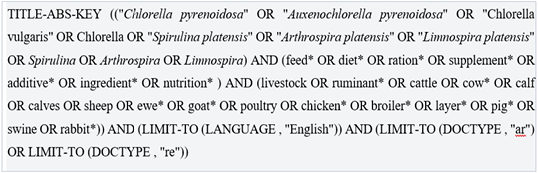
The search intentionally included both currently accepted taxonomic names and historically or commonly used genus-level terms, including Chlorella, Spirulina, Arthrospira, and Limnospira, to maximize retrieval across nomenclatural changes. Consequently, records using ‘Spirulina’ or ‘Chlorella’ generically were eligible for retrieval when these terms occurred in the title, abstract, or keywords. Proprietary commercial product names were not exhaustively enumerated; therefore, studies indexed exclusively under a brand name without a recognizable taxonomic or common-name identifier may not have been retrieved. A corpus audit confirmed that every exported record contained at least one target taxonomic term (Chlorella or Auxenochlorella, or Spirulina, Arthrospira, or Limnospira) in the title, abstract, author keywords, or indexed keywords. The corpus nevertheless included studies from human food, aquaculture, plant production, biotechnology, wastewater treatment, and environmental science; these records required eligibility screening rather than automated exclusion based solely on keywords.
Eligibility criteria
Studies were eligible when they evaluated whole biomass, processed biomass, extracts, oils, residues, fractions, or relevant bioactive products derived from Chlorella- or Spirulina-type taxa in livestock. Eligible populations included cattle, buffalo, sheep, goats, poultry, pigs, and rabbits. In vivo feeding studies were eligible when they reported feed intake, growth, feed efficiency, nutrient digestibility, rumen or intestinal fermentation, health, immune or antioxidant status, microbiological responses, reproductive performance, product yield, product composition, sensory quality, safety, toxicity, or economic performance. Livestock-relevant in vitro studies, compositional studies, techno-economic analyses, and life-cycle assessments were retained when they directly informed mechanisms, feed value, or implementation feasibility. Eligibility across these evidence types did not imply equal evidentiary weight. Their inclusion reflected the broader objective of evaluating both biological efficacy and implementation feasibility; however, direct conclusions regarding livestock responses were based primarily on in vivo feeding studies.
Studies were excluded when they focused exclusively on human food or supplementation, aquaculture, crop biostimulation, pharmaceuticals, cosmetics, wastewater treatment, or biofuel production without a direct terrestrial-livestock feed application. Opinion articles without identifiable supporting evidence, records with insufficient intervention information, duplicate publications, and publications for which the full text could not be obtained were also excluded. Review articles identified within the search corpus were treated as secondary sources rather than primary evidence. They were used for contextual interpretation and to identify potentially relevant primary publications. The unit of evidence was the individual primary report; therefore, a primary study cited in multiple reviews was considered only once after bibliographic verification. Review articles themselves were not used to derive animal-level efficacy conclusions or to increase the count of supporting primary studies.
Record management and study selection
The Scopus records were assessed for duplication using DOI and normalized bibliographic metadata. Lowercase conversion and whitespace-normalized title matching identified 2 probable duplicate records, corresponding to 1,759 unique titles before final manual verification. Because one duplicate pair contained discordant year, pagination, and DOI metadata, deduplication required manual comparison of title, authors, source, volume, pages, DOI, and Scopus EID rather than reliance on DOI matching alone.
After deduplication was verified, 1,759 records underwent independent title-and-abstract screening. Of these, 1,616 records were excluded, and 143 reports were sought for retrieval. Eight reports could not be retrieved because their full texts were inaccessible; these records were classified as reports not retrieved and were not assigned eligibility decisions. Thus, 8 of 143 reports sought for retrieval (5.6%) could not be assessed. No eligibility or methodological-quality judgment was assigned to these reports because their full texts were unavailable. Although all records in the retrieved Scopus corpus were English-language publications, the available data were insufficient to determine whether non-retrieved reports differed systematically from retrieved reports in publication age, study design, intervention characteristics, or study quality.
Consequently, 135 reports were assessed at full text, 31 were excluded with one primary reason, and 104 reports were included in the review. The full-text exclusion reasons were secondary literature (n= 15), wrong population or application (n= 7), wrong intervention, taxon, or formulation (n= 6), absence of eligible in vivo feeding data or other directly relevant livestock evidence (n= 2), and insufficient target-intervention specificity (n= 1). The same bibliographic verification principle was applied to primary publications encountered through secondary sources. Potentially relevant primary reports were matched using DOI and, where DOI information was absent or inconsistent, title, authors, year, source, volume, and pagination. Multiple citations of the same primary publication across review articles therefore represented a single study record rather than independent evidence.
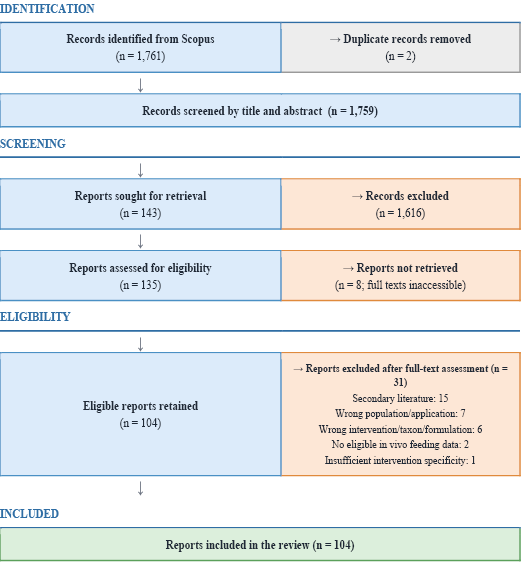
PRISMA 2020 flow diagram of record identification, screening, full-text retrieval, eligibility assessment, and inclusion. Records were identified through a single Scopus search (August 3, 2026). After removal of duplicates, records were screened by title and abstract, and potentially eligible reports were retrieved and assessed at full text against the eligibility criteria described in Section 2.3. Reports excluded at full text are shown with their primary exclusion reason. Of the 1,761 records identified, 104 reports were included in the review.
All titles and abstracts were screened independently by two reviewers (Y.P.M. and A.) against the predefined eligibility criteria. Initial screening decisions were made independently before comparison. Disagreements were discussed until consensus was reached under the supervision of a third senior author (N.M.). Inter-rater agreement was not prospectively quantified using Cohen’s kappa or another agreement statistic. A single principal exclusion reason was recorded for every excluded full-text report. The selection process is presented in Figure 1.
Data charting and extraction
Data were charted using a standardized extraction form. The extracted variables covered four domains. Study characteristics comprised author, year, country, experimental design, treatment allocation, sample size, and the number and definition of experimental units. Animal characteristics comprised species, breed or strain, age, sex, and physiological or challenge status. Intervention characteristic comprised microalgal taxon and strain, biomass source and cultivation information, processing method, chemical composition, dietary inclusion rate, basal diet, comparator, and intervention duration. Outcomes data comprised measured outcomes, effect estimates, variability measures, statistical methods, and adverse findings. Funding source, and declared conflicts of interest were also recorded. Information on the origin of the biomass, putative active compounds, method of administration, processing, animal characteristics, and reported results was used to construct the evidence table. All extracted variables and numerical metrics were independently verified against the corresponding full-text reports. Dose was retained in the exposure unit reported by the original study. No universal post hoc conversion was applied across exposure unit (g/kg diet, percentage of diet or dry matter, g/animal/day, dose per unit body weight, replacement percentage, or extract concentration). Such conversion would have required information on feed intake, body weight, dietary dry matter, or product concentration that was not consistently reported. Missing denominators were not inferred.
Cross-study dose comparisons were therefore restricted to studies with sufficiently comparable exposure bases and dietary roles, while otherwise heterogeneous doses were interpreted qualitatively. Any discrepancies were rechecked against the source publication and resolved before synthesis. Missing numerical or methodological information was recorded as not reported rather than inferred from secondary sources. Taxonomic nomenclature was harmonized during evidence synthesis by considering historical and currently accepted names together when they referred to the same taxonomic lineage. The original nomenclature reported in each source was retained for study-level traceability. Historical names were not, however, assumed to indicate equivalent strains or biomass characteristics; where strain identity or taxonomic resolution was insufficient, evidence was interpreted at the genus or broader taxonomic-group level rather than as strain-specific evidence. Insufficient strain identification alone was not grounds for exclusion when the intervention and livestock application were otherwise eligible; instead, it restricted the taxonomic level at which the findings could be interpreted. Physiological and challenge status was recorded during data extraction.
Critical appraisal
Each primary animal study was evaluated using domains adapted from SYRCLE’s risk-of-bias framework and livestock-nutrition-specific considerations. The appraisal examined three groups of domains. Design and conduct domains comprised randomization, baseline comparability, housing and allocation procedures, blinding where feasible, completeness of outcome data, selective reporting. Replication and analysis domains comprised adequacy of biological replication, identification of the true experimental unit, sample-size justification, and appropriateness of the statistical model. Intervention domains comprised basal-diet description, nutrient equivalence among treatments, microalgal identity and batch characterization, inclusion dose, and intervention duration. An in vitro or ex vivo assay and a compositional/metabolomic characterization without an in vivo feeding intervention fell outside SYRCLE’s applicable domains and were retained for mechanistic or compositional context rather than assigned a risk-of-bias judgment.
Discrepancies in individual SYRCLE domains were resolved through joint re-examination of the source report. Study-level judgments are documented in the supplementary appraisal file, and methodological limitations were used to calibrate the strength of the narrative conclusions rather than being reduced to a single numerical score. Calibration was qualitative and domain-specific rather than score-based. Findings received greater interpretive weight when studies demonstrated appropriate experimental units, adequate biological replication, transparent allocation and baseline comparability, nutritionally comparable diets, well-characterized biomass and dose, appropriate duration and statistical analysis, and outcomes directly relevant to animal performance or product value. Batch characterization was assessed as a set of reporting domains rather than as a single binary quality category. Taxonomic resolution also affected interpretive weight. Findings from biomass identified only to genus or by an historical/common name were not pooled conceptually with strain-specific findings as evidence of strain equivalence. Such studies contributed only to genus-level or broader conclusions unless additional strain or biomass characterization supported a more specific interpretation. Confidence in dose comparisons was greatest for within-study dose–response relationships, intermediate for studies using comparable exposure units and dietary roles, and lower when dose metrics or denominators differed. Consequently, heterogeneous dose measures were not quantitatively pooled or used to derive universal inclusion thresholds.
Relevant domains included taxonomic and strain identification, biomass source, processing history, chemical composition, and contaminant or microbial testing where reported. Missing characterization information was recorded as not reported. Studies lacking complete biomass characterization were retained when otherwise eligible, but their findings were interpreted more cautiously and were not used alone to support strain-specific or composition-specific efficacy claims. When important concerns were present in these domains, conclusions were deliberately restricted in scope and expressed as preliminary, supportive, mechanistically plausible, or insufficiently confirmed rather than as evidence of reproducible efficacy. No single domain automatically determined the conclusion; the direction and magnitude of the limitation were considered in relation to the outcome being interpreted.
Evidence synthesis
Evidence was synthesized according to a predefined hierarchy of directness. In vivo livestock feeding studies were given primary weight for conclusions concerning biological efficacy, animal performance, digestibility, health, reproduction, and product outcomes. In vitro and ex vivo studies were used only to support mechanistic interpretation, compositional studies to characterize biomass properties and potential nutrient or bioactive value, and techno-economic or life-cycle studies to assess implementation feasibility and environmental trade-offs. These evidence types were not treated as interchangeable, and contextual evidence was not used to substitute for direct in vivo evidence where animal-level outcomes were absent or inconsistent. Greater interpretive weight was assigned to studies with appropriate experimental units, adequate replication, well-characterized biomass, nutritionally comparable diets, relevant comparators, and outcomes linked to animal performance or product value.
Because the aim was critical interpretation rather than quantitative effect estimation, and because of substantial heterogeneity in species, interventions, doses, processing methods, comparators, and outcomes, evidence was synthesized narratively rather than by meta-analysis. For example, small or weakly replicated studies could support mechanistic hypotheses but were not used alone to justify broad efficacy claims; biomarker responses were given less weight than corresponding animal-performance outcomes; and benefits observed primarily in challenge models were interpreted cautiously with respect to normal commercial production. Challenge-model findings were interpreted according to the condition experimentally tested. Evidence of improved performance, immune function, oxidative status, or survival under a defined infectious, inflammatory, thermal, or toxicological challenge was considered evidence of protective or resilience-related efficacy under that condition. Such findings were not treated as equivalent to evidence of routine efficacy in healthy animals. For conclusions concerning normal commercial production, greater interpretive weight was assigned to studies conducted under non-challenge or representative production conditions with direct animal-performance, health, or product outcomes.
Studies reporting only biomarker, molecular, metabolic, immune, antioxidant, or microbiological responses without corresponding production outcomes were interpreted as mechanistic or physiological-response evidence rather than direct evidence of productive efficacy. Such findings could strengthen biological plausibility but were not used alone to support conclusions concerning growth, feed efficiency, reproduction, product yield, disease resistance, or economic return. Dietary role was considered explicitly during synthesis. Studies were interpreted as functional supplementation when microalgae were used primarily to provide a defined bioactive, pigmentation, product-enrichment, or stress-resilience function without substantial replacement of a conventional nutrient source. Replacement studies were interpreted according to their ability to substitute for conventional protein or energy ingredients while maintaining nutrient equivalence, digestibility, intake, and productive performance
The geographical distribution of the evidence was not used to imply regional representativeness. Global feeding studies were used to evaluate biological efficacy, whereas Southeast Asian publications and institutional evidence were interpreted separately to assess regional implementation feasibility, including biomass availability, cultivation and processing requirements, production costs, regulation, environmental performance, technology readiness, and supply-chain constraints.
Nutritional and functional basis
The nutritional value of microalgal biomass depends on nutrient accessibility and utilization rather than crude composition alone. For example, Spirulina platensis with or without Chlorella vulgaris showed high ruminal protein degradability in dairy cows but did not improve dry-matter intake, nutrient digestibility, or milk yield. Likewise, at 15% inclusion in broilers, extruded Arthrospira platensis maintained performance whereas whole biomass reduced growth, indicating that processing can substantially alter the biological value of the same nominal feed source. Dietary dose is also important: Chlorella vulgaris at 6% reduced broiler performance, whereas inclusion up to 3% caused no adverse performance effect. These findings show that feed value must be interpreted together with cell-wall characteristics, processing history, palatability, digestibility, dose, and the nutritional context of the complete diet. Chlorella-type biomass may provide protein, chlorophylls, carotenoids, minerals, and unsaturated fatty acids, whereas Spirulina-type biomass is frequently valued for protein, phycocyanin, carotenoids, and antioxidant activity ; .
This variability limits direct comparison among feeding trials because differences attributed to Chlorella or Spirulina may instead reflect differences in biomass composition, processing, or effective nutrient and bioactive exposure. Nevertheless, amino-acid balance, nucleic-acid content, ash, cell wall resistance, and digestibility determine whether these nutrients are accessible to the animal. Processing by drying, extraction, cell disruption, extrusion, or enzyme supplementation can improve nutrient accessibility, but the associated economic and energy penalties are highly process-specific. The available livestock literature rarely reports processing energy or cost together with digestibility and animal-performance responses, preventing a defensible cross-study estimate of the net benefit of individual processing methods. For example, extrusion of Arthrospira platensis improved performance relative to whole biomass at high dietary inclusion, but whether this biological benefit offsets the additional processing energy and cost remains unresolved. Processing should therefore be evaluated in terms of nutritional or animal value gained per unit of economic and energy input rather than assumed to be beneficial solely because nutrient accessibility increases.
Functional effects are similarly conditional. Antioxidant, anti-inflammatory, immunomodulatory, and antimicrobial activities are often inferred from phytochemical screening or in vitro assays. Such tests identify potentially active fractions but do not establish effective dietary dose, bioavailability, target tissue exposure, or clinical relevance. Dietary microalgae supplementation tends to improve feed conversion ratio (FCR) and average daily gain (ADG) across multiple livestock species, but the magnitude and consistency of these effects depend heavily on microalgal strain, inclusion level, and animal species . In animal feeding studies, biomarker changes should be interpreted alongside production outcomes and health status. An increase in catalase or superoxide dismutase activity may support biological plausibility, but it does not, by itself, demonstrate improved feed efficiency, disease resistance, or profitability. Bioavailability remains a central unresolved issue for microalgal bioactives, and application-oriented reviews explicitly identify digestion pathways and factors affecting absorption as necessary for translation ; .
Quality assurance is central to translation. Microalgal biomass can vary between batches in protein content, fatty acid profile, pigment concentration, moisture, ash, microbial load, heavy metals, residual solvents, and unwanted metabolites. Use of wastewater, digestate, or agro-industrial effluent for microalgal cultivation may improve nutrient circularity, but feed application requires explicit biosafety control. Relevant hazards include pathogenic or undesirable microorganisms, heavy metals, pharmaceutical residues, other chemical contaminants, and unwanted metabolites that may be associated with the cultivation medium or harvested biomass. Wastewater-derived biomass should therefore not be regarded as feed-grade solely on the basis of successful cultivation. The wastewater source, biomass-processing history, and relevant microbial and chemical hazards should be characterized, and removal or control procedures should be validated for the contaminant profile of the production system. Final biomass intended for feeding should undergo appropriate microbial and chemical contaminant testing and comply with applicable feed-safety limits. Because wastewater composition and regulatory requirements differ among production systems and regions, the present evidence does not support a single universal treatment sequence; treatment requirements should instead be defined and validated for each feed-production chain. Consequently, every efficacy claim must be interpreted in relation to biomass identity, processing history, analytical specification, and the final diet. Functional claims for microalgal feed ingredients are therefore strongest when the material is composition-defined, processing-defined, contaminant-tested, and evaluated in complete diets against animal performance and health endpoints, not biomarkers alone. In the available literature, the main limitation is not a lack of promising activity but a lack of standardized translation of assay signals into reliable feed efficacy ; ; . The implications of incomplete biomass characterization for interpreting the evidence are addressed in Section 5.
Evidence across livestock systems
Ruminants
Ruminant evidence (Table 1) separates biochemical modification from production benefit. Spirulina and Chlorella have been tested as protein supplements, lipid sources, and functional additives, but responses vary with the basal diet, dietary role, and inclusion level. In dairy cows, microalgae did not consistently improve intake, digestibility, milk yield, or composition. In Lamminen et al. (2017), high ruminal protein degradability and possible palatability limitations were relevant constraints, illustrating that crude protein supply does not necessarily translate into greater metabolizable protein or productive response. In da Silva et al. (2016), microalgal meal was evaluated as a partial replacement for ground corn and altered intake and blood metabolites without improving milk production, indicating that replacement responses must be interpreted in relation to the nutritional role of the displaced ingredient and the nutrient equivalence of the complete diet. These factors should be regarded as plausible contributors to the null responses rather than definitive causal explanations because biomass characterization, dose comparability, and diet formulation were not uniformly reported across studies.
Product composition and biomarkers appear more responsive. Chlorella increased antioxidant-enzyme activity in goats without improving milk yield or fatty-acid composition , whereas other studies reported greater rumenic acid or n-3 fatty acids in milk . Microalgae increased microbial protein and average daily gain in cattle fed low-quality forage in one trial ; a five-steer study found altered rumen-fluid fatty acids, supporting a mechanism but not a broad inference .
Dose-specific evidence further supports a targeted rather than replacement-oriented interpretation. In dairy cows, Arthrospira platensis supplied at 2 mL/kg live body weight was associated with improved intake, digestibility, and milk yield, whereas 5% dietary inclusion as a soybean-meal replacement produced no improvement in intake or milk production. In finishing steers, 0.5–1.0% of diet dry matter did not improve digestion and tended to reduce weight gain and feed efficiency. In small ruminants, lower or purpose-specific doses produced more favorable responses: 0.1–0.2 g/kg body weight of Spirulina improved lamb growth, while 0.5% DM Chlorella vulgaris increased beneficial n-3 fatty acids in lamb meat, with no further improvement at 1% DM. The absence of additional enrichment at 1% DM should be interpreted as a plateau in response rather than evidence that the higher dose was necessarily ineffective or detrimental. The mechanism underlying this plateau was not established in the available evidence. Possible explanations include a limit to the proportion of additional dietary PUFA escaping ruminal biohydrogenation, saturation of tissue fatty-acid incorporation, or dose-related changes in nutrient accessibility, digestibility, or release of lipids from the microalgal biomass. These explanations remain hypotheses and require direct evaluation. The finding nevertheless demonstrates that increasing microalgal inclusion does not necessarily produce a proportional increase in the desired product-quality response. Future ruminant trials should therefore use composition-defined biomass, nutritionally matched control diets, standardized dry-matter inclusion levels, multiple-dose designs, and explicit measurements of palatability, intake, ruminal protein degradability, nutrient digestibility, microbial protein supply, and animal performance to distinguish biological inactivity from limitations imposed by formulation or nutrient availability.
Table 1: Representative in vivo feeding studies of Chlorella- and Spirulina-type biomass in ruminants.
| Animal (breed) | Microalgal treatment | Inclusion level | Key findings | Reference |
| Cow (Holstein-Friesian) | Arthrospira platensis | 2 mL/kg LBW in drinking water | Best results for nutrient digestibility, feed intake, milk yield, and economic efficiency. | |
| Cow (Brown Swiss & Holstein) | Arthrospira platensis (Spirulina) | 5% inclusion (replacing soybean meal) | Did not affect DM intake, milk yield, or antioxidant capacity; no sensory differences detected. | |
| Cow (Holstein-Friesian) | Spirulina platensis | 5% inclusion dried Spirulina platensis | Increased health-promoting fatty acids in milk, providing nutraceutical benefits. | |
| Cow (Finnish Ayrshire) | Spirulina platensis ± Chlorella vulgaris | microalgae replaced part or all of the protein supplied by rapeseed supplement | No effect on DMI, milk yield, or nutrient digestibility; microalgae had high ruminal protein degradability. | |
| Dairy cattle | Spirulina | 0.1% inclusion in the feed | Improved blood gas parameters in cattle with sub-acute ruminal acidosis. | |
| Cow (Holstein-Friesian) | Prototheca moriformis† | Replacing ground corn | Replacing ground corn with microalgae meal did not alter milk yield/composition; increased blood cholesterol. | |
| Cattle (Bos indicus) | S. platensis, C. pyrenoidosa, D. salina†, Schizochytrium sp.†, and others | 4 g/kg body weight/day & 4.7 g/kg body weight/day | S. platensis and C. pyrenoidosa showed potential to increase ADG of weaner cattle on tropical forages. | |
| Beef cattle (Limousin crossbred bulls) | Arthrospira platensis (Spirulina) | Replacing soybean meal | Performed comparably to soybean meal; no effect on DM/nutrient intake or energy utilisation. | |
| Beef bull (crossbreed) | Dunaliella salina† ± Bacillus subtilis | 30 g/head/day | Improved digestibility coefficients, body weight gain, and feed efficiency under heat-stress. | (AL Suwaiegh, 2023) |
| Steer (Holstein & Crossbred) | Arthrospira (Spirulina) platensis | 0.5, 1.0% of diet DM | No effect on digestion; tended to decrease weight gain and efficiency in finishing steers. | |
| Goat (Damascus) | Chlorella vulgaris + Moringa oleifera silage | Replacing 20–40% of concentrate | Increased milk yield, PUFA, and lactation performance; cheese had superior flavor and texture. | ; |
| Goat kid (Damascus) | Chlorella vulgaris + Moringa oleifera leaves silage | 1% of DM (CV) + 20–40% silage | Increased growth performance, nutrient digestibility, and blood antioxidant capacity. | |
| Goat (Cross-bred) | Chlorella vulgaris | 0.515% of the total diet | Significant increase in antioxidant enzyme activity (CAT and SOD); no effect on milk yield. | |
| Goat (Hungarian native) | Chlorella kessleri | microalgae replaced part or all of the protein supplied by rapeseed supplement | Significantly higher concentrations of rumenic acid and n-3 fatty acids in milk. | |
| Lamb (Barki) | Spirulina (Arthrospira platensis) | 0.1 or 0.2 g/kg BW | Dose-dependent improvement in growth and muscle area; increased antioxidant capacity. | |
| Lamb (Hu sheep) | Spirulina (under high-fat diet) | 3% of diet | Improved VFA concentration and upregulated rumen tight-junction genes. | |
| Lamb (Barki) | Spirulina | 2 mg/g | Partially mitigated performance losses when replacing alfalfa with Guinea grass. | |
| Ram (Iraqi Awassi) | Arthrospira platensis (Spirulina) | 1 or 5 g/kg | High dose (5 g/kg) improved testosterone and semen quality; reduced inflammatory markers. | |
| Ewes (Chios) | Spirulina sp. | 15 g/ewe/day | Slightly modulated selected rumen microbes in a dose-dependent manner. |
Studies were selected from the 104 included reports to illustrate the range of species, dietary roles, inclusion levels, and outcomes. † Taxon outside the Chlorella/Spirulina target group, shown for comparison only. ADG, average daily gain; BW, body weight; DM, dry matter; DMI, dry matter intake; LBW, live body weight; PUFA, polyunsaturated fatty acids; VFA, volatile fatty acids.
Table 2: Representative in vivo feeding studies of Chlorella- and Spirulina-type biomass in poultry.
| Animal (breed) | Microalgal treatment | Inclusion level | Key findings | Reference |
| Broiler (Ross 308) | Arthrospira (Spirulina) platensis | 0.25–1.0% | Linear improvement in BWG and FCR; increased serum antioxidant enzymes (SOD/GPx). | |
| Broiler (Ross 308) | Arthrospira spp. | 30 or 60 g/kg | Higher inclusion (60 g/kg) worsened FCR and final body weight; increased breast yellowness. | |
| Broiler (Cobb500) | Spirulina platensis | 1–4 g/kg | Linear improvement in BWG and FCR; 4 g/kg provided highest net return. | |
| Broiler (Cobb500) | Spirulina platensis | 10 g/kg | Mitigated performance deterioration and improved immune response under E. coli challenge. | |
| Broiler | Spirulina platensis-derived polysaccharides | 1500–6000 mg/kg | 3000 mg/kg optimized BWG and FCR; improved villus morphology and digestive enzyme activity. | |
| Broiler (Ross 308) | Spirulina platensis (powder vs. extract) | 1–2 g/kg (powder) or 1–2 mL/L (extract) | Powder form more effectively improved growth and redox status than aqueous extract under heat stress. | |
| Broiler chicken | Spirulina platensis | 3 and 6% | Enhanced growth performance and physiological status. | |
| Broiler chickens | Spirulina | 0.5% of the complete diet on an as-fed basis | Improved growth and intestinal morphology under Eimeria challenge. | |
| Broiler | Arthrospira platensis (whole vs. extruded) | 15% | Extruded Spirulina matched control performance, whereas whole Spirulina decreased growth at high inclusion. | ; |
| Broiler (Ross 708) | Arthrospira platensis (Spirulina) | 2.5, 5% | No effect on growth performance; increased skin/fillet yellowness and shifted gut microbiome. | |
| Broiler (Lohmann MB 202) | Arthrospira platensis (various culture media) | 10% (v/v) of fresh Spirulina culture | Spirulina grown on tempeh wastewater matched commercial Spirulina in improving BWG and FCR. | |
| Broiler (Ross 308) | Chlorella vulgaris | 3–6% | 6% inclusion reduced performance; up to 3% improved meat color without negative effects. | |
| Broiler | Chlorella vulgaris (dried)±cinnamon oil | 1 g/kg DCV | Improved BWG, FCR, and jejunal villus height; upregulated tight-junction genes. | |
| Broiler chickens | Chlorella vulgaris | 10% of the complete broiler diet | Influenced meat quality and lipid composition. | |
| Broilers | Various algal species | 10 g/kg of basal feed | Significant effects on meat quality and intestinal morphology. | |
| Laying hen (HY-Line W-36) | Spirulina platensis | Replacing soybean meal | Improved productive performance, egg quality, and blood metabolites. | |
| Laying hen (Sinai indigenous) | Spirulina platensis | 0.6 or 0.8 g/kg | 0.6 g/kg optimized egg production; 0.8 g/kg enhanced hatchability and sperm concentration. | |
| Laying hens | Spirulina platensis | 30, 60, and 90 g/kg of feed on an as-fed basis. | Mitigated negative effects of heat stress on cholesterol and inflammation. | |
| Laying hen (White Leghorn) | DHA-rich Schizochytrium sp. oil† | Up to 40 g/kg | Enriched eggs with n-3 PUFA; inclusion above 20 g/kg depressed egg production, and 40 g/kg induced hypotriglyceridemia. | |
| Japanese quail | Arthrospira platensis (Spirulina powder) | 1000–5000 mg/kg | Dose-dependent improvements in growth, antioxidant enzymes, and immune organ weights. | |
| Peking ducks | Spirulina powder | 2.5%, 5%, 7.5%, and 10% of basal feed | Positive potential for hepatic histomorphometry. |
Studies were selected from the 104 included reports to illustrate the range of species, dietary roles, inclusion levels, and outcomes. † Taxon outside the Chlorella/Spirulina target group, shown for comparison only. BWG, body weight gain; DCV, dried Chlorella vulgaris; DHA, docosahexaenoic acid; FCR, feed conversion ratio; GPx, glutathione peroxidase; PUFA, polyunsaturated fatty acids; SOD, superoxide dismutase.
Poultry
Poultry responses (Table 2) depend on dietary purpose. Replacement studies assess nutrient supply, whereas low-dose supplementation tests functional effects. In laying hens, partial replacement of soybean meal with Spirulina was associated with improved performance, egg quality, and blood traits , but interpretation requires nutritionally equivalent diets and control for changes in amino-acid balance, pigments, and palatability.
Benefits are often reported under challenge. Spirulina at 10 g/kg mitigated performance and immune–oxidative deterioration during an Escherichia coli-related challenge , while 1–2 g/kg Spirulina powder improved growth and redox status during cyclic heat stress. Such findings demonstrate stress-mitigating potential rather than unconditional growth promotion. Their practical relevance is therefore greatest in production systems where heat or enteric disease pressure is substantial. However, translation to healthy commercial flocks remains uncertain because studies conducted without imposed challenge report mixed responses: low-dose Spirulina has improved growth and feed efficiency in some broiler studies, whereas moderate-to-high inclusion has produced neutral or adverse performance responses. Challenge-model benefits should therefore be interpreted as evidence of resilience that requires confirmation under normal commercial conditions rather than as proof of routine performance enhancement. For example, Arthrospira/Spirulina at 0.25–1.0% or 1–4 g/kg improved body-weight gain and feed conversion in some broiler studies, whereas 2.5–5% produced no growth response and 60 g/kg worsened feed conversion and final body weight. Similarly, Chlorella vulgaris caused no adverse performance effect at up to 3% but reduced performance at 6%. These findings indicate that positive challenge responses cannot be extrapolated independently of dose, biomass form, and production context.
Species-dependent broiler responses to Chlorella vulgaris, S. platensis, and Amphora coffeaformis further show that microalgae are not a uniform intervention . Microalgal lipids can enrich products, but dose and timing matter. Microalgal lipids can effectively enrich eggs, but the response is dose-dependent. In laying hens, DHA-rich Schizochytrium oil increased egg n-3 PUFA concentrations at dietary inclusion levels up to 20 g/kg, whereas levels above 20 g/kg depressed egg production; at 40 g/kg, reduced egg production was accompanied by altered lipid metabolism . Thus, 20 g/kg represented the highest tested inclusion level providing enrichment without the reported production penalty in that study, rather than a universally optimal dose. Commercial application should therefore target the lowest dose that achieves the required n-3 enrichment while maintaining egg output and feed efficiency. Maternal and post-hatch provision also influenced pullet skeletal development . The defensible application is therefore purpose-specific (replacement, pigmentation, stress resilience, or enrichment) rather than unrestricted inclusion.
Pigs, rabbits, and other monogastrics
Evidence from pigs and rabbits (Table 3) further demonstrates that physiological responses are neither uniformly beneficial nor readily transferable across health states. Spirulina and Chlorella supplementation improved intestinal architecture and nutrient digestibility in weaned piglets in a study by Furbeyre et al. (2017). By contrast, C. vulgaris altered blood-cell profiles and plasma metabolites in finishing pigs and appeared to reduce systemic antioxidant capacity when used without carbohydrase support . Spirulina supplementation during pre-gestation, gestation, and lactation did not improve reproductive or lactational performance in primiparous sows .
In rabbits exposed to lead, S. platensis improved growth, hematological, biochemical, oxidative, and histological outcomes , while related supplementation studies reported improved growth and antioxidant status under heat stress. These findings demonstrate protective or resilience-related activity under
Table 3: Representative in vivo feeding studies of Chlorella- and Spirulina-type biomass in pigs and rabbits.
| Animal (breed) | Microalgal treatment | Inclusion level | Key findings | Reference |
| Pig (growing-finishing) | Spirulina (powder) | Replacing up to 100% soybean meal | Full replacement of soybean meal did not impair growth rate, feed efficiency, or meat quality. | |
| Piglet / Weanling pigs | Spirulina platensis ± Chlorella vulgaris | 1% of basal feed | Improved intestinal mucosal architecture and nutrient digestibility in weaned piglets. | |
| Rabbit | Spirulina platensis ± Nanoparticles | 1 g/kg SP | Improved growth, hematology, and antioxidant status; mitigated heat stress and lead toxicity. | ; |
Studies were selected from the 104 included reports to illustrate the range of species, dietary roles, inclusion levels, and outcomes. † Taxon outside the Chlorella/Spirulina target group, shown for comparison only. SP, Spirulina platensis.
defined stress conditions, but they do not establish routine growth-promoting efficacy in healthy rabbits. Lead toxicity has limited relevance to normal commercial production, whereas heat-stress mitigation may have greater practical importance in hot production environments. Nevertheless, the evidence summarized in this review does not provide sufficient direct support for consistent performance benefits in healthy, non-challenged rabbits; routine supplementation therefore remains insufficiently validated. Evidence from pigs and rabbits indicates that efficacy is strongly conditioned by health status, physiological stage, dietary role, and biomass accessibility. In weaned piglets, Spirulina platensis and/or Chlorella vulgaris improved intestinal architecture and nutrient digestibility, with related benefits reported under inflammatory challenge, suggesting that the post-weaning period and compromised gut function may represent responsive contexts. By contrast, C. vulgaris in finishing pigs was associated with unfavorable antioxidant responses when used without carbohydrase support, indicating that cell-wall accessibility and enzyme assistance may influence nutrient utilization. In growing–finishing pigs, substantial replacement of soybean meal with Spirulina was tolerated without loss of growth or feed efficiency, but did not demonstrate a clear performance advantage, while supplementation of primiparous sows during reproduction and lactation did not improve reproductive performance. In rabbits, Spirulina at 1 g/kg improved growth and physiological responses under heat stress or lead exposure, supporting a protective role under challenge rather than a proven routine benefit in healthy animals. Thus, the available evidence supports context-specific use under defined intestinal, oxidative, environmental, or nutritional stress rather than generalized supplementation across commercial pig and rabbit production.
Cross-cutting methodological limitations
The apparent inconsistency across animal studies is partly biological but also methodological. First, species and strain names are frequently reported without a culture-collection number, molecular identification, or batch specification, and taxonomic revisions further complicate comparison among Chlorella, Auxenochlorella, Spirulina, Arthrospira, and Limnospira. Second, biomass is often described as dried, lyophilized, spray-dried, extracted, or pelletized without sufficient compositional data to determine which nutrient or process drove the response. When strain identity, batch composition, processing history, or contaminant status is insufficiently reported, differences in animal response cannot confidently be attributed to the microalgal taxon. As described in Sections 2.5 and 2.6, such studies were retained but interpreted only at the genus or broader taxonomic level. Incomplete characterization therefore limits cross-study attribution and the generalizability of taxon-specific conclusions.
Third, dietary exposure is difficult to compare. Studies report inclusion as g/kg diet, g/animal/day, volume per unit body weight, replacement percentage, extract concentration, or unspecified supplementation. The basal diet, nutrient equivalence, and comparator ingredient are not always clear. A biomass used at low dose as a pigment or immunomodulator cannot be evaluated by the same criteria as a high-inclusion protein replacement. The two dietary roles defined in section 2.7 were therefore evaluated against separate criteria. For functional supplementation, benefit required achievement of the intended functional or product-quality endpoint without impairment of intake or production. For ingredient replacement, maintenance of nutrient supply, digestibility, palatability, and animal performance was considered successful substitution, even without additional growth or production benefit. This distinction is applied throughout the remainder of the review.
Dose–response relationships are uncommon, despite evidence that low and high doses can produce different outcomes. Because exposure metrics were not directly interchangeable, doses were compared only within the context of species, animal class, biomass form, basal diet, and intended dietary role (Section 2.5). This limits confidence in cross-study dose ranking and prevents definition of a universal optimal or harmful inclusion level, although within-study dose–response comparisons remain informative. Taken together, the critical appraisal indicated heterogeneous methodological quality across the evidence base rather than uniformly high or low risk of bias.
Fourth, endpoint selection frequently favors statistical responsiveness over farm relevance. Changes in antioxidant enzymes, cytokines, gene expression, or microbiota can clarify the mechanism, but they require evidence of linkage to health, productivity, product quality, or reduced treatment costs. Challenge models are valuable for identifying protective or resilience effects, but effect sizes obtained under experimentally induced disease, inflammatory, thermal, or toxicological stress may not predict responses under normal production conditions. Challenge-model evidence was therefore interpreted as condition-specific evidence of resilience (Section 2.7). Short experimental duration, limited reporting of power or sample-size justification, and selective emphasis on significant outcomes further reduce certainty. Without standardized reporting of identity, composition, exposure, comparator, and endpoint, species names serve as inadequate proxies for the feed material actually tested. For these reasons, minimum standards for interpretable microalgal feeding studies are proposed as shown in Table 4. Because reporting was heterogeneous, Table 4 presents
Table 4: Minimum standards for interpretable microalgal feeding studies.
| Domain | Why it matters | Minimum reporting standard | References |
| Identity and taxonomy | Different strains may have different composition and safety profiles. | Culture-collection or molecular identifier; accepted name plus commonly used synonym. | |
| Biomass specification | Crude species names do not describe the tested feed material. | Batch proximate, amino-acid, fatty-acid, pigment, ash, moisture, contaminant, and microbial data. | ; |
| Processing history | Drying, extraction, disruption, and storage alter digestibility and bioactivity. | Complete processing conditions, storage duration, oxidation control, and final physical form. | ; ; |
| Dose and dietary role | Additive and replacement studies answer different questions. | Dry-matter inclusion, dose per animal, basal diet, comparator, nutrient equivalence, and dose–response. | ; ; |
| Endpoint hierarchy | Biomarkers may not predict farm-level value. | Prespecified primary production/health endpoint plus mechanistic secondary endpoints. | ; ; |
| Sustainability claim | Environmental performance depends on system boundary and region. | Functional unit, electricity mix, nutrient source, drying, transport, coproduct allocation, and uncertainty analysis. | ; |
these characteristics as minimum recommended standards for future feeding studies rather than as criteria retrospectively imposed on all included studies.
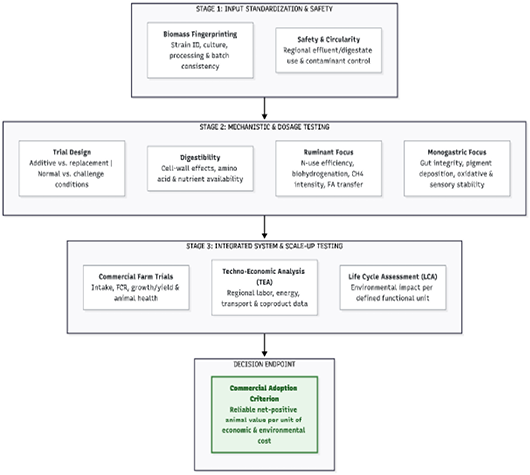
Staged research priorities for evaluating microalgal feed applications in Southeast Asian livestock systems. Stage 1 standardizes biomass inputs and safety; Stage 2 tests mechanisms and dose under defined dietary roles and animal-specific endpoints; Stage 3 evaluates integrated performance through commercial farm trials, techno-economic analysis (TEA), and life cycle assessment (LCA) based on regional data. Arrows indicate progression between stages. Adoption is justified only when the decision endpoint, a reliable net-positive animal value per unit of economic and environmental cost, is met. The priorities are discussed in Section 8. CH₄, methane; FA, fatty acid; FCR, feed conversion ratio; N, nitrogen.
Several study-level characteristics were not prospectively coded as binary variables across the 104 included reports: Challenge status, dietary role (supplementation versus replacement), biomarker-only versus production outcomes, strain identification, batch characterization, dose–response evaluation, and compliance with individual appraisal domains. Their prevalence therefore cannot be expressed as study-level percentages without retrospective reclassification. In addition, the included evidence comprised heterogeneous animal, mechanistic, compositional, and implementation studies, making a single denominator inappropriate for some domains. These limitations were handled qualitatively through domain-specific critical appraisal. Confidence was greatest when studies combined verified biomass identity, adequate batch characterization, clearly defined dose and dietary role, nutritionally appropriate comparators, and animal-level production or health outcomes. Where one or more of these domains were inadequately reported, the scope and certainty of the corresponding conclusions were reduced. The minimum reporting standards in Table 4 also form the evidence-quality basis for the producer-oriented decision framework described at the end of this section (Figure 3).
Several further limitations apply to the review process. Full texts could not be retrieved for 8 of 143 reports sought for eligibility assessment (5.6%). Because these reports could not undergo eligibility assessment or methodological appraisal, availability bias cannot be excluded, although it concerns a small portion of the potentially relevant evidence. Inter-rater agreement during title-and-abstract screening was not prospectively quantified. All records were independently screened by two reviewers, and disagreements were resolved through supervised consensus; however, an agreement statistic would have provided an additional measure of screening reproducibility. The search may also have missed studies that described the intervention only by a proprietary product name, without identifying Chlorella, Spirulina, Arthrospira, Limnospira, or a corresponding species name in searchable metadata. The magnitude of this potential omission could not be quantified because no validated denominator of such brand-only studies was available. Finally, the review was not prospectively registered in a public protocol repository. Although the search strategy, eligibility criteria, screening process, data-extraction procedures, and critical-appraisal approach are reported transparently, retrospective methodological reporting does not provide the same protection against post hoc modification as a prospectively registered protocol. This limitation should be considered when assessing reproducibility.
For practical application, the evidence can be translated into the sequential decision framework shown in Figure 3. The framework contains seven decision points, and a biomass proceeds to the next point only when the preceding condition is met. First, supplementation must address a clearly defined objective. Such objectives include correcting a nutrient limitation, modifying product composition, improving resilience under a defined heat, oxidative, or intestinal challenge, or replacing part of a conventional ingredient. Second, the biomass must be adequately characterized by verified taxon or strain, batch composition, processing and storage history, and contaminant and microbial safety; otherwise, strain-specific efficacy claims are not justified. Third, the dietary role must match the formulation. Functional supplementation should use a purpose-specific, preferably low, effective dose, whereas ingredient replacement additionally requires nutrient equivalence, acceptable digestibility, and palatability. Fourth, dose–response evidence should be relevant to the species, production stage, and health status; where it is lacking, pilot multiple-dose testing is preferable to extrapolating doses between species. Fifth, the selected dose must maintain intake, digestibility, and performance; if it does not, the dose, processing, or diet should be modified, or supplementation discontinued. Sixth, the claimed benefit must be demonstrated at the animal or product level, for example as growth, feed efficiency, milk or egg production, health, reduced losses, or product enrichment. Biomarker responses alone constitute mechanistic evidence and are insufficient for routine commercial adoption. Seventh, the additional biological or product-quality value must exceed the incremental biomass and processing cost. Biomasses that satisfy all seven conditions are candidates for practical adoption, subject to on-farm validation. Failure at any point indicates that supplementation should be reformulated, reduced, or discontinued rather than assumed to be beneficial.
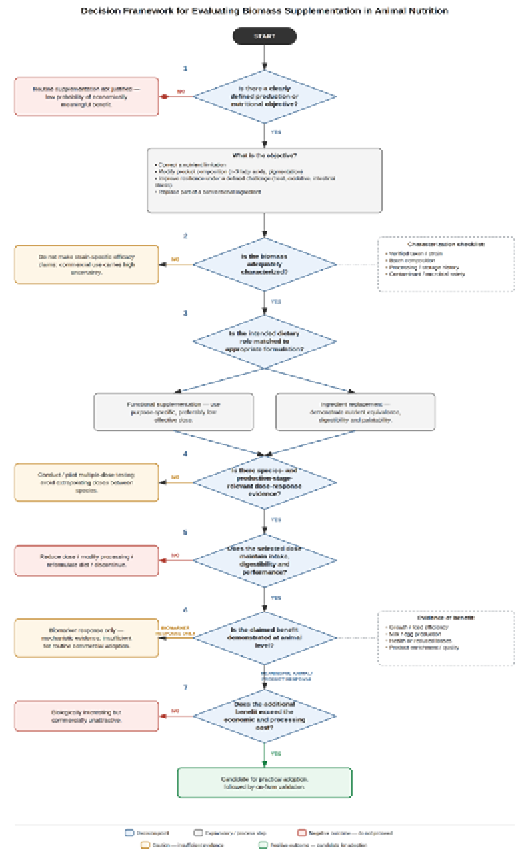
Decision framework for the practical use of Chlorella- and Spirulina-type biomass in livestock diets. Numbered diamonds represent seven sequential decision points: (1) production or nutritional objective; (2) biomass characterization; (3) dietary role and formulation; (4) dose–response evidence; (5) maintenance of intake, digestibility, and performance; (6) animal-level benefit; and (7) benefit relative to cost. Red boxes indicate outcomes at which supplementation should not proceed, amber boxes indicate insufficient evidence requiring caution or further testing, and the green box indicates a candidate for practical adoption subject to on-farm validation. Dashed boxes list the characterization criteria (step 2) and accepted evidence of benefit (step 6). The framework is explained in Section 5
Economic feasibility and environmental sustainability
The available evidence does not permit a standardized numerical cost breakdown across microalgal feed systems for cultivation, harvesting, dewatering, drying, cell disruption, stabilization, storage, and transport. Published techno-economic studies differ substantially in production scale, cultivation technology, energy source, system boundary, geographic setting, and coproduct allocation. Consequently, this review does not establish that Chlorella- or Spirulina-type biomass is cost-competitive with soybean meal, fishmeal, or other conventional protein ingredients. A valid comparison should report delivered ingredient cost together with protein concentration, amino-acid composition, species-specific digestibility or availability, and processing losses, allowing calculation of cost per unit of crude protein, digestible protein, or digestible essential amino acid. Where these data are unavailable, comparison based only on biomass price or crude-protein concentration should be regarded as insufficient for assessing economic substitution. Functional units for supplementation applications are defined later in this section.
Biological efficacy alone cannot justify adoption if the delivered nutrient value does not offset cultivation and processing costs. Contamination control, harvesting, dewatering, drying, disruption, stabilization, storage, and transport all add expense, while feed markets cannot absorb pharmaceutical-grade cost structures. Feasibility improves with robust strains, low-cost nutrient streams, minimal drying, local distribution, and biorefineries that allocate costs across multiple products ; . Post-extraction residues may retain feed value, but nutrient availability and solvent safety require testing .
Environmental performance is also conditional. Low land demand does not guarantee a smaller overall footprint because electricity, mixing, temperature control, nutrient supply, harvesting, dewatering, and drying can contribute substantially to greenhouse-gas emissions, energy demand, and water use. The present evidence base does not support a single standardized carbon footprint, water footprint, or energy-use value for microalgal feed production because published life-cycle assessments differ in cultivation technology, geographic location, electricity mix, nutrient source, production scale, system boundary, functional unit, and coproduct allocation. Consequently, this review does not establish that Chlorella- or Spirulina-type biomass has a lower environmental footprint than soybean meal, fishmeal, or other conventional feed ingredients. Comparisons per kilogram of biomass may differ substantially from comparisons per unit of digestible protein, dietary energy, effective functional dose, or product enrichment. Environmental superiority should therefore be evaluated only for clearly defined production chains using harmonized functional units and region-specific life-cycle inventory data. Results vary with cultivation mode, location, functional unit, system boundary, and coproduct allocation ; .
Wastewater, digestate, or industrial carbon streams may improve circularity but introduce biosafety and treatment burdens. The appropriate comparison is therefore a defined regional production chain delivering a specified nutritional function. Sustainability should be assessed through region-specific life-cycle assessment, rather than treated as an intrinsic property of microalgal biomass. Direct quantitative comparison among processing technologies remains difficult because published techno-economic and life-cycle studies use different scales, energy systems, functional units, system boundaries, and coproduct assumptions. Consequently, no single energy or cost penalty for drying, disruption, extrusion, or extraction can be generalized across microalgal feed systems. Process-level comparisons should instead express the additional processing input relative to the resulting gain in digestible nutrient supply, ingredient replacement, animal performance, or product enrichment.
For Southeast Asian microalgal feed systems, LCA and TEA should use functional units matched to the intended nutritional function rather than relying solely on kilograms of dry biomass. For bulk protein replacement, appropriate functional units include 1 kg of digestible protein supplied, 1 kg of digestible essential amino acid supplied, or 1 kg of conventional feed ingredient replaced under nutritionally equivalent conditions. For functional supplementation, the functional unit should instead represent one effective dietary dose or a defined product-quality outcome, such as a specified increase in n-3 fatty-acid deposition, pigmentation, or other validated response. Biomass mass may be reported as a secondary process-level unit, but it should not be the sole basis for environmental or economic comparison. A common cradle-to-feed-gate boundary should be used for both microalgal and conventional-feed comparators. Upstream, this boundary should include cultivation infrastructure and operation; electricity, water, and nutrient inputs; and mixing and temperature control where applicable. Downstream, it should include harvesting and dewatering, drying or alternative stabilization, processing by cell disruption, extrusion, or extraction, storage and transport to the feed-production stage. Waste-treatment burdens or credits and coproduct allocation should also be reported. TEA should report the corresponding capital and operating costs for each stage. Where the purpose is ingredient replacement, comparison should extend to delivered feed value by incorporating composition, digestibility, and processing losses. Regional inventories should reflect Southeast Asian electricity mixes, water and nutrient sources, climatic conditions, labor costs, transport distances, and waste-management infrastructure. Scenario analysis should compare open ponds and photobioreactors, conventional and recovered nutrient sources, alternative drying strategies, and local and extended supply chains. Sensitivity and uncertainty analyses should test biomass productivity, electricity demand, harvesting and drying intensity, transport distance, and coproduct allocation. Conventional-feed comparisons should use the same functional unit and system boundary so that any claimed environmental or economic advantage reflects equivalent feed function rather than differences in accounting.
Competitiveness should be defined relative to the regional conventional-feed comparator rather than by an arbitrary universal percentage advantage. For ingredient-replacement applications, the minimum economic threshold is a delivered cost per equivalent nutritional function such as digestible protein, digestible essential amino acid, or conventional ingredient successfully replaced that is no greater than that of the regional conventional feed while maintaining animal performance. For functional supplementation, net economic value should be calculated as the additional value generated through improved productivity, feed efficiency, health, or product quality minus the incremental biomass and processing cost. A minimum requirement is therefore a non-negative net value, whereas commercial attractiveness requires a positive margin that remains robust under sensitivity analyses of biomass productivity, energy, labor, processing, transport, and conventional-feed prices. The corresponding minimum environmental threshold is parity or improvement relative to the regional conventional-feed pathway when evaluated using the same functional unit and system boundary. Greenhouse-gas emissions, cumulative energy demand, water use, and other relevant impacts should therefore be compared directly with those of the regional conventional-feed comparator. Environmental superiority should be claimed only when the microalgal system reduces the targeted environmental impact without substantial burden shifting to other major impact categories. Because the available evidence does not establish harmonized Southeast Asian economic or environmental benchmarks, fixed percentage targets would be arbitrary; country- and site-specific TEA and LCA should instead determine whether competitiveness is maintained across uncertainty and sensitivity scenarios.
Implications for Southeast Asia
Southeast Asia offers a relevant but demanding test case for microalgal feed systems. The region combines strong solar resources, extensive livestock and aquaculture sectors, and concentrated agro-industrial activities. These characteristics are compatible with broader ASEAN priorities for sustainable and resource-efficient agriculture (ASEAN , but current regional policy should not be interpreted as establishing a specific target for microalgal feed adoption. These conditions may support integration of microalgal cultivation with livestock effluent, food-processing wastewater, biogas systems, or industrial carbon dioxide. Local production could also reduce transport and create high-value uses for nutrient streams that otherwise require treatment. These regional characteristics provide the implementation rationale considered in this review; they should not be interpreted as evidence that microalgae are already economically or environmentally superior to conventional feed ingredients in Southeast Asia. Whether microalgae provide meaningful economic or environmental advantages in Southeast Asia therefore requires direct comparison with current regional feed supply chains.
In Southeast Asian circular-production systems, wastewater or livestock effluent should therefore be treated as a nutrient resource only when source-specific biosafety assessment and final biomass verification are incorporated into the production chain. Potential savings in water or nutrient inputs should not be considered an environmental or economic benefit if additional treatment is required to achieve feed-safety standards. Nevertheless, tropical conditions do not remove technical constraints.
Microalgae cultivation can be coupled with environmental sustainability by sequestering carbon dioxide through photosynthesis while assimilating organic matter and inorganic salts from wastewater during growth. Microalgae can be cultivated in various water sources, including seawater, brackish water, and wastewater, without requiring fertile soil or irrigation systems . The choice of cultivation system illustrates the resulting trade-offs. Open raceway ponds have lower capital and infrastructure requirements, which is important for feed markets with relatively low allowable ingredient costs. However, they generally have lower productivity and greater exposure to evaporation, rainfall, and contamination. Closed photobioreactors offer higher productivity and greater control of light exposure, temperature, nutrient supply, and biomass consistency, but their energy demand for lighting, temperature regulation, and circulation increases production cost and environmental impact . Open raceway ponds therefore appear to be the more plausible near-term option for bulk feed-grade biomass, particularly when co-located with farms, feed mills, wastewater-treatment facilities, biogas plants, or industrial carbon sources that allow nutrient recycling, shorter transport, and minimal drying. Photobioreactors are more appropriate where strain purity, biosafety, or high-value functional biomass justifies the additional investment. This comparison is not a universal cost ranking, because labor, electricity prices, infrastructure, climate, and downstream-processing requirements vary among locations. The choice should be confirmed by site-specific TEA and LCA using the system boundary described in Section 6.
Tropical conditions also impose operational constraints. High temperature, rainfall, evaporation, seasonal variation in light availability, contamination pressure, and local water chemistry can alter biomass productivity and composition and thereby reduce batch consistency. These constraints can be addressed by selecting locally adapted or commercially proven strains, using locally relevant nutrient and water sources, implementing contamination and biomass-quality control, and validating productivity and composition across seasons. Because livestock-production conditions and supply chains differ across Southeast Asia, adoption should proceed through modular, locally validated systems linked to representative diets and local resource streams, not through direct extrapolation from laboratory studies or temperate-country production models.
Regional research should first identify and characterize locally isolated or commercially accessible microalgal strains that are suitable for feed-grade production under Southeast Asian conditions rather than assuming that locally available strains are already validated. Candidate regional nutrient and carbon resources include livestock effluent, food-processing wastewater, nutrient streams associated with biogas systems, industrial carbon dioxide, and other locally available water or nutrient sources. However, the present review did not identify a sufficiently characterized set of Southeast Asian strain–substrate combinations for which taxonomic identity, biomass productivity, batch composition, contaminant safety, processing requirements, and livestock-feeding efficacy have all been demonstrated. Accordingly, regional strain and substrate screening should precede commercial feeding recommendations. Candidate strains should be verified by molecular or culture-collection identification and evaluated under locally relevant climatic conditions. Candidate substrates should be assessed for nutrient availability, biomass productivity, contaminant transfer, microbial safety, and consistency of biomass composition. Only after the resulting biomass has been composition-defined and safety-tested should it progress to digestibility, dose–response, and animal-performance trials using livestock diets representative of Southeast Asian production.
Regional adoption should proceed through a staged validation pathway rather than direct extrapolation from laboratory studies or temperate-country production chains. Pilot systems should first verify strain identity and evaluate biomass productivity, seasonal stability, contamination risk, water and energy requirements, and batch composition under local climatic conditions. Feed-grade biomass should then undergo validation of harvesting, dewatering, processing or stabilization, storage, and microbial and chemical safety. Candidate biomasses should progress to controlled livestock dose–response trials using nutritionally matched diets and subsequently to adequately powered commercial demonstrations measuring intake, digestibility, growth or production, feed efficiency, health, product quality, and economic return. Techno-economic and life-cycle assessment should accompany these stages using regional data for energy, water, nutrients, labor, transport, waste treatment, and coproduct allocation. Priority demonstration platforms should include modular cultivation units colocated with livestock farms or feed mills and, where biosafety can be validated, integrated units associated with wastewater-treatment or biogas systems. Such demonstrations should compare relevant cultivation and downstream-processing options under local seasonal conditions and determine whether reduced nutrient, transport, or drying requirements translate into a lower delivered feed cost and environmental burden. Scale-up should proceed only when reproducible feed-grade biomass quality, animal-level efficacy or successful ingredient replacement, feed safety, and favorable regional economic and environmental performance are demonstrated together.
Regulatory readiness represents an additional constraint on regional implementation. Feed-ingredient approval, permitted-use categories, registration procedures, labeling requirements, contaminant limits, and documentation requirements differ among Indonesia, Malaysia, Thailand, Vietnam, and the Philippines; therefore, authorization in one jurisdiction should not be assumed to permit use in another. The present review was not designed as a systematic analysis of national feed legislation and consequently does not provide a verified country-by-country legal pathway. Before commercialization, candidate microalgal ingredients should therefore undergo jurisdiction-specific regulatory assessment based on current primary legislation and competent-authority guidance. Irrespective of jurisdiction, a regulatory dossier for a microalgal feed ingredient should at minimum define taxonomic identity and traceability, cultivation and manufacturing process, biomass specification and batch composition, intended animal species and dietary use, recommended inclusion level, nutritional or functional purpose, microbial and chemical contaminant status, safety and tolerance, storage stability, and evidence supporting any claimed functional effect. Biomass produced using wastewater, digestate, or agro-industrial effluent requires particular attention to microbial hazards, heavy metals, pharmaceutical residues, and other contaminants. Regional demonstration programs should therefore include regulatory assessment in parallel with feed-safety, animal-performance, techno-economic, and life-cycle evaluation rather than postponing regulatory review until after scale-up. Accordingly, locally validated feed systems should demonstrate biological efficacy, standardized feed-grade biomass quality, economic and environmental feasibility, and compliance with the regulatory requirements of the intended Southeast Asian market before commercial adoption.
Research priorities
Research should reduce decision uncertainty by adopting a standardized, batch-linked reporting package rather than relying on narrative reporting of strain identity and treatment conditions (Figure 2). Improved reporting should be implemented through a structured minimum reporting package rather than left as a general recommendation. We propose that Table 4 be operationalized as a Microalgal Feeding Study Reporting Checklist completed at manuscript submission. Each study should provide a batch-specific biomass passport reporting taxonomic identity and source, batch identifier, cultivation conditions, processing history, storage conditions, proximate and relevant functional composition, and microbial and chemical contaminant status. Each feeding experiment should additionally report the original exposure unit and, where data permit, inclusion on a dry-matter basis, intended dietary role, basal-diet composition, comparator, nutrient equivalence, experimental unit, dose–response design, and prespecified primary animal-level endpoint. Missing information should be explicitly designated as ‘not reported’ or ‘not determined’ rather than silently omitted.
To create an incentive for compliance, journals could require the completed checklist and biomass passport as supplementary material before a microalgal feeding study enters full peer review, while reviewers could use checklist completeness when evaluating reproducibility and the strength of taxon- or strain-specific claims. Funders and multicenter research programs could similarly require this minimum dataset for study completion and subsequent data integration. Machine-readable supplementary data containing dose, batch composition, processing, comparator, and primary outcomes would further allow direct reuse in systematic reviews and future meta-analyses. This approach differs from current heterogeneous free-text reporting by converting recommended descriptors into a consistent, auditable dataset linked to the exact biomass batch and feeding experiment. Feeding trials should use nutritionally appropriate controls, distinguish supplementation from replacement, express dose on a dry-matter basis, and measure digestibility or nutrient availability. Microalgal species differ significantly in metabolic composition, protein degradability, and cell wall structure, making strain selection and batch characterization essential for interpreting feeding trial outcomes. Digestibility is constrained by high fiber content, polysaccharide levels reaching up to 64% of dry weight, and phenolic compounds that form insoluble complexes with amino acids . Identifying the appropriate inclusion range is critical, as high microalgae levels in the diet can reduce digestibility and negate performance benefits.
For Chlorella- and Spirulina- type biomasses, the available livestock evidence does not support a single species-independent protein-digestibility value. In dairy cows, Spirulina platensis with or without Chlorella vulgaris showed high ruminal protein degradability, but this did not improve overall nutrient digestibility or milk production, indicating that rapid ruminal degradation does not necessarily increase productive protein value. Likewise, Arthrospira platensis used at 5% dietary inclusion as a soybean-meal replacement did not improve intake or production, while lower inclusion levels in finishing steers did not consistently improve digestion. In weaned piglets, Spirulina platensis and/or Chlorella vulgaris improved nutrient digestibility, whereas responses in finishing pigs depended partly on biomass accessibility and enzyme supplementation. In broilers, the contrast between extruded and whole Arthrospira platensis demonstrates that processing can substantially modify nutrient accessibility. Collectively, these findings indicate that digestibility depends on animal species, biomass structure, processing, inclusion level, and diet formulation rather than crude protein concentration alone. Direct comparison with conventional protein sources also remains insufficiently standardized. Replacement of soybean meal by Spirulina in pigs or dairy-cow diets has generally demonstrated that microalgal biomass can be tolerated under some conditions, but has not established consistently superior nutrient utilization or productive performance. Future studies should therefore compare Chlorella and Spirulina directly with conventional protein ingredients using nutritionally matched diets, clearly defined biomass processing, multiple inclusion levels, and species-appropriate measures of protein and amino-acid availability together with animal performance.
Programs should progress from dose–response and safety studies to adequately powered commercial trials integrating intake, production, feed efficiency, health, product quality, sensory acceptance, and economic return. Biomarkers should be prespecified and linked to animal-level hypotheses. Priorities include rumen nitrogen use, biohydrogenation, methane intensity, and fatty acid transfer in ruminants, and amino-acid digestibility, gut function, pigment deposition, oxidative stability, and performance in poultry and pigs under normal and challenge conditions. Cell wall disruption is a prerequisite for making algal nutrients available to digestive enzymes, but further processing increases costs and must be reported alongside feeding data . A substantial proportion of dietary PUFAs may undergo ruminal biohydrogenation, thereby limiting the amount of intact n-3 fatty acids reaching the small intestine for absorption and subsequent tissue or milk deposition. Practical application should therefore consider not only increasing dietary PUFA supply but also improving post-ruminal PUFA delivery. Potential approaches include encapsulation or matrix-based delivery systems, calcium-salt or other rumen-inert lipid forms, and processing strategies intended to reduce exposure of unsaturated fatty acids to ruminal microorganisms. Intact or minimally disrupted microalgal biomass may also provide some physical association between lipid and the cellular matrix; however, the extent of protection is likely to depend on microalgal species, processing, cell structure, and diet composition. The available Chlorella- and Spirulina- focused livestock evidence does not yet establish which of these protection strategies provides the most effective or economically viable delivery of microalgal PUFA.
Future trials should therefore directly compare protected and unprotected forms of the same composition-defined microalgal lipid source and quantify ruminal fatty-acid disappearance, duodenal flow of EPA, DHA, or other target PUFA, apparent intestinal availability, and transfer efficiency into milk or meat. These measurements should be evaluated together with feed intake, animal performance, product quality, processing cost, and economic return. A protection technology should be considered practically effective only when improved post-ruminal PUFA supply produces meaningful product enrichment without compromising animal performance or economic feasibility. A lamb study demonstrated that 0.5% DM Chlorella vulgaris increased beneficial omega-3 fatty acids in meat without affecting growth, whereas 1% DM provided no further improvement, underscoring the need for dose–response testing . This response suggests a plateau rather than a simple linear dose-response relationship. The available evidence does not establish the mechanism responsible for the plateau, but potential explanations include limited incremental escape of PUFA from ruminal biohydrogenation, saturation of tissue fatty-acid deposition, and dose-dependent changes in biomass digestibility or nutrient availability. These mechanisms should be regarded as testable hypotheses rather than established explanations. For feeding-program design, the appropriate target should therefore be the minimum inclusion level that produces the desired fatty-acid enrichment while maintaining intake, digestibility, animal performance, and economic efficiency. Future trials should include at least several graded inclusion levels and measure ruminal fatty-acid transformation, post-ruminal PUFA supply, tissue transfer efficiency, production response, and feed cost so that the biological and economic optimum can be distinguished from the maximum tested dose.
Commercially relevant dose–response trials should therefore compare low-dose functional supplementation with higher replacement levels using a common dry-matter basis and should report feed cost, processing cost, intake, digestibility, production response, and economic return. Until such data are available, experimental inclusion levels should not be interpreted as established commercial recommendations. Promising challenge-model findings should be followed by field-scale validation under commercial conditions, including both low-stress and naturally stressed flocks. Such trials should measure growth, feed conversion, mortality, morbidity, medication use, product quality, and economic return to determine whether improved physiological resilience translates into commercially meaningful benefit. For product-enrichment applications in laying hens, future dose–response studies should identify the minimum inclusion required to achieve a defined yolk n-3 target and the maximum inclusion that preserves egg production, feed efficiency, hepatic health, and economic return. Reporting both enrichment efficiency and production response is necessary to define a commercially useful dose rather than simply maximizing nutrient deposition. Future pig and rabbit studies should explicitly stratify animals by physiological and health status, compare healthy and challenged conditions where appropriate, use nutritionally matched diets, and evaluate standardized dry-matter-based dose–response relationships.
For cell-wall-resistant biomasses such as Chlorella, processing and carbohydrase supplementation should be evaluated factorially. Commercial relevance should be assessed using growth, feed efficiency, morbidity, mortality, medication use, product quality, and economic return rather than physiological biomarkers alone. For rabbits, future studies should move beyond toxicological challenge models and evaluate standardized Chlorella or Spirulina supplementation in healthy animals under conventional production conditions. Trials should include dose–response designs and measure growth, feed conversion, digestibility, morbidity, mortality, carcass quality, and economic return. Parallel heat-stress trials may be particularly relevant in tropical production systems, but results from challenged animals should be analyzed separately from routine efficacy in healthy rabbits.
Future techno-economic assessments should report costs separately for cultivation, nutrient supply, harvesting and dewatering, drying, cell disruption or extraction, stabilization, storage, and transport. These costs should be linked to batch composition and animal nutrient-utilization data and expressed per functional unit matched to the intended dietary role, as defined in Section 6. Life cycle assessment (LCA) is emphasized as a necessary tool to assess environmental performance and inform policy decisions for closed-loop microalgal systems . Standardized LCA and TEA protocols are needed to evaluate trade-offs between capital expenditures, energy penalties for harvesting and drying, and coproduct allocation . Regional LCA and TEA should be conducted alongside pilot feeding systems and should apply the system boundary, reporting requirements, and competitiveness criteria described in Section 6. Scenario analysis should determine whether advantages persist when key Southeast Asian variables, including grid electricity, tropical climate, wastewater integration, transport, and downstream drying, are varied. The decisive endpoint is reliable animal value per unit of economic and environmental cost.
Future feeding studies should also report the energy requirement and incremental processing cost of cell disruption, extrusion, drying, extraction, or enzyme treatment together with changes in digestibility, nutrient availability, and animal performance. This would allow calculation of the marginal nutritional or productive benefit per unit of processing energy and cost.
Conclusion
Chlorella- and Spirulina-type biomasses are best regarded as purpose-specific feed supplements rather than universally beneficial ingredients or ready substitutes for conventional protein and energy feeds. The most consistent responses in the reviewed evidence involve targeted functions, such as fatty-acid enrichment of animal products, and protection of performance or physiological status under defined heat, enteric, inflammatory, or toxicological challenges. Routine growth promotion in healthy animals has not been consistently demonstrated. Efficacy depends on dose, because higher inclusion levels can reduce intake and performance, and on processing, because cell-wall accessibility affects nutrient availability. It also varies with animal species and life stage, health or challenge status, and dietary role. Biomarker responses do not reliably predict productive or economic benefit. Because strain identity, batch composition, and processing history were often incompletely reported, the taxonomic name alone is an inadequate basis for predicting feed value. Sustainability benefits likewise cannot be assumed; they must be demonstrated for defined production chains against regional conventional feeds. Future progress, particularly in Southeast Asia, will require composition-defined and safety-tested biomass evaluated in dose–response and commercial-scale feeding trials. These trials should be conducted alongside region-specific techno-economic and life-cycle assessment.
Acknowledgement
The authors gratefully acknowledge Universitas Padjadjaran for supporting this work through the Padjadjaran Doctoral Education Scholarship (Beasiswa Program Doktoral Padjadjaran) awarded to [Y.P.M.]. The funder had no role in the study design, literature search and selection, data extraction, interpretation of the evidence, writing of the manuscript, or the decision to submit it for publication.
Novelty Statement
This review moves beyond compiling reported benefits of Chlorella- and Spirulina-type biomass by linking livestock-level efficacy to biomass identity, processing, dose, dietary role, animal species, and health status. It distinguishes challenge-model resilience from routine efficacy and biomarker responses from production outcomes, proposes minimum reporting standards and a decision framework for practical use, and evaluates implementation in Southeast Asia separately from the predominantly global efficacy evidence.
Author’s Contribution
Conceptualization and study design, YPM, A, and NM. Search strategy and literature retrieval, YPM and A. Title and abstract screening, YPM and A, with disagreements resolved by consensus under the supervision of NM. Full-text assessment and data extraction, YPM. verification of extracted variables and numerical data, ETM. Risk-of-bias assessment using the SYRCLE framework, YPM and MNMN, with discrepancies resolved through discussion with A. writingoriginal draft preparation, YPM and A; writing review and editing, NM, ETM, and MNMN; supervision, NM. All authors reviewed and approved the final version of the manuscript.
Screening protocol attestation
The authors attest that manual checking and verification for the screening dataset were conducted from 21 July 2026 to 4 August 2026. The stated reviewer roles, consensus procedures, full-text retrieval status, and independent data verification process correspond to the screening records supplied with this manuscript. The eight reports that could not be accessed were retained as “not retrieved” and excluded from the full-text eligibility denominator.
Generative AI and AI-Assisted Technology Statement
During the preparation of this work, the authors used two AI-assisted tools. Grammarly (Grammarly, Inc.) was used to check grammar, spelling, punctuation, and sentence clarity in the English text. Consensus (consensus.app), an AI-assisted academic search engine, was used as a supplementary aid to locate background literature for the Introduction and Discussion. Consensus was not used for the structured Scopus search, title-and-abstract screening, full-text eligibility assessment, data extraction, risk-of-bias assessment, or evidence synthesis; therefore, it did not contribute to the 104 included reports or to the record counts presented in Figure 1. Every publication identified through Consensus was retrieved and read in full by the authors, and its bibliographic details and cited content were verified against the original publication. AI-generated summaries were not cited or reproduced in the manuscript. Neither tool was used to generate scientific content, interpret data, or formulate conclusions. After using these tools, the authors reviewed and edited the content as needed and take full responsibility for the content of the publication.
Conflict of interest
The authors have declared no conflict of interest.
References
- Abbas AO, Alaqil AA, Mehaisen GMK, Kamel NN (2022). Effect of dietary blue-green microalgae inclusion as a replacement to soybean meal on laying hens’ performance, egg quality, plasma metabolites, and hematology. Animals, 12. https://doi.org/10.3390/ani12202816 [CrossRef]
- Ahmad A, Hassan WS, Banat F (2022). An overview of microalgae biomass as a sustainable aquaculture feed ingredient: food security and circular economy. Bioengineered, 13: 9521–9547. https://doi.org/10.1080/21655979.2022.2061148 [CrossRef]
- Al-Suwaiegh SB (2023). Effect of feeding green microalgae and Bacillus subtilis on growth performance, blood metabolites and nutrient digestibility of beef bulls in arid subtropics. Indian J. Anim. Res., 57: 882–888. https://doi.org/10.18805/IJAR.BF-1605 [CrossRef]
- Aladaileh SH, Khafaga AF, Abd El-Hack ME, Al-Gabri NA, Abukhalil MH, Alfwuaires MA, Bin-Jumah M, Alkahtani S, Abdel-Daim MM, Aleya L, Abdelnour S (2020). Spirulina platensis ameliorates the sub chronic toxicities of lead in rabbits via anti-oxidative, anti-inflammatory, and immune stimulatory properties. Sci. Total Environ., 701: 134879. https://doi.org/10.1016/j.scitotenv.2019.134879 [CrossRef]
- Alagbe EO, Schulze H, Adeola O (2024). Dietary Spirulina effects in Eimeria-challenged broiler chickens: Growth performance, nutrient digestibility, intestinal morphology, serum biomarkers, and gene expression. J. Anim. Sci., 102. https://doi.org/10.1093/jas/skae186 [CrossRef]
- Alaqil AA, Abbas AO (2023). The effects of dietary Spirulina platensisis on physiological responses of broiler chickens exposed to endotoxin stress. Animals, 13: 363. https://doi.org/10.3390/ani13030363 [CrossRef]
- Alfaia CM, Pestana JM, Rodrigues M, Coelho D, Aires MJ, Ribeiro DM, Major VT, Martins CF, Santos H, Lopes PA, Lemos JPC, Fontes CMGA, Lordelo MM, Prates JAM (2021). Influence of dietary Chlorella vulgaris and carbohydrate-active enzymes on growth performance, meat quality and lipid composition of broiler chickens. Poult. Sci., 100: 926–937. https://doi.org/10.1016/j.psj.2020.11.034 [CrossRef]
- Ali SS, Al-Tohamy R, Al-Zahrani M, Schagerl M, Kornaros M, Sun J (2025). Advancements and challenges in microalgal protein production: A sustainable alternative to conventional protein sources. Microb. Cell Fact., 24: 61. https://doi.org/10.1186/s12934-025-02685-1 [CrossRef]
- Al-Otaibi MIM, Abdellatif HAE, Al-Huwail AKA, Abbas AO, Mehaisen GMK, Moustafa ES (2022). Hypocholesterolemic, antioxidative, and anti-inflammatory effects of dietary Spirulina platensisis supplementation on laying hens exposed to cyclic heat stress. Animals, 12. https://doi.org/10.3390/ani12202759 [CrossRef]
- Al-Suwailem NK, Alaqil AA, Gouda GF, Mansour HEH, Kamel NN, Elsayed DAA, Abbas AO (2026). Spirulina platensis: A natural feed additive to support the productivity and profitability of broiler chickens. Int. J. Vet. Sci., 15: 10–17. https://doi.org/10.47278/journal.ijvs/2025.106 [CrossRef]
- ASEAN Member States (2024). Action plan for sustainable agriculture in ASEAN. Jakarta.
- Atalla S, Youssef MA, Ebraheem EM, El-Diasty M, Rizk MA (2023). Effect of prebiotic and spirulina on blood gas parameters and acute phase proteins in dairy cattle with sub-acute ruminal acidosis. Int. J. Vet. Sci., 12: 24–30. https://doi.org/10.47278/journal.ijvs/2022.149 [CrossRef]
- Bashar AM, Abdelnour SA, El-Darawany AA, Sheiha AM (2024). Dietary supplementation of microalgae and/or nanominerals mitigate the negative effects of heat stress in growing rabbits. Biol. Trace Elem. Res., 202: 3639–3652. https://doi.org/10.1007/s12011-023-03953-0 [CrossRef]
- Beckerman E, Patel S, Bennett DC, Pokharel S, Ismail MA, Laummert A, Kim WK, Kang I (2026). Effects of dietary spirulina (Arthrospores platensis) on the growth performance and meat quality of broiler chickens. Poult. Sci., 105. https://doi.org/10.1016/j.psj.2026.107282 [CrossRef]
- Bošković CM, Huerta A, Bordignon F, Pravato M, Birolo M, Petracci M, Xiccato G, Trocino A (2024). Dietary supplementation with Chlorella vulgaris in broiler chickens submitted to heat-stress: Effects on growth performance and meat quality. Poult. Sci., 103. https://doi.org/10.1016/j.psj.2024.103828 [CrossRef]
- Budiwardani D, Sunarno S, Budiraharjo K, Isdadiyanto S, Jaya LOI (2024). The potential of spirulina powder as feed additive on hepatic histomorphometry in Peking ducks (Anas platyrhynchos). Biosaintifika, 16: 481–489. https://doi.org/10.15294/biosaintifika.v16i3.9246 [CrossRef]
- Chen CY, Zhao XQ, Yen HW, Ho SH, Cheng CL, Lee DJ, Bai FW, Chang JS (2013). Microalgae-based carbohydrates for biofuel production. Biochem. Eng. J., 78: 1–10. https://doi.org/10.1016/j.bej.2013.03.006 [CrossRef]
- Christodoulou C, Mavrommatis A, Loukovitis D, Symeon G, Dotas V, Kotsampasi B, Tsiplakou E (2023). Effect of spirulina dietary supplementation in modifying the rumen microbiota of ewes. Animals, 13. https://doi.org/10.3390/ani13040740 [CrossRef]
- Coelho D, Alfaia CM, Lopes PA, Pestana JM, Costa MM, Pinto RMA, Almeida JM, Moreira O, Fontes CMGA, Prates JAM (2022). Impact of Chlorella vulgaris as feed ingredient and carbohydrases on the health status and hepatic lipid metabolism of finishing pigs. Res. Vet. Sci., 144: 44–53. https://doi.org/10.1016/j.rvsc.2022.01.008 [CrossRef]
- Costa DFA, Quigley SP, Isherwood P, McLennan SR, Poppi DP (2016). Supplementation of cattle fed tropical grasses with microalgae increases microbial protein production and average daily gain. J. Anim. Sci., 94: 2047–2058. https://doi.org/10.2527/jas.2016-0292 [CrossRef]
- Costa DFA, Quigley SP, Isherwood P, McLennan SR, Sun XQ, Gibbs SJ, Poppi DP (2020). Chlorella pyrenoidosa supplementation increased the concentration of unsaturated fatty acids in the rumen fluid of cattle fed a low-quality tropical forage. Rev. Brasil. Zoot., 49. https://doi.org/10.37496/rbz4920200042 [CrossRef]
- Costa MM, Spínola MP, Tavares B, Pestana JM, Tavares JC, Martins CF, Alfaia CM, Carvalho DFP, Mendes AR, Ferreira JI, Mourato MP, Lordelo MM, Prates JAM (2024). Effects of high dietary inclusion of Arthrospira platensis, either extruded or supplemented with a super-dosing multi-enzyme mixture, on broiler growth performance and major meat quality parameters. BMC Vet. Res., 20: 176. https://doi.org/10.1186/s12917-024-04027-6 [CrossRef]
- da Silva GG, Ferreira de Jesus E, Takiya CS, Del Valle TA, da Silva TH, Vendramini THA, Yu EJ, Rennó FP (2016). Short communication: Partial replacement of ground corn with algae meal in a dairy cow diet: Milk yield and composition, nutrient digestibility, and metabolic profile. J. Dairy Sci., 99: 8880–8884. https://doi.org/10.3168/jds.2016-11542 [CrossRef]
- Don G., Giannuzzi, D., Toscano, A., Schiavon, S., Gallo, L., 2025. Growth performance and carcass traits of growing and finishing pigs fed diets with a partial to total replacement of soybean meal with Spirulina powder. J. Anim. Sci. Biotechnol. 16. https://doi.org/10.1186/s40104-025-01197-7 [CrossRef]
- Drewery, M.L., Sawyer, J.E., Pinchak, W.E., Wickersham, T.A., 2014. Effect of increasing amounts of postextraction algal residue on straw utilization in steers. J. Anim. Sci., 92: 4642–4649. https://doi.org/10.2527/jas.2014-7795 [CrossRef]
- El-Bahr, S., Shousha, S., Shehab, A., Khattab, W., Ahmed-Farid, O., Sabike, I., El-Garhy, O., Albokhadaim, I., Albosadah, K., 2020. Effect of Dietary Microalgae on Growth Performance, Profiles of Amino and Fatty Acids, Antioxidant Status, and Meat Quality of Broiler Chickens. Animals 10: 761. https://doi.org/10.3390/ani10050761 [CrossRef]
- Elbaz, A.M., Ahmed, A.M.H., Abdel-Maqsoud, A., Badran, A.M.M., Abdel-Moneim, A.M.E., 2022. Potential ameliorative role of Spirulina platensis in powdered or extract forms against cyclic heat stress in broiler chickens. Environmental Science and Pollution Research 29, 45578–45588. https://doi.org/10.1007/s11356-022-19115-z [CrossRef]
- El-Hady, A.M.A., Elghalid, O.A., Elnaggar, A.S., El-khalek, E.A., 2022. Growth performance and physiological status evaluation of Spirulina platensis algae supplementation in broiler chicken diet. Livest. Sci. 263. https://doi.org/10.1016/j.livsci.2022.105009 [CrossRef]
- Elkin, R.G., El-Zenary, A.S.A., Bomberger, R., Haile, A.B., Weaver, E.A., Ramachandran, R., Harvatine, K.J., 2023. Feeding laying hens docosa hexaenoic acid-rich microalgae oil at 40 g/kg diet causes hypotriglyceridemia, depresses egg production, and attenuates expression of key genes affecting hepatic triglyceride synthesis and secretion, but is rescued by dietary co-supplementation of high-oleic sunflower oil. Poult. Sci. 102, 102318. https://doi.org/10.1016/j.psj.2022.102318 [CrossRef]
- El-Wahab, A.A., Schubert, D.C., Starke, S., Ahmed, M.F.E., Krischek, C., Visscher, C., Lingens, J.B., 2025. Effects of different dietary algal species on growth performance, meat quality, and intestinal morphology in broilers. Poult. Sci. 104. https://doi.org/10.1016/j.psj.2025.106013 [CrossRef]
- Fahim NH, Elken EM, Othman MA, Saudi EM, El-awady RM, Abdeltawab AS, Eldawy MH (2026). Growth performance and ultrasonographic body composition responses in lambs receiving Spirulina. Trop. Anim. Health Prod., 58. https://doi.org/10.1007/s11250-026-05015-8 [CrossRef]
- Furbeyre H, Van Milgen J, Mener T, Gloaguen M, Labussière E (2017). Effects of dietary supplementation with freshwater microalgae on growth performance, nutrient digestibility and gut health in weaned piglets. Animal, 11: 183–192. https://doi.org/10.1017/S1751731116001543 [CrossRef]
- Gaafar HM, Riad WA, Elsadany AEGY, El-Reidy KF, Abu El-Hamd MA (2017). Effect Of spirulina (Arthrospira platensis) on productive and reproductive performance of Friesian cows. Egypt. J. Agric. Res., 95: 893–911. https://doi.org/10.21608/ejar.2017.148904 [CrossRef]
- Geng Y, Shaukat A, Azhar W, Raza QUA, Tahir A, Abideen MZ, Zia MAB, Bashir MA, Rehim A (2025). Microalgal biorefineries: A systematic review of technological trade-offs and innovation pathways. Biotechnol. Biofuels and Bioprod., 18: 93. https://doi.org/10.1186/s13068-025-02694-7 [CrossRef]
- Gurreri L, Calanni Rindina M, Luciano A, Lima S, Scargiali F, Fino D, Mancini G (2023). Environmental sustainability of microalgae-based production systems: Roadmap and challenges towards the industrial implementation. Sustain. Chem. Pharm., 35: 101191. https://doi.org/10.1016/j.scp.2023.101191 [CrossRef]
- Holman BWB, Malau-Aduli AEO (2013). Spirulina as a livestock supplement and animal feed. J. Anim. Physiol. Anim. Nutr. (Berl). 97: 615–623. https://doi.org/10.1111/j.1439-0396.2012.01328.x [CrossRef]
- Hooijmans CR, Rovers MM, de Vries RB, Leenaars M, Ritskes-Hoitinga M, Langendam MW (2014). SYRCLE’s risk of bias tool for animal studies. BMC Med. Res. Methodol., 14: 43. https://doi.org/10.1186/1471-2288-14-43 [CrossRef]
- Isazaei A, Bagherzadeh-Kasmani F, Ghazaghi M, Mehri M, Esfandiari J (2025). Dietary supplementation of spirulina powder (Arthrospira platensis) enhances growth, antioxidant status, immune function, and cardiac health in Japanese quails. Poult. Sci., 104. https://doi.org/10.1016/j.psj.2025.105874 [CrossRef]
- Ismail F, Sherif K, Rizk Y, Hassan M, Mekawy A, Mahrose K (2023). Dietary supplementation of spirulina and canthaxanthin boosts laying performance, lipid profile in blood and egg yolk, hatchability, and semen quality of chickens. J. Anim. Physiol. Anim. Nutr. (Berl). 107: 650–658. https://doi.org/10.1111/jpn.13729 [CrossRef]
- Kakhki RAM, Price KR, Moats J, Bédécarrats G, Karrow NA, Kiarie EG (2020). Impact of feeding microalgae (Aurantiochytrium limacinum) and co-extruded mixture of full-fat flaxseed as sources of n-3 fatty acids to ISA brown and Shaver white breeders and progeny on pullet skeletal attributes at hatch through to 18 weeks of age. Poult. Sci., 99: 2087–2099. https://doi.org/10.1016/j.psj.2019.12.016 [CrossRef]
- Keller M, Kreuzer M, Reidy B, Scheurer A, Liesegang A, Giller K (2022). Methane emission, nitrogen and energy utilisation of beef cattle when replacing or omitting soybean meal in a forage-based diet. Anim. Feed Sci. Technol., 290. https://doi.org/10.1016/j.anifeedsci.2022.115362 [CrossRef]
- Kewan A, Madkour M, El-Ghoul AA, Abo-Salem RA, Abdelmoez W, Ramzy A, Sayed KS, Hosny M, Shehata AM (2026). Effects of dietary Chlorella vulgaris and cinnamon oil on growth performance, gut morphology, digestive enzymes, and intestinal gene expression in broilers. Vet. Anim. Sci., 32. https://doi.org/10.1016/j.vas.2026.100604 [CrossRef]
- Kholif AE, Gouda GA, Abu Elella AA, Patra AK (2022). Replacing the concentrate feed mixture with moringa oleifera leaves silage and chlorella vulgaris microalgae mixture in diets of Damascus goats: Lactation Performance, nutrient utilization, and ruminal fermentation. Animals, 12. https://doi.org/10.3390/ani12121589 [CrossRef]
- Kholif AMM, Kholif AE (2026). Impact of dietary Moringa oleifera silage and Chlorella vulgaris microalgae on milk quality and ripening characteristics of white soft cheese in lactating Damascus goats. Small Rumin. Res., 263. https://doi.org/10.1016/j.smallrumres.2026.107853 [CrossRef]
- Lamminen M, Halmemies-Beauchet-Filleau A, Kokkonen T, Simpura I, Jaakkola S, Vanhatalo A (2017). Comparison of microalgae and rapeseed meal as supplementary protein in the grass silage based nutrition of dairy cows. Anim. Feed Sci. Technol., 234: 295–311. https://doi.org/10.1016/j.anifeedsci.2017.10.002 [CrossRef]
- Lugarà R, Grześkowiak Ł, Zentek J, Meese S, Kreuzer M, Giller K (2022). A high-energy diet and spirulina supplementation during pre-gestation, gestation, and lactation do not affect the reproductive and lactational performance of primiparous sows. Animals, 12. https://doi.org/10.3390/ani12091171 [CrossRef]
- Lum KK, Kim J, Lei XG (2013). Dual potential of microalgae as a sustainable biofuel feedstock and animal feed. J. Anim. Sci. Biotechnol., 4: 53. https://doi.org/10.1186/2049-1891-4-53 [CrossRef]
- Ma M, Hu Q (2024). Microalgae as feed sources and feed additives for sustainable aquaculture: Prospects and challenges. Rev. Aquacult., 16: 818–835. https://doi.org/10.1111/raq.12869 [CrossRef]
- Manzocchi E, Guggenbühl B, Kreuzer M, Giller K (2020). Effects of the substitution of soybean meal by spirulina in a hay-based diet for dairy cows on milk composition and sensory perception. J. Dairy Sci., 103: 11349–11362. https://doi.org/10.3168/jds.2020-18602 [CrossRef]
- Marina-Montes C, Villaró-Cos S, Tintrop LK, Kurpan D, Alarcón FJ, García-Vaquero M, Lafarga T (2026). Physicochemical characterisation of microalgal biomass: Paving the way for industrial exploitation. Foods, 15: 809. https://doi.org/10.3390/foods15050809 [CrossRef]
- Markou G, Wang L, Ye J, Unc A (2018). Using agro-industrial wastes for the cultivation of microalgae and duckweeds: Contamination risks and biomass safety concerns. Biotechnol. Adv., 36: 1238–1254. https://doi.org/10.1016/j.biotechadv.2018.04.003 [CrossRef]
- Mavrommatis A, Tsiplakou E, Zerva A, Pantiora PD, Georgakis ND, Tsintzou GP, Madesis P, Labrou NE (2023). Microalgae as a sustainable source of antioxidants in animal nutrition, health and livestock development. Antioxidants, 12: 1882. https://doi.org/10.3390/antiox12101882 [CrossRef]
- Meteab MI, Khorshed MM, El-Essawy AM, Nassar MS, El-Bordeny NES (2026). Influence of substituting 25% alfalfa hay with Panicum maximum cv. Mombasa with or without spirulina supplementation on the productive performance of fattening Barki lambs. Sci. Rep., 16. https://doi.org/10.1038/s41598-025-28525-1 [CrossRef]
- Nishshanka GKSH, Anthonio RADP, Nimarshana PHV, Ariyadasa TU, Chang JS (2022). Marine microalgae as sustainable feedstock for multi-product biorefineries. Biochem. Eng. J., 187: 108593. https://doi.org/10.1016/j.bej.2022.108593 [CrossRef]
- Orzuna-Orzuna JF, Chay-Canul AJ, Lara-Bueno A (2023). Performance, milk fatty acid profile and oxidative status of lactating small ruminants supplemented with microalgae: A meta-analysis. Small Rumin. Res., 226. https://doi.org/10.1016/j.smallrumres.2023.107031 [CrossRef]
- Park JH, Lee SI, Kim IH (2018). Effect of dietary Spirulina (Arthrospira) platensis on the growth performance, antioxidant enzyme activity, nutrient digestibility, cecal microflora, excreta noxious gas emission, and breast meat quality of broiler chickens. Poult. Sci., 97: 2451–2459. https://doi.org/10.3382/ps/pey093 [CrossRef]
- Peters MD, Godfrey C, McInerney P, Munn Z, Tricco AC, Khalil H (2024). Scoping reviews, In: JBI Manual for Evidence Synthesis. JBI. https://doi.org/10.46658/JBIMES-24-09 [CrossRef]
- Plascencia A, Martínez-Álvarez IG, Montano M, Estrada-Angulo A, Urías-Estrada JD, Castro-Pérezc BI, Zinnd RA (2022). Effects of spirulina (Arthrospira platensis) as feed additive of steers consuming high energy diets: Growth performance, carcass characteristics, morbidity, and nutrient digestion. J. Hellenic Vet. Med. Soc., 73: 4015–4022. https://doi.org/10.12681/jhvms.26069 [CrossRef]
- Pootthachaya P, Wongtangtintharn S, Puangsap W, Pintaphrom N, Srikha T, Cherdthong A, Yuangsoi B, Tengjaroensakul B, Hironori I (2025). Metabolomic changes and enhanced digestibility with algae (Spirulina platensis) derived polysaccharides supplementation in broilers. Algal Res., 90. https://doi.org/10.1016/j.algal.2025.104112 [CrossRef]
- Póti P, Pajor F, Bodnár Á, Penksza K, Köles P (2015). Effect of micro-alga supplementation on goat and cow milk fatty acid composition. Chil. J. Agric. Res., 75: 259–263. https://doi.org/10.4067/S0718-58392015000200017 [CrossRef]
- Rethlefsen ML, Kirtley S, Waffenschmidt S, Ayala AP, Moher D, Page MJ, Koffel JB, Blunt H, Brigham T, Chang S, Clark J, Conway A, Couban R, de Kock S, Farrah K, Fehrmann P, Foster M, Fowler SA, Glanville J, Harris E, Hoffecker L, Isojarvi J, Kaunelis D, Ket H, Levay P, Lyon J, McGowan J, Murad MH, Nicholson J, Pannabecker V, Paynter R, Pinotti R, Ross-White A, Sampson M, Shields T, Stevens A, Sutton A, Weinfurter E, Wright K, Young S (2021). PRISMA-S: An extension to the PRISMA statement for reporting literature searches in systematic reviews. Syst. Rev., 10: 39. https://doi.org/10.1186/s13643-020-01542-z [CrossRef]
- Ryckebosch E, Bruneel C, Termote-Verhalle R, Goiris K, Muylaert K, Foubert I (2014). Nutritional evaluation of microalgae oils rich in omega-3 long chain polyunsaturated fatty acids as an alternative for fish oil. Food Chem., 160: 393–400. https://doi.org/10.1016/j.foodchem.2014.03.087 [CrossRef]
- Saadaoui I, Rasheed R, Aguilar A, Cherif M, Al Jabri H, Sayadi S, Manning S (2021). Microalgal-based feed: promising alternative feedstocks for livestock and poultry production. J. Anim. Sci. Biotechnol., 12: 76. https://doi.org/10.1186/s40104-021-00593-z [CrossRef]
- Saleh ID, Shahooth MA, Al-Rawi FT (2026). Spirulina and vitamin E supplementation at sustainable feeding levels enhance the reproductive performance and health of Iraqi Awassi Rams. Anbar J. Agric. Sci., 24: 0–0. [CrossRef]
- Salvia MY, Ilyanie HY, Ramaiyulis DM, Rahma N, Ananta D, Rosandy AR, Ningsih KN (2026). The effect of spirulina supplementation cultured in different nutrient media on the performance, carcass characteristics, physiological responses, and economic value of broilers. Int. J. Vet. Sci., 15: 732–739. [CrossRef]
- Sinetova MA, Kupriyanova EV, Los DA (2024). Spirulina/arthrospira/Limnospira. Three names of the single organism. Foods, 13: 2762. https://doi.org/10.3390/foods13172762 [CrossRef]
- Smetana S, Sandmann M, Rohn S, Pleissner D, Heinz V (2017). Autotrophic and heterotrophic microalgae and cyanobacteria cultivation for food and feed: Life cycle assessment. Bioresour. Technol., 245: 162–170. https://doi.org/10.1016/j.biortech.2017.08.113 [CrossRef]
- Spínola MP, Costa MM, Tavares B, Pestana JM, Tavares JC, Martins CF, Alfaia CM, Maciel V, Carvalho DFP, Mourato MP, Lordelo MM, Prates JAM (2024). Impact of long-term feeding a high level of Spirulina combined with enzymes on growth performance, carcass traits and meat quality in broiler chickens. Front. Vet. Sci., 11. https://doi.org/10.3389/fvets.2024.1451516 [CrossRef]
- Sun W, Du M, Shen G, Lai D, Wang J (2026). Microalgae-derived bioactive compounds for liver health: Mechanisms, therapeutic potential, and translational challenges. Phycology, 6: 9. https://doi.org/10.3390/phycology6010009 [CrossRef]
- Tricco AC, Lillie E, Zarin W, O’Brien KK, Colquhoun H, Levac D, Moher D, Peters MDJ, Horsley T, Weeks L, Hempel S, Akl EA, Chang C, McGowan J, Stewart L, Hartling L, Aldcroft A, Wilson MG, Garritty C, Lewin S, Godfrey CM, Macdonald MT, Langlois EV, Soares-Weiser K, Moriarty J, Clifford T, Tunçalp Ö, Straus SE (2018). PRISMA extension for scoping reviews (PRISMA-ScR): Checklist and explanation. Ann. Intern. Med., 169: 467–473. https://doi.org/10.7326/M18-0850 [CrossRef]
- Tsiplakou E, Abdullah MAM, Mavrommatis A, Chatzikonstantinou M, Skliros D, Sotirakoglou K, Flemetakis E, Labrou NE, Zervas G (2018). The effect of dietary Chlorella vulgaris inclusion on goat’s milk chemical composition, fatty acids profile and enzymes activities related to oxidation. J. Anim. Physiol. Anim. Nutr. (Berl). 102: 142–151. https://doi.org/10.1111/jpn.12671 [CrossRef]
- Urrutia-Mazzuca L, Mazzuca M, Ibáñez-González MJ, Mazzuca-Sobczuk T (2025). Leveraging microalgae to achieve zero hunger: Enhancing livestock feed for nutritional security. Biomass, 5: 4. https://doi.org/10.3390/biomass5010004 [CrossRef]
- Venckus P, Kostkevičienė J, Bendikienė V (2017). Green algae chlorella vulgaris cultivation in municipal wastewater and biomass composition. J. Environ. Eng. Landsc. Manage., 25: 56–63. https://doi.org/10.3846/16486897.2016.1245661 [CrossRef]
- Waghmare AG, Chugh N, Sagaram US, Arun S, Menon D, Subhash GV, Nagle V, Dattaroy T, Dasgupta S (2022). Characterization of storage stability of microalgal biomass for its applications as protein feed ingredients in animal and aquafeeds. Anim. Feed Sci. Technol., 288: 115323. https://doi.org/10.1016/j.anifeedsci.2022.115323 [CrossRef]
- Wang B, Ji Z, Zhang Y, Copyright F, Wang Z, Liang Y, Lu J, Wei Z, Bao Y, Yao X, Fan Y, Wang F, Wang D (2023). Dietary spirulina supplementation modifies rumen development, fermentation and bacteria composition in Hu sheep when consuming high-fat dietary. Front. Vet. Sci., 10: 1–12. https://doi.org/10.3389/fvets.2023.1001621 [CrossRef]
- Wu G, Chong JWR, Khoo KS, Tang DYY, Show PL (2025). Upcycling food waste for microalgae cultivation toward lipid production in a closed-loop and system-integrated circular bioeconomy. Biotechnol. Biofuels Bioprod., 18: 74. https://doi.org/10.1186/s13068-025-02679-6 [CrossRef]
- Zampiga M, Laghi L, Soglia F, Piscitelli R, Dayan J, Petracci M, Bonaldo A, Sirri F (2024). Partial substitution of soybean meal with microalgae meal (Arthrospira spp. Spirulina) in grower and finisher diets for broiler chickens: implications on performance parameters, footpad dermatitis occurrence, breast meat quality traits, amino acid digestibility and plasma metabolomics profile. Poult. Sci., 103. https://doi.org/10.1016/j.psj.2024.103856 [CrossRef]
- Zhou L, Li K, Duan X, Hill D, Barrow C, Dunshea F, Martin G, Suleria H (2022). Bioactive compounds in microalgae and their potential health benefits. Food Biosci., 49: 101932. https://doi.org/10.1016/j.fbio.2022.101932 [CrossRef]

Services
Article usage statistics
Loading…
Related articles
- The Potentiality of Major Crop’s by Products as Livestock Feed in Bangladesh- A ReviewAdvances in Animal and Veterinary Sciences · 2021
- Mycotoxins in Silage: Occurrence, Effects, and Management Strategies for Sustainable Livestock Production a ReviewVeterinary Sciences: Research and Reviews · 2023
- Mycotoxins in Silage: Occurrence, Effects, and Management Strategies for Sustainable Livestock Production a ReviewVeterinary Sciences: Research and Reviews · 2023
- Moringa as a Natural Feed Supplement for Livestock: Impact on Growth Performance, Milk and Meat Production, Semen Quality and Hormonal RegulationJournal of Animal Health and Production · 2025
- Zingiberaceae Plants as Potential Feed Additives in Aquaculture: A ReviewAdvances in Animal and Veterinary Sciences · 2026
- Effect of Functional Feeding Strategies Based on Nano-Biological Additives on the Productive Performance of Laying HensSarhad Journal of Agriculture · 2026