
This study examines the profitability and sustainability status of Kacang goat farming as a local germplasm resource in Bone Bolango Regency, Gorontalo Province, Indonesia. Previous studies have focused more on genetic, reproductive, and production aspects, while integrated studies on profitability and economic, social, and ecological sustainability of smallholder livestock farmers are still limited. A descriptive quantitative survei was conducted method involving 85 smallholder farmers. The sample was determined using purposive sampling. Data were collected through structured questionnaires, field observations, and documentation, and were analyzed using farm profitability analysis and Multidimensional Scaling (MDS) to assess sustainability across economic, social, and ecological dimensions. Results showed that total annual revenue reached IDR 811,240,000, with total production costs of IDR 665,824,753 and a net economic return of IDR 145,415,247 per year, equivalent to approximately IDR 1,710,768 per farmer. The R/C and B/C ratios were 1.22 and 0.22, respectively. these figures indicate a positive yet relatively low economic return, making Kacang goat farming insufficient as a primary source of household income. The multidimensional sustainability index was recorded at 58.16, categorizing the overall system as moderately sustainable. Among the three dimensions, the economic dimension achieved the highest score (75.33, sustainable), followed by the ecological dimension (51.04, moderately sustainable), and the social dimension (48.17, less sustainable). The leverage analysis identified access to capital, production costs, and market access as key sensitive attributes in the economic dimension; access to technical services and group participation in the social dimension; and crop-livestock integration, waste utilization, and water access in the ecological dimension. These findings suggest the need for integrated policies with synergy among farmer groups, government, universities, and other supporting institutions to improve the sensitive aspects of sustainability of the kacang goat farming enterprise.
Research Article · Volume 14, Issue 12, Pages 2670–2788, 4 November 2026 · Open Access
Analysis of the Profitability and Sustainability of Kacang Goat Farming as a Local Genetic Resource in Bone Bolango Regency, Gorontalo Province
· ·
Affiliations & Notes ⌄
- 1Master of Animal Science and Technology Study Program students, Faculty of Animal Husbandry, Hasanuddin University, Indonesia
- 2Department of Livestock Social Economics, Faculty of Animal Husbandry, Hasanuddin University, Indonesia
- *Correspondence | Ihwanul Rasul; Email: ihwanulrasul23@gmail.com
Article Info ⌄
- Journal:
- Advances in Animal and Veterinary Sciences
- Submitted Date:
- 29 June 2026
- Accepted Date:
- 6 October 2026
- Published Date:
- 4 November 2026

Abstract
Introduction
Livestock development is no longer only oriented towards increasing production, but also needs to pay attention to economic, social and ecological sustainability (FAO, 2018). Its success must be assessed in terms of farmer welfare, resource use efficiency, and environmental conservation . In this context, the Sustainable Development Goals (SDGs) provide a broader framework for aligning livestock development with the principles of sustainable development . Specifically, Goal 1.4 emphasizes access to economic resources and financial services; Goal 2.3 focuses on the productivity and incomes of small-scale food producers; Goal 2.5 addresses the maintenance of genetic diversity in farmed and domesticated animals; whereas Goal 12.2 emphasizes the sustainable and efficient management and utilization of natural resources. These targets are conceptually relevant to the principles of economic, social, and ecological sustainability in goat farming enterprises.
Livestock have an important role in food security because they provide a continuous source of animal protein . Among the various livestock commodities, goats are especially relevant because they are relatively affordable, adaptable, and economically valuable. These characteristics make goat farming suitable for rural households that generally have limited capital and land . Goats are also able to survive under different environmental conditions and can help meet the increasing demand for animal protein . In many developing countries, goat farming has become part of poverty reduction efforts due to its simple management, economic benefits, and role as both a household asset and a financial reserve .
As an important small-ruminant commodity, goats contribute to rural livelihoods, household food security, and the availability of animal protein . Goat farming is mostly carried out by smallholder farmers. For these farmers, goats are not merely a source of income, but also function as savings, food reserves, and a form of financial protection for the household . According to the Directorate General of Livestock and Animal Health (2024), the goat population in Indonesia reached 15,710,055 head, with meat production totaling 60,986.59 tons (Directorate General of Livestock and Animal Health, 2024). At the regional level, Gorontalo Province has the potential to develop goat farming supported by geographical conditions and the availability of local feed. The population increased from 16,229 head in 2023 to 17,723 head in 2024 and 18,369 head in 2025. In Bone Bolango Regency, the Kacang goat population was 2,023 head in 2025, comprising the total Kacang goat population in the region.
The changes in population are also related to several structural problems that may affect the sustainability of goat farming. Traditional production systems are still widely used, which can limit management efficiency and livestock productivity . Kacang goats were designated as a local Indonesian goat breed by the Decree of the Minister of Agriculture No. 2840/Kpts/LB.430/8/2012 (Ministry of Agriculture of the Republic of Indonesia, 2012). This decree grants legal recognition to the identity and characteristics of the Kacang goat and affirms its status as a livestock genetic resource that must be protected and conserved. However, the decree does not yet specifically address sanctions for uncontrolled crossbreeding or incentives for farmers who maintain purebred Kacang goats.
However, in recent years, there has been a shift in breed composition, marked by an increasing proportion of Etawah Crossbred goats (PE) and crossbred Kacang-PE goats. This condition makes Bone Bolango Regency a relevant study area, as Kacang goats are still widely maintained by smallholder farmers, providing an important context for assessing the sustainability of this local genetic resource. This shift is thought to be driven by consumer and farmer preferences for larger goats, which are considered to have higher market value. Although such a shift may provide short-term economic benefits, it may reduce the proportion of pure Kacang goats and gradually diminish their adaptive characteristics to local environmental conditions. If not accompanied by appropriate conservation and breeding strategies, continued changes in breed composition may pose a threat to the long-term conservation of Kacang goats as an indigenous genetic resource. Preserving and sustainably developing this local breed is therefore important for maintaining livestock biodiversity and supporting sustainable goat production in Gorontalo Province . If left unaddressed, this situation may raise concerns regarding the future availability, preservation, and sustainable development of Kacang goats in Bone Bolango Regency.
The sustainability of Kacang goat farming enterprises is determined by their ability to balance three dimensions: economic, social, and ecological . These dimensions are interrelated, as economic performance is influenced by social conditions and by the availability and sustainable utilization of ecological resources. A multidimensional framework serves as the basis for selecting sustainability attributes, which were identified based on the concept of sustainability and previous studies and tailored to the specific conditions of Kacang goat farming in Bone Bolango Regency. This conceptual framework is presented in Figure 1. Within this framework, profitability analysis is used to assess the economic performance of Kacang goat farming enterprises, whereas multidimensional sustainability assessment provides a broader evaluation of the economic, social, and ecological conditions of the farming system. Although profitability is crucial for assessing an enterprise’s ability to generate economic returns, profitability does not automatically reflect long-term sustainability. Therefore, integrating profitability analysis with multidimensional sustainability assessment provides a more comprehensive understanding of the ability of Kacang goat farming enterprises to generate economic benefits while maintaining social and ecological sustainability.
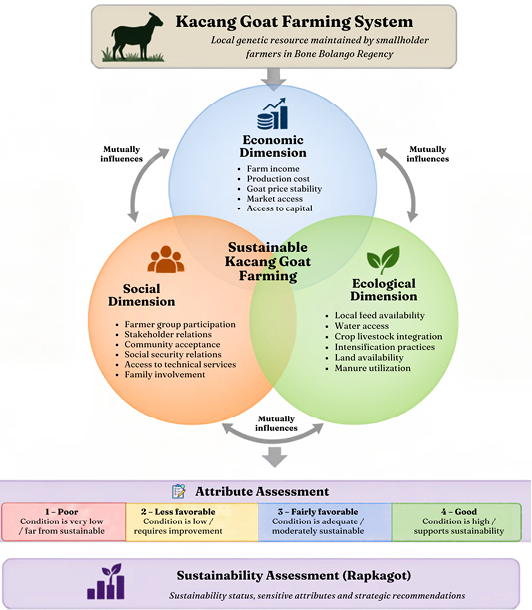
Conceptual framework of Kacang goat farming sustainability.
Previous research on Kacang Goats in Gorontalo generally focused on phenotypic characteristics, production, reproduction, and genetic diversity, while studies linking economic performance with enterprise sustainability at the farmer level are still limited. There is a lack of integrated research assessing profitability, sustainability status across economic, social, and ecological dimensions, and the sensitive attributes that determine the sustainability of Kacang goat farming enterprise in Gorontalo Province. This gap has resulted in the absence of an adequate empirical basis for determining enterprise development interventions capable of enhancing socio-economic benefits for farmers while simultaneously preserving the Kacang goat as a local genetic resource. Therefore, this study aims to analyze enterprise profitability, assess multidimensional sustainability status, and identify sensitive attributes to serve as a basis for formulating development priorities the Kacang goat farming enterprise in Bone Bolango Regency.
Materials and Methods
Time and location
This study examined the sustainability of Kacang goat farming as a local germplasm resource. It was carried out from November to December 2025 in Bone Bolango Regency (Botupingge, Kabila Bone, Bone Pantai, and Bone Raya). These locations were purposively selected because they had a relatively high Kacang goat population, most of which were raised by smallholder farmers under traditional rearing systems, with a total Kacang goat population of 574 head distributed across Botupingge (155 head), Kabila Bone (183 head), Bone Pantai (141 head), and Bone Raya (95 head).
Research design
This study used a descriptive quantitative survey method to provide an objective description of the sustainability of Kacang goat farming as a local germplasm resource in Bone Bolango Regency, Gorontalo Province. A descriptive quantitative approach was chosen because this study aimed to quantitatively describe the actual condition of Kacang goat farming enterprises based on data obtained at the farmer level. Profitability analysis was used to describe the economic performance of these farming enterprises, while Multidimensional Scaling (MDS) was applied to assess sustainability across three dimensions: economic, social, and ecological. These two approaches were used complementarily to provide an integrated assessment of the economic performance and sustainability of Kacang goat farming enterprises. The research design is presented in Figure 2.
Population and sample
The initial population consisted of 107 Kacang goat farmers distributed across the four subdistricts where the study was conducted. The initial identification of farmers was based on information from the local Livestock Service Office regarding the existence and distribution of Kacang goat farmers, which was then followed by direct field verification and further identification through information from previously identified farmers. Respondents were selected using a purposive sampling method based on the following inclusion criteria: Farmers who were actively engaged in goat farming, raised at least three Kacang goats, and had at least two years of farming experience. The minimum requirement of three goats was set to ensure that respondents had an adequate rearing scale to represent farming activities, while the minimum two-year experience requirement was set to ensure sufficient experience in goat rearing and farm management.
All identified farmers were screened for eligibility using the same inclusion criteria. Farmers who did not meet at least one criterion were excluded from the sample. The selection process resulted in 85 of 107 farmers meeting all inclusion criteria, and these 85 farmers were included as respondents, while 22 farmers did not meet at least one criterion. Therefore, the sample of this study consisted of 85 Kacang goat farmers: 27 farmers in Kabila Bone Subdistrict, 23 farmers in Botupingge Subdistrict, 20 farmers in Bone Pantai Subdistrict, and 15 farmers in Bone Raya Subdistrict.
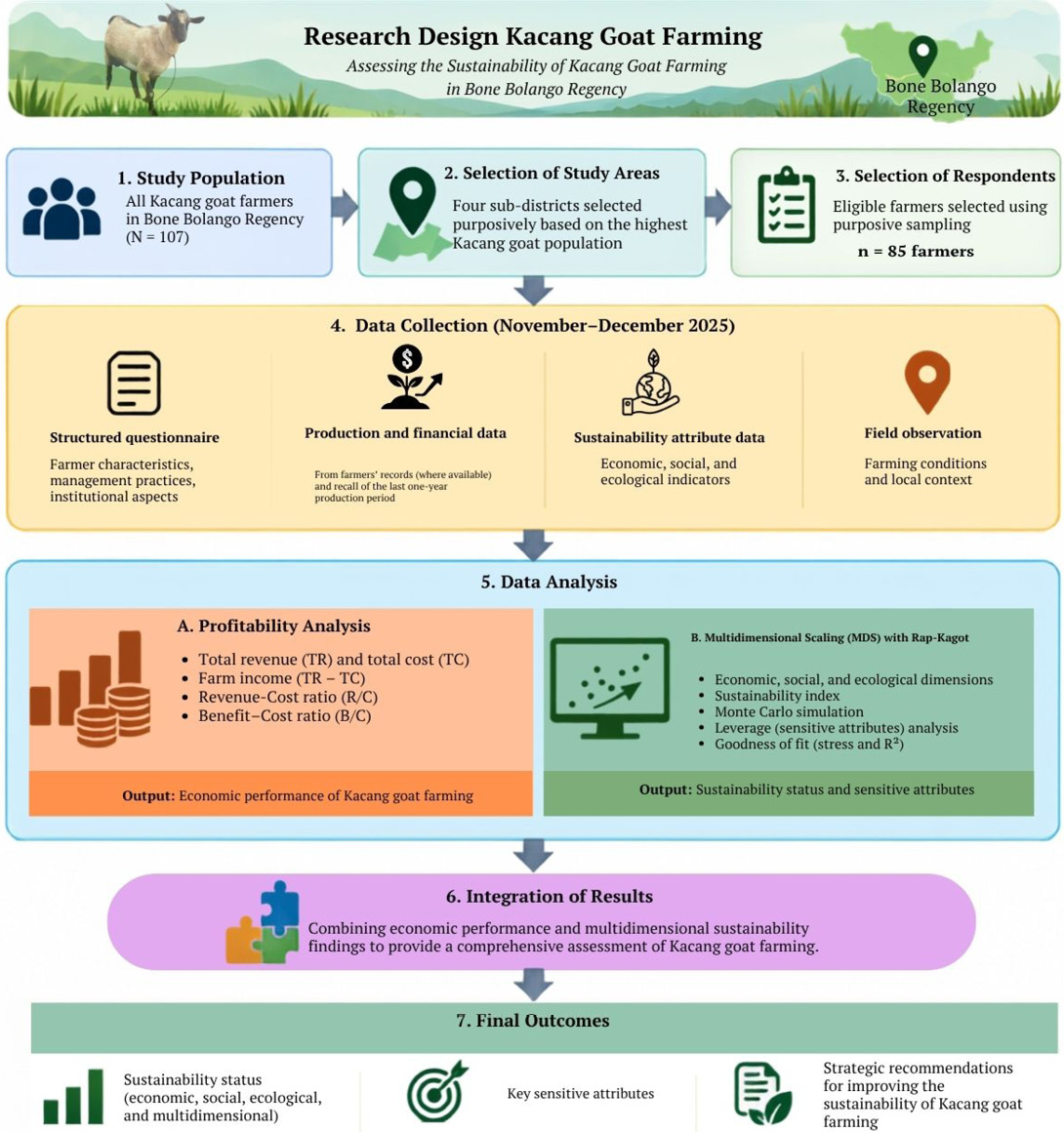
Research design of the study.
Data collection
Primary data were collected through face-to-face interviews with 85 Kacang goat farmers using a structured questionnaire. The questionnaire contained pre-established 1–4 scale assessment criteria for each attribute of economic, social, and ecological sustainability. Prior to data collection, an enumerator received training on the research objectives, the questionnaire, and the assessment criteria to ensure a shared understanding with the researcher. The researcher checked the completeness and consistency of the questionnaire responses. The questionnaire was primarily presented in Indonesian, while the Gorontalo language was used orally when clarification was needed. Financial data related to costs and revenues were collected for the preceding 1-year period. Potential recall bias was minimized by collecting information based on specific cost and revenue components and verifying the reported data against farmers’ livestock sales, including the number of animals sold and their selling prices. Nevertheless, the possibility of recall bias remained and is acknowledged as a limitation. This study was a non-interventional survey that did not involve clinical procedures or biological sampling; therefore, no formal ethical approval was obtained. Participation was voluntary, and oral informed consent was obtained from all respondents prior to the interviews. Respondent information was kept confidential and used only for research purposes.
Data analysis
The collected data were analyzed using two related approaches. First, farm profit analysis was used to estimate the income generated from Kacang goat farming. Second, MDS was applied to evaluate the sustainability status of Kacang goat farming across three dimensions, economic, social, and ecological dimensions.
Profitabilty analysis
Profitability was assessed using total revenue (TR), total cost (TC), the R/C ratio, and the net B/C ratio. Family labor was accounted for as an implicit cost and estimated based on the applicable Regional Minimum Wage (Upah Minimum Regional, UMR) in Bone Bolango Regency and the proportion of family labor allocated to Kacang goat farming activities. This cost was included to reflect the economic value of family labor, even though no direct cash payment was made. Farmers incurred relatively low cash costs because they utilized local resources and family labor. However, these resources were still accounted for as economic costs in the analysis. Total revenue included realized livestock sales and the increase in livestock inventory value during the observation period. Net economic profit was calculated as the difference between total revenue and total costs. Each component was computed using the formulas established by Armelia et al. (2026) as follows:
Total cost was calculated using the following formula:
TC = TFC + TVC
Description: TC: Total cost, TFC: Total fixed cost, TVC: Total variable cost.
Revenue was calculated using the following formula:
TR = P × Q
Description: TR: Revenue (IDR/Period), P: Price or selling price per head, Q: Number of livestock sold.
Profit was calculated using the following formula:
NI = TR-TC
Description: NI: net income, TR: Total revenue received by the farmer, TC: Total costs incurred.
Revenue-Cost Ratio (R/C Ratio) analysis is the ratio between revenue and total costs in a business activity, calculated using the formula:
R/C = TR/TC
Indicators: R/C Ratio > 1 Business is profitable or feasible to operate, R/C Ratio= 1 Business breaks even (neither profitable nor at a loss), R/C Ratio < 1 Business is not profitable or not feasible to operate.
Benefit cost ratio (B/C Ratio)
The benefit-cost ratio (B/C Ratio) represents the ratio of total profit to total production costs, calculated using the following formula:
BC = TP/TC
Description: TP: Total profit, TB: Total production cost.
Multidimensional scaling analysis
Multidimensional scaling (MDS) was chosen because the research aims to place the condition of the livestock system on a sustainability scale of 0–100 based on its proximity to reference points of poor and good conditions. MDS has been widely used in studies on the sustainability of livestock enterprisees because of its ability to integrate economic, social, and ecological attributes with different units of measurement after converting them. Several previous studies, such as Tatipikalawan and Sangadji, (2024) on the sustainability of Kisar sheep farming and Tatipikalawan et al. (2024) on pig farming in the Maluku Islands, have shown that MDS is effective in assessing the level of sustainability and identifying sensitive factors that influence the dynamics of the smallholder livestock system.
MDS is also equipped with leverage analysis to identify sensitive attributes and Monte Carlo simulation to evaluate ordination uncertainty . The sustainability analysis was conducted using the Rap-Kagot (Rapid Appraisal for Kacang Goat) approach, which is a sectoral adaptation of the Rapfish framework to assess the sustainability of the Kacang goat farming system. Rapfish was originally developed to evaluate fisheries sustainability through multidimensional ordination. In this study, fishery-specific attributes were replaced with attributes relevant to the economic, social, and ecological dimensions of Kacang goat farming in Bone Bolango Regency. The assessment comprised 17 attributes across three dimensions: five economic, six social, and six ecological attributes, as presented in Table 1. The operational definitions of these attributes were established according to the local farming context, as described in Table 2. The adaptation involved defining the attributes, their operational definitions, assessment directions, scoring criteria on a scale of 1–4, and reference points representing poor and good conditions. This adaptation retained the fundamental principles of the MDS algorithm while adjusting the unit of analysis, attributes, scoring system, and reference points to the specific context of Kacang goat farming. The assessment criteria were adapted to local farming conditions, with a score of 1 representing the least favorable condition and a score of 4 representing the most favorable condition, without altering the fundamental MDS ordination procedure.
Table 1: Sustainability dimensions, attributes, and sources.
| Variable | Indicator | Source |
Economic dimension |
1. Farm income | |
| 2. Production costs | ||
| 3. Goat price stability | ||
| 4. Market access | ||
| 5. Access to capital | ||
| Social dimension | 1. Group participant | |
| 2. Stakeholder relations | ||
| 3. Community acceptance | ||
| 4. Social security relations | ||
| 5. Access to technical services | ||
| 6.family involvement | ||
| Ecological dimension | 1. Availability of local feed | |
| 2. Water access | ||
| 3. Crop-livestock integration | ||
| 4. Intensification model | ( | |
| 5. Land availability | ||
| 6. Manure utilization |
Table 2: Operational definitions of sustainability attributes.
| Dimension | Indicator | Operational definition |
| Economic | Farm income | The contribution of Kacang goat farming income to household income |
| Production costs | The expenditure incurred for maintaining and operating the Kacang goat farming enterprise | |
| Goat price stability | The degree of stability of Kacang goat selling prices over the observation period | |
| Market access | The ease with which farmers access buyers and sell Kacang goats | |
| Access to capital | The ease with which farmers obtain capital or loans to support goat farming activities | |
| Social | Group participation | The extent to which farmers participate in livestock farmer group activities. |
| Stakeholder relations | The extent of interaction and support received from government institutions and relevant stakeholders | |
| Community acceptance | The extent to which Kacang goat farming is accepted by the surrounding community | |
| Social security relations | The role of social relationships with neighbors in maintaining livestock security | |
| Access to technical services | The ease and frequency of farmers' access to technical livestock services | |
| Family involvement | The extent to which family members participate in goat farming activities | |
| Ecological | Availability of local feed | The availability and accessibility of locally available forage for goats |
| Water access | The ease of obtaining adequate water for livestock | |
| Crop-livestock integration | The extent to which crop production and goat farming are integrated through the utilization of agricultural resources or by-products | |
| Intensification model | The level of intensity of the goat farming management system | |
| Land availability | The adequacy of land available to support goat farming activities | |
| Manure utilization | The extent to which goat manure is utilized as fertilizer or another useful resource |
Table 3: Sustainability attribute scoring rubric.
| Dimension | Attribute | Score 1 | Score 2 | Score 3 | Score 4 |
| Economic | Farm income | No income | Income exists but is insufficient | Provides sufficient support to household income | Main source of income |
| Production costs | High expenditure | Expenditure exists but is irregular | Very low expenditure | No expenditure | |
| Goat price stability | Very unstable/decreased substantially | Sometimes decreases | Sometimes increases and sometimes decreases | Very stable | |
| Market access | Very difficult to sell | Can be sold but through intermediaries | Buyers sometimes come to the farm | Buyers come directly to the farm | |
| Access to capital | No access to capital | Difficult to obtain capital | Relatively easy | Very easy | |
| Social | Participation in farmer groups | Never participates | Rarely participates | Sometimes participates | Very active |
| Government/stakeholder assistance | Never | Occasionally | Frequently | Very frequently | |
| Community acceptance | Not accepted | Less accepted | Accepted | Highly accepted | |
| Social relations with neighbors | Strongly disagree | Disagree | Agree | Strongly agree | |
| Access to technical services | No services available | Services are occasionally available | Services are frequently available | Services are very frequently available | |
| Family involvement | Not involved | Slightly involved | Moderately involved | Highly involved | |
| Ecological | Access to local forage | Very difficult | Difficult | Easy | Very easy |
| Access to water resources | Very difficult | Difficult | Easy | Very easy | |
| Utilization of agricultural waste/by-products | Never | Rarely | Frequently | Always | |
| Management system | Traditional | Semi-traditional | Semi-intensive | Intensive | |
| Land availability | Very insufficient | Insufficient | Sufficient | Highly sufficient | |
| Livestock waste utilization | Not utilized | Rarely utilized | Frequently utilized | Always utilized |
Data processing was conducted using Rapython, a Python-based MDS analysis application developed by Santoso (2025) Rapython Multidimensional Scaling Rapfish Basis Python webpage. Classic Rapfish typically operates via Microsoft Excel add-ins or macros, meaning its usage can be affected by factors such as Excel version compatibility, the operating system, and macro security settings. Rapython implements Rapfish’s ordination principles in a Python environment so that the analysis process does not depend on a specific Microsoft Excel add-in. Data can be prepared using spreadsheet software that supports the appropriate format and subsequently processed via Rapython. The choice of Rapython for this study was based on the ease of data processing and its flexibility for use across different computing environments.
The stages of sustainability analysis, following Kavanagh and Pitcher (2004) and Randu and Hartono (2020), are as follows:
Determination of attributes used for each dimension. The sustainability assessment was conducted across three dimensions, comprising 17 attributes, as presented in Table 1.
Determination of attribute scores to represent the sustainability conditions across the three dimensions. Each attribute was assessed using an ordinal scale ranging from 1 (poor) to 4 (very good), based on the scoring criteria presented in Table 3.
Calculation of the sustainability index using the Rapython. The interpretation of the sustainability index is presented in Table 4.
Analysis of sensitive attributes that significantly influence the sustainability of Kacang goat farming was conducted using leverage analysis, based on changes in the Root Mean Square (RMS) on the x-axis. The attributes that most significantly influence sustainability status can be identified based on the highest RMS percentages. RMS values are automatically calculated by Rapython using a leave-one-attribute-out procedure.
Analysis of error effects resulting from scoring, calculation, or analytical procedures was performed using Monte Carlo analysis with 1,000 iterations and 5% noise. The figure of 1,000 iterations refers to the number of repeated simulations, while 5% noise represents the level of random disturbance introduced into the assessment data. Analysis of error effects resulting from scoring, calculation, or analytical procedures was performed using Monte Carlo analysis at a 95% confidence level. The 95% confidence level refers to the uncertainty interval obtained from the resulting Monte Carlo distribution. Assessment of the accuracy of the MDS analysis was conducted through evaluation of the stress value and the coefficient of determination (R²). A model is considered accurate (goodness of fit) when the stress value is less than 0.25 and the R² value approaches 1.
Table 4: Sustainability index classification.
| Index value | Category |
| 0.00 – 25.00 | Unsustainable |
| 25.01 – 50.00 | Less sustainable |
| 50.01 – 75.01 | Moderately sustainable |
| 75.01 – 100.0 | Sustainable |
Sources: (Suyitman, 2016).
Results
Respondent characteristics
The characteristics of the 85 respondents based on age, sex, education, and livestock farming experience are presented in Table 5. The 36–50 age group was the largest respondent group, followed by the 51–65 age group. Overall, these two groups accounted for 80.00% of all respondents. Thus, most farmers were in the adult age range and were still economically active. The low proportion of young farmers indicates a potential challenge in the regeneration of enterprise actors, which in the long term may affect the sustainability of Kacang goat farming enterprises. Limited involvement of the younger generation may potentially reduce the sustainability of intergenerational transfer of knowledge and farming experience.
By sex, the respondents consisted of 64 men (75.29%) and 21 women (24.71%). The predominance of male respondents is related to cultural characteristics that position men as the main managers of enterprises that tend to require mobility and physical labor, whereas women can contribute in roles that do not require high levels of physical activity.
Table 5: Respondent characteristics.
| A. Age (years) | Total (Persons) | Percentage (%) |
| 21 – 35 | 12 | 14.12 |
| 36 – 50 | 44 | 51.76 |
| 51 – 65 | 24 | 28.24 |
| >65 | 5 | 5.88 |
| Total | 85 | 100 |
| B. Gender | Total (persons) | Percentage (%) |
| Male | 64 | 75.29 |
| Female | 21 | 24.71 |
| Total | 85 | 100 |
| C. Educational background | Total (persons) | Percentage (%) |
| No formal education | 14 | 16.47 |
| Elementary school | 34 | 40.00 |
| Junior high school | 16 | 18.82 |
| Senior high school | 14 | 16.47 |
| Bachelor’s degree | 7 | 8.24 |
| Total | 85 | 100 |
| D. Years of farming experience (years) | Total (persons) | Persentage (%) |
| 2 – 5 | 46 | 54.12 |
| 6 – 10 | 21 | 24.71 |
| 11 – 15 | 10 | 11.76 |
| >15 | 8 | 9.41 |
| Total | 85 | 100 |
Source: Processed primary data, 2026.
In terms of educational level, respondents were predominantly elementary school graduates, namely 34 people (40.00%). Respondents who had never attended formal education numbered 14 (16.47%); those with junior high school education numbered 16 (18.82%); those with senior high school education, 14 (16.47%); and those with a bachelor’s degree, seven (8.24%). This relatively low level of education may limit access to technical information, financial management practices, and new technologies, thus highlighting the need for practical and easily accessible extension services and training.
Based on livestock farming experience, 46 respondents (54.12%) had 2–5 years of experience. Respondents with 6–10 years of experience numbered 21 (24.71%), those with 11–15 years numbered 10 (11.76%), and those with more than 15 years numbered eight (9.41%). Practical experience can support daily farm management. However, the low involvement of the younger generation and the relatively low level of formal education may pose challenges to the long-term sustainability of the enterprise. These conditions constitute obstacles to accessing technical information, performing record-keeping and financial management, and adopting new technologies, which may ultimately have implications for the efficiency and profitability of the enterprise.
Cost Structure, revenue, and profit of kacang goat farming
The analysis results in Table 6 show that the total production cost of Kacang goat farming enterprises reached 665,824,753 IDR per year. The cost structure was dominated by the labor component, amounting to 607,813,920 IDR or approximately 91.3% of total production costs. The dominance of labor costs indicates that Kacang goat rearing activities in the smallholder farming system remain highly labor-dependent, including family labor that is accounted for as an implicit cost. Meanwhile, the costs of vitamins and medicines, as well as the depreciation of pens and equipment, made relatively small contributions to total production costs.
Table 6: Profitability analysis of kacang goat farmers in bone bolango regency.
| Cost type | Total value (Rp/Tahun) | Value per farmer (Rp/Tahun) |
| Variable costs | ||
| Labor costs | Rp607.813.920,00 | Rp7.150.752,00 |
| Vitamins and medicines | Rp27.965.000,00 | Rp329.000,00 |
| Fixed costs | ||
| Depreciation of housing | Rp20.483.333,33 | Rp240.980,39 |
| Depreciation of equipment | Rp9.562.500,00 | Rp112.500,00 |
| Total costs (TC) | Rp665.824.753,33 | Rp7.833.232,39 |
| Revenue | ||
| Initial livestock value | Rp639.600.000 | Rp7.524.706 |
| Final livestock value | Rp1.179.040.000 | Rp13.871.059 |
| Increase in livestock value (final livestock value– initial livestock value) | Rp539.440.000,00 | Rp6.346.352,94 |
| Livestock sales | Rp271.800.000,00 | Rp3.197.647,06 |
| Total revenue (TR) | Rp811.240.000,00 | Rp9.544.000,00 |
| Net economic return (TR-TC) | Rp145.415.246,67 | Rp1.710.767,61 |
| Revenue-cost ratio (R/C) | 1,22 | 1,22 |
| Benefit-cost ratio (B/C) | 0,22 | 0,22 |
Source: Processed primary data, 2026.
Enterprise revenue originated from livestock sales amounting to 271,800,000 IDR and an increase in livestock inventory value of 539,440,000 IDR. Thus, the total economic value generated reached 811,240,000 IDR per year. The increase in livestock inventory value, which was greater than the revenue from sales, indicates that most of the economic value of the enterprise during the analysis period remained in the form of livestock assets that had not yet been realized through sales. Therefore, this economic value cannot be entirely regarded as cash receipts received by farmers during the analysis period.
The difference between total economic value and total production costs yielded a net economic profit of 145,415,247 IDR per year, equivalent to approximately 1,710,768 IDR per farmer per year. Profitability analysis produced an R/C ratio of 1.22 and a B/C ratio of 0.22. The R/C ratio of 1.22 indicates that, based on the total economic value accounted for in the analysis, every 1.00 IDR of production cost generated an economic value of 1.22 IDR. Meanwhile, the B/C ratio of 0.22 indicates that every 1.00 IDR of production cost generated a net economic profit of approximately 0.22 IDR, based on the B/C formula used in this study. Thus, the profitability analysis indicates a positive economic profit, although most of this economic value originated from the increase in livestock inventory value and had not been fully realized as cash income.
Sustainability analysis of the farming enterprise
The ordination results obtained using the MDS approach through Rap-Kagot showed that the sustainability level of Kacang goat farming differed across dimensions. The economic dimension had the highest index, 75.33, and was classified as sustainable (Figure 3). The social dimension had an index of 48.17 and was classified as less sustainable (Figure 4), while the ecological dimension had an index of 51.04 and was classified as moderately sustainable (Figure 5). In multidimensional terms, the sustainability index of Kacang goat farming reached 58.16, placing it in the moderately sustainable category (Table 7).
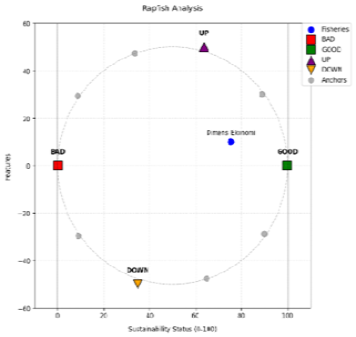
Economic sustainability index.
Table 7: Sustainability index and status of kacang goat farming.
| Dimension | Sustainability index | Monte carlo | Stress value | R2 | Sustainability status |
| Economy | 75.33 | 70.77 | 0.10 | 0.99 | Sustainable |
| Social | 48.17 | 45.40 | 0.11 | 0.98 | Less sustainable |
| Ecology | 51.04 | 49.75 | 0.11 | 0.98 | Moderately sustainable |
| Multidimension | 58.16 | 55.31 | 0.11 | 0.98 | Moderately sustainable |
Source: Processed primary data, 2026.
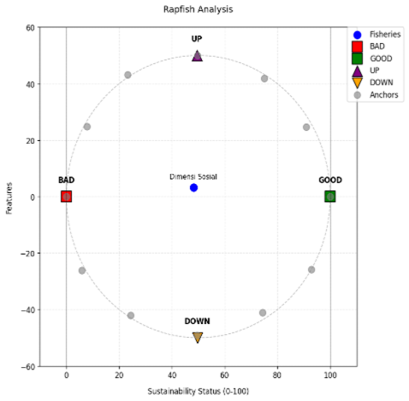
Social sustainability index.
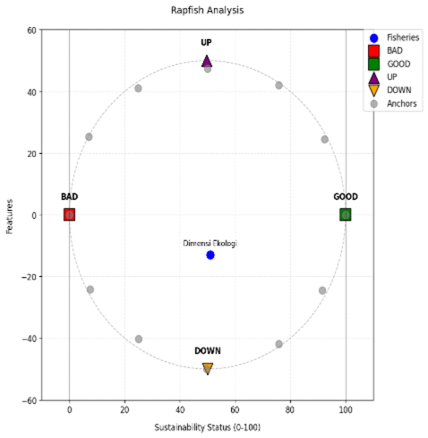
Ecological sustainability index.
The differences in index values indicate that the sustainability of Kacang goat farming has not been achieved in a balanced manner across all dimensions. The economic dimension had the highest value, whereas the social dimension had the lowest. The multidimensional value of 58.16 indicates that the farming system as a whole has the capacity to persist, but it still requires improvement in several attributes, especially those in the social and ecological dimensions.
The Monte Carlo analysis results in Table 6 show values of 70.77 for the economic dimension, 45.40 for the social dimension, 49.75 for the ecological dimension, and 54.50 for the multidimensional analysis. The absolute differences between the MDS and Monte Carlo indices were 4.56 for the economic dimension, 2.77 for the social dimension, 1.29 for the ecological dimension, and 3.66 for the multidimensional analysis. The Monte Carlo value for the economic dimension (70.77) was lower than the MDS value (75.33) and fell below the sustainability threshold of 75.01. These results indicate uncertainty in the estimation of the sustainability index and suggest that the MDS value is relatively close to the boundary of the sustainable category. Nevertheless, the MDS value remains the basis for determining the sustainability status, while the Monte Carlo analysis is used to assess the influence of uncertainty on the estimated index. Although the MDS result indicates a sustainable status, the Monte Carlo result falls within the moderately sustainable category. Therefore, the economic sustainability of Kacang goat farming needs to be maintained and strengthened through improvements in the identified sensitive attributes.
Stress values in Table 7 ranged from 0.10 to 0.11, while the coefficient of determination (R²) ranged from 0.98 to 0.99. In the RAPFISH-based MDS approach, a stress value below 0.25 indicates an acceptable ordination configuration, while an R² value approaching 1 indicates a good representation of the observed data. These results indicate that the ordination model has a high goodness of fit in representing the configuration of sustainability attributes. Thus, the stress value and R² value in this study support the adequacy of the MDS model in representing the sustainability attributes across the three dimensions.
Leverage analysis
The leverage analysis revealed that each sustainability dimension had specific attributes that were more sensitive to changes in the sustainability index. These sensitive attributes were identified based on their root mean square (RMS) values, with higher RMS values indicating a greater potential influence on the sustainability index when the respective attributes are improved. In the economic dimension, the most sensitive attributes were access to capital, production costs, and market access, as illustrated in Figure 6. In the social dimension, the sensitive attributes were access to technical services and farmer group participation (Figure 7). Meanwhile, in the ecological dimension, the most sensitive attributes were crop–livestock integration, livestock waste utilization, and access to water resources (Figure 8).
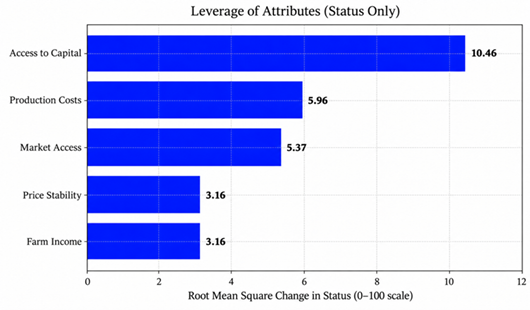
Leverage analysis of the Economic dimension.
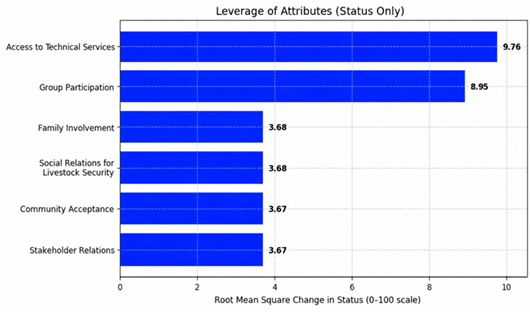
Leverage analysis of the Social dimension.
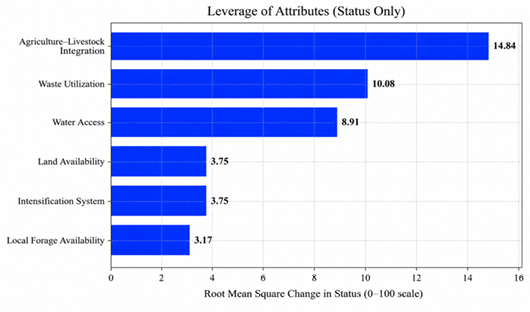
Leverage analysis of the ecological dimension.
Discussion
The predominance of farmers in the 36–65 age group, as illustrated in Table 5, indicates that Kacang goat farming is predominantly undertaken by adults of working age. The involvement of this age group is important because smallholder livestock activities require the ability to make decisions, manage family labor, provide feed, and care for livestock sustainably. Halidu et al. (2021) stated that the age of farmers can be related to physical ability, experience, and decision-making capacity in livestock management. Meanwhile, the relatively low proportion of young farmers may be a concern for the regeneration of enterprise managers. By sex, Kacang goat farmers consisted of 75.29% men and 24.71% women. The predominance of men may be related to the nature of rearing activities, especially searching for, cutting, and transporting feed, which require relatively high mobility and physical strength. Although their proportion was lower, a small number of women in this study were also primary managers of livestock enterprises, not merely supporting household laborers. Women’s involvement in livestock enterprises is more concentrated on supporting activities that do not require much physical exertion, such as feeding, livestock care, monitoring livestock condition, and assisting with household income management. However, women who act as primary managers can also be involved in decision-making and management of the livestock enterprise. This indicates that women can also contribute to the sustainability of Kacang goat farming enterprises.
The educational level of farmers was dominated by elementary school, indicating limited formal education among Kacang goat farmers. Nevertheless, farmers rely on practical knowledge gained through farming experience, family, and interaction with fellow farmers. Knowledge gained through experience can help farmers adapt rearing practices to local production conditions and available resources. This is in line with Welerubun et al. (2016), who reported that farmers with limited formal education tend to rely on practical knowledge gained from family and farming experience. However, practical knowledge cannot replace or compensate for formal education in producing better management performance. Dependence on practical knowledge without adequate support from education and technical information can also limit farmers’ access to technical information, animal health services, and appropriate technology. Therefore, practical knowledge and formal education should be viewed as complementary forms of knowledge in supporting the management and sustainability of livestock enterprises.
Based on farming experience, most respondents had 2–5 years of enterprise experience (54.12%), followed by 6–10 years of experience (24.71%). Nevertheless, there were also farmers who had more than 10 years of farming experience. This indicates that Kacang goat farming at the research site is managed not only by novice farmers but also by farmers with considerable experience in goat rearing. Farming experience is an important factor that can influence farmers’ ability to manage livestock enterprises effectively and sustainably. This is consistent with the view of Sudrajat et al. (2024), who stated that the longer a person farms, the more knowledge the farmer possesses to drive the development of the livestock enterprise .
Analysis of livestock enterprise
The production cost structure of Kacang goat farming, as shown in Table 6, indicates that labor is the largest cost component compared with other production inputs. This condition is related to a farming system that relies heavily on family labor for feed provision and daily livestock management. Labor costs were estimated based on the UMR applicable in Bone Bolango Regency in 2026. The wage value was converted into wages per unit of working time and multiplied by the total time farmers used for Kacang goat rearing activities. In the smallholder farming system, production resources including family labor and local feed sources are utilized without direct cash expenditure. Therefore, the absence of cash payments does not necessarily mean the absence of economic costs. Although most farmers did not record labor payments as operational expenses, family labor still has economic value even though no cash payment was made. All farming activities were carried out by household members without involving hired labor. On this basis, family labor was treated as an implicit cost because it reflects the time and effort devoted to livestock management, which could otherwise be allocated to other productive activities with the potential to generate income. Posadas-Dominguez et al. (2014) emphasized that labor costs can affect the profitability and competitiveness of small-scale livestock enterprises, because including the economic value of labor can produce profitability estimates that differ greatly from analyses based solely on cash costs.
Expenditures for vitamins and medicines were relatively low because these inputs were mainly used when goats experienced health problems rather than as part of routine preventive care. This pattern reflects the health management practices of smallholder farmers, who tended to prioritize treatment after health problems had occurred. Limited attention to preventive health management may also be associated with farmers’ limited time, as Kacang goat farming is generally regarded as a supplementary livelihood activity. Most farmers tended to attend to their goats in the afternoon after completing their main occupations, thereby limiting the time available for regular monitoring and preventive health management. Fitria et al. (2025) reported that limited time and labor among smallholder farmers can contribute to low awareness and delayed responses to livestock health problems. Although the direct effects of this health management pattern on productivity were not quantified in the present study, the relatively low expenditure on animal health may indicate limited preventive health management. In the longer term, inadequate vaccination, parasite control, and early disease prevention may increase the risk of morbidity and mortality, potentially reducing growth and reproductive performance and increasing treatment costs. These conditions may subsequently affect the productivity and sustainability of smallholder goat farming.
Depreciation costs for pens and equipment were the lowest component of production costs, reflecting the use of simple facilities in Kacang goat farming. Most farmers built their own pens and used simple equipment made from natural materials and local resources, thereby suppressing annual depreciation costs. The utilization of local resources can reduce dependence on external inputs and is in line with the principles of sustainable development, which emphasize minimizing ecological footprint while increasing resource use efficiency . Thus, relatively low depreciation costs not only reduce the production cost burden on farmers but also support the sustainability of the livestock system through efficient use of local resources.
Enterprise revenue
Revenue from Kacang goat farming was obtained from two components, namely inventory increase and livestock sales over a one-year production period, as shown in Table 6. Livestock sales reflect realized cash income, while inventory increase reflects the accumulation of biological assets still held by farmers. The value of livestock inventory increased from IDR 639,600,000 at the beginning of the period to IDR 1,179,040,000 at the end of the period, resulting in an increase of IDR 539,440,000. This increase reflects the accumulation of biological assets retained by farmers during the production period and indicates an increase in the economic value of livestock that contributes to household wealth and potential future income. Thus, most of the economic value generated came from livestock still owned at the end of the year, rather than from direct cash receipts. Hastang and Asnawi (2014) stated that goats serve not only as productive animals but also as household assets or savings that can be sold when needed.
Livestock sales are the main source of cash income from Kacang goat farming enterprises in Bone Bolango. The marketing process generally involves intermediaries (balantik) who connect farmers with buyers and facilitate livestock transactions. For smallholder farmers, balantik can provide easier market access and reduce the time and effort required to find buyers. However, dependence on intermediaries can limit farmers’ bargaining power and potentially affect the selling price and income received by farmers. This is consistent with Dewi et al. (2024), who stated that farmers who market their livestock through intermediaries tend to receive lower prices than those who sell directly, although this marketing channel offers advantages in terms of convenience, lower marketing risk, and faster access to cash.
Male goats are highly sought after for cultural and religious purposes. In fact, farmers receive orders for male goats before the animals reach six months of age. This demand creates a fairly specific market and provides opportunities for farmers to obtain cash income from livestock sales. However, high demand for male goats can encourage the sale of young males that have the potential to be bred, thereby risking a reduction in the availability of males for breeding purposes. Therefore, maintaining high-quality local males is essential to support breeding sustainability and the preservation of Kacang goat genetic resources. This is consistent with the view of Sobirin et al. (2025) that a cultural driver of goat enterprises is the seasonal market driven by religious and cultural needs. This periodic demand pattern creates a relatively assured market opportunity each year, thereby encouraging farmers to maintain goat farming as a source of income. Mutmainah et al. (2025) stated that in addition to their economic value, goats also have social and cultural significance for local communities, particularly in customary and religious activities.
Enterprise profit
Enterprise profit was calculated as the difference between the total economic value generated and total production costs, a measure commonly used to assess the economic performance of livestock enterprises . As presented in Table 6, Kacang goat farming in Bone Bolango Regency generated a positive net economic profit of IDR 145,415,247 per year, equivalent to approximately IDR 1,710,768 per farmer per year. This relatively low profit indicates that the contribution of Kacang goat farming to household income remains limited. The low profit is partly due to the inclusion of implicit costs particularly the imputed value of family laboras well as the fact that most economic benefits remain embedded in livestock assets and have not been realized as direct cash receipts. Kaumbata et al. (2020) noted that such non-cash benefits can contribute significantly to the overall economic value of small-scale goat farming. Furthermore, Agyeman et al. (2021) stated that small ruminant farming can still contribute to household income even when production inputs and management practices remain limited.
The economic profit of Kacang goat farming enterprises was 1,710,768 IDR per farmer per year. Although this figure is relatively low, the enterprise generated a positive economic surplus, as reflected by an R/C ratio of 1.22. This ratio indicates that every 1.00 IDR of production cost generated an economic value of approximately 1.22 IDR, meaning that the value generated was sufficient to cover the production costs incurred. The B/C ratio in this study was 0.22, meaning that every 1.00 IDR of production cost generated a net benefit of approximately 0.22 IDR. This value can be compared with the findings of Tachrudin dan Hadid (2021), who reported a B/C ratio of 0.19 for Gibas goat fattening enterprises in Kaliwadas Village, indicating a positive net benefit relative to production costs. The difference between the two B/C values is related to differences in production scale, cost structure, labor valuation, livestock management, and farming conditions. These results indicate that small-scale goat farming enterprises can generate a positive economic surplus, although the magnitude of profit depends on the characteristics of the production system.
The relatively low profitability of Kacang goat farming enterprises indicates the need to improve production and marketing efficiency. Suryaningrum et al. (2026) stated that a collective marketing strategy through farmer groups can strengthen farmers’ bargaining position, reduce transaction costs, and facilitate access to larger-scale buyers. Improving production efficiency through better feed utilization, preventive health management, and more optimal reproductive management can also increase productivity while reducing production costs that are actually avoidable. In addition, value-added activities, such as selling superior breeding stock or processed goat products, can open opportunities to increase income beyond conventional live animal sales.
Sustainability of kacang goat farming
The sustainability findings indicate that Kacang goat farming in Bone Bolango Regency is in the moderately sustainable category, with a multidimensional index of 58.16. This status indicates that the livestock enterprise has the capacity to persist, but performance across dimensions remains unbalanced.
Economic dimension
Nevertheless, a high economic sustainability index does not fully reflect the profitability level of the enterprise. Profitability analysis showed a net economic profit of 145,415,247 IDR per year and an R/C ratio of 1.22. This difference occurs because the MDS economic dimension assesses broader conditions including farm income, production costs, price stability, market access, access to capital, and access to price information not merely profitability alone. Family labor is also accounted for as an implicit production cost in the profitability analysis, thus providing a more comprehensive assessment of the resources used in the production process.
Kacang goats also serve as productive assets and non-cash financial reserves for households. The livestock inventory value increased from 639,600,000 IDR at the beginning of the period to 1,179,040,000 IDR at the end of the period, or an increase of 539,440,000 IDR. This increase indicates an accumulation of livestock asset value still held by farmers. Although it is not yet realized cash income, livestock can be converted into money through sales when households need funds. Thus, goat ownership not only provides economic benefits through cash income but also serves as a financial reserve that can support household economic resilience. Kaumbata et al. (2020) stated that non-cash benefits can make a significant contribution to the economic value of small-scale goat farming enterprises. Thus, economic sustainability reflects not only profitability but also asset accumulation and economic conditions that support enterprise continuity. This pattern is consistent with Randu et al. (2022), who stated that Kacang goats in smallholder farming are often raised as a sideline enterprise and used to meet short-term household needs.
Leverage analysis of the economic dimension
Based on Figure 6, there are three highest attributes that are sensitive and influential for enterprise sustainability in the economic dimension, namely: (1) access to capital; (2) production costs; and (3) market access. The sensitivity of these attributes is directly related to the enterprise system developed by smallholder farmers. The access to capital attribute is the most sensitive factor; although Kacang goat farming requires relatively low capital, the economic sustainability at the farmer level still depends on small-scale and traditional enterprises, most of which still rely on their own capital with limited access to formal financial institutions. Better access to capital would enable farmers to invest in productive production inputs, animal health, and better management practices. This is consistent with the view of Yaqin et al. (2022) that limited capital and access to financing have implications for rearing management patterns that remain traditional. Sitorus et al. (2026) emphasized the importance of access to capital in maintaining the continuity of goat farming enterprises in the face of financial challenges.
The production cost attribute showed a high level of sensitivity in the economic dimension, indicating that small changes in cost components can have a significant impact on enterprise sustainability. Although under existing conditions production costs are relatively low due to the use of local feed, family labor, and minimal livestock health costs, the sensitivity of this attribute indicates that such efficiency is still illusory and vulnerable. This is consistent with the view of Alfian (2022) that production cost calculations at the smallholder level are generally still carried out traditionally without accounting for non-cash cost components such as family labor and feed collection costs, resulting in low cost estimates that do not reflect actual economic conditions.
The market access attribute is a sensitive factor in the economic dimension, indicating that the marketing structure has a major influence on enterprise sustainability. The sensitivity of this attribute indicates that although field facts show that farmers do not experience difficulties in market access because both consumers and middlemen (Balantik) come directly to farmers, this condition creates limitations such as a lack of access to more profitable market information and dependence on middlemen, which actually weakens farmers’ bargaining position. The available market access has not fully provided optimal economic benefits for farmers. Dependence on the traditional marketing system limits farmers’ opportunities to obtain more competitive prices through alternative marketing channels. This is consistent with the view of Suparman et al. (2024) that most farmers still rely on traditional marketing methods limited to local networks or nearby markets, resulting in limited access to information.
Intervention strategies to improve sustainability in the economic dimension based on sensitive attributes include increasing farmers’ access to financing sources through livestock enterprise credit support, establishing livestock farmer groups, and strengthening farmer institutions to make it easier to reach formal financial institutions. In addition, efforts are needed to improve production cost efficiency through the use of simple technology, the development of feed based on local resources, and increasing farmers’ capacity in livestock enterprise management. From the marketing aspect, strengthening market access can be carried out through the development of business partnerships, the provision of livestock price information, and the strengthening of farmer group-based marketing networks so that farmers’ bargaining position improves. These intervention strategies are expected to enhance farmers’ economic capacity while supporting the sustainability of Kacang goat farming in Bone Bolango Regency.
Social dimension
Based on Figure 5, the sustainability index of the social dimension was recorded at 48.17, which falls into the less sustainable category. This indicates that the social aspects of Kacang goat farming management in Bone Bolango Regency have not developed optimally. Although this enterprise provides economic benefits, social support remains limited. The low social sustainability is partly related to the perception that goat farming is merely a sideline activity, which can reduce farmers’ participation in collective activities. The leverage analysis also identified access to technical services and participation in farmer groups as sensitive attributes. Limited access to extension services can hinder farmers’ access to technical information, while low group participation can limit collective learning, information exchange, and institutional support. This condition is exacerbated by the lack of socialization, information, and motivation from relevant stakeholders. Amam and Rusdiana (2022) stated that limited access to extension and technical services can restrict farmers’ access to technical information, while low group participation can limit collective learning, information exchange, and institutional support. Furthermore, Randu et al. (2022) identified limitations in institutional and supporting services as constraints to the sustainable development of Kacang goat farming enterprises.
Leverage analysis of the social dimension
The attribute of livestock group participation needs attention because it is a sensitive factor affecting social sustainability. The lack of farmer participation in groups is caused by most farmers raising Kacang goats only as a sideline enterprise, in addition to limited socialization, information, and motivation from stakeholders at the village, sub-district, and district levels. This is consistent with the view of Raisa et al. (2025) that when farmers feel that their enterprise is merely a sideline, they tend to be less committed to actively participating in group activities.
Based on the sensitive factors, intervention strategies that can be carried out to improve the sustainability of the social dimension are strengthening access to technical services through enhancing the role of livestock extension workers, training in livestock enterprise management, mentoring in livestock health, and dissemination of appropriate technology suited to smallholder conditions. In addition, strengthening farmer group institutions is needed through increasing member participation, developing more active and productive group activities, and encouraging collaboration between farmer groups and government, universities, and other supporting institutions. These strategies are expected to enhance farmers’ social capacity, strengthen cooperation networks, and support the sustainable development of Kacang goat farming.
Ecological dimension
Based on Figure 5, the sustainability index of the ecological dimension was 51.04 and is classified as moderately sustainable. According to the interpretation criteria, this value falls within the 50–75 interval, which is categorized as moderately sustainable. Thus, the value of 51.04 is only 1.04 points above the lower limit of the moderately sustainable category, indicating that the ecological condition remains vulnerable and could shift to the less sustainable category if environmental management is not improved. This indicates that the management practices of Kacang goat enterprises have sufficiently met the principles of ecological sustainability; however, this condition remains vulnerable because most farmers still rely on natural resources for their farming activities. This is consistent with the view of Koluman and Goncu (2022) that in small ruminant management in rural areas, dependence on natural resources such as forage and land needs to be managed adaptively to maintain environmental balance and livestock enterprise productivity.
Leverage analysis of the ecological dimension
Based on Figure 8, there are three sensitive attributes that influence the sustainability index of the ecological dimension of Kacang goat farming, namely (1) application of crop–livestock integration; (2) utilization of livestock waste; and (3) access to water. The findings indicate that crop–livestock integration has been applied but not optimally. Some farmers simply allow livestock feces to accumulate, which can potentially pollute the environment. The application of crop–livestock integration is the attribute with the highest value in determining the sustainability level of the ecological dimension of Kacang goat farming. Based on this, the application of integration has an important role in maintaining the ecological balance of the region through optimizing resource utilization. This crop–livestock integration system enables a mutually supporting cycle in which agricultural by-products are utilized as livestock feed, while livestock manure is returned to agricultural land as organic fertilizer. This cycle supports nutrient recycling, enhances the use of organic resources, and can contribute to maintaining soil fertility and health. Crop and livestock diversification within an integrated system can also support agricultural biodiversity. The integration system not only improves resource use efficiency but also reduces dependence on external inputs and the potential for environmental pollution. The sensitivity of this attribute indicates that suboptimal application of crop–livestock integration can weaken the ecological sustainability of livestock enterprises. Therefore, strengthening the integration of crop and livestock activities is important for maintaining nutrient cycles, soil health, and ecological sustainability. This is consistent with the view of Bilotto et al. (2024) that crop–livestock integration systems have been proven to reduce competition between feed and food needs and reduce pressure on the environment through sustainable resource utilization.
The water access attribute also showed a relatively high level of sensitivity in the ecological dimension. This indicates that changes in the availability and management of water sources will have a significant impact on the sustainability of Kacang goat farming. Water plays a very important role in supporting livestock health, maintaining pen cleanliness, and supporting the availability of forage feed. The high sensitivity of this attribute reflects that the farming system still depends heavily on natural water sources without planned management. This dependence makes livestock enterprises vulnerable, especially during prolonged dry seasons. This condition indicates that enterprise sustainability is determined not only by resource availability but also by the ability to manage resources sustainably. This is consistent with the view of Khalid (2025), who stated that water scarcity can put pressure on livestock, affecting growth, reproduction, immune function, and overall productivity. Therefore, appropriate water management strategies are needed as mitigation efforts to reduce negative impacts, especially for farmers facing drought conditions.
Based on the sensitive factors, intervention strategies that can be carried out to improve the sustainability of the ecological dimension are encouraging the application of crop–livestock integration systems through the use of local forage and the use of organic fertilizer from livestock waste. In addition, increasing farmers’ capacity in livestock waste management is needed so that waste is not merely discarded but can be processed into more useful and environmentally friendly products. From the aspect of water access, support is needed for the provision of clean water facilities, water storage, and efficient water resource management to support the sustainability of Kacang goat farming. These strategies are expected to improve the efficiency of natural resource use while minimizing the environmental impact of smallholder livestock activities.
Multidimensional sustainability index
The analysis results based on Table 7 show that the sustainability index of Kacang goat farming in multidimensional terms had an index value of 58.16. Based on the interpretation, the multidimensional sustainability index is in the moderately sustainable category. The achievement of sustainability indices across dimensions was unbalanced, with the economic dimension having reached the sustainable category and the ecological dimension being moderately sustainable, while the social dimension was less sustainable. The imbalance between dimensions indicates that Kacang goat farming at the smallholder level remains partial, where economic strength is not matched by social strengthening and adequate ecological management. This condition could potentially weaken long-term enterprise sustainability if integrated interventions are not carried out. This is consistent with the findings of Anim-Jnr et al. (2023) that sustainable small ruminant production requires a long-term perspective that prioritizes environmental sustainability, farmer welfare, and social equity.
From a policy perspective, the imbalanced sustainability profile indicates that interventions should prioritize the weaker social and ecological dimensions while maintaining economic viability. Social interventions should focus on strengthening farmer groups, improving access to extension and technical services, and increasing farmer participation in collective activities. Ecological interventions should prioritize crop–livestock integration, utilization of manure, and sustainable water management. Meanwhile, economic viability should be maintained by supporting access to capital, improving production efficiency, and strengthening market access. These interventions should be implemented in an integrated manner so that improvements in social and ecological conditions support, rather than weaken, farmers’ economic incentives to sustain Kacang goat farming.
The results of the sustainability dimension analysis methodologically show that the Monte Carlo values and ordination results had relatively small differences, indicating that the model has a good level of stability and is not sensitive to scoring errors or random variation. The stress values for each dimension were within the tolerance limit (<0.25), while the coefficient of determination (R²) for each dimension showed values approaching 1. Therefore, it can be concluded that the analysis model used has good validity and reliability, so the sustainability index results obtained are suitable as a basis for scientific interpretation and for formulating strategies for the sustainable development of Kacang goat farming as a local genetic resource in Bone Bolango Regency, Gorontalo Province.
Conclusion
The Kacang goat enterprise in Bone Bolango Regency had a multidimensional sustainability index of 58.16 and was classified as moderately sustainable. The economic dimension had the highest index (75.33), while the social dimension was classified as less sustainable (48.17) and the ecological dimension as moderately sustainable (51.04). Interventions need to prioritize the weaker social and ecological dimensions while maintaining the economic viability of the enterprise. Local governments and extension workers need to strengthen farmer groups, technical services, access to capital and markets, and crop–livestock integration. Farmer groups need to encourage collective learning and marketing as well as sustainable resource management, while extension workers need to provide practical training on animal health, reproduction, feed, and livestock waste management.
This study has several limitations. First, the descriptive cross-sectional design limits the ability to establish causal relationships between the identified factors and sustainability outcomes. Second, the use of purposive sampling may limit the generalizability of the findings beyond Kacang goat farmers who met the established criteria in the selected study areas. Third, annual economic data relied partly on farmers’ recall and available documentation, potentially introducing recall bias. Finally, the MDS analysis identified sensitive attributes but did not include scenario-based simulation.
Acknowledgement
The authors would like to thank the farmers and relevant local government agencies for their valuable participation and contributions during the data collection process.
Novelty Statement
The novelty of this study lies in the integrated assessment of profitability and multidimensional sustainability (economic, social, and ecological) in smallholder Kacang goat farming systems. By combining financial analysis with a multidimensional sustainability assessment, this study identifies key factors influencing the sustainability of Kacang goat farming and provides an evidence-based foundation for developing targeted interventions to support the continued viability of this local Indonesian goat breed.
Author’s Contribution
IR: Contributed to conceptualization, data collection, data analysis, and drafting. ARS and H: Provided direction in designing the methodology, validating the analysis, as well as reviewing and improving the manuscript as a whole.
Data availability
Data presented in this study will be available upon reasonable request to the corresponding author
Ethics approval
Not applicable to this paper.
Generative AI and AI assisted technology statement
The authors declare that no generative AI and AI assisted technology was used in the creation of this manuscript.
Conflict of interest
The authors have declared no conflict of interest.
References
- Adeola OS, Mamman SN, Audu OH, Abiodun OA (2024). Design and construction of sheep and goat shelter using bamboo architecture in Bauchi. Afr. J. Environ. Sci. Renewable Energy, 16: 258–264. https://doi.org/10.62154/ajesre.2024.016.010491 [CrossRef]
- Agyeman O, Shuai L, Baion YM, Antwi CK (2021). Profitability analysis of small ruminants (goat and sheep) production in rural communities of Ghana. Agric. For. Econ. Manage., 4: 33–39. https://doi.org/10.23977/agrfem.2021.040107 [CrossRef]
- Alfian D (2022). Analisis Pendapatan dan Pemasaran Ternak Kambing Rakyat di Kecamatan Bandar Petalangan Kabupaten Pelalawan Provinsi Riau. Universitas Islam Riau.
- Amam A, Rusdiana S (2022). Peranan kelembagaan peternakan, sebuah eksistensi bukan hanya mimpi: Ulasan dengan metode systematic literature review (SLR). J. Petern. UIN Sultan Syarif Kasim, 19(1): 9–21. https://doi.org/10.24014/jupet.v19i1.14244 [CrossRef]
- Amrawaty AA, Indrawirawan, Abdullah A, Dagong MIA (2025). Multidimensional sustainability assessment of marica goat farming in contrasting agroecological zones of South Sulawesi, Indonesia Am. J. Anim. Vet. Sci., 20: 266-273. https://doi.org/10.3844/ajavsp.2025.266.273 [CrossRef]
- Anim-Jnr AS, Sasu P, Bosch C, Mabiki FP, Frimpong YO, Emmambux MN, Greathead HMR (2023). Sustainable small ruminant production in low-and middle-income African countries: Harnessing the potential of agroecology. Sustainability, 15(21): 15326. https://doi.org/10.3390/su152115326 [CrossRef]
- Armelia V, Magfira M, Pangesti RT, Aini FS, Fahri M (2026). Karakteristik morfologis dan kelayakan finansial usaha kambing kosta sebagai plasma nutfah lokal banten. Maduranch: Jurnal Ilmu Peternakan Dan Ilmu Agribisnis, 11(1): 149–160.
- Bilotto F, Harrison MT, Vibart R, Mackay A, Christie-Whitehead KM, Ferreira CS, Chang J (2024). Towards resilient, inclusive, sustainable livestock farming systems. Trends Food Sci. Technol., 152: 104668. https://doi.org/10.1016/j.tifs.2024.104668 [CrossRef]
- Dewi NMAK, Syahlani SP, Haryadi FT (2024). The role of belantik in marketing Bali cattle in Bali Province: A review. Majalah Ilmiah Petern., 27(1): 46–49. https://doi.org/10.24843/MIP.2024.V27.i01.p09 [CrossRef]
- Direktorat Jenderal Peternakan dan Kesehatan Hewan (2024). Statistik Peternakan dan Kesehatan Hewan 2024. Kementerian Pertanian Republik Indonesia.
- Elieser S, Syaputra MA, Umar S (2016). Pendugaan parameter genetik dan komponen ragam kambing Kacang: Estimation of genetic parameters and components of variance Kacang goats. J. Petern. Integratif, 4(3): 305–316. https://doi.org/10.32734/jpi.v4i3.2807 [CrossRef]
- Fitria R, Kurniawan A, Handoko B, Prasetyo D, Setiawan MT, Nurfitriana NW, Lailahudin G (2025). Penyuluhan manajemen kesehatan serta pemberian obat dan vitamin pada ternak kambing di Kelompok Ternak Menda Mukti Desa Suro Kecamatan Kalibagor Banyumas. J. Abdi Masyarakat Indones., 5: 2493–2500. https://doi.org/10.54082/jamsi.2123 [CrossRef]
- Food and Agriculture Organization of the United Nations (2018). Sustainable livestock development: Pathways to Sustainability.
- Halidu J, Saleh Y, Ilham F (2021). Identifikasi jalur pemasaran sapi Bali di pasar ternak tradisional. Jambura J. Anim. Sci., 3: 135–143. https://doi.org/10.35900/jjas.v3i2.6943 [CrossRef]
- Hastang H, Asnawi A (2014). Analisis keuntungan peternak sapi potong berbasis peternakan rakyat di Kabupaten Bone. J. Ilmu Dan Ind. Petern., 1: 240–252.
- Hausufa N, Lole UR, Makandolu SM (2015). Analisis faktor-faktor yang mempengaruhi pendapatan tunai usaha ternak kambing (Income analysis factors affecting of goat farm in Belu Regency). J. Nukleus Petern., 2: 89–95.
- Irma I, Purnama I, Juanda F, Raisa DM (2025). Peran Usaha Ternak dalam Mendukung Ketahanan Pangan dan Ekonomi Keluarga: Kajian Studi Literatur. J. Ilmiah Petern. Halu Oleo, 7(4): 511–517. https://doi.org/10.56625/jipho.v7i4.406 [CrossRef]
- Kaumbata W, Banda L, Mészáros G, Gondwe T, Woodward-Greene MJ, Rosen BD, Wurzinger M (2020). Tangible and intangible benefits of local goats rearing in smallholder farms in Malawi. Small Rumin. Res., 187: 106095. https://doi.org/10.1016/j.smallrumres.2020.106095 [CrossRef]
- Kavanagh, P., and Pitcher, T. J. (2004). Implementing Microsoft Excel software for Rapfish: a technique for the rapid appraisal of fisheries status. Doi: 10.14288/1.0074801 [CrossRef]
- Khalid O (2025). Effect of water scarcity on livestock productivity and health. Glob. J. Agric. Health Sci., 14(2): Article 1000256.
- Koluman N, Göncü S (2022). Sustainability of small ruminant production in rural areas of Eastern Mediterranean Region of Turkey In HAICTA, pp. 266–276.
- Ministry of Agriculture of the Republic of Indonesia. 2012. Decree of the Minister of Agriculture of the Republic of Indonesia No. 2840/Kpts/LB.430/8/2012 on the Designation of the Kacang Goat Breed. Jakarta, Indonesia.
- Mutmainah A, Khairiyah DC, Nasution HR, Sambo RA, Cahya SD, Zainarti Z (2025). Strategi dan tantangan peternak kambing dalam menyambut permintaan aqiqah dan Idul Adha: Studi kasus pada Usaha Adinda Aqiqah milik Pak Anto. Zoologi: Jurnal Ilmu Peternakan, Ilmu Perikanan, Ilmu Kedokteran Hewan, 3: 43–50. https://doi.org/10.62951/zoologi.v3i2.198 [CrossRef]
- Nafiu LO, Pagala MA, Mogiye SL (2020). Karakteristik produksi kambing Peranakan Etawa dan kambing Kacang pada sistem pemeliharaan berbeda di Kecamatan Toari, Kabupaten Kolaka. J. Ilmu Produksi Dan Teknol. Hasil Petern., 8(2): 91–96. https://doi.org/10.29244/jipthp.8.2.91-96 [CrossRef]
- Posadas-Dominguez RR, Arriaga-Jordan CM, Martinez-Castaneda FE (2014). Contribution of family labour to the profitability and competitiveness of small-scale dairy production systems in central Mexico. Trop. Anim. Health Prod., 46: 235–240. https://doi.org/10.1007/s11250-013-0482-4 [CrossRef]
- Raisa DM, Suryaningrum DA, Masani SU, Utami SW, Nurdin F, Rasyidin M (2025). Tingkat Kepuasan Anggota: Evaluasi Kinerja Kelembagaan Kelompok Tani Ternak dengan Indeks Kepuasan (CSI) dan Analisis Kinerja (IPA). J. Peternakan Lokal, 7(2): 90–106. https://doi.org/10.46918/peternakan.v7i2.2875 [CrossRef]
- Randu MDS, Hartono B (2020). Keberlanjutan dimensi ekonomi, teknologi infrastruktur, dan hukum kelembagaan untuk evaluasi pengembangan kuda sandelwood di Kabupaten Sumba Barat Daya. J. Sain Petern. Indones., 15(1): 50–59. https://doi.org/10.31186/jspi.id.15.1.50-59 [CrossRef]
- Randu MDS, Tulle DR, Suek FS (2022). Evaluation of sustainability of kacang goat development in Pantura area of North Insana Subdistrict North Central Timor Regency. J. Petern., 19(2): 96–110. https://doi.org/10.24014/jupet.v19i2.16787 [CrossRef]
- Rihi MSR, Lano ML, Nuchri AA, Mooy LM, Ayuni N, Dariwu CT, Darwis D, Hamzah H (2025). Pembangunan berkelanjutan: Dari Konsep SDGs ke Implementasi Lokal.
- Rohmah NA, Santoso W, Andriansyah M (2026). Analisis keberlanjutan agribisnis kambing etawa di desa tunggul, kecamatan paciran, kabupaten lamongan BT - prosiding seminar nasional UNARS (Vol. 4, Issue 1: 186–195.
- Rusdiana S, Hutasoit R (2017). Peningkatan Usaha Ternak Kambing Di Kelompok Tani Sumber Sari Dalam Analisis Ekonomi Pendapatan. SEPA: J. Sosial Ekon. Pertan. Dan Agribisnis, 11(1): 151. https://doi.org/10.20961/sepa.v11i1.14168 [CrossRef]
- Santoso AB (2025). Aplikasi Rapython [Perangkat lunak komputer]. Zenodo.
- Saputra J, Sudirman, Yani A, Ayu IW (2024). Karakteristik pengembangan ternak kambing kacang di kecamatan moyo hulu kabupaten sumbawa provinsi nusa tenggara barat. J. Riset Kajian Teknol. Dan Lingkungan, 7(1): 223–240. https://doi.org/10.58406/jrktl.v7i1.1634 [CrossRef]
- Simamora T, Matoneng OW (2024). Karakteristik Peternak, Sifat dan Proses Adopsi Inovasi Peternakan Sapi Potong di Kabupaten Timor Tengah Utara (TTU). JAS, 9(1): 11–19. https://doi.org/10.32938/ja.v9i1.5429 [CrossRef]
- Sitorus N, Fatati F, Pramusintho B (2026). Evaluasi Tingkat Keberlanjutan Usaha Peternakan Kambing Kacang Rakyat di Kecamatan Air Hitam, Kabupaten Sarolangun. Universitas Jambi.
- Sobirin R, Afifah LRV, Nurillah IK, Khairuddin KK, Assuyuthi MJ, Dewi MP (2025). Analisis Potensi Usaha Ternak Kambing di Kabupaten Sleman, Daerah Istimewa Yogyakarta. J. Sustain. Agric. Exten., 3(2): 93–106. https://doi.org/10.47687/josae.v3i2.1573 [CrossRef]
- Sudrajat A, Bhoki ME, Isty GMN (2024). Skala Usaha dan Karakteristik Peternak Kambing Perah Rakyat yang Dipelihara Secara Intensif di Kecamatan Turi Kabupaten Sleman. J. Sustain. Agric. Exten., 2(1): 19–27. https://doi.org/10.47687/josae.v2i1.814 [CrossRef]
- Suparman S, Irwansyah I, Amin M, Junaedi J, Kasmin MO, Nursalam N, Mushafaat LO (2024). Peningkatan agribisnis peternakan kambing di kabupaten kolaka sulawesi tenggara melalui sistem pemasaran berbasis media sosial whatsapp dan facebook. Tarjih Trop. Livest. J., 4(2): 53–60. https://doi.org/10.47030/trolija.v4i2.835 [CrossRef]
- Suyitman (2016). Model pengembangan kawasan agropolitan keberlanjutan berbasis peternakan sapi potong terpadu di Kabupaten Situbondo. J. Agro Ekon., 27(2): 165–191. https://doi.org/10.21082/jae.v27n2.2009.165-191 [CrossRef]
- Suryaningrum, D. A., Shahab, M. A., Jamil, F. A., Masani, S. U., and Anzani, E. (2026). Peluang Pengembangan Usaha Koperasi Merah Putih Berbasis Potensi Lokal Di Wilayah Perkotaan: Studi Kasus Kota Mataram. Indonesian Journal of Multidisciplinary on Social and Technology Vol, 4(2). [CrossRef]
- Tachrudin T, Hadid MI (2021). Kelayakan Agribisnis Penggemukan Kambing Gibas Di Kabupaten Tegal. J. Agribus. Commun. Dev. (AGRIVASI) UMUS, 1(1): 33–44.
- Tatipikalawan JM, Ririmasse PM, Matatula MJ, Liur IJ (2024). Sustainability of pig farming business development in urban communities in Ambon City, Maluku Province. J. Pertan. Agros, 26(2): 1317–1326.
- Tatipikalawan JM, Sangadji I (2024). Keberlanjutan Usaha Peternakan Domba Kisar dan Strategi Pengembangannya di Pulau Kisar Provinsi Maluku. J. Galung Trop., 13(2): 229–242. https://doi.org/10.31850/jgt.v13i2.1216 [CrossRef]
- Welerubun IN, Ekowati T, Setiadi A (2016). Analisis profitabilitas usaha ternak domba Kisar di Pulau Kisar Kabupaten Maluku Barat Daya. Mediagro, 12(2).39–47.
- Widianingrum DC, Septio RW (2023). Peran peternakan dalam mendukung ketahanan pangan Indonesia: Kondisi, potensi, dan peluang pengembangan. Natl. Multidis. Sci., 2(3): 285–291. https://doi.org/10.32528/nms.v2i3.298 [CrossRef]
- Woldu T, Markemann A, Reiber C, Muth PC, Zárate AV (2016). Optimising contributions of goat farming to household economic success and food security in three production systems in Ethiopia. J. Agric. Rural Dev. Trop. Subtrop., 117(1): 73–85.
- Yaqin MH, Amam A, Rusdiana S, Huda AS (2022). Pengaruh Aspek Kerentanan Usaha Peternakan Domba terhadap Pembangunan Peternakan Berkelanjutan. Mimbar Agribis., 8(1): 396–406. https://doi.org/10.25157/ma.v8i1.6829 [CrossRef]

Services
Article usage statistics
Loading…
Related articles
- Genetic Diversity and Phylogenetic Analysis of Bligon Goats Using Partial Mitochondrial Cytochrome B GeneJournal of Animal Health and Production · 2025
- Catalyst Factors for the Effectiveness of the Artificial Insemination Programs Based on Breeders’ Internal Dynamics and External Support in Bone Bolango RegencyAdvances in Animal and Veterinary Sciences · 2025
- Performance Analysis and Development of Closed-House Broiler Farm Business (Case Study at Camara Farm, Cigendel Village, Pamulihan District, Sumedang Regency)Advances in Animal and Veterinary Sciences · 2024
- The Effectiveness of Cattle Assistance Program Policy in Bone Bolango Regency, IndonesiaAdvances in Animal and Veterinary Sciences · 2024
- Phenotypic Characterization of Local Hairy Goat Breed in Punjab, PakistanPakistan Journal of Zoology · 2026
- Genetic Polymorphism of Local Goat Gorontalo Indonesian Based on Microsatellite MarkersJournal of Animal Health and Production · 2025