
Monogeneans are ectoparasitic flatworms that attach to fish skin and gills using specialized haptors, causing epithelial damage, respiratory impairment, and increased susceptibility to secondary infections. Their distribution and severity are influenced by environmental and management factors, including aquaculture system type. This study characterized the biodiversity of monogeneans infecting African catfish (Clarias gariepinus) and evaluated variation in infestation patterns across culture container types in relation to host clinical and physiological indicators. Using a descriptive exploratory design with stratified random sampling, fish were collected from concrete tanks (n = 3) and tarpaulin ponds (n= 1). Stocking densities ranged from 170–240 fish/m2 in concrete tanks and 150–160 fish/m2 in tarpaulin ponds. A total of 108 fish (27 per unit) were examined through skin mucus scraping and gill lamella sampling, followed by light microscopy and morphometric identification. Prevalence, intensity, and dominance were calculated, and hematocrit, leukocrit, and opercular beat rate were measured. Marked differences were observed between systems, with tarpaulin ponds showing substantially higher prevalence, intensity, and dominance. Actinocleidus sp. was the most prevalent genus in tarpaulin systems (74.07%), while Dactylogyrus sp. exhibited the highest intensity (14 ind/fish), indicating aggregated, potentially pathogenic infestations. In contrast, infestation levels in concrete ponds were markedly lower, and Gyrodactylus sp. was absent. Overall, the monogenean community was dominated by Actinocleidus sp., which showed the highest total abundance (166 individuals), prevalence (28.70%), and dominance (53.89%), indicating broad distribution within the population. These findings demonstrate that pond type strongly influences parasite community structure and transmission dynamics, with tarpaulin systems presenting greater epidemiological risk.
Research Article · Volume 14, Issue 12, Pages 2820–2831, 10 November 2026 · Open Access
Monogenean Parasites in Farmed Catfish: Pond Type Shapes Infestation Patterns
· · · · · · ·
Affiliations & Notes ⌄
- 1Department of Aquaculture, Faculty of Fisheries and Marine Science, Universitas Diponegoro, Semarang, 50275. Indonesia
- 2Post Graduate Program on Aquatic Resources Management, Faculty of Fisheries and Marine Science, Universitas Diponegoro, Semarang, 50275. Indonesia
- *Correspondence | Alfabetian Haditomo; Email: condrohaditomo@gmail.com
Article Info ⌄
- Journal:
- Advances in Animal and Veterinary Sciences
- Submitted Date:
- 6 February 2026
- Accepted Date:
- 18 October 2026
- Published Date:
- 10 November 2026

Abstract
Introduction
Catfish (C. gariepinus) is recognized as one of the most extensively cultured freshwater fish species globally, largely due to its rapid growth rate and remarkable adaptability to diverse rearing environments, including tarpaulin and concrete ponds ; . These characteristics have significantly contributed to its high economic value within the domestic market (around 1.14 tons in 2023), which is further bolstered by a steady increase in consumer demand annually (MMAF-RI, 2024). Despite its promising potential for aquaculture, the industry continues to face significant challenges, particularly those related to disease management and fish health .
Disease outbreaks in aquaculture are commonly driven by imbalances among the host, pathogenic organisms, and environmental conditions, with ectoparasitic infections representing a major contributing factor . Among ectoparasites, monogeneans are of particular concern in catfish aquaculture due to their direct life cycle, which enables rapid transmission without the need for intermediate hosts, especially under high stocking densities typical of intensive production systems. These parasites primarily colonize the gills, causing epithelial hyperplasia, impaired respiration, and increased susceptibility to secondary infections, ultimately affecting growth performance and survival in C. gariepinus . From an epidemiological standpoint, the dynamics of monogenean infestations are assessed using key indicators such as prevalence, intensity, and dominance, which describe the proportion of infected hosts, the average parasite load per infected individual, and the most frequently encountered parasite species . These parameters are essential for understanding transmission patterns and evaluating the potential impacts of monogenean parasites on catfish (C. gariepinus) health, growth, and overall production performance.
Environmental conditions and culture systems play a pivotal role in shaping these epidemiological patterns by influencing host susceptibility and parasite survival. In conventional tarpaulin ponds, inadequate water management can result in the accumulation of organic waste and ammonia, increasing physiological stress and vulnerability to parasitic infections. In contrast, concrete ponds, depending on their design and management practices, may allow improved control of water parameters; however, in the present study, the concrete ponds were unroofed and exposed to environmental fluctuations, which could also influence parasite transmission dynamics, thereby suppressing parasite populations. Furthermore, the integration of biofloc technology in both pond types enhances microbial assimilation of organic waste, leading to reduced ammonia concentrations and in one study the prevalence and intensity of ectoparasites were 15% for Gyrodactylus sp.; 10% for Dactylogyrus sp., while Lernaea sp. and Vorticella sp. were 7.5% .
Among ectoparasites, monogeneans such as Dactylogyrus sp., Gyrodactylus sp., and Actinocleidus sp. are frequently reported in catfish culture and predominantly colonize the gills, where they cause tissue damage and respiratory impairment, increasing susceptibility to secondary infections. Despite clear evidence that environmental factors and rearing systems strongly influence monogenean infestation levels, comparative studies across different catfish culture systems remain limited. This limitation constrains farmers, aquaculture health consultant, and farm managers in selecting specific prevention and control strategies. Comparative data would enable farmers to optimize stocking density, water quality management, and biosecurity protocols according to the risk profile of each culture system, ultimately reducing treatment costs, minimizing production losses, and improving fish welfare and farm sustainability. Environmental conditions and farming practices play a decisive role in the transmission dynamics and infection intensity of parasitic diseases in aquaculture system . Addressing this knowledge gap is crucial for developing environment-specific disease prevention and management strategies that support the sustainability and productivity of catfish aquaculture.
Materials and Methods
This study was conducted at four major catfish production centers in the city of Semarang. Sampling of C. gariepinus reared in tarpaulin ponds was performed at the Teaching Factory of the Faculty of Fisheries and Marine Sciences, Universitas Diponegoro, where the ponds were equipped with protective roofing. In contrast, sampling from concrete pond systems was carried out at multiple production sites in Semarang, including Sambiroto, Mranggen, and Pedurungan, where the ponds were operated under open conditions without roof coverings.
This study adopted a descriptive exploratory design to characterize monogenean parasite biodiversity in cultured C. gariepinus. Fish were collected using random sampling to ensure representative coverage across culture systems. A total of 108 individuals were sampled in accordance with assumed prevalence levels for populations of 1,000–10,000 fish, following the recommendations of Kabata (1985). All specimens were transported to the Aquaculture Laboratory, Faculty of Fisheries and Marine Sciences, Universitas Diponegoro, for parasitological analysis.
Parasitological assessment began with measurements of opercular beat rate, recorded three times at one-minute intervals, together with observations of external morphological abnormalities. Fish total length and body weight were then measured. Ectoparasites were examined through skin mucus scraping, while gill parasites were assessed by excising gill lamellae and mounting them on microscope slides with distilled water. Samples were observed under a light microscope at magnifications of ×40, ×100, and ×400.
Parasitological indices, including prevalence (P), intensity (I), and dominance (D), were calculated, alongside hematological parameters (hematocrit and leukocrit). Monogenean parasites were identified based on diagnostic morphological characteristics such as body shape and size, opisthaptor structure, and the number of large and small hooks by comparison with standard identification keys ; and supported by relevant scientific literature and fish disease references.
Data analysis
Intensity and prevalence were calculated using the following formulas.
Intensity (I)
Intensity is defined as the number of parasites infecting an organism within a given space and time with the formula used to calculate intensity as follows:

Prevalence (P)
Prevalence is defined as the number of fish in a population that are infected by a disease. The formula used to calculate prevalence as follows:

Dominance (D)
Dominance is a condition in which certain individuals are more dominant than others within a population. The formula used to calculate dominance as follows:

Statistical analysis
Statistical analyses were performed using SPSS version 26.0 (IBM Corp., Armonk, NY, USA). Data were tested for normality using the Shapiro-Wilk test. Prevalence was compared between pond types using the Chi-square test. Intensity and dominance were compared using the Mann-Whitney U test for two-group comparisons and the Kruskal-Wallis test for multiple-group comparisons. A significance level of p < 0.05 was used for all tests.
Results and Discussion
Sampling
Data obtained from the identification of 108 fish (C. gariepinus) across four different sampling locations are presented in Table 1.
Sampling in this study was conducted on catfish (C. gariepinus) cultured in two pond types tarpaulin and concrete across four locations in Semarang and surrounding areas. The tarpaulin pond at the Teaching Factory FPIK UNDIP (3.14 × 1 m) contained 500 fish (159 fish/m2). Concrete ponds were located in Sambiroto (5 × 1.5 m; 1,800 fish; 240 fish/m2), Mranggen (5 × 6 m; 7,000 fish; 233 fish/m2), and Pedurungan (3.5 × 2 m; 1,200 fish; 171 fish/m2). Fish were randomly sampled from each pond, with 27 individuals taken per pond type at each location. Stocking density differed between systems, with concrete ponds ranging from 171–240 fish/m2 and the tarpaulin pond at 159 fish/m2 (Table 1). These differences are presented to provide contextual information for interpreting infestation patterns across systems.
Table 1: Catfish rearing sampling locations.
| S. | Types of ponds |
Locations | Pond size (m) | Fish population (fish/pond) | Stocking density (fish/m2) |
| 1. | Tarpaulin | Teaching factory FPIK UNDIP | 3,14x1 | 500 | 159 |
| 2. | Concrete | Sambiroto | 5x1,5 | 1.800 | 240 |
| Mranggen | 5x6 | 7.000 | 233 | ||
| Pedurungan | 3,5x2 | 1.200 | 171 |
Each site differed in technical characteristics, including water source, seed origin, feed type, and probiotic use. The tarpaulin pond (Teaching Factory Univeritas Diponegoro) used well water, self-produced seed, commercial feed mixed with probiotics, and was roofed. Sambiroto concrete ponds also used well water and self-produced seed, commercial feed mixed with bran, and probiotics applied before stocking. Mranggen ponds used groundwater with locally sourced seed, commercial feed mixed with local microorganisms (MOL), which refer to farmer-prepared microbial fermentation products derived from locally available organic materials (e.g., fruit residues, or plant-based substrates) and/or probiotics (commercial probiotics), and probiotics applied prior to stocking. Pedurungan ponds used groundwater, self-produced seed, commercial feed mixed with MOL, and probiotics applied before stocking. Such practices are commonly used in Indonesian aquaculture to enhance water quality and microbial balance. Unlike the tarpaulin pond, all concrete ponds were unroofed and exposed to weather. These differences were intended to assess how pond type and culture conditions influence parasite infestation levels.
Clinical simptomps
The African catfish (C. gariepinus) observed during the research showed a number of clinical symptoms as shown in Figure 1.
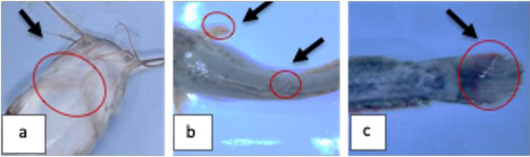
Clinical symptoms of African catfish (C. gariepinus)
Clinical signs were recorded qualitatively through visual examination without application of a standardized scoring system, and the frequency of each clinical manifestation was not quantified. The clinical signs showed fin damage, including fraying, tearing, or incomplete fins, which may indicate tissue injury caused by ectoparasite activity and increase the risk of secondary bacterial or fungal infections. In addition, pale discoloration was observed on the operculum and body surface, and reddish lesions were found on the fins.
Catfish (C. gariepinus) examined during the study also exhibited external clinical symptoms in the form of excessive mucus production on the body surface. This increased mucus secretion is generally a defensive physiological response and often indicates parasitic infection affecting the skin or gills, which may subsequently lead to further damage or infection in these areas.
Monogenean parasites
The monogenean parasites found can be seen in Figures 2–4, and Tables 2–4.
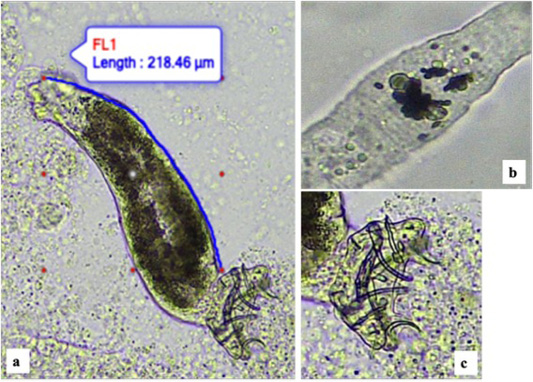
Morphometrics of Dactylogyrus sp.
Microscopic observation of catfish (C. gariepinus) at a magnification of ×40 revealed the presence of parasites morphologically identified as Dactylogyrus sp. The observed specimens displayed key diagnostic features of this genus, including anterior head glands, a mouth connected to the pharynx, and eyespots. At the posterior end, an attachment organ (opisthaptor) was clearly visible, equipped with two main structures: Anchors and marginal hooks.
Table 2: Morphometrics of Dactylogyrus sp.
| No | Morphology | Morphometric |
| 1. | Body length | Length: 218,46 µm Width: 57,12 µm |
| 2. | Opishaptor: Marginal hooks Bar |
7 pairs of marginal hooks Double bars |
| 3. | Eyes spot | 1 pair eye spot |
Table 3: Morphometrics of Gyrodactylus sp.
| No | Morphology | Morphometric |
| 1. | Body length | Length: 218,46 µm Width: 57,12 µm |
| 2. | Opishaptor: Anchor Marginal hooks Dorsal Bar |
1 pair of anchor 8 pairs of marginal hooks (21,28 µm) Single bar (17,42 µm) |
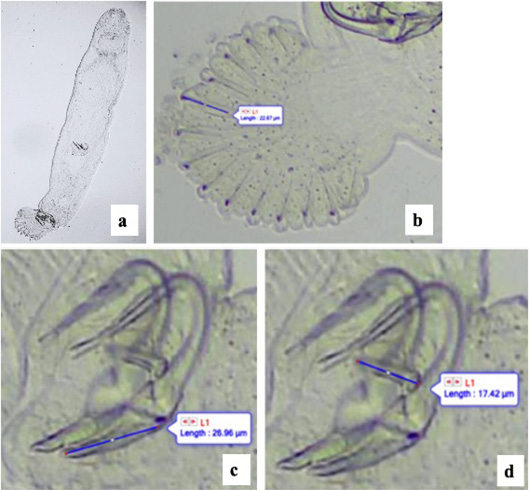
Morphometrics of Gyrodactylus sp.
Table 4: Morphometrics of Actinocleidus sp.
| No | Morphology | Morphometric |
| 1. | Body length | Length: 291,18 µm Width: 57,12 µm |
2. 3. |
Opishaptor: Anchor/Haptor Bar Male Aparatus |
1 pair of anchor/haptor Double bars present |
Based on microscopic observations, parasites morphologically identified as Gyrodactylus sp. were detected, a member of Monogenea commonly found on the body surface and gills of freshwater fish. The parasite has a transparent, elongated body, allowing clear observation of both internal and external structures under the microscope. The posterior end is equipped with a characteristic attachment organ (opisthaptor) consisting of two large anchors and sixteen marginal hooks arranged in a circular pattern. In the middle of the parasite’s body, a well-developed embryo with hooks was visible inside the parent, which is a distinctive feature of the viviparous reproductive system of the genus Gyrodactylus.
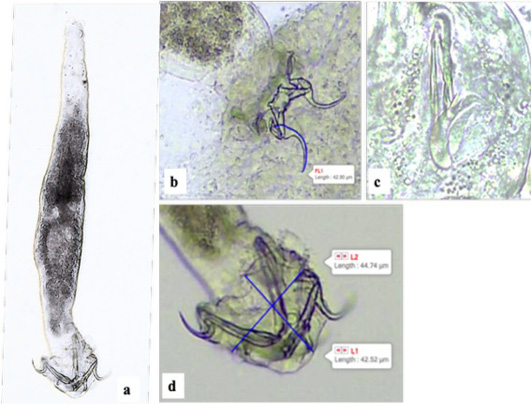
Morphometrics of Actinocleidus sp.
Observations revealed the presence of parasites morphologically identified as Actinocleidus sp. This parasite has an elongated body flattened dorsoventrally, with the posterior region forming a haptor structure composed of a pair of large symmetrical anchors, small marginal hooks, and a transverse bar connecting the anchors. Other internal organs such as the testes, ovary, and digestive tract were not clearly visible in the image; therefore, the distinctive haptor morphology served as the strongest basis for identifying the parasite as Actinocleidus sp. Although internal organs were not clearly distinguishable in some specimens, genus-level identification was based on diagnostic haptoral morphology, including anchor structure, transverse bars, and hook arrangement.
Intensity, prevalence and dominance calculations
The results of the intensity, prevalence, and dominance calculations are shown in Table 5.
A total 308 monogeneans community infestating C. gariepinus was structured by differential patterns of prevalence, intensity, and dominance among genera. Actinocleidus sp. emerged as the most epidemiologically widespread parasite, exhibiting the highest prevalence (28.70%), total abundance (166 individuals), and dominance (53.89%). This indicates that Actinocleidus sp. represents the principal component of the parasite community and the most consistently established genus within the host population.
In contrast, Dactylogyrus sp. showed the highest mean intensity (8.25 ind/fish), despite a lower prevalence (11.11%), suggesting a more aggregated infection pattern characterized by heavier burdens in infected individuals. Such aggregation may imply higher pathogenic potential at the individual host level, even if population-level distribution is less extensive than that of Actinocleidus sp.
Gyrodactylus sp. displayed comparatively low prevalence (7.56%) and dominance (13.96%), although its intensity (6.14 ind/fish) remained relatively elevated, reflecting moderate infection pressure but limited overall contribution to community structure.
Overall, these results indicate a parasite assemblage dominated numerically and epidemiologically by Actinocleidus sp., while Dactylogyrus sp. may pose greater
Table 5: Intensity, prevalence, and dominance of monogeneans in catfish.
| No. | Parasite | ∑ parasite (ind) | ∑ infected fish (fish) | ∑ Fish examined (fish) | I (ind/ ekor) | P (%) | D (%) |
| 1. | Dactylogyrus | 99 | 12 | 108 | 8,25 | 11,11 | 32,14 |
| 2. | Gyrodactylus | 43 | 7 | 108 | 6,14 | 7,56 | 13,96 |
| 3. | Actinocleidus | 166 | 31 | 108 | 5,35 | 28,70 | 53,89 |
Table 6: Intensity, prevalence, and dominance of monogeneans based on aquaculture container.
| Types of aquaculture container | Parasite | ∑ parasite (ind) | ∑ infected fish (fish) | ∑ Fish examined (fish) | I (ind/fish) | P (%) | D (%) |
| Tarpaulin | Dactylogyrus | 98 | 7 | 27 | 14 | 25,92 | 33,56 |
| Gyrodactylus | 43 | 11 | 27 | 3,9 | 40,74 | 14,72 | |
| Actinocleidus | 151 | 20 | 27 | 7,55 | 74,07 | 51,71 | |
| Concrete | Dactylogyrus | 1 | 1 | 81 | 1 | 1,23 | 6,25 |
| Gyrodactylus | 0 | 0 | 81 | - | - | - | |
| Actinocleidus | 15 | 11 | 81 | 1,36 | 13,58 | 93,75 |
Table 7: Hematology of catfish based on aquaculture container.
| Types of aquaculture ponds | Fish condition | Hematology | |
| Hematocrit (%) | Leukocrit (%) | ||
| Tarpaulin | Parasite infestation | 23% ± 0,0801 | 2% ± 0,0083 |
| Non-parasite infestation | 12% ± 5 | 3% ± 0 | |
| Concrete | Parasite infestation | 18% ± 0,0520 | 2% ± 0,0086 |
| Non-parasite infestation | 22% ± 6 | 2% ± 1 | |
individual-level pathological risk due to higher infection intensity. The contrasting distribution patterns among genera suggest differences in transmission dynamics and host parasite interaction strategies within the culture system. The following section presents the results of the intensity, prevalence, and dominance calculations based on aquaculture container type, as shown in Table 6.
Clear structural divergence in the monogenean assemblage between tarpaulin and concrete systems suggests strong environmental modulation of parasite transmission patterns. In tarpaulin ponds, infestation pressure was substantially higher across all indices. Actinocleidus sp. dominated (74.07% prevalence; 51.71% dominance; 7.55 ind/fish), indicating broad host distribution and successful establishment. Dactylogyrus sp. showed the highest intensity (14 ind/fish) despite moderate prevalence (25.92%), reflecting a highly aggregated pattern with potential pathological implications. Gyrodactylus sp. exhibited intermediate prevalence (40.74%) but lower intensity (3.9 ind/fish), suggesting widespread but lighter infestations.
In contrast, parasite burden in concrete ponds was markedly reduced. Gyrodactylus sp. was absent, while Actinocleidus sp. (13.58% prevalence) and Dactylogyrus sp. (1.23% prevalence; 1 ind/fish) showed substantially lower infestation levels, indicating constrained transmission and establishment. Importantly, the absence of Gyrodactylus sp. in concrete systems suggests that reproductive strategy (viviparity and rapid autoinfection cycles) may confer an advantage only under specific environmental conditions.
Notably, these differences occurred despite higher stocking densities in concrete systems, contradicting classical density-dependent expectations. This suggests that container-associated environmental factors may exert stronger regulatory effects on parasite persistence than host density alone. Overall, culture system type appears to function as a key ecological determinant shaping parasite community structure, aggregation patterns, and transmission potential in intensive catfish aquaculture.
Hematocrit and leucocrit
The results of the hematological parameters based on the aquaculture medium can be seen in Table 7.
Table 7 shows that infested catfish reared in tarpaulin ponds had a higher hematocrit value (23%) compared to those in concrete ponds (18%), indicating that infested fish were still able to maintain hematocrit within the normal range despite differences between container types. In non-infested fish, the opposite pattern was observed: Fish in concrete ponds had a higher hematocrit (22%) than those in tarpaulin ponds (12%), which was considered relatively low. Leukocrit values in both tarpaulin and concrete ponds remained stable at 2–3%, suggesting that the fish immune response to infection and environmental conditions was still within a normal range.
Opercular beat rate measurement results
The mean and standard deviation of catfish operculum opening measurements grouped by culture pond type are presented in Table 8.
Table 8: Operculum aperture of catfish based on the aquaculture container.
| Container type | Average length (cm) | Average weight (g) | Average opercular aperture (/m) |
| Tarpaulin | 22,74±5,91 | 85,59±36,61 | 59,55±19,86 |
| Concrete | 19,39±1,71 | 41,03±8,46 | 65,25±16,04 |
Fish reared in tarpaulin ponds showed an average opercular beat rate of 59.55±19.86 times per minute, whereas fish from concrete ponds exhibited a higher rate of 65.25± 16.04 times per minute.
Discussion
Sampling
Sampling was conducted at four catfish culture sites that differed in water source, seed origin, feed composition, and probiotic use factors closely linked to the health of C. gariepinus. The tarpaulin pond at Teaching Factory FPIK UNDIP used well water, self-produced seed, and commercial feed supplemented with probiotics. Probiotic application has been reported to improve growth, biomass, immunity, hematological profiles, and feed efficiency ; . Concrete ponds in Sambiroto also used well water and self-produced seed, with commercial feed mixed with bran and probiotics applied before stocking. Similar approaches have been shown to enhance growth and survival through Bacillus sp. supplementation and improve feed quality with bran . In Mranggen, concrete ponds used groundwater and local seed, with commercial feed mixed with MOL and/or probiotics, which are known to improve FCR, growth rate, suppress pathogens, and enhance water quality . Pedurungan applied a comparable system combining MOL and probiotics to maintain water quality and reduce organic buildup that may favor parasites . The use of microbial amendments in aquaculture has been associated with modulation of microbial communities, enhancement of water quality, and potential indirect effects on pathogen dynamics . These variations highlight how culture inputs strongly influence fish health and susceptibility to parasites.
Roofed tarpaulin ponds provided greater thermal stability and protection from weather, reducing stress but increasing the risk of organic and ammonia accumulation that favors monogenean development ; . In contrast, unroofed concrete ponds allowed better water circulation and waste management, which can help control parasite populations, although higher temperature fluctuations may induce chronic stress and affect hematological health. Overall, pond design and water management play a crucial role in shaping environmental conditions and parasite vulnerability in cultured catfish.
Importantly, infestation levels were higher in the tarpaulin pond despite its lower stocking density (159 fish/m2) compared to concrete ponds (171–240 fish/m2). This pattern suggests that density alone does not explain the observed variation in parasite indices. If density were the primary driver, higher infestation would be expected in concrete systems.
Clinical symptoms
One limitation of this study is that clinical signs were assessed qualitatively without a standardized scoring system. Consequently, the frequency and severity of observed abnormalities could not be quantified or statistically analyzed in relation to parasite burden. Although these observations provided contextual support for parasitological findings, future studies incorporating quantitative clinical indices would enable more robust evaluation of host–parasite interactions.
Morphology and morphometry of monogenea
Based on the results of this study, catfish (C. gariepinus) exhibited physical clinical signs including frayed caudal, dorsal, and pectoral fins; slightly pale operculum openings; red and white spots or lesions; generalized body paleness; and excessive mucus production. Clinical manifestations were assessed qualitatively through external visual examination without the use of standardized lesion scoring. These symptoms are consistent with common indicators of parasitic infection in fish, such as body discoloration and increased mucus secretion . The specific signs observed also correspond to infections caused by monogenean parasites. Actinocleidus sp. is known to induce pale to brownish gill discoloration in severe cases ; in this study, the infection level was categorized as mild, with pale operculum openings serving as an early indication of gill damage. In addition, infections by Dactylogyrus sp. and Gyrodactylus sp., which are associated with frayed fins , white spots , and reddish lesions on the body , further reinforce that the observed clinical conditions in catfish were closely related to parasitic infestation. However, signs such as fin erosion and mucus hypersecretion are considered nonspecific indicators of physiological stress in fish and may arise from multifactorial causes; therefore, clinical observations should be interpreted alongside parasitological confirmation.
Dactylogyrus sp.
Agustiya et al. (2023), to support parasite identification, morphometric analysis was conducted by measuring body size and attachment structures, which are important diagnostic characters for determining genus or species. The Dactylogyrus sp. parasites found on the skin and gills of catfish (C. gariepinus) had a flattened body, with a prohaptor at the anterior end and an opisthaptor (posterior sucker) at the posterior end equipped with one pair of large anchors and 14 marginal hooks (7 pairs). Two pairs of eyespots were located near the pharynx, and the head possessed four lobes. Monogeneans life cycles are oviparous (egg laying). This morphology is consistent with descriptions of Dactylogyrus sp. reported by Suhardi et al. (2014), who stated that Dactylogyrus sp. is an egg-laying monogenean possessing an opisthaptor with 1–2 pairs of large hooks and 14 marginal hooks at the posterior. It also has four lobes on the head and two pairs of eyes near the pharynx. The body of Dactylogyrus sp. is dorsoventrally flattened and bilaterally symmetrical. The prohaptor functions as both a feeding organ and a locomotory structure, enabling the parasite to attach and move on host tissues . The opisthaptor structure in Dactylogyrus sp. is diagnostic because the shape and size of anchors and the number of marginal hooks are important for species identification ; . The digestive tract extending directly toward the posterior without branching also reflects the simple digestive system typical of monogeneans. This opisthaptor morphology supports the identification of the parasite as Dactylogyrus sp., which commonly infects freshwater fish gills, including C. gariepinus, and may cause tissue damage due to hook attachment and suction, leading to excessive mucus production and epithelial hyperplasia .
Morphometric measurements showed that the parasite had an average body length of 218.46 µm and width of 57.12 µm. A distinctive feature observed was the presence of 7 pairs of marginal hooks symmetrically arranged around the haptors, which functions as the main attachment organ to the host’s gill tissue. The haptor measured 30.16 µm in length and 59.21 µm in width, indicating a relatively wider structure that supports strong attachment.
The combination morphometric profile and haptoral configuration are consistent with members of the family Dactylogyridae. The presence of seven pairs of marginal hooks and double transverse bars represents key diagnostic characters widely used in dactylogyrid classification. Additionally, the observation of a single pair of eyespots is also consistent with many dactylogyrids, particularly those whose larval stages (oncomiracidia) rely on photoreception for host localization. While eyespots are primarily functional during the free-swimming larval stage, their persistence in adult forms reflects retained developmental traits. Beyond taxonomy, the structural features indicate functional specialization for stable gill attachment and efficient direct transmission, traits that are particularly advantageous in high-density aquaculture systems. However, because the identification was not confirmed molecularly, the results remain tentative and serve only as preliminary taxonomic indications.
Gyrodactylus sp.
Microscopic examination revealed monogenean specimens exhibiting morphological characteristics consistent with the genus Gyrodactylus, a viviparous ectoparasite commonly infecting freshwater and marine fishes. The parasites displayed an elongated, transparent, and bilaterally symmetrical body, allowing clear visualization of internal and external structures. The anterior region, bearing the mouth and pharynx, functions in host attachment and nutrient acquisition, with the mouth facilitating direct ingestion of host mucus and epithelial cells . Adhesive glands likely contribute to stabilization during feeding and movement .
A defining feature was the posterior opisthaptor, which serves as the primary attachment organ and contains anchors (hamuli) and marginal hooks that secure the parasite to host tissues . This haptoral configuration represents a key diagnostic characteristic of Gyrodactylus sp. and underpins its capacity for effective host colonization (Bakke et al., 2007; . The observed specimens measured 653.51 µm in total body length and possessed eight pairs of marginal hooks (mean length 21.28 µm), anchors measuring 26.96 µm, and a dorsal bar of 17.42 µm. These morphometric parameters fall within the known range for Gyrodactylus species and are taxonomically informative at the genus level.
Comparative assessment with Gyrodactylus gymnodiptychi revealed close similarity in key morphometric traits, suggesting potential phylogenetic affinity. However, in the absence of detailed copulatory organ analysis or molecular confirmation, identification remains conservatively tentative.
Embryos bearing developing hooks were observed within the parental body, confirming viviparity a hallmark reproductive strategy of Gyrodactylus sp. that facilitates rapid population expansion via direct transmission. This observation was qualitative, and no quantitative analysis was conducted to evaluate relationships between reproductive status, infection intensity, or host condition.
Actinocleidus sp.
Actinocleidus sp. is a monogenean worm inhabiting freshwater fish gills with a direct life cycle . Morphological observation showed an elongated, dorsoventrally flattened body with a posterior haptor composed of paired anchors, transverse bars, and marginal hooks. The anchors are fused centrally with fan-shaped dorsal bars, consistent with previous descriptions . The opisthaptor is plate-like and relatively small (about 10% of body length) and contains 14 rows of marginal hooks . The transverse bars connecting the anchors provide structural stability and are diagnostic features distinguishing Actinocleidus from other monogeneans . Infection may cause severe gill damage, hyperplasia, hemorrhage, and respiratory impairment ; .
Measurements indicated a body length of 291.18 µm, ventral bar length of 20.42 µm, anchor size of 42.90 µm, and a haptor measuring 42.52 × 44.74 µm. The nearly symmetrical haptor shape reflects efficient attachment capability. When compared with Actinocleidus oculatus described by Beverley and Burton (1986), similarities were observed in attachment structures despite differences in overall body size. The slightly larger body length found in this study still falls within an acceptable taxonomic range, supporting genus-level identification.
Intensity, prevalence, dominance analysis
Analysis of 108 catfish showed infection intensities of Dactylogyrus sp. (8.25 ind/fish), Gyrodactylus sp. (6.14 ind/fish), and Actinocleidus sp. (5.35 ind/fish). Based on Salsabilla et al. (2021), these values fall within the low to moderate range and are still categorized as mild infections, as the fish remained healthy and active. Nevertheless, excessive monogenean infestation can damage gill tissues, causing hyperplasia and hemorrhage that may interfere with respiration and reduce oxygen supply ; . Prevalence values were 11.11% for Dactylogyrus sp., 7.56% for Gyrodactylus sp., and 28.70% for Actinocleidus sp. Dactylogyrus sp. and Actinocleidus sp. infections are classified as frequent, while Gyrodactylus sp. is occasional. The relatively high prevalence is linked to the direct life cycle of monogeneans, which allows rapid transmission in aquaculture systems . Dominance analysis revealed that Actinocleidus sp. was the dominant parasite (53.89%), followed by Dactylogyrus sp. (32.14%) and Gyrodactylus sp. (13.39%). This indicates that Actinocleidus sp. was the most influential parasite species in the population and potentially poses the greatest risk to fish health due to its gill-targeting behavior.
Intensity, prevalence, dominance based on culture containers
In tarpaulin ponds, infection intensity varied among genera, with Dactylogyrus sp. reaching 14 ind/fish, Gyrodactylus sp. 3.9 ind/fish, and Actinocleidus sp. 7.55 ind/fish. Based on the classification of Salsabilla et al. (2021), intensities of 1–5 ind/fish are considered low and 6–55 ind/fish moderate. Accordingly, Dactylogyrus sp. and Actinocleidus sp. fall within the moderate infection category, whereas Gyrodactylus sp. is classified as low intensity. Notably, despite its relatively high prevalence (approximately 40–50%), Gyrodactylus sp. maintained low mean intensity, indicating widespread but light infections. In contrast, Dactylogyrus sp. exhibited moderate intensity with comparatively lower prevalence, suggesting a more aggregated infection pattern. These findings emphasize that prevalence and intensity capture different epidemiological dimensions distribution across hosts versus parasite burden per infected individual and should be interpreted complementarily when assessing infection severity. Prevalence values were 25.92% for Dactylogyrus sp., 40.74% for Gyrodactylus sp., and 74.07% for Actinocleidus sp. Based on Salsabilla et al. (2021), Dactylogyrus sp. falls into the frequent category (10–29%), Gyrodactylus sp. into the common category (30–49%), and Actinocleidus sp. into the moderate prevalence category (70–89%). Dominance values were 33.56% for Dactylogyrus sp., 14.72% for Gyrodactylus sp., and 51.71% for Actinocleidus sp. Although Dactylogyrus sp. had the highest intensity (14 ind/fish), Actinocleidus sp. showed the highest prevalence (74.07%) and dominance.
In concrete ponds, infection intensity was low for both Dactylogyrus sp. (1 ind/fish) and Actinocleidus sp. (1.36 ind/fish), corresponding to the “low” infection category of Salsabilla et al. (2021). Prevalence was also limited (1.23% for Dactylogyrus sp. and 13.58% for Actinocleidus sp.), indicating sporadic occurrence, and Gyrodactylus sp. was not detected in any examined fish. Despite the overall low infestation levels, dominance analysis revealed a pronounced asymmetry, with Actinocleidus sp. accounting for 93.75% of the parasite assemblage. This near-monospecific structure suggests a simplified community likely shaped by ecological filtering, where environmental conditions within the concrete system selectively favor a single taxon while constraining others. In contrast to the more heterogeneous assemblage observed in tarpaulin ponds, these findings indicate that container type may play a decisive role in regulating parasite community composition and assembly dynamics. Overall, comparison between pond types indicates that tarpaulin ponds had the highest intensity and prevalence for all three monogenean parasites, whereas concrete ponds showed the highest dominance for Actinocleidus sp.,. Catfish reared in tarpaulin ponds are generally more susceptible to parasite infestation than those cultured in concrete ponds. This is due to differences in environmental conditions and management systems. Tarpaulin ponds typically have smaller water volumes and heat-absorbing surfaces, resulting in higher and unstable temperatures that induce stress and lower fish immunity. In addition, limited water circulation and waste accumulation create favorable conditions for parasite development. The smooth tarpaulin surface also facilitates parasite attachment, unlike the rough concrete surface which is easier to clean.
Hematology
Hematological condition is an important indicator for evaluating the physiological health of fish. Salasia et al. (2001) stated that hematological analysis is effective for early disease detection and for observing fish responses to environmental and biological factors. Parameters such as hematocrit and leukocrit not only describe health status but also reflect non-specific defense mechanisms. Through hematological values, the adaptive capacity and stress level experienced by fish can be identified. The results showed differences in hematocrit values between culture systems. In infested fish, hematocrit in tarpaulin ponds reached 23%, higher than in concrete ponds (18%). Values between 20–30% are still considered normal for teleost fish such as catfish , indicating that although parasite infestation was higher in tarpaulin ponds, blood condition remained within physiological limits. This suggests that hematocrit reduction is influenced not only by parasites but also by environmental conditions. Concrete ponds in this study had high stocking density, temperature fluctuations, and possible ammonia accumulation, which may induce chronic stress and suppress erythrocyte production .
Conversely, in non-infested fish, hematocrit values in concrete ponds (22%) were much higher than in tarpaulin ponds (12%). The 12% value is below the normal range, indicating physiological stress despite the absence of parasite infection. This finding confirms that environmental factors such as water quality and potential nutritional imbalance strongly influence fish hematology, sometimes more significantly than parasite presence itself.
Opercular beat response
Opercular beat rate, or the frequency of gill cover movements, is an important physiological indicator that reflects respiratory activity and the stress response of fish to environmental conditions. In this study, the opercular beat rate was measured over one minute as a parameter to assess metabolic rate and the ability of fish to adapt to environmental and biological factors. The normal opercular beat rate of catfish ranges from 68–72 beats per minute .
The results showed that the average opercular beat rate of catfish reared in concrete ponds (65.25 ± 16.04 beats/min) was slightly higher than that of fish reared in tarpaulin ponds (59.55 ± 19.86 beats/min). Although differences were observed, these values remain within the normal range for catfish and reflect normal physiological responses to the respective pond environments. The relatively warmer conditions in concrete ponds may induce fish to increase respiratory activity as an adaptive response .
Based on sex, female fish exhibited slightly higher opercular beat rates (65.07 ± 16.88 beats/min) than males (61.39 ± 15.37 beats/min), which may be related to higher metabolic demands in females, particularly during gonadal maturation . When examined by body size, a decreasing trend in opercular beat rate was observed with increasing fish size. All size groups showed values within the normal range, except fish measuring 6–8 cm, which exhibited the highest rate (94 ± 9.64 beats/min). This elevated rate indicates increased respiratory activity, which may be attributed not only to smaller body size with a higher surface area-to-volume ratio, but also to the higher prevalence of parasite infection in this size group. High parasite infestation can induce physiological stress and increase oxygen demand, thereby accelerating opercular movements as a compensatory mechanism.
Limitations section
This study has several limitations. First, parasite identification was based solely on morphological characteristics and was not confirmed molecularly; therefore, identifications should be considered preliminary. Second, water quality parameters (temperature, pH, ammonia, dissolved oxygen) were not measured, limiting our ability to correlate environmental factors with infestation patterns. Third, clinical signs were assessed qualitatively without a standardized scoring system, preventing statistical analysis of clinical severity. Fourth, the study design was unbalanced, with only one tarpaulin pond compared to three concrete ponds, which may limit the generalizability of findings. Fifth, no statistical tests were performed to compare infestation indices between pond types. Future studies should incorporate molecular confirmation, comprehensive water quality monitoring, quantitative clinical scoring, balanced sampling designs, and appropriate statistical analyses.
Conclusion
The biodiversity of Monogenean parasites in catfish (C. gariepinus) revealed infestation by three genera: Dactylogyrus sp., Gyrodactylus sp., and Actinocleidus sp. All three were found in fish from tarpaulin ponds, whereas only Dactylogyrus sp. and Actinocleidus sp. occurred in concrete ponds. These results indicate that monogenean infestation reflects interactions between culture systems, environmental conditions, and host physiology. Higher infestation in tarpaulin ponds emphasizes the role of microenvironmental stability and water management. The dominance of Actinocleidus sp. suggests its potential as a biological indicator for aquaculture ecosystem health and early disease risk detection.
Acknowledgement
This research funded (No. 85/UN7.F10/PP/II/2024) by a research grant from the Faculty of Fisheries and Marine Sciences (FPIK) of the University of Diponegoro, supported by the State Budget (APBN) and the Faculty’s Operational Budget (DPA SUKPA) for the 2024 fiscal year.
Novelty Statement
This study provides the first comparative characterization of monogenean parasite communities in African catfish (C. gariepinus) across two distinct intensive aquaculture systems roofed tarpaulin ponds and unroofed concrete ponds in Semarang, Indonesia. The novelty lies in demonstrating that container type functions as a stronger ecological determinant of parasite community structure than host stocking density, contradicting classical density-dependent transmission expectations. This study also identifies Actinocleidus sp. as the dominant monogenean genus and positions it as a potential biological indicator for aquaculture ecosystem health. Furthermore, it integrates parasitological indices with hematological and physiological indicators, demonstrating that environmental factors can influence fish physiology more significantly than parasite presence itself.
Author’s Contribution
AHCH designed the research. ATS performed the data analysis. KZW drafted the manuscript. AKRA and DD collected the data. RA, D, and SBP reviewed and revised the manuscript. All authors have read and agreed to the published version of the manuscript.
Ethical statement
All experimental procedures involving fish were conducted in accordance with the ethical guidelines and approved by the Animal Ethics Committee of Diponegoro University (Approval No. 070/EC/KEPK/FK-UNDIP/IV/2025).
Generative AI and AI-assisted technology statement
During the preparation of this work, the authors used ChatGPT and Paperpal to improve language clarity, readability, and grammar. After using these tools, the authors reviewed and edited the content as necessary and take full responsibility for the content of the publication.
Conflict of interest
The authors have declared no conflict of interest.
References
- Ageng’o J, Mwanja W, Ojwang W (2024). Effects of organic load on parasite infestation in aquaculture systems. Aquacult. Res., 55(2): 235–244.
- Agustiya R, Mahasri G, Subekti S (2023). Identification of morphometric characteristics and intensity of marine leech Zeylanicobdella infestation on cantang grouper from Brondong District, Lamongan and Mandangin Island, Madura. J. Mar. Coastal Sci., 12(1): 35–42. https://doi.org/10.20473/jmcs.v12i1.38273 [CrossRef]
- Aini N, Fitriani D, Mustofa M (2022). Effect of probiotic supplementation on non-specific immune response of catfish (Clarias sp.). J. Aquacult. Fish Health, 11(1): 15–22.
- Amri K, Khairuman (2008). Intensive culture of Nile tilapia. Agromedia Pustaka.
- Anshary H (2010). Pathological infection of Actinocleidus sp. (Monogenea) on the gills of African catfish (Clarias gariepinus). J. Perikanan, 12(2): 79–85.
- Bakke TA, Harris PD, Hansen H, Cable J, Hansen LP (2004). Susceptibility of Baltic and East Atlantic salmon (Salmo salar) stocks to Gyrodactylus salaris (Monogenea). Dis. Aquat. Organ., 58: 171–177. https://doi.org/10.3354/dao058171 [CrossRef]
- Barton BA, Iwama GK (1991). Physiological changes in fish from stress in aquaculture with emphasis on corticosteroid responses. Ann. Rev. Fish Dis., 1: 3–26. https://doi.org/10.1016/0959-8030(91)90019-G [CrossRef]
- Beverley B, Burton M (1986). The taxonomic status of Actinocleidus Mueller, 1937; Anchoradiscus Mizelle, 1941; Clavunculus Mizelle et al., 1956; Anchoradiscoides Rogers, 1967; Syncleithrium Price, 1967 and Crinicleidus n. gen.: North American ancyrocephalids (Monogenea) with articulating haptoral bars. J. Parasitol., 72(1): 22–44. https://doi.org/10.2307/3281794 [CrossRef]
- Buchmann K, Bresciani J (2006). Monogenea (Platyhelminthes). In: P. T. K. Woo (Ed.): Fish diseases and disorders. CABI Publishing. 1: 297–344. https://doi.org/10.1079/9780851990156.0297 [CrossRef]
- Bunkley-Williams L, Williams EH, Jr (1994). Parasites of Puerto Rican freshwater sport fishes. Puerto Rico Department of Natural and Environmental Resources and University of Puerto Rico.
- Dewi RRS, Tahapari E (2017). Application of commercial probiotics in the grow-out of African catfish (Clarias gariepinus). J. Riset. Akuakult., 12(3): 275–281. https://doi.org/10.15578/jra.12.3.2017.275-281 [CrossRef]
- Fachrussyah ZC, Ahmad IG, Lantu IS, Lamadi A, Nento WR (2024). Prevalence and intensity of ectoparasites in catfish (Clarias sp.) cultivated with a biofloc system. Adv. Anim. Vet. Sci., 12(10): 2029–2033. https://doi.org/10.17582/journal.aavs/2024/12.10.2029.2033 [CrossRef]
- Fira D, Wiradani PA, Ansori AN, Susilo RJ, Sabdoningrum EK (2021). Ectoparasite inventory of Nilem fish (Osteochilus hasselti) fingerlings cultured in ponds in Sukabumi, West Java, Indonesia. Iraqi J. Vet. Sci., 35(3): 605–609. https://doi.org/10.33899/ijvs.2020.127031.1440 [CrossRef]
- Gussev AV (1985). Parasitic Monogenea of freshwater fishes: Systematics, fauna and evolution. Leningrad University Press. https://doi.org/10.1007/978-94-009-6545-4_7 [CrossRef]
- Hakim LN, Irawan H, Wulandari R (2019). Intensity and prevalence of endoparasites in silver pompano (Trachinotus blochii) cultured in Tanjungpinang. Intek Akuakult., 3(1): 45–55. https://doi.org/10.31629/intek.v3i1.1005 [CrossRef]
- Hasyimia USA, Dewi NK, Pribadi TA (2016). Identification of ectoparasites in cultured Sangkuriang catfish (Clarias gariepinus) at Boja Hatchery, Kendal. Life Sci., 5(2): 118–124.
- Hermawan H (2013). Tarpaulin pond aquaculture technology for household food security programs. BPTP.
- Hirazawa N (2010). Effects of water temperature on Neobenedenia girellae infection, parasite growth and pathology in amberjack (Seriola dumerili). Aquaculture, 299: 2–7. https://doi.org/10.1016/j.aquaculture.2009.11.025 [CrossRef]
- Kabata Z (1985). Parasites and diseases of fish cultured in the tropics. Taylor and Francis.
- Kearn GC (2004). Swimming behaviour of Gyrodactylus rysavyi from Nile catfish (Clarias gariepinus). Acta Parasitol., 49(2): 102–107.
- Kritsky DC, Boeger WA (2002). Neotropical monogenoidea: New and previously described species of Dactylogyridae from marine and freshwater perciform fishes. Zoosystema, 24(1): 7–40.
- Laia NP, Desrina Haditomo AHC (2018). Monogenean infestation in Nile tilapia and African catfish from Central Java, Indonesia. J. Aquacult. Manage. Technol., 7(1): 107–113.
- Mahyuddin K (2008). Complete guide to catfish agribusiness. Penebar Swadaya.
- Malmberg, G (1957). On the occurrence of Gyrodactylus on Swedish fishes. Skrifter utgivna av Södra Sveriges Fiskeriförening, 1956: 19–76.
- Margolis L, Arthur JR (1979). Synopsis of the parasites of fishes of Canada. Bulletin of the Fisheries Research Board of Canada, 199. [CrossRef]
- Ministry of Marine and Fisheries of the Republic of Indonesia (2024). Aquaculture production by province, 2023. Center for Data, Statistics and Information.
- Munguti JM, Musa S, Orina PS, Kyule D, Opiyo MA, Charo-Karisa H, Ogello EO (2014). An overview of the current status of the Kenyan fish feed industry and feed management practices, challenges and opportunities. Int. J. Fish. Aquat. Stud., 1(5): 128–137.
- Newaj-Fyzul A, Al-Harbi AH, Austin B (2014). Developments in the use of probiotics for disease control in aquaculture. Aquaculture, 431: 1–11. https://doi.org/10.1016/j.aquaculture.2013.08.026 [CrossRef]
- Noga J (2010). Fish disease: Diagnosis and treatment (2nd ed.). Wiley-Blackwell. https://doi.org/10.1002/9781118786758 [CrossRef]
- Pickering AD (1993). Growth and stress in fish production. Aquaculture, 111: 51–63. https://doi.org/10.1016/B978-0-444-81527-9.50010-5 [CrossRef]
- Pratiwi R, Hidayat KW, Sumitro S (2020). Production performance of catfish (Clarias gariepinus Burchell, 1822) cultured with added probiotic Bacillus sp. in biofloc technology. J. Aquacult. Fish Health, 9(3): 41. https://doi.org/10.20473/jafh.v9i3.16280 [CrossRef]
- Pujiastuti N, Setiati N (2015). Identification and prevalence of ectoparasites in food fish at the Siwarak Fish Hatchery. Unnes J. Life Sci., 4(1): 9–15.
- Putri M, Fauziah NA (2021). Prevalence and intensity of parasites in Oreochromis niloticus cultured at PBIAT Janti and Barbonymus gonionotus at BBIAT Muntilan, Central Java. J. Enggano, 6(1): 138–146.
- Putri SM, Haditomo AHC, Desrina (2016). Monogenean infestation in freshwater food fish cultured in ponds at Ngrajek Village, Magelang. J. Aquacult. Manage. Technol., 5(1): 162–170.
- Salasia SIO, Sulanjari D, Ratnawati A (2001). Hematological study of freshwater fish. Biologi, 2(12): 710–723.
- Salsabilla A, Putra DF, Octavina C, Maulana R (2021). Prevalence and intensity of ectoparasites on cultivated catfish (Clarias sp.) in aquaculture ponds and bioflocs system in Aceh Besar, Indonesia. IOP Conf. Ser.: Earth Environ. Sci., 869(1): Article 012073. https://doi.org/10.1088/1755-1315/869/1/012073 [CrossRef]
- Saluta M (2019). Utilization of biofloc technology in high-stocking-density grow-out systems on the growth and survival of African catfish (Clarias gariepinus) juveniles in Buhu Village, Talaga Jaya District, Gorontalo Regency [Undergraduate thesis, Universitas Negeri Gorontalo].
- Sarjito, Prayitno SB, Haditomo AHC (2013). Introduction to fish parasites and diseases. UNDIP Press.
- Setiawan A, Supriyono E, Puspitasari D (2023). Effect of shading on water quality and health of African catfish (Clarias gariepinus) in a closed system. J. Akuatik Trop., 8(1): 45–52.
- Subandiyono, Lestari ND, Chilmawati D, Nugroho RA (2023). Influence of probiotic on feed utilization efficiency, growth performance and survival of Clarias gariepinus. Asian J. Res. Biol., 6(1): 87–93. https://doi.org/10.56557/ajrib/2023/v6i121 [CrossRef]
- Sugiyono (2017). Quantitative, qualitative, and R and D research methods. CV Alfabeta.
- Suhardi, Raharjo EI, Sunarto (2014). Intensity of ectoparasite infestation in Siamese catfish (Pangasius hypophthalmus) cultured in floating cages in the Kapuas River, Pontianak City. J. Ruaya, 1(1): 42–52.
- Sumiati T, Aryati Y (2010). Parasitic diseases in freshwater ornamental fish. In: Proceedings of the 2010 aquaculture technology innovation forum. pp. 963–971.
- Tuwitri R, Irwanto R, Kurniawan A (2021). Identification of parasites in catfish (Clarias sp.) cultured in fish ponds of Bangka Regency. J. Fish. Mar. Technol., 11(2): 189–198. https://doi.org/10.24319/jtpk.11.189-198 [CrossRef]
- Wedemeyer GA (1996). Physiology of fish in intensive culture systems. Chapman and Hall. https://doi.org/10.1007/978-1-4615-6011-1 [CrossRef]
- Wirawan IKA, Suryani SAMP, Arya IW (2018). Diagnosis, analysis, and identification of parasites infecting Nile tilapia (Oreochromis niloticus) in the “Baru” Subak aquaculture area, Tabanan. Gema Agro, 23(1): 63–78. https://doi.org/10.22225/ga.23.1.661.63-78 [CrossRef]
- Yanuhar U, Raharjo DKWP, Caesar NR, Junirahma NS (2021). Hematological responses of catfish (Clarias sp.) as indicators of fish health. IOP Conf. Ser. Earth Environ. Sci., 718: Article 012045. https://doi.org/10.1088/1755-1315/718/1/012059 [CrossRef]
- Zhang WR, Hao CL, Kadirden A, Meng JR, Sheng LT (2023). A new species of Gyrodactylus (Monogenoidea: Gyrodactylidae) from China. Int. J. Parasitol. Parasit. Wildl., 22: 136–145. https://doi.org/10.1016/j.ijppaw.2023.10.002 [CrossRef]
- Zidni I, Afrianto E, Mahdiana I, Herawati H, Bangkit I (2018). Gastric evacuation rates of common carp (Cyprinus carpio) and Nile tilapia (Oreochromis niloticus). J. Fish. Mar. Sci., 9(2): 147–151.

Services
Article usage statistics
Loading…
Related articles
- Influence of Parasite Infestation and Water Quality Deterioration During Mass Fish Mortality Event in Manzala Lake and its Corresponding Fish FarmsAdvances in Animal and Veterinary Sciences · 2022
- Histopathological Studies of Pond Reared Indian Major Carp, Catla catla Infested with Argulus japonicus and Trial for Argulosis TreatmentPunjab University Journal of Zoology · 2021
- Effects of Dietary Ginger (Zingiber officinale) Powder on Growth Performance, Feed-Related CO₂e Intensity, Economic Returns, and Management Decisions in African catfish (Clarias gariepinus) FarmingJournal of Animal Health and Production · 2026
- Distribution and Infestation of Yellow Cyst Nematodes on Potato Farm Area in Malang District, IndonesiaSarhad Journal of Agriculture · 2025
- Modifying the Design of Pond Production Systems can Improve the Health and Welfare of Farmed Nile Tilapia, Oreochromis niloticusPakistan Journal of Zoology · 2024
- Effect of Water of Tilapia Pond on Reproduction of Meloidogyne incognita and Growth of Eggplant in Relation to Soil TypePakistan Journal of Zoology · 2022