
Camels are among the most resilient livestock species, recognized for their remarkable adaptability to extreme climatic conditions. However, scientific studies on these important animals remain limited. This study investigates morphometric variation among three locally named dromedary camel types raised in Mogadishu, Somalia. We studied 248 camels (102 males, 146 females) from the SiifDacar, Hoor, and Eyddimo types on camel farms in the Dharkenley, Dayniile, and Hodan districts of Mogadishu. We measured eight body dimensions manually using a standard measuring tape and analyzed the data statistically using one-way ANOVA with Tukey’s post hoc test and Pearson correlation analysis. The analyses revealed significant differences between the locally named camel types, primarily among females. Among females, SiifDacar camels had significantly greater wither height, rump height, body length, and shoulder width than Hoor and Eyddimo females (p <0.05). In males, we found a significant difference between types only for seat width, with SiifDacar males having significantly wider rumps than Eyddimo males (p <0.05). Correlation analysis revealed significant positive associations among wither height, rump height, shoulder width, and seat width, and a negative association between chest height and wither height. Overall, female SiifDacar camels were morphologically larger than Hoor and Eyddimo females, and males generally had greater body dimensions than females. These findings document morphometric variation among locally recognised camel types in Somalia and provide a baseline for future studies on breed characterisation, genetic analysis, and conservation of Somali dromedary camels.
Research Article · Volume 14, Issue 12, Pages 2717–2728, 4 November 2026 · Open Access
Morphometric Characterization and Variation of Somali Dromedary Camels (Camelus dromedarius) in Selected Districts of the Benadir Region
· · · ·
Affiliations & Notes ⌄
- 1Department of Animal Science (Zootechny), Faculty of Veterinary Medicine, Selçuk University, Konya, Türkiye
- 2Department of Animal Production and Development, Ministry of Livestock, Forestry, and Range, Mogadishu, Somalia
- 3Department of Veterinary Clinical Studies, Faculty of Veterinary Medicine, Universiti Putra Malaysia, 43400 Serdang, Selangor, Malaysia
- 4Director of Animal Production, Ministry of Livestock, Forestry and Range, Hirshabelle State, Somalia
- *Correspondence | Abdirahman Barre; Email: gs72189@student.upm.edu.my
Article Info ⌄
- Journal:
- Advances in Animal and Veterinary Sciences
- Submitted Date:
- 21 April 2026
- Accepted Date:
- 1 July 2026
- Published Date:
- 4 November 2026

Abstract
INTRODUCTION
Camels, particularly the one-humped dromedary (Camelus dromedarius), are key livestock in arid and semi-arid regions, providing milk, meat, transport, and cultural value under conditions where other species perform poorly. Their exceptional adaptation to heat, feed scarcity, and water limitation makes them strategically important for food security and climate-resilient livestock systems in the Horn of Africa . Despite this importance, camels have historically received less scientific attention than cattle, sheep, and goats, and detailed information on their morphology and genetic diversity remains limited in many countries .
Somalia hosts one of the largest camel populations in the world. Somali camels are traditionally classified by pastoralists using local names that reflect perceived differences in conformation, performance, and adaptation. However, these folk classifications have rarely been evaluated using quantitative morphometric data. Systematic measurement of body dimensions can help to identify and describe distinct camel populations, understand sexual dimorphism and age-related growth patterns, and support formal breed recognition and conservation planning .
Somalia is located in the Horn of Africa between latitudes 5.1521°N and longitudes 46.1996°E, with an area of approximately 638,000 square kilometres. The country has an arid to semi-arid climate that makes it well-suited for nomadic livestock farming (Al-Asmari and Mir, 2021). The livestock sector contributes significantly to the country’s gross domestic product and is the primary livelihood source. The main livestock species raised are sheep, goats, camels, and cattle . Somalia has four main seasons: the Gu season (April–June) with the heaviest rainfall, and the Deyr season (October–December) with lighter, more sporadic rainfall.
Camels are used in dairy and meat production, wool production, transport, farm work, sports, and tourism. Globally, the camel population is estimated at approximately 31.1 million dromedary camels (Camelus dromedarius) and 3.7 million Bactrian camels (Camelus bactrianus). Nearly 60% of this population is concentrated in northeastern African countries, particularly Somalia, Sudan, Ethiopia, and Kenya. Beyond their economic value, camels also hold an essential place in the region’s cultural and social practices.
The main types of camels raised in Somalia are SiifDacar, Eyddimo, and Hoor. It is important to note that the term ‘type’ is used throughout this study to refer to locally named dromedary camel populations distinguished by herders based on traditional criteria including coat colour, geographic origin, and perceived performance but whose genetic distinctiveness has not been formally established. This operational definition distinguishes ‘type’ from ‘breed’, which implies confirmed genetic differentiation. Local herders identify these types as follows: SiifDacar camels are typically identified by their white to sandy-yellow coat, taller frame, and longer body, and are mainly found in the southern parts of the country, especially in the Middle Shabelle Valley and central coastal areas . Eyddimo camels are found mainly in the borderlands between Somalia and Ethiopia and along the hot coastal regions of Djibouti, and are distinguished by a reddish coat and comparatively smaller body frame. Hoor camels are the most widely distributed type in Somalia, mainly found in Nogal, Bakool, Gedo, and the Central Shabelle Valley, and are characterised by a moderate to large body with variable coat colour. These camel types have been raised in different regions for many years and are traditionally regarded as having differentiated morphologically, though whether this reflects genetic divergence, environmental adaptation, or both remains to be established.
Determining body characteristics is important for livestock breeding and selection programs. Regular recording of body measurements provides insights into animals’ adaptation to ecological conditions, nutritional status, and health. These measurements also help estimate commercial value . This study aimed to measure body dimensions of Somali dromedary camel types in Mogadishu to reveal morphological diversity in the region and establish a baseline for future research. Specifically, the objectives were to: (i) compare key body measurements among SiifDacar, Hoor, and Eyddimo types within sex; and (ii) assess the correlations among body measurements to describe overall body conformation.
MATERIALS AND METHODS
Study area and animals
We conducted this study on five camel farms in the Dharkenley, Dayniile, and Hodan districts of Mogadishu, Somalia, in 2021. A semi-arid climate with high temperatures and low, erratic rainfall characterizes these districts. We studied 248 dromedary camels aged six years or older, representing three locally named types: SiifDacar, Hoor, and Eyddimo. Six years was chosen as the minimum age because dromedary camels reach skeletal maturity at approximately 5–7 years of age, minimising the confounding effect of ongoing growth on body measurements. The sample included 102 males and 146 females. The distribution of animals by sex, age, and type is shown in Table 1.
Table 1: Distribution of camels by age, sex, and type.
| Camel type | Sex | 6–9 years | 10–13 years | ≥14 years | Total | Total by type |
| SiifDacar | Female | 19 | 10 | 20 | 49 | 82 |
| Male | 7 | 17 | 9 | 33 | ||
| Hoor | Female | 26 | 16 | 15 | 57 | 95 |
| Male | 12 | 14 | 12 | 38 | ||
| Eyddimo | Female | 19 | 9 | 12 | 40 | 71 |
| Male | 7 | 16 | 8 | 31 | ||
| Total by sex | Female: 146 | Male: 102 | 248 | Grand total: 248 | |||
Study site
This study was conducted in the Banadir region of Somalia, specifically within Mogadishu, the capital city of the country. Data were collected from three districts, namely Dharkenley, Dayniile, and Hodan (Figure 1). Banadir is located along the southeastern coast of Somalia bordering the Indian Ocean, and is characterized by a tropical semi-arid climate. The area experiences two rainy seasons, the Gu (April–June) and Deyr (October–December), with annual temperatures typically ranging between 25°C and 32°C.
The selected districts are predominantly urban and peri-urban areas where livestock keeping is commonly practiced alongside other socioeconomic activities. These districts were purposively selected due to their substantial livestock populations and accessibility for data collection. The geographical location of the study area is presented in Figure 1.
Body measurements
Body measurements were obtained using a flexible measuring tape according to standard procedures described by Çağlı (2019). All measurements were recorded in centimeters (cm) while animals were standing in a natural upright position on a level surface. Eight morphometric traits were evaluated: wither height (distance from the highest point of the withers to the ground), back height (distance from the spinous process of the last thoracic vertebra to the ground), rump height (distance from the highest point of the sacral region to the ground), body length (distance between the caput humeri and tuber ischiadicum), chest height (distance from the ground to the lowest point of the chest), abdominal height (distance from the ground to the lowest point of the abdomen), shoulder width (distance between the humeral bones), and seat width (distance between the femoral bones).
Study animals and population structure
A total of 248 camels representing three indigenous Somali camel types (Siif Dacar, Hoor, and Eyddimo) were included in this study. The study population comprised 146 females and 102 males distributed across three age categories (6–9 years, 10–13 years, and ≥14 years). The Siif Dacar type consisted of 82 animals (49 females and 33 males), Hoor comprised 95 animals (57 females and 38 males), and Eyddimo included 71 animals (40 females and 31 males). Overall, 90 camels were classified in the 6–9-year age group, 82 in the 10–13-year group, and 76 in the ≥14-year group.
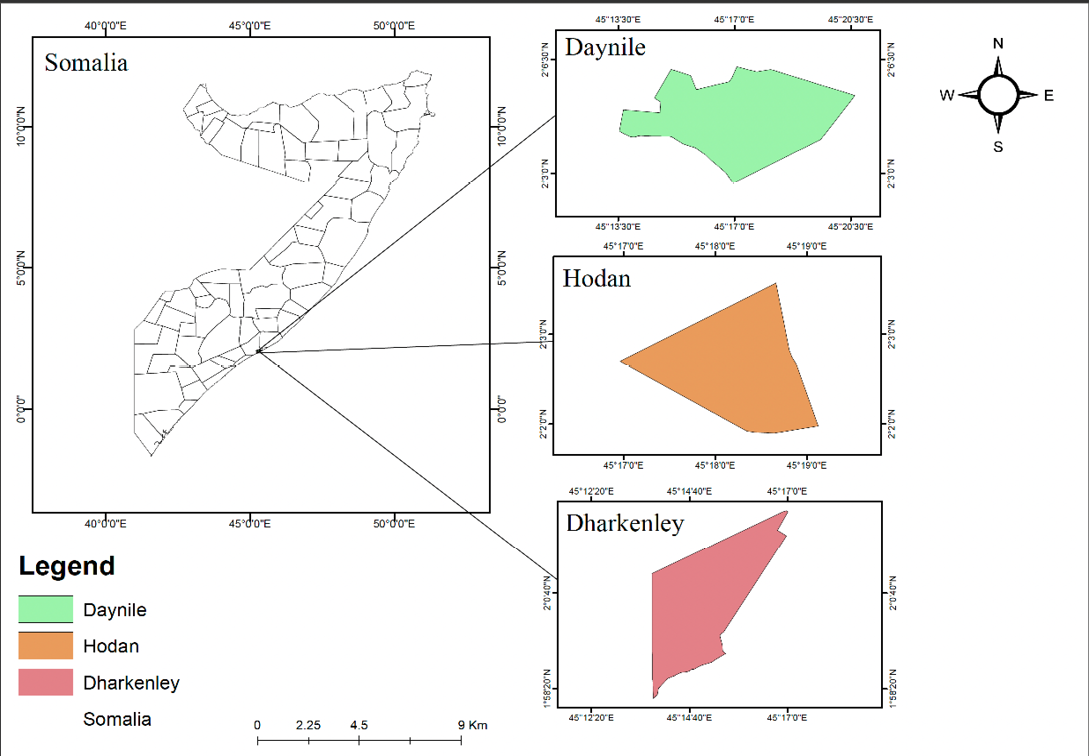
Study site map showing Dharkenley, Dayniile, and Hodan districts in Mogadishu, Banadir region, Somalia.
Although minor variations in the distribution of age and sex classes were observed, the study population was considered sufficiently balanced to permit comparative analyses among camel types, age groups, and sexes. Female camels outnumbered males across all camel types. Statistical analyses were subsequently performed to evaluate the effects of camel type, age, and sex on morphometric characteristics.
Morphometric measurements
Morphometric measurements were obtained using a flexible measuring tape following the standardized procedures described by Çağlı (2019). All measurements were recorded in centimeters (cm) while animals were standing naturally on a flat surface. Eight morphometric traits were assessed: withers height, back height, rump height, body length, chest height, abdominal height, shoulder width, and seat width. Withers height was defined as the vertical distance from the highest point of the withers to the ground; back height as the distance from the spinous process of the last thoracic vertebra to the ground; rump height as the distance from the highest point of the sacral region to the ground; body length as the distance between the caput humeri and the tuber ischiadicum; chest height as the distance from the ground to the lowest point of the chest; abdominal height as the distance from the ground to the lowest point of the abdomen; shoulder width as the distance between the humeral bones; and seat width as the distance between the femoral bones.
Measurement procedure and quality control
To ensure measurement accuracy and consistency, all morphometric assessments were conducted by the same trained measurement team following a standardized protocol. Measurements were performed by three individuals, with one person responsible for restraining the animal while the remaining two recorded the measurements. Each measurement was verified through repeated observations to minimize observer error and improve data reliability. Additional handling precautions were implemented when measuring more active animals, particularly females. In cases where animals exhibited behavioral responses such as kicking or biting, assistance from caretakers was sought, and appropriate animal-handling procedures were applied to ensure the safety of both the animals and the research team. The duration of each measurement session ranged from approximately 5 to 10 minutes, depending on animal temperament and handling requirements.
Statistical analysis
All data were screened for completeness, entry errors, and outliers before analysis. Descriptive statistics, including means, standard deviations (SD), and ranges, were calculated for each morphometric trait according to camel type and sex. The assumptions of normality and homogeneity of variances were evaluated using the Shapiro–Wilk and Levene’s tests, respectively.
Differences in body measurements among camel types within each sex category were assessed using one-way analysis of variance (ANOVA). When significant differences were detected (P < 0.05), Tukey’s honestly significant difference (HSD) test was applied for multiple pairwise comparisons of means. Pearson’s correlation coefficients (r) were calculated to determine the strength and direction of linear relationships among morphometric traits within camel type and sex groups.
The results are presented as means ± SD, and statistical significance was declared at P < 0.05. Summary statistics, comparative analyses, and correlation matrices are presented in Tables 1–7. All statistical analyses were performed using IBM SPSS Statistics version 26.0.
RESULTS
Body measurements of female camels by type
As presented in Table 2, significant differences among female Somali dromedary camel types were observed for withers height, rump height, body length, and shoulder width (P < 0.05). In contrast, back height, chest height, abdominal height, and seat width did not differ significantly among the camel types (P > 0.05).
Female Siif Dacar camels exhibited significantly greater withers height than Hoor camels (P < 0.05). Similarly, rump height was significantly higher in Siif Dacar females compared with both Hoor and Eyddimo females (P < 0.01). These findings indicate that Siif Dacar camels possess a relatively taller body conformation than the other camel types evaluated.
Body length also differed significantly among the camel types, with Siif Dacar females showing greater body length than Hoor females (P < 0.01). In addition, shoulder width was significantly greater in Siif Dacar camels than in both Hoor and Eyddimo camels (P < 0.01), suggesting differences in skeletal development and body conformation among the studied camel populations.
Overall, the results demonstrate that female Siif Dacar camels are characterized by greater stature and body dimensions compared with Hoor and Eyddimo camels. The observed variations in morphometric traits may reflect genetic differences, adaptation to local production environments, and management practices among the camel types. In addition, Table 3 presents the morphometric measurements of male individuals from the different Somali dromedary camel types.
Table 2: Body measurements (cm) of female camels by type (mean ± SE).
| Measurement | SiifDacar (n=49) | Hoor (n=57) | Eyddimo (n=40) | Total (n=146) | p-value | Post-hoc differences |
| Wither height | 195.81 ± 3.08a | 185.80 ± 2.86b | 188.52 ± 3.41 | 189.90 ± 1.72 | < 0.05 | a > b |
| Back height | 229.87 ± 7.56 | 214.47 ± 7.00 | 207.78 ± 8.36 | 217.81 ± 5.70 | 0.273* | ns |
| Rump height | 182.49 ± 2.54a | 177.63 ± 2.36b | 177.43 ± 2.82c | 179.21 ± 0.76 | < 0.01 | a > b, c |
| Body length | 154.06 ± 1.15a | 148.74 ± 1.06b | 149.27 ± 1.27 | 150.67 ± 0.70 | < 0.01 | a > b |
| Chest height | 132.39 ± 3.56 | 141.11 ± 3.28 | 141.13 ± 3.94 | 138.18 ± 2.64 | 0.140 | ns |
| Abdominal height | 122.57 ± 8.32 | 146.75 ± 7.71 | 132.98 ± 9.20 | 134.86 ± 6.27 | 0.156 | ns |
| Shoulder width | 33.94 ± 0.40a | 31.95 ± 0.38b | 31.73 ± 0.45c | 32.55 ± 0.27 | < 0.01 | a > b, c |
| Seat width | 24.94 ± 0.35 | 24.05 ± 0.32 | 24.45 ± 0.38 | 24.44 ± 0.20 | 0.225 | ns |
Note: Values are presented as mean ± standard deviation (SD). Different superscript letters (a, b, c) within the same row indicate significant differences among camel types according to Tukey’s post-hoc test (P < 0.05). Means sharing at least one common superscript letter are not significantly different (P > 0.05). “ns” indicates no significant difference among camel types (P > 0.05). *The absence of a significant difference in back height despite apparent numerical differences among camel types may be attributed to the relatively large within-group variation observed for this trait.
Table 3: Body measurements (cm) of male camels by type (mean ± SE).
| Measurement | SiifDacar (n=33) | Hoor (n=38) | Eyddimo (n=31) | Total (n=102) | p-value | Post-hoc differences |
| Wither height | 224.06 ± 3.75 | 223.26 ± 3.59 | 220.80 ± 3.87 | 222.77 ± 2.27 | 0.784 | ns |
| Back height | 226.67 ± 9.21 | 228.34 ± 8.58 | 228.77 ± 9.49 | 227.93 ± 1.58 | 0.962 | ns |
| Rump height | 210.15 ± 3.09 | 210.76 ± 2.88 | 202.09 ± 3.19 | 207.93 ± 2.54 | 0.093 | ns |
| Body length | 148.60 ± 1.39 | 148.21 ± 1.30 | 148.83 ± 1.44 | 148.52 ± 0.78 | 0.978 | ns |
| Chest height | 122.90 ± 4.33 | 121.78 ± 4.03 | 124.45 ± 4.47 | 122.96 ± 0.73 | 0.896 | ns |
| Abdominal height | 130.30 ± 10.13 | 128.55 ± 9.44 | 128.25 ± 10.45 | 129.02 ± 0.56 | 0.983 | ns |
| Shoulder width | 35.90 ± 0.49 | 37.02 ± 0.46 | 35.80 ± 0.51 | 36.29 ± 0.25 | 0.126 | ns |
| Seat width | 29.45 ± 0.42a | 28.52 ± 0.39 | 27.96 ± 0.44c | 28.65 ± 0.24 | < 0.05 | a > c |
Note: Values are expressed as mean ± standard deviation (SD). Different superscript letters (a, c) within the same row indicate significant differences between camel types according to Tukey’s post-hoc test (P < 0.05). Means without superscripts or sharing the same superscript letter are not significantly different (P > 0.05). ns = not significant.
Body measurements of male camels by type
Although seat width differed significantly between Siif Dacar and Eyddimo camels, the magnitude of the difference was relatively small (~1.5 cm) and should therefore be interpreted with caution when considering its biological or breeding relevance.
The analyses revealed no significant differences among the studied camel types for withers height, back height, rump height, body length, chest height, abdominal height, or shoulder width (P > 0.05). However, seat width differed significantly among camel types (P < 0.05), with male Siif Dacar camels exhibiting greater values than male Eyddimo camels.
These findings suggest that the overall body conformation of male Somali dromedary camels is generally comparable across the evaluated camel types. Nevertheless, the observed variation in seat width indicates differences in pelvic morphology among the populations. Since seat width is an important morphometric trait associated with skeletal development and body conformation, the greater values observed in Siif Dacar camels may reflect inherent phenotypic differences between the camel types. Further studies incorporating productive, reproductive, and genetic parameters are required to determine the biological significance of these morphological variations.
Age-stratified analyses
Tables 4–6 present the morphometric characteristics stratified by age group and sex within each Somali camel type. These subgroup analyses should be interpreted with caution because some age–sex categories contained relatively small sample sizes (minimum n = 7), which may have reduced the statistical power to detect significant differences. Back height, body length, and abdominal height were excluded from Tables 4–6 because no significant effects of camel type, sex, or their interaction were observed across any age group (P> 0.05). For consistency with standard statistical reporting, all previously reported P-values of 0.000 have been corrected to P < 0.001.
Among camels aged 6–9 years, no significant differences in morphometric measurements were observed among the three camel types (P > 0.05). However, sex had a significant effect on several morphometric traits. Male camels exhibited significantly greater withers height, rump height, and shoulder width than females (P < 0.001), whereas females had significantly greater chest height than males (P= 0.029). No significant camel type × sex interactions were detected for any of the measured traits. Although relatively large standard errors were observed in certain subgroups, particularly among Hoor females, these values reflect considerable within-group variability rather than systematic measurement error. Consequently, findings from these subgroups should be interpreted with appropriate caution.
Among camels aged 10–13 years, shoulder width was the only morphometric trait that differed significantly among camel types (P = 0.013). A significant camel type × sex interaction was also observed for shoulder width (P = 0.003), indicating that the effect of sex on this trait varied among the camel types. Specifically, male Hoor camels exhibited substantially greater shoulder width than female Hoor camels, whereas the sex-related differences were less pronounced in the Siif Dacar and Eyddimo camel types. Female camels had significantly greater chest height than males (P = 0.006). In addition, sex had a significant effect on the remaining morphometric traits, with males generally exhibiting larger body dimensions than females (P < 0.001).
Among camels aged 14 years and above, seat width differed significantly among camel types (P= 0.025). Sex had a significant effect on all morphometric traits evaluated (P ≤ 0.003). In addition, a significant camel type × sex interaction was observed for shoulder width (P = 0.043), indicating that the influence of sex on shoulder width varied among the camel types. Across all camel types, females consistently exhibited greater chest height than males. However, because reproductive status (e.g., pregnancy or lactation) was not recorded, the biological basis of this sex-related difference cannot be fully explained and should therefore be interpreted with caution. Further studies incorporating reproductive and physiological data are warranted to clarify the factors contributing to these observed differences.
Table 4: Morphometric characteristics of 6–9-year-old camels by sex and type (exploratory; mean ± SE).
| Camel type | Sex | N | Wither height | Rump height | Chest height | Shoulder width | Seat width |
| SiifDacar | Female | 19 | 191.89 ± 7.35 | 183.05 ± 17.90 | 133.26 ± 34.51 | 33.47 ± 3.58 | 24.57 ± 2.34 |
| Male | 7 | 220.71 ± 14.97 | 205.14 ± 22.92 | 120.71 ± 3.72 | 34.71 ± 2.42 | 28.85 ± 2.19 | |
| Hoor | Female | 26 | 181.87 ± 37.34* | 178.26 ± 7.13 | 139.92 ± 40.91* | 33.46 ± 2.91 | 24.73 ± 2.37 |
| Male | 12 | 221.91 ± 22.95 | 208.66 ± 21.49 | 121.41 ± 4.20 | 37.50 ± 4.03 | 27.91 ± 2.99 | |
| Eyddimo | Female | 19 | 186.52 ± 7.06 | 177.47 ± 5.97 | 140.84 ± 31.21 | 31.89 ± 2.88 | 25.05 ± 2.81 |
| Male | 7 | 220.14 ± 29.26 | 197.57 ± 10.01 | 122.42 ± 3.73 | 36.28 ± 2.28 | 27.42 ± 2.50 | |
| Type | p | 0.810 | 0.240 | 0.877 | 0.178 | 0.809 | |
| Sex | p | < 0.001 | < 0.001 | 0.029 | < 0.001 | < 0.001 | |
| Type × Sex | p | 0.703 | 0.362 | 0.935 | 0.206 | 0.492 |
Note: Values are presented as mean ± standard error (SE). Statistical significance was set at P < 0.05. All P-values previously reported as 0.000 are presented as P < 0.001, in accordance with standard statistical reporting practices. Relatively large SE values observed in some subgroups reflect substantial within-group variability and should therefore be interpreted with caution.
Table 5: Morphometric characteristics of 10–13-year-old camels by sex and type (exploratory; mean ± SE).
| Camel type | Sex | n | Wither height | Rump height | Chest height | Shoulder width | Seat width |
| SiifDacar | Female | 10 | 191.20 ± 6.05 | 181.10 ± 5.74 | 129.70 ± 29.07 | 34.70 ± 3.26 | 25.40 ± 2.59 |
| Male | 17 | 223.41 ± 21.42 | 210.76 ± 29.36 | 123.41 ± 6.28 | 36.00 ± 1.58 | 29.00 ± 2.95 | |
| Hoor | Female | 16 | 191.12 ± 16.88 | 178.43 ± 6.52 | 135.75 ± 29.92 | 30.50 ± 3.24 | 23.50 ± 1.26 |
| Male | 14 | 228.42 ± 25.22 | 214.50 ± 22.46 | 121.57 ± 5.31 | 36.64 ± 2.06 | 28.50 ± 1.74 | |
| Eyddimo | Female | 9 | 187.44 ± 3.84 | 175.88 ± 6.15 | 143.66 ± 26.47 | 30.77 ± 2.58 | 23.66 ± 1.50 |
| Male | 16 | 220.00 ± 30.15 | 201.06 ± 26.29 | 125.00 ± 15.20 | 35.75 ± 2.81 | 27.87 ± 2.91 | |
| Type | p | 0.589 | 0.318 | 0.392 | 0.013 | 0.071 | |
| Sex | p | < 0.001 | < 0.001 | 0.006 | < 0.001 | < 0.001 | |
| Type × Sex | p | 0.882 | 0.625 | 0.560 | 0.003 | 0.536 |
Note: Values are presented as mean ± standard error (SE). Statistical significance was set at P <0.05. All P-values previously reported as 0.000 are presented as P <0.001, in accordance with standard statistical reporting practices.
Table 6: Morphometric characteristics of camels aged ≥14 years by sex and type (exploratory; mean ± SE).
| Camel type | Sex | n | Wither height | Rump height | Chest height | Shoulder width | Seat width |
| SiifDacar | Female | 20 | 201.85 ± 24.96 | 182.65 ± 8.48 | 132.90 ± 27.42 | 34.00 ± 3.04 | 25.05 ± 3.23 |
| Male | 9 | 227.88 ± 24.32 | 212.88 ± 29.80 | 123.66 ± 3.04 | 36.66 ± 2.17 | 30.77 ± 1.64 | |
| Hoor | Female | 15 | 186.93 ± 4.28 | 175.66 ± 5.71 | 148.86 ± 31.28 | 30.86 ± 2.58 | 23.46 ± 2.29 |
| Male | 12 | 218.58 ± 11.80 | 208.50 ± 31.88 | 122.41 ± 4.71 | 37.00 ± 2.17 | 29.16 ± 1.52 | |
| Eyddimo | Female | 12 | 192.50 ± 18.63 | 178.50 ± 7.99 | 139.66 ± 26.16 | 32.16 ± 2.58 | 23.91 ± 1.92 |
| Male | 8 | 223.00 ± 24.10 | 208.12 ± 29.82 | 125.12 ± 3.90 | 35.50 ± 1.92 | 28.62 ± 1.68 | |
| Type | p | 0.087 | 0.563 | 0.510 | 0.085 | 0.025 | |
| Sex | p | < 0.001 | < 0.001 | 0.003 | < 0.001 | < 0.001 | |
| Type × Sex | p | 0.864 | 0.956 | 0.383 | 0.043 | 0.724 |
Note: Values are presented as mean ± standard error (SE). Statistical significance was set at P <0.05. All P-values previously reported as 0.000 are reported as P <0.001 in accordance with standard statistical reporting practices. Relatively large SE values observed in some subgroups reflect substantial within-group variability and should be interpreted with caution.
Table 7: Pearson correlation matrix for body measurements (n = 248; df = 246).
| Measurement | (1) | (2) | (3) | (4) | (5) | (6) | (7) | (8) | |
| (1) wither height | r | — | |||||||
| (2) back height | r | 0.051 ns | — | ||||||
| (3) rump height | r | 0.449** | 0.068 ns | — | |||||
| (4) body length | r | 0.085 ns | −0.070 ns | 0.200** | — | ||||
| (5) chest height | r | −0.224** | 0.119 ns | −0.204** | −0.015 ns | — | |||
| (6) abdominal height | r | −0.087 ns | −0.081 ns | −0.073 ns | 0.022 ns | −0.068 ns | — | ||
| (7) shoulder width | r | 0.421** | 0.093 ns | 0.383** | 0.071 ns | −0.141 ns† | −0.098 ns | — | |
| (8) seat width | r | 0.500** | 0.040 ns | 0.528** | 0.015 ns | −0.175** | −0.117 ns | 0.569** | — |
Note: ** indicates significance after Bonferroni correction (adjusted α = 0.0018); † indicates significance at the unadjusted significance level (P <0.05) but not after Bonferroni correction. ns = not significant (P> 0.05). Correlation strength was interpreted according to Evans (1996).
Correlations between body measurements
Table 7 presents the Pearson correlation coefficients among the eight morphometric traits measured in the Somali dromedary camels.
Withers height showed significant positive correlations with rump height (r = 0.449), shoulder width (r = 0.421), and seat width (r = 0.500), indicating that taller camels generally exhibited broader body dimensions. Rump height was positively correlated with seat width (r = 0.528), body length (r = 0.200), and shoulder width (r = 0.383). A strong positive correlation was also observed between shoulder width and seat width (r = 0.569). In contrast, chest height exhibited weak but significant negative correlations with withers height (r = −0.224) and rump height (r = −0.204). These findings suggest that while most morphometric traits increase proportionally with overall body size, chest height follows a different pattern of association. Further studies are warranted to investigate the biological factors underlying these relationships. Therefore, Pearson’s correlation analysis revealed several significant associations among the morphometric traits of Somali dromedary camels. Withers height was positively correlated with rump height (r = 0.449, P < 0.001), shoulder width (r = 0.421, P < 0.001), and seat width (r = 0.500, P < 0.001), indicating that taller camels generally possessed broader body dimensions. Rump height also showed positive correlations with body length (r = 0.200, P = 0.002), shoulder width (r = 0.383, P < 0.001), and seat width (r = 0.528, P < 0.001). Furthermore, shoulder width was positively correlated with seat width (r = 0.569, P < 0.001), suggesting coordinated development of these skeletal traits.
In contrast, chest height exhibited weak but significant negative correlations with withers height (r = −0.224, P < 0.001), rump height (r= −0.204, P = 0.001), shoulder width (r = −0.141, P= 0.026), and seat width (r= −0.175, P= 0.006). These results indicate that chest height varied inversely with several measures of overall body size and width.
Overall, the correlation analysis demonstrated that most morphometric traits were positively associated, reflecting coordinated growth and body development in Somali dromedary camels. The strongest relationships were observed among withers height, rump height, shoulder width, and seat width, whereas chest height showed relatively weak inverse associations with several structural traits. These findings provide useful information on the morphometric relationships among body measurements and may contribute to future studies on phenotypic characterization, selection, and conservation of Somali camel genetic resources.
DISCUSSION
This study measured and statistically evaluated eight body measurements and their interrelationships among three locally recognised types of Somali dromedary camels SiifDacar, Hoor, and Eyddimo raised on farms in the Dharkenley, Dayniile, and Hodan districts of Mogadishu, Somalia. A total of 248 camels comprising 102 males and 146 females were subjected to morphometric assessment. The results revealed biologically meaningful and statistically significant differences between types, primarily in female camels, and confirmed that sex is a major determinant of body dimensions across all age groups. The findings contribute important baseline data on Somali dromedary camel morphology to a field where published information remains limited.
Among female camels, significant differences were found between types for withers height, rump height, body length, and shoulder width (p < 0.05), consistent. SiifDacar females exhibited significantly greater withers height and rump height than Hoor females, and significantly greater body length and shoulder width than both Hoor and Eyddimo females. While no significant difference in body length was found between Hoor and Eyddimo, SiifDacar camels displayed a longer and taller body structure than both types. Similarly, shoulder width did not differ between Hoor and Eyddimo, but SiifDacar females had notably broader shoulders. Overall, SiifDacar females showed larger body dimensions across most measured traits. The taller stature and longer body of SiifDacar females are consistent with morphological characteristics classically associated with dairy-type conformation in ruminants, though this interpretation requires validation through concurrent milk production data, which were not collected in the present study. In contrast, the broader shoulder structure observed in Hoor camels may indicate a body conformation more suited to meat production, a finding consistent with that reported by Ishag et al. (2011) in Sudanese dromedary camels.
In male camels, a statistically significant difference among types was observed only for seat width (p < 0.05). SiifDacar males exhibited the broadest rump structure, while Eyddimo males had the narrowest, with Hoor males falling in between. Although the general body structure of males appeared relatively similar across types for most other measurements, the variation in seat width is noteworthy. Given that seat width is anatomically associated with fattening performance and skeletal muscle development, SiifDacar camels may hold a morphological advantage relevant to meat production selection . However, the modest absolute magnitude of the difference (~1.5 cm) warrants cautious interpretation in terms of practical breeding significance, and future studies with larger male subgroup samples are recommended to confirm this finding.
In the age-stratified analyses, no significant differences among camel types were identified in the 6–9-year age group for any of the measured parameters, including withers height, rump height, chest height, shoulder width, or seat width. Sex, rather than type, emerged as the primary determinant of body size in this age group: males had significantly greater withers height, rump height, and shoulder width, while females displayed significantly greater chest height (p= 0.029). The consistently greater chest height in females across all age groups is biologically plausible, as this measurement reflects the distance from the sternum to the ground and may be influenced by the proportionally more slender leg conformation of females, as well as the effects of pregnancy and lactation on abdominal and thoracic positioning. The absence of reproductive status data in the present study limits further interpretation of this finding, and future studies are recommended to record reproductive status at the time of measurement.
In the 10–13-year age group, sex-related differences remained prominent across all measurements, with males exhibiting generally larger body dimensions than females . However, shoulder width varied significantly by both type (p = 0.013) and exhibited a significant type × sex interaction (p = 0.003). This interaction indicates that the magnitude of the sex difference in shoulder width is not uniform across types: Hoor males showed substantially broader shoulders than Hoor females, whereas this male-female difference was less pronounced in the SiifDacar and Eyddimo types. For selection purposes, this finding suggests that shoulder width should be interpreted as a type-specific trait, and breed improvement programmes targeting musculature development should account for this interaction. Females also had significantly greater chest height than males in this age group (p= 0.006), consistent with the pattern observed in younger animals.
Among camels aged 14 years and above, parameters including withers height, back height, rump height, and chest height were predominantly influenced by sex, with male camels consistently exhibiting more robust skeletal structures . A statistically significant difference between types was identified for seat width (p = 0.025), and a significant type × sex interaction was also found for shoulder width (p = 0.043) in this age group. The persistence of type-specific variation in seat width across age groups suggests that this trait may reflect underlying type-specific genetic variation that becomes more evident as animals mature. Identifying and documenting such structural distinctions is directly relevant to the development of evidence-based breeding strategies and the refinement of genetic selection programmes in Somali camel populations .
This study also systematically examined the correlations among all eight body measurements in both male and female camels. Significant positive correlations were found between withers height and rump height (r = 0.449, p < 0.001), withers height and shoulder width (r = 0.421, p < 0.001), and withers height and seat width (r = 0.500, p < 0.001), indicating that taller animals tend to have broader rump and shoulder structures. Rump height was positively correlated with seat width (r = 0.528, p < 0.001) and moderately with body length (r = 0.200, p = 0.002) and shoulder width (r = 0.383, p < 0.001). A strong positive correlation was found between shoulder width and seat width (r = 0.569, p < 0.001). Negative correlations were identified between chest height and withers height (r = −0.224, p < 0.001) and between chest height and rump height (r = −0.204, p < 0.001), a biologically plausible finding consistent with the inverse relationship between leg length below the chest and overall body height observed in camelid species. These correlation patterns are in agreement with those reported by Li et al. (2017) and are consistent with findings in other dromedary populations. A Bonferroni correction was applied for the 28 pairwise comparisons (adjusted α = 0.0018); correlations surviving this correction are the most robust and are indicated as such in Table 7.
The mean body measurements recorded in the present study withers height 189.90 cm, back height 217.81 cm, rump height 179.21 cm, body length 150.67 cm, chest height 138.18 cm, abdominal height 134.86 cm, shoulder width 32.55 cm, and seat width 24.44 cm provide a useful reference for comparative analysis. Cross-study comparisons must be made with caution, however, as differences in measurement techniques, anatomical landmark definitions, age and sex composition, and management and nutritional conditions may affect reported values. When compared with camels studied in Türkiye by Li et al. (2017) and Çağlı (2019), the Mogadishu camels displayed higher withers and rump height but narrower shoulder widths. Yılmaz et al. (2013) and Meghelli et al. (2020) reported a withers height of 161.70 cm in Turkish wrestling camels, a value considerably lower than that recorded in the present study. Ishag et al. (2011) reported a mean withers height of 189.42 cm among female camels in Sudan, which aligns closely with the values recorded for Mogadishu females (189.90 cm), lending confidence to the cross-study comparison for this trait. Camels from Pakistan and Afghanistan studied by Muigai et al. (2016) and Mushtaq et al. (2025) showed withers heights of approximately 164 cm and rump heights of 139 cm, both substantially lower than those observed in the present study. The relatively taller stature of Mogadishu camels may reflect both genetic and environmental factors, including selective breeding practices, feed availability, and the management conditions of peri-urban farm settings, though this requires further investigation ; ; .
The correlation patterns observed in the present study are consistent with those reported in the literature. Raziq et al. (2011) and Çağlı (2019) reported strong positive correlations between withers height and rump height in both male and female dromedary camels. High positive correlations between body length, back height, shoulder width, and seat width have also been documented in Turkish dromedary populations ; . The alignment of the current findings with this body of literature supports the validity and reliability of the morphometric data collected in this study. In this context, the systematic determination of morphometric characteristics among different Somali camel types provides a valuable scientific foundation for the development of breed improvement programmes, the establishment of breed registries, and the refinement of genetic selection strategies for dromedary camel populations in Somalia and the broader Horn of Africa region.
Several limitations of this study should be acknowledged. The absence of genetic data means that the observed morphometric differences between types cannot be attributed definitively to genetic divergence rather than environmental, nutritional, or management differences. Inter-observer measurement reliability was not formally assessed, and reproductive status was not recorded, limiting the interpretation of sex-specific findings. Some age-sex-type subgroups had small sample sizes, and no a priori power analysis was performed; age-stratified analyses should therefore be regarded as exploratory. Furthermore, the camels sampled in Mogadishu farm settings may not fully represent the traditional regional populations of SiifDacar, Hoor, and Eyddimo, as some animals may have been relocated from their regions of origin. These limitations should be addressed in future studies through larger, geographically broader sampling designs, inclusion of genomic data, and systematic recording of reproductive and nutritional status.
CONCLUSION
This study characterised the morphometric variation among three locally named Somali dromedary camel types SiifDacar, Hoor, and Eyddimo raised on farms in selected districts of Mogadishu, Somalia, across different age and sex groups. The findings demonstrate clear phenotypic differences in body size and conformation among the three types. Female SiifDacar camels generally possessed larger body measurements, including greater withers height, rump height, body length, and shoulder width, whereas Hoor and Eyddimo females had comparatively smaller body structures. Male camels consistently displayed more robust physiques than females across all age groups, with seat width being the only measurement that differed significantly between male types. Significant type × sex interactions were identified for shoulder width in the 10–13-year and ≥14-year age groups, indicating that this trait is influenced by both type and sex in a non-additive manner. Correlation analysis revealed strong positive associations among withers height, rump height, shoulder width, and seat width, and a biologically plausible negative relationship between chest height and overall body height. These findings document meaningful morphometric variation among locally recognised camel types in the Benadir Region and provide important baseline data for Somali dromedary camel research.
The data generated by this study contribute quantitative baseline information on body measurements and morphological conformation of dromedary camels in Somalia, helping to address an important gap in the published literature on camel populations in the Horn of Africa. It must be emphasised, however, that the observed differences among types cannot be attributed definitively to genetic divergence. Because animals were assessed under their routine management and environmental conditions, and neither pedigree records nor genomic data were collected, the present study cannot distinguish whether the documented morphometric variation is attributable to genetic factors, environmental and nutritional influences, or their interaction. Morphometric differences alone are insufficient to confirm the existence of genetically distinct breeds, and this limitation is explicitly acknowledged throughout this paper. The findings should therefore be interpreted as describing phenotypic variation among locally recognised types rather than as evidence of formal breed differentiation.
Despite this constraint, the morphometric patterns identified here provide a valuable foundation for hypothesis generation and future research design. To advance understanding of camel diversity and production potential in Somalia, studies that integrate body measurements with milk and meat productivity records, reproductive performance data, and whole-genome genomic analyses are strongly recommended. Controlled comparisons of animals from their traditional regional habitats rather than only from peri-urban farm settings are also needed to disentangle genetic from environmental contributions to the observed variation. Clarifying the genetic basis of morphometric variation in Somali camels, quantifying genotype-by-environment interactions, and establishing minimum sample sizes of at least 30 animals per sex-type-age subgroup will be essential priorities for future investigations. Such integrative, multidisciplinary research will provide the scientific foundation necessary for designing evidence-based breeding objectives, objectively evaluating the production potential of SiifDacar, Hoor, and Eyddimo types, and developing sustainable, data-driven selection and conservation programmes for dromedary camel populations in Somalia and other camel-keeping nations across the Horn of Africa and beyond.
ACKNOWLEDGEMENTS
The authors would like to express their sincere gratitude to Selçuk University for providing a supportive academic environment and the resources necessary to conduct this research. We also extend our appreciation to the Department of Animal Production and Development at the Ministry of Livestock, Forestry and Range, Somalia, for facilitating access to study sites and animals in Mogadishu, and to all local livestock owners and field assistants whose cooperation and support were essential to the success of the data collection process.
Special thanks are owed to Prof. Dr. Alper Yılmaz for his invaluable supervision, methodological guidance, and constructive critical input throughout the course of this study. We also gratefully acknowledge that the data presented in this article were originally collected as part of an MSc thesis submitted to Selçuk University.
AUTHOR’s CONTRIBUTION
HHA: Conceptualisation, data curation, formal analysis, investigation, methodology, writing original draft. AY: Conceptualisation, funding acquisition, methodology, project administration, supervision, writing review and editing. AB: Formal analysis, data interpretation, writing review and editing. FFJA: Methodology, data interpretation, writing review and editing. MAM: Investigation, data curation, fieldwork facilitation. All authors have read and approved the final version of the manuscript for submission.
Funding
The authors declare that no specific funding was received for this study. The research was conducted as part of an MSc programme at Selçuk University, and no external financial support was provided.
Ethics statement
This study was conducted in full accordance with accepted institutional and international standards for the ethical treatment, care, and use of animals in research. All procedures involving animals were reviewed and approved by the Selçuk University Animal Experiments Ethics Committee (Approval No. SÜVDAMEK2021/77). In addition, permission to conduct fieldwork and collect data from camel farms in Mogadishu was obtained from the Ministry of Livestock, Forestry, and Range, Somalia, prior to commencement of the study. Verbal informed consent was obtained from all camel owners before their animals were included in the study. This approach to consent was approved by the ethics committee as appropriate given the field context in Somalia.
Data availability
The datasets generated and/or analysed during the current study are not publicly available due to institutional data governance requirements but are available from the corresponding author upon reasonable request.
Publisher’s note
All claims expressed in this article are solely those of the authors and do not necessarily represent those of their affiliated institutions, or those of the publisher, the editors, and the reviewers. Any product that may be evaluated in this article, or claim that may be made by its manufacturer, is not guaranteed or endorsed by the publisher.
Generative AI and AI assisted technology statement
The authors declare that no Generative AI was used in the creation of this manuscript. Any alternative text (alt text) provided alongside figures in this article has been generated by Frontiers with the support of artificial intelligence, and reasonable efforts have been made to ensure accuracy, including review by the authors wherever possible. If you identify any issues, please contact us.
Statement of conflict of interest
The authors have declared no conflict of interest.
References
- Abdulraheem AO, Waziri OB, Mohammed A, Kolo UM, Raji AO, Aliyu J (2024). Phenotypic and biochemical diversity of Nigerian dromedary camels in Maiduguri, Borno state, Nigeria. ASRIC J. Agric. Sci., 5(1): 20-28.
- Al-Asmari A, Mir R (2026). Evaluation of genetic studies on camels in Saudi Arabia: Traits, tools, and applications. Trop. Anim. Health Prod., 58(2): 110. https://doi.org/10.1007/s11250-026-04902-4 [CrossRef]
- Alhajeri BH, Alaqeely R, Alhaddad H (2019). Classifying camel breeds using geometric morphometrics: A case study in Kuwait. Livest. Sci., 230: 103824. https://doi.org/10.1016/j.livsci.2019.103824 [CrossRef]
- Alhajeri BH, Alhaddad H, Alaqeely R, Alaskar H, Dashti Z, Maraqa T (2021). Camel breed morphometrics: Current methods and possibilities. Trans. R. Soc. S. Austral., 145(1): 90-111. https://doi.org/10.1080/03721426.2021.1889347 [CrossRef]
- Barre A (2023). Prevalence of hemorrhagic septicemia in dromedary camel (Camelus dromedarius) of some selected farms at Benadir region, Somalia. J. Istanbul Vet. Sci., 7(1): 8-14. https://doi.org/10.30704/http-www-jivs-net.1199746 [CrossRef]
- Barre A, Abdullah FF, Mohamed SA, Hashi HA, Balakrishnan KN, Nageye HI (2025). Gross and Histopathological Lesions Associated with Platyhelminth Infections in Camels (Camelus dromedarius) at a somali meat processing facility. Insights Anim. Sci., 2(1): 52-58. https://doi.org/10.69917/ias.02.01-05 [CrossRef]
- Barre A, Karanja DN, Bebora LC, Gitao CG (2023). Comparative prevalence and pathological changes on camel brucelosis at the selected slaughterhouses in Garissa County, Kenya. Vet. Sci. Res. Rev., 9(1): 1-17. https://doi.org/10.17582/journal.vsrr/2023/9.1.1.17 [CrossRef]
- Çağlı A (2019). Develerin üç boyutlu modelleme yöntemiyle bazı vücut ölçülerinin belirlenmesi. Master’s thesis, Aydın Adnan Menderes Üniversitesi Fen Bilimleri Enstitüsü.1(1) 88-95.
- Eisa MO (2011). Phenotypic characteristics of Sudanese camels (Camelus dromedarius). Livest. Res. Rural Dev.,
- Fadlelmoula AA, Mudarris MS, Hariri MS (2015). Phenotypic classification based on body measurements and body features of some Saudi camel types (Camelus dromedarius). J. Camel Pract. Res., 22(2): 265-270. https://doi.org/10.5958/2277-8934.2015.00044.2 [CrossRef]
- Fares MA (2025). Three-dimensional morphological variation and sexual dimorphism in the humerus of dromedary camels (Camelus dromedarius) from El-Oued region: A geometric morphometric analysis. Ankara Üniv. Vet. Fakültesi Dergisi, 72(3): 287-296. https://doi.org/10.33988/auvfd.1610019 [CrossRef]
- Ishag IA, Eisa MO, Ahmed MKA (2011). Phenotypic characteristics of Sudanese camels (Camelus dromedarius). Livest. Res. Rural Dev., 23(24): 4.
- Jafar S (2018). Characterization and bioactive properties of camel whey protein hydrolysate generated with gastric and pancreatic proteases.
- Kebede K, Bekele B, Tilahun S, Serda B (2022). Application of multivariate principal component factor analysis to morphological characterization of camels in Ethiopia. Turk. J. Agric. Food Sci. Technol., 10(4): 503-507. https://doi.org/10.24925/turjaf.v10i4.503-507.4118 [CrossRef]
- Legesse YW, Dunn CD, Mauldin MR, Ordonez-Garza N, Rowden GR, Gebre YM, Bradley RD (2018). Morphometric and genetic variation in 8 breeds of Ethiopian camels (Camelus dromedarius). J. Anim. Sci., 96(12): 4925-4934. https://doi.org/10.1093/jas/sky351 [CrossRef]
- Leyland T, Lotira R, Abebe D, Bekele G, Catley A (2014). Community-based animal health workers in the horn of Africa an evaluation for the office of foreign disaster assistance. Feinstein International Center, Tufts University Africa Regional Office, Addis Ababa and Vetwork UK, Great Holland, pp. 1-84.
- Li Y, Khalafalla AI, Paden CR, Yusof MF, Eltahir YM, Al Hammadi ZM, Tong S (2017). Identification of diverse viruses in upper respiratory samples in dromedary camels from the United Arab Emirates. PLoS One, 12(9): e0184718. https://doi.org/10.1371/journal.pone.0184718 [CrossRef]
- Meghelli I, Kaouadji Z, Yilmaz O, Cemal I, Karaca O, Gaouar SBS (2020). Morphometric characterization and estimating body weight of two Algerian camel breeds using morphometric measurements. Trop. Anim. Health Prod., 52(5): 2505-2512. https://doi.org/10.1007/s11250-020-02204-x [CrossRef]
- Muigai A, Matete G, Aden HH, Tapio M, Okeyo AM, Marshall K (2016). The indigenous farm genetic resources of Somalia: Preliminary phenotypic and genotypic characterization of cattle, sheep and goats. ILRI (aka ILCA and ILRAD).
- Mushtaq N, Rafiq N, Arra T, Muhammad W (2025). Morphometric and milk yield analysis of camel breeds (Camelus dromedarius) in Quetta, Balochistan, Pakistan. Pak-Euro J. Med. Life Sci., 8(3): 601-608
- Noor IM, Guliye AY, Tariq M, Bebe BO (2013). Assessment of camel and camel milk marketing practices in an emerging peri-urban production system in Isiolo County, Kenya-pastoralism. Res. Policy Pract., 3(1): 28. https://doi.org/10.1186/2041-7136-3-28 [CrossRef]
- Raziq A, Tareen AM, de Verdier K (2011). Characterization and significance of raigi camel, a livestock breed of the pashtoon pastoral people in Afghanistan and Pakistan. J. Livest. Sci., 2: 1–9. https://doi.org/10.1186/2041-7136-1-3 [CrossRef]
- Tandoh G, Gwaza DS, Addass PA (2018). Phenotypic characterization of camels (Camelus dromedarius) in selected herds of Katsina State. J. Appl. Life Sci. Int., 18(3): 1-11. https://doi.org/10.9734/JALSI/2018/37787 [CrossRef]
- Yakubu A, Okpeku M, Shoyombo AJ, Onasanya, GO, Dahloum L, Çelik S, Oladepo A (2022). Exploiting morphobiometric and genomic variability of African indigenous camel populations: A review. Front. Genet., 13: 1021685. https://doi.org/10.3389/fgene.2022.1021685 [CrossRef]
- Yılmaz O, Ertürk YE, Ertuğrul M (2013). Some phenotypical characteristics of camels raised in the provinces of Balikesir and Canakkale of Türkiye. Çanakkale Onsekiz Mart Üniversitesi Ziraat Fakültesi Dergisi, 1: 51-56.
- Yosef T, Kefelegn K, Mohammed YK, Mengistu U, Solomon A, Tadelle D, Han J (2014). Morphological diversities and eco-geographical structuring of Ethiopian camel (Camelus dromedarius) populations. Emirat. J. Food Agric., 26(4): 371-389. https://doi.org/10.9755/ejfa.v26i4.17021 [CrossRef]

Services
Article usage statistics
Loading…
Related articles
- Prevalence and Major Pathogens Associated with Clinical and Subclinical Mastitis in Dairy Camel (Camelus dromedarius) in Benadir Region of SomaliaVeterinary Sciences: Research and Reviews · 2020
- Seroprevalence of Trypanosoma evansi in Dromedary Camels from selected Dairy farms in Benadir, SomaliaAdvances in Animal and Veterinary Sciences · 2020
- Clinical and Histopathological Findings of Brucellosis In Dromedary Camels (Camelus dromedarius) from Selected Slaughterhouse for Postmortem ExaminationsResearch Journal for Veterinary Practitioners · 2025
- Reference Values for Hematological and Serum Biochemical Parameters of Dromedary Camel (Camelus dromedarius) in Sub-Tropical Climate of BangladeshAdvances in Animal and Veterinary Sciences · 2019
- Dromedary Camel (Camelus dromedarius) Cloning Using Somatic Cell Nuclear Transfer (SCNT) Current Knowledge and Future PerspectivesJournal of Animal Health and Production · 2024
- Forced Mating an Efficient Tool in Camel Production to Reduce the Age at Puberty and Calving Interval in Dromedary She-Camel (Camelus dromedarius)Punjab University Journal of Zoology · 2022