
Olive cultivation has been expanding in recent years in the Potohar Plateau due to government-led projects. Harvesting time, however, is another crucial factor that must be optimized for local conditions and significantly influences olive oil production. In this study, eight harvesting dates were tested in three potential sites in Potohar (Chakwal, Kallar Kahar and Talagang) to evaluate the oil production potential of ‘Arbequina’ olives from the dates of mid-September to Late November. This study was a field experiment conducted over 6 years (2017 to 2022) in a Randomized Complete Block Design (RCBD). All experimental units had uniform agronomic practices. The data showed an increasing pattern from the beginning to the middle of the harvests, with the highest oil recovery rate of 11.04% at T7 (15 November). After 15 November, the olive oil yield decreased significantly. Statistical analysis showed significant differences between harvesting dates, years of production, and their interaction, as well as locations (p<0.01). Based on the findings, mid-November is recommended as the best time to harvest for the best oil yield in Pothohar. This fruit collection system could improve production efficiency and economic returns.
Research Article · Volume 39, Issue 4, Pages 72–77, 3 November 2026 · Open Access
Optimizing Fruit Harvest Timing for Maximum Oil Recovery from Arbequina Olives in the Pothohar Region: A Six-Year Multi-Location Study
· · ·
Affiliations & Notes ⌄
- 1Centre of Excellence for Olive Research and Training (CEFORT) at BARI Chakwal, Chakwal 48800, Pakistan
- 2Barani Agricultural Research Institute (BARI), Chakwal 48800, Pakistan
- 3National Agricultural Research Centre, Park Road Islamabad 44000, Pakistan
- 4Millet Research Station, Rawalpindi 46000, Pakistan
- *Correspondence | Shahid Ali; Email: shahidalisaqib@gmail.com
Article Info ⌄
- Journal:
- Pakistan Journal of Agricultural Research
- Submitted Date:
- 13 May 2026
- Accepted Date:
- 7 October 2026
- Published Date:
- 3 November 2026
Abstract
Introduction
Olive oil is consumed internationally and is a major part of the Mediterranean diet. It is globally recognized for its health and economic benefits ; IOOC, 2018). Olive oil is native to Mediterranean countries, where almost 95% of global production is produced, especially in Spain, Italy, and Greece. However, in recent years, its expansion has been seen in non-traditional countries like America, Australia, and South Asia, especially Pakistan ; . In Pakistan, commercial olive cultivation began in the last two decades and is emerging as a strategic agricultural sector. Currently, more than 50,555 acres of land in Pakistan are under olive cultivation, and the Pothohar Plateau contributes more than 32% of the total plantation . This part of the province is the most promising olive-growing area due to having a unique combination of Mediterranean-like climate, suitable topography and Government-led initiatives that have turned virgin lands into valuable economic assets. However, optimal harvest planning remain unexplored, hence limiting the oil yield potential. On the other hand, various developmental projects at Government level, such as “Transformation of Agriculture in Pothohar, Developing Pothohar into an Olive Valley, Establishment of Centre of Excellence for Olive Research & Training (CEFORT) and Promotion of Olive Cultivation at Commercial Scale in Pakistan,” have sensitized the olive expansion, especially with olive cultivars like Arbequina, Koroneiki, BARI Zaitoon-1, Gemlik, and Manzanilla etc. which are suited to arid environment.
Olive fruit harvesting time is the most critical factor which influences both oil quantity and quality. Late harvesting generally improves oil recovery but imposes risk of over-ripeness and oxidative degradation, whereas early harvesting often results in lower oil recovery ; . Given Pothohar’s unique agro-climatic variations as compared with the Mediterranean climate, region-specific studies are important. Previous research studies in analogous climates (e.g. Argentine, Chile) recommended the role of genotype-environment interaction ; , but Pakistani data is limited.
This work aimed to assess the effect of 8 calendar-based harvesting dates on olive oil yield in the three main olive-growing areas of the Pothohar region. By analyzing six years of field trials, the study provides region-specific, research-based information to optimize harvesting time, oil recovery, and processing efficiency in Pakistan’s emerging olive sector. This study assessed calendar-based harvest dates, but since the maturing period may fluctuate from year to year depending on climatic conditions, it is hoped that the practical suggestions from this study will be accepted by growers and processors under local conditions. The harvested dates observed over the years also suggest that a fixed calendar date cannot be used as a universal criterion, and that the suggested harvesting window should be based on annual fruit maturity and weather conditions. We assumed that the amount of olive oil recovered would increase as harvesting was delayed to an optimum period, then decrease with further delay. The results from this study are expected to help local olive growers select the optimum harvest time to maximize oil recovery and contribute to diversifying Pakistan’s agricultural economy.
Materials and Methods
Study area
This study was conducted in the three major olive-growing regions of the Pothohar Plateau: Chakwal, Kallar Kahar, and Talagang. These regions have a semi-arid climate, with average annual rainfall of 290 to 600 mm and temperatures ranging from 5 °C (winter) to 45°C (summer).
Experimental design
The experiment was conducted for six consecutive years (2017–2022) using a randomized complete block design (RCBD). In each region, three olive orchards were selected, and each orchard was divided into three blocks containing trees of uniform age and similar growth and management conditions. All experimental orchards were planted with the same olive cultivar, ‘Arbequina’. The experimental trees were 8 years old at the beginning of the study. The trees were planted at 18x18 feet spacing and maintained under similar agronomic and orchard management practices throughout the experimental period. Orchard management included [drip irrigation, fertilizer application (N.P.K), annual pruning, weed management through hoeing, and plant protection practices against olive psyllid], which were kept as uniform as possible across locations and years.
Harvesting schedule
For this experiment, eight harvest dates were tested at 10-day intervals from September 15 to November 25 (T1 to T8) (Table 1). Harvesting was done annually at all sites. Fruits were considered green at the start of the harvest and gradually turned dark purple as the harvest progressed. Fruit maturity was assessed visually on the basis of fruit skin color.
Sample selection and processing
Five trees were randomly chosen and tagged from each selected block. 10kg of olives were taken from each tree; 1350 kg of olives were collected annually (3 districts × 3 orchards × 3 blocks × 5 trees × 10kg of olives), and after 6 years, 8100 kg of olives were collected.
Fruit was harvested and delivered to the Centre of Excellence for Olive Research & Training (CEFORT) within 24 h for the extraction of oil by cold extraction process in a PIERALISI (Fattoria) mill.
The fruits were harvested and, at CEFORT, initially washed to remove any dust, debris, or impurities. The cleaned fruits were then crushed with the olive pits in a hammer mill to get a homogeneous olive paste. The paste was then malaxed to promote coalescence of small oil droplets into larger ones, aiding oil separation. The malaxed paste was then horizontally centrifuged to remove the oil from the solid pomace and plant water. Oil was finally subjected to vertical centrifugation to obtain the final olive oil and remove residual moisture.
Oil Recovery Calculation
Oil recovery was expressed as:
Oil recovery (L 100 kg-¹) = [Volume of extracted oil (L) / Weight of fresh olives (kg)] × 100
Statistical analysis
For statistical analysis, a three-way ANOVA was performed to evaluate the effects of treatments (harvest date), year and location, including their interactions. Duncan’s Multiple Range Test (DMRT) in SPSS V25 was used to obtain significant results (p < 0.05). The data were presented graphically using a boxplot showing the spread and distribution of oil recovery across treatments and locations.
Results and Discussion
Oil recovery trends across harvest dates
The olive oil recovery data from six years (2017 to 2022) showed that the oil recovery rate consistently increased from mid-September (T1) to mid-November (T7) at all three sites in Pothohar, then decreased on 26th November (T8) at the end of the harvesting period (Figure 1). In terms of oil recovery, Chakwal improved from 8.5% at T1 to 16.2% at T7, and Kallar Kahar from 8.2% at T1 to 15.9% at T7. This was observed in Talagang as well. Delayed harvesting increases oil recovery, mainly due to the progressive accumulation and maturation of oil in the olive mesocarp. The level of extractable oil tends to rise as the fruit develops from green to purple/dark as it ripens. Therefore, the later the harvest date, the higher the amount of extractable oil from the fruit and, thus, the higher the oil recovery. The same trend of an increase in oil content as the fruit matures has been reported for other olive cultivars such as Arbequina ; .
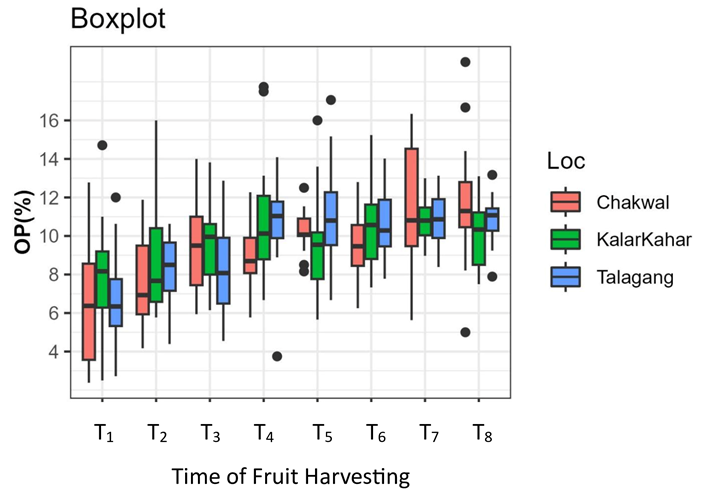
Effect of fruit harvest timing on oil recovery of ‘Arbequina’ olives in the pothohar region.
Table 1: Fruit Harvest-date treatments and locations evaluated during the six-year study (2017–2022)
| Treatment | Harvest date | Chakwal | Kallar kahar | Talagang |
| T1 | 15 September | 2017–2022 | 2017–2022 | 2017–2022 |
| T2 | 25 September | 2017–2022 | 2017–2022 | 2017–2022 |
| T3 | 05 October | 2017–2022 | 2017–2022 | 2017–2022 |
| T4 | 15 October | 2017–2022 | 2017–2022 | 2017–2022 |
| T5 | 25 October | 2017–2022 | 2017–2022 | 2017–2022 |
| T6 | 05 November | 2017–2022 | 2017–2022 | 2017–2022 |
| T7 | 15 November | 2017–2022 | 2017–2022 | 2017–2022 |
| T8 | 25 November | 2017–2022 | 2017–2022 | 2017–2022 |
The small decrease at T8 could suggest that maximum oil accumulation was reached by late November. During maturation, fruit oil content may also change, adding to oil accumulation and affecting apparent recovery during mechanical extraction. Thus, T7 showed better recovery, indicating that fruit maturity and extractable oil content in mid-November were favorable under the climatic conditions of the Pothohar region.
A three-way ANOVA was used to further examine these patterns. The results showed that harvest date, location, and year significantly affected olive oil recovery (Table 2). The interaction harvest date × location also suggests that the response to delayed harvest date may vary by location, necessitating a different optimum harvest period in some areas. The same year-to-year and cultivar variability in response to harvest date has been described in other olive growing areas of the Mediterranean region.
Table 2: Analysis of variance table
| Df | Sum Sq | Mean Sq | F value | Pr(>F) | ||
| Trt | 7 | 781.24 | 111. 606 | 30.3950 | < 2.2e-16 | *** |
| Year | 5 | 236.14 | 47.228 | 12.8623 | 2.717e-11 | *** |
| Loc | 2 | 9.69 | 4.845 | 1.3196 | 0.2688575 | |
| Rep | 2 | 5.60 | 2.800 | 0.7626 | 0.4674051 | |
| Trt : Year | 35 | 319.11 | 9.117 | 2.4831 | 2.153e-05 | *** |
| Trt : Loc | 14 | 154.56 | 11.040 | 3.0066 | 0.0002479 | *** |
| Year : Loc | 10 | 135.26 | 13.526 | 3.6836 | 0.0001188 | *** |
| Trt : Year: Loc | 70 | 432.64 | 6.181 | 1.6832 | 0.0016648 | ** |
| Residuals | 286 | 1050. 15 | 3.672 |
MS error Df Mean CV
3.671839 286 9.620347 19.91824
Table 3: Mean oil percentage by year (Duncan’s grouping)
| Year | Oil Percentage | Group |
| 2017 | 10.50 | a |
| 2018 | 9.15 | bc |
| 2019 | 8.61 | c |
| 2020 | 9.38 | b |
| 2021 | 10.69 | a |
| 2022 | 9.37 | b |
Table 4: Mean oil percentage by location
| Location | Oil percentage | Group |
| Chakwal | 9.41 | a |
| Kalar Kahar | 9.77 | a |
| Talagang | 9.67 | a |
Year-to-Year variability
Year also significantly affected olive oil recovery percentage (Table 3). The data showed that maximum oil recovery was obtained during 2021 (10.70%) and 2017 (10.50%), whereas the minimum percentage of oil was recorded during 2019 (8.6%).
These differences likely reflect variation among climatic conditions, particularly rainfall and temperature fluctuation during fruit maturity ; . According to Dag et al. (2011), the exceptional yield during 2021 may have resulted from optimal pre-harvest rains as reported in analogous arid regions.
Location effects and interactions
Main effect of location
No significant differences (p = 0.269) were observed among the three locations (Chakwal, Kallar Kahar & Talagang) in oil recovery (Table 4). These results are consistent with findings of homogeneous Mediterranean regions (IOOC, 2018) and suggest a uniform agro-climatic suitability across Pothohar’s olive growing area.
Treatment by year interaction
Significant differences were recorded for treatment by year interaction, highlighting that optimal harvesting time varies during different years. During 2021, the highest oil recovery (13.13%) was obtained at T4 (15 October), most probably due to synergistic effects of optimum temperature and timely rainfall . On the other hand, the lowest oil recovery (5.27%) was obtained at T1 (15 September) during 2019, highlighting the risks of early harvesting under suboptimal conditions . Borges et al. (2019) reported similar findings in their two-year experiments on Arbequina and Hojiblanca olive varieties.
Treatment into location interaction
Location-specific responses were recorded for the treatment-by-location interaction. The highest yield (11.82%) was recorded in Chakwal under T8 (25 November), whereas Kallar Kahar showed average performance (9.99%). This may be due to microclimatic differences in temperature during late harvesting .
Conclusions and Recommendations
The six-year, multi-location study in the Pothohar region shows that the harvesting period significantly influences olive oil recovery. Among eight evaluated dates for olive harvesting, Mid-November (T7 15 November) consistently produced the maximum olive oil content (11.04%), making it the most suitable harvesting date for the ‘Arbequina’ olive cultivar under Pothohar conditions. Although some year-to-year and location-specific differences were recorded, the general trend of increasing olive oil content from Mid-September to Mid-November remained consistent. Implementing this harvest schedule can significantly enhance olive oil yield in the Pothohar region, supporting the sustainability and profitability of Pakistan’s emerging olive sector. Future research should examine how harvest timing affects olive oil quality parameters and assesses the applicability of these findings to other olive cultivars and regions of Pakistan.
Acknowledgments
The authors sincerely acknowledge the Centre of Excellence for Olive Research & Training (CEFORT) at BARI, Chakwal, for providing the facilities for olive oil extraction. The authors also express their gratitude to the selected olive growers of Chakwal, Kallar Kahar, and Talagang for providing olive fruit essential for the successful conduct of this research.
Novelty Statement
This six-year, multi-location study identifies mid-November (15 November) as the best harvesting time for ‘Arbequina’ olives, providing novel, region-specific evidence to maximize oil recovery under Pothohar conditions.
Author’s Contribution
Humara Umar: Conducted data collection and data entry; prepared the abstract, methodology, results and discussion; and contributed to the conclusion and references.
Inam Ul Haq: Conceived the research idea; contributed to research planning and interpretation of results; provided technical guidance throughout the research and manuscript preparation; critically reviewed the manuscript; and supervised the overall development of the article.
Shahid Ali: Served as the corresponding author; contributed to the interpretation and discussion of results; critically reviewed the manuscript; and contributed to improving its scientific content.
Attiq Ur Rehman: Performed statistical analysis; contributed to the interpretation of results; provided scientific input; and improved the presentation of the research findings.
Generative AI and AI-assisted technology statement
The authors declare that no generative AI and AI assisted technology was used in the creation of this manuscript.
Conflict of interest
The authors have declared no conflict of interest.
References
- Allaq, A.A., N.J. Sidik, A. Abdul-Aziz, A. Elengoe, H.M. Agha, A.L. Abdulrazzaq, and F. Kouider. 2022. Overview of the character analysis of Libyan olive oil and their advantages in biomedical applications. J. Asian Sci. Res., 12: 53–61. https://doi.org/10.55493/5003.v12i1.4474 [CrossRef]
- Berbel, J. and A. Posadillo. 2018. Review and analysis of alternatives for the valorisation of agro-industrial olive oil by-products. Sustain., 10: 237. https://doi.org/10.3390/su10010237 [CrossRef]
- Borges, T.H., A. Serna, L.C. López, L. Lara, R. Nieto, and I. Seiquer. 2019. Composition and antioxidant properties of Spanish extra virgin olive oil regarding cultivar, harvest year and crop stage. Antioxid., 8: 217. https://doi.org/10.3390/antiox8070217 [CrossRef]
- Dag, A., Z. Kerem, I. Yogev, N. Zipori, S. Lavee, and E. Ben-David. 2011. Influence of time of harvest and maturity index on olive oil yield and quality. Scient. Hortic., 127: 358–366. https://doi.org/10.1016/j.scienta.2010.11.008 [CrossRef]
- García-Inza, G.P., D.N. Castro, A.J. Hall, and M.C. Rousseaux. 2014. Responses to temperature of fruit dry weight, oil concentration, and oil fatty acid composition in olive (Olea europaea L. var. Arauco). Europ. J. Agron., 54: 107–115. https://doi.org/10.1016/j.eja.2013.12.005 [CrossRef]
- García-Inza, G.P., A.J. Hall, and M.C. Rousseaux. 2018. Proportion of oleic acid in olive oil as influenced by the dimensions of the daily temperature oscillation. Scient. Hortic., 227: 305–312. https://doi.org/10.1016/j.scienta.2017.09.030 [CrossRef]
- International Olive Oil Council (IOOC). (2018). The world production for olive oils: Ongoing trends. Olivae., 82: 16–19.
- Pak Olive 2025; https://pakolive.com/ visited on 08.05.2025
- Rondanini, D.P., D.N. Castro, P.S. Searles, and M.C. Rousseaux. 2014. Contrasting patterns of fatty acid composition and oil accumulation during fruit growth in several olive varieties and locations in a non-Mediterranean region. Europ. J. Agron., 32: 237–246. https://doi.org/10.1016/j.eja.2013.09.002 [CrossRef]
- Servili, M., S. Esposto, R. Fabiani, S. Urbani, A. Taticchi, F. Mariucci, R. Selvaggini, & G.F. Montedoro. 2013. Literature review on production process to obtain extra virgin olive oil enriched in bioactive compounds. Potential use of byproducts as alternative sources of polyphenols. J. Agric. Food Chem., 61: 6801–6813 https://doi.org/10.1021/jf400806z [CrossRef]
- Torres, M., P. Pierantozzi, P. Searles, M.C. Rousseaux, G. García-Inza, and A. Miserere. 2017. Olive cultivation in the southern hemisphere: flowering, water requirements and oil quality responses to new crop environments. Front. Plant Sci., 8: 1830. https://doi.org/10.3389/fpls.2017.01830 [CrossRef]
- Trentacoste, E.R. and C.M. Puertas. 2011. Preliminary characterization and morpho-agronomic evaluation of the olive germplasm collection of the Mendoza province (Argentina). Euphytica, 177: 99–109. https://doi.org/10.1007/s10681-010-0270-4 [CrossRef]
- Trentacoste, E.R., C.M. Puertas, and V.O. Sadras. 2012. Modelling the intraspecific variation in the dynamics of fruit growth, oil and water concentration in olive (Olea europaea L.). Europ. J. Agron., 38: 83–93. https://doi.org/10.1016/j.eja.2012.01.001 [CrossRef]
- Wang, J., Ma, L.M. Gómez-del-Campo, D. Zhang, Y. Deng, and Z. Jia. 2018. Youth tree behavior of olive (Olea europaea L.) cultivars in Wudu, China: Cold and drought resistance, growth, fruit production, and oil quality. Sci. Hortic., (Amsterdam). 236: 106–122. https://doi.org/10.1016/j.scienta.2018.03.033 [CrossRef]

Services
Article usage statistics
Loading…
Related articles
- Multi-Location Assessment of Harvesting Time Effects on Olive Oil Yield in PakistanSarhad Journal of Agriculture · 2025
- Influence of the Date of Harvest on the Olive Oil Quality with Focus on Effect of Olive Ripening on Oxidative StabilityPakistan Journal of Agricultural Research · 2021
- Evaluation of Some Promising Varieties of Olive (Olea europaea L.) for Growth and Yield under Pothwar Regions of Punjab, PakistanPakistan Journal of Agricultural Research · 2021
- Optimizing Transplanting Dates for the Management of Brinjal Shoot and Fruit Borer and Better Crop Yield under Field ConditionsPakistan Journal of Zoology · 2021
- Olive Cultivars and Harvest Index Determines Quality of Olive OilSarhad Journal of Agriculture · 2024
- Effect of Nitrogen Doses and Timing on Fruit Quality of Guava in WinterSarhad Journal of Agriculture · 2024