
Reproductive losses undermine reproductive efficiency, threaten productivity and cause significant negative economic impacts on cattle industries in most of Africa. Though reproductive wastage of cows occurs in Cameroon, there is dearth of information on its extent and economic impact in the country. The study was done to determine the prevalence and associated economic losses due to the slaughter of cows and foetal wastages in the Bamenda municipal abattoir, Cameroon. A systematic random sampling technique was used to select 9,143 study animals at the abattoir. An impact model was used to calculate the economic burden according to standard procedure based on slaughter rate of fertile cows, recovered foetuses, and unit loss costs of elements in the cattle sector. During the study period, 2,529 fertile cows were slaughtered, corresponding to a prevalence of 27.66% (26.74– 28.58). This included 525(20.76%) pregnant cases. The study cows were Zebu (65.56%) and Zebu-crossed (31.44%) breeds and predominantly 3–7 years old (94.70%) with moderate to fat body condition scores (97.15%) and mostly slaughtered during the rainy (60.78%) season. A total of 527 foetuses (56.74% females, 43.26% males) were recovered; at the first (40.38%), second (40.38%) and third (19.24%) trimesters of gestation. Breed, age, body condition score and location of cow, and season significantly (P<0.05) influenced the slaughter prevalence of fertile cows and foetal wastage. Economic impact analysis estimated losses of 26,350,000FCFA (US$47,430) for wasted foetuses, 75,589,200FCFA (US$136,060.56) if calves were delivered and raised to weaning, 117,708,000FCFA (US$211,874.40) if the calves survived to adult age and 154,600,000FCFA (US$278,280) if calves survived to adult age and pursued active reproductive lifespans. Overall, 4,219,900,000FCFA (US$7,595,820) was the estimated lost due to shortened active reproductive lifespans of the slaughtered cows and wasting of foetuses which would have been delivered, survived to adult age and pursued active reproductive lifespans. The study highlighted on the implementation of legislations and education of stakeholders against slaughtering fertile and pregnant animals as well as strengthening of veterinary services with intensification on pregnancy detection and control of reproductive status of cows in abattoirs to minimize the consequence of reproductive wastages on the economy and growth of the cattle industry in Cameroon.
Research Article · Issue 1, Pages 1–24, 19 November 2026 · Open Access
Prevalence and Associated Economic Losses of Cattle Reproductive Wastage at the Bamenda Municipal Abattoir, Cameroon
, , , ,
Affiliations & Notes ⌄
- 1Department of Animal Production, College of Technology, University of Bamenda, Cameroon
- 2Regional College of Agriculture, Bambili, MINADER, Cameroon
- 3Department of Animal Science, Faculty of Agronomy and Agricultural Sciences, University of Dschang, Cameroon
- *Correspondence | McLewis Eseme Ngole Ekane; Email: drngole@gmail.com
- *Correspondence | Julius Awah-Ndukum; Email: awahndukum@yahoo.co.uk
Article Info ⌄
- Journal:
- Veterinary Sciences: Research and Reviews
- Submitted Date:
- 19 September 2026
- Accepted Date:
- 4 November 2026
- Published Date:
- 19 November 2026
Abstract
Introduction
Livestock are important food animals and contribute greatly to the socio-economic, cultural and religious livelihood of many communities worldwide . They contribute to poverty alleviation in most of Africa through improving the nutritional status, livelihood and economic growth of their owners and agropastoral communities , INS, 2015). Livestock reproduction is paramount to food security and an essential component to the economic development of many nations . In Cameroon, cattle population is estimated at 8.5 million heads (Kouamo and Oumarou, 2026) and supplies about 35% of the annual tons of meat production . The cattle population in the country are predominantly zebu breeds which are characterized by low productivity, delayed age at first calving (averagely 36 months) and longer calving interval of 536 days compared to exotic breeds such as Holstein with first calving at 24 – 28 months and shorter calving interval of 360 days . The zebu cattle productivity in the country is constrained by several other factors such as disease, inadequate nutrition, poor management, and low biosecurity practices, and reproductive wastages , , , , , , .
A minimum protein intake of 71.3 g (50 – 75g) per person per day with about 28 g (50%) being from foods of animal origin is widely recommended ; FAO, 2006). However, in Cameroon, the estimated average protein intake is 13.2g per person per day with meat contributing about 6.8g (FAO, 2006; . Low protein intake has been attributed to low production of meat including beef , Lamnyam et al., 2022). Thus, increase demand for meat accompanied by chronic shortage in meat supply and higher meat prices in most of Africa including Cameroon has been associated to unethical practices such as unregulated slaughter of pregnant and non-pregnant fertile cows , ; . The slaughter of pregnant and non-pregnant fertile cows negatively affects the national herd of cattle and worsens the increasing trend in the price of beef. In 2024, an estimated US$ 63 million worth of live beef cattle was imported into Cameroon from Chad through informal livestock trade, which was 20.3% higher compared to the previous year (INS, 2025). However, the importation of food animals and protein of animal origin is contrary to the country’s import-substitution policy, aimed at boosting local production in targeted sectors including livestock and reducing foreign dependence (INS, 2025).
Reproductive efficiency has significant economic impact on any livestock operations and thus, a major concern for livestock producers. Early pregnancy confirmation is crucial in determining reproductive efficiency. It enables identification of non-pregnant animals for rebreeding or culling, reduce the cost of feeding non-productive animals during periods of scarcity and plan proper nutrition during gestations and dry-off dates before calving. Overall, pregnancy detection allows for the evaluation of conception rate, efficacy of breeding programs, and detection of underlying diseases. Pregnancy in cows can be detected as early as 25 to 30 days using ultrasound or hormonal blood tests, and around 35 to 45 days using manual rectal palpation , . However, embryonic and foetal wastages due to the slaughter of pregnant zebu cows continue to query the efficiency and or inadequacies of ante-mortem inspection and the rationale for converting pregnant animals to beef.
The slaughter of pregnant animals due to poor legislative enforcement and inadequate ante-mortem inspection is a widespread challenge in the global livestock sector, particularly across municipal slaughterhouses. Indiscriminate slaughter of pregnant animals leads to persistent and significant foetal wastage which directly harms livestock herd replacement rates and compromises animal welfare standards, as well as threatens livestock productivity, food security, and public health in most of Africa , , , including Cameroon , , , . In Cameroon, there is lack of enforcement of the legislation regulating abattoir operations , particularly the prohibition of slaughter of pregnant and non-pregnant fertile animals. In Cameroon, 2 to 2.5% loses of the future productive herds due to indiscriminate slaughter of pregnant cows has been estimated , while implementing intensive pregnancy detection procedures during ante mortem inspection of abattoir animals had been proposed (Tchoumboue in 1984) to control this significant violation of the country’s legislation.
Foetal wastage through the slaughter of pregnant cows (ranging from 16.61% to 44.4%) , , , , , , and financial losses related to the slaughter of pregnant cows and loss of wasted fetuses, based on losses calculated at birth, weaning and maturity, ranging from 43.3 million to 4.222 billion FCFA (16.89 million US$) have been reported in some abattoirs in the country , , , . However, investigations on abattoir animals destined for human consumption in most of Africa including Cameroon have focused on meat production, disease surveillance and economic impacts, animal welfare standards, conservation of animals’ genetic resources; pre-slaughter stress responsiveness; abattoir and slaughter surveillance, animal slaughter and meat quality ; ; ; ; Lamnyam et al., 2022; ; ; . Though reproductive wastage of cows occurs in Cameroon, there is a dearth of information on the extent in magnitude and nature as well as zootechinical and economic impact due to the slaughter of fertile female and pregnant animals in the country. Therefore, this study was carried out to determine the prevalence and associated economic losses of cattle reproductive wastage at the Bamenda municipal abattoir.
Materials and Methods
Study area and animal
The cross sectional study was carried out from March 2023 to April 2024 on cattle originating from the administrative divisions of the Northwest region of Cameroon (5o45” – 9o9” N and 9o13” – 11o13” E) destined for slaughter in the Bamenda III municipal abattoir (Figure 1). The Northwest region of Cameroon is located within an altitude of 500 – 3000 m above sea level, and is characterized by fertile volcanic soils. The choice of the study area was due to the following: (1) The Northwest region is ranked as a major livestock production area including cattle in the country and lots of grazing pasture and assembling sites for ranch farming, communal grazing and other pastoral activities. (2) The study region area has a subtropical type climate with average temperatures ranging from 21.6 to 27ºC, annual rainfall of over 2259 mm, high humidity (75% - 80%) and savannah vegetation with forest galleries. The region has a bimodal rainfall type with two seasons: the rainy season which spans from mid-March to mid-November and dry season from mid-November to mid-March ; ; . The warm humid subtropical climate and vegetation type of the region provides suitable conditions for livestock husbandry. There are many ethnic agropastoral communities with strong cultures of livestock rearing which is the basic economic activity for livelihood in the region. The Northwest region is a privileged area of cattle breeding, because of its natural assets favourable to this activity, compared to many other production areas of the country.
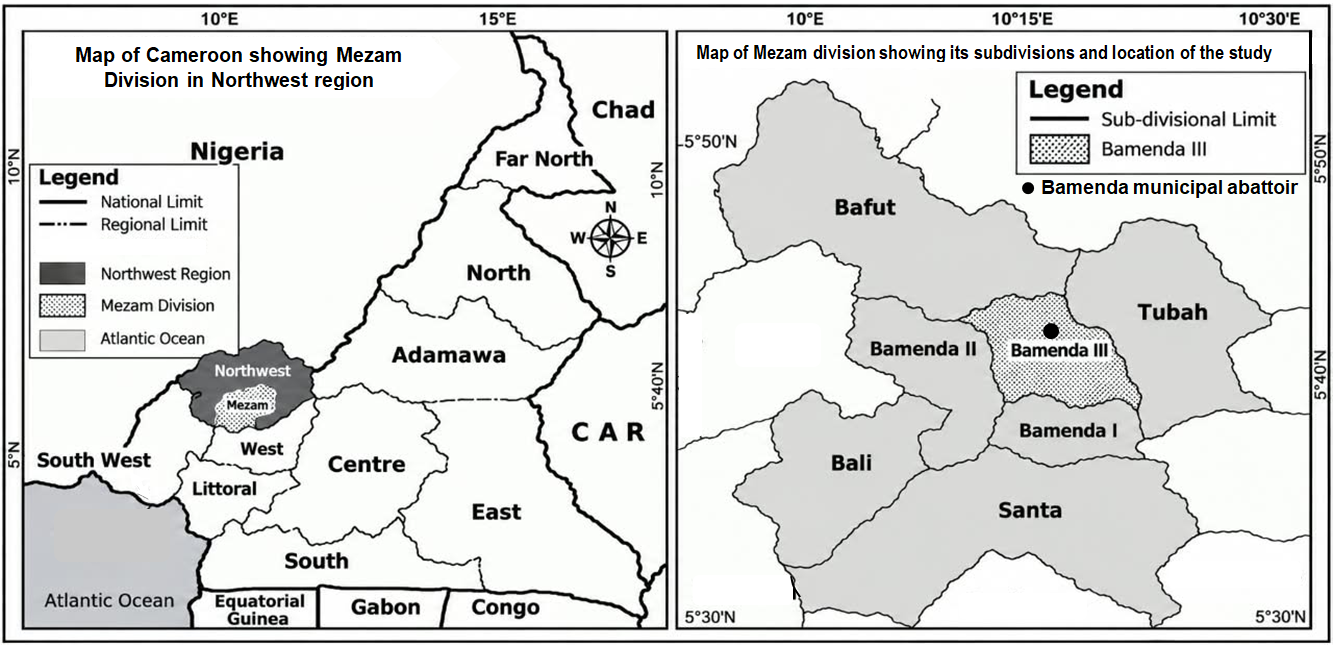
Map of Cameroon showing Mezam division in Northwest region and the location of Bamenda Municipal abattoir in Bamenda III in Mezam division.
Animal and management practices in the study region
The animals used in this study were cattle reared traditionally (with or without shelter) and semi-intensive management systems and owned by individuals in the Northwest region of Cameroon. These animals were made up of the indigenious zebus (eg: White Fulani, Gudali, Red Bororo, and Zebu crossed). The animals on traditional pastoral systems were kept in a free range, grazing on natural pasture and watered at drinking points (water bodies), with scarce supplementary feeding, patchy underprovided shelters and little or no professional veterinary care provided to the animals. The animals on semi-extensive system were grazed on communal and natural pastures but were often given concentrate feed supplements, and often received veterinary attention. The traditional pastoral husbandry is a common practice compared to the semi-intensive systems.
Selection of animals in the study
A total of 9,143 cattle Bos indicus zebu cattle and their crossed judged as fit for slaughter at the slaughterhouse were used in the study. However, a slaughter rate of cows ranging from 16.02 % – 26.40 % was used to estimate the minimum sample size required to determine the prevalence of reproductive wastage of Zebu cows for the study as described by Thrusfield (2007) using the following formula:
with a desired 95% confidence and precision of ≥ 5%.
Where; n = required sample size; Pexp = expected prevalence; and d = desired absolute precision.
The animal sampling and selection procedure of cows was done as previously described . Briefly, at the rhythm of 5 days per week during the study period and based on a calculated sampling fraction of five (every fifth animal was sampled) for daily use, the first animal was selected by picking one animal by random generation method of the first five animals on the slaughter chain and subjected to strict ante- and post- mortem examinations. Thereafter, every fifth animal (adding 5 to previous picked number) was chosen. For ante mortem examination, animals brought for slaughter were clinically examined carefully in the liarage of the abattoir. The slaughtering, dressing and post mortem examination of cattle carcasses were done following standard procedures as described by the Cameroon Veterinary Services and supported by manuals on routine meat inspection (FAO, 1994).
Information related to the breed, sex, age and body condition score of the chosen animals were noted. Estimation of ages was done by dental inspection and examination of horn rings for animals without teeth (especially old/adult females) while the breed of the animals was obtained as previously described , , , . The body condition score was done by assessing the general appearance and palpation of the lumbar region of the animal on a scale of 1 to 5 and further classed into 3 categories: 1 – 2 (thin), 3 (moderate) and 4 – 5 (fat) as previously described by Eversole (2009).
Determination of reproductive wastage, age and sex of foetuses with slaughter of fertile cows at the Bamenda abattoir
The reproductive wastage was determined by visual inspection, palpation and dissection of the exposed reproductive tract of slaughtered cows. A slaughtered pregnant cow was identified from the presence of foetus or embryo in uterus while the ovaries from the other cows were observed for the presence of follicles including corpus luteum assessment and validation of reproductive criteria such as adult age, observable estrus and physical scores (body condition score, reproductive tract score to establish their fertility status . Pregnant and normal cycling cows were noted as fertile.
Sex differentiation of foetuses was done through observation. However, the determination of sex by early diagnosis is possible for the bovine species between the 55th and 100th day of pregnancy. Around the 47th day, the genital tubercle is located between the hind limbs. In the male, it migrates gradually towards the umbilical region, where it reaches towards the 56th day of pregnancy. In the female, it moves to the caudal region where it is identified on the 54th day .
The distance from the crown of the head to the base of the tail (crown-rump length (CRL)) of recovered foetuses was measured and recorded by the same researcher (MENE) assisted by veterinary staff of the abattoir as instructed by MENE. CRL was used to determine the age of the foetuses and duration of the gestation using the formula X = 2.5 (Y + 21); X = days of gestation or age of foetus in days and Y = CRL , . The ages of all the foetuses recovered were classified according to the stage of pregnancy as follows: First trimester ≤ 3 months; Second trimester 3 – 6 months and Third trimester ≥ 6 months. The sex ratio was calculated by the ratio male / female number and the weight of foetuses was recorded by Roman scale (0.1 error margin).
Data were captured into the data collection forms specifically designed for the study. The percentages of reproductive wastage (slaughtered pregnant and fertile non-pregnant cows, wasted foetuses) were calculated.
Estimated economic losses due to reproductive waste with slaughter of fertile cows at the Bamenda abattoir
An economic impact model was used to calculate the economic burden of reproductive waste due to slaughter of fertile cows and foetal wastage at the Bamenda abattoir. The reproductive wastage and financial losses were estimated based on the associated economic value of fertile cows and recovered foetuses in the study. The economic analysis used the slaughter rate of fertile cows, recovered foetuses and average market prices in the local market. The economic loss was obtained following the summation of unit loss costs of elements in the cattle (animal / meat) sector, using the approach adapted from ; . The elements considered included conditions of animal reproduction such as lifespan of fertile cows, a calf per cow per annum, rearing a calf to maturity, cost-benefit analysis up to maturity and losses due to unforeseen conditions estimated at 10% the total summations.
The associated economic loss due to slaughter of fertile cows before the reproductive lifespan was attained in the farm was calculated according to Swai and Ulicky’s (2009) method as follows:
EL=ECsx(Coyx10%)xRozEL = ECs\ x\ (Coy\ x\ 10\%)x\ Roz
Where :
EL = Economic loss estimated during the study period;
ECs = Number of fertile cows slaughtered during the study period;
Coy = Average cost of single fertile cow during the study period;
Roz = Prevalence of slaughter of fertile cows during the study period.
However, several other scenarios for estimation of economic losses due to foetal wastage, losses associated to absence of reproductive maturity of wasted foetuses and losses due to shortened lifespan of slaughtered fertile females were considered using the approach adapted from ; , as follows:
FLB (N#) = N0 × P0
FLW (N#) = N1 × P1
FLCW (MT) = (N1 × W1) × D × 1000
FLM (N#) = N2 × P2 - (N2 - C0)
FLCM (MT) = (N2 × W2) × D × 1000
Where :
FLB = Financial loss at birth, FLW = Financial loss at weaning, FLCW = Financial loss of Carcass at weaning, FLM = Financial loss at maturity, FLCM = Financial loss of Carcass at maturity, N0 = Number of foetuses at birth, P0 = Average price of calves at birth, N1 = Number of calves at weaning assuming 17 % pre-weaning mortality, P1 = Average price of calves at weaning, W1 = Average weaning weight of calves in kg, D = Dressing % of cattle (52%), N2 = Number of cattle at maturity assuming 5 % of post weaning mortality, P2 = Average price of cattle at maturity, W2 = Average weight of cattle at maturity in kg, C0 = Cost of rearing a calf to maturity, MT = Metric tonnes
Cattle farmers, animal health care workforce, meat inspectors and relevant community staff in the livestock finance chain provided the costs of the economic elements used in the study. However, a structured questionnaire survey of 20 cattle producers / traders, 25 butchers / meat traders at the Bamenda municipal abattoir provided the average market prices for a fertile cow, a calf at birth (after receiving colostrum), and a weaned calf. The structured questionnaire also focused on the motive for slaughter of cows, foetal losses due to slaughter of pregnant cows, methods of pregnancy detection and level of awareness about the legislation prohibiting the slaughter of fertile (pregnant and non-pregnant) animals of the respondents.
The growth and production parameters (including age of cow at first calving, reproductive lifespan of cow, calving interval, average birth and weaning weights of calves, pre – and post – weaning mortality rates, average weight of mature cattle and dressing percentage of cattle) of the cattle sector in the Northwest region of Cameroon during the study period were obtained from the Regional Delegation of Livestock, Fisheries and Animal Industries (RDLFAI, per communication).
The financial losses were calculated in terms of the local currency used in Cameroon; Franc de la Communauté Financière Africaine (FCFA). Therefore, the growth and production parameters and costs of the economic elements used in the study were as follows:
A birth weight of calves was 25 kg.
Average weaning weight of calves was 140 kg.
Average weight at maturity of cattle was 330 kg for bulls and 300 kg for cows.
Pre-weaning mortality of 17% in calves.
Post-weaning mortality rate of 5 % in cattle.
Dressing percentage of 52% in cattle.
Average market price of 1 kg of meat (beef) is 3,000 FCFA
Average cost of rearing a calf to maturity is 150,000 FCFA.
Average cost of rearing a calf from birth to weaning 15,000 FCFA (estimated as the cost to care for the dam and welfare status of dam/calf in traditional extensive systems at a rate of 10% the cost of rearing a calf to maturity)
Average price of calf at birth after receiving colostrum is 50,000FCFA.
Average price of calf at weaning is 150,000FCFA
Average price of cattle at maturity is 400,000FCFA for bulls and 350,000frs for cows
The lifespan / reproductive usefulness of a fertile cow is 7 years. Slaughtered fertile cows that are less than 7 years were considered as a reproductive waste
In the traditional extensive system, a fertile cow calves normally once every 12 – 15 months annually (i.e. 2 calves every 30 months (two and a half years))
1 FCFA = USD $ 0.0018 (Google exchange rate. Date : 09/04/2026)
Data analysis
Data were entered in Microsoft Excel and subsequently transferred to SPSS version 20.0 for analysis. Descriptive statistics including frequency of pregnant animals slaughtered, prevalence of foetal wastage was calculated and economic losses were determined. Along 95% confidence intervals and statistical significance set at p<0.05, the chi-square test was used to test significant levels within factors on the rates and logistic regression models (odds-ratios) to determine the strength of association between factors while Kruskal-Wallis test used to compare observations as previously described (Thrusfield, 2007). Direct financial losses due to slaughter of fertile cows and foetal wastage as well as economic losses associated with foetal wastage versus the benefits of allowing pregnant dams were analysed , .
Ethical considerations
To avoid hazards to all persons and animals involved in the study, the researchers performed risk assessments of the project. Permission for the study and ethical approval were obtained from the required authorities in the Northwest region of Cameroon [Ministry of Livestock, Fisheries and Animal Industries (MINEPIA) Ref No : MINEPIA/DREPIA/NW/40/56 of 15/05/2023] before carrying out the study. The purpose of the study was explained to the targeted participants (producers, traders and butchers at the cattle market and slaughterhouse in the present study) usually with the assistance of resident veterinarians, local leaders and trusted intermediaries. The cattle professionals (for animal survey and human survey) gave their oral informed consent before they and / or their animals were included in the study. Apart from procedural restraining manipulations for safety purposes, the animals used in the present study were not subjected to stress and suffering.
Results
Sociodemographic factors
A total of 9143 slaughtered animals were sampled in the study period including 2529 [27.66 % (95% CI : 26.75 – 28.59%)] females considered as fertile cows and 6614 [72.34%, (95% CI: 71.42 – 73.26 %)] males; 2629 [28.75%, (95% CI: 27.83 - 29.68 %)] Red Mbororo (RB), 3284 [35.92%, (95% CI: 34.93 – 36.90 %)] White Fulani (WF), 3121 [34.14%, (95% CI: 33.16 – 35.11%)] Cross breed (RB x WF) and 109 [1.19%, (%5 CI: 0.97 – 1.41 %)] Gudali as well as 525 [20.76%, (95% CI: 19.18 – 22.34 %)] pregnant and 2004 [79.24%, (95%CI: 77.66 - 80.82%)] non-pregnant cows (Table 1). Overall, significantly more (p<0.05) male than female animals, predominantly (P<0.05) from Boyo and Menchum and during the rainy season than from Donga Mantung, Mezam and Bui and dry season, respectively, were slaughtered during the study period.
The highest proportion of slaughtered zebu in the study was the Cross breeds (RB x WF) followed (P>0.05) by the White Fulani and Red Mbororo and the Gudali was the least (p<0.05) slaughtered breed (Figure 2). An average of over 762 slaughtered animals were sampled monthly in the study corresponding to 211 [27.66 %; (95%CI: 26.75 – 28.59 %)] females, 44 [20.76%; (95%CI: 19.18 – 22.34 %)] pregnant, 167 [79.24 %; (95%CI: 77.66 – 80.82%)] non-pregnant fertile cows], 551 (72.34 %) males, 260 (34.15 %) Cross breed (RB x WF), 12 (1.19 %) Gudali, 219 (28.74 %) Red Mbororo and 274 (35.92 %) White Fulani cattle.
Table 1: Distribution of Cattle slaughtered at the Bamenda municipal abattoir by breed, sex and origin of animals and season in study.
| Parameter | Variable | Total | Breed, % (95%CI) | Sex, % (95%CI) | |||||
|---|---|---|---|---|---|---|---|---|---|
| Number | % (95%CI) | Cross breed (WFxRB) | Gudali | Red Mbororo (RB) | White Fulani (WF) | Female | Male | ||
| Breed (N=9143) | Cross breed (WFxRB) | 3121 | 34.14a (33.16-35.11) |
100.00 | / | / | / | 9.53a (8.92-10.13) |
24.61a (23.73-25.49) |
| Gudali | 109 | 1.19b (0.97-1.41) |
/ | 100.00 | / | / | 0.28b (0.18-0.39) |
0.91b (0.71-1.10) |
|
| Red Mbororo (RB) | 2629 | 28.75a (27.83-29.68) |
/ | / | 100.00 | / | 7.86c (7.31-8.42) |
20.89a (20.06-21.72) |
|
| White Fulani (WF) | 3284 | 35.92a (34.93-36.90) |
/ | / | / | 100.00 | 9.99a (9.37-10.60) |
25.93a (25.03-26.83) |
|
| Sex (N=9143) | Female | 2529 | 27.66a (26.74-28.58) |
34.44 (32.59-36.29) |
1.03 (0.63-1.42) |
28.43 (26.67-30.19) |
36.10 (34.23-37.97) |
27.66 (26.74-28.58) |
/ |
| Male | 6614 | 72.34b (71.42-73.26) |
34.02 (32.88-35.16) |
1.25 (0.99-1.52) |
28.88 (27.79-29.97) |
35.86 (34.71-37.02) |
/ | 72.34 (71.42-73.26) |
|
| Female (N=2528) | Pregnant | 525 | 20.76a (19.18-22.34) |
32.76 (28.75-36.78) |
/ | 35.62 (31.52-39.72) |
31.62 (27.64-35.60) |
20.76a (19.19-22.34) |
/ |
| Not-pregnant | 2004 | 79.24b (77.66-80.82) |
34.88 (32.79-36.29) |
1.30 (0.80-1.79) |
26.55 (24.61-28.48) |
37.28 (35.16-39.39) |
79.24b (77.66-80.82) |
/ | |
| Location / origin (N=9143) | Boyo | 4310 | 47.14a (46.12-48.16) |
33.06 (31.66-36.29) |
0.88 (0.60-1.16) |
31.51 (26.67-32.90) |
34.55 (33.13-35.97) |
12.98a (12.29-13.67) |
34.16a (33.19-35.13) |
| Bui | 355 | 3.88b (3.49-4.28) |
30.42 (25.64-34.47) |
1.97 (0.53-3.42) |
32.68 (30.12-37.56) |
34.93 (29.9-39.89) |
1.30b (1.07-1.53) |
2.58b (2.26-2.91) |
|
| Donga Mantung | 604 | 6.61c (6.10-7.12) |
28.97 (25.36-35.21) |
1.32 (0.41-2.24) |
30.13 (26.47-33.79) |
39.57 (36.67-43.47) |
1.63b (1.37-1.89) |
4.98c (4.53-5.42) |
|
| Menchum | 3350 | 36.64a (35.65-37.63) |
37.73 (36.09-39.37) |
1.43 (1.03-1.84) |
24.24 (22.79-25.69) |
36.60 (34.97-38.23) |
10.11c (9.49-10.72) |
26.52d (25.62-27.43) |
|
| Mezam | 524 | 5.73bc (5.25-6.21) |
28.44 (24.57-32.30) |
1.53 (0.48-2.58) |
30.73 (26.77-34.68) |
39.31 (35.13-43.50) |
1.63b (1.37-1.89) |
4.10c (3.69-4.51) |
|
| Season (N=9143) | Rainy season | 5750 | 62.89a (61.90-63.88) |
35.77 (34.53-37.01) |
1.04 (0.78-1.31) |
27.55 (26.39-28.70) |
35.63 (34.40-36.87) |
16.81a (16.04-17.58) |
46.08a (45.06-47.10) |
| Dry season | 3393 | 37.11b (36.12-38.10) |
31.36 (29.80-32.92) |
1.44 (1.04-1.85) |
30.80 (29.25-32.35) |
36.40 (34.78-38.02) |
10.85b (10.21-11.49) |
26.26b (25.36-27.16) |
|
| Overall total | 9143 | 100 | 34.14 (33.16 -35.11) |
1.19 (0.97 -1.41) |
28.75 (27.83 -29.68) |
35.92 (34.93 -36.90) |
27.66 (26.74 -28.58) |
72.34 (71.42 -73.26) |
|
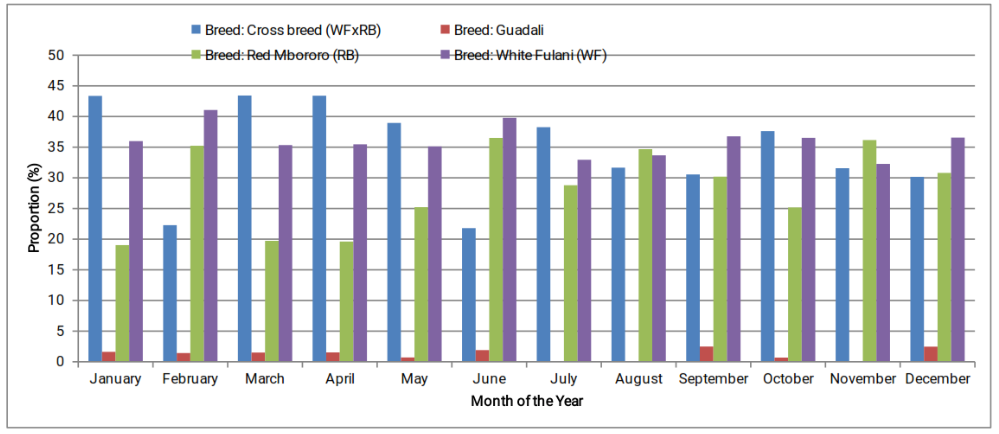
Monthly distribution of cattle slaughtered at the Bamenda municipal abattoir according to breed
Slaughter of pregnant and non-pregnant cows
Over 27.66 % [95%CI : 26.75 – 28.59 %) of cattle slaughtered each month at the Bamenda abattoir were fertile cows with 20.76% [95%CI : 19.18 – 22.34 %] of them being pregnant and 79.24 % [95%CI : 77.66 – 80.82%] non-pregnant cows. Slaughtering of fertile cows occurred throughout the entire period of the study (Figure 3). Though no significant difference were observed between the proportions of slaughtered animals monthly irrespective of sex and pregnancy status, the peak and least proportions of slaughtered male and female animals, respectively, were during May and September. While the peak and least proportions of slaughtered non-pregnant and pregnant cows, respectively, were during March, September and December (Figure 3).
The study showed that the proportion of slaughtered cows, including pregnant and non-pregnant cows, varied significantly (p<0.05) between body condition scores, age group, and location of origin of the cows and season (Table 2). The predominantly slaughtered cows were crossed (RB x WF) and White Fulani cow breeds, cows with moderate BCS, cows 3 to 6 years old, as well as cows from Boyo and Menchum compared to the other breeds, BCS, age group and location of origin, respectively. The difference in breeds significantly (p<0.05) influenced the proportion of slaughtered cows and non-pregnant cows but not (p>0.05) the slaughter of pregnant cows (Table 2). The body condition score (BCS) of the fertile cows in this study were predominantly moderate (78.05%) corresponding to 61.33% for pregnant and 82.44 % for non-pregnant animals. In addition, no pregnant Gudali and no thin pregnant cow compared to about 3.59% of thin non-pregnant cows were slaughtered in the present study (Table 2).
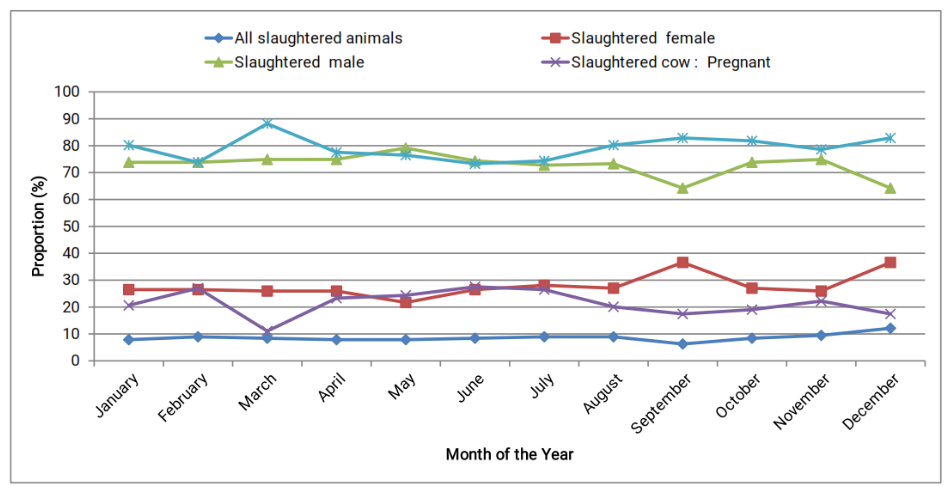
Monthly distribution of cattle slaughtered at the Bamenda municipal abattoir according to sex and pregnancy status of slaughtered cows
Table 2: Prevalence of fertile cows slaughtered at the Bamenda municipal abattoir by breed, body condition score, and origin of animal and season
| Parameter | Variable | Total (N=2529) | Pregnancy status | ||||
|---|---|---|---|---|---|---|---|
| Pregnant (N=525) | Not-pregnant (N=2004) | ||||||
| Number | % (95%CI) | Number | % (95%CI) | Number | % (95%CI) | ||
| Breed | Cross breed (WF x RB) | 871 | 34.44a (32.59-36.29) | 172 | 32.76a (28.75-36.78) | 699 | 34.88a (32.79-36.97) |
| Gudali | 26 | 1.03b (0.63-1.42) | / | / | 26 | 1.30b (0.80-1.79) | |
| Red Mbororo (RB) | 719 | 28.43c (26.67-30.19) | 187 | 35.62a (31.52-39.72) | 532 | 26.55c (24.61-28.48) | |
| White Fulani (WF) | 913 | 36.10a (34.23-37.97) | 166 | 31.62a (27.64-35.60) | 747 | 37.28a (35.16-39.39) | |
| Body Condition Score (BCS) | Fat | 483 | 19.10a (17.57-20.63) | 203 | 38.67a (34.50-42.83) | 280 | 13.97a (12.45-15.49) |
| Moderate | 1974 | 78.05b (76.44-79.67) | 322 | 61.33b (57.17-65.50) | 1652 | 82.44b (80.77-84.10) | |
| Thin | 72 | 2.85c (2.20-3.50) | / | / | 72 | 3.59c (2.78-4.41) | |
| Age (years) | 3≤ Age (years) ≤ 5 | 1587 | 62.75a (60.87-64.64) | 297 | 56.57a (52.33-60.81) | 1290 | 64.37a (62.27-66.47) |
| 5< Age (years) ≤ 7 | 808 | 31.95b (30.13-33.77) | 194 | 96.95b (32.82-41.08) | 614 | 30.64b (28.62-32.66) | |
| Age (years) > 7 | 134 | 5.30c (4.43-6.17) | 34 | 6.48a (4.37-8.58) | 100 | 4.99c (4.04-5.94) | |
| Location of origin | Boyo | 1187 | 46.94a (44.99-48.88) | 251 | 47.81a (43.54-52.08) | 936 | 46.71a (44.52-48.89) |
| Bui | 119 | 4.71b (3.88-5.53) | 23 | 4.38b (2.63-6.13) | 96 | 4.79b (3.86-5.73) | |
| Donga Mantung | 149 | 5.89b (4.97-6.81) | 36 | 6.86b (4.70-9.02) | 113 | 5.64b (4.63-6.65) | |
| Menchum | 925 | 36.58c (34.70-38.45) | 184 | 35.05c (30.97-39.13) | 741 | 36.98c (34.86-39.09) | |
| Mezam | 149 | 5.89b (4.97-6.81) | 31 | 5.90b (3.89-7.92) | 118 | 5.89b (4.86-6.92) | |
| Season | Rainy season | 1537 | 60.78a (58.87-62.68) | 320 | 60.95a (56.78-65.13) | 1217 | 60.73a (58.59-62.87) |
| Dry season | 992 | 39.22b (37.32-41.13) | 205 | 39.05b (34.87-43.22) | 787 | 39.27b (37.13-41.41) | |
Recovered foetuses from slaughtered pregnant cows
A total of 527 foetuses were recovered from 525 slaughtered cows sampled (Table 3) at an average rate of 44 (8.35 %; 95%CI: 5.99 – 10.71%) foetuses per month during the study period. Overall, the sex ratio (Male : Female) was 8 : 10 and varied with factors studied. Pregnant cows slaughtered in first, second and third trimester were 212 (40.38%), 212 (40.38%) and 101 (19.24%), respectively. Recovered female foetuses (229 [56.74 %; 95%CI: 52.51 – 60.97%]) were significantly higher (OR = 1.72 (95%CI: 1.35 – 2.19); X2 = 19.13, p<0.001) than the male foetuses (228 [43.26%; 95%CI: 39.03 – 47.49%]). In addition, there was a significant difference (OR = 2.84 (95%CI: 2.15 – 3.75); X2 = 55.99, p<0.0001) between the numbers of cows slaughtered in third trimester (19.24%), compared to those in first (40.38%) and second (40.38%) trimesters (Table 3).
Overall, the study showed that more (p<0.05) female than male foetuses were recovered and the number of foetuses recovered during the first and second trimester were significantly higher (p<0.05) than the number recovered during the third trimester (Table 3). However, the difference due to sex and number of the recovered foetuses varied significantly (p<0.05) between body condition scores, age group, and location of origin of the cows and season (Table 3). The difference in breeds significantly (p<0.05) influenced the proportion of female foetuses recovered but not (p>0.05) the proportion of male foetuses recovered.
The logistic regression revealed that breed, BCS, age, and location of origin of the animals and season had effect (𝑃 < 0.05) on the slaughter of cows, while BCS, age, and location of origin of the animals and season had effect (𝑃 < 0.05) on the slaughter of pregnant cows and wasted foetuses in the Bamenda municipal abattoir (Table 4). Furthermore, there were increased odds of slaughtering cows that were White Fulani (WF) (OR= 1.42 (95%CI: 1.26 – 1.60), X2 = 34.05, p<0.0001), Cross breed (RB x WF) (OR= 1.32 (95%CI: 1.17 – 1.49), X2 =21.19, p<0.0001), moderate BCS (OR = 15.07 (95%CI: 13.14 – 17.27), X2 =1759.5, p<0.0001) and ≤7 years old (OR=319.45 (95%CI: 249.77 – 408.57), X2=4042.8, p<0.0001) than cows that were Red Mbororo (RB), fat BCS and >7 years old, respectively. However, there was no significant difference in the slaughter of White Fulani and Cross breed (RB x WF) cows (OR=1.08 (95%CI: 0.96 – 1.21), X2=1.53, p=0.216) in the present study. Also, there were increased odds of slaughtering pregnant ≤7 years old cows (OR=208.55 (95%CI: 127.56 – 340.94), X2=795.62, p<0.0001), slaughtering pregnant cows their 1st and 2nd trimesters (OR= 17.62 (95%CI: 13.00 – 23.95), X2=397.44, p<0.0001), recovering foetuses from pregnant ≤7 years old cows (OR=197.60 (95%CI: 121.67 – 320.91), X2=792.6, p<0.0001) and recovering foetuses during the 1st and 2nd trimesters of pregnancy (OR= 17.36 (12.79 – 23.57), X2=395.94, p<0.0001) than slaughtering of pregnant >7 years old cow, slaughtering of cows during the 3rd trimester, recovering foetuses from pregnant >7 years old cows and recovering foetuses at the 1st and 2nd trimesters of pregnancy, respectively. There was no significant difference in the slaughter of pregnant Red Mbororo cows (OR=1.14 (95%CI: 0.88 – 1.47), X2=0.95, p=0.330) and foetuses recovered from pregnant Red Mbororo cows (OR =1.15 (95%CI: 0.89 – 1.49), X2=1.22, p=0.269) than the slaughter pregnant of Cross breed (RB x WF) cows and foetuses recovered from pregnant Cross breed (RB x WF) cows, respectively.
Table 3: Prevalence of recovered foetus at the Bamenda municipal abattoir according to sex, gestational period and number of foetuses recovered
| Parameter | Variable | Sex of foetus (N=527) | Foetuses recovered (N=527) | |||||||||
|---|---|---|---|---|---|---|---|---|---|---|---|---|
| Female | Male | Ratio | First trimester | Second trimester | Third trimester | |||||||
| Number | % (95%CI) | Number | % (95%CI) | M:F | Number | % (95%CI) | Number | % (95%CI) | Number | % (95%CI) | ||
| Total | 299 | 56.74A (52.51-60.97) |
228 | 43.26B (39.03-47.49) |
8 : 10 | 212 | 40.23A (36.04-44.41) |
213 | 40.42A (36.23-44.61) |
102 | 19.35B (15.98-22.73) |
|
| Breed | Cross breed (WFxRB) | 79 | 14.99a (11.94-18.04) |
93 | 17.65a (14.39-20.90) | 12 : 10 | 70 | 13.28a (10.39-16.18) |
71 | 13.47a (10.56-16.39) |
31 | 5.88a (3.87-7.89) |
| Red Mbororo (RB) | 119 | 22.58b (19.01-26.15) |
70 | 13.28a (10.39-16.18) | 6 : 10 | 76 | 14.42a (11.42-17.42) |
73 | 13.85a (10.90-16.80) |
39 | 7.21a (5.00-9.42) |
|
| White Fulani (WF) | 101 | 19.17ab (15.80-22.53) |
65 | 12.33a (9.53-14.15) |
6 : 10 | 66 | 12.52a (9.70-15.49) |
68 | 12.90a (10.04-15.77) |
32 | 6.07a (4.03-8.11) |
|
| Body Condition Score | Fat | 104 | 19.73a (16.34-23.13) |
100 | 18.98a (15.63-22.32) | 10 : 10 | 41 | 7.78a (5.49-10.07) |
86 | 16.32a (13.16-19.47) |
77 | 14.61a (11.60-17.63) |
| Moderate | 195 | 37.00b (32.88-41.12) |
128 | 24.29a (20.63-27.95) | 7 : 10 | 171 | 32.45b (28.45-36.45) |
127 | 24.10a (20.45-27.75) |
25 | 4.74b (2.93-6.56) |
|
| Age | 3≤ Age (years) ≤ 5 | 166 | 31.50a (27.53-35.47) |
132 | 25.05a (21.35-28.75) |
8 : 10 | 114 | 21.63a (18.12-25.15) |
130 | 24.67a (20.99-28.35) |
54 | 10.25a (7.66-12.84) |
| 5< Age (years) ≤ 7 | 111 | 21.06b (17.58-24.54) |
83 | 15.75b (12.64-18.86) | 8 : 10 | 79 | 14.99b (11.94-18.04) |
74 | 14.04b (11.08-17.01) |
41 | 7.78a (5.49-10.07) |
|
| Age (years) > 7 | 22 | 4.17c (2.47-5.88) |
13 | 2.47c (1.14-3.79) |
6 : 10 | 19 | 3.61c (2.01-5.20) |
9 | 1.71c (060-2.81) |
7 | 1.33b (0.35-2.31) |
|
| Pregnancy stage | First trimester | 115 | 21.82a (18.30-25.35) |
97 | 18.41a (15.10-21.71) | 8 : 10 | 212 | 40.23 (36.04-44.41) |
/ | / | / | / |
| Second trimester | 126 | 23.91a (20.27-27.55) |
87 | 16.51a (13.34-19.68) | 7 : 10 | / | / | 213 | 40.42 (36.23-44.61) |
/ | / | |
| Third trimester | 58 | 11.01b (8.33-13.68) |
44 | 8.35b (5.99-10.71) |
8 : 10 | / | / | / | / | 102 | 19.35 (15.98-22.73) |
|
| Location / origin | Boyo | 135 | 25.62a (21.89-29.34) |
116 | 22.01a (18.47-25.55) | 9 : 10 | 103 | 19.54a (16.16-23.93) |
102 | 19.35a (15.98-22.73) |
46 | 8.73a (6.32-11.14) |
| Bui | 15 | 2.85b (1.48-4.27) |
8 | 1.52b (0.47-2.56) |
5 : 10 | 11 | 2.09b (0.87-3.31) |
8 | 1.52b (0.47-2.56) |
4 | 0.76b (0.02-1.50) |
|
| Donga Mantung | 21 | 3.98b (2.31-5.65) |
15 | 2.85b (1.43-4.27) |
7 : 10 | 11 | 2.09b (0.87-3.31) |
19 | 3.61b (2.01-5.20) |
6 | 1.14b (0.23-2.04) |
|
| Menchum | 107 | 20.30a (16.87-23.74) |
78 | 14.80c (11.77-17.83) | 7 : 10 | 77 | 14.61a (11.60-17.63) |
75 | 14.23a (11.25-17.21) |
33 | 6.26a (4.19-8.33) |
|
| Mezam | 21 | 3.98b (2.31-5.65) |
11 | 2.09b (0.87-3.31) |
5 : 10 | 10 | 1.90b (0.73-3.06) |
6 | 1.52b (0.47-2.56) |
15 | 2.85b (1.43-4.27) |
|
| Season | Rainy season | 185 | 35.10a (31.03-39.18) |
137 | 26.00a (22.25-29.74) | 7 : 10 | 120 | 22.77a (19.19-26.35) |
138 | 26.19a (22.43-29.94) |
64 | 12.14a (9.36-14.93) |
| Dry season | 114 | 21.63b (18.12-25.15) |
91 | 17.27b (14.04-20.49) |
8 : 10 |
92 | 17.46a (14.22-20.70) |
75 | 14.23b (11.23-17.21) |
38 | 7.21b (5.00-9.42) |
|
Table 4: Logistic regression model of associated risks for the slaughter of fertile cows, gestational stage of pregnant cows and recovered foetus at the Bamenda municipal abattoir of Cameroon
| Parameter | Variable | Number of fertile cows (pregnant and non-pregnant) slaughtered (N=2529) | Number of pregnant cows (N=525) | Number of foetuses recovered (N=527) | ||||||
|---|---|---|---|---|---|---|---|---|---|---|
| n (%) | Odds (95%CI) | P value | n (%) | Odds (95%CI) | P value | n (%) | Odds (95%CI) | P value | ||
| Breed | Cross breed (WFxRB) | 871 (34.44) | 50.57 (34.07 – 75.07) |
<0.0001 | 172 (32.76) | 1.05 (0.81 – 1.37) |
0.689 | 172 (32.64) | 1.05 (0.81 – 1.36) |
0.689 |
| Gudali | 26 (1.03) | 1 | / | / | / | / | ||||
| Red Mbororo (RB) | 719 (28.43) | 38.24 (5.74 – 56.82) |
<0.0001 | 187 (35.62) | 1.20 (0.93 – 1.55) |
0.170 | 189 (35.86) | 1.22 (0.94 – 1.57) |
0.134 | |
| White Fulani (WF) | 913 (36.10) | 54.39 (36.65 – 80.72) |
<0.0001 | 166 (31.62) | 1 | 166 (31.50) | 1 | |||
| Body Condition Score | Fat | 483 (19.10) | 8.06 (6.25 – 10.39) |
<0.0001 | 203 (38.67) | 1 | 204 (38.71) | 1 | ||
| Moderate | 1974 (78.05) | 121.37 (94.28 – 156.25) |
<0.0001 | 322 (61.33) | 2.52 (1.96 – 3.23) |
<0.0001 | 323 (61.29) | 2.51 (1.96 – 3.21) |
<0.0001 | |
| Thin | 72 (2.85) | 1 | / | / | / | / | ||||
Age |
3≤ Age (years) ≤ 5 | 1587 (62.75) | 30.11 (24.86 – 36.48) |
<0.0001 | 297 (56.57) | 18.81 (12.76 – 27.73) |
<0.0001 | 298 (56.55) | 18.29 (12.46 – 26.85) |
<0.0001 |
| 5< Age (years) ≤ 7 | 808 (31.95) | 8.39 (6.92 – 10.18) |
<0.0001 | 194 (96.95) | 8.46 (5.73 – 12.50) |
<0.0001 | 194 (36.81) | 8.19 (5.57 – 12.05) |
<0.0001 | |
| Age (years) > 7 | 134 (5.30) | 1 | 34 (6.48) | 1 | 35 (6.64) | 1 | ||||
| Pregnancy stage | First trimester | / | / | / | 213 (40.57) | 2.89 (2.17 – 3.79) |
<0.0001 | 212 (40.23) | 2.80 (2.12 – 3.70) |
<0.0001 |
| Second trimester | / | / | / | 212 (40.38) | 2.84 (2.15 – 3.76) |
<0.0001 | 213 (40.42) | 2.83 (2.14 – 3.73) |
<0.0001 | |
| Third trimester | / | / | / | 101 (19.24) | 1 | 102 (19.35) | 1 | |||
| Location / origin | Boyo | 1187 (46.94) | 17.19 (14.67 – 21.88) |
<0.0001 | 251 (47.81) | 19.99 (12.73 – 13.41) |
<0.0001 | 251 (47.63) | 19.93 (12.68 – 31.30) |
<0.0001 |
| Bui | 119 (4.71) | 1 | 23 (4.38) | 1 | 23 (4.36) | 1 | ||||
| Donga Mantung | 149 (5.89) | 1.27 (0.99 – 1.62) |
0.060 | 36 (6.86) | 1.61 (0.94 – 2.75) |
0.082 | 36 (6.83) | 1.61 (0.93 – 2.75) |
0.082 | |
| Menchum | 925 (36.58) | 11.67 (9.55 – 14.28) |
<0.0001 | 184 (35.05) | 11.78 (7.47 – 18.56) |
<0.0001 | 185 (35.10) | 11.85 (7.52 – 18.68) |
<0.0001 | |
| Mezam | 149 (5.89) | 1.27 (0.99 – 1.62) |
0.060 | 31 (5.90) | 1.37 (0.79 – 2.38) |
0.264 | 32 (6.07) | 1.42 (0.82 – 2.46) |
0.213 | |
| Season | Rainy season | 1537 (60.78) | 2.40 (4.14 – 2.69) |
<0.0001 | 320 (60.95) | 2.44 (1.90 – 3.12) |
<0.0001 | 322 (61.10) | 2.47 (1.93 – 3.16) |
<0.0001 |
| Dry season | 992 (39.22) | 1 | 205 (39.05) | 1 | 205 (38.90) | 1 | ||||
Estimated economic losses associated with reproductive waste of slaughter of fertile cows at the Bamenda abattoir
The average price of the live moderate BCS cattle destined for slaughter was 400.000 FCFA a bull and 350,000 FCFA for cows while the cost for a calf at birth (after receiving colostrum) was 50,000 FCFA. In this study, the estimation of financial values assumed a 17% pre-weaning mortality rate for calves from birth to weaning age of 1 year and 5% post-weaning mortality rate for cattle from weaning to maturity (at about 3 years). In this study, 2529 fertile cows were slaughtered corresponding to 525 pregnant and 2004 non-pregnant cows and 527 foetuses were recovered from the pregnant cows. The financial losses at the Bamenda abattoir for the period of the study for the 527 wasted foetuses were estimated at 26,350,000 F CFA (US $ 47,430)1 (Table 5). However, if 527 of the foetuses were not wasted and the calves were delivered, received colostrum, raised and slaughtered at weaning age of 1 year (assuming cost of pre-weaning rearing @ 15,000FCFA, 17% pre-weaning mortality and income on carcass yield at 3,000FCFA per kg), the total income loss to producers was estimated at 75,589,200 FCFA (US $ 136,060.56) (Table 5). In addition, the income lost to producers if the calves was reared and slaughtered at maturity (assuming cost of post-weaning rearing of cattle @ 150,000FCFA, 5 % post-weaning mortality and income on carcass yield at 3,000FCFA per kg) was estimated at 117,708,000 FCFA (US $ 211,874.4) (Table 5). Out of 527 foetuses (228 male; 299 female) obtained during the study, 438 cattle (180 bulls and 236 cows) would have attended maturity and reproductive age with financial value of 72,000,000 FCFA (US $ 129,600) for bulls and 82,600,000 FCFA (US $ 148,680) for cows giving a total estimated financial value for all the wasted foetuses of 154, 600,000 FCFA (US $ 278,280). At the recommended optimum reproduction of Zebu cows of 5 – 7 calves (reproductive age of 3 years and 1 calf every 12 – 15 months per cow) for reproductive lifespan of up to 7 years, 2429 out of 2529 cows slaughtered in the study were at most 7 years old with financial value 850,150,000 FCFA (US $ 1,530,270) (Table 6). However, the mature fertile cows (at most 7 years) slaughtered in the present study would have calved 1 – 5 times (2395 calves) with an estimated lost financial value of 119,750,000 FCFA. While 840 female calves (8 male : 10 female ratio) would have reached reproductive age within the reproductive lifespan of their dams/parents, calved 1 – 3 times (840 calves) with a lost financial value of 42,000,000 FCFA and also an income for 840 cows of 2,940,000,000 FCFA (US $ 5,292,000) if slaughtered (Table 6). If the male calves (8 male: 10 female ratio) were reared and slaughtered at maturity, the total financial values (670 bulls) would be 268,000,000 FCFA (US $ 482,400) (Table 6). The study revealed if 2429 cows were slaughtered at end of reproductive lifespan of up to 7 years, the total estimated financial value would be 4,219,900,000 FCFA (US $ 7,595,820).
Table 5: Economic losses associated with slaughter of fertile cows and foetal wastage in the study abattoir.
|
|
Number wasted | Measure | Unit price (FCFA) | Total (FCFA) | |||
|---|---|---|---|---|---|---|---|---|
|
|
527 | 527 foetuses | 50,000 | 26,350,000 | |||
|
|
90 | 90 calves | 150,000 | 13,500,00 | |||
|
|
438 | 438 calves | 15,000 | 6,570,000 | |||
|
|
438 | 61,320 kg | 3,000 | 95,659,200 | |||
|
438 | 438 calves | / | 75,589,200 | ||||
|
|
10 | 10 calves | 400,000 | 4,000,000 | |||
|
13 | 13 calves | 350,000 | 4,550,000 | ||||
|
|
416 | 416 calves | 150,000 | 62,400,000 | |||
|
|
10 | 63,000 kg | 3,000 | 98,280,000 | |||
|
13 | 70,800 kg | 3,000 | 110,448,000 | ||||
|
416 | 416 calves | / | 117,708,000 | ||||
Table 6 : Economic losses associated with slaughter of fertile cows before end their reproductive lifespan based on the animals in this study.
|
|
Age of cattle (year) | Number of calving | Number of cattle | Unit price (FCFA) | Total (FCFA) |
|---|---|---|---|---|---|---|
|
|
3 * | 5 | 236 | 50,000 | 11,800,000 |
|
4** | 4 | 624 | 50,000 | 31,200,000 | |
|
5*** | 3 | 727 | 50,000 | 36,350,000 | |
|
6 | 2 | 324 | 50,000 | 16,200,000 | |
|
7 | 1 | 484 | 50,000 | 24,200,000 | |
|
3 – 7 | 1 – 5 | 2395 | 50,000 | 119,750,000 | |
|
7 | 1 – 5 | 2429 | 350,000 | 850,150,000 | |
|
|
3**** | 3 | 104 | 50,000 | 5,200,000 |
|
3 | 2 | 274 | 50,000 | 13,700,000 | |
|
3 | 1 | 404 | 50,000 | 20,200,000 | |
|
3 | 1 | 58 | 50,000 | 2,900,000 | |
|
3 | 1 – 3 | 840 | 50,000 | 42,000,000 | |
|
7 | 1 – 3 | 840 | 350,0000 | 2,940,000,000 | |
|
|
3 | / | 82 | 400,000 | 32,800,000 |
|
3 | / | 219 | 400,000 | 87,600,000 | |
|
3 | / | 322 | 400,000 | 128,800,000 | |
|
3 | / | 47 | 400,000 | 18,800,000 | |
|
3 | / | 670 | 400,000 | 268,000,000 |
The questionnaire interview survey showed that cattle professionals traded and / or slaughtered pregnant cows for the purpose of income generation and slaughter for human consumption (19/45; 42.22%), could detect cows on heat (oestrus) (33/45; 73.33%), could detect cow in late gestational stage by visual and behaviour appreciations (40/45; 88.89%), visually checked for pregnancy before trade and / or slaughter of cows (25/45, 55.56%), were aware of the country’s legislation forbidding the unauthorised slaughter of cows (pregnant and non-pregnant) for meat production (40/45; 88.89%) and the negative impact of foetal losses due to slaughter of pregnant cows to herd growth and cattle population (45/45; 100%). The respondents used recovered foetuses from slaughtered pregnant cows for income generation (34/45, 75.56%), food for humans (25/45; 55.55%) and food for domestic canines and felines (20/45; 44.44%).
Discussion
The cattle slaughtered at the Bamenda municipal abattoir were predominantly Zebu and Zebu cross breeds which originated from the cattle producing areas of the Northwest region of Cameroon. Breed, sex, location of origin and season influenced the slaughter rates. Predominantly more Red Mbororo, White Fulani and zebu cross breeds and male cattle were slaughtered compared to the Gudali breeds and female cattle, respectively. The low proportion of Gudali breed indicates a small population size in the Northwest region. The Adamawa region is the principal rearing and conservation site for the Gudali breed in Cameroon. The high slaughter rate of Zebu cross breeds in this study was attributed to indiscriminate and uncontrolled hybridization practices among the Red Mbororo and White Fulani usually raised together in production areas in the country. In addition, the cattle originated most from Menchum and Boyo Divisions compared to the other Divisions, and most cattle were slaughtered during the rainy season than the dry season. Seasonal changes revealed that more cows, including pregnant cows, were slaughtered during the rainy season than in dry season. This was associated to the availability of more pastures during the rainy months, which lead to better body conditions and higher conception rates and more inclination of herders to sell their animals due to financial pressures such as children’s back-to-school campaign. Although Donga-Mantung, Menchum and Bui Divisions are among the major cattle producing areas followed by Boyo, Mezam, Ngoketunjia and Momo Divisions, the slaughter rates for cattle from Donga-Mantung and Bui Divisions in the present study was low. The low rates in Donga-Mantung and Bui Divisions were attributed to their further distance from Bamenda abattoir compared to the other divisions, insecurities of transporting cattle to Bamenda due to conflicts and their closer proximity to livestock markets in Nigerian towns bordering Cameroon.
The predominance of male cattle (72.34%) over females (27.66%) reflected the production strategy of reserving females for reproduction, though all the female cattle slaughtered in this study were fertile cows. Over 20.76% of the slaughtered female cattle were pregnant cows while 79.24% were non-pregnant fertile cows. This finding agrees with Ndi et al., (1993) and Tchoumboue (1984) who reported prevalence of slaughtered pregnant cows of 22.10% in Bamenda and 16.61% in Yaoundé, respectively, over three to four decades ago. However, higher rates have been recorded in abattoirs in other parts of Cameroon such as Ngaoundéré (37.30%) , Bamenda municipal abattoir (34.3%, 44.4% and 63.5%) , , , Yaoundé (31.4%) (Kouamo et al., (2025). The proportion of fertile females slaughtered in this study is lower compared with the observation of Bah et al., (2010) who reported a higher prevalence of slaughter of female cattle (86.6%) and less than 9 years old (83%) at the Ngaoundéré municipal slaughterhouse. These findings indicate that fertile female (pregnant and non-pregnant) cows have remained persistently high in cattle marketing and slaughter system in Bamenda and the country in general, although the magnitude varies considerably between study periods. The present study showed that most slaughtered cows were within their active reproductive years, with economic consequences linked to loss of active reproductive (pregnant and non-pregnant) cows, foetus wastage, and loss of potentially productive breeding animals from cattle herds. These may contribute to reduced herd replacement which will negatively impact beef production with increased pressure on domestic beef supply. The removal of animals through culling, offtake and foetal wastage could exceed the rate of herd replacement and negatively impact herd productivity.
Varying prevalence rates of slaughtered pregnant cows have been reported in parts of Africa ranging from 22 – 26% have been reported in Nigeria and the Democratic Republic of Congo ; ; , 35.9 % in Ibadan – Nigeria , 18.4 % in Kumasi-Ghana , 40.34 % in Nsukka-Nigeria , 12.2 % in Abeokuta-Nigeria and 19.47 % in Masaka-Uganda . The relatively high proportion of females slaughtered, particularly those of reproductive age, suggests economic pressures such urgent financial needs, and inadequate nutrition (e.g., due to feed scarcity among other reasons) that force farmers to sell even productive animals , . Though the cattle professionals in the present study could detect heat (oestrus), were aware of the country’s legislation on the slaughter of pregnant animals and the negative impact of foetal losses on herd growth and replacement dynamics, income generation and human food security were their main reasons for trading and slaughtering fertile (pregnant and non-pregnant) cows. This finding indicated that many cattle breeders in the area intentionally get cows pregnant to improve their body condition score, attractiveness and high market value during sales at livestock markets for slaughter. The finding supports the persistence of slaughter of fertile (pregnant and non-pregnant) cows in abattoirs in many Africa countries. The unethical and unregulated slaughter of pregnant and non-pregnant fertile cows can contribute to a progressive decline of bovine population, increase in beef prices and low protein available for intake per caput in the country.
The slaughter of fertile cows and recovering of foetuses [averagely 44 per month (8.35%)] from pregnant cows occurred during the entire study period. Most of the cows were at the first and second trimesters of gestation and most of the recovered foetuses were females. However, body condition scores, age group, and location of origin of the cows and season influenced the slaughter rate of pregnant cows and the sex and number of the recovered foetuses while breed influenced the proportion of the female and not male foetuses recovered. The present finding is similar to 9.1% reported by Hakoueu et al., (2018) in Bamenda-Cameroon; but lower than 22.1% by Ndi et al., (1993) and 37.3% by Bah et al., (2010) in other parts of the country. Higher foetal recovery rates have been reported in Tanzania (29.1%) , Nigeria (13.95%) , Democratic Republic of Congo (26.3%) . Donga-Mantung, Menchum and Bui are the major cattle producing divisions in the Northwest region of Cameroon compared to the other divisions, with Mezam contributing the least in cattle production in the region. The lower slaughter rate recorded for cows from Bui (4.71%) and Donga-Matung (5.89%) divisions compared to Boyo (46.94%) and Menchum (36.58%) was associated with differences in distance between the study abattoir and the division of origin of the cows. According to logistic regression analysis model, cows from Boyo and Menchum showed increased odds of being slaughtered in the study abattoir than cows from Bui, Donga-Mantung and Mezam divisions. The Bamenda municipal abattoir is located in Mezam division and the distance from Bui and Donga-Mantung is more than from Boyo and Menchum divisions to the abattoir. Therefore, it is more favourable and a lesser travel distance for cattle from Mezam, Boyo and Menchum than cattle from Bui and Donga-Mantung to get to the Bamenda abattoir. The study showed that moderate BCS and ≤7 years old fertile cows (pregnant and non-pregnant) have increased odds of being slaughtered and foetuses recovered from them than fat BCS and older cows, respectively. This was associated to the socio-economic pressures and food security among agropastoral communities in the region. The proportion of slaughtered pregnant cows and recovered foetuses during the first and second trimesters were significantly higher than during the third trimester. Ultrasonography and reproductive hormonal assays are the choice methods for detecting early pregnancy . Though the cattle professionals in this study could correct observed cows on heat (oestrus) which is essential for mating and conception during breeding purposes, they were not capable of detecting early pregnancies. This finding suggest that cattle professionals could have missed the heat (oestrus) and traded cows in early pregnancy status without knowing, since natural and uncontrolled breeding is widespread and often unnoticed among and between herds.
In addition, the present study showed that one foetus was wasted for every five cows slaughtered at the Bamenda municipal abattoir, including two twin pregnancies and more female (55.56%) than male foetuses were wasted. The finding agrees with Mutwedu et al., (2019) who observed that one fetus was lost out of 4.5 cows slaughtered as well as previous reports of more female wastage than male foetuses of 55.67 % by Ogunbodede and Oladele (2016) and 58.25% by Adeyemi et al., (2016), contrary to wastage of more male than female foetuses of 51.6% by Hakoueu et al., (2018), and 55.95% by Nabasirye et al., (2024). Foetal wastage has been estimated to account for 20 – 25% of livestock population decline in sub-Saharan Africa . Thus, the higher wastage rate of female foetus compared to male foetuses was of particular concern for long-term loss in breeding stock and severe implications for herd replacement and expansion compounding future productivity losses. The study established that most of foetuses were recovered in the first (40.23%) and second (40.42%) trimesters of gestation while 19.35 % was in the third trimester. This finding agrees with Hakoueu et al., (2018) and Mutwedu et al., (2019) who recorded 24.83% and 58% for the first, 50.83% and 29.1% for the second and 24.37 % and 12.9% for the third trimesters of gestation, respectively. The results differ from those of Ogunbodede et al., (2016) and Swai et al., (2015) who observed more foetuses in the second and third trimesters of gestation and recorded 27.9% and 25.8% for the first, 40.8% and 42.7% for the second and 31.3% and 31.6% for the third trimesters, respectively.
Detection of late stages of gestation of cattle by visual appreciations based on morphological and behavioural markers of the animal are common knowledge among the cattle professionals and are used for late stage pregnancy detection of cow along the slaughter chain at ante mortem inspections. However, specialized diagnostic tools are required such as ultrasound or blood hormonal tests (for early stages of gestation) and manual rectal palpation (for middle to late stages of gestation) , where visual diagnosis are not feasible. The noticeability of pregnancies in the second and third trimesters by visual appreciations than those in the first trimester has been described . However, non-negligible proportions of cows in their second (40.38%) and third trimester (19.24%) of gestation whose pregnancy compared to pregnancies in the first trimester were conspicuous and easy to identify based on their morpho-phyiological and behavioural status were slaughtered in the present study. Also, cattle professionals reported they traded and / or slaughtered pregnant cows and recovered foetuses for the purpose of income generation (42.22 – 75%) and food for humans (42.22 – 55.56%), visually checked pregnancy status of cows before trade and / or slaughter (55.56%), were aware of the country’s legislation forbidding the slaughter of cows (88.89%) and negative impact of foetal losses to herd growth and cattle population (100%). This suggested ignorance or neglect of the law forbidding the slaughter of pregnant cows in the country by inspectors at ante mortem examinations and or intentional exploitation and slaughter of these pregnant cows by butchers. However, over time and with repeated ante mortem examinations butchers acquire ample knowledge about the criteria for judgement of fitness or unfitness for slaughtering of animals just from observing the activities of the veterinary inspector. Unruly butchers could obstruct and cause unassisted inspectors to misjudge animal on slaughter chain and / or distract inspectors from observing the general behaviour, signs of abnormalities and pregnancy related features of animals during ante mortem veterinary examination and judgement of animals. Obstructing of inspection of animal carcasses and hiding lesions by unruly butchers from unassisted inspectors in abattoirs in Cameroon and pathological cases including zoonoses in slaughtered animals missed due to uncooperative attitudes of butchers in ensuring thorough meat inspection in Nigeria have been reported.
Most of the slaughtered cows, including pregnant cows, in the present study had moderate to fat body condition compared to the thin ones. Though the choice of animals for slaughter may be based on their attractive body conditions without realizing their pregnancy status, thin cows were rarely pregnant in this study. The impact of poor nutrition on the reproductive performance such as the negative effect on conception and maintenance of pregnancy in cattle has been previously described . Also, the recommended minimum slaughter age of cows in Cameroon is 8 years , and the cows slaughtered in this study were 3 – 8 years old, with over 94.70% of them aged 3 – 7 years old. Similar to previous reports in parts of Cameroon , , , , , the present study showed that fertile cows in their prime reproductive years (3 – 8 years old) were slaughtered for meat in violation of the country’s legislation which forbids the slaughter of pregnant and female cattle under eight years of age, except in cases of accidents, sterility and incurable diseases.
The economic analysis in this study revealed enormous losses due to reproductive wastage from the slaughter of fertile non-pregnant and pregnant cows and the foetuses wasted at the Bamenda abattoir. The financial losses for the period of the study for 527 wasted foetuses were estimated at 26,350,000 FCFA (US$47,430). However, when the potential production of the calves is considered, the estimated income loss increased to 75,589,200 FCFA (US$136,060.56) at weaning and 117,708,000 FCFA (US$211,874.40) at maturity. The estimated financial value of all the recovered foetuses if they were delivered, survived to maturity and pursued the active reproductive lifespan was 154,600,000 FCFA (US$278,280). The present findings is similar to previous estimated financial losses of 43 300 000 F CFA (US$86,600) due to wasted foetuses and 55,530,200 FCFA (US$100,964) due to slaughter of pregnant cows within a period of three months and 61,490,000 FCFA (US$111,800) if the wasted foetuses were delivered and calves assumed to survive to adult age at the same Bamenda abattoir. In the present study, at the recommended optimum reproduction of Zebu cows of 5 – 7 calves for a reproductive lifespan, the estimated financial losses due to slaughter of fertile cows was 850,150,000 FCFA (US$1,530,270). However, if the female foetuses were not wasted and the calves reared to adult age though their dams / parents were still within their active reproductive lifespan, the estimated financial value was 2,940,000,000 FCFA (US$5,292,000). The total financial value of the male calves if they survived and slaughtered at adult age was 268,000,000 FCFA (US$482,400). Therefore, if cows in the present study had undergone active reproduction in the farms and slaughtered at the end of their reproductive lifespan, the total estimated financial value was 4,219,900,000 FCFA (US$7,595,820). These findings are consistent with Ndi et al., (1993) who reported that the economic implications nationwide of slaughtering pregnant cows extend far beyond the immediate value of the foetus. Based on the projected number of calves that could have been produced nationally from cows slaughtered, Ndi et al., (1991) also estimated potential losses of 1.027 billion FCFA at birth, 1.717 billion FCFA at weaning and 4.222 billion FCFA at maturity corresponding to US$3,423,500 at birth, US$5,723,500 at weaning and US$14,073,500 at maturity (assuming a 1993 flat rate of 1 US dollar = 300 FCFA).
Financial losses at abattoirs due to reproductive wastage causing substantial threat to the food security and economy of many African countries including the Cameroon have been previously described , , , . The present study agrees with previous reports , , that the net effect of the continuous slaughter of pregnant cows would mean a reduction in both consumer and producer welfare (production and cost-benefits analysis) through meat shortage and reduced farmer incomes. There would have been reproduction to generate offspring, propagate and increase the cattle population and reduce food insecurity if slaughtered fertile (pregnant and non-pregnant) cows were to calve, and the calves survived to adult reproductive age. Measures such as implementation of the legislations against the slaughtering of pregnant and under age animals, strengthening of veterinary structures and services in the abattoirs, intensifying pregnancy detections during ante mortem inspections and control of reproductive status of cows at abattoirs, education of stakeholders in livestock sectors against slaughtering of pregnant animals and its economic implication , , , , , , , have been reported in many parts of Africa to mitigate economic losses related to pregnancy losses in national abattoirs and improve the growth of the cattle industry. The enforcement of these measures in Cameroon will minimize the slaughter of fertile cows and reduce foetal wastage in all abattoirs in the country including the Bamenda municipal abattoir and have beneficial effects on herd productivity such as increasing the cattle population and reducing food insecurity.
Conclusion
The study showed the trends and economic losses associated with the slaughter of fertile cows and foetal wastage in the Bamenda municipal abattoir, Cameroon. Though the prevalence of slaughter of fertile cows (20.76%) and foetal wastage (26.30%) was considered to be moderate, the reproductive wastage occurs throughout the year but in greater magnitude during the rainy season, among animals with moderate body condition scores and animals in active reproductive ages (3 to 7 years old) as well as during the first and second trimesters of pregnancy. Some cattle breeders could have intentionally gotten their cows pregnant to improve body condition and attractiveness in livestock markets for slaughter. The economic implications resulting from the slaughter of pregnant cows and foetal wastages in Bamenda municipal abattoir are enormous. The study highlights the consequence of reproductive losses in abattoirs on the national economy and growth of the cattle industry in Cameroon. The magnitude of reproductive losses indicated financial losses of 26,350,000 FCFA (US$47,430) for wasted foetuses, 75,589,200 FCFA (US$136,060.56) if calves were delivered and raised to weaning and 117,708,000 FCFA (US$211,874.40) if calves were delivered and to adult age as well as 154,600,000 FCFA (US$278,280) if calves were delivered, survived to adult age and pursued the active reproductive lifespan. Overall, analysis of the magnitude of reproductive losses in the present study showed that about 4,219,900,000 FCFA (US$7,595,820) was lost due to foetal wastage and slaughtered fertile cows which have not attained the limit of their active reproductive lifespans. The study emphasized on the implementation of legislations against slaughtering of pregnant animals, strengthening of veterinary services in abattoirs, intensifying pregnancy detection and control of reproductive status of cows destined for slaughter during ante mortem inspections, education of stakeholders against slaughtering of pregnant animals and its economic implication to minimize the associated economic losses related to pregnancy losses in abattoirs and increase herd productivity in Cameroon.
Acknowledgements
The authors are grateful to the traders and butchers of Bamenda municipal abattoir for allowing collection and analysis of data on their animals. The authors also express their gratitude to the staff of MINEPIA of the Northwest Region, Cameroon, for their generous collaboration. The maps of North West and West Regions were adapted for this paper by the cartographic unit of the Bamenda City Council.
Conflict of interest statement
The authors declare no conflicts of interests.
Data availability statement
Presented within the manuscript
Novelty statement
This study highlighted the significant influence of breed, age, body condition score and location of cow, and season on the prevalence of slaughter of fertile cows and foetal wastage in the Bamenda municipal abattoir. It emphasized on the implementation of legislations and education of stakeholders against slaughtering fertile and pregnant animals as well as strengthening of veterinary services with intensification on pregnancy detection and control of reproductive status of cows in abattoirs to minimize the consequence of reproductive wastages on the economy and growth of the cattle industry in Cameroon.
Author contributions
MENE, FN, and JAN conceived, designed and coordinated the study. MENE and JAN contributed equally and were the principal investigators. MENE, AJGN, VMN, FN, and JAN designed data collections tools, methodology and implementation. MENE, AJGN, VMN, and JAN contributed materials and research equipment. MENE and VMN carried out field investigation and data entry. FN and JAN supervised the field investigation. MENE, AJGN VMN, FN, and JAN were involved in data validation, statistical analysis and interpretation. MENE, AJGN and VMN drafted and revised the original manuscript, which was reviewed and edited by FN and JAN. All authors participated in preparation and critical reviewed of the manuscript. All authors have read and approved the final version of the manuscript.
Funding
No specific funding was received for this study
Generative AI and AI-assisted technology statement
The authors declare that they have not used generative AI and AI-assisted technologies in the drafting, reviewing and editing process of this article before submission.
Conflict of interest
The authors have declared no conflict of interest.
References
- Abonyi, F.O., Ikejiofor, O.E. and Idika, K.I., 2014. Fetal Wastage in Food Animals Slaughtered at Nsukka Municipal Abattoir, Nigeria. Nigerian J. Anim. Prod., 41 (1), 205 – 212. https://doi.org/10.51791/njap.v41i1.2706 [CrossRef]
- Adeyemi,.A.B, Adamu, M., Dawuda, P.M. and Oyedipe, E.O., 2016. The Economic Implication of Foetal Wastage in Cattle, Sheep and Goat in Makurdi Abattoirs, Benue State, Nigeria. Nigerian Vet. J. 37 (4): 198 – 205.
- Alejandro, C.I, Adrian, E.I, Gustavo, R.L. and Jorge, S.O., 2021. Nutrition and Food in the Reproduction of Cattle. European J. Agric. Food Sci., 3(3) : 21 – 33 https://doi.org/10.24018/ejfood.2021.3.3.184 [CrossRef]
- Atawalna, B.O. Emikpe, E. Shaibu, A. Mensah, O.D. Eyarefe and R.D. Folitse, 2013. Incidence of Fetal Wastage in Cattle Slaughtered at the Kumasi Abattoir, Kumasi, Ghana. Global Vet., 11 (4): 399-402. https://doi.org/10.5829/idosi.gv.2013.11.4.76104 [CrossRef]
- Awah Ndukum, J., Kudi, A.C., Bradley, G., Ane-Anyangwe, I.N., Fon-Tebug, S. and Tchoumboue, J., 2010. Prevalence of Bovine Tuberculosis in Abattoirs of the Littoral and Western Highland Regions of Cameroon: A Cause for Public Health Concern. Vet. Med. Int., 2010, 495015 https://doi.org/10.4061/2010/495015 [CrossRef]
- Awah-Ndukum, J., Kudi, A.C., Bradley, G., Ane-Anyangwe, I., Titanji, V.P.K., Fon-Tebug, S. and Tchoumboue, J., 2012. Prevalence of bovine tuberculosis in cattle in the highlands of Cameroon based on the detection of lesions in slaughtered cattle and tuberculin skin tests of live cattle. Vet. Med., 57(2), 59–76. https://doi.org/10.17221/5252-VETMED [CrossRef]
- Awah-Ndukum, J., Mingoas, K.J.P., Ngu-Ngwa, V., Ndjaro-Leng, M.G.V. and Zoli, P.A., 2016a. Causes and Associated Financial Losses of Carcass and Organ Condemnations in the SODEPA Abattoir of Yaoundé, Cameroon. Global Vet., 17 (1): 15-24, 2016. https://doi.org/10.5829/idosi.gv.2016.17.01.104124 [CrossRef]
- Awah-Ndukum, J., V. NguNgwa, M.M. Mouiche, K.J.P. Mingoas, J. Temwa, D. Iyawa and P.A. Zoli, 2016b. Bovine Tuberculosis in Cattle Destined for Human Consumption in Maroua-Cameroon: Prevalence, Economic Losses and Risk Factors to Meat Handlers. Global Vet., 17(3), 271 – 281. https://doi.org/10.5829/idosi.gv.2016.17.03.10578 [CrossRef]
- Bah G.S., A.L. Ebangi, E.S. Niba, T.K. Manchang, O. Messine and M.D. Achukwi, 2010. Reproductive status of cows slaughtered at the Ngaoundere Municipal Slaughterhouse and factors responsible for potential losses in herd productivity. Int. J. Biol. Chem. Sci. 4(4): 916-923. https://doi.org/10.4314/ijbcs.v4i4.62975 [CrossRef]
- Balhara, A.K., Gupta, M., Singh, S., Mohanty, A.K. and Singh, I., 2013. Early pregnancy diagnosis in bovines: current status and future directions. Scient. World J., 958540. https://doi.org/10.1155/2013/958540 [CrossRef]
- Blench, R. (1999). Traditional livestock breeds: Geographical distribution and dynamics in relation to the ecology of West Africa. Overseas Development Institute, London, UK.
- Cadmus S.I.B. and Adesokan H.K., 2009. Causes and implications of bovine organs/offal condemnations in some abattoirs in Western Nigeria. Trop. Anim. Health Prod., vol. 41, no. 7, pp. 1455–1463. https://doi.org/10.1007/s11250-009-9334-7 [CrossRef]
- Eversole, D.E., Browne M.F., Hall, J.B. and Deitz, R.E., 2009. Body condition scoring of beef Cows. Virginia Cooperative Extension Publication. 400 – 709
- FAO, 1994. Manual for meat inspection for developing countries (by Herenda D, Chambers P.G., Ettriqui A., Seneviratna P., and T.l.P. da Silva and reprinted in 2000). Food and Agriculture Organization of the United Nations, Rome, Italy. https://www.fao.org/4/t0756e/t0756e00.htm
- FAO, 2006. Food and Agricultural Organization of United Nations. Bull. Statistics. 2 (2):138-139.
- FAOSTAT, 2014. Food and Agriculture Organization of the United Nations. Available at: http://faostat.fao.org/site/610/default.aspx#ancor
- Fassi, F.A., 2006. Collecte et maturation des ovocytes bovins : Effet de l’état nutritionnel sur le rendement et la qualité des ovocytes, Thèse de Doctorat d’Etat Es-Sciences Biologiques, Institut Agronomique et Vétérinaire Hassan II, Rabat, Maroc.
- Gwazdauskas F.C., 1985. Effects of Climate on Reproduction in Cattle. J. Dairy Sci., 68:1568-1578. https://doi.org/10.3168/jds.S0022-0302(85)80995-4 [CrossRef]
- Hafez, E.S.E. and Hafez, B., 2000. Reproduction in Farm Animal (7th ed.). Blackwell Publishing. https://doi.org/10.1002/9781119265306 [CrossRef]
- Hakoueu N.B.F., Mbiba H.F., Mveng W.D., Kinso A.L., Ndukong E. N., Nsadzetsen G.A., Mekue M.C.L., Isabelle L.N. and Munji V.N., 2021. Reproductive Status of Cows Slaughtered at the Bamenda City Slaughterhouse, Cameroon. EAS J. Vet. Med. Sci., 3(5), 50-54. https://doi.org/10.36349/easjvms.2021.v03i05.001 [CrossRef]
- Hakoueu, N., Blandine, F., Nsadzetsen, G., Mbiba, H.F., Wirndzerem, F.N., Wankui, I.L., Munji, V.N. and Dieudonné, B.P.H., 2018. Incidence of foetal wastage in cattle slaughtered and its economic implications at the Bamenda city slaughter house, Cameroon. International J. Vet. Sci. Anim. Husban., 3 (6), 14–18. https://www.veterinarypaper.com/archives/2018/3/6/A/3-5-8
- INS, 2015. Institut National de la Statistique, Annuaire Statistique du Cameroun, Edition, 2015, 261.
- INS, 2025. Institut National de la Statistique, Annuaire Statistique du Cameroun, Edition, 2025.
- Kingsley, M.T., Youssouf, M.M., Julius, A.N., Joseph, N.A., Bah, G.S. and Bayemi, H., 2016. Seasonal Evaluation of Some Disease Conditions of Cattle Slaughtered In Ngaoundere-MunicipalAbattoir, Cameroon. International J. Livest. Res., 6 (11), 46-53. https://doi.org/10.5455/ijlr.2016091911543 [CrossRef]
- Kouamo J., Mbeba C.C. and Nankam R. C., 2025. Pathological abnormalities in genital tract of cows slaughtered at Yaoundé (Cameroon). Moroccan J. Agric. Sci., 6 : 6 – 12. https://doi.org/10.5281/zenodo.14966125 [CrossRef]
- Lamny, D.N., Fombe, L.F. and Ambebe, T.F., 2022. Meat Production and Consumption Trends on the Western Highlands of Cameroon: evidence from the Menoua. Int. J. Global Sustain., 6(1): 73 – 84. https://doi.org/10.5296/ijgs.v6i1.20543 [CrossRef]
- Lawan P.Y., Musongong G.A., Ndofor-Foleng H.M. and Atanga M.H.N., 2020. Associated Causes of Low Productivity of Indigenous Beef Cattle Farming under the Pastoral Systems of the North West Region of Cameroon. J. Agric. Life Sci., 7 (2): 1 - 6. https://doi.org/10.30845/jals.v7n2p1 [CrossRef]
- Messine, O., 2003. Certain aspects of the reproductive performance of zebu cattle in Cameroon. PhD Thesis, University of the Free State, Bloemfontein, South Africa. 2003, 200.
- MINEPIA, 2002. La stratégie sectoriel de l’élevage, des peches et industries animales. In: Cabinet Management 2000 MINEPIA. Ministry of Livestock, Fisheries and Animal Industries, Yaounde, Yaounde, Cameroon.
- MINEPIA, 2013. Ministère de l'Elevage, des Pêche et des Industries Animales. MINEPIA Policy Document. Ministry of Livestock, Fisheries and Animal Industries, Yaounde, Yaounde, Cameroon.
- MINEPIA, 2020. Situation des productions et des importations du sous-secteur élevage, Pêches et industries animales en 2019. MINEPIA, Yaounde, Cameroon, Division des Etudes, de la Planification, de la Coopération et des Statistiques.
- Molua, E.L., 2006. Climatic trends in Cameroon: implications for agricultural management. Climate Research 30, 255-262. https://doi.org/10.3354/cr030255 [CrossRef]
- Molua, E.L. and Lambi, C.M., 2006. Climate, hydrology and water resources in Cameroon, CEEPA, Pretoria.
- Mutwedu, V.B., Buuma, B.K., Mushagalusa, A.C., Bisimwa, N.P., Cirezi, N.C., Mugumaarhahama, Y. and Ayagirwe, R.B.B., 2019. Prevalence and economic losses of calf foetal wastage in ELAKAT public slaughterhouse of Bukavu, Democratic Republic of Congo, Vet. World, 12 (10): 1644 – 1649. Available at www.veterinaryworld.org/Vol.12/October-2019/18.pdf
- Nabasirye, S., Baluka, S.A. and Sengooba, A., 2024. Prevalence and economic losses associated with foetal wastage in abattoir. Vet.Med. Sci., 10(1), e1343. https://doi.org/10.1002/vms3.1343 [CrossRef]
- Nana Aisha, B., 2013. Foetal wastage and detection of leptospira species in wasted foetuses from cows in old Kano abattoir. Thesis of Master of Science in veterinary epidemiology. Department of veterinary public health and preventive medicine, Ahmadu Bello University, Zaria, Nigeria, Kano state. pg 1-5.
- Ndi, C., Tambi, N.E. and Agharih, N.W., 1993. Reducing calf wastage from the slaughtering of pregnant cows in Cameroon. World Anim. Rev., 77:4 – 10. https://www.fao.org/4/v1650t/v1650t0g.htm
- Nfor, B.M., Corazzin, M., Fonteh, F.A., Aziwo, N.T., Galeotti, M. and Piasentier, E., 2014. Quality and Safety of Beef Produced in Central African Sub-Region. Italian J. Anim. Sci., 13(2). https://doi.org/10.4081/ijas.2014.3114 [CrossRef]
- Ngbedea E.O., Henab S.A., Oguntoyeb O.O., Tarhyelc R. and Bulus C., 2012. Bovine foetal wastage and its economic implication: a six-year (2003 – 2008) retrospective study in an abattoir in northwestern, Nigeria. Scientific J. Vet. Adv.,1 (2) : 42-46
- Ngom, R.V., de Paul Ndzana, V., Bohounbele, D., Houli, V., Oumara, B. and Pagnah, A.Z., 2022. Nutritional Quality of Meat from Cattle Breed in Livestock Production Area of Cameroon. Open J. Anim.Sci., 12, 467-483. https://doi.org/10.4236/ojas.2022.123035 [CrossRef]
- Njoga Emmanuel O., Kperegbeyi, J.I., Onyinye, S. Onwumere-Idolor, U.G.I., Chidiebere, O.A., Lynda O.M., Joel C.U., Nnaedozie E.O. and James W.O., 2026a. Animal Welfare, Carcass-Processing Practices and Post-Mortem Lesions in Nigerian Municipal Slaughterhouses: Implications for Meat Quality and Public Health Security. Vet. Sci., 13, 439. https://doi.org/10.3390/vetsci13050439 [CrossRef]
- Njoga, E.O., Ilo, S.U., Nwobi, O.C., OnwumereIdolor, O.S., Ajibo, F.E., Okoli, C.E., Jaja, I.F. and Oguttu, J.W., 2023. Preslaughter, slaughter and post-slaughter practices of slaughterhouse workers in Southeast, Nigeria: Animal welfare, meat quality, food safety and public health implications. PLoS ONE, 18(3): e0282418. https://doi.org/10.1371/journal.pone.0282418 [CrossRef]
- Njoga, U.J., Njoga, E.O. and Oguttu, J.W., 2026b. Maternal slaughter and foetal wastage in Nigerian municipal abattoirs: Prevalence, drivers, economic losses and One Health implications. One Health, 23, 101508. https://doi.org/10.1016/j.onehlt.2026.101508. [CrossRef]
- Noakes D.E., Pearson Arthur, G.H. and Parkinson, T.J., 2009. Veterinary Reproduction and Obstetrics (theriogenology). London SW1P 1SB, UK: Saunders Elsevier. 80 – 100.
- Nwakpu, P.E and Osakwe, I.I., 2007. Trends in volume and Magnitude of foetal Wastage of slaughter Animals in Ebonyi State of Nigeria. Res. J. of Anim. Sci., 1(1): 30 – 35.
- Oduguwa, B.O, Raimi, C.O., Talabi, A.O. and Sogunle, O.M., 2013. Foetal Losses From Slaughtering Pregnant Cows At Lafenwa Abattoir In Abeokuta, South Western Nigeria. Global J. Biol. Agric. Health Sci., 2(2) : 38 – 41.
- Ogunbodede, M.A. and Oladele, G.M., 2016. Wastage of bovine conceptus through the slaughter of pregnant cows at Bodija central abattoir Ibadan. J. Agric. Crop Res., 4 (4): 60 – 65.
- Richardson, C, Jones, P.C., Barnard, V., Hebert, C.N, Terlecki, S. and Wijeratne, W.V.S., 1990. Estimation of the development age of the bovine foetus and new-born calf. Vet. Rec. 1990; 126 : 279 – 284.
- Sedrique, Z.T. and Nfor, J.T., 2021. Rainfall Variability and Quantity of Water Supply in Bamenda I, Northwest Region of Cameroon. In: African Handbook of Climate Change Adaptation. 713-733.
- Sultana, J., Paul, S. R., Arafath, M. S., Alam, M. H., Hossain, M. S. and Moniruzzaman, M., 2025. Early pregnancy detection in ruminants: challenges and innovations. The J. Reprod. Develop., 71(5), 238–248. https://doi.org/10.1262/jrd.2025-048 [CrossRef]
- Swai, E.S and Ulicky, E., 2009. An Evaluation of the Economic Losses Resulting from Condemnation of Cattle Livers and Loss of Carcass Weight due to Fascioliasis, in Tanzania. Livestock Research for Rural Development. 21 (11).
- Swai, E.S., Hayghaimo, A.A., Hassan, A.A. and Mhina, B.S., 2015. The slaughter of increased numbers of pregnant cows in Tanga abattoir, Tanzania: A cause for concern?. Onderstepoort J.Vet. Res., 82(1), Art. #947, 5 pages. http://dx.doi.org/10.4102/ojvr.v82i1.947 [CrossRef]
- Taiwo, V.O., Oladele, O.A. and Olaniyi, M.O., 2011. Foetal wastage in Nigerian abattoirs and its economic implications. Nigerian Vet. J., 32, 1–7.
- Tchoumboue, J. (1984). Calves lost through pregnant cows slaughtering: a particular case in Yaoundé abattoir (Cameroon). Rev. Elev. Méd.vét. Pays trop., 37(1): 70-72.
- Thrusfield, M., 2007. Veterinary epidemiology. 3rd/Ed. Blackwell Science Ltd, Oxford, UK
- Turton, J., 1999). How to estimate the age of cattle. National Department of Agriculture, ARC- Onderspoort Veterinary Institute., Onderspoort, South Africa.
- Vieux, F., Rémond, D., Peyraud, J. L. and Darmon, N., 2022. Approximately Half of Total Protein Intake by Adults Must be Animal-Based to Meet Nonprotein, Nutrient-Based Recommendations, With Variations Due to Age and Sex. J. Nutr., 152(11), 2514–2525. https://doi.org/10.1093/jn/nxac150 [CrossRef]
- Zachée, B., Mahamat, O., Saboun, M. and Awah-Ndukum, J., 2020. Prevalence, Intensity and Risk Factors of Tick Infestation of Cattle in N’djamena Chad. International J. Vet. Sci. Anim. Husban. 5, 139 - 146. https://www.veterinarypaper.com/archives/2020/5/4/C/5-2-17

Services
Article usage statistics
Loading…
Related articles
- Prevalence, Intensity and Risk Factors of Tick Infestation of Cattle in Northwest Region CameroonVeterinary Sciences: Research and Reviews · 2025
- Prevalence of Fasciolosis in Cattle Farm of Tilottama Municipality, Rupandehi, NepalVeterinary Sciences: Research and Reviews · 2022
- Effects of Fascioliasis on the Economic Losses of Beef Liver at Abu Simbel Abattoir, Aswan Governorate, EgyptAdvances in Animal and Veterinary Sciences · 2020
- Prevalence and Associated Risk Factors of Cryptosporidium and Giardia species in Cattle within Mandalay Region, MyanmarThe Journal of Advances in Parasitology · 2014
- Prevalence and Associated Risk Factors of Bovine Ephemeral Fever in the Cattle of Nageshwari Upazila, Kurigram, BangladeshSouth Asian Journal of Life Sciences · 2025
- Prevalence, Clinicopathological Investigation and Economic Impact of FMD in Cattle in a Selected Area of BangladeshVeterinary Sciences: Research and Reviews · 2024