
The aim of the study was to determine the polymorphism of the A1101G SNP in the growth hormone gene and its relationship to production traits in a sample of 80 goats. The statistical analysis showed three genotypes in Shami and Local goats, the frequencies of the AA, AG and GG genotypes were 25.93, 21.74 and 14.81, 13.09 and 59.26, 82.61 respectively. The frequency of the A in Shami and Local were 0.33, 0.11 and the frequency of G were 0.67, 0.89. Thus, (P≤ 0.01) in the allele frequency of the two populations was significantly different (P ≤ 0.01). The results showed that the genetic polymorphism in goats caused by SNP A1101G had a significant effect on birth weight and dam weight, 3.5 kg and 43.34 kg for the AG and GG in Shami. The AG group significantly outperformed others in average gain (20.20 kg). The GG group in both Shami and local goats outperformed the other groups in total milk production. The GG in Shami also showed superior fertility, while AG showed a superior lactation period in both breeds, the AG in Shami also showed superior fertility. No significant differences were found in the genetic effects of SNP A1101G on milk components in Shami, except for lactose %, also in local goats, except for protein %. It can be concluded that, the SNP A1101G in GH gene are lead to genetic variance in productive traits of goat and we can exploit it in selection programs and Improve the goat performance to achieve better economic returns.
Research Article · Volume 39, Issue Sp. Iss. 1, Pages 47–54, 2 November 2026 · Open Access
Relationship of the A1101G SNP in GH Gene Polymorphism with Performance in Goat
·
Affiliations & Notes ⌄
- 1Department of Animal Production, College of Agricultural Engineering Sciences, University of Baghdad
- *Correspondence | Wasan Jasim M. Al-Khazraji; Email: tamara.ali2201p@coagri.uobaghdad.edu.iq
Article Info ⌄
- Journal:
- Pakistan Journal of Agricultural Research
- Submitted Date:
- 10 April 2026
- Accepted Date:
- 7 October 2026
- Published Date:
- 2 November 2026
From the article
- Molecular analysis of exon 4 of the GH gene in both Shami and local goat revealed the presence of a SNP A1101G.
- The results showed that the A1101G SNP significantly affected average gain in AG genotype.
- The results presented in Table 4 indicate a significant effect of the SNP A1101G on Total milk yield in both Shami and local goats.
- SNP A1101G in GH gene is lead to genetic polymorphisms in productive traits of goat and we can exploit it in selection programs and improving the goat performance to achieve an economic income.
Selected from the article's own text.
Abstract
Introduction
Goats are farm animals with a high ability to adapt to environmental conditions, feed shortages, and poor pastures, as well as a higher resistance to disease and parasites compared to other animals . Their management is also simple and economical. Goat farming in Iraq is faced by many challenges like the lack of enough veterinary services, poor marketing, and lack of genetic improvement programs. Using modern molecular techniques and incorporating them into the local breed improvement projects enhance productivity and attain sustainable development, To have quick and correct results, DNA markers are used to identify genes with a positive effect on the desired type of the outstand by detecting the role of genes that affect quantitative traits identifying by detecting the role of genes that affect quantitative and productive performance, and connect them with superior animals . Growth is a complex process; it is triggered by a response to a team of neural and endocrine pathway, It is also triggered by a group of hormones secreted by the endocrine glands like the pituitary gland, thyroxin, insulin, and prolactin and controlled by the action of genes , .
Growth hormone is responsible for bone and muscle growth Fast growth depends on amounts of growth hormones, GH is an anabolic hormone secreted by the anterior lobe of the pituitary gland and plays a critical role in for body muscle growth and composition It plays many other biological functions such as growth and metabolism of organic compounds and has a major role in the growth, and tissue repair in animal ; and . GH also plays a big role in milk composition a Production, and reproduction . The gene responsible for encoding growth hormone in goats (GH1) spans an estimated 2.5 kilobytes and is located on the chromosome 19 (19q22), This gene consists of four introns and five exons .The genetic polymorphism of the GH gene has been extensively studied in most goat breeds , as well as sheep and .
Growth is a basic process in the biological systems of every being, Therefore, the present study was investigated the relationship between the polymorphism produced by SNP A1101G in GH gene with performance of goats.
Materials and Methods
This study has been approved by the Scientific Committee at the Department of Animal Production, College of the Agricultural and Engineering Sciences, Baghdad, Iraq: 25/5/2023. Sample location and period of study are as follows; the work was conducted at the Ruminant Research Station of the General Authority for Agricultural Research / Ministry of Agriculture, for the period of 1/8/2023 until 25/7/2024. On a sample of 80 goats a 32 Shami goat and 48 local goat of age 3-4 years, Animal Housing: Goats were housed in semi-open pens 35% roofs and 65% open-air, the pens were specially designed for goat keeping and used only for the purpose of the work, meaning that they are solely responsible for the stay of the mentioned animals. Blood Samples: a 5 ml of blood was collected from the jugular vein of the goat with a medical 10 ml syringe after shaving and cleaning the area of the jugular vein and sterilizing it with 70% ethyl alcohol; the blood was collected in tubes containing EDTA anticoagulant and transferred to the laboratory 4 using a refrigerated drugs cool box with ice for the purpose of freezing them at 4°C until the time of extraction. Extraction of DNA: DNA was extracted from the blood following the Promega kit instructions. PCR: The presence of the studied fragment of the growth hormone was determined using the PCR with 830 bp, designed by the researchers using NCBI Site (Table 1).
Table 1: Primer sequence.
| Gene | Primers ( 5 → 3) | PCR product (bp) |
| GH-F | F- TGTAAAACGACGGCCAG TGCATCTCACTGCTCCTTATC | 830 pb |
| GH-R | R- CAGGAAACAGCTATGACAATCCTCCC TCTCGCTATC |
In order to mix the reaction mixture, 2 µL of DNA sample, 12.5 µL of Master Mix, 1 µL of forward and reverse primers and 8.5 µL of deionized water PCR reaction mixture preparation was done in test tube with final mixture of 25 µL. This was placed in a micro centrifuge for 30 seconds. While the PCR program was initial denaturing 95 m for 5 minutes, denaturation 95 m for 30 seconds, annealing 60 m for 30 seconds, elongation 72 m for 45 seconds, final elongation 72 m for 7 minutes and final incubation 10 m for 10 minutes. The PCR target fragment 830 bp was identified. The PCR product sample was taken to Macrogen Corporation - Korea to read the Nitrogen bases sequences for the detection of genetic polymorphism within the SNP A1101G within the gene region (exon 4) by using Genious Software to analyze the results in the gene bank. The nucleotide sequence file was used to identify the presence or absence of heterozygosity and the curve file was used to identify the genetic polymorphism of Heterozygosity within the mutation site. Studied Traits: Growth traits: birth weight, weaning weight and average gain from birth to weaning and dam weight, Milk traits: Total milk yield, lactation period, fertility and Milk components: (fat, protein, lactose and Non-fat solids)%. Milk was collected once daily by removing the kids from their dams in the evening and then milking in the morning ,then The total milk yield determined using the following equation:
Total milk yield = (one milking/day * 2) × No. of milking days.
Milk samples were collected weekly and a Juli Z7_Scop Electric device was used to determine the percentage of milk components. Fertility was estimated in accordance with the methodology described by Al-Saigh and Al-Qass (1992).
Statistical analysis
Data were analyzed using GLM according to SAS to study the effect of genetic patterns of SNP A1101G from the GH t gene on the studied traits. Data were analyzed according to the following mathematical model:
Yijk = [µ + Gi + Aj + eijk]
Where:
Yijk : The observation value for the genotype i and the dam age j.
µ : The overall mean for the trait.
Gi : The genotype effect of the GH gene at SNP G1101A.
Aj : Effect of dam age i (for adjustment only).
eijk : Random error with a mean of zero and variance of σ2e
The formula of the first allele frequency according to Falconer and Mackay (1996) was as follows:
2 × No. of Homozygous + 1 × No. of Heterozygous
PA = ----- 2 × Total number of sample
Since: P + q = 1, the frequency of the second allele is:
q a = 1 – PA
The Chi-square test ( χ2) was used to compare the Percentages of the distribution of genotypes and the allelic frequency of the studied SNP A1101G. Duncan multiple range test was used to detect the significant difference among means.
Results and Discussion
Molecular analysis of exon 4 of the GH gene in both Shami and local goat revealed the presence of a SNP A1101G. This SNP transformed an Adenine (A) to Guanine (G), leading to a no synonymous amino acid change from Aspartic acid to Lysine. Such an alteration may affect the structural conformation and functional properties of the GH protein, The detection of the SNP site in the Figure 1.
The SNP A1101G resulted in three genotypes: AA, AG, and GG, with frequencies of 25.93%, 14.81%, and 59.26%, respectively. The frequency of the wild allele (A) was 0.33, while the mutant allele (G) had a frequency of 0.67. Statistically significant differences (P ≤ 0.01) in both genotype and allele frequencies within the Shami goat breed. Similarly, in the Local goat population, the same three genotypes AA, AG, and GG were detected, with respective frequencies of 21.74%, 13.04%, and 82.61%. The frequency of the wild allele (A) was 0.11, and that of the mutant allele (G) was 0.89. These results also revealed significant differences (P ≤ 0.01) in genotype and allele frequency, Table 2.
Table 2: Distribution genotypes and allele frequency for the SNP A1101G in the GH gene in shami and local goat.
| Breed | Genotype | NO. | Genotype freq. | Sign. | Allele | Allele freq. |
| Shami | AA | 7 | 25.93 | ** | A | 0.33 |
| AG | 4 | 14.81 | G | 0.67 | ||
| GG | 16 | 59.26 | ||||
| Local | AA | 2 | 21.74 | ** | A | 0.11 |
| AG | 6 | 13.09 | G | 0.89 | ||
| GG | 38 | 82.61 | ||||
| ** (P≤0.01) | ||||||
Table 3 reveals significant differences in birth weight among the genotypic groups of Shami goats. The AG genotype recorded the highest mean at birth weight (3.5 kg) compared with AA and GG. This finding may indicate a potential role of the A1101G SNP in influencing fetal growth. Khatib et al. (2007) reported that polymorphisms in growth-related genes, such as IGF1 and GH, can affect birth weight through the regulation of intrauterine growth. It is possible that the AG genotype provides a functional balance between the alleles, leading to improved embryonic development. However, no significant differences were observed among the genotypes of the A1101G SNP for weaning weight and average gain from birth to weaning. These results suggest that the effect of the A1101G SNP on postnatal growth may be indirect,
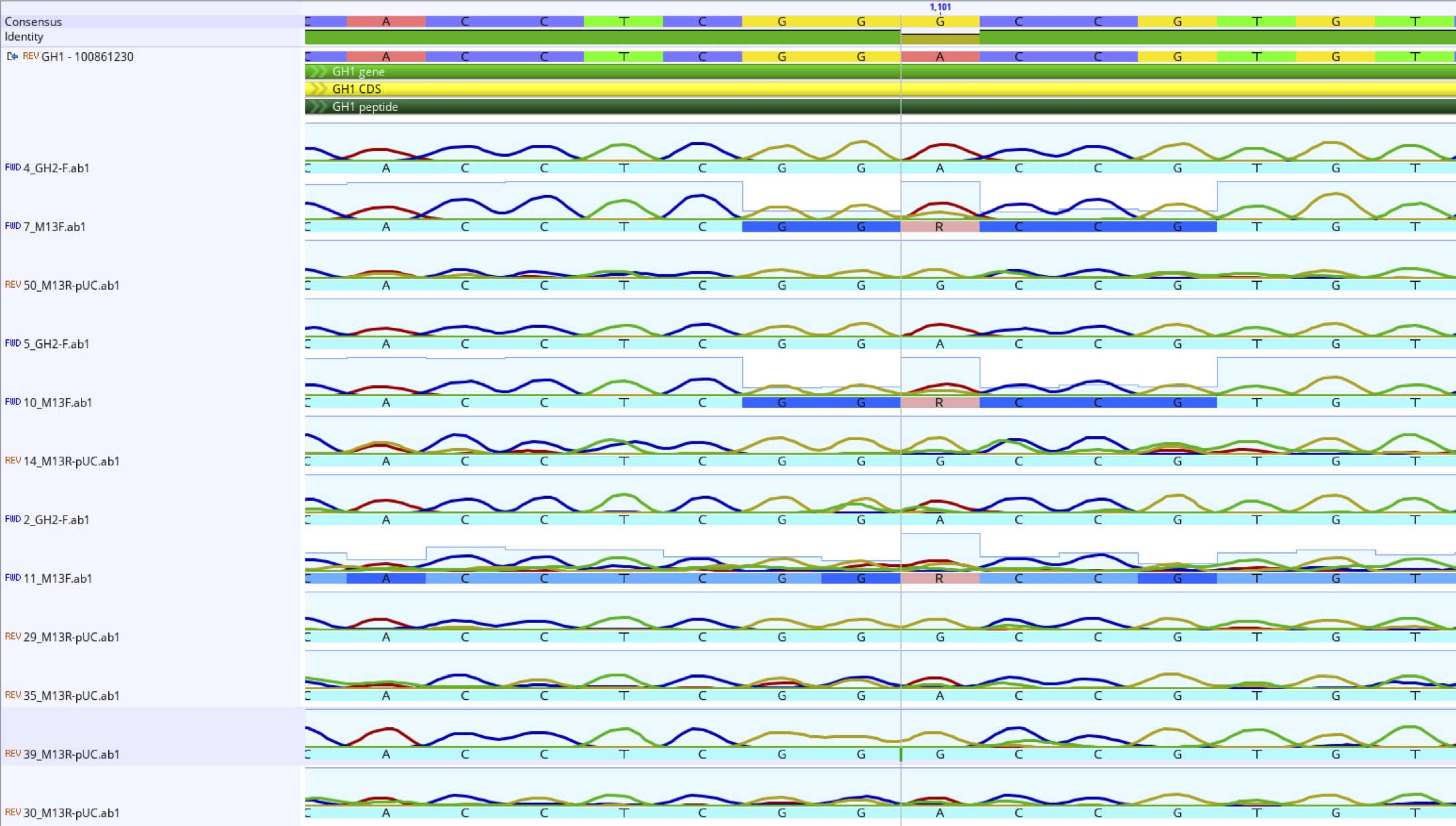
Detection site of GH gene A1101G SNP.
which could also be attributed to the small sample size and limited nutritional resources available to the animals, Hua et al. (2009) reported that genetic polymorphism in the GH gene associate with growth traits in Boer goat. Moreover, the results demonstrated a significant effect of the A1101G SNP on maternal weight, favoring mothers with the GG genotype, followed by the AG, whereas those with the AA genotype had the lowest weight. In the case of the local goat population, only the AG and GG genotypes were observed, with the absence of the wild-type genotype. This was due to the number of individuals carrying the AA genotype being fewer than three, which could potentially compromise the statistical analysis; therefore, it was excluded. The results showed that the A1101G SNP significantly affected average gain in AG genotype. However, no significant effects of the A1101G SNP on the other growth traits studied. The results of this study are similar with the results of Wickramaratne et al. (2010) proved that the use of growth hormone gene polymorphism in selecting Osmanabadi and Sangamneri Goat breeds is efficient tool to improve the growth traits and increase the economic income and he determine many SNPs such as A497G, A499G C500G C501-2 C730T C781T and C2055T which can classified as a genetic markers for growth traits. The results also agreed with those of Mahrous et al. (2018) who indicated considerable SNPs that effected significantly on growth in three goat breed in Egypt.
Table 3: Relationship of A1101G SNP in GH gene polymorphism with growth traits in Shami and local goats
| Traits | A 1101G | Sig. | ||
| Shami | AA | AG | GG | |
| Birth Weight (kg) | 3.190.2 6±ab | 3.5 ± 0.18 a | 3.16 ± 0.14b | * |
| Weaning Weight (kg) | 22.87 ±1.26 | 22.37 ± 1.62 | 21.50 ± 0.84 | N.S |
| average gain from birth to weaning (kg) | 19.59± 1.05 | 18.78 ± 1.71 | 18.34 ± 0.77 | N.S |
| Dam Weight (kg) | 36.85 ± 1.73 b | 41 ± 2.24 ab | 43.34 ± 1.88 a | * |
| Local | ||||
| Birth Weight (kg) | ---- | 3.13 ± 0.16 | 0.10± 3.11 | N.S |
| Weaning Weight (kg) | ---- | 23.33 ±1.33 | 21.31 ±0.75 | N.S |
| average gain from birth to weaning (kg) | ---- | ±20.20 1.21a | 0.74± 18.20 b | * |
| Dam Weight (kg) | ---- | 41.00± 2.49 | 1.14± 39.46 | N.S |
N.S.: No Significant ، * P˂ 0.05
In the same direction, El-Halawany et al. (2019) mentioned that the GH gene including many important SNPs which directly related with growth traits variation in three Egyptian goat breeds (Zaraibi, Barki, and Baladi) which support our results strongly.
Table 4: Relationship of the1101G SNP in GH gene polymorphism with milk production traits in Shami and local goats
| Breed | Trait | A 1101G | Sig. | ||
| AA | AG | GG | |||
| Shami | Total milk yield (Kg) | 132.17± 16.35 b | 186.35± 21.27 ab | 208.59± 30.93a | * |
| Lactation period (Day) | 191.14± 12.93 b | 233.00 ±4.41 a | 11.29± 197.50b | * | |
| Fertility Kid/kiding | 1.14 ± 0.14 b | 0.25± 1.25 ab | 0.12 ± 1.50a | * | |
| Local | Total milk yield (Kg) | --- | 97.66 ±16.74b | 149.57 ±14.67a | * |
| Lactation period (Day) | ------ | 5.08 ± 142.20 a | 179.50± 7.08 b | * | |
| Fertility Kid/kiding | ------- | 1.50± 0.12 a | 1.23± 0.07 b | * | |
| * P˂ 0.05 | |||||
The results presented in Table 4 indicate a significant effect of the SNP A1101G on Total milk yield in both Shami and local goats. Individuals carrying GG recorded the highest Total milk yield (208.59 kg and 149.57 kg, respectively), followed by (AG) with averages of 186.35 kg and 97.66 kg, respectively. These findings suggest that animals with the GG are superior in Total milk yield, which may be attributed to the effect of this allele in regulating other genes associated with lactation, This aligns with Gutiérrez-Gil et al. (2008), who reported that genetic polymorphisms in regulatory genes play a key role in enhancing milk production performance by influencing mammary gland efficiency and the physiological response to lactation hormones. Furthermore, the effect of SNP A1101G on Lactation Period was also significant (P<0.05). In Shami goats, (AG) exhibited the longest lactation period (233 days), whereas in local goats, the GG was associated with the longest lactation period (179.5 days). A significant effect of SNP A1101G was also observed on fertility traits in both breeds; does carrying the GG genotype in Shami goats produced an average of 1.5 kids / kidding, while in local goats, does carrying the AG had an average of 1.5 kids / kidding. This effect may be attributed to the influence of the GH gene on genes related to ovulation, which regulate the number of mature oocytes. These results are consistent with previous studies indicating that genetic polymorphisms in the GH gene play an important and effective role in milk production, fertility, and growth by regulating metabolism in livestock ; .Reproductive traits were similarly affected by the A1101G SNP. Shami does carrying the GG exhibited higher fertility, averaging 1.5 kids/kidding, while in local goats, enhanced fertility was observed in does carrying the AG. These differences may reflect the regulatory effect of GH gene variants on ovulation-related genes, influencing the number of mature oocytes and overall reproductive efficiency. Overall, these findings align with previous studies ; .
Table 5: Relationship of the1101G SNP in GH gene polymorphism with Milk Components in Shami and Local goats.
| Breed | Trait | Genotype | Sig. | ||
| AA | AG | GG | |||
| Shami | (%)Fat | ±2.390 .28 | 0.23±2.71 | ±2.54 0.18 | N.S. |
| Protein % | ±2.990 .06 | 2.88±0.21 | ±3.15 0.12 | N.S. | |
| Lactose % | ±4.41 0.16 b | ±4.370.07 b | ±4.57 0.08 a | * | |
| non-fat solids % | ±8.160.18 | ±8.220.11 | ±8.16 0.14 | N.S. | |
| Local | (%)Fat | ----- | ±2.260.18 | ±2.57 0.19 | N.S. |
| Protein % | ----- | ±3.23 0.1a | 3.06 ± 0.03b | * | |
| Lactose % | ----- | ±4.440.15 | 4.56 ± 0.06 | N.S. | |
| non-fat solids % | ----- | ±8.190.23 | ±8.26 0.08 | N.S. | |
| N.S.: No Sig. ، * P˂ 0.05 | |||||
The results in Table 5 indicate that the genetic polymorphisms associated with the A1101G SNP have no significant effect on most milk components in both Shami and local goats. However, a notable exception was observed in milk protein content, which was higher in GG 4.57% in the Shami goat, and in favor of individuals with AG (3.23%) in the local goat, These findings are consistent with those of Bekele et al. (2023), who reported a positive association between the GH gene and increased milk protein content in cattle,. This result is further supported by earlier studies conducted on farm animals, including goats and sheep .
Conclusions and Recommendations
SNP A1101G in GH gene is lead to genetic polymorphisms in productive traits of goat and we can exploit it in selection programs and improving the goat performance to achieve an economic income.
Acknowledgements
We are grateful to the management of the Ruminant Station of the Agricultural Research Department- Ministry of Agriculture, for their support in completing this study and for helping to provide the conditions suitable for its implementation.
Novelty Statement
This study is notable for being one of the few studies to examine the genetic polymorphism of the GH gene in local and Shami goats and to detect the role of SNP A1101G in productive performance.
Authors’ Contributions
Tamara H. Al-Samarai: Extraction of DNA, collation of data, and writing of the initial draft of the paper.
Dr. Wasan J. Al-khazraji: analysis data and contribution to the review and submission of the paper for publication.
Generative AI and AI-assisted technology statement
The authors declare that no generative AI and AI assisted technology was used in the creation of this manuscript.
Conflict of interest
The authors have declared no conflict of interest.
References
- Abdel-Aziem, S.H., H.A.M. Abdel-Kader, S.S. Alam, and O.E. Othman. 2015. Detection of MspI polymorphism and the single nucleotide polymorphism of GROWTH HORMON gene in camel breeds reared in Egypt. Afri. J. of Biot., 14(9): 752-757. https://ask.orkg.org/item/478328940/
- Al-Jorani , M.A., A.S.A. Al-Obaidi and Z.T. Al-Doori. 2020. Effect of feeding Panicum Mombasa grass on productive traits and carcass characteristics of Local cross breed goats. Iraqi J. Agric. Sci., 51(5): 1436 - 1447. https://doi.org/10.36103/ijas.v51i5.1154 [CrossRef]
- Al-Sayegh, M.N. and J.E. Al-Qass. 1992. Sheep and Goat Production. Dar Al-Hikma for Printing and Publishing, University of Basra, Iraq.
- An, X.P., J.X. Hou, Y.N. Lei, T.Y. Gao, and B.Y. Cao. 2015. Polymorphism and DNA methylation in KISS1 gene expression and are associated with litter size in goats. Anim. Reprod. Sci., 155(4): 36– 41. https://doi.org/10.1016/j.anireprosci.2015.01.013 [CrossRef]
- Bekele, R., M. Taye, G. Abebe, and S. Meseret. 2023. Genomic regions and candidate genes associated with milk production traits in Holstein and its crossbred cattle: A review. Int. J. Genom., 2023: 1-18. https://doi.org/10.1155/2023/8497453 [CrossRef]
- Dettori, M.L., M. Pazzola, E. Pira, P. Paschino and G.M. Vacca. 2015. The sheep growth hormone gene polymorphism and its effects on milk traits. J. Dairy Res., 82: 169-176. https://doi.org/10.1016/j.heliyon.2023.e14194 [CrossRef]
- Duncan, D.B. 1955. Multiple Range and Multiple F Tests. Biomet., 11: 1.
- El-Halawany, N., A. El-Werdanya, Y.A. El-Sayed, A.E.M. Shawky, A.F. Al-Tohamy, H. Abdel-Shafy, and F.M. Abd-El-Razek. 2019. Characterization of growth hormone gene (GH) in three Egyptian goat breeds. Meta Gene., 20: 100556. https://doi.org/10.1016/j.mgene.2019.100556 [CrossRef]
- El-Mansy, S.A., M.A.E. Naiel, I.A. Abu El-Naser, M.D. Waard, A.O. Babalghith, H.A. Ogaly G.E. Batiha and A.A. Ghazy. 2023. The growth hormone gene polymorphism and its relationship to performance and carcass features in Egyptian Awassi lambs. Heliyon., 9 .e14194. doi: https://doi.org 10.1016/j.heliyon.2023.e14194
- Falconer, D.S. and T.F.C.Mackay. 1996. Introduction to quantitative genetics (4th edition). Longman Longman, Harlow,UK.
- Hua, G.H., S.L. Chen, J.N. Yu, K.L. Cai, C.J. Wu, Q.L. Li, C.Y. Zhang, A.X. Liang, L. Han, L.Y. Geng, Z. Shen, D.Q. Xu and L.G. Yang. 2009. Polymorphism of the growth hormone gene and its association with growth traits in Boer goat bucks. Meat Sci., 81: 391-395. https://doi.org/10.1016/j.meatsci.2008.08.015 [CrossRef]
- Gutierrez-Gil, B., N. Ball, D. Burton, M. Haskell, J.L. Williams, and P. Wiener. 2008. Identification of quantitative trait Loci affecting cattle temperament. Hered., 99: 629–638. https://doi.org/10.1093/jhered/esn060 [CrossRef]
- Khatib, H., V. Schutzkus, Y. Chang, and G. Rosa. 2007. Pattern of expression of the uterine milk protein gene and its association with productive life in dairy cattle. J. Dairy Sci., 90: 2427-2433. https://doi.org/10.3168/jds.2006-722 . [CrossRef]
- Koluman-Darcan, N. and N. Silanikove. 2018. The advantages of goats for future adaptation to Climate Change: A conceptual overview. Small Rum. Res. Volu., 163: 34-38. https://doi.org/10.1016/j.smallrumres.2017.04.013 [CrossRef]
- Lan, X.Y., H. Chen, C.Y. Pan, L.J. Ming, C.Z. Lei L.S. Hua, C.L. Zhang, and S.R. Hu. 2007. Polymorphism in Growth Hormone gene and its association with production traits in goats. J. Anim. Res., 32: 55-60. https://doi.org/10.1080/09712119.2007.9706846 [CrossRef]
- Mahrous, K.F., S.H. Abdel-Aziem, M.A.M. Abdel-Hafez, M. Abdel-Mordy, and H.E. Rushdi. 2018. Polymorphism of growth hormone gene in three goat breeds in Egypt. Bull. Natl. Res. Cent., 42: 35. https://doi.org/10.1186/s42269-018-0035-0. [CrossRef]
- Marques, P., M. Pereira, M. Marques, I. Santos, C. Belo, R. Renaville, and A. Cravador. 2003. Association of milk traits with SSCP polymorphisms at the growth hormone gene in the Serrana goat. Small Rum. Res., 50: (1-2). https://doi.org/10.1016/S0921-4488(03)00104-4 . [CrossRef]
- Meira, A.N., H. Montenegro, L.L. Coutinho, G.B. Mourao, H.C. Azevedo, E.N. Muniz, A.L. Machado, L.P. Sousa-Jr, V.B. Pedrosa, and L.F.B. Pinto. 2019. Single nucleotide polymorphisms in the GH and IGF1 genes associated with carcass traits in Santa Inês sheep. Anim. Int. J. Anim. Biosci., 13: 460-468. https://doi.org/10.1017/S1751731118001362 [CrossRef]
- Missohou, A. E. Talaki, and I.M. Laminon. 2006. Diversity and Genetic Relationships among Seven West African Goat Breeds. Asian-Aust. J. Anim. Sci. Vol., 19, No. 9: 1245 – 1251. https://doi.org 10.5713/ajas.2006.1245
- Pollott, G. and E. Gootwine. 2004. Reproductive performance and milk production of Assaf sheep in an intensive management system. J. Dairy Sci., 87: 3690– 3703. https://doi.org/10.3168/jds.S0022-0302(04)73508-0 [CrossRef]
- Rasouli, S., A. Abdolmohammadi, and A. Mostafaei. 2017. Evaluation of Polymorphism in IGF-I and IGFB-3 genes and their Relationship with Twinning Rate and growth traits in Markhoz goats. Ann. Anim. Sci., 17(1): 89- 103. DOI: https://doi.org 10.1515/aoas-2016-0020
- SAS. 2018. Statistical Analysis System, User’s Guide. Statistical. Version 9.6th ed. SAS. Inst. N.C. USA.
- Seevagan, M., V. Jeichitra, R. Rajendran, and K.G. Tirumurugaan. 2015. Detection of lethal SNP (A781G) in growth hormone (GH) gene of Indian sheep. Small Rum. Res., 126: 13–15. https://doi.org/10.1016/j.smallrumres.2015.03.003 [CrossRef]
- Singh, P.P., S.S. Tomar, M.S. Thakur, and A. Kumar. 2015. Polymorphism and association of growth hormone gene with growth traits in Sirohi and Barbari breeds of goat, Veterin. World., 8(3): 382-387. doi: https://doi.org 10.14202/vetworld.2015.382-387.
- Supakorn, C. 2009. The important candidate genes in goats—a review. Walailak J. Sci. Tech; 6(1): 17-36. DOI: https://doi.org 10.2004/wjst.v6i1.70
- Wickramaratne, S.H.G., B.R. Ulmek, S.P. Dixit, S. Kumar, and M.K. Vyas..2010. Use polymorphism of GH gene in selecting Osmanabadi and Sangamneri Goats. Trop. Agric. Res. Vol., 21(4): 398 – 411. DOI: https://doi.org 10.4038/tar.v21i4.3316
- Yadav, D.K., R. Arora, A. Jain. 2017. Classification and conservation priority of five Deccani sheep ecotypes of Maharashtra, India. PLoS ONE., 12(9): e0184691. https://doi.org/10.1371/journal.pone.0184691 [CrossRef]
- Yousief, Y.M. M.O. Jaafar, and R.H. Mohsin. 2023. Relationship between Growth Hormone gene polymorphism with milk production and its components in Black Iraqi goat. Basrah J. Agric. Sci., 36(2): 285-299. https://doi.org/10.37077/25200860.2023.36.2.22 [CrossRef]
- Zhang, Z.J., Y.H. Ling, L.J. Wang, Y.F. Hang X.F. Guo, Y.H. Zhang, J.P. Ding, and X.R. Zhang. 2013. Polymorphisms of the myostatin gene (MSTN) and its relationship with growth traits in goat breeds Genet. Mol. Res. ,12(2): 965-971.
- Zonaed Siddiki, A., M.A.M. Miah, G. Islam, M.S. Kumkum, M. Rumi, M.H. Baten, and M.A. Hossain. 2020. Goat Genomic Resources: The Search for Genes Associated with Its Economic Traits. Int. J. Genom., Vol. 2020, 5940205: 13. https://doi.org/10.1155/2020/5940205 [CrossRef]

Services
Article usage statistics
Loading…
Related articles
- Correlation of PGAM2 Gene Polymorphism with Production Performance in F3 Generation of Boer × White Goat HybridPakistan Journal of Zoology · 2024
- Association Analysis of Polymorphism of FGFR1 and EBP41L5 Genes with Kidding Performance of GoatsPakistan Journal of Zoology · 2023
- Toll-Like Receptor Gene Polymorphisms and their Relationship with Performance and Immune Response in Sheep: A Systematic ReviewJournal of Animal Health and Production · 2026
- Clinical Study with Investigation of Polymorphism FSHR Gene in Twining Goats in IraqAdvances in Animal and Veterinary Sciences · 2017
- Relationship of PIT-1 Gene Polymorphism with Breeding Parameters and Body Weights of Cows and CalvesPakistan Journal of Zoology · 2018
- Genetic Diversity and Phylogenetic Analysis of Bligon Goats Using Partial Mitochondrial Cytochrome B GeneJournal of Animal Health and Production · 2025