
Introduction
Considered one of the first animals to be domesticated by man, goats are still an integral part of livestock production all over the world. They play a crucial role in small-scale farming systems in developing regions, not only due to their role in milk production, but also because they are important sources of meat . Alongside the unique ability to utilize low-quality feed to produce highly valuable food products, goats are among the important sources of monetary income and protein for rural populations, especially in resource-limited environments . Besides, goats are more productive under less optimal conditions compared to the other two major types of adult ruminant livestock, sheep and cattle .
Thyroid hormones are involved in various physiological activities like growth and development of the somatotypes, metabolism and reproductive function. They can be influenced by their excretory pattern in different physiological periods of the organisms such as growth, gestations and lactation . Type II iodothyronine deiodinase is mostly responsible for the regulation of thyroid hormone metabolism, transport and biological activity . DIO2, as an enzyme, transforms thyroxine (T₄) into the active form, triiodothyronine (T₃), thus activating thyroid hormone action (Arrojo e .
The iodothyronine deiodinase family comprises several proteins, with iodothyronine deiodinases types I, II, and III, which regulate thyroid hormone activity collectively ; . Dio2 enzyme has been found in liver tissue of patients during surgery. It basically serves as a biological catalyst to convert T₄ to T₃ by removing an iodine atom from the outer ring of the T₄ molecule.” This gene encodes its DIO2 protein’s mRNA, which is about 6.8 kilobases in length. The 5′ untranslated region contains short reading frames (uORFs or sORFs), which can serve as regulatory elements that restrain translation efficiency.
The DIO2 gene in humans encodes the D2 enzyme, which is located on the long arm of chromosome 14, in the region of q24.2–q24.3. It is located at the 12 locus in mice, 7 in sheep and 10 in goats ; ; . The gene is composed of two coding regions (exons 1 and 2) flanked by an approximately 7.4-kilobase intron. Furthermore, three transcription initiation sites were found in DIO2 gene, which explains the variability in the length of the 5′-UTR region . Hence, the present study was undertaken to determine the correlation between the DIO2 gene genotypes and milk production traits in local goat, and to examine their relationship with plasma levels of T₃ and T₄ in local goats.
Materials and Methods
Sample collection
Forty milk samples were taken from indigenous goat (2-3 years) maintained at the Animal Production Department, College of Agriculture, University of Diyala. Sampling was done between 15 October 2024 and 15th May 2025. The molecular and genetic analyses were carried out in the laboratories of The College of Agriculture and Rukan Al-Rawan Laboratory of Al-Jadriya and the thyroid hormone level was performed in Al-Hadeed Medical Laboratories.
Blood sampling and collection
Samples of blood were taken from the jugular vein of the 40 Iraqi goats, approximately 8 mL being removed from each one. The blood was then split in half. The first part (5 mL) was, immediately, transferred to the tubes filled with EDTA and stored at −18°C until the molecular procedures were performed to study the genetic characteristics of the region selected. The second sample (3 mL) was collected in serum gel tubes without EDTA for further hormonal analyses. The blood was allowed to coagulate at 37°C for 30 min and centrifuged at 6000 rpm for 5 min. The serum was collected and used to determine the levels of thyroid hormones.
Agarose gel electrophoretic analysis
To confirm the quality and presence of isolated DNA, agarose gel electrophoresis was performed and to determine the molecular size of the PCR product corresponding to the exon 2, the agarose gel electrophoresis was performed. To make up the gels, 1% agarose was dissolved in 100 mL of TBE buffer and 1.5 µL of ethidium bromide added. Then 3 µL from each PCR amplification product was loaded into the corresponding gel wells. The separation was done using electrophoretic method for 50 min under 50 V. The bands of DNA were observed and documented with a Gel Imaging System.
This gene is identified as DIO2
Primers were designed for the second exon of the DIO2 gene by using Geneious Prime software with the reference sequence in the GenBank/NCBI database (NC-030817). The designed primers gave an amplified fragment with a length of 638 base pairs (bp). Using the specific primers designed for this study, a novel single nucleotide polymorphism (SNP) was identified within exon 2 of the analysis of 40 local goats.
F: 5′ – ACAGAGTAAGCGCAGTAAAGA – 3′
R: 5′ – TGCTTCTTCACCTCGAAAAAC – 3′
For 40 DNA samples PCR amplifications were performed, the final reaction volume was adjusted to 20µL. A series of annealing temperatures (49 to 58°C) was tested to determine the temperature that gave the best results. Table 1 reveals that the amplification temperature of 57°C is the optimum temperature for the desired exon 2 region.
Table 1: The program used in the molecular analysis by PCR technique for the Exon2 region.
| Stage | Temperature (°C) | Time | Number of cycles |
| Initial denaturation | 94 | 5 min | 1 |
| Denaturation | 94 | 30 sec | |
| Annealing | 57 | 45 sec | 35 cycles |
| Extension | 72 | 35 sec | |
| Final extension | 72 | 10 min | 1 |
Genotyping using DNA Sequencing technology
The second exon was amplified to give the desired 638 bp PCR product which was used to identify genetic variants by DNA sequencing. After being amplified, all 40 samples were then sent to a sequencing lab in South Korea. Sanger sequencing method was used for sequence determination. The nucleotide sequences obtained from the samples were then compared with the sequences deposited in GenBank/NCBI database using BLAST search tool, and appropriate bioinformatics software for sequence evaluation and identification of genetic variation.
Milk traits
Milk production was recorded weekly for all goats, which were milked manually. Total milk yield (TMY) was calculated based on daily milk production using the following parameters. The lactation period for each goat was also measured during the experimental period until weaning:

TMY: Milk production overall; T0: Date when the first measurement was taken; T1: Birth date; Tr: Measurement date for the given month; Tr-1: Measurement date for the month before; M1: Milk amount at the first measurement; Mr: Milk amount at the specified measurement; Mr-1: Milk amount at the previous measurement.
Using a Milk Analyzer, the content of the major milk components, such as protein, fat, lactose, solids-not-fat and mineral content, were determined. The milk was promptly put into specially designed bottles. Then, after thawing at room temperature, they were mixed before measurement to check the degree of homogeneity of the milk components. The analysis was conducted over two periods: the first period after the birth of the offspring, and the second period at the time of weaning, to determine the changes in milk components between the two periods and their correlation with the gene section under study.
The length of the milk season for each dam was also calculated from the start of production until drying off.
Measurement of thyroid hormone levels (T3 and T4)
Prepared plastic containers with the appropriate sample/container number and then directly placed in a refrigerated box to maintain the samples at the proper temperature until laboratory examination. Three milliliters of blood were drawn from the jugular vein into EDTA-free gel tubes using a medical syringe and centrifuged at 6000 rpm for five minutes. T3 and T4 hormone levels were measured using an i-Chroma analyzer, which operates on the principle of fluorescent immunoassay, according to the instructions in the diagnostic kit.
Statistical treatment of experimental data
The present study data were analysed statistically with the help of the Statistical Analysis System (SAS, 2018) to explore the effect of genetic variation in the second exon of the DIO2 gene on the measured traits in the local goat. Duncan’s multiple range test (1955) was used for determining the statistical significance of differences among the means. The following linear statistical model was used for the analysis:
Yijklmn = µ + Gi + Aj + Bk + Tl + Sm + eijklmn
The model is: Where, Yijklmn is the measured response for observation n, genotype i, month of birth j, year of birth k, type of birth l, and sex of offspring m; µ is the general mean of the trait under investigation; Gi is the effect of the genetic genotype at the A9280G variant site of the DIO2 gene (AA and AG); Aj is the effect of the month of birth (11, 12, 1 and 2), included as a correction factor; Bk is the effect of the birth year (2024 and 2025), incorporated for adjustment; Tl is the effect of the birth type (single or twin), used as a correction factor; and Sm is the effect of the sex of the offspring (male or female); and eijklmn is the unexplained random variation, assumed to be normally distributed with mean zero and variance σ²e.
Furthermore, the Chi-square (χ²) test was used to assess the observed proportions of the genotypes of the studied polymorphism, compared to the expected ones according to Mendel’s second law. The frequencies of alleles were estimated as reported by Falconer and Mackay (1996) by the mathematical formula based on the Hardy–Weinberg equilibrium.
Table 2: Genotypes at the A9280G mutation site and their effect on the amino acid within the second expression region (Exon2).
| Mutation site | A9280G |
| Genotype | AA , AG |
| Type of mutation | Missense |
| Amino acid before mutation | Glutamine ( CAG ) |
| Amino acid after mutation | Argenine ( CGG ) |
Results and Discussion
DIO2 gene / Exon 2 polymorphism
The polymerase chain reaction, followed by DNA sequencing analysis, indicated that the results from the analyzed Exon 2 region of the DIO2 gene showed a mutation. The point of mutation was at locus A9280G, the substitution of the nucleotide A (which would encode the amino acid glutamine) by nucleotide G was found by sequence analysis. The identified genetic variation was classified as a missense mutation since a change in base was associated with a change in the coded amino acid as shown in Table 2. As a result of the variation of the nucleotide sequence, two genotypes appeared: AA and AG. A hybrid, or a nucleotide substitution in one allele, is the AG genotype, while homozygosity, or the stability of the nucleotide in both alleles, is the AA genotype.
This missense mutation has been identified and is of great importance since it occurs in the coding sequence of exon 2. Therefore, if the nucleotide changes, this changes the amino acid sequence that is coded for by this area. A change like this could affect the tertiary structure of the protein that is produced and can therefore have an impact on its biological activity. The DIO2 gene encodes the type II deiodinase enzyme, a crucial participant in the metabolism of thyroid hormones that converts thyroxine (T4) to triiodothyronine (T3), the active physiologically-acting hormone. So any modification of the amino acid sequence of this enzyme may disrupt the normal efficiency of this biochemical change and in turn important physiological functions, especially metabolism and growth, could be affected.
The result of the present study is similar to that reported by Abd Al-RaZaq (2019) who found a substitution in the second exon of DIO2 gene in Awassi sheep, which is C478G. This change led to the change of amino acid proline to alanine. Conversely, the present result contradicts He et al. which found that the G482C mutation in the second exon of the same gene did not lead to an amino acid change, and hence was not likely to affect the function of the encoded protein .
The relationship between DIO2 Gene polymorphism with total milk yield and lactation period
Results (summarized in Table 3) indicated that there were no statistically significant differences among the genotypic effect of DIO2 gene on total milk production or lactation period.The highest calculated mean for milk yield was (7253.57 ± 1029.02 ml) for the heterozygous AG genotype, while the mean total milk yield was 7164.29 ± 490.79 ml for animals with the homozygous AA genotype. The current study is consistent with previous studies ; ; ; conducted on sheep, all of which indicated the superiority of the heterozygous genotype in total milk yield.
Table 3: Relationship between DIO2 gene genotypes with milk yield and lactation period.
| Genotype | Number of observations | Mean ±Standard error | |||||
| Total milk yield (ml) | Lactation period (days) | Milk yield in the first period (ml) | Number of observations | Milk yield in the second period (ml) | |||
| AA | 36 | 7164.29 ± 490.79 | 46.86 ± 1.05 | 5141.4 ± 386.06a | 34 | 2329.62 ± 190.65 | |
| AG | 7 | 7253.57 ± 1029.02 | 48.14 ± 1.82 | 1.89 | 4976.33±794.28b | 6 | 2247.33 ± 422.80 |
| Significance level | ----- | NS | NS | 1.74 | * | NS | |
| NS: Not significant (P≤ 0.05)* | |||||||
Table 4: Relationship between DIO2 gene genotypes and milk components during the first production period.
| Genotype | Number of observations | Mean ± Standard error | ||||||
| Protein (%) | Fat (%) | Lactose (%) | Density (%) | SNF (%) | Mineral (%) | |||
| AA | 36 | 5.31 ±1.22 a | 5.36 ±0.70a | 5.33 ± 0.06 a | 39.47±2.08 | 13.88 ±2.61 | 0.893±0.02 | |
| AG | 7 | 3.98± 0.13 b | 4.10 ± 0.83 b | 1.89 | 6.05±0.20b | 37.62±0.86 | 11.08± 0.33 | 0.885 ±0.03 |
| Significance Level | ----- | * | * | 1.74 | * | NS | NS | NS |
| NS: Not significant ( P ≤.05) * | ||||||||
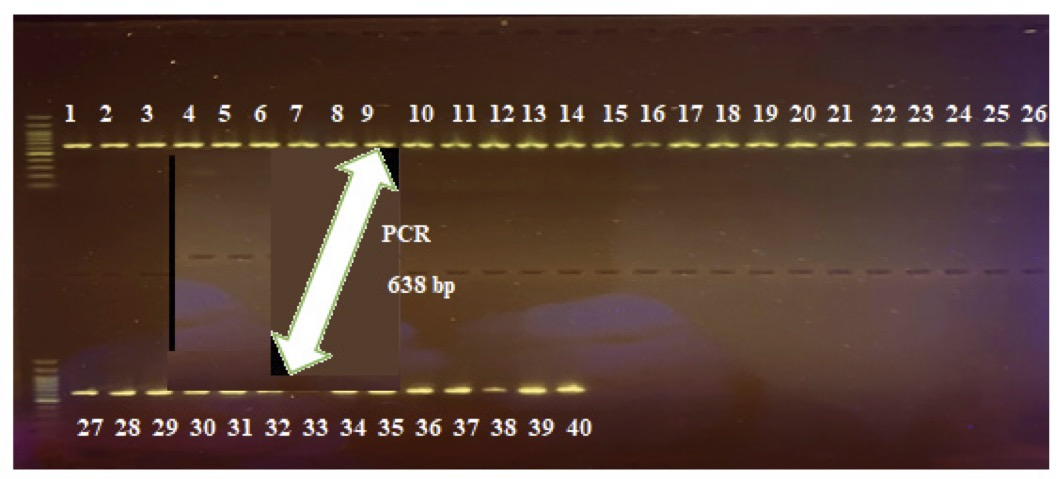
PCR product size for the exon II region of the DIO2 gene using 1% agarose gel with a molecular marker (100–1500 bp).
A significant difference (P ≤ 0.05) was observed in milk yield in the first milk production period, however. The goats with the genotype AA had the highest production with a mean value of 5141.4 ± 386.06 mL while those carrying the genotype AG had a mean of 4976.33 ± 794.28 mL. In contrast, the differences were not significant in lactation period and milk yield in the second period, despite the calculated milk yield being higher for individuals carrying the wild genotype; the small number of observations in this period led to the statistical significance being masked. The higher milk production in goat AA (wild genotype) compared to AG (heterozygous genotype) in the initial production period could be attributed to the potential effect of the mutant allele on the activity or expression of the DIO2 enzyme. The expression of DIO2 might be reduced due to the presence of the mutant allele and as a consequence thyroid hormone conversion and metabolism of associated pathways affecting milk type and production might be altered.It may be that this decrease in enzyme levels resulted in a general reduction in mRNA levels at specific sites in the organs, which in turn positively affected the decrease in T3 levels, which are related to metabolic processes.
The relationship between DIO2 Gene polymorphisms and the main components of milk in local goats
The statistical results also revealed significant differences (P ≤ 0.05) between the DIO2 genotype and protein level, fat level and lactose level during the first milk production period. The results are shown in Table (4). The highest mean values for each were 5.31 ± 1.32%, 5.36 ± 0.70%, and 5.33 ± 0.06%, respectively, favoring individuals carrying the homozygous AA genotype, while milk from the AG genotype had the least amount of protein, fat, and lactose recorded. This study agrees with other studies on fat percentage conducted on sheep ; . It is recognized that fat is a crucial component of milk, and the quality of the milk — as well as the quality and type of product manufactured from it — is dependent on it. Regarding protein percentage, this study was nearly similar to the findings of Abd Al-Razaq (2019) in her study on Awassi sheep, where the protein percentage in the current study and the other study was 5.31 ± 1.32% and 5.45 ± 0.18% for the AA and CC genotypes, respectively. The findings of present investigation showed better agreement in finding significant difference in milk protein percentage than obtained by Oravcova et al. (2007), Molic et al. (2008) and Al-Jawari (2011). However, the results of this study did not agree with the results reported by Abd Al-Razaq (2019) for the percentage of lactose and solids not fat. The current study showed that lactose percentage varied significantly amongst the genotypes, AA genotype having more lactose than AG genotype with mean of 5.33 ± 0.06% and 6.05 ± 0.20% respectively. On the other hand, there was no significant difference in milk density, solids- not-fat content and mineral concentration between the genotype for the early milk production period.
Table 5: Relationship between DIO2 gene genotypes and milk components during the second production period.
| Genotype | Number of observations | Mean ±Standard error | ||||||
| Protein (%) | Fat (%) | Lactose (%) | Density (%) | SNF (%) | Mineral (%) | |||
| AA | 31 | 3.73 ± 0.04a | 4.67± 0.23a | 5.63± 0.09a | 35.33 ± 0.45 a | 13.53 ± 3.14a | 0.825±0.01a | |
| AG | 5 | 2.86 ± 0.27b | 2.76 ±1.10b | 1.89 | 6.05 ±0.20b | 29.64 ± 2.65 b | 8.70 ± 1.04 b | 0.700 ±0.08b |
| Significance Level | ----- | ** | ** | 1.74 | ** | ** | * | ** |
| (P ≤ 0.05)* ، (P ≤.01)** | ||||||||
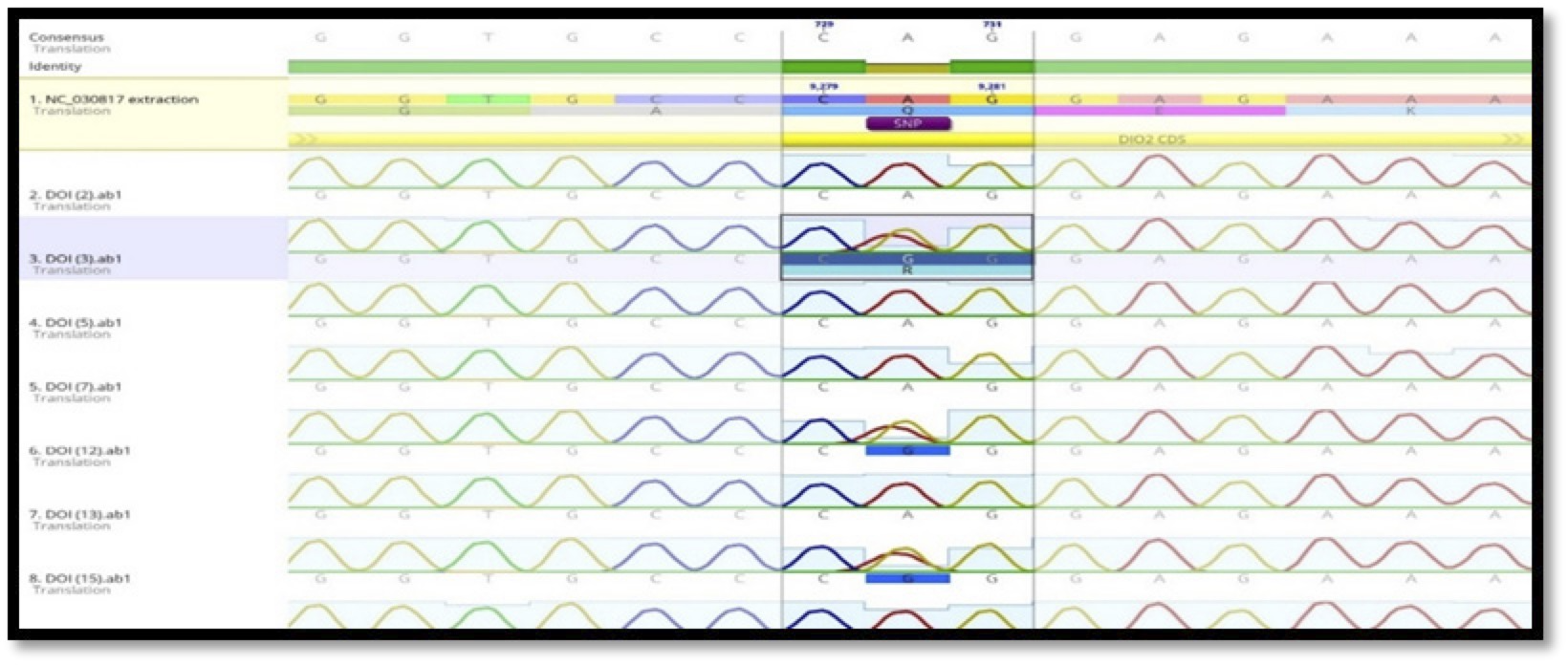
DIO2 gene / exon 2 region polymorphism at position 9280.
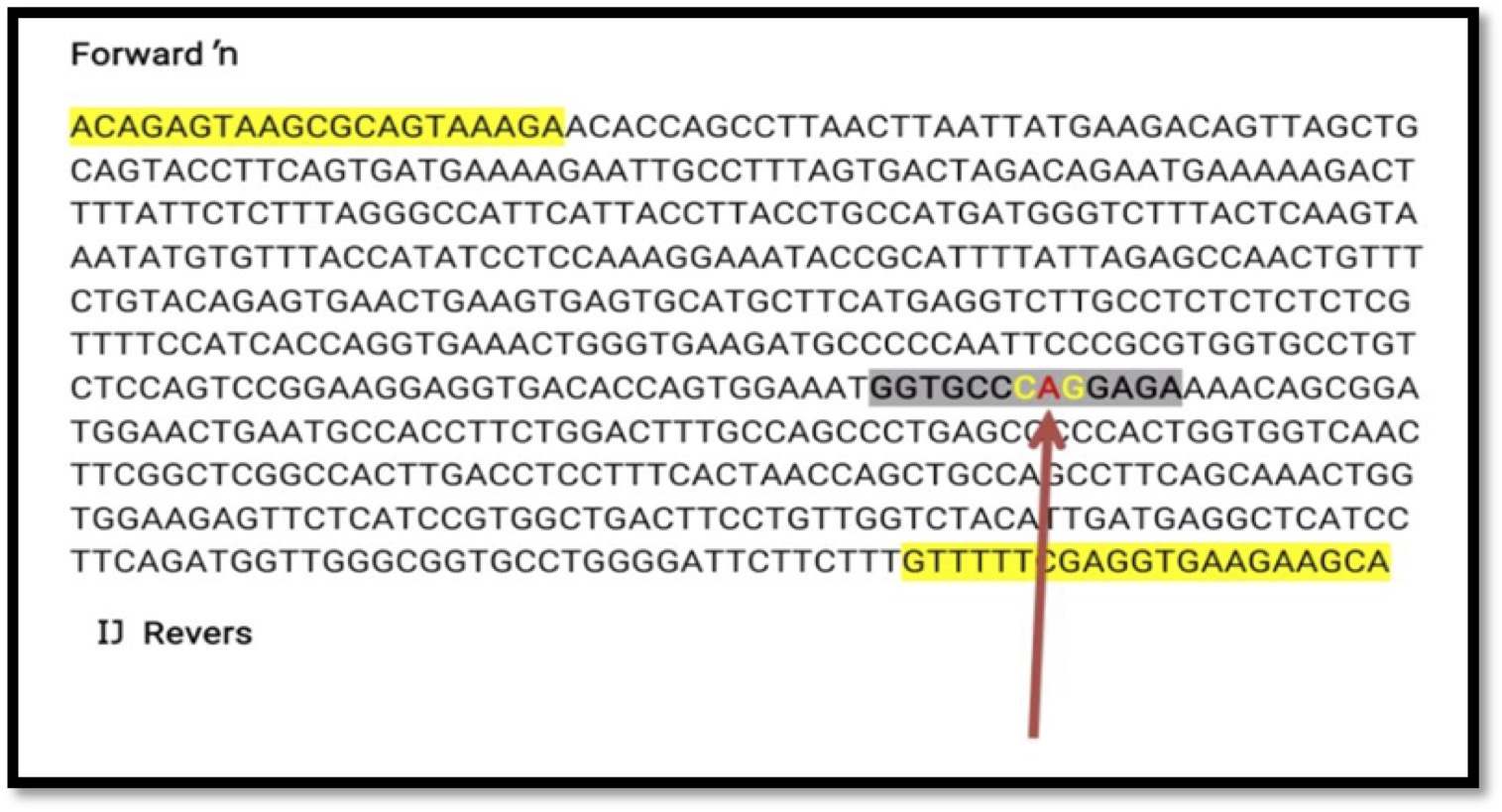
Location of the mutation within the 638 base pair amplified sequence.
As for the second production period, the differences were highly significant for protein, fat, lactose, density, and minerals for the AA genotype, as the means reached 3.73 ± 0.04%, 4.67 ± 0.23%, 5.63 ± 0.09%, 5.33 ± 0.45, and 0.825 ± 0.01%, respectively, while the differences were significant for non-fat solids. The superiority of the homozygous AA genotype over the hybrid AG genotype in these percentages indicates that the homozygous genotype enhances the maximum productivity of bioactive components during the early periods, as the presence of the G allele negatively affected the levels of the DIO2 enzyme in adipose tissue (Table 5).
Relationship between DIO2 Genotype and thyroid hormones
The detected gene genotypes and how they affect the levels of triiodothyronine (T3) and thyroxine (T4) in local goat does’ blood is shown in Table 6. No significant differences were found between the two groups (AA, AG) in the levels of either circulating T3 or T4. For T3, animals with the AA genotype had an average concentration of 1.712 ± 0.10 nmol/L while the corresponding concentration for animals with the AG genotype was 1.67 ± 0.28 nmol/L. As for T4 hormone concentration, it was 66.16 ± 3.23 nmol/L for the AA genotype and 67.85 ± 3.31 nmol/L for the AG genotype.
Table 6: Relationship between DIO2 gene genotypes and the concentrations of thyroid hormones T₃ and T₄.
| Genotype | Number of observations | Mean ± Standard erroe | |
| T3 (nmol/L) | T4 (nmol /L) | ||
| AA | 36 | 1.712 ± 0.10 | 66.16 ± 3.23 |
| AG | 7 | 1.67 ±0.28 | 67.85 ±3.31 |
| Significance level | --- | NS | NS |
| ( P ≤ 0.05)* , NS : Not significant | |||
These results contradict the findings of Abd Al-Razaq (2019), who found significant differences between T3 and T4 hormone levels for the genetic structures of Awassi sheep, where the wild genotype (CC) surpassed the hybrid (CG) in T3 and T4 levels.
No significant differences were found between the AA and AG groups for T₃ and T₄, but a numerical difference was noted for T₃. The mean T₃ level in the goats with AA genotype was more (1.71 nmol/L) than with AG genotype (1.67 nmol/L). The lower T₃ concentration in AG animals may be due to a mutation in the A9280G polymorphic position that could affect the amount of DIO2 enzyme present or activity. The similarity of the T₄ values obtained for the two genotypes could be attributed to the fact that T₄ is the main precursor and circulating source of T₃. Furthermore, the G allele can have a negative effect on the conversion of T₄ to T₃ because it can affect deiodination, a chemical process that removes an iodine atom from the T₄ molecule.
Conclusions and Recommendations
Among the local black goats two genotypes were found, AA and AG, in the genetic variant A9280G in the DIO2 gene, with GG being not observed. This nucleotide change was a missense change, which caused a change of glutamine to arginine. Overall milk yield, lactation duration and milk production during early lactation were not affected significantly by the polymorphism, but goats with the AA genotype performed better than AG goats, especially in the production of lactose, protein and fat during the early lactation period. There was no difference in T₃ and T₄ concentrations, although T₃ tended to be higher in AA goats, which may be related to a decrease in the expression or activity of the DIO2 enzyme. So, DIO2 gene may be used as a potential candidate gene in future large-scale genetic studies and selection programmes for milk production characteristics in goats.
Acknowledgment
The authors would like to acknowledge the research facilities provided by the College of Agriculture at the University of Diyala and technical support from Al-Rukan Al-Rawan Laboratory, Al-Hadeed Medical Laboratories in molecular and hormonal analyses.
Novelty Statement
This study is the first to identify the A9280G polymorphism in exon II of the DIO2 gene in Iraqi local black goats. The findings reveal for the first time an association between this polymorphism and milk production traits. These results highlight the potential of the DIO2 gene as a novel genetic marker that could be used to improve selection and productivity programs in indigenous goat breeds.
Authors’ Contribution
Warqaa S. Mahdi: Conducted field and laboratory experiments, collected data, and performed analyses.
Zaid M. Mahdi: Both authors were involved in the research, analysis and interpretation of the findings, draft of the manuscript and the final one submitted.
Generative AI and AI-assisted technology statement
The authors declare that no generative AI and AI assisted technology was used in the creation of this manuscript.
Conflict of interest
The authors declare no financial, personal, or professional conflicts of interest that could be construed to bias their interpretation or reporting of the results of this study.
