
The combined application of induced mutagenesis and hybridization is an effective approach for expanding genetic variability in cotton breeding; however, the interaction between gamma irradiation and hybrid performance remains insufficiently understood. In this study, dry seeds of the cotton (Gossypium hirsutum L.) analyzer line L-70 were exposed to 400 Gy gamma irradiation using a ^60Co source. The resulting M₁ plants were used as female parents in crosses with donor lines L-39, L-37, L-34, and L-35, as well as commercial cultivars Surkhan-108 and Surkhan-103. Seed germination, plant viability, plant height, and internode number were evaluated under field conditions using a randomized complete block design with three replications, and the data were analyzed using ANOVA (p < 0.05). Gamma irradiation significantly reduced seed germination (71.42% to 40.00%), plant viability (65.08% to 37.62%), plant height (91.44 to 79.12 cm), and internode number in the M₁ generation, confirming its inhibitory effect on early growth and development. The performance of F₁ hybrids was strongly genotype-dependent. The hybrid F₁ L-35 × M₁L-70 exhibited the highest germination (80.00%) and viability (75.24%), indicating a pronounced heterotic effect, while F₁ L-39 × M₁L-70 showed superior vegetative growth, reaching 101.25 cm at maturity and exceeding its parental line by 11.08 cm. In contrast, hybrids involving L-34 and L-37 displayed substantial reductions in germination, viability, plant height, and internode number, suggesting unfavorable allelic interactions and hybrid depression. The observed variation among hybrid combinations reflects the involvement of additive, dominance, and epistatic gene effects in the inheritance of these quantitative traits. Overall, the results demonstrate that the integration of gamma-induced mutagenesis and hybridization generates considerable phenotypic variability in cotton and can facilitate the identification of superior breeding materials. In particular, the combinations L-39 × M₁L-70 and L-35 × M₁L-70 were identified as promising genetic resources for the development of high-performing cotton cultivars with improved agronomic potential.
Research Article · Volume 39, Issue 4, Pages 31–42, 26 October 2026 · Open Access
Seed Germination, Viability, and Growth Dynamics of Intra-and Interspecific Hybrid Cotton Plants under Gamma Irradiation
· · · · · · · · · ·
Affiliations & Notes ⌄
- 1National University of Uzbekistan named after Mirzo Ulugbek, Tashkent, Uzbekistan
- 2Tashkent State Agrarian University, Tashkent, Uzbekistan
- 3Research Institute of Horticulture, Viticulture and Winemaking named after Academician Mahmud Mirzayev, Tashkent, Uzbekistan
- 4Quaid-i-Azam University, Islamabad, Pakistan
- 5Gulistan State University, Gulistan, Uzbekistan
- 6Karakalpakstan Institute of Agriculture and Agrotechnologies, Nukus, Karakalpakstan, Uzbekistan
- *Correspondence | Azamat Yuldoshkhonov; Email: yoldoshxonovazamat9@gmail.com
Article Info ⌄
- Journal:
- Pakistan Journal of Agricultural Research
- Submitted Date:
- 27 March 2026
- Accepted Date:
- 7 October 2026
- Published Date:
- 26 October 2026
From the article
- Plant height analysis revealed significant genotype-dependent variation across all developmental stages (budding, flowering, and maturity), indicating differential responses of parental lines and their F₁ hybrids to gamma irradiation and hybridization.
- The observed variation in seed germination, plant viability, growth dynamics, and internode number among parental genotypes, mutant lines, and their F₁ hybrids indicates a complex genetic architecture underlying these quantitative traits under the combined influence of gamma irradiation and hybridization.
- For example, in combinations involving L-34 and L-35, the superiority of parental genotypes over hybrids in both plant height and internode number indicates a higher frequency and expression of dominant alleles in parental forms, whereas hybridization resulted in their partial suppression (Table 4).
- In Surkhan-108, parental superiority suggests stable dominant allele expression, whereas in Surkhan-103 combinations, relatively improved hybrid performance indicates allelic redistribution and possible overdominance effects (Table 4).
Selected from the article's own text.
Abstract
Introduction
Cotton (Gossypium spp.) is one of the most important fiber and oilseed crops worldwide, playing a key role in the global textile industry and agricultural economy. In addition to fiber production, cottonseed is an important source of oil and protein, with cottonseed oil being used in human food products and processed cottonseed meal and protein fractions being primarily used as animal feed. Because cottonseed contains gossypol, appropriate processing is required for its safe use in food and feed applications. Therefore, improving both fiber and seed-related traits remains a major objective in modern cotton breeding programs ; . In this context, improving the genetic potential of cotton while maintaining high seed quality and reliable crop establishment is essential for sustainable cotton production. Seed germination, viability, and early growth dynamics are critical indicators of plant performance, as they directly determine successful crop establishment and productivity. These traits are highly sensitive to genetic factors as well as external influences, including mutagenic treatments . Recent studies emphasize that early developmental traits such as germination rate, seedling vigor, and survival capacity are closely associated with yield stability and stress tolerance . Consequently, evaluating these traits in genetically diverse cotton materials is important for identifying breeding materials with improved establishment and developmental performance. Gamma irradiation is widely applied in plant breeding as a powerful mutagenic tool for inducing genetic variability. It causes structural and functional changes at the DNA level, leading to the emergence of new phenotypic variations. Depending on the dose, gamma radiation may stimulate physiological processes or inhibit growth due to oxidative stress and cellular damage ; ; ; . This dual effect highlights the importance of optimizing irradiation conditions in breeding programs. Therefore, assessing germination, viability, and subsequent growth responses following gamma irradiation can provide valuable information for determining the biological effects of mutagenesis and identifying potentially useful variation for cotton improvement. Hybridization is another fundamental approach for cotton improvement. Intraspecific hybridization allows the exploitation of heterosis within species, while interspecific (distant) hybridization enables the transfer of valuable traits across species boundaries, including stress tolerance, disease resistance, and improved seed composition ; . Studies on distant hybrids have shown that economically important traits can exhibit complex inheritance patterns influenced by gene interactions.
In particular, the inheritance of seed oil content in distant cotton hybrids has been investigated by Amanturdiev et al. (2021), who reported that in F₂ populations, the appearance of non-parental traits indicates additional gene effects, suggesting that oil content may not follow simple polygenic inheritance. This highlights the genetic complexity of economically important seed traits in hybrid populations.
Recent advances in cotton genetics further support the importance of integrating classical breeding with modern molecular approaches. For instance, marker-assisted selection (MAS) has proven effective in identifying genes associated with fiber quality, disease resistance, and abiotic stress tolerance. A recent study by Narkizilova et al. (2025) demonstrated that specific molecular markers (e.g., BNL1604, Gh247, BNL3255) are strongly associated with fiber traits and Fusarium wilt resistance, emphasizing the role of genomics in accelerating cotton improvement. These developments demonstrate that combining genetic diversity generated through hybridization and mutagenesis with systematic evaluation of early developmental traits may provide an effective strategy for identifying promising cotton genotypes.
Despite these advances, the combined effects of mutagenesis and hybridization—particularly their influence on seed germination, viability, and early growth dynamics—remain insufficiently studied. Most previous research has focused either on mutation breeding or hybrid performance separately, with limited attention given to their interaction across developmental stages. This represents an important research gap because the response of hybrid cotton materials to gamma irradiation may differ according to their genetic background, and such differences may become evident during germination, seedling establishment, and subsequent growth. Accordingly, the scope of present study encompasses the comparative evaluation of germination, seed viability, survival, and early growth dynamics in intra- and interspecific hibrid cotton materials obtained from gamma-irradiated seeds. The specifically focuses on determining how gamma irradiation influences these developmental traits in different hybrid genetic backgrounds and on identifying differences in their responses during early plant development.
Therefore, the present study aims to evaluate seed germination, viability, and growth dynamics of intra- and interspecific hybrid cotton plants derived from gamma-irradiated seeds. The specific objectives are to (i) determine the effects of gamma irradiation on seed germination and viability, (ii) compare early growth and survival dynamics among intra- and interspecific hybrid materials, and (iii) assess the potential of irradiation-induced variation for identifying promising genetic materals for cotton breeding. This research will contribute to a better understanding of the interaction between induced mutagenesis and hybrid genetic systems, and its potential application in developing high-yielding, stress-tolerant cotton varieties.
Materials and Methods
Plant material
The experimental material consisted of genetically diverse upland cotton (Gossypium hirsutum L.) collection lines obtained from the breeding program of the National University of Uzbekistan. The study included one analyzer line L-70 (Accession No. NUZ-131) which was used as the female parental line for gamma irradiation and subsequent hybridization with selected donor lines. In this study, the term “analyzer line” refers to the selected parental line used as common female parent to evaluate the responses and combining performance of different donor genotypes in hibrid combinations. Four donor lines used: L-39 (Accession No. NUZ-79), L-37 (Accession No. NUZ-77), L-34 (Accession No. NUZ-73), and L-35 (Accession No. NUZ-74), along with two commercial cultivars, Surkhan-108 (Accession No. NUZ-S-108) and Surkhan-103 (Accession No. NUZ-S-103). These accession numbers correspond to the collection identifiers maintained by the National University of Uzbekistan breeding program.The collection lines are maintained in the cotton breeding collection of the National University of Uzbekistan and can be obtained, subject to institutional availability and permission, by contacting the corresponding author or the breeding program. The genotypes were selected based on their contrasting agronomic traits, adaptability, and genetic backgrounds to ensure a broad spectrum of variability for hybridization and mutagenesis studies ; .
Gamma irradiation and hybridization
Dry seeds of the analyzer line L-70 were exposed to gamma irradiation at a dose of 400 Gy using a cobalt-60 (⁶⁰Co) gamma source. Gamma irradiation is a widely applied physical mutagen known to induce heritable genetic variation through DNA damage, including single- and double-strand breaks, leading to mutations (IAEA, 2018; . Following irradiation, treated seeds were sown to obtain the M₁ generation. The designation M₁ refers to the first generation of plants obtained from mutagen-treated seeds, where “M” denotes the mutant generation and “₁” denotes the first generation following mutagenic treatment. Plants grown from irradiated seeds were used as female parents in controlled hybridization experiments. Crosses were performed manually between M₁ plants of L-70 and selected donor lines (L-39, L-37, L-34, L-35, Surkhan-108, Surkhan-103) following standard emasculation and pollination techniques in cotton . The resulting hybrid seeds constituted the F₁ generation.
Experimental design
The experiment was conducted under field conditions at the experimental field of the National University of Uzbekistan, Tashkent, Uzbekistan, using a randomized complete block design (RCBD) with three replications to minimize environmental variation. Each experimental plot measured 10 m × 15 m (150 m²). The experiment included 14 experimental variants, resulting in a total of 42 plots. The experimental field was characterized by an old irrigated typical sierozem (gray soil), with a silt loam texture based on the USDA soil-texture triangle. According to the USDA Soil Taxonomy, this soil is classified as Ustic Torriorthent, while in the FAO/WRB system it corresponds to a Calcic Xerosol.The cotton seeds were sown on April 10, 2023. During the experimental period, the mean air temperature was 24.6 °C, with minimum and maximum temperatures of 16.2 °C and 34.8 °C, respectively. The total rainfall recorded during the experimental period was 182.4 mm. The experimental plots were irrigated because the field was maintained under irrigated conditions. Irrigation was applied in April, May, June, and July 2023 at approximately 60 mm per irrigation, with a total of 6 irrigation events and approximately 360 mm of irrigation water applied during the growing season. Irrigation timing was determined according to crop water requirements and field conditions. Each experimental variant included 126–210 seeds, depending on seed availability and hybrid combination. Seed germination and plant survival were recorded under natural field conditions. Germination was assessed according to the guidelines of the International Seed Testing Association (ISTA, 2020), where seeds were considered germinated upon radicle emergence. Germination observations were conducted from April 15, 2023 to May 5, 2023, and plant viability was recorded at the designated developmental stages. Growth and developmental parameters were recorded at three key phenological stages: Budding stage (June 15, 2023), flowering stage (July 20, 2023), and maturity stage (August 25, 2023). Main stem height and internode number were measured on June 15, 2023 at the budding stage, July 20, 2023 at the flowering stage, and August 25, 2023 at the maturity stage. The cotton plants were harvested on September 30, 2023. Standard agronomic practices were uniformly applied across all experimental plots.
Measured traits
The following morphological and physiological traits were evaluated: Seed germination (%) – calculated as the proportion of germinated seeds relative to total seeds sown.
Plant viability (%) – determined as the percentage of surviving plants at each developmental stage.
Main stem height (cm) – measured from soil surface to apical meristem.
Number of internodes – counted along the main stem.
These traits are widely used as indicators of plant vigor, adaptability, and mutagenic effects in cotton breeding programs ; .
Statistical analysis
All experimental data were subjected to statistical analysis using standard biometric methods. Mean values and standard errors (X ± m) were calculated for each trait. Differences among control lines and hybrid combinations were evaluated using analysis of variance (ANOVA), followed by appropriate post hoc comparisons. Statistical significance was set at p < 0.05. All statistical analyses were performed using R statistical software, version 4.6.1.
Results
Seed germination and viability
Seed germination and plant viability varied considerably among the studied cotton genotypes and their F₁ hybrid combinations under both control and gamma-irradiated (400 Gy) conditions (Table 1), indicating a strong genotype-dependent response to mutagenic treatment. The L-39 genotype and its hybrid (F₁ L-39 × M₁ L-70) exhibited comparable performance, with germination rates of 67.61% and 67.15%, respectively, and viability values of 65.24% and 64.70%. This similarity suggests the absence of both heterotic effects and hybrid depression for these traits in this combination.
Table 1: Seed germination and plant viability of cotton genotypes and their F₁ Hybrids
| Genotype / Hybrid Combination | Treatment | Germination (%) | Viability (%) | Effect |
| L-39 | Control | 67.61 | 65.24 | – |
| F₁ L-39 ×M₁L-70 | 400 Gy | 67.15 | 64.70 | Stable |
| L-37 | Control | 60.48 | 60.47 | – |
| F₁ L-37×M₁L-70 | 400 Gy | 44.28 | 40.48 | Decrease |
| L-34 | Control | 60.11 | 54.76 | – |
| F₁ L-34×M₁L-70 | 400 Gy | 35.25 | 32.05 | Strong decrease |
| L-35 | Control | 51.59 | 47.62 | – |
| F₁ L-35×M₁ L-70 | 400 Gy | 80.00 | 75.24 | Heterosis |
| L-70 | Control | 71.42 | 65.08 | – |
| M₁ L-70 | 400 Gy | 40.00 | 37.62 | Radiation effect |
| Surkhan-108 | Control | 74.40 | 70.24 | – |
| F₁ Surkhan-108 × M₁ L-70 | 400 Gy | 73.81 | 68.45 | Slight decrease |
| Surkhan-103 | Control | 70.24 | 65.48 | – |
| F₁ Surkhan-103 × M₁ L-70 | 400 Gy | 66.67 | 63.49 | Moderate decrease |
In contrast, a pronounced reduction in both germination and viability was observed in hybrids involving L-37 and L-34 genotypes. In L-37, germination decreased from 60.48% in the parental line to 44.28% in the hybrid, while viability declined from 60.47% to 40.48%. An even stronger depressive effect was recorded in the L-34 combination, where germination dropped from 60.11% to 35.25%, and viability from 54.76% to 32.05%. These results indicate a negative interaction between parental genomes under gamma irradiation, leading to reduced seed performance and plant survival. Conversely, the L-35 genotype demonstrated a clear heterotic response. Despite relatively low germination (51.59%) and viability (47.62%) in the parental line, the hybrid (F₁ L-35 × M₁ L-70) showed a substantial increase, reaching 80.00% germination and 75.24% viability. This positive deviation highlights the potential of specific genetic combinations to enhance performance under mutagenic conditions. Gamma irradiation exerted a strong inhibitory effect on the L-70 analyzer line. Germination decreased sharply from 71.42% in the control to 40.00% in the M₁ generation, accompanied by a decline in viability from 65.08% to 37.62%. This confirms the sensitivity of this genotype to high-dose radiation. Among the tested cultivars, Surkhan-108 maintained relatively stable performance following hybridization, with only minor reductions in germination (74.40% to 73.81%) and viability (70.24% to 68.45%). Similarly, Surkhan-103 exhibited a moderate decline in germination (70.24% to 66.67%) and viability (65.48% to 63.49%) in its hybrid form, suggesting a comparatively higher tolerance to mutagenic and hybridization effects. Overall, the findings demonstrate that the effects of gamma irradiation and hybridization on seed germination and plant viability are highly dependent on genotype. While certain hybrid combinations (e.g., L-35 × M₁ L-70) exhibit strong heterosis, others (notably L-34 and L-37 combinations) show significant depression, reflecting complex genetic interactions under induced mutagenesis.
Growth dynamics (Plant Height)
Plant height analysis revealed significant genotype-dependent variation across all developmental stages (budding, flowering, and maturity), indicating differential responses of parental lines and their F₁ hybrids to gamma irradiation and hybridization.
A consistent inhibitory effect of gamma irradiation on vegetative growth was observed in the M₁L-70 line compared to the control L-70 at all stages of development. In particular, at maturity, plant height in L-70 reached 91.44 ± 2.05 cm, whereas in M₁L-70 it was significantly lower (79.12 ± 2.11 cm), confirming the suppressive effect of 400 Gy gamma irradiation on stem elongation. Hybrid combinations exhibited contrasting patterns depending on the parental genotype. The F₁ L-39 × M₁L-70 hybrid showed a pronounced heterotic response, exceeding its parental line L-39 at all developmental stages and reaching the highest plant height at maturity (101.25 ± 2.41 cm), which is 11.08 cm greater than the parent. This indicates a positive genetic interaction and possible overdominance effects for growth-related traits in this cross.
Table 2: Plant height at maturity stage in parental lines and F1 hybrids
| Genotype / Hybrid | Maturity (cm) | Difference vs Parent | Interpretation |
| L-70 (control) | 91.44 | – | Baseline |
| M1L-70 | 79.12 | −12.32 | Gamma inhibition |
| L-39 | 90.17 | – | Parent |
| F1 L-39×M1L-70 | 101.25 | +11.08 | Heterosis |
| L-37 | 82.51 | – | Parent |
| F1 L-37×M1L-70 | 74.38 | −8.13 | Negative hybrid effect |
| L-34 | 91.63 | – | Parent |
| F1 L-34×M1L-70 | 78.14 | −13.49 | Growth reduction |
| L-35 | 91.15 | – | Parent |
| F1 L-35×M1L-70 | 75.16 | −15.99 | Strong reduction |
| Surkhan-108 | 95.28 | – | Parent |
| F1 Surkhan-108×M1L-70 | 91.68 | −3.60 | Slight reduction |
| Surkhan-103 | 94.52 | – | Parent |
| F1 Surkhan-103×M1L-70 | 89.12 | −5.40 | Reduction |
In contrast, hybrids involving L-34 and L-35 demonstrated a stable reduction in plant height relative to their respective parental lines. At maturity, L-34 and L-35 reached 91.63 ± 2.42 cm and 91.15 ± 2.28 cm, respectively, whereas their F₁ hybrids attained only 78.14 ± 2.56 cm and 75.16 ± 2.31 cm. These findings indicate the absence of heterosis and suggest that alleles limiting growth may be dominant in these hybrid combinations. The L-37 genotype displayed an intermediate response pattern. Although the irradiated line (M₁L-70) slightly exceeded the control L-37 in plant height at certain stages, the F₁ L-37 × M₁L-70 hybrid showed consistently reduced growth throughout development, confirming a negative hybrid effect for this trait. A similar trend was observed in interspecific varieties. Both Surkhan-108
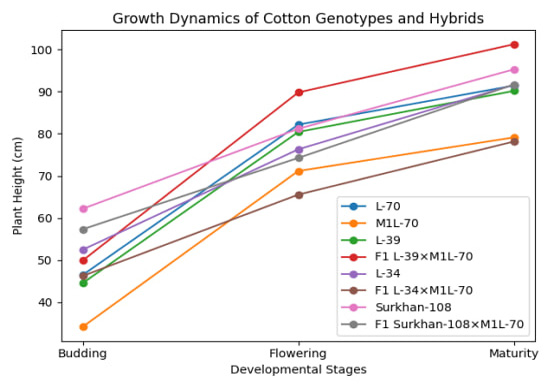
Dynamics of plant height across developmental stages in parental lines and F1 hybrids under gamma irradiation conditions.
and Surkhan-103 exhibited higher plant height values compared to their respective hybrids at all stages. At maturity, Surkhan-108 reached 95.28 ± 2.52 cm compared to 91.68 ± 2.47 cm in its hybrid, while Surkhan-103 showed 94.52 ± 2.23 cm versus 89.12 ± 2.49 cm in the hybrid. This suggests that parental genotypes possess a higher frequency of favorable dominant alleles controlling stem growth than their hybrid derivatives.
Overall, while certain crosses, particularly L-39 × M₁L-70, exhibit clear heterosis, most hybrid combinations showed reduced growth relative to parental lines. These findings indicate that the inheritance of plant height is governed by complex genetic mechanisms, including dominance effects and allele frequency distribution, which vary depending on the genetic background of the parental forms (Table 2; Figure 1).
Internode number
A comparative analysis of internode number revealed clear genotype-dependent variation across all developmental stages (budding, flowering, and maturity), indicating differential responses to gamma irradiation and hybridization (Table 3). In the control line L-70, the number of internodes increased progressively from 5.45 ± 0.37 at budding to 13.14 ± 0.39 at maturity. In contrast, exposure to 400 Gy gamma irradiation (M₁L-70) resulted in a consistent reduction at all stages, with values decreasing to 3.60 ± 0.34, 8.72 ± 0.53, and 10.15 ± 0.48, respectively. This reduction suggests a suppressive effect of irradiation on meristematic activity and stem segmentation. A similar pattern was observed in the L-39 genotype, where control plants maintained relatively high internode numbers throughout development (7.14 ± 0.28; 12.48 ± 0.44; 15.12 ± 0.51), while the corresponding F₁ hybrid (L-39 × M₁L-70) consistently exhibited lower values (5.18 ± 0.39; 10.29 ± 0.48; 13.61 ± 0.62). The stable decrease across all stages indicates the presence of partial dominance or suppression effects in the hybrid genotype.
In contrast, the L-37 genotype demonstrated a different response pattern. The irradiated generation (M₁L-37) showed superiority over both the control and hybrid plants, with higher internode numbers recorded at all developmental stages (7.61 ± 0.35; 12.27 ± 0.44; 15.81 ± 0.51). Meanwhile, the F₁ hybrid (L-37 × M₁L-70) exhibited reduced values (5.33 ± 0.31; 10.24 ± 0.48; 14.11 ± 0.56), indicating a negative hybrid effect for this trait. Consistent trends were also observed in the L-34 and L-35 genotypes, where parental lines exceeded their respective hybrids in internode number at all stages. For example, in L-34, the number of internodes reached 15.24 at maturity in the control, whereas the hybrid showed a reduced value of 13.74. Similarly, in L-35, control plants developed 15.78 internodes compared to 14.51 in the hybrid combination. These differences indicate that dominant alleles controlling internode formation are more strongly expressed in parental genotypes than in hybrid forms. In interspecific combinations involving Surkhan cultivars, somewhat distinct patterns were identified. In Surkhan-108, the hybrid (F₁ Surkhan-108 × M₁L-70) exhibited slightly higher internode numbers at the budding and flowering stages but lower values at maturity compared to the control. In contrast, the Surkhan-103 genotype consistently maintained higher internode numbers than its hybrid across all stages, with values of 7.12 ± 0.41 vs. 5.90 ± 0.33 at budding, 12.43 ± 0.51 vs. 10.46 ± 0.45 at flowering, and 15.28 ± 0.64 vs. 13.19 ± 0.56 at maturity.
Table 3: Internode number across developmental stages
| Genotype | Variant | Budding | Flowering | Maturity |
| L-70 | Control | 5.45 ± 0.37 | 10.17 ±0.41 | 13.14±0.39 |
| L-70 | M₁ (400 Gy) | 3.60 ± 0.34 | 8.72 ± 0.53 | 10.15 ±0.48 |
| L-39 | Control | 7.14 ± 0.28 | 12.48 ±0.44 | 15.12 ±0.51 |
| L-39 | F₁ Hybrid | 5.18 ± 0.39 | 10.29 ±0.48 | 13.61 ±0.62 |
| L-37 | Control | 6.84 ± 0.29 | 11.25 ±0.37 | 14.52 ±0.45 |
| L-37 | M₁ | 7.61 ± 0.35 | 12.27 ±0.44 | 15.81 ±0.51 |
| L-37 | F₁ Hybrid | 5.33 ± 0.31 | 10.24 ±0.48 | 14.11 ±0.56 |
| L-34 | Control | 6.74 ± 0.29 | 11.12 ±0.37 | 15.24 |
| L-34 | F₁ Hybrid | 6.06 ± 0.38 | 10.85 ±0.49 | 13.74 |
| L-35 | Control | 7.08 ± 0.31 | 12.45 ±0.43 | 15.78 |
| L-35 | F₁ Hybrid | 5.72 ± 0.37 | 10.23 ±0.51 | 14.51 |
| Surkhan -108 | Control | 6.48 ± 0.27 | 11.24±0.42 | 15.09 |
| Surkhan -108 | F₁ Hybrid | 7.58 ± 0.36 | 12.41 ±0.53 | 14.28 |
| Surkhan -103 | Control | 7.12 ± 0.41 | 12.43 ±0.51 | 15.28 |
| Surkhan -103 | F₁ Hybrid | 5.90 ± 0.33 | 10.46 ±0.45 | 13.19 |
Overall, the results presented in Table 3 demonstrate that hybrid combinations generally exhibit reduced internode numbers compared to their parental forms, while gamma irradiation tends to have an inhibitory effect on this trait. The observed variation indicates that the expression of genes controlling internode number is strongly influenced by genotype, irradiation effects, and allelic interactions. In most cases, parental lines possess higher frequencies of dominant alleles, whereas hybrids display partial suppression or non-additive gene effects for this quantitative trait.
Table 4: Genetic effects in different hybrid combinations
| Genotype/combination | Germination & viability | Plant height | Internode number | Inferred genetic effect |
| L-70 (control) | High | High | High | Baseline (reference genotype) |
| M₁L-70 | Reduced | Reduced | Reduced | Mutation-induced depression |
| F₁ L-39 × M₁L-70 | Stable / Slight ↑ | Increased | Slight ↓ | Partial heterosis (positive allelic interaction) |
| F₁ L-37 × M₁L-70 | Reduced | Reduced | Reduced | Negative dominance |
| F₁ L-34 ×M₁L-70 | Reduced | Reduced | Reduced | Reduced expression of dominant alleles |
| F₁ L-35 × M₁L-70 | Slight ↑ | Reduced | Reduced | Mixed genetic effects (additive + dominance) |
| F₁ Surkhan-108 × M₁L-70 | Slight ↓ | Reduced | Reduced | Parental dominance (dominant alleles retained in parent) |
| F₁ Surkhan-103 × M₁L-70 | Slight ↓ | Reduced | Reduced | Allelic redistribution (possible overdominance) |
Genetic interpretation
The observed variation in seed germination, plant viability, growth dynamics, and internode number among parental genotypes, mutant lines, and their F₁ hybrids indicates a complex genetic architecture underlying these quantitative traits under the combined influence of gamma irradiation and hybridization. The results demonstrate that growth-related traits, such as plant height and internode number, are controlled by polygenic systems with variable dominance patterns. In several hybrid combinations, including F₁ L-34 × M₁L-70, F₁ L-35 × M₁L-70, and F₁ L-37 × M₁L-70, a consistent reduction in trait expression was observed compared to their parental forms across all developmental stages. This suggests partial or incomplete dominance, as well as additive gene effects. A notable reduction in dominant allele expression was observed in certain hybrids, particularly those derived from genetically distant parental lines. For example, in combinations involving L-34 and L-35, the superiority of parental genotypes over hybrids in both plant height and internode number indicates a higher frequency and expression of dominant alleles in parental forms, whereas hybridization resulted in their partial suppression (Table 4). Conversely, the hybrid combination F₁ L-39 × M₁L-70 showed relatively improved performance, indicating partial heterosis and more favorable allelic interactions. This highlights genotype-specific dominance relationships depending on parental compatibility. Gamma irradiation (400 Gy) applied to the L-70 genotype resulted in significant phenotypic reductions in the M₁ generation, including decreased germination, viability, plant height, and internode number. These changes are associated with mutation-induced alterations in gene structure and regulation, affecting gene expression. The inclusion of mutant forms in hybridization further enhanced genotype-dependent variability (Table 4). In interspecific hybrid combinations, contrasting patterns were observed. In Surkhan-108, parental superiority suggests stable dominant allele expression, whereas in Surkhan-103 combinations, relatively improved hybrid performance indicates allelic redistribution and possible overdominance effects (Table 4).
Discussion
The present study provides comprehensive evidence that gamma irradiation combined with hybridization induces substantial phenotypic and genetic variability in cotton, particularly affecting seed germination, plant viability, plant height, and internode number. The observed responses clearly demonstrate that these traits are under complex polygenic control and are highly sensitive to both mutagenic treatment and genotype-specific interactions.This interpretation is consistent with the broader concept of mutation-assisted breeding, in which ionizing radiation generates a wide spectrum of genomic alterations and thereby expands the genetic variation available for selection ; Bado et al., 2023). In cotton, the value of such induced variation is particularly relevant because modern breeding has progressively narrowed the usable genetic background of elite germplasm, making the creation and exploitation of additional variation an important breeding objective . Thus, the variability observed in the present material should not be considered only as a radiation response, but also as a potential source of novel alleles for subsequent selection. The pronounced reduction in seed germination and viability observed in the M₁ L-70 line confirms the detrimental effects of high-dose gamma irradiation (400 Gy) on early developmental processes. This effect can be attributed to radiation-induced DNA damage, including chromosomal aberrations, gene mutations, and disruption of metabolic pathways essential for embryo development. Such findings are consistent with established mutation breeding studies, where high irradiation doses often lead to physiological injury and reduced seed performance. However, the differential responses among genotypes highlight that radiosensitivity is strongly genotype-dependent, suggesting the presence of intrinsic genetic mechanisms controlling stress tolerance. Comparable dose-dependent reductions in germination, survival, and early growth have been reported in several crop species, supporting the interpretation that the negative M₁ response at high doses reflects excessive cellular and genomic damage rather than simply reduced vigor. Ionizing radiation can produce DNA strand breaks, base modifications, and oxidative damage through both direct ionization and radiation-induced reactive oxygen species, while the efficiency of DNA repair determines whether damaged cells survive and recover . Similarly, increasing gamma-ray doses have been shown to progressively reduce germination and plant growth in maize, with substantial genotypic differences in radiation sensitivity . Therefore, the strong reduction observed in L-70 at 400 Gy suggests that this genotype may possess a comparatively narrow tolerance range for radiation-induced damage. Hybrid combinations revealed contrasting patterns, ranging from heterosis to hybrid depression, reflecting the complexity of allelic interactions under induced mutagenesis. The superior performance of the F₁ L-35 × M₁ L-70 hybrid in germination and viability indicates the presence of positive non-additive gene effects, likely due to dominance complementation or overdominance. This suggests that favorable alleles from both parents can interact synergistically to mitigate radiation-induced damage. In contrast, the significant decline observed in hybrids involving L-34 and L-37 suggests negative epistatic interactions and possible disruption of co-adapted gene complexes. Such hybrid depression is often associated with genetic incompatibility, particularly when mutation-derived alleles interfere with the normal regulatory networks of the parental genomes. The coexistence of enhanced and depressed hybrid performance is in agreement with current models of heterosis, which emphasize that hybrid superiority cannot be explained by a single genetic mechanism. Dominance, overdominance, epistasis, parental genetic distance, and genome-wide allele interactions may all contribute to the final phenotype ; . In cotton specifically, genetic analyses have demonstrated that heterosis may involve both additive and non-additive genetic effects, while the relative contribution of these effects varies among traits and developmental stages . Consequently, the contrasting performance of L-35 × M₁ L-70 versus combinations involving L-34 and L-37 suggests that induced mutations may modify the genetic relationships among parental genomes, making parental selection particularly important when mutant lines are incorporated into hybrid breeding. Plant height analysis further supports the inhibitory effect of gamma irradiation on vegetative growth. The reduced height in the M₁ L-70 line indicates that radiation affects meristematic activity, likely through alterations in hormonal regulation (e.g., auxin and gibberellin pathways) and gene expression controlling cell division and elongation. Nevertheless, the strong heterotic response observed in the F₁ L-39 × M₁ L-70 hybrid demonstrates that hybridization can partially compensate for these negative effects. This suggests the involvement of overdominance or additive × additive gene interactions, reinforcing the notion that plant height is a quantitatively inherited trait with high sensitivity to allelic recombination. These findings are particularly consistent with genetic studies in Upland cotton showing that plant height is controlled by multiple QTL and that the genetic basis of height heterosis changes during plant development. Shang et al. (2016) identified numerous QTL affecting plant height and demonstrated that dominance effects were particularly important at later developmental stages. This provides a genetic explanation for why the irradiated L-70 line may show reduced height while particular F₁ combinations can recover or exceed parental performance. Moreover, cotton plant architecture is regulated by complex networks involving hormone signaling, meristem activity, branching, and developmental genes, indicating that radiation-induced changes in any of these processes may have substantial phenotypic consequences . Despite this, most hybrid combinations exhibited reduced plant height relative to their parental lines, indicating the prevalence of partial dominance or dominance of growth-limiting alleles. This pattern suggests that favorable dominant alleles controlling stem elongation are more effectively expressed in homozygous parental backgrounds, whereas hybridization may lead to allelic dilution or masking effects. Similar trends observed in Surkhan cultivars further support the hypothesis that parental genotypes possess a higher frequency of beneficial alleles, which are not always optimally expressed in hybrid combinations. However, the observed reduction should not necessarily be interpreted as evidence that hybridization universally masks favorable alleles. Rather, it may reflect cross-specific segregation of genetic effects and the balance between favorable and unfavorable allele combinations. Studies of cotton heterosis indicate that parental genetic background strongly influences hybrid performance and that the expression of quantitative traits can involve both dominance and epistatic interactions ; . Therefore, the lower height of most hybrids in the present study may indicate that the parental combinations were not equally complementary for genes controlling vegetative growth. From a breeding perspective, this is important because the best cross is not necessarily the cross between the phenotypically tallest parents, but the combination capable of producing favorable allele interactions in the F₁ and subsequent generations. Internode number exhibited patterns largely consistent with plant height, reinforcing the close developmental and genetic linkage between these traits. The general reduction observed in hybrids and irradiated lines suggests that gamma irradiation disrupts meristem organization and stem segmentation processes. The superior performance of the M₁ L-37 line is particularly noteworthy, as it indicates that induced mutations can occasionally generate beneficial allelic configurations. However, the overall trend of reduced internode number in hybrids points to the predominance of non-additive gene effects, including dominance and epistasis, which limit trait expression in heterozygous backgrounds. The association between internode production and overall plant architecture is biologically plausible because cotton stem growth depends on repeated meristematic activity and coordinated regulation of cell division and elongation. Previous work has shown that cotton plant architecture is strongly genetically regulated but is also responsive to environmental and hormonal signals . In addition, gamma irradiation has been reported to alter plant height and node-related traits in other crops, indicating that radiation effects may extend beyond a single morphological character and influence developmental programs more broadly . The relatively high internode number observed in M₁ L-37 may therefore represent a potentially useful mutant phenotype that warrants evaluation in later generations to determine whether the trait is stable and heritable. The contrasting responses observed in interspecific hybrids, particularly between Surkhan-108 and Surkhan-103, highlight the critical role of genetic compatibility and parental divergence. The relatively stable performance of Surkhan-108 hybrids suggests a more harmonious allelic interaction, whereas the moderate decline in Surkhan-103 combinations may reflect partial disruption of gene regulation due to increased genetic distance. These findings emphasize that the success of hybridization largely depends on the genomic compatibility of parental lines.This interpretation agrees with contemporary cotton genomics, which demonstrates that genetic background, population structure, and genome-wide variation strongly influence the expression of complex agronomic traits . In hybrid breeding, parental genetic distance can contribute to heterosis, but excessive divergence does not automatically result in superior hybrids; rather, the specific combination of complementary alleles and genetic interactions determines hybrid performance . Thus, the contrasting responses of Surkhan-108 and Surkhan-103 suggest that genetic divergence should be considered together with combining ability and trait-specific performance when selecting parents for crosses involving irradiated material. Importantly, the integration of gamma-induced mutagenesis with hybridization appears to be a powerful approach for generating novel genetic variability. While irradiation introduces new alleles and modifies existing gene functions, hybridization reshuffles these alleles, leading to diverse phenotypic outcomes. The coexistence of heterosis and hybrid depression observed in this study underscores the dual nature of this approach and highlights the necessity of strategic parental selection. Previous mutation-breeding research supports the complementary use of induced mutagenesis and hybridization: irradiation can create genetic variants that are subsequently incorporated into conventional crossing and selection programs, thereby expanding the range of alleles available to breeders ; . Whole-genome analyses of gamma-induced mutants further demonstrate that radiation can generate a broad spectrum of genomic changes, including small sequence alterations and larger structural variants, which can provide new phenotypic variation for selection . Therefore, the present results strengthen the concept that mutation breeding and hybridization should be viewed as complementary rather than competing approaches. From a breeding perspective, combinations such as L-39 × M₁ L-70 and L-35 × M₁ L-70 demonstrate significant potential due to their favorable performance and adaptive responses. In contrast, combinations involving L-34 and L-37 may require further selection, stabilization, or backcrossing to eliminate unfavorable allelic interactions. These results suggest that mutation breeding should not be applied in isolation but rather integrated with hybridization strategies to maximize genetic gain. Nevertheless, the present M₁ and F₁ responses should be regarded primarily as an initial screening stage rather than definitive evidence of stable breeding value. Because radiation-induced phenotypes can include both heritable mutations and temporary physiological effects, promising M₁ plants and F₁ combinations should be evaluated in subsequent generations to distinguish stable genetic changes from transient radiation injury. Modern cotton breeding increasingly combines phenotypic selection with molecular markers, genome-wide association studies, genomic prediction, and functional genomics to improve the efficiency of selection for complex traits . Accordingly, the most promising combinations identified here could be advanced through multi-generational selection and, where appropriate, molecular characterization to determine whether their superior germination, viability, plant architecture, or adaptive responses are associated with stable genetic variation.
Conclusions and Recommendations
This study confirms that gamma irradiation combined with hybridization effectively generates significant genetic and phenotypic variability in cotton. Key traits such as seed germination, viability, plant height, and internode number were strongly influenced by genotype and showed complex inheritance patterns governed by polygenic systems. Gamma irradiation (400 Gy) generally had a negative impact on growth and development, particularly in the M₁ L-70 line, reflecting its mutagenic and inhibitory effects. However, hybrid combinations displayed contrasting responses, ranging from heterosis (e.g., L-39 × M₁ L-70, L-35 × M₁ L-70) to hybrid depression (notably L-34 and L-37 combinations), indicating the importance of allelic interactions and genetic compatibility. Overall, the results highlight that successful trait improvement depends on careful selection of parental genotypes and effective integration of mutation breeding with hybridization. This approach provides a valuable strategy for enhancing genetic diversity and developing improved cotton genotypes.
Acknowledgments
This research was carried out within the framework of the project announced by the Innovation Development Agency entitled “AL-442105927: Mapping of Quantitative Trait Loci (QTL) and development of a new early-maturing medium-fiber cotton variety using transgressive variability.”
Novelty Statement
This study provides novel evidence that integrating gamma-induced mutagenesis with hybridization produces strongly genotype-dependent responses in cotton seed germination, plant viability, and vegetative growth. The identification of specific combinations, particularly F₁ L-39 × M₁L-70 and F₁ L-35 × M₁L-70, with enhanced growth or germination and viability demonstrates their potential as promising genetic materials for cotton breeding.
Author’s Contribution
A.B. and S.B. conceived and designed the study.
A.B., S.B., M.M., A.Y., N.K., U.A., M.Z., D.A., E.M., I.Z., and J.Z. contributed to the experimental work, plant material preparation, gamma irradiation, ybridization, field experiments, and data collection.
A.B., S.B., M.M., and A.Y. contributed to data analysis and interpretation of the results.
A.B. coordinated the study, supervised the research, and contributed to manuscript development.
A.B. and A.Y. prepared the initial draft of the manuscript.
S.B. and M.M. contributed to reviewing and critically revising the manuscript. All authors read and approved the final version of the manuscript.
Generative AI and AI-assisted technology statement
The authors declare that no generative AI and AI assisted technology was used in the creation of this manuscript.
Conflict of interest
The authors declare that there is no conflict of interest.
References
- Amanturdiev, I.G., S.G. Boboyev, A.B. Amanturdiev, I.A. Abdulov, & M.S. Mirakhmedov. 2021. Inheritance of trait oil content in seeds of distant hybrids of cotton F1–F2. J. Cotton Res., 144–147. https://doi.org/10.5958/0974-4479.2021.00020.4 [CrossRef]
- Ahloowalia, B., M. Maluszynski, & K. Nichterlein. 2004. Global impact of mutation-derived varieties. Euphyt., 135: 187–204 (2004). https://doi.org/10.1023/B:EUPH.0000014914.85465.4f [CrossRef]
- Ashraf, M. et al. 2019. Effect of mutagens on cotton growth. Environmental and Experimental Botany.
- Afram, Y., G. Amenorpe, E.A. Bediako, A.A. Darkwa, and I.K. Amegbor. 2024. Assessing the sensitivity of maize genotypes to gamma radiation for germination and physiological characteristics. J. Environ. Radioact., 271: 107318. https://doi.org/10.1016/j.jenvrad.2023.107318 [CrossRef]
- Bado, S., B.P. Forster, S. Nielen, A.M. Ali, P.J.L. Lagoda, B.J. Till, and M. Laimer. 2015. Plant Mutation Breeding: Current Progress and Future Assessment. In Plant Breeding Reviews: Volume 39, J. Janick (Ed.). https://doi.org/10.1002/9781119107743.ch2 [CrossRef]
- Bekmukhamedov, A., S. Boboev, M. Mirakhmedov, N. Khusanov, A. Yuldoshkhonov, U. Abdukarimov, A. Shaxida, D. Ganiybay, G. Khalmuminova, M. Turopova, & M. Kudratova. 2026. Phenotypic and agronomic evaluation of isogenic and introgressive cotton lines for yield, fiber quality, and growth traits under field conditions in Uzbekistan. Roman. Agric. Res., 43: RAR 2026-199. https://doi.org/10.59665/rar4389 [CrossRef]
- Du Y., Z. Feng J. Wang, W. Jin, Z. Wang, T. Guo, Y. Chen, H. Feng, L. Yu, W. Li, L. Zhou. 2022. Frequency and Spectrum of Mutations Induced by Gamma Rays Revealed by Phenotype Screening and Whole-Genome Re-Sequencing in Arabidopsis thaliana. Int J Mol Sci., 2022 Jan 7;23(2):654. doi: https://doi.org/10.3390/ijms23020654. PMID: 35054839; PMCID: PMC8775868. [CrossRef]
- Fang, D.D. and R.G. Percy. 2017. Cotton genomics and breeding. Plant Biotechnol. J., 15(5): 567–581.
- Finch-Savage, W.E. and G.W. Bassel. 2016. Seed vigour and crop establishment. J. Experimen. Bot., 67(3): 567–591.
- Grover, C.E. et al. 2020. Insights into cotton evolution and domestication. Natu. Rev. Genet., 21: 1–15.
- Gomez, K.A. and A.A. Gomez. 1984. Statistical Procedures for Agricultural Research. [CrossRef]
- Huang, X., H. Liu, and B. Ma. 2022. The Current Progresses in the Genes and Networks Regulating Cotton Plant Architecture. Front. Plant Sci. 13:882583. doi: https://doi.org/10.3389/fpls.2022.882583 [CrossRef]
- Iqbal, M. et al. 2021. Effects of gamma irradiation on plant growth and physiology. Plant., 10(4): 1–18.
- International Seed Testing Association (2020). International Rules for Seed Testing.
- International Atomic Energy Agency (2018). Manual on Mutation Breeding.
- Khan, N.U. et al. 2015. Genetic variability in cotton. The Journal of Animal & Plant Sciences.
- Labroo, M.R., A.J. Studer, and J.E. Rutkoski. 2021. Heterosis and Hybrid Crop Breeding: A Multidisciplinary Review. Front. Genet., 12: 643761. doi: https://doi.org/10.3389/fgene.2021.643761 [CrossRef]
- Ma, L., Y. Wang, B. Ijaz. et al. 2019. Cumulative and different genetic effects contributed to yield heterosis using maternal and paternal backcross populations in Upland cotton. Sci. Rep., 9: 3984(2019). https://doi.org/10.1038/s41598-019-40611-9 [CrossRef]
- Narkizilova, G., O.S. Turaev, S. Boboyev, M. Mirakhmedov, et al. 2025. Unravelling the genetic basis of Fusarium wilt resistance and abiotic stress tolerance in cotton. J. Phytopathol., 173(3): e70107. https://doi.org/10.1111/jph.70107 [CrossRef]
- Oladosu, Y. et al. 2016. Principle and application of plant mutagenesis. Biotechnology & Biotechnol.Equip., 30(1): 1–16.
- Poehlman, J.M. and D.A. Sleper. 1995. Breeding Field Crops. Iowa State University Press.
- Raina, A. et al. 2022. Role of mutation breeding incrop improvement. Agron., 12(2): 1–15.
- Shu, Q.Y., B.P. Forster, H. Nakagawa. 2012. Plant Mutation Breeding and Biotechnology. CABI. [CrossRef]
- Szurman-Zubrzycka, M., P. Jędrzejek, & I. Szarejko. 2023. How Do Plants Cope with DNA Damage? A Concise Review on the DDR Pathway in Plants. Int. J. Molecul. Sci., 24(3): 2404. https://doi.org/10.3390/ijms24032404 [CrossRef]
- Shang, L., L. Ma, Y. Wang, Y. Su, X. Wang, Y. Li, A. Abduweli, S. Cai, F. Liu, K. Wang, J. Hua. 2016. Main Effect QTL with Dominance Determines Heterosis for Dynamic Plant Height in Upland Cotton. G3 (Bethesda). 2016 Oct 13;6(10): 3373-3379. doi: https://doi.org/10.1534/g3.116.034355. PMID: 27565885; PMCID: PMC5068956. [CrossRef]
- Smith AB, Cullis BR. 2018. Plant breeding selection tools built on factor analytic mixed models for multi-environment trial data. Euphytica. 214:143. https://doi.org/10.1007/s10681-018-2220-5 [CrossRef]
- Wu, X., Y. Liu, Y. Zhang, and R. Gu. 2021. Advances in Research on the Mechanism of Heterosis in Plants. Front. Plant Sci., 12: 745726. doi: https://doi.org/10.3389/fpls.2021.745726 [CrossRef]
- Wang, C., Ma, Q., Xie, X., Zhang, X., Yang, D., Su, J., Ma, X., and Lin, H. (2022). Identification of favorable haplotypes/alleles and candidate genes for three plant architecture-related traits via a restricted twostage multilocus genome-wide association study in upland cotton. Industrial Crops and Products, 177, Article 114458. https://doi.org/10.1016/j.indcrop.2021.114458 [CrossRef]
- Wani, A.A. et al. 2017. Gamma radiation induced variability in plants. Environ. Experiment.Bot., 134: 93–101.
- Yu, J. et al. 2018. Advances in cotton hybrid breeding. Front. Plant Sci., 9: 1–12.
- Yang, Z., C. Gao, Y. Zhang, Q. Yan, W. Hu, L. Yang, Z. Wang, F. Li. 2023. Recent progression and future perspectives in cotton genomic breeding. J Integr Plant Biol., 2023 Feb;65(2): 548-569. doi: https://doi.org/10.1111/jipb.13388. Epub 2022 Dec 31. PMID: 36226594. [CrossRef]
- Zhang, T. et al. 2021. Cotton breeding strategies under climate change. Theoretical and Applied Genetics, 134, 1–15.
- Zhang, J. et al. 2020. Genetic improvement of cotton. Plant Biotechnol. J., 18(3): 660–680.

Services
Article usage statistics
Loading…
Related articles
- Germination, Winter Survival and Plant Growth of Sophora secondiflora as Affected by Sowing Dates and Seed ScarificationSarhad Journal of Agriculture · 2021
- Effects of Gamma Irradiation on some Growth Attributes in Cotton (Gossypium hirsutum L.)Pakistan Journal of Agricultural Research · 2017
- ALLELOPATHIC EFFECTS OF PLANT PARTS OF TWO INVASIVE WEEDS ON SEED GERMINATION AND SEEDLING GROWTH OF OPEN POLLINATED MAIZE VARIETIESPakistan Journal of Weed Science Research · 2024
- Optimizing Seed Cotton Yield: Exploring the Synergistic Effects of De-topping Stage and Plant SpacingSarhad Journal of Agriculture · 2024
- Genetic Dissection of Interspecific and Intraspecific Hybrids of Cotton for Morpho-Yield and Fiber Traits using Multivariate AnalysisPakistan Journal of Agricultural Research · 2020
- EFFECT OF DIFFERENT SOWING METHODS AND PLANTING DENSITIES ON GROWTH, YIELD, FIBER QUALITY AND ECONOMIC EFFICACY OF COTTONPakistan Journal of Agricultural Research · 2018