
Local isolates of Beauveria bassiana may provide useful candidates for biological control of Spodoptera frugiperda, but their virulence can differ among isolates and requires laboratory selection. This study screened 25 local Beauveria isolates from maize rhizosphere soils collected in three maize-growing areas of West Java, Indonesia: Lembang, Jatinangor, and Majalengka. Third-instar S. frugiperda larvae were exposed to 1 × 10⁶, 1 × 10⁷, 1 × 10⁸, and 1 × 10⁹ conidia mL-¹ using a leaf-dip bioassay. Isolate performance was evaluated based on conidial viability, day-7 Abbott-corrected mortality, LC₅₀, LC₇₅, LT₅₀, and LT₇₅. Viability ranged from approximately 75% to 98%, and mortality increased with conidial concentration. At 1 × 10⁹ conidia mL-¹, BSDKMS 1 and BCLSJT 5 produced the highest corrected mortality, both reaching 88.1%, followed by BHGRJS 5 at 84.7% and BCKDLS 1 at 83.1%. Combined LC–LT analysis identified these four isolates as the most favorable candidates, with BSDKMS 1 showing the strongest overall potency profile and BCLSJT 5 showing the shortest lethal-time estimates. ITS-based molecular identification confirmed the selected isolates as B. bassiana. These results provide a laboratory-based selection of local B. bassiana candidates from West Java maize agroecosystems for further evaluation against S. frugiperda.
Research Article · Volume 39, Issue 4, Pages 43–51, 26 October 2026 · Open Access
Selection of High-Performing Local Beauveria Isolates from West Java, Indonesia Against Third-Instar Spodoptera frugiperda Larvae through Laboratory Virulence Screening
· · ·
Affiliations & Notes ⌄
- 1Biology Doctoral Program, School of Life Sciences and Technology, Institut Teknologi Bandung, 40132, Indonesia
- 2Department of Plant Pests and Diseases, Faculty of Agriculture, Universitas Padjadjaran, 45363, Indonesia
- 3School of Life Sciences and Technology, Institut Teknologi Bandung, 40132, Indonesia
- *Correspondence | Tjandra Anggraeni; Email: tjandra@itb.ac.id
Article Info ⌄
- Journal:
- Pakistan Journal of Agricultural Research
- Submitted Date:
- 2 May 2026
- Accepted Date:
- 7 October 2026
- Published Date:
- 26 October 2026
From the article
- BHGRJS 5 had the highest conidial viability among the selected isolates, although its LC and LT estimates were higher than those of BSDKMS 1 and BCLSJT 5.
- Laboratory screening of 25 local Beauveria isolates from West Java showed clear isolate-level variation in conidial viability, corrected mortality, lethal concentration, and lethal time against third-instar Spodoptera frugiperda larvae.
- Mortality increased with conidial concentration, with the clearest separation among isolates observed at 1 × 10⁹ conidia mL-¹.
- Based on the combined performance of day-7 mortality, LC₅₀, LC₇₅, LT₅₀, and LT₇₅, four isolates were prioritized as high-performing candidates: BSDKMS 1, BCLSJT 5, BHGRJS 5, and BCKDLS 1.
Selected from the article's own text.
Abstract
Introduction
The fall armyworm, Spodoptera frugiperda (J.E. Smith) (Lepidoptera: Noctuidae), is a destructive pest of maize and has become a major problem in maize-producing regions worldwide . In many fields, farmers still depend on synthetic insecticides for control. However, repeated insecticide application may increase resistance risk, disturb natural enemies, and create demand for safer control methods . For this reason, entomopathogenic fungi have received attention as biological control agents against S. frugiperda.
Entomopathogenic fungi infect insects mainly through contact with the cuticle. Fungal conidia attach to the host surface, germinate, penetrate the integument, and then develop inside the insect body ; . Previous studies have shown that entomopathogenic fungi can infect different developmental stages of S. frugiperda, including eggs, larvae, and adults ; . Infection may also reduce feeding, delay development, or affect reproduction before host death occurs ; .
Among entomopathogenic fungi, Beauveria bassiana is one of the most frequently studied species for insect pest control. Several studies have reported its pathogenicity against lepidopteran larvae, including S. frugiperda, under laboratory conditions . However, the performance of B. bassiana is strongly isolate-dependent. Previous screening studies have also shown substantial variation in mortality and lethal-time estimates among Beauveria isolates tested under comparable conditions . Such variation may reflect differences in isolate origin and infection-related traits, including enzyme activity, metabolite production, and host penetration efficiency ; ; .
Local isolates are important because they may represent fungal populations already associated with the crop environment where the target pest occurs. West Java is one of the maize-producing regions where S. frugiperda occurs, but local Beauveria isolates from maize rhizosphere soils in this region still require laboratory screening before further development. Rhizosphere soil is a relevant source for such isolates. B. bassiana can be detected in the rhizosphere of maize, and its retention there increased when the plants were wounded . Tolerance to local abiotic stress is also isolate-dependent and may be partly related to the environment of origin. Among Beauveria isolates originating from 0° to 22° latitude, those from lower latitudes were more tolerant to UV-B radiation , and in a screening of isolates from warm regions most of the best-performing thermotolerant isolates came from the warmest collection sites, although origin and virulence were not consistently related .
In Indonesia, screening of soil-derived entomopathogenic fungi against S. frugiperda has been reported mainly from South Sumatra and East Java . Beauveria from maize rhizosphere soils in West Java, which spans highland (Lembang) and mid-elevation (Jatinangor, Majalengka) maize systems, has not been screened to our knowledge. A second gap is methodological. Most screening studies rank isolates on mortality at a single concentration and time point, which cannot separate an isolate that requires a high dose from one that kills slowly. Because viability and virulence of Indonesian B. bassiana isolates vary with origin and assay conditions , inoculum quality should be combined with concentration- and time-based endpoints before candidates are selected.
The present study screened 25 local Beauveria isolates from maize rhizosphere soils in West Java, Indonesia, against third-instar S. frugiperda larvae under laboratory conditions. Isolate performance was assessed using conidial viability, day-7 corrected mortality, LC₅₀, LC₇₅, LT₅₀, and LT₇₅. The most promising isolates were selected based on their combined LC–LT profiles and were then identified molecularly using the ITS region. This study aimed to identify local B. bassiana candidates for further evaluation against S. frugiperda in maize.
Materials and Methods
Laboratory site and experimental conditions
The study was conducted at the Pesticides and Environmental Toxicology Laboratory, Department of Plant Pests and Diseases, Faculty of Agriculture, Universitas Padjadjaran, Jatinangor, West Java, Indonesia. Fungal culture, insect rearing, and bioassays were carried out at 25 ± 2 °C, 70 ± 5% relative humidity, and a 12:12 h light–dark photoperiod.
Insect colony and test larvae
Larvae of Spodoptera frugiperda were collected from maize fields in Jatinangor, West Java, Indonesia, and maintained as a laboratory colony. Rearing followed Hafeez et al. (2025), with minor adjustment to local laboratory conditions. Larvae were fed fresh baby corn. To reduce cannibalism, larvae were kept at low density during early development and separated individually from the third instar. Pupae were transferred to mesh cages for adult emergence. Adults were supplied with 10% honey solution and fresh maize plants as oviposition substrates. Egg masses were collected to maintain the colony. Uniform and active third-instar larvae were used for the bioassay.
Fungal isolates and culture preparation
Twenty-five local Beauveria isolates were evaluated in this study. The isolates were obtained from the Microbial Pesticide Subdivision, Pesticides and Environmental Toxicology Laboratory, Universitas Padjadjaran. They originated from maize rhizosphere soils collected from three maize-growing areas in West Java, Indonesia: Lembang, Jatinangor, and Majalengka. In each area, three maize fields were sampled, with five sampling points from each field. The isolate codes and sampling origins are provided in Supplementary Data 1.
Before the bioassay, all isolates were subcultured under the same conditions to standardize sporulation. Each isolate was grown on potato dextrose agar (PDA) at 25 ± 2 °C for 30 days.
Conidial suspension and viability assessment
Conidia were harvested from 30-day-old PDA cultures by adding 10 mL of sterile distilled water containing 0.05% Tween 80 to the colony surface. The colony was gently scraped with a sterile loop, and the suspension was filtered through sterile gauze to remove hyphal fragments. Conidial density was counted using a hemocytometer and adjusted to 1 × 10⁹ conidia mL-¹ as the stock suspension. Serial tenfold dilutions were prepared to obtain 1 × 10⁸, 1 × 10⁷, and 1 × 10⁶ conidia mL-¹. All suspensions were prepared freshly and used for the bioassay on the same day.
Conidial viability was assessed before the bioassay using a germination test. A 150 µL aliquot of conidial suspension was spread on water agar and incubated at 25 °C for 24 h. At least 300 conidia were examined microscopically for each isolate. A conidium was considered germinated when the germ tube length was equal to or greater than the conidial diameter, following Oliveira et al. (2015). Viability was expressed as percentage germination.
Leaf-dip bioassay
Virulence was evaluated against third-instar S. frugiperda larvae using a leaf-dip bioassay modified from Louw et al. (2025). Fresh maize leaves were cut into 4 × 4 cm sections and immersed for 30 s in conidial suspensions of 1 × 10⁹, 1 × 10⁸, 1 × 10⁷, and 1 × 10⁶ conidia mL-¹. Treated leaves were air-dried under sterile conditions before being offered to the larvae. Control leaves were dipped in sterile distilled water containing 0.05% Tween 80.
Each isolate–concentration treatment consisted of three biological replicates, with 20 larvae per replicate. Larvae were placed individually in sterile Petri dishes lined with moist filter paper. Treated leaves were provided for the first 48 h after exposure, and untreated fresh maize leaves were supplied daily thereafter. Mortality was recorded every 24 h for seven days. Larvae were recorded as dead when they failed to respond to gentle stimulation. To confirm that mortality was fungus-associated, dead larvae were removed daily, incubated individually in moist chambers at 25 ± 2 °C for up to seven days, and examined under a stereomicroscope for white mycelium and conidiation characteristic of Beauveria. Such outgrowth occurred on treated cadavers but not on control larvae. Mycosis was scored only as present or absent, not per replicate, and was excluded from the statistical analysis.
Virulence parameters and isolate selection
Isolate performance was assessed based on conidial viability, day-7 corrected mortality, lethal concentration, and lethal time. Day-7 Abbott-corrected mortality was used to describe final pathogenicity at each concentration.
Isolates were prioritized when they combined acceptable conidial viability, high corrected mortality at 1 × 10⁹ conidia mL-¹, low LC values, and short LT values. An LC–LT selection map was prepared to compare the relative performance of all isolates.
Molecular identification of selected isolates
High-performing isolates selected from the laboratory screening were identified molecularly based on the internal transcribed spacer (ITS) region. Fungal mycelia were used for genomic DNA extraction. The ITS region was amplified using ITS1 and ITS4 primers. PCR products were sequenced, and the resulting sequences were compared with reference sequences in GenBank. Species-level identification was assigned based on ITS sequence similarity.
Statistical analysis
Conidial viability was analyzed using one-way analysis of variance (ANOVA), with isolate as the fixed factor. Residual normality and homogeneity of variance were assessed using the Shapiro–Wilk and Levene’s tests. When the isolate effect was significant, means were separated using Tukey’s honestly significant difference test.
Mortality data were corrected using Abbott’s formula based on mortality in the Tween 80 control. Day-7 corrected mortality was analyzed using a generalized linear model with a quasibinomial error distribution and logit link, with isolate, conidial concentration, and their interaction as fixed factors. Estimated marginal means were calculated on the response scale, and pairwise comparisons among isolates within each concentration were adjusted using Tukey’s method. Compact letter displays were used to summarize multiple-comparison results.
LC₅₀ and LC₇₅ values were estimated from day-7 corrected mortality using probit regression with log₁₀-transformed conidial concentration as the independent variable. LT₅₀ and LT₇₅ values were estimated from cumulative Abbott-corrected mortality recorded from day 1 to day 7 using probit regression with observation day as the independent variable. Estimates were obtained separately for each biological replicate and summarized across replicates. LT estimates exceeding the seven-day observation period were treated as model-based extrapolations rather than directly observed endpoints.
All statistical analyses were performed in R version
Results and Discussion
Conidial viability and larval mortality
The 25 local Beauveria isolates showed significant variation in conidial viability before the pathogenicity bioassay (one-way ANOVA, F₂₄,₅₀ = 59.18, P < 0.001). Germination generally remained high, indicating that the conidial suspensions were suitable for larval exposure. The highest viability values were observed in BCKHRLT 2, BCKHRLS 1, BHGRJS 5, and BSDKMS 1, whereas BCLSJS 5 and BCLSJS 1 showed lower germination than most other isolates (Figure 1A).
Conidial viability is important because germination is required before fungal penetration and infection can proceed. In this study, however, viability did not always follow the same pattern as larval mortality. Some isolates with high viability were not the most pathogenic, whereas several isolates with moderate viability still caused high mortality. BCLSJT 5, for instance, had lower viability than BHGRJS 5, but it produced higher day-7 mortality and shorter LT estimates. This pattern indicates that germination percentage was useful as an inoculum-quality check, but it was not enough to describe virulence.
Mortality of third-instar S. frugiperda larvae increased as conidial concentration increased. The isolate × concentration interaction was not significant in the quasibinomial GLM (F₇₂,₂₀₀ = 0.94, P = 0.616). However, both isolate and concentration were significant in the additive model (isolate: F₂₄,₂₇₂ = 24.80, P < 0.001; concentration: F₃,₂₇₂ = 1062.52, P < 0.001). Corrected mortality was generally low at 1 × 10⁶ conidia mL-¹, increased at 1 × 10⁷ and 1 × 10⁸ conidia mL-¹, and separated most clearly among isolates at 1 × 10⁹ conidia mL-¹ (Figure 1B). Mortality in the Tween 80 control was low and reached only 1.67% on day 7; therefore, treatment mortality values were corrected using Abbott’s formula. This result agrees with Zalte et al. (2024), who also reported higher S. frugiperda mortality at higher B. bassiana conidial concentrations.
At 1 × 10⁹ conidia mL-¹, BCLSJT 5 and BSDKMS 1 produced the highest corrected mortality, both reaching 88.1% by day 7. BHGRJS 5 and BCKDLS 1 also showed high mortality, reaching 84.7% and 83.1%, respectively. These four isolates were prioritized because they combined high day-7 mortality, lower LC values, and shorter LT estimates relative to the remaining isolates. Several other isolates produced moderate to high mortality, but their lethal concentration or lethal time values were less favorable.
The pathogenicity of the selected isolates is consistent with previous reports showing that entomopathogenic fungi, including B. bassiana, can affect immature stages and feeding performance of S. frugiperda . Similar isolate-level variation has also been reported among soil-derived Beauveria isolates, where mortality and lethal-time values differed substantially among isolates tested under the same conditions . The underlying infection-related mechanisms were not measured directly in the present study, so the results should be interpreted as laboratory
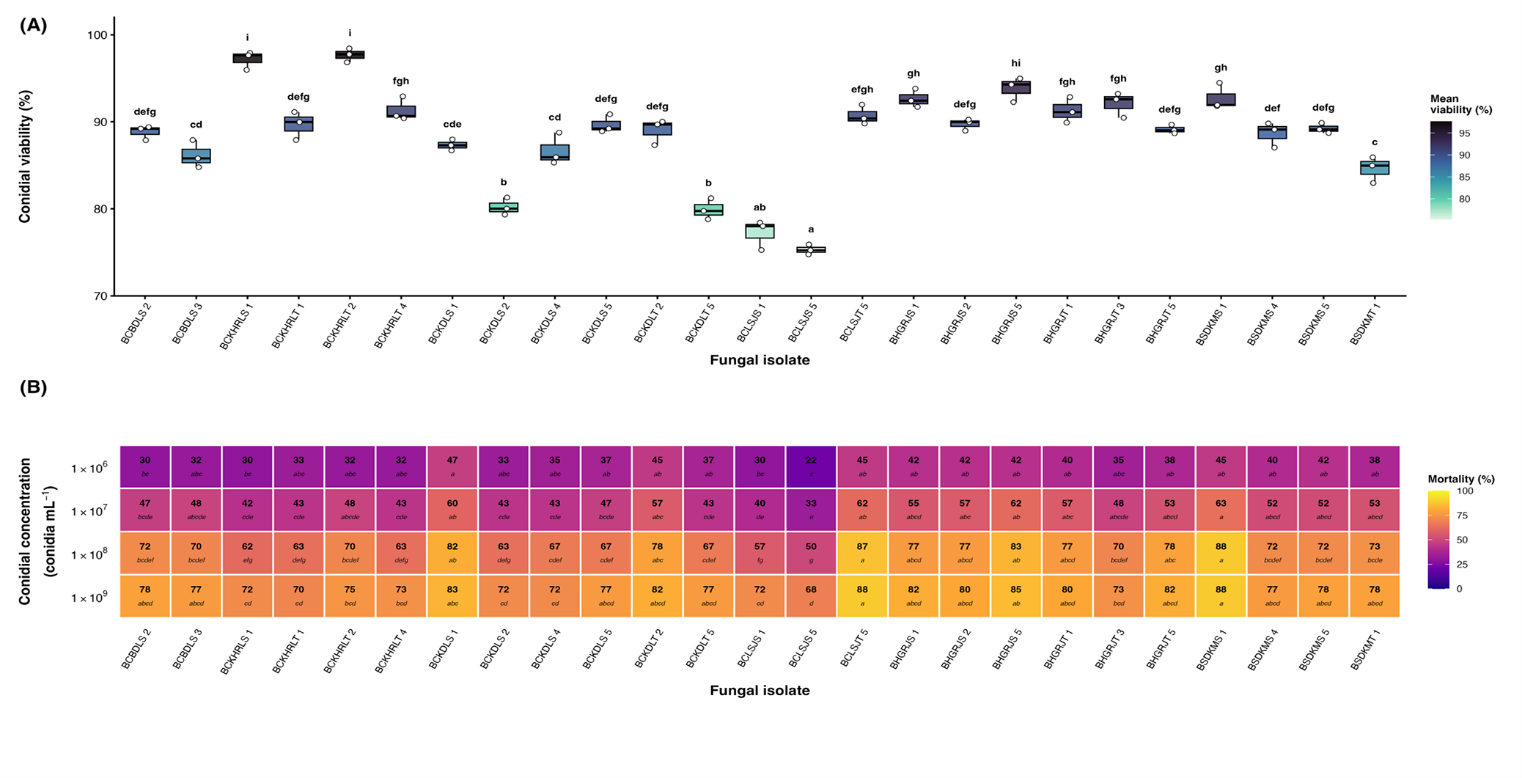
Conidial viability and day-7 corrected mortality of 25 local Beauveria isolates against third-instar Spodoptera frugiperda larvae. (A) Conidial viability before bioassay. (B) Abbott-corrected mortality across four conidial concentrations. Values in heatmap cells indicate mean mortality (%), and letters indicate significant differences among isolates within each concentration.
Table 1: Integrated laboratory performance of selected high-performing Beauveria bassiana isolates against third-instar Spodoptera frugiperda larvae.
| Parameter | BCKDLS 1 | BCLSJT 5 | BHGRJS 5 | BSDKMS 1 |
| Viability (%) | 87.33 ± 1.57 | 90.72 ± 2.78 | 93.84 ± 3.51 | 92.73 ± 3.74 |
| Mortality at 1 × 10⁹ (%) | 83.1 ± 19.3 | 88.1 ± 7.3 | 84.7 ± 12.7 | 88.1 ± 14.6 |
| LC₅₀ (conidia mL-¹) | 1.6 × 10⁶ (7.7 × 10⁵–3.4 × 10⁶) | 1.7 × 10⁶ (1.1 × 10⁶–2.6 × 10⁶) | 2.2 × 10⁶ (1.9 × 10⁶–2.6 × 10⁶) | 1.5 × 10⁶ (8.3 × 10⁵–2.7 × 10⁶) |
| LC₇₅ (conidia mL-¹) | 8.7 × 10⁷ (2.5 × 10⁷–3.0 × 10⁸) | 4.1 × 10⁷ (3.9 × 10⁷–4.5 × 10⁷) | 6.9 × 10⁷ (3.9 × 10⁷–1.2 × 10⁸) | 3.6 × 10⁷ (2.4 × 10⁷–5.5 × 10⁷) |
| LT₅₀ at 1 × 10⁹ (days) | 4.74 ± 0.72 | 4.22 ± 0.30 | 4.82 ± 0.38 | 4.24 ± 0.47 |
| LT₇₅ at 1 × 10⁹ (days) | 6.23 ± 0.86 | 5.74 ± 0.32 | 6.33 ± 0.44 | 5.80 ± 0.61 |
| Molecular identification | Beauveria bassiana | Beauveria bassiana | Beauveria bassiana | Beauveria bassiana |
| GenBank accession number | PZ287918 | PZ287919 | PZ287920 | PZ287921 |
virulence under leaf-dip exposure conditions rather than as mechanistic evidence.
Two explanations may account for this variation. The first is physiological. Isolates can differ in conidial vigor, germination speed on the cuticle, and the timing of cuticle-degrading enzyme and metabolite production, so isolates with similar germination percentages may still establish infection at different rates. Faria et al. (2015) reported that conidial vigor predicted virulence better than viability, and Seyed-talebi et al. (2020) showed that the induction of cuticle-degrading enzymes in B. bassiana differed among isolates. Both observations are consistent with the difference between viability and mortality found here. The second explanation concerns isolate origin. All isolates came from maize rhizosphere soils, but from three areas that differ in altitude, and the four selected isolates were not restricted to a single area. High-performing isolates therefore appear to occur across the sampled areas rather than in one location. Medo et al. (2021) also reported that virulence of Beauveria soil isolates was not related to the habitat or site attributes of their collection sites, while Sumikarsih et al. (2019) reported region-related variation among Indonesian B. bassiana. The sampling
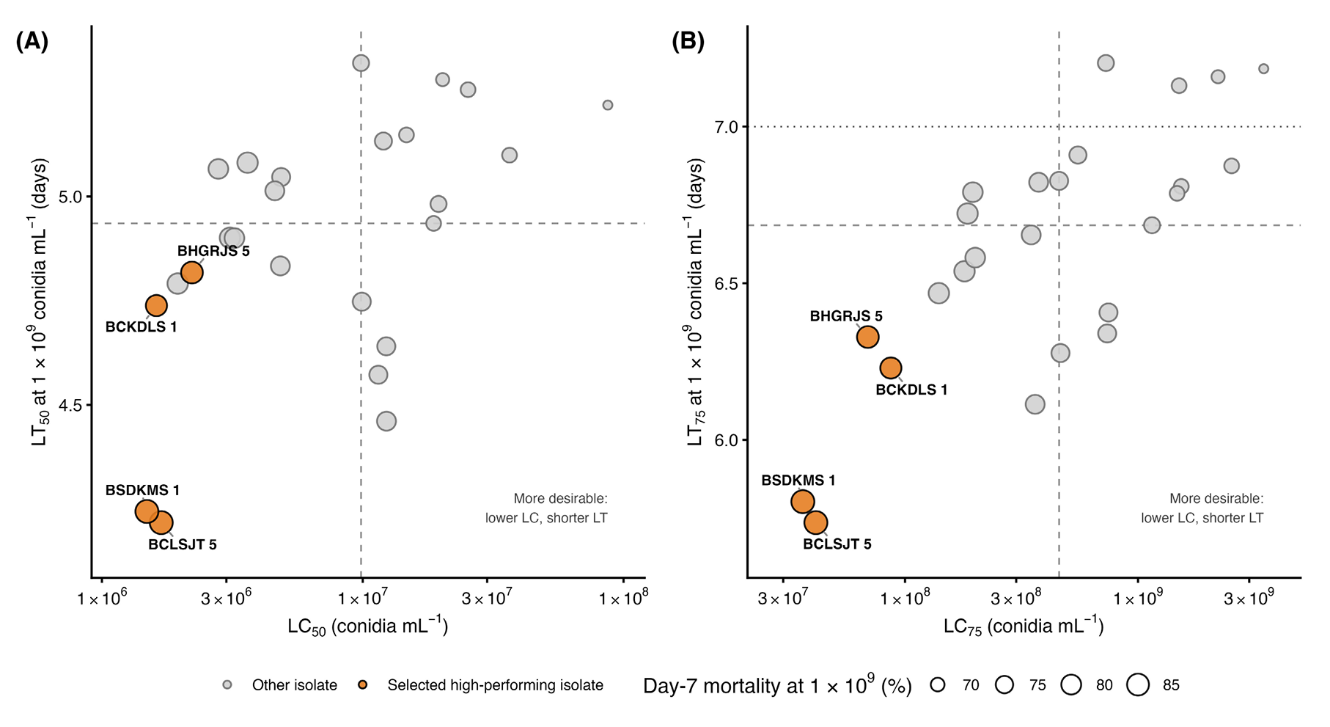
LC–LT selection map of 25 local Beauveria isolates against third-instar Spodoptera frugiperda larvae. (A) LC₅₀–LT₅₀ relationship. (B) LC₇₅–LT₇₅ relationship. Point size indicates day-7 corrected mortality at 1 × 10⁹ conidia mL-¹. Highlighted points indicate the four selected isolates: BSDKMS 1, BCLSJT 5, BHGRJS 5, and BCKDLS 1.
design of the present study was not intended to test site effects, so this explanation remains a hypothesis for further work.
LC–LT profiles and selected B. bassiana isolates
LC and LT estimates were used to refine isolate selection after the mortality screening because they describe different parts of the infection process. The LC–LT selection map showed that the selected isolates were positioned in the more favorable region, with lower lethal concentration and shorter lethal time while maintaining high day-7 mortality at 1 × 10⁹ conidia mL-¹ (Figure 2A, B). Montecalvo and Navasero (2021) also showed that B. bassiana isolates against S. frugiperda differed in both LC₅₀ values and mean time to mortality, supporting the use of concentration- and time-based indicators for isolate comparison. The integrated laboratory performance of the selected isolates is summarized in Table 1.
Note: Viability, mortality, and LT values are presented as mean ± 95% CI half-width based on three biological replicates. LC values are presented with 95% confidence intervals in parentheses. All selected isolates were confirmed as Beauveria bassiana based on ITS sequence analysis.
BSDKMS 1 and BCLSJT 5 were the two most favorable isolates in this screening, but they showed different strengths. BSDKMS 1 was stronger in lethal-concentration estimates. It had high conidial viability, high day-7 mortality, and the lowest LC₅₀ and LC₇₅ values among the selected isolates, indicating that fewer conidia were needed to reach the same mortality endpoint.
BCLSJT 5 was stronger in lethal-time estimates. It produced the same day-7 mortality as BSDKMS 1, but gave the shortest LT₅₀ and LT₇₅ values among the selected isolates. This suggests that once infection was established, larval death occurred more quickly in this treatment.
BHGRJS 5 and BCKDLS 1 were also retained because both produced high day-7 mortality. BHGRJS 5 had the highest conidial viability among the selected isolates, although its LC and LT estimates were higher than those of BSDKMS 1 and BCLSJT 5. BCKDLS 1 had a low LC₅₀ and high final mortality, but its LC₇₅ and LT values were less favorable. These patterns place BSDKMS 1 and BCLSJT 5 as the main candidates, with BHGRJS 5 and BCKDLS 1 as additional isolates for further evaluation.
The two criteria did not separate the candidates to the same degree. LC₇₅ differed by 2.4-fold among the selected isolates (3.6 × 10⁷ to 8.7 × 10⁷ conidia mL-¹), whereas LT₅₀ differed by only 0.6 days (4.22 to 4.82 days). Potency therefore discriminated among the candidates more clearly than speed of kill. Part of this difference is methodological, because the seven-day observation window limits how far LT values can diverge, and LT₇₅ already approached this limit (5.74 to 6.33 days). LT values in this study should therefore be treated as a relative ranking within the assay rather than as absolute killing speeds.
These results have three implications for local biological control of S. frugiperda in West Java. Retaining more than one candidate is useful, because an isolate with a lower LC value suits situations where production cost or application rate is limiting, while an isolate with a shorter LT value suits situations where whorl feeding damage develops quickly. The LC₇₅ values of the selected isolates (3.6 × 10⁷ to 8.7 × 10⁷ conidia mL-¹) also indicate the concentration range that formulation and field trials should target, which is lower than the 1 × 10⁹ conidia mL-¹ needed to separate isolates during screening. Laboratory potency, however, is only the first selection step. The candidates still need to be characterized for conidial yield, UV-B and thermal tolerance, and persistence on leaf surfaces, because these traits vary among B. bassiana isolates ; .
The selected isolates were confirmed as B. bassiana based on ITS sequence analysis. However, molecular confirmation was focused only on the selected isolates. The remaining isolates were evaluated as local Beauveria isolates based on the laboratory collection and initial identification.
This study was conducted under controlled laboratory conditions using treated maize leaf sections. The results therefore should not be interpreted as evidence of field efficacy. Although the leaf-dip bioassay provided standardized exposure, performance in the field may be influenced by ultraviolet radiation, rainfall, humidity, plant architecture, larval behavior, and conidial persistence on leaf surfaces. The study also used only third-instar larvae, so the responses of eggs, early instars, and later instars were not evaluated. Mycosis was recorded only as present or absent, so the proportion of deaths caused by confirmed infection could not be estimated. The fungal outgrowth observed on treated cadavers and the low control mortality (1.67%) nevertheless indicate that death was fungus-associated. In addition, the mechanisms behind isolate-level differences, such as enzyme activity, metabolite production, and penetration efficiency, were not examined. Thus, BSDKMS 1, BCLSJT 5, BHGRJS 5, and BCKDLS 1 should be regarded as laboratory-selected isolates, not field-ready control agents.
Conclusions and Recommendations
Laboratory screening of 25 local Beauveria isolates from West Java showed clear isolate-level variation in conidial viability, corrected mortality, lethal concentration, and lethal time against third-instar Spodoptera frugiperda larvae. Mortality increased with conidial concentration, with the clearest separation among isolates observed at 1 × 10⁹ conidia mL-¹. Based on the combined performance of day-7 mortality, LC₅₀, LC₇₅, LT₅₀, and LT₇₅, four isolates were prioritized as high-performing candidates: BSDKMS 1, BCLSJT 5, BHGRJS 5, and BCKDLS 1. Among them, BSDKMS 1 showed the strongest overall potency profile, while BCLSJT 5 showed the shortest lethal-time estimates. ITS-based molecular identification confirmed the selected candidates as B. bassiana. These isolates should be further evaluated under greenhouse and field conditions to assess their potential for biological control of S. frugiperda in maize.
Acknowledgement
This work was supported by the Indonesian Education Scholarship, the Center for Higher Education Funding and Assessment, and the Indonesian Endowment Fund for Education.
Novelty Statement
This study screened 25 local Beauveria isolates from maize rhizosphere soils in West Java, Indonesia, a region for which such isolates have not been screened against Spodoptera frugiperda to our knowledge. By combining mortality, lethal concentration, and lethal time within a single selection framework, four high-performing Beauveria bassiana candidates with different virulence profiles were identified, providing a local isolate resource for further development of biological control.
Authors’ Contributions
Lilian Rizkie1,2, Tjandra Anggraeni: conceived and designed the study.
Lilian Rizkie: Conducted the laboratory experiments, including fungal culture preparation, pathogenicity bioassays, insect rearing, and data analysis.
Tjandra Anggraeni: Supervised the research and provided scientific guidance throughout the study.
I. Nyoman Pugeg Aryantha3 and Agus Susanto: Contributed to result interpretation and manuscript improvement.
All authors reviewed the manuscript, provided critical input, and approved the final version.
Generative AI or AI assisted technology statement
No generative AI or AI-assisted technologies were used in the preparation of this manuscript.
Conflict of interest
The authors declare that there are no conflicts of interest regarding the publication of this manuscript.
References
- Abbas, A., F. Ullah, M. Hafeez, X. Han, M.Z.N. Dara, H. Gul and C.R. Zhao. 2022. Biological control of fall armyworm, Spodoptera frugiperda. Agron., 12: 2704. https://doi.org/10.3390/agronomy12112704 [CrossRef]
- Afandhi, A., I. Fernando, T. Widjayanti, A.K. Maulidi, H.I. Radifan and Y. Setiawan. 2022. Impact of the fall armyworm, Spodoptera frugiperda (J. E. Smith) (Lepidoptera: Noctuidae), invasion on maize and the native Spodoptera litura (Fabricius) in East Java, Indonesia, and evaluation of the virulence of some indigenous entomopathogenic fungus isolates for controlling the pest. Egypt. J. Biol. Pest Cont., 32: 48. https://doi.org/10.1186/s41938-022-00541-7 [CrossRef]
- Akutse, K.S., F.M. Khamis, F.C. Ambele, J.W. Kimemia, S. Ekesi and S. Subramanian. 2020. Combining insect pathogenic fungi and a pheromone trap for sustainable management of the fall armyworm, Spodoptera frugiperda (Lepidoptera: Noctuidae). J. Invertebr. Pathol., 177: 107477. https://doi.org/10.1016/j.jip.2020.107477 [CrossRef]
- Alali, S., V. Mereghetti, F. Faoro, S. Bocchi, F. Al Azmeh and M. Montagna. 2019. Thermotolerant isolates of Beauveria bassiana as potential control agent of insect pest in subtropical climates. PLoS ONE., 14(2): e0211457. https://doi.org/10.1371/journal.pone.0211457 [CrossRef]
- Altaf, N., M.I. Ullah, M. Afzal, M. Arshad, S. Ali, M. Rizwan, L.A. Al-Shuraym. S.S. Alhelaify and S. Sayed. 2023. Endophytic colonization by Beauveria bassiana and Metarhizium anisopliae in maize plants affects the fitness of Spodoptera frugiperda (Lepidoptera: Noctuidae). Microorgan., 11: 1067. https://doi.org/10.3390/microorganisms11041067 [CrossRef]
- Baek, S., M.Y. Noh, S. Mun, S.J. Lee, Y. Arakane and J.S. Kim. 2022. Ultrastructural analysis of beetle larva cuticles during infection with the entomopathogenic fungus, Beauveria bassiana. Pest Manag. Sci., 78: 3356-3364. https://doi.org/10.1002/ps.6962 [CrossRef]
- Faria, M., R.B. Lopes, D.A. Souza and S.P. Wraight. 2015. Conidial vigor vs. viability as predictors of virulence of entomopathogenic fungi. J. Invertebr. Pathol., 125: 68-72. https://doi.org/10.1016/j.jip.2014.12.012 [CrossRef]
- Fernandes, E.K.K., D.E.N. Rangel, A.M.L. Moraes, V.R.E.P. Bittencourt and D.W. Roberts. 2007. Variability in tolerance to UV-B radiation among Beauveria spp. isolates. J. Invertebr. Pathol., 96(3): 237-243. https://doi.org/10.1016/j.jip.2007.05.007 [CrossRef]
- Hafeez, A., S. Maalik, S. Mushtaq, M. Batool, N. Bano and N. Ehsan. 2025. Laboratory rearing of herbivore larva of Spodoptera frugiperda (Order: Lepidoptera) to assess yield loss of economically important crops. J. Zool. Syst., 3(1): 36-46. https://doi.org/10.56946/jzs.v3i1.575 [CrossRef]
- Herlinda, S., N. Octariati, S. Suwandi and Hasbi. 2020. Exploring entomopathogenic fungi from South Sumatra (Indonesia) soil and their pathogenicity against a new invasive maize pest, Spodoptera frugiperda. Biodivers., 21(7): 2955-2965. https://doi.org/10.13057/biodiv/d210711 [CrossRef]
- Hong, S., J. Shang, Y. Sun, G. Tang and C. Wang. 2024. Fungal infection of insects: Molecular insights and prospects. Trends Microbiol., 32(3): 302-314. https://doi.org/10.1016/j.tim.2023.09.005 [CrossRef]
- Idrees, A., Z.A. Qadir, K.S. Akutse, A. Afzal, M. Hussain, W. Islam, M.S. Waqas, B.S. Bamisile and J. Li. 2021. Effectiveness of entomopathogenic fungi on immature stages and feeding performance of fall armyworm, Spodoptera frugiperda (Lepidoptera: Noctuidae) larvae. Insect., 12: 1044. https://doi.org/10.3390/insects12111044 [CrossRef]
- Karthi, S., P. Vasantha-Srinivasan, S. Senthil-Nathan, Y.S. Han, M.S. Shivakumar, R.K. Murali-Baskaran, K. Kalaivani, N. Radhakrishnan, K.B. Park and G. Malafaia. 2024. Entomopathogenic fungi promising biocontrol agents for managing lepidopteran pests: Review of current knowledge. Biocatal. Agric. Biotechnol., 58: 103146. https://doi.org/10.1016/j.bcab.2024.103146 [CrossRef]
- Louw, S., V.M. Paradza, J. van den Berg and H. du Plessis. 2025. Susceptibility of Spodoptera frugiperda to commercial entomopathogenic fungi formulations in South Africa. Insect., 16: 656. https://doi.org/10.3390/insects16070656 [CrossRef]
- McKinnon, A.C., T.R. Glare, H.J. Ridgway, A. Mendoza-Mendoza, A. Holyoake, W.K. Godsoe and J.L. Bufford. 2018. Detection of the entomopathogenic fungus Beauveria bassiana in the rhizosphere of wound-stressed Zea mays plants. Front. Microbiol., 9: 1161. https://doi.org/10.3389/fmicb.2018.01161 [CrossRef]
- Medo, J., J. Medová, J. Michalko and Ľ. Cagáň. 2021. Variability in virulence of Beauveria spp. soil isolates against Ostrinia nubilalis. J. Appl. Entomol., 145(1-2): 92-103. https://doi.org/10.1111/jen.12806 [CrossRef]
- Montecalvo, M.P. and M.M. Navasero. 2021. Comparative virulence of Beauveria bassiana (Bals.) Vuill. and Metarhizium anisopliae (Metchnikoff) Sorokin to Spodoptera frugiperda (J.E. Smith) (Lepidoptera: Noctuidae). J. ISSAAS., 27(1): 15-26.
- Nithya, P.R., S. Manimegalai, S. Nakkeeran, S. Mohankumar and S.J. Nelson. 2019. Metabolome heterogeneity in the isolates of entomopathogenic fungus, Beauveria bassiana (Balsamo) Vuillemin. J. Biol. Cont., 33(4): 326-335. https://doi.org/10.18311/jbc/2019/24302 [CrossRef]
- Oliveira, D.G.P., G. Pauli, G.M. Mascarin and I. Delalibera. 2015. A protocol for determination of conidial viability of the fungal entomopathogens Beauveria bassiana and Metarhizium anisopliae from commercial products. J. Microbiol. Method., 119: 44-52. https://doi.org/10.1016/j.mimet.2015.09.021 [CrossRef]
- Panigrahi, C.K., D. Sikha, S.N. Satapathy, B. Adhikari, A. Warghat, A. Verma, S. Mahapatra, S. Panigrahi, B.R. Devi, D. Sarangi, P. Das and R.S. Parida. 2025. A brief review on the invasive fall armyworm (Spodoptera frugiperda) J.E. Smith (Lepidoptera: Noctuidae). Int. J. Pathog. Res., 14(4): 71-80. https://doi.org/10.9734/ijpr/2025/v14i4377 [CrossRef]
- Seyed-talebi, F.S., S.A. Safavi, R. Talaei-Hassanloui and A. Bandani. 2020. Variable induction of cuticle-degrading enzymes of Beauveria bassiana isolates in the presence of different insect cuticles. J. Crop Prot., 9(4): 563-576. https://doi.org/10.48311/jcp.2020.1501 [CrossRef]
- Sumikarsih, E., S. Herlinda and Y. Pujiastuti. 2019. Conidial density and viability of Beauveria bassiana isolates from Java and Sumatra and their virulence against Nilaparvata lugens at different temperatures. Agrivita J. Agric. Sci., 41(2): 335-350. https://doi.org/10.17503/agrivita.v41i2.2105 [CrossRef]
- Zalte, O.P., P.R. Panchbhai, T. Pillai, N.V. Lavhe, V. Deshmukh, V. Shah, B.B. Fand, R. Pande, T. Prabhulinga, A. Nikoshe and S. Thube. 2024. Bio-efficacy evaluation of Beauveria bassiana against fall armyworm, Spodoptera frugiperda (J.E. Smith). Hexapoda, Insecta Indica., 31(1&2): 44-48. https://doi.org/10.55446/hexa.2024.12 [CrossRef]

Services
Article usage statistics
Loading…
Related articles
- Detection, Isolation, and Molecular Characterization of Foot-and-Mouth Disease Virus from the 2022–2023 West Java OutbreakAdvances in Animal and Veterinary Sciences · 2026
- Beyond Intrinsic Drive: The Role of External Support and Performance in Sustaining Pasundan Cattle FarmingAdvances in Animal and Veterinary Sciences · 2026
- Egg Production and Physiological Assessment of Sentul Hens in Temperate and Lowland Regions of West Java, IndonesiaAdvances in Animal and Veterinary Sciences · 2025
- Consumer-Driven Attributes and Production System Trade-offs for Local Chicken (Kampung) in West Java: A Systematic ReviewAdvances in Animal and Veterinary Sciences · 2026
- Farmer Characteristics and Knowledge of Reproductive Management Practice in Traditional Dairy Goat Farming at Simpay Tampomas Farmers Group, Sumedang, West Java IndonesiaAdvances in Animal and Veterinary Sciences · 2023
- Performance Analysis of Shallot Farming Under Glebagan System in Central Java, IndonesiaPakistan Journal of Agricultural Research · 2024