
This study aimed to determine the mortality rate of biotic and non-biotic pesticides against the larvae of the wheat gall nematode (Anguina tritici): measure the germination rate of six wheat varieties, and nd assess their susceptibility and disease severity to wheat canker gall.. The results of the study on the kill rate of biotic and nonbiotic pesticides against the second-stage larvae of the wheat canker nematode (Anguina tritici) showed that the chemical pesticide Velum achieved 100% mortality, followed by the biological pesticide Verox at 43.11% There was no significant effect observed in the other treatments. Germination rate measurements of the tested wheat varieties (Tammuz, Sham, Sali, Iraq, Rasheed, and Abba 90) showed that Sali and Sham had the highest germination rate, reaching 82%, while Iraq had the lowest germination rate, only 1.00%. Susceptibility testing of the wheat varieties tested (Tammuz, Sham, Sally, Iraq, Rasheed, and Abs 90) to the wheat canker nematode (Anguina tritici) revealed that Sally and Sham had the highest germination rates, reaching 82%, followed by Abs 90 at 78.66%, with no significant differences among the three varieties. Iraq had the lowest germination rate at only 1.00%, which was significantly different from the other varieties.
Research Article · Volume 39, Issue Sp. 1, Pages 110–117, 17 November 2026 · Open Access
Sensitivity of Some Wheat Cultivars to Anguina tritici and Control by Using Biotic and Abiotic Agents
, , , ,
Affiliations & Notes ⌄
- 1Department of Plant Protection, College of Agriculture, University of Kerbala, Karbala, Iraq
- 2Department of Plant Protection, College of Agriculture, University of Kufa, Najaf, Iraq
- *Correspondence | Hayder Abdulhasan Ali; Email: haider.abid@uokerbala.edu.iq
Article Info ⌄
- Journal:
- Pakistan Journal of Agricultural Research
- Submitted Date:
- 11 April 2026
- Accepted Date:
- 25 October 2026
- Published Date:
- 17 November 2026
Abstract
Introduction
Wheat Triticum aestivum L. is one of the world's most important crops, crucial for its cultivated area, production, distribution, and the wide range of uses of its products on consumer tables and in other industries. It is also used as animal feed, such as poultry feed, and plays a vital role in global food security. Due to its numerous valuable properties, this crop is often referred to as the "King of Crops." Wheat grains are highly nutritious, containing carbohydrates and starch in addition to proteins, fats, and fibers. Despite its high nutritional value and increasing global demand, wheat is cultivated in nearly every part of the world. This is driven by continued population growth and the efforts of researchers and wheat growers to expand agricultural land, utilize all available planting opportunities, and improve yield and quality per unit area . However, in Iraq, where most of the population depends heavily on bread wheat, both the yield and the quality remain low. This situation may be due to a lack of proper crop management, including the selection of superior varieties and the maintenance of adequate modern irrigation systems . In 2019, the total wheat planting area was 6,331,000 dunams, with a total production of 4,343,000 tons and a yield of 2,744.4 kg/hectare (according to the 2019 Agricultural Census). This not only fails to meet market demand but is also below average. In 2015, global wheat production was 8 tons per hectare (according to the United States Department of Agriculture, 2016). In 2019, the global wheat planting area was 213.81 million hectares, with a total production of 760.64 million tons (according to the Food and Agriculture Organization, 2025). Like all crops, wheat is susceptible to a variety of pests and diseases. Wheat canker, caused by the nematode Anguina tritici, is one of the most essential nematode diseases affecting this crop. It is the first plant parasitic nematode discovered : classified in the family Anguinidae and the order Tylenchida, which was confirmed by scientist Philipjev (1936) and used ever since:
Kingdom: Animalia
Phylum: Nematoda
Class: Chromadorea
Subclass: Chromadoria
Order: Tylenchida
Superfamily: Tylenchoidea
Family: Anguinidae
Subfamily: Anguininae
Genus: Anguina
Species: tritici
Nematodes are classified molecularly. Since their first description in Iraq by Rao (1929): they have continued to affect this crop, causing yield losses of up to 75%. This severe damage is attributed to female nematodes, which can lay up to 2,000 eggs per wart. A single wart typically contains approximately 20,000 second-stage larvae (J2): with large warts containing up to 90,000 . A method developed by Deley et al. (2006) increases the risk of disease transmission by mixing infected seeds with healthy seeds during harvest, thereby reducing their viability as seeds in the following season. Nematodes can also colonize root nodules, causing disease incidence rates ranging from 22–45%, depending on the wheat variety . Symptoms of wheat wart nematode infection include curling of leaves and stems, stunted growth, and ear deformities. The disease sometimes causes seedling death, resulting in warts instead of healthy kernels, leading to yield losses ; . Given the severe impact of this disease on Iraq's wheat harvest and the high economic losses it causes, chemical pesticides are actively used to control nematodes, but they still cause severe environmental contamination and pose a threat to human health and safety. Nematodes are also persistent and harmful to non-target organisms ;
Many methods have been used to control nematodes, particularly biological control, which is considered a safe and side-effect-free method. Considered environmentally and human-friendly, it has been shown to be effective against various agricultural pests, including the wheat canker nematode. Consequently, the use of microbial metabolites has become widespread. Microorganisms offer a promising alternative to chemical nematicides. Some bacteria and fungi feed on nematodes and are commercially used to control plant-parasitic nematodes . Man-made control measures aim to keep pest populations below economic levels. These levels are maintained through regular monitoring of pest levels, along with measures to protect and preserve natural factors that can eliminate the pests and, when necessary, the use of specialized methods. These measures are essential to reduce pest infestations. These measures are implemented as selectively as possible. They are economically and ecologically justified, as the primary goal of control is to maximize yield at the lowest cost while taking into account the long-term balance of the ecosystem (Committee on .
Independently grown plant growth-promoting rhizobacteria (PGPRs) are widely used because they enhance plant nutrient uptake, growth, and productivity, often possessing bioactivity against plant pathogens . PGPRs promote plant growth and root vigor, stimulating overall plant growth. The presence of these bacteria in the rhizosphere protects host roots from pathogens ; . Consequently, the use of soil rhizobacteria via PGPR inoculation has demonstrated significant efficacy in rhizosphere bacterial biocontrol, often through antibiotic production, hydrolytic enzyme production, and induced systemic resistance (ISR) (Ramadan et al. 2016). Varietal resistance has also been adopted. It is considered the most cost-effective pest control method in agriculture, without environmental harm or requiring additional effort from farmers, as disease resistance is permanent and incurs no additional production costs
The purpose of pest control is to reduce pest populations to levels below those that generate economic losses. This threshold is determined through regular monitoring of infestation rates. While taking into account the biological and social restrictions associated with ecosystem and environment conservation, this management method seeks to maximise yield at the lowest feasible cost. Long-term environmental impacts . Due to the disease's severity and prevalence in Iraq, this study tested biotic and abiotic control approaches to address this major agricultural challenge.
This study aimed to:
Test the viability of second-stage larvae using biotic and abiotic agents (J2 Laboratory).
Test the susceptibility of several varieties grown in Iraq (Tammuz, Sham, Sali, Iraq, Rasheed, and Abba 90)
Test the effectiveness of biotic and abiotic factors in reducing wheat canker gall infestations.
Materials and Methods
Grain samples infested with wheat wart nematodes collected from the Abu Ghraib Agricultural and Food Administration, and the wart nematode, A. tritici, was isolated.
Nematode Isolation
The nematodes were immersed in sterile distilled water, and the larvae were removed using a mechanical scraper. The juveniles were placed in 1 liter of sterile distilled water and counted using a 1 ml pipette under a light microscope. The effects of several biotic and abiotic factors on the viability of second-stage juveniles of wheat wart nematodes were examined:
EM1 biocide
This pesticide contains a biologically active ingredient, including bacteria, according to the manufacturer's recommendations (Figure 1).
Verox is used according to the manufacturer's recommendations.
Plant extracts used according to the manufacturer's recommendations
Use the commercial product containing green algae at a rate of 1 gram per liter.
Use the Velum chemical pesticide according to the manufacturer's recommendations.
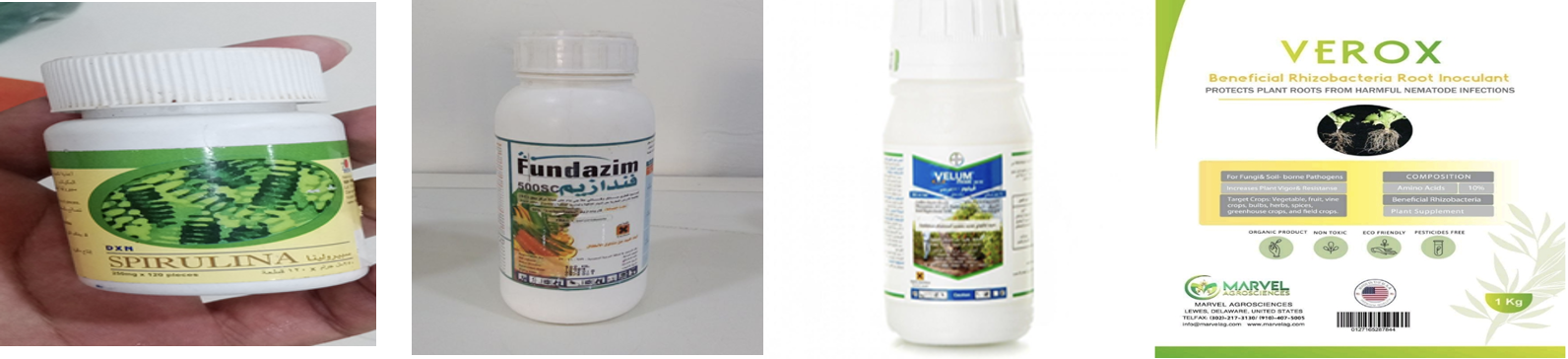
: Some of the commercial product packaging of biological and non-biological pesticides used in the experiment.
Place 3 mL of the prepared solution containing J2100 ± 5 juveniles in a petri dish with a diameter of 9 cm and a height of 2 cm, and complete the volume to 10 mL for each of the materials used in the experiment, with three replicates for each treatment. Distilled and sterile water served as the control, also with three replicates. The juveniles were kept in the incubator at a temperature of 25oC. Readings were taken at 24 hours, 48 hours, and five days by counting the immobilized larvae in the dish, as they are considered dead if they are pricked with a fine needle/hair and do not move, or if they are straightened and appear brown .
The percentage of larval mortality was calculated according to the following equation:

Testing the percentage of germination of the studied varieties.
Several varieties of wheat were selected from the Department of Agricultural Research - Abu Ghraib Sham, Iraq, Ibaa 99, Rashid, Sally, July 3. It was surface sterilized with a 2% sodium hypochlorite solution for three minutes, then washed with distilled and sterile water to remove any residual effect of the sterilizing solution. The seeds were placed in Petri dishes and covered with filter paper until they dried. It was planted in 2-kg pots containing soil sterilized with alcohol at a rate of 30 seeds per pot with three replicates for each variety, and watered regularly. And after germination, the germination percentage was calculated according to the following equation:

Testing the susceptibility of wheat varieties to infection with the wheat wart nematode A. tritici
Soil was prepared, packed in bags, and sterilized with ethanol (medical grade, 70%). Applied at a rate of 1 L per 15 kg of soil. After 3 days, the soil was uncovered, aerated, and turned over for 48 hours to remove traces of ethanol. That was packed in 1-kg plastic pots. The wheat grains of 6 varieties were used: Aba- 99, Tammuz 3, Sally, Iraq, Sham, and Rashid, prepared from the Department of Agricultural Research/ Abu Ghraib30 seeds were planted for each pot, with three replicates . Planting took place in the greenhouse of the College of Agriculture - University of Kerbala on 12/24/2023. Seedlings emerged approximately two weeks after planting and were inoculated with the wheat wart nematode solution. The first seedlings appeared approximately two weeks after the date of planting, and they were inoculated with wheat nematode suspension. At a rate of 5 mL, with the number of second-stage juveniles per mL ranging between 25 and 200 per pot, the percentage of infection was calculated according to the following equation:

Results and Discussion
The results of Table 1 showed the effect of some biotic and abiotic factors on the death of second-stage juveniles of wheat wart nematodes, as the chemical pesticide outperformed with a killing rate of 100% and with a significant difference from the rest of the treatments, followed by the biopesticide Verox with a killing rate of 43.11%, the biopesticide EM1 with a killing rate of 22.66%. At the same time, the algae preparation failed the remaining treatments. The mortality rate increased with longer exposure periods.
Table 1: effect of biological and abiotic pesticides on the numbers of second-stage juveniles of wheat wart nematodes during three time periods. (*Each number in the table represents the average of three replicates).
| Treatments | Time periods | Treatments rate % | ||
|---|---|---|---|---|
| 24 hours | 48 hours | 5 days | ||
| Algae | 0.00 | 0.66 | 4.66 | 1.77 |
| Verox | 20.00 | 48.66 | 60.66 | 43.11 |
| EM1 | 8.00 | 31.33 | 28.66 | 22.66 |
| Plant extract | 0.66 | 6.00 | 8.00 | 4.88 |
| Distilled water | 0.00 | 0.00 | 0.00 | 0.00 |
| Velum | 100 | 100 | 100 | 100 |
| Average time period | 5.73 | 17.33 | 20.40 | 1.77 |
| Lsd | Treatments | Time period | Interference | |
| 1.9938 | 1.5444 | 3.4533 | ||
The reason for the superiority of the chemical pesticide is due to its ability to inhibit the hatching of wheat wart nematode eggs and stop the development of the embryo inside the egg, or kill the first-stage juveniles before they hatch while inside the egg, or kill the second-stage juveniles. The reason may be attributed to its content of the trifluorine atom, which enables it to penetrate the cuticle and thus kill the larvae, as indicated by Olson et al. (2010).
Regarding the biocide Verox and its effect on the vitality of the second-stage juveniles, it is consistent with what Xing et al. (2017) found regarding the impact of bacteria, with 212 out of 662 strains causing a high mortality rate. The efficacy of Verox may be due to bacterial production of hydrogen cyanide, enzymes such as chitinase, and siderophores
Its efficiency may be attributed to bacteria and their effective role in producing hydrogen cyanide and some enzymes and hormones, including inase Chit, Siderophores . As for the effect of seaweed, which had no effect on killing the second-stage juveniles, perhaps due to the loss of its effectiveness due to poor storage, although global and local studies have demonstrated the ability of these algae to kill the second-stage juveniles (Figure 2).
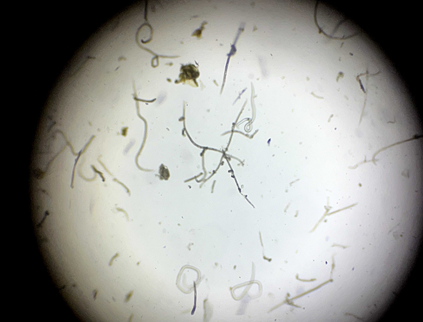
Second-stage juveniles of wheat wart nematodes
Table 2: Percentage of germination of tested wheat varieties. (*Each number in the table represents the average of three replicates)
| Categories | Germination percentage |
|---|---|
| Sally | 82.00 |
| Abba 90 | 78.66 |
| Sham | 82.00 |
| Tamus 3 | 56.33 |
| Rasheed | 59.66 |
| Iraq | 1.00 |
| L.S.D 0.05 | 7.4774 |
The results of the table above show that the highest seed germination rate was for the Sally and Sham variety, reaching 82.00%, followed by the Aba 90 variety, with a rate of 78.66%. No significant differences were found among Sally, Sham, and Aba 90, whereas the Iraq variety had the lowest germination rate (1.00%). There were no significant differences between the three mentioned varieties, while the lowest seed germination rate was for the Iraq variety, 1.00. The reason for the low germination rate for some varieties is due to their lack of exposure to sufficient lighting, incorrect storage, or poor water absorption in the early stages of germination, and accordingly, the covers do not tear, or according to the nature of the variety . Table 3 shows the sensitivity of the varieties to infection with wheat warts after 30 days of inoculation at a rate of 2,500 second-stage juveniles (J2) for each replicate, showing differences in their susceptibility to disease. The tested wheat varieties showed differences in their sensitivity to wheat wart nematodes. It was found that the Rashid variety achieved the highest infection rate of 73.33% among the tested varieties, followed by the Sally variety at a rate of 56.66%, while the Aba90 variety recorded the lowest infection rate, indicating the high resistance of Aba-90, which differed significantly from the other varieties. The main reason for the differences in susceptibility among the varieties is the genetic resistance controlled by the resistance genes. These results are in agreement with Al-Daraji (2023): who tested approved varieties for disease susceptibility.
Table 3: Sensitivity of tested varieties. (*Each number in the table represents the average of three replicates).
| Categories | Infection percentage % |
|---|---|
| Abba 90 | 56.66 |
| Sham | 33.33 |
| Rasheed | 73.33 |
| Sally | 22.33 |
| Tamus 3 | 31.33 |
| Iraq | 27.33 |
| L.S.D 0.05 | 11.53 |
This was consistent with what Al-Daraji, (2023) found in testing the approved varieties and their susceptibility to infection with this disease. This was consistent with a study conducted by AL Jobouri et al. (2010). but few young plants were able to reach the flower ovaries as a result of irregular irrigation. In general, most wheat varieties grown in Iraq were sensitive to infection .
Conclusions
The study results showed a clear variation in the susceptibility of wheat varieties to the Anguina tritici nematode, with some varieties showing a high level of resistance or tolerance, while others exhibited a high susceptibility to infection. Biological treatments using certain anti-nematode microorganisms also demonstrated remarkable effectiveness in reducing disease severity and enhancing growth and yield characteristics, compared with abiotic treatments.
Acknowledgments
This research did not receive any external funding from agencies or institutions. The work was conducted based on the our self . We acknowledge the Department of Plant Protection, College of Agriculture, University of Kerbala, for providing the laboratory facilities and environment necessary to complete the experimental work.
Authors’ Contributions
Estabraq Mohammed Abdalreda: Supervision, study design, and critical revision of the manuscript. Waref Mohammed Hanoon: Performance of experiments, data analysis, and drafting of the manuscript. Fadhal Abedalhussein Alfadhal: Performance of experiments, data analysis, and manuscript editing. Hayder Abdulhasan Ali: Study methodology, statistical analysis, interpretation of results, and critical manuscript revision. Mayada Mahmoud Muteab: Literature review, preparation of figures and tables, and contribution to manuscript editing.
Novelty Statement
The novelty and unique contribution of this research lie in the analysis of the effect The novelty and unique contribution of this research lie in the analysis of the rate of biotic and nonbiotic pesticides against the larvae of the wheat gall nematode (Anguina tritici): measure the germination rate of six wheat varieties, and examine their susceptibility to and severity of wheat wart disease.
Conflict of Interest
The authors declare that there is no conflict of interest.
References
- Abede, A.I.M., 2016. Study of the possibility of inducing systemic resistance using growth-promoting bacteria PGPR in tomato plants in controlling root-knot disease caused by Meloidogyne spp. PhD thesis, College of Agriculture, University of Baghdad.
- Agricultural Statistics, 2019. Wheat and Barley Production 2019. Ministry of Planning, Central Statistical Organization, Directorate of Agricultural Statistics, p. 22.
- Al-Adhari, A.H.M., 1992. Breeding of field crops, Dar Al-Kitaba for Printing and Publishing, University of Mosul, pp. 365-366.
- Al-Asas, K., Muhammad, K. and Majd J., 2008. Inventory of cyst nematode species (Heterodera spp.) in wheat fields in Al-Hasakah Governorate, northeastern Syria. Arab J. Plant Prot., 26: 118-122.
- Al-Beldawi, A.S., Stephan, Z.A. and A.H., Alwan, 1974. General survey of wheat. Incomplete Reference.
- Al-Daraji, M.H.G., 2023. A taxonomic study of wheat wart nematodes Anguina tritici and grain cyst nematodes Heterodera avenae in central and southern Iraq and their integrated management. PhD thesis, College of Agriculture, University of Basra.
- Al-Hazmi, A.b.S., 1992. Introduction to Plant Nematology, First Edition, College of Agriculture. King Saud University Press, 321 pp.
- ALJobouri, M.A.J. and ALJobouri, A. 2010. Susceptibility of bread wheat cultivars to wheat gall nematode and a study some of the gene action of infection percentage. Kirkuk Univ. J. Sci. Stud., 5(2): 112-121.
- Al-Rashidi, S.A.S., 2011. Biological control of root rots and wheat smut in unplowed soils, Master's thesis, College of Agriculture and Forestry, University of Mosul.
- Alwan, S.M. and Abbas, K.A. 2020. The effect of temperature and rainfall on the production of wheat and barley crops in Diyala and Maysan Governorates. Research of the Second International Scientific Conference, Iraqi Academics Syndicate, Center for Academic Strategic Development and University of Salahuddin, College of Basic Education, Erbil for the period February 1, 2020.
- Ami, S.N., 2012. Susceptibility of certain wheat and barley. Cultivars to seed gall nematode. Incomplete Reference.
- Committee on Agricultural Pesticides, 2017. Approved recommendations for combating agricultural pests. Ministry of Agriculture, Arab Republic of Egypt.
- Dababat, A. A. and R. A. Sikora, 2007. Importancia del Momento de Aplicación y la Densidad de Inóculo. de Fusarium oxysporum 162 para el Control Biológico de Meloidogyne incognita attraction and invasion. Nematology, 9:771-776.
- De Ley, P., W. Decraemer and E. Abebe, 2006. Introduction: summary of present knowledge and research addressing the ecology and taxonomy of freshwater nematodes p.3-30. In Freshwater Nematodes: Ecology and Taxonomy. Editors: E. Abebe, W. Traunspurger, I. Andrássy .CAB International. Wallingford UK.
- FAO, 2019. Food and Agriculture Organization. Statisticl Data of the Organization for International Food and Agriculture Rome.
- Filipjev. I.N., 1936. Labdeu J. Science and the Technology 2: 238-239 formation by Arthrobotrys oligospora in liquid culture. gall disease in Iraq. Iraq Agric. Bull., 29: 48-69.
- Khan, M.R., Mohiddin , F.A. , Ejaz , M.N. and Khan, M.M. 2012 . Management of root-knot Disease in eggplant through the application of bio control fungi and dry neem leaves..Turk J Biol . 36: 161-169.
- Lipiec J. and Glinski J., 2011. Rhizosphere. In Encyclopedia of Agrophysics, Glinski, J., Horabik, J., Eds., Springer: Dordrecht, the Netherlands,pp.705-709.
- Liu, K., Garrett. C., Fadamiro, H. and Kloepper, J.W. 2016 . Induction of systemic resistance In chinese cabbage against black rot by plant growth -promoting rhizobacteria Biol. Contr., 99: 8-13.
- Mustafa, S.A., 2009. Study on wheat and Barley ear-cockle disease caused by Nematode Anguina tritici in Erbil province. M SC. Theses, College of Agriculture, University of salahaddin – Erbil.
- Nihorimbere, V.O.M., Smargiassi, M. and Thonart, P. 2011 . Beneficial effect of the rhizosphere microbial community for plant growth and health . Biotechnol. Agron. Soc. Environ., 15(2).
- Olson, S. K., Greenan, G., Desai, A., Müller-Reichert, T. and Oegema, K., 2012. Hierarchical assembly of the eggshell and permeability barrier in C. elegans. J. Cell Biol., 198(4): 731-748.
- Othman, A.A., 2008. The World of Nematodes: The Problem - The Solution, Al-Durr Al-Arabiya for Publishing and Distribution, Cairo, Arab Republic of Egypt, p. 600.
- Rao, H.S., 1929. The freshwater and amphibious gastropod molluscs of the Indawgyi Lake and of the connected freshwater areas in the Myitkyina district, Burma. Records Indian Museum. 31(4): 273-299. https://doi.org/10.26515/rzsi/v31/i4/1929/162539. [CrossRef]
- Stephan, Z. A., Hammadi, A. I. and Antoon, B. G., 1991. Races of ear-cockle nematode Anguina tritici in Iraq. Dept., State Board of Agric. Res. and Educ. Abu-Ghraib, Baghdad, Iraq. Basrah J. Agric. Sci. 4, 1–2.
- Waref, M.H.I., Asmaa, M.A.R. and Zeinab, A.M.A., 2019. Evaluation the efficiency of some controlling methods on olive seedlings infected with root-knot nematodes Meloidogyne spp. IOP Conf. Ser.: Earth Environ. Sci., 388(1) 012009.
- Will,C.N., Gomes, C.B., Minotto, E. and Nascimento, J.S., 2019 . Potential of aqueous extracts of basidiomycetes' to control root-knot Nematodes on lettuce. Hortic. Bras. 37,54-59.
- Xiang, N. Lawrence, K.S., Kloepper, J.W., Donald, P.A., McInroy, J.A. and Lawrence, G.W. 2017. Biological control of Meloidogyne incognita by spore-forming plant growth-promoting rhizobacteria on cotton. Plant Dis., 101: 774–784. https://doi.org/10.1094/PDIS-09-16-1369-RE. [CrossRef]
- Yasmin, J., Lohumi, S., Ahmed, M.R., Kandpal, L.M., Faqeerzada, M.A., Kim, M. S. and Cho, B.K. 2020. Improvement in purity of healthy tomato seeds using an image-based one-class classification method. Sensors, 20(9): 2690.
- Yassein, H.S. and Jabbar B.A. 2017. The use of technioues in determining the responsible gene of knot nematode disease in tomato crop. Iraq J. Agric.,22(8).

Services
Article usage statistics
Loading…
Related articles
- In Vitro Evaluation of Abiotic and Biotic Agents Against Tomato Early Blight Disease Caused by Alternaria SolaniSarhad Journal of Agriculture · 2025
- Re-Emergence of Wheat Seed Gall Nematode (Anguina tritici) in Punjab, PakistanPakistan Journal of Zoology · 2018
- Irrigation Stress to Wheat at Sensitive Growth Stages: Tri-trophic Effects and Implications for Aphid ControlPakistan Journal of Zoology · 2022
- Unraveling the Genetic and Geographic Diversity of Puccinia striiformis f. sp. Tritici (Pst) Populations for Effective Control of Stripe Rust in Global Wheat ProductionPakistan Journal of Agricultural Research · 2024
- Priming of wheat plant with weed extracts, calcium and salicylic acid for contribution to alleviating the oxidative stress imposed by Fusarium graminearum and lead toxicityNovel Research in Microbiology Journal · 2023
- Management of date palm root rot diseases by using some biological control agents under organic farming systemNovel Research in Microbiology Journal · 2018