
Reports from the Intergovernmental Panel on Climate Change (IPCC) highlight that the North African region is facing rising temperatures and alterations in rainfall patterns, which are likely to adversely impact agricultural productivity. This research examines the recent climatic changes in the arid area of Sidi BelAbbès, situated in western Algeria, and aims to evaluate the precipitation effect on olive oil production. By using thirty years of daily data on precipitation, temperature, and relative humidity (1980-2009), the analysis of recent climate trends primarily employs parametric methods such as the Mann-Kendall test and Sen’s slope estimator to assess monthly and annual climatic variations. The influence of climate evolution on olive oil yield is further analyzed using linear regression. Throughout the study period, no significant trends were observed in precipitation levels. However, temperature tests revealed a warming trend, which is statistically significant at a 95% confidence level (p=0.05), particularly notable in summer (June; 2.08), very significant in spring (March; 2.77), and significant in winter (January; 1.88). Additionally, the analysis showed a negative trend in relative humidity, with highly significant results for winter (January; -2.18) and spring (April; -2.08). The regression analysis produced a highly significant coefficient of determination (R² = 0.86), highlighting the important impact of rainfall on olive oil yields.
Research Article · Volume 39, Issue 4, Pages 14–21, 26 October 2026 · Open Access
Trends of Recent Climate and Precipitations Impact on Olive Oil Yield in Western Algeria
· · · · ·
Affiliations & Notes ⌄
- 1Laboratory of Characterization and Valorization of Natural Resources, Faculty of Natural and Life Sciences and Earth and Universe Sciences, University Mohamed El-Bachir El-Ibrahimi of Bordj Bou Arreridj, Algeria
- 2Laboratory of Inorganic Materials (LIM), University of M’sila, Faculty of Natural and Life Sciences and Earth and Universe Sciences, University Mohamed El-Bachir El-Ibrahimi of Bordj Bou Arreridj, Algeria
- 3Laboratory of Biodiversity and Biotechnological Techniques for the Valorization of Plant Resources, University of M’sila, Faculty of Natural and Life Sciences and Earth and Universe Sciences, University Mohamed El-Bachir El-Ibrahimi of Bordj Bou Arreridj, Algeria
- 4Faculty of Natural and Life Sciences,University of Djilali Bounaama, Khemis Miliana, Algeria
- *Correspondence | Nacira Chourghal; Email: n.chourghal@univ-bba.dz
Article Info ⌄
- Journal:
- Pakistan Journal of Agricultural Research
- Submitted Date:
- 18 December 2024
- Accepted Date:
- 12 May 2025
- Published Date:
- 26 October 2026
From the article
- The Mann-Kendall test shows no significant trends in the monthly average precipitation levels.
- These findings are corroborated by Sen’s slope test, which indicates a slight warming trend in April, May, November, and December, although these trends are not statistically significant (see Figure 4).
- Analyzing the climate trends in the Sidi BelAbbès region of western Algeria from 1980 to 2009 reveals that, despite the erratic nature of rainfall typical of North Africa, there is no significant decline in precipitation levels.
- It indicates that rainfall is a crucial factor influencing olive oil production and consequently, olive yields.
Selected from the article's own text.
Abstract
Introduction
Recent climate data analysis spanning the past 50 years highlights the Mediterranean region as a critical climate change hotspot in the coming decades . This region is experiencing significant impacts from climate change, including rising temperatures, more frequent heatwaves, increased water stress (drought), and a reduction in cold weather events . According to the “Representative Concentration Pathways” (RCP 4.5) scenario, summer temperatures are expected to rise by 4.5°C and winter temperatures by 2.5°C . The GCM model CMIP5 ENSEMBLE predicts a decrease in precipitation of approximately 10% to 20%, particularly noting a reduction in winter rainfall . The observed climatic changes vary across North Africa, with a general upward trend in temperatures throughout the region . In contrast, precipitation is generally declining , with the western areas experiencing more severe reductions compared to the eastern regions, such as Mediterranean Tunisia and parts of Libya and Egypt .
Furthermore, research indicates that North African agriculture is likely to be significantly impacted, primarily due to its heavy reliance on rain-fed farming and its limited capacity to adapt to climate change . Climate change would significantly affect olive cultivation, which may have relevant consequences on yield since olives are a main cash crop in the Mediterranean area, thus with great economic importance particularly in sub-humid and semi-arid areas (Tanasijevic et al., 2014). Probably, the most affected variables will be the duration of phenological stages, crop evapo transpiration, irrigation requirements and biomass growth and yield ; ; . This highlights the importance of studying climate trends and precipitations effect on crop yields in these areas.
This paper aims to validate previous findings concerning the western part of the country (Meddi et Talia, 2008; and to provide additional insights into climate change and the effect of rainfall on olive cultivation, one of Algeria’s key crops. This study will involve a thorough analysis of monthly and seasonal variations in precipitation, temperature, and relative humidity, utilizing a robust dataset and appropriate statistical methods to study climatic trends for more accurate and detailed information. The relationship between rainfall and oil yield will then be explored through regression analysis, using recorded yield data from the study area over the same climatic period.
Materials and Methods
Study area and data set
Sidi Bel Abbès is situated in the western part of Algeria (Latitude: 35°11′23″ N, Longitude: 0°37′51″ W, Elevation: 476 m). It holds a strategically central location and covers roughly 15% of the North-West region of the country, amounting to 9,150.63 km² (Figure 1). The area is divided into three primary zones: A mountainous region that accounts for 24.59% of the territory, a plain area representing 35.40%, and a steppe region that occupies the largest portion at 40%. The bioclimatic classification of Sidi Bel Abbès ranges from semi-arid to arid, experiencing continental climate conditions characterized by hot, dry summers and cool, relatively dry winters. Precipitation is limited (310 mm) and highly variable (ONM, 2017). In this context, climatic variability and drought play crucial roles in shaping production systems .
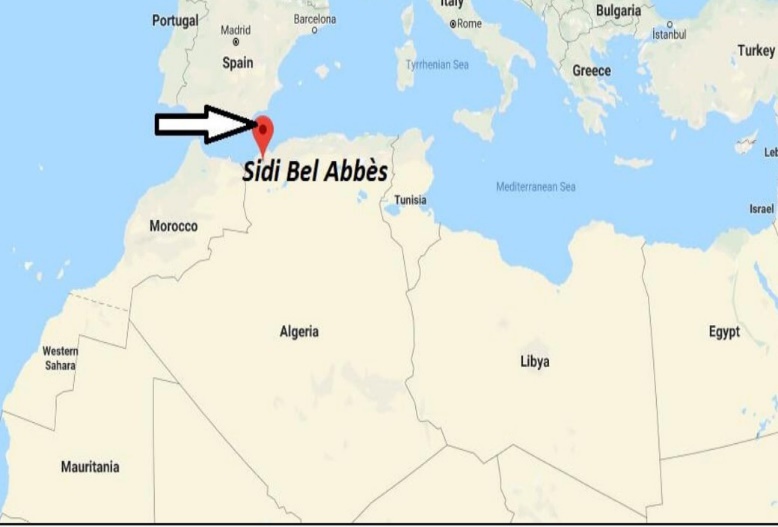
Location of the study area.
The Sidi Bel-Abbès region is noted for its dual agricultural focus ; in the northern part, it supports annuals crops (such as cereals and fodder) and perennial crops, including vines (primarily for wine), olive trees, and various fruit trees. The southern part of the region features silvo-pastoral activities across different massifs and high steppe plains, along with considerable potential for livestock farming.
Climate data spanning thirty years (1980 to 2009) was collected from a meteorological station in the area, encompassing daily records of precipitation, average temperature, and relative humidity. This data underwent pre-processing to ensure homogeneity and independence, followed by the calculation of statistical parameters (mean and standard deviation) for various time frames, including inter-annual, annual, monthly, and seasonal values.
Data on olive oil production in the region from 1980 to 2009 were sourced from the DSAW (Direction des Services Agricoles de la Wilaya), which is affiliated with the Ministry of Agriculture. The primary olive varieties cultivated are Chemlall and Sigoise, with a total of 1,145,786 olive trees spread over an area of 8,781 hectares. The overall olive production (including both table olives and those for oil) amounts to 223,824 Qx, although the average yield of olive oil remains modest at 14 liters per quintal.
Recent climate change
Recent climate changes are evaluated through linear trend analysis using statistical tests. The Sen’s slope estimator and the Mann–Kendall nonparametric test are applied to assess monthly averages of precipitation, temperature, and relative humidity over the entire period from 1980 to 2009.
The mann-kendall test
The Mann-Kendall test is robust to outliers and does not require normality, making it widely applicable. It detects monotonic trends in a dataset over time without distribution assumptions.
The null hypothesis (H0) states no trend, while the alternative (H1) suggests an increasing or decreasing trend. The test ranks data points over time and calculates a Z statistic based on pairwise comparisons. A positive Z indicates a rising trend, a negative Z a decreasing one, with significance assessed using critical values.
The sen’s estimation method
The method provides a robust estimate of the slope of a linear trend in a time series, allowing researchers to quantify the rate of change over time.
Sen’s method assumes that the underlying trend can be modeled as a linear function, typically expressed as: [f(t) = Qt + B] where (Q) is the slope and (B) is a constant.
To estimate the slope (Q), the method calculates the slopes between all pairs of data points in the time series. For each pair of points ((xj, xk)) where (j > k), the slope is calculated as: [Qj = / frac{xj - x_k}{j - k}] This results in multiple slope estimates.
The Sen’s estimator for the slope (Q) is the median of all the calculated slope estimates. This median provides a robust measure of the central tendency of the slopes, minimizing the influence of outliers.
Once the slope (Q) is estimated, the method can also be used to estimate the intercept (B) by calculating the differences (xi - Qti) for each data point and taking the median of these differences.
Sen’s method can also be used to calculate confidence intervals for the slope estimate, providing a measure of uncertainty around the trend.
Precipitations impact on olives oil yield
The effect of recent climate change on olive oil production was analyzed using simple linear regression. This regression aims to describe a dependent variable Y (olive oil yield) concerning an independent variable X (rainfall). The linear relationship between these two variables is represented by the following equation:
y = β0 + β1x
In this equation, the coefficients β0 and β1 represent the y-intercept and the slope of the line, respectively, which is why it is referred to as a “linear” model. The parameter β1 indicates the average change in Y for each one-unit increase in X. Meanwhile, β0 represents the theoretical value of Y when X is zero .
Results and Discussion
Statistical features of observed climate
The average precipitation over the historical period from 1980 to 2009 in the Sidi BelAbbès region is 309.56 mm, with a standard deviation of 160.02 mm, highlighting the variability of rainfall in North Africa. The recent climate analysis indicates an inter-annual average temperature of 16.83 ± 0.57 °C and an inter-annual average relative humidity of 68.68 ± 1.99%.
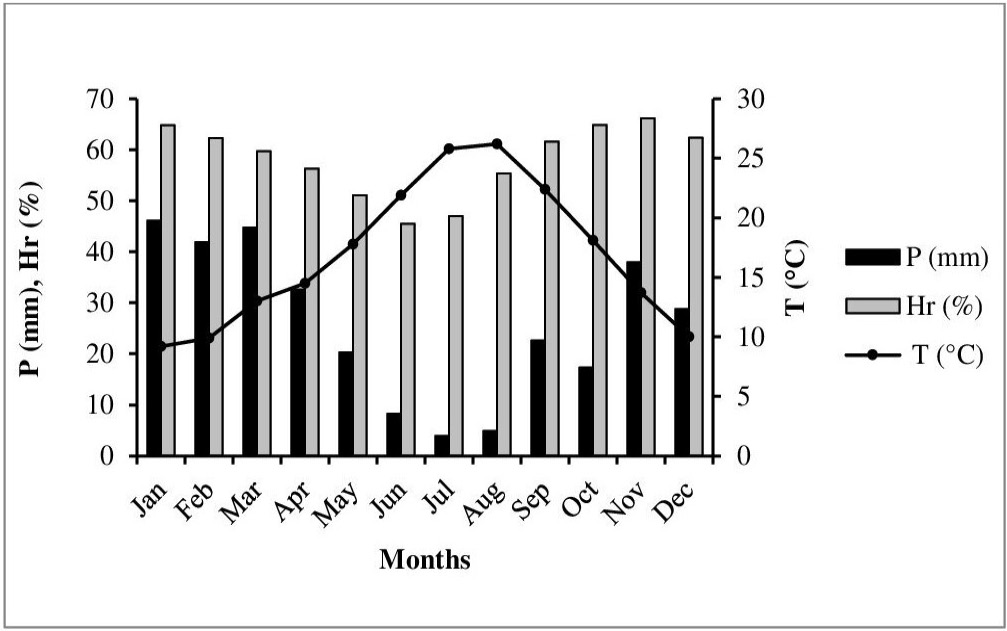
shows the inter-annual monthly averages of precipitation, temperature, and relative humidity over the study period. Precipitation gradually increases from autumn to winter, peaking at 46.1 mm in January, then declines to a low of 3.9 mm in July. Temperature rises from winter to summer, reaching 26.18°C in August before dropping to 9.17°C in January. Relative humidity fluctuates between a high of 77.3% in December and a low of 54.4% in July and August.
Evolution of the recent climate
The Mann-Kendall test shows no significant trends in the monthly average precipitation levels. While the Z value is positive for February, July, August, and September, it lacks significance. In contrast, the values for the other months are entirely negative (see Table 1). This finding is supported by the confidence intervals for the slope Q from Sen’s test at a 95% confidence level, which indicate that the values cross zero (refer to Figure 3). Consequently, the analysis of rainfall trends in Algeria does not reveal any temporal changes, a conclusion that aligns with previous research (Chourghal et Huard, 2017).
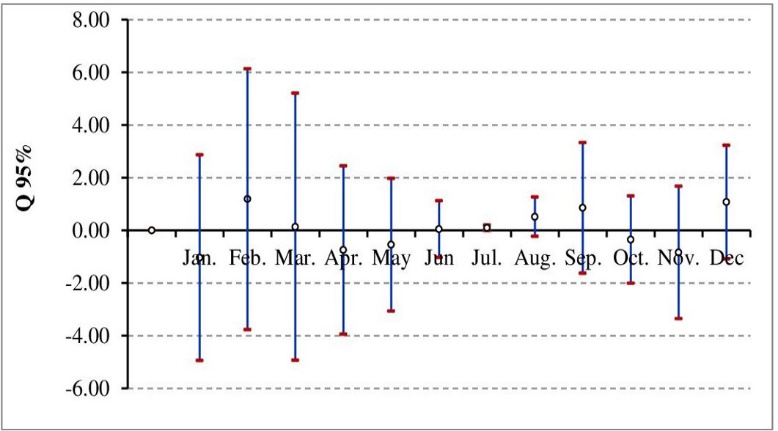
The Sens’s estimates trends for the inter-annual monthly averages precipitations (1980-2009).
In terms of temperature, the Mann-Kendall test yields positive results (see Table 2), showing significant levels in winter (January, 1.88), highly significant levels in summer (June, 2.08), and very highly significant levels in spring (March, 2.77). These findings are corroborated by Sen’s slope test, which indicates a slight warming trend in April, May, November, and December, although these trends are not statistically significant (see Figure 4). The test only shows significance for January, June, and March. Our findings are consistent with other studies conducted in the southern Mediterranean region, which also indicate a rising temperature trend .
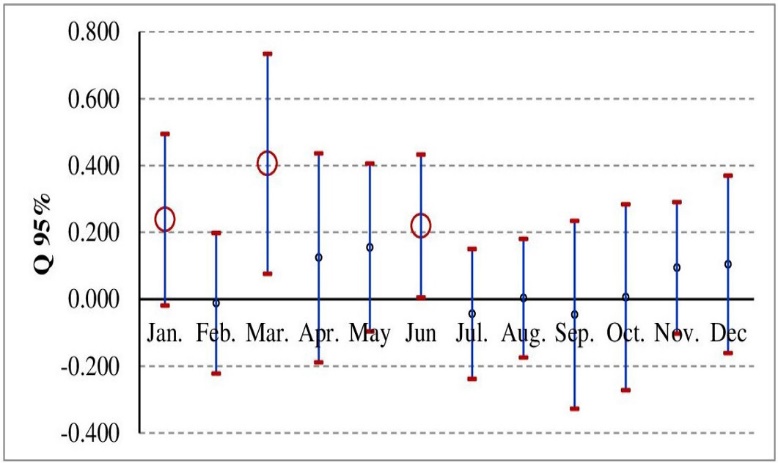
The Sens’s estimates trends for the inter-annual monthly averages temperature (1980-2009).
Table 1: Values of the Mann-Kendal test for the inter-annual monthly averages precipitations (1980-2009).
| Jan. | Feb. | Mar. | Apr. | May | Jun | Jul. | Aug. | Sep. | Oct. | Nov. | Dec | |
| Test Z (Mann-Kendal) | -0,59 | 0,49 | -0,69 | -0,3 | -0,59 | -0,05 | 0,43 | 1,34 | 0,45 | -0,4 | -0,59 | 1,19 |
| Significance | - | - | - | - | - | - | - | - | - | - | - | - |
Table 2: Values of the Mann-Kendal test for the inter-annual monthly averages of temperatures (1980-2009).
| Jan. | Feb. | Mar. | Apr. | May | Jun | Jul. | Aug. | Sep. | Oct. | Nov. | Dec. | |
| Test Z (Mann-Kendal) | 1,88 | -0,4 | 2,77 | 1,09 | 1,48 | 2,08 | -0,69 | 0,4 | -0,1 | 0,1 | 0,89 | 0,79 |
| Significance | * | - | *** | - | - | ** | - | - | - | - | - | - |
Table 3: Values of the Mann-Kendal test for the inter-annual monthly averages of relative humidity (1980-2009).
| Jan. | Feb. | Mar. | Apr. | May | Jun | Jul. | Aug. | Sep. | Oct. | Nov. | Dec. | |
| Test Z (Mann-Kendal) | -2,18 | -0,89 | -1,29 | -2,08 | -1,98 | -1,68 | -1,39 | 0,4 | -0,49 | -1,78 | -0,49 | -1,78 |
| Significance | ** | ** | ** | * | * | * |
The Mann-Kendall test reveals a decreasing trend in the inter-annual monthly average relative humidity in Sidi Bel Abbès from 1980 to 2009 (see Table 3). This trend is significant for June (-1.68), October (-1.78), and December (-1.78), and highly significant for January (-2.18), April (-2.08), and May (-1.98). Sen’s slope test further confirms this decline, with the confidence interval for slope Q remaining above zero throughout the year. A clear downward trend in inter-annual average relative humidity is evident for nearly all months, as illustrated in Figure 5, although the trend is not statistically significant.
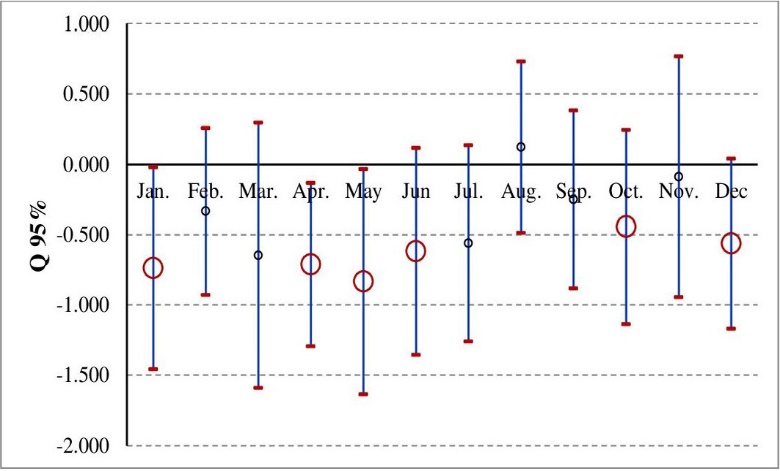
The Sens’s estimates trends for the inter-annual monthly averages relative humidity (1980-2009).
As temperatures rise, relative humidity is decreasing. Without increased precipitation, warming is expected to cause atmospheric drying, especially in winter, spring, and summer. This trend aligns with IPCC (2019) findings for the Mediterranean region and studies in Algeria .
Precipitation changes impact on oil olives yield
The average yield of olive oil calculated for the period from 1980 to 2009 is 12.9 ± 1.9 liters per quintal. The lowest yield recorded was 9.1 liters per quintal in 2009, a year that saw only 214.9 mm of rainfall. Conversely, the highest yield of 16.4 liters per quintal occurred in 2003, when rainfall reached 421.6 mm. A noticeable trend of decreasing yields is evident (Figure 6).
A simple linear regression analysis shows a high R² value of 0.86, indicating that olive oil yield in SidiBel Abbes is strongly influenced by total annual rainfall (Figure 6). The regression parameters (β1= 0.024, β0= 5.79) suggest that a 0.24% increase in annual rainfall boosts yield by 10 liters per quintal. Fraga et al. (2021) highlight precipitation as a key factor, with water availability crucial for maximizing yields. Even without rainfall, olive trees can produce 5.8 liters per quintal, showcasing their resilience to drought. Around 90% of Mediterranean olive trees rely on rainwater , 2007), though growth in semi-arid and arid regions is limited when rainfall falls below 350 mm . Several studies indicate that the practice of irrigation in the southern Mediterranean area improves the yield of olives and olive oil even if the inputs are reduced . The work of Pierantozzi et al. (2013), shows that water deficit impacts the yield of olives and olive oil; it causes a significant reduction in the number of flowers if it appears during the period of inflorescence formation (March–mid-April), and negatively affects the process of pollination and fertilization, the fruit set rate and subsequently the final number of fruits, if it appears at the time of flower development (April–May).
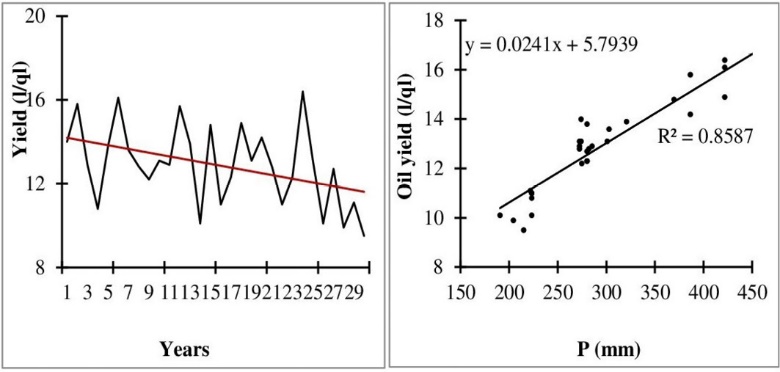
Evolution of olives yields over the study period and its relation with annual precipitation (1980-2009).
Conclusion
The typical characteristics of the arid climate are reflected in the average annual patterns of temperature and precipitation of Sidi Bel Abbès region. Summers are characterized by high temperatures and dryness, while winters are generally mild with some humidity. Analyzing the climate trends in the Sidi BelAbbès region of western Algeria from 1980 to 2009 reveals that, despite the erratic nature of rainfall typical of North Africa, there is no significant decline in precipitation levels. On the other hand, evidence of global warming and a reduction in relative humidity, especially during spring and winter, is apparent. Our results are in perfect agreement with IPCC reports regarding climate change in North Africa. It indicates that rainfall is a crucial factor influencing olive oil production and consequently, olive yields. The observed low oil yields of this crop are directly linked to the decrease in precipitation in the region. Several studies conducted in southern Mediterranean regions mention that lower yields may be expected due to increased heat and water stress and greater water scarcity and for that reason, increasing water productivity in irrigation is a priority issue especially in the areas already characterized by water scarcity and high irrigation inputs, as it is the Mediterranean region.
Acknowledgement
We thank the staff of the Statistics Department of the Directorate of Agricultural Services of the Wilaya of Sidi Bel Abbes for their valuable collaboration regarding statistics on olive oil yield in the region.
Novelty Statement
This study provides a novel and comprehensive analysis of monthly and seasonal variations in precipitation, temperature, and relative humidity using a robust dataset and appropriate statistical methods. Unlike previous studies, it investigates the relationship between rainfall and olive oil yield in the western region of Algeria through regression analysis.
Author’s Contribution
Nacira Chourghal: Conceptualization, data curation, formal analysis, funding acquisition, methodology, supervision, validation, writing original draft.
Amel Salamani: Formal analysis.
Khelifa Maamri: Methodology.
Bahlouli Fayçal: Writing original draft.
Mohammed Benaini: Data curation.
Hemza Belguerri: Funding acquisition.
Conflict of interest
The authors have declared no conflict of interest.
References
- Baldy, C., 1986. Comportement des blés dans les climats méditerranéens. Ecol. Méd., XII: 73-88. https://doi.org/10.3406/ecmed.1986.1175 [CrossRef]
- Bucchignani, E., P. Mercogliano, H.J. Panitz and M. Montesarchio. 2018. Climate change projections for the Middle East–North Africa domain with COSMO-CLM at different spatial resolutions. Adv. Clim. Chan. Res., 9(1): 66-80. https://doi.org/10.1016/j.accre.2018.01.004 [CrossRef]
- Cantoni, E., P. Huber and E. Ronchetti. 2009. Régression linéaire. In: Maîtriser l’aléatoire. Statistique et probabilités appliquées. Springer, Paris. https://doi.org/10.1007/978-2-287-99671-9_9 [CrossRef]
- Chourghal, N. and F. Huhard. 2017. Observed and future changes in precipitations and air temperatures in the central region of Algeria. J. Bio. Environ. Sci., 111(1): 247-256.
- Chourghal, N., J.P. Lhomme, F. Huard and A. Aidaoui. 2016. Climate change in Algeria and its impact on durum wheat. Reg. Environ. Chan., 16(6): 1623-1634. https://doi.org/10.1007/s10113-015-0889-8 [CrossRef]
- Christensen, J.H., K.K. Kanikicharla, E. Aldrian, S.I. An, I.F.A. Cavalcanti, M. de Castro and L. Zou. 2013. Climate phenomena and their relevance for future regional climate change. In Climate change 2013 the physical science basis: Working group I contribution to the fifth assessment report of the intergovernmental panel on climate change. Cambridge University Press, pp. 1217-1308. https://doi.org/10.1017/CBO9781107415324.028 [CrossRef]
- DSASI, 2018. Statistiques agricoles: Superficies et production. Direction des Statistiques Agricoles et des Systèmes d’Information, MADR. Série B, pp. 58-61.
- Fraga, H., M. Moriondo, L. Leolini and J.A. Santos. 2021. Mediterranean olive orchards under climate change: A review of future impacts and adaptation strategies. Agronomy, pp. 11-56. https://doi.org/10.3390/agronomy11010056 [CrossRef]
- Giorgi, F. and P. Lionello. 2008. Climate change projections for the Mediterranean region. Glob. Plan. Chan., 63(2-3): 90-104. https://doi.org/10.1016/j.gloplacha.2007.09.005 [CrossRef]
- Gómez, J.A., J.V. Giráldez and E. Fereres. 2001. Rainfall interception by olive trees in relation to leaf area. Agric. Water Manage. 49: 65–76. https://doi.org/10.1016/S0378-3774(00)00116-5 [CrossRef]
- Gomez-Rico, A., M.D. Salvador, A. Moriana, D. Perez, N. Olmedilla, F. Ribas and N. Fregapane. 2007. Influence of different irrigation strategies in a traditional Cornicabra cv. olive orchard on virgin olive oil composition and quality. Food Chem., 100: 568–578. https://doi.org/10.1016/j.foodchem.2005.09.075 [CrossRef]
- Hamlaoui-Moulai, L., M. Mesbah, D. Souag-Gamane and A. Medjerab. 2013. Detecting hydro-climatic change using spatiotemporal analysis of rainfall time series in Western Algeria. Nat. Hazard., 65(3): 1293-131. https://doi.org/10.1007/s11069-012-0411-2 [CrossRef]
- Hertig, E., 2004. Precipitation and temperature estimates for the Mediterranean region under anthropogenically enhanced greenhouse effect (Doctoral dissertation, University of Würzburg).
- Hertig, E. and J. Jacobeit. 2008. Downscaling future climate change: Temperature scenarios for the Mediterranean area. Glob. Plan. Chan., 63(2-3): 127-131. https://doi.org/10.1016/j.gloplacha.2007.09.003 [CrossRef]
- IPCC, 2007. Climate change: Synthesis report. Contribution of working groups I, II and III to the fourth assessment report of the intergovernmental panel on climate change [Core Writing Team, Pachauri, R.K and Reisinger, A. (eds.)]. IPCC, Geneva, Switzerland. pp. 104.
- IPCC, 2019. Climate change and land: An IPCC special report on climate change, desertification, land degradation, sustainable land management, food security, and greenhouse gas fluxes in terrestrial ecosystems (eds. P.R. Shukla, J. Skea, E. Calvo Buendia, V. Masson-Delmotte, H.-O. Pörtner, D. C. P. Roberts, R. Zhai, S. Slade, R. Connors, M. van Diemen, E. Ferrat, S. Haughey, S. Luz, M. Neogi, J. Pathak, J. Petzold, P. Portugal Pereira, E. Vyas, K. Huntley, K. Kissick, M. Belkacemi and J. Malley).
- Quiroga, S. and A. Iglesias. 2009. A comparison of the climate risks of cereal, citrus, grapevine and olive production in Spain. Agric. Syst., 101: 91–100. https://doi.org/10.1016/j.agsy.2009.03.006 [CrossRef]
- Kourat, T., D. Smadhi, B. Mouhouche, N. Gourari, M.G.M. Amin and C.R. Bryant. 2021. Assessment of future climate change impact on rainfed wheat yield in the semi-arid eastern high plain of Algeria using a crop model. Nat. Hazard., 107(3): 2175-2203. https://doi.org/10.1007/s11069-020-04435-5 [CrossRef]
- Mann, H.B., 1945. Nonparametric tests against trend. Econometrica, 13(3): 245-259. www. jstor.org/stable/1907187. [CrossRef]
- Meddi, M. and A. Talia. 2008. Pluviometric regime evolution in the North of Algeria. Arab Gulf J. Sci. Res., 26: 152–162.
- Mertz, O., K. Halsnæs, J.E. Olesen and K. Rasmussen. 2009. Adaptation to climate change in developing countries. Environ. Manage., 43(5): 743-752. https://doi.org/10.1007/s00267-008-9259-3 [CrossRef]
- Moriana, A., F. Orgaz, M. Pastor and E. Fereres. 2003. Yield responses of a mature olive orchard to water deficits. J. Am. Soc. Hortic. Sci., 128(3): 425-431. https://doi.org/10.21273/JASHS.128.3.0425 [CrossRef]
- ONM, 2017. Bulletin climatique, Office Nationale de la Météorologie, Algérie.
- Osborne, C.P., I. Chuine, D. Viner and F.I. Woodward. 2000. Olive phenology as a sen-sitive indicator of future climatic warming in the Mediterranean. Plant Cell Environ., 23(7): 701–720. https://doi.org/10.1046/j.1365-3040.2000.00584.x [CrossRef]
- Pereira, L.S. and J.P. De Melo-Abreu. 2009. Vulnerability of rainfed and irrigated agri-culture to climate change. In: (eds. E. Eulisse and L. Ceccato), climate changesand natural resources: Impact and water challenge. Università Ca’Foscari diVenezia and Civilitá dell’Aqua, Venice, Italy, pp. 39–64.
- Pierantozzi, P., M. Torres, R. Bodoira and D. Maestri. 2013. Water relations,biochemical-physiological and yield responses of olive trees (Olea europaea L.cvs. Arbequina and Manzanilla) under drought stress during the pre-flowering and flowering period. Agric. Water Manage., 125: 13-25. https://doi.org/10.1016/j.agwat.2013.04.003 [CrossRef]
- Ponti, L., A.P. Gutierrez, P.M. Ruti and A. Dell’Aquila. 2014. Fine-scale ecological and economic assessment of climate change on olive in the Mediterranean Basin reveals winners and losers. Proc. Natl. Acad. Sci. USA, 111: 5598–5603. https://doi.org/10.1073/pnas.1314437111 [CrossRef]
- Rufat, J., J.M. Villar, M. Pascual, V. Falguera and A. Arbones. 2014. Productive and vegetative response to different irrigation and fertilization strategies of an Arbequina olive orchard grown under super-intensive conditions. Agric. Water Manage., 144: 33-41. https://doi.org/10.1016/j.agwat.2014.05.014 [CrossRef]
- Schilling, J., E. Hertig, Y. Tramblay and J. Scheffran. 2020. Climate change vulnerability, water resources and social implications in North Africa. Reg. Env. Chan., 20(1): 1-12. https://doi.org/10.1007/s10113-020-01597-7 [CrossRef]
- Sen, P.K., 1968. On a class of aligned rank order tests in two-way layouts. Ann. Math. Stat., 39(4): 1115-1124. https://doi.org/10.1214/aoms/1177698236 [CrossRef]

Services
Article usage statistics
Loading…
Related articles
- Assessing the Impact of Climate Change on Wheat Productivity in Khyber Pakhtunkhwa, PakistanSarhad Journal of Agriculture · 2019
- Climate Change Impacts on Weed–Crop Interactions and Their Implications for Agricultural Productivity: A ReviewPakistan Journal of Weed Science Research · 2026
- Climate Change-Farmers’ Perception, Adaptation and Impact on Agriculture in the Lakki Marwat District of Khyber PakhtunkhwaSarhad Journal of Agriculture · 2019
- Impact of Climate Change on Maize Productivity in Khyber Pakhtunkhwa, PakistanSarhad Journal of Agriculture · 2019
- Climate change trends over coniferous forests of PakistanPakistan Journal of Forestry · 2024
- Climate Change Impact Assessment on Net Revenue of Rice Crop in Khyber Pakhtunkhwa: A Cross-Sectional Ricardian Rent AnalysisSarhad Journal of Agriculture · 2024