
Brucellosis is an important zoonotic disease affecting livestock productivity and public health, particularly in smallholder production systems with limited biosecurity practices. This study aimed to estimate apparent Rose Bengal Test (RBT) seroreactivity and describe the geographic distribution of RBT-reactive goats in Membrillal parish, Jipijapa canton, Ecuador. A cross-sectional study was conducted from September to December 2025, including 101 reproductive-age female goats from nine participating smallholder farms. Serum samples were screened using the RBT as a presumptive serological assay for antibodies against Brucella spp., and apparent RBT seroreactivity was estimated using exact 95% confidence intervals. Four goats were RBT-reactive, corresponding to an apparent RBT seroreactivity of 3.96% (95% CI: 1.09–9.83). RBT-reactive animals were identified in three production units located in Pueblo Nuevo community, while no reactive animals were detected in the other evaluated communities. No statistically significant associations were observed between RBT reactivity and the evaluated epidemiological variables (p > 0.05); however, these findings should be interpreted cautiously due to the limited number of reactive animals and the unequal distribution of sampled goats among communities. The geographic distribution of RBT-reactive animals was described through exploratory spatial visualization, without inference regarding spatial clustering, focal transmission, or epidemiological risk areas. These findings indicate the presence of apparent RBT seroreactivity among goats from the evaluated production units; however, confirmatory diagnostic methods are required to determine whether active Brucella spp. infection is present. This study provides preliminary epidemiological information to support future surveillance activities, confirmatory testing strategies, and One Health-based approaches for monitoring Brucella spp. exposure in small-ruminant production systems in Ecuador.
Research Article · Volume 15, Issue 1, Pages 140–149, 16 November 2026 · Open Access
Apparent Rose Bengal Test Seroreactivity and Geographic Distribution of Reactive Goats from Smallholder Farms in Coastal Ecuador
, , , , , , , ,
Affiliations & Notes ⌄
- 1State University of Southern Manabí, Ecuador
- 2Quevedo State Technical University, Ecuador
- 3University of Guayaquil, Ecuador
- 4Fauna, Conservation and Global Health Research Group, Ikiam Amazon Regional University, Km-7 Muyuna-Tena 1501, Ecuador
- *Correspondence | Darwin Yánez-Avalos; Email: darwin.yanez@ikiam.edu.ec
Article Info ⌄
- Journal:
- Journal of Animal Health and Production
- Submitted Date:
- 26 March 2026
- Accepted Date:
- 6 October 2026
- Published Date:
- 16 November 2026

Abstract
Introduction
Brucellosis is a globally distributed bacterial zoonosis that continues to affect livestock productivity and public health, particularly in low- and middle-income countries where small-scale production systems predominate . Among the causative agents of brucellosis affecting small ruminants, Brucella melitensis is of particular importance due to its high pathogenicity in humans and its close association with sheep and goats, representing a significant challenge at the animal–human interface . Human brucellosis remains one of the most widespread zoonotic diseases worldwide, with occupational and foodborne exposure representing important transmission pathways .
In smallholder production systems, the maintenance and transmission of brucellosis are influenced by inadequate biosecurity measures, unregulated animal movements, and the consumption of raw milk or unpasteurized dairy products . These factors facilitate within-herd transmission and increase zoonotic exposure risks among farmers, veterinarians, and consumers ; . In this context, the One Health approach is essential, as it recognises the interconnectedness of animal, human, and environmental health and highlights the need for integrated strategies for surveillance, prevention, and control.
From a productive perspective, caprine brucellosis primarily manifests as a reproductive disorder characterised by abortions during the second half of gestation, the birth of weak offspring, and reduced productive performance, resulting in substantial economic losses in low-input production systems ; . From an epidemiological perspective, the shedding of Brucella spp. through uterine discharges, placental tissues, and foetal fluids contributes to transmission within and between herds, particularly under inadequate sanitary management conditions.
In Latin America, brucellosis continues to be reported across diverse production systems, where its control is constrained by the coexistence of formal and informal livestock value chains, limitations in the continuity and coverage of diagnostic and vaccination programmes, and animal movement dynamics that hinder the effective implementation of sanitary strategies . Epidemiological information on Brucella spp. exposure and serological evidence in smallholder goat production systems remains scarce in Ecuador, representing an important knowledge gap for national surveillance and control strategies .
In Ecuador, brucellosis has been documented primarily in bovine populations, with evidence of increasing outbreak reports across continental territory. According to the World Animal Health Information System, Ecuador has reported an increase in bovine brucellosis outbreaks in recent years, generating economic losses for producers and representing a public health concern. Garrido-Haro et al. (2023) conducted a large-scale cross-sectional study across 23 provinces of continental Ecuador, identifying bovine brucellosis seroprevalence and associated risk factors at the national level. More recently, Garrido-Haro et al. (2025) characterised circulating Brucella spp. strains within Ecuador’s national bovine brucellosis control programme using molecular approaches, including IS711-PCR and AMOS-PCR, to evaluate species and biovar diversity. Despite this increasing evidence in cattle, epidemiological information on Brucella spp. exposure and serological evidence in small-ruminant populations, particularly goats, remains scarce in Ecuador, representing an important gap for national one health surveillance and control strategies.
Regarding diagnosis, international guidelines recommend the use of sequential testing algorithms that combine screening and confirmatory assays to improve diagnostic accuracy and enhance interpretation of serological results, particularly in low-prevalence settings where false-positive reactions may affect the predictive value of screening tests (World Organisation for Animal Health (WOAH, 2024); Legesse et al., 2023). The Rose Bengal Test (RBT) is widely used as a first-line serological screening method due to its practicality, low cost, and high diagnostic sensitivity in many epidemiological settings; however, a reactive result should not be interpreted as confirmatory evidence of active Brucella spp. infection. The biological characteristics of Brucella spp., including its ability to persist within host cells through complex mechanisms involving bacterial adaptation and modulation of host immune responses, contribute to the challenges associated with diagnosis and disease control . In low-prevalence populations, the positive predictive value of the RBT may decrease substantially, increasing the probability of false-positive serological reactions due to cross-reactive antibodies against antigenically related Gram-negative bacteria (WOAH, 2024; .
The diagnosis and epidemiological surveillance of brucellosis remain challenging due to the complexity of host immune responses and the limitations of currently available diagnostic methods. Although the RBT continues to be widely used as a screening assay because of its operational simplicity and good diagnostic sensitivity in many epidemiological contexts, false-positive serological reactions caused by cross-reactive antibodies against antigenically related Gram-negative bacteria may occur, particularly in low-prevalence settings . Furthermore, recent systematic reviews have highlighted the need to strengthen diagnostic algorithms through the integration of serological, molecular, and bacteriological approaches within animal and human brucellosis surveillance programmes ; . Additionally, advances in the taxonomy and pathobiology of the genus Brucella continue to improve our understanding of disease epidemiology and host–pathogen interactions, reinforcing the importance of accurate laboratory confirmation in epidemiological investigations .
In this context, generating local epidemiological evidence is essential to characterize serological reactivity to Brucella spp. and contribute to the development of control strategies adapted to smallholder caprine production systems. Therefore, this study aimed to estimate apparent RBT seroreactivity and describe the geographic distribution of RBT-reactive animals among reproductive-age female goats from smallholder farms in a rural parish of coastal Ecuador.
Materials and Methods
Study area and climatic conditions
The study was conducted in Membrillal parish, Jipijapa canton, Manabí province, Ecuador (1°14′11.047″ S, 80°39′48.247″ W), located in the south-western coastal region of the country (Figure 1). The reference population comprised approximately 700 goats distributed across 35 smallholder production units registered by the (Agencia de Regulación y Control Fito y Zoosanitario, 2023) within the study area. The goat populations evaluated were located in the rural communities of Membrillal, Pueblo Nuevo, and San Vicente, which are characterised by extensive family-based livestock production systems (Gobierno Autónomo Descentralizado de Jipijapa, 2021; INEC, 2022). Among the production units identified in the AGROCALIDAD registry, nine met the predefined inclusion criteria and were therefore included in the study, representing a census of eligible production units rather than a probabilistic sample. The area exhibits a tropical dry to sub-humid climate, with mean annual temperatures ranging from 24 to 27 °C and annual precipitation between 400 and 800 mm, concentrated mainly from January to April, followed by a prolonged dry season (INAMHI, 2021). This climatic seasonality may influence forage availability, livestock management practices, and environmental conditions relevant to animal health in rural production systems (FAO, 2020).
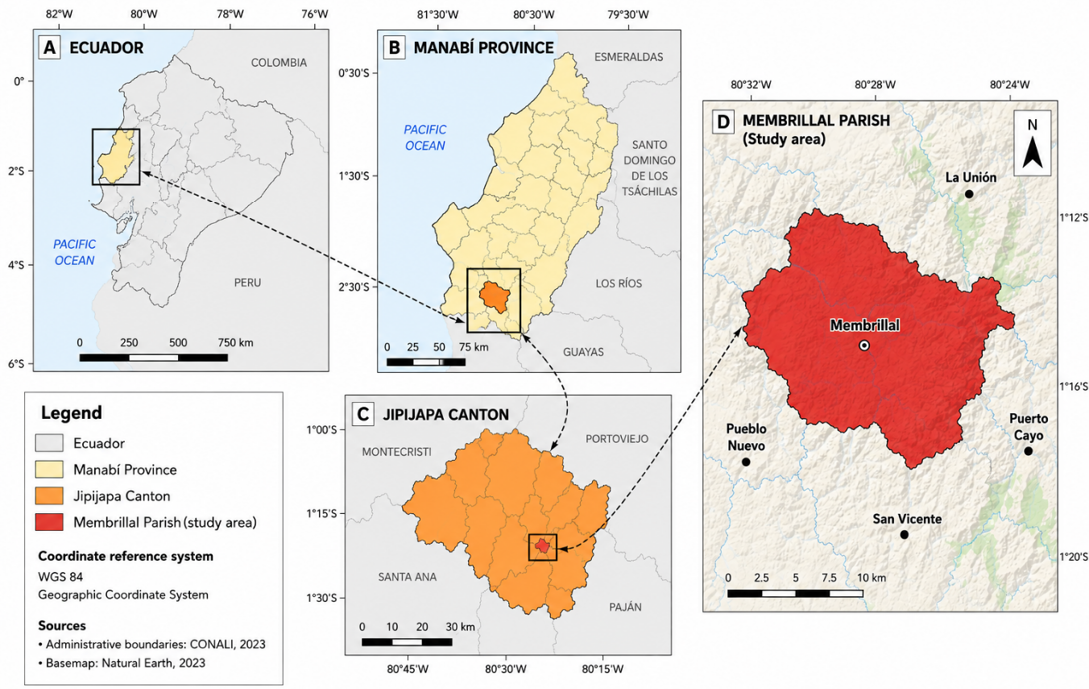
Geographic location of the study area in Membrillal Parish, Jipijapa Canton, Manabí Province, Ecuador. The figure depicts the administrative spatial context of the study area at different geographic levels: (A) Ecuador with the location of Manabí Province; (B) Manabí Province showing the position of Jipijapa Canton; (C) Jipijapa Canton showing the location of Membrillal Parish; and (D) detailed view of Membrillal Parish, corresponding to the study area, including surrounding localities. Geographic coordinates (WGS 84), scale bars, and a north arrow were included to facilitate spatial interpretation.
Study design and inclusion criteria
A field-based cross-sectional observational study was conducted to estimate apparent RBT seroreactivity against Brucella spp. in goats from smallholder production systems located in Membrillal parish, Jipijapa canton, Manabí Province, Ecuador. The reference population consisted of approximately 700 goats distributed across 35 registered production units located in the rural communities of Membrillal, Pueblo Nuevo, and San Vicente.
Given the epidemiological importance of Brucella spp. exposure and its association with reproductive disorders, the study focused on reproductive-age female goats (≥8 months old), considered the target population group for serological evaluation.
All registered production units were contacted and assessed for eligibility. Of the 35 production units initially considered, 26 were excluded because they did not have reproductive-age females available at the time of sampling, mainly due to the presence of males and/or females that had not yet reached reproductive maturity.
The remaining nine production units met the inclusion criteria and were incorporated into the study. In these units, all available reproductive-age female goats were evaluated, representing the accessible study population.
Only males and females younger than eight months were excluded. Pregnancy status, lactation stage, and reproductive history were recorded when available but were not used as selection criteria.
Previous antibiotic exposure was not considered an exclusion criterion because the diagnostic approach used in this study was based on antibody detection rather than direct pathogen identification. Additionally, because Brucella spp. vaccination is not routinely practiced in the study area, vaccination status did not influence animal selection ; WOAH, 2024).
Sample size
The study was conducted between September 1 and December 3, 2025. Considering the reference goat population of approximately 700 animals, an initial theoretical minimum sample size required for the epidemiological assessment of apparent RBT seroreactivity was established.
However, during the field assessment of registered production units, it was determined that the eligible population was considerably smaller than the initial reference population because only nine production units had available reproductive-age female goats that fulfilled the established inclusion criteria.
Therefore, the sampling strategy was adapted to the actual conditions of the accessible population. Instead of selecting a probabilistic sample from the general reference population, all eligible animals available in the participating production units were included.
The final study population consisted of 101 reproductive-age female goats, representing a census of the accessible and eligible population within the nine evaluated production units.
This approach allowed complete inclusion of all available eligible animals and minimized potential biases associated with partial selection of individuals within participating production units.
Nevertheless, because the evaluated population consisted exclusively of reproductive-age females from the included production units, interpretation of the results should consider limitations regarding external validity. Therefore, extrapolation of the findings to males, young animals, other productive categories, or non-participating production units should be performed with caution.
The primary outcome was RBT seroreactivity against Brucella spp. antigens, determined using the RBT and categorized as reactive or non-reactive. Independent variables included geographical location, defined according to the community of origin, and age, categorized into four groups: 8–16, 17–24, 25–36, and ≥36 months.
Sample collection and serological diagnosis (Rose Bengal Test)
Blood samples were collected via jugular venepuncture performed by trained veterinary personnel. The puncture site was disinfected with 70% alcohol prior to sampling, and blood was collected using sterile needles and vacuum tubes without anticoagulant, following appropriate biosecurity procedures and animal welfare considerations throughout the sampling process .
Samples were maintained in an upright position until complete coagulation and subsequently centrifuged at 2000 rpm for 5–10 minutes to obtain serum. The resulting serum was transferred into properly labelled sterile cryovials and stored at 4 °C for immediate analysis or at −20 °C for short-term preservation, ensuring sample quality and traceability (WOAH, 2024).
Detection of antibodies against Brucella spp. antigens was performed using the RBT as a serological screening assay. Prior to testing, serum samples and antigen were equilibrated to room temperature (22 °C ± 4 °C). Subsequently, 30 µL of serum and 30 µL of Rose Bengal antigen were placed on an agglutination plate and carefully mixed using a disposable applicator. The plates were gently rotated (10–12 rpm) for 4 minutes, following internationally recognised protocols for the serological screening of brucellosis in small ruminants ; ; WOAH, 2024).
Results were interpreted under indirect light conditions, with samples classified as RBT-reactive when visible agglutination was observed and as non-reactive in the absence of agglutination. The RBT was performed as a serological screening assay using a commercial antigen (IDEXX Laboratories, Maine, United States), according to the manufacturer’s instructions and the recommendations of the World Organisation for Animal Health (WOAH). Positive and negative controls supplied with the kit were included to ensure the validity of each analytical run ; WOAH, 2024).
Statistical analysis
Statistical analyses were performed using RStudio version 2024.09.0 (Posit Software, PBC, Boston, MA, USA) within the R programming environment. Apparent RBT seroreactivity was estimated as a proportion with exact 95% confidence intervals (95% CI) using the Clopper–Pearson method. Associations between RBT seroreactivity and categorical variables, including community, production unit, and age group, were evaluated using Fisher’s exact test when appropriate, considering the limited number of RBT-reactive animals. Statistical significance was established at p < 0.05.
Multivariable regression modelling was not performed because only four goats were RBT-reactive (n = 4), resulting in an insufficient number of outcome events to obtain reliable parameter estimates or ensure model stability. Therefore, statistical interpretations were restricted to descriptive analyses and exploratory comparisons, and all findings were interpreted cautiously.
Geographic coordinates (UTM, WGS84) of each production unit were used to generate an exploratory spatial visualization. Production units were grouped using an unsupervised k-means clustering algorithm based exclusively on geographic coordinates to facilitate visualization of spatial proximity. No formal spatial autocorrelation analyses or spatial cluster detection methods were performed.
Ethical considerations and animal welfare
The study was conducted after obtaining prior informed consent from all participating farmers. Blood samples were collected through jugular venipuncture by qualified veterinary personnel following standard animal handling and sampling procedures. This procedure was considered a minimal-risk intervention associated with brief and transient discomfort, without anticipated long-term adverse effects on animal health or welfare.
According to the applicable institutional procedures and national regulations governing routine veterinary field activities in Ecuador, formal ethical committee approval was not required for procedures involving minimal animal manipulation and routine diagnostic sampling performed by qualified veterinary personnel. Nevertheless, all procedures were conducted following principles of responsible animal use, veterinary good practices, and animal welfare considerations.
The study adhered to the principles of Replacement, Reduction, and Refinement (3Rs), as described by Kilkenny et al. (2010), the recommendations of the National Research Council (2011), and the animal welfare standards established by the World Organisation for Animal Health (WOAH, 2024). All animals were handled appropriately during sampling and returned immediately to their respective herds after blood collection.
Results
A total of 101 reproductive-age female goats were analysed using the RBT as a serological screening method for the detection of antibodies against Brucella spp. antigens. The overall apparent RBT seroreactivity was 3.96% (4/101; 95% CI: 1.09–9.83).
The distribution of RBT-reactive animals was restricted to the Pueblo Nuevo community (5.06%), with no RBT-reactive animals detected in Membrillal or San Vicente. No statistically significant association was observed between community and RBT seroreactivity (Fisher’s exact test, p = 0.421) (Table 1).
Table 1: Apparent RBT seroreactivity by community.
| Community | N | RBT-reactive animals | Apparent RBT seroreactivity (%) | 95% CI |
| Membrillal | 12 | 0 | 0.00 | 0.00–26.46 |
| Pueblo Nuevo | 79 | 4 | 5.06 | 1.40–12.46 |
| San Vicente | 10 | 0 | 0.00 | 0.00–30.85 |
Note: 95% CI calculated using the exact binomial method (Clopper–Pearson). p = 0.421 (Fisher’s exact test).
RBT-reactive animals were identified in three of the nine evaluated production units (units 2, 3, and 7). No statistically significant association was observed between production unit and RBT seroreactivity (Fisher’s exact test, p = 0.537) (Table 2).
Table 2: Apparent RBT seroreactivity by production unit.
| Production unit | n | RBT- reactive animals | Apparent RBT seroreactivity (%) | 95% CI |
| 1 | 12 | 0 | 0.00 | 0.00–26.46 |
| 2 | 25 | 1 | 4.00 | 0.10–20.35 |
| 3 | 7 | 1 | 14.29 | 0.36–57.87 |
| 4 | 9 | 0 | 0.00 | 0.00–33.63 |
| 5 | 7 | 0 | 0.00 | 0.00–40.96 |
| 6 | 8 | 0 | 0.00 | 0.00–36.94 |
| 7 | 23 | 2 | 8.70 | 1.07–28.04 |
| 8 | 4 | 0 | 0.00 | 0.00–60.24 |
| 9 | 6 | 0 | 0.00 | 0.00–45.93 |
| Total | 101 | 4 | 3.96 | 1.09–9.83 |
Note: 95% confidence intervals were calculated using the exact binomial method (Clopper–Pearson). p = 0.537 (Fisher’s exact test).
RBT-reactive animals were detected only among goats younger than 36 months. However, no statistically significant association was observed between age group and RBT seroreactivity (Fisher’s exact test, p = 0.684) (Table 3).
Table 3: Apparent RBT seroreactivity by age group.
| Age group (months) | n | RBT-reactive animals | Apparent RBT seroreactivity (%) | 95% CI |
| 8–16 | 15 | 1 | 6.67 | 0.17–31.95 |
| 17–24 | 32 | 2 | 6.25 | 0.77–20.81 |
| 25–36 | 36 | 1 | 2.78 | 0.07–14.53 |
| >36 | 18 | 0 | 0.00 | 0.00–18.53 |
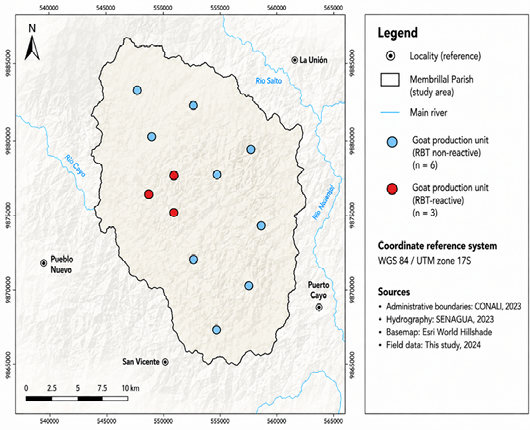
The map illustrates the geographic distribution of the nine goat production units included in the study. Each point represents a georeferenced production unit, and symbols indicate the presence or absence of RBT-reactive animals.
The Figure 2, provides a descriptive visualization of the spatial distribution of sampled farms. No spatial clustering analysis, spatial autocorrelation assessment, or disease-risk modelling was performed. Therefore, the observed geographic distribution should not be interpreted as evidence of spatial aggregation, localized transmission patterns, or epidemiological risk areas.
Discussion
The apparent RBT seroreactivity identified in this study was 3.96% (4/101) among reproductive-age female goats evaluated in smallholder production systems. This value was lower than estimates reported in some comparable studies conducted in Latin America. Regional differences in brucellosis occurrence have been associated with variations in production systems, surveillance capacity, and control strategies among Latin American countries . However, comparisons among studies should be interpreted cautiously because differences in diagnostic methods, population characteristics, management systems, and epidemiological contexts may influence apparent RBT seroreactivity estimates ; .
Beyond its public health implications, brucellosis generates important economic impacts through reproductive losses, reduced productivity, and control costs, particularly in smallholder livestock systems .
The limited number of RBT-reactive animals detected in the present study restricts the interpretation of epidemiological patterns and does not allow conclusions regarding Brucella spp. transmission dynamics. Although no statistically significant associations were observed between RBT seroreactivity and community, production unit, or age group (p > 0.05), these findings should not be interpreted as evidence of the absence of epidemiological differences. The low number of RBT-reactive animals (n= 4), together with the unequal distribution of sampled goats among communities (79/101 goats originating from Pueblo Nuevo), considerably reduced statistical power and may have limited the ability to detect potential associations.
Although based on a limited number of RBT-reactive animals, these findings provide preliminary evidence of apparent RBT seroreactivity against Brucella spp. among goats from the evaluated smallholder production units. At the national level, Garrido-Haro et al. (2023) reported bovine brucellosis serological findings associated with an increasing number of reported outbreaks in continental Ecuador, identifying extensive management systems and the absence of vaccination as relevant epidemiological factors. Subsequently, Garrido-Haro et al. (2025) described the territorial distribution, incidence rates, and relative risk of bovine brucellosis between 2019 and 2023, highlighting the contribution of coastal areas to the national epidemiological scenario. Although these studies provide important evidence regarding bovine brucellosis in Ecuador, information regarding Brucella spp. exposure and serological evidence in small-ruminant populations remains limited.
The apparent RBT seroreactivity observed in the present caprine study, although based on a limited number of reactive animals, is consistent with the heterogeneous distribution of Brucella spp. serological reactivity patterns described in Ecuadorian livestock systems. These findings highlight the importance of expanding surveillance strategies to small-ruminant populations, which have historically received less epidemiological attention than cattle populations .
The geographic visualization showed the distribution of production units with and without RBT-reactive animals. However, because only four RBT-reactive animals were identified and no formal spatial analyses were performed, including spatial autocorrelation or cluster detection methods, these observations should be considered exploratory. The spatial distribution presented should not be interpreted as evidence of localized transmission, spatial aggregation, or epidemiological risk areas. Further investigations using larger datasets, confirmatory diagnostic methods, and appropriate spatial analytical approaches are required to better characterize potential spatial patterns ; .
The interpretation of apparent RBT seroreactivity should also consider the broader epidemiological context of brucellosis in small-ruminant production systems. Previous studies conducted in mixed goat–cattle production systems have demonstrated that interspecies interactions may contribute to the persistence and transmission potential of Brucella spp., particularly under extensive management conditions and limited sanitary control . Similarly, retrospective evaluations in goat populations have highlighted the co-occurrence of brucellosis-related serological findings with other infectious diseases affecting herd productivity, emphasizing the importance of integrated surveillance programmes and multipathogen monitoring strategies .
The potential presence of Brucella spp. in milk and dairy products remains an important public health concern, particularly in rural production systems where raw milk consumption and traditional dairy practices persist. These conditions reinforce the importance of strengthening food safety measures within a One Health framework .
From a public health perspective, even low levels of apparent RBT seroreactivity may warrant attention in rural settings where practices such as raw milk consumption and direct contact with reproductive materials without adequate biosecurity measures may occur. Although these practices were not directly evaluated in the present study, previous investigations have identified exposure to raw milk and reproductive fluids as potential risk factors associated with zoonotic transmission of Brucella spp. in smallholder production systems ; ; .
From a control perspective, current evidence supports integrated strategies involving sustained surveillance, targeted vaccination programmes where recommended by national control policies, improvement of farm biosecurity, and producer education. However, implementation should consider local epidemiological conditions and the operational capacity of smallholder production systems .
An important consideration in the interpretation of these findings is that the Rose Bengal Test was used as the sole diagnostic screening method. Although RBT is widely applied because of its simplicity, rapid implementation, and suitability for field conditions, reactive results may occur due to cross-reactive antibodies against antigenically related organisms, particularly in low-prevalence settings . Therefore, RBT-reactive results should not be interpreted as evidence of confirmed Brucella spp. infection without additional confirmatory testing ; WOAH, 2024).
Confirmatory approaches, including indirect ELISA, complement fixation tests, molecular assays, or bacterial isolation, are recommended to improve diagnostic accuracy and facilitate more reliable epidemiological comparisons among studies .
Several limitations should be acknowledged. First, the small number of RBT-reactive animals (n= 4) limited statistical power and prevented reliable multivariable regression modelling. Consequently, the absence of statistically significant associations should be interpreted cautiously, as insufficient statistical power may have limited the detection of potential relationships between animal characteristics and RBT seroreactivity. Second, because confirmatory serological or molecular tests were not performed, the results represent apparent RBT seroreactivity rather than confirmed Brucella spp. infection status. Third, the cross-sectional design provides a temporal snapshot of apparent RBT seroreactivity and does not allow evaluation of transmission dynamics or causal relationships, as simultaneous measurement of exposures and outcomes limits temporal interpretation and causal inference .
Future studies incorporating molecular and bacteriological approaches, including conventional PCR, quantitative PCR (qPCR), and bacterial isolation, would strengthen confirmation of Brucella spp. infection status and improve the understanding of epidemiological patterns in goat populations .
These approaches would contribute to integrated One Health strategies by strengthening the links between animal health, public health, and food safety components .
Overall, although the limited number of RBT-reactive animals restricts the strength of epidemiological inferences, the present findings provide valuable preliminary information regarding apparent RBT seroreactivity against Brucella spp. in smallholder goat production systems and support the need for expanded surveillance incorporating confirmatory diagnostic approaches.
Conclusions
Although exploratory in nature, this study provides preliminary evidence of apparent RBT seroreactivity among goats from participating smallholder production units. However, these findings should not be interpreted as confirmation of active Brucella spp. infection or as representative of the epidemiological situation of goat populations at the national level in Ecuador. Instead, the results provide preliminary epidemiological information to support future surveillance activities, the implementation of confirmatory diagnostic approaches, and the development of One Health-based strategies for monitoring and controlling brucellosis in small-ruminant production systems.
Acknowledgements
The authors thank the goat farmers of Membrillal parish, Jipijapa canton, for their collaboration and for facilitating access to their production units during the implementation of this study. The authors also acknowledge the institutional support provided by the State University of Southern Manabí and Universidad Regional Amazónica Ikiam for promoting and supporting research initiatives in animal health and public health.
The authors further thank the technical staff and collaborators involved in field activities, sample collection, and data processing, whose contributions were essential for the successful completion of the study.
Novelty Statement
To the best of our knowledge, this study represents the first reported descriptive assessment of apparent RBT seroreactivity among reproductive-age female goats from smallholder production systems in coastal Ecuador. The findings provide preliminary information on the occurrence and geographic distribution of RBT-reactive animals and contribute to strengthening future confirmatory investigations and One Health-based surveillance strategies addressing Brucella spp. serological reactivity in goat production systems.
Author’s Contribution
RC-C: Conceptualization, methodology, supervision, writing review and editing. BA-P: Investigation, data curation, writing original draft. JA-C: Formal analysis, validation. IG-P: Methodology, writing review and editing. MV-L: Investigation, data curation. JD-L: Investigation, writing review and editing. JT-M: Formal analysis, data curation. DCV: Methodology, formal analysis, writing review and editing. DY-A: Conceptualization, supervision, project administration, writing review and editing.
Funding statement
This research received no specific grant from any funding agency in the public, commercial, or not-for-profit sectors. The study was conducted using the authors’ own resources and without external financial support.
Declaration on the use of generative AI and AI-assisted technologies
Generative AI and AI-assisted technologies were used exclusively to improve language clarity and readability during manuscript preparation. These tools were not used for data analysis, interpretation of results, generation of scientific content, or formulation of conclusions. The authors critically reviewed all AI-assisted outputs and take full responsibility for the accuracy, integrity, originality, and scientific validity of the manuscript.
Conflict of interest
The authors have declared that they have no conflicts of interest related to the conduct, analysis, or publication of this study. No financial, personal, or institutional relationships exist that could have influenced the results, interpretation, or conclusions of the research.
References
- Agencia de Regulación y Control Fito y Zoosanitario (2023). Registro oficial pecuario de la parroquia Membrillal. Agrocalidad.
- Banai M, Jiang H, Peng X, Feng Y, Ding J (2021). The prevention and control of domesticated animal brucellosis. Biosaf. Health, 3(4): 197–201. https://doi.org/10.1016/j.bsheal.2021.04.003 [CrossRef]
- Baumeister S-E, Kocher T, Papapanou PN, Holtfreter B, Demmer RT (2025). Cross-sectional studies: Strengths, limitations, and methodological considerations. J. Periodontal Res., 61: 1–12. https://doi.org/10.1111/jre.70063 [CrossRef]
- Béjaoui A, Ben Abdallah I, Maaroufi A (2022). Brucella spp. contamination in artisanal unpasteurized dairy products: An emerging foodborne threat in Tunisia. Foods, 11(15): Article 2269. https://doi.org/10.3390/foods11152269 [CrossRef]
- Bhandi S, Pfukenyi DM, Matope G, Murondoti A, Tivapasi M, Ndengu M (2019). Brucellosis and chlamydiosis seroprevalence in goats at livestock–wildlife interface areas of Zimbabwe. Onderstepoort J. Vet. Res., 86(1): Article a1670. https://doi.org/10.4102/ojvr.v86i1.1670 [CrossRef]
- Bonilla-Aldana DK, Trejos-Mendoza AE, Pérez-Vargas S, Rivera-Casas E, Muñoz-Lara F, Zambrano LI, Arteaga-Livias K, Ulloque-Badaracco JR, Alarcon-Braga EA, Hernandez-Bustamante EA, Al-kassab-Córdova A, Benites-Zapata VA, Rodriguez-Morales AJ (2023). A systematic review and meta-analysis of bovine brucellosis seroprevalence in Latin America and the Caribbean. New Microbes and New Infections, 54, Article 101168. https://doi.org/10.1016/j.nmni.2023.101168 [CrossRef]
- Corbel MJ (2006). Brucellosis in humans and animals. World Health Organization.
- Dadar M, Tiwari R, Sharun K, Dhama K (2021). Importance of brucellosis control programs of livestock on the improvement of one health. Vet. Quart., 41(1): 137–151. https://doi.org/10.1080/01652176.2021.1894501 [CrossRef]
- Das S, Das P, Das A, Hasib FMY, Chowdhury S (2025). A systematic review and meta-analysis on the prevalence of Brucella melitensis in sheep and goat. Vet. Med. Sci., 11(6): Article e70667. https://doi.org/10.1002/vms3.70667 [CrossRef]
- Elias IC, Viola MN, Russo AM, Signorini Porchietto M (2025). Factores de riesgo asociados a la presentación de brucelosis en establecimientos mixtos de caprinos-bovinos de la provincia de Formosa, Argentina. Rev. Argent. Microbiol., 57(2): 152–160. https://doi.org/10.1016/j.ram.2024.10.003 [CrossRef]
- Food and Agriculture Organization of the United Nations (2020). The state of food and agriculture 2020: Overcoming water challenges in agriculture. FAO.
- Freire ML, Machado de Assis TS, Silva SN, Cota G (2024). Diagnosis of human brucellosis: Systematic review and meta-analysis. PLoS Negl. Trop. Dis., 18(3): Article e0012030. https://doi.org/10.1371/journal.pntd.0012030 [CrossRef]
- Garrido-Haro A, Barrionuevo-Samaniego M, Moreno-Caballeros P, Burbano-Enriquez A, Sánchez-Vázquez MJ, Pompei J, Humblet M-F, Ron-Román J, Saegerman C (2023). Seroprevalence and risk factors related to bovine brucellosis in continental Ecuador. Pathogens, 12(9): Article 1134. https://doi.org/10.3390/pathogens12091134 [CrossRef]
- Garrido-Haro A, Falconí M, Moreno-Caballeros P, Elena-Rovalino M, Rosero-Mayanquer H, Yugcha-Díaz M, Fretin D, Wielick C, Saegerman C, Ron-Román J (2025). Determination and characterization of (novel) circulating strains of Brucella spp. within the national bovine brucellosis control program in Ecuador. Pathogens, 14(2): Article 158. https://doi.org/10.3390/pathogens14020158 [CrossRef]
- Ghssein G, Ezzeddine Z, Tokajian S, Khoury CA, Kobeissy H, Ibrahim J-N, Iskandar C, Hassan HF (2025). Brucellosis: Bacteriology, pathogenesis, epidemiology and role of the metallophores in virulence: A review. Front. Cell. Infect. Microbiol., 15: Article 1621230. https://doi.org/10.3389/fcimb.2025.1621230 [CrossRef]
- Gobierno Autónomo Descentralizado Municipal del Cantón Jipijapa (2021). Plan de desarrollo y ordenamiento territorial (PDOT) del cantón Jipijapa 2020–2023. GAD Jipijapa.
- Godfroid J, Nielsen K, Saegerman C (2013). Diagnosis of brucellosis in livestock and wildlife. Croat. Med. J., 54(4): 296–305. https://doi.org/10.3325/cmj.2010.51.296 [CrossRef]
- Instituto Nacional de Estadística y Censos (2022). Encuesta de superficie y producción agropecuaria continua (ESPAC) 2022. INEC. https://www.ecuadorencifras.gob.ec/
- Instituto Nacional de Meteorología e Hidrología (2021). Boletín climatológico anual del Ecuador 2021. INAMHI. https://www.inamhi.gob.ec/
- Islam MS, Islam MA, Rahman MM, Islam K, Islam MM, Kamal MM, Islam MN (2023). Presence of Brucella spp. in milk and dairy products: A comprehensive review and its perspectives. J. Food Qual., 2023, Article 2932883. https://doi.org/10.1155/2023/2932883 [CrossRef]
- Kilkenny C, Browne WJ, Cuthill IC, Emerson M, Altman DG (2010). Improving bioscience research reporting: The ARRIVE guidelines for reporting animal research. PLoS Biol., 8(6): Article e1000412. https://doi.org/10.1371/journal.pbio.1000412 [CrossRef]
- Kolachi HA, Abro SH, Kambhoh AA, Soomro SA, Kalhoro NH, Soomro AA (2025). Serological evidence of chlamydiosis, Q fever and brucellosis in District Dadu, Pakistan. Pak. J. Zool., 57(4): 1543. https://doi.org/10.17582/journal.pjz/20210324160335 [CrossRef]
- Laine CG, Scott HM, Arenas-Gamboa AM (2022). Human brucellosis: Widespread information deficiency hinders an understanding of global disease frequency. PLoS Negl. Trop. Dis., 16(5): Article e0010404. https://doi.org/10.1007/s13577-022-00756-8 [CrossRef]
- Legesse A, Mekuriaw A, Gelaye E, Abayneh T, Getachew B, Weldemedhin W, Tesgera T, Deresse G, Birhanu K (2023). Comparative evaluation of RBPT, I-ELISA, and CFT for the diagnosis of brucellosis and PCR detection of Brucella spp. from Ethiopian sheep, goats, and cattle sera. BMC Microbiol., 23(1): Article 216. https://doi.org/10.1186/s12866-023-02962-2 [CrossRef]
- Liu Y, Zhao Z, Liu X, Zhang Z, Wang Y, Wang Z (2024). Global epidemiology and antimicrobial resistance characteristics of Brucella spp.: A systematic review and meta-analysis. Front. Vet. Sci., 11: Article 1367425. https://doi.org/10.1016/j.jgar.2024.03.007 [CrossRef]
- Lucero NE, Ayala SM, Escobar GI, Jacob NR (2008). Brucella isolated in humans and animals in Latin America from 1968 to 2006. Epidemiol. Infect., 136(4): 496–503. https://doi.org/10.1017/S0950268807008795 [CrossRef]
- Mangi MH, Kamboh AA, Rind R, Dewani P, Nizamani ZA, Mangi AR, Nizamani AR, Vistro WA (2015). Seroprevalence of brucellosis in Holstein-Friesian and indigenous cattle breeds of Sindh Province. Pakistan. J. Anim. Health Prod., 3(4): 82-87. https://doi.org/10.14737/journal.jahp/2015/3.4.82.87 [CrossRef]
- Martínez-Rodríguez D, Hernández-Mora G, Chaves-Olarte E, Moreno E (2021). Brucellosis: Molecular mechanisms of pathogenesis and host immune response. Front. Cell. Infect. Microbiol., 11: Article 637587.
- McDermott J, Grace D, Zinsstag J (2013). Economics of brucellosis impact and control in low-income countries. Rev. Sci. Tech. (Office International des Epizooties): 32(1): 249–261. https://doi.org/10.20506/rst.32.1.2197 [CrossRef]
- National Research Council (2011). Guide for the care and use of laboratory animals (8th ed.). Nat. Acad. Press. [CrossRef]
- Nielsen K, Yu WL (2010). Serological diagnosis of brucellosis. Prilozi, 31(1): 65–89. [CrossRef]
- Pappas G, Papadimitriou P, Akritidis N, Christou L, Tsianos EV (2006). The new global map of human brucellosis. Lancet Infect. Dis., 6(2): 91–99. https://doi.org/10.1016/S1473-3099(06)70382-6 [CrossRef]
- Poester FP, Samartino LE, Santos RL (2013). Pathogenesis and pathobiology of brucellosis in livestock. Rev. Sci. Tech. (Office International des Epizooties): 32(1): 105–115. https://doi.org/10.20506/rst.32.1.2193 [CrossRef]
- Qureshi N, Shahid M, Khan MS, Raza A, Ahmad M (2023). Brucellosis in small ruminants: Epidemiology, diagnosis, and control strategies. Vet. Med. Sci., 9(6): 2667–2680.
- Rahman AKMA, Saegerman C, Berkvens D, Fretin D, Gani MO, Ershaduzzaman M, Emmanuel D (2014). Brucella infection in small ruminants: A systematic review and meta-analysis. Vet. World, 7(10): 811–821.
- Rahman H, Kamboh AA, Korejo NA, Memon AM, Korejo RA, Chandio MA (2022). Seroprevalence of brucellosis in camels in district Sibi, Balochistan. J. Anim. Health Prod., 10: 153-157. https://doi.org/10.17582/journal.jahp/2022/10.2.153.157 [CrossRef]
- Rossetti CA, Arenas-Gamboa AM, Maurizio E (2017). Caprine brucellosis: A comprehensive review. Vet. Microbiol., 206: 1–8.
- Samartino LE (2002). Brucellosis in Argentina. Vet. Microbiol., 90(1–4): 71–80. https://doi.org/10.1016/S0378-1135(02)00247-X [CrossRef]
- Seleem MN, Boyle SM, Sriranganathan N (2010). Brucellosis: A re-emerging zoonosis. Vet. Microbiol., 140(3–4): 392–398. https://doi.org/10.1016/j.vetmic.2009.06.021 [CrossRef]
- Smith MC, Sherman DM (2023). Goat medicine (3rd ed.). Wiley-Blackwell. https://doi.org/10.1002/9781119382775 [CrossRef]
- World Organisation for Animal Health (2024). Terrestrial animal health code: Infection with Brucella abortus, B. melitensis and B. suis. WOAH.
- Xie Y, Zhang Y, Wang J, Li H, Chen Z (2025). Advances in diagnosis, epidemiology, and prevention strategies of animal brucellosis: A One Health perspective. Front. Vet. Sci., 12: Article 1512345.

Services
Article usage statistics
Loading…
Related articles
- Thermoregulatory Responses and Physiological Adaptability of Kacang Goats Under Smallholder Farms in the Islands Region of North Maluku, IndonesiaJournal of Animal Health and Production · 2026
- The Utility of Punyakoti Test for Pregnancy Detection in Artificially Inseminated Dairy Cattle: The Case of Smallholder Farming in ZambiaAdvances in Animal and Veterinary Sciences · 2022
- Reproductive Performance of Dairy Goats in Smallholder Farmers Affiliated with Dian Santosa and Pangestu Farmer Groups in Sleman Regency, Yogyakarta: A Descriptive StudyPakistan Journal of Agricultural Research · 2025
- Evaluation of Duck Farming and its Development Strategy: The Case of Smallholder Farmers in Indramayu District, IndonesiaAdvances in Animal and Veterinary Sciences · 2025
- Geographical Spatial Distribution of a Tropical Freshwater Snail, Oncomelania hupensis and Influencing Factors on its DistributionPakistan Journal of Zoology · 2025
- Influence of Farming Systems on the Incidence of Toxoplasma gondii Infection in Cattle and GoatsResearch Journal for Veterinary Practitioners · 2026