
Semen cryopreservation can reduce sperm functionality through decreased motility, impaired membrane integrity, and increased cellular stress. This study evaluated the effects of L-arginine supplementation in a Tris-egg yolk extender on the functional quality of cryopreserved semen from Indonesian Simmental bulls. Semen was collected from four healthy bulls, pooled after quality screening, and allocated to four treatments: Control without L-arginine (T0), 55 mM L-arginine (T1), 110 mM L-arginine (T2), and 220 mM L-arginine (T3). Semen quality was assessed at pre-freezing and post-thawing stages based on individual motility, total motile sperm count, and viability. The results demonstrated a dose-dependent association between L-arginine supplementation and functional semen quality following cryopreservation. Among the tested concentrations, T1 (55 mM) maintained the most favorable overall functional semen profile, particularly in terms of total motile sperm count and sperm viability. Although post-thaw motility was numerically higher in T1 than in the control group, the difference was not statistically significant. In contrast, higher concentrations (110 and 220 mM) were associated with poorer post-thaw functional outcomes. These findings suggest that appropriate dose optimization is essential when L-arginine is incorporated into semen extenders. However, the underlying mechanisms remain unclear because nitric oxide balance, oxidative and nitrosative stress, mitochondrial function, apoptosis-related pathways, DNA integrity, membrane stabilization, and extender osmolality were not evaluated. Further studies are required to clarify the mechanisms involved and to confirm the practical relevance of L-arginine supplementation under field conditions.
Research Article · Volume 15, Issue 1, Pages 186–197, 18 November 2026 · Open Access
Dose-Dependent Effects of L-Arginine Supplementation on Functional Post-Thaw Semen Quality of Indonesian Simmental Bulls
, , , , , ,
Affiliations & Notes ⌄
- 1Faculty of Veterinary Medicine, Universitas Brawijaya, Malang 65146, East Java, Indonesia
- 2Faculty of Animal Science and Technology, Universitas Brawijaya, Malang 65145, East Java, Indonesia
- 3Faculty of Science, Technology, Engineering, and Mathematics, Universitas Brawijaya, Malang 65145, East Java, Indonesia
- 4Faculty of Veterinary Medicine, Universitas Airlangga, Surabaya 60115, East Java, Indonesia
- *Correspondence | Trinil Susilawati; Email: tsusilawati@ub.ac.id
Article Info ⌄
- Journal:
- Journal of Animal Health and Production
- Submitted Date:
- 30 January 2026
- Accepted Date:
- 25 June 2026
- Published Date:
- 18 November 2026

Abstract
Introduction
Bovine semen cryopreservation is an essential component of modern reproductive biotechnology and plays a central role in artificial insemination programs aimed at improving livestock genetics. In tropical countries such as Indonesia, cryopreservation enables the efficient dissemination of superior genetic material across geographically dispersed cattle populations. Despite its practical advantages, the cryopreservation process remains biologically challenging because freezing and thawing induce substantial structural and functional damage to spermatozoa . This damage is commonly characterized by reduced sperm motility, impaired membrane integrity, decreased viability, and lower fertilizing capacity after thawing ; . Consequently, improving post-thawing semen quality remains a major objective in reproductive biotechnology. One important strategy is the optimization of semen extenders through the incorporation of bioactive additives that can reduce cryoinjury and maintain sperm functionality during freezing and thawing. Previous studies in bovine and buffalo semen have demonstrated that oxidative stress and membrane-associated damage are among the primary factors responsible for sperm dysfunction after cryopreservation. Excessive production of reactive oxygen species during the freezing-thawing process can disrupt membrane stability, impair mitochondrial activity, and compromise sperm survival. Therefore, antioxidant supplementation has been widely investigated as a practical approach to mitigate cryodamage and improve post-thawing sperm quality ; . This issue is particularly important in Indonesia, where the success of artificial insemination programs depends not only on semen availability but also on the preservation of sperm quality after thawing.
Among the antioxidants evaluated for semen preservation, L-arginine has attracted considerable attention because of its role as a precursor of nitric oxide (NO), a signaling molecule involved in sperm metabolism, motility, and cellular homeostasis. Several studies have reported beneficial effects of L-arginine supplementation; however, these effects appear to be concentration-dependent. Moderate concentrations generally improve sperm quality, whereas excessive supplementation may provide limited benefits or even exert adverse effects. For example, supplementation with 3-6 mM L-arginine improved sperm motility and viability in subfertile buffalo semen . Similarly, Hegazy et al. (2020) evaluated 0, 0.5, 1, 5, and 10 mM L-arginine and reported that lower concentrations, particularly 0.5 mM, produced the most favorable post-thawing outcomes. The authors observed improvements in sperm motility, viability index, acrosome integrity, fertilizing potential, and reduced lipid peroxidation compared with untreated controls. Consistent with these findings, our previous study demonstrated that supplementation with 0.05 M L-arginine in a Tris-egg yolk extender improved motility, viability, acrosome integrity, and antioxidant status in cryopreserved Indonesian Simmental bull semen, whereas higher concentrations did not yield additional benefits . Collectively, these findings suggest that the beneficial effects of L-arginine depend on species, extender composition, and cryopreservation protocol. Therefore, identifying the optimal concentration remains essential for maximizing semen preservation outcomes. The present study was designed to evaluate the effects of different concentrations of L-arginine in a Tris-egg yolk extender on cryopreserved semen quality in Indonesian Simmental bulls. Sperm quality was assessed at two critical stages of cryopreservation, namely pre-freezing and post-thawing, with particular emphasis on individual motility, total motile sperm count, and sperm viability.
Although our previous study reported the beneficial effects of 0.05 M L-arginine supplementation on selected semen quality parameters, the current study differs substantially in both scope and scientific focus. The earlier study primarily evaluated acrosome integrity and lipid peroxidation as indicators of cryoprotective activity. In contrast, the present investigation focuses on functional sperm preservation by examining individual motility, total motile sperm count, and viability before freezing and after thawing. Furthermore, a comprehensive dose–response design was applied to compare multiple concentrations of L-arginine within a single experimental framework. This approach enabled the identification of the most effective concentration for preserving sperm function after cryopreservation. The novelty of this study lies in evaluating dose-dependent responses to L-arginine supplementation and identifying its practical relevance for artificial insemination programs in tropical production systems.
Materials and Methods
Ethical approval and study design
This study was conducted as a laboratory experiment using a randomized block design with four treatments and fifteen replications (Table 1). Semen samples were collected biweekly from four healthy Indonesian Simmental bulls, aged approximately six years and weighing between 800 and 850 kg. Semen was collected using an artificial vagina under standard veterinary supervision. Ejaculates meeting the Indonesian National Standard criteria (progressive motility > 70%, sperm concentration 800 to 2000 ×10^6 cells/mL, mass motility +++) were included in the study (Indonesian . To minimize individual variation among bulls, qualified ejaculates were pooled in equal proportions before treatment allocation. Therefore, the experimental unit was the pooled semen aliquot rather than the individual bull.
The primary outcomes were individual motility, total motile sperm count, and viability. The study was conducted from March to June 2023 at the Artificial Insemination Center, East Java, Indonesia, and all procedures were approved by the Animal Care, Use, and Ethics Committee of Universitas Brawijaya, Malang, Indonesia (No. 177-KEP-UB-2023).
Table 1: Experimental groups of Supplementation of L-arginine on Tris-egg yolk.
| Treatment group | Extender composition |
| T0 | Tris-egg yolk extender without L-arginine |
| T1 | Tris-egg yolk extender + 55 mM L-arginine |
| T2 | Tris-egg yolk extender + 110 mM L-arginine |
| T3 | Tris-egg yolk extender + 220 mM L-arginine |
T0 = control treatment; T1= Treatment 1; T2= Treatment 2; T3= Treatment 3.
Semen assessment
Semen was collected from four healthy Indonesian Simmental bulls following a standardized collection procedure. Ejaculates were evaluated individually, and only samples meeting the Indonesian national standard criteria were included in the pooled sample. These criteria were a progressive motility (PMOT) of at least 70%, a spermatozoa concentration of 800 to 2000 ×10^6 cells/mL, and mass motility scored as +++. To minimize inter-bull variation, qualified ejaculates were pooled before treatment allocation. Following pooling, semen quality was re-evaluated using both macroscopic and microscopic assessments. Macroscopic assessment included color, odor, volume, consistency, and pH whereas microscopic evaluation included mass motility, sperm concentration, progressive motility, viability, morphological abnormalities, and plasma membrane integrity. The pooled semen was then divided into replicated aliquots and assigned to the treatment groups. Each replication represented an independent semen-processing batch conducted on a separate experimental occasion using freshly pooled semen. Within each batch, pooled semen was independently diluted, allocated into treatment groups, cryopreserved, thawed, and evaluated using the same standardized protocol. Therefore, the replication structure reflected independent experimental runs rather than repeated microscopic observations or technical measurements from the same aliquot. Semen quality was assessed at two stages: Pre-freezing and post-thawing, in accordance with Indonesian National Standard (2017). Because both assessments were performed on the same treated aliquots, pre-freezing and post-thawing observations were treated as repeated measurements within the same experimental unit. The main functional parameters observed in this study were individual motility, total motile sperm count, and viability after L-arginine supplementation of the Tris-egg yolk extender.
Extender
The Tris-egg yolk extender was freshly prepared before each cryopreservation procedure. Tris-aminomethane, citric acid, lactose monohydrate, D-(+)-raffinose pentahydrate, and D-(-)-fructose were dissolved in 80 mL of double-distilled water and homogenized using a magnetic stirrer for 15 min. The base solution was adjusted to an osmolarity of 295 mOsm/L and a pH of 6.7, sterilized by heating at 100°C for 5–10 min, and then cooled to room temperature. Penicillin G and streptomycin sulfate were subsequently added. After re-homogenization, 20 mL of egg yolk was added, and the mixture was centrifuged at 450 rpm for 15 min. The supernatant was used as the base extender, whereas the pellet was discarded ; . The base diluent was then divided equally into Extender A and Extender B. Extender A served as the treatment base without glycerol. In the supplemented groups (T1, T2, and T3), L-arginine (Sigma-Aldrich) was added to Extender A and homogenized thoroughly, whereas the control group contained no L-arginine. Extender B was prepared for the final addition of glycerol 5% as a cryoprotectant .
Individual motility
Individual progressive motility was assessed in fresh semen, pre-freezing and post-thawing stages. The assessment was performed immediately after semen collection or sample preparation to minimize changes in sperm activity caused by temperature variation or storage time. A 10 µL sample was placed on a glass slide preheated to 37°C on a warm stage and covered with a 22 × 22 mm coverslip to produce a thin and even layer. The slide was maintained at 37°C throughout the observation. Samples were observed using an Olympus® CX-23 light microscope at 400× magnification. Five random fields were examined systematically from the edge to the center of the preparation to obtain a representative assessment of the cell population. Spermatozoa were classified as progressive, non-progressive, or immotile. Progressive spermatozoa were defined as those moving forward in a straight or curved trajectory at a steady speed. Non-progressive spermatozoa showed movement without forward progression or oscillated in place, whereas immotile spermatozoa showed no movement. Progressive motility was calculated as the number of progressively motile spermatozoa divided by the total number of spermatozoa observed and multiplied by 100 .
Sperm concentration
Sperm concentration was determined immediately after semen collection using an improved Neubauer counting chamber. Fresh semen was diluted using an RBC pipette by aspirating semen to the 0.5 mark and then adding either 3% sodium chloride (NaCl) or formol saline to the 101 mark, resulting in a dilution factor of 200. The diluent immobilized the spermatozoa and allowed accurate counting. The diluted sample was homogenized thoroughly, and the first few drops were discarded before the sample was loaded into the hemocytometer chamber under a coverslip .
The chamber was left for 1-2 min to allow spermatozoa to settle evenly. Counting was performed using an Olympus® CX-23 light microscope at 400× magnification in five large squares of the Neubauer chamber. The number of spermatozoa counted was converted to concentration per milliliter using the standard Neubauer formula. This value represented fresh semen concentration before dilution in extender and before cryopreservation processing. In the present study, fresh semen concentration averaged approximately 1687.04 ×10^6 cells/mL. After extension and processing, sperm concentration was expressed as the estimated total sperm concentration in diluted semen at the pre-freezing and post-thawing stages. Thus, the lower values reported in the Results section represent processed semen after dilution with extender, not fresh undiluted semen. Total motile sperm count was calculated from the estimated sperm concentration at each stage multiplied by the corresponding percentage of progressive motility and is presented as ×10^6 cells/mL .
Total motile sperm count (10^6 cells/mL)
The determination of total motile spermatozoa is based on a combination of the spermatozoa concentration per milliliter and the percentage of individual progressive motility. The examination begins with measuring the spermatozoa concentration using a hemocytometer or automated reader, according to standard laboratory procedures. The semen sample is diluted in an isotonic diluent solution to achieve optimal dilution (1:100) and then homogenized to ensure even cell distribution before calculating the concentration. Individual progressive motility values were obtained through direct microscopic examination. A 10 µL sample of fresh semen was placed on a slide preheated to 37°C, then covered with a cover slip, and observed using an Olympus CX light microscope at 400× magnification . Observations were made in five random fields. The number of progressive, non-progressive, and immotile spermatozoa was counted using ImageJ software via the cell counter feature to obtain an accurate percentage of individual progressive motility. Once the spermatozoa concentration and the percentage of individual progressive motility were known, the total motile spermatozoa value was calculated using the percentage of progressive motility as a multiplier against the total spermatozoa concentration. The calculation was performed using the formula:
Total motile sperm count (106 cells/mL) = Total sperm concentration (cells/mL) × Progressive motility (%)/ 100
This approach allows for a more precise quantitative estimate of the number of spermatozoa that are truly motile and potentially fertile. The entire analysis was performed in less than 10 minutes. Semen smears were collected within 10 minutes after semen collection to prevent artifacts due to decreased motility. Furthermore, all observations were conducted by the same analyst to minimize subjective variation and increase the consistency of results .
Sperm viability
Sperm viability was evaluated using the eosin-nigrosin staining method, which distinguishes between live and dead spermatozoa. A drop of semen (0.1 mL) was mixed with a drop of eosin-nigrosin (0.1 mL) (concentration ± 2%) on a glass slide. The mixture was spread to create a thin, even layer and then allowed to air dry to prevent spermatozoa movement, ensuring accurate observation. The smear was examined using a light microscope (Olympus CX-21, Olympus Corporation, Tokyo, Japan) at 1000× magnification, and sperm viability was assessed by evaluating a minimum of 100 spermatozoa per smear. Live spermatozoa appeared transparent, while dead spermatozoa stained red due to eosin uptake. The percentage of live spermatozoa was calculated by dividing the number of live spermatozoa by the total number of spermatozoa observed (live and dead), then multiplying by 100%. Viability was further analyzed using ImageJ counting software to ensure accurate results ; .
Statistical analysis
Data were analyzed using RStudio (Version 4.3.3). Normality and homogeneity of variance were assessed using the Shapiro-Wilk and Levene tests, respectively. The study included four treatment groups and two evaluation stages, pre-freezing and post-thawing. Therefore, the analysis assessed the main effects of treatment and stage, as well as the treatment × stage interaction. Because ejaculates from four bulls were pooled before treatment allocation, each replicated aliquot of pooled semen from an independent processing batch was considered the experimental unit rather than the individual bull. Replications represented independent cryopreservation batches performed on separate experimental occasions and were included as a blocking factor to account for inter-batch variability. pre-freezing and post-thawing evaluations obtained from the same aliquot were treated as repeated measurements within the same experimental unit. Replication or batch was included as a blocking factor to account for variation among experimental runs. Since individual motility, total motile sperm count, and viability are functionally related semen quality variables, MANOVA was used to evaluate overall differences among treatments and stages, with stage treated as a repeated measurement factor. When MANOVA showed a significant effect (p < 0.05), Duncan’s Multiple Range Test was used for post hoc pairwise comparisons ; . Data are presented as mean ± SEM, and significance was set at p < 0.05. Mechanistic interpretations were limited to literature-based hypotheses because oxidative, nitrosative, mitochondrial, and apoptosis-related biomarkers were not directly measured.
Results and Discussion
Evaluation of fresh semen
Macroscopic and microscopic evaluation of fresh semen is presented in Table 2. The average volume of semen was 6.93 ± 0.15 ml, with a creamy color, consistency, and pH of 6.6, all within the normal range according to Indonesian National Standard (2017). Microscopically, the spermatozoa concentration reached 1687.04 ± 22.13 ×10⁶ cells/mL), and the mass motility was in the +++ category, indicating strong movement quality. Individual motility of 85.25% ± 5.92% exceeded the minimum standard of >70%, while the total motile sperm count was 1438.70 ± 15.34 (10^6 cells/mL). Sperm viability was also very high, namely 97.65 ± 1.57, indicating that most spermatozoa were in a living and viable condition. Overall, all fresh semen parameters were within the normal range, so the ejaculate met the requirements for processing into frozen semen according to the Indonesian National Standard (Indonesian .
Table 2: Fresh semen quality profile of Indonesian Simental bulls.
| Parameter | Mean ± SEM | Normal range for continuous liquid semen (SNI, 2017) |
| Macroscopic | ||
| Volume (ml) | 6.93 ± 0.15 | > 5 |
| Color | Cream | Cream |
| Consistency | Thick | Thick |
| Semen pH | 6.6 | 6.4–6.6 |
| Microscopic | ||
| Concentration (cells × 10^6) | 1687.04±22.13 | 800-2000 |
| Mass motility | +++ | +++ |
| Individual motility (%) | 85.25 ± 5.92 | > 70% |
Total motile sperm count (10^6 sperm cells/mL) |
1438.70±15.34 | – |
| Viability (%) | 97.65 ± 1.57 | > 70% |
Spermatozoa concentration (cells/mL)
The concentration of fresh undiluted semen measured immediately after collection averaged 1687.04 ×10^6 cells/mL, indicating that all ejaculates met the concentration requirement for further processing. After dilution with extender and allocation to treatment groups, the estimated total spermatozoa concentration of processed semen remained relatively uniform across all treatments at both the pre-freezing and post-thawing stages, ranging from 105.95 to 107.87 ×10^6 cells/mL and 105.89 to 107.95 ×10⁶ cells/mL, respectively. Thus, the values presented in Table 3 refer to diluted and processed semen rather than to fresh semen collected before extender addition.
Table 3: Estimated sperm concentration of diluted semen at pre-freezing and post-thawing stages.
| Treatment | Stages | |
Pre-freezing (×106 cells/mL) ± SEM |
Post-thawing (×106 cells/mL) ± SEM |
|
| T0 | 106.51 ± 3.70 | 106.46 ± 2.73 |
| T1 | 105.95 ± 3.42 | 105.89 ± 3.35 |
| T2 | 107.87 ± 3.70 | 107.95 ± 4.55 |
| T3 | 107.24 ± 4.77 | 107.48 ± 4.31 |
This distinction is important because it indicates that L-arginine supplementation did not materially affect the total sperm concentration of the processed semen during cryopreservation. Instead, the major differences among treatments were observed in the functional quality of spermatozoa, particularly progressive motility, total motile sperm count, and viability. The superior post-thawing performance observed in T1 was therefore not due to a higher sperm concentration, but rather to a greater proportion of spermatozoa remaining motile and viable during cryopreservation. Likewise, the marked decline in total motile sperm count in T2 and especially T3 cannot be attributed to reduced sperm concentration, since the estimated concentration remained comparable among groups. Rather, total motile sperm count was derived from sperm concentration and progressive motility at the corresponding stage, indicating that the reductions in T2 and T3 were mainly driven by poorer motility and lower cell survival. Taken together, these results show that the effect of L-arginine was expressed primarily at the functional level rather than through changes in sperm density.
Individual motility
Individual sperm motility is an important indicator of fertilizing capacity because it reflects the ability of spermatozoa to maintain membrane integrity, mitochondrial activity, and flagellar function during storage and after exposure to cryogenic stress. This parameter is highly sensitive to environmental conditions, including extender composition and the presence of bioactive compounds such as L-arginine, which may influence energy metabolism and cellular redox balance. Variations in motility among treatments therefore provide insight into the functional response of spermatozoa to different concentrations of L-arginine during the freezing-thawing process (Figure 1).
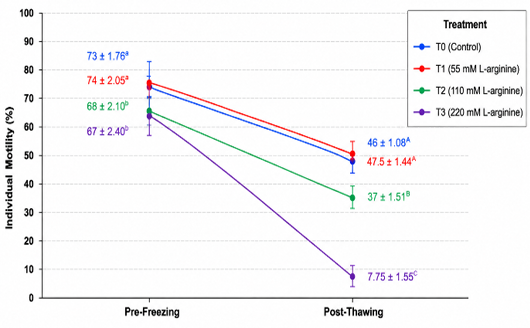
Sperm Motility (%) of Indonesian Simmental bull semen supplemented with different concentrations of L-arginine at pre-freezing and post-thawing stages. Data are presented as mean ± SEM (n = 15 replicates per treatment). Error bars represent the standard error of the mean. Different letters indicate significant differences among treatments within the same preservation stage according to Duncan’s Multiple Range Test (p < 0.05).
The repeated-measures analysis demonstrated that individual sperm motility was significantly influenced by treatment, evaluation stage, and the interaction between treatment and stage. A significant treatment effect was observed (p = 3.48 × 10^-88), indicating that L-arginine supplementation produced different motility responses among treatment groups. The evaluation stage also had a significant effect (p = 2.41 × 10^-127), showing a marked difference in motility between the pre-freezing and post-thawing stages. Moreover, the significant treatment × stage interaction (p = 3.66 × 10^-71) indicates that the reduction in motility after thawing varied across treatment groups. The replication/block effect was also significant (p= 6.55 × 10^-15), suggesting that variation among experimental runs was statistically detectable. Post hoc analysis using Duncan’s Multiple Range Test showed that, during the pre-freezing stage, T0 and T1 maintained significantly higher motility than T2 and T3. Post-thawing, T1 numerically showed the highest post-thawing motility; however, it was not significantly different from T0, although both treatments maintained significantly higher motility than T2 and T3. Across all treatments, motility declines after thawing, although the degree of reduction varies according to L-arginine concentration. Pre-freezing motility ranged from 67% to 74%, with T0 (Tris-egg yolk) and T1 (Tris-egg yolk + 55 mM L-arginine) showing the highest values, indicating that the extender system effectively preserved membrane stability and flagellar integrity before cryogenic exposure. After thawing, T0 and T1 maintained relatively higher motility (46% and 47.5%, respectively), whereas T2 decreased to 37% and T3 declined sharply to 7.75%. Figure 1 illustrates a pronounced decline in motility in T2 and particularly T3, suggesting that L-arginine concentrations above the optimal level reduced sperm tolerance to freeze-thaw stress. Overall, these findings demonstrate a dose-dependent response of sperm motility to L-arginine supplementation, with 55 mM (T1) providing the most favorable functional outcome under the present cryopreservation conditions.
The improved post-thawing motility observed at T1 may be related to the biological role of L-arginine as a precursor of nitric oxide (NO), which has been reported to support sperm physiology at physiological concentrations. Previous studies have shown that NO contributes to the maintenance of membrane fluidity, mitochondrial activity, and ATP production, all of which are closely related to flagellar movement and sperm motility ; . This mechanism may explain why motility remained relatively stable at T1 after thawing. In contrast, the marked decrease observed at T2 and especially T3 suggests that higher L-arginine concentrations are less favorable for maintaining sperm motility under current cryopreservation conditions. Previous literature has suggested that excessive NO-related activity may create an unfavorable redox environment, including potential nitrosative stress and impaired sperm function ; .
Total motile sperm count (10^6 cells/mL)
Total motile spermatozoa is an important indicator of semen quality because it reflects the proportion of spermatozoa that remain progressively motile and therefore potentially capable of contributing to fertilization. In the present study, analysis of total motile sperm count pre-freezing and post-thawing showed a clear dose-dependent pattern in response to L-arginine supplementation. The variability in total motility between treatments is thought to indicate differences in spermatozoa resistance to physiological stress, particularly during the cryopreservation process, which is known to cause significant structural and biochemical changes. Therefore, analyzing total motility patterns provides a comprehensive overview of the treatment’s effectiveness in maintaining spermatozoa integrity and viability (Figure 2). Analysis of total motile spermatozoa data pre-freezing and post-thawing similarly high values (77.75 ± 1.94 and 78.40 ± 1.30 ×10^6 cells/mL), whereas T2 and T3 were lower, indicating that the higher L-arginine concentrations were not associated with improved total motile sperm count even before cryopreservation. Repeated-measures MANOVA showed that total motile sperm count was significantly affected by treatment (p = 7.63 × 10^-87), evaluation stage (p= 2.54 × 10^-127), and the treatment × stage interaction (p= 1.76 × 10^-71). These findings indicate that L-arginine supplementation influenced the number of motile spermatozoa, that total motile sperm count changed significantly between the pre-freezing and post-thawing stages, and that the magnitude of post-thawing decline differed among treatment groups. The replication/block effect was also significant (p = 7.06 × 10^-15), indicating measurable variation among experimental runs.
Post hoc analysis using Duncan’s Multiple Range Test showed that, at the pre-freezing stage, T0 and T1 had similarly high total motile sperm counts (77.75 ± 1.94 and 78.40 ± 1.30 × 10⁶ cells/mL, respectively), whereas T2 and T3 were significantly lower. At the post-thawing stage, the difference among treatments became more pronounced, with T1 maintaining the highest total motile sperm count (50.30 ± 0.46 ×10^6 cells/mL), followed by T0, T2, and T3. These findings indicate that low-dose L-arginine supplementation improved the preservation of motile spermatozoa during cryopreservation, whereas higher concentrations resulted in poorer functional outcomes. Importantly, T3 should not be interpreted as reflecting an absence of protective supplementation because it represented the highest L-arginine dose used in this study. Rather, the findings suggest that excessive supplementation was less favorable than low-dose supplementation under the present experimental conditions (Figure 2).
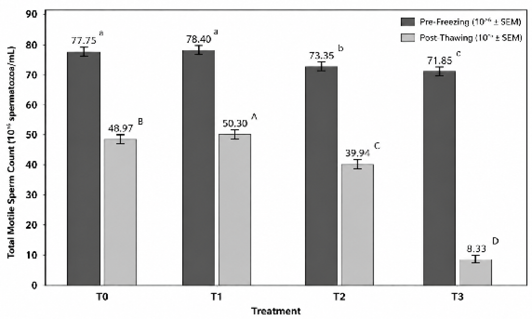
Total Motile Sperm Count (10^6 cells/mL) of Indonesian Simmental bull semen supplemented with different concentrations of L-arginine at the pre-freezing and post-thawing stages. T0: control without L-arginine; T1: 55 mM L-arginine; T2: 110 mM L-arginine; T3: 220 mM L-arginine. Bars represent mean ± SEM. Different lowercase superscripts (a–c) indicate significant differences among treatments at the pre-freezing stage, whereas different uppercase superscripts (A–D) indicate significant differences among treatments at the post-thawing stage according to Duncan’s Multiple Range Test (DMRT) (p < 0.05).
A comparison of pre-freezing and post-thawing values showed that the treatments with better initial total motile sperm counts, particularly T0 and T1, maintained higher post-thawing values, whereas T3 showed the greatest decline. This pattern supports the interpretation that both initial semen quality and treatment condition influenced post-thawing performance. The marked reduction observed in T3 indicates that the highest tested concentration of L-arginine was associated with a substantial loss of total motile spermatozoa after thawing. Although previous studies have proposed that cryopreservation-induced damage may involve oxidative stress, membrane disruption, and mitochondrial impairment, these mechanisms were not directly measured in the present study ; . Overall, the present data support the conclusion that 55 mM L-arginine was the most favorable concentration for preserving total motile sperm count, whereas higher concentrations, particularly 220 mM, were associated with poorer outcomes.
Post hoc analysis using Duncan’s Multiple Range Test showed that, at the pre-freezing stage, T0 and T1 had significantly higher total motile sperm counts than T2 and T3, with values of 77.75 ± 1.94 and 78.40 ± 1.30 × 10^6 spermatozoa/mL, respectively. At the post-thawing stage, T1 showed the highest total motile sperm count (50.30 ± 0.46 × 10^6 spermatozoa/mL), followed by T0 (48.97 ± 0.50 × 10^6 spermatozoa/mL), T2 (39.94 ± 0.42 × 10^6 spermatozoa/mL), and T3 (8.33 ± 0.88 × 10^6 spermatozoa/mL). Therefore, 55 mM L-arginine was associated with the most favorable preservation of total motile sperm count after cryopreservation.
Sperm viability
Sperm viability differed among treatments and between evaluation stages (Figure 3 and 4). At the pre-freezing stage, T1 showed the highest viability value (93.40 ± 1.72%), followed by T0 (89.05 ± 1.31%), T2 (83.91 ± 1.85%), and T3 (75.29 ± 1.18%). Post-thawing, T1 maintained the highest viability (92.39 ± 1.72%), whereas T0 decreased to 84.63 ± 1.14%, T2 to 77.30 ± 1.10%, and T3 showed the lowest value at 62.25 ± 1.69%. These results indicate that 55 mM L-arginine was associated with the most favorable preservation of sperm viability during cryopreservation, whereas higher concentrations, especially 220 mM, were associated with lower viability after thawing. The box plot further illustrates that T1 had the most stable viability distribution between pre-freezing and post-thawing.
Sperm viability was significantly affected by treatment (p= 3.27 × 10^-41), evaluation stage (p= 7.09 × 10^-12), and the treatment × stage interaction (p= 1.68 × 10^-15). These findings show that L-arginine supplementation affected sperm viability, that viability differed between pre-freezing and post-thawing stages, and that the extent of viability decline after thawing varied among treatments. The replication/block effect was not significant (p= 0.547), suggesting that inter-batch variation did not substantially affect the viability results. The non-significant block effect suggests good consistency among experimental runs. The consistent performance observed in T1 may be related to the biological role of L-arginine as a precursor of nitric oxide (NO), which has been suggested to support sperm function at appropriate concentrations. Previous studies have reported that physiological levels of NO may contribute to sperm viability, motility, and fertilizing capacity by helping maintain membrane fluidity and supporting cellular metabolism ; ; ; . In addition, L-arginine supplementation has been associated in some studies with improved sperm function under stress conditions, possibly through pathways related to energy metabolism and cellular homeostasis ; ; .
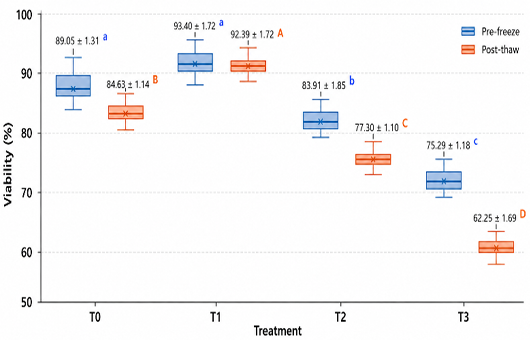
Boxplot of sperm viability (%) in Indonesian Simmental bull semen supplemented with different concentrations of L-arginine at the pre-freezing and post-thawing stages. T0: control without L-arginine; T1: 55 mM L-arginine; T2: 110 mM L-arginine; T3: 220 mM L-arginine. Boxes represent the interquartile range (25th–75th percentile), horizontal lines indicate medians, × symbols indicate means, and whiskers indicate minimum and maximum values. Different lowercase superscripts (a–d) indicate significant differences among treatments at the pre-freezing stage, whereas different uppercase superscripts (A–D) indicate significant differences among treatments at the post-thawing stage according to Duncan’s Multiple Range Test (DMRT) (p < 0.05). Data are presented as mean ± SEM.
The higher viability observed in T1 should be interpreted as a favorable functional outcome that may be consistent with previously proposed protective mechanisms, rather than as direct evidence that such mechanisms were active. Likewise, the marked decline observed in T3 should not be interpreted as the absence of molecular support, because T3 represented the highest L-arginine dose tested, not the absence of supplementation. Instead, this finding suggests that excessive supplementation was less favorable than low-dose supplementation under the present cryopreservation conditions. Overall, the present results support a dose-dependent association between L-arginine supplementation and sperm viability, with 55 mM showing the most favorable outcome among the tested concentrations.

The viability of Indonesian Simmental bull spermatozoa with L-arginine supplementation post-thawing stages. Blue arrow, dead spermatozoa (red staining); no arrow, live spermatozoa (white/unstained).
The primary outcomes of this analysis indicate that T1 was associated with the most favorable preservation of sperm viability at both the pre-freezing and post-thawing stages. The minimal decline in viability observed in T1 suggests that low-dose L-arginine supplementation may have supported better maintenance of sperm integrity during cryopreservation under the present conditions. T0 also maintained relatively high viability, although its values were consistently lower than those of T1. In contrast, T2 showed a greater decline, and T3 exhibited the lowest viability overall. Importantly, T3 should not be interpreted as reflecting the absence of protective supplementation, because it represented the highest L-arginine concentration tested in this study. Rather, the marked decline observed in T3 suggests that excessive supplementation was less favorable than low-dose supplementation for preserving sperm viability during cryopreservation. Overall, these results emphasize that pre-cryopreservation treatment conditions can substantially influence post-thaw sperm quality.
The observed pattern is consistent with previous literature and suggests that L-arginine and nitric oxide-related pathways may contribute to sperm physiology in a concentration-dependent manner ; ; . At appropriate levels, these pathways have been proposed to support sperm function through mechanisms related to cellular homeostasis, membrane properties, and redox regulation ; ; Almeida et al., 2017; . In this context, the superior performance of T1 may be consistent with a beneficial effect of low-dose L-arginine supplementation, whereas the poorer outcomes observed in T2 and especially T3 may indicate that higher concentrations were not advantageous under the present cryopreservation conditions. Thus, the present findings support a dose-dependent association between L-arginine supplementation and sperm viability, with 55 mM producing the most favorable outcome among the tested concentrations.
Discussion
L-arginine supplementation in the Tris-egg yolk extender showed a clear dose-dependent association with post-cryopreservation semen quality in Indonesian Simmental bulls. Among the tested concentrations, T1 generally showed the most favorable functional outcomes, particularly for total motile sperm count and viability. Although T1 numerically maintained the highest post-thawing motility value, it was not significantly different from T0 according to Duncan’s Multiple Range Test. In contrast, the higher concentrations used in T2 and especially T3 were associated with poorer semen quality after thawing. These findings suggest that, under the present experimental conditions, low-dose L-arginine supplementation was more beneficial than high-dose supplementation for preserving sperm function during cryopreservation. This overall pattern is generally consistent with previous studies in bovine and buffalo semen showing that the beneficial effects of L-arginine or nitric oxide-related supplementation occur within an effective dose range rather than increasing linearly across all concentrations ; ; ; . The superior response observed in T1 may be attributed to the role of L-arginine as a precursor of nitric oxide (NO), a signaling molecule involved in sperm physiology. At physiological levels, NO has been suggested to support membrane dynamics, mitochondrial activity, ATP production, sperm motility, capacitation, and the acrosome reaction ; ; . Therefore, the improved motility and viability observed in T1 are consistent with the reported physiological roles of L-arginine and NO ; ; .
The poorer performance observed at higher concentrations, particularly in T3, further supports the dose-sensitive nature of the response. Importantly, T3 represented the highest L-arginine concentration tested, not the absence of supplementation. Previous studies have suggested that excessive nitric oxide-related activity may be associated with an unfavorable redox environment, membrane damage, and impaired mitochondrial activity, which could contribute to reduced sperm motility and viability during cryopreservation ; ; ; ; ; . The present findings are also consistent with previous evidence in buffalo and other ruminants indicating that NO donors or antioxidant-related supplementation may improve post-thawing sperm survival, membrane integrity, and motility when used at appropriate concentrations, whereas higher concentrations may be associated with poorer semen quality ; ; ; Abd el-Hamid, 2024; ; . In this context, the current study provides additional evidence in Indonesian Simmental bulls by identifying 55 mM as the most favorable concentration under the cryopreservation conditions used. Thus, the principal contribution of this study lies in defining a functionally effective dose range rather than directly demonstrating the underlying molecular mechanisms.
From a biological perspective, these findings suggest that successful semen cryopreservation depends not only on conventional cryoprotectants but also on maintaining an optimal biochemical environment throughout semen processing. The favorable response observed in T1 is consistent with previous reports suggesting that L-arginine-related pathways may influence sperm physiology through nitric oxide signaling and redox regulation. On the other hand, the less favorable responses observed in T2 and T3 may reflect the broader principle that excessive supplementation can become counterproductive ; ; ; ; ; . From a practical perspective, these findings may contribute to semen extender optimization, particularly by emphasizing the importance of careful dose selection when L-arginine is used as an extender supplement. Under the present laboratory conditions, 55 mM L-arginine appeared to be the most favorable concentration for maintaining the evaluated functional semen parameters, especially total motile sperm count and viability. Although the present findings are consistent with previous reports on L-arginine and nitric oxide-related pathways, the study did not directly measure biomarkers of oxidative stress, nitrosative stress, mitochondrial function, membrane integrity, DNA damage, or apoptosis. Therefore, the proposed biological mechanisms should be interpreted as literature-supported hypotheses rather than direct mechanistic evidence from the current experiment ; ; ; and cannot be interpreted as evidence of improved fertility in the field, as pregnancy rates, conception rates, and other reproductive outcomes were not assessed. An additional limitation of this study is that the final osmolality of the semen extender was not measured after L-arginine supplementation. Because L-arginine is a highly soluble amino acid, increasing its concentration may alter the osmotic environment of the extender and potentially contribute to the poorer sperm performance observed at higher concentrations (110 and 220 mM). Therefore, the possibility that osmotic effects partially influenced the observed dose-dependent responses cannot be excluded and should be investigated in future studies.
Overall, this study provides evidence that L-arginine supplementation exerts a dose-dependent effect on post-cryopreservation semen quality in Indonesian Simmental bulls, with 55 mM representing the most favorable concentration under the current experimental framework. The principal contribution of this work is the demonstration of a functional dose-response relationship in semen quality parameters rather than direct confirmation of the underlying molecular pathways. Further studies incorporating biomarkers of oxidative and nitrosative stress, mitochondrial function, DNA integrity, apoptosis-related pathways, and fertility outcomes are needed to clarify the biological mechanisms involved and to validate the practical benefits of low-dose L-arginine supplementation ; ; ; .
Conclusion
L-arginine supplementation in the Tris-egg yolk extender exhibited a dose-dependent association with the functional quality of cryopreserved semen from Indonesian Simmental bulls. Under the present experimental conditions, supplementation with 55 mM L-arginine (T1) produced the most favorable overall functional semen profile, particularly in terms of total motile sperm count and sperm viability. Although T1 maintained numerically higher post-thaw motility than the control group, the difference was not statistically significant. In contrast, higher concentrations, especially T3 (220 mM), were associated with educed functional sperm performance after thawing. These findings highlight the importance of dose optimization when L-arginine is used as a semen extender supplement. Nevertheless, the mechanisms underlying these responses remain incompletely understood because nitric oxide balance, oxidative and nitrosative stress, mitochondrial function, apoptosis-related pathways, membrane integrity, DNA integrity, and fertility outcomes and final extender osmolality were not directly assessed. The biological mechanisms and practical reproductive implications should be interpreted cautiously. Further studies incorporating molecular biomarkers, oxidative stress indicators, mitochondrial activity, DNA integrity assessments, osmolality measurements, and fertility trials are needed to elucidate the mechanisms involved and to confirm the applicability of L-arginine supplementation under field conditions.
Acknowledgements
We express our deepest gratitude for the support from the Indonesian Education Scholarship, the Center for Financing and Assessment of Higher Education, the Ministry of Higher Education, Science and Technology of the Republic of Indonesia, the Education Fund Management Institute, the Ministry of Finance of the Republic of Indonesia, and Brawijaya University.
Novelty Statement
This study provides new evidence on the dose-dependent effects of L-arginine supplementation in Tris-egg yolk diluent on the cryopreservation of Indonesian Simmental cattle semen. By evaluating key functional sperm quality parameters, including motility, total motile sperm count, and viability at pre-freezing and post-thawing stages, this study identified 55 mM L-arginine as the most effective concentration for maintaining post-thawing semen quality under current experimental conditions.
Author’s Contribution
AF: Conceptualization, data curation, formal analysis, investigation, methodology, programming, visualization, writing the initial draft, review and editing, supervision, and funding management. NI, KK, and SR: Conceptualization, methodology, validation, and review and editing of the manuscript. TS, SW, WW: Conceptualization, methodology, validation, provision of resources, supervision, project administration, and contribution to funding acquisition.
Data availability
All data underlying the results of this study have been presented in full within the manuscript.
Generative AI and AI-assisted technology statement
No generative AI or AI-assisted tools were involved in the study design, data collection, data analysis, or initial drafting of this manuscript. The experimental design, data processing, and first manuscript draft were completed entirely by the authors. Language-support tools, including DeepL, Paperpal, and Grammarly, were used only to improve grammar, readability, and linguistic clarity. Zotero was used to assist with reference management and formatting. These tools were limited to editorial and formatting support, and all scientific content, interpretations, and conclusions remain solely the responsibility of the authors.
Conflict of interest
The authors have declared no conflict of interest.
References
- Abd El‐Hamid IS (2023). Improving chilled and frozen buck sperm characteristics by adding melatonin and L‐carnitine to the preservation medium. Reprod. Domest. Anim., 59(1): 1-12. https://doi.org/10.1111/rda.14504 [CrossRef]
- Abd-Allah E, Eliraqy EZ (2019). Effect of addition L-Arginine to extender of poor motile Holstein bulls spermatozoa. J. Prod. Dev., 24(1): 165-179. https://doi.org/10.21608/jpd.2019.41328 [CrossRef]
- Abdelnour SA, Hassan MAE, El‐Ratel IT, Essawi WM, El‐Raghi AA, Lu Y, Sheiha AM (2022). Effect of addition of L‐carnitine to cryopreservation extender on rabbit post‐thaw semen parameters, antioxidant capacity, mitochondrial function, apoptosis and ultrastructure changes. Reprod. Domest. Anim., 57(8): 902–911. https://doi.org/10.1111/rda.14139 [CrossRef]
- Almeida FC, Silva SV, Souza HM, Gomes WA, Lima Filho JAC, Wicke AA, Batista AM, Guerra MMP (2016). Effects of glycerol, equilibration time and antioxidants on post-thaw functional integrity of bovine spermatozoa directly obtained from epididymis. Andrologia, 49(3): e12623. https://doi.org/10.1111/and.12623 [CrossRef]
- Ax R, Dally M, Didion BA, Lenz RW, Love CC, Varner DD, Hafez B, Bellin ME (2000). Semen evaluation. In: Hafez ESE and Hafez B (eds), Reproduction in Farm Animals. Lippincott Williams and Wilkins, Baltimore, Maryland, USA, pp. 363–375. https://doi.org/10.1002/9781119265306.ch25 [CrossRef]
- Bahmid NA, Karja NWK, Arifiantini RI (2023). The quality of frozen Friesian Holstein semen after long-term storage. Trop. Anim. Sci. J., 46(1): 13–19. https://doi.org/10.5398/tasj.2023.46.1.13 [CrossRef]
- Bustani GS, Baiee FH (2021). Semen extenders: An evaluative overview of preservative mechanisms of semen and semen extenders. Vet. World, 14(5): 1220–1233. https://doi.org/10.14202/vetworld.2021.1220-1233 [CrossRef]
- Cardeal C, Alberton LR, Boscarato AG, Rocha MV, Marchetti LGL, Macedo GG, Lourenço ELB, Martins LF (2017). Comparative study between the hemocytometric and spectrophotometric methods for measuring the sperm concentration of young Nelore bulls. Semina: Ciências Agrárias, 38(6): 3605–3614. https://doi.org/10.5433/1679-0359.2017v38n6p3605 [CrossRef]
- Drevet JR, Hallak J, Nasr-Esfahani MH, Aitken RJ (2022). Reactive oxygen species and their consequences on the structure and function of mammalian spermatozoa. Antioxid. Redox Signal., 37(7–9): 481–500. https://doi.org/10.1089/ars.2021.0235 [CrossRef]
- Eliraqy E, Abd-Allah E, Salem M, Fouad W (2020). Effects of supplementing extenders with L-arginine on semen cryopreservation and fertility in buffalo bulls. J. Anim. Poult. Prod., 11(12): 591–595. https://doi.org/10.21608/jappmu.2020.161209 [CrossRef]
- Firmawati A, Syah HA, Putranto DEM, Widjiati W, Wahjuningsih S, Susilawati T (2025). Cryopreserved Indonesian Simmental bull semen: Effect of L-arginine supplementation in tris egg yolk extender on sperm quality. Open Vet. J., 15(9): 4578. https://doi.org/10.5455/OVJ.2025.v15.i9.64 [CrossRef]
- Hegazy M, Abdel-Khalek A, Sakr A, Badr M, Rawash Z (2020). Effect of level and time of L-arginine addition to semen extender on freezability and fertilizing potential of buffalo spermatozoa. Assiut Vet. Med. J., 66: 19–30. https://doi.org/10.21608/avmj.2020.167299 [CrossRef]
- Indonesian National Standard (2017). Frozen semen – Part 1: Cattle (SNI 4869-1:2017). National Standardization Agency of Indonesia, Jakarta, Indonesia, pp. 6–10.
- Kadhem Shahad H, Oneeis Hussain S, Kadhim Arrak J (2021). L-arginine as semen additive to improve poor motility of cryopreserved sperm in Holstein bulls born in Iraq. Plant Arch., 21(Suppl. 1): 510–514. https://doi.org/10.51470/PLANTARCHIVES.2021.v21.S1.078 [CrossRef]
- Kamal M, Alam M, Islam M, Gofur M, Kabir A (2022). Effects of tris (hydroxymethyl) aminomethane and egg yolk on the cryopreservation of buck semen. J. Adv. Vet. Anim. Res., 9(4): 676–684. https://doi.org/10.5455/javar.2022.i636 [CrossRef]
- Larasati MD, Lestari SW, Hestiantoro A, Pangestu M (2022). Can cryoprotectant’s modification in spermatozoa cryopreservation be an alternative to improve embryo quality? A review. Int. J. Technol., 13(8): 1755–1764. https://doi.org/10.14716/ijtech.v13i8.6129 [CrossRef]
- Li S, Ren J, Zhang W, Wang B, Ma Y, Su L, Dai Y, Liu G (2023). Glutathione and selenium nanoparticles have a synergistic protective effect during cryopreservation of bull semen. Front. Vet. Sci., 10: 1093274. https://doi.org/10.3389/fvets.2023.1093274 [CrossRef]
- Maitan PP, Bromfield EG, Hoogendijk R, Leung MR, Zeev-Ben-Mordehai T, van de Lest CH, Jansen JWA, Leemans B, Guimarães JD, Stout TAE, Gadella BM, Henning H (2021). Bicarbonate-stimulated membrane reorganization in stallion spermatozoa. Front. Cell Dev. Biol., 9: 772254. https://doi.org/10.3389/fcell.2021.772254 [CrossRef]
- Mohammed OA, Abdulkareem TA, Ibrahim FF, Al-Zaidi OH (2020). Effect of adding pentoxifylline and nitric oxide to tris extender on post-cryopreserved semen attributes of Holstein bulls. Iraqi J. Agric. Sci., 51(2): 619–628. https://doi.org/10.36103/ijas.v51i2.989 [CrossRef]
- O’Flaherty C, Rodriguez P, Srivastava S (2004). L-arginine promotes capacitation and acrosome reaction in cryopreserved bovine spermatozoa. Biochim. Biophys. Acta (BBA), Gen. Subjects, 1674(2): 215–221. https://doi.org/10.1016/j.bbagen.2004.06.020 [CrossRef]
- Patrat C, Lemoine M, Ferraretto X, Royer MA, Benammar A, Darolles J, Epelboin S, Eustache F (2018). Sperm concentration measurement with a disposable counting chamber. Asian J. Androl., 20(5): 525–531. https://doi.org/10.4103/aja.aja_72_17 [CrossRef]
- Prastiya R, Sardjito T, Saputro A, Budi D, Maxdhameta S, Sulistiyawati E, Sulistyowati D, Amaliya A, Sasi S, Haryuni N (2024). Quality and kinematic characteristics of Bali bulls frozen semen with purified green tea extract epigallocatechin-3-gallate antioxidant addition in diluent. Open Vet. J., 14(8): 2040–2048. https://doi.org/10.5455/OVJ.2024.v14.i8.33 [CrossRef]
- Ratnawati D, Kuswati K, Yekti APA, Ciptadi G, Rahayu S, Susilawati T (2023). Effect of modified CEP-3 diluents with aqueous soybean extract on liquid semen quality in Ongole crossbred bull. Vet. World, 16(5): 1075–1083. https://doi.org/10.14202/vetworld.2023.1075-1083 [CrossRef]
- Sharafi M, Borghei-Rad SM, Hezavehei M, Shahverdi A, Benson JD (2022). Cryopreservation of semen in domestic animals: A review of current challenges, applications, and prospective strategies. Animals, 12(23): 3271. https://doi.org/10.3390/ani12233271 [CrossRef]
- Shi H, Li QY, Li H, Wang HY, Fan CX, Dong QY, Pan BC, Ji ZL, Li JY (2023). ROS-induced oxidative stress is a major contributor to sperm cryoinjury. Hum. Reprod., 39(2): 310–325. https://doi.org/10.1093/humrep/dead250 [CrossRef]
- Staicu FD, Lopez-Úbeda R, Romero-Aguirregomezcorta J, Martínez-Soto JC, Matás Parra C (2019). Regulation of boar sperm functionality by the nitric oxide synthase/nitric oxide system. J. Assist. Reprod. Genet., 36(8): 1721–1736. https://doi.org/10.1007/s10815-019-01526-6 [CrossRef]
- Ugur MR, Saber Abdelrahman A, Evans HC, Gilmore AA, Hitit M, Arifiantini RI, Purwantara B, Kaya A, Memili E (2019). Advances in cryopreservation of bull sperm. Front. Vet. Sci., 6: 268. https://doi.org/10.3389/fvets.2019.00268 [CrossRef]
- Upadhyay VR, Roy AK, Pandita S, Raval K, Patoliya P, Ramesh V, Dewry RK, Yadav HP, Mohanty TK, Bhakat M (2023). Optimized addition of nitric oxide compounds in semen extender improves post-thaw seminal attributes of Murrah buffaloes. Trop. Anim. Health Prod., 55(1): 43. https://doi.org/10.1007/s11250-023-03474-x [CrossRef]
- Watson PF (2000). The causes of reduced fertility with cryopreserved semen. Anim. Reprod. Sci., 60–61: 481–492. https://doi.org/10.1016/S0378-4320(00)00099-3 [CrossRef]
- Zhang R, Wang X, Liu R, Mei Y, Miao X, Ma J, Zou L, Zhao Q, Bai X, Dong Y (2025). Proteomics and metabolomics analyses of mechanisms underlying bovine sperm cryoinjury. BMC Genom., 26(1): 63. https://doi.org/10.1186/s12864-025-11258-w [CrossRef]

Services
Article usage statistics
Loading…
Related articles
- Dose-Dependent Effect of Green Tea (Camellia sinensis) Extract in the Post-Thawed Fertility Indicators of frozen Bovine Semen ExtenderPakistan Journal of Zoology · 2022
- Effect of EGCG Supplementation on Post-Thaw Sperm Quality and DNA Integrity of Cryopreserved Kacang Buck SemenAdvances in Animal and Veterinary Sciences · 2026
- Field Applicable Thawing Strategies for Frozen Bull Semen: Comparison of Warm-Water and Tap-Water Thawing on Post-Thaw Sperm Quality and Storability Across Cattle BreedsJournal of Animal Health and Production · 2026
- Effect of Different Thawing Methods on Frozen Semen Characteristics and DNA Damage of Indonesian Simmental BullPakistan Journal of Agricultural Research · 2025
- Post Thawed Quality of Tharparkar Bull Semen Extended in BioxcellTM and Tris-Based Egg Yolk Extenders Supplemented with Vitamin E (α-Tocopherol)Pakistan Journal of Zoology · 2024
- The Effect of Different Levels of Lycopene in Egg Yolk Citrate Extenders on Post-Thawed Semen Qualities of Belgian Blue Crossbreed BullAdvances in Animal and Veterinary Sciences · 2023