
Rice breeding activities are growing in line with the increasing global demand for food. With conventional methods, rice breeding programs can be very time-consuming. With the anther culture method, pure lines can be formed in a short time. The success of callus formation is crucial to study because the formation of double haploid rice is carried out during the callus phase. The purpose of this study was to determine the optimal anther from floret position on the panicle for callus induction and to obtain the best media formulation for callus induction in rice anther culture. The anthers used were Indonesian indica upland rice cv. Situbagendit. This study was conducted using a completely randomized design with two factors (anther position on the panicle and medium) and three replications. The panicle was divided into two parts, namely the upper and lower parts. The callus induction media formula used was N6 base media, then treated with different types of auxin (2 mg/L NAA, 0.5 mg/L 2,4 D) and carbon sources (sucrose, maltose). The data were analyzed using ANOVA and Tukey’s test at the α level = 5%. The results showed that the number of performed calli was very low due to a recalcitrant genetic factor. However, the result of ANOVA was that the position of the floret in the panicle significantly affected callus formation, while the media had no significant effect. Anthers originating from florets where located at the basal part of the panicle may be more potent in inducing callus formation in indica rice. This research can be used as a reference for indica rice anther callus induction in plant breeding programs.
Research Article · Volume 43, Issue 2, 2027, Pages 271–278, published online 27 November 2026 · Open Access
Effect of Floret Position and Culture Medium on Anther-Derived Callus Induction in Indonesian Indica Upland Rice (cv. Situbagendit)
, , ,
Affiliations & Notes ⌄
- 1Department of Agrotechnology, Faculty of Agriculture, Jenderal Soedirman University, Purwokerto, Indonesia
- *Correspondence | Zulfa Az Zahroh; Email: zulfa.zahroh@unsoed.ac.id
Article Info ⌄
- Journal:
- Sarhad Journal of Agriculture
- Submitted Date:
- 31 October 2025
- Accepted Date:
- 21 May 2026
- Published Date:
- 27 November 2026
Abstract
Introduction
Rice plant breeding programs have developed rapidly. The dynamic nature of life also demands that plant breeding activities be carried out more quickly and efficiently. One method of accelerating plant breeding programs is the anther culture technique. Anther culture techniques are used to accelerate the process of forming pure lines in plant breeding , 2018; ; ; ; ; ; . With conventional rice breeding methods, pure lines can only be obtained in the 7th, 8th, or 9th generation, whereas with anther culture techniques, pure lines can be obtained in 1 generation . Cultured rice anthers will produce haploid calli or plantlets, which are then doubled in chromosome size to become double haploid. These double-haploid plantlets, which are homozygous, are the pure lines used in developing new varieties.
The success of calli formation in rice anther cultures is important to study, because the chromosome duplication process occurs during the calli phase to produce double- haploid rice plantlets. One important factor in the success of calli induction is the media composition ; and the stage of microspore division. Microspores in the late uninucleate and early binucleate stages are most suitable for induction to form calli . Savenko et al. (2021) stated that suitable microspores are those that are still uninucleate and have just passed the tetrad phase. External observation of the morphology of pregnant rice is necessary as a guide to identify the appropriate stage of microspore division, one of which is through observing the position of the anther in the panicle.
Anthers on panicles have different microspore maturity because the flowering development of each floret on a panicle is not simultaneous . This suggests that the stages of microspore division in anthers across the panicle are also not uniform. Therefore, in this study, investigations related to the stage of microspores in Indonesian indica upland rice that are suitable for use were carried out by observing the development of anthers cultured from the upper florets of the panicle and the lower florets of the panicle. Determining the floret position to obtain suitable anthers for inducing callus is important to research in order to increase the chances of success in anther culture in rice, especially in indica rice.
In rice anther culture, the basal medium used is usually N6 ; ; . The composition of the media for calli induction usually contains specific Plant Growth Promotors (PGRs) at certain concentrations desired by the anther. The carbon source in rice calli induction media can be maltose or sucrose ; ; . Some PGRs from the auxin and cytokinin groups used in rice anther calli induction are 2,4-D, NAA, and kinetin ; ; ; . Media with the same concentration of auxin and cytokinin were used to induce calli. The addition of AgNO3 and activated charcoal to the calli induction medium is given to prevent browning by acting as an inhibitor compound that absorbs oxidation of phenolic compounds that occurs in plant cell culture ; .
Situbagendit is a rice variety resulting from a cross between the Batur variety and the S2823-7D-8-1-A strain, released by the Indonesian Rice Research Institute . Situbagendit cultivar is one of the upland or amphibious rice that is massively cultivated in dry land in Indonesia, with a potential yield of 3-5 tons/ha on dry land. This cultivar can be harvested on the 110-120th day after sowing, and has soft rice grains with an amylose content of around 22%. In addition to being tolerant to drought, Situbagendit is also resistant to blast disease and bacterial leaf blight strains III & IV. Situbagendit is often chosen to increase the IP (cropping index) in rainfed land because of its broad adaptation . Therefore, this cultivar has great potential to be developed in Indonesia to meet the need for varieties in cultivated land.
However, since the cultivar Situbagendit belongs to the indica rice group, androgenesis in indica rice was very difficult due to its recalcitrant factor. The recalcitrant genetic factor manifests in several ways, including poor callus induction, early anther necrosis, frequent albinism, and low green plant regeneration . Anther culture in indica rice remains limited compared to the more proven effective application of anther culture in japonica rice .
This study aimed to determine the optimum floret position on the rice panicle for calli induction and to obtain the best media formulation for calli induction in indica rice anther culture.
Materials and Methods
Study area
This study was conducted at the Tissue Culture Laboratory, Faculty of Agriculture, Jenderal Soedirman University, Indonesia from July to September 2025. Situbagendit cultivar, Indonesian indica upland rice , was used as genetic material for anther culture study.
Experimental design
This study was designed using two-factor treatments and three replications of a completely randomized design, resulting in 24 experimental units. The factor treatments were part of the panicle (apical and basal part of panicle) and medium formulas of rice anther culture (M1, M2, M3, M4). Each replication consisted of one bottle which containing 9 ± 1 anthers for the apical floret treatment and 16 ± 1 anthers for the basal floret treatment. The difference in the number of anthers was due to the difference in floret density in the apical or basal part of the panicle. The determination of the apical and basal parts was done by dividing the panicle length in half.
Procedures
Anther determination
The anthers used were taken from rice panicles at the booting stage. Booted rice panicles were collected at 8 a.m. at 66 days after planting, then wrapped in plastic and incubated at 8 °C ± 2 °C for 8 days. The panicles were divided into two parts (apical and basal) during planting. Anthers from the florets of the apical panicle were planted separately from the anthers of the basal panicle as a treatment.
Medium preparation
In this study 4 types of media used, namely M1, M2, M3, and M4. Formula M1 consists of N6 + 2 mg/L NAA + 0.5 mg/L Kinetin + 60 g/L Sucrose + 5 mg/L AgNO3 + 1 g/L Activated Charcoal + 7 g/L Agar. Formula M2 consists of N6 + 0.5 mg/L 2.4 D + 0.5 mg/L Kinetin + 60 g/L Sucrose + 5 mg/L AgNO3 + 1 g/L Activated Charcoal + 7 g/L Agar. Formula M3 consists of N6 + 2 mg/L NAA + 0.5 mg/L Kinetin + 30 g/L Maltose + 5 mg/L AgNO3 + 1 g/L Activated Charcoal + 7 g/L Agar. Formula M4 consists of N6 + 0.5 mg/L 2.4 D + 0.5 mg/L Kinetin + 30 g/L Maltose + 5 mg/L AgNO3 + 1 g/L Activated Charcoal + 7 g/L Agar. All media have a pH of 5.8.
Sterilization and culturing
Sterilization was performed in laminar air flow (LAF) by immersing the panicles in 0.1% HgCl2 for 5 minutes, then rinsing them with distilled water three times for 5 minutes each. The use of HgCl2 was carried out under strict procedures due to its high toxicity. The anthers were then removed and cultured in culture bottles. Each bottle contained 9 ± 1 anthers for the apical floret treatment and 16 ± 1 anthers for the basal floret treatment. The condition of the incubation room was 25 ± 2 °C for temperature, dark conditions and there was no photoperiod within 3 months.
The development of the cultured anthers was observed for three months (July-September). Observation variables included the number of browning, the percentage of browning, the number of contamination, the percentage of contamination, the number of calli, the percentage of calli, the number of plantlets, and the percentage of plantlets. The number of calli was determined by the anthers that burst and release microspores, which appear like bubbles. The number of plantlets was determined by the micro plants that has fully developed roots, stems, and leaves.
Data analysis
To analyze the effect of anther position on panicles and calli induction media, ANOVA and Tukey tests were conducted at the α = 5% level.
Results and Discussion
General condition
In this study, a total of 304 rice anthers were planted. The planted anthers were separated based on the position of the florets on the panicle, namely the apical and basal part. After 3 months of anther planting, no explant browning or contamination was found in all research samples (Table 1). This indicates that the sterilization method using HgCl2 immersion for 5 minutes is quite effective for sterilizing rice panicles in anther culture studies. In rice anther culture research, the use of 0.1% mercury chloride with a 5-minute immersion for surface sterilization is more effective than the use of 70% ethanol with a 5-minute immersion . Sterilization with 0.1% HgCl2 for 10-15 minutes is also carried out in anther cultures to form double haploid rice .
In addition, the addition of AgNO3 and activated charcoal in this study was quite optimal for inhibiting browning. AgNO3 is an ethylene inhibitor compound that can inhibit browning in in vitro cultures. Activated charcoal has the ability to suppress the oxidation of phenolic acids that can cause cell death and inhibit regeneration . Browning that occurs in in-vitro cultures is the
Table 1: Number of browning, percentage of browning, number of contamination, percentage of contamination of Indonesian indica upland rice Cv. Situbagendit anthers
| Part of panicle | Medium | Number of cultured anther | Number of browning | Percentage of browning (%) | Number of contamination | Percentage of contamination (%) |
| Apical | M1 | 28 | 0 | 0% | 0 | 0% |
| Apical | M2 | 29 | 0 | 0% | 0 | 0% |
| Apical | M3 | 28 | 0 | 0% | 0 | 0% |
| Apical | M4 | 28 | 0 | 0% | 0 | 0% |
| Basal | M1 | 47 | 0 | 0% | 0 | 0% |
| Basal | M2 | 50 | 0 | 0% | 0 | 0% |
| Basal | M3 | 48 | 0 | 0% | 0 | 0% |
| Basal | M4 | 46 | 0 | 0% | 0 | 0% |
| Total | 304 | 0 | 0% | 0 | 0% | |
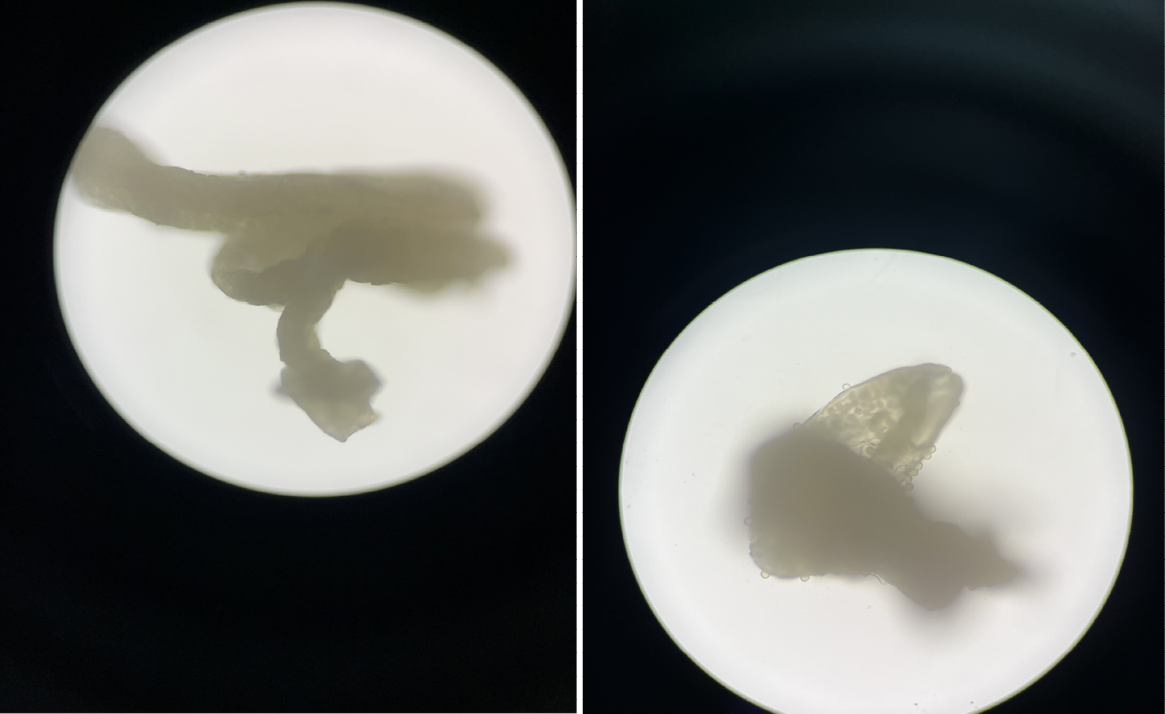
Microscopic observation of emerging anthers in media formulations M1 (A) and M4 (B) was observed at 100x magnification.
accumulation of ethylene and phenolic compound biosynthesis activity, followed by oxidation due to injury or stress on plant tissue. Browning that occurs in in-vitro cultures can inhibit plantlet formation and be a factor causing explant death.
Browning can be prevented by administering ethylene inhibitors and antioxidants antioxsidant . The addition of AgNO3 at a dose of 20 mg/L to strawberry anther cultures can reduce browning and increase calli formation . The addition of 15 ml/L and 50 ml/L AgNO3 to chickpea anther cultures can also increase the number of embryos formed . In potato anther cultures, the use of silver nitrate in the media can increase embryogenesis and reduce non-responsive anthers . Thus the less likely browning occurs, the greater the chance that the explants can develop into embryos or calli.
Anther development
The development of rice anthers cultured in vitro is characterized by the rupture of the anther and the release of microspores that resemble bubbles. Microspores emerge from the ruptured anthers and develop into calli (Figure 1). Anthers of the local indica rice variety, Situbagendit, require approximately 2-3 months to emerge. Studies have shown that indica rice takes relatively longer to respond to in vitro culture and very low number of calli was performed sinceindica rice is generally recalcitrant. Recalcitrant genotypes have lower regeneration rates. Indica rice varieties are generally recalcitrant, exhibiting lower regeneration rates compared to japonica, which shows higher responsiveness to microspore embryogenesis and calli regeneration ; . To break recalcitrant, additional treatment interventions are required, such as the addition of chemicals or stimulation of stress conditions to increase the regeneration rate ; .
The number of calli from the anthers at the apical of the panicle was 1, or only about 0.88% of the total anthers at the apical of the panicle (Table 2). Meanwhile, 8 anthers from the basal part of the panicle developed into calli. By the third month of observation, no plantlets had formed because the anthers remained dormant and did not progress to callus formation. Indica rice very slow to respond. The differences in anther development and the presence of undeveloped anther explants indicate that the tissue’s ability to respond to or absorb nutrients and plant growth regulators in the media varies. Non-uniformity in explant tissue development also occurred in cv. Mentik Wangi Susu seeds cultured in vitro .
Genetic differences between indica and japonica rice significantly affect their regeneration capacity in anther culture, primarily due to their genetic architecture and distinct responses to culture conditions. Genetic studies have identified specific quantitative trait loci (QTL) associated with regeneration traits, with japonica alleles often associated with good regeneration yield . This disparity in regeneration between indica and japonica rice underscores the need for specialized tissue culture approaches to optimise regeneration in these rice subspecies.
Analysis of variance (ANOVA) of the effect the effect of the floret position and medium formulation on callus induction
The ANOVA test results showed that flower position on the panicle influenced calli formation (Table 3). However, the media formulation had no significant effect on anther development. The average number of calli formed from anthers at the basal of the panicle was higher than that from anthers at theapical . The mean percentage of calli from anthers at the basal of the panicle was 4.21%. Differences in anther responsiveness in different panicle parts were influenced by physiological and molecular factors. The basal panicle was younger than the apical panicle, indicating it had more young tissue and was likely more meristematic.
The callus and plantlet formation in anther cultures is also influenced by the developmental stage of the microspores. Microspores in the uninucleate or early binucleate stage are more optimal for androgenesis due to their better callus formation and regeneration capabilities . In Situbagendite rice panicles collected at 66 days after planting (DAP), which is the end of the Situbagendite flowering period, anthers in the lower panicles are likely still optimal at the uninucleate or early binucleate microspore stage. Meanwhile, anthers in the upper panicles have passed the binucleate stage and are entering the pollen maturation stage, characterized by a less responsive
Table 2: Number of calli, percentage of calli, number of plantlet and percentage of plantlet of indonesian indica upland rice Cv. Situbagendit
| Part of panicle | Medium | Number of cultured anther | Number of calli | Percentage of calli (%) | Number of planlet | Percentage of planlet (%) |
| Apical | M1 | 28 | 1 | 3,57 | 0 | 0 |
| Apical | M2 | 29 | 0 | 0,00 | 0 | 0 |
| Apical | M3 | 28 | 0 | 0,00 | 0 | 0 |
| Apical | M4 | 28 | 0 | 0,00 | 0 | 0 |
| Total of apical panicle | 113 | 1 | 0,88 | 0 | 0 | |
| Basal | M1 | 47 | 2 | 4,26 | 0 | 0 |
| Basal | M2 | 50 | 1 | 2,00 | 0 | 0 |
| Basal | M3 | 48 | 3 | 6,25 | 0 | 0 |
| Basal | M4 | 46 | 2 | 4,35 | 0 | 0 |
| Total of basal of panicle | 191 | 8 | 4,19 | 0 | 0 | |
| Total | 304 | 9 | 2,96 | 0 | 0 | |
response to phytohormones and nutrients in the media .
Table 3: Result of ANOVA of the effect of the floret position on the panicle and medium on the number of calli and percentage of calli.
| Factor | Mean of number of calli | Mean of percentage of calli (%) |
| Part of panicle | ||
| Top | 0,083 b | 0,93 b |
| Basal | 0,667 a | 4,21 a |
| Medium | ||
| M1 | 0,50 a | 4,01 a |
| M2 | 0,16 a | 0,98 a |
| M3 | 0,50 a | 3,13 a |
| M4 | 0,33 a | 2,15 a |
Note: The number followed by the same letter in each column indicates no significant difference in the Tukey test at α = 5%.
The average number of calli in M1 and M3 was 0.50 and 0.50, M4 was 0.33, and M2 was 0.16 calli. The average percentage of calli in anthers cultured in M1 and M3 was 4.01% and 3.13%, respectively. Meanwhile, in M4 and M2, the average percentage of calli was 2.15% and 0.98%, respectively. The use of NAA is quite effective for inducing callus formation . The use of 2 mg/L of 2.4 D in the study by Chakravarthi Mari (2020) gave the highest results in callus formation. Media with maltose carbon source produces more callus than media with sucrose carbon source ; ; .
The low amount of callus formed in indica rice, despite the absence of contamination and significant effects (ANOVA result) of floret position on callus induction, can be attributed to the inherent recalcitrance of indica varieties. Studies indicate that while some genotypes, such as I.W. Ponni and BPT-5204, exhibit better callus induction rates with specific concentrations of 2,4-D, others remain recalcitrant, yielding no embryogenic calli . Furthermore, optimization of tissue culture protocols has shown that even with refined methods, many indica varieties still struggle with regeneration, necessitating the use of various phytohormonal combinations and additives to enhance outcomes ; . The genotype-dependent nature of callus induction and regeneration highlights the challenges faced in developing effective protocols for these rice varieties, underscoring the need for continued research in this area ; .
Conclusions and Recommendations
In conlusion, this study showed that callus induction in the indica rice cultivar Situbagendit was notably low, with only 9 calli formed from 304 anthers planted. The result revealed that the majority of calli (8 out of 9) originated from anthers in the basal part of the panicle, while only 1 callus came from the apical part. Furthermore, the anysis of variance (ANOVA) showed that the position of the floret on the panicle significantly influences the number of calli, whereas the media formulation had no effect. The low regeneration rate for calli and plantlet formation is due to the recalcitrant nature of indica rice, which is also characterized by the uneven response of the tissue to the nutrients available in the medium. These results provide potential insight into the possibility that using florets from the basal part of the panicle may increase the chance of callus formation in indica rice anther culture projects. Studies to determine the stage of microspore division based on external morphological panicles need to be further investigated for each rice variety and cultivars in the indica and japonica groups.
Acknowledgements
This research was funded by the Ministry of Higher Education, Science and Technology of The Republic of Indonesia under the 2025 BIMA research grant for Regular Fundamental Research scheme. The Authors sincerely thank Nindy Sevirasari and team for the panicle materials of indica upland rice variety. The authors also thank the Tissue Culture Laboratory, Faculty of Agriculture, Jenderal Soedirman University for providing experimental facilities.
Novelty Statement
This study provides new insights into the influence of floret position in panicle and medium formula to calli and plantlet development in Indonesian indica upland rice anther culture.
Authors’ Contribution
Zulfa Ulinnuha: Led the rice anther culture project.
Totok Agung Dwi Haryanto: Perform supervision, validation, and genotype breeding material preparation.
Zulfa Az Zahroh: Performed data analysis and manuscript preparation.
Dyah Susanti: Wrote the research proposal.
All authors read and approved the final version of manuscript.
Generative AI and AI-assisted technology statement
The authors declare that no generative AI and AI assisted technology was used in the creation of this manuscript.
Conflict of interest
The Authors declares that there are no conflicts of interest regarding the publication of this paper.
References
- Abdollahi, M.R. and S. Rashidi. 2018. Production and conversion of haploid embryos in chickpea (Cicer arietinum L.) anther cultures using high 2,4-D and silver nitrate containing media. P.C.T.O.C. 133(1): 39–49. https://doi.org/10.1007/s11240-017-1359-4. [CrossRef]
- AboShama, H.M. and M.M. Atwa. 2019. Anther culture in potato (Solanum tuberosum L.) in vitro. J. Plant Biochem. Physio., 7(3): 1–10. https://doi.org/10.35248/2329-9029.19.7.244. [CrossRef]
- Ali, J., K.L.C. Nicolas, S. Akther, A. Torabi, A. Ebadi, C.M. Marfori-Nazarea, and A. Mahender. 2021. Improved anther culture media for enhanced callus formation and plant regeneration in rice (Oryza sativa L.). Plant., 10(5): 1–16. https://doi.org/10.3390/plants10050839. [CrossRef]
- Chakravarthi Mari, B. 2020. Development of doubled haploids for iron toxicity tolerance in rice (Oryza sativa L.). Ph.D thesis, Kerala Agricultural University, Trissur, India.
- Chutipaijit, S. and T. Sutjaritvorakul. 2018. Application of activated charcoal and nanocarbon to callus induction and plant regeneration in aromatic rice (Oryza sativa L.). Chem. Spec. and Bioavail., 30(1): 1–8. https://doi.org/10.1080/09542299.2017.1418184. [CrossRef]
- Dai, Y., Q. Hu, J. Ye, R. Tu, K. Xie, Y. Qiu, C. Cheng, J. Zhou, F. Niu, and B. Sun. 2024. Deciphering the genetic architecture of anther culturability in rice using segregation distortion approach. Crop Sci., 64(2): 817–826. https://doi.org/10.1002/csc2.21180. [CrossRef]
- Dhamangaonkar, S.N., L. Shukla. 2013. Identification of Callus Induction Potential of Nine Different Genotypes of Indica Rice. J. Environ. Nanotechnol., 2(2): 44–52. https://doi.org/10.13074/jent.2013.06.132013. [CrossRef]
- Fanata, W.I.D., D.E. Setiawan, and A.M. Sholikhah. 2022. The effect of additional inhibitor ethylene and antioxidant compounds on regeneration of Mentik Wangi Susu rice callus. J. Agrikultura., 2022(2): 236–246.
- Gao, R., Y. Zong, S. Zhang, G. Guo, W. Zhang, Z. Chen, R. Lu, C. Liu, Y. Wang, and Y. Li. 2024. Efficient isolated microspore culture protocol for callus induction and plantlet regeneration in Japonica rice (Oryza sativa L.). Plant Meth., 20(1): 1–12. https://doi.org/10.1186/s13007-024-01189-0. [CrossRef]
- Islam, M.T., M.R. Arif, M.T. Hasan, and A.H.K. Robin. 2023. Anther culture in crop plants: progress and perspectives. Plant Breed. Biotech., 11(2): 69–96. https://doi.org/10.9787/PBB.2023.11.2.69. [CrossRef]
- Istiana, R., H.P. Kusumaningrum, and R.S. Ferniah. 2018. Analysis of the open reading frame (ORF) 29-TrnC (GCA) sequence to detect Indica and Japonica sub-species on upland rice in Situ Bagendit and inbred rice of Ciherang. Biosaintifika., 10(1): 153–159. https://doi.org/10.15294/biosaintifika.v10i1.12626. [CrossRef]
- Juturu, V.N., G.K. Mekala, M. Garladinne, C. Obul, R. Puli, and A.C. Sekhar. 2016. Optimization of in vitro regeneration protocol for a popular Indica rice ( Oryza sativa L. cv Swarna ). Annals of Plant Sci., 5(8): 1385–1401. http://dx.doi.org/10.21746/aps.2016.08.002. [CrossRef]
- Lantos, C., M. Jancsó, A. Székely, T. Szalóki, S. Venkatanagappa, and J. Pauk. 2023. Development of in vitro anther culture for doubled haploid plant production in Indica rice (Oryza sativa L.) genotypes. Plant., 12(9): 1–16. https://doi.org/10.3390/plants12091774. [CrossRef]
- Maharani, A., W.I.D. Fanata, F.N. Laeli, K.M. Kim, and T. Handoyo. 2020. callus induction and regeneration from anther cultures of Indonesian Indica black rice cultivar. J. Crop Sci. Biotech., 23(1): 21–28. https://doi.org/10.1007/s12892-019-0322-0. [CrossRef]
- Mayakaduwa, D.M.R.G. and T.D. Silva. 2017. A cytological indicator allows rapid assessment of microspore maturity, leading to improved in vitro anther response in Indica rice (Oryza sativa L.). In Vitro Cell.Dev.Biol– Plant., 53(6): 591–597. https://doi.org/10.1007/s11627-017-9855-0. [CrossRef]
- Mayakaduwa, D.M.R.G. and T.D. Silva. 2018. Anther culture as a supplementary tool for rice breeding. Chapter.1. p. 1-16. In: S. Farooq, Z. Khan, and A. Iqbal (Eds), Rice Crop Current Developments, IntechOpen. London. https://doi.org/10.5772/intechopen.76157. [CrossRef]
- Men, A., Y. Li, L. Zhao, and C. Zhang. 2018. The within-panicle flowering sequence of hybrid rice affects seed vigour. Australian J. Crop Sci., 12(8): 1342–1350. https://doi.org/10.21475/ajcs.18.12.08.PNE1210. [CrossRef]
- Mostafiz, S.B. and A. Wagiran. 2018. Efficient callus induction and regeneration in selected Indica rice. Agron., 8(77). https://doi.org/10.3390/agronomy8050077. [CrossRef]
- Murugesan, D., G. Subramanian, A.P. Salini, and R. Muthurajan. 2022. Optimization of high frequency plant regeneration protocol via embryogenic callus formation from diverse indica rice genotypes induced by combinations of 2, 4-D and BA. ORYZA-An Inter. J. Rice., 59(3): 281–291. https://doi.org/10.35709/ory.2022.59.3.3. [CrossRef]
- Paul, S. and A. Roychoudhury. 2019. Comparative analyses of regeneration potentiality of eight indigenous aromatic Indica rice (Oryza sativa L.) varieties. Inter. J. Sci. Research. Bio. Sci., 6(1): 55–64. https://doi.org/10.26438/ijsrbs/v6i1.5564. [CrossRef]
- Repalli, S.K., C.K. Geda, N.S.N. Pradhan, and G.J.N. Rao. 2017. Regeneration enhancement in tissue culture of Indica Rice’s through partial desiccation and chemical supplements. J. Plant Biochem. Physio., 05(03): 5–8. https://doi.org/10.4172/2329-9029.1000196. [CrossRef]
- Safitri, H., B.S. Purwoko, I.S. Dewi, S.W. Ardie. 2017. Kultur antera untuk mendapatkan galur padi toleran salinitas. J. Agron. Indon., 44(3): 221–227. https://doi.org/10.24831/jai.v44i3.12770. [CrossRef]
- Savenko, E.G., Zh.M. Mukhina, V.A. Glazyrina, and L.A. Shundrina. 2021. Cyto-histological aspects of haploid androgenesis when obtaining haploids/doubled haploids in rice (Oryza Sativa L.) anther culture in vitro. E3S Web Confer., 285: 1-7. https://doi.org/10.1051/e3sconf/202128502033. [CrossRef]
- Şener, S., A.G. Nasircilar, and A. Karaçan. 2024. The effects of silver nitrate and pre-cold treatments on callus formation in strawberry anther culture. JOTAF., 21(1): 15–23. https://doi.org/10.33462/jotaf.1217960. [CrossRef]
- Sharma, M. 2020. Development of doubled haploid bacterial blight resistance genotypes of basmati rice (Oryza sativa L.) through anther culture. Ph.D thesis, Sher-e-Kashmir University of Agricultural Sciences & Technology of Jammu, Chatha, India.
- Silva, T. 2010. Indica rice anther culture: can the impasse be surpassed. PCTOC., 100(1): 1 – 11. https://doi.org/10.1007/s11240-009-9616-9. [CrossRef]
- Susanto, U., A.I. Gumelar, and J. Ali. 2022. Genetic variability and heritability of agronomic traits of selected green super rice (gsr) lines in Indonesia. IOP Conference Series: Earth. Env. Sci., 978(1): 012014. https://doi.org/10.1088/1755-1315/978/1/012014. [CrossRef]
- Wu, J., X. Chang, C. Li, Z. Zhang, J. Zhang, C. Yin, W. Ma, H. Chen, F. Zhou, and Y. Lin. 2022. QTLs related to rice callus regeneration ability: localization and effect verification of qPRR3. Cells., 11(24). https://doi.org/10.3390/cells11244125. [CrossRef]
- Yaqoob, U., T. Kaul, and I.A. Nawchoo. 2021. In vitro plant regeneration of some recalcitrant indica rice (Oryza sativa L.) varieties. Vegetos., 34(1):102–106. https://doi.org/10.1007/s42535-021-00193-2 [CrossRef]

Services
Article usage statistics
Loading…
Related articles
- Propagation of Juniperus polycarpos C. Koch through tissue culture I. Induction of CallusPakistan Journal of Forestry · 1980
- Effects of Carbon Sources and Growth Regulators on the Tissue Culture of SugarcaneSarhad Journal of Agriculture · 2022
- The Effect of using HEPES in Culture Medium on Oocyte Maturation Rates and In vitro Fertilization in Pesisir CattleJournal of Animal Health and Production · 2024
- Effect of Growth Regulators on Callus Induction and Plant Regeneration in Potato (Solanum tuberosum L.) ExplantsSarhad Journal of Agriculture · 2023
- Chemical Mutation Induction of In Vitro Cultured Shoot Tip of Banana cv. Grand Nain for Resistance Some Viruses DiseasesJournal of Virological Sciences · 2010
- Effect of Culture Medium, pH and GA3 on Germination and Seedling Growth of Capsicum frutescensSarhad Journal of Agriculture · 2025