
This study investigates how halal slaughterers in Indonesian slaughterhouses perceive the use of pre-slaughter stunning. Stunning remains controversial in modern halal practice due to concerns about sharia compliance and animal welfare, making the perspectives of slaughterers as frontline practitioners crucial to understand. A qualitative descriptive design with a phenomenological approach was employed, involving 13 purposively selected halal slaughterers with at least three years of experience and prior involvement in slaughtering cattle with and without stunning. Data were collected through in-depth face-to-face and online interviews, focusing on perceived challenges and the perceived ease of slaughter with or without stunning, as well as arguments for and against stunning. Data were validated through triangulation of interviews, field observations, and Islamic legal documents, then analyzed using the Miles and Huberman framework of data reduction, data display, and conclusion drawing. The findings indicate a nuanced spectrum of responses, in which most slaughterers conditionally accept pre-slaughter stunning under strict technical and sharia safeguards. At the same time, a minority firmly rejects it due to concerns over mis-stunning, animal suffering, and doubts about halal validity. This study concludes that slaughterers’ perceptions are pivotal for the practical implementation of halal-compliant stunning and may provide an initial exploratory reference for reflecting on policy orientation and training needs to better align stunning practices with Islamic principles and animal welfare.
Research Article · Volume 15, Issue 1, Pages 55–65, 14 November 2026 · Open Access
Halal Slaughterers’ Lived Experiences of Pre-Slaughter Stunning in Indonesian Abattoirs
, , ,
Affiliations & Notes ⌄
- 1Department of Islamic Economic Laws, Faculty of Islamic Studies, Universitas Muhammadiyah Surakarta, Sukoharjo, 57162, Indonesia
- 2Faculty of Islamic Contemporary Studies, Universiti Sultan Zainal Abidin, Kampung Gong Badak, 21300, Terengganu, Malaysia
- *Correspondence | Azhar Alam; Email: aa123@ums.ac.id
Article Info ⌄
- Journal:
- Journal of Animal Health and Production
- Submitted Date:
- 9 April 2026
- Accepted Date:
- 15 September 2026
- Published Date:
- 14 November 2026

Abstract
INTRODUCTION
The halal industry in Indonesia has grown rapidly in recent years ; ; ; . This development can be seen across sectors such as food, beverages, cosmetics, and the financial and tourism sectors ; ; ; . To strengthen its position as the center of the world’s halal industry, the Indonesian government, through the Halal Product Assurance Agency (BPJPH), implemented a mandatory halal certification policy for certain products starting in October 2024 ; ; ; . One of them is halal certification for Slaughterhouses .
In Indonesia, one of the countries with the largest Muslim populations, the use of pre-slaughter stunning remains an ongoing and contested issue. Understanding slaughterers’ perspectives is crucial for assessing how this method is implemented in slaughterhouses . Many stakeholders continue to question whether stunning complies with Islamic sharia, particularly regarding the halal status of the meat and the requirement that animals be healthy and in a good condition at the time of slaughter .
In many countries, stunning is applied to reduce pain and improve animal welfare during slaughter ; . This method aims to render animals unconscious before slaughter and is also considered to facilitate handling and reduce suffering . However, some parties remain concerned that stunning may cause death before slaughter, decrease the volume of blood loss , or negatively affect meat quality and cleanliness ; .
Based on the State of the Global Islamic Economy (SGIE) report, the market value of halal products is estimated to reach USD 2.4 trillion by 2024 . Therefore, Indonesia, with the world’s largest Muslim population, has great potential to become the center of the global halal industry . One of the important aspects of this industry is the halal supply chain , which ensures that the entire production, distribution, and consumption processes are carried out in accordance with Islamic sharia principles ; ; .
Other studies show that acceptance of stunning is heterogeneous across Muslim communities. Fuseini et al. (2017) document diverse views among UK scholars and consumers and highlight the role of education and dialogue in shaping attitudes, whereas Supratikno et al. (2022) focus on Indonesian cattle and find that non-penetrative pre-slaughter stunning can prolong bleeding and reduce false aneurysms, informing efforts to optimise stunning technologies in line with halal standards. Alam et al. (2024) broaden this discussion by comparing slaughter with and without stunning on pain, meat quality, ethical considerations, and halal status, underscoring the complexity of balancing religious and welfare concerns.
Institutionally, the Indonesian Ulema Council (MUI) has sought to mediate these tensions through Fatwa No. 12 of 2009 on Halal Slaughter Certification Standards, which sets detailed conditions for the permissibility of stunning and serves as a key reference for its implementation (MUI Fatwa No. 12 of 2009 Concerning Halal Slaughter Certification Standards, 2009). Practical implementation is further informed by Grandin (2010), who emphasises the importance of trained personnel and appropriate equipment, and by Wibowo and Suhardi (2022), who show that proper handling and technique can reduce animal stress at slaughter.
Additional contributions by Adzitey (2011), Bergeaud-Blackler (2007), and Husna (2021) explore market dynamics, regulatory discourses, and legal–ethical debates, revealing how stunning is negotiated at the intersection of theology, technology, and practice. Despite this substantial literature, most studies foreground texts, technologies, and consumer or scholar perspectives, while giving comparatively little attention to halal slaughterers themselves, who implement both sharia guidelines and technical protocols in daily work.
Against this background, the present study specifically examines how halal slaughterers in Indonesian abattoirs perceive, experience, and negotiate the use of pre-slaughter stunning, and what they identify as key challenges and enabling factors in its implementation. The study also analyses how their views relate to Islamic normative law and relevant positive legal regulations in Indonesia, thereby contributing practitioner-based insights that can inform policy orientation and operational best practices aligned with sharia principles and animal welfare.
Several studies have highlighted uncertainty among butchers regarding the Islamic legal status of stunning and the risk of practices that may not align with halal slaughter principles . As frontline implementers of slaughter procedures, slaughterers therefore play a key role in applying any pre-slaughter stunning methods.
Slaughterers’ perspectives are particularly important because they are directly responsible for upholding halal requirements in Indonesian slaughterhouses. Their experiences can provide practical insights into the challenges and opportunities associated with implementing stunning in this context. Nevertheless, empirical research focusing specifically on slaughterers’ own views remains limited. Therefore, this study aims to explore halal slaughterers’ perceptions of the application of stunning in animal slaughter and to interpret these perceptions in light of Islamic normative law and the relevant positive legal framework in Indonesia. The study also seeks to identify factors influencing the implementation of stunning and to formulate recommendations for its application in Indonesian slaughterhouses that are consistent with sharia principles and animal welfare considerations.
MATERIALS AND METHODS
Study period and location
Data collection was conducted from July to December 2025 at two slaughterhouses (Rumah Potong Hewan; RPH) in Indonesia. The locations were selected based on geographic representation and high slaughter volumes, including Wonogiri, Surakarta, Sukoharjo, Sragen, and Semarang, to provide a comprehensive picture.
This study uses a qualitative descriptive method with a phenomenological approach to explore halal slaughterers’ perceptions of stunning in slaughterhouses Indonesia . The phenomenological approach was chosen because it allows researchers to delve into perpetrators’ direct experiences to generate an authentic understanding of the phenomenon , and to avoid manipulation (Suyanto, 2019). This phenomenological study is rooted in the disciplines of philosophy and psychology , in which researchers aim to delineate personal experiences of an event through the consciousness of those who experience it directly ; .
Data analysis
Data were analyzed using the framework proposed by Miles and Huberman (1984), comprising three stages: data reduction, data display, and conclusion drawing. Results interpret slaughterers’ perspectives on stunning processes. Data validity was ensured through triangulation by comparing findings from interviews, direct observations, and relevant Shariah documents as shown in Figure 1.
Research steps
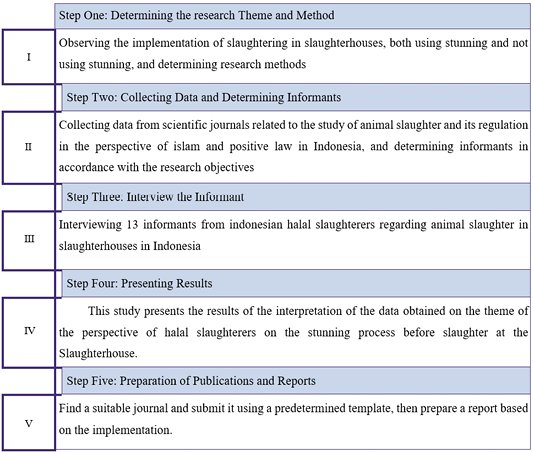
Research procedure.
Data collection
The two slaughterhouses were selected purposively to maximise variation in organisational scale, infrastructure, and stunning practice, comprising one larger, more technologically equipped slaughterhouses (RPH) and one smaller facility with more limited resources. Within these sites, informants were selected based on predefined inclusion criteria: at least three years of experience as halal slaughterers, direct involvement in the slaughter of Brahman Cross (BX) cattle, and documented experience performing slaughter both with and without pre-slaughter stunning. This combination of site-level and individual criteria was designed to capture a range of everyday conditions and decision-making contexts rather than statistical representativeness, so the 13 in-depth cases are intended to generate analytically rich, transferable insights about how practitioners understand and negotiate stunning, especially in settings that resemble the two slaughterhouses studied.
In-depth interviews with 13 purposively selected halal slaughterers were conducted face-to-face, via WhatsApp voice calls, and via Zoom teleconference, with attention to the ethical aspects of research, including informed consent (obtaining the informant’s consent) . Selection criteria: internal (sharia knowledge, beliefs, ≥3 years experience, ≥10 cows slaughtered with/without stunning, animal welfare understanding); external (RPH location, regulations, halal standards, industry demands). Interviews focused on slaughtering challenges, ease of slaughter, and perceptions of stunning, while additional data were obtained through direct observations and an examination of relevant Shariah sources, including the Qur’an, Hadith, and MUI fatwas. See Table 1 for informant details.
Table 1: Informant data.
| No. | Initial name | Age (Years) | Experience (Years) | Quantity (No. of cows slaughtered) | Regional origin | |
| Without stunning | With stunning | |||||
| 1 | HK | 43 | 4 | 100 | 40 | Wonogiri |
| 2 | AH | 26 | 5 | 1000 | 350 | Surakarta |
| 3 | AK | 49 | 6 | 800 | 150 | Sukoharjo |
| 4 | AN | 37 | 3 | 100 | 30 | Surakarta |
| 5 | AR | 40 | 3 | 155 | 72 | Surakarta |
| 6 | AB | 40 | 8 | 1500 | 450 | Sukoharjo |
| 7 | MJ | 38 | 5 | 260 | 10 | Sragen |
| 8 | SA | 29 | 5 | 350 | 30 | Surakarta |
| 9 | HS | 40 | 5 | 100 | 10 | Surakarta |
| 10 | AZ | 27 | 6 | 1100 | 80 | Surakarta |
| 11 | BA | 42 | 8 | 200 | 15 | Sukoharjo |
| 12 | BH | 28 | 5 | 2000 | 2000 | Semarang |
| 13 | PW | 46 | 15 | 2000 | 15 | Surakarta |
RESULTS
Obstacles in pre-slaughter using the stunning method
Based on interviews with 13 informants, summarised in Table 2, the practice of stunning cattle is perceived to pose complex technical challenges, particularly bullet mismatch, a high risk of stunning failure, and a limited time window between stunning and slaughter. BH explained that although the Standard Operating Procedure (SOP) requires a gap of about 10–20 seconds between stunning and the slaughter process, field practices are often interrupted by bullets that do not meet specifications, so that stunning must be repeated up to 2–4 times, which clearly opens up potential procedural violations, threatens animal welfare, and casts doubt on the halalness of carcasses.
Table 2: Summary of the obstacles faced by pre-slaughter using the stunning method.
| Remarks | Source of Informants |
| Bullet mismatch, risk of stunning failure, and the urgency of time | BH, AH, AN, SA, MJ, PW, AR, AB, AZ, AK, HS, HK |
| Facility limitations | BA, SA, HS, AK, AZ, AB |
| Difficulty in controlling the position of the cow and the quality of the carcass | BH, THE, SA, MJ, BA, PW, AR, AB, HS |
| Physical, mental, and human resource readiness | MJ, AR, HK, BH, AN, SA, BA, AB, AZ, HS, AK |
| Polemic of Islamic compliance and Standard Operating Procedure consistency | BH, AH, SA, MJ, PW, BA, HS, AN, AR, AB, AK, AZ, HK |
Note: Source of Informants represents the initials assigned to individual informants. Initials are used to maintain informants’ confidentiality and anonymity.
AH and SA explained that the bullet’s color and pressure should be adjusted according to the cow’s weight. However, the inaccuracy of the tool and the quality of the bullet often cause the stun to fail, risking disability or death before slaughter. AN emphasizes that the delay between stunning and slaughter is a critical point because it can magnify the risk of pre-slaughter damage or death. In line with that, SA and AR added that stun failure can make cows regain consciousness, cause head injuries, lower meat quality, and cause ethical and halal legal problems.
“… based on the existing SOPs, slaughter is 10-20 seconds between the stunning and slaughter processes, but often the bullets do not meet the specifications, so it must be 2-4 stunning times until the cow really falls and faints...” (BH, 28 years old, Semarang):
From the perspectives of BA, AK, AZ, and HS, the stunning method is only feasible in large RPH because it requires pneumatic tools and specialized slaughter boxes; beyond that, the limitations of devices and infrastructure make it difficult to consistently and safely implement stunning SOPs. This condition makes tools and facilities a prerequisite for uneven materials, thereby creating an implementation gap between industrial settings and community-based slaughter. Several slaughterers also proposed to the government that it procure hydraulic systems across the slaughterhouses RPH in equal numbers, as using special boxes remains ineffective. Only a few slaughterhouses in Indonesia have used hydraulic tools in demolishing cattle:
“Stunning in the main RPH, special tools/cages, only suitable for mass slaughter... SOPs demand special tools not easy for the general public to implement, high cost.” (BA, 42 years old, Sukoharjo).
The difficulty of controlling the position of the cow and its impact on the quality of the carcass appears strongly in the narrative of the slaughterers. Some halal slaughterers state that physical control and position of large and aggressive cows, especially the BX type, are serious challenges because animals often roll, jump, untyre, difficult to drop stably, and can be rebuilt even if stunning has been carried out according to the procedure, thus demanding precise retraining techniques, strong team coordination, emotional stability, and improvisation when directing the cow to the restraining box or when stunning fails. which, as a whole, increases the risk of accidents and the workload. In addition, PW assessed that improper stunning often leads to suboptimal blood production and more pronounced brain damage, while slaughter without properly done stunning is perceived to result in more maximum blood output and more durable meat; In line with that, HS, AK, AZ, and HK emphasized that limited training, non-up-to-date equipment, and inconsistent implementation of SOPs make the risk of stun failure and declining carcass quality remain a source of doubt among slaughterers:
“Cows are difficult to control, especially the BX type. The operator must be very experienced and competent. The execution time is longer than for ordinary cows (without stunning) because there is no rope attached to the nose or the head. Cows are wilder and difficult to control, starting from herding cows from the cage to the restraining box to the leg folding stage,” (AN, 37 years old, Surakarta)
The fourth obstacle concerns the physical and mental burden on the slaughterer and the degree of human resource readiness, including training, flight hours, and certification, as emphasized by MJ, AR, HK, BA, HS, AK, and AZ. Stunning requires operators to simultaneously master stunning techniques, read animal responses, comply with SOPs time limits, and coordinate with slaughter teams, so that cognitive and physical capacity are used intensively, especially in BX cattle and large-volume slaughter. MJ described that the operator’s mental pressure increases sharply when the precision of the bullet is not achieved, and the stun repeatedly fails, because this condition not only risks injuring the animal but also gives rise to moral pressure related to animal welfare and the validity of the process according to sharia. AR and HK highlight that physical and mental endurance are heavily tested, as operators must be prepared for the possibility of cattle regaining their feet while maintaining strict SOP adherence. BA, HS, AK, and AZ added that inequality in training, uneven certification, educational challenges in the community, and limitations in competency-improvement programs make human resource capacity the main limiting factor for the implementation of safe and accountable stunning. In this context, the slaughterer’s perception of stunning is largely determined by the extent to which they feel adequately trained, supported by facilities, and protected by a system of continuous training and supervision:
“The Standard Operating Procedure for the stunning time interval with the slaughter process is 20 seconds; the bullet must be of the right weight and precision. There is a mental pressure on operators because time must be fast, and the importance of training, certification, and flight hours for stunning operators and slaughterers.” (MJ, 38 years old, Sragen)
The fifth obstacle is rooted in the normative and regulatory dimensions, namely the polemic over the compliance of stunning methods with Islamic sharia and the consistency of SOP and regulatory implementation. All informants from halal slaughterers display a spectrum of attitudes ranging from supporting with strict conditions, to refusing due to concerns about sharia and animal welfare. Nine informants, including BH, AH, AB, AZ, HK, AK, BA, AN, and AR, tend to declare conditional acceptance because stunning is considered to apply especially to BX cattle and in large volumes if the tools are suitable, strict SOPs are followed, strong supervision is provided, and the MUI fatwa is obeyed. Animals are ensured to be alive when slaughtered. On the contrary, SA, MJ, PW, and HS express doubt and rejection by emphasizing that technical failures in the field such as animals appearing more tortured, brain damage, blood that is perceived to be less than optimal, and lack of education make stunning perceived as risking violating the basic principles of halal slaughter. Thus, sharia compliance and SOP consistency are not only a matter of regulatory text, but also a matter of practitioners’ trust in the system’s ability to prevent technical failures that have direct implications for the status of halal and ethical perception of stunning methods:
“Even though the international SOP exists, and the MUI Fatwa is clear, I do not agree with the stunning method, because the blood that comes out is less than optimal, the head is damaged, which I consider to be more torturous to the animal, and there is a potential for the cow to die before slaughter” (PW, 46 years old, Surakarta)
Ease of pre-slaughter using the stunning method
The stunning method, according to several halal slaughterers, offers several real conveniences, as summarized in Table 3, especially in controlling BX cattle, improving operator safety, and enhancing operational efficiency in large-scale slaughterhouses. BH stated that for the stunned cow, it was a BX cow, because there was no rope wrapped around the cow’s nose and head, the easiest way to slaughter it was to stun it first. Stunning makes the process much easier because the animal falls faster, and the execution of the slaughter becomes safer for the slaughterer. On the other hand, AH emphasized that when tools and SOPs are used correctly, the fall process is shorter and the control of the cow’s body becomes easier, so the team does not have to fight for long to face animal resistance in the slaughter area:
“This stunning method is intended for BX-type cows; the SOP for the cow must use stunning because there is no teluh/rope used to guide the cow. In addition, slaughter execution is also safer for operators.” (BH, 28 years old, Semarang)
Table 3: Summary of ease in pre-slaughter using the stunning method.
| Remarks | Source of informants |
| Easy to handle certain types of cattle | BH, AH, AN, AR, AB, BA, AZ, HK |
| Improve safety and work efficiency | BH, THE, AR, AB, BA, AZ, HK |
| Minimizing cow movement before slaughter | SA, MJ, PW, AK |
| International Standard Operating Procedure (SOP) and clear regulations | BA, AB, AZ, HK |
Note: Source of Informants represents the initials assigned to individual informants. Initials are used to maintain informants’ confidentiality and anonymity.
In terms of occupational safety and accident risk reduction, the informants positioned stunning as an important instrument to protect slaughterers, especially when handling large and panic-prone BX cows, because stunning speeds up animal control and minimizes direct physical contact, as explained by AN and emphasized by AB who stated that after BX cows are stunned, the animal is much easier to control and the risk of accidents decreases drastically. While MJ added that when stunning succeeded, the cow’s movement was minimal, making conditions safer when knives were used:
“With stunning, the cows fall faster, so we do not need too much direct physical contact, so the risk of accidents for the slaughterer is reduced, and the slaughter process can be done more safely and controlled.” (AB, 40 years old, Sukoharjo)
In addition, stunning is considered to help reduce the physical load and complexity of binding at high-volume facilities, with SA highlighting that this method no longer requires a lot of physical effort and does not require a lot of ropes so that the team can focus on the head and neck area, HK confirms that the calf cow minimizes its movement and allows operators to focus on technical SOPs and improve work efficiency. At the same time, BA and AZ view stunning as an important prerequisite for mass operations in large slaughterhouses, as workflows become more standardized and controlled, leading to minimal disturbance of animal movements:
“With stunning, the cow’s movements before slaughter are minimal, the cow falls faster and does not struggle much, so that the slaughterer no longer needs to wrestle or hold the animal’s body firmly and can focus more on slaughtering in the head and neck area according to the SOP for halal slaughter.” (MJ, 38 years old, Sragen)
Obstacles in pre-slaughter without using stunning methods
Table 4 shows that, without stunning, pre-slaughter becomes inefficient and poses greater occupational safety risks because cows are difficult to control and require longer handling time. BH explained that cows often go berserk when they are about to be put on a leash. The cow’s position changes and moves wildly, requiring more energy and increasing the risk of injury to the operator. AN and HS added that the non-stunning slaughter technique at slaughterhouses (RPH_ is used for types of cattle other than BX cows; the execution time tends to be longer, from starting to herd cattle from the cage, dropping cows that require many operators, to folding the legs and heads of cows. The process of dropping cows is often unsuccessful, so handling time increases, and the cow’s welfare is less often considered.
“If traditional techniques are used, the position of the cow often changes and moves wildly, requiring more physical exertion and directly increasing the risk of the operator being injured in the slaughter area.” (BH, 28 years old, Semarang)
Table 4: Summary of constraints in pre-slaughter without using stunning methods.
| Remarks | Source of Informants |
| Inefficiency of time, occupational safety risks, and animal welfare | BH, AN, SA, BA, PW, AR, AB, HS, AZ, HK |
| The physical and mental burden of the slaughterer is heavier. | BH, AN, SA, MJ, BA, PW, AR, HS, AK, AZ, HK |
| Lack of tools and facilities | SA, AN, AH, HS, AK, AZ |
Note: Source of Informants represents the initials assigned to individual informants. Initials are used to maintain informants’ confidentiality and anonymity.
The physical and mental burden of the slaughterer also becomes much heavier when the stun is not used. SA emphasized that this condition requires strong teamwork and precise ropes to control the cow’s movements. MJ described that the cow’s movement during slaughter is very active, so the risk of operator injury is high, and the mental pressure, especially for new operators, increases. HK stated that, without stunning, the team needs strong cohesiveness and physical fitness because controlling the cow takes longer:
“The cow’s movement when slaughtered is very active, so the risk of the operator being injured is great, and this adds to the mental pressure, especially for operators who are still new to the field.” (MJ, 38 years old, Sragen)
In addition, the lack of tools and the lack of facilities are increasingly an obstacle for slaughterers during pre-slaughter without using stunning, especially in RPH, which is not yet modern. AH explained that dropping and tying cattle is difficult without modern aids, and this increases the risk of injury to the operator. AK said that the limitations of assistive devices make handling more time-consuming and energy-consuming, so work efficiency at RPH decreases. By contrast, AZ highlighted that, in inadequate equipment conditions, there are often injuries in the team, and the process takes longer, requiring additional equipment in the field.
“The lack of tools makes handling cows take more time and energy, so that work efficiency at RPH decreases, especially in facilities that are not equipped with modern facilities.” (AK, 49 years old, Sukoharjo)
Ease of pre-slaughter without using stunning methods
Table 5 explains the ease of pre-slaughter without the use of a stunning method. In terms of budget efficiency and facility independence, slaughter without stunning is considered more economical and flexible because it does not require investment in modern equipment or specialized RPH infrastructure. MJ emphasized that this practice can be done anywhere without relying on equipment, and AK highlighted the absence of the cost of modern tools. At the same time, BA and AZ stated that in the village, it is enough to rely on simple stretching techniques and ties that still fit the traditional character of the local:
“Slaughter without stunning can be done anywhere and does not depend on modern tools or facilities.” (MJ, 38 years old, Sragen)
Regarding public trust and compliance with Islamic law, some informants considered the non-stun method to be more reassuring from a religious and social perspective. AH views the process without stunning as a more natural way, so that halal is felt more strongly. At the same time, HS stated that, without stunning, polemics related to sharia decrease and public trust in the validity of qurbani worship increases, in line with MJ and SA’s anxiety about potential sharia violations in the practice of stunning.
“Without stunning, there will be no sharia polemics in the community, and trust in the halalness of the process will be higher.” (HS, 40 years old, Surakarta)
Table 5: Summary of ease in pre-slaughter without using stunning methods.
| Remarks | Source of informants |
| Budget efficient and not dependent on modern tools and facilities | BH, MJ, BA, AZ, AK, SA |
| Public trust and compliance with Islamic Sharia | AH, HS, MJ, SA |
| Maximum blood production | AN, TV |
| Aligned with local traditions and easy to understand | BA, PW, AR, AZ |
Regarding the technical aspects of blood production, slaughter without stunning is considered optimal for the carcass. AN explained that without stunning, blood can flow more freely, making the meat better and more durable. At the same time, PW notes that in practice, stunning sometimes results in less blood being released, implicitly strengthening the preference for non-stun methods among traditional actors:
“Without stunning, blood can come out more optimally so that the quality of the meat is considered better and more durable.” (AN, 37 years old, Surakarta)
Conformity with local traditions and ease of understanding are also important factors that facilitate pre-slaughter without stunning. PW emphasized that this method follows the old pattern, in which animals are slaughtered directly without additional technical steps, making the flow easy for the committee and worshippers to understand. BA considers that simple SOPs, without specialized tools, are easy for the village community to adopt. AZ and AR see this traditional approach as a practice that maintains locality while being compatible with the communal atmosphere in local cow slaughter:
“The non-stun method follows a tradition that has been going on for a long time; the animals are slaughtered directly without additional processes so that the flow is easy for the committee and worshippers to understand.” (PW, 46 years old, Surakarta)
Statement of approval and rejection of the stunning method
Table 6 describes the statements of approval and rejection of the stunning method. Most of the informants expressed support for the use of stunning, but with strict technical and sharia requirements. BH, AH, AB, BA, AZ, HK, AK, AN, and AR basically accept stunning, especially for BX cattle, and in the context of large volumes, as long as the SOP is carried out in a disciplined manner, the tools used are appropriate and meet standards, and halal and animal welfare are maintained. BH and AH emphasized the importance of strict SOPs and the suitability of tools to make the process safer for slaughterers. At the same time, AB supported stunning on BX for operator safety and ensured that the tools met sharia and regulatory requirements. BA and AZ are considered stunning under international standards and national regulations, provided they are accompanied by strong education and supervision. At the same time, HK and AK require tested technical protocols, strict supervision, and adaptation to the Indonesian context. AN and AR take a neutral position that tends to accept, emphasizing that stunning can be used as long as it follows field SOPs and government regulations and does not contradict sharia, while still showing compassion for animals:
“Agree to BX and large volumes, as long as we follow strict SOPs, tools used according to standards, and halal remains a top priority.” (AH, 26 years old, Surakarta)
Table 6: Statement of approval and rejection of the stunning method.
| Source of informants who agree with the stunning method (supports with strict terms) | Source of informants who reject the stunning method |
| BH, AH, AB, AZ, HK, AK, BA, AN, AR | PW, MJ, HS, SA |
Note: Source of Informants represents the initials assigned to individual informants. Initials are used to maintain informants’ confidentiality and anonymity.
On the other hand, some informants showed strong disapproval or objection to stunning due to concerns about the aspects of sharia and animal welfare. PW considered that stunning can cause blood not to come out optimally and damage the head, especially the cow’s brain, so he views this method as more torturous for animals and less convincing in terms of halal. MJ stated that he did not agree that operator training and the quality of human resources were inadequate, because these conditions risked ignoring animal welfare and failing to implement sharia optimally. HS highlighted weaknesses in education, the lack of modern tools, and insufficient regulatory support. Hence, HS tends not to support stunning because he is worried that sharia is neglected in practice. SA disagrees with the view that the risk of failure of the SOP is high and has doubts about the guarantee of sharia aspects, so that, for this group, stunning is seen as bringing more potential problems than benefits in the context of religion and animal protection:
“I disagree if stunning is applied when training and the quality of human resources is inadequate, because in such conditions, animal welfare can be neglected and the implementation of sharia is no longer optimal.” (MJ, 38 years old, Sragen).
DISCUSSION
This study found that halal slaughterers’ perceptions of pre-slaughter stunning in Indonesian RPH were mixed. Nine of the 13 informants conditionally supported stunning for BX cattle, citing its benefits in facilitating the control of aggressive animals, improving operator safety, minimizing animal movement during slaughter, and aligning slaughter practices with established SOPs and regulatory guidance, including MUI Fatwa No. 12/2009. In contrast, four informants opposed stunning because of concerns regarding stunning failure and the need for repeated stunning (two to four times) due to improper bullet placement, limited facilities in smaller RPH, physical and psychological demands on slaughter personnel, suboptimal bleeding, potential carcass damage, and concerns that stunning may cause greater animal suffering than non-stun slaughter, which they regarded as more consistent with traditional halal slaughter practices.
A central tension emerging from these findings is the gap between the formal permission for stunning in MUI Fatwa No. 12/2009 and the continued rejection of stunning by some practitioners. For slaughterers who conditionally accept stunning, the fatwa is understood as a religious safeguard that legitimises the method, provided that clear conditions, such as reversibility, animals being alive at the time of the cut, and disciplined adherence to procedures, are demonstrably met. For those who reject stunning, however, the presence of a permissive fatwa does not automatically generate trust, because their daily experience is dominated by mis-stunning, inadequate equipment, and uneven training and supervision. They therefore judge stunning not on its ideal, sharia-compliant form, but on how it is actually implemented in their own work settings, where technical and organisational weaknesses are perceived as regularly pushing practice beyond what the fatwa allows. This helps explain why a ruling permitting conditional stunning can coexist with persistent resistance among practitioners: religious authority establishes what may be considered acceptable in principle, whereas practitioners’ experiences and concerns shape its acceptance in practice. At the same time, the lived experience of implementation determines whether individual slaughterers feel able to accept and operationalise that permission in practice.
The findings are consistent with Fuseini et al. (2017) who reveal the variation of UK Muslim scholars and consumers’ views on stunning, where acceptance relies on scientific evidence that reversible methods do not kill animals before halal slaughter, as well as Nakyinsige et al. (2013) who integrate Islamic-scientific perspectives to support stunning for animal welfare as long as it meets sharia requirements such as animals are conscious at slaughter. Research by Supratikno et al. (2022) showed that stunning non-penetrative methods prolong bleeding in cattle but reduce the risk of false aneurysms, strengthening the conditional support argument for slaughterers.
The main obstacles of stunning identified such as the urgency of 10-20 seconds, stun failure causing cows to wake up, difficulty in controlling BX position, and sharia polemics reflect a global issue where mis-stunning triggers hyperalgesia and nociceptor sensitivity, increasing pain perception, as reviewed by who reviewed halal stunning compliance in Muslim-majority countries such as Indonesia, Malaysia, and Saudi Arabia, Where fatwa allows reversible stunning but demands identification of the animal’s life status and appropriate restraint to avoid pre-cut death
The rejection of some slaughterers is in line with the perception of Saujan et al (2025) study about the Sri Lankan Muslim community, which highlights the concerns of meat traders about halal slaughter without stunning due to the risk of blood obstruction and poor meat quality, similar to Wibowo and Suhardi (2022) in Samarinda, who emphasized stress reduction without focusing on the perpetrator’s perception. Meanwhile, Grandin (2010) emphasized personnel training and the use of precision tools for effective stunning, a recommendation relevant to Indonesia’s unequal RPH facilities.
The comparison with non-stunning reinforces the preference of some slaughterers for traditional methods due to budget efficiency, maximum blood expenditure, public trust, and minimal sharia polemics, despite obstacles such as the risk of operator injury and higher physical load on large volumes. In line with the study by Farouk et al. (2014) on stunning that improves meat quality without violating halal principles, as well as the study by Alam et al. (2024) on halal welfare that compares with/without stunning regarding pain and ethics. Overall, this perception supports harmonization, such as in the UK (84% halal poultry stunning) and the MUI fatwa that allows stunning as a courtesy if temporary and not torturous, demands recommendations for standardization of hydraulic tools, certified training, sharia education, and Halal Regulator supervision for the optimization of Indonesia’s halal industry worth trillions of dollars.
Beyond demonstrating that the findings are consistent with earlier work, this study also helps explain why slaughterers position themselves along the spectrum from conditional acceptance to firm rejection of stunning. For practitioners who accept stunning under strict conditions, the method is viewed as a pragmatic means of reconciling competing demands. It facilitates the safer handling of large, aggressive BX cattle in high-volume slaughter settings while maintaining compliance with MUI fatwa guidance and public expectations regarding halal slaughter. By contrast, slaughterers who reject stunning read the same field realities repeated mis-stunning, visible head trauma, and perceived reductions in blood flow as evidence that the technology amplifies rather than resolves the risk of violating core sharia principles and betraying community trust. Taken together, these patterns suggest that the key fault line is not simply “pro- versus anti-stunning,” but how practitioners in different infrastructural and training contexts interpret the balance between operational efficiency, animal welfare, and religious accountability.
For halal slaughterers, sharia compliance emerges as the key tension that shapes how all other practical issues are understood. Technical problems such as bullet mismatch, the risk of animals regaining consciousness, or unequal access to modern equipment become ethically charged because they are perceived as potentially leading to pre-cut death, inadequate bleeding, or visible suffering, which in turn threatens the halal validity of the meat and the integrity of worship practices like qurbani. Among informants who conditionally accept stunning, strict adherence to MUI Fatwa No. 12/2009, continuous supervision, and clear evidence that animals remain alive at the time of slaughter are essential conditions, especially for BX cattle and high-volume operations. In contrast, informants who reject stunning read the same technical weaknesses as evidence that the method too easily falls outside sharia boundaries, undermining both personal religious responsibility and public trust. Sharia compliance thus functions as the primary lens through which slaughterers interpret operational constraints, assess animal welfare, and position themselves along the spectrum from conditional acceptance to outright rejection.
CONCLUSIONS
This study explored how halal slaughterers in two Indonesian abattoirs understand and negotiate the use of pre-slaughter stunning in their everyday work. The findings revealed a nuanced spectrum of perspectives: most informants conditionally accepted stunning for Brahman Cross cattle when strict technical and religious safeguards were observed, whereas a smaller group firmly rejected the practice due to concerns about mis-stunning, animal suffering, suboptimal bleeding, and uncertainty regarding halal validity. Across these positions, slaughterers emphasise concrete operational challenges, including bullet mismatch, tight time windows between stunning and cutting, unequal access to appropriate equipment, and uneven training and supervision, together with normative concerns related to compliance with MUI fatwas and maintaining public trust in halal slaughter. By centring these lived experiences, the study provides an exploratory, practitioner-based contribution to debates on halal-compliant stunning. It suggests that any future policy and training discussions should be informed by, and remain accountable to, the practical constraints and ethical considerations articulated by slaughterers themselves, rather than being treated as direct prescriptions derived from this single, qualitative case study.
Acknowledgements
The authors would like to express their sincere gratitude to the Lembaga Riset dan Inovasi Universitas Muhammadiyah Surakarta for funding support and facilitation through the Riset Tesis Magister (RTM) scheme, Contract No. 95.35/A.3-III/LRI/IV/2025. Appreciation is also extended to the Faculty of Islamic Studies, Universitas Muhammadiyah Surakarta, and all halal slaughterers and institutional partners who contributed invaluable assistance during data collection and the implementation of this research project.
Novelty Statemenet
The authors would like to express their sincere gratitude to the Lembaga Riset dan Inovasi Universitas Muhammadiyah Surakarta for funding support and facilitation through the Riset Tesis Magister (RTM) scheme, Contract No. 95.35/A.3-III/LRI/IV/2025. Appreciation is also extended to the Faculty of Islamic Studies, Universitas Muhammadiyah Surakarta, and all halal slaughterers and institutional partners who contributed invaluable assistance during data collection and the implementation of this research project.
Author’s Contribution
AWK led the conceptualization, methodology design, investigation, data collection, data curation, and drafting of the original manuscript. AA contributed to conceptualization, supervision, and critical review and editing of the manuscript. I contributed to validation and revisions to the manuscript. NN contributed to supervision, theoretical refinement, and critical review and editing of the manuscript. All authors read and approved the final version of the manuscript.
Ethical approval
The study ensures ethical research practices by obtaining informed consent from informants before interviews. All informant identities remain confidential, with data used solely for research purposes. Researchers foster a harmonious relationship to create a comfortable, open atmosphere, starting with introductions, objective explanations, and requests for willingness .
Availability of data and materials
All data generated and analyzed in this study are fully presented within this manuscript.
Generative AI and AI assisted technology statement
The authors state that generative AI tools were used only to refine the language of this manuscript and had no impact on the scientific content, data analysis, or conclusions.
Conflict of interest
The authors have declared that there is no conflict of interest regarding any financial, personal, or other relationships with individuals or organizations that could inappropriately influence, or be perceived to influence, the work reported in this manuscript.
References
- Abdussamad Z (2021). Metode penelitian kualitatif (Qualitative research methods). CV. Syakir Media Press. https://doi.org/10.31219/osf.io/juwxn [CrossRef]
- Adamsah B, Subakti E (2022). Development of the halal industry on Indonesian economic growth. Indones. J. Halal, 5: 71–75.
- Adzitey F (2011). Effect of pre-slaughter animal handling on carcass and meat quality. Int. Food Res. J., 18.
- Ahrari S, Krauss SE, Suandi T, Abdullah H, Sahimi AHA, Olutokunbo AS, Dahalan D (2019). A stranger in a strange land: Experiences of adjustment among international postgraduate students in Malaysia. Issues Educ. Res., 29: 611–632.
- Alam A, Azhari FD, Fathma A, Nordin N (2025). Netnography analysis of halal food finder applications. Int. J. Basic Appl. Sci., 14: 458–465. https://doi.org/10.14419/52fkp465 [CrossRef]
- Alam A, El Ashfahany A, Aisyah S, Ramadayanti A, Tabash MI (2024). Animal welfare studies in religious and halal slaughter studies: A literature review. J. Anim. Behav. Biometeorol., 12: 2024019. https://doi.org/10.31893/jabb.2024019 [CrossRef]
- Alam A, Nizam RS, Hidayat MT (2021). The role of Islamic microfinance institution in empowering Indonesian fishing communities. Univ. J. Account. Finance, 9: 178–183. https://doi.org/10.13189/ujaf.2021.090205 [CrossRef]
- Alam A, Ratnasari RT, Prasetyo A, Hapnitasari I, Rahmawati E (2024). Systematic literature review on halal label studies of halal tourism. TEM J., 13: 635–645. https://doi.org/10.18421/TEM131-66 [CrossRef]
- Alam A, Utami D, Hakim L, Karima NI, Ullah I (2025). Environmental concern and individual innovation on halal green skincare purchase intention. Int. Rev. Manage. Mark., 15: 90–99. https://doi.org/10.32479/irmm.18938 [CrossRef]
- Alhazmi AA, Kaufmann A (2022). Phenomenological qualitative methods applied to the analysis of cross-cultural experience in novel educational social contexts. Front. Psychol., 13: 785134. https://doi.org/10.3389/fpsyg.2022.785134 [CrossRef]
- Bergeaud-Blackler F (2007). New challenges for Islamic ritual slaughter: A European perspective. J. Ethn. Migr. Stud., 33: 965–980. https://doi.org/10.1080/13691830701432871 [CrossRef]
- Bima M, Alim MN, Adnan NIM (2025). Assessing the reliability of halal certification implementation: A qualitative study on perceptions of halal supervisors and micro business actors. J. Islam. Econ. Laws, 8: 79–105. https://doi.org/10.23917/jisel.v8i01.7305 [CrossRef]
- Creswell JW, Creswell JD (2018). Research design: Qualitative, quantitative, and mixed methods approaches, 5th ed. SAGE Publications.
- Desika P, Ulinnuha R (2023). Panopticism on the consumption of halal products in Indonesian Muslim society markets. J. Islam. Econ. Laws, 6: 41–59. https://doi.org/10.23917/jisel.v6i2.22313 [CrossRef]
- El-Rahim IHAA (2020). Recent slaughter methods and their impact on authenticity and hygiene standards. In: The halal food handbook. Wiley Blackwell, pp. 81–91. https://doi.org/10.1002/9781118823026.ch7 [CrossRef]
- Farouk MM, Al-Mazeedi HM, Sabow AB, Bekhit AED, Adeyemi KD, Sazili AQ, Ghani A (2014). Halal and kosher slaughter methods and meat quality: A review. Meat Sci., 98: 505–519. https://doi.org/10.1016/j.meatsci.2014.05.021 [CrossRef]
- Fatwa MUI No. 12 Tahun 2009 tentang standar sertifikasi penyembelihan halal (MUI Fatwa No. 12 of 2009 concerning halal slaughter certification standards) (2009). Available at: https://halalmui.org/wp-content/uploads/2023/06/Fatwa-MUI-No-12-Tahun-2009-Standar-Penyemblihan-Halal-.pdf
- Fuseini A, Wotton SB, Hadley PJ, Knowles TG (2017). The perception and acceptability of pre-slaughter and post-slaughter stunning for halal production: The views of UK Islamic scholars and halal consumers. Meat Sci., 123: 143–150. https://doi.org/10.1016/j.meatsci.2016.09.013 [CrossRef]
- Grandin T (2010). Auditing animal welfare at slaughter plants. Meat Sci., 86: 56–65. https://doi.org/10.1016/j.meatsci.2010.04.022 [CrossRef]
- Hakim R, Muslikhati, Aprilianto F (2020). Islamic economics ethics perspective on economic development in the time of coronavirus disease. Falah: J. Ekon. Syariah, 5: 111–127. https://doi.org/10.22219/jes.v5i2.14019 [CrossRef]
- Herianti H, Siradjuddin S, Efendi A (2023). Industri halal dari perspektif potensi dan perkembangannya di Indonesia (The halal industry in Indonesia: Potential and development). Indones. J. Halal, 6: 56–64. https://doi.org/10.14710/halal.v6i2.19249 [CrossRef]
- Husna F (2021). Stunning from sains and Islamic perspective. J. Halal Prod. Res., 4: 8–13. https://doi.org/10.20473/jhpr.vol.4-issue.1.8-13 [CrossRef]
- Junejo S, Anwar S, Hamidi ML (2023). Revolutionizing the halal food industry: The crucial role of green halal supply chain in Pakistani companies - a compelling theoretical framework. J. Islam. Econ. Laws, 6: 1–18. https://doi.org/10.23917/jisel.v6i2.22236 [CrossRef]
- Kurniawan AW, Alam A, Yuspin W (2025). Comparative legal analysis of stunning methods in halal animal slaughter between Muslim-majority and Muslim-minority countries. Int. J. Law Soc., 4: 84–107. https://doi.org/10.59683/ijls.v4i1.103 [CrossRef]
- Kustinah EM, Nisa FL (2024). Peran Bank Syariah dalam mendukung pertumbuhan sektor halal di Indonesia (The role of sharia banks in supporting the growth of the halal sector in Indonesia). J. Rumpun Manaj. Ekon., 1: 357–366. https://doi.org/10.61722/jrme.v1i3.1679 [CrossRef]
- Lenaini I (2021). Teknik pengambilan sampel purposive dan snowball sampling (Purposive sampling and snowball sampling techniques). HISTORIS: J. Kajian Penelit. Pengemb. Pendidik. Sej., 6: 33–39. [CrossRef]
- Lesthari F, Permana MZ (2022). Pengalaman membangun cita-cita serta tujuan hidup pada emerging adulthood: Analisa fenomenologi (The experience of building aspirations and life goals during emerging adulthood: A phenomenological analysis). J. Psikol. Perseptual, 7: 168–184. https://doi.org/10.24176/perseptual.v7i2.6711 [CrossRef]
- Makbul M (2021). Metode pengumpulan data dan instrumen penelitian (Data collection methods and research instruments). OSF Preprints. https://osf.io/svu73/download, https://doi.org/10.31219/osf.io/svu73 [CrossRef]
- Miles MB, Huberman AM (1984). Drawing valid meaning from qualitative data: Toward a shared craft. Educ. Res., 13: 20–30. https://doi.org/10.3102/0013189X013005020 [CrossRef]
- Millatina AN, Hakimi F, Budiantoro RA, Arifandi MR (2022). The impact of halal label in halal food buying decisions. J. Islam. Econ. Laws, 5: 159–176. https://doi.org/10.23917/jisel.v5i1.17139 [CrossRef]
- Muhamad M (2020). Tantangan dan peluang penerapan kebijakan mandatory sertifikasi halal (Studi implementasi UU No. 33 Th. 2014 dan PP No. 31 Th. 2019) (Challenges and opportunities in implementing the mandatory halal certification policy). J. Ilmu Ekon. Bisnis Islam, 2: 1–26. https://doi.org/10.24239/jiebi.v2i2.29.1-26 [CrossRef]
- Nakyinsige K, Che Man YB, Aghwan ZA, Zulkifli I, Goh YM, Abu Bakar F, Al-Kahtani HA, Sazili AQ (2013). Stunning and animal welfare from Islamic and scientific perspectives. Meat Sci., 95: 352–361. https://doi.org/10.1016/j.meatsci.2013.04.006 [CrossRef]
- Peristiwo H, Firdaus F, Haryati S (2024). Analysis of halal supply chain policy and its impact on sharia business and economic growth. ISLAMICONOMIC: J. Ekon. Islam, 15: 81–108. Available at: https://www.journal.islamiconomic.or.id/index.php/ijei/article/view/740
- Priatna R, Fadillah N, Ibrahim MY, Isa M (2023). Comparative study on halal policy in Southeast Asian countries. J. Halal Prod. Res., 6: 77–92. https://doi.org/10.20473/jhpr.vol.6-issue.2.77-92 [CrossRef]
- Rizki D, Hamzah M, Fakhiroh Z, Hendri D (2023). Best practice halal integrity management in the logistic chain scheme: Analysis of opportunities and challenges. J. Islam. Econ. Laws, 6: 13–29. https://doi.org/10.23917/jisel.v6i1.19867 [CrossRef]
- Rohaeni Y, Sutawijaya AH (2020). Pengembangan model konseptual manajemen rantai pasok halal studi kasus Indonesia (Development of a conceptual model for halal supply chain management: A case study of Indonesia). JATI Undip: J. Tek. Ind., 15: 177–188. https://doi.org/10.14710/jati.15.3.177-188 [CrossRef]
- Saujan I, Sifkan MHM, Nimsith SI, Nafees SMM (2025). Exploring community perceptions of halal slaughtering: Its impact on family and social obligations in Ampara District, Sri Lanka. QURU’: J. Fam. Law Cult., 3: 53–72. https://doi.org/10.59698/quru.v3i1.370 [CrossRef]
- Sazili AQ, Kumar P, Hayat MN (2023). Stunning compliance in halal slaughter: A review of current scientific knowledge. Animals, 13: 3061. https://doi.org/10.3390/ani13193061 [CrossRef]
- Sazili AQ, Norbaiyah B, Zulkifli I, Goh YM, Lotfi M, Small AH (2013). Quality assessment of longissimus and semitendinosus muscles from beef cattle subjected to non-penetrative and penetrative percussive stunning methods. Asian-Australas. J. Anim. Sci., 26: 723–731. https://doi.org/10.5713/ajas.2012.12563 [CrossRef]
- Supratikno, Setijanto H, Nuraini H, Agungpriyono S (2022). Bleeding time and false aneurysm incidence on cattle slaughtering using non-penetrative pre-slaughter stunning in Indonesia. Trop. Anim. Sci. J., 45: 482–489. https://doi.org/10.5398/tasj.2022.45.4.482 [CrossRef]
- Tetlow SAJ, Brennan ML, Garcia-Ara A (2022). Welfare indicators for stunning versus non-stunning slaughter in sheep and cattle: A scoping review. Vet. Rec., 191: 1-12. https://doi.org/10.1002/vetr.1739 [CrossRef]
- Trisno R, Nasir M (2025). The effect of brand image, product quality, and halal labeling on junk food product purchase decision (Case study of FEB students of Universitas Muhammadiyah Surakarta). Majapahit J. Islam. Finance Manage., 13: 1–16.
- Utari D, Fasa MI, Suharto S (2022). The halal industry contributes to economic growth during the COVID-19 pandemic: Opportunities and challenges. J. Bina Bangsa Ekon., 15: 87–98. https://doi.org/10.46306/jbbe.v15i1.119 [CrossRef]
- Wibowo A, Suhardi S (2022). Teknik penyembelihan standar halal bagi para penyembelih (juru sembelih) di wilayah Samarinda Provinsi Kalimantan Timur (Halal standard slaughter techniques for slaughterers in the Samarinda region, East Kalimantan Province). Peternakan Abdi Masyarakat, 2: 1–6. https://doi.org/10.24815/petamas.v2i2.29047 [CrossRef]
- Yani A, Suryadi RA, Nurrohman N (2020). Stunning on animals slaughter on Islamic law perspective. J. Ilm. Al-Syir’ah, 18: 77–90. https://doi.org/10.30984/jis.v18i1.1103 [CrossRef]
- Zaluchu SE (2020). Strategi penelitian kualitatif dan kuantitatif di dalam penelitian agama (Qualitative and quantitative research strategies in religious research). Evangelikal: J. Teol. Injili Pembinaan Warga Jemaat, 4: 28. https://doi.org/10.46445/ejti.v4i1.167 [CrossRef]
- Zuolo F (2015). Equality among animals and religious slaughter. Hist. Soc. Res., 40: 110–127.
- Żurek J, Rudy M, Stanisławczyk R, Duma-Kocan P (2023). The effect of kosher determinants of beef on its color, texture profile and sensory evaluation. Int. J. Environ. Res. Publ. Health, 20: 1378. https://doi.org/10.3390/ijerph20021378 [CrossRef]

Services
Article usage statistics
Loading…
Related articles
- Major Causes of Organ Condemnation in Camels Slaughtered at Akaki Abattoir, Addis Ababa, EthiopiaJournal of Animal Health and Production · 2015
- Prevalence and Risk Factors of Babesia Infection in Cattle Slaughtered in Nigerian AbattoirsThe Journal of Advances in Parasitology · 2025
- Seroprevalence of Trichinellosis among Pigs at Slaughter in a Major Abattoir in Makurdi, Benue State, NigeriaAdvances in Animal and Veterinary Sciences · 2016
- Enhancing Halal Management System in Poultry Production and Halal Control Point-Based Compliance Framework for ThailandJournal of Animal Health and Production · 2026
- An Abattoir-Based Study on the Prevalence of Hydatidosis Infestation and Fertility of Hydatid Cysts in Slaughtered Herbivores (Food Animals) in Dhamar Province-Yemen.Journal of Animal Health and Production · 2022
- Prevalence of Indigestible Foreign Body in Rumen and Reticulum of Cattle Slaughtered at Chinaksen and Midega Tola Woreda Abattoir, Eastern Oromia, EthiopiaVeterinary Sciences: Research and Reviews · 2026