
This study provides information on the external morphological characteristics and morphometric indices of the golden threadfin bream, Nemipterus virgatus, collected from the coastal waters of Da Nang, Central Vietnam. Analysis of 68 specimens revealed that the species possesses a laterally compressed and slightly convex body, ctenoid scales, a deeply forked caudal fin, and an elongated filamentous upper caudal lobe. The body coloration is pink dorsally and white ventrally. The length–weight relationship was described by the power regression equation W = 0.0011TL2.1292 (R2 = 0.8164, P < 0.001). The growth coefficient (2.1292 ± 0.1243; 95% CI: 1.881 – 2.377) indicated a statistically significant pattern of negative allometric growth (b < 3), suggesting that body length increases at a faster rate than body weight. Based on the relative gut length index (RLG < 1), the species was identified as exhibiting carnivorous feeding habits. These findings provide baseline biological information that contributes to the management, conservation, and sustainable exploitation of N. virgatus resources in Central Vietnam.
Research Article · Volume 15, Issue 1, Pages 46–54, 14 November 2026 · Open Access
First Report on Morphological and Biological Characteristics of the Golden Threadfin Bream Nemipterus virgatus from Da Nang Coastal Waters, Central Vietnam
, , , , , , , , , , ,
Affiliations & Notes ⌄
- 1University of Education, Hue University, Hue City, Vietnam
- 2Thuan Hoa High School, University of Education, Hue University, Hue City, Vietnam
- 3Pham Van Dong University, Quang Ngai Province, Vietnam
- 4Quy Nhon University, Gia Lai Province, Vietnam
- 5Da Nang College, Da Nang City, Vietnam
- 6Hue University, Hue City, Vietnam
- *Correspondence | Tran Van Giang; Email: tvgiang@hueuni.edu.vn
Article Info ⌄
- Journal:
- Journal of Animal Health and Production
- Submitted Date:
- 20 June 2026
- Accepted Date:
- 8 September 2026
- Published Date:
- 14 November 2026
Vo Quoc Vu and Nguyen Thi Hien are co-first author.

Abstract
Vo Quoc Vu and Nguyen Thi Hien are co-first author.
INTRODUCTION
Marine fishery resources, particularly demersal fish species, play a vital role in the fisheries sector of tropical and subtropical coastal regions . Among them, the family Nemipteridae is recognized as one of the most economically important fish groups, with a wide distribution throughout the Indo-West Pacific region ; . The golden threadfin bream, Nemipterus virgatus, is a common representative of this family and is frequently recorded in coastal fisheries catches across many Asian countries, including Vietnam . Owing to its high nutritional value and commercial importance, N. virgatus constitutes a valuable fishery resource in several Asian coastal nations such as Japan, China, Vietnam, Thailand, and Philippines ; . In Vietnam, the species is commonly distributed in the Gulf of Tonkin as well as the central and southern coastal waters .
However, the sustainable management of such a valuable resource cannot rely solely on fishery catch statistics; it necessitates a comprehensive understanding of the species’ biological and morphological integrity. Morphology serves as the fundamental baseline for population monitoring, allowing researchers to distinguish between stocks, detect phenotypic plasticity, and assess how local populations adapt to environmental stressors ; . Despite its significance, biological profiles are often extrapolated from regional data, which may fail to account for site specific adaptations. In this context, Da Nang represents a critical study site; situated within a transitional zone of the Central Vietnamese coast, its distinct oceanographic features such as seasonal upwelling and complex coastal topography create a unique selective environment . Documenting the morphological and biological characteristics of N. virgatus in this specific region is therefore essential to bridge the current knowledge gap and provide site specific data for local resource management.
Previous studies conducted in Vietnam and elsewhere have documented the conservation status of N. virgatus according to the criteria of the International Union for Conservation of Nature and the Vietnamese Red Data Book. The species has also been reported in assessments of demersal fishery resources in Vietnamese waters. More recent investigations have focused on its genetic characteristics and population structure to better understand its adaptive capacity under changing marine environmental conditions and increasing fishing pressure . Nevertheless, despite its recognized economic importance, comprehensive studies on the biological characteristics, growth patterns, and population dynamics of N. virgatus remain fragmented. While significant data are available for populations in the Beibu Gulf, South China Sea and parts of the northern coastal waters of Vietnam, such biological information is notably scarce for the central coastal waters of Vietnam, particularly in the Da Nang region. While prior research in Vietnam has largely prioritized broad scale resource assessments and species composition surveys, predominantly in the southern fishing grounds, there is a dearth of comprehensive, species specific biological data. This omission leaves a critical knowledge gap concerning the localized morphometric and feeding dynamics essential for the effective management of N. virgatus in the central coastal region, specifically the Da Nang area.
Growth and feeding ecology are among the key parameters in fisheries resource research. Understanding these biological characteristics provides an essential basis for population assessment models, evaluation of habitat suitability, and the development of sustainable exploitation strategies. However, for N. virgatus in the central coastal waters of Vietnam, particularly off Da Nang, information on growth patterns and digestive morphology remains limited and has not been comprehensively updated, despite the species’ regional importance . In the Da Nang coastal region, N. virgatus represents a primary target species for demersal fisheries, harvested using trawl nets, gill nets, and handlines. Its substantial catch volume and high market value provide significant income for coastal fishing communities. However, excessive fishing pressure, particularly the capture of immature individuals, combined with benthic habitat degradation due to environmental shifts, has raised concerns regarding the long term sustainability of local stocks , 2022).
Given these concerns, investigating the morphological and biological characteristics of N. virgatus is scientifically and practically vital. The objective of this study is to provide a comprehensive analysis of the external morphological characteristics, morphometric indices, growth patterns of N. virgatus in the coastal waters of Da Nang. The findings from this research will establish a baseline biological dataset, contributing to more effective local management, sustainable exploitation, and conservation of this economically valuable resource in Central Vietnam.
MATERIALS AND METHODS
Study specimens
A total of 68 specimens of N. virgatus were collected from the coastal waters of Da Nang, central Vietnam, between December 2025 and May 2026. Sampling was conducted opportunistically from commercial fishery landings, where sample size was constrained by local catch availability. Specimens were identified based on standard taxonomic keys ; . The study focused primarily on external morphological, meristic, and digestive system characterization (Figure 1).
Research methods
Field sampling
Specimens were collected from the coastal waters of Da Nang using hook and line fishing gear, trawl nets, and cast nets. Immediately after collection, the samples were preserved under chilled conditions and transported to the Animal Laboratory, Faculty of Biology, University of Education, Hue University, for subsequent examination and analysis.
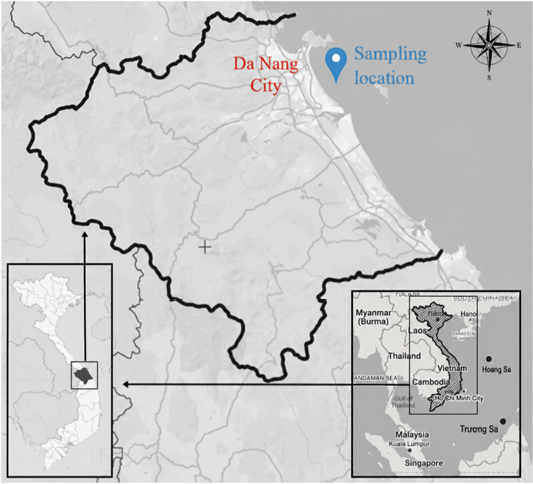
Sampling locations in the coastal waters of Da Nang.
Morphological analysis
Morphometric and meristic data were obtained from all 68 specimens collected in the study area. Morphometric measurements and counts of fin rays and spines were recorded following the standard procedures for establishing morphological profiles described by Gorospe and Demayo (2013).
Length–weight relationship analysis
The relationship between body length and body weight was determined using the allometric growth model proposed by Julian S. Huxley. The length–weight relationship was described by the following equation :
W = a.TLb
Where; W is the total body weight (g), SL => TL is the total length (mm), a is the intercept (condition factor), and b is the growth coefficient.
Anatomical examination
Specimens were secured on a dissecting tray for examination of the mouth, teeth, and tongue morphology. Internal organs were subsequently dissected using standard anatomical instruments to isolate the stomach and intestine for further analyses.
Analysis of digestive tract morphology
The relative gut length (RLG) index was calculated according to the method described by Nikolsky (1963) as follows:
RLG = Li / TL
Where RLG is the relative gut length index, Li is the intestinal length measured from the anterior end of the intestine to the anus (mm), and TL is the total length measured from the tip of the snout to the end of the caudal fin rays (mm).
According to Nikolsky (1963), fish species are classified as carnivorous when RLG < 1, omnivorous when RLG ranges from 1 to 3, and herbivorous when RLG > 3.
Statistical analysis
All data were processed using Microsoft Excel 2021. Morphometric and meristic measurements were summarized as Mean ± SD, with minimum and maximum values. The length–weight relationship was analyzed using logarithmic linear regression. The coefficient of determination (R²), standard error (SE), 95% confidence interval (CI) of the growth coefficient (b), and P-value were calculated. Statistical significance was set at P < 0.05.
RESULTS
External morphological characteristics
Body shape
Observations from both dorsal and ventral views revealed that N. virgatus possesses a fusiform and elongated body (Figure 2), with the head and caudal regions laterally compressed, while the mid body is relatively robust (Figure 2B, C). In lateral view, the body appears oval with a rounded and developed abdomen. The dorsal profile is slightly convex from the posterior margin of the head to approximately one third of the dorsal fin base and gradually descends toward the caudal peduncle. The caudal peduncle is elongated, narrowing posteriorly toward the caudal fin and expanding anteriorly toward the dorsal and anal fin bases. The caudal fin is deeply forked.
The body is entirely covered with medium sized ctenoid scales arranged regularly. The lateral line is distinct and conspicuous, positioned dorsally and following the curvature of the dorsal profile, extending from behind the operculum to the base of the caudal fin. The dorsal surface is pale pink, gradually fading along the flanks and becoming white on the ventral region (Figure 2A). Notably, three bright yellow longitudinal stripes are present symmetrically on each side of the body. The first stripe is located near the dorsal region and extends straight from behind the operculum to the caudal fin base. The second stripe is the shortest and situated along the mid lateral body, extending from behind the pectoral fin to the caudal peduncle. The third stripe originates beneath the snout and subsequently bifurcates into two ventrolateral stripes extending posteriorly to the caudal fin base (Figure 2A, C).
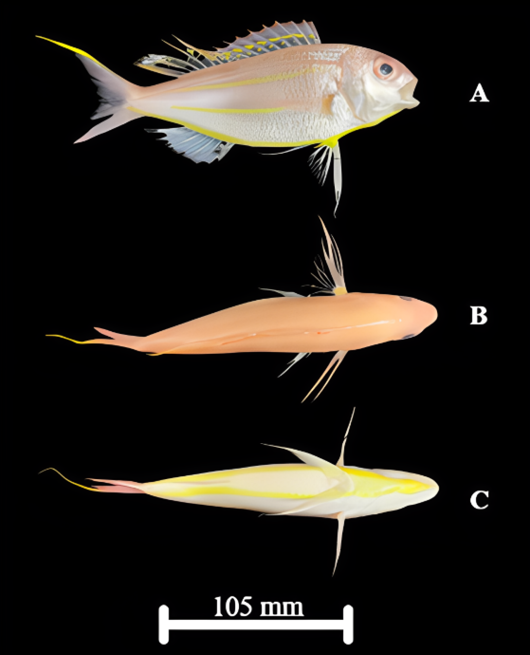
Morphology of N. virgatus. A: Lateral view, B: Dorsal view, C: Ventral view.
Scale characteristics
The scales are fan shaped, closely arranged, and uniformly distributed over the entire body surface. They are ctenoid scales characterized by small comb like projections along the posterior margin, a typical feature of many teleost fishes belonging to the order Perciformes. Concentric growth rings are clearly visible on the scales, together with radii extending from the focus toward the anterior margin (Figure 3).
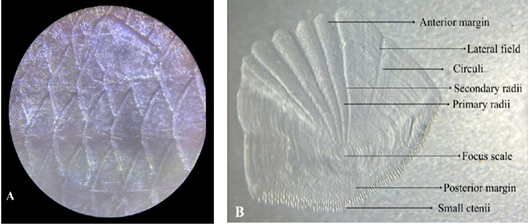
Scale morphology of N. virgatus. A: Scale arrangement on the body. B: Structure of a ctenoid scale.
Head, mouth, and dentition characteristics
Head morphology
The head is relatively large with a head length (HL) averaging 29.17% ± 3.3% of the standard length (SL) (Figure 4). The head is slightly expanded laterally and gradually tapers toward the mouth. The eyes are prominent, positioned laterally, with a mean diameter (O) representing 34.95% ± 1.2% of the head length (HL). The interorbital region is broad, with an average distance (OO) of 30.43% ± 1.8% of the HL (Figure 4C). In lateral view, the forehead exhibits a slight convexity (Figure 4A).
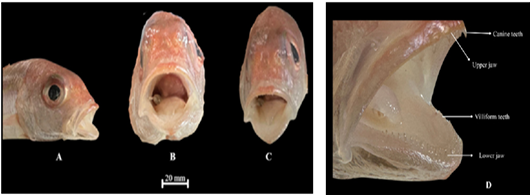
Head, mouth, and dentition morphology of N. virgatus. A: Head and eye morphology. B: Mouth morphology. C: Tongue morphology and eye position. D: Dentition of the upper and lower jaws.
Mouth morphology
The mouth is terminal, located along the midline axis of the body and directed anteriorly. The mouth width averages 16.6 ± 2.4 mm, representing approximately 40.6% of the head length (HL). The maxilla extends posteriorly to the vertical line passing through the anterior margin of the eye (Figure 4A). The snout is blunt rather than pointed. Both jaws bear teeth; these teeth are small and fine. The upper jaw possesses inwardly curved conical canine teeth, an adaptation associated with carnivorous feeding habits and effective prey retention. The lower jaw contains a greater number of teeth arranged more uniformly than those of the upper jaw, whereas teeth on the upper jaw are restricted mainly to the protruding portion of the jaw (Figure 4D).
The upper and lower jaws are of similar size, although the upper jaw slightly overlaps the lower jaw without projecting markedly. The lower jaw is more pointed in shape (Figure 4A). The jaws are covered externally by a thin layer of soft tissue forming the lips. The mouth structure, with a mean width of 16.6 ± 2.4 mm (accounting for approximately 40.6% of the HL), facilitates significant expansion, forming a capacious buccal cavity suitable for the capture of diverse prey (Figure 4C).
Fin characteristics and body coloration
The fin system of N. virgatus is fully developed and exhibits species specific characteristics. The dorsal fin is a single, elongated fin extending from behind the head to near the caudal peduncle. The numbers of dorsal fin spines and soft rays are generally similar, with the soft rays being longer than the spines. The anterior spines are rigid and pointed, whereas the posterior rays are soft and branched. Fin membranes connect the spines and rays, and distinct yellow markings are present on both the fin membrane and the tips of the dorsal spines. A pair of pectoral fins is located symmetrically on either side of the body. These fins are fan shaped, lack spines, and consist of slender, elongated soft rays.
The pelvic fins are positioned ventrally at approximately the same level as the pectoral fin base. They are relatively long and comprise slender spines and rays, typically including one spine and several soft rays. A distinctive feature is the elongated terminal soft ray, which extends into a filamentous structure. The caudal fin is deeply forked, with an easily recognizable elongated yellow ray on the upper lobe. The anal fin is a single fin situated posterior to the pelvic fins and assumes a roof like shape when expanded. It contains relatively short spines and rays, with the soft rays clearly branched. The entire body is covered with silvery scales. The dorsal, pectoral, and caudal fins are typically pale pink, whereas the pelvic and anal fins are translucent white (Figure 5).
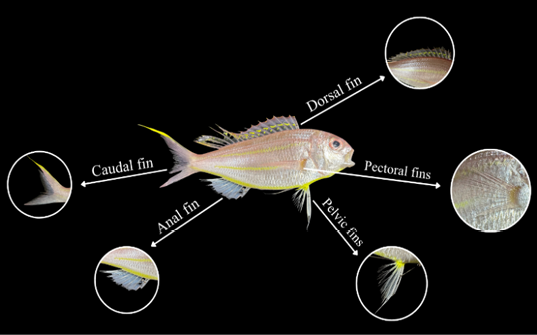
Morphological characteristics of the fins of N. virgatus.
Meristic characteristics
The meristic characteristics of the 68 N. virgatus specimens are summarized in Table 1. Overall, the meristic counts showed low variability and were generally consistent with established taxonomic descriptions for the species. Dorsal fin counts typically consisted of 10–11 spines and 7–11 soft rays, with 10 being the most frequent value for both. Pectoral and caudal fin ray counts exhibited the widest ranges, reflecting some individual variation. Most individuals possessed 3 anal spines and 8 anal rays. The number of lateral line scales ranged from 44 to 58. Detailed ranges and statistical parameters for all meristic traits are provided in Table 1.
Morphometric characteristics
Analysis of the morphometric measurements of N. virgatus indicated a relatively stable body morphology among the examined individuals. Specifically, the ratios BD/SL, HL/SL, O/HL, OO/HL, PO/HL, and HCP/LCP were 32.77%, 29.17%, 34.95%, 30.43%, 28.59%, and 59.32%, respectively (Figure 6).
Table 1: Meristic characteristics of N. virgatus.
| Character | Symbol | Min - Max (n = 68) |
Mean ± SD (n = 68) |
| Number of dorsal fin spines | DFS | 10 - 11 | 10 ± 0.17 |
| Number of dorsal fin rays | DFR | 7 - 11 | 10 ± 0.66 |
| Number of pectoral fin rays | PCFR | 9 - 16 | 15 ± 1.35 |
| Number of pelvic fin spines | PVFS | 1 - 1 | 1 ± 0 |
| Number of pelvic fin rays | PVFR | 4 - 6 | 5 ± 0.25 |
| Number of caudal fin rays | CFR | 14 - 19 | 17 ± 0.73 |
| Number of anal fin spines | AFS | 2 - 3 | 3 ± 0.17 |
| Number of anal fin rays | AFR | 6 - 8 | 8 ± 0.61 |
| Number of lateral line scales | LLS | 44 - 58 | 49 ± 3.09 |
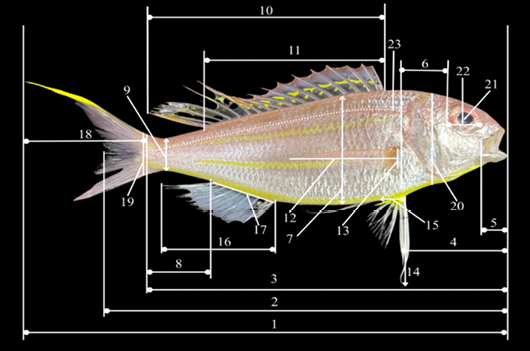
Morphometric and meristic measurements of N. virgatus. (Note: 1: Total length; 2: Fork length; 3: Standard length; 4: Head length; 5: Snout length; 6: Postorbital head length; 7: Body depth; 8: Caudal peduncle length; 9: Caudal peduncle depth; 10: Dorsal fin length; 11: Dorsal fin base length; 12: Pectoral fin length; 13: Pectoral fin base length; 14: Pelvic fin length; 15: Pelvic fin base length; 16: Anal fin length; 17: Anal fin base length; 18: Caudal fin length; 19: Caudal fin base length; 20: Head depth; 21: Interorbital width; 22: Eye diameter; 23: Lateral line).
These results demonstrate a relatively balanced proportional distribution of morphological structures throughout the body (Table 2).
Relationship between the length–weight
The length–weight relationship was determined using a power function model and described by the regression equation W= 0.001164TL2.1292, with a coefficient of determination (R²= 0.8164, P < 0.001), indicating a strong positive correlation between total length and body weight. The growth coefficient (b= 2.1292±0.1243 SE, 95% CI= 1.881– 2.377, b < 3) suggests that N. virgatus in the study area exhibits negative allometric growth. The results indicate that the rate of increase in body length exceeds
Table 2: Body weight, standard length, and morphometric parameters of N. virgatus.
| No. | Character | Symbol | Min - Max (n = 68) |
Mean ± SD (n = 68) |
| 1 | Body weight (g) | P | 58.5 - 99.3 | 81 ± 17.8 |
| 2 | Total length (mm) | TL | 163.2 - 224.5 | 203.9 ± 14.3 |
| 3 | Fork length (mm) | FL | 104.2 - 170.1 | 156.7 ± 12.4 |
| 4 | Standard length (mm) | SL | 120.9 - 157.9 | 142.3 ± 8 |
| 5 | Head length (mm) | HL | 30.1 - 47.5 | 40.9 ± 3.3 |
| 6 | Snout length (mm) | PO | 5.81 - 16.9 | 11.7 ± 2.6 |
| 7 | Postorbital head length (mm) | OPA | 11.5 - 20 | 16 ± 2.2 |
| 8 | Body depth (mm) | BD | 34.2 - 52 | 46 ± 4 |
| 9 | Caudal peduncle length (mm) | LCP | 13.9 - 30.5 | 24.5 ± 3.7 |
| 10 | Caudal peduncle depth (mm) | HCP | 11.9 - 16.2 | 14.2 ± 1 |
| 11 | Dorsal fin length (mm) | DL | 78.9 - 111.7 | 93.3 ± 6.7 |
| 12 | Dorsal fin base length (mm) | LDB | 62.7 - 80.5 | 73.8 ± 4.3 |
| 13 | Pectoral fin length (mm) | LPF | 32.8 - 47.5 | 41 ± 3.5 |
| 14 | Pectoral fin base length (mm) | LGPF | 6.8 - 9.4 | 8.3 ± 0.8 |
| 15 | Pelvic fin length (mm) | LPVF | 28 - 41.6 | 35.8 ± 3.3 |
| 16 | Pelvic fin base length (mm) | LPVB | 1.5 - 6.8 | 5 ± 1 |
| 17 | Anal fin length (mm) | LAF | 36.1 - 48.2 | 42.6 ± 3 |
| 18 | Anal fin base length (mm) | LAB | 20.61 - 28.1 | 24.5 ± 2.1 |
| 19 | Caudal fin length (mm) | LCI | 41.1 - 78.7 | 61.7 ± 8.6 |
| 20 | Caudal fin base length (mm) | LCB | 12.9 - 17.4 | 15.2 ± 1 |
| 21 | Head width (mm) | HW | 18.8 - 23.7 | 21.5 ± 1.3 |
| 22 | Head depth (mm) | HD | 28.9 - 46 | 37.4 ± 3.6 |
| 23 | Interorbital width (mm) | OO | 9.9 - 16.7 | 12.4 ± 1.8 |
| 24 | Eye diameter (mm) | O | 11.7 - 16.2 | 14.2 ± 1.2 |
| 25 | Mouth width (mm) | GW | 11.7 - 21.8 | 16.6 ± 2.4 |
that of body weight. Therefore, although body weight increases with increasing body length, the increase in weight is not proportional to the increase in length. As fish size increases, individuals tend to elongate more rapidly than they accumulate body mass (Figure 7).
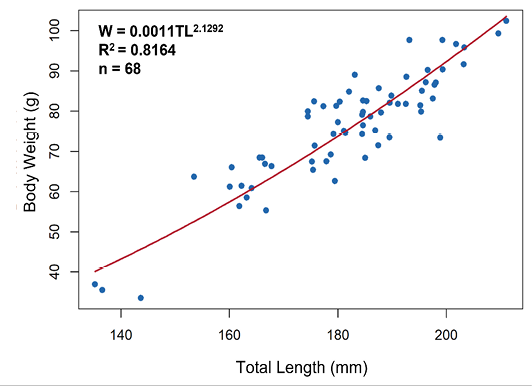
Length–weight relationship of N. virgatus.
Digestive system characteristics and feeding ecology
Digestive system characteristics
The digestive system of N. virgatus exhibits morphological specializations characteristic of an active carnivore. The mouth is terminal, with a mean width of 16.6 ± 2.4 mm (accounting for approximately 40.6% of HL), providing the structural capacity for efficient prey capture. Both jaws are equipped with inwardly directed, conical canine teeth, a specialized adaptation for grasping and retaining mobile prey. Internally, the digestive tract is characterized by a muscular, sac like stomach suited for processing protein rich food and a relatively short, straight intestine with minimal coiling (Figure 8). These anatomical features, combined with the low RLG index, consistently support the classification of N. virgatus as a carnivorous species adapted for active predation.
Relationship between intestinal length and total length (RLG)
The average intestinal length (Li) and total length (TL) of N. virgatus were 121.71 mm and 203.86 mm, respectively. The relative gut length (RLG), calculated as the ratio of intestinal length to total length (Li/TL), was approximately 0.6. Based on the criterion established by Nikolsky (1963), species with RLG values below 1 are classified as carnivorous. Accordingly, N. virgatus can be characterized as a carnivorous fish species with a feeding preference for animal prey.
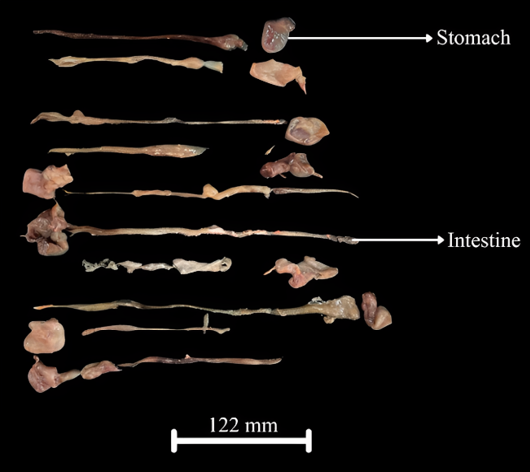
Morphology of the intestine and stomach of N. virgatus.
DISCUSSION
The external morphological characteristics of N. virgatus observed in the present study are generally consistent with previously published taxonomic descriptions. Specifically, the species is characterized by a pinkish body coloration that gradually fades ventrally, a white ventral surface, a pink head, elongated pectoral and pelvic fins, an anal fin with eight soft rays, and a forked caudal fin with the upper lobe extended into a filamentous tail extension . Other morphological features recorded in this study also agree with earlier descriptions, including an elongated and slender body, a relatively large head, large eyes, a terminal mouth of moderate size, and an upper jaw extending to the anterior margin of the eye. Teeth are present on both the upper and lower jaws, with several enlarged conical teeth located anteriorly on the upper jaw .
According to the identification guide published by the Food and Agriculture Organization, N. virgatus typically possesses five to six longitudinal yellow stripes along the lateral surface of the body . However, specimens collected from the coastal waters of Da Nang in the present study exhibited only three distinct yellow stripes. This discrepancy may be associated with intraspecific variation or ontogenetic stage. Although site specific environmental factors unique to the Da Nang coastal region (such as local hydrographic conditions or habitat characteristics) could potentially influence phenotypic expression, these variables were not quantified in the present study. Further research incorporating site specific environmental monitoring is required to confirm the drivers of this observed morphological variation. The meristic characteristics observed in the examined specimens fell within the ranges previously reported for the species. Morphometric indices, including BD/SL= 32.77%, HL/SL= 29.17%, PO/HL=34.95%, Ô/HL=30.43%, PO/HL= 28.59%, and HCP/LCP= 59.32%, indicate that N. virgatus possesses a relatively deep body, a developed head, large eyes, and a robust caudal peduncle. These traits are commonly associated with demersal fishes and are considered adaptive features that enhance visual capability, maneuverability, and foraging efficiency while enabling individuals to respond effectively to environmental challenges. Such characteristics are consistent with the general morphological adaptations previously reported for members of the family Nemipteridae.
The relationship between TL and W was described by the regression equation W= 0.0011TL2.1292 (R2= 0.8164). The moderate strength of this relationship (R2= 0.8164) and the low growth coefficient (b= 2.1292) suggest a negative allometric growth pattern, where body elongation occurs at a faster rate than biomass accumulation. When compared with broader regional studies, our b value is lower than those reported by Zhang et al. (2022), who observed b values ranging from 2.51 to 2.91 for N. virgatus populations in the Beibu Gulf between 1960 and 2012. This discrepancy may be attributed to several potential factors. Primarily, the opportunistic sampling strategy used in this study resulted in a size distribution dominated by larger individuals, which may have constrained the estimation of growth parameters compared to long term datasets. Furthermore, geographic variations in environmental conditions, prey availability, and localized fishing pressures in the Da Nang coastal waters could potentially influence growth trajectories. Consequently, our findings suggest that growth parameters for N. virgatus may be locally specific. These observations should be interpreted as a baseline characterization rather than a definitive growth trajectory for the species across all life stages. Future studies incorporating a broader size range and longitudinal data are warranted to verify these potential drivers and to confirm the growth dynamics of the population in the central coastal region. Although the sample size (n= 68) was constrained by opportunistic collection, it provided sufficient data to establish a consistent morphological baseline for N. virgatus in the Da Nang waters.
Furthermore, the relative gut length index (RLG \< 1) is consistent with the digestive morphology of carnivorous fish species. As documented by Russell (1990), carnivorous fishes that prey primarily on small animals typically possess a sac like stomach, a relatively short and straight intestine, and small, fine teeth. The morphological characteristics of the mouth, dentition, stomach, and intestine observed in the present study align with these diagnostic features, suggesting that the digestive anatomy of N. virgatus is adapted to a predatory feeding strategy. These anatomical traits, together with the low RLG value, support a carnivorous trophic classification, reflecting an ecological adaptation to a demersal lifestyle and predatory feeding capacity. It is important to note, however, that this classification is inferred from digestive morphology and the RLG index rather than direct confirmation of the species’ diet via stomach content analysis. Additionally, the opportunistic sampling strategy resulted in a skewed size distribution dominated by larger individuals, potentially limiting the precision of growth parameter estimates and the broader applicability of the findings. Consequently, these results should be viewed as a baseline biological characterization, with future research integrating direct dietary studies, broader size class representation, and longitudinal sampling required to provide a more comprehensive understanding of the species’ biology in the central coastal region.
CONCLUSION
This study provides baseline information on the morphological and biological characteristics of Nemipterus virgatus in the coastal waters of Da Nang, Central Vietnam. The examined specimens showed morphological and meristic characteristics generally consistent with established taxonomic descriptions, while the observed three-stripe body pattern may indicate local phenotypic variation. The length–weight relationship showed negative allometric growth (b= 2.1292), indicating that body length increased at a greater rate than body weight. The digestive tract morphology and relative gut length (RLG ≈ 0.60) supported a predominantly carnivorous feeding habit of N. virgatus.
Overall, the findings provide baseline biological information on N. virgatus in the central coastal waters of Vietnam, particularly regarding its morphology, growth pattern, and feeding characteristics. This information contributes to the biological knowledge of the species and provides a useful basis for future studies and for the sustainable management and exploitation of N. virgatus resources in the region.
ACKNOWLEDGEMENTS
This research is funded by Hue University, under the Core Research Program, Grant No. NCM.DHH.2025.10 and University of Education, Hue University under grant number NCTBSV-T.26-TN.106.04.
Novelty Statement
This study provides the first detailed description of the morphological characteristics, morphometric indices, growth pattern, and feeding ecology of Nemipterus virgatus from the coastal waters of Da Nang, Central Vietnam, supplying baseline biological data for future resource management and conservation.
AUTHOR’S CONTRIBUTION
Conceptualization, data curation, analysis and writing original draft: VTTN, NTHi, VQV, NTH, NHNM, NTDQ, NTTN. Investigation and species identification: VTTN, NTHi, VQV, NTH, NHNM, NTDQ, NTTN, NTTV, TTS, VTPA, NAT, TVG. Methodology, validation and manuscript review: TVG, NTTV, TTS, VTPA, NAT. Data analysis, English proofreading and editing: NHNM, NTHi, TVG. Supervision, reviewing, and final approval of the manuscript: TVG.
Generative AI and AI assisted technology statement
The authors declare that no generative AI and AI assisted technology was used in the creation of this manuscript.
Conflict of interest
The authors have declared no conflict of interests.
References
- Bui DC, Tran D (2005). Initial list of marine fish in Vietnam. In: Proceedings of Marine Fisheries Research, Vol. III, pp. 200210. Research Institute for Marine Fisheries, Ministry of Fisheries, Agricultural Publishing House. [in Vietnamese].
- Carpenter KE, Niem VH (2001). FAO species identification guide for fishery purposes. The living marine resources of the Western Central Pacific. Volume 5. Bony fishes. Part 3 (Menidae to Pomacentridae). Food and Agriculture Organization of the United Nations, Rome.
- Froese R (2006). Cube law, condition factor and weight-length relationships: History, meta-analysis and recommendations. J. Appl. Ichthyol., 22(4): 241–253. https://doi.org/10.1111/j.1439-0426.2006.00805.x [CrossRef]
- Gorospe JG, Demayo CG (2013). Population variability of the Golden rabbit fish (Siganus guttatus Bloch) (Pisces: Siganidae) in Northern Mindanao, Philippines. AACL Bioflux, 6(3): 188201.
- Grandcourt EM, Al Abdessalaam TZ, Hartmann SA, Al Shamsi AT, Francis F (2011). An evaluation of the management effectiveness of a stock re-building strategy for a multi-species demersal trap fishery in Abu Dhabi, United Arab Emirates. Open J. Mar. Sci., 1(3): 8297. https://doi.org/10.4236/ojms.2011.13009 [CrossRef]
- Le MH (2019). Study on demersal fish resources in the Da Nang coastal waters. J. Sci. Technol. Univ. Da Nang, 17(4): 78–85. [in Vietnamese].
- Nikolsky GV (1963). The ecology of fishes. Academic Press, London.
- Russell BC (1990). Nemipterid fishes of the world. Threadfin breams, whiptail breams, monocle breams, dwarf monocle breams and coral breams (Family Nemipteridae). FAO Species Catalogue, Vol. 12. Food and Agriculture Organization of the United Nations, Rome.
- Russell BC (1993). A review of the threadfin breams of the genus Nemipterus (Nemipteridae) from Japan and Taiwan, with description of a new species. Jpn. J. Ichthyol., 39(4): 295–310. https://doi.org/10.1007/BF02905130 [CrossRef]
- Sasikumar RG, Santhoshkumar S, Pavinkumar P, Paplin Prince B, Joyson Paul J, Sharumathi M, Nandhakumar M (2026). Exploring the length-weight relationships and well-being of 15 commercially important threadfin breams (Family: Nemipteridae) from the Southeast Coromandel Coast, Tamil Nadu, India. Thalassas, 42: 12. https://doi.org/10.1007/s41208-025-01027-7 [CrossRef]
- Trinh TT, Nguyen TL, Le TH, Hoang NT (2021). Taxonomic morphological characteristics of species belonging to the genus Nemipterus Swainson, 1839 (Pisces: Perciformes: Nemipteridae) in the coastal waters of Nghi Son Town, Thanh Hoa. Hong Duc Univ. J. Sci., 56: 111118. [in Vietnamese].
- Wu Z, Li X (2016). Complete mitochondrial genome of the Nemipterus virgatus (Perciformes: Nemipteridae). Mitochond. DNA Part A, 27(5): 34853486. https://doi.org/10.3109/19401736.2015.1066360 [CrossRef]
- Yang B, Yan L, Li J, Wang T, Zhang P ( 2024). Size selectivity of codend-mesh size in single boat bottom otter trawls for Nemipterus virgatus in South China Sea. South China Fish. Sci., 20(3): 17. https://doi.org/10.12131/20230227 [CrossRef]
- Zhang K, Geng P, Li J, Xu Y, Kalhoro MA, Sun M, Shi D, Chen Z (2022). Influences of fisheries management measures on biological characteristics of threadfin bream (Nemipterus virgatus) in the Beibu Gulf, South China Sea. Acta Oceanol. Sin., 41(3): 24–33. https://doi.org/10.1007/s13131-021-1925-9 [CrossRef]
- Zhang K, Li J, Hou G, Huang Z, Shi D, Chen Z, Qiu Y (2021). Length-based assessment of fish stocks in a data-poor, jointly exploited (China and Vietnam) fishing ground, northern South China Sea. Front. Mar. Sci., 8: 718052. https://doi.org/10.3389/fmars.2021.718052 [CrossRef]

Services
Article usage statistics
Loading…
Related articles
- The Validation of Different Growth Models of Randall’s Threadfin Bream, Nemipterus randalli (Russell, 1986), in Northeastern Mediterranean SeaPakistan Journal of Zoology · 2020
- First Report of Root-Knot Nematode, Meloidogyne javanica from Wisteria sinensis in Razavi Khorasan Province, IranPakistan Journal of Nematology · 2025
- First Report on Morpho-Molecular Identification of Pathogenic Fungal Isolates Associated with Rosemary (Rosmarinus officinalis L.) Plants in Al-Qadisiyah, IraqSarhad Journal of Agriculture · 2026
- First Report of Moraxella Bovis Infection in Indian CattleAdvances in Animal and Veterinary Sciences · 2013
- Biological and Morphological Parameters of Trilocha varians (Lepidoptera: Bombycidae) in PakistanPunjab University Journal of Zoology · 2020
- First report of Xiphinema rivesi Dalmasso, 1969 on citrus in northern EgyptPakistan Journal of Nematology · 2023