
Chestnut tannin is a plant-derived polyphenolic compound that may modify ruminal fermentation and gas production during feed degradation. This study evaluated the effects of chestnut tannin supplementation on cumulative gas production, total gas production, gas-production kinetics, and methane-related variables of complete-feed silage using an in vitro rumen fermentation system. Five treatments were evaluated: T0, complete-feed silage without chestnut tannin; T1, T0 supplemented with 0.50% chestnut tannin; T2, T0 supplemented with 1.00% chestnut tannin; T3, T0 supplemented with 1.50% chestnut tannin; and T4, T0 supplemented with 2.00% chestnut tannin on a dry-matter basis. After 30 days of ensiling, the samples were incubated with rumen fluid and McDougall’s buffer for 72 h. Gas-production kinetics were estimated using an exponential model, and methane concentration was analysed by gas chromatography. Data were analysed by analysis of variance followed by Duncan’s multiple range test when the treatment effect was significant. Chestnut tannin supplementation significantly affected total gas production, potential gas production, and the fractional gas-production rate constant (P<0.05). Mean total gas production ranged from 180 mL/g DM in T2 to 192 mL/g DM in T0, whereas potential gas production ranged from 145 mL in T4 to 161 mL in T3. Chestnut tannin did not significantly affect CH₄/total gas or CH₄/substrate; however, both variables showed a tendency to vary among treatments (0.05< P<0.10), with T3 having the lowest numerical means. It can be concluded that chestnut tannin supplementation altered the in vitro gas-production characteristics of complete-feed silage, although no single inclusion level was consistently optimal.
Research Article · Volume 15, Issue 1, Pages 113–123, 14 November 2026 · Open Access
In vitro Gas Production Kinetics and Methane Output of Complete Feed Silage Supplemented with Chestnut Tannin
, , , , , , , , , ,
Affiliations & Notes ⌄
- 1Department of Animal Science, Faculty of Agriculture and Animal Science, Universitas Islam Negeri Sultan Syarif Kasim Riau, 28293, Pekanbaru, Indonesia
- 2Department of Animal Science, Faculty of Animal Husbandry, Universitas Jambi, Jambi, Indonesia
- 3Study Program of Animal Science, Faculty of Agriculture, Tanjungpura University, Pontianak 78124, West Kalimantan, Indonesia
- 4Department of Plantation, Livestock, and Animal Health, Jln. Lingkar Komplek Perkantoran Pemerintah Kabupaten Kampar, Kabupaten Kampar, Indonesia
- 5Department of Animal Nutrition and Feed Technology, Faculty of Animal Husbandry, Universitas Padjadjaran, Sumedang 45363, West Java, Indonesia
- 6Research Center for Animal Husbandry, National Research and Innovation Agency (BRIN), Cibinong Science Center, Bogor District 16911, West Java, Indonesia
- 7Department of Animal Science, Politeknik Negeri Jember. Jln. Mastrip 164, Jember, East Java, Indonesia
- 8Department of Animal Production and Health, Faculty of Agriculture, University of Africa, Bayelsa State, Toru-Orua, Nigeria
- 9Faculty of Veterinary Medicine and Zootechnics, Autonomous University of Tamaulipas, Victoria City, Tamaulipas, Mexico
- *Correspondence | Saitul Fakhri; Email: sfakhri@unja.ac.id
Article Info ⌄
- Journal:
- Journal of Animal Health and Production
- Submitted Date:
- 18 May 2026
- Accepted Date:
- 6 September 2026
- Published Date:
- 14 November 2026
Abstract
INTRODUCTION
Ruminant livestock production is under increasing pressure to improve feed efficiency while simultaneously mitigating greenhouse gas emissions. Methane (CH₄), primarily generated during enteric fermentation, stands as one of the predominant greenhouse gases associated with ruminant production systems. In the context of ruminal fermentation, the degradation of feed organic matter is facilitated by complex microbial communities, yielding volatile fatty acids as the principal energy source for the host animal, alongside by-products such as carbon dioxide, hydrogen, and methane. The formation of methane not only poses significant environmental challenges but also represents an energy inefficiency in the diet, indicating that a portion of the gross energy consumed by ruminants remains unconverted into productive outputs. Recent global discourse surrounding sustainable livestock systems has underscored the need to implement mitigation strategies for methane emissions that do not compromise animal productivity, nutrient utilisation, or the economic viability of feeding systems (FAO, 2023; . Moreover, the successful implementation of enteric-methane mitigation strategies depends not only on their biological efficacy but also on their affordability, feasibility, and accessibility across different production systems . This is especially pertinent in tropical livestock systems, where the availability of feed resources frequently hinges on agricultural and agro-industrial by-products, which are characterised by considerable variability in moisture content, fibre composition, fermentability, and storage stability. Consequently, there is a pressing need for feed processing strategies that preserve nutrients, enhance feed availability, and modulate ruminal fermentation to promote sustainable ruminant production.
Numerous nutritional strategies have been investigated to mitigate methane production while improving rumen fermentation efficiency. These strategies include dietary manipulation, lipid supplementation, nitrate, essential oils, seaweed-derived compounds, probiotics, and plant secondary metabolites. Meta-analytical evidence indicates that the methane-mitigation efficacy of dietary additives and rumen modifiers varies among additive classes and may also be associated with changes in feed intake, digestibility, and animal performance . Among these additives, tannins have received considerable attention because of their ability to interact with dietary proteins, fibre fractions, and rumen microbial populations. Tannins may reduce ruminal protein degradation, alter hydrogen-utilisation pathways, suppress protozoa and methanogenic archaea, and consequently modify gas and methane production during fermentation. The meta-analysis by Yanza et al. (2021) showed that tannin extracts can influence rumen fermentation characteristics, nutrient digestibility, methane output, animal performance, and nitrogen utilisation in ruminants. However, these responses depend on the type of tannin, its dose, chemical structure, and the composition of the basal diet. Recent reviews have further indicated that although tannin-based feed additives may contribute to methane mitigation, their effects are inconsistent, and excessive inclusion levels may impair feed intake, digestibility, and microbial activity ; ; . Chestnut tannin, a hydrolysable tannin, has been reported to exert dose-dependent effects on ruminal protein degradation, protease activity, nutrient digestibility, and microbial community composition . Therefore, its efficacy should be evaluated within specific feed matrices, particularly fermented complete-feed systems.
Complete-feed silage, also known as total mixed ration silage, is a feeding strategy that integrates roughage, concentrates, and additives into a preserved ration. This approach can improve the utilisation of locally available feed resources and agro-industrial by-products, particularly materials with high moisture contents and limited storage stability. Ensiling can extend feed availability, preserve nutrients, and reduce spoilage. In a related study using chestnut tannin at 0, 0.50, 1.00, 1.50, and 2.00% of dry matter and an ensiling period of 30 days, Sadarman et al. (2024) evaluated nutrient composition, dry-matter loss, temperature, humidity, mould growth, physical characteristics, ammonia, and total volatile fatty acids. The authors concluded that supplementation at 1.50–2.00% reduced dry-matter loss, protected crude protein, maintained physical quality, inhibited mould growth, and stabilised silage temperature. Recent studies have also shown that additives incorporated into total mixed ration silage can influence ruminal fermentation characteristics, degradability, gas production, and methane-related responses under in vitro or in sacco conditions . Furthermore, adding tannins before ensiling may modify subsequent ruminal degradation kinetics and nutrient availability . Nevertheless, information remains limited on the effects of adding chestnut tannin before ensiling on the gas-production kinetics and methane output of complete-feed silage formulated from tropical feed ingredients. Therefore, this study evaluated the effects of varying levels of chestnut tannin inclusion on cumulative gas production, total gas production, gas-production kinetics, and methane output during in vitro ruminal fermentation of complete-feed silage. It was hypothesised that chestnut tannin would modify fermentation kinetics and methane output, with the magnitude of the response depending on its inclusion level.
MATERIALS AND METHODS
Study sites and experimental design
The study was conducted in two consecutive stages: preparation of complete-feed silage supplemented with chestnut tannin and evaluation of its in vitro rumen fermentation characteristics. Complete-feed silage was prepared at the Laboratory of Nutrition and Feed Technology, Faculty of Agriculture and Animal Science, Universitas Islam Negeri Sultan Syarif Kasim Riau, Pekanbaru, Indonesia. In vitro rumen fermentation and gas-production measurements were conducted at the Dairy Laboratory, Faculty of Animal Science, IPB University, Bogor, Indonesia. Methane concentration was determined by gas chromatography at the Pati Agricultural Environment Laboratory, Central Java, Indonesia.
The experiment consisted of five levels of chestnut tannin supplementation arranged in a completely randomised design, following approaches commonly applied in laboratory-scale complete-feed and total mixed ration silage studies ; ; . Chestnut tannin, derived from the bark and wood of chestnut trees (Castanea spp.), was used as the silage additive, following Sadarman et al. (2024). The treatments were T0, complete-feed silage without chestnut tannin; T1, T0 supplemented with 0.50% chestnut tannin; T2, T0 supplemented with 1.00% chestnut tannin; T3, T0 supplemented with 1.50% chestnut tannin; and T4, T0 supplemented with 2.00% chestnut tannin. Chestnut tannin supplementation levels were calculated on a dry-matter basis. Each treatment consisted of five independently prepared silo replicates, resulting in a total of 25 experimental silos. The individual silo was considered the experimental unit during the silage-preparation stage.
Feed ingredients and treatment preparation
The basal complete feed consisted of field grass, oil palm leaf sheath, palm kernel cake, fresh tofu dregs, molasses, sodium chloride, urea, and calcium carbonate. The nutrient composition of the feed ingredients is presented in Table 1, and the treatment formulations in Table 2.
The nutrient composition of the feed ingredients was determined using standard laboratory procedures. Dry matter (DM), crude protein (CP), ether extract (EE), crude fibre (CF), ash, calcium (Ca), and phosphorus (P) contents were analysed according to AOAC International (2023). The analytical results were expressed as percentages of dry matter, except for DM, which was expressed on an as-fed basis. Neutral detergent fibre (NDF) and acid detergent fibre (ADF) were determined separately using the detergent-fibre procedure, while total digestible nutrients (TDN) were estimated from the chemical composition of the feed ingredients. The nutrient composition of the individual ingredients is presented in Table 1.
The basal ration was formulated on a dry-matter basis using 30% field grass, 17% oil palm leaf sheath, 25% palm kernel cake, 15% fresh tofu dregs, 10% molasses, 1% sodium chloride, 1% urea, and 1% calcium carbonate. These basal ingredients constituted 100% of the complete-feed formulation. Chestnut tannin was subsequently added at 0.00, 0.50, 1.00, 1.50, or 2.00% of dietary dry matter and was not included as part of the 100% basal formulation. The use of chestnut tannin as an additive in complete-feed silage was based on previous work demonstrating its potential to modify silage characteristics and ruminal fermentation responses .
Before ensiling, all ingredients were weighed according to their respective dry-matter proportions. Field grass, oil palm leaf sheath, and other coarse materials were prepared to obtain a relatively uniform particle size. The ingredients were manually mixed until homogeneous. Molasses, sodium chloride, urea, calcium carbonate, and chestnut tannin were incorporated gradually to ensure uniform distribution throughout the ration.
Table 1: Nutrient composition of feed ingredients used in complete feed silage preparation.
| Raw materials | DM | CP | EE | CF | Ash | Ca | P | TDN | NDF | ADF |
| Field grass | 24.4 | 8.20 | 1.44 | 31.7 | 14.5 | 0.37 | 0.23 | 56.2 | 74.6 | 42.0 |
| Oil palm leaf sheath | 44.0 | 4.41 | 2.71 | 35.9 | 10.3 | 0.32 | 0.27 | 50.8 | 79.1 | 57.6 |
| Palm kernel cake | 89.7 | 15.7 | 7.20 | 20.4 | 4.24 | 0.47 | 0.72 | 66.0 | 65.3 | 36.7 |
| Fresh tofu dregs | 8.69 | 27.6 | 4.39 | 7.11 | 3.42 | 0.53 | 0.24 | 70.4 | 30.4 | 39.3 |
| Molasses | 70.9 | 4.00 | 0.10 | 1.00 | 4.00 | 1.51 | 0.02 | 80.0 | 0.00 | 0.00 |
| NaCl | 99.6 | 0.00 | 0.00 | 0.00 | 0.00 | 0.00 | 0.00 | 0.00 | 0.00 | 0.00 |
| Urea | 99.0 | 225 | 0.00 | 0.00 | 0.00 | 0.00 | 0.00 | 70.0 | 0.00 | 0.00 |
| CaCO₃ | 99.0 | 0.00 | 0.00 | 0.00 | 0.00 | 40.0 | 0.00 | 0.00 | 0.00 | 0.00 |
| Chestnut tannin | - | - | - | - | - | - | - | - | - | - |
Note: DM= dry matter; CP= crude protein; EE= ether extract; CF= crude fibre; TDN= total digestible nutrients; NDF= neutral detergent fibre; ADF= acid detergent fibre. Chestnut tannin was applied as an additive at the specified treatment level.
Table 2: Formulation of complete feed silage supplemented with different levels of chestnut tannin.
| Components | T0 | T1 | T2 | T3 | T4 |
| Basal feed ingredients (% DM) | |||||
| Field grass | 30 | 30 | 30 | 30 | 30 |
| Oil palm leaf sheath | 17 | 17 | 17 | 17 | 17 |
| Palm kernel cake | 25 | 25 | 25 | 25 | 25 |
| Fresh tofu dregs | 15 | 15 | 15 | 15 | 15 |
| Molasses | 10 | 10 | 10 | 10 | 10 |
| NaCl | 1 | 1 | 1 | 1 | 1 |
| Urea | 1 | 1 | 1 | 1 | 1 |
| CaCO₃ | 1 | 1 | 1 | 1 | 1 |
| Total basal feed | 100 | 100 | 100 | 100 | 100 |
| Chestnut tannin additive (% DM) | 0.00 | 0.50 | 1.00 | 1.50 | 2.00 |
Note: T0= complete feed without chestnut tannin; T1= T0 + 0.50% chestnut tannin; T2= T0 + 1.00% chestnut tannin; T3= T0 + 1.50% chestnut tannin; T4= T0 + 2.00% chestnut tannin. Chestnut tannin was used as an additive and was not included in the 100% basal feed formulation.
Field grass and oil palm leaf sheath were mechanically chopped to obtain a relatively uniform particle size before being mixed with the other ingredients. Approximately 1.50 kg of freshly mixed complete feed was packed into each 2.0-L plastic laboratory-scale mini-silo, following the mini-silo specification described by Anggraeni et al. (2024). Based on the nominal silo volume and the amount of fresh material packed, the estimated packing density was approximately 750 kg fresh matter per m³. The material was compacted manually to minimise residual air, after which each silo was sealed tightly using plastic film, a tight-fitting lid, and adhesive tape to maintain anaerobic conditions. The silos were stored in a dark room at a controlled temperature of approximately 25°C for 30 days, following the storage conditions reported by Sadarman et al. (2024).
Silage harvesting and sample preparation
After 30 days of ensiling, each silo was opened separately. The silage was removed, homogenised within the respective silo replicate, and visually inspected for evidence of spoilage. A representative sample was collected from each silo and placed in a labelled plastic bag.
The samples were transported in a Styrofoam container containing ice gel to the Dairy Laboratory at the Faculty of Animal Science, IPB University. Upon arrival, the samples were dried in a forced-air oven at 65°C for 24 h and ground to pass through a 0.50-mm screen. The ground samples were stored in airtight containers until in vitro incubation. Drying and grinding were performed to obtain a uniform substrate and reduce variation in the subsequent in vitro fermentation measurements ; . Each silo sample remained identifiable throughout sample preparation and laboratory analysis to preserve the independence of the five biological replicates.
Ethical approval and rumen-fluid collection
All procedures involving donor animals and rumen-fluid collection were conducted in accordance with accepted animal-welfare principles. The procedures were reviewed and approved by the Animal Ethics Committee of the Faculty of Animal Husbandry, Universitas Jambi, Indonesia, under Ethical Clearance No. 08/UN21.7/ECC/2022.
Rumen fluid was obtained from two rumen-fistulated Friesian Holstein cows maintained at the Dairy Cattle Barn, Faculty of Animal Science, IPB University, Bogor, Indonesia. The donor cows were fed a basal diet consisting of 80% hybrid elephant grass (Pennisetum purpureum) and 20% concentrate, offered twice daily, in accordance with donor-animal management. Rumen fluid was collected before the morning feeding to minimise variation associated with recent feed intake. Rumen contents were collected from several locations within the rumen, filtered through four layers of cheesecloth, and immediately transferred into a pre-warmed thermos flask under anaerobic conditions.
Rumen contents were collected from several locations within the rumen and filtered through four layers of cheesecloth. The filtered fluid was immediately transferred into a pre-warmed thermos flask and transported to the laboratory under warm and anaerobic conditions. These handling procedures were adapted from the in vitro gas-production technique described by Theodorou et al. (1994).
Preparation of buffer solution and in vitro incubation
McDougall’s artificial saliva was prepared by dissolving 9.80 g NaHCO₃, 9.30 g Na₂HPO₄·12H₂O, 0.57 g KCl, 0.47 g NaCl, 0.12 g MgSO₄·7H₂O, and 0.04 g anhydrous CaCl₂ in distilled water and making the final volume up to 1 L. The final buffer concentrations were approximately 116.7 mM NaHCO₃, 26.0 mM Na₂HPO₄, 7.6 mM KCl, 8.0 mM NaCl, 0.49 mM MgSO₄, and 0.36 mM CaCl₂. The buffer was prepared at a final pH of 8.3, maintained at 39°C, and continuously flushed with CO₂ before being mixed with rumen fluid to minimise oxygen exposure. No reducing agent or redox indicator was added to the buffer. The preparation was based on the artificial saliva formulation described by McDougall (1948) and subsequently used in in vitro rumen fermentation studies.
Rumen fluid and McDougall’s buffer were mixed at a ratio of 1:2. For each incubation bottle, 0.75 g of dried and ground silage sample was weighed into a serum bottle. Subsequently, 25 mL of rumen fluid and 50 mL of McDougall’s buffer were added, resulting in a total incubation medium volume of 75 mL.
The bottles were flushed with CO₂, sealed with rubber stoppers and aluminium caps, and incubated in a water bath at 39°C for 72 h. Blank bottles containing rumen fluid and buffer without substrate were included in each incubation run to correct gas production originating from the inoculum and incubation medium. The incubation temperature, anaerobic handling, use of blanks, and repeated gas measurements were adapted from Theodorou et al. (1994). The day of rumen-fluid collection and incubation was treated as a blocking factor to account for variation in inoculum activity among incubation runs.
Gas-production measurement
Gas production was measured using a calibrated gas syringe inserted through the rubber stopper of each serum bottle, following the general procedure described by Theodorou et al. (1994). Gas volume was recorded after 2, 4, 6, 8, 10, 12, 24, 48, and 72 h of incubation.
Gas volume at each measurement time was corrected using the corresponding blank value. Cumulative gas production was obtained by summing the corrected gas volumes over the incubation period. The gas volume measured directly from the incubation bottle was expressed in millilitres, whereas total gas production, normalised to the amount of substrate, was expressed as mL/g DM.
Estimation of gas-production kinetics
Gas-production kinetics were estimated using the exponential model proposed by Ørskov and McDonald (1979):

Where p is the cumulative gas production at incubation time t; a is gas production from the rapidly soluble fraction; b is gas production from the insoluble but potentially fermentable fraction; a+b is the potential maximum gas production; c is the fractional gas-production rate constant; and t is the incubation time in hours.
The kinetic parameters were estimated by nonlinear regression using IBM SPSS Statistics. Potential gas production was expressed in mL, and the fractional gas-production rate constant was expressed as h-¹. The principal variables subjected to statistical analysis were total gas production, potential gas production (a+b), and the fractional gas-production rate constant (c).
Methane determination
At the end of the 72-h incubation period, gas samples were collected from the headspace of each serum bottle and analysed for methane concentration using gas chromatography. The gas chromatograph was calibrated with a certified methane standard before sample analysis.
Methane output was calculated relative to total gas production and the amount of dry-matter substrate incubated. The use of gas chromatography for evaluating methane production in tannin-supplemented in vitro rumen fermentation systems has also been reported by Battelli et al. (2023) and Foggi et al. (2022).
Statistical analysis
Gas-production and methane data were analysed using IBM SPSS Statistics for Windows, Version 26.0 (IBM Corp., Armonk, NY, USA). The in vitro experiment was arranged in a randomised complete block design comprising five chestnut tannin treatments and five blocks. Each block represented one replicate and corresponded to one rumen-fluid collection day and its associated incubation run.
Each incubation run included one independent sample from each of the five treatments, resulting in five observations per treatment and 25 experimental units in total. Chestnut tannin treatment was included as a fixed effect, whereas the incubation run was treated as a random blocking effect. The statistical model was:

Where Yij is the observed response for the ith treatment in the jth incubation run; µ is the overall mean; Ti is the fixed effect of the ith chestnut tannin treatment (i,=, 1….5); Bj is the random effect of the jth block or incubation run (j,=, 1…5) and εij is the residual error.
The normality of residuals and homogeneity of variance were assessed before the analysis of treatment effects. When the overall treatment effect was significant, treatment means were compared using Duncan’s multiple range test. Differences were considered significant at P<0.05, whereas 0.05 ≤ P < 0.10 was interpreted as a statistical tendency. Results were presented as mean ± standard deviation.
RESULTS AND DISCUSSION
In vitro gas-production pattern and fermentation kinetics
The cumulative gas production profile of complete-feed silage supplemented with different levels of chestnut tannin during 72 h of in vitro rumen incubation is shown in Figure 1. Cumulative gas production increased progressively throughout the incubation period in all treatments, indicating that fermentable substrate remained available over time. This pattern may reflect the heterogeneous composition of the complete-feed silage, which contained readily fermentable ingredients, such as molasses and fresh tofu dregs, as well as more slowly degradable fibrous materials, including field grass, oil palm leaf sheath, and palm kernel cake. In total mixed ration or complete-feed silage, the availability of soluble carbohydrates, protein, fibre fractions, and fermentation products formed during ensiling can influence subsequent ruminal fermentation patterns ; .
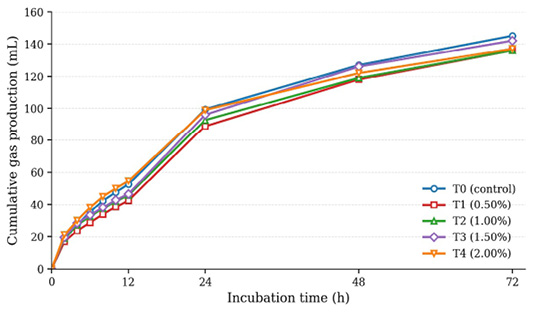
Cumulative gas-production profiles of complete-feed silage supplemented with different levels of chestnut tannin during 72 h of in vitro rumen incubation. T0, complete-feed silage without chestnut tannin; T1, T0 supplemented with 0.50% chestnut tannin; T2, T0 supplemented with 1.00% chestnut tannin; T3, T0 supplemented with 1.50% chestnut tannin; and T4, T0 supplemented with 2.00% chestnut tannin, on a dry-matter basis.
At 72 h, cumulative gas production was 145 mL in T0, 136 mL in T1, 136 mL in T2, 142 mL in T3, and 137 mL in T4. Thus, the chestnut tannin-supplemented treatments had numerically lower cumulative gas production than the control, although the response was not proportional to the supplementation level. This pattern is consistent with tannins’ ability to modify rumen fermentation through interactions with dietary protein, fibre, microbial enzymes, and rumen microorganisms. However, tannin responses vary according to tannin source, molecular structure, inclusion level, and basal diet composition ; ; .
As shown in Table 3, chestnut tannin supplementation significantly affected total gas production, potential gas production (a+b), and the fractional gas-production rate constant (c)(P<0.05). Total gas production ranged from 180 to 192 mL/g DM. T0 had the highest mean value at 192 mL/g DM, whereas T2 had the lowest at 180 mL/g DM, representing a reduction of approximately 6.25% relative to the control. However, T2 did not differ statistically from any of the other tannin-supplemented treatments. Therefore, this result indicates that chestnut tannin altered total gas production, but it does not establish 1.00% as the optimum inclusion level.
Table 3: Gas production kinetics of complete feed silage supplemented with different levels of chestnut tannin.
| Treatment | Total gas production (mL/g DM) | Potential gas production, a+b (mL) | Gas production rate, c (h⁻¹) |
| T0 | 192 ± 5.26c | 157 ± 3.46bc | 0.038 ± 0.0019b |
| T1 | 182 ± 5.94a | 156 ± 5.54bc | 0.028 ± 0.0025a |
| T2 | 180 ± 4.69a | 152 ± 6.82ab | 0.032 ± 0.0029a |
| T3 | 189 ± 4.47bc | 161 ± 6.42c | 0.030 ± 0.0008a |
| T4 | 181 ± 7.37ab | 145 ± 6.38a | 0.039 ± 0.0018b |
| P-value | <0.05 | <0.05 | <0.05 |
Note: T0= complete feed without chestnut tannin; T1= T0 + 0.50% chestnut tannin; T2= T0 + 1.00% chestnut tannin; T3= T0 + 1.50% chestnut tannin; T4= T0 + 2.00% chestnut tannin, based on dry matter. Values are presented as mean ± standard deviation. Different superscript letters within the same column indicate significant differences among treatments (P<0.05). a+b= potential maximum gas production; c= fractional gas production rate constant.
Reduced gas production may indicate lower availability or degradation of fermentable substrate rather than improved fermentation efficiency. Tannins can form complexes with dietary proteins and structural carbohydrates, thereby limiting their availability for microbial degradation. They may also reduce microbial attachment to feed particles and interfere with extracellular enzymatic activity during fermentation ; ; . Because nutrient digestibility was not measured, the reduction in gas production cannot be interpreted as an improvement in feed quality or nutrient-use efficiency.
The lower mean total gas production in T2 suggests that 1.00% chestnut tannin restricted fermentation under the conditions of this study. Nevertheless, the absence of a linear dose response indicates that the relationship between tannin level and fermentation was complex. Tannin effects may be favourable or neutral at low to moderate inclusion levels but increasingly suppressive at higher levels, depending on tannin chemistry, substrate composition, and microbial adaptation. Meta-analytical evidence indicates that tannin supplementation may reduce methane and modify ruminal fermentation, whereas excessive inclusion may also reduce feed intake and nutrient digestibility ; . Hydrolysable tannins have also reduced methane and nitrogen losses in beef cattle under some dietary conditions, although the magnitude of the response depended on forage proportion, crude protein concentration, and tannin characteristics , 2019).
Potential gas production (a+b) ranged from 145 to 161 mL. T3 had the highest mean value, whereas T4 had the lowest. The lower potential gas-production value in T4 suggests that supplementation with 2.00% chestnut tannin restricted the estimated extent of substrate fermentation. However, T4 was not clearly different from T2, as indicated by their shared superscript letters. Therefore, the result should not be interpreted as definitive evidence that 2.00% produced the greatest reduction among all tannin treatments.
The non-linear response in a+b, particularly the relatively high value in T3, may reflect interactions among tannin level, ensiling processes, and the chemical composition of the complete feed. Sadarman et al. (2022) reported that ensiling and tannin addition altered the ruminal degradation kinetics of soy sauce residues, suggesting that tannin activity after ensiling may differ from that observed when tannin is added directly to fresh feed or incubation medium.
The relatively high cumulative gas production and the highest a+b value in T3 indicate that 1.50% chestnut tannin did not consistently restrict the estimated fermentable substrate pool. Readily fermentable ingredients, particularly molasses and fresh tofu dregs, may have supported continued microbial fermentation despite tannin supplementation. Previous in vivo and in vitro studies have similarly shown that chestnut hydrolysable tannin can alter rumen fermentation without consistently reducing intake, digestibility, or total fermentation output, demonstrating that its effects depend strongly on the dietary matrix and microbial response ; .
Chestnut tannin supplementation also significantly affected the fractional gas-production rate constant. T4 had the lowest potential gas-production mean but the highest c value at 0.039 h⁻¹, which was statistically similar to the control. In contrast, T1, T2, and T3 had lower fractional rate constants. This finding indicates that the estimated extent and rate of gas production responded differently to tannin supplementation. In T4, the fermentable substrate pool may have been restricted, while the remaining available fraction was fermented relatively rapidly.
The cumulative gas-production curve supports this interpretation, as T4 maintained appreciable gas production during the early incubation period but did not produce the highest cumulative volume at 72 h. Thus, 2.00% chestnut tannin may have affected the estimated extent of fermentation more strongly than the initial fermentation rate. Changes in a+b and c should therefore be interpreted separately because they represent different aspects of fermentation: The quantity of potentially fermentable substrate and the rate at which the available fraction is fermented. Similar variation in tannin responses has been reported in meta-analyses and in vitro studies, in which tannin source, dose, substrate composition, and incubation conditions influenced the direction and magnitude of fermentation responses ; ; .
The findings are consistent with reports showing that tannin-containing materials and purified tannin extracts can modify gas production and ruminal fermentation. Gutiérrez Vázquez et al. (2016) found that tannin-containing fodder-tree species altered in vitro methane-related fermentation responses, although the magnitude of these changes varied among species. Durmic et al. (2022) similarly emphasised that plant bioactive compounds may influence methane formation and fermentation, but their effectiveness depends on botanical source and chemical composition. Loza et al. (2021) also reported variation among tannin-rich forage mixtures in their ability to reduce methane while maintaining digestibility. These findings indicate that chestnut tannin can modify fermentation, although its response depends on the specific feed matrix and experimental conditions.
Methane production and its relationship with fermentation patterns
The methane-related variables of complete-feed silage supplemented with different chestnut tannin levels are presented in Table 4. According to the predefined statistical criteria, P<0.05 indicated a significant treatment effect, whereas 0.05 ≤ P < 0.10 was interpreted as a tendency. Chestnut tannin supplementation did not significantly affect CH₄/total gas or CH₄/substrate. However, the treatment effects showed a tendency, with P= 0.067 for CH₄/total gas and P= 0.060 for CH₄/substrate.
T3 had the lowest numerical means for CH₄/total gas and CH₄/substrate, at 0.015 mM/mL and 2.80 mM/g DM, respectively, followed numerically by T4. However, because the treatment effects did not reach statistical significance and no significant pairwise differences were demonstrated, T3 cannot be described as producing significantly lower methane output than the other treatments. The appropriate interpretation is that both methane-related variables tended to vary among treatments, with T3 showing the lowest numerical means. Methane-mitigation claims should be based on statistically supported responses rather than numerical differences alone ; .
Table 4: Methane production of complete feed silage supplemented with different levels of chestnut tannin.
| Treatment | CH₄/total gas (mM/mL) |
CH₄/substrate (mM/g DM) |
| T0 (control) | 0.026 ± 0.0091 | 5.07 ± 1.87 |
| T1 (0.50%) | 0.027 ± 0.0067 | 4.82 ± 1.12 |
| T2 (1.00%) | 0.021 ± 0.0052 | 3.81 ± 1.01 |
| T3 (1.50%) | 0.015 ± 0.0072 | 2.80 ± 1.39 |
| T4 (2.00%) | 0.017 ± 0.0080 | 3.09 ± 1.33 |
| P-value | 0.067 | 0.060 |
Note: T0 = complete feed without chestnut tannin; T1 = T0 + 0.50% chestnut tannin; T2 = T0 + 1.00% chestnut tannin; T3 = T0 + 1.50% chestnut tannin; T4 = T0 + 2.00% chestnut tannin, based on dry matter. Values are presented as mean ± standard deviation. The absence of superscript letters indicates no significant difference among treatments (P>0.05). A tendency was observed for CH₄/total gas and CH₄/substrate, with P-values ranging from 0.05 to 0.10. CH₄ = methane; DM = dry matter.
The numerical reduction in methane-related variables in T3 may reflect biological effects of hydrolysable tannins on rumen microorganisms and fermentation pathways involved in methanogenesis. Tannins may influence methane formation by suppressing protozoa-associated methanogens, directly inhibiting methanogenic archaea, reducing hydrogen availability, or shifting fermentation end products. Methane formation is determined not only by methanogenic archaeal abundance but also by interactions among bacteria, protozoa, hydrogen-producing microorganisms, and fermentation pathways ; . Niu et al. (2024) also reported that tannin supplementation altered ruminal fermentation, methanogen communities, and metabolomic profiles, suggesting that responses to tannins may involve both microbial and metabolic mechanisms.
Nevertheless, the present study did not demonstrate a significant reduction in the measured methane variables. Furthermore, volatile fatty acid profiles, protozoal populations, hydrogen balance, methanogenic archaea, and nutrient digestibility were not measured. Consequently, it is not possible to determine whether the numerical reduction observed in T3 resulted from direct inhibition of methanogens, lower protozoal activity, altered hydrogen utilisation, reduced substrate degradation, or a combination of these mechanisms. Methane responses to tannins should therefore be interpreted together with nutrient digestibility, fermentation end products, and microbial characteristics ; .
The results also indicate that total gas production and methane-related variables did not respond in the same way to chestnut tannin supplementation. T2 had the lowest mean total gas production, whereas T3 had the lowest numerical methane means. Thus, lower total gas production did not necessarily correspond to proportionally lower methane output. Total gas production represents the combined gaseous products of substrate fermentation, whereas methane formation depends more specifically on hydrogen availability, fermentation stoichiometry, and methanogenic activity.
Accordingly, the results do not support the identification of a single optimum chestnut tannin inclusion level. The different response patterns for total gas production, potential gas production, fractional gas-production rate, and methane-related variables indicate that each endpoint responded differently to supplementation. Although T2 had the lowest total gas-production mean and T3 had the lowest numerical methane means, these findings should not be translated directly into practical supplementation recommendations without information on digestibility, fermentation efficiency, nutrient utilisation, and animal performance.
The composition of the complete-feed silage may partly explain the variable response. Molasses and fresh tofu dregs provide readily fermentable substrates that can support microbial activity and hydrogen production, whereas field grass, oil palm leaf sheath, and palm kernel cake contain more slowly degradable fibre fractions that may interact differently with tannins. Consequently, tannin supplementation may simultaneously reduce the availability of certain substrates, alter microbial ecology, and redirect fermentation pathways. Such concurrent effects may produce inconsistent methane responses ; ; .
The present findings are consistent with studies reporting variable responses to tannin-based additives. Battelli et al. (2023) found that chestnut and quebracho tannins affected methane production, fermentation parameters, and rumen microbiota in vitro. Verma et al. (2024) reported that purified tannin extracts from temperate forages reduced methane production, but the reduction was accompanied by lower total gas production, suggesting that reduced substrate degradation may have contributed to the response. Foggi et al. (2022) similarly demonstrated in vitro methane- and ammonia-mitigating potential when chestnut or quebracho tannins were combined with essential-oil blends. These studies indicate that methane-related responses should be evaluated alongside the extent of fermentation, digestibility, and nutrient degradation.
From a practical perspective, the present study demonstrates that chestnut tannin can alter the in vitro gas-production characteristics of complete-feed silage. However, the findings do not establish a supplementation level that consistently improves all fermentation responses. T2 had the lowest mean total gas production, T4 had the lowest mean potential gas production, and T3 had the lowest numerical methane values. These contrasting patterns indicate that the response depends on the variable evaluated. An effective methane-mitigation additive should reduce methane without adversely affecting nutrient digestibility, feed intake, animal performance, or economic feasibility ; ; .
Several limitations should be considered when interpreting these findings. First, the experiment was conducted under in vitro conditions and therefore did not account for passage rate, absorption of fermentation products, host metabolism, long-term microbial adaptation, or animal-level responses. Second, the treatment effects on methane-related variables showed only a tendency (0.05 ≤ P < 0.10), indicating that additional replication or more precise methane measurements may be required. Third, nutrient digestibility, ammonia concentration, volatile fatty acid profiles, protozoal populations, and methanogenic archaea were not evaluated. Therefore, the observed reduction in gas production cannot be classified as improved fermentation efficiency and may instead reflect restricted substrate degradation.
Chestnut tannin supplementation affected total gas production and gas-production kinetics more clearly than the measured methane variables. The methane-related responses showed a tendency to vary among treatments, with T3 having the lowest numerical means. The non-linear responses across supplementation levels support further investigation integrating gas production with nutrient digestibility, fermentation end products, microbial characteristics, and in vivo animal performance.
CONCLUSION
It can be concluded that chestnut tannin supplementation altered the in vitro gas-production characteristics of complete-feed silage, although no single inclusion level was consistently optimal. Methane-related variables were not significantly affected, but showed a tendency to vary among treatments, with T3 having the lowest numerical means.
ACKNOWLEDGEMENT
The authors would like to express their sincere gratitude to the Institute for Research and Community Service (LP2M) of Universitas Islam Negeri Sultan Syarif Kasim Riau for facilitating and supporting this research. The assistance and institutional support provided have greatly contributed to the successful completion of this study.
Novelty Statement
This study offers further evidence regarding the effects of chestnut tannin supplementation prior to ensiling on subsequent in vitro ruminal gas production kinetics and methane-related responses in silage formulated from tropical feed resources and agro-industrial by-products. The findings reveal marked differences in total gas production, potential gas production, fractional fermentation rates, and methane-related variables. This underscores the importance of assessing multiple fermentation endpoints rather than focusing solely on gas reduction.
AUTHOR’S CONTRIBUTION
SS and SF contributed to conceptualisation, formal analysis, and project administration. SS and RPH developed the methodology, while SS was responsible for the software. NQ and ERAR contributed to validation, and NQ and RAN conducted the investigation and curated the data. DF prepared the visualisation, YRY provided supervision, and MA contributed resources. SS, SD, and ZAB prepared the original draft, while SD, RAN, and ERAR contributed to writing review and editing. All authors reviewed and approved the final version of the manuscript.
Generative AI and AI assisted technology statement
The authors declare that no generative AI and AI assisted technology was used in the creation of this manuscript.
Conflict of interest
The authors have declared no conflict of interest.
References
- Aboagye IA, Beauchemin KA (2019). Potential of molecular weight and structure of tannins to reduce methane emissions from ruminants: A review. Animals, 9(11): 856. https://doi.org/10.3390/ani9110856 [CrossRef]
- Aboagye IA, Oba M, Castillo AR, Koenig KM, Iwaasa AD, Beauchemin KA (2018). Effects of hydrolyzable tannin with or without condensed tannin on methane emissions, nitrogen use, and performance of beef cattle fed a high-forage diet. J. Anim. Sci., 96(12): 5276–5286. https://doi.org/10.1093/jas/sky352 [CrossRef]
- Aboagye IA, Oba M, Koenig KM, Zhao GY, Beauchemin KA (2019). Use of gallic acid and hydrolyzable tannins to reduce methane emission and nitrogen excretion in beef cattle fed a diet containing alfalfa silage. J. Anim. Sci., 97(5): 2230–2244. https://doi.org/10.1093/jas/skz101 [CrossRef]
- Almeida AK, Hegarty RS, Cowie A (2021). Meta-analysis quantifying the potential of dietary additives and rumen modifiers for methane mitigation in ruminant production systems. Anim. Nutr., 7(4): 1219–1230. https://doi.org/10.1016/j.aninu.2021.09.005 [CrossRef]
- Anggraeni AS, Jayanegara A, Sofyan A, Laconi EB, Kumalasari NR, Gunadarma IN, Herdian H, Fidriyanto R (2024). In vitro and in sacco evaluation of total mixed ration silage added different levels of chitosan. Czech J. Anim. Sci., 69(5): 178–190. https://doi.org/10.17221/173/2023-CJAS [CrossRef]
- AOAC International (2023). Official methods of analysis of AOAC international. 22nd ed. AOAC International, Oxford University Press. [CrossRef]
- Baihaqi ZA, Widiyono I, Suwignyo B, Angeles AA (2022). Alternative strategies of plant metabolite secondary “tannin” for methane emissions reduction on ruminant livestock: A review of the last 5 years literature. Adv. Anim. Vet. Sci., 10(3): 599–606. https://doi.org/10.17582/journal.aavs/2022/10.3.599.606 [CrossRef]
- Battelli M, Colombini S, Parma P, Galassi G, Crovetto GM, Spanghero M, Pravettoni D, Zanzani SA, Manfredi MT, Rapetti L (2023). In vitro effects of different levels of quebracho and chestnut tannins on rumen methane production, fermentation parameters, and microbiota. Front. Vet. Sci., 10: 1178288. https://doi.org/10.3389/fvets.2023.1178288 [CrossRef]
- Beauchemin KA, Ungerfeld EM, Abdalla AL, Alvarez C, Arndt C, Becquet P, Benchaar C, Berndt A, Mauricio RM, McAllister TA, Oyhantcabal W, Salami SA, Shalloo L, Sun Y, Tricarico JM, Uwizeye A, De Camillis C, Bernoux M, Robinson T, Kebreab E (2022). Invited review: Current enteric methane mitigation options. J. Dairy Sci., 105(12): 9297–9326. https://doi.org/10.3168/jds.2022-22091 [CrossRef]
- Besharati M, Maggiolino A, Palangi V, Kaya A, Jabbar M, Eseceli H, De Palo P, Lorenzo JM (2022). Tannin in ruminant nutrition: A review. Molecules, 27(23): 8273. https://doi.org/10.3390/molecules27238273 [CrossRef]
- Black JL, Davison TM, Box I (2021). Methane emissions from ruminants in Australia: Mitigation potential and applicability of feeding strategies. Anim. Prod. Sci., 61: 1–14. https://doi.org/10.3390/ani11040951 [CrossRef]
- Cappucci A, Mantino A, Buccioni A, Casarosa L, Conte G, Serra A, Mannelli F, Luciano G, Foggi G, Mele M (2021). Diets supplemented with condensed and hydrolysable tannins affected rumen fatty acid profile and plasmalogen lipids, ammonia and methane production in an in vitro study. Ital. J. Anim. Sci., 20(1): 935–946. https://doi.org/10.1080/1828051X.2021.1915189 [CrossRef]
- Cardoso-Gutiérrez E, Aranda-Aguirre E, Robles-Jiménez LE, Castelán-Ortega OA, Chay-Canul AJ, Foggi G, Angeles-Hernandez JC, Vargas-Bello-Pérez E, González-Ronquillo M (2021). Effect of tannins from tropical plants on methane production from ruminants: A systematic review. Vet. Anim. Sci., 14: 100214. https://doi.org/10.1016/j.vas.2021.100214 [CrossRef]
- Durmic Z, Black JL, Martin GB, Vercoe PE (2022). Harnessing plant bioactivity for enteric methane mitigation in Australia. Anim. Prod. Sci., 62(12): 1160–1172. https://doi.org/10.1071/AN21004 [CrossRef]
- FAO (2023). Pathways towards lower emissions: A global assessment of the greenhouse gas emissions and mitigation options from livestock agrifood systems. Food and Agriculture Organization of the United Nations. https://doi.org/10.4060/cc9029en [CrossRef]
- Foggi G, Terranova M, Conte G, Mantino A, Amelchanka SL, Kreuzer M, Mele M (2022). In vitro screening of the ruminal methane and ammonia mitigating potential of mixtures of either chestnut or quebracho tannins with blends of essential oils as feed additives. Ital. J. Anim. Sci., 21(1): 1520–1532. https://doi.org/10.1080/1828051X.2022.2130832 [CrossRef]
- Gutiérrez Vázquez E, Hernández Medina L, Márquez Benavides L, Juárez Caratachea A, Salas Razo G, Ayala Burgos AJ, Ortiz Rodríguez R (2016). Effect of fodder tree species with condensed tannin contents on in vitro methane production. Asian-Australas. J. Anim. Sci., 29(1): 73–79. https://doi.org/10.5713/ajas.15.0464 [CrossRef]
- Hristov AN (2024). Invited review: Advances in nutrition and feed additives to mitigate enteric methane emissions. J. Dairy Sci., 107(7): 4129–4146. https://doi.org/10.3168/jds.2023-24440 [CrossRef]
- Kondo M, Shimizu K, Jayanegara A, Mishima T, Matsui H, Karita S, Goto M, Fujihara T (2016). Changes in nutrient composition and in vitro ruminal fermentation of total mixed ration silage stored at different temperatures and periods. J. Sci. Food Agric., 96(4): 1175–1180. https://doi.org/10.1002/jsfa.7200 [CrossRef]
- Kreuzer M (2025). Feed additives for methane mitigation: Introduction special issue on technical guidelines to develop feed additives to reduce enteric methane. J. Dairy Sci., 108(1): 298–301. https://doi.org/10.3168/jds.2024-25669 [CrossRef]
- Ku-Vera JC, Castelán-Ortega OA, Galindo-Maldonado FA, Arango J, Chirinda N, Jiménez-Ocampo R, Valencia-Salazar SS, Flores-Santiago EJ, Montoya-Flores MD, Molina-Botero IC, Piñeiro-Vázquez AT, Arceo-Castillo JI, Aguilar-Pérez CF, Solorio-Sánchez FJ, Valencia-Heredia ER (2020). Review: Strategies for enteric methane mitigation in cattle fed tropical forages. Animal, 14(S3): s453–s463. https://doi.org/10.1017/S1751731120001780 [CrossRef]
- Loza C, Reinsch T, Loges R, Taube F, Gere JI, Kluß C (2021). Assessing the potential of diverse forage mixtures to reduce enteric methane emissions in vitro. Animals, 11(4): 1126. https://doi.org/10.3390/ani11041126 [CrossRef]
- McDougall EI (1948). Studies on ruminant saliva. 1. The composition and output of sheep’s saliva. Biochem. J., 43(1): 99–109. https://doi.org/10.1042/bj0430099 [CrossRef]
- Min BR, Solaiman S, Waldrip HM, Parker D, Todd RW, Brauer DK (2020). Dietary mitigation of enteric methane emissions from ruminants: A review of plant tannin mitigation options. Anim. Nutr., 6(3): 231–246. https://doi.org/10.1016/j.aninu.2020.05.002 [CrossRef]
- Naumann HD, Tedeschi LO, Zeller WE, Huntley NF (2017). The role of condensed tannins in ruminant animal production: Advances, limitations and future directions. Rev. Bras. Zootec., 46(12): 929–949. https://doi.org/10.1590/s1806-92902017001200009 [CrossRef]
- Niu X, Xing Y, Wang J, Bai L, Xie Y, Zhu S, Sun M, Yang J, Li D, Liu Y (2024). Effects of Caragana korshinskii tannin on fermentation, methane emission, community of methanogens, and metabolome of rumen in sheep. Front. Microbiol., 15: 1334045. https://doi.org/10.3389/fmicb.2024.1334045 [CrossRef]
- Ørskov ER, McDonald I (1979). The estimation of protein degradability in the rumen from incubation measurements weighted according to rate of passage. J. Agric. Sci., 92(2): 499–503. https://doi.org/10.1017/S0021859600063048 [CrossRef]
- Orzuna-Orzuna JF, Dorantes-Iturbide G, Lara-Bueno A, Mendoza-Martínez GD, Miranda-Romero LA, Hernández-García PA (2021). Effects of dietary tannins’ supplementation on growth performance, rumen fermentation, and enteric methane emissions in beef cattle: A meta-analysis. Sustainability, 13(13): 7410. https://doi.org/10.3390/su13137410 [CrossRef]
- Pazla R, Antonius A, Mohd-Aris A, Ikhlas Z, Fitri Y, Bansi H, Dewi YL, Hadiatry MC, Qomariyah N, Wahyuwardani S, Yusriani Y, Rohaeni ES, Bakrie B (2026). The role of tannin-based products in mitigating enteric methane emissions in ruminant livestock: A review. J. Adv. Vet. Anim. Res., 13(1): 192–206. https://doi.org/10.5455/javar.2026.m1023 [CrossRef]
- Prapaiwong T, Srakaew W, Poolthajit S, Wachirapakorn C, Jarassaeng C (2023). Effects of chestnut hydrolysable tannin on intake, digestibility, rumen fermentation, milk production and somatic cell count in crossbred dairy cows. Vet. Sci., 10(4): 269. https://doi.org/10.3390/vetsci10040269 [CrossRef]
- Roques S, Martinez-Fernandez G, Ramayo-Caldas Y, Popova M, Denman S, Meale SJ, Morgavi DP (2024). Recent advances in enteric methane mitigation and the long road to sustainable ruminant production. Annu. Rev. Anim. Biosci., 12: 321–343. https://doi.org/10.1146/annurev-animal-021022-024931 [CrossRef]
- Sadarman, Febrina D, Febriyanti R, Peter R, Zulkarnain, Sirajuddin, Gazali I, Hafid A, Qomariyah N, Sastrawan S, Prihambodo TR (2024). Complete feed silage innovation: Utilization of agro-industry by-products with chestnut tannin as additives. Anim. Prod., 26(3): 169–181. https://doi.org/10.20884/1.jap.2024.26.3.337 [CrossRef]
- Sadarman, Irawan A, Ridla M, Jayanegara A, Nahrowi, Ridwan R, Sofyan A, Herdian H, Darma ING, Wahyono T, Febrina D, Harahap RP, Nurfitriani RA, Adli DN (2022). Influence of ensiling and tannin addition on rumen degradation kinetics of soy sauce residues. Adv. Anim. Vet. Sci., 10(2): 270–276. https://doi.org/10.17582/journal.aavs/2022/10.2.270.276 [CrossRef]
- Sun M, Liu P, Xing Y, Zhang M, Yu Y, Wang W, Li D (2025). Effects of chestnut tannin on nutrient digestibility, ruminal protease enzymes, and ruminal microbial community composition of sheep. Fermentation, 11(6): 302. https://doi.org/10.3390/fermentation11060302 [CrossRef]
- Tapio I, Snelling TJ, Strozzi F, Wallace RJ (2017). The ruminal microbiome associated with methane emissions from ruminant livestock. J. Anim. Sci. Biotechnol., 8: 7. https://doi.org/10.1186/s40104-017-0141-0 [CrossRef]
- Theodorou MK, Williams BA, Dhanoa MS, McAllan AB, France J (1994). A simple gas production method using a pressure transducer to determine the fermentation kinetics of ruminant feeds. Anim. Feed Sci. Technol., 48(3–4): 185–197. https://doi.org/10.1016/0377-8401(94)90171-6 [CrossRef]
- Vasta V, Daghio M, Cappucci A, Buccioni A, Serra A, Viti C, Mele M (2019). Invited review: Plant polyphenols and rumen microbiota responsible for fatty acid biohydrogenation, fiber digestion, and methane emission: Experimental evidence and methodological approaches. J. Dairy Sci., 102(5): 3781–3804. https://doi.org/10.3168/jds.2018-14985 [CrossRef]
- Verma S, Taube F, Malisch CS (2024). Investigating the efficacy of purified tannin extracts from underutilized temperate forages in reducing enteric methane emissions in vitro. Sci. Rep., 14: 12578. https://doi.org/10.1038/s41598-024-63434-9 [CrossRef]
- Yanza YR, Fitri A, Suwignyo B, Elfahmi, Hidayatik N, Kumalasari NR, Irawan A, Jayanegara A (2021). The utilisation of tannin extract as a dietary additive in ruminant nutrition: A meta-analysis. Animals, 11(11): 3317. https://doi.org/10.3390/ani11113317 [CrossRef]

Services
Article usage statistics
Loading…
Related articles
- Fermentation Characteristics, In Vitro Nutrient Digestibility, and Methane Production of Oil Palm Frond-Based Complete Feed Silage Treated with CellulaseAdvances in Animal and Veterinary Sciences · 2024
- Evaluation of In Vitro Nutrient Digestibility, Fermentation Characteristics and Methane Production of Agro-industrial Byproducts-based Complete Feed Block Treated with Mixed MicrobesAdvances in Animal and Veterinary Sciences · 2018
- Combined Effects of Cottonseed Oil and Tannin from Tea By-Products (Camellia sinensis) Supplementation on Nutrient Digestibility, Performance and Enteric Methane Production of Fattening CattleAdvances in Animal and Veterinary Sciences · 2020
- Effects of Different Additives and Lignin Peroxidase Enzyme on in vitro Gas Production Kinetics and Methane Production of some StrawsPakistan Journal of Zoology · 2019
- Improvement of Fermentation and the In Vitro Digestibility Characteristics of Agricultural Waste-Based Complete Feed Silage with Cellulase Enzyme TreatmentAdvances in Animal and Veterinary Sciences · 2020
- The Effect of Swamp Forages Combination in Rations on Rumen Fermentability Characteristics and In Vitro Methane ProductionAdvances in Animal and Veterinary Sciences · 2023