

This study aimed to investigate the morphological features, productive and reproductive performance of three riverine buffalo populations (Indigenous, Murrah and Crossbreds) in Bangladesh. Herdbook-based data were recorded, including 277 lactating buffaloes from four geographical regions: Padma River Basin (PRB), Southern Coastal Region (SCR), Jamuna River Basin (JRB) and Central Region of Bangladesh (CER). Both Indigenous and Murrah buffaloes had black coat color (100%), compared to only 55.96% in Crossbred buffaloes. Morphometric features (horn length, heart girth, wither height, and rump height) and mature body weight differ significantly (P<0.05 to P<0.001) among genotypes, except body length. Murrah buffaloes exhibited 25% and 31% higher daily milk yield (3.80±0.22 liters), 24% higher peak milk yield (PMY) (4.76±0.23 liters) and 40% and 32% longer lactation length (412.50±35.26 days) than Indigenous and Crossbred populations, respectively, along with higher SNF (Solids-not-fat) (9.83±0.34%). Indigenous buffalo had 14% and 17% higher fat% (9.04±0.18%) compared to Murrah (7.91±0.53%) and Crossbred (7.75±0.18%) buffaloes, respectively. Besides, Crossbred buffaloes showed a numerically but not significantly higher age at first heat (37.72±1.55 months) and significantly longer calving interval (574.85±28.60 days). Geographic locations also had highly significant (P<0.001) effects on the investigated productive and reproductive traits. Excluding protein%, buffaloes of PRB showed better results for most of the production traits. However, management systems significantly influenced only age at first heat and PMY. These findings show how genotypes, location and management jointly shape the production and reproduction potential of buffaloes. This study provides a baseline dataset to help guide future selective breeding programs and management decisions for riverine buffalo genetic resources of Bangladesh.
INTRODUCTION
River buffalo (Bubalus bubalis) is an important livestock resource in many tropical and sub-tropical countries, including Bangladesh. Especially in South Asia, the contribution of buffalo to milk and meat production is enormous and is often referred to as the “Black Gold” . Globally, buffaloes are the second most important species in the dairy sector in regard to milk production as they contribute 15.14% of the total milk production around the world (FAO, 2019). In Bangladesh, however, buffaloes contribute under 3% to national milk production, as reported by Ape et al. (2025) based on DLS’s (2023) data. River buffaloes account for about 70% of the global water buffalo population (FAO, 2025). The total number of buffalo in Bangladesh is approximately 1.532 million (DLS, 2025), among them 70% to 75% are River buffalo, and the remaining 25% to 30% are Swamp buffalo and crosses between swamp and river types . In contrast to cattle, the riverine buffaloes are distributed unevenly and are primarily concentrated in the Jamuna and Padma River basins and in the coastal regions of Bangladesh. Buffaloes can digest around 5% more crude fiber and convert low-quality fibrous feed 4– 5% more efficiently than high-producing dairy cows . Compared with cow milk, buffalo milk is richer in nutrients, has a thicker texture, and has a creamier consistency, making it more versatile and a preferred choice for culinary use . Although buffalo rearing is increasing in Bangladesh, the contribution of buffalo milk to the national milk supply remains comparatively minimal .
The river buffalo population of Bangladesh primarily includes Indigenous types along with improved breeds such as Murrah, Nili-Ravi, Surti and their available crosses. Among the established buffalo breeds, Murrah buffaloes are known for their exceptional production performance, including superior milk production and quality, along with advanced growth and reproductive traits ; . The Indigenous buffaloes, on the other hand, are comparatively less efficient in these aspects. However, Indigenous buffaloes are highly adapted to the local climatic conditions compared to Murrah. Therefore, crossbreeding is practiced for upgrading the buffalo populations to produce offspring with enhanced productivity and adaptability . The understanding of the differences among the Indigenous, improved, and Crossbred buffalo with regard to their morphometric, productive, and reproductive traits will facilitate the design of novel breeding strategies and programs. Morphometric traits like body length, heart girth, and height at withers can be considered reliable indicators of growth and productivity, while wither height, rump length, and width help determine the carcass classes of the beef animal, and coat color has a direct relationship with adaptability ; ; . The performance indicators, including age at calving, milk yield, and calving intervals, are essential parameters for assessing the genetic advancement of buffalo. It is to be noted that indigenous buffalo cows produce more milk compared with indigenous cattle and an added benefit of higher fat (10.5%) and total solids (21%) content . Milk composition is also an important parameter that determines the quality and, in turn, the price of milk. Genetic and phenotypic correlations of the parameters, systematic evaluation and selection, and optimized management practices affect the lifetime production and the overall profitability .
Despite buffalo being a potentially important livestock species in the agricultural economy of Bangladesh, documented research on the species is scarce and remains the least explored livestock species . Most of the existing research is mainly region- or breed-specific, focusing either on the productive and reproductive or morphometric characteristics. For instance, husbandry and productive performance in specific coastal districts ; , or reproductive performance limited to the Bhola region . None of these studies simultaneously evaluated morphometric, productive, and reproductive traits across multiple genotypes and geographic regions within a single analytical framework. Consequently, it remains unclear whether the performance differences stem from genotype, location, management, a distinction essential for designing genotype- and region-specific breeding strategies. This knowledge gap constrains breeding and management decisions for buffalo at the national level. Specifically, it remains unclear whether: Productive, reproductive and morphometric traits differ significantly among Indigenous, Murrah and Crossbred buffaloes; geographic region and management systems independently influence these traits; and genotype- and region-specific differences carry distinct implications for selective breeding and conservation strategy. Therefore, this study was designed to address this gap by jointly assessing the morphometric, productive and reproductive features of Indigenous, Murrah and Crossbred buffaloes in smallholder and institutional farming systems across seven locations spanning four regions of Bangladesh, generating a genotype and region-specific evidence base for future selective breeding and management interventions.
MATERIALS AND METHODS
Animals and location
A total of 277 lactating buffaloes were selected from seven different areas belonging to four distinct regions, including Pabna and Rajshahi districts of the Padma River Basin (PRB) area; Noakhali, Lakshmipur, and Bagerhat districts from the Southern Coastal Region (SCR); Jamalpur district from the Jamuna River Basin (JRB); and Bangladesh Livestock Research Institute (BLRI), Dhaka, from the Central Region (CER) (Figure 1). The 7 locations were selected due to the rich availability of riverine buffaloes in these locations as compared to the other regions. Details of sampling locations are presented in Table 1. Among the selected 277 animals, 100 were Indigenous river-type, 50 were purebred Murrah, and the remaining 127 were Crossbred buffaloes (Table 1). The crossbreeds selected for the purpose of the study were crosses between available improved riverine buffaloes and indigenous buffaloes. Genotypes of the buffaloes were ascertained through pedigree tracing of the recorded data and interactions with the animals’ owners.
Table 1: Sample information of this study
| Breed or population | Sample size |
Geographical region |
| Indigenous river type (100) | 71 | Padma river basin areas (Pabna and Rajshahi districts) |
| 17 | Southern coastal region (Noakhali, Lakshmipur and Bagerhat districts) | |
| 12 | Central region (Bangladesh Livestock Research Institute, Dhaka) | |
| Murrah (50) | 16 | Southern coastal region (Buffalo Breeding and Development Farm, Bagerhat district) |
| 34 | Southern region (Milk Vita Buffalo Breeding Station, Lakshmipur district) | |
| Crossbred (127) | 29 | Jamuna river basin areas (Jamalpur district) |
| 87 | Southern coastal region (Noakhali, Lakshmipur and Bagerhat districts) | |
| 11 | Central region (Bangladesh Livestock Research Institute, Dhaka) |
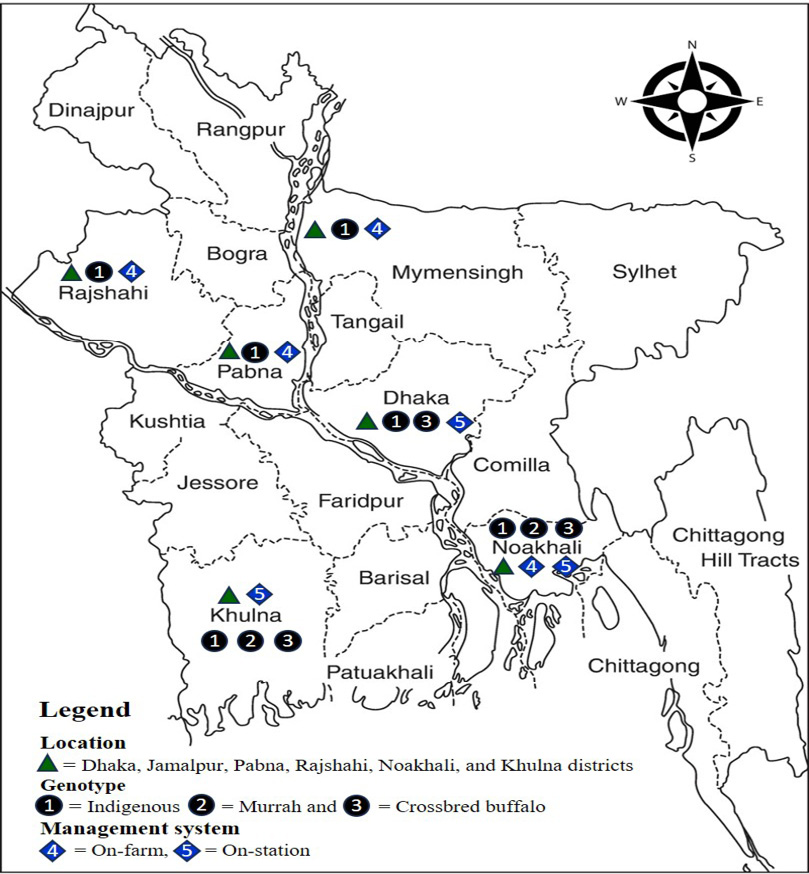
Map showing the location-wise genotypes and management systems of this study.
Data collection
Necessary data collection for the purposes of the study was conducted over 18 months, from January 2024 to June 2025.
Management system
The buffaloes were housed in a loose housing system under farmer management, where a small shed is usually set up for sheltering animals at night while they graze on the riverbanks during the day. Only small amounts of concentrates are offered to the milking buffaloes to meet their lactational needs. In addition, the government and institutional farms reared buffaloes under a semi-intensive management system where conventional rations were provided to them based on their physiological demands.
Morphological and morphometric parameters
The morphometric parameters were measured using a measuring tape and recorded. Age of the selected animals ranged between 4 and 9 years (1st to 4th parity). The parameters included horn length and shape, heart girth (HG), body length (BL), wither height (WH), and rump height (RH). Mature body weights (MBW) were estimated using Schaeffer’s formula ; .

Where, HG= Heart girth, DBL= Diagonal body length.
The coat color of the animals was visually identified by the same data collector for all the samples used in the study and was recorded for further analysis.
The length of the horns (HL) was measured by following the Safari Club International (SCI) method as cited by Gandy and Reilly (2004). The combined lengths of both horns, starting from the tip of one horn to the tip of the other across the forehead. The measuring tape is placed at the tip one horn. Then, following the hair-like grain of the horn around its outer curve to its lowest point, the tape is pivoted along the underside of the horn up to the forward edge of the forehead and a measurement is taken. Now from the forward edge of the forehead and bridging the gap in between the two horn bases, the previous steps are repeated. It is to be noted that the tape is to be kept in constant contact with the horn and the line must cross the grain of the horn, not run parallel to it. The length of both horns were taken and then averaged to form the resultant horn length.
The shape of the horns was observed and recorded based on their types. The types of horns observed were coiled, backwardly curved, straight downward and semi-curved.
Productive and reproductive traits
Herdbook-based record keeping was performed to collect data on productive and reproductive traits. Periodic visits to either farmers’ or institutional herds ensured the collection of objective data. Test-day milk recording was practiced according to ICAR guidelines in order to calculate the daily milk yield. For peak milk yield, the highest amount of milk yielded by the buffalo within the first 100 days of its calving was recorded, and the mean was calculated for the study. The productive and reproductive traits considered in this study were age at first heat (AFH), average daily milk yield (DMY), peak milk yield (PMY), lactation length (LL), and calving interval (CI).
The milk composition parameters included fat (%), protein (%), and SNF (%). A portable Lactoscan milk analyzer (Milkotronic Ltd., Nova Zagora, Bulgaria) was used for this purpose. The device was set to buffalo mode to perform tests for buffalo milk, and no calibration was necessary from the user’s side because the machine came with a built-in standard for buffalo milk. Testing was done based on the manufacturer’s instructions. Two repeat tests were performed for each sample to ensure accuracy, and an average value was recorded for further analysis. All measurements were taken both during the morning and the evening and then rounded up into a daily average.
Statistical analysis
The data from the experimental record book were computed in Excel, and outliers were removed to fit the data to a normal distribution. The Standard deviation was multiplied by 2 and added and subtracted from the mean to identify the upper and lower limits respectively. Any values beyond those upper and lower limits were considered outliers and were promptly removed from the dataset. The data were analyzed using the agricolae package (Version 1.3-5) in the R platform (version 4.5.2) to compute descriptive statistics and ANOVA with a completely randomized design . Tests of significance among the means was performed using the pastecs package (Version 1.4.2) in R . The following model was used.

Yijklm= the dependent variable (traits), µ= the overall mean, Gi= the fixed effect of the ith genotype (1, 2, 3), Lj= the fixed effect of the jth location (1, 2, 3, 4), Mk= the fixed effect of the kth management (1, 2), eijklm= the random residual error.
RESULTS AND DISCUSSION
River buffalo is one of the two types of domestic water buffalo predominantly found in the southern coastal regions and major river basins of Bangladesh, except northeastern marshlands, which are the only habitats of the swamp buffalo. River buffaloes are especially important for milk and meat production in Bangladesh. Here, data were collected on physical features and productive and reproductive traits from Indigenous, Murrah, and Crossbred buffaloes to characterize them and quantify their genetic potential under two different production environments.
Morphology and morphometric features
Qualitative traits
The distribution of coat color and horn pattern in river-type buffaloes of Bangladesh is presented in Table 2. Black coat color was predominant in both Indigenous and Murrah buffaloes (100%), but variations in coat color were mainly found in Crossbred buffaloes; the majority of them were black (55.96%), followed by grey (33.95%) and rusty brown (10.09%). Similar to our findings, Siddiquee et al. (2010) and Yeasmin et al. (2016) reported that most of the Indigenous River buffaloes’ coat colors were black, although some variations were also observed. However, Rahman et al. (2015) reported that buffaloes in Sylhet district of Bangladesh were predominantly light to dark grey in color (92.50%). Genotype difference might be the major contributing factor for the variation between the present and previous studies. The horn pattern showed marked diversity among the river-type buffaloes. Coiled horns were predominant in both Indigenous (59.41%) and Murrah (100%) buffaloes, except in the Crossbred population (3.28%). In Crossbred buffaloes, almost half of the buffaloes had a semi-curved horn pattern (47.54%). Furthermore, a wide range of horn patterns, such as backwardly curved, downward straight, and backwardly straight, were also observed in the Indigenous and Crossbred populations. According to Sohel and Amin (2015), the horn pattern of buffaloes from the southeast coastal areas
Table 2: Distribution of coat color and horn pattern in river type buffalo of Bangladesh.
| Trait | Variations | Buffalo population | ||
| Indigenous | Murrah | Crossbred | ||
| Coat color | Black | 100% | 100% | 55.96% |
| Grey | 33.95% | |||
| Rusty Brown | 10.09% | |||
| Horn pattern | Coiled | 59.41% | 100% | 3.28% |
| Backwardly curved | 33.66% | 21.31% | ||
| Downward straight | 2.97% | 1.64% | ||
| Backwardly straight | 1.98% | 0% | ||
| Semi curved | 1.98% | 47.54% | ||
| Short and backwardly curved | 26.23% | |||
of Bangladesh was generally coiled in shape. This relates to our findings as a considerable number of our animals were from the southern coastal region. The findings are in accordance with Siddiquee et al. (2010), who stated that the majority of the buffaloes had coiled horns in Mymensingh and Noakhali districts of Bangladesh. Except for coiled horns, a wide range of horn patterns were found in Indigenous and Crossbred buffaloes, which were quite similar to those of Dar et al. (2018). The horn pattern is mostly breed- or population-specific, and differences among individuals of a population or between populations attributed to the genotypes of the animals.
Quantitative traits
Table 3 represents some morphometric features of the three riverine buffalo populations. The highest average HL (39.28±1.53 cm) was found in Indigenous buffaloes, while it was observed as 35.47±1.30 cm and 35.52±1.26 cm in Murrah and Crossbred populations, respectively. The comparatively greater HL observed in case of Indigenous buffaloes may simply reflect the natural breed variation and adaptaion as horn traits in this population have not been subject to any selection program. The average HG and MBW exhibited non-significant differences (P>0.05) between Murrah and Crossbred buffaloes; however, both parameters showed significant differences (P<0.05) when compared with Indigenous buffalo. The highest values of WH (134.69±1.57 cm) and RH (129.39±1.22 cm) were also recorded in Murrah buffaloes; intermediate values was observed in Crossbreds (132.31±0.61 and 115.32±1.05 cm, respectively), and the lowest values were found in Indigenous riverine buffaloes (115.00±2.27 and 104.64±1.33, respectively). However, there was no significant difference in body length among all three genotypes. The relative morphometric comparison indicated the superior physical conformation of the Murrah breed, characterized by broader heart girth, greater wither and rump height, and overall mature body weight. Rezende et al. (2017) observed higher body weight and thoracic perimeter in Murrah buffaloes than those in the present study, which were 527.50 kg and 204.36 cm, respectively. Similarly, Dhillod et al. (2017) found an average MBW of 556.11±11 kg for Indian Murrah. The other parameters observed for the Murrah breed are in accordance with the findings of Rezende et al. (2017) and Dhillod et al. (2017). Our results were similar to the findings of Rahman et al. (2015), who reported that MBW, HG, and WH of adult Indigenous buffaloes in the Sylhet district of Bangladesh ranged from 426.68 to 447.83 kg, 192.06 to 196.50 cm, and 112.85 to 118.20 cm, respectively. The study also exhibited similarities in horn length with the findings reported by Tariq et al. (2013) for Nili-Ravi buffaloes. Sohel and Amin (2015) stated that the horns of Murrah buffaloes are generally short and coiled, which supports the current results. According to Khan et al. (2023), the horn length of Azikheli buffaloes was similar to that in our study, whereas the length observed by Rahman et al. (2015) was higher compared with the observed population. The differences in observed results might be associated with genetics, management, and other environmental factors ; . Furthermore, the Murrah and Crossbred populations showed physical similarities, demonstrating a significant divergence from the Indigenous buffalo population of Bangladesh. The remnants of some South Asian breeds, such as Murrah, Nili-Ravi, Jafrabadi, and Monipuri, also exist in Indigenous and Crossbred buffaloes of Bangladesh, which might have contributed to morphometric differentiation in the buffalo populations of Bangladesh ; .
Productive and reproductive performances
Across river buffalo genotypes
The average DMY, PMY, and LL were significantly higher (P <0.001) in Murrah buffaloes (3.80±0.22 L, 4.76±0.23 L and 412.50±35.26 d, respectively) than those of Indigenous (3.03±0.07 L, 3.83±0.07 L and 295.00±6.76 d, respectively) and Crossbred (2.90±0.07 L, 3.85±0.11 L and 312.06±8.49 d, respectively) buffalo populations (Table 4). This superiority reflects improved genetics and selective breeding practiced for milk yield in Murrah. Although the yield of Murrah buffaloes remained considerably lower than values reported internationally , they represent higher values than several previously reported Bangladeshi estimates ; ; . Another study carried out by Sigdel et al. (2015), estimated an intermediate DMY (4.55±0.09 kg) for an institutional herd in Nepal. The shortfall relative to international values might be attributed to lack of structured performance recording or selection programs in Bangladesh and the depressive effects of tropical heat stress on milk synthesis even under improved management systems, rather than management alone. However, no significant differences were observed between Indigenous and Crossbred buffaloes in these three productive traits. Crossbred found in field conditions across Bangladesh represent a group covering Indigenous x Improved breeds (Murrah, Nili-Ravi, Surti). The graded levels are not a fixed 50:50 ratio, rather varying grading level due to uncontrolled and undocumented crossing. Grouping such diverse categories under one genotype likely dilutes any hybrid vigor present in individual crosses. The present study therefore provides a raw insight into the farmers crossbreeding patterns. Harun-Or-Rashid et al. (2019) eported LL values of 230.56±34.78, 250.88±18.81, and 246.51±27.39 days in Indigenous, Murrah, and Crossbred buffaloes,
Table 3: Morphometric features of three riverine buffalo populations of Bangladesh
| Trait | Genotype (LSM±SE) | Level of Significance1 | ||
| Indigenous | Murrah | Crossbred | ||
| Horn length (cm) | 39.28a±1.53 (72) | 35.47b±1.30 (36) | 35.52b±1.26 (87) | * |
| Heart girth (cm) | 180.72b±0.91 (72) | 191.86a±1.52 (36) | 191.78a±1.11 (88) | *** |
| Body length (cm) | 142.99±0.58 (72) | 144.61±1.61 (36) | 141.42±1.02 (88) | NS |
| Wither height (cm) | 115.00b±2.20 (72) | 134.69a±1.57 (36) | 132.31b±0.61 (88) | *** |
| Rump height (cm) | 104.64c±1.33 (72) | 129.39a±1.22 (36) | 115.32b±1.05 (88) | *** |
| Mature weight (kg) | 423.10b±4.87 (72) | 482.92a±10.10 (36) | 472.83a±7.55 (89) | *** |
1Different superscripts in each row different significantly at *P<0.05, **P<0.01 and ***P<0.001
Table 4: Productive and reproductive performances of river buffalo population of Bangladesh
| Trait1 | Genotype (LSM±SE)2 | Level of significance3 | ||
| Indigenous | Murrah | Crossbred | ||
| AFH (month) | 34.56±1.12 (59) | 36.00±1.02 (20) | 37.72±1.55 (50) | NS |
| DMY (liter) | 3.03b±0.07 (97) | 3.80a±0.22 (33) | 2.90b±0.07 (109) | *** |
| PMY (liter) | 3.83b±0.07 (78) | 4.76a±0.23 (20) | 3.85b±0.11 (104) | * |
| LL (day) | 295.00b±6.76 (25) | 412.50a±35.26 (33) | 312.06b±8.49 (47) | *** |
| Fat (%) | 9.04a±0.18 (75) | 7.91b±0.53 (18) | 7.75b±0.18 (61) | *** |
| Protein (%) | 4.06±0.47 (75) | 3.58±0.12 (18) | 3.55±0.04 (61) | NS |
| SNF (%) | 9.30c±0.14 (75) | 9.83a±0.34 (18) | 9.62b±0.10 (63) | * |
| CI (day) | 410.68b±19.69 (34) | 451.50b±101.50 (12) | 574.85a±28.60 (55) | *** |
1AFH, Age at first heat: DMY, Dairy milk yield; PMY, Peak milk yield; LL, Lactation length; SNF, Solids-not-fat and CI, Calving Interval. 2Values in the parentheses represent the number of observations in each category. 3Different superscripts in each row differ significantly at * = P < 0.05; **= P < 0.01 and *** = P < 0.001.
respectively, which are inconsistent with the present study. The longer LL observed in the current study may reflect differences in management intensity and lactation persistency between populations. Comparatively better nutritional management at the institutional farms sampled here, particularly for Murrah, likely supported longer lactation persistency. The fat (%) was significantly higher in Indigenous buffaloes (9.04±0.18) than in Murrah (7.91±0.53) and Crossbred buffaloes (7.75±0.18). The comparatively large standard error observed in Murrah suggests a greater within group variability likely due to differences in individual nutrition and lactation stage among the smaller Murrah subsample group. In contrast, the highest SNF% was recorded in Murrah buffaloes (9.83±0.34), whereas the lowest value was measured in the Indigenous population (9.30±0.10). For Protein (%), Indigenous buffalo recorded numerically highest values (4.06±0.47) compared to Murrah (3.58±0.12) and Crossbred (3.55±0.4). Although the difference was not statistically significant, likely due to a higher within-group variability in Indigenous protein % (SE=0.47) than in Murrah and Crossbred. Gunathilake et al. (2024) stated that milk composition and quality characteristics largely depend on the breed. Furthermore, they added that globally reported SNF contents ranged from 8.8% to 11.7%, depending on the breed and our current findings (9.30±0.14% to 9.83±0.34%) mirror this range. Abdel-Hamid et al. (2023) reported similar milk fat content (7.17±1.7%) in Chinese Murrah buffaloes; however, the protein (4.91±0.2%) and SNF contents (10.34±0.2%) were higher than those observed in the present study. The discrepancies could be due to the impact of seasonal variations. It is to be noted that differences in genetic merit alongside the differences in management intensity might also contribute to the overall discrepancies observed in the study. Also, Chinese Murrah populations are kept intensively within a better nutritionally controlled system as compared with the buffaloes sampled for the study. Moreover, Rahman et al. (2019a) discussed the proximate components of buffalo milk, including fat (%), protein (%) and SNF (%) (6.86±0.65% to 8.62±0.97%; 3.86±0.22% to 4.32±0.35% and 9.42±0.70% to 9.49±0.29%, respectively), which are in accordance with our study.
For Indigenous, Murrah, and Crossbred genotypes, the average calving interval (CI) was 410.68±19.69, 451.50±50, and 574.85±28.60 days, respectively (Table 4). The extended calving interval observed in Crossbred buffaloes is may be due to silent heat and poor management. Buffaloes are notorious for silent heat, moreover most Crossbred buffaloes are raised under loose housing systems, which makes it even harder to detect heat. Additionally, they have comparatively lower adaptability than indigenous buffaloes, which further contributes to the problem. Omar et al. (2024) reported a higher mean CI of 453.04 days in Indigenous buffaloes. On the other hand, Sanker et al. (2014) found a slightly lower CI of 424.32±2.60 days in Indian Murrah buffaloes. The CI documented by previous studies was higher among different genotypes than compared than that observed in the present research ; . No significant difference was observed in the case of AFH between Indigenous (34.56±1.12), Murrah (36.00±1.02) and Crossbred (37.72±1.55) buffaloes. Despite that, the approximate 3 months gap holds practical significance, as delayed puberty extends generation interval as well as rearing costs. The present study is in line with the findings of Harun-Or-Rashid et al. (2019), who reported AFH ranges between 34 and 37 months, whereas Amin et al. (2015) found a delayed AFH compared to the present study. Puberty is affected by multiple factors, such as genetics, nutrition level, climate, and husbandry practices ; .
Influence of non-genetic factors
Locations had highly significant effects on all investigated productive and reproductive traits (P<0.001) except protein percentage (Table 5). The PRB buffaloes attained puberty (29.73±0.29 months) earlier (P<0.001) compared with JRB (33.62±0.40 months), SCR (41.06±2.05 months), and CER (43.00±3.42 months) buffalo populations. While studying buffaloes across five regions in the Bhola district of Bangladesh, Jahan et al. (2024) found an AFH ranging from 3.0±0.65 to 3.4±0.25 years (≈36 to 41 months) that aligns with the current findings (33.62±0.40 to 43.00±3.42 months). Similarly, Uddin et al. (2016) reported an AFH of between 37 and 38 months under household farming in riverine districts and in the coastal bathan system. Our study demonstrated that alongside locations, management systems also had significant (P<0.001) effects on reproductive performance, particularly for AFH (Table 5). The farmer-managed (on-farm) buffaloes attained puberty substantially earlier (32.54±0.51 months) than those in the on-station management system (45.39±2.86 months). While comparing different management systems, Chanda et al. (2021) discussed that the average AFH of Crossbred buffaloes in small-scale and commercial farms that were 3.04 ± 0.04 and 1.96 ± 0.19 years, respectively. Whereas, the current study found a similar age at first heat (32.54±0.51 months) under on-farm management, although this was substantially higher in the cases of on-station buffaloes (45.39±2.86 months). The delayed AFH under on-station management and in the SCR/CER regions where a large proportion of data were pooled from institutional herds (Figure 1), likely reflects genuine management constraints rather than a location effect itself. Confined animals lack free movement and may experience added stress compared to farmer-managed grazing systems. Similarly, standardized
Table 5: Effects of different non-genetic factors on the productive and reproductive traits of the river-type buffaloes of Bangladesh.
| Trait1 | Location2 | Sig. level | Management system3 | Sig. level4 | ||||
| JRB | PRB | SCR | CER | 1 | 2 | |||
| AFH (month) | 33.62a±0.40 (29) | 29.73b±0.29 (33) | 41.06a±2.05 (34) | 43.00a±3.42 (15) | *** | 45.39a±2.86 (28) |
32.54b±0.51 (83) |
*** |
| DMY (liter) | 3.26a±0.08 (29) | 3.07a±0.06 (70) | 3.28a±0.10 (143) | 1.97b±0.19 (17) | *** | 3.10±0.11 (138) |
3.16±0.05 (121) |
NS |
| PMY (liter) | 4.45a±0.09 (29) | 4.02a±0.02 (68) | 4.14a±0.16 (120) | 2.84b±0.28 (17) | *** | 4.03±0.12 (138) |
4.08±0.03 (96) |
* |
| LL (day) | 276.93b±1.90 (27) | 288.77b±6.37 (42) | 369.68a±12.65 (52) | 310.00ab±12.0 (12) | *** | 365.26±12.11 (47) | 282.24±3.13 (86) |
NS |
| Fat (%) | 7.11c ±0.20 (29) | 9.49a±0.17 (56) | 8.62b±0.23 (50) | 6.45c±0.17 (19) | *** | 7.87±0.22 (60) |
8.74±0.17 (94) |
NS |
| Protein (%) | 3.60±0.04 (29) |
3.94±0.63 (56) |
3.81±0.10 (50) |
3.70±0.04 (19) |
NS | 3.55±0.05 (60) |
3.96±0.38 (94) |
NS |
| SNF (%) | 10.19a±0.08 (29) | 9.12b±0.17 (56) | 9.29b±0.14 (50) | 10.02a±0.06 (19) | *** | 9.54±0.13 (60) |
9.46±0.11 (94) |
NS |
1AFH, age at first heat; DMY, dairy milk yield; PMY, peak milk yield; LL, lactation length and SNF, solids-not-fat. 2Jamuna river basin (JRB); Padma river basin (PRB); Southern coastal region (SCR), and central region (CER). 31, On-station management and 2, On-farm management system. 4Different superscripts in each row differ significantly at * = P < 0.05; **= P < 0.01 and *** = P < 0.001.
institutional breeding protocols, where animals are bred only after reaching a fixed minimum age rather than at first observed heat, likely contribute to the pattern. This suggests that implementing individualized, weight-based breeding decisions would be more beneficial for institutional herds than age-based scheduling. Suboptimal management, stress, and nutritional imbalances might contribute to delayed puberty .
The average DMY did not vary significantly across locations except CER, where the lowest production was found (1.97±0.19 L). Furthermore, despite similar genotypes, the longest LL was observed in the buffaloes of SCR (369.68±12.65 days) while the lowest LL (276.93±1.90 days) was found in JRB buffaloes. This variation could be due to calving and dry-period management rather than genetics. A balanced diet based on their maintenance, production and nutritional needs is necessary at all levels to help them reach their genetic zenith. The findings of Karim et al. (2013) were consistent with our study, which showed that buffaloes in the southern coastal districts (Pirojpur and Borguna districts) had an average DMY of 3.33±0.68 L and 3.43±0.744 L, respectively, and a lactation period lasting 286.12±11.27 days and 290.44±10.92 days, respectively. Bindu et al. (2025) reported that DMY of buffaloes reared under intensive and semi– intensive systems was 4.48 L and 2.84 L; our findings fall within this range (Table 5). On the other hand, when investigating different intensive and semi-intensive management systems, Rahman et al. (2019a), Khaton et al. (2020) and Habib et al. (2023) found shorter lactation lengths (179 to 217 days) than the current findings. The effects of management practices also showed significant differences for PMY (Table 5). Omar et al. (2024) reported different geographical locations affecting PMY ranging between 2.85 and 4.32 kg, which is in accordance with our study (2.84±0.28 to 4.45±0.09 kg). However, the PMY observed in the present study in different management systems is higher than the value reported for semi-intensively managed buffaloes in an earlier study by Faruque et al. (2019). Non– genetic factors such as parity, calving year, lactation length, and season of calving interaction also affect PMY .
Although buffalo milk composition traits, including fat%, protein%, and SNF%, did not show notable variations under different management systems, they varied significantly among the different locations for fat% and SNF%. The fat (%) was significantly higher in PRB buffaloes (9.49±0.17), whereas the value was lower in CER buffaloes. The buffaloes of JRB exhibited the highest SNF (%) among all the locations (10.19±0.08%). Buffalo milk fat%, protein% and SNF% in this study ranged from 6.45±0.17% to 9.49±0.17%, 3.60±0.04% to 3.94±0.63% and 9.12±0.17% to 10.19±0.08%, respectively (Table 5) across the sampled locations. Rahman et al. (2019b) reported that fat, protein and SNF% in buffaloes of coastal areas, river basin and semi– arid locations were 6.55±1.53 to 7.55±1.10, 3.64 ±0.41 to 4.12±0.37 and 8.30±0.54 to 9.43±0.32%, respectively, which are slightly lower than our observed values. However, they observed significant differences in fat and protein content between intensive and extensive management practices which partially agree with the present findings. Furthermore, Bindu et al. (2025) found that fat (%) varied significantly in buffaloes reared under intensive and semi– intensive systems. Besides genetics, differences in food and nutritional requirements, climatic conditions, randomly selected samples, and husbandry practices can explain the variations present in earlier and present studies ; ; . Overall, riverine buffaloes with grazing access, such as PRB buffaloes, performed better, supporting grazing access at lower– performing farms. Regarding non-genetic management, better housing, strict disease control protocols, and heat mitigation strategies, including wallowing facilities, are also essential to allow buffaloes to express their full production potential. Furthermore, national breeding policies must be established to prevent the indiscriminate crossbreeding of native stock and preserve the genetic integrity of Bangladeshi buffalo populations.
Limitations
Primary limitations include an unequal number of animals among the three classes considered for the purpose of the study mainly due to a smaller presence of the three breeds of animal within the considered geographical positions. Small number of data available for certain traits like age, calving interval, age at first heat etc. made it hard to incorporate into the analysis. However, a Cohen’s d test and Hedge’s g sensitivity analysis were done to justify the validity of the analyzed data. The statistical model was not reinforced with certain parameters like age, parity and season of calving due to insufficient data availability. Misclassification of genotypes, especially among the crossbred animals, remains possible due to no admixture analysis being considered for the purpose of the study. The crossbred group is also genetically heterogeneous, encompassing varying and undocumented grading levels rather than a single defined cross. The effects due to season were not considered into the statistical model’s designing. Farmers’ recall bias is also a possibility for parameters like age and reproductive events.
CONCLUSION
This study demonstrated that genotype and geographical regions significantly influence the morphometric, productive, and reproductive performance of riverine buffaloes in Bangladesh. Murrah buffaloes exhibited superior results in overall milk yield and quality, whereas Indigenous buffaloes recorded higher fat content. Geographically, Padma River Basin populations outperformed other populations for most production traits. The findings provide insightful information on genetic and non– genetic factors that may contribute to the production and reproduction of riverine buffalo populations of Bangladesh. This information will help design future breeding practices and conservation strategies. Given the superior productive performance found in this study, Murrah supports continued use for higher milk production. On the other hand, as Indigenous genetic diversity is associated with high milk fat, heat tolerance and disease resistance, it needs to be prioritized for conservation as a resource. Rather than continuing unrestricted, undocumented crossbreeding, we recommend a structured, pedigree or DNA-verified selective and controlled breeding, and crossbreeding program with defined generational targets (F1, F2). This in turn will help transmit improved production traits while ensuring the preservation of Indigenous genetic resources, balancing production and conservation alongside.
ACKNOWLEDGEMENT
The authors gratefully acknowledge the “Buffalo Research and Development Project” (ID No.: 2022/8/BAU/Other), Bangladesh Livestock Research Institute, Ministry of Fisheries and Livestock, Bangladesh, for funding this research. Special thanks to the institutional staff and buffalo farmers for their assistance with data collection.
NOVELTY STATEMENT
Although considerable research exists on buffalo morphology, productivity, reproduction and regional phenotypic variation, no prior study has simultaneously evaluated the morphometric, productive and reproductive characteristics of Indigenous, Murrah and Crossbred buffaloes alongside their management systems and geographical locations within a single framework. The present study addresses this gap by doing a joint evaluation of the morphometric, productive and reproductive parameters of the three major buffalo genotypes (Indigenous, Murrah and Crossbred buffaloes), distributed across four major geographical regions of Bangladesh where there is a considerable presence of riverine buffaloes. This type of genotype and region-based comparison provides a rather broader perspective on the genetic variations and possibilities existing among the buffalo populations in comparison to the studies that have been conducted on individual populations or locations. The study also shows us the differences in management systems that are existing among the farms and households that rear buffaloes and shows us the potential gaps that are to be fulfilled in both the management systems to utilize the complete potential of the buffalo populations existing right now alongside their future development. These findings provide baseline performance and morphological data to guide future breeding and management efforts aimed at improving buffalo productivity and its contribution to Bangladesh’s economy.
AUTHOR’S CONTRIBUTION
KNK, MMHH and MSAB: Conceptualization, study design and planning, and writing the original draft; KNK, MMHH, STM and LKT: Field data collection, acquisition, and analysis; GKD and MAA: Fund acquisition; MSAB and GKD: Reviewing and editing the manuscript. All authors read and approved the final manuscript.
Ethical statement
This study was carried out according to the guidelines of the Animal Experimentation Ethics Committee of Bangladesh Agricultural University (BAU), Mymensingh, Bangladesh. The BAU ethics committee granted prior approval for this study (Approval No. BAURES/ESRC/42/2024).
Generative AI and AI assisted technology statement
The authors declare that no generative AI and AI assisted technology was used in the creation of this manuscript.
Conflict of interest
The authors have declared no conflict of interest.
