
Escherichia coli infection remains a major cause of intestinal inflammation and mucosal barrier dysfunction, while increasing antimicrobial resistance limits the effectiveness of conventional antibiotic therapy. Fucoidan, a sulfated polysaccharide derived from brown seaweed, has attracted considerable interest due to its immunomodulatory, anti-inflammatory, and antimicrobial properties. This systematic review aims to evaluate current evidence regarding the potential of fucoidan-based nanoparticles as intestinal mucosal immunomodulators against Escherichia coli infection. This systematic review was conducted according to the PRISMA 2020 guidelines. Peer-reviewed articles published between 2010 and 2025 were retrieved from PubMed, Scopus, Web of Science, ScienceDirect, SpringerLink, and Google Scholar. Of the 278 records initially identified, 22 studies met the eligibility criteria and were included in the qualitative synthesis. The evidence synthesized from the included studies demonstrates that fucoidan regulates intestinal immune responses by suppressing pro-inflammatory cytokines (TNF-α, IL-6, and IL-1β), enhancing mucosal immune function, improving gut microbiota composition, and reinforcing epithelial barrier integrity through upregulation of tight junction proteins, particularly claudin-1. Nanoformulation enhances fucoidan stability, gastrointestinal bioavailability, controlled release, and targeted delivery to intestinal tissues. In addition, fucoidan nanoparticles reduce E. coli pathogenicity by inhibiting bacterial adhesion and modulating host immune responses rather than exerting direct bactericidal effects. Overall, the available evidence suggests that fucoidan-based nanoparticles represent a promising non-antibiotic, host-directed therapeutic strategy to enhance mucosal immunity and preserve intestinal barrier function against E. coli infection. Nevertheless, further standardized in vivo studies and well-designed clinical trials are required to confirm their therapeutic efficacy and safety.
Research Article · Volume 14, Issue 12, Pages 2802–2809, 10 November 2026 · Open Access
Potential of Fucoidan-Based Nanoparticles as Intestinal Mucosal Immunomodulators Against Escherichia coli Infection: A Systematic Review
· · · · · · · · · · · · · · · · · ·
Affiliations & Notes ⌄
- 1Master’s Program in Vaccinology and Immunotherapeutics, Faculty of Veterinary Medicine, Universitas Airlangga, Surabaya, Indonesia
- 2Department of Anatomy, Histology, and Pharmacology, Faculty of Medicine, Universitas Airlangga, Surabaya, Indonesia
- 3Department of Medical Laboratory Science, Alex Ekwueme Federal University Ndufu-Alike Ikwo, Nigeria
- 4Department of Veterinary Science, Faculty of Veterinary Medicine, Universitas Airlangga, Surabaya, Indonesia
- 5Master’s Program in Veterinary Agribusiness, Faculty of Veterinary Medicine, Universitas Airlangga, Surabaya, Indonesia
- 6Maha Pet Care Animal Clinic, Bandung, Indonesia
- 7Department of Islamic Education, Faculty of Islamic Studies, Nusantara Islamic University, Indonesia
- 8Master’s Program in Reproductive Biology, Faculty of Veterinary Medicine, Universitas Airlangga, Surabaya, Indonesia
- 9State Senior High School 1 Puri, Mojokerto, East Java, Indonesia
- *Correspondence | Agus Widodo; Email: agus.widodo@vokasi.unair.ac.id
Article Info ⌄
- Journal:
- Advances in Animal and Veterinary Sciences
- Submitted Date:
- 12 June 2026
- Accepted Date:
- 26 July 2026
- Published Date:
- 10 November 2026

Abstract
INTRODUCTION
The intestinal mucosal immune system plays a crucial role in maintaining gastrointestinal homeostasis and protecting the host against pathogenic microorganisms . The intestinal mucosa serves as the first line of defense through coordinated interactions among epithelial cells, the mucus layer, gut microbiota, and immune cells . Disruption of this barrier increases susceptibility to enteric bacterial infections, including those caused by Escherichia coli, which remains one of the leading causes of gastrointestinal diseases and intestinal inflammation worldwide. Recent evidence indicates that impairment of intestinal barrier integrity and dysregulated mucosal immune responses facilitate bacterial colonization, pathogen invasion, and chronic intestinal inflammation, highlighting the importance of strategies that enhance mucosal immune function .
Fucoidan, a sulfated polysaccharide primarily extracted from brown seaweeds, has attracted considerable attention due to its diverse biological activities, including anti-inflammatory, antioxidant, antimicrobial, antiviral, and immunomodulatory properties . Its biological activities are largely attributed to its sulfate groups and fucose-rich structure, which enable interactions with immune cells and signaling pathways involved in inflammatory regulation . Recent studies have demonstrated that fucoidan can regulate cytokine production, maintain intestinal barrier integrity, modulate gut microbiota composition, and enhance mucosal immune responses, thereby contributing to gastrointestinal health and protection against intestinal pathogens . Consequently, fucoidan has emerged as a promising natural biomaterial for pharmaceutical and nutraceutical applications .
Despite these beneficial properties, the clinical application of native fucoidan remains limited because of its poor gastrointestinal stability, low bioavailability, rapid degradation, and insufficient site-specific delivery, which reduce its therapeutic efficacy against enteric pathogens such as Escherichia coli. Nanotechnology-based delivery systems have been developed to overcome these limitations by improving the physicochemical stability, intestinal absorption, controlled release, and targeted delivery of bioactive compounds . Among these approaches, fucoidan nanoparticles have demonstrated superior performance due to their biocompatibility, biodegradability, enhanced interaction with intestinal mucosal tissues, and ability to provide sustained drug release . Recent studies further suggest that fucoidan-based nanoparticles possess considerable potential for drug delivery, immune modulation, and the treatment of intestinal diseases ; .
Infections caused by pathogenic Escherichia coli continue to represent a major public health challenge because they are associated with diarrhea, intestinal inflammation, epithelial damage, and the increasing prevalence of antimicrobial resistance . Conventional antibiotic therapy is becoming less effective due to the rapid emergence of multidrug-resistant strains, creating an urgent need for alternative therapeutic strategies that are both safe and effective . Natural polysaccharide-based nanoparticles have therefore gained increasing interest as immunomodulatory agents capable of enhancing host defense while minimizing inflammatory injury. Fucoidan nanoparticles are particularly promising because they may simultaneously inhibit pathogen colonization, regulate immune responses, preserve intestinal barrier function, and restore gut microbial homeostasis .
Although numerous studies have separately reported the immunomodulatory properties of fucoidan and the advantages of nanoparticle-based delivery systems, a comprehensive review specifically focusing on the role of fucoidan nanoparticles in enhancing intestinal mucosal immunity against Escherichia coli infection remains limited. This knowledge gap highlights the need to integrate current evidence on the mechanisms, therapeutic potential, and future prospects of fucoidan nanoparticles for the prevention and management of enteric bacterial infections.
Therefore, this review aims to comprehensively summarize current evidence regarding the potential of fucoidan-based nanoparticles as intestinal mucosal immunomodulators against Escherichia coli infection. Specifically, this review discusses the biological characteristics of fucoidan, recent advances in fucoidan nanoparticle delivery systems, mechanisms underlying intestinal mucosal immune modulation, and their prospective applications in preventing and managing Escherichia coli-associated gastrointestinal infections.
Unlike previous reviews that have discussed the biological activities of fucoidan or the pharmaceutical applications of fucoidan-based nanomaterials independently, the present systematic review specifically integrates current evidence regarding the use of fucoidan nanoparticles as host-directed immunomodulators against Escherichia coli-induced intestinal disease. This review not only summarizes the biological mechanisms underlying intestinal barrier protection, mucosal immune regulation, microbiota modulation, and bacterial adhesion inhibition, but also critically evaluates how nanoparticle-based delivery systems enhance the therapeutic performance of fucoidan. Furthermore, by identifying current limitations and future research priorities, this review provides a translational framework for developing non-antibiotic therapeutic strategies to combat enteric infections and antimicrobial resistance.
Materials and Methods
This systematic review was conducted following the Preferred Reporting Items for Systematic Reviews and Meta-Analyses (PRISMA 2020) guidelines . The review aimed to systematically identify, evaluate, and synthesize available evidence regarding the potential of fucoidan nanoparticles as intestinal mucosal immunomodulators against Escherichia coli infection. The review protocol was developed based on the PRISMA 2020 framework to ensure transparency and reproducibility throughout the study selection and reporting process.
Eligibility criteria
The eligibility criteria were established using the Population–Concept–Context (PCC) framework. The population included intestinal epithelial systems, gastrointestinal immune components, and experimental or clinical models associated with Escherichia coli infection or intestinal inflammation. The concept focused on fucoidan and fucoidan-based nanoparticles with immunomodulatory, antimicrobial, anti-inflammatory, microbiota-modulating, or intestinal barrier-protective properties. The context comprised intestinal mucosal immunity, gut barrier integrity, host–microbiota interactions, and host-directed therapeutic strategies.
Peer-reviewed articles published in English between 2010 and 2025 were included. Eligible publications consisted of in vitro studies, in vivo studies, and review articles addressing the biological mechanisms or therapeutic applications of fucoidan nanoparticles. Editorials, conference abstracts, book chapters, non-peer-reviewed publications, and studies unrelated to the review objectives were excluded.
Information sources and search strategy
A comprehensive literature search was conducted in PubMed/MEDLINE, Scopus, Web of Science, ScienceDirect, SpringerLink, and Google Scholar. Searches covered publications from January 2010 to December 2025. The search strategy combined Medical Subject Headings (MeSH), where applicable, and free-text keywords using Boolean operators (AND, OR). The principal search terms included fucoidan, nanoparticle, intestinal mucosa, mucosal immunity, gut barrier, microbiota and Escherichia coli infection. Additional relevant studies were identified through manual screening of reference lists of eligible articles.
Study selection
All retrieved records were imported into a reference management software, and duplicate records were removed. Titles and abstracts were screened independently according to the predefined eligibility criteria, followed by full-text assessment of potentially relevant studies. A total of 278 articles were identified through database searching. After duplicate removal and eligibility assessment, 22 studies fulfilled the inclusion criteria and were included in the qualitative synthesis. The study selection process was conducted according to the PRISMA (2020) flow diagram (Figure 1).
Data extraction
Data were extracted using a standardized form that included publication year, study design, fucoidan source, nanoparticle formulation, experimental model, and major biological outcomes. Outcomes of interest included intestinal barrier integrity, cytokine modulation, immune responses, gut microbiota alterations, antimicrobial activity against Escherichia coli, and other mechanisms related to intestinal mucosal immunity.
Quality assessment
The methodological quality of the included studies was evaluated according to study design. Experimental studies were assessed for methodological clarity, appropriate controls, reproducibility, and biological relevance, whereas review articles were evaluated based on the comprehensiveness of the literature search, methodological rigor, and quality of evidence synthesis. Studies with limited methodological information were interpreted cautiously during data synthesis.
Data synthesis
Because of substantial heterogeneity in study designs, fucoidan sources, nanoparticle formulations, experimental models, and reported outcomes, a meta-analysis was not performed. Instead, findings were synthesized narratively and organized into thematic categories, including the biological activities of fucoidan, nanoparticle-based delivery systems, intestinal barrier protection, mucosal immune modulation, gut microbiota regulation, anti-inflammatory effects, and antimicrobial activity against Escherichia coli.
STUDY CHARACTERISTICS
Study selection and characteristics
A total of 278 records were identified through database searching in PubMed/MEDLINE, Scopus, Web of Science, ScienceDirect, SpringerLink, and Google Scholar. After duplicate removal and title/abstract screening, potentially eligible articles underwent full-text assessment. Based on the predefined inclusion and exclusion criteria, 22 studies published between 2010 and 2025 were included in the final qualitative synthesis (Figure 1). The included studies comprised in vitro studies, in vivo studies, and review articles investigating the biological activities of fucoidan and the therapeutic potential of fucoidan-based nanoparticles in intestinal health and Escherichia coli infection. The studies were synthesized into six thematic categories: (1) fucoidan bioactivity, (2) intestinal barrier protection, (3) mucosal immune modulation, (4) gut microbiota regulation, (5) antibacterial activity against Escherichia coli, and (6) fucoidan-based nanoparticle delivery systems.
Summary of fucoidan bioactivity findings
Across the included studies, fucoidan was consistently reported to exhibit immunomodulatory and anti-inflammatory activities within the gastrointestinal tract. The reviewed evidence indicates that fucoidan regulates pro-inflammatory cytokines (TNF-α, IL-6, and IL-1β), enhances intestinal immune responses, and contributes to the maintenance of mucosal immune homeostasis. Several studies further reported that fucoidan improves intestinal barrier integrity by increasing the expression of tight junction proteins, reducing intestinal permeability, and limiting pathogen translocation. In addition, fucoidan was associated with beneficial modulation of the gut microbiota and maintenance of intestinal homeostasis.
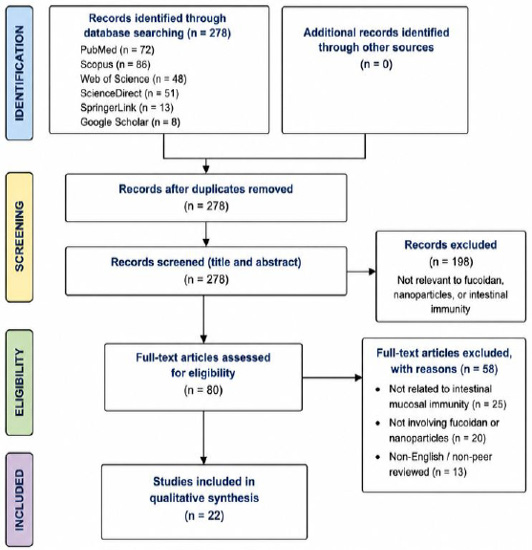
PRISMA 2020 flow diagram of the study selection process.
Immunomodulatory effects
The included studies suggest that fucoidan supports intestinal immune defense through enhanced secretory IgA production, improved antigen sampling in Peyer’s patches, and modulation of mucosal immune signaling pathways. Collectively, these findings indicate that fucoidan contributes to the regulation of both innate and adaptive mucosal immune responses.
Intestinal barrier protection
Several studies consistently reported that Escherichia coli infection disrupts epithelial integrity, induces excessive inflammatory responses, and impairs intestinal barrier function. Evidence synthesized from the included studies indicates that fucoidan helps preserve epithelial integrity by reducing intestinal permeability, enhancing tight junction protein expression, and limiting bacterial translocation.
Gut microbiota modulation
The reviewed studies consistently demonstrated that fucoidan promotes a favorable gut microbiota composition and contributes to intestinal homeostasis. These microbiota-modulating effects are considered to support intestinal immune regulation and reinforce barrier function.
Nanoparticle delivery systems
The included studies consistently demonstrated that fucoidan-based nanoparticle delivery systems improve gastrointestinal stability, controlled release, and intestinal bioavailability compared with native fucoidan. Furthermore, these formulations were reported to enhance targeted delivery to intestinal mucosal tissues, thereby increasing the therapeutic potential of fucoidan for intestinal inflammatory diseases and Escherichia coli infection. A summary of the characteristics and principal findings of the included studies is presented in Table 1.
Table 1: Summary of the 22 included studies in the review.
| No | Authors and year | Title / Focus | Journal | Domain | Core pillars informed |
| 1 | Li et al., 2024 | Fucoidan modulates gut microbiota and immunity in Peyer’s patches against inflammatory bowel disease | Carbohydrate Polymers | Fucoidan immunomodulation | Immunomodulation, microbiota |
| 2 | Barbosa et al., 2019 | Application of pH-Responsive Fucoidan/Chitosan Nanoparticles to Improve Oral Drug Delivery | Molecules | Nanoparticle delivery system | Nanodelivery, GI stability |
| 3 | Yu et al., 2015 | Fucoidan-shelled chitosan beads for antibacterial application | Carbohydrate Polymers | Antibacterial nanoparticles | Antibacterial, Escherichia coli inhibition |
| 4 | Habibi et al., 2024 | Prebiotic and antibacterial activities of fucoidan | International Journal of Biological Macromolecules | Gut microbiota modulation | Prebiotic, antimicrobial |
| 5 | Iraha et al., 2013 | Fucoidan enhances intestinal barrier via claudin-1 | World Journal of Gastroenterology | Intestinal barrier | Tight junction, epithelial protection |
| 6 | Cox et al., 2020 | Fucoidan supplementation restores fecal lysozyme | Marine Drugs | Mucosal immunity | Immune biomarkers, mucosa |
| 7 | Yang & Lim, 2021 | Fucoidans and bowel health | Marine Drugs | Gut health review | Microbiota, inflammation |
| 8 | Zhang et al., 2025 | Fucoidan in ulcerative colitis mechanisms | Frontiers in Cellular and Infection Microbiology | Inflammation & microbiota | Anti-inflammatory, gut balance |
| 9 | Hammood & Makassees, 2025 | Escherichia coli triggers intestinal inflammation | Academia Open | Pathogenesis | Escherichia coli inflammation, cytokines |
| 10 | Jung & Son, 2025 | Nanoparticle-driven mucosal immunity | Journal of Microbiology and Biotechnology | Nanoparticle immunology | Mucosal immunity, nanotech |
| 11 | Fitton, 2011 | Therapies from fucoidan | Marine Drugs | Fucoidan bioactivity review | Anti-inflammatory, immunomodulation |
| 12 | Menshova et al., 2016 | Fucoidans from brown algae: structure and activity | Frontiers in Marine Science | Structural biology | Fucoidan structure-function |
| 13 | Sanjeewa et al., 2021 | Anti-inflammatory mechanisms of fucoidan | Marine Drugs | Immunology | Cytokine regulation |
| 14 | Kaper et al., 2004 | Pathogenic Escherichia coli | Nature Reviews Microbiology | Bacterial pathogenesis | Virulence, infection |
| 15 | Kumar et al., 2022 | Virulence regulation in enteric pathogens | mBio | Microbial virulence | Host-pathogen interaction |
| 16 | Mantis & Forbes, 2010 | Secretory IgA in mucosal defense | Immunological Investigations | Mucosal immunity | IgA barrier defense |
| 17 | Pietrzak et al., 2020 | Secretory IgA as intestinal barrier | International Journal of Molecular Sciences | Immune barrier | Adaptive immunity |
| 18 | Lavelle & Ward, 2022 | Mucosal immunity mechanisms | Nature Reviews Immunology | Immune system | Gut immune regulation |
| 19 | Liyanage et al., 2023 | Seaweed polysaccharides in GI health | Life | Gut protection | Barrier protection |
| 20 | Iqbal et al., 2024 | Fucoidan nanomaterials in biomedicine | Critical Reviews in Food Science and Nutrition | Nanotechnology | Drug delivery systems |
| 21 | Ayrapetyan et al., 2021 | Antibacterial properties of fucoidan | Biology | Antimicrobial activity | Escherichia coli inhibition |
| 22 | Qin et al., 2025 | Fucoidan improves gut barrier and immunity | International Journal of Biological Macromolecules | Gut microbiota & immunity | Barrier + microbiota regulation |
DISCUSSION
This review synthesizes evidence from 22 studies and demonstrates that fucoidan nanoparticles have considerable potential to enhance intestinal mucosal immunity against Escherichia coli infection through multiple complementary mechanisms. The principal findings indicate that fucoidan modulates immune responses, preserves intestinal barrier integrity, regulates gut microbiota, and improves the delivery efficiency of bioactive compounds when formulated as nanoparticles. Overall, the included studies consistently support these beneficial effects; however, differences in fucoidan sources, molecular characteristics, nanoparticle formulations, and experimental models contribute to variability in the reported outcomes.
The immunomodulatory effects of fucoidan were consistently reported across the included studies. Li et al. (2024), Yang and Lim (2021), and Sanjeewa et al. (2021) demonstrated that fucoidan regulates pro-inflammatory cytokines, including TNF-α, IL-6, and IL-1β, thereby reducing excessive intestinal inflammation. These findings agree with previous evidence that balanced cytokine production is essential for maintaining intestinal immune homeostasis while preventing tissue damage during bacterial infection. Furthermore, modulation of Peyer’s patches and gut-associated lymphoid tissue suggests that fucoidan enhances both innate and adaptive mucosal immune responses. Although all studies reported anti-inflammatory effects, the magnitude of cytokine suppression differed among studies. For example, some studies primarily demonstrated reductions in TNF-α and IL-6, whereas others also reported significant regulation of IL-1β and additional inflammatory mediators. These variations are likely attributable to differences in fucoidan molecular weight, sulfate content, extraction methods, dosage, and experimental models.
Another consistent finding was the protective effect of fucoidan on intestinal barrier function. Iraha et al. (2013) and Liyanage et al. (2023) reported improved expression of tight junction proteins, reduced intestinal permeability, and enhanced epithelial integrity following fucoidan administration. These findings collectively indicate that fucoidan not only suppresses inflammation but also strengthens the physical barrier that limits bacterial translocation and subsequent systemic inflammatory responses. Nevertheless, the biomarkers used to evaluate intestinal barrier integrity differed among studies, with some focusing on claudin-1 expression, whereas others evaluated epithelial permeability or histopathological changes. This methodological variability limits direct comparison of the reported effects.
The reviewed studies also highlighted the important contribution of gut microbiota regulation to the biological activity of fucoidan. Several studies demonstrated that fucoidan promotes beneficial microbial populations and improves microbial homeostasis, which may subsequently enhance short-chain fatty acid production, intestinal barrier function, and immune regulation. These observations support the concept that the beneficial effects of fucoidan are mediated through both direct immunomodulation and indirect microbiota-dependent mechanisms. However, differences in microbiota analysis methods, sequencing platforms, and experimental conditions resulted in variation in the reported microbial composition, emphasizing the need for standardized microbiome assessment in future studies.
Nanoparticle formulation further enhances the therapeutic potential of fucoidan. Barbosa et al. (2019), Iqbal et al. (2024), and Jung and Son (2025) consistently reported that fucoidan nanoparticles improve gastrointestinal stability, controlled release, bioavailability, and targeted delivery to intestinal tissues. Compared with native fucoidan, nanoparticle-based systems provide greater protection against degradation and improve the interaction of fucoidan with intestinal mucosal tissues, thereby increasing its biological efficacy. Although these studies consistently demonstrated improved therapeutic performance, each emphasized different advantages of nanoparticle formulation, including enhanced gastrointestinal stability, increased bioavailability, controlled drug release, or targeted intestinal delivery. These differences most likely reflect variations in nanoparticle composition, particle size, encapsulation techniques, and delivery systems.
Although fucoidan is not a conventional antibacterial agent, several studies demonstrated that it may reduce the severity of Escherichia coli infection by inhibiting bacterial adhesion, maintaining epithelial barrier integrity, regulating inflammatory responses, and restoring gut microbial balance. These mechanisms differ from those of conventional antibiotics because they primarily strengthen host-directed defense rather than directly eliminating bacteria. Such a host-directed therapeutic approach may be particularly valuable in addressing the growing challenge of antimicrobial resistance. This characteristic may reduce the selective pressure associated with conventional antibiotics and therefore represents a promising complementary strategy for combating antimicrobial resistance.
Despite these promising findings, most available evidence originates from in vitro experiments and animal models, while clinical studies remain limited. Heterogeneity in fucoidan sources, extraction methods, nanoparticle formulations, and experimental models also contributes to variability among studies. Therefore, standardized nanoparticle formulations, well-designed clinical trials, and long-term safety evaluations are needed before fucoidan nanoparticles can be translated into routine clinical applications for the prevention and management of Escherichia coli-associated intestinal diseases.
Limitations
This systematic review has several limitations. First, substantial heterogeneity in fucoidan sources and extraction methods may influence the physicochemical characteristics and biological activities of fucoidan. Second, variability in nanoparticle formulations, including particle composition, encapsulation techniques, particle size, and release characteristics, limits direct comparison among studies. Third, most of the available evidence is derived from in vitro experiments and animal models, whereas clinical evidence remains limited. Finally, inconsistent study designs, experimental protocols, and outcome measures prevented quantitative synthesis and may limit the generalizability of the findings.
CONCLUSIONS AND Recommendations
Fucoidan nanoparticles represent a promising host-directed therapeutic strategy for preventing and managing Escherichia coli-associated intestinal disorders by modulating mucosal immune responses, preserving intestinal barrier integrity, and maintaining gut microbiota homeostasis. Compared with native fucoidan, nanoparticle-based delivery systems improve gastrointestinal stability, bioavailability, and targeted intestinal delivery, thereby enhancing therapeutic efficacy. This review highlights the integrated role of fucoidan nanoparticles in combining immunomodulatory and drug-delivery functions, providing a comprehensive perspective on their potential application in intestinal health. Unlike previous reviews that separately discussed the biological activities of fucoidan or the pharmaceutical applications of fucoidan-based nanomaterials, this systematic review integrates current evidence on intestinal barrier protection, mucosal immune modulation, gut microbiota regulation, and nanoparticle-mediated delivery into a unified host-directed therapeutic framework for intestinal bacterial infections.
Future research should prioritize the standardization of fucoidan extraction methods, physicochemical characterization, and nanoparticle formulations to improve comparability among studies. In addition, well-designed preclinical studies using standardized experimental protocols and adequately powered clinical trials are needed to establish optimal dosing regimens, evaluate long-term safety, and confirm therapeutic efficacy in both biomedical and veterinary settings. Further investigations into the molecular mechanisms underlying fucoidan-mediated immunomodulation and interactions with the gut microbiota will also facilitate the clinical translation of fucoidan-based nanoparticles as non-antibiotic therapeutic agents against Escherichia coli-associated intestinal diseases.
ACKNOWLEDGEMENT
The authors would like to thank all parties who contributed to the preparation of this literature review. No specific funding was received for this manuscript.
Authors’ Contribution
DI, RK, ANB, and LRY contributed to conceptualization, literature collection, data curation, and writing the original draft. RAA, FS, AZ, and RD contributed to manuscript editing. RMW, BS, and FA contributed to methodology, formal analysis and validation. RD, GAH, VO, KPS, NH, HP contributed to visualization, writing-review, and project administration. DNI and AW contributed to supervision, and final manuscript approval.
Data availability statement
No new primary data were generated in this literature review. All information discussed in this article was obtained from previously published scientific literature.
Generative AI and AI-assisted technology statement
No generative AI or AI-assisted technologies were employed. Only paraphrasing/rephrasing text were used. All processes of literature selection, data interpretation, and conclusion development were conducted and verified solely by the author.
Conflict of interest
The authors have declared no financial, personal, or professional conflict of interest related to this manuscript.
References
- Allaire JM, Crowley SM, Law HT, Chang SY, Ko HJ, Vallance BA (2018). The intestinal epithelium: Central coordinator of mucosal immunity. Trends Immunol., 39(9): 677-696. https://doi.org/10.1016/j.it.2018.04.002 [CrossRef]
- Ayrapetyan ON, Obluchinskaya ED, Zhurishkina EV, Skorik YA, Lebedev DV, Kulminskaya AA and and Lapina IM (2021). Antibacterial properties of fucoidans from the brown algae Fucus vesiculosus L. of the Barents sea. Biology (Basel), 10(1): 67. https://doi.org/10.3390/biology10010067 [CrossRef]
- Barbosa AI, Costa Lima SA, Reis S (2019). Application of pH-responsive fucoidan/chitosan nanoparticles to improve oral quercetin delivery. Molecules, 24(2): 346. https://doi.org/10.3390/molecules24020346 [CrossRef]
- Cox AJ, Cripps AW, Taylor PA, Fitton JH, West NP (2020). Fucoidan supplementation restores fecal lysozyme concentrations in high-performance athletes: A pilot study. Mar. Drugs, 18(8): 412. https://doi.org/10.3390/md18080412 [CrossRef]
- Deniaud-Bouët E, Kervarec N, Michel G, Tonon T, Kloareg B, Hervé C (2014). Chemical and enzymatic fractionation of cell walls from Fucales: Insights into the structure of the extracellular matrix of brown algae. Ann. Bot. 114(6): 1203-1216. https://doi.org/10.1093/aob/mcu096 [CrossRef]
- Fitton JH (2011). Therapies from fucoidan: Multifunctional marine polymers. Mar. Drugs, 9(10): 1731-1760. https://doi.org/10.3390/md9101731 [CrossRef]
- Habibi M, Golmakani MT, Eskandari MH, Hosseini SMH (2024). Potential prebiotic and antibacterial activities of fucoidan from Laminaria japonica. Int. J. Biol. Macromol., 268: 131776. https://doi.org/10.1016/j.ijbiomac.2024.131776 [CrossRef]
- Haggag YA, Abd Elrahman AA, Ulber R, Zayed A (2023). Fucoidan in pharmaceutical formulations: A comprehensive review for smart drug delivery systems. Mar. Drugs, 21(2): 112. https://doi.org/10.3390/md21020112 [CrossRef]
- Hammood MI, Makassees JN (2025). Escherichia coli triggers intestinal inflammation and mucosal damage through immune activation. Acad. Open, 10(1): 10-21070. https://doi.org/10.21070/acopen.10.2025.10674 [CrossRef]
- Iqbal MW, Riaz T, Mahmood S, Bilal M, Manzoor MF, Qamar SA and Qi X (2024). Fucoidan-based nanomaterial and its multifunctional role for pharmaceutical and biomedical applications. Crit. Rev. Fd. Sci. Nutr., 64(2): 354-380. https://doi.org/10.1080/10408398.2022.2106182 [CrossRef]
- Iraha A, Chinen H, Hokama A, Yonashiro T, Kinjo T, Kishimoto K, Nakamoto M, Hirata T, Kinjo N, Higa F, Tateyama M, Kinjo F and Fujita J (2013). Fucoidan enhances intestinal barrier function by upregulating the expression of claudin-1. World J. Gastroenterol., 19(33): 5500-5507. https://doi.org/10.3748/wjg.v19.i33.5500 [CrossRef]
- Jiang Y, Zhao Y, Liu Z, Fang JK, Lai KP, Li R (2024). Roles and mechanisms of fucoidan against dermatitis: A review. Int. J. Biol. Macromol., 279: 135268. https://doi.org/10.1016/j.ijbiomac.2024.135268 [CrossRef]
- Jung W, Son YM (2025). Nanoparticle-driven modulation of mucosal immunity and interplay with the microbiome. J. Microbiol. Biotechnol., 35: e2404033. https://doi.org/10.4014/jmb.2504.04033 [CrossRef]
- Kaper JB, Nataro JP, Mobley HLT (2004). Pathogenic Escherichia coli. Nat. Rev. Microbiol., 2: 123-140. https://doi.org/10.1038/nrmicro818 [CrossRef]
- Lavelle EC, Ward RW (2022). Mucosal vaccines: Fortifying the frontiers. Nat. Rev. Immunol., 22: 236-250. https://doi.org/10.1038/s41577-021-00583-2 [CrossRef]
- Li JK, Veeraperumal S, Aweya JJ, Liu Y, Cheong KL (2024). Fucoidan modulates gut microbiota and immunity in Peyer’s patches against inflammatory bowel disease. Carbohydr. Polym., 342: 122421. https://doi.org/10.1016/j.carbpol.2024.122421 [CrossRef]
- Liyanage NM, Nagahawatta DP, Jayawardena TU, Jeon YJ (2023). The role of seaweed polysaccharides in gastrointestinal health: Protective effect against inflammatory bowel disease. Life (Basel). 13(4): 1026. https://doi.org/10.3390/life13041026 [CrossRef]
- Mantis NJ, Forbes SJ (2010). Secretory IgA: Arresting microbial pathogens at epithelial borders. Immunol. Invest., 39(4-5): 383-406. https://doi.org/10.3109/08820131003622635 [CrossRef]
- Menshova RV, Shevchenko NM, Imbs TI, Zvyagintseva TN, Malyarenko OS, Zaporoshets TS, Besednova NN and Ermakova SP (2016). Fucoidans from brown alga Fucus evanescens: Structure and biological activity. Front. Mar. Sci., 3: 129. https://doi.org/10.3389/fmars.2016.00129 [CrossRef]
- Mistri A, Sardar S, Srivastava A (2025). Mucosal immunity of farmed fish within aquaculture: Mechanisms, challenges, and advances. Aquacult. Int., 33: 665. https://doi.org/10.1007/s10499-025-02353-6 [CrossRef]
- Murray CJL, Ikuta KS, Sharara F, Swetschinski L, Aguilar GR, Gray A(2022). Global burden of bacterial antimicrobial resistance in 2019: A systematic analysis. Lancet, 399(10325): 629-655. https://doi.org/10.1016/S0140-6736(21)02724-0 [CrossRef]
- Page MJ, McKenzie JE, Bossuyt PM, Boutron I, Hoffmann TC, Mulrow CD, Shamseer L, Tetzlaff JM, Akl EA, Brennan SE, Chou R, Glanville J, Grimshaw JM, Hróbjartsson A, Lalu MM, Li T, Loder EW, Mayo-Wilson E, McDonald S, McGuinness LA, Stewart LA, Thomas J, Tricco AC, Welch VA, Whiting P, Moher D (2021). The PRISMA 2020 statement: An updated guideline for reporting systematic reviews. Br. Med. J., 372: n71. https://doi.org/10.1136/bmj.n71 [CrossRef]
- Park EJ, Kim JY, Jaiswal V, Park HS, Ki DB, Lee YS, Lee HJ (2024). High-molecular-weight fucoidan exerts an immune-enhancing effect in RAW264.7 cells and cyclophosphamide-induced immunosuppression rat by altering the gut microbiome. Int. Immunopharmacol., 139: 112677. https://doi.org/10.1016/j.intimp.2024.112677 [CrossRef]
- Pokharel P, Dhakal S, Dozois CM (2023). The diversity of Escherichia coli pathotypes and vaccination strategies against this versatile bacterial pathogen. Microorganisms, 11(2): 344. https://doi.org/10.3390/microorganisms11020344 [CrossRef]
- Sanjeewa KKA, Herath KHINM, Yang HW, Choi CS, Jeon YJ (2021). Anti-inflammatory mechanisms of fucoidans to treat inflammatory diseases: A review. Mar Drugs, 19(12): 678. https://doi.org/10.3390/md19120678 [CrossRef]
- Senthil SL (2024). A comprehensive review to assess the potential, health benefits and complications of fucoidan for developing as functional ingredient and nutraceutical. Int. J. Biol. Macromol., 277: 134226. https://doi.org/10.1016/j.ijbiomac.2024.134226 [CrossRef]
- Venkatesan J, Murugan SS, Seong GH (2022). Fucoidan-based nanoparticles: Preparations and applications. Int. J. Biol. Macromol., 217: 652-667. https://doi.org/10.1016/j.ijbiomac.2022.07.068 [CrossRef]
- Wang Y, Xing M, Cao Q, Ji A, Liang H, Song S (2019). Biological activities of fucoidan and the factors mediating its therapeutic effects: A review of recent studies. Mar. Drugs, 17(3): 183. https://doi.org/10.3390/md17030183 [CrossRef]
- Yang JY, Lim SY (2021). Fucoidans and bowel health. Mar Drugs, 19(8): 436. https://doi.org/10.3390/md19080436 [CrossRef]
- Yu SH, Wu SJ, Wu JY, Wen DY, Mi FL (2015). Preparation of fucoidan-shelled and genipin-crosslinked chitosan beads for antibacterial application. Carbohydr. Polym., 126: 97-107. https://doi.org/10.1016/j.carbpol.2015.02.068 [CrossRef]
- Zhang Y (2025). Fucoidan as a therapeutic agent for ulcerative colitis: Mechanisms of action and modulation of the gut microbiota. Front. Cell Infect. Microbiol., 15: 1626614. https://doi.org/10.3389/fcimb.2025.1626614 [CrossRef]
- Zheng D, Liwinski T, Elinav E (2020). Interaction between microbiota and immunity in health and disease. Cell Res., 30(6): 492-506. https://doi.org/10.1038/s41422-020-0332-7 [CrossRef]

Services
Article usage statistics
Loading…
Related articles
- Potential Use of Chromolaena odorata Linn. Flavonoids against Escherichia coli Induced Diarrhoea in MicePakistan Journal of Zoology · 2021
- Propolis Inclusion into Broiler Diets Improves the Immunomodulation and Productive Performance After Challenge with Escherichia coli InfectionAdvances in Animal and Veterinary Sciences · 2023
- In Silico Identification of Escherichia coli Curli Protein Phytochemical Inhibitors as Potential Antibiotic Drug Compounds for Urinary Tract Infection via Molecular DockingNovel Research in Microbiology Journal · 2025
- The Potency of Probiotics and Acidifiers on Body Weight, Feed Efficiency, Cholesterol, HDL, LDL in Meat of Broiler Chickens Infected with Escherichia ColiAdvances in Animal and Veterinary Sciences · 2024
- Evaluation of the Probiotic Effects of Bacillus clausii on the Biochemical Profile of Diarrheic Male Rats Experimentally Infected with Escherichia coliPakistan Journal of Zoology · 2025
- Evaluation of the Probiotic Effects of Bacillus clausii on the Biochemical Profile of Diarrheic Male Rats Experimentally Infected with Escherichia coliJournal of Animal Health and Production · 2025