
Scrapie is a fatal neurodegenerative transmissible spongiform encephalopathy (TSE) affecting sheep and goats, with host susceptibility primarily governed by polymorphisms within the prion protein gene (PRNP). Despite its significance, the genetic architecture of PRNP in thin-tailed sheep from West Java remains entirely uncharacterized. This research aimed to analyze the PRNP variability and genetic susceptibility in these sheep. Genomic DNA extracted from the blood samples was amplified using the forward primer 5’-AAGCCACATAGGCAGTTGGA-3’ and reverse primer 5’-GAGACACCACCACTACAGGG-3’. Ten PCR products were sequenced and analyzed using MEGA v.12.0.15 and multiply aligned using the ClustalW program. Further, we assessed the effects of the nonsynonymous mutations using PolyPhen-2. The results identified 18 nucleotide variations and four single-nucleotide polymorphisms (SNPs) at sites 380, 566, 691, and 711. Two specific codon haplotypes, G127A and Q189L, were identified alongside three genotypic variations. PolyPhen-2 results suggested that the G127A mutation was probably damaging, whereas Q189L was benign. Notably, all examined samples exhibit the A136L141R154Q171 profile. The absence of resistant genotypes and protective alleles indicates that these sheep are genetically less resistant to classical scrapie and susceptible to atypical scrapie. As the first characterization of PRNP n thin-tailed sheep from West Java, this study underscores the necessity of broader PRNP research in Indonesian sheep to anticipate the risk of a scrapie outbreak, enhance sustainable breeding planning, and support the long-term health of the Indonesian livestock sector.
Research Article · Volume 15, Issue 1, Pages 256–264, 21 November 2026 · Open Access
Preliminary Study on Genetic Susceptibility and Variability of Prion Protein Gene in Thin-Tailed Sheep from West Java, Indonesia
, , , , ,
Affiliations & Notes ⌄
- 1Department of Biochemistry and Molecular Biology, Faculty of Veterinary Medicine, Universitas Gadjah Mada, Jl. Fauna No. 2, Karangmalang, Yogyakarta-55281, Indonesia
- 2Research Center for Animal Husbandry, National Research and Innovation Agency (BRIN), Soekarno Science and Technology Park, Jl. Raya Jakarta-Bogor KM 46, Cibinong, Bogor-16911, Indonesia
- 3Department of Animal Production, Faculty of Animal Husbandry, Universitas Padjajaran, Jl. Raya Bandung-Sumedang KM 21, Sumedang-45363, West Java, Indonesia
- *Correspondence | Medania Purwaningrum; Email: medania@ugm.ac.id
Article Info ⌄
- Journal:
- Journal of Animal Health and Production
- Submitted Date:
- 3 May 2026
- Accepted Date:
- 27 August 2026
- Published Date:
- 21 November 2026
Abstract
Introduction
Scrapie is a terminal neurodegenerative disease in small ruminants, specifically sheep and goats, that serves as the hallmark for transmissible spongiform encephalopathies (TSEs), manifesting through severe neurological deterioration, ataxia, and eventual death. These disorders are driven by prions, infectious proteinaceous particles, which are unconventional infectious agents composed of host-encoded cellular prion proteins (PrPC) that have undergone a pathological post-translational conformational shift into a protease-resistant isoform known as PrPSc . This structural transition involves a shift from a predominantly α-helical configuration to a β-sheet-rich, thermodynamically stable state. Through an autocatalytic mechanism, the presence of PrPSc induces the misfolding of healthy proteins, leading to toxic aggregation within the central nervous system (CNS) that eventually causes systemic neurological failure .
The impact of prion diseases is across species, including Creutzfeldt-Jakob disease, Gerstmann-Sträussler-Scheinker disease, kuru, and fatal familial insomnia in humans; bovine spongiform encephalopathy (BSE) in cattle; and chronic wasting disease (CWD) in cervids. Historically, the large-scale BSE crisis in the UK underscored significant economic burdens and public health risks, leading to the emergence of variant CJD (vCJD) in humans . Recent molecular evidence suggests that other neurodegenerative conditions, such as Alzheimer’s and Parkinson’s diseases, share prion-like mechanisms of protein mispropagation, posing a growing challenge in global society . Consequently, maintaining animal health surveillance is essential for preventing the entry of these agents into the human food supply .
The PRNP gene, located on chromosome 13 in sheep, serves as the primary genetic determinant of scrapie susceptibility . While PrPC is naturally expressed in the CNS, lymphoid tissues, and diverse internal organs, it is bound to the plasma membrane via a glycosylphosphatidylinositol (GPI) anchor, facilitating critical biological roles such as copper homeostasis, neuroprotective signaling, and cellular antioxidant defense ; . The ovine PRNP gene structure consists of three exons, with the entire 768 bp open reading frame (ORF) residing in exon 3, encoding a protein product of 256 amino acids . Polymorphisms within the ORF are the determinants of scrapie susceptibility and dictate the protein’s propensity for conformational instability and misfolding .
Genetic susceptibility in sheep is specifically linked to variations at codons 136, 141, 154, and 171 . These genetics allow for the categorization of sheep into five distinct risk levels, ranging from R1 (highly resistant, associated with the ARR haplotype) to R5 (highest vulnerability, associated with the VRQ haplotype) . However, while these genetic profiles are well documented in Western livestock, critical research gaps remain regarding the PRNP architecture of indigenous sheep breeds in Southeast Asia, which are insufficiently characterized .
In the specific context of Indonesia, recent molecular characterization of the PRNP gene in thin-tailed type sheep from Yogyakarta and fat-tailed type sheep from East Java found that they have poor genetic resistance to classical scrapie and are susceptible to atypical scrapie due to a lack of resistant genotypes and protective alleles . However, there is a lack of data on PRNP variability in other local sheep breeds or locations, including thin-tailed type sheep from West Java. West Java constitutes the primary epicenter of Indonesia’s sheep sector, accounting for approximately 60.78% of the national population and contributing over 46.2% of total lamb meat production in 2025. This centralized sheep population and production is reinforced by longitudinal data from the past decade, which demonstrates that the province consistently maintained over 64.8% of the country’s sheep stock and 60.04% of its lamb meat output (BPSa, 2026; BPSb, 2026). Although Indonesia has not officially recorded scrapie cases, the absence of a comprehensive passive surveillance system emphasizes the necessity of proactive genetic mapping to facilitate early risk identification and anticipate disease emergence. This study aims to analyze PRNP gene variability and genetic susceptibility to scrapie in thin-tailed sheep from West Java, Indonesia, providing foundational molecular evidence for sustainable breeding planning and supporting the long-term health of the Indonesian livestock sector.
Materials and Methods
Collection and sample preparation
Whole blood specimens (2.5 ml per subject) were collected from ten thin-tailed sheep within Garut Regency of West Java Province, Indonesia, via jugular vein using a 3-cc sterile syringe, following rigorous aseptic preparation of the puncture site with alcohol. The specimens were immediately transferred into vacutainer tubes containing ethylenediaminetetraacetic acid (EDTA) and preserved within a regulated cold chain during transit. The samples collected were then extracted and refrigerated for future analysis. The longitudinal field collection phase spanned July 2019. Laboratory-based investigations were facilitated by the Laboratory of Biochemistry and Molecular Biology within the Faculty of Veterinary Medicine, Universitas Gadjah Mada, during the period of November 2023 to March 2024.
DNA extraction, PCR amplification, and sequencing of PRNP
Total genomic DNA was extracted using the PureLinkTM Genomic DNA Mini Kit (Invitrogen, USA), following the manufacturer’s established protocols. The PRNP gene was targeted for amplification via polymerase chain reaction (PCR) using the forward primer PRNP-F (5’-AAG CCA CAT AGG CAG TTG GA-3’) and the reverse primer PRNP-R (5’-GAG ACA CCA CCA CTA CAG GG-3’), which were designed to yield an amplicon of 852 bp. The PCR assays were optimized in a reaction volume containing 3 µl of DNA template, 20 µl of MyTaq™ HS Red Mix (Meridian Bioscience, USA), 1.5 µl of each specific primer, and 14 µl of nuclease-free water. Thermal cycling was executed using a Cleaver® GTC965 apparatus (Cleaver Scientific Ltd.) under the following conditions: an initial denaturation at 96°C for 5 minutes; 35 subsequent cycles comprising denaturation at 96°C (30 s), primer annealing at 57°C (30 s), and extension at 72°C (90 s); followed by a final extension at 72°C for 4 minutes. The DNA amplification was qualitatively assessed by 1.5% agarose gel electrophoresis at 90 mV for 35 minutes, followed by visualization under a UV transilluminator, as shown in Figure 1. A total of 10 amplicons were submitted for sequencing according to the manufacturer’s protocols. Samples G2 and P1 were analyzed by PT. Genetika Science Indonesia (Tangerang, Banten), while the remaining samples (G1, G3, G4, G5, P2, P3, P4, and P5) were processed at the Integrated Research and Testing Laboratory (LPPT), Universitas Gadjah Mada.
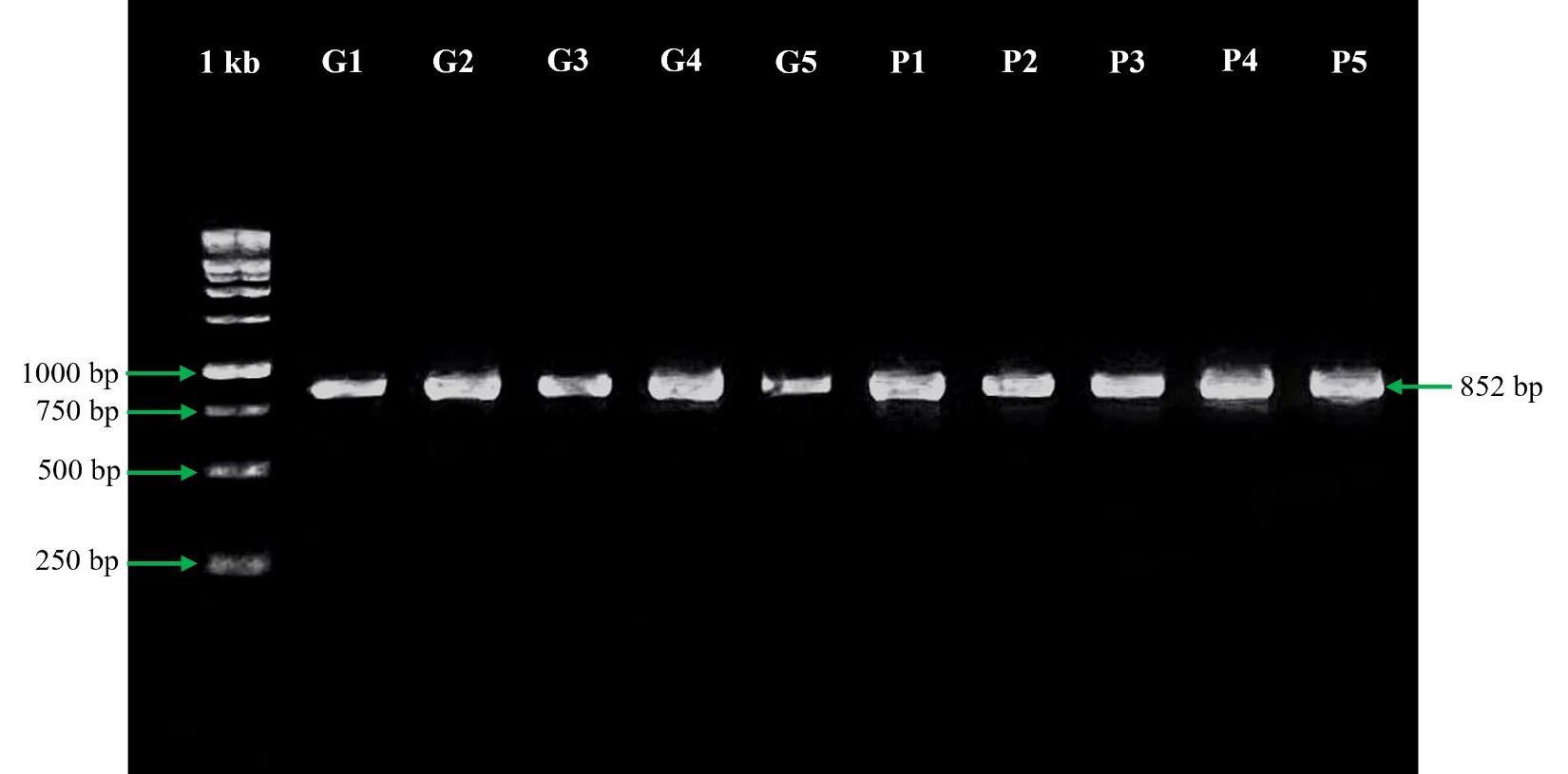
Visualization of PRNP gene amplification in thin-tailed sheep from West Java, Indonesia, using 1.5% agarose gel.
Data analysis
The bioinformatic processing and downstream molecular characterization of the PRNP sequence product were conducted using the Molecular Evolutionary Genetics Analysis (MEGA software, version 12.0.15). The ClustalW program was used to align the PRNP region sequences of thin-tailed sheep. The genetic profiling focused primarily on characterizing nucleotide polymorphisms in the third exon of the PRNP gene. These experimental sequences were benchmarked against the ovine PRNP reference sequence (GenBank accession: AJ223072.1), retrieved from the National Center for Biotechnology Information (NCBI) database (https://www.ncbi.nlm.nih.gov). The effects of the nonsynonymous mutations of the PRNP gene of the thin-tailed sheep were evaluated using PolyPhen-2 (http://genetics.bwh.harvard.edu/pph2/), the predictive online software for annotating nonsynonymous mutations and predicting damaging effects of missense mutations.
Results
Molecular characterization of the PRNP coding region in thin-tailed sheep revealed a total of 18 nucleotide variations and four single-nucleotide polymorphisms (SNPs). The mean nucleotide distribution in thin-tailed sheep was recorded as 23.84% adenine (A), 21.90% thymine (T), 29.97% guanine (G), and 24.29% cytosine (C). Sequence alignment metrics further delineated 848 monomorphic loci, complemented by four polymorphic (variable) sites and four parsimony-informative sites. Specific mutational nucleotides were localized to four primary sites. A transversion mutation at site 380 (G → C) was identified in samples G3 and G5, precipitating a nonsynonymous mutation at codon 127, where glycine was replaced by alanine (G127A). Additionally, an A → C transversion at site 566 was observed in samples (G2, G4, P1, P2, and P4), yielding a homozygous haplotype codon Q189L (glutamine to leucine). Six and five synonymous mutations were also documented at site 691 (G2, G4, G5, P1, P2, and P5) and site 711 (G2, G4, P1, P2, and P5), respectively. Details of these substitution mutations in thin-tailed sheep are presented in Table 1. Genomic analysis at positions 380, 566, and 691 identified specific SNPs that produced two nonsynonymous and two synonymous mutations. These variations were situated at nucleotide sites defined by strong (S: C and G), weak (W: A and T), and amino (M: A and T) nucleotides within thin-tailed sheep samples. Details of these SNPs in thin-tailed sheep are presented in Table 2. In total, the analysis quantified 9 nonsynonymous and 13 synonymous mutations arising from nucleotide substitutions and SNPs, with three genotypic variations occurring specifically at codons 127 and 189 (shown in Tables 3 and 4). Notably, the A136L141R154Q171 scrapie genotype was consistently identified across the entire sample. Based on polymorphism results, the effect of the nonsynonymous mutation in the thin-tailed sheep was assessed via PolyPhen-2. It was predicted that the amino acid substitution in thin-tailed sheep, as shown in Table 5, was probably damaging and benign.
Table 1: Substitution mutations of thin-tailed sheep from West Java, Indonesia.
| Site | Sample code | Nucleotide | Codon | Amino acid | Mutation |
| 380 | G3 and G5 | G→C (Transversion) | G127A: G379 G380 C381 → G379C380 C381 | Glycine (G) → Alanine (A) | Nonsynonymous |
| 566 | G2, G4, P1, P2, and P5 | A→T (Transversion) | Q189L: C565 A566 A567 → C565 T566 A567 | Glutamine (Q) → Leucine (L) | Nonsynonymous |
| 691 | G2, G4, G5, P1, P2, and P5 | C→A (Transversion) | 231: C691 G692 G693 → A691 G692 G693 | Arginine → Arginine (R) | Synonymous |
| 711 | G2, G4, P1, P2, and P5 | G→C (Transversion) | 237: C709 T710 G711 → C709 T710 C711 | Leucine → Leucine (L) | Synonymous |
Table 2: SNP mutations of thin-tailed sheep from West Java, Indonesia.
| Site | Sample code | Nucleotide a | Codon | Amino acid | Mutation | Allele variation |
| 380 | P3 | S (C and G) | 127: G379 S380 C381 | G379 G380 C381 (Glycine/G) | Nonsynonymous | G/A127 |
| G379 C380 C381 (Alanine/A) | ||||||
| 566 | G1 | W (A and T) | 189: C565 W566 A567 | C565 A566 A567 (Glutamine/Q) | Nonsynonymous | Q/L189 |
| C565 T566 A567 (Leucine /L) | ||||||
| 691 | G1 and P4 | M (A and C) | 231: M691 G692 G693 | A691 G692 G693 (Arginine/R) | Synonymous | R/R231 |
| C691 G692 G693 (Arginine/R) |
aStrong or S (C andG), weak or W (A and T), and amino or M (A and C) nucleotide.
Table 3: PRNP genotype and allele frequencies in codon 127 of thin-tailed sheep from West Java, Indonesia.
| Codon | Sample size | Genotype a | Allele frequency a | ||||||||
| AA | % | GA | % | GG | % | ⅀A | A% | ⅀G | G% | ||
| 127 | 10 | 2 | 20 | 1 | 10 | 7 | 70 | 5 | 25 | 15 | 75 |
a A (alanine) and G (glycine).
Table 4: PRNP genotype and allele frequencies in codon 189 of thin-tailed sheep from West Java, Indonesia.
| Codon | Sample size | Genotype a | Allele frequency a | ||||||||
| % | QL | % | LL | % | ⅀Q | Q% | ⅀L | L% | |||
| 189 | 10 | 4 | 40 | 1 | 10 | 5 | 50 | 9 | 45 | 11 | 55 |
a Q (glutamine) and L (leucine).
Table 5: Measurement of the effect of amino acid substitutions of PRNP nonsynonymous mutation in thin-tailed sheep using PolyPhen-2.
| Codon position | AA1 a | AA2 a | Score | Prediction |
| 127 | G | A | 0.998 | Probably damaging |
| 189 | Q | L | 0.192 | Benign |
a G (glycine), A (alanine), Q (glutamine), and L (leucine).
Discussion
Nucleotide substitution mutations in the coding region of PRNP
Genomic analysis of the samples revealed a total of eighteen nucleotide substitutions within the ten samples of thin-tailed sheep in West Java, Indonesia. As presented in Table 1, there were seven nonsynonymous and eleven synonymous mutations, all of which were driven by transversion mutations. The nonsynonymous mutation manifested as homozygous haplotype codons G127A and Q189L. The presence of the G127A variant aligns with several previous research studies in sheep prion protein ; . In Indonesia, this finding is corroborated by thin-tailed sheep from Yogyakarta and fat-tailed sheep from East Java, as well as the homozygous haplotype codon G127S . From a structural perspective, the amino acids at codons 126 and 127 are situated within a highly conserved glycine-rich motif, GAVVG126G127LGGYMLG . While this protective motif is present in the majority of samples, it was notably disrupted in samples G3 and G5. Furthermore, we used PolyPhen-2 to predict the impact of the nonsynonymous mutation of G127A, and the prediction result is probably damaging with a score of 0.998. Polymorphisms such as Q189L have previously been reported in several studies ; . In Indonesia, this polymorphism can also be found in thin-tailed sheep from Yogyakarta and fat-tailed sheep from East Java. It seems that codons 127 and 189 were highly polymorphic in West Java, Indonesia, based on polymorphisms found in thin-tailed sheep samples used in this study and in thin-tailed sheep from Yogyakarta and fat-tailed sheep from East Java that have been reported by Wicaksono et al., (2025). The amino acid change from nonsynonymous Q189L was benign via PolyPhen-2. We also identified AA and GG genotype variations in codon 127 and QQ and LL genotype variations in codon 189. The frequency of the AA genotype in codon 127 was 20%, and the GG genotype was 70%. At codon position 189, the frequencies of the QQ and LL genotypes were 40% and 50%, respectively.
SNPs in the coding region of PRNP
We identified four SNPs within the PRNP coding sequence at positions 380, 566, and 691, resulting in two nonsynonymous and synonymous mutations across the thin-tailed sheep samples. Specifically, at position 380, we observed the heterozygous haplotype codon G127A alongside G/A127 allelic variation. This polymorphism aligns with various genetic research records and has been reported in native Ethiopian sheep , Pelibuey sheep in Mexico , and other studies . Domestically, similar heterozygous profiles featuring G127A and G127V have also recently been reported in thin-tailed sheep from Yogyakarta and fat-tailed sheep from East Java . The high polymorphism at codon 127 closely mirrors the scrapie susceptibility patterns previously observed in Nigerian ovine populations and indigenous Ethiopian sheep breeds . The polymorphism at codon 127 is situated within a critical glycine-rich domain ; . The change of amino acid nonsynonymous G127A in P3 was assessed as probably damaging with a score of 0.998 via PolyPhen-2. Furthermore, analysis of position 566 in G1 revealed the heterozygous Q189L haplotype codon and Q/L189 allelic variation. The Q189L polymorphism has frequently been reported in several research studies ; ; and has similarly been detected in Portuguese Serra de Esterela sheep . The genotypic frequencies for both the GA genotype in codon 127 and the QL genotype in codon 189 were 10% in thin-tailed sheep samples from West Java.
Scrapie genotype in thin-tailed sheep from West Java, Indonesia
Codon variants at positions 136, 154, and 171 are widely recognized as primary determinants of susceptibility to classical scrapie ; . In the current investigation, the genomic profiles of ten thin-tailed sheep samples from West Java, Indonesia, revealed a uniform homozygous A136R154Q171 scrapie genotype. This specific genotype is categorized within the R3 risk group (low genetic resistance to scrapie). Meanwhile, in Europe (EU), where most scrapie cases occur, the ARQ/ARQ genotype is considered a higher risk for scrapie despite more than 90% of sheep in the EU already carrying the ARR allele . Numerous studies of scrapie outbreaks have demonstrated that the ARQ/ARQ genotype confers a risk similar to that of VRQ carriers . This vulnerability is further illustrated in Spain, where 95% of scrapie cases in Rasa sheep were found to have the homozygous ARQ genotype . In Italian Sarda sheep, all 175 classical scrapie cases carried at least one ARQ allele, and 154 of 175 were homozygous ARQ . While in French Manech sheep, 77% of clinical cases were ARQ/ARQ . Similar trends have been documented across Germany and Greece, where this genotype represents a significant proportion of confirmed cases . Confirmed classical scrapie worldwide in 2024 reported that a total of 307 out of 530 cases were sheep with the ARQ/ARQ genotype . The ARQ/ARQ individuals often succumb to the disease at a younger age with a shorter incubation period than expected relative to their susceptibility level . In sheep with a lack of the VRQ allele, scrapie outbreaks predominantly involve young sheep with the homozygous ARQ genotype . Consequently, all thin-tailed sheep samples in this study were classified as the R3 risk group, due to the prevailing lack of genetic resistance to classical scrapie.
While classical scrapie is recognized as a naturally occurring infectious disease, atypical scrapie is considered to arise from spontaneous prion misfolding. Horizontal transmission within flocks is well documented and occurs primarily through direct physical contact or exposure to contaminated environments. The oral route remains the most efficient pathway for infection, with most transmission events occurring during the neonatal period. Pathogenesis typically initiates in the gut-associated lymphoid tissues (GALT), specifically Peyer’s patches. The pathogen then spreads through the lymphoreticular system, reaching the mesenteric lymph nodes before disseminating to all secondary lymphoid organs. During this phase, the concentration of infectious PrPSc increases progressively until reaching a plateau. The extent of scrapie replication within lymphoid tissues appears to be influenced by the PRNP genotype of the sheep. The transition to the central nervous system (CNS), the brain and spinal cord, typically occurs approximately midway through the incubation period. This process is facilitated by axonal transport through the enteric and autonomic nervous systems. In the advanced stage of the disease, a centrifugal redistribution occurs, with the agent spreading from the CNS back to peripheral nerves and skeletal muscle. Subclinical ewes can harbor a substantial infectious load in the placenta, which serves as a major source of environmental contamination and horizontal transmission. Furthermore, infectivity has been documented in both colostrum and milk, presenting a possible transmission to suckling lambs . The vulnerability to both types of scrapie is modulated by PRNP polymorphisms. Sheep categorized within R1–R3 risk groups are most frequently infected with atypical scrapie . According to global data until 2024, there were 23,972 confirmed cases of classical scrapie and 3,290 cases of atypical scrapie. A total of 84 of 89 atypical scrapie cases worldwide in 2024 were sheep in the R1–R3 risk groups . Susceptibility to atypical scrapie is particularly linked to variations at codons 141 and 154. The AF141RQ genotype is associated with the highest risk, followed by the AHQ and AL141RQ genotypes . The thin-tailed sheep evaluated in this study exhibit a homozygous A136L141R154Q171 profile that is classified as genetically susceptible to atypical scrapie.
Protective alleles and specific motifs of the PRNP gene in Sheep
Beyond the variations at codons 136, 154, and 171, prior research has identified specific protective alleles that confer scrapie resistance and/or prolonged incubation periods. The M112T variant within ARQ haplotypes has been identified as a marker for resistance in the American Suffolk sheep following oral inoculation. Sheep carrying the T112ARQ haplotype appear resistant to developing classical scrapie . The AT137RQ and ARQK176 haplotypes were resistant to classical scrapie as shown by the incapability of propagating the pathogenic PrPSc via protein misfolding cyclic amplification (PMCA) experiments . Similarly, research studies in the Italian Sarda breed have linked the ARQ genotype with the homozygous M137T and N176K variants to scrapie resistance under both natural and experimental conditions (intracranial and oral challenges) ; . Broader research studies have reported that sheep with haplotypes T112ARQ, AT137RQ, AC151RQ, and ARQK176 offer resistance to scrapie ; ; ; ; . Furthermore, Greek dairy sheep with the ARK171 genotype exhibit a significantly lower vulnerability to scrapie than sheep with the ARQ and ARH profiles . The nonsynonymous mutations of S173N and N177T that were associated with structural rigidity of the loop β2-α2 appear to confer resistance to some prion diseases . Those protective variants found in the ARQ genotype could provide the eventual eradication of classical scrapie via genetic selection in populations where the ARR allele is rare or absent ; . However, none of the aforementioned protective or resistant alleles were detected within the thin-tailed sheep samples from West Java, indicating a concerning lack of these genetic safeguards.
The amino acids at positions 126 and 127 are situated within the highly conserved glycine-rich motif GAVVG126G127LGGYMLG. This specific motif may play a protective role in preventing the progression of prion disease by inhibiting amyloid fibril aggregation . Polymorphisms within this region may be vital for sustaining the normal cellular function of the prion protein. Structural flexibility within PrPC is influenced by sequence variations within the palindromic region (PRNP 113–120) and the complementary glycine repeat regions (PRNP 124–128). Alterations in these zones can shift the protein’s structural pliability, potentially facilitating the emergence of novel scrapie strains ; . In this study, the protective homozygous GAVVG126G127LGGYMLG motif was identified in samples G1, G2, G4, P1, P2, P4, and P5. While sample P3 exhibited a heterozygous GAVVG126G127LGGYMLG motif, the effects of this configuration remain undefined.
The N-terminal is defined by a series of unique octapeptide repeat sequences (PHGGGWGQ), in which the histidine (H) plays a critical role in coordinating divalent anions, particularly copper and lesser zinc. This region is followed by a hydrophobic domain containing two features, a non-octarepeat fifth-copper binding site (HNQWNKPSKPKTNLKH) and a characteristic palindromic sequence (AGAAAAGA). Both domains are critical for the conformational transition of PrPC into the pathogenic PrPSc . Notably, the non-octarepeat fifth-copper binding site was not detected in the thin-tailed sheep samples in this study. Instead, a variant sequence of HSQWNKPSKPKTNMKH was observed. However, the palindromic sequence (AGAAAAGA) was consistently observed across all samples. The effects of this palindromic sequence in the context of a modified non-octarepeat fifth-copper binding site are not yet known and require further investigation.
In many countries, the prevalence of scrapie remains unknown due to insufficient passive surveillance . This situation is also reflected in Indonesia, where no cases have been officially recorded to date. However, the genetic characterization of thin-tailed sheep samples in this study indicated that these sheep had low genetic resistance to classical scrapie and were susceptible to atypical scrapie. Furthermore, the prevailing trend of importing foreign breeds such as Suffolk, Dorper, and Texel, as well as other breeds from Europe and other regions, may pose risks of transmitting disease agents and introducing susceptible genetics into the domestic population. This study is limited by a relatively small sample size, consisting of healthy sheep from a single region. Therefore, it serves as a preliminary or pilot study for future studies. These findings underscore the need for further investigation of the PRNP gene in Indonesian sheep, using a large sample size and a broader geographical scope. Future studies should encompass both Indonesian thin-tailed sheep and other local breeds to facilitate disease prevention, enhance national surveillance, and improve preparedness through breeding strategies, ultimately safeguarding the national livestock economy.
Conclusion
Scrapie represents a critical veterinary and public health challenge, characterized by significant economic risks and potential zoonotic problems. The molecular findings of this study underscore that this study underscore that these sheep were sheep were genetically less resistant to classical scrapie and vulnerable to atypical scrapie, as evidenced by the absence of resistant genotypes and protective alleles. Representing the first genetic characterization of the PRNP gene in thin-tailed sheep from West Java, Indonesia, this research could provide foundational molecular evidence for scientific and policy insights for authorities. Consequently, expanding the PRNP research across broader Indonesian ovine populations is imperative to preemptively mitigate the risk of scrapie disease emergence, enhance sustainable breeding programs, and safeguard the long-term health of the Indonesian livestock sector.
Acknowledgements
The authors would like to thank the Department of Biochemistry and Molecular Biology, Faculty of Veterinary Medicine at Universitas Gadjah Mada, for their support and for providing the facilities necessary for this research. The authors also thank the farmers for the sample collection.
Novelty Statements
This is the inaugural investigation into the PRNP gene architecture of thin-tailed sheep from West Java, Indonesia. This research identifies the genetic vulnerabilities within these sheep. The findings reveal that sheep in this study are less resistant to classical scrapie and more susceptible to atypical scrapie, a finding that is intrinsically linked to the paucity of recognized protective alleles and resistant genotype profiles. This study also provided the foundational molecular evidence for scientific and policy insights into the authorities for biosecurity and economics relevant to sheep in Indonesia.
Author’s Contribution
AW contributed to the conceptualization, investigation, sample preparation, data analysis and interpretation, and wrote the original manuscript. MP was the principal supervisor, funded the research, confirmed the results, and reviewed the final version of the manuscript. AH was a research supervisor and provided funding and resources for the research. AI was a study supervisor, provided resources, contributed to conceptualization, collected and prepared samples, and contributed to the writing of the original manuscript and its editing. AS contributed to sample preparation and assisted with the experiment. APZNLS was involved in conceptualization and provided resources. All authors read and approved the final version.
Ethics approval
The ethical framework and methodological protocols of this investigation were reviewed and formally endorsed by the Research Ethics Commission of the Faculty of Veterinary Medicine, Universitas Gadjah Mada, under certificate number 002/EC-FKH/Int./2019.
Generative AI and AI-assisted technology statement
Generative AI tools were not used to generate any scientific content, data analysis, or interpretation. The AI assistance was only used for language editing and grammar improvement.
Conflict of interest
The authors have declared no conflicts of interest.
References
- Acín C, Bolea R, Monzón M, Monleón E, Moreno B, Filali H, Marín B, Sola D, Betancor M, Guijarro I, García M, Vargas A, Badiola J (2021). Classical and atypical scrapie in sheep and goats. Review on the etiology, genetic factors, pathogenesis, diagnosis, and control measures of both diseases. Animals, 11(691): 1–20. [CrossRef]
- Acín C, Martín-Burriel I, Goldmann W, Lyahyai J, Monzón M, Bolea R, Smith A, Rodellar C, Badiola JJ, Zaragoza P (2004). Prion protein gene polymorphisms in healthy and scrapie-affected Spanish sheep. J. Gen. Virol., 85(7): 2103–2110.
- Adeola AC, Bello SF, Abdussamad AM, Adedokun RAM, Olaogun SC, Abdullahi N, Mark AI, Onoja AB, Sanke OJ, Mangbon GF, Ibrahim J, Dawuda PM, Salako AE, Kdidi S, Yahyaoui MH (2024). Single nucleotide polymorphisms (SNPs) in the open reading frame (ORF) of prion protein gene (PRNP) in Nigerian livestock species. BMC Genom., 25: 177. [CrossRef]
- Adeola AC, Bello SF, Abdussamad AM, Mark AI, Sanke OJ, Onoja AB, Nneji LM, Abdullahi N, Olaogun SC, Rogo LD, Mangbon GF, Pedro SL, Hiinan MP, Mukhtar MM, Ibrahim J, Saidu H, Dawuda PM, Bala RK, Abdullahi HL, Salako AE, Kdidi S, Yahyaoui MH, Yin TT (2023). Polymorphism of prion protein gene (PRNP) in Nigerian sheep. Prion, 17(1): 44–54.
- Boukouvala E, Gelasakis AI, Kanata E, Fragkiadaki E, Giadinis ND, Palaska V, Christoforidou S, Sklaviadis T, Ekateriniadou LV (2018). The association between 171 K polymorphism and resistance against scrapie affection in Greek dairy sheep. Small Rumin. Res., 161: 51-56.
- BPSa (Central Bureau of Statistics Indonesia) (2026). Populasi Domba menurut Provinsi, Available at: https://www.bps.go.id/assets/statistics-table/2/NDczIzI=/populasi-domba-menurut-provinsi.html (accessed 3 June 2026).
- BPSb (Central Bureau of Statistics Indonesia) (2026). Produksi Daging Domba menurut Provinsi, Available at: https://www.bps.go.id/id/statistics-table/2/NDgzIzI=/produksi-daging-domba-menurut-provinsi.html (accessed 3 June 2026).
- Bucalossi C, Cosseddu G, D’Agostino C, Di Bari M, Chiappini B, Conte M, Rosone F, De Grossi L, Scavia G, Agrimi U, Nonno R, Vaccari G (2011). assessment of the genetic susceptibility of sheep to scrapie by protein misfolding cyclic amplification and comparison with experimental scrapie transmission studies. J. Virol., 85(16): 8386–8392.
- Corbière F, Barillet F, Andréoletti O, Fidelle F, Laphitz-Bordet N, Schelcher F, Joly P (2007). Advanced survival models for risk-factor analysis in scrapie. J. Gen. Virol., 88(2): 696–705.
- Curcio L, Sebastiani C, Di Lorenzo P, Lasagna E, Biagetti M (2016). Review: A review on classical and atypical scrapie in caprine: Prion protein gene polymorphisms and their role in the disease. Animal, 10(10): 1585-1593.
- EFSA (European Food Safety Authority), Nonno R, Ru G, Aminalragia-Giamini R, Iancu C, Ortiz-Pelaez A, Kryemadhi K, Baldinelli F (2025). The European Union summary report on surveillance for the presence of transmissible spongiform encephalopathies (TSE) in 2024. EFSA J., 23(11): 9732. [CrossRef]
- Goldmann W (2008). PrP genetics in ruminant transmissible spongiform encephalopathies. Vet. Res., 39(4): 1–14. [CrossRef]
- Harrathi C, Fernández-Borges N, Eraña H, Elezgarai SR, Venegas V, Charco JM, Castilla J (2019). Insights into the bidirectional properties of the sheep–deer prion transmission barrier. Mol. Neurobiol., 56: 5287–5303. [CrossRef]
- Houston F, Andréoletti O (2019). Animal prion diseases: the risks to human health. Brain Pathol., 29: 248-262. [CrossRef]
- Houston F, Goldmann W, Foster J, González L, Jeffrey M, Hunter N (2015). Comparative susceptibility of sheep of different origins, breeds and prnp genotypes to challenge with bovine spongiform encephalopathy and scrapie. PLoS One, 10(11): 1–17.
- Igel-Egalon A, Moudjou M, Martin D, Busley A, Knapple T, Herzog L, Reine F, Lepejova N, Richard C, Beringue V, Rezaei H (2017). Reversible unfolding of infectious prion assemblies reveals the existence of an oligomeric elementary brick. PLoS Pathog., 13(9): 1–21. [CrossRef]
- Kioutsioukis C, Papadogiannakis E, Palaska V, Kontos V, Papakostaki D, Paraskeva S, Vassalou E (2018). Prion protein gene polymorphisms in classical scrapie-affected flocks of sheep in Central Macedonia. J. Hellenic Vet. Med. Soc., 69(2): 931–940.
- Kovač V, Šerbec VC (2022). Prion Protein: The molecule of many forms and faces. Int. J. Mol. Sci., 23:1232. [CrossRef]
- Laegreid WW, Clawson ML, Heaton MP, Green BT, O’Rourke KI, Knowles DP (2008). Scrapie resistance in ARQ sheep. J. Virol., 82(20): 10318–10320. [CrossRef]
- Lan Z, Li J, Sun C, Liu Y, Zhao Y, Chi T, Yu X, Song F, Wang Z (2014). Allelic variants of PRNP in 16 Chinese local sheep breeds. Arch. Virol., 159: 2141–2144. [CrossRef]
- Lan Z, Wang ZL, Liu Y, Zhang X (2006). Prion protein gene (PRNP) polymorphisms in Xinjiang local sheep breeds in China. Arch. Virol., 151: 2095–2101. [CrossRef]
- Legname G (2023). Copper coordination modulates prion conversion and infectivity in mammalian prion proteins. Prion, 17(1): 1–6. [CrossRef]
- Lühken G, Buschmann A, Brandt H, Eiden M, Groschup MH, Erhardt G (2007). Epidemiological and genetical differences between classical and atypical scrapie cases. Vet. Res., 38(1): 65–80. [CrossRef]
- Öner Y, Yesilbag K, Tuncel E, Elmaci C (2011). Prion protein gene (PrP) polymorphisms in healthy sheep in Turkey. Animal, 5(11): 1728–1733. [CrossRef]
- Orkara S, Khamzina A, Sandybayev N, Sattarova R, Davletova A, Khamzin K, Pokharel K, Ibragimov P, Burambayeva N, Smagulov D (2025). Epidemiological landscape and genetic prospects for marker-assisted selection in Kazakh sheep. Front. Vet. Sci., 12: 1647959. [CrossRef]
- Rashaydeh FS, Yildiz MA, Alharthi AS, Al-Baadani HH, Alhidary IA, Meydan H (2023). Novel prion protein gene polymorphisms in awassi sheep in three regions of the fertile crescent. Vet. Sci., 10: 597. [CrossRef]
- Rodrigues S, Moreira G, Santos-Silva S, Gomes-Gonçalves S, Aires Pereira M, Baptista A, Cruz R, Esteves F, Mesquita JR (2025). Mapping PRNP polymorphisms in Portuguese Serra da Estrela ovine populations: insights into scrapie susceptibility and farm animal improvement. Animals, 15: 2750.
- Rodríguez-Andrade F, Villanueva-Castillo A, Pastelin-Rojas CF, Avila-Benitez R, Moreno-Mejía RS, Galicia-Domínguez JA (2023). Evaluation of resistance and susceptibility to prion diseases in Pelibuey sheep from Mexico. Mac. Vet. Rev., 46(1): 17–26.
- Saitoh Y, Mizusawa H (2024). Prion diseases, always a threat? J. Neurol. Sci., 463: 123119.
- Sezgin E, Teferedegn E, Ün C, Yaman Y (2022). Excessive replacement changes drive evolution of global sheep prion protein (PRNP) sequences. Heredity, 128: 377–385.
- Teferedegn EY, Yaman Y, Ün C (2020). Five novel PRNP gene polymorphisms and their potential effect on Scrapie susceptibility in three native Ethiopian sheep breeds. BMC Vet. Res., 16: 122. [CrossRef]
- Tranulis MA (2002). Influence of the prion protein gene, prnp, on scrapie susceptibility in sheep. APMIS, 110: 33-43.
- Vaccari G, D’Agostino C, Nonno R, Rosone F, Conte M, Di Bari MA, Chiappini B, Esposito E, De Grossi L, Giordani F, Marcon S, Morelli L, Borroni R, Agrimi U (2007). Prion protein alleles showing a protective effect on the susceptibility of sheep to scrapie and bovine spongiform encephalopathy. J. Virol., 81(13): 7306–7309.
- Vaccari G, Scavia G, Sala M, Cosseddu G, Chiappini B, Conte M, Esposito E, Lorenzetti R, Perfetti G, Marconi P, Scholl F, Barbaro K, Bella A, Nonno R, Agrimi U (2009). Protective effect of the AT137RQ and ARQK176 PrP allele against classical scrapie in Sarda breed sheep. Vet. Res., 40(3): 1–11.
- Wicaksono A, Haryanto A, Ibrahim A, Suryandari A, Puspita RAA, Purwaningrum M (2025). Genetic variability of the prion protein gene (PRNP) in thin-tailed and fat-tailed sheep. Open Vet. J., 15(6): 2789–2797.

Services
Article usage statistics
Loading…
Related articles
- Genetic Analysis and Phylogenetic Study of IL-10-Like Protein and ORF103 Encoded Genes of Sheep Poxvirus Infecting Sheep from IraqJournal of Animal Health and Production · 2024
- Polymorphism and Comparative Expression Analysis of THRSP Gene in Fat-Tailed and Thin-Tailed Sheep BreedsPakistan Journal of Zoology · 2021
- Preliminary Study on Phylogenetic Analysis of Sakub Sheep from Brebes Regency Based on the Mitochondrial DNA (mtDNA) Displacement Loop (D-Loop) Gene SequenceAdvances in Animal and Veterinary Sciences · 2025
- Comparison of Morphometry, Physiological Status, and Protein Total in Twin and Single Ewes of Fat-Tail Sheep (Sapudi Indonesian Local Sheep) and Their CrossbredAdvances in Animal and Veterinary Sciences · 2023
- Polymorphisms of ESR1, PGR and CYP19A1 Genes and their Association with Litter Size in Small-Tailed Han SheepPakistan Journal of Zoology · 2025
- Polymorphism of SYNE2 Gene and its Association with Litter Size in Small Tail Han SheepPakistan Journal of Zoology · 2021