
Coconut fatty acid distillate (CFAD) is a potential lipid source for dairy cattle, although its high medium-chain fatty acid content may require ruminal protection to regulate fatty acid availability. Protection may influence ruminal biohydrogenation pathways, particularly formation of conjugated linoleic acid (CLA). This study evaluated the comparative effects of CFAD form and supplementation level on ruminal fatty acid biohydrogenation using in vitro study. Treatments were arranged in a 2 × 4 factorial randomized block design, consisting of two CFAD forms (unprotected and protected) and four CFAD supplementation levels (0%, 1%, 2%, and 3%), with three rumen fluid sources as blocks. Biohydrogenation was assessed using indices of C18:2 cis, C18:3 n-3, C18:3 n-6, total PUFA, incomplete biohydrogenation, isomerization, saturation, unsaturation, ruminal CLA yield, and total C18 recovery. Most ruminal biohydrogenation and fatty acid transformation indices were not significantly affected by CFAD supplementation level or form. In contrast, ruminal CLA yield was significantly affected by CFAD form, with protected CFAD producing a higher ruminal CLA yield than unprotected CFAD (P < 0.05). Correlation analysis showed that CFAD form was positively associated with ruminal CLA yield (P < 0.05), while principal component analysis showed no clear multivariate separation according to CFAD level or form. However, CLA-related variables were descriptively associated with C18:2 isomerization and total C18 recovery. In conclusion, protected CFAD may enhance ruminal CLA yield during fatty acid transformation without markedly altering the overall biohydrogenation profile.
Research Article · Volume 15, Issue 1, Pages 221–230, 21 November 2026 · Open Access
Protected Coconut Fatty Acid Distillate Enhances Ruminal CLA Yield without Altering Overall Fatty Acid Biohydrogenation in Dairy Rations
, , ,
Affiliations & Notes ⌄
- 1Study Program of Nutrition and Feed Science, Graduate School, IPB University, Bogor 16680, Indonesia
- 2Department of Nutrition and Feed Technology, Faculty of Animal Science, IPB University, Bogor 16680, Indonesia
- 3Graduate School of Agriculture, Hokkaido University, Sapporo 060-8589, Japan
- *Correspondence | Despal; Email: despal@apps.ipb.ac.id
Article Info ⌄
- Journal:
- Journal of Animal Health and Production
- Submitted Date:
- 19 August 2026
- Accepted Date:
- 24 October 2026
- Published Date:
- 21 November 2026
Abstract
INTRODUCTION
Dietary fat supplementation is commonly used to increase the energy density of dairy cow diets and meet the high energy requirements of lactation ; . In addition to its role as an energy source, fat supplementation can also modify the fatty acid profile of milk by influencing ruminal lipid metabolism. It is one of the main nutritional strategies used to modulate ruminal biohydrogenation and enhance the formation of conjugated linoleic acid (CLA)-related intermediates . Ruminal biohydrogenation is a microbial process that converts dietary unsaturated fatty acids into more saturated fatty acids. Dietary lipids are first hydrolyzed through lipolysis, releasing free fatty acids that become substrates for microbial transformation . This process is mainly carried out by rumen bacteria and is considered a mechanism to reduce the toxic effects of unsaturated fatty acids on rumen microorganisms . Ruminal biohydrogenation produces several important intermediates, including conjugated linoleic acids (CLA), with cis-9, trans-11 CLA being the predominant isomer found in milk . Therefore, increasing the ruminal formation of CLA may improve the functional fatty acid profile of dairy products .
Coconut fatty acid distillate (CFAD), a by-product of coconut oil refining, is a potential lipid source for dairy rations because it is rich in medium-chain fatty acids ; . Medium-chain fatty acids (MCFA) may serve as an energy source and have antimicrobial properties that can reduce methanogenic microorganisms and methane-related energy loss ; ; . However, their effects on ruminal fatty acid biohydrogenation appear to be limited. Panyakaew et al. (2013) reported that coconut oil as an MCFA source reduced methane production and shifted rumen fermentation toward higher propionate. Besides methanogens, MCFA has been reported to reduce several rumen bacterial populations, including Ruminococcus albus, Ruminococcus flavefaciens, Fibrobacter succinogenes, Prevotella ruminicola, and Butyrivibrio fibrisolvens . Since B. fibrisolvens is involved in the initial biohydrogenation of linoleic acid and CLA formation , the antimicrobial effects of MCFA may indirectly influence CLA-related fatty acid transformation. Similarly, Costa et al. (2017) reported that coconut oil increased lauric and myristic acid concentrations in rumen fluid, while the fatty acid profile of the supplemented oil was only partially reflected in rumen fluid and did not markedly alter CLA isomers. These findings suggest that coconut oil may influence rumen fermentation and microbial activity more strongly than CLA formation, while studies evaluating its effects on ruminal biohydrogenation and CLA formation remain limited. In addition, Anzhany et al. (2024) reported that diet composition influenced ruminal fatty acid biohydrogenation during in vitro fermentation. However, that study focused on forage source and quality, rather than protected fat supplementation. Therefore, protection strategies may be required to regulate fatty acid availability in the rumen and improve the accumulation of beneficial biohydrogenation intermediates, including CLA.
Protection of CFAD as calcium soap may reduce the immediate exposure of rumen microorganisms to free fatty acids because calcium soaps remain relatively stable under normal ruminal condition . This protection may limit the immediate accessibility of fatty acids to rumen microorganisms, thereby reducing the antimicrobial pressure of free MCFA and potentially slowing subsequent biohydrogenation. As a result, more C18 unsaturated fatty acids may remain available as substrates for microbial isomerization. Since CLA is formed as an intermediate during the biohydrogenation of linoleic acid ; , such regulated fatty acid availability may favor CLA formation and accumulation without necessarily changing the overall extent of C18 PUFA biohydrogenation.
Our previous study, Zahera et al. (2024) evaluated CFAD Ca-soap as a protected fat source in dairy rations and demonstrated that blended unprotected and protected CFAD had limited effects on rumen fermentation characteristics, while complete protection showed the most favorable response in nutrient digestibility and rumen microbial conditions. As a follow-up study, the present work directly compares unprotected and protected forms of CFAD at different supplementation levels, with a specific focus on ruminal fatty acid biohydrogenation and the formation of CLA-related intermediates. Therefore, this study specifically evaluated apparent ruminal fatty acid biohydrogenation indices and CLA yield to clarify whether CFAD protection influences CLA-related fatty acid transformation. We hypothesized that protected CFAD would improve CLA-related fatty acid transformation during ruminal biohydrogenation without markedly altering the broader ruminal biohydrogenation profile.
MATERIALS AND METHODS
Sample preparation
Coconut fatty acid distillate was obtained from PT Karacoco Nucifera Pratama, Indonesia. The CFAD was rich in medium-chain fatty acids, predominantly lauric acid (50.42%) and myristic acid (19.82%) . Protected CFAD was prepared in the form of calcium soap using a double-decomposition method . Briefly, CFAD was reacted with NaOH solution, under heating to form water-soluble sodium soap. A CaCl₂ solution was then gradually added under continuous stirring, allowing ion exchange between Na⁺ in the sodium soap and Ca²⁺ from CaCl₂ to form insoluble calcium soap. Unprotected CFAD represented the original untreated CFAD material. The basal dairy ration was formulated with a forage-to-concentrate ratio of 40:60, and the nutrient and fatty acid compositions of the ration are presented in Table 1. Rumen fluid was collected from fistulated Friesian Holstein cattle before morning feeding on three separate days and used as the inoculum, with each collection day designated as an experimental block.
Ruminal fatty acid biohydrogenation
In vitro fermentation was conducted using dairy ration substrate incubated with rumen fluid and buffer under anaerobic conditions at 39°C, following the method of Tilley and Terry (1963). Briefly, 0.5 g of dairy ration substrate was placed into fermentation tubes containing 40 mL of buffer solution and 10 mL of rumen fluid. The tubes were flushed with CO₂ to maintain anaerobic conditions, sealed, and incubated at 39°C for 48 h. Samples were collected at 0 and 48 h of incubation for fatty acid analysis and calculation of apparent biohydrogenation indices. Ruminal C18 fatty acid profiles were analyzed using gas chromatography (GC-7820A, Agilent Technologies) following the procedure of Anzhany et al. (2024). Briefly, the incubation samples were lyophilized, and 50 mg of each sample was transferred into a screw-cap tube. The sample was mixed with 2148 µL methanol, 990 µL toluene, 66 µL sulfuric acid, 1000 µL dimethyl sulfoxide, and 2000 µL hexane. The tightly closed tubes were heated in a water bath at 80 °C for 2 h. After cooling to room temperature, the upper hexane layer was transferred to a 2-mL tube and evaporated under nitrogen. The residue was dissolved in 500 µL dichloromethane and vortexed for 1 min. An aliquot of 250 µL was transferred into a chromatographic vial and stored at −20 °C until gas chromatographic analysis.
Table 1: Nutrient composition of dairy ration.
| Nutrient | Percentage (% of DM) |
| Ash | 11.60 |
| Ether extract | 3.70 |
| Crude protein | 14.30 |
| Crude fiber | 21.41 |
| Nitrogen free extract | 52.65 |
| Total digestible nutrient | 65.24 |
| Fatty acid composition (% of total fatty acids) | |
| C18:0 | 21.43 |
| C18:1 cis | 3.87 |
| C18:1 trans | 7.50 |
| C18:2 cis | 2.69 |
| C18:2 trans | 0.26 |
| C18:3n3 | 0.48 |
| C18:3n6 | 0.60 |
| Total conjugated linoleic acid (CLA) | 1.29 |
| Total polyunsaturated fatty acid (PUFA) | 10.37 |
Biohydrogenation indices were determined based on changes in fatty acid concentrations between 0 and 48 h of incubation. Apparent biohydrogenation of individual C18 PUFA and total C18 PUFA was calculated from their proportional disappearance during incubation, following Vlaeminck et al. (2008) with minor modifications. Indices of incomplete biohydrogenation and ruminal CLA yield, representing the accumulation of biohydrogenation intermediates and CLA formation relative to initial C18:2 cis concentration, were adapted from Kalscheur et al. (1997) and Cruz-Hernandez et al. (2007). Saturation and unsaturation indices were calculated to describe the degree of fatty acid saturation and unsaturation, following Jalc et al. (2007). The C18:1 and C18:2 trans/cis isomerization indices were calculated based on the trans/cis fatty acid ratios described by Kramer et al. (2004) and Toral et al. (2024). Total C18 recovery was expressed as the ratio of total C18 fatty acids after 48 h of incubation to their initial concentration, as described by Harvatine and Allen (2006).
Research design and data analysis
This experiment used a 2 × 4 factorial randomized block design, consisting of two CFAD forms (unprotected and protected) and four CFAD supplementation levels (0%, 1%, 2%, and 3%), with three rumen fluid sources as blocks. Parameters measured were fatty acid biohydrogenation, including C18:2 cis, C18:3 n-3, C18:3 n-6, total PUFA, incomplete biohydrogenation, isomerization, saturation and unsaturation, ruminal CLA yield, and total C18 recovery. Data were analyzed using ANOVA for CFAD forms, supplementation level, their interaction, and rumen fluid source as the blocking factor. When significant effects were detected, treatment means were compared using Tukey’s test. Pearson correlation analysis was conducted and visualized using the corrplot package, with only statistically significant correlations (confidence level = 95%) presented. Principal component analysis (PCA) was performed to visualize the multivariate pattern of fatty acid biohydrogenation variables, which was conducted using the prcomp function in R version 4.4.2 with RStudio. The CFAD supplementation level was shown by color, while CFAD form was shown by point shape. The effects of both factors on the overall multivariate profile were tested using PERMANOVA with the adonis2 function in the vegan package, based on Euclidean distance with 999 permutations. Statistical significance was declared at P < 0.05.
RESULTS
Ruminal fatty acid biohydrogenation
Ruminal fatty acid biohydrogenation indices of dairy cattle rations supplemented with different levels and forms of CFAD are presented in Table 2. There were no significant effects of CFAD supplementation level or CFAD form on the biohydrogenation indices of C18:2 cis, C18:3 n-3, C18:3 n-6, total PUFA, and incomplete biohydrogenation. Negative apparent biohydrogenation values were observed in several treatments, particularly for C18:2 cis, C18:3 n-3, and total PUFA, with considerable variation among treatments. The isomerization indices are presented in Table 3. No significant effects of CFAD supplementation level or CFAD form were observed on the isomerization indices of C18:1 and C18:2. The C18:1 isomerization index remained relatively stable across supplementation levels and CFAD forms. Similarly, the C18:2 isomerization index showed no significant differences among treatments. Fatty acid transformation indices are presented in Table 4. No significant effects were observed on the saturation index, unsaturation index, or total C18 recovery. In contrast, protected CFAD showed a higher ruminal CLA yield than unprotected CFAD (48.17 ± 56.98 vs. −60.48 ± 56.32, respectively; P < 0.05). Negative ruminal CLA yield values were observed in several treatments, particularly in the unprotected CFAD form.
Table 2: Ruminal fatty acid biohydrogenation indices in dairy rations supplemented with different levels and forms of CFAD.
| Parameters | Level | CFAD form | Average | |
| Unprotected | Protected | |||
| BH C18: 2 cis | 0 | -42.58±120.01 | -28.46±113.40 | -35.52±95.67 |
| 1 | 27.7±28.20 | 51.34±30.08 | 39.52±27.44 | |
| 2 | 12.46±5.90 | -1.35±34.02 | 5.56±21.47 | |
| 3 | 20.53±31.95 | -19.35±111.27 | 0.59±70.70 | |
| Average | 4.53±32.02 | 0.55±35.69 | ||
| BH C18: 3n3 | 0 | -10.93±39.84 | -2.15±13.13 | -6.54±24.74 |
| 1 | 3.92±10.11 | 21.68±12.34 | 12.8±13.78 | |
| 2 | -6.32±1.35 | -2.59±8.78 | -4.45±5.56 | |
| 3 | 8.71±1.58 | -4.83±18.58 | 1.94±13.30 | |
| Average | -1.16±9.04 | 3.03±12.49 | ||
| BH C18: 3n6 | 0 | 69.17±11.56 | 11.22±51.07 | 40.2±45.09 |
| 1 | 24.9±36.81 | 15.6±0.00 | 20.25±26.58 | |
| 2 | 62.85±16.21 | 28.81±100.67 | 45.83±62.06 | |
| 3 | 27.25±102.88 | 58.07±31.13 | 42.66±64.56 | |
| Average | 46.04±23.22 | 28.42±21.13 | ||
| BH Total PUFA | 0 | -6.65±5.19 | 4.41±4.99 | -1.12±7.62 |
| 1 | 10.52±12.64 | -15.09±31.53 | -2.28±24.56 | |
| 2 | 9.34±12.91 | -15.02±8.4 | -2.84±16.64 | |
| 3 | -15.99±20.85 | 11.27±5.34 | -2.36±20.05 | |
| Average | -0.69±12.86 | -3.61±13.51 | ||
| Incomplete BH | 0 | 0.28±0.06 | 0.28±0.14 | 0.28±0.09 |
| 1 | 0.25±0.01 | 0.25±0.09 | 0.25±0.05 | |
| 2 | 0.22±0.02 | 0.27±0.14 | 0.25±0.09 | |
| 3 | 0.17±0.03 | 0.36±0.18 | 0.27±0.15 | |
| Average | 0.23±0.05 | 0.29±0.05 | ||
1CFAD = Coconut Fatty Acid Distillate. Values are presented as mean ± SD. Absence of superscript letters within the same row or column indicates no significant difference among treatments (P > 0.05).
Correlation analysis
The correlation analysis among fatty acid biohydrogenation variables is presented in Figure 1. The CFAD form was positively correlated with ruminal CLA yield, indicating that protected CFAD was associated with greater ruminal CLA yield during ruminal biohydrogenation compared
Table 3: Isomerization index in dairy rations supplemented with different levels and forms of CFAD.
| Parameters | Level | CFAD form | Average | |
| Unprotected | Protected | |||
| C18:1 | 0 | 0.68±0.07 | 0.55±0.00 | 0.62±0.08 |
| 1 | 0.56±0.07 | 0.61±0.06 | 0.58±0.06 | |
| 2 | 0.58±0.07 | 0.6±0.09 | 0.59±0.07 | |
| 3 | 0.48±0.18 | 0.64±0.03 | 0.56±0.14 | |
| Average | 0.57±0.08 | 0.60±0.04 | ||
| C18:2 | 0 | 0.19±0.03 | 0.24±0.05 | 0.21±0.05 |
| 1 | 0.07±0.10 | 0.28±0.05 | 0.17±0.14 | |
| 2 | 0.13±0.12 | 0.26±0.17 | 0.19±0.14 | |
| 3 | 0.29±0.03 | 0.28±0.07 | 0.28±0.04 | |
| Average | 0.17±0.09 | 0.26±0.02 | ||
1CFAD = Coconut Fatty Acid Distillate. Values are presented as mean ± SD. Absence of superscript letters within the same row or column indicates no significant difference among treatments (P > 0.05).
Table 4: Fatty acid transformation in dairy rations supplemented with different levels and forms of CFAD.
| Parameters | Level | CFAD form | Average | |
| Unprotected | Protected | |||
| Saturation index | 0 | 2.23±0.45 | 2.46±0.52 | 2.35±0.42 |
| 1 | 1.54±0.17 | 2.24±0.88 | 1.89±0.66 | |
| 2 | 2.26±0.35 | 2.42±1.18 | 2.34±0.72 | |
| 3 | 2.55±2.04 | 2.34±0.70 | 2.44±1.25 | |
| Average | 2.15±0.43 | 2.36±0.10 | ||
| unsaturated index _0 | 0 | 0.5±0.19 | 0.59±0.01 | 0.55±0.12 |
| 1 | 0.88±0.46 | 0.39±0.04 | 0.64±0.39 | |
| 2 | 0.64±0.00 | 0.45±0.11 | 0.54±0.12 | |
| 3 | 0.48±0.10 | 0.57±0.03 | 0.53±0.08 | |
| Average | 0.63±0.18 | 0.50±0.09 | ||
| Unsaturated index 48 | 0 | 0.46±0.09 | 0.42±0.09 | 0.44±0.08 |
| 1 | 0.65±0.07 | 0.48±0.19 | 0.57±0.15 | |
| 2 | 0.45±0.07 | 0.47±0.23 | 0.46±0.14 | |
| 3 | 0.58±0.46 | 0.45±0.13 | 0.51±0.29 | |
| Average | 0.53±0.10 | 0.45±0.03 | ||
| Yield CLA | 0 | -17.13±49.31 | 127.35±180.32 | 55.11±136.41 |
| 1 | -123.84±58.18 | 18.1±17.13 | -52.87±89.11 | |
| 2 | -91.84±19.4 | -2.46±38.44 | -47.15±57.28 | |
| 3 | -9.11±40.04 | 49.71±34.85 | 20.3±45.74 | |
| Average | -60.48±56.32b | 48.17±56.98a | ||
| Recovery total C18 | 0 | 1.10±0.26 | 1.19±0.07 | 1.14±0.16 |
| 1 | 0.85±0.32 | 0.85±0.08 | 0.85±0.19 | |
| 2 | 1.04±0.07 | 1.04±0.17 | 1.04±0.11 | |
| 3 | 1.05±0.44 | 1.17±0.01 | 1.11±0.26 | |
| Average | 1.01±0.11 | 1.06±0.16 | ||
1CFAD = Coconut Fatty Acid Distillate. Values are presented as mean ± SD. a-cMeans in the same row with different superscripts significantly different (P < 0.05).
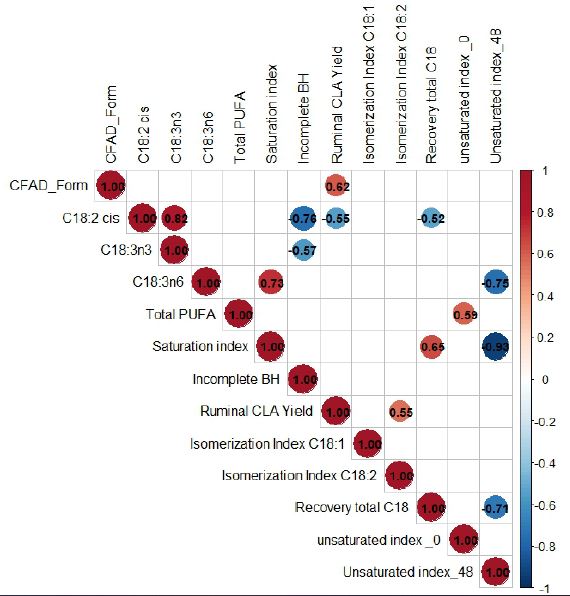
Correlation matrix of coconut fatty acid distillate (CFAD) forms and ruminal fatty acid biohydrogenation variables. The values shown in the matrix represent significant Pearson correlation coefficients (P < 0.05). Red circles indicate positive correlations, blue circles indicate negative correlations, and blank cells indicate non-significant correlations.
with unprotected CFAD. Among biohydrogenation variables, ruminal CLA yield was positively correlated with the C18:2 isomerization index. Overall, the correlation pattern indicates that CFAD form was more closely associated with fatty acid transformation, particularly ruminal CLA yield.
Principal component analysis
Principal component analysis was performed to visualize the overall relationship among fatty acid biohydrogenation variables, CFAD supplementation level, and CFAD form (Figure 2). The first two principal components explained 56.8% of the total variation, with PC1 accounting for 30.4% and PC2 accounting for 26.4%. The PCA score plot showed that samples from different CFAD supplementation levels and forms were widely distributed and did not form distinct clusters, indicating no clear multivariate separation among treatments. The loading vectors showed that ruminal CLA yield, incomplete biohydrogenation, total C18 recovery, and the C18:1 isomerization index were mainly associated with the positive direction of PC2 and PC1. In contrast, C18:2 cis and C18:3 n-3 were associated with the negative direction of PC2. The saturation index and C18:3 n-6 were oriented toward the positive direction of PC1, whereas the unsaturation indices at 0 and 48 h were positioned toward the negative direction of PC1. Overall, the PCA indicates that treatment-related variation was more closely associated with specific CLA-related and C18 transformation variables rather than a clear separation of the overall biohydrogenation profile by CFAD level or form.
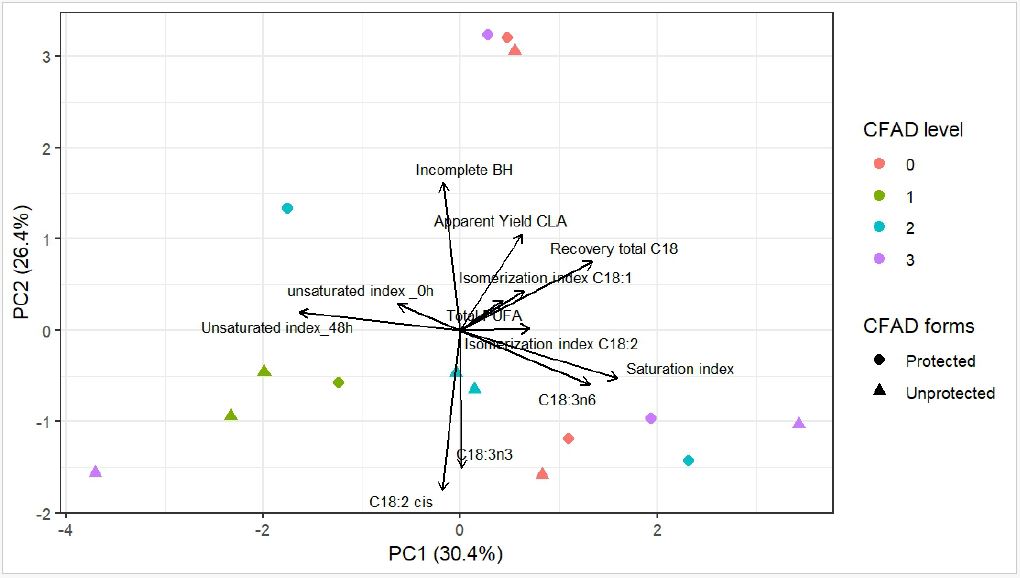
Principal component analysis (PCA) biplot of fatty acid biohydrogenation variables in dairy rations supplemented with different CFAD forms and levels. Colors indicate CFAD supplementation levels, while point shapes indicate unprotected or protected CFAD forms.
DISCUSSION
Coconut fatty acid distillate (CFAD) is rich in medium-chain fatty acids (MCFA), which may influence rumen microbial populations and fatty acid transformation due to their antimicrobial properties ; . Medium-chain fatty acids can affect microorganisms involved in lipolysis, isomerization, and hydrogenation, thereby potentially modifying the flow of biohydrogenation intermediates . Biohydrogenation is a complex microbial process involving isomerization of unsaturated fatty acids, formation of intermediate fatty acids, and final hydrogenation to more saturated end products ; . Previous studies have shown that MCFA supplementation may alter the rumen bacterial community by reducing certain fiber-degrading and hydrogen-producing bacteria, which are important contributors to lipolysis and hydrogenation processes . Lauric acid, one of the major MCFA, has been associated with ruminal microbial and metabolomic changes related to lipid metabolism and milk fat synthesis . Lauric acid has also been reported to decrease total volatile fatty acid production and nutrient digestibility, indicating a broad inhibitory effect on rumen microbial fermentation, including microbial processes related to lipid breakdown and fatty acid metabolism . Therefore, CFAD, due to its high MCFA content, may require protection to regulate fatty acid availability in the rumen, reduce excessive microbial inhibition and improve fatty acid transformation.
In the present study, increasing CFAD supplementation level did not markedly alter apparent C18 PUFA biohydrogenation, isomerization indices, saturation index, or total C18 recovery compared with the non-supplemented treatment. This indicates that CFAD supplementation level was not sufficient to strongly modify the overall biohydrogenation pathway. Negative apparent biohydrogenation values were also observed, similar to those reported by Anzhany et al. (2024), indicating that the relative abundance of some fatty acids at 48 h exceeded that at 0 h and should not be interpreted as net fatty acid synthesis. Instead, these values reflect changes in the relative fatty acid profile during incubation rather than an absolute fatty acid mass balance . The relatively stable biohydrogenation of C18:2, C18:3, and total PUFA, together with the unchanged total C18 recovery, suggests that the general pathway of C18 fatty acid transformation was maintained across treatments. Behan et al. (2024) reported that rumen-protected fats tended to increase the biohydrogenation of C18:2 n-6 and other C18 unsaturated fatty acids without adversely affecting rumen fermentation. Thus, protection may help maintain rumen fermentation while still allowing fatty acid substrates to undergo microbial isomerization and hydrogenation .
Although the overall biohydrogenation indices were not significantly altered, ruminal CLA yield was significantly affected by the CFAD form. The CLA concentration in ruminant products is mainly influenced by diet, particularly the type and amount of dietary fat ; . The increasing ruminal CLA yield in protected CFAD suggests that protection may improve the accumulation of CLA-related intermediates during ruminal biohydrogenation. In unprotected fat, fatty acids are more directly exposed to rumen microorganisms ; , which may accelerate further hydrogenation of intermediate fatty acids or disturb microbial populations involved in CLA formation . In contrast, protected CFAD may regulate fatty acid availability in the rumen by reducing the immediate accessibility of fatty acids to rumen microorganisms. This may slow subsequent biohydrogenation and maintain the availability of C18 unsaturated fatty acids for microbial isomerization. Since MCFA are not direct precursors of CLA, the higher ruminal CLA yield observed in protected CFAD likely originated from the biohydrogenation of C18 unsaturated fatty acids, particularly C18:2 n-6 and C18:3 n-3, into CLA-related intermediates ; . Therefore, the higher ruminal CLA yield observed in protected CFAD may be attributed to an indirect effect of protection on ruminal fatty acid transformation rather than direct conversion of MCFA into CLA. This may explain why protection resulted in the highest ruminal CLA yield, even though the overall apparent biohydrogenation of C18 PUFA was not significantly changed. The absence of significant differences at 0 h indicates that the initial degree of fatty acid unsaturation was relatively comparable among treatments before fermentation. This is important because the degree of fatty acid unsaturation can influence rumen microbial fermentation and fatty acid transformation, as reported by Gao et al. (2016). Similarly, Broudiscou et al. (2023) showed that different unsaturated lipid sources can differentially affect rumen microbial functions, indicating that fatty acid characteristics may influence ruminal lipid metabolism. However, in the present study, the non-significant unsaturation index after 48 h suggests that CFAD level and form did not markedly alter the final degree of fatty acid unsaturation during in vitro ruminal biohydrogenation.
Correlation analysis and PCA suggest that the higher ruminal CLA yield observed in protected CFAD was more closely associated with C18:2 isomerization than with a broad shift in the overall biohydrogenation profile. Protected fat may regulate fatty acid availability in the rumen, allowing linoleic acid transformation to proceed toward CLA formation while limiting excessive further hydrogenation of CLA intermediates ; . The absence of distinct PCA clustering despite the significant ruminal CLA yield difference may reflect the different information captured by univariate and multivariate analyses. PCA summarizes the combined variance across all variables rather than testing individual treatment effects . Moreover, PC1 and PC2 explained 56.8% of the total variation, with the remaining variation distributed across subsequent components. Although the PCA score plot did not show clear clustering according to CFAD supplementation level or CFAD form, ruminal CLA yield was positioned in the same direction as incomplete biohydrogenation, total C18 recovery, and the C18:1 isomerization index. This indicates that ruminal CLA yield was more closely related to specific C18 fatty acid transformation pathways than to overall treatment separation. The positive association between ruminal CLA yield and the C18:2 isomerization index supports this interpretation, as CLA is formed through the rearrangement of methylene-separated double bonds in C18:2 into conjugated double bonds ; ; . The higher ruminal CLA yield observed in protected CFAD form may be related to enhanced C18:2 isomerization by rumen bacteria involved in CLA biosynthesis. Lin et al. (2025) reported that rumen bacteria such as Butyrivibrio fibrisolvens can convert linoleic acid into CLA, mainly cis-9, trans-11 CLA. In addition, Verhulst et al. (1985) reported that one strain of Bacteroides sp. Could hydrogenate linoleic acid through the formation of 9-cis,11-trans-octadecadienoic acid, a CLA intermediate, before further conversion to trans-vaccenic acid. The observed increase in Bacteroides in completed protected CFAD in our previous study , may indicate changes in ruminal microbial fatty acid transformation during biohydrogenation. Together with the positive association between ruminal CLA yield and C18:2 isomerization index, these findings suggest that protected CFAD may support the accumulation of CLA-related biohydrogenation intermediates derived from C18 unsaturated fatty acids, rather than direct conversion of MCFA into CLA.
CONCLUSION
In conclusion, protected CFAD was the most favorable treatment, resulting in a higher ruminal CLA yield than unprotected CFAD without significantly altering the overall ruminal fatty acid biohydrogenation profile. This response suggests that CFAD protection may favor CLA-related fatty acid transformation and the accumulation of biohydrogenation intermediates rather than markedly modifying C18 fatty acid biohydrogenation. From a practical perspective, protected CFAD may represent a potential dietary strategy to enhance beneficial fatty acid formation in dairy cattle. Further in vivo studies are needed to confirm its effects on milk fatty acid composition and CLA concentration.
ACKNOWLEDGEMENT
This research was financially supported by the Center for Education Financing Services Puslapdik and the Indonesia Endowment Fund for Education Agency-LPDP of the Republic of Indonesia, through the BPI scheme.
NOVELTY STATEMENT
This study provides novel evidence on the comparative role of unprotected and protected forms of coconut fatty acid distillate (CFAD) in modulating apparent ruminal fatty acid biohydrogenation and conjugated linoleic acid (CLA) yield in dairy rations. As a follow-up to previous studies, which primarily evaluated blended proportions of unprotected and protected CFAD with a focus on rumen fermentation, nutrient digestibility, and microbial populations. In contrast, the present study directly compared unprotected and protected CFAD forms and specifically examined C18 fatty acid biohydrogenation indices, ruminal CLA yield, and their relationships with C18:2 isomerization and C18 fatty acid transformation. This study demonstrates that protected CFAD enhances ruminal CLA yield compared with unprotected CFAD, without markedly altering the broader ruminal fatty acid biohydrogenation profile. These findings suggest that protected CFAD may improve specific CLA-related fatty acid transformation during ruminal fermentation.
AUTHOR’S CONTRIBUTION
RZ conducted sample collection, laboratory analyses, performed data acquisition, data analysis, visualization, and prepared the original manuscript draft. D, IGP, and SK conceived, supervised the study, critically reviewed and edited the manuscript. All authors contributed to manuscript revision, validated the results, and approved the final version of the manuscript.
Ethical approval
The in vitro study using rumen fluids from fistulated cattle in this experiment, was approved by the Animal Ethics Committee of the School of Veterinary Medicine and Biomedical Sciences, IPB University (No:113/KEH/SKE/IX/2023).
Generative AI and AI-assisted technology statement
The authors declare that generative AI and AI-assisted technologies were used solely for language improvement and grammar checking. All scientific content, data analysis, interpretation of results, and conclusions were developed and verified by the authors, who take full responsibility for the content of this manuscript.
Conflict of interest
The authors have declared no conflict of interest.
References
- Albarki HR, Daulai MS, Kusuma RI, Suntara C, Iwai CB, Jayanegara A, Cherdthong A (2025). Meta-analysis of in vitro studies on the effects of rumen-protected oils on rumen fermentation products, methane mitigation, microbial populations, and feed digestibility. Anim. Feed Sci. Technol., 329: 116514. [CrossRef]
- Anzhany D, Toharmat T, Despal D, Łozicki A (2024). Fatty acid biohydrogenation, fermentation, and digestibility of ration containing Napier and King grass with different harvest ages and altitudes: In vitro study. Trop. Anim. Sci. J., 47(1): 68–78. [CrossRef]
- Balcazar ICA, Rivera LDG, Chavira JS, Estrada Drouaillet B, Bautista MR, Martínez AY (2022). Relationship between the composition of lipids in forages and the concentration of conjugated linoleic acid in cow’s milk: A review. Animals, 12: 1621.
- Baldin M, Adeniji YA, Souza JG, Green MH, Harvatine KJ (2022). In vivo kinetics of oleic, linoleic, and α-linolenic acid biohydrogenation in the rumen of dairy cows. J. Dairy Sci., 105(9): 7373–7385.
- Bauman DE, Corl BA, Peterson DG (2020). The biology of conjugated linoleic acids in ruminants. In: Advances in Conjugated Linoleic Acid Research. AOCS Publishing. [CrossRef]
- Bayat AR, Razzaghi A, Sari M, Kairenius P, Tröscher A, Trevisi E, Vilkki J (2022). The effect of dietary rumen-protected trans-10,cis-12 conjugated linoleic acid or a milk fat-depressing diet on energy metabolism, inflammation, and oxidative stress of dairy cows in early lactation. J. Dairy Sci., 105(4): 3032–3048. [CrossRef]
- Behan AA, Chwen LT, Kaka U, Muhammad AI, Samsudin AA (2024). Effect of rumen-protected fat on in vitro rumen fermentation and apparent biohydrogenation of fatty acids. J. Indones. Trop. Anim. Agric., 49(3): 252–263.
- Broudiscou L, Quinsac A, Berthelot V, Carré P, Dauguet S, Peyronnet C (2023). Differential effects of rapeseed, sunflower and linseed oils on rumen microbial functions in dual effluent fermenters on maize silage-based diet. OCL, 30: 5.
- Costa DFA, Quigley SP, Isherwood P, McLennan SR, Sun XQ, Gibbs SJ, Poppi DP (2017). The inclusion of low quantities of lipids in the diet of ruminants fed low-quality forages has little effect on rumen function. Anim. Feed Sci. Technol., 234: 20–28. [CrossRef]
- Cruz-Hernandez C, Kramer JKG, Kennelly JJ, Glimm DR, Sorensen BM, Okine EK (2007). Evaluating the conjugated linoleic acid and trans 18:1 isomers in milk fat of dairy cows fed increasing amounts of sunflower oil and a constant level of fish oil. J. Dairy Sci., 90(8): 3786–3801. [CrossRef]
- Cusiayuni A, Nurfatahillah R, Evvyernie D, Jayanegara A, Wiryawan K (2022). Coconut oil effects on in vitro ruminal fermentation and methanogenesis. IOP Conf. Ser. Earth Environ. Sci., 1041: 012065.
- Despal D, Irmadani D, Permana IG, Zahera R, Nuraina N (2022). Effect of different unsaturated fatty acid sources on in vitro fermentability and digestibility of ration in dairy cattle. Online J. Anim. Feed Res., 12(3): 154–159.
- Despal D, Zahera R, Farras MN, Isnaini R, Barus WCDA, Boer FZF, Adila N, Yunilas, Tanuwiria UH, Zain M (2026). Contrasting patterns in rumen fermentation, digestibility, and fatty acid biohydrogenation with increasing levels of protected coconut and palm fatty acid distillates. Trop. Anim. Sci. J., 49(6): 531–543.
- Enjalbert F, Combes S, Zened A, Meynadier A (2017). Rumen microbiota and dietary fat: A mutual shaping. J. Appl. Microbiol., 123: 782–797. [CrossRef]
- Farras MN, Despal D, Anzhany D, Zahera R, Anjani FM, Astuti WD, Arief II (2026). In vitro characterization of ruminal fermentation and lipid metabolism in dairy diets associated with high versus low concentrations of conjugated linoleic acid in milk. AIMS Agric. Food, 11(3): 780–819.
- Ferlay A, Bernard L, Meynadier A, Malpuech-Brugère C (2017). Production of trans and conjugated fatty acids in dairy ruminants and their putative effects on human health: A review. Biochimie, 141: 107–120.
- Gao J, Wang M, Jing Y, Sun X, Wu T, Shi L (2016). Impacts of the unsaturation degree of long-chain fatty acids on the volatile fatty acid profiles of rumen microbial fermentation in goats in vitro. J. Integr. Agric., 15(12): 2827–2833. [CrossRef]
- Greenacre M, Groenen PJF, Hastie T, D’Enza AI, Markos A, Tuzhilina E (2022). Principal component analysis. Nat. Rev. Methods Primers, 2: 100.
- Harvatine KJ, Allen MS (2006). Effects of fatty acid supplements on ruminal and total tract nutrient digestion in lactating dairy cows. J. Dairy Sci., 89(3): 1092–1103. [CrossRef]
- Hervás G, Toral PG, Fernández-Díez C, Della Badia A, Frutos P (2021). Effect of dietary supplementation with lipids of different unsaturation degree on feed efficiency and milk fatty acid profile in dairy sheep. Animals, 11: 2476.
- Hristov AN, Lee C, Cassidy T, Long M, Heyler K, Corl B, Forster R (2011). Effects of lauric and myristic acids on ruminal fermentation, production, and milk fatty acid composition in lactating dairy cows. J. Dairy Sci., 94(1): 382–395. [CrossRef]
- Hur SJ, Kim HS, Bahk YY, Park Y (2017). Overview of conjugated linoleic acid formation and accumulation in animal products. Livest. Sci., 195: 105–111. [CrossRef]
- Iorizzo M, Di Martino C, Letizia F, Crawford TW, Paventi G (2024). Production of conjugated linoleic acid (CLA) by Lactiplantibacillus plantarum: A review with emphasis on fermented foods. Foods, 13: 975. [CrossRef]
- Jadhav HB, Annapure US (2023). Triglycerides of medium-chain fatty acids: A concise review. J. Food Sci. Technol., 60(8): 2143–2152. [CrossRef]
- Jalc D, Certik M, Kundrikova K, Namestkova P (2007). Effect of unsaturated C18 fatty acids (oleic, linoleic and α-linolenic acid) on ruminal fermentation and production of fatty acid isomers in an artificial rumen. Vet. Med., 52(3): 87–94.
- Kalscheur KF, Teter BB, Piperova LS, Erdman RA (1997). Effect of dietary forage concentration and buffer addition on duodenal flow of trans-C18:1 fatty acids and milk fat production in dairy cows. J. Dairy Sci., 80(9): 2104–2114. [CrossRef]
- Kramer JKG, Cruz-Hernandez C, Deng Z, Zhou J, Jahreis G, Dugan MER (2004). Analysis of conjugated linoleic acid and trans 18:1 isomers in synthetic and animal products. Am. J. Clin. Nutr., 79(6): 1137S–1145S. [CrossRef]
- Kumar R, Sivaiah K, Ramana Reddy Y, Ekambram B, Reddy TJ, Reddy GVN (2006). Effect of supplementation of dietary protected lipids on intake and nutrient utilization in Deccani lambs. Trop. Anim. Health Prod., 38(2): 151–158.
- Li S, Xu L, Qing J, Wu X, Li H, Chen H, Liu X (2023). Multiple biological activities and biosynthesis mechanisms of specific conjugated linoleic acid isomers and analytical methods for prospective application. Food Chem., 409: 135257. [CrossRef]
- Lin L, Sun M, Wang K, Gao J, Ji X (2025). Biosynthesis of conjugated linoleic acid: Current status and future perspectives. Bioresour. Bioprocess., 12: 72.
- Lourenço M, Ramos-Morales E, Wallace RJ (2010). The role of microbes in rumen lipolysis and biohydrogenation and their manipulation. Animal, 4(7): 1008–1023.
- Panyakaew P, Goel G, Lourenço M, Yuangklang C, Fievez V (2013). Medium-chain fatty acids from coconut or krabok oil inhibit in vitro rumen methanogenesis and conversion of non-conjugated dienoic biohydrogenation intermediates. Anim. Feed Sci. Technol., 180(1–4): 18–25. [CrossRef]
- Patra A, Park T, Kim M, Yu Z (2017). Rumen methanogens and mitigation of methane emission by anti-methanogenic compounds and substances. J. Anim. Sci. Biotechnol., 8: 13. [CrossRef]
- Shi L, Zhang Y, Wu L, Xun W, Liu Q, Cao T (2020). Moderate coconut oil supplement ameliorates growth performance and ruminal fermentation in Hainan black goat kids. Front. Vet. Sci., 7: 622259. [CrossRef]
- Singh A, Nayak S, Baghel RPS, Khare A, Malapure CD (2018). Dietary manipulations to alter milk fat composition. J. Entomol. Zool. Stud., 6(2): 176–181.
- Sukhija PS, Palmquist DL (1990). Dissociation of calcium soaps of long-chain fatty acids in rumen fluid. J. Dairy Sci., 73: 1784–1787. [CrossRef]
- Sun X, Guo C, Zhang Y, Wang Q, Yang Z, Wang Z, Wang W, Cao Z, Niu M, Li S (2023). Effect of diets enriched in n-6 or n-3 fatty acid on dry matter intake, energy balance, oxidative stress, and milk fat profile of transition cows. J. Dairy Sci., 106(8): 5416–5432.
- Sun X, Wang Y, Ma X, Li S, Wang W (2022). Producing natural functional and low-carbon milk by regulating the diet of cattle. The fatty acid-associated rumen fermentation, biohydrogenation, and microorganism response. Front. Nutr., 9: 955846.
- Tilley JMA, Terry RA (1963). A two-stage technique for the in vitro digestion of forage crops. Grass Forage Sci., 18(2): 104–111.
- Toral PG, Hervás G, Frutos P (2024). Invited review: Research on ruminal biohydrogenation. Achievements, gaps in knowledge, and future approaches from the perspective of dairy science. J. Dairy Sci., 107(12): 10115–10140. [CrossRef]
- Vadroňová M, Šťovíček A, Jochová K, Výborná A, Tyrolová Y, Tichá D, Homolka P, Joch M (2023). Combined effects of nitrate and medium-chain fatty acids on methane production, rumen fermentation, and rumen bacterial populations in vitro. Sci. Rep., 13: 21961. [CrossRef]
- Vadroňová M, Šťovíček A, Výborná A, Tyrolová Y, Tichá D, Joch M (2024). Insights into effects of combined capric and lauric acid on rumen bacterial composition. Microorganisms, 12: 1085. [CrossRef]
- Verhulst A, Janssen G, Parmentier G, Asselberghs S, Eyssen H (1985). Biohydrogenation of linoleic acid by Clostridium sporogenes, Clostridium bifermentans, Clostridium sordellii and Bacteroides sp. FEMS Microbiol. Lett., 31(4): 255–259.
- Vlaeminck B, Mengistu G, Fievez V, de Jonge L, Dijkstra J (2008). Effect of in vitro docosahexaenoic acid supplementation to marine algae-adapted and unadapted rumen inoculum on the biohydrogenation of unsaturated fatty acids in freeze-dried grass. J. Dairy Sci., 91(3): 1122–1132.
- Wang K, Xin Z, Chen Z, Li H, Wang D (2023). Progress of conjugated linoleic acid on milk fat metabolism in ruminants and humans. Animals, 13: 3429.
- Yanza YR, Szumacher-Strabel M, Jayanegara A, Kasenta AM, Gao M, Huang H, Patra AK, Warzych E, Cieślak A (2021). The effects of dietary medium-chain fatty acids on ruminal methanogenesis and fermentation in vitro and in vivo: A meta-analysis. J. Anim. Physiol. Anim. Nutr., 105(5): 874–889. [CrossRef]
- Zahera R, Pratiwi MI, Fitri A, Koike S, Permana IG (2024). Coconut fatty acid distillate Ca-soap with different calcium sources: Effects of varied proportions of protected and unprotected fat supplementation in dairy rations. Dairy, 5: 542–554. [CrossRef]
- Zhang H, Wang Y, Hu L, Cong J, Xu Z, Chen X, Rao S, Li M, Shen Z, Mauck J, Loor JJ, Yang Z, Mao Y (2024). Potential role of lauric acid in milk fat synthesis in Chinese Holstein cows based on integrated analysis of ruminal microbiota and metabolomics. Animals, 14: 1493.

Services
Article usage statistics
Loading…
Related articles
- Synergistic Effects of Micromineral Mixtures and Protected Palm Fatty Acid Distillate on In Vitro Rumen Fermentation and DigestibilityAdvances in Animal and Veterinary Sciences · 2025
- Effects of Gelidium sp. Extract Supplementation on Rumen Fermentation, Methane Emission, and Fatty Acid Profile In VitroJournal of Animal Health and Production · 2026
- Dietary Kepayang (Pangium edule) Seed Meal Alters Intestinal Characteristics Without Affecting Growth Performance or Meat Fatty Acid Composition in BroilersAdvances in Animal and Veterinary Sciences · 2026
- Enhancing Rumen Fermentation: Bioactive Fermentation Broth Synergizes with Ammoniated Rice Straw to Improve Digestibility and Volatile Fatty Acid Production In vitroAdvances in Animal and Veterinary Sciences · 2026
- Dietary Oil Source and Inclusion Level Determine Milk Fatty Acid Health Indices in Dairy Cows: A Meta-AnalysisAdvances in Animal and Veterinary Sciences · 2026
- Feed Restriction in Kacang Goats: Major Impacts on Carcass Yield and Metabolic Gene Expression, but not Meat Fatty Acid ProfileAdvances in Animal and Veterinary Sciences · 2026