
This study evaluated the independent and interactive effects of drinker type and feeding energy program on physiological responses, growth performance, mortality, and intestinal histomorphometry in broilers reared under naturally high temperature-humidity conditions. A total of 200 one-day-old Cobb 500 chicks were allocated to a 2 × 2 factorial arrangement: two drinker types (plastic or terracotta (clay)) and two energy programs, DE1 (reference; 3,300–3,300–3,250 kcal/kg) and DE2 (reduced; 3,300–3,250–3,100 kcal/kg) for the starter, grower, and finisher phases, respectively, with five replicate pens of 10 birds per treatment. Respiratory rate and rectal temperature were analysed over time using mixed-effects models, and pen-level production variables using factorial models. Drinker type significantly affected daily water intake, feed intake, and body weight gain (P < 0.01), as well as feed conversion ratio and mortality (P < 0.05). Drinker × energy interactions were significant for water and feed intake (P < 0.01), but not for weight gain or feed conversion ratio. Respiratory rate was affected by drinker type and measurement period (P < 0.01), with significant interactions involving period, whereas rectal temperature was unaffected by any factor or interaction (P > 0.05). Drinker type influenced villus length and the villus length-to-crypt depth ratio (P < 0.01); drinker × energy interactions were significant for villus length (P < 0.05) and crypt depth (P < 0.01). Terracotta drinkers were associated with improved physiological and productive responses under these conditions, although effects varied by outcome and, for some variables, by energy program.
Research Article · Volume 15, Issue 1, Pages 231–240, 21 November 2026 · Open Access
Effects of Feeding Energy Programs and Terracotta Drinkers on Physiological Responses, Growth Performance, Mortality, and Intestinal Morphology in Broiler Chickens Exposed to High Temperature-Humidity Conditions
, , , , , ,
Affiliations & Notes ⌄
- 1Department of Agriculture, Livestock and Derived Product, National Advanced School of Engineering, University of Maroua, Maroua, Cameroon
- 2Department of Animal Science, Faculty of Science, University of Garoua, Garoua, Cameroon
- 3Department of Animal Science, Faculty of Agriculture and Agricultural Sciences, University of Dschang, Dschang, Cameroon
- 4Faculty of Agronomy and Agricultural Science, Cameroon
- *Correspondence | Cyrille d’Alex Tchingo Tadondjou; Email: cyrilletadondjou@gmail.com
Article Info ⌄
- Journal:
- Journal of Animal Health and Production
- Submitted Date:
- 19 March 2026
- Accepted Date:
- 12 October 2026
- Published Date:
- 21 November 2026
Abstract
Introduction
Heat stress is a major constraint to broiler production in tropical and subtropical regions because high ambient temperature can depress feed intake, impair growth, disrupt physiological homeostasis, and increase mortality ; . Because birds lack sweat glands, respiratory evaporative cooling is an important pathway for dissipating excess body heat, and water requirements generally increase as ambient temperature rises ; . Ensuring adequate access to water is therefore a fundamental component of heat-stress management.
The effectiveness of drinking water as a cooling resource depends not only on its availability but also on its temperature. Previous studies have reported that cool drinking water can improve hydration and, under heat-stress conditions, may reduce body temperature and respiratory responses compared with warmer water ; ; ; Cyrille d’Alex et al., 2024). These observations suggest that maintaining drinking water at a relatively low temperature may provide a simple means of supporting thermoregulation in hot environments.
Maintaining cool water is, however, difficult in open-sided poultry houses, particularly where refrigeration or mechanical cooling is unavailable or too costly. Terracotta (clay) drinkers may provide a practical passive-cooling alternative because their porous walls permit limited evaporation, which can reduce water temperature without an external energy source. In a previous study, Cyrille d’Alex et al. (2024) reported improved productive and physiological responses in broilers provided with terracotta drinkers under heat stress. That study did not, however, examine whether the response to drinker type depends on dietary energy supply.
Dietary energy supply is another important component of heat-stress management. Heat-stressed birds often reduce feed intake, which can limit energy intake and consequently compromise growth. Increasing dietary energy density can help compensate for reduced feed consumption because birds can meet their energy requirements from a smaller quantity of feed; dietary fat may also generate less heat increment than carbohydrate or protein metabolism ; ; . The physiological response to dietary energy may therefore be influenced by the availability and temperature of drinking water. For example, cooler water may support hydration and thermoregulation, whereas the energy density of the diet may alter the amount of feed required to meet metabolic demands. These two factors could consequently interact, although such an interaction should be demonstrated statistically rather than assumed.
The specific knowledge gap addressed in this study is therefore whether drinker type and dietary energy program exert independent effects or interact in determining the physiological status, growth performance, mortality, and intestinal morphology of broiler chickens exposed to high temperature-humidity conditions. A 2 × 2 factorial design was used to distinguish the main effects of the two factors from their interaction. We hypothesized that drinker type and dietary energy program would each influence heat-stress responses and productive performance and that their effects could interact for some outcomes.
Materials and Methods
Study area
The present study was conducted at the Applied Research Farm of the National Advanced School of Engineering of Maroua, situated in the Far North Region of Cameroon (see Figure 1). The farm was located at the following coordinates: 10°35’02.74”N, 14°18’05.3”E, and the altitude of the site is 384 meters above sea level. During the experimental period (1st April – 19 May 2024), the mean ambient temperature registered at the study area was 33.37°C, 41.44°C, and 37.12°C at 7:00 a.m., 1:00 p.m., and 7:00 p.m., respectively. Relative humidity ranged from 11% and 23%.
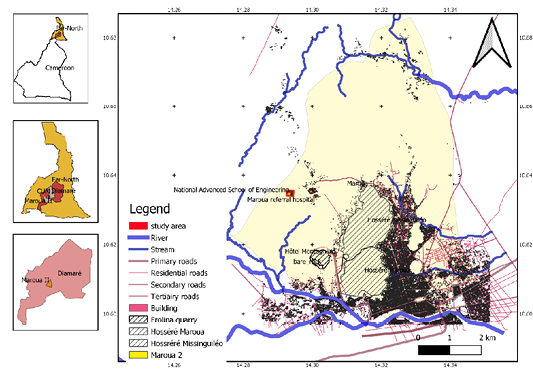
Location map of the study area. (A) The Far North Region of Cameroon; (B) The divisions of the Far North Region; (C) The subdivisions of the Diamaré Division; (D) The location of the National Advanced School of Engineering in the Maroua 2 subdivision. The National Advanced School of Engineering’s application farm is in Maroua 2, a subdivision of the Diamaré division in the Far North Region of Cameroon.
Experimental animals and their management
A total of 200 one-day-old Cobb 500 broiler chicks were obtained from a commercial hatchery (Agrocam, Yaoundé, Cameroon) for the experiment. The study was conducted in accordance with the animal welfare requirements approved by the Cameroonian Bioethics Committee (Reg. No. FWA-IRB00001945/2024) and the HIN-care and use of laboratory animals’ manual (8th edition).
Upon arrival, the chicks were weighed (39.4 ± 3.21 g) and randomly distributed into 20 cages (10 chicks/cage). The birds were accommodated within floor cages, with a layer of wood shavings (5 cm deep) serving as bedding material, and a density of 8 birds/m² was maintained. The lighting schedule was continuous for the initial 24-hour period, followed by a 4-hour period of darkness and 20 hours of light until the conclusion of the experiment. Throughout the experiment, the broiler chickens were housed in an open-sided poultry housing system where the environmental elements were not controlled during the hot season. The birds were provided with feed and water ad libitum under the available housing conditions. Standard health and vaccination programs against Newcastle and Gumboro diseases were carried out. The chicks were observed and examined daily for any clinical signs throughout the experiment.
Experimental design
The experiment followed a completely randomized 2 × 2 factorial design with two drinking systems (plastic and terracotta) and two feeding energy programs: DE1, the reference-energy program (3,300–3,300–3,250 kcal/kg), and DE2, the reduced-energy program (3,300–3,250–3,100 kcal/kg) for the starter, grower, and finisher phases, respectively. Twenty pens were used, with five replicate pens assigned to each treatment combination. Each pen contained 10 broiler chickens and constituted the experimental unit for pen-level performance and mortality variables. The four treatment combinations were plastic drinker + DE1, plastic drinker + DE2, terracotta drinker + DE1, and terracotta drinker + DE2.
The two feeding energy programs had the same energy density during the starter phase but differed during the grower and finisher phases, with DE2 providing lower metabolizable energy than DE1 during these phases. Accordingly, DE1 and DE2 are referred to throughout the manuscript as the reference-energy and reduced-energy programs.
Experimental diets
The diets were formulated from various ingredients purchased at harvest time in Maroua. The chemical composition of the diets was determined according to the methodology described by Helrich and AOAC (1990) at the Faculty of Agronomy and Agricultural Sciences’ (The University of Dschang) laboratory of nutrition and animal feed. As demonstrated in Table 1, two isonitrogenous diets were formulated for each developmental stage.
Data collection
Respiratory rate, rectal temperature, water intake, feed intake, and live body weight were recorded weekly. Mortality was recorded throughout the experimental period and summarized at 49 days of age. For histomorphometric evaluation, two birds per pen were selected at random until 10 birds per treatment had been sampled. The selected birds were fasted for 12 hours, weighed, and slaughtered, and an intestinal portion was collected for histological analysis.
Animal handling in this study was conducted in accordance with the institutional recommendations for the care and use of laboratory animals. The handling procedures followed the ethical standards stated in the approved animal-use protocol.
Heat index (HI)
The ambient temperature and relative humidity were measured daily at 7 AM, 1 PM and 7 PM using a Taylor brand temperature and humidity sensor (FCC ID: WEC-1502) positioned at the chickens’ back level in the center of the room. The heat index was calculated using the formula described by National Research Council (1971), cited by Kendal and Webster (2009).
The heat index (HI) was calculated as follows:
HI = (1.8Tmax + 32) – [(0.55 – 0.0055 Hmin) × (1.8 Tmax – 26)]
In this equation, T denotes the maximum ambient temperature (°C) and H represents the minimum relative humidity (%).
As presented in Table 2, the heat-stress classes, according to the recommendation of Wasti et al. (2020).
Refreshing capacity of the terracotta drinkers
Before the experiment began, the terracotta drinking system was evaluated for its water-cooling capacity. Tap water was stored overnight in a terracotta tank for five
Table 1: Ingredients and nutrient composition of experimental diet.
| Nutrients | Reference-energy program (DE1) | Reduced-energy program (DE2) | ||||
| Starter 1 | Grower 1 | Finisher 1 | Starter 2 | Grower 2 | Finisher 2 | |
| M E (Kcal/kg) | 3307.5 | 3320.65 | 3258.75 | 3353.8 | 3250.17 | 3100.75 |
| Crude protein (%) | 18.15 | 15.24 | 16.01 | 18.06 | 15.74 | 16.20 |
| Phosphore (%) | 0.8 | 0.9 | 1 | 0.8 | 0.9 | 1 |
| Calcium (%) | 2 | 2.3 | 2.6 | 2 | 2.3 | 2.6 |
| Lysine (%) | 1 | 0.9 | 0.8 | 1 | 0.9 | 0.8 |
| Methionine (%) | 0.4 | 0.4 | 0.5 | 0.4 | 0.4 | 0.5 |
Table 2: Heat stress classification for poultry (adapted from .
| HI value (°F) | Description |
| ≤72 | Absolute comfort (no heat stress) |
| 73 to 76 | Light discomfort (mild heat stress) |
| 77 to 80 | Moderate discomfort (moderate heat stress) |
| 81 to 87 | Severe discomfort (severe heat stress) |
| ≥88 | Life threatening (extreme heat stress) |
HI: Heat index.
consecutive days at ambient temperature. Each morning at 7:00 a.m., the water was transferred to one plastic drinker and two terracotta drinkers (3-L and 5-L) obtained from a local producer in Maroua. Water temperature was measured immediately before filling the drinkers and at 2-h intervals thereafter (9:00 and 11:00 am, 1:00, 3:00, 5:00 and 7:00 pm).
Respiratory rate
One day per week, between 12:00 and 1:00 p.m., respiratory rate was estimated for each selected bird according to Perez et al. (2006).
Respiration Rate = 10 × 60/t10
Where: t10 represents the time required to count 10 successive panting breaths.
Rectal temperature
Rectal temperature (RT) was measured once a week at 1:00 p.m. by inserting the probe into the cloaca up to the terminal colon, as recommended by Perez et al. (2006). Birds were selected from the centre of the flock, which allowed them to be captured by gently extending the arms and minimized additional handling stress.
Growth parameters
Feed and water intake: The amount of water and feed consumed by the birds was measured at the end of each week. A known amount of water and feed was provided, and the leftovers were measured for each replicate.
Total water consumption (L) = Total water given to birds (L) – water left-over (L)
Total feed intake (g) = Total feed given to birds (g) – feed left-over (g)
After feed intake and live body weight were measured using a 5-kg capacity scale with 1-g precision, the body weight gain, and feed conversion ratio were calculated in accordance with the following formulas:
Body weight gain = Live body weight of week (n+1) −Live body weight of week (n)
Feed conversion ratio = Weekly Feed intake (g)/Weekly Body weight gain (g)
Mortality was recorded throughout the experimental period. For each pen, mortality was calculated as the number of dead birds divided by the number of birds initially allocated to the pen and was expressed as a percentage. The corresponding death counts and numbers at risk were retained for the binomial analysis.
Histomorphometric measurements
Intestinal tissue from five birds per treatment group was subjected to histological examination. Birds were selected at random. Following slaughter, samples were collected from the mid-gut (jejunum) and fixed in neutral buffered formalin. Five-micrometre-thick hematoxylin-eosin-stained sections were prepared after paraffin embedding and histological processing . The sections were examined by standard light microscopy. Quantitative measurements of villus length and crypt depth were obtained from photomicrographs captured at 40× magnification using ImageJ 1.32j software. For each bird, 10 apparently complete, full-sized villi without bending or mechanical damage were measured (Figure 2). The 10 measurements were averaged to obtain one value per bird; the bird, rather than the individual villus, was therefore the statistical unit for histomorphometric analysis. Measurements were performed by a single observer. The villus length-to-crypt depth ratio was then calculated from the bird-level mean measurements.
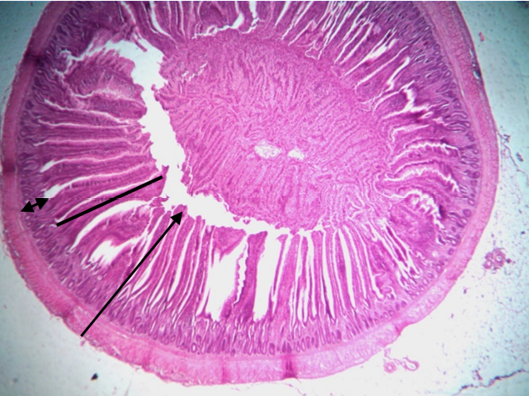
Method for measurements of villus and crypt lengths. (↔︎): Crypt depth; (−): Villus length; (→): Wall thickness.
Data analyses
The experimental unit for feed intake, water intake, body weight gain, feed conversion ratio, and mortality was the pen. Individual physiological measurements obtained from birds within a pen were treated as subsamples and were not considered independent experimental replicates. For variables measured repeatedly over time, observations were retained at the pen/bird level and analysed using repeated-measures mixed-effects models, with pen included as a random effect. For histomorphometry, the 10 villi measured per bird were averaged before analysis, so that the bird was the observational unit. Data are presented as means with their standard deviations (SD), unless otherwise indicated. Before inferential analysis, model assumptions were assessed using residual diagnostics. Normality was evaluated using the Shapiro–Wilk test and Q–Q plots, while homogeneity of variance was assessed using residual-versus-fitted plots and Levene’s test as a supplementary diagnostic. Where assumptions were not adequately met, appropriate transformations or non-parametric/robust procedures were considered.
For variables summarized at a single time point, the factorial model was specified as:
Yijk = µ + Di + Ej + (D × E)ij + εijk
Where Yijk is the observed response, µ is the overall mean, Di is the fixed effect of drinker type, Ej is the fixed effect of feeding energy program, (D × E)ij is the drinker × energy interaction, and εijk is the residual error. The five replicate pens per treatment combination were incorporated as independent experimental units.
Statistical significance was set at P < 0.05. When a significant interaction was detected, simple-effect comparisons were used to describe differences between drinker types within each feeding energy program and/or between feeding energy programs within each drinker type, with Tukey adjustment for multiple comparisons. When no interaction was detected, interpretation focused on the corresponding main effects.
Feed conversion ratio was evaluated at the pen level. The factorial analysis was retained only after assessment of residual normality and homogeneity of variance; these diagnostics indicated no major departure from the model assumptions in the available data.
Wall thickness and villus length were evaluated using the factorial model, with non-parametric/robust analyses used as sensitivity checks when distributional assumptions were questionable. The statistical unit for each histomorphometric variable was the bird-level mean derived from 10 villi.
Mortality was analysed using a generalized linear model with a binomial distribution and logit link. For each pen, the number of dead birds was used as the numerator and the number of surviving birds as the denominator. Drinker type, dietary energy program, and their interaction were included as fixed effects. The model was specified as:
logit(pijk)=µ+Di+Ej+(D×E)ij,\text{logit}(p_{ijk})=\mu+D_i+E_j+(D\times E)_{ij},
Where pijkp_{ijk} is the probability of mortality, DiD_i is the effect of drinker system, EjE_j is the effect of feeding energy program, and D×ED\times E represents their interaction. Statistical significance was declared at P <0.05.
Rectal temperature and respiration rate were analysed using linear mixed-effects models to account for repeated measurements over time. Drinker type, feeding energy program, measurement period, and their two- and three-way interactions were included as fixed effects. Pen was treated as the experimental unit and included as a random effect to account for repeated observations within the same pen. Where individual birds were measured repeatedly, bird identity was included as a subject-level repeated factor. The covariance structure was selected according to the lowest Akaike information criterion (AIC). Model assumptions were evaluated using Q–Q plots and residual-versus-fitted-value plots. When significant interactions were detected, period-specific simple-effect comparisons were performed with Tukey adjustment. Statistical significance was set at P ≤ 0.05.
Results
Heat index
As shown in Figure 3, the ambient heat index in the room remained within the range associated with moderate to severe heat stress throughout the experimental period. The lowest values were recorded at 7:00 am (78–81°F), whereas the highest values occurred around 1:00 pm (86–88°F).
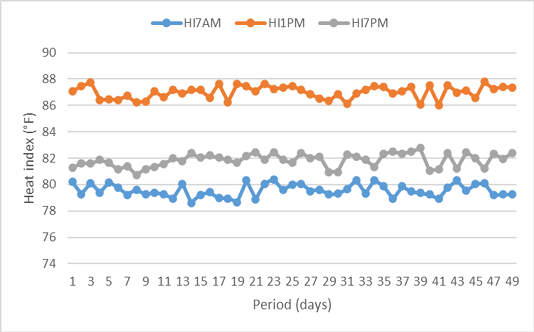
Heat index inside the breeding room during the experiment.
Refreshing capacity of terracotta drinkers
Water temperature in the terracotta and plastic drinkers, together with the temperature of water stored for 12 h in the terracotta tank, is presented in Figure 4. Water temperature in the 3-L and 5-L terracotta drinkers remained relatively stable between 23 and 25°C from 7:00 am to 7:00 pm. In contrast, water temperature in the plastic drinker increased from 24°C to approximately 37°C at 1:00 pm.
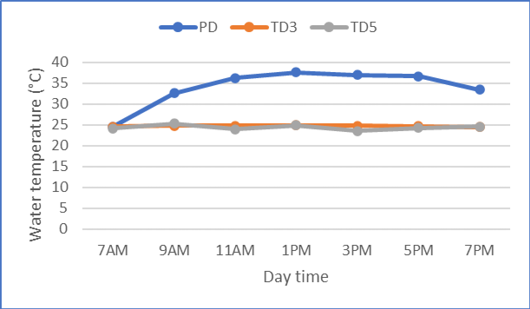
Daily variation of water temperature in plastic or terracotta drinkers. PD: Plastic drinker; TD3: Terracotta drinker of 3L; TD5: Terracotta drinker of 5L
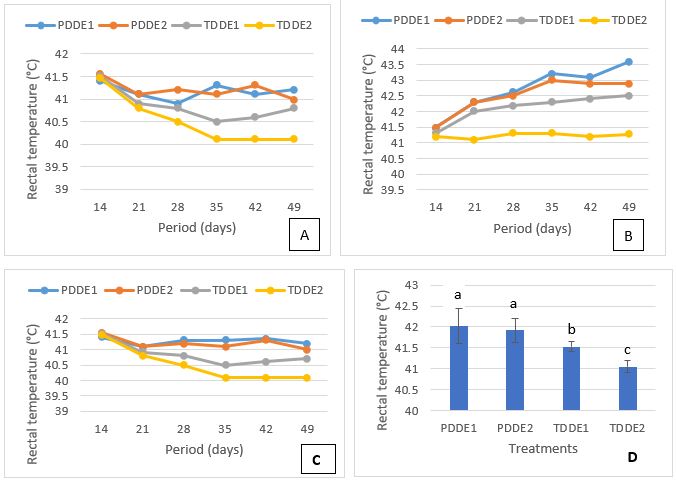
Weekly variation of the rectal temperature at 7 AM (A), 1 PM (B), 7 PM (C) and mean daily (D). a,b (if present): Mean with different superscript within the same graph are significantly (P < 0.05) different. PD: Plastic drinker; TD: Terracotta drinker; DE1: Low diet energy program; DE2: High diet energy program.
Rectal temperature
Weekly rectal temperature values are presented in Figure 5. The mixed-effects analysis showed no significant effect of drinker type (P= 0.200), dietary energy program (P= 0.776), or measurement period (P= 0.230). None of the interactions was significant (P > 0.05), including the drinker × energy interaction (P= 0.920) and the drinker × energy × period interaction (P= 0.721). Although rectal temperature tended to be lower in birds provided with terracotta drinkers, this descriptive difference was not statistically significant in the repeated-measures analysis.
Respiration rate
As shown in Figure 6, weekly respiration rate values are presented according to feeding energy program and drinker type. The mixed-effects analysis showed significant effects of drinker type (P < 0.001) and measurement period (P = 0.004). The drinker × energy interaction was not significant (P = 0.181), whereas significant drinker × period (P < 0.001), energy × period (P < 0.001), and drinker × energy × period (P < 0.001) interactions were detected. The significant three-way interaction indicates that the effect of feeding energy program on respiration rate differed according to drinker type and changed across measurement periods. Accordingly, the interpretation of treatment effects should rely on period-specific simple effects rather than on the main effects alone. Descriptively, respiration rate was generally lower in birds receiving terracotta drinkers, although the magnitude of the difference varied across feeding energy programs and measurement periods.
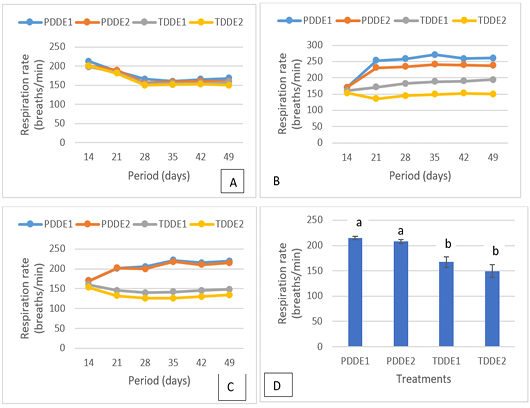
Weekly variation of the respiration rate at 7 AM (A), 1 PM (B), 7 PM (C) and mean daily (D). a,b (if present): Mean with different superscript within the same graph are significantly (P < 0.05) different. PD: Plastic drinker; TD: Terracotta drinker; DE1: Low diet energy program; DE2: High diet energy program.
Growth parameters
As shown in Table 3, growth and mortality outcomes differed according to drinker type, feeding energy program, and their interaction. Drinker type had significant main effects on daily water intake (P = 0.0026), daily feed intake (P < 0.0001), daily body weight gain (P= 0.0021), feed conversion ratio (P= 0.037), and mortality (P= 0.027). The findings revealed significant increases in daily water and feed intake and body weight gain (P < 0.01) in the terracotta group compared to the plastic group.
Table 3: Growth performance and mortality of broiler chickens according to drinker type and dietary energy program.
| Parameters | Plastic drinker | Terracotta drinker | P value | ||||
| DE1 | DE2 | DE1 | DE2 | Drinkers | Energy program | Interaction | |
| DWI (mL) | 295.0±14.84ab | 323.6±19.71a | 290.4±20.65b | 273.7±11.33b | 0.0026 | 0.4503 | 0.0091 |
| DFI (g) | 58.41±2.68ab | 61.49±1.65a | 56.33±2.62b | 49.46±3.11c | 0.1187 | 0.0005 | |
| DBWG (g) | 24.5±3.49a | 27.25±5ab | 30.96±3.98ab | 32.98±1.56b | 0.0021 | 0.1718 | 0.8302 |
| FCR | 2.08±0.52 | 2.11±0.6 | 1.67±0.32 | 1.56±0.4 | 0.037 | 0.99 | 0.54 |
| Mortality | 15/50 | 13/50 | 10/50 | 5/50 | 0.027 | 0.224 | 0.404 |
DE1: Reference-Energy Program; DE2: Reduced-Energy Program; DWI: Daily water intake; DFI: Daily feed intake; DBWG: Daily body weight gain; FCR: Feed conversion ratio.
Table 4: Histomorphometric characteristics of the small intestine according to drinker type and dietary energy program.
| Parameters | Plastic drinker | Terracotta drinker | P value | ||||
| DE1 | DE2 | DE1 | DE2 | Drinkers | Energy program | Interaction | |
| WT (µm) | 687.12±117.54 | 668.81±197.72 | 710.19±151.9 | 612.04±60.17 | 0.098 | 0.088 | 0.8911 |
| VL (µm) | 372.6±69.56a | 328.5±23.84b | 392±69.11a | 402.8±65.12a | 0.1460 | 0.017 | |
| CD (µm) | 103.6±22.69a | 80.77±16.28b | 96.31±14.76a | 80.49±15.93b | 0.2967 | 0.2598 | |
| VL/CD | 3.82±1.34a | 4.22±0.83a | 4.14±0.86a | 5.19±1.38b | 0.0029 | 0.0010 | 0.1323 |
DE1: Reference-Energy Program; DE2: Reduced-Energy Program; WT: Wall thickness (Kruskal-Wallis test: H = 7.81, P = 0.050); VL: Villi length (Kruskal-Wallis test: H = 21.58, P = 0.0001); VL/CD: Villi length to crypt depth ratio; CD: Crypt depth
Concurrently, the mortality rate was observed to decrease significantly (P < 0.01) in the terracotta group. Feeding energy program did not significantly affect any of these outcomes (P > 0.05). Significant drinker × energy interactions were detected for daily water intake (P= 0.0091) and daily feed intake (P= 0.0005), whereas the interactions were not significant for daily body weight gain (P= 0.8302), feed conversion ratio (P= 0.54), or mortality (P= 0.404). Therefore, differences between individual treatment combinations for water and feed intake were interpreted in the context of the significant interaction. Descriptively, water and feed intake were generally lower in birds receiving terracotta drinkers, although the magnitude of the difference varied across feeding energy programs.
Histomorphometric characteristics of the small intestine
As shown in Table 4, histomorphometric responses differed according to the factor considered. Drinker type significantly affected villus length (P < 0.0001) and the villus length-to-crypt depth ratio (P = 0.0029), but not wall thickness or crypt depth. Feeding energy program significantly affected only the villus length-to-crypt depth ratio (P = 0.0010). Significant drinker × energy interactions were detected for villus length (P = 0.017) and crypt depth (P < 0.0001), whereas the interaction was not significant for wall thickness (P = 0.8911) or the villus length-to-crypt depth ratio (P = 0.1323). These results indicate that the response of villus length and crypt depth depended on the combination of drinker type and feeding energy program.
Discussion
Cooling capacity of terracotta drinkers
In the present study, water temperature differed markedly between drinker types. Water in the plastic drinker increased from 24.17 °C to 37.57°C between 7:00 a.m. and 1:00 p.m., whereas water in the terracotta drinkers remained comparatively stable, at approximately 24°C. This pattern is consistent with the passive evaporative-cooling properties of porous terracotta vessels. In fact, the slight porosity of the terracotta trough permits a minimal quantity of water to pass through its walls to the exterior, thereby maintaining the container’s moisture content. During the phase change from liquid to gas, the water absorbs heat energy from the ambient air, thereby reducing its temperature. This cooling method requires only water as a coolant. This natural evaporation process has been shown to maintain a significantly lower water temperature in the trough than the ambient temperature .
Physiological responses to drinker type and feeding energy program
The temperature-humidity index recorded during the experiment indicated moderate-to-severe heat stress conditions, particularly during the warmest part of the day. Such environmental conditions are known to increase the reliance of broilers on respiratory evaporative cooling and can impair feed intake and productive performance ; ; . The environmental conditions therefore, provided an appropriate context in which to examine whether drinker type and feeding energy program were associated with differences in physiological and productive responses.
Respiration rate was significantly affected by drinker type and measurement period, and significant interactions involving measurement period were also detected. In particular, the significant three-way interaction between drinker type, feeding energy program, and measurement period indicates that the response changed across time and was not uniform across the two drinking systems. The generally lower respiration rate observed with terracotta drinkers is consistent with the possibility that cooler drinking water supported heat dissipation. Such mechanism have been reported by some authors ; . Nevertheless, this interpretation should remain cautious because the experiment did not independently manipulate water temperature. The observed response may therefore reflect the combined characteristics of the terracotta drinking system, including its water-temperature profile.
In contrast to the descriptive tendency toward lower values in birds receiving terracotta drinkers, the repeated-measures analysis did not detect a significant effect of drinker type on rectal temperature (P = 0.200), feeding energy program (P = 0.776), or their interaction (P = 0.920). This finding is important because it does not support a direct statistical conclusion that terracotta drinkers lowered core body temperature under the conditions tested. The lower water temperature maintained by the terracotta system may have contributed to the observed physiological pattern, but this explanation remains a hypothesis because water temperature and drinker material were not experimentally separated.
Growth performance and feed utilization
The effects of drinker type on water and feed intake were more complex than a simple overall comparison between terracotta and plastic drinkers. Drinker type had significant main effects on daily water intake and daily feed intake, and significant drinker × feeding energy interactions were also detected for both variables (P = 0.0091 and P = 0.0005, respectively). These interactions indicate that the magnitude and direction of the response depended on the feeding energy program. Therefore, the individual treatment means should be interpreted as simple effects rather than as evidence that terracotta drinkers universally increase or decrease intake. The lower water temperature maintained by terracotta drinkers may have contributed to these differences, but other characteristics of the drinking system cannot be excluded.
The observed feed-intake pattern should also be interpreted in relation to the factorial analysis. Although feed intake differed among treatment combinations, the significant drinker × energy interaction indicates that the effect of drinker type depended on feeding energy program. It is therefore not appropriate to attribute the response solely to terracotta drinkers or solely to the reduced-energy program. Cooler water may have supported thermoregulation and altered the birds’ drinking and feeding responses ; , but the present experiment did not directly measure metabolic heat production, nutrient partitioning, or digestive processes. Consequently, these mechanisms should be regarded as possible explanations rather than demonstrated pathways.
Daily body weight gain was significantly affected by drinker type (P= 0.0021), whereas neither feeding energy program nor the drinker × energy interaction was significant. Thus, the higher body-weight gain observed in some terracotta-drinker treatment combinations should be interpreted primarily as a drinker-type effect. The absence of a significant interaction indicates that the effect on daily body weight gain did not depend statistically on the feeding energy program in the present dataset. Previous studies have reported improved growth in heat-stressed broilers supplied with cool water ; Cyrille d’Alex et al., 2024), which is broadly consistent with the present association between drinker type and growth.
Feed conversion ratio was also significantly affected by drinker type in the current analysis (P = 0.037), whereas the feeding energy main effect and the drinker × energy interaction were not significant. The lower numerical feed conversion ratios observed with terracotta drinkers may therefore be consistent with improved feed efficiency associated with the drinking system. Possible explanations include differences in water temperature, hydration status, or other characteristics of the drinking system. Because digestibility, nutrient absorption, and metabolic heat production were not directly measured, these mechanisms remain speculative.
Mortality was significantly associated with drinker type (P = 0.027), while neither feeding energy program nor the drinker × energy interaction was significant. The lower mortality observed in pens with terracotta drinkers may be interpreted as a drinker-type association under the experimental conditions. The observed pattern may be consistent with improved thermal management, but confirmation would require analyses based on individual mortality events and adequately powered experimental replication. Even though futher analyses on individual mortality events are required for the terracotta drinker effect confirmation, several studies indicated that under severe stress, chickens mortality can be reduced by preventing dehydration and maintaining a low internal temperature ; ; .
Intestinal histomorphometry provided evidence of factor-specific and interactive responses. Drinker type significantly affected villus length and the villus length-to-crypt depth ratio, while feeding energy program significantly affected the villus length-to-crypt depth ratio. Significant drinker × energy interactions were observed for villus length and crypt depth. These findings indicate that the intestinal response to the drinking system was not uniform across all measurements and that the effects of drinker type on villus length and crypt depth depended on the feeding energy program. The higher villus length-to-crypt depth ratio observed in some treatment combinations may be compatible with better intestinal functional status . Manon and Vetea (2022) reported that an elevated villus length-to- crypt depth ratio is often linked to better health outcomes, improved intestinal digestive function, and optimized nutrient absorption. But since intestinal permeability, nutrient absorption, and digestive capacity were not measured directly, mechanistic interpretations of the present data remain cautious.
Conclusion
In conclusion, terracotta drinkers were associated with improved water and feed intake, daily body weight gain, feed conversion ratio, and lower mortality under the heat-stress conditions of this experiment. However, the magnitude and statistical nature of these effects varied among outcomes. Significant drinker × feeding energy interactions were detected for daily water intake, daily feed intake, villus length, and crypt depth, but not for daily body weight gain, feed conversion ratio, mortality, or the repeated-measures rectal-temperature response. Terracotta drinkers also maintained substantially cooler water than plastic drinkers during the daytime, while respiration rate was lower overall with terracotta drinkers and showed time-dependent interactions with feeding energy program. These findings support terracotta drinkers as a potentially practical passive-cooling option under hot environmental conditions, but they do not establish that terracotta material itself, rather than the lower water temperature or other characteristics of the drinking system, caused the observed responses. Further studies should separate the effects of drinker material from water temperature and should confirm the observed interactions using adequately powered repeated-measures and hierarchical models.
ACKNOWLEDGEMENT
The authors would like to thank and appreciate the National Advanced School of Engineering of the University of Maroua, and the Faculty of Agronomy and Agricultural Sciences of the University of Dschang, Cameroon, for the facilities used to conduct the present study.
NOVELTY STATEMENT
This study pointed out significant drinker × feeding energy interactions for daily water intake, daily feed intake, villus length, and crypt depth, but not for daily body weight gain, feed conversion ratio, mortality, or the repeated-measures rectal-temperature response in heat-stressed broiler chickens.
AUTHOR’S CONTRIBUTION
TTCD: Conceptualization; data curation, formal analysis, investigation, methodology, project administration, writing original draft, writing review and editing. KB: Data curation, formal analysis, investigation, methodology, software, writing original draft. TJP: Methodology, software, visualization, writing review and editing. LN: Data curation, formal analysis, investigation, software. KJR: Supervision; visualization, writing review and editing. FN: Supervision, validation, visualization, writing review and editing. AT: Supervision, validation, visualization, writing review and editing.
Data availability statement
The data presented in this study are available on request from the corresponding author.
Generative AI and AI assisted technology statement
During the preparation of this work, the authors used “DeepL write” to improve the language quality of the manuscript. After using this tool, the authors reviewed and edited the content as needed and take full responsibility for the content of the publication.
Statement of conflict of interest
The authors have declared no conflict of interest.
References
- Abbas G, Ahmad F, Saeed M, Ayasan T, Mahmood A, Yasmeen R, Kamboh A (2019). Effect of dietary inclusion of sodium bicarbonate on digestibility of nutrients and immune response in caged layers during the summer. Braz. J. Poult. Sci., 21(2): eRBCA-2018. [CrossRef]
- Abioja MO, Osinowo OA, Smith OF, Eruvbetine D, Abiona JA (2011). Evaluation of cold water and vitamin C on broiler growth during hot‐dry season in the humid tropical conditions of south‐western Nigeria. Arch. Zoot., 60(232): 1095–1103.
- Collin A, Coustham V, Tona JK, Tesseraud S, Mignon-Grasteau S, Meda B, Zerjal T (2024). Face au changement climatique, quelles stratégies d’atténuation et d’adaptation pour les productions avicoles? INRAE Prod. Anim., 37(1): 8069.
- Cyrille d’Alex TT, Gilhoube E, Djaomanwe D, Ledang N, Ponka R, Ngoula F, Teguia A (2024). Effect of terracotta drinker and/or water addition of ASPRO‐C Plus on behavior, growth, and physiological response of broiler chickens exposed to high temperature. Anim. Res. One Health, pp. 1–11.
- Eltahan HM, Kang CW, Chowdhury VS, Eltahan HM, Abdel‐Maksoud MA, Mubarak A, Lim CI (2023). Cold drinking water boosts the cellular and humoral immunity in heat‐exposed laying hens. Animals, 13(4): 580. [CrossRef]
- Helrich K, AOAC (1990). Official methods of analysis of the association of official analytical chemists. 15th Edn., Arlington, VA: The Association, Washington D.C., ISBN-13: 9780935584424.
- Kamboh AA, Hang SQ, Bakhetgul M, Zhu WY (2013). Effects of genistein and hesperidin on biomarkers of heat stress in broilers under persistent summer stress. Poult. Sci., 92(9): 2411-2418. [CrossRef]
- Kaya M, Dereli FE (2023). The effect of drinking water temperature and stocking density on broiler performance, meat quality and some behavioral traits at high ambient temperature. J. Hellenic Vet. Med. Soc., 74(1): 5315–5324.
- Kendall PE, Webster JR (2009). Season and physiological status affects the circadian body temperature rhythm of dairy cows. Livest. Sci., 125: 155-160. [CrossRef]
- Kim CH, Lee WD, Lim SJ, Yang KY, Jeon JH (2025). Effects of cool water supply on laying performance, egg quality, rectal temperature and stress hormones in heat-stressed laying hens in open-type laying houses. Animals, 15: 1635. [CrossRef]
- Lara, L. J., and Rostagno, M. H. (2013). Impact of Heat Stress on Poultry Production. Animals, 3(2), 356–369. https://doi.org/10.3390/ani3020356 [CrossRef]
- Lison L (1960). Histochimie et cytochimie animales. Gauthiers-Villars, Paris, pp. 842. [CrossRef]
- Makule E, Dimoso N, Tassou S (2022). Precooling and cold storage methods for fruits and vegetables in sub‐saharian Africa: A review. Horticulturae, 8(9): 776.
- Mangan M, Siwek M (2024). Strategies to combat heat stress in poultry production-A review. J. Anim. Physiol. Anim. Nutr. (Berl). 108(3): 576-595. [CrossRef]
- Manon J, Vetea PG (2022). Intérêt de l’utilisation d’un noyau photogénique dans la Gestion d’un pool de mycotoxines en volaille de chair en Comparaison à un capteur à base d’argile: Nouvelle approche par la gestion des seuils de tolérance aux Contaminants de l’aliment. Quatorzièmes Journées de la Recherche Avicole et Palmipèdes à Foie Gras, Tours, 09 et 10 mars 2022, 5p.
- National Research Council (US) (1971). A guide to environmental research on animals. National Academies.
- Oluwagbenga EM, Fraley GS (2023). Heat stress and poultry production: a comprehensive review. Poult. Sci., 102: 103141. [CrossRef]
- Onagbesan OM, Uyanga VA, Oso O, Tona K, Oke OE (2023). Alleviating heat stress effects in poultry: Updates on methods and mechanisms of actions. Front. Vet. Sci., 10: 1255520.
- Park S, Park B, Hwangbo J (2015). Effect of cold water and inverse lighting on growth performance of broiler chickens under extreme heat stress. J. Environ. Biol., 36(4): 865–873.
- Pérez M, De Basilio V, Colina Y, Oliveros Y, Yahav S, Picard M, Bastianelli D (2006). Evaluation du niveau de stress thermique par mesure de la température corporelle et du niveau d’hyperventilation chez le poulet de chair dans des conditions de production au Venezuela. Rev. Élev. Méd. Vét. Pays Trop., 59(1–4): 81–90. [CrossRef]
- Saeed M, Abbas G, Alagawany M, Kamboh AA, Abd El‐Hack ME, Khafaga AF, Chao S (2019). Heat stress management in poultry farms: A comprehensive overview. J. Therm. Biol., 84: 414–425. [CrossRef]
- Ward D, Dam A, Creighton C (2020). Le stress thermique chez les poules pondeuses commerciales. In Fiche technique, NO 20‐026, AGDEX 451/20. Publié par le Ministère de l’Agriculture, l’Alimentation et des Affaires rurales de l’Ontario. Imprimeur de la reine pour l’Ontario. ISSN 1198‐7138.
- Wasti S, Sah N, Mishra B (2020). Impact of heat stress on poultry health and performances, and potential mitigation strategies. Animals, 10: 1266. [CrossRef]

Services
Article usage statistics
Loading…
Related articles
- Effects of Housing and Feeding Types on Growth and Physiological Performance of Growing Rabbits (Oryctolagus cuniculus) in Humid TropicsAdvances in Animal and Veterinary Sciences · 2024
- Effects of Feeding Multi-Strain Probiotics and Multi-Enzymes to Broilers on Growth Performance, Intestinal Morphology and Cost Effectiveness of ProductionAdvances in Animal and Veterinary Sciences · 2022
- Optimizing Broiler Chick Management: Interactive Effects of Initial Body Weight and Post-Hatch Feed Deprivation on Growth, Hematological Immune Response, and Intestinal IntegrityAdvances in Animal and Veterinary Sciences · 2025
- Effects of Antibiotics on Growth Performance, Immune Response, and Intestinal Microflora of BroilersPakistan Journal of Zoology · 2022
- Interactive Effects of Chick Hatch Weight and Dietary Antioxidant Supplementation on Physiological, Hematological, and Intestinal Responses in BroilersJournal of Animal Health and Production · 2025
- Effect of Restricted Feeding on Growth Performance, Carcass Traits, Blood Hematology, Internal Organs, and Intestinal Histomorphology of BroilersAdvances in Animal and Veterinary Sciences · 2024