
This study aimed to determine the ability of Polled Bali Cattle (PBC) to adapt to temperature variations that affect physiological and hematological profiles during heat stress periods. The fourteen cattle used in this study included four horned male Bali cattle and four male PBC, three horned female Bali cattle, and three female PBC. Each animal was measured twice: in the morning, from 6:30 to 7:30 am (before eating and other activities), and at noon, from 1:00 to 2:00 pm. The effects of heat stress were evident in changes in rectal temperature, which was higher in PBC males (p<0.01) and females (p<0.05). The body surface temperature of PBC was lower than that horned Bali cattle, although the difference was not statistically significant (p>0.05). Thermoregulatory activity in PBC was not manifested through an increased respiratory rate but was instead indicated by changes in hematological parameters. Homeostatic regulation was reflected by a significant reduction in procalcitonin (PCT) levels (p < 0.05) in male PBC and by significant decreases in red blood cell (RBC) count and hemoglobin concentration (p < 0.05) in female PBC. In conclusion, homeostatic regulation in PBC appeared to be mediated by hematological mechanisms, likely associated with the absence of horns.
Research Article · Volume 15, Issue 1, Pages 241–247, 21 November 2026 · Open Access
Influence of the Polled Phenotype on Environmental Stress Adaptation in Bali Cattle (Bos javanicus) in Indonesia
, , , , ,
Affiliations & Notes ⌄
- 1Faculty of Animal Science, Hasanuddin University, 90245 Makassar, Indonesia
- 2Faculty of Vocational Studies, Hasanuddin University, 90245 Makassar, Indonesia
- 3Research and Innovation Agency (BRIN), 16911 Cibinong, Indonesia
- 4Faculty of Agricultural Engineering, University of Cokroaminoto, 90245 Makassar, Indonesia
- *Correspondence | Zulkharnaim; Email: zulkharnaim@unhas.ac.id
Article Info ⌄
- Journal:
- Journal of Animal Health and Production
- Submitted Date:
- 17 September 2026
- Accepted Date:
- 14 December 2026
- Published Date:
- 21 November 2026

Abstract
Introduction
Tropical climatic conditions necessitate that beef cattle breeds possess the capacity to adapt to changes in temperature, humidity, and climate. Polled Bali Cattle (PBC) are Bali cattle that do not naturally grow horns . As a newly developed local beef cattle breed in Indonesia, PBC are expected to possess the ability to adapt to climate change. To evaluate their adaptability to temperature changes, it is necessary to investigate their hematological and physiological profiles. The hematological profile serves as a physiological indicator that can be used to assess the health status of animals. A good blood profile can support animals in achieving optimal performance, while an ideal physiological condition profile can enhance livestock production and productivity .
In the beef industry, polled cattle are preferred due to cultural and traditional preferences, as well as farmers’ desire to reduce the incidence of horn-related injuries . In the United States, horn-related injuries are frequent and are recognized as one of the top ten challenges in the beef supply chain . Polled Bali cattle (PBC) are currently being developed in South Sulawesi Province, Indonesia, as a beef cattle breed suited to tropical environments.
The objective of this study was to assess the adaptability and performance of PBC under varying temperature conditions by evaluating their physiological responses and hematological profiles during heat stress exposure. Specifically, this study investigated whether the absence of horns is associated with altered stress responses to increasing environmental temperatures, as reflected by physiological and hematological indicators. The physiological and hematological parameters examined in this study enable the identification of key hematological variables involved in body heat regulation in PBC, which may serve as potential selection criteria for improved environmental adaptability.
Materials and Methods
Animal management and experimental design
Ethical approval for this study was obtained from the Hasanuddin University Ethics Committee on using Research and Learning Animals (029/UN4.12/EC/IX/2025). This study was conducted in Enrekang Regency, South Sulawesi Province, Indonesia, from December 2024 to March 2025. The Enrekang Regency is at a latitude of 3°46’14” and 3°46’14”S and a longitude of 119°51’13” and 119°51’2”E. The humidity is 79% to 98%, and temperatures are 23°C to 29°C. The 14 Bali cattle used in this study were: 4 male horned cattle, 4 male PBC, 3 female horned cattle, and 3 female PBC, with an adult age of 18-24 months. The cattle were housed in individual cages measuring 1.5 m x 2.0 m. All the cattle were fed elephant grass (Pennisetum purpureum) with supplementary rice bran-based concentrate. The feeding schedule was twice daily, at 08:00 a.m. and 3:00 p.m. Water was provided ad libitum through a drinking trough in the cage.
Each animal was measured twice: in the morning, from 6:30 to 7:30 a.m. (before eating and engaging in other activities), and in the day, from 1:00 to 2:00 p.m. Measurements were taken monthly from December 2024 to March 2025. Physiological measurements were conducted on the study animals including rectal temperature, skin surface temperature, and respiration rate. Blood was drawn from the jugular vein and placed in a 4 mL Vaculab EDTA-K3 vial (One Med, Indonesia). The collected samples were transferred in a cooler box to the laboratory and kept at 4 ºC.
Measured variables
Environmental parameters
Temperature, relative humidity (RH), and temperature-humidity index (THI) were the environmental parameters measured in this study. Ambient temperature and humidity were measured using a thermohygrometer placed in the location to be measured and left for 5 minutes before a reading was taken. The relationship between air temperature and humidity is calculated using the THI to measure the comfort level of the livestock environment according to Brown-Brandl (2018).
THI = (1.8 x Ta + 32) - [(0.55 – 0.0055 x RH) x (1.8 x Ta – 26)]
Where Ta = air temperature (°C) and RH = relative humidity (%). As a component of the guidelines, Livestock Conservation Inc. developed the Livestock Weather Safety Index based on the following four THI categories: normal, THI < 74; alert, 74 < THI < 79; danger, 79 < THI < 84; and emergency, THI > 84 .
Physiological parameters
The body physiological parameters measured in the horned Bali cattle and PBC in this study include rectal temperature, skin temperature, and respiration rate. Rectal temperature was measured using an Omron digital thermometer model MC-343F (Omron Healthcare Co. Ltd., Japan). The thermometer was inserted 5-6 cm into the rectum at an angle to the rectal wall . The skin temperature was measured using an Omron model MC- 720 infrared thermometer (Omron Healthcare Co. Ltd., Japan) at 1-5 cm from the skin surface at four measuring points: back (A), chest (B), thigh (C), and lower leg (D). The average skin surface temperature was calculated according to McLean et al. (1983):
Skin temperature = 0.25 (A + B) + 0.32 C + 0.18 D
The respiration rate was measured visually by counting flank movements with a stopwatch, following Shilja et al. (2016).
Hematological parameters
Samples were tested using a veterinary hematology analyzer (Prokan, Model PE-6100) to calculate the number of red blood cells (RBC), hemoglobin (HGB), hematocrit (HCT), white blood cell (WBC), lymphocytes (LYM), mean cell volume (MCV), mean cell hemoglobin (MCH), mean cell hemoglobin concentration (MCHC), mean platelet volume (MPV), red cell distribution width - coefficient of variation (RDW-CV), platelet distribution width (PDW), platelet count (PLT), procalcitonin (PCT), platelet-large cell count (P-LCC), platelet large cell ratio (P-LCR), and eosinophils. All assays were conducted following the standard operating procedures provided by the manufacturer of the hematology analyzer.
Data analysis
The data for rectal temperature, skin surface temperature, respiratory rate, and hematological profile studies were analyzed using factorial analysis of variance (ANOVA) with a 2 x 2 factorial design based on a completely randomized design (CRD), utilizing SPSS 26.0 statistical software.
Results and discussion
The effects of climate change are already negatively impacting livestock producers and animal welfare. Ambient temperatures in Indonesia are generally high, ranging from 24 to 34°C, with humidity levels consistently between 60 and 90% throughout the year . This study was conducted to evaluate the PBC’s ability to cope with the ambient temperature changes. It aims to examine the relationship between ambient temperature fluctuations, physiological response parameters and hematological profile variables.
Microclimatic conditions of the research site
The temperature measurements obtained from the research site showed significant differences (p<0.05) between morning and daytime temperatures, with Ta increasing by 3.67°C during the day. In contrast, the increase in RH was not significant (p>0.05). The THI values exhibited a significant difference between morning and daytime periods (p<0.05), with THI levels increasing by 5.01 units during the day (Table 1). Based on the THI values, the temperature changes observed at the study site can be categorized as a transition from a normal to an alert state. The THI is a metric used to indicate the level of heat stress in cattle . It is important to note that these conditions are specific to the tropical regions; therefore, beef cattle must exhibit a high degree of adaptability. Such conditions may lead to disturbances in various physiological systems, including production, reproduction, immune function, and overall welfare .
Table 1: Ambient temperature, relative humidity, and temperature–humidity index at the research area.
| Time of measurement | Ta (°C) | RH (%) | THI | Environmental comfort category |
| Morning | 24.67±1.15a | 63.33±7.51ns | 72.64±1.05a | Normal |
| Day | 28.33±1.15b | 61.33±4.93ns | 77.65±1.00b | Alert |
Ta: ambient temperature; RH: relative humidity; THI: temperature humidity index. a,bSignificant differences (P<0.05) are indicated by different superscripts in the same column.
Ta and RH are two parameters commonly used to describe environmental conditions. Variations in these parameters directly affect livestock performance. To better assess the impact of environmental factors on individual animals, these parameters are combined into the THI, which reflects the interaction between Ta and RH. At the research location, the THI indicated a anormal status in the morning and changes to alert status in the day. This indicates that individual livestock will experience stress due to fluctuations in temperature and humidity. Heat stress is influenced by several climatic factors, including air temperature, humidity, air movement, solar radiation and precipitation . The THI incorporates the combined effects of temperature and relative humidity and is widely used to quantify heat stress in dairy and beef cattle . FFurthermore, the THI is a reliable indicator of thermal stress in livestock and has also been applied to predict stress conditions in broilers and other animal species.
Physiological response
Physiological responses are defined as the reactions of livestock to environmental changes and the resulting impacts of these changes. Several key physiological indicators have been identified in livestock, including rectal temperature, skin surface temperature, and respiratory rate. These parameters are commonly used to describe how animals physiologically adapt to environmental fluctuations. As illustrated in Figures 1–3, the physiological responses of polled Bali cattle (PBC) differ markedly from those of horned Bali cattle.
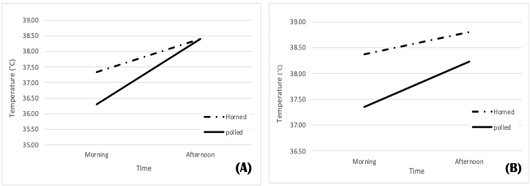
Rectal temperature of PBC and horned cattle: male (A) and female (B).
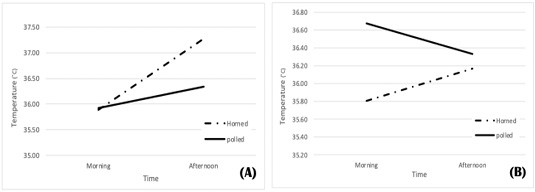
Skin temperature of PBC and horned cattle: male (A) and female (B).
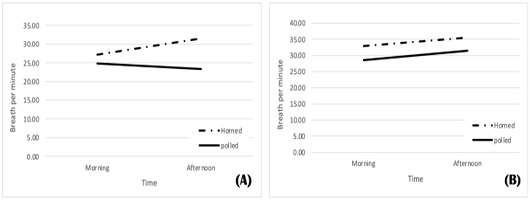
Respiration rate of PBC and horned cattle: male (A) and female (B).
As illustrated in Figure 1, the effect of environmental changes from morning to daytime on rectal temperature in both PBC and horned cattle. During the day, the rectal temperature of males, with recorded at 38.4°C in both groups. A highly significant difference (p<0.01) was observed in the magnitude of rectal temperature increase among males., with PBC males showing the greatest rise of 2.10°C compared to 1.07°C in horned cattle (Figure 1). Significant differences (p<0.05) were also observed among females, with PBC exhibiting an increase of 0.88°C, while horned females showed an increase of 0.43°C.
In response to environmental heat stress, PBC increases its body temperature, as indicated by a higher rectal temperature in the day (Figure 1). Cattle are homeothermic animals that can regulate their internal body temperature within a stable range despite changes in environmental temperature. According to Tami (2018), cattle are capable of maintaining a relatively constant body temperature under various environmental conditions. Based on the results of this study, both male and female PBC showed a greater increase in temperature during the day compared to horned cattle. Horned Bali cattle appeared to be more adaptable to environmental temperature changes, as they did not exhibit a high daytime temperature. In contrast, PBC seemed less capable of coping with elevated temperatures. However, the rectal temperature of the PBC remained within the normal range for beef cattle, which is 36.67°C – 39.11°C . This finding suggests that, although ambient temperature increased during the day, it did not cause a significant rise in stress levels in either PBC or horned Bali cattle.
No significant differences (p>0.05) in physiological responses in skin surface temperature in both males and females were observed. The absence of stress in the cattle was confirmed by skin surface temperatures ranging from 35.81°C to 37.28°C. In contrast to the smaller increase in skin surface temperature observed in male PBC, a decrease in temperature was noted in female PBC. PBC do not regulate or reduce their body temperature through respiration, as their respiratory rate is lower than that of horned Bali cattle. The responses of PBC and horned cattle to changes in ambient temperature differ. Although both groups should theoretically adjust to variations in environmental temperature, both remained within the normal range. Nevertheless, the statistically significant differences in rectal temperature are interesting to discuss. PBC showed a greater increase in rectal temperature than horned cattle (Figure 1). Regarding respiratory rate, male PBC showed a decrease in the day, indicating that elevated environmental temperature did not induce physiological stress. This is reinforced by the fact that the change in skin surface temperature is smaller than that of horned male cattle.
Based on the skin temperature measurements presented in Figure 2, male PBC experienced a smaller increase in skin surface temperature (0.42°C) compared to horned cattle (1.39°C) in the daytime. However, this difference was not statistically significant (p>0.05). Conversely, female PBC showed a decrease in skin temperature of 0.34°C in the day, whereas horned females experienced an increase of 0.36°C (Figure 2B). Skin surface temperature, which represents the accumulated temperature of the back, chest, upper and lower limbs, serves as a reliable parameter for determining the thermal status of cattle. Regarding respiration rate (RR) (Figure 3), male PBC showed a significantly different response (p<0.05), by showing a decrease in RR in the day. Conversely, horned males demonstrated an increase in RR (Figure 3). For female PBC, the increase in RR was smaller than that observed in horned females, although this difference was not statistically significant (p>0.05).
A similar trend was observed in the female PBC, where changes in respiratory rate were minimal (Figure 3). Moreover, their body surface temperature decreased in the day (Figure 2). In both male and female PBC, increases in ambient temperature were reflected in physiological mechanisms, as indicated by hematological responses. Changes in hematological parameters in male cattle (PBC and horned cattle) were characterized by increased WBC and lymphocyte counts. This increase is thought to play a role in minimizing physiological stress in response to environmental changes. WBC and lymphocyte count at THI of 76.51 in beef calves reached 14.5 k/µL and 11.3 k/µL, respectively . In the present study, at THI of 77.65, male PBC exhibited WBC and lymphocyte counts of 11.34 k/µL and 5.36 k/µL, respectively.
Hematological profile
In order to combat the consequences of heat stress, three principal responses are observed in cattle. Firstly, blood flow to the skin increases to facilitate heat dissipation. Secondly, feed intake is reduced to lower metabolic heat production. Thirdly, genes are activated, including those encoding heat shock proteins and heat shock transcription factors, which play key roles in cellular protection and thermotolerance.
The hematological analysis of male PBC and horned males, based on the time difference between morning and daytime measurements, revealed two statistically significant differences (p<0.05) in white blood cell count (WBC) and lymphocyte count (Table 2). However, when comparing the horn type variable, a significant difference was observed only in the procalcitonin (PCT) parameter (p<0.05). In female PBC and female horned cattle, two interaction variables were statistically different (p < 0.05): red blood cell count (RBC) and hemoglobin. When analyzed by time, three parameters differed: RBC, hemoglobin and PLT count (p<0.01). Based on horn type,
Table 2: Hematological profiles of polled Bali cattle (PBC) and horned Bali cattle.
| Sex | Parameter | Cattle type | Time of measurement | Average | |
| Morning | Day | ||||
| Male | White blood cell count (109/L) | Horned | 9.33±2.96 | 12.48±1.30 | 10.90±2.71 |
| Polled | 9.30±1.15 | 10.20±1.17 | 9.75±1.18 | ||
| Average | 9.31±2.08x | 11.34±1.67y | |||
| Lymphocyte (109/L) | Horned | 3.68±1.27 | 5.88±1.16 | 4.78±0.94 | |
| Polled | 3.95±0.65 | 4.85±0.97 | 4.40±1.13 | ||
| Average | 3.81±1.63x | 5.36±0.90y | |||
| Procalcitonin (PCT) (%) | Horned | 0.19±0.16 | 0.14±0.10 | 0.16±0.13p | |
| Polled | 0.09±0.02 | 0.07±0.01 | 0.08±0.02q | ||
| Average | 0.14±0.12 | 0.10±0.07 | |||
| Female | Red blood cells (RBC) count (1012/L) | Horned | 5.69±0.55a | 6.61±0.92b | 6.15±0.84p |
| Polled | 5.70±1.54c | 5.15±1.46b | 5.42±1.38q | ||
| Average | 5.70±1.03x | 5.88±1.35y | |||
| Hemoglobin (g/dL) | Horned | 9.83±1.33a | 9.80±1.15b | 9.82±1.11p | |
| Polled | 7.77±1.80c | 6.93±1.78d | 7.35±1.67q | ||
| Average | 8.80±1.81x | 8.37±2.06y | |||
| Mean corpuscular volume (MCV) (fL) | Horned | 72.77±6.34 | 67.85±7.93 | 70.31±6.96p | |
| Polled | 62.93±3.01 | 61.43±2.72 | 62.18±2.88q | ||
| Average | 67.85±6.98 | 64.64±6.36 | |||
| Mean corpuscular hemoglobin (MCH) (pg) | Horned | 15.93±0.75 | 16.07±0.92 | 16.00±0.76p | |
| Polled | 13.70±0.62 | 13.53±0.40 | 13.62±0.74q | ||
| Average | 14.82±1.37 | 14.80±1.53 | |||
| Platelet count (PLT) (109/L) | Horned | 149.40±20.01 | 172.33±33.02 | 160.87±27.46p | |
| Polled | 179.00±60.23 | 234.67±63.67 | 206.83±33.02q | ||
| Average | 164.20±43.29e | 203.50±56.78f | |||
Notes: a, b, c, d Different superscripts in rows and columns within the same parameter indicate significant differences (P<0.05). e, f Different superscripts in the same row indicate significant differences (P<0.01). x, y Different superscripts in the same row indicate significant differences (P<0.05). p, q Different superscripts in the same column indicate significant differences (P<0.05).
five parameters showed significant differences (p<0.05): RBC, hemoglobin, MCV, MCH and PLT.
In male PBC, in particular, the concentration of PCT was significantly lower than that observed in horned cattle (p<0.05), suggesting a more efficient physiological adaptation of PBC to environmental changes. PCT functions as an inhibitor in the biosynthesis pathway of prostaglandins G and H from arachidonic acid, which play a crucial role in maintaining homeostatic balance . The lower level of PCT in male PBC is presumed to reduce the inhibitory activity of prostaglandins and arachidonic acid interactions, thereby enhancing the dynamic interplay between these molecules during the homeostasis regulation in male PBC. Although research reports on PCT in ruminants are scarce, the present findings in PBC may provide novel insights into the potential regulatory function of PCT in modulating adaptive homeostatic mechanisms and environmental responsiveness in beef cattle.
The hematological responses of female PBC showed a significant interaction between horn status parameters and the time of day on RBC and hemoglobin counts. Both parameters were significantly different (p<0.05) in the day compared to those of horned females (Table 2). Red blood cells and hemoglobin play a vital role in oxygen transport, a process that contributes to thermogenesis and increased body temperature . Although variations in ambient temperature indicate potential heat stress in cattle, female PBC were able to maintain and reduce their body temperature during the day. This response may be attributed to reduced RBC and hemoglobin activity in PBC females than in horned females (Figure 2 and Table 2). The ability of female PBC to exhibit lower body surface temperature during the day suggests superior thermoregulatory adaptation, which is linked to diminished erythrocytic activity. Furthermore, the concurrent declines in Hb and RBC, together with the marked reductions in MCV and MCH observed under elevated ambient temperatures, indicate that this adaptive mechanism involves decreased cellular oxygen demand to mitigate metabolic heat production .
Statistically significant differences were observed in mean corpuscular volume (MCV), mean corpuscular hemoglobin (MCH), and platelet count (PLT) among the different horn types (p < 0.05). Female polled Bali cattle (PBC) exhibited lower MCV and MCH values compared with horned cattle, whereas the platelet count (PLT) was higher in female PBC than in horned cattle. Hematological indices are widely recognized as reliable indicators of animals’ physiological adaptability to environmental conditions, including altitude and thermal stress . The platelet count (PLT) was found to be influenced by horn type, with female PBC exhibiting higher PLT values compared to horned females. This increase may indicate enhanced oxygen transport activity in RBC, which facilitates more effective heat dissipation and thermal regulation. Such physiological efficiency may explain the absence of elevated respiratory rate in PBC females under heat stress conditions. Moreover, PLT levels were also affected by the time of the day, with significantly higher counts recorded during the daytime than in the morning. This diurnal variation is likely a response to environmental fluctuations, reflecting the dynamic hematological adaptability of PBC to changing thermal conditions.
Heat tolerance index
The Iberian Heat Tolerance Coefficient (IHTC) is an indicator of stress levels in cattle. Based on IHTC values, horned Bali cattle exhibited higher coefficients than polled Bali cattle (PBC) in both males and females (Table 3). However, both groups were classified as experiencing heat stress, as their IHTC values were below 100.
Table 3: Heat tolerance index values of polled and horned Bali cattle.
| Sex | Bali cattle type | Iberian heat tolerance coefficient (IHTC) | Benezra’s coefficient of adaptability (BCA) |
| Male | Horned | 89.33±1.53 | 2.10±0.37 |
| Polled | 82.33±4.04 | 1.98±0.04 | |
| Female | Horned | 95.00±3.04 | 1.83±0.21 |
| Polled | 99.67±13.20 | 2.10±0.23 |
Conclusion
Polled Bali cattle (PBC) exhibit greater susceptibility to elevated ambient temperatures than horned Bali cattle. The physiological responses of PBC differ from those of horned cattle under environmental change, as evidenced by variations in rectal temperature and skin surface temperature in male PBC. Despite this susceptibility, PBC appear to counteract increases in environmental temperature through hematological mechanisms. In males, PCT was identified as the primary hematological indicator associated with this response, whereas in females, RBC, HGB, MCV, MCH, and PLT were the key parameters involved. Overall, the hematological profile of PBC provides valuable insights into their capacity for environmental adaptation.
Acknowledgements
This research was supported by the RIIM LPDP Grant and BRIN, grant number (35/IV/KS/06/2022). We also thank the local government of Enrekang Regency, and smallholder farmers.
Novelty Statement
This study provides information on the ability of local tropical cattle to adapt to environmental changes, which is an important consideration given the impact of climate change on livestock. As temperature fluctuations are currently unpredictable, it is important to examine how well local tropical cattle can cope with these changes. This information is also important for making recommendations about developing Bali polled cattle as a new local breed in tropical regions of Southeast Asia, such as Indonesia.
Author’s Contribution
ZL: Plan the research, conduct the analysis, and write the first draft of the manuscript. HS: Conducting analyses and field research and interpreting the results. SB: Determining research samples and reviewing manuscripts. HR: Conduct field research and interpret the results of the analysis. AA: Determining environmental variables, methodology, and writing manuscripts. SH: Interpreting analysis results, project administration, and editing manuscripts.
Generative AI and AI assisted technology statement
The authors declare that no generative AI and AI assisted technology was used in the creation of this manuscript.
Conflict of interest
The authors have declared no conflict of interest.
References
- Andersson J, Beck-Friis J, Sarenbo S (2024). Legal assessment of ingrown horns and other horn-related anomalies in cattle and sheep. Anim. Welfare, 33: e4. https://doi.org/10.1017/awf.2024.5 [CrossRef]
- Bezerra LR, Oliveira WD, Silva TP, Torreão JN, Marques CA, Araújo MJ, Oliveira RL. (2017). Comparative hematological analysis of Morada Nova and Santa Inês ewes in all reproductive stages. Pesquisa Vet. Brasil., 37: 408-414 https://doi.org/10.1590/s0100-736x2017000400017. [CrossRef]
- Brown-Brandl TM (2018). Understanding heat stress in beef cattle. Rev. Bras. Zootec., 47: e20160414. https://doi.org/10.1590/rbz4720160414 [CrossRef]
- El-Nouty FD, Al-Haidary AA, Salah MS (1990). Seasonal variation in hematological values of high- and average-yielding Holstein cattle in a semi-arid environment. King Saud. Univ., 2: 173–182.
- Habeeb AA, Gad AE, Atta MA (2018). Temperature-humidity indices as indicators to heat stress of climatic conditions with relation to production and reproduction of farm animals. Int. J. Biotechnol. Recent Adv., 1(1): 35–50. https://doi.org/10.18689/ijbr-1000107 [CrossRef]
- Igono MO, Bjotvedt G, Sanford-Crane HT (1992). Environmental profile and critical temperature effects on milk production of Holstein cows in desert climate. Int. J. Biometeorol., 36: 77–87. https://doi.org/10.1007/BF01208917 [CrossRef]
- Kerr SR (2015). Livestock heat stress: recognition, response, and prevention. Washington State University.
- Kim WS, Lee JS, Jeon SW, Peng DQ, Kim YS, Bae MH, Lee HG (2018). Correlation between blood, physiological, and behavioral parameters in beef calves under heat stress. Asian-Australas. J. Anim. Sci., 31(6): 919. https://doi.org/10.5713/ajas.17.0545 [CrossRef]
- Kim WS, Nejad JG, Park KK, Lee HG (2023). Heat stress affects physiological and blood parameters, and behavior in the early fattening stage of beef steers. Animals, 13(7): 1130. https://doi.org/10.3390/ani13071130 [CrossRef]
- Mazzullo G, Rifici C, Caccamo G, Rizzo M, Piccione G (2014). Effect of different environmental conditions on some haematological parameters in the cow. Ann. Anim. Sci., 14(4): 947. https://doi.org/10.2478/aoas-2014-0049 [CrossRef]
- McLean JA, Downie AJ, Jones CDR, Stombaugh DP, Glasbey CA (1983). Thermal adjustments of steers (Bos taurus) to abrupt changes in environmental temperature. J. Agric. Sci., 100(2): 305-314. https://doi.org/10.1017/S0021859600033451 [CrossRef]
- Rashamol VP, Sejian V, Bagath M, Krishnan G, Archana PR, Bhatta R (2018). Physiological adaptability of livestock to heat stress: An updated review. J. Anim. Behav. Biometeorol., 6(3): 62-71. https://doi.org/10.31893/2318-1265jabb.v6n3p62-71 [CrossRef]
- Ricciotti E, FitzGerald GA (2011). Prostaglandins and inflammation. Arterioscler. Thromb. Vasc. Biol., 31(5): 986-1000. https://doi.org/10.1161/ATVBAHA.110.207449 [CrossRef]
- Shilja S, Sejian V, Bagath M, Mech A, David CG, Kurien EK, Bhatta R (2016). Adaptive capability as indicated by behavioral and physiological responses, plasma HSP70 level, and PBMC HSP70 mRNA expression in Osmanabadi goats subjected to combined (heat and nutritional) stressors. Int. J. Biometeorol., 60(9): 1311-1323. https://doi.org/10.1007/s00484-015-1124-5 [CrossRef]
- Tian D, Zhang Z, Huang B, Han B, Li X, Zhao K (2024). Genome-wide association analyses and population verification highlight the potential genetic basis of horned morphology during polled selection in Tibetan sheep. Animals, 14(15): 2152. https://doi.org/10.3390/ani14152152 [CrossRef]
- Velayudhan SM, Brügemann K, Alam S, Yin T, Devaraj C, Sejian V, König S (2022). Molecular, physiological and hematological responses of crossbred dairy cattle in a tropical savanna climate. Biology, 12(1): 26. https://doi.org/10.3390/biology12010026 [CrossRef]
- Wuletaw Z, Wurzinger M, Holt T, Dessie T, Sölkner J (2011). Assessment of physiological adaptation of indigenous and crossbred cattle to hypoxic environment in Ethiopia. Livest. Sci., 138(1-3): 96-104. https://doi.org/10.1016/j.livsci.2010.12.005 [CrossRef]
- Yani A, Suhardiyanto H, Hasbullah R, Purwanto BP (2007). Analisis dan simulasi distribusi suhu udara pada kandang sapi perah menggunakan computational fluid dynamics (CFD). Media Petern., 30(3): 218-228. https://journal.ipb.ac.id/index.php/mediapeternakan/article/view/951
- Zulkharnaim, Baco S, Rahim L, Yusuf M (2022). Level of DNA similarity between the horned and polled Bali cattle using the microsatellite approach. Hasanuddin J. Anim. Sci., 4(2): 125-136. https://doi.org/10.20956/hajas.v4i2.21798 [CrossRef]

Services
Article usage statistics
Loading…
Related articles
- Effect of Heat Stress on the Physiological and Hematological Profiles of Horned and Polled Bali CattleAdvances in Animal and Veterinary Sciences · 2023
- Adaptive Capacity of Beef Cattle Farmers in Dryland Border Areas of Indonesia–Timor LesteSarhad Journal of Agriculture · 2026
- Body Morphometric Characterization in Conjunction with Reproductive Performance of Bali and Bali Cross Cattle in IndonesiaAdvances in Animal and Veterinary Sciences · 2023
- Productive Potency of the Endangered Taro White Cattle Population Reared Under Conservation Management System in Bali, IndonesiaJournal of Animal Health and Production · 2020
- Sustainable Feed Supply for Bali Cattle Breeding Center in Pulukan, Bali, Indonesia: A System Dynamics ModellingAdvances in Animal and Veterinary Sciences · 2023
- Factors Influencing the Innovation Adoption Process of Jabres Cattle Farmers in Brebes Regency, Central Java IndonesiaPakistan Journal of Agricultural Research · 2025