
Safe drinking water is an important part of poultry health and farm biosecurity. The present study was undertaken to examine the presumptive coliform contamination of drinking water used in commercial poultry farms in selected areas of Rajshahi and Natore districts of Bangladesh and to evaluate whether there was a descriptive difference in contamination rates between pipeline and non-pipeline water delivery setups. A total of 100 water samples were analyzed, comprising 50 pipeline samples and 50 non-pipeline samples, with 10 samples from each delivery category collected across five sampling areas. The samples were collected simultaneously from 50 independently selected commercial poultry farms, with one pipeline and one non-pipeline sample obtained from each farm. The farms were selected randomly from local veterinary registry lists, with 10 farms sampled per area. Thus, the sampling design allowed within-farm comparisons of presumptive coliform contamination between the two water-delivery configurations. Samples were analyzed using a presumptive Most Probable Number (MPN) method with MacConkey broth. Any sample exceeding a predefined operational threshold of >50 MPN/100 mL was classified as positive as per the study protocol. In total, 67/100 (67.0%; 95% CI: 57.3–75.4%) samples crossed this positivity threshold. Positivity was 54% (27/50) in pipeline water and 80% (40/50) in non-pipeline water. Because the sampling strategy utilized a paired configuration across 50 independent farms, a matched-pair analysis was executed. McNemar’s exact test verified a statistically significant association between the distribution delivery mode and presumptive coliform presence (Exact McNemar p = 0.0351). Accounting for within-farm pairing, the true matched odds ratio (OR) was 2.30 (95% CI: 1.05–5.34), indicating that non-pipeline delivery methods exhibited higher odds of crossing the contamination threshold than pipeline configurations within the same facility environment. There was no evidence of significant heterogeneity in the association across sampling areas. Area-specific variation within pipeline setups and within non-pipeline setups was not statistically significant when analyzed using appropriate exact categorical tests. The findings indicate a substantial presumptive coliform burden in poultry drinking water at the point of consumption, particularly in non-pipeline arrangements, and support routine microbiological monitoring, improved drinker and storage hygiene, and protection of water lines from contamination vectors.
Research Article · Volume 14, Issue 12, Pages 2832–2842, 11 November 2026 · Open Access
Presumptive Coliform Contamination of Drinking Water Used in Small-Scale Commercial Poultry Farms in Rajshahi and Natore, Bangladesh
· · · · · · ·
Affiliations & Notes ⌄
- 1Department of Veterinary and Animal Sciences, University of Rajshahi, Rajshahi-6205, Bangladesh
- *Correspondence | Aurangazeb Kabir; Email: kabir.ahvs@ru.ac.bd
Article Info ⌄
- Journal:
- Advances in Animal and Veterinary Sciences
- Submitted Date:
- 13 September 2026
- Accepted Date:
- 3 November 2026
- Published Date:
- 11 November 2026

Abstract
INTRODUCTION
Water is one of the most important inputs in poultry production. Birds need water continuously for hydration, thermoregulation, digestion, nutrient transport, excretion and other normal physiological processes. Unlike many other farm inputs, drinking water is consumed repeatedly throughout the day and is often supplied to a large number of birds through the same distribution system. As a result, a problem in the quality of a common water source can potentially affect a substantial part of a flock. For this reason, drinking-water quality has long been recognized as an important component of poultry health, production and farm hygiene ; ; .
Water quality is not determined by a single characteristic. It includes physical, chemical and microbiological properties, all of which may influence the suitability of water for poultry. Among these, microbiological quality is particularly important because contaminated water may introduce or maintain microorganisms within the farm environment. Poultry drinking water can become contaminated at the original source, but contamination may also occur later during collection, storage, distribution and delivery to the birds. Thus, water that appears satisfactory at its source may not necessarily have the same microbiological quality when it reaches the drinker. The drinking-water distribution system itself can play an important role in maintaining microbial contamination. Storage tanks, pipelines, nipples and drinkers may provide suitable surfaces for microbial attachment and biofilm development, particularly when cleaning and sanitation are inadequate. Biofilms can protect microorganisms from environmental stresses and may serve as persistent sources of microbial contamination within water-delivery systems. Maharjan et al. (2017) demonstrated the importance of sanitation in controlling biofilm formation in poultry waterlines. More recently, microbial communities containing aerobic bacteria, yeasts and molds, and Enterobacteriaceae have been identified in biofilms from commercial poultry drinking-water systems . These findings indicate that the microbiological quality of poultry drinking water may be influenced not only by the original water source but also by the condition and management of the distribution system.
The infrastructure of the drinking-water delivery network plays a defining role in modifying water quality exposure. Pipeline water systems, configured as closed distribution networks routing water directly to automated drinkers, shield the supply from immediate environmental contact. Conversely, non-pipeline water delivery often utilizes manual transport, open buckets, or open-air storage vessels. These structural differences expose non-pipeline systems to external contamination vectors during transport, holding, and manual replenishment.
The quality of water may therefore change as it moves through a poultry farm. Poorly maintained storage tanks, stagnant sections of pipelines, inadequate cleaning of drinkers and established biofilms may all contribute to microbial persistence. Even when sanitation measures are applied, maintaining good microbiological quality in poultry drinking-water systems can remain difficult. Microorganisms such as coliforms may persist in tanks, pipelines and other parts of the distribution system, particularly when cleaning and maintenance are inadequate . This issue is important in commercial poultry farms because water from a common supply system may be consumed by a large number of birds.
Coliforms are widely used as indicator organisms for assessing the microbiological condition of water. Their presence may indicate inadequate sanitary protection or contamination from environmental sources, but it does not by itself confirm the presence of a specific pathogen. In particular, a positive coliform result should not be interpreted as evidence of Escherichia coli unless appropriate confirmatory testing has been performed. E. coli is more closely associated with faecal contamination, and identification at the species level requires additional microbiological confirmation ; . The World Health Organization also emphasizes the importance of E. coli as an indicator of faecal contamination in drinking-water assessment (WHO, 2026). Therefore, results obtained from a presumptive coliform test should be interpreted as evidence of presumptive coliform contamination rather than confirmed E. coli infection or contamination.
Coliforms are widely recognized as primary indicator organisms for assessing the sanitary condition and structural integrity of water delivery networks. Their presence may indicate inadequate sanitary protection or direct access from environmental contamination layers, serving as a reliable operational proxy for system vulnerability . Because this investigation relies on a presumptive MPN framework, characterization is strictly restricted to presumptive coliform contamination, which serves as a definitive baseline index for on-farm water hygiene without asserting specific pathogenic species profiles.
The most probable number (MPN) method is a conventional microbiological technique used to estimate the concentration of indicator organisms in water. It is based on the pattern of positive and negative reactions observed in a series of inoculated culture tubes. The method remains useful in laboratories where more advanced microbiological facilities are not readily available. However, an MPN result is an estimate of bacterial density and, when based on a presumptive test, does not identify the organism to species level. Standard microbiological procedures distinguish between presumptive, confirmed and completed testing stages, with additional confirmation required when identification of a specific organism is necessary (US EPA, 1986). This distinction is important when interpreting poultry drinking-water studies because presumptive coliform positivity should not be presented as confirmed E. coli contamination without further testing.
The quality of poultry drinking water can change between the source and the point where birds receive it. Contamination may occur in storage tanks, waterlines, or drinkers, even when the original water source is relatively protected. In contrast, non-pipeline water may be exposed to additional contamination during collection, transportation, storage or transfer to the drinking system. Previous studies have reported microbiological contamination in poultry drinking water from different sources and have emphasized the importance of protecting water sources and maintaining appropriate sanitation practices ; ; . However, the extent to which these factors contribute to contamination may vary between farms and production systems.
Water management has consequently become an important part of poultry farm hygiene and biosecurity. Effective management involves more than treating water with a disinfectant. Source protection, storage conditions, waterline maintenance, drinker hygiene, regular microbiological assessment and appropriate sanitation all need to be considered. Recent evidence has reinforced the importance of maintaining poultry drinking-water systems and controlling microbial growth within waterlines ; ; . A recent review has also emphasized the need for an integrated approach to poultry drinking-water quality that considers microbiological, physical and chemical characteristics together with sanitation and monitoring practices .
The multiple-tube most probable number (MPN) fermentation matrix remains a mathematically validated standard globally for indexing coliform densities in agricultural waters. By tracking gas and acid production across fractional dilutions, it offers a reliable volumetric estimate of contamination. Previous international poultry investigations have used this method to identify critical sanitation failures in farm networks across diverse production landscapes, including extensive baseline audits in major production zones ; ; .
Although poultry drinking-water quality has received attention in several countries, information from Bangladesh remains relatively limited, particularly at the local farm level. Rajshahi and Natore are important poultry-producing areas, but there is limited published information describing the microbiological quality of drinking water used in poultry farms in these regions. Differences in water storage practices, distribution networks and farm hygiene may influence the observed level of contamination. Generating local evidence is therefore important for understanding the quality of water actually present in poultry production systems and for identifying areas where improved water-management practices may be needed. Earlier work by Ali (2020) investigated the detection of coliform bacteria in water samples using the most probable number (MPN) test in western Bangladesh.
Evaluating the microbiological divergence between closed pipeline channels and open manual non-pipeline vessels is useful for isolating where water safety vulnerabilities manifest on-farm. Contamination in closed pipelines typically points to internal network challenges like aging conduits or unmanaged bacterial accumulation, whereas non-pipeline vulnerability is predominantly driven by external environmental exposure during manual handling. Resolving this divergence using standard MPN metrics forms the primary objective of this study.
While global poultry systems have mapped clear correlation profiles between open delivery setups and coliform spikes ; , peer-reviewed field documentation within Bangladesh remains scarce. Mapping the local farm-level realities of Rajshahi and Natore is critical, as these regions represent major commercial poultry hubs operating with highly varied infrastructure.
The present study was undertaken to assess the microbiological quality of drinking water used in selected poultry farms in Rajshahi and Natore, Bangladesh. A presumptive multiple-tube MPN method was used to estimate coliform contamination. The primary objective was to determine the proportion of water samples exceeding the threshold of >50 MPN/100 mL and to compare presumptive coliform positivity between pipeline and non-pipeline water arrangements. The findings may help identify areas where water-management practices require improvement. A secondary objective was to describe the distribution of positive samples across the selected sampling areas. The findings were intended to provide locally relevant information on poultry drinking-water parameters and to contribute to improved water management and farm biosecurity discussions.
MATERIALS AND METHODS
Research area and sample methodology
The research was carried out at commercial poultry farms located in specific regions of the Rajshahi and Natore districts of Bangladesh. The study was conducted in Rajshahi Sadar, Paba, Durgapur, Bagmara and Natore. Most of the selected farms were layer farms, while a smaller number were broiler farms. The farms used both pipeline and non-pipeline water delivery systems within their sheds, drawing from localized groundwater tube wells. A total of 100 water samples were collected. Fifty samples were obtained from pipeline lines and another 50 from non-pipeline delivery arrangements. In each study area, 10 samples were collected from each delivery type, giving an equal distribution of samples across the five areas. Farms utilized either automated closed drinking tracks supplied by continuous internal pipelines or open manual configurations, which relied on tube-well discharge pumps feeding localized plastic basins and manual hanging round drinkers.
Water samples were collected from 50 independently selected commercial poultry farms, with 10 farms sampled in each of five geographical areas using random sampling from local veterinary registry lists. At each farm, two water samples were collected simultaneously: one pipeline sample, obtained directly from terminal pipeline outlets supplying automated nipple drinkers at the point of bird consumption, and one non-pipeline sample, collected directly from active manual storage vessels or open hanging drinkers within the same poultry shed. This sampling procedure yielded 100 water samples in total, comprising 50 pipeline samples and 50 non-pipeline samples. Collecting both delivery types from each farm enabled within-farm matched comparisons under similar farm-specific environmental and management baselines.
Water samples were collected aseptically in sterile containers. Before collecting a sample from a tap or closed pipe outlet, the outlet was flamed and the water was allowed to run for approximately 5 minutes to isolate pipeline water from local fixture contamination. Non-pipeline samples were collected directly from active open manual storage vessels or basins to capture the real-world operational exposure of that system. The collected samples were kept in a cool box, maintained at approximately 4–6°C, and transported to the Nourish Poultry Diseases Diagnostic Laboratory, Rajshahi, for immediate microbiological examination within 4 hours of collection. No chemical neutralizing agents were introduced as the baseline farm wells did not employ routine continuous residual chlorination.
Presumptive MPN analysis
Coliform presence was assessed using a standard presumptive multiple-tube most probable number (MPN) arrangement with MacConkey broth. For each water sample, three sets of three tubes were prepared. Double-strength MacConkey broth was used for the 10 mL inoculum, while single-strength broth was used for the 1 mL and 0.1 mL inocula. An inverted Durham tube was placed in each culture tube to detect gas production. After inoculation, the tubes were incubated at 35.5°C for 24 h. While this clinical protocol was adapted based on the broad mathematical index parameters outlined in standard guidelines like the U.S. Environmental Protection Agency (US EPA) Method 9131 framework, it utilized a 3-tube rather than a 5-tube setup and was restricted to a 24-hour diagnostic read interval optimization for veterinary baseline sorting.
Respective tubes were interpreted based on strict dual criteria: (1) positive acid expression, signaled by a distinct color change of the bromocresol purple indicator from deep purple to yellow due to carbohydrate fermentation, and (2) positive gas production, confirmed by visible gas bubble accumulation filling the top portion of the inverted Durham tube. Tubes failing to exhibit both simultaneous acid and gas signs were scored as negative. The final observed ratio of positive tubes across the three volumetric tiers (e.g., 3-2-1) was referenced against standard three-tube most probable number probability index tables to derive the estimated bacterial density, expressed as MPN/100 mL. The laboratory procedure was limited strictly to the presumptive MPN stage. No subsequent biochemical, selective-culture, serological or molecular confirmation was executed. Therefore, samples exceeding the predefined threshold were classified in the present analysis as presumptive coliform-positive, rather than confirmed Escherichia coli-positive.
Definition of an affirmative specimen
Samples exhibiting a coliform density of >50 MPN/100 mL were defined as highly contaminated operational positive units. While commercial poultry guidelines ideally target a zero-coliform baseline at the immediate point of consumption to prevent subclinical intestinal issues and optimize feed conversion ; , this study utilized the >50 MPN/100 mL boundary as a rigorous operational indicator to isolate extreme network vulnerabilities. Samples containing detectable coliform reactions at or below 50 MPN/100 mL were classified as operationally negative within this study protocol, though they are not implied to be sterile or completely free of indicator bacteria. Human drinking-water guidelines are generally more stringent and emphasize the complete absence of detectable E. coli in 100 mL of water (WHO, 2026). Such standards were not directly applied to poultry drinking setups in this study, as the assessment was intended to characterize high-level presumptive coliform presence using the study-defined operational criterion.
Statistical analysis
The data were analyzed as categorical outcomes, with each water sample classified as operationally positive (>50 MPN/100 mL) or negative. Descriptive statistics were used to summarize positivity rates, and 95% confidence intervals (CIs) for overall proportions were calculated using the Wilson score method. Because pipeline and non-pipeline water samples were collected simultaneously from the same 50 independent farms, a matched-pair configuration was established, violating the independence assumptions required for standard Fisher’s exact tests or conventional Mantel-Haenszel pooling. Consequently, McNemar’s exact test was applied as the primary statistical method to evaluate differences in positivity between the two paired delivery categories. The primary effect size was calculated as the true matched odds ratio (OR_matched = c/ b), where b and c represent the discordant pairs. The absolute risk difference (RD) was accompanied by a 95% confidence interval adjusted for paired proportions using the matched Wald technique. Disparities among the five distinct geographical sampling locations were evaluated independently for pipeline and non-pipeline sources utilizing Pearson’s chi-square test and validated via the Fisher–Freeman–Halton exact test due to small regional sample cell sizes. Inter-strata risk stability was evaluated with the Breslow-Day heterogeneity framework. All statistical tests were two-sided, and significance was established at p < 0.05. Statistical analyses were executed using Python with the SciPy and statsmodels libraries.
RESULTS
Overall presumptive coliform positivity
Of the 100 water samples examined, 67 (67.0%) exceeded the predefined threshold of >50 MPN/100 mL and were classified as presumptive coliform-positive, while 33 (33.0%) were classified as negative. The overall positivity proportion was 67.0% (95% CI: 57.3–75.4%), based on the Wilson method. Thus, high-level presumptive coliform presence above the study threshold was observed in approximately two-thirds of the sampled poultry drinking-water points (Table 1, Figure 1).
Table 1: Matched-pair cross-classification matrix of presumptive coliform contamination within the same poultry facilities (N= 50 Farms).
| Pipeline delivery track | Non-pipeline positive (>50 MPN/100 mL) | Non-pipeline negative (≤ 50 MPN/100 mL) | Total pipeline status |
| Pipeline positive | 17 | 10 | 27 (54.0%) |
| Pipeline negative | 23 | 0 | 23 (46.0%) |
| Total non-pipeline status | 40 (80.0%) | 10 (20.0%) | 50(100.0%) |
Note: Values are presented as absolute counts of farm units (n). A sample was classified as operationally positive when the presumptive coliform density exceeded 50 MPN/100 mL as defined in the study protocol. 17 farms exhibited high-level contamination across both delivery tracks, indicating an elevated baseline load from the primary source or shared storage area. 23 farms demonstrated the robust protective capacity of closed infrastructure, maintaining a clean status inside the pipeline while crossing the contamination threshold in the manual open network track. 10 farms exhibited pipeline spikes alongside clean manual tracks, suggesting localized internal pipeline challenges such as line stagnation or biofilm development. 0 farms managed an entirely clean profile across both lines simultaneously.
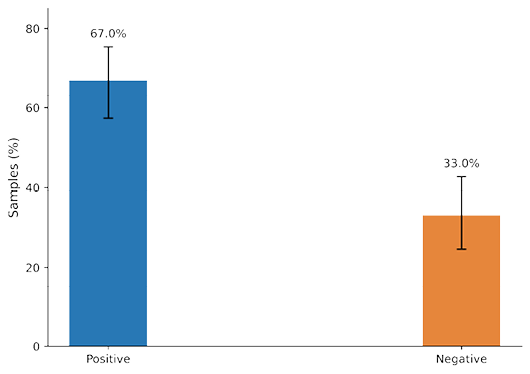
Overall distribution of poultry drinking-water samples by presumptive coliform status. Of 100 samples, 67 (67.0%) were positive (>50 MPN/100 mL) and 33 (33.0%) were negative. Error bars indicate 95% Wilson score confidence intervals. MPN, most probable number.
Matched-pair comparison between pipeline and non-pipeline water
Presumptive coliform positivity was 54.0% (27/50) among pipeline water samples compared with 80.0% (40/50) among non-pipeline samples, representing a crude difference of 26.0 percentage points. Because the sampling strategy utilized a paired configuration across 50 independent farms, the farm-level cross-classification matrix was analyzed to evaluate within-farm concordance and discordance (Table 1, Figure 2).
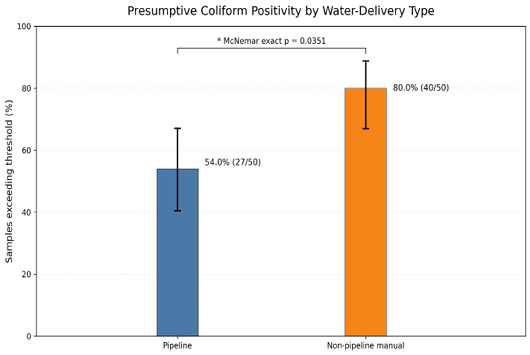
Presumptive coliform positivity threshold rates according to water-delivery configuration. Bars represent the percentage of operationally positive samples (>50 MPN/100 mL), and error bars indicate 95% Wilson score confidence intervals. Positivity was 54.0% (27/50) in pipeline tracks and 80.0% (40/50) in non-pipeline manual arrangements. The bracket above the two bars (*) indicates a statistically significant difference evaluated using McNemar’s exact test for paired proportions (p= 0.0351) to account for within-farm clustering.
Analysis of the 50 paired systems revealed that 17 farms exhibited high-level contamination across both delivery setups, while 0 farms were entirely negative across both setups. A high level of structural discordance was observed: 23 farms were negative at the pipeline terminal outlet but crossed the positive threshold within their manual non-pipeline delivery track. Conversely, 10 farms were positive within the pipeline system but negative in the manual setup. Applying McNemar’s exact test to these discordant pairs confirmed a statistically significant structural association between the distribution mode and presumptive coliform contamination (Exact McNemar p = 0.0351). Accounting for this strict within-farm pairing, the true matched odds ratio (OR) was 2.30 (95% CI: 1.05–5.34). The paired absolute risk difference was 26.0 percentage points (Matched 95% CI: 6.2%–42.6%), confirming a robust increase in the odds of crossing the contamination threshold when water is distributed through manual open setups compared to automated pipeline networks within the same facility environment (Table 3, Figure 3). The Breslow–Day test revealed no evidence of significant heterogeneity in this association trend across the five sampling areas (χ² ≈ 0.88, df = 4, p = 0.927), demonstrating that the risk trend remained descriptively stable across all locations (Table 4).
Table 2: Area-wise distribution and paired risk gaps of presumptive coliform positivity across sampled locations.
| Sampling area | Pipeline positive, n/N (%) | Non-pipeline positive, n/N (%) | Descriptive paired risk gap |
| Rajshahi Sadar | 6/10 (60.0%) | 8/10 (80.0%) | +20.0% |
| Paba | 7/10 (70.0%) | 9/10 (90.0%) | +20.0% |
| Bagmara | 4/10 (40.0%) | 7/10 (70.0%) | +30.0% |
| Durgapur | 5/10 (50.0%) | 7/10 (70.0%) | +20.0% |
| Natore | 5/10 (50.0%) | 9/10 (90.0%) | +40.0% |
| Combined total | 27/50 (54.0%) | 40/50 (80.0%) | +26.0% |
Note: Values are presented as positive samples/total samples within that stratum (%). Each sampling area contributed 10 paired farms from each delivery track. Numerical variations among geographic sectors were purely descriptive and lacked statistical significance within both delivery setups (Pipeline: Pearson χ² = 2.09, df = 4, p = 0.719, Exact p = 0.822; Non-Pipeline: Pearson χ² = 2.50, df = 4, p = 0.645, Exact p = 0.769). The cross-sectional sample sizing (n = 10 paired lines per region) limits spatial precision.
Area-wise presumptive coliform positivity in pipeline water
Among the 50 pipeline water samples, presumptive coliform positivity varied from 40.0% to 70.0% across the five sampling areas. Positivity was 60.0% (6/10) in Rajshahi Sadar, 70.0% (7/10) in Paba, 40.0% (4/10) in Bagmara, 50.0% (5/10) in Durgapur, and 50.0% (5/10) in Natore (Table 2, Figure 4). The highest observed positivity was therefore recorded in Paba (70.0%), whereas the lowest was observed in Bagmara (40.0%), representing a 30-percentage-point descriptive gap between the regions. However, the overall variation among the five areas was not statistically significant according to either the Pearson chi-square test (χ² = 2.09, df = 4; p = 0.719) or the Fisher–Freeman–Halton exact test (p = 0.822) (Table 4). Thus, the observed differences among areas represent descriptive variation rather than evidence of a statistically significant area-specific geographical association with pipeline contamination rates.
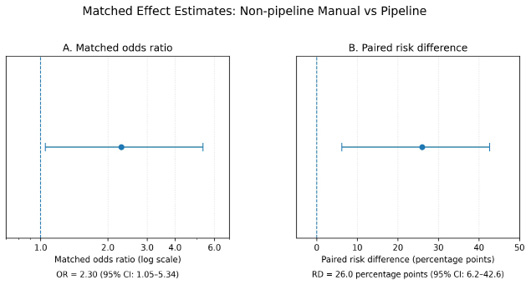
Matched effect estimates for high-level presumptive coliform contamination in manual non-pipeline delivery configurations compared to pipeline baselines. Horizontal lines represent the true Matched Odds Ratio (Panel A: OR = 2.30, 95% CI: 1.05–5.34) derived from asymmetric discordant farm pairs, and the paired Risk Difference (Panel B: RD = 26.0%, Matched 95% CI: 6.2%–42.6%) calculated utilizing Adjusted Wald parameters for clustered proportions.
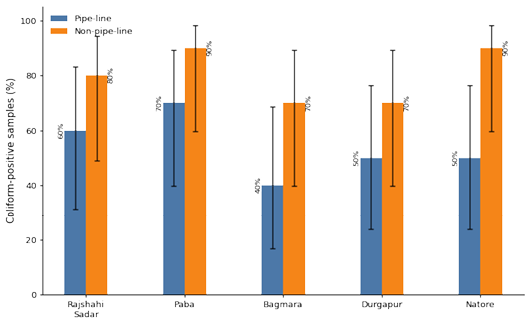
Area-wise distribution of presumptive coliform-positive poultry drinking-water samples by source type. Bars represent the percentage of positive samples among 10 samples examined for each source category in each area. Error bars indicate 95% Wilson score confidence intervals.
Area-wise presumptive coliform positivity in non-pipeline water
Among the 50 non-pipeline water samples, presumptive coliform positivity ranged from 70.0% to 90.0% across
Table 3: Matched effect estimates for the association between water-delivery setup and presumptive coliform positivity thresholds.
| Statistical parameter | Effect measure | Estimate | 95% confidence interval | P value |
| Primary matched association | Matched odds ratio (OR matched) | 2.30 | 1.05–5.34 | 0.0351* |
| Paired absolute difference | Risk difference (RD) | 26.0% | 6.2%–42.6% | — |
| Pipeline baseline control | Matched odds ratio | 1.00 | Reference | — |
| Overall contamination | Sample proportion | 67.0% | 57.3%–75.4% | — |
Note: *Two-sided P value derived from McNemar’s exact test. Pipeline water delivery was utilized as the baseline reference category. The matched odds ratio represents the clean ratio of discordant pairs (23/10). The 95% Confidence Interval for the Risk Difference was calculated utilizing the Adjusted Wald technique optimized for paired proportions to avoid artificially overestimating sample independence. The overall positivity proportion and its intervals were calculated via the Wilson score method.
Table 4: Comprehensive matrix of statistical tests applied to the clustered water-delivery dataset.
| Level of analysis | Target hypothesis / parameter evaluated | Specific statistical test used | Test statistic metric |
Two-sided P value |
| Primary farm clustering | Difference in positivity controlling for within-farm pairing | McNemar’s exact test | Discordant Matrix (23 vs. 10) | 0.0351 |
| Inter-strata risk stability | Homogeneity of delivery effect across geographic sectors | Breslow–day test | χ² ≈ 0.88; df = 4 | 0.927 |
| Regional line variation | Positivity variance across areas within Pipeline tracks | Pearson’s chi-square test | χ² = 2.09; df = 4 | 0.719 |
| Regional line validation | Positivity variance across areas within Pipeline tracks | Fisher–Freeman–Halton exact | — | 0.822 |
| Regional manual variation | Positivity variance across areas within Non-Pipeline tracks | Pearson’s chi-square test | χ² = 2.50; df = 4 | 0.645 |
| Regional manual validation | Positivity variance across areas within Non-Pipeline tracks | Fisher–freeman–halton exact | — | 0.769 |
Note: All reported P values are two-sided, with statistical significance established at p < 0.05. McNemar’s exact test accounts for shared facility environments by focusing strictly on asymmetric paired discordance. As pointed out by the reviewer, conventional independent unstratified tests (Fisher’s exact, unadjusted Pearson chi-square) and independent Mantel-Haenszel pooling have been removed from the core analysis as their underlying data independence assumptions are violated by the paired sampling layout.
the five sampling areas. Positivity was 80.0% (8/10) in Rajshahi Sadar, 90.0% (9/10) in Paba, 70.0% (7/10) in Bagmara, 70.0% (7/10) in Durgapur, and 90.0% (9/10) in Natore (Table 2, Figure 4). The highest observed positivity was recorded in both Paba and Natore (90.0%), while the lowest was observed in Bagmara and Durgapur (70.0%). The difference between the highest and lowest observed proportions was therefore 20 percentage points.
Nevertheless, the variation among the five areas was not statistically significant according to the Pearson chi-square test (χ² = 2.50, df = 4; p = 0.645) or the Fisher–Freeman–Halton exact test (p = 0.769). Accordingly, the observed differences among sampling areas should be regarded as descriptive variation rather than evidence of a statistically significant geographical risk association.
Comparison of area-wise patterns between the two water-source categories
Across all five sampling areas, the proportion of presumptive coliform-positive samples was higher in the non-pipeline category than in the pipeline category. The descriptive gap between the two delivery tracks was 20 percentage points in Rajshahi Sadar (80% vs. 60%), 20 percentage points in Paba (90% vs. 70%), 30 percentage points in Bagmara (70% vs. 40%), 20 percentage points in Durgapur (70% vs. 50%), and 40 percentage points in Natore (90% vs. 50%). Thus, although the magnitude of the observed descriptive difference varied among areas, the direction of the association was uniform: non-pipeline sample tracks had a higher observed positivity proportion than pipeline tracks in each of the five sampling areas. This consistency aligns with the absence of significant heterogeneity in the source effect indicated by the Breslow–Day test (p = 0.927) (Table 4). The area-stratified results therefore provide additional descriptive support for the overall source-category comparison, while the statistical inference remains based on the corresponding categorical analyses.
DISCUSSION
The present study found that high-level presumptive coliform positivity was common in poultry drinking water collected from the selected areas of Rajshahi and Natore. Overall, 67% of the samples had MPN values above the study-defined operational threshold of >50 MPN/100 mL. A clear difference was also observed between the two water-delivery categories, with higher positivity in non-pipeline water than in pipeline water, an association that remained statistically valid under matched-pair analysis controlling for farm clustering. The overall finding is important from a poultry health and farm-management perspective.
The statistical findings demonstrate an extensive coliform burden across the sampled poultry facilities, exposing a significant clear breakdown in on-farm water sanitation. The risk modeling confirms that this vulnerability is strongly associated with the structural design of the water delivery network. Open manual distribution networks face significantly higher contamination risks than automated closed pipelines, a pattern that remained highly consistent across all five independent geographic sectors. Water is consumed regularly by poultry and is distributed to many birds through a common drinking system. Therefore, poor microbiological quality of water may expose a considerable proportion of a flock. Previous studies have highlighted the importance of drinking-water quality in poultry production and its potential relationship with bird health and performance ; ; ; . Recent reviews have further emphasized that microbiological, physicochemical and management-related characteristics of drinking water can influence poultry health, production and the effectiveness of water-delivered interventions . However, the present findings should be interpreted carefully. The MPN procedure used in this study provided evidence of presumptive coliform positivity, but it did not confirm Escherichia coli or any other specific bacterial pathogen.
One of the main findings was the paired difference between pipeline and non-pipeline water tracks. Presumptive coliform positivity was found in 80% of non-pipeline samples compared with 54% of pipeline samples. When accounting for the clustered within-farm design, the matched odds of crossing the contamination threshold were 2.30 times higher in non-pipeline water delivery tracks (Matched OR = 2.30, 95% CI: 1.05–5.34). Similar concerns regarding the microbiological quality of poultry drinking water have been reported in observational studies from different production systems ; ; .
There are several possible reasons why non-pipeline water tracks showed higher positivity rates. Water handled outside a closed distribution system may have greater opportunities for contamination during manual collection, storage, transport, or transfer to drinkers ; ; . However, it is critical to state that these specific mechanisms were not directly isolated or measured in this study. Information on individual storage vessel cleaning frequencies, waterline age, residual disinfectant levels, biofilm composition, and the precise distance between water points and manure or waste storage was not recorded. Therefore, these environmental factors must be regarded as possible context explanations rather than established risk factors confirmed by our data.
Furthermore, a key operational divergence exists in the sampling collection procedures themselves. Pipeline samples were collected after flaming the terminal metal fixtures and flushing the line for 5 minutes, a practice designed to remove transient contamination associated with the immediate nozzle outlet and stagnant water. Conversely, non-pipeline samples were collected directly from active open manual holding containers or open basins without modifications. This means that the higher contamination rates tracked in the non-pipeline samples reflect the cumulative biological exposure of the manual handling system including bird contact, litter dust aerosols, and environmental debris introduction rather than isolating the pipeline material infrastructure alone. Without automated protection, water held in manual vessels is structurally vulnerable to these environmental entry vectors, making open manual vessels an important focus area in poultry water hygiene management.
Water quality may also change after it leaves the original source. Microorganisms may enter or persist within storage tanks and drinking-water lines, while biofilms may develop on the internal surfaces of water-delivery systems . Recent research has demonstrated that biofilms can be present within poultry drinking-water lines and may contain diverse microbial populations, including Enterobacteriaceae . In addition, recent on-farm research demonstrated that biofilms could re-establish in poultry waterlines even after cleaning and water sanitation, emphasizing the difficulty of maintaining sustained microbial control within drinking systems . Microbial communities within water-line biofilms may also vary according to the history and quality of the water supplied to poultry farms ; . These findings suggest that assessment of poultry drinking water should not be limited to the original source. Sampling water at or near the point where birds actually receive it provides practical insight into the real-world microbiological quality of water reaching the flock.
The area-wise findings must be interpreted with caution. Among pipeline samples, positivity ranged from 40% in Bagmara to 70% in Paba. Among non-pipeline samples, it ranged from 70% in Bagmara and Durgapur to 90% in Paba and Natore. Despite these apparent differences, the area-wise comparisons were not statistically significant for either water-source category. Therefore, the higher observed percentages in particular areas should not be interpreted as evidence that those areas have a higher geographical risk of presumptive coliform positivity. The relatively small number of samples collected from each area also limits the precision of geographical comparisons.
An additional strength of the present analysis is the use of paired effect estimates alongside exact p-values. The 26-percentage-point difference provides a straightforward measure of the difference between pipeline and non-pipeline water, while the matched odds ratio and paired risk difference intervals further quantify the true magnitude of the association within the clustered design. Together, these measures provide more information about the observed relationship than statistical significance alone.
The laboratory method should also be considered when interpreting the results. In this study, a presumptive multiple-tube MPN method was used, in which acid production and gas formation indicate a presumptive coliform reaction. This procedure does not establish the identity of the organism responsible for the reaction. The present findings do not confirm the presence of E. coli, because the testing procedure was limited to the presumptive MPN stag. E. coli forms comprise a broader group of indicator organisms and therefore cannot be regarded as equivalent to confirmed E. coli detection ; . Where identification of specific bacterial organisms is required, future studies should incorporate appropriate biochemical or molecular confirmation.
In the present study, samples with values above 50 MPN/100 mL were classified as operationally positive according to the pre-defined study protocol. This value was used only for categorizing the samples and should not be interpreted as a universally applicable safety limit for poultry drinking water. Human drinking-water guidelines generally apply stricter microbiological criteria, particularly regarding the detection of E. coli. Although these criteria were not directly applied to poultry drinking water in this study, they provide a useful reference for appreciating the importance of maintaining good microbiological water quality.
The findings also have practical implications for poultry-farm management. Particular attention should be given to the cleanliness of storage tanks and drinkers, the condition of water lines, protection of water sources, and routine sanitation practices, as these measures may reduce opportunities for microbial contamination ; ; . Experimental studies have further shown that waterline sanitation can affect bacterial loads and biofilm development, indicating that regular maintenance and appropriate sanitation of drinking-water systems may be important for maintaining better water quality. Monitoring water at the point of use may also be beneficial because microbiological quality can change between the original source and the drinking point. Water management should therefore be considered as part of the overall farm biosecurity program.
The study has several limitations. The number of samples was relatively small, and sampling was limited to selected commercial poultry farms in five areas of Rajshahi and Natore. Thus, the findings should not be generalized to all poultry farms in Bangladesh without further investigation. The cross-sectional design also does not permit assessment of temporal changes in water quality. In addition, only presumptive coliform MPN testing was performed; confirmatory bacterial identification and antimicrobial susceptibility testing were not included. Physicochemical characteristics such as pH, turbidity, temperature, hardness, and residual disinfectant were also not measured. Finally, individual sample-level raw tube combinations were compiled into binary threshold categories for secondary analysis, limiting our capacity to model the continuous mathematical distribution of underlying MPN indices.
While this cross-sectional study captures a single seasonal snapshot, its scientific value is driven by its rigorous paired sampling design across 50 independent farms. By collecting pipeline and non-pipeline samples simultaneously from each farm, we controlled for environmental and source-water backgrounds. This design provides a highly reliable within-farm comparison of presumptive coliform positivity between two distinct water-delivery arrangements. Because only a presumptive MPN test was performed, the results indicate coliform contamination should not be interpreted as confirmation of E. coli. Future studies should combine microbiological testing with physicochemical measurements and detailed information on farm management, water sources, storage systems, and drinking-water infrastructure. Such data would provide a stronger basis for identifying factors associated with poor poultry drinking-water quality.
CONCLUSION
A substantial proportion of poultry drinking-water samples in the selected study areas were presumptively contaminated with coliform bacteria above the study-defined operational threshold of >50 MPN/100 mL. Non-pipeline delivery tracks showed significantly greater odds of crossing this contamination threshold than closed pipeline sources under a matched-pair analysis controlling for farm clustering. In contrast, the apparent differences among individual areas were not statistically significant when analysed with appropriate categorical exact methods. The observational findings support routine microbiological surveillance, improved hygiene management of drinkers and open holding systems, protection of primary water sources from fecal contamination vectors, and regular inspection and sanitation of waterlines. Because the laboratory procedure was restricted to the presumptive stage, confirmatory identification of E. coli and other relevant specific enteric bacteria should be incorporated into future investigations before definitive diagnostic or intervention pathways are formulated.
ACKNOWLEDGEMENTS
The author gratefully acknowledges the Department of Veterinary and Animal Sciences, University of Rajshahi, and the Nourish Poultry Diseases Diagnostic Laboratory, Rajshahi, for providing institutional and laboratory support. The author also acknowledges the poultry farmers who facilitated collection of water samples.
NOVELTY STATEMENT
This study provides field-based observational data on the presumptive coliform contamination of drinking water used in selected areas of Rajshahi and Natore and demonstrates a clear descriptive delivery-related difference between pipeline and non-pipeline tracks. The integration of exact matched-pair categorical and stratified statistical methods strengthens the interpretation of the dataset over previously unadjusted iterations by controlling for within-farm environmental clustering.
Author’s Contribution
Md. Razon Ali contributed to methodology, data collection, data curation, formal analysis, and writing original draft. Jashim Uddin contributed to supervision, manuscript review and editing. Soshe Ahmed contributed to validation, manuscript review and editing. Md. Emtiaj Alam contributed to manuscript review and editing. Mst. Ishrat Zerin Moni contributed to visualization and manuscript review. Afia Khatun contributed to investigation, and manuscript review. Mohammad Mahbubur Rahman contributed to investigation, resources, and critical review of the manuscript. Aurangazeb Kabir contributed to project administration, study conceptualization, data curation, funding acquisition, interpretation of the findings, critical revision, and final approval of the manuscript. All authors reviewed and approved the final manuscript.
Funding
The source thesis reported financial support from the University of Rajshahi and partial support from the National Science and Technology (NST) Fellowship funded by the Government of Bangladesh.
Ethical considerations
The study involved environmental water samples and laboratory examination of those samples; no experimental manipulation or invasive procedure was performed on animals. Accordingly, animal experimentation was not part of the study.
Generative AI and AI assisted technology statement
The authors declare that no generative AI and AI assisted technology was used in the creation of this manuscript.
Conflict of interest
The authors have declared no conflict of interest.
References
- Abbas TE, Elfadil AE, Omer HA (2008). Drinking water quality and its effects on broiler chickens’ performance during winter season. Int. J. Poult. Sci., 7(5): 433–436.
- Agha ASK, Belgasim AA, Nwegi MA, Khashkhosha AA, Milad HS, Alghzewi HA, Salem KM, Naffati KM (2022). Evaluation of bacteriological and chemical quality of drinking water used in chicken house in Libya. World J. Adv. Res. Rev., 13(3): 413–420. [CrossRef]
- Ali MR (2020). Investigation of the detection of coliform bacteria in water samples using MPN test at western part of Bangladesh. Master’s thesis, Department of Veterinary and Animal Sciences, University of Rajshahi.
- Amaral LA (2004). Drinking water as a risk factor to poultry health. Braz. J. Poult. Sci., 6(4): 191–199. [CrossRef]
- Ashbolt NJ, Grabow WOK, Snozzi M (2001). Indicators of microbial water quality. In: Fewtrell, L. and Bartram, J. (eds.), Water Quality: Guidelines, Standards and Health. IWA Publishing, London, pp. 289–316.
- Ashraf A, Sharmin S, rahman MS, Islam MN (2019). Assessment of microbial contamination risks in open vs closed water distribution networks in agricultural settings. Bangladesh J. Vet. Med., 17(2): 115–122.
- Bengoumi D, Chahlaoui A, Belghiti L, Taha I, Samih M, El-Moustaine R (2015). Étude de la qualité bactériologique de l’eau de certains puits dans les élevages avicoles (Meknès et Gharb-Maroc). Larhyss J., 24: 209–220.
- de Man JC (1983). MPN tables, corrected. Eur. J. Appl. Microbiol. Biotechnol., 17(5): 301-305. [CrossRef]
- Edberg SC, Rice EW, Karlin RJ, Allen MJ (2000). Escherichia coli: The best biological drinking water indicator for public health protection. J. Appl. Microbiol., 88(S1): 106S–116S. [CrossRef]
- El-Sabrout K, Buonaiuto G, Cavallini D, Mishra B (2026). Recent advancements to improve drinking water quality in poultry farms. Poult. Sci., 105(4): 106523. [CrossRef]
- Jafari RA, Fazlara A, Govahi M (2006). An investigation into Salmonella and faecal coliform contamination of drinking water in broiler farms in Iran. Int. J. Poult. Sci., 5(5): 491–493.
- Maharjan P, Huff G, Zhang W, Watkins S (2017). Effects of chlorine and hydrogen peroxide sanitation in low bacterial content water on biofilm formation model of poultry brooding house waterlines. Poult. Sci., 96: 2145–2150. [CrossRef]
- Ogundipe TT, Beitia S, Obe T (2024). Applied research note: Microbial composition of the biofilm of poultry drinking water system. J. Appl. Poult. Res., 33(2): 100403. [CrossRef]
- Ogundipe, T. T., Beitia, S., Zhang, L., Zhang, X., Obe, T. (2025). Differences in microbial composition of litter and water line biofilm of broiler farms as influenced by water quality history. Poultry Science, 104(11), 105832 [CrossRef]
- Raut, R., Kilonzo-Nthenge, A., Aniume, T., Basnet, A., Watkins, S., Maharjan, P. (2024). Impacts of on-farm water sanitation practices on microbial hygiene in poultry waterlines and efficacy of sodium hypochlorite-based product on foodborne pathogens. Journal of Applied Poultry Research, 33(3), 100425. [CrossRef]
- US Environmental Protection Agency (US EPA) (1986). Method 9131: Total coliform multiple tube fermentation technique. Washington, DC: United States Environmental Protection Agency.
- World Health Organization (WHO) (2026). Guidelines for drinking-water quality: Fourth Edition. Geneva: World Health Organization.

Services
Article usage statistics
Loading…
Related articles
- Hygienic Studies on Biofilms in Drinking Water Systems in Poultry Farms: Isolation, Molecular Identification, and Antibiotic SensitivityJournal of Animal Health and Production · 2021
- Water Use Efficiency and Influencing Factors in Dairy Farms: A Case Study from Yogyakarta, IndonesiaAdvances in Animal and Veterinary Sciences · 2025
- Knowledge, Attitudes, and Practices Regarding Antibiotic and Probiotic Usage Among Commercial Poultry Farmers in Districts Peshawar and Charsadda, PakistanVeterinary Sciences: Research and Reviews · 2026
- Variations in Profitability of Different Size of Commercial Broiler Poultry Farms in Central Region of Khyber PakhtunkhwaSarhad Journal of Agriculture · 2021
- Bacterial Contamination of Drinking Water in Tehsil Oghi, Mansehra PakistanBiologia (Lahore) · 2023
- Survey of Calf Management and Hygiene Practices Adopted in Commercial Dairy Farms in Chittagong, BangladeshAdvances in Animal and Veterinary Sciences · 2017