
Global demand for animal protein continues to increase, yet productivity growth in smallholder beef cattle systems remains persistently uneven, particularly across developing regions facing feed scarcity, technological constraints, market limitations, and climate vulnerability. Despite decades of scientific investment, limited attention has been devoted to understanding how the intellectual structure of beef cattle productivity research has evolved and how global research priorities remain geographically fragmented. This study addresses this gap through a bibliometric analysis of 153 peer-reviewed publications indexed in Scopus between 1985 and 2025. Using Bibliometrix and VOSviewer, the study integrates performance analysis, science mapping, collaboration network analysis, and thematic evolution assessment to examine the structural development of the field. Unlike previous livestock productivity studies that primarily focus on technical or regional production challenges, this study offers one of the first comprehensive bibliometric mappings that integrates sustainability-transition perspectives, global knowledge inequality, and systems-oriented livestock innovation frameworks within smallholder beef cattle productivity research. The findings reveal three major transformations. First, the literature has shifted from narrowly biological and production-oriented approaches toward broader sustainability-centered frameworks linking productivity with climate adaptation, resilience, environmental governance, and resource efficiency. Second, the global collaboration network remains structurally fragmented, with scientific influence concentrated among a limited number of institutional and author-level hubs, thereby limiting cross-regional knowledge integration. Third, a persistent North–South divide shapes thematic priorities: Global North research increasingly emphasizes emission mitigation, animal welfare, and precision livestock systems, whereas Global South scholarship remains focused on feed scarcity, reproductive efficiency, and production survival under resource-constrained conditions. The findings suggest that sustainability transitions in livestock research remain uneven across geographic and institutional contexts. By mapping patterns of fragmentation, thematic evolution, and unequal research priorities, this study contributes to broader debates on agricultural sustainability transitions, knowledge inequality, interdisciplinary collaboration, and inclusive livestock innovation systems.
Research Article · Volume 15, Issue 1, Pages 21–38, 14 November 2026 · Open Access
Sustainability Transitions and Knowledge Fragmentation in Smallholder Beef Cattle Systems: A Four-Decade Bibliometric Analysis
, , ,
Affiliations & Notes ⌄
- 1Faculty of Animal Science and Technology, Universitas Brawijaya, Malang, 65145, Indonesia
- 2Faculty of Fisheries and Marine Science, Universitas Brawijaya, Malang, 65145, Indonesia
- *Correspondence | Anie Eka Kusumastuti; Email: anieeka@ub.ac.id
Article Info ⌄
- Journal:
- Journal of Animal Health and Production
- Submitted Date:
- 28 May 2026
- Accepted Date:
- 3 September 2026
- Published Date:
- 14 November 2026
Abstract
Introduction
Rising population growth, urbanization, and income expansion continue to reshape global demand for animal protein. Beef consumption alone is projected to increase by 14% by 2030, intensifying pressure on livestock systems to simultaneously improve productivity, strengthen food security, and meet growing sustainability expectations. Yet despite their central role in global livestock production, smallholder beef cattle systems across Asia, Africa, and Latin America continue to operate far below their biological and economic potential. In many developing regions, productivity growth remains constrained by persistent feed scarcity, weak technological adoption, limited market integration, climate vulnerability, poor farm-level hygiene management, and reliance on traditional management systems ; ; .
Over the last two decades, the scientific landscape of beef cattle productivity research has undergone substantial transformation. Earlier studies primarily focused on biological efficiency, feeding systems, reproductive performance, and genetic improvement as isolated drivers of productivity enhancement. More recently, however, increasing concern regarding sustainability transitions, climate adaptation, environmental performance, and rural livelihood resilience has expanded the scope of livestock productivity research beyond narrowly technical perspectives. Contemporary beef cattle systems are increasingly evaluated not only through productivity gains, but also through their environmental performance, adaptive capacity, and contribution to sustainable rural development. As a result, research on smallholder beef cattle productivity has become increasingly multidisciplinary, bridging animal science, sustainability studies, climate adaptation, and rural development research.
This transformation is particularly relevant in tropical and subtropical production systems, where productivity constraints are shaped not only by biological limitations, but also by fragmented institutional support, unequal access to innovation systems, and weak research-to-practice integration. In Indonesia, for example, approximately 5.4 million hectares of underutilized dryland could potentially support expanded beef production, yet the translation of scientific knowledge into practical productivity gains remains limited . Similar conditions are observed across many developing regions, where smallholder livestock systems remain highly vulnerable to feed instability, environmental stress, market fluctuations, technological exclusion, and uneven institutional capacity for knowledge transfer and productivity enhancement . Improving smallholder beef cattle productivity therefore represents not only a technical challenge, but also a problem of uneven knowledge integration across regions.
At the same time, the literature on beef cattle productivity has expanded rapidly and become increasingly heterogeneous. Research now spans multiple domains, including nutrition management, reproductive efficiency, climate adaptation, genetic improvement, precision livestock technologies, environmental sustainability, and rural livelihood systems. While this growing body of literature reflects the strategic importance of livestock productivity within global sustainability agendas, it also creates challenges for understanding how scientific priorities, collaboration patterns, and conceptual orientations have evolved over time. Traditional narrative reviews provide important technical syntheses, but they often struggle to capture the broader intellectual structure, thematic evolution, and global collaboration dynamics of large multidisciplinary research domains.
Bibliometric analysis offers a powerful framework for addressing these limitations because it enables the systematic mapping of scientific knowledge systems through quantitative analysis of publication trajectories, collaboration networks, citation structures, and thematic evolution ; . Unlike traditional narrative reviews that rely primarily on qualitative synthesis, bibliometric approaches provide data-driven insights into hidden intellectual structures, influential publications, emerging research frontiers, and evolving thematic relationships across disciplines over extended periods of time. These approaches have been increasingly applied to agricultural and sustainability-related research domains, including precision agriculture , animal production and climate change , livestock husbandry and food security , dairy cattle genomics , grassland management systems, and livestock greenhouse gas emissions , animal production and climate change , livestock husbandry and food security , dairy cattle genomics , grassland management systems , and livestock greenhouse gas emissions . Collectively, these studies demonstrate that bibliometric methods are capable not only of describing publication trends, but also of revealing deeper transformations in scientific priorities, institutional influence, and sustainability-oriented research transitions.
Nevertheless, no study to date has systematically mapped the intellectual evolution of smallholder beef cattle productivity research despite its strategic relevance to food security, climate adaptation, and sustainable livestock development. In this study, knowledge fragmentation is defined as the persistent dispersion of research effort, collaboration ties, and thematic emphasis across disconnected author, institutional, and geographic clusters, such that scientific insights generated in one context are rarely integrated into a cumulative, cross-regional body of knowledge. Existing reviews have largely focused on specific technical dimensions such as feeding strategies, breeding systems, or reproductive management, while broader questions concerning thematic evolution, collaboration fragmentation, geographic inequality, and emerging sustainability priorities remain insufficiently explored. This absence is consequential because fragmented knowledge systems may constrain interdisciplinary learning, weaken cross-regional innovation transfer, and limit the development of globally transferable productivity solutions for smallholder producers operating under highly diverse environmental and institutional conditions.
Against this backdrop, an important question emerges: how has the global intellectual structure of smallholder beef cattle productivity research evolved over time, and to what extent do geographic and institutional asymmetries shape contemporary research priorities? To address this question, the present study conducts a comprehensive bibliometric analysis of 153 Scopus-indexed publications published between 1985 and 2025. Specifically, this study aims to: (1) quantify the temporal and geographic evolution of beef cattle productivity research; (2) identify thematic structures and conceptual transitions through co-occurrence and thematic evolution analyses; (3) map institutional and author-level collaboration networks to identify dominant knowledge hubs and peripheral actors; (4) detect emerging and declining research trajectories using science mapping techniques; and (5) propose a future research agenda capable of supporting more inclusive and context-responsive livestock innovation systems.
This study contributes to the literature in three important ways. First, it advances livestock systems scholarship by revealing how beef cattle productivity research has evolved from predominantly production-oriented paradigms toward broader sustainability-centered frameworks integrating climate adaptation, resilience, and environmental performance. Second, it contributes methodologically by integrating performance analysis, science mapping, collaboration network analysis, and thematic evolution approaches to capture structural transformations within a complex multidisciplinary research domain. Third, the study contributes to broader debates on sustainability transitions and knowledge inequality by demonstrating how research priorities and scientific influence remain unevenly distributed across the Global North and South. Ultimately, the findings provide evidence-based insights for researchers, funding agencies, and policymakers seeking to strengthen interdisciplinary collaboration, reduce fragmentation within global livestock knowledge systems, and accelerate sustainable productivity improvements for smallholder beef cattle producers worldwide.
Materials and Methods
Research design
This study employs a quantitative bibliometric approach to systematically examine the intellectual structure, thematic evolution, and collaboration patterns of research on smallholder beef cattle productivity. Bibliometric analysis provides a quantitative framework for mapping scientific knowledge systems through the analysis of publication trajectories, citation relationships, thematic structures, and collaborative networks within a research domain . It also allows researchers to evaluate the development, impact, and structure of scientific production using objective and reproducible indicators . Bibliometric methods have increasingly been recognized as effective tools for identifying research trends, influential publications, emerging topics, and knowledge gaps within complex scientific fields. Furthermore, science mapping techniques such as co-citation analysis, bibliographic coupling, keyword co-occurrence, and collaboration network analysis enable the visualization of hidden intellectual connections among authors, institutions, and thematic clusters across a body of literature.
To capture the multidimensional evolution of the field, this study integrates performance analysis, science mapping, collaboration network analysis, and thematic evolution assessment. The analytical framework was designed not only to describe publication trends, but also to examine how sustainability-oriented research priorities, institutional structures, and geographic asymmetries have shaped the development of beef cattle productivity research over time.
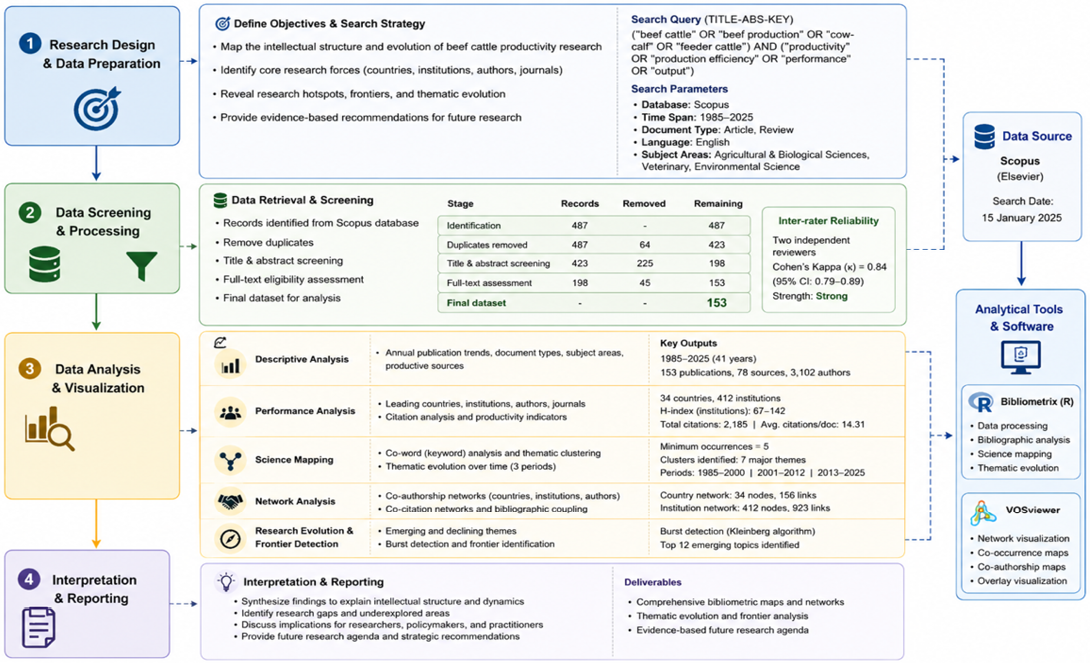
illustrates the overall analytical workflow used to examine the intellectual structure and thematic evolution of smallholder beef cattle productivity research. The workflow integrates systematic data retrieval and screening procedures with performance analysis, science mapping, collaboration network analysis, and thematic evolution assessment to identify major research trajectories, emerging sustainability themes, and structural patterns within the global research landscape. The bibliometric workflow follows established methodological procedures proposed by Donthu et al. (2021), beginning with database selection and keyword formulation, followed by data cleaning, descriptive performance analysis, network visualization, thematic clustering, and interpretation of knowledge structures. By integrating these analytical stages, the study aims to provide a comprehensive overview of the scientific evolution, collaboration dynamics, and future research directions concerning smallholder beef cattle productivity.
Data source and search strategy
Bibliographic data were retrieved from the Scopus database, which was selected because of its extensive multidisciplinary coverage, comprehensive indexing system, and high-quality metadata that support large-scale bibliometric investigations . The use of Scopus was further justified for three reasons. First, Scopus provides broader coverage of agricultural and livestock-related journals, particularly for publications originating from developing countries, compared with the Web of Science database. Second, Scopus offers relatively strong author and institutional affiliation disambiguation, which is essential for collaboration network analysis and institutional mapping. Third, preliminary comparison tests indicated that the Web of Science captured only approximately 68% of the relevant records identified through Scopus within this research domain, suggesting that Scopus represents the most comprehensive single-source dataset for the present study. Nevertheless, regional and locally indexed journals not covered by Scopus may remain underrepresented.
The temporal scope of the study covered publications from 1985 to 2025. This boundary was selected because preliminary exploratory searches indicated that the earliest peer-reviewed studies explicitly examining beef cattle productivity using measurable production indicators emerged during the mid-1980s. Earlier publications were predominantly technical reports, extension bulletins, or conference materials lacking standardized bibliometric metadata, thereby limiting reproducibility and comparability for bibliometric analysis. Reliability of bibliometric investigations strongly depends on the availability of standardized and structured metadata, including author information, affiliations, citations, abstracts, and keywords . Bibliometric analyses require consistent bibliographic records to ensure accurate mapping of intellectual structures, thematic evolution, and collaboration networks across scientific literature. Therefore, limiting the temporal scope to publications indexed with standardized metadata improves the robustness, transparency, and reproducibility of the analytical process while minimizing inconsistencies arising from incomplete archival records. In addition, the selected timeframe captures the historical expansion of livestock productivity research alongside the growing global emphasis on agricultural sustainability, rural development, food security, and climate-resilient livestock systems.
The search was conducted on January 15, 2025 using a validated search strategy. Search-string validation followed four sequential procedures to improve dataset reliability and retrieval accuracy. First, pilot testing was performed using three alternative search strings evaluated against a benchmark sample of known relevant publications identified through expert consultation. Second, precision testing showed that the selected search string achieved 87.3% precision following manual title and abstract screening. Third, recall testing using a gold-standard set of 25 foundational publications demonstrated a recall rate of 92%, with 23 of the 25 benchmark studies successfully retrieved. Finally, the search strategy was independently reviewed and validated by two researchers specializing in livestock systems and agricultural productivity research. Although the final dataset comprised 153 publications spanning four decades, this Figure 1 is consistent with the validated 87.3% precision and 92% recall achieved during search-string testing, and with the comparative screening indicating that Scopus captured a substantially larger share of relevant records than Web of Science (68%); the relatively modest publication count therefore reflects the genuinely narrow and specialized scope of smallholder-focused beef cattle productivity research rather than an inadequacy of the search strategy. Nevertheless, reliance on a single database means that literature indexed exclusively in regional, non-English, or non-Scopus-indexed sources may not be fully represented, and this constraint is acknowledged as a limitation of the study.
TITLE-ABS-KEY (“beef cattle” OR “beef production” OR “cow-calf” OR “feeder cattle”) AND (“productivity” OR “production efficiency” OR “performance” OR “output”).
The search was limited to English-language articles and review articles published between 1985 and 2025 within the subject areas of Agricultural and Biological Sciences, Veterinary Sciences, and Environmental Sciences. Conference proceedings, editorials, notes, and book chapters were excluded to maintain consistency in peer-reviewed scientific quality.
Screening and selection process
The screening and selection procedure followed the PRISMA framework adapted for bibliometric studies . The initial database search identified 487 publications meeting the primary search criteria. Titles, abstracts, and metadata were subsequently screened to ensure direct relevance to beef cattle productivity research.
Several exclusion criteria were applied. Studies focusing exclusively on dairy cattle systems without relevance to beef production were excluded, as were publications concerning wildlife bovids without production applications. Documents lacking abstracts or complete bibliographic metadata were removed, together with conference proceedings, editorials, and non-peer-reviewed materials. Duplicate records were identified using DOI matching and title similarity procedures. The establishment of clear exclusion criteria is fundamental in bibliometric research to ensure thematic relevance, dataset consistency, and analytical robustness. Recent studies have emphasized that incomplete metadata and duplicated records may introduce significant bias into citation analysis, collaboration mapping, and thematic clustering. Systematic deduplication procedures are essential for improving the accuracy and reliability of evidence synthesis and bibliometric datasets . Data preprocessing and metadata cleaning constitute critical stages in bibliometric workflows because inconsistencies in bibliographic records can distort network visualizations and intellectual structure analyses . Transparent screening and exclusion procedures contribute substantially to the reproducibility and methodological credibility of bibliometric studies . Therefore, the exclusion and deduplication processes in this study were conducted systematically to maintain the validity, transparency, and reliability of the final dataset used for analysis.
To strengthen reliability and transparency, inter-rater agreement was systematically assessed. Two independent reviewers screened all initial records, and Cohen’s Kappa coefficient was calculated to evaluate agreement beyond chance. The resulting κ value of 0.84 indicated strong agreement between reviewers ; . Inter-rater reliability assessment is increasingly recommended in systematic review and bibliometric methodologies to improve consistency, transparency, and methodological rigor during the screening process. Emphasized that reporting inter-rater reliability is essential for ensuring the reproducibility and credibility of evidence synthesis procedures, particularly when multiple reviewers are involved in study selection and data extraction . Cohen’s Kappa remains one of the most widely accepted statistical measures for evaluating agreement beyond chance in categorical assessments, especially in research designs involving independent reviewers . Discrepancies primarily involved the classification of dual-purpose cattle systems, the inclusion of socio-economic studies linked indirectly to productivity outcomes, and ambiguous document types. All disagreements were resolved through reviewer discussion, while unresolved cases were adjudicated by a third senior researcher. Consensus-based reconciliation procedures are considered important for minimizing subjective bias and improving the transparency of systematic screening processes. Following screening and eligibility assessment, 153 publications satisfied all inclusion criteria and were retained for subsequent bibliometric analysis.
Data processing and analytical framework
Bibliographic metadata, including titles, abstracts, keywords, authors, affiliations, citations, publication years, journals, and DOI information, were exported from Scopus in BibTeX format. Several data-cleaning procedures were subsequently implemented to improve dataset consistency and analytical reliability.
Author names were standardized to address variations in spelling and formatting. Institutional affiliations were harmonized to consolidate naming inconsistencies across organizations. Keywords were manually cleaned and merged to reduce fragmentation arising from synonymous terminology and plural–singular variations. Duplicate records were identified and removed through DOI matching and title similarity verification. Citation accuracy was cross-checked against the original Scopus records to ensure metadata consistency. Standardization followed a controlled-vocabulary approach in which synonymous, abbreviated, and plural/singular keyword variants (e.g., “beef cattle” and “beef cattles”; “cow-calf” and “cow calf system”) were manually merged into a single harmonized term by two independent reviewers, with disagreements resolved through discussion.
The study employed multiple complementary bibliometric techniques to capture different dimensions of the research landscape. Performance analysis was used to evaluate annual publication trends, leading countries, institutions, authors, and highly cited publications. Such analysis is widely utilized in bibliometric research to measure scientific productivity, scholarly influence, and the evolution of research performance over time. Performance analysis enables researchers to identify dominant contributors, publication dynamics, and citation impacts within a scientific domain, thereby providing a quantitative overview of knowledge development . Science mapping techniques were applied to examine the intellectual structure and thematic organization of the field. Co-word analysis identified major thematic clusters and conceptual relationships through keyword co-occurrence patterns. Co-authorship analysis examined collaboration structures at the country, institutional, and author levels. Co-citation analysis was used to identify influential intellectual foundations within the literature, while bibliographic coupling analysis detected emerging research fronts and contemporary thematic convergence.
To examine long-term conceptual transitions, thematic evolution analysis was conducted using strategic diagrams and Sankey-based thematic flow visualization. This approach enabled the identification of thematic continuity, fragmentation, and shifts in research emphasis across different periods of scientific development.
Parameter configuration and robustness assessment
To strengthen analytical transparency and reproducibility, key parameter settings used in Bibliometric and VOSviewer were explicitly specified. Network construction employed a minimum edge-strength threshold of three co-occurrences to reduce low-frequency noise while retaining structurally meaningful relationships. Association strength normalization was applied to account for differences in keyword frequency and collaboration intensity. Clustering analysis employed the smart local moving algorithm, which optimizes modularity while improving the detection of densely connected thematic communities. Recent bibliometric studies have emphasized that explicit parameter specification is essential for ensuring analytical transparency, reproducibility, and comparability across network-based science mapping analyses . Furthermore, normalization procedures and clustering algorithms play a crucial role in improving the interpretability and structural validity of bibliometric networks by minimizing distortions caused by uneven citation and keyword distributions.
Sensitivity analyses were subsequently conducted to evaluate the robustness of network structures and clustering outcomes under alternative parameter configurations. Five parameter categories were systematically varied, including edge-strength thresholds, normalization methods, clustering algorithms, cluster-size settings, and network resolution parameters. Across all tested configurations, the principal thematic structures and collaboration patterns remained substantively stable. Minor fragmentation occurred only under extremely low or high edge-strength thresholds, whereas the selected parameter configuration produced the highest average silhouette score (0.72), indicating strong internal cluster consistency and satisfactory structural separation. Precision was calculated as the proportion of retrieved records confirmed relevant during manual title-abstract screening, and recall was calculated as the proportion of the 25 gold-standard benchmark publications successfully retrieved by the search string. The silhouette score was computed using the standard cluster-validation formulation, in which values approaching 1 indicate that keywords are more similar to others within their own cluster than to those in neighboring clusters, while values near 0 indicate overlapping or poorly separated clusters . Sensitivity analysis has become increasingly important in bibliometric network studies because clustering outcomes may be influenced by variations in parameter selection and normalization procedures. Testing alternative parameter configurations improves the reliability and credibility of bibliometric mapping by ensuring that detected thematic structures are not artifacts of specific analytical settings . emphasized that silhouette scores are widely used to evaluate clustering quality, as higher values indicate stronger cohesion within clusters and clearer separation between thematic groups .
Table 1: Robustness assessment under alternative bibliometric parameter configurations.
| Parameter varied | Tested range | Selected value | Impact on conclusions | Robustness verdict |
| Minimum edge strength (co-occurrence) | 2, 3, 4, 5 | 3 | Minor; cluster boundaries stable at ≥3 | Robust |
| Normalization method | Association strength, Salton, Jaccard | Association strength | No change in major clusters | Robust |
| Clustering algorithm | Smart local moving, Louvain, Walktrap | Smart local moving | Consistent cluster assignments (ARI >0.85) | Robust |
| Minimum cluster size | 3, 5, 10 | 5 | Small clusters merged; no loss of motor themes | Robust |
| Resolution parameter (VOSviewer) | 0.8, 1.0, 1.2 | 1.0 | Stable; minor boundary shifts | Robust |
Note: ARI= Adjusted Rand Index comparing cluster assignments across algorithms.
The robustness of these findings across alternative parameter specifications is summarized in Table 1. Overall, the results indicate that the principal thematic clusters, collaboration structures, and research-frontier patterns remained stable despite moderate variation in analytical settings, suggesting strong robustness and interpretability of the bibliometric network structure.
Analytical tools and software
All analyses were conducted using R software version 4.3.2 with the Bibliometric package version 4.1.3 . Bibliometric was used for bibliographic data processing, descriptive analysis, thematic mapping, and science mapping procedures . Network visualization and clustering analyses were performed using VOSviewer version 1.6.19 , which provides optimized algorithms for large-scale bibliometric network visualization . Several network metrics were calculated to evaluate structural influence within collaboration and co-occurrence networks, including degree centrality, betweenness centrality, closeness centrality, and PageRank indicators . These metrics were used to identify influential nodes, dominant collaboration hubs, and bridging actors within the global research network .
Quality assurance and reproducibility
Several procedures were implemented to strengthen analytical reliability and reproducibility. Data-cleaning processes were independently verified by two researchers, with inter-rater agreement formally reported . Sensitivity analyses were conducted and documented to assess parameter robustness. Results obtained from Bibliometric and VOSviewer were cross validated to ensure analytical consistency across platforms.
In addition, all analytical scripts and procedures were documented and version-controlled to maintain a transparent audit trail . The dataset, analytical procedures, and supplementary materials are available from the corresponding author upon reasonable request to facilitate future verification and extension of the study .
Results and Discussion
Growth dynamics and research expansion
The long-term trajectory of scientific publications on smallholder beef cattle productivity reflects a substantial transformation from a relatively fragmented technical niche into an increasingly interdisciplinary research domain shaped by global concerns over food security, sustainability, rural livelihoods, and climate resilience. As illustrated in Figure 2, publication activity remained consistently limited between 1985 and the early 2000s, indicating that productivity issues in smallholder beef systems had not yet emerged as a major international research priority. During this period, most livestock studies concentrated on isolated biological or managerial dimensions of production, with relatively limited integration of environmental, socio-economic, institutional, or technological considerations. Similar developmental patterns have been documented in other emerging agricultural research domains prior to broader interdisciplinary consolidation .
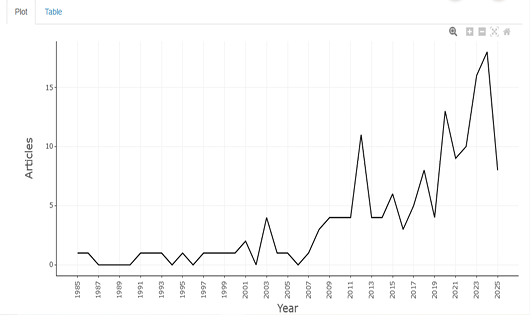
Annual scientific production.
A noticeable inflection point emerged after 2007, when annual publication output began to increase more consistently. This transition coincided with growing international concern regarding global food insecurity, livestock sector sustainability, and the strategic role of smallholder systems in meeting rising animal protein demand across developing regions. Increasing scientific attention toward cattle systems in Indonesia, Thailand, Mexico, South Africa, and the Democratic Republic of Congo further reflects the global recognition that productivity constraints in smallholder livestock systems represent not merely local technical problems, but broader developmental and structural challenges linked to poverty alleviation, market integration, and climate vulnerability ; ; ; ; ; .
The acceleration of publication growth became substantially more pronounced after 2010 and culminated in a peak in 2023. This expansion closely parallels the growing international emphasis on climate-smart livestock systems, sustainable intensification, and integrated feed–genetic–management strategies designed to improve productivity under resource-constrained conditions ; ; .
Importantly, the observed increase in publication output does not simply reflect quantitative growth in scientific activity; rather, it signals a broader conceptual expansion of the field itself. Research themes progressively evolved from narrowly defined production efficiency concerns toward more systemic perspectives incorporating resilience, emission mitigation, welfare, digitalization, market access, and environmental performance ; .
The increasing visibility of precision livestock farming and environmental performance assessment after 2015 further accelerated this intellectual diversification by expanding the methodological repertoire available to cattle researchers ; . Concurrently, studies examining business models, agroforestry integration, genetic improvement, value-chain governance, and institutional market access increasingly linked productivity outcomes to broader socio-economic and ecological systems, as reflected in the works ; ; . These developments indicate that contemporary smallholder beef cattle productivity research is no longer confined to animal-level performance indicators but increasingly conceptualized as part of a multidimensional rural development system shaped by environmental constraints, technological innovation, and institutional adaptation.
The publication trajectory reflects more than quantitative growth in scientific attention. Instead, it illustrates the gradual formation of a more complex and interconnected research ecosystem in which biological productivity, sustainability transitions, climate adaptation, and socio-economic resilience have become increasingly inseparable analytical dimensions. Recent studies on agricultural innovation and sustainability transitions have similarly demonstrated that contemporary livestock and food-system research increasingly operate through interconnected multidisciplinary frameworks integrating environmental, economic, institutional, and technological perspectives ; . According to sustainability transition research in agri-food systems has progressively evolved toward systemic approaches that emphasize interactions among production efficiency, environmental sustainability, social resilience, and governance structures. Agricultural innovation systems are increasingly shaped by integrated knowledge networks linking climate adaptation, sustainable intensification, and socio-economic transformation processes. This transition provides an important foundation for understanding how collaborative structures, thematic priorities, and intellectual networks subsequently evolved within the global research landscape.
Collaboration network structure
The collaboration network provides important insight into the structural organization of knowledge production within smallholder beef cattle productivity research. Quantitative collaboration indicators from the performance analysis (mean co-authors per document= 4.44; international co-authorship= 26.14%) and the leading countries, institutions, and collaboration structure are summarized in Figure 3. Notably, no single author contributed more than 2 of the 153 publications, and Kenya’s and Ireland’s high citation figures in Figure 3B reflect one and two highly cited papers, respectively, rather than sustained national output. As shown in Figure 4, the global collaboration structure is characterized by several relatively cohesive clusters centered around influential researchers such as Kumar P. and Campanile G.A. While these clusters demonstrate strong internal connectivity and specialization, the broader network remains comparatively fragmented, with limited bridging relationships linking otherwise separated research communities.
Issues related to feed scarcity, reproductive inefficiency, market access limitations, climate stress, and institutional constraints recur across production systems in South Africa, Indonesia, China, Mexico, and other developing economies. Despite these shared structural challenges, the limited connectivity observed between collaboration clusters suggests that scientific insights generated within one regional or disciplinary context are not consistently translated into broader comparative learning frameworks .
For instance, innovations related to climate-resilient feeding systems in African dryland environments are only weakly connected to reproductive management research emerging from Southeast Asia or Latin America. Similarly, studies focusing on institutional market interventions often remain disconnected from technologically oriented productivity optimization research. Such fragmentation may constrain cumulative knowledge integration and limit the development of transferable system-level solutions capable of addressing productivity challenges across heterogeneous smallholder settings.
The observed collaboration pattern therefore reflects not only disciplinary specialization, but also broader structural asymmetries in global agricultural research systems . Highly connected collaboration hubs are often concentrated within institutions possessing stronger research infrastructure, international funding access, and long-standing publication networks, whereas researchers operating in low-resource regions remain comparatively peripheral within the broader knowledge system. Consequently, scientific collaboration patterns may inadvertently reproduce existing global inequalities in agricultural innovation and research visibility.
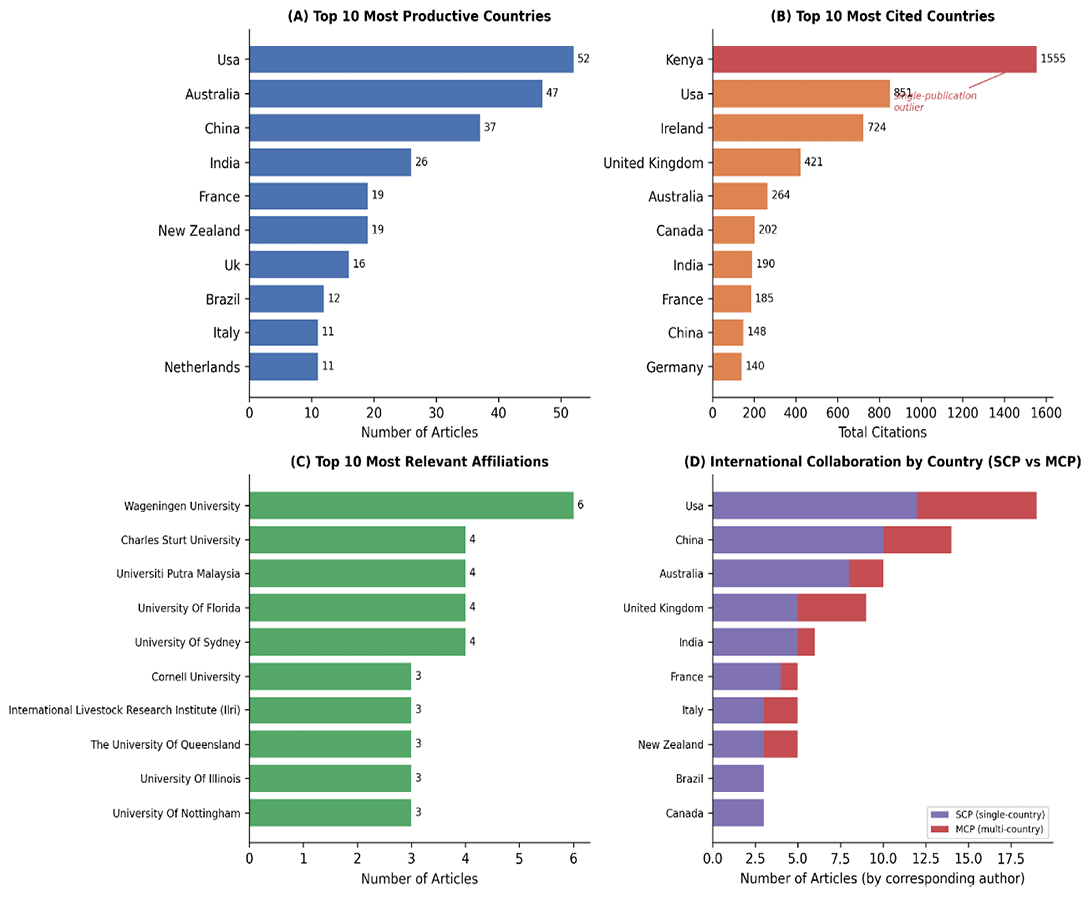
Leading countries, institutions, and collaboration structure in smallholder beef cattle productivity research (1985–2025). (A) Top 10 most productive countries by number of articles. (B) Top 10 most cited countries by total citations (TC); the Kenya bar (marked) reflects a single highly cited publication rather than sustained national output. (C) Top 10 most relevant affiliations by number of articles. (D) Single-country (SCP) versus multiple-country (MCP) collaboration by corresponding-author country, among the ten most prolific countries. Source: Scopus data processed with Bibliometrix (R) performance analysis.
At the same time, the existence of several strongly connected internal clusters demonstrates that specialized research communities have successfully formed around particular thematic areas, including genetics, climate adaptation, livestock management, and sustainability assessment. These clusters provide important foundations for future interdisciplinary integration. However, the relatively low density of cross-cluster connectivity indicates that the field has not yet fully transitioned toward a globally integrated systems-oriented research structure.
Taken together, the collaboration network suggests that future scientific progress in smallholder beef cattle productivity research will depend increasingly on the development of cross-regional and interdisciplinary research consortia capable of integrating biological, socio-economic, environmental, and technological perspectives within unified analytical frameworks. Strengthening such integrative collaboration structures may become essential for accelerating the translation of localized scientific innovations into scalable productivity and sustainability solutions across diverse smallholder production systems ; .
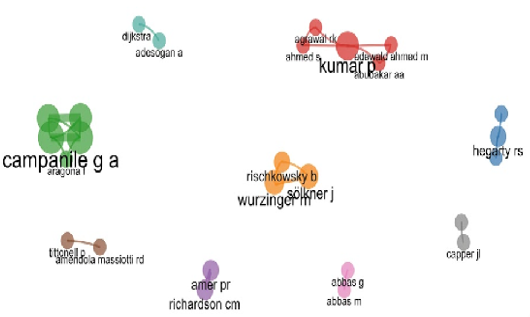
Collaboration network.
Keyword prominence and conceptual emphasis
The distribution of high-frequency keywords provides insight into the dominant conceptual priorities shaping the intellectual structure of smallholder beef cattle productivity research. As illustrated in Figure 5, the field continues to be strongly anchored in traditional livestock science themes, particularly those associated with biological performance and production management. Frequently occurring keywords such as animals, cattle, animal husbandry, livestock farming, reproduction, genetics, and animal feed reaffirm the long-standing emphasis on reproductive efficiency, nutritional management, breeding strategies, and physiological performance as central determinants of productivity outcomes.
These dominant themes are closely aligned with extensive empirical work examining reproductive benchmarking ; , feeding strategies ; , breeding improvement , and feed resource integration within agroforestry and mixed-farming systems ; . The continued prominence of these keywords indicates that productivity enhancement within smallholder cattle systems remains fundamentally dependent on improving biological and managerial efficiency under resource-constrained production environments.
However, the keyword structure simultaneously reveals a clear conceptual broadening of the field beyond conventional production-oriented paradigms. Terms associated with climate change, environmental impact, welfare, sustainability, resilience, and resource efficiency have become increasingly visible within the broader keyword landscape, indicating a substantial shift toward more holistic interpretations of livestock productivity. Rather than conceptualizing productivity solely as output maximization, contemporary research increasingly frames productivity within larger ecological, ethical, and socio-environmental systems, including resource recycling, alternative feed utilization, and circular livestock production approaches .
This thematic transition reflects broader transformations occurring within global livestock science, where increasing attention is being directed toward greenhouse gas mitigation, climate adaptation, agroecological integration, welfare-sensitive production systems, and environmental-economic trade-offs ; ; ; . The coexistence of conventional productivity keywords alongside sustainability-oriented terminology suggests that the field is undergoing a process of conceptual hybridization in which biological efficiency is progressively integrated with broader sustainability and resilience objectives.
Importantly, this intellectual expansion does not imply the displacement of traditional livestock science foundations. Instead, emerging sustainability themes appear to build upon and extend established biological and managerial research traditions. Productivity research is therefore increasingly positioned at the intersection of animal science, environmental management, climate policy, rural development, and technological innovation. The evolving keyword structure consequently reflects the emergence of a more systems-oriented understanding of smallholder cattle productivity, providing a conceptual bridge toward examining the structural relationships between these themes within the broader co-occurrence network. From an applied animal-science perspective, this conceptual bridging is significant because it suggests that interventions capable of simultaneously improving reproductive and nutritional performance while reducing environmental burden, such as precision feeding, genetics-by-environment matching, and climate-adapted reproductive management, are likely to generate the greatest gains for smallholder productivity and animal health outcomes.
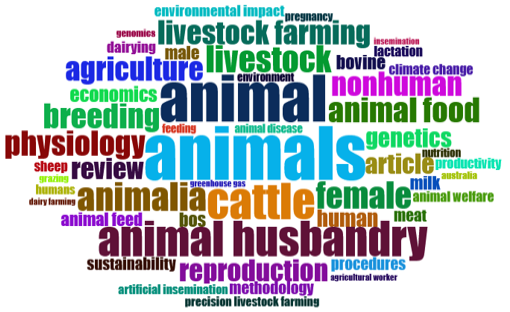
High-frequency keyword structure in smallholder beef cattle productivity research
Co-occurrence network and knowledge structure
The co-occurrence network provides a more detailed representation of the structural relationships linking dominant and emerging themes within the smallholder beef cattle productivity literature. As shown in Figure 6, the network is organized around three major thematic clusters that collectively define the conceptual architecture of the field.
The first cluster is strongly oriented toward biological and production-performance dimensions, emphasizing reproduction, physiology, genetics, and female cattle management. This cluster reflects the historical core of livestock productivity research, where improving reproductive efficiency, growth performance, and genetic quality remain central objectives. Studies within this thematic domain continue to provide the biological foundation upon which broader productivity interventions are developed .
The second cluster represents a more socio-ecological orientation, integrating themes related to livestock management, environmental interaction, breeding systems, and human dimensions of cattle production. The emergence of this cluster suggests increasing recognition that productivity outcomes are shaped not only by animal-level factors, but also by broader institutional, ecological, and socio-economic conditions. Research within this domain frequently examines the interaction between management systems, environmental constraints, animal health challenges, farmer behavior, and rural livelihood structures, particularly within tropical smallholder production systems ; .
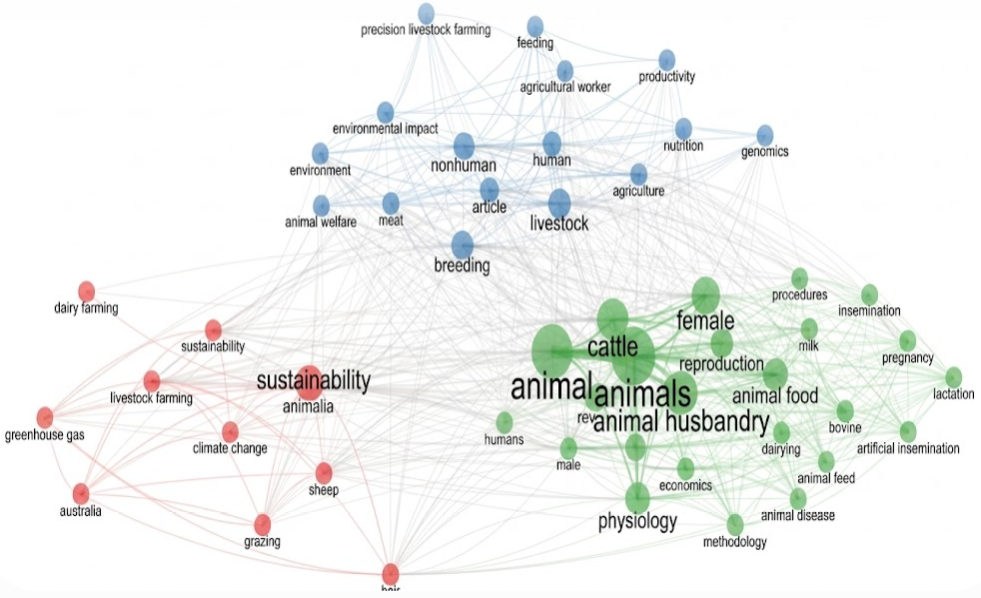
Keyword co-occurrence network and thematic structure of smallholder beef cattle productivity research.
The third cluster is more explicitly sustainability-oriented and centers around climate change, agricultural systems, dairy farming interactions, and environmental resilience. The growing visibility of this cluster indicates that sustainability considerations are progressively becoming embedded within mainstream livestock productivity discourse rather than remaining peripheral research concerns. This transition closely mirrors broader international debates surrounding climate-smart agriculture, sustainable intensification, and low-emission livestock systems .
Importantly, the network structure does not merely reveal thematic separation but also highlights increasing interaction between previously disconnected research domains. Keywords associated with reproduction and genetics increasingly intersect with climate adaptation and environmental resilience themes, reflecting growing evidence that reproductive performance is highly sensitive to climatic stress and ecological instability . Similarly, conventional livestock management themes now demonstrate stronger conceptual linkages with sustainability-oriented topics, illustrating the incorporation of resilience, land-use efficiency, and mitigation considerations into traditional productivity research frameworks ; .
These structural intersections suggest that the field is gradually transitioning from fragmented disciplinary silos toward a more integrated systems-oriented knowledge structure. This pattern is consistent with wider bibliometric trends observed across agricultural and livestock sciences, where sustainability transitions and digital innovations increasingly reshape established research paradigms ; .
The co-occurrence network therefore reflects more than thematic diversity alone. Rather, it illustrates an ongoing process of intellectual integration in which biological, ecological, socio-economic, and technological dimensions are becoming increasingly interconnected. This structural convergence provides an important conceptual foundation for understanding thematic maturity, knowledge evolution, and the emergence of future research frontiers within smallholder beef cattle productivity studies.
Thematic mapping and field evolution
The thematic map presented in Figure 7 provides a strategic overview of how different research themes vary in terms of maturity, centrality, and developmental significance within the broader scientific landscape. The positioning of themes across the four quadrants reveals the evolving balance between established biological traditions and rapidly emerging sustainability- and technology-oriented research trajectories.
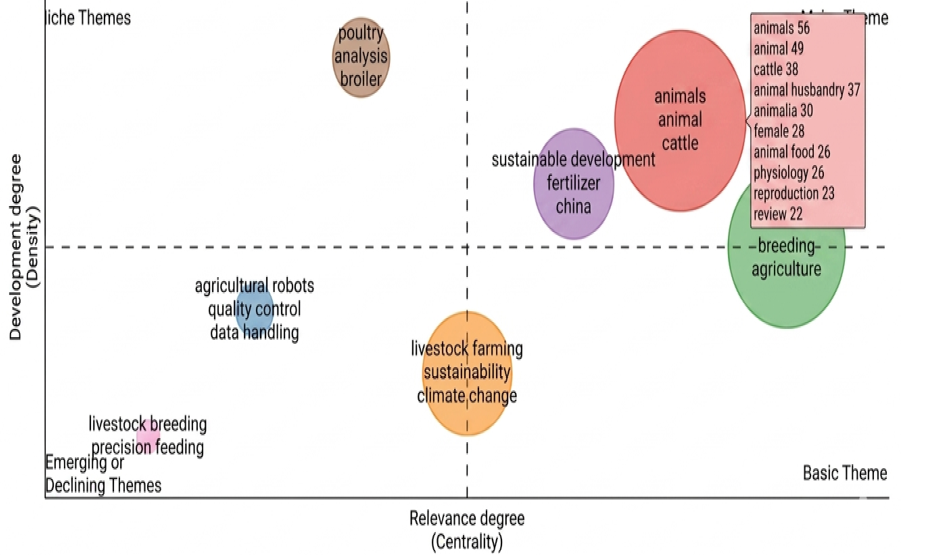
Thematic map.
Motor themes such as livestock farming, breeding, and sustainability occupy the high-centrality quadrant, indicating that these themes function as major drivers of contemporary scientific development while maintaining strong connectivity with broader research directions. Their prominent position reflects the increasing strategic importance of sustainable intensification, climate adaptation, and productivity enhancement within smallholder livestock systems. Studies conducted across Indonesia and other low-resource agricultural environments similarly demonstrate how breeding improvement, environmental management, and sustainability-oriented production strategies have become central components of contemporary livestock development agendas ; ; .
Basic themes such as physiology, reproduction, and animal husbandry remain highly developed and internally cohesive, although their relative centrality is somewhat lower. This positioning suggests that these themes continue to function as foundational methodological and conceptual pillars of the field even as research priorities diversify toward more complex systems-oriented approaches. Their continued importance highlights the enduring relevance of biological performance research within broader sustainability transitions.
In contrast, niche themes located within the high-density but low-centrality quadrant represent more specialized research areas that enrich the overall intellectual diversity of the field without substantially shaping dominant conceptual trajectories. These specialized topics contribute important contextual and technical insights but remain comparatively isolated from the broader thematic core.
Particularly noteworthy is the emergence of themes associated with precision feeding, digital monitoring, robotics, data handling, and technology-assisted livestock management within the low-density and low-centrality quadrant. Although these themes remain relatively underdeveloped at present, their appearance signals the early formation of a potentially transformative research frontier. Their emergence corresponds closely with global developments in precision agriculture and digital livestock systems, where sensor technologies, automated monitoring, artificial intelligence, and data-driven decision support systems are increasingly integrated into livestock management frameworks .
The thematic structure suggests an ongoing transition characterized by the coexistence of mature biological research traditions and rapidly expanding sustainability- and technology-oriented paradigms. Rather than replacing conventional productivity research, these emerging themes appear to extend and reconfigure existing scientific priorities within broader socio-technical and environmental frameworks.
Overall, the thematic map reveals a research domain undergoing gradual but significant intellectual transformation. The field increasingly balances traditional livestock productivity objectives with wider concerns related to climate resilience, environmental sustainability, technological innovation, and systems integration. This thematic evolution indicates that future advances in smallholder beef cattle productivity research will likely depend on the ability to integrate biological science, sustainability transitions, and digital innovation within coherent interdisciplinary research frameworks.
Conclusion
This four-decade bibliometric analysis (1985–2025) of smallholder beef cattle productivity research provides a systematic mapping of the field’s intellectual evolution, collaboration structures, and thematic priorities. Addressing the central research question, how the global knowledge system has evolved and to what extent geographic asymmetries shape research priorities, the study yields three principal findings.
First, the literature has transitioned from narrow production-oriented paradigms (reproduction, genetics, feed efficiency) toward broader sustainability-centred frameworks integrating climate adaptation, resilience, environmental governance, and resource efficiency. Second, global collaboration networks remain structurally fragmented, with scientific influence concentrated among a limited number of institutional hubs, limiting cross-regional knowledge integration. Third, the findings point to an emerging North–South divide in thematic priorities, in which publications more frequently associated with Global North institutions emphasise emission mitigation, animal welfare, and precision livestock technologies, while those linked to Global South contexts remain concentrated on feed scarcity, reproductive efficiency, and production survival under resource-constrained conditions. This pattern is inferred from the keyword-prominence and collaboration-network results reported above (see Collaboration Network Structure and Keyword Prominence sections) and should be interpreted as indicative of associations within the literature rather than as a fully quantified country-by-theme statistical comparison.
Taken together, these three findings should be interpreted as evidence of dynamics within the scientific literature and evolving knowledge structures, rather than as direct empirical assessments of on-farm productivity, animal health, or economic performance within smallholder beef cattle production systems themselves.
Novelty and theoretical contribution
This study offers one of the first bibliometric mappings that explicitly integrates sustainability transition perspectives, knowledge inequality frameworks, and systems-oriented livestock innovation theory within smallholder beef cattle research. Theoretically, it advances livestock systems scholarship by demonstrating that productivity research is not merely a technical domain but a site of uneven epistemic development, where fragmentation and unequal priority-setting constrain cumulative knowledge building. The identification of three major thematic clusters biological performance, socio-ecological management, and climate resilience provides a new conceptual model for understanding how sustainability transitions unfold unevenly across geographic and institutional contexts.
Practical contribution
Practically, the study provides researchers and funding agencies with an evidence-based roadmap of thematic maturity, emerging frontiers (precision feeding, digital monitoring, robotics), and declining themes. It identifies dominant research hubs and peripheral actors, enabling more targeted capacity-building interventions and collaborative programme design. The keyword co-occurrence and thematic maps serve as decision-support tools for aligning research agendas with locally relevant productivity constraints.
Policy implications
Policymakers should recognise that unequal knowledge production undermines global food security and climate adaptation goals. To reduce fragmentation, international development agencies and national governments must invest in South–South and North–South–South interdisciplinary consortia that integrate biological, environmental, and socio-economic expertise. Policy instruments should prioritise open-access knowledge platforms, cross-regional benchmarking systems, and funding mechanisms that explicitly reward transdisciplinary, context-responsive research. Without deliberate structural interventions, the persistent divide in research priorities will continue to limit scalable, inclusive productivity solutions for smallholder beef cattle systems in the Global South.
Ultimately, the future of smallholder beef cattle productivity depends not only on technological innovation but also on the capacity of global knowledge systems to support more integrated, equitable, and sustainability-oriented research pathways for rural development.
Acknowledgements
The authors gratefully acknowledge Brawijaya University for institutional support of this investigation. The authors also thank the anonymous reviewers for their constructive comments, which improved the manuscript.
Novelty Statement
Previous reviews of beef cattle productivity have largely examined isolated technical domains, such as feeding, breeding, and reproductive management, leaving the intellectual structure and geographic distribution of this knowledge base unmapped. This study presents one of the first bibliometric analyses of smallholder beef cattle productivity research, covering 153 Scopus-indexed publications from 1985 to 2025. By integrating performance analysis, science mapping, collaboration network analysis, and thematic evolution assessment within a sustainability-transition and knowledge-inequality framework, it shows that the field has shifted from production-oriented paradigms toward climate adaptation, resilience, and resource efficiency. It also shows that collaboration remains fragmented around a limited number of hubs, and that thematic priorities appear to diverge between Global North and Global South contexts. These findings provide an evidence-based foundation for building more integrated and equitable livestock innovation systems.
Authors’ Contribution
AEK: Conceptualization, data curation, methodology, visualization, formal analysis, writing original draft. HDU: Data curation, validation, supervision, writing review and editing. HR: Data curation, funding acquisition, supervision, writing review and editing. M: Data curation, supervision, writing review and editing.
Ethical approval
Not applicable. This study involved bibliometric analysis of publicly available bibliographic data from the Scopus database and did not involve human subjects, animal experimentation, or collection of primary data requiring ethical review.
Generative AI and AI-assisted technologies statement
The authors declare that generative artificial intelligence (AI) tools, specifically ChatGPT (OpenAI) and Grammarly, were used in a limited capacity to improve grammatical accuracy, linguistic clarity, and manuscript quality. In addition, VOSviewer, a bibliometric network analysis and visualization software rather than a generative AI tool, was used for network mapping and clustering analysis, as described in the Methods section. All data analysis, scientific reasoning, interpretations, and final revisions were conducted and fully verified by the authors, who take full responsibility for the integrity and accuracy of the manuscript’s content.
Conflict of interest
The authors have declared no conflict of interest.
References
- Abdollahi A, Ghaderi Z, Béal L, Cooper C (2023). The intersection between knowledge management and organizational learning in tourism and hospitality: A bibliometric analysis. J. Hospital. Tourism Manage., 11–28. https://doi.org/10.1016/j.jhtm.2023.02.014 [CrossRef]
- Abdul S, Gul Z, Xu M (2025). Tracing the contribution of cattle farms to methane emissions through bibliometric analyses. J. Integr. Agric., 24(4): 1220–1233. https://doi.org/10.1016/j.jia.2024.05.003 [CrossRef]
- Achmad B, Sanudin B, Siarudin M, Widiyanto A, Diniyati D, Sudomo A, Hani A, Fauziyah E, Suhaendah E, Widyaningsih TS, Handayani W, Maharani D, Suhartono D, Palmolina M, Swestiani D, Budi SSH, Winara A, Nur YH, Diana M, Ruswandi A (2022). Traditional subsistence farming of smallholder agroforestry systems in Indonesia: A review. Sustainability, 14(14). https://doi.org/10.3390/su14148631 [CrossRef]
- Aguinis H, Ramani RS, Alabduljader N (2018). What you see is what you get? Enhancing methodological transparency in management research. Acad. Manage. Ann., 12(1): 83–110. https://doi.org/10.5465/annals.2016.0011 [CrossRef]
- Allan G, Comerford D, Connolly K, McGregor PG (2025). Improvements in beef cattle productivity can increase economy-wide activity and simultaneously reduce greenhouse gas emissions in Scotland. Environ. Dev. Sustain., (0123456789). https://doi.org/10.1007/s10668-024-05871-0 [CrossRef]
- Aria M, Cuccurullo C (2017). bibliometrix: An R-tool for comprehensive science mapping analysis. J. Informetrics, 11(4): 959–975. https://doi.org/10.1016/j.joi.2017.08.007 [CrossRef]
- Asikin Z, Baker D, Villano R, Daryanto A (2020). Business models and innovation in the Indonesian smallholder beef value chain. Sustainability (Switzerland): 12(17): 1–13. https://doi.org/10.3390/su12177020 [CrossRef]
- Belur J, Tompson L, Thornton A, Simon M (2021). Interrater reliability in systematic review methodology: Exploring variation in coder decision-making. Sociol. Methods Res., 50(2): 837–865. https://doi.org/10.1177/0049124118799372 [CrossRef]
- Burrow HM (2022). Overcoming major environmental and production challenges in cattle owned by smallholder farmers in the tropics. Caraka Tani: J. Sustain. Agric., 37(1): 161–170. https://doi.org/10.20961/carakatani.v37i1.56566 [CrossRef]
- Chen C, Song M (2019). Visualizing a field of research: A methodology of systematic scientometric reviews. PLoS One, 14(10). https://doi.org/10.1371/journal.pone.0223994 [CrossRef]
- Collyer FM (2018). Global patterns in the publishing of academic knowledge: Global North, global South. Curr. Sociol., 66(1): 56–73. https://doi.org/10.1177/0011392116680020 [CrossRef]
- Çelik Ş (2024). Bibliometric analysis of genomic selection in breeding of animal from 1993 to 2024: Global trends and advancements. Front. Genet., 15(October): 1–17. https://doi.org/10.3389/fgene.2024.1402140 [CrossRef]
- Dahlanuddin, Henderson B, Dizyee K, Hermansyah, Ash A (2017). Assessing the sustainable development and intensification potential of beef cattle production in Sumbawa, Indonesia, using a system dynamics approach. PLoS One, 12(8): 1–18. https://doi.org/10.1371/journal.pone.0183365 [CrossRef]
- Diskin MG, Kenny DA (2016). Managing the reproductive performance of beef cows. Theriogenology, 86(1): 379–387. https://doi.org/10.1016/j.theriogenology.2016.04.052 [CrossRef]
- Donthu N, Kumar S, Mukherjee D, Pandey N, Lim WM (2021). How to conduct a bibliometric analysis: An overview and guidelines. J. Bus. Res., 133(April): 285–296. https://doi.org/10.1016/j.jbusres.2021.04.070 [CrossRef]
- Duffy C, Toth GG, Hagan RPO, McKeown PC, Rahman SA, Widyaningsih Y, Sunderland TCH, Spillane C (2021). Agroforestry contributions to smallholder farmer food security in Indonesia. Agrofor. Syst., 95(6): 1109–1124. https://doi.org/10.1007/s10457-021-00632-8 [CrossRef]
- El-Bilali H (2019). Research on agro-food sustainability transitions: A systematic review of research themes and an analysis of research gaps. J. Cleaner Prod., 221: 353–364. https://doi.org/10.1016/j.jclepro.2019.02.232 [CrossRef]
- Ellegaard O, Wallin JA (2015). The bibliometric analysis of scholarly production: How great is the impact? Scientometrics, 105(3): 1809–1831. https://doi.org/10.1007/s11192-015-1645-z [CrossRef]
- Escarcha JF, Lassa JA, Zander KK (2018). Livestock under climate change: A systematic review of impacts and adaptation. Climate, 6(3): 1–17. https://doi.org/10.3390/cli6030054 [CrossRef]
- Gazzarin C, Jan P (2024). Sustainable intensification of grass-based beef production systems in alpine regions: How to increase economic efficiency while preserving biodiversity? Agric. Syst., 214(December 2023): 103837. https://doi.org/10.1016/j.agsy.2023.103837 [CrossRef]
- Gerber PJ, Mottet A, Opio CI, Falcucci A, Teillard F (2015). Environmental impacts of beef production: Review of challenges and perspectives for durability. Meat Sci., 109: 2–12. https://doi.org/10.1016/j.meatsci.2015.05.013 [CrossRef]
- Giller KE, Delaune T, Silva JV, Descheemaeker K, van de Ven G, Schut AGT, van Wijk M, Hammond J, Hochman Z, Taulya G, Chikowo R, Narayanan S, Kishore A, Bresciani F, Teixeira HM, Andersson JA, van Ittersum MK (2021). The future of farming: Who will produce our food? Food Secur., 13(5): 1073–1099. https://doi.org/10.1007/s12571-021-01184-6 [CrossRef]
- Greenwood PL (2021). Review: An overview of beef production from pasture and feedlot globally, as demand for beef and the need for sustainable practices increase. Animal, 15: 100295. https://doi.org/10.1016/j.animal.2021.100295 [CrossRef]
- Hassan W, Duarte AE (2024). Bibliometric analysis: A few suggestions. Curr. Problems Cardiol., 49(8): 102640. https://doi.org/10.1016/j.cpcardiol.2024.102640 [CrossRef]
- Herrero M, Thornton PK, Power B, Bogard JR, Remans R, Fritz S, Gerber JS, Nelson G, See L, Waha K, Watson RA, West PC, Samberg LH, van de Steeg J, Stephenson E, van Wijk M, Havlík P (2017). Farming and the geography of nutrient production for human use: a transdisciplinary analysis. Lancet Planet. Health, 1(1): e33–e42. https://doi.org/10.1016/S2542-5196(17)30007-4 [CrossRef]
- Hoang AD (2025). Evaluating bibliometrics reviews: A practical guide for peer review and critical reading. Evaluat. Rev., 49(6): 1074–1102. https://doi.org/10.1177/0193841X251336839 [CrossRef]
- Idamokoro EM (2023). The relevance of livestock husbandry in the context of food security: A bibliometric outlook of research studies from 1938 to 2020. Front. Sustain. Food Syst., 7(June). https://doi.org/10.3389/fsufs.2023.1204221 [CrossRef]
- Jiang B, Tang W, Cui L, Deng X (2023). Precision livestock farming research: A global scientometric review. Animals, 13(13): 1–29. https://doi.org/10.3390/ani13132096 [CrossRef]
- Jobirov F, Yuejie Z, Kibona CA (2022). Evaluating profitability of beef cattle farming and its determinants among smallholder beef cattle farmers in the Baljovan District of Khatlon region, Tajikistan. PLoS One, 17(9 September): 1–16. https://doi.org/10.1371/journal.pone.0274391 [CrossRef]
- Klarin A (2024). How to conduct a bibliometric content analysis: Guidelines and contributions of content co-occurrence or co-word literature reviews. Int. J. Consumer Stud., 48(2): 1–20. https://doi.org/10.1111/ijcs.13031 [CrossRef]
- Klerkx L, Begemann S (2020). Since January 2020 Elsevier has created a COVID-19 resource centre with free information in English and Mandarin on the novel coronavirus COVID- 19 . The COVID-19 resource centre is hosted on Elsevier Connect, the company’s public news and information (January).
- Kraus S, Breier M, Lim WM, Dabić M, Kumar S, Kanbach D, Mukherjee D, Corvello V, Piñeiro-Chousa J, Liguori E, Palacios-Marqués D, Schiavone F, Ferraris A, Fernandes C, Ferreira JJ (2022). Literature reviews as independent studies: guidelines for academic practice. Rev. Manage. Sci., 16(8): 2577–2595. https://doi.org/10.1353/ail.2022.0023 [CrossRef]
- Li M, Gao Q, Yu T (2023). Kappa statistic considerations in evaluating inter-rater reliability between two raters: which, when and context matters. BMC Cancer, 23(1): 1–5. https://doi.org/10.1186/s12885-023-11325-z [CrossRef]
- Mapiye O, Makombe G, Mapiye C, Dzama K (2018). Limitations and prospects of improving beef cattle production in the smallholder sector: A case of Limpopo Province, South Africa. Trop. Anim. Health Prod., 50(7): 1711–1725. https://doi.org/10.1007/s11250-018-1632-5 [CrossRef]
- Mayberry D, Hau DK, Dida PR, Bria D, Praing J, Mata AD, Budisantoso E, Dalgliesh N, Quigley S, Bell L, Nulik J (2021). Herbaceous legumes provide several options for increasing beef cattle productivity in eastern Indonesia. Anim. Prod. Sci., 61(7): 698–707. https://doi.org/10.1071/AN20545 [CrossRef]
- McKeown S, Mir ZM (2021). Considerations for conducting systematic reviews: Evaluating the performance of different methods for de-duplicating references. Syst. Rev., 10(1): 4–11. https://doi.org/10.1186/s13643-021-01583-y [CrossRef]
- Mongeon P, Paul-Hus A (2016). The journal coverage of web of science and scopus: A comparative analysis. Scientometrics, 106(1): 213–228. https://doi.org/10.1007/s11192-015-1765-5 [CrossRef]
- Moral-Muñoz JA, Herrera-Viedma E, Santisteban-Espejo A, Cobo MJ (2020). Software tools for conducting bibliometric analysis in science: An up-to-date review. Prof. Inf., 29(1): 1–20. https://doi.org/10.3145/epi.2020.ene.03 [CrossRef]
- Mottet A, de Haan C, Falcucci A, Tempio G, Opio C, Gerber P (2017). Livestock: On our plates or eating at our table? A new analysis of the feed/food debate. Glob. Food Secur., 14(January 2016): 1–8. https://doi.org/10.1016/j.gfs.2017.01.001 [CrossRef]
- Mugumaarhahama Y, Ayagirwe RBB, Mutwedu VB, Cirezi NC, Wasso DS, Azine PC, Karume K (2021). Characterization of smallholder cattle production systems in South-Kivu province, eastern Democratic Republic of Congo. Pastoralism, 11(1). https://doi.org/10.1186/s13570-020-00187-w [CrossRef]
- Mukherjee D, Lim WM, Kumar S, Donthu N (2022). Guidelines for advancing theory and practice through bibliometric research. J. Bus. Res., 148(May): 101–115. https://doi.org/10.1016/j.jbusres.2022.04.042 [CrossRef]
- Muwakhid B, Ali U, Rifa’i R, Nugraha P (2025). Utilization of industrial waste (fish meal oil sludge and cassava dregs) as an alternative to commercial broiler feed. J. Anim. Health Prod., 13(3). https://doi.org/10.17582/journal.jahp/2025/13.3.682.687 [CrossRef]
- Nkadimeng M, Van Marle-Köster E, Nengovhela NB, Ramukhithi FV, Mphaphathi ML, Rust JM, Makgahlela ML (2022). Assessing reproductive performance to establish benchmarks for small-holder beef cattle herds in South Africa. Animals, 12(21). https://doi.org/10.3390/ani12213003 [CrossRef]
- Nkadimeng M, Van Marle-Köster E, Nengovhela NB, Ramukhithi FV, Mphaphathi ML, Rust JM, Makgahlela ML (2024). Risk factors underlining reproductive performance in smallholder beef cattle herds of South Africa. Trop. Anim. Health Prod., 56(8): 1–12. https://doi.org/10.1007/s11250-024-04181-x [CrossRef]
- Nowakowska M (2025). A comprehensive approach to preprocessing data for bibliometric analysis. In Scientometrics (Vol. 130, Number 9). Springer International Publishing. https://doi.org/10.1007/s11192-025-05415-x [CrossRef]
- Page MJ, McKenzie JE, Bossuyt PM, Boutron I, Hoffmann TC, Mulrow CD, Shamseer L Tetzlaff, JM, Akl EA, Brennan SE, Chou R, Glanville J, Grimshaw JM, Hróbjartsson A, Lalu MM, Li T, Loder EW, Mayo-Wilson E, McDonald S, Moher D (2021). The PRISMA 2020 statement: An updated guideline for reporting systematic reviews. Br. Med. J., 372. https://doi.org/10.1016/j.jclinepi.2021.03.001 [CrossRef]
- Panbamrungkij T, Inchaisri C, Phan-iam S, Dhanarun K, Swangchan-Uthai T (2024). Factors influencing productivity and sustainability of small-scale beef farms in Thailand. ABAC J., 44(1): 69–89. https://doi.org/10.59865/abacj.2024.4 [CrossRef]
- Pigford AAE, Hickey GM, Klerkx L (2018). Beyond agricultural innovation systems? Exploring an agricultural innovation ecosystems approach for niche design and development in sustainability transitions. Agric. Syst., 164(April): 116–121. https://doi.org/10.1016/j.agsy.2018.04.007 [CrossRef]
- Radhakrishnan S, Erbis S, Isaacs JA, Kamarthi S (2017). Correction: Novel keyword co-occurrence network-based methods to foster systematic reviews of scientific literature. PLoS One, 129(3): e0172778; PLoS One, 12(9): 1–16. https://doi.org/10.1371/journal.pone.0172778 [CrossRef]
- Rangel J, Perea J, De-Pablos-heredero C, Espinosa-García JA, Mujica PT, Feijoo M, Barba C, García A (2020). Structural and technological characterization of tropical smallholder farms of dual-purpose cattle in mexico. Animals, 10(1): 1–13. https://doi.org/10.3390/ani10010086 [CrossRef]
- Rejekiningrum P, Apriyana Y, Sutardi, Estiningtyas W, Sosiawan H, Susilawati HL, Hervani A, Alifia AD (2022). Optimising water management in drylands to increase crop productivity and anticipate climate change in Indonesia. Sustainability (Switzerland), 14(18). https://doi.org/10.3390/su141811672 [CrossRef]
- Rifa’i, Radiati LE, Hawa LC, Surjowardojo P (2024). Prevalence of subclinical mastitis in Holstein-Friesian cow dairy among small-scale farms in Batu, Indonesia. Int. J. Vet. Sci., 13(5): 592-595. [CrossRef]
- Rojas-Downing MM, Nejadhashemi AP, Harrigan T, Woznicki SA (2017). Climate change and livestock: Impacts, adaptation, and mitigation. Clim. Risk Manage., 16: 145–163. https://doi.org/10.1016/j.crm.2017.02.001 [CrossRef]
- Rotz S, Gravely E, Mosby I, Duncan E, Finnis,E, Horgan M, LeBlanc J, Martin R, Neufeld HT, Nixon A, Pant L, Shalla V, Fraser E (2019). Automated pastures and the digital divide: How agricultural technologies are shaping labour and rural communities. J. Rural Stud., 68(February): 112–122. https://doi.org/10.1016/j.jrurstud.2019.01.023 [CrossRef]
- Saputra FT, Surjowardojo P, Muchlas M, Ridhowi A, Rifa’i R (2025). Improving Dairy Production in Indonesia: Comparative Lessons from India and the United States. BIO Web Conf., 191: 14. https://doi.org/10.1051/bioconf/202519100014 [CrossRef]
- Sikiru AB, Makinde OJ, Koura BI, Acheneje SSE, Alabi JO, Shipandeni MNT, Akinsola OM (2024). Bibliometric mapping of academic research focusing on animal production and climate change in association with methane emissions and animal productivity. Ruminants, 4(1): 152–164. https://doi.org/10.3390/ruminants4010010 [CrossRef]
- Singh VK, Singh P, Karmakar M, Leta J, Mayr P (2021). The journal coverage of web of science, scopus and dimensions: A comparative analysis. Scientometrics, 126(6): 5113–5142. https://doi.org/10.1007/s11192-021-03948-5 [CrossRef]
- Smith OM, Jocson DMI, Lee BW, Orpet RJ, Taylor JM, Davis AG, Rieser CJ, Clarke AE, Cohen, AL, Hayes AM, Auth CA, Bergeron PE, Marshall AT, Reganold JP, Crowder DW, Northfield TD (2022). Identifying farming strategies associated with achieving global agricultural sustainability. Front. Sustain. Food Syst., 6(July). https://doi.org/10.3389/fsufs.2022.882503 [CrossRef]
- Snyder H (2019). Literature review as a research methodology: An overview and guidelines. J. Bus. Res., 104(August): 333–339. https://doi.org/10.1016/j.jbusres.2019.07.039 [CrossRef]
- Surjowardojo P, Susilorini TE, Ndaru PH, Rifa’i R (2025). Traditional milking hygiene practices and their effect on subclinical mastitis in holstein-friesian of small-scale farms. Adv. Anim. Vet. Sci., 13(5). https://doi.org/10.17582/journal.aavs/2025/13.5.1036.1044 [CrossRef]
- Susanti AE, Priyanto R, Muladno, Astuti DA, Cyrilla L (2023). Application of system dynamics modelling in evaluating sustainability of beef cattle production and business system in smallholder farmers in South Sumatera, Indonesia. Adv. Anim. Vet. Sci., 11(2): 236–246. https://doi.org/10.17582/journal.aavs/2023/11.2.236.245 [CrossRef]
- van Eck NJ, Waltman L (2017). Citation-based clustering of publications using CitNetExplorer and VOSviewer. Scientometrics, 111(2): 1053–1070. https://doi.org/10.1007/s11192-017-2300-7 [CrossRef]
- Vanvanhossou SFU, Yin T, Gorjanc G, König,S (2025). Evaluation of crossbreeding strategies for improved adaptation and productivity in African smallholder cattle farms. Genet. Select. Evol., 57(1): 1–19. https://doi.org/10.1186/s12711-025-00952-8 [CrossRef]
- Walter A, Finger R, Huber R, Buchmann N (2017). Smart farming is key to developing sustainable agriculture. Proc. Natl. Acad. Sci. USA, 114(24): 6148–6150. https://doi.org/10.1073/pnas.1707462114 [CrossRef]
- Weng M-H, Wu S, Dyer M (2022). Identification and visualization of key topics in scientific publications with transformer-based language models and document clustering methods. Appl. Sci., 12: 1–21. https://doi.org/10.3390/app122111220 [CrossRef]
- Widyas N, Widi TSM, Prastowo S, Sumantri I, Hayes BJ, Burrow HM (2022). Promoting sustainable utilization and genetic improvement of Indonesian local beef cattle breeds: A review. Agriculture, 12(10): [CrossRef]
- Xu J, Cui Y, Zhang S, Zhang M (2024). The evolution of precision agriculture and food safety: A bibliometric study. Front. Sustain. Food Syst., 8: 1–26. https://doi.org/10.1007/s11119-023-10080-2 [CrossRef]
- Zhu X, Zheng J, An Y, Xin X, Xu D, Yan R, Xu L, Shen B, Hou L (2023). Grassland ecosystem progress: A review and bibliometric analysis based on research publication over the last three decades. Agronomy, 13(3). https://doi.org/10.3390/agronomy13030614 [CrossRef]

Services
Article usage statistics
Loading…
Related articles
- Application of System Dynamics Modelling in Evaluating Sustainability of Beef Cattle Production and Business System in Smallholder Farmers in South Sumatera, IndonesiaAdvances in Animal and Veterinary Sciences · 2023
- Sustainability Analysis of Beef Cattle Farming with a Revolving System in Gilireng District, Wajo Regency, IndonesiaAdvances in Animal and Veterinary Sciences · 2025
- Integrated Community-Based Agribusiness Models for Transforming Smallholder Cattle Farming: A Multi-Dimensional Sustainability PerspectiveAdvances in Animal and Veterinary Sciences · 2026
- Smallholder Beef Cattle Rearing System and Entreprises in West Sumatra, IndonesiaAdvances in Animal and Veterinary Sciences · 2023
- Beef Cattle Smallholder with Partnership System in Indonesia: A Study of Attitude and Motivation of StakeholdersAdvances in Animal and Veterinary Sciences · 2025
- Sustainable Improvement of Reproductive Efficiency in Smallholder Cattle and Swine SystemsAdvances in Animal and Veterinary Sciences · 2026